Chapter I · BANDAGING.
Reading edition
General Rules.—Ordinary bandages are strips of unbleached calico 6 or 8 yards long, having a breadth of ¾ inch for the fingers and toes, 2¼ inches for the head and upper limb, 3 inches for the lower limb, and 6 inches for the body. These, when tightly rolled for use, are termed rollers. Besides these rollers for general use there are special bandages, such as rollers of muslin for using with plaster of paris, of stocking-webbing when elasticity is needed; four- and many-tailed bandages for particular fractures, &c. Messrs. J. & J. Cash, the cambric frilling makers of Coventry, now make a very firm light bandage of unbleached cambric woven in the necessary widths and lengths for use; these are very cool and pleasant, and a decided improvement on the ordinary calico strips generally used.
Position of the Operator.—He should place himself opposite his patient, not at the side of the limb to be bandaged; the limb too should be bent to the position it will occupy when the bandage is completed.
Before applying any kind of apparatus, the surgeon should see that the limb is carefully washed and dried.
How to hold a Roller.—When applying a roller it is best to begin by placing the outer surface of the roller next the skin (see fig. 1, page 3), for it then unwinds more readily, and the first turns are more easily secured; moreover the bandage should be carried from the inner side of the limb by the front to the outer side, for the muscles are thus more firmly and pleasantly confined than by turns passing in the opposite direction; of course this observation supposes the hand and forearm to be in their usual position of semi-pronation.
Varieties of Turns.—In carrying a bandage up a limb, it is necessary, in order to support the parts evenly, to employ a combination of three different turns. The simple spiral, reverse, and the figure of 8.
The simple spiral turn is used only where the circumference of the part increases slightly, as the wrist; but when the limb enlarges too fast to allow the fresh turn to overlap the previous one regularly, the turn must be interrupted, and the bandage brought back again by reverse, or by figure of 8.
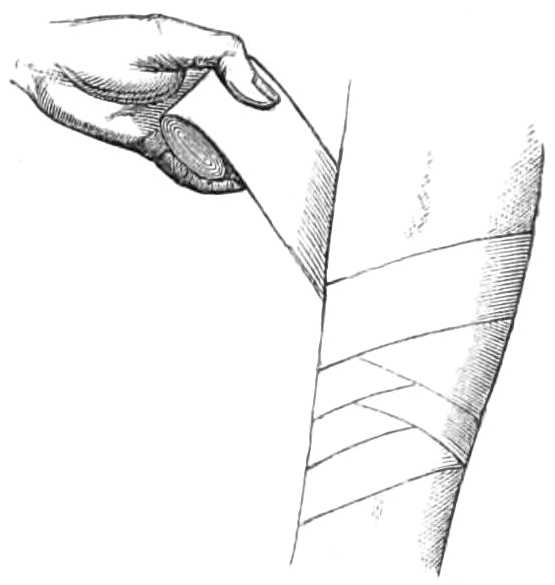
Fig. 1.—Figure of 8 turn.
To reverse the bandage, the thumb of the unoccupied hand is placed on the lower border of the bandage while the roller is turned over in the other, and then passed downwards to overlap and fix the previous turn evenly. At the moment of reversing, the bandage should be held quite slack, and not unrolled more than is necessary to make the reverse. All the reverses must be carried one above the other along the outer side of the limb, and only employed where really necessary.
Figures of 8 are made, as their name implies, by passing the roller alternately upwards and downwards as it enwraps the limb (see fig. 1). They are adopted where the enlargement is too great and irregular for reverses to sit evenly, over the ankle and elbow joint for instance.