Chapter V · MISCELLANEOUS. (continued 2)
Reading edition
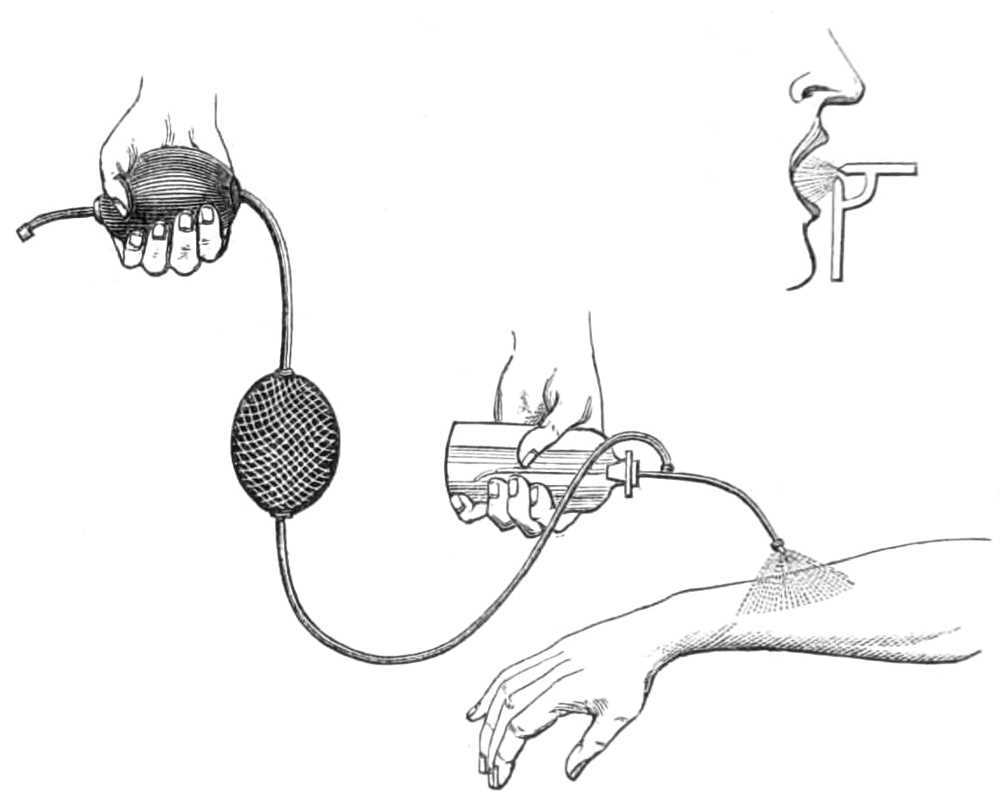
Fig. 121.—The Spray-producer.
Richardson’s Ether Spray-Producer (fig. 121) consists of a tube on which two india-rubber bags are placed; one, protected by a silk net, acts as a reservoir; the other, furnished with a valve, is the pump; these drive a constant stream of air over the tip of a fine tube projecting from a flask of ether; this sucks up the ether and throws it in fine spray on the surface to be chilled by its evaporation. The ether for this purpose must be very pure and dry, having a specific gravity of ·720, or the evaporation will not be sufficiently rapid to produce congelation. The first effect of the spray is a numbing aching pain with reddening of the surface. This is succeeded by a pricking pain. In ten seconds, if the ether be good, a dead white hue spreads rapidly over the skin, and when this appears the surface is quite insensible.
The bottle and elastic air-pump may be attached to the glass jet seen in the corner of fig. 121, which then makes an apparatus for injecting astringent solutions in spray over the nasal passages, the throat, and air-tubes; but the tubes used for watery fluids are much wider than that for pulverising ether into spray. Tannin in solution of 3-10 grains to the ounce of water, sulphate of zinc, or alum in similar quantity, may be thus inhaled with much benefit by persons suffering from chronic congestion of the mucous membranes.
Injecting Chloroform Vapour into the Uterus is a ready means of relieving pain in cancer of that organ; special apparatus is made for the purpose, but an ordinary elastic clyster syringe will answer the purpose, if the flask is unscrewed and a few drops of chloroform are poured into it, from time to time, while air is pumped through the delivery tube, which is passed up the vagina to the ulcerated cervix-uteri.
Subcutaneous Injection.—The syringe for this operation (fig. 122) consists of a graduated glass tube holding six minims. The piston works in a silver continuation of the graduated tube, and is thus kept clear of the solutions used for injection. To the nozzle of the syringe fine sharp-pointed cannulæ are screwed on; they are of different lengths, some of steel, others of steel gilt; the gilding renders the points very blunt, and consequently much more painful to insert. In filling the syringe, care should be taken not to draw the fluid above the level of the graduation on the tube, that the exact amount injected may be read off as the liquid sinks in the tube. The finer the cannula, and the sharper its point, the less pain is caused by its introduction.
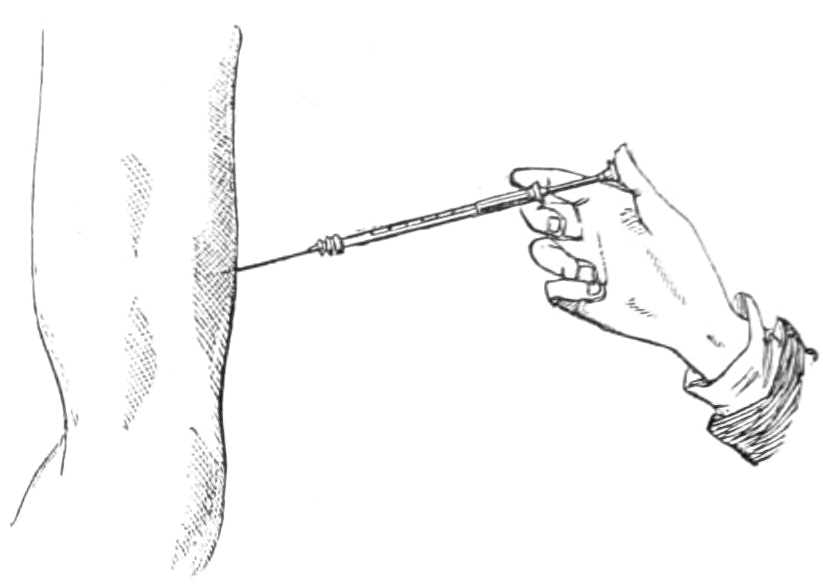
Fig. 122.—Subcutaneous Injection.
The solution of morphia should contain a grain in six drops and be as little acid as possible. In injecting morphia, it should be recollected that ⅙ grain is the usual dose to allay pain, and produce sleep; doses even far smaller often suffice for this purpose, though very much greater quantities can be administered by injection, where long use has rendered the patient tolerant of the drug. Some persons dread the puncture considerably; for them the pain may be entirely prevented by numbing the surface with ether-spray (see page 186) before inserting the syringe, though usually the prick is of so little consequence that any precaution of this kind is unnecessary.
The cannula should be thrust completely through the skin into the subcutaneous cellular tissue; if the fluid is injected into the skin itself, inflammation and suppuration of the puncture sometimes ensues. After the cannula is withdrawn, the finger should be placed for a few seconds over the puncture, or much of the fluid will leak out again. When large quantities of solution (one or two syringefuls) are injected the cannula need not always be withdrawn, the nozzle can be unscrewed and the syringe charged again; but more than ten or twelve drops injected into one place generally causes much pain, even where the cellular tissue is very loose.
The syringe and cannula should be carefully cleaned, by sending plenty of cold water through them each time they are used, or the cannula will rust and become unfit for use.
Collodion is much used in drawing the edges of small wounds together, &c. Preston’s plastic collodion, or the flexible collodion of the British Pharmacopœia, 1867, have advantages over the common form by furnishing a tougher pellicle, yielding to the movements of the skin beneath without cracking. Collodion should be kept for use in a small wide-mouthed bottle, with stopper and brush, and when employed should be laid on quickly in a thick mass, so that the crust it leaves shall be of one layer. A tougher crust is obtained if a piece of muslin is soaked in the collodion and then laid on the wound, than if the collodion is used alone.
Vaccination.—The lymph of the vaccine vesicle, taken between the seventh and tenth days, is preserved for use on lancet-shaped slips of bone 1 inch long, called points. These are dipped in the lymph as it exudes from the vesicle, and exposed to the air till dry; they are then wrapped in paper ready for use. When used, the lymph should be moistened, by holding them over a vessel of steaming water a few seconds before inserting them in the wound made to receive the lymph.
The points often lose the virus in a few days, and should, if possible, be used the same day they are charged.
The lymph may be much longer preserved if hermetically sealed in glass tubes. These are about the thickness of a darning-needle, 3 inches long, and open at both ends. When the tube is to be charged, one end is inserted in the lymph exuding from a punctured vesicle; a drop then enters the tube by capillary attraction, but filling not more than half its interior: a few shakes of the hand will send the drop a little further in. The lymph end of the tube is then taken in the thumb and forefinger, while the unoccupied part of the tube is passed once or twice quickly through the flame of a candle. This rarifies the air, and while it is warm the end is closed by melting it at the edge of the flame. The second end is then closed in the same way as the first. When the lymph is wanted for use, the ends of the tube are broken, and the lymph blown out on the point of a lancet. Lymph preserved in these tubes retains its efficacy an indefinite time. The National Vaccine Institution, Russell Place, Fitzroy Square, London, W., supplies to medical practitioners both points and tubes gratis on application.
In performing the operation the common lancet does very well; but two or three forms of narrow-grooved lancets are employed by surgeons for this purpose. The operation is most successful when the lymph is transferred direct from arm to arm; the lancet making the puncture is then charged at the vesicle of a child vaccinated a week before, and points are unnecessary. When making the puncture the surgeon grasps the child’s arm in his left hand, puts the skin on the stretch over the insertion of the deltoid with his left forefinger and thumb, pushes the lancet downwards between the cutis and cuticle, about 1-10th of an inch, to raise the latter in a little pocket; he then charges his lancet with lymph and inserts it in the pocket, or if using points, inserts the moistened point for a minute, taking care as he withdraws the point to press the skin down on the point with his left thumb, that the lymph may be well wiped off the point and left in the wound. This process is repeated four or five times and the operation is complete. The corium should not be penetrated, or it will bleed freely and the blood will wash away the lymph; one drop of blood is of little consequence; indeed, it shows that an absorbing surface has been reached.
The phenomena following the insertion of the vaccine virus in an infant’s arm are as follows:—On the second day the puncture is slightly elevated; on the third it begins to grow red; on the fifth it is marked by a distinct vesicle with a depressed centre and red areola; on the eighth the vesicle is perfect, of pearl-like aspect, full of clear lymph; the areola, often little marked by the eighth day, rapidly increases on the ninth and tenth days, and reaches an inch or more in diameter. This bright-red inflammatory action in the skin is essential to show the system is properly infected with the vaccine disease; by the twelfth day the areola has lessened, the lymph is yellow, and often escapes by rupture of the vesicle; on the fourteenth day the vesicle has dried to a scab, that falls on the twenty-first day, leaving a dotted cicatrix, the vestige of the multilocular structure of the vesicle. The three important marks diagnostic of the vaccination being satisfactory, are—1, the pearly multilocular vesicle of the 8th-9th day; 2, the widely-spread areola on the 9th-12th day; 3, the well-marked foveated cicatrix after the scab has fallen.
Observation shows that the number of people who take small-pox after vaccination is very small indeed, when more than three well-marked scars exist; and this number at least should be secured by making five insertions of lymph at the time of vaccination.