THE SECOND PART OF THE FIRST BOOKE OF the English Husbandman, Contayning the Art of Planting, Grafting and Gardening, either for pleasure or profit; together with the vse and ordering of Woodes.
Reading edition

Chap. I. Of the Scyte, Modell, Squares, and Fashion of a perfect Orchard.
Although many authors which I haue read, both in Italian, French, and Dutch, doe make a diuersitie and distinguishment of Orchardes, as namely, one for profit, which they fashion rudely and without forme, the other for delight, which they make comely, decent, and with all good proportion, deuiding the quarters into squares, making the alleyes of a constant breadth, and planting the fruit-trées in arteficiall rowes: yet for as much as the comelinesse and well contriuing of the ground, doth nothing abate, but rather increase the commoditie, I will therefore ioyne them both together, and make them onely but one Orchard. Now for the scyte and placing of this Orchard, I haue in the modell of my Country house, or Husbandmans Farme, shewed you where if it be possible it should stand, and both what Sunne & ayre it should lye open vpon: but if the scyte or ground-plot of your house will not giue you leaue to place your Orchard according to your wish, you shall then be content to make a vertue of necessitie, and plant it in such a place as is most conuenient, and nearest alyed to that forme before prescribed.
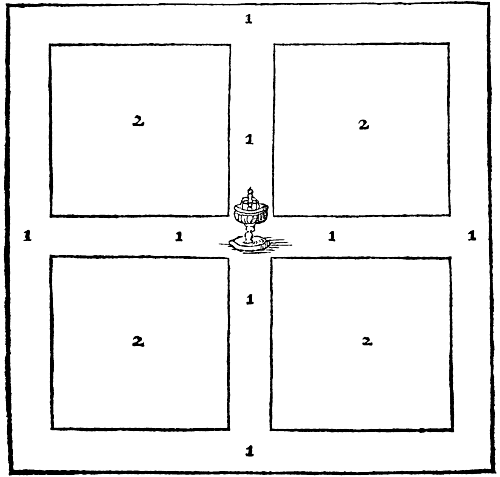
Now when you haue found out a perfect ground-plot, you shall then cast it into a great large square, which you shall fence in either with a stone or bricke wall, high, strong pale, or great ditch with a quicke-set hedge, but the wall is best and most durable, and that wall would haue vpon the inside within twelue or fourtéene foote on of another, Iames or outshoots of stone or bricke, betweene which you may plant and plash those fruit-trées which are of greatest tendernesse, the South and West Sunne hauing power to shine vpon them.
When you haue thus fenc'st in this great square, you shall then cast foure large alleyes, at least fourtéene foote broad, from the wall round about, and so likewise two other alleyes of like breadth, directly crosse ouerthwart the ground-plot, which will deuide the great square into foure lesser squares, according to the figure before set downe.
The figure 1. sheweth the alleyes which both compasse about, and also crosse ouer the ground-plot, and the figure 2. sheweth the foure quarters where the fruit-trées are to be planted.
Now if either the true nature and largnesse of the ground be sufficient, or your owne abilitie of pursse so great that you may compasse your desires in these earthly pleasures, it shall not be amisse, but a matter of great state, to make your ground-plot full as bigge againe, that is to say, to containe eight large quarters, the first foure being made of an euen leuell, the other foure being raysed at least eight foote higher then the first, with conuenient stayres of state for ascending to the same, to be likewise vpon another euen leuell of like forme, and if in the center of the alleyes, being the mid-point betwéene the squares, might be placed any quaint fountaines or any other antique standard, the platforme would be more excellent and if vpon the ascent from one leuell to another there might be built some curious and arteficiall banquetting house, it would giue luster to the Orchard.
Now for the planting and furnishing of these quarters: you shall vnderstand that if your Orchard containe but foure quarters, then the first shalbe planted with Apple-trées of all sorts, the second with Peares and Wardens of all sorts, the third with Quinces & Chesnutes, the fourth with Medlars & seruices. Against the North side of your Orchard wall against which the South sunne reflects, you shall plant the Abricot, Verdochio, Peach, and Damaske-plumbe: against the East side of the wall, the whit Muskadine Grape, the Pescod-plumbe, and the Emperiall-plumbe: against the West side the grafted Cherries, and the Oliue-trée: and against the South side the Almond, & Figge trée. Round about the skirts of euery other outward or inward alley, you shall plant, the Wheate-plumbe, both yealow & redde, the Rye-plumbe, the Damson, the Horse-clog, Bulleys of all kindes, ordinary french Cherryes, Filberts, and Nuts of all sorts, together with the Prune-plumbe, and other such like stone fruits. But if your Orchard be of state and prospect, so that it containe eight quarters or more (according to the limitation of the earth) then you shall in euery seuerall quarter plant a seuerall fruit, as Apple-trées in one quarter, Peares in another, Quinces in another, Wardens in another, and so forth of the rest. Also you shall obserue in planting your Apples, Peares, and Plumbes, that you plant your summer or early fruit by themselues, and the Winter or long lasting fruit by themselues. Of Apples, your Ienitings, Wibourns, Pomederoy, and Quéene-Apples are reckoned the best earely fruits, although their be diuers others, and the Pippin, Peare-maine, Apple-Iohn, and Russetting, your best Winter and long lasting fruit, though there be a world of other: for the tastes of Apples are infinite, according to there composition and mixture in grafting. Of Peares your golden Peare, your Katherine-Peare, your Lording, and such like, are the first, and your stone-Peare, Warden-Peare, and choake-Peare, those which indure longest. And of Plumbes the rye-plumbe is first, your Wheate-plumbe next, and all the other sorts of plumbes ripen all most together in one season, if they haue equall warmth, and be all of like comfortable standing.

Now for the orderly placing of your trées, you shall vnderstand that your Plumbe-trées (which are as it were a fence or guard about your great quarters) would be placed in rowes one by one, aboue fiue foote distance one from another, round about each skirt of euery alley: your Apple-trées & other greater fruit which are to be planted in the quarters, would be placed in such arteficiall rowes that which way soeuer a man shall cast his eyes yet hée shall sée the trées euery way stand in rowes, making squares, alleyes, and deuisions, according to a mans imagination, according to the figure before, which I would haue you suppose to be one quarter in an Orchard, and by it you may easily compound the rest: wherein you shall vnderstand that the lesser prickes doe figure your Plumbe-trées, & the greater prickes your Apple trées, and such other large fruit.
Now you shall vnderstand that euery one of these great trées which furnish the maine quarter, shall stand in a direct line, iust twelue foote one from another, which is a space altogether sufficient inough for there spreading, without waterdropping or annoying one another; prouided that the Fruiterer, according to his duty, be carefull to preserue the trees vpright and to vnderprope them when by the violence of the winde they shall swarue any way. Vpon the ascent or rising from one leuell to another, you may plant the Barberry-trées, Feberries, and Raspberries, of all sorts, which being spreading, thorny and sharpe trées, take great delight to grow thicke and close together, by which meanes often times they make a kinde of wall, hedge, or fencing, where they stand.
Hauing thus shewed you the ground-plot and proportion of your Orchard, with the seuerall deuisions, ascents, and squares, that should be contained therein, and the fruits which are to furnish euery such square and deuision, and their orderly placing, it now rests that you vnderstand that this Orchard-plot, so neare as you can bring it to passe, doe stand most open and plaine, vpon the South and West sunne, and most defended from the East and North windes and bitternesse, which being obserued your plot is then perfect and absolute.
Now forasmuch as where nature, fruitfulnesse, and situation doe take from a man more then the halfe part of his industrie, and by a direct and easie way doth lead him to that perfection which others cannot attaine to without infinit labour and trauell: and whereas it is nothing so commendable to maintaine beautie, as to make deformitie beautifull, I will speake something of the framing of Orchard-plots there where both nature, the situation, and barrainnesse, doe vtterly deny the enioying of any such commoditie, as where the ground is vneuen, stonie, sandy, or in his lownesse subiect to the ouerflow of waters, all being apparant enemies to these places of pleasure and delight. First, for the vneuennesse of the ground, if that be his vttermost imperfection, you shall first not onely take a note with your eye, but also place a marke vpon the best ascent of the ground to which the leuell is fittest to be drawne, and then plowing the ground all ouer with a great common plough, by casting the furrowes downward, séeke to fill in and couer the lesser hollownesses of the ground, that their may not any thing appeare but the maine great hollowes, which with other earth which is frée from stones, grauell, or such like euils, you shall fill vp and make leuell with that part where your marke standeth, and being so leuelled, forthwith draw the plot of your Orchard: but if the ground be not onely vneuen but also barraine, you shall then to euery loade of earth you carry to the leuelling adde a loade of Manure, either Oxe Manure, or Horse Manure, the rubbish of houses, or the clensings of olde ditches, or standing pooles, and the earth will soone become fertill and perfect; but if the ground be stonie, that is, full of great stones, as it is in Darbishire about the Peake or East Mores, for small pibbles or small lime-stones are not very much hurtfull, then you shall cause such stones to be digd vp, and fill vp the places where they lay either with marle, or other rich earth, which after it hath béene setled for a yéere or two you shall then plough, and leuell it, and so frame forth the plot of your Orchard. If the ground be onely a barraine sand, so that it wanteth strength either to maintaine or bring forth, you shall then first digge that earth into great trenches, at least foure foote déepe, and filling them vp with Oxe Manure, mixe it with the sand, that it may change some part of the colour thereof and then leuelling it fashion out your Orchard. But lastly, and which is of all situations the worst, if you haue no ground to plant your Orchard vpon, but such as either through the neighbourhood of riuers, descent of Mountaines, or the earths owne naturall quallitie in casting and vomiting out water and moysture, is subiect to some small ouerflowes of water, by which you cannot attaine to the pleasure you séeke, because fruit-trées can neuer indure the corruption of waters, you shall then in the dryest season of the yéere, after you haue marked out that square or quantitie of ground which you intend for your Orchard, you shall then cast therein sundry ditches, at least sixtéene foote broad, and nine foote déepe, and not aboue twelue foote betwixt ditch and ditch, vpon which reserued earth casting the earth that you digged vp, you shall raise the banckes at least seauen foote high of firme earth, and kéepe in the top the full breadth of twelue foote, with in a foote or little more: and in the casting vp of these bankes you shall cause the earth to be beaten with maules and broad béetels that it may lye firme, fast, and leuell, and after these bankes haue rested a yéere or more, and are sufficiently setled, you may then at the neather end of the banke, neare to the verge of the water plant store of Osyers, which will be a good defence to the banke, and vpon the top and highest part of the banke you shall plant your Orchard and fruit-trées, so that when any inundation of water shall happen, the ditches shalbe able inough to receiue it; or else making a passage from your Orchard into some other sewer, the water excéeding his limits may haue a frée current or passage: besides these ditches being neatly kept, and comforted with fresh water, may make both pleasant and commodious fish-ponds. Also you must be carefull in casting these bankes that you doe not place them in such sort that when you are vpon one you cannot come to the other, but rather like a maze, so that you may at pleasure passe from the one to the other round about the ground, making of diuers bankes to the eye but one banke in substance, and of diuers ponds in appearance, but one in true iudgement. And thus much for the plot or situation of an Orchard.
Chap. II. Of the Nurserie where you shall set all manner of Kernels, and Stones, for the furnishing of the Orchard.
Although great persons, out of their greatnesse and abilitie, doe buy their fruit trées ready grafted, and so in a moment may plant an Orchard of the greatest quantitie, yet sith the Husbandman must raise euery thing from his owne indeauours, and that I onely write for his profit, I therefore hould it most conuenient to beginne with the nursery or store-house of fruits, from whence the Orchard receiueth his beauty and riches.
This Nursery must be a piece of principall ground, either through Art or Nature, strongly fenced, warme, and full of good shelter: for in it is onely the first infancy and tendernesse of fruit-trées, because there they are first kernells, or stones, after sprigs, and lastly trées.
Now for the manner of chusing, sowing, and planting them in this nursery, I differ some thing from the french practise, who would chuse the kernells from the cider presse, sow them in large bedds of earth, and within a yeere after replant them in a wilde Orchard: now for mine owne part, though this course be not much faulty, yet I rather chuse this kinde of practise, first: to chuse your kernells either of Apples, Peares, or Wardens, from the best and most principallest fruit you can taste, for although the kernell doe bring forth no other trée but the plaine stocke vpon which the fruit was grafted, as thus, if the graft were put into a Crab-stocke the kernell brings forth onely a Crab-trée, yet when you taste a perfect and delicate Apple, be assured both the stocke and graft were of the best choise, and so such kernells of best reckoning. When you haue then a competent quantitie of such kernells, you shall take certaine large pots, in the fashion of milke-boules, all full of hoales in the bottome, through which the raine and superfluous moysture may auoyde, and either in the Months of March or Nouember (for those are the best seasons) fill the pots three parts full of the finest, blackest, and richest mould you can get, then lay your kernells vpon the earth, about foure fingars one from another, so many as the vessell can conueniently containe, and then with a siue sift vpon them other fine moulds almost thrée fingars thicke, and so let them rest, filling so many pots or vessells as shall serue to receiue your quantitie of kernells of all sorts. Now if any man desire to know my reason why I rather desire to set my kernells rather in vessells then in beds of earth, my answere is, that I haue often found it in mine experience, that the kernell of Apples, Peares, Quinces, and such like, are such a tender and dainty séede that it is great oddes but the wormes will deuoure and consume them before they sprout, who naturally delight in such séedes, which these vessels onely doe preuent: but to proceede.
After your kernells are sprouted vp and growne to be at least seauen or eight inches high, you shall then within your nursery digge vp a border about two foote and an halfe broad, more then a foote déepe, and of such conuenient length as may receiue all your young plants, and hauing made the mould fine and rich with Manure, you shall then with your whole hand gripe as much of the earth that is about the plant as you can conueniently hould, and so take both the plant and the mould out of the vessell, and replant it in the new drest border: and you shall thus doe plant after plant, till you haue set euery one, and made them firme and fast in the new mould: wherein you are to obserue these two principles, first that you place them at least fiue foote one from another, and secondly, that such kernells as you set in your vessels in March, that you replant them in borders of earth in Nouember following, and such as you set in Nouember to replant in March following, and being so replanted to suffer them to grow till they be able to beare grafts, during which time you shall diligently obserue, that if any of them chance to put forth any superfluous branches or cyons, which may hinder the growth of the body of the plant, that you carefully cut them away, that thereby it may be the sooner inabled to beare a graft: for it is euer to be intended that whatsoeuer procéedeth from kernells are onely to be preserued for stockes to graft on, and for no other purpose.
Now for the stones of Plumbes, & other stone fruit, you shall vnderstand that they be of two kindes, one simple and of themselues, as the Rye-plumbe, Wheate-plumbe, Damson, Prune-plumbe, Horse-clogge, Cherry, and such like, so that from the kernells of them issueth trées of like nature and goodnesse: the other compounded or grafted plumbes, as the Abricot, Pescod, Peach, Damaske, Verdochyo, Emperiall, and such like, from whose kernells issueth no other trées but such as the stockes were vpon which they were grafted. Now, for the manner of setting the first, which are simple and vncompounded, you shall digge vp a large bedde of rich and good earth a month or more before March or Nouember, and hauing made the mould as fine as is possible, you shall flat-wise thrust euery stone, a foote one from another, more then thrée fingars into the mould, and then with a little small rake, made for the purpose, rake the bedde ouer and close vp the holes, and so let them rest till they be of a yéeres groath, at which time you shall replant them into seuerall borders, as you did your Apple-trée plants and others.
Now for the kernells of your compounded or grafted Plumbes, you shall both set them in beddes and replant them into seuerall borders, in the same manner as you did the other kernells of Plumbes, onely you shall for the space of eight and forty houres before you set them stéepe them in new milke, forasmuch as the stones of them are more hard, and with greater difficulty open and sprout in the earth, then any other stone whatsoeuer: and thus hauing furnished your Nursery of all sorts of fruits and stockes, you shall when they come to full age and bignesse graft them in such order as shalbe hereafter declared.
Chap. III. Of the setting or planting of the Cyons or Branches of most sorts of Fruit-trees.
As you are to furnish your nursery with all sorts of kernells and stones, for the bréeding of stockes where on to graft the daintiest fruits you can compasse, so shall you also plant therein the cyons and branches of the best fruit trées: which cyons and branches doe bring forthe the same fruit which the trées doe from whence they are taken, and by that meanes your nursery shall euer afford you perfect trées, wherewith either to furnish your owne grounds, or to pleasure your neighbours. And herein by the way you shall vnderstand that some trées are more fit to be set then to be sowne, as namely, the Seruice-trée, the Medler, the Filbert and such like. Now for the Seruice-trée, hée is not at all to be grafted, but set in this wise: take of the bastard cyons such as be somewhat bigger then a mans thumbe, and cutting away the branches thereof, set it in a fine loose moulde, at least a foote déepe, and it will prosper exceedingly, yet the true nature of this trée is not to be remoued, and therefore it is conuenient that it be planted where it should euer continue: in like manner to the Seruice-tree, so you shall plant the bastard cyons of the Medlar-trée either in March or October, and at the waine of the moone.
Now for the Filbert, or large Hassell-nut, you shall take the smallest cyons or wands, such as are not aboue two yéeres groath, being full of short heauie twigges, and grow from the roote of the maine trée, and set them in a loose mould, a foote déepe, without pruning or cutting away any of the branches, and they will prosper to your contentment. Now for all sorts of Plumbe-trées, Apple-trées or other fruit-trées which are not grafted, if you take the young cyons which grow from the rootes cleane from the rootes, and plant them either in the spring, or fall, in a fresh and fine mould, they will not onely prosper, but bring forth fruit of like nature and qualitie to the trées from whence they were taken.
Now for your grafted fruit, as namely, Apples, Plumbes, Cherryes, Mulberries, Quinces, and such like, the cyons also and branches of them also will take roote and bring forth fruit of the same kinde that the trées did from whence they were taken: but those cyons or branches must euer be chosen from the vpper parts of the trées, betwixt the feast of all-Saints and Christmas, they must be bigger then a mans finger, smooth, straight, and without twigges: you shall with a sharpe chissell cut them from the body or armes of the trée with such care, that by no meanes you raise vp the barke, and then with a little yealow waxe couer the place from whence you cut the cyon: then hauing digged and dunged the earth well where you intend to plant them, and made the mould easie, you shall with an Iron, as bigge as your plant, make a hoale a foote déepe or better, and then put in your cyon and with it a few Oates, long stéept in water, and so fixe it firme in the mould, and if after it beginneth to put forth you perceiue any young cyons to put forth from the root thereof, you shall immediatly cut them off, & either cast them away or plant them in other places, for to suffer them to grow may bréede much hurt to the young trées. Now where as these cyons thus planted are for the most part small and weake, so that the smallest breath of winde doth shake and hurt their rootes, it shalbe good to pricke strong stakes by them, to which, fastning the young plant with a soft hay rope it may the better be defended from stormes and tempests.
Next to these fruit-trées, you shall vnderstand that your bush-trées, as Barberryes, Gooseberryes, or Feberryes, Raspberryes, and such like, will also grow vpon cyons, without rootes, being cut from their maine rootes in Nouember, & so planted in a new fresh mould. And here by the way I am to giue you this note or caueat, that if at any time you finde any of these cyons which you haue planted not to grow and flourish according to your desire, but that you finde a certaine mislike or consumption in the plant, you shall then immediatly with a sharpe knife cut the plant off slope-wise vpward, about three fingars from the ground, and so let it rest till the next spring, at which time you shall beholde new cyons issue from the roote, which will be without sicknesse or imperfection; and from the vertue of this experiment I imagine the gardners of antient time found out the meanes to get young cyons from olde Mulberry-trées, which they doe in this manner: first, you must take some of the greatest armes of the Mulberry-trée about the midst of Nouember, and with a sharpe sawe to sawe them into bigge truncheons, about fiuetéene inches long, and then digging a trench in principall good earth, of such depth that you may couer the truncheons, being set vp on end, with Manure and fine mould, each truncheon being a foote one from another, and couerd more then foure fingars aboue the wood, not fayling to water them whensoeuer néede shall require, and to preserue them from wéeds and filthinesse, within lesse then a yéeres space you shall behold those truncheons to put forth young cyons, which as soone as they come to any groath and be twigged, then you may cut them from the stockes, and transplant them where you please, onely the truncheons you shall suffer to remaine still, and cherish them with fresh dunge, and they will put forth many moe cyons, both to furnish your selfe and your friends. And thus much for the planting and setting of cyons or branches.
Chap. IIII. Of the ordinary and accustomed manner of Grafting all sorts of Fruit-trees.
As soone as your nursery is thus amply furnished of all sorts of stockes, procéeding from kernells and of all sorts of trées procéeding from cyons, branches or vndergrowings, and that through strength of yéeres they are growne to sufficient abilitie to receiue grafts, which is to be intended that they must be at the least sixe or eight inches in compasse, for although lesse many times both doth and may receiue grafts, yet they are full of debilitie and danger, and promise no assurance to the worke-mans labour, you shall then beginne to graft your stockes with such fruits as from art and experience are méete to be conioyned together, as thus: The mixing of Stockes and Grafts. you shall graft Apples vpon Apples, as the Pippin vpon the great Costard, the Peare-maine vpon the Ienetting, and the Apple-Iohn or blacke annet vpon the Pomewater or Crab-trée: to conclude, any Apple-stocke, Crab-tree, or wilding, is good to graft Apples vpon, but the best is best worthy. So for Peares, you shall graft them vpon Peare stockes, Quinces vpon Quinces or Crab-trées, and not according to the opinion of the frenchman, vpon white thorne or willow, the Medlar vpon the Seruice-trée, and the Seruice vpon the Medlar, also Cherryes vpon Cherryes, & Plumbes vpon Plumbes, as the greater Abricots vpon the lesser Abricots, the Peach, the Figge, or the Damson-trée, and to speake generally without wasting more paper, or making a long circumstance to slender purpose, the Damson-trée is the onely principall best stocke whereupon to graft any kinde of Plumbe or stone fruit whatsoeuer.
The choise of Grafts. After you haue both your stockes ready, and know which grafts to ioyne with which stockes, you shall then learne to cut and chuse your grafts in this manner: looke from what trée you desire to take your grafts, you shall goe vnto the very principall branches thereof, and looke vp to the vpper ends, and those which you finde to be fairest, smoothest, and fullest of sappe, hauing the little knots, budds, or eyes, standing close and thicke together, are the best and most perfect, especially if they grow vpon the East side of the trée, whereon the Sunne first looketh; these you shall cut from the trée in such sort that they may haue at least thrée fingars of the olde woode ioyning to the young branch, which you shall know both by the colour of the barke, as also by a little round seame which maketh as it were a distinction betwixt the seuerall growths. Now you shall euer, as néere as you can, chuse your grafts from a young trée, and not from an olde, and from the tops of the principall branches, and not from the midst of the trée, or any other superfluous arme or cyon; now if after you haue got your grafts you haue many dayes Iourneys to carry them, you shall fould them in a few fresh mouldes, and binde them about with hay, and hay ropes, and so carry them all day, and in the night bury them all ouer in the ground and they will containe their goodnesse for a long season.
How to graft in the Cleft. Hauing thus prepared your grafts, you shall then beginne to graft, which worke you shall vnderstand may be done in euery month of the yéere, except Nouember and October, but the best is to beginne about Christmas for all earely and forward fruit, and for the other, to stay till March: now hauing all your implements and necessaryes about you, fit for the Grafting, you shall first take your grafts, of what sort soeuer they be, and hauing cut the neather ends of them round and smoth without raysing of the barke, you shall then with a sharp knife, made in the proportion of a great pen-knife slice downe each side of the grafts, from the seame or knot which parts the olde woode from the new, euen to the neather end, making it flat and thinne, cheifely in the lowest part, hauing onely a regardfull eye vnto the pith of the graft, which you may by no meanes cut or touch, and when you haue thus trimmed a couple of grafts, for moe I doe by no meanes alow vnto one stocke, although sundry other skilfull workmen in this Art alow to the least stocke two grafts, to the indifferent great thrée, and to the greatest of all foure, yet I affirme two are sufficiently inough for any stocke whatsoeuer, and albeit they are a little the longer in couering the head, yet after they haue couered it the trée prospereth more in one yéere then that which contayneth foure grafts shall doe in two, because they cannot haue sap inough to maintaine them, which is the reason that trées for want of prosperitie grow crooked and deformed: but to my purpose. When you haue made your grafts ready, you shall then take a fine thinne sawe, whose téeth shalbe filed sharpe and euen, and with it (if the stocke be excéeding small) cut the stocke round off within lesse then a foote of the ground, but if the stocke be as bigge as a mans arme, then you may cut it off two or thrée foote from the ground, and so consequently the bigger it is the higher you may cut it, and the lesser the nearer vnto the earth: as soone as you haue sawne off the vpper part of the stocke, you shall then take a fine sharpe chissell, somewhat broader then the stocke, and setting it euen vpon the midst of the head of the stocke somewhat wide of the pith, then with a mallet of woode you shall stricke it in and cleaue the stocke, at least foure inches déepe, then putting in a fine little wedge of Iron, which may kéepe open the cleft, you shall take one of your grafts and looke which side of it you intend to place inward, and that side you shall cut much thinner then the out side, with a most héedfull circumspection that by no meanes you loosen or rayse vp the barke of the graft, cheifly on the out side, then you shall take the graft, and wetting it in your mouth place it in one side of the cleft of the stocke, and regard that the very knot or seame which goes about the graft, parting the olde woode from the new, do rest directly vpon the head of the stocke, and that the out side of the graft doe agrée directly with the out side of the stocke, ioyning barke vnto barke, and sappe vnto sappe, so euen, so smooth, and so close, that no ioyners worke may be discerned to ioyne more arteficially: which done, vpon the other side of the stocke, in the other cleft, you shall place your other graft, with full as much care, diligence, and euery other obseruation: when both your grafts are thus orderly and arteficially placed, you shall then by setting the haft of your chissell against the stocke, with all lenitie and gentlenesse, draw forth your wedge, in such sort that you doe not displace or alter your grafts, and when your wedge is forth you shall then looke vpon your grafts, and if you perceiue that the stocke doe pinch or squize them, which you may discerne both by the straitnesse and bending of the outmost barke, you shall then make a little wedge of some gréene sappy woode, and driuing it into the cleft, ease your grafts, cutting that wedge close to the stocke. When you haue thus made both your grafts perfect, you shall then take the barke of either Apple-trée, Crab-trée or Willow-trée, and with that barke couer the head of the stocke so close that no wet or other annoyance may get betwixt it and the stocke, then you shall take a conuenient quantitie of clay, which indéede would be of a binding mingled earth, and tempering it well, either with mosse or hay, lay it vpon the barke, and daube all the head of the stocke, euen as low as the bottome of the grafts, more then an inch thicke, so firme, close, and smooth as may be, which done, couer all that clay ouer with soft mosse, and that mosse with some ragges of wollen cloath, which being gently bound about with the inward barkes of Willow, or Osyar, let the graft rest to the pleasure of the highest: and this is called grafting in the cleft.
Notes. Now there be certaine obseruations or caueats to be respected in grafting, which I may not neglect: as first, in trimming and preparing your grafts for the stocke: if the grafts be either of Cherry, or Plumbe, you shall not cut them so thinne as the grafts of Apples, Quinces, or Medlars, because they haue a much larger and rounder pith, which by no meanes must be toucht but fortefied and preserued, onely to the neather end you may cut them as thinne as is possible, the pith onely preserued.
Secondly, you shall into your greatest stockes put your greatest grafts, and into your least, the least, that there may be an equall strength and conformitie in their coniunction.
Thirdly, if at any time you be inforced to graft vpon an olde trée, that is great and large, then you shall not graft into the body of that trée, because it is impossible to kéepe it from putrifaction and rotting before the grafts can couer the head, but you shall chuse out some of the principall armes or branches, which are much more slender, and graft them, as is before shewed, omitting not dayly to cut away all cyons, armes, branches, or superfluous sprigs which shall grow vnder those branches which you haue newly grafted: but if there be no branch, small or tender inough to graft in, then you shall cut away all the maine branches from the stocke, and couering the head with clay and mosse, let it rest, and within thrée or foure yéeres it will put forth new cyons, which will be fit to graft vpon.
Fourthly, if when you either sawe off the top of your stocke, or else cleaue the head, you either raise vp the barke or cleaue the stocke too déepe, you shall then sawe the stocke againe, with a little more carefulnesse, so much lower as your first errour had committed a fault.
Fiftly, you shall from time to time looke to the binding of the heads of your stockes, in so much that if either the clay doe shrinke away or the other couerings doe losen, by which defects ayre, or wet, may get into the incission, you shall presently with all spéede amend and repaire it.
Lastly, if you graft in any open place where cattell doe graze, you shall not then forget as soone as you haue finisht your worke to bush or hedge in your graft, that it may be defended from any such negligent annoyance. And thus much for this ordinary manner of grafting, which although it be generall and publike to most men that knoweth any thing in this art, yet is it not inferiour, but the principallest and surest of all other.
Chap. V. Of diuers other wayes of grafting, their vses and purposes.
Although for certainty, vse, and commodity, the manner of grafting already prescribed is of sufficiency inough to satisfie any constant or reasonable vnderstanding, yet for nouelty sake, to which our nation is infinitly addicted, and to satisfie the curious, who thinke their iudgements disparaged if they heare any authorised traueller talke of the things which they haue not practised, I will procéede to some other more quaint manners of grafting, and the rather because they are not altogether vnnecessary, hauing both certainety in the worke, pleasure in the vse, and benefit in the serious imploying of those howers which else might challenge the title of idlenesse, besides they are very well agréeing with the soyles and fruits of this Empyre of great Brittaine and the vnderstandings of the people, for whose seruice or benefit, I onely vndergoe my trauell.
You shall vnderstand therefore, that there is another way to graft, which is called grafting betwéene the barke and tree, and it is to be put in vse about the latter end of February, at such time as the sappe beginnes to enter into the trées: and the stockes most fit for this manner of grafting are those which are oldest and greatest, whose graine being rough and vneuen, either through shaking or twinding, it is a thing almost impossible to make it cleaue in any good fashion, so that in such a case it is meete that the grafter exercise this way of grafting betwixt the barke and the trée, the manner whereof is thus.
Grafting betweene the barke. First, you shall dresse your grafts in such sort as was before discribed when you grafted in the cleft, onely they shall not be so long from the knot or seame downeward by an inch or more, neither so thicke, but as thinne as may be, the pith onely preserued, and at the neather end of all you shall cut away the barke on both sides, making that end smaller and narrower then it is at the ioynt or seame, then sawing off the head of the stocke, you shall with a sharpe knife pare the head round about, smooth and plaine, making the barke so euen as may be, that the barke of your grafts and it may ioyne like one body, then take a fine narrow chissell, not excéeding sharpe, but somewhat rebated, and thrust it hard downe betwixt the barke and the trée, somewhat more then two inches, according to the iust length of your graft, and then gently thrust the graft downe into the same place, euen close vnto the ioynt, hauing great care that the ioynt rest firme and constant vpon the head of the stocke, and thus you shall put into one stocke not aboue thrée grafts at the most, how euer either other mens practise, or your owne reading doe perswade you to the contrary. After your grafts are fixt and placed, you shall then couer the head with barke, clay, and mosse, as hath béene formerly shewed: also you shall fasten about it some bushes of thorne, or sharpe whinnes, which may defend and kéepe it from the annoyance of Pye-annats, and such like great birds.
There is another way of grafting, which is called grafting in the scutchion, which howsoeuer it is estéemed, yet is it troublesome, incertaine, and to small purpose: the season for it is in summer, from May till August, at what time trées are fullest of sappe and fullest of leaues, and the manner is thus: take the highest and the principallest branches of the toppe of the trée you would haue grafted, and without cutting it from the olde woode chuse the best eye and budding place of the cyon, then take another such like eye or budde, being great and full, and first cut off the leafe hard by the budde, then hollow it with your knife the length of a quarter of an inch beneath the budde, round about the barke, close to the sappe, both aboue and below, then slit it downe twice so much wide of the budde, and then with a small sharpe chissell raise vp the scutchion, with not onely the budde in the midst but euen all the sappe likewise, wherein you shall first raise that side which is next you, and then taking the scutchion betwéene your fingars, raise it gently vp without breaking or brusing, and in taking it off hould it hard vnto the woode, to the end the sappe of the budde may abide in the scutchion, for if it depart from the barke and cleaue to the woode, your labour is lost, this done you shall take another like cyon, and hauing taken off the barke from it, place it in the others place, and in taking off this barke you must be carfull that you cut not the woode, but the barke onely, and this done you shall couer it all ouer with redde waxe, or some such glutenous matter; as for the binding of it with hempe and such trumpery it is vtterly dissalowed of all good grafters: this manner of grafting may be put in practise vpon all manner of cyons, from the bignesse of a mans little fingar to the bignesse of a slender arme.
Grafting with the Leafe. Not much vnlike vnto this, is the grafting with the Leafe, and of like worth, the art whereof is thus: any time betwixt midst May, vntill the midst of September, you shall chuse, from the toppe of the sunne-side of the trée, the most principall young cyon you can sée, whose barke is smoothest, whose leaues are greatest, and whose sappe is fullest, then cutting it from the trée note the principall leafe thereof, and cut away from it all the woode more then about an inch of each side of the leafe, then cutting away the vndermost part of the barke with your knife, take péece meale from the barke all the woode and sappe, saue onely that little part of woode and sappe which féedeth the leafe, which in any wise must be left behind, so that the graft will carry this figure.

Then goe to the body, arme, or branch of that trée which you intend to graft, which is to be presupposed must euer haue a smooth and tender barke, and with a very sharpe knife slit the barke, two slits at least, two inches long a péece, and about halfe an inch or more distance betwéene the two slits: then make another slit crosse-wise ouerthwart, from long slit to long slit, the figure whereof will be thus:
Then with your knife raise the barke gently from the trée, without breaking, cracking, or brusing: then take your graft, and putting it vnder the barke lay it flat vnto the sappe of the trée, so as that little sappe which is left in the leafe, may without impediment cleaue to the sappe of the trée, then lay downe the barke close againe and couer the graft, and with a little vntwound hempe, or a soft wollen list, binde downe the barke close to the graft, and then couer all the incisions you haue made with greene waxe: by this manner of grafting you may haue vpon one trée sundry fruits, as from one Apple-tree, both Pippins, Peare-maines, Russettings and such like, nay, you may haue vpon one tree, ripe fruit all summer long, as Ienettings from one branch, Cislings from another, Wibourns from another, Costards and Quéene-Apples from others, and Pippens and Russettings, from others, which bringeth both delight to the eye, and admiration to the sence, and yet I would not haue you imagine that this kinde of grafting doth onely worke this effect, for as before I shewed you, if you graft in the cleft (which is the fastest way of all grafting) sundry fruits vpon sundry armes or bowes, you shall likewise haue procéeding from them sundry sorts of fruits, as either Apples, Plumbes, Peares or any other kind, according to your composition and industry; as at this day we may dayly sée in many great mens Orchards.
Grafting on the toppes of trees. There is yet another manner of grafting, and it is of all other especially vsed much in Italy, and yet not any thing disagréeable with our climate, and that is to graft on the small cyons which are on the toppes of fruit trées, surely an experience that carryeth in it both dificulty and wonder, yet being put to approbation is no lesse certaine then any of the other, the manner whereof is thus: you shall first after you haue chosen such and so many grafts as you doe intend to graft, and trimd them in the same manner as you haue béene taught formerly for grafting within the cleft, you shall then mount vp into the toppe of the trée, vpon which you meane to graft, and there make choise of the highest and most principallest cyons (being cleane barkt and round) that you can perceiue to grow from the trée, then laying the graft, and the cyon vpon which you are to graft, together, sée that they be both of one bignesse and roundnesse: then with your grafting knife cut the cyon off betwéene the olde woode and the new, and cleaue it downe an inch and an halfe, or two inches at the most: then put in your graft (which graft must not be cut thinner on one side, then on the other, but all of one thicknesse) and when it is in, sée that the barke of the graft both aboue and below, that is, vpon both sides, doe ioyne close, euen, and firme with the barke of the branch or cyon, and then by foulding a little soft towe about it, kéepe them close together, whilst with clay, mosse, and the in-most barke of Osyars you lappe them about to defend them from ayre, winde, and tempests. And herein you shall obserue to make your graft as short as may be, for the shortest are best, as the graft which hath not aboue two or thrée knots, or buddes, and no more. You may, if you please, with this manner of grafting graft vpon euery seuerall cyon, a seuerall fruit, and so haue from one trée many fruits, as in case of grafting with the leafe, and that with much more spéede, by as much as a well-growne graft is more forward and able then a weake tender leafe. And in these seuerall wayes already declared, consisteth the whole Art and substance of Grafting: from whence albeit many curious braines may, from preuaricating trickes, beget showes of other fashions, yet when true iudgement shall looke vpon their workes, he shall euer finde some one of these experiments the ground and substance of all their labours, without which they are able to doe nothing that shall turne to an assured commoditie.
The effects of Grafting. Now when you haue made your selfe perfect in the sowing, setting, planting and grafting of trées, you shall then learne to know the effects, wonders, and strange issues which doe procéede from many quaint motions and helpes in grafting, as thus: if you will haue Peaches, Cherryes, Apples, Quinces, Medlars, Damsons, or any Plumbe whatsoeuer, to ripen earely, as at the least two months before the ordinary time, and to continue at least a month longer then the accustomed course, you shall then graft them vpon a Mulberry stocke: and if you will haue the fruit to tast like spice, with a certaine delicate perfume, you shall boyle Honey, the powder of Cloues and Soaxe together, and being cold annoynt the grafts there-with before you put them into the cleft, if you graft Apples, Peares, or any fruit vpon a Figge-tree stocke, they will beare fruit without blooming: if you take an Apple graft, & a Peare graft, of like bignesse, and hauing clouen them, ioyne them as one body in grafting, the fruit they bring forth will be halfe Apple and halfe Peare, and so likewise of all other fruits which are of contrary tastes and natures: if you graft any fruit-tree, or other trée, vpon the Holly or vpon the Cypresse, they will be greene, and kéepe their leaues the whole yéere, albeit the winter be neuer so bitter.
If you graft either Peach, Plumbe, or any stone-fruit vpon a Willow stocke, the fruit which commeth of them will be without stones.
If you will change the colour of any fruit, you shall boare a hole slope-wise with a large auger into the body of the trée, euen vnto the pith, and then if you will haue the fruit yealow you shal fill the hole with Saferne dissolued in water: if you will haue it redde, then with Saunders, and of any other colour you please, and then stoppe the hole vp close, and couer it with red or yealow waxe: also if you mixe the coulour with any spice or perfume, the fruit will take a rellish or tast of the same: many other such like conceits and experiments are practised amongst men of this Art, but sith they more concerne the curious, then the wise, I am not so carefull to bestow my labour in giuing more substantiall satisfaction, knowing curiosity loues that best which procéedes from their most paine, and am content to referre their knowledge to the searching of those bookes which haue onely strangnesse for their subiect, resolued that this I haue written is fully sufficient for the plaine English husbandman.
Chap. VI. Of the replanting of Trees, and furnishing the Orchard.
As soone as your séedes, or sets, haue brought forth plants, those plants, through time, made able, and haue receiued grafts, and those grafts haue couered the heads of the stockes and put forth goodly branches, you shall then take them vp, and replant them, (because the sooner it is done the better it is done) in those seuerall places of your Orchard which before is appointed, and is intended to be prepared, both by dungging, digging, and euery orderly labour, to receiue euery seuerall fruit. And herein you shall vnderstand, that as the best times for grafting are euery month (except October and Nouember) and at the change of the moone, so the best times for replanting, are Nouember and March onely, vnlesse the ground be cold and moist and then Ianuary, or February must be the soonest all wayes, excepted that you doe not replant in the time of frost, for that is most vnholsome.
The taking vp of trees. Now when you will take vp your trées which you intend to replant in your Orchard, you shall first with a spade bare all the maine branches of the roote, and so by degrées digge and loosen the earth from the roote, in such sort that you may with your owne strength raise the young trée from the ground, which done, you shall not, according to the fashion of Fraunce, dismember, or disroabe the trée of his beauties, that is to say, to cut off all his vpper branches and armes, but you shall diligently preserue them: for I haue séene a trée thus replanted after the fall of the leafe to bring forth fruit in the summer following: but if the trée you replant be olde then it is good to cut off the maine branches with in a foote of the stocke, least the sappe running vpward, and so forsaking the roote too sodainely doe kill the whole trée.
When you haue taken your trée vp, you shall obserue how, and in what manner, it stoode, that is, which side was vpon the South and receiued most comfort from the sunne, and which side was from it and receiued most shadow and bleaknesse, and in the same sort as it then stoode, so shall you replant it againe: this done you shall with a sharpe cutting-knife, cut off all the maine rootes, within halfe a foote of the trée, onely the small thriddes or twist-rootes you shall not cut at all: then bringing the plant into your Orchard, you shall make a round hole in that place where you intend to set your trée (the rankes, manner, distance and forme whereof hath béene all ready declared, in the first Chapter:) and this hole shalbe at least foure foote ouerthwart euery way, and at least two foote déepe, then shall you fill vp the hole againe, fiftéene inches déepe, with the finest blacke mould, tempered with Oxe dunge that you can get, so that then the hole shalbe but nine inches déepe, then you shall take your trée and place it vpon that earth, hauing care to open euery seuerall branch and thrid of the roote, & so to place them that they may all looke downe into the earth, and not any of them to looke backe and turne vpward: then shall you take of the earth from whence your trée was taken, and tempering it with a fourth part of Oxe dunge and slekt sope-asshes (for the killing of wormes) couer all the roote of your trée firmely and strongly: then with gréene soddes, cut and ioyned arteficially together, so sodde the place that the hole may hardly be discerned. Lastly take a strong stake, and driuing it hard into the ground neare vnto the new planted trée, with either a soft hay rope, the broad barke of Willow, or some such like vnfretting band, tye the trée to the stake, and it will defend it from the rage of winde and tempests, which should they but shake or trouble the roote, being new planted, it were inough to confound and spoyle the trée for euer.
Now, although I haue vnder the title and demonstration of replanting one trée giuen you a generall instruction for the replanting of all trées whatsoeuer, yet, for as much as some are not of that strength and hardnesse to indure so much as some others will, therefore you shal take these considerations by the way, to fortefie your knowledge with.
First, you shall vnderstand that all your dainty and tender grafted Plumbes, and fruits, as Abricots, Peaches, Damaske-Plumbes, Verdochyos, Pescods, Emperialls, and diuers such like, together with Orrenges, Cytrons, Almonds, Oliues, and others, which indéede are not familiar with our soyles, as being nearer neighbours to the sunne, doe delight in a warme, fat, earth, being somewhat sandy, or such a clay whose coldnesse by Manure is corrected, and therefore here with vs in the replanting of them you cannot bestow too much cost vpon the mould: as for the Damson, and all our naturall english Plumbes, they loue a fat, cold, earth, so that in the replanting of them if you shall lay too much dunge vnto their roote, you shall through the aboundant heate, doe great hurt vnto the trée. The cherry delighteth in any clay, so that vpon such soyle you may vse lesse Manure, but vpon the contrary you cannot lay too much. The Medlar estéemeth all earths alike, and therefore whether it be Manured or no it skilles not, sunne and shadow, wet and drinesse, being all of one force or efficacy. The Peare and Apple-trée delights in a strong mixt soyle, and therfore indureth Manure kindly, so doth also the Quince and Warden: lastly the Filbert, the Hasell, and the Chesnut, loue cold, leane, moist, and sandy earths, in so much that there is no greater enimy vnto them then a rich soyle: so that in replanting of them you must euer séeke rather to correct then increase fertillity.
You shall also vnderstand that all such fruit-trées as you doe plant against the walles of your Orchard (of which I haue spoken already & deciphered out their places) you shall not suffer to grow as of themselues, round, and from the wall, but at the times of pruning and dressing of them (which is euer at the beginning of the spring and immediately after the fall) you shall as it were plash them, and spread them against the wall, foulding the armes in loopes of leather, and nayling them vnto the wall: and to that end you shall place them of such a fit distance one from another, that they may at pleasure spread and mount, without interruption: the profit whereof is at this day seene almost in euery great mans Orchard: and although I haue but onely appointed vnto the wall the most quaint fruits of forraine nations; yet there is no fruit of our owne, but if it be so ordered it will prosper and bring forth his fruit better and in greater abundance. And thus much for the replanting of trées and furnishing of a well proportioned Orchard.
Chap. VII. Of the Dressing, Dungging, Proyning, and Preseruing of Trees.
Sith after all the labour spent of ingendring by séede, of fortefying and inabling by planting, and of multiplying by grafting it is to little or no purpose if the trées be not maintained and preserued by dressing, dungging and proyning, I will therefore in this place shew you what belongs to that office or duty, and first, for the dressing of trees: you shall vnderstand that it containeth all whatsoeuer is méete for the good estate of the trée, as first, after your trée is planted, or replanted, if the season shall fall out hot, dry, and parching, insomuch that the moisture of the earth is sucked out by the atraction of the Sunne, and so the trée wanteth the nutriment of moisture, in this case you shall not omit euery morning before the rising of the sunne, and euery euening after the set of the sunne, with a great watring-pot filled with water, to water & bath the rootes of the trées, if they be young trées, and newly planted, or replanted, but not otherwise: for if the trées be olde, and of long growth, then you shall saue that labour, and onely to such olde trées you shall about the midst of Nouember, with a spade, digge away the earth from the vpper part of the rootes and lay them bare vntill it be midde-March, and then mingling such earth as is most agréeable with the fruit and Oxe-dunge and sope-ashes together, so couer them againe, and tread the earth close about them: as for the vncouering of your trées in summer I doe not hold it good, because the reflection of the sunne is somewhat too violent and dryeth the roote, from whence at that time the sappe naturally is gone: you shall also euery spring and fall of the leafe clense your fruit trées from mosse, which procéeding from a cold and cankerous moisture, bréedeth dislike, and barrainenesse in trées: this mosse you must take off with the backe of an olde knife and leaue the barke smooth, plaine, and vnraced: also if you shall dunge such trées with the dunge of Swine, it is a ready way to destroy the mosse.
Proyning of Trees. After you haue drest and trimmed your trées, you shall then proyne them, which is to cut away all those superfluous branches, armes, or cyons, which being either barraine, bruised or misplaced, doe like drones, steale-away that nutriment which should maintaine the better deseruing sinewes, and you shall vnderstand that the best time for proyning of trées, is in March and Aprill, at which time the sappe assending vpward, causeth the trées to budde: the branches you shall cut away are all such as shall grow out of the stocke vnderneath the place grafted, or all such as by the shaking of tempests shall grow in a disorderly and ill fashioned crookednesse, or any other, that out of a well tempered iudgement shall séeme superfluous and burdensome to the stocke from whence it springs, also such as haue by disorder béene brooken, or maimed, and all these you shall cut away with a hooke knife, close by the trée, vnlesse you haue occasion by some misfortune to cut away some of the maine and great armes of the trée, and then you shall not vse your knife for feare of tearing the barke, but taking your sawe you shall sawe off those great armes close by the trée, neither shall you sawe them off downeward but vpward, least the waight of the arme breake the barke from the body: And herein you shall also vnderstand that for as much as the mischances which beget these dismembrings doe happen at the latter end of Summer, in the gathering of the fruit, and that it is not fit such maymed and broken boughes hang vpon the trée till the Spring, therefore you shall cut them off in the Winter time, but not close to the trée by almost a foote, and so letting them rest vntill the spring, at that time cut them off close by the trée. Now if you finde the superfluitie of branches which annoy your trées to be onely small cyons, springing from the rootes of the trées, as it often hapneth with all sorts of Plumbe-trées, Cherry-trées, Nut-trées, and such like, then you shall in the winter, bare the rootes of those trées, and cut off those cyons close by the roote: but if your trées be broused or eaten by tame-Deare, Goates, Shéepe, Kine, Oxen, or such like, then there is no help for such a misfortune but onely to cut off the whole head and graft the stocke anew.
Of Barke-bound. Next to the proyning of trées, is the preseruing, phisicking, and curing of the diseases of trées: to which they are subiect as well as our naturall bodyes: and first of all, there is a disease called Barke-bound, which is when the barke, through a mislike and leperous drynesse, bindeth in the trée with such straitnesse that the sappe being denied passage the body growes into a consumption: it is in nature like vnto that disease which in beasts is called hide-bound, and the cure is thus: at the beginning of March take a sharpe knife, and from the toppe of the body of the trée, to the very roote, draw downe certaine slits, or incissions, cleane through the barke, vnto the very sappe of the trée, round about the trée, & then with the backe of your knife open those slits and annoint them all through with Tarre, and in short space it will giue libertie vnto the trée to encrease & grow: this disease commeth by the rubbing of cattell against the trée, especially Swine, who are very poyson vnto all plants.
Of the Gall. There is another disease in fruit-trées, called the Gall, and it eateth and consumeth the barke quit away, and so in time kills the trée: the cure is to cut and open the barke which you sée infected, and with a chissell to take away all that is foule and putrefied, and then to clappe Oxe dunge vpon the place, and it will helpe it, and this must be done euer in winter.
Of the Canker. The Canker in fruit trées is the consumption both of the barke and the body, & it commeth either by the dropping of trées one vpon another, or else when some hollow places of the trée retaineth raine water in them, which fretting through the barke, poysoneth the trée: the cure is to cut away all such boughes as by dropping bréede the euill, and if the hollow places cannot be smooth and made euen, then to stoppe them with clay, waxe, and sope-ashes mixt together.
Of worme-eaten barkes. If the barkes of your trées be eaten with wormes, which you shall perceiue by the swelling of the barke, you shall then open the barke and lay there-vpon swines dunge, sage, and lime beaten together, and bound with a cloath fast to the trée, and it will cure it: or wash the trée with cowes-pisse and vinegar and it will helpe it.
Of Pismiers and Snailes. If your young trées be troubled with Pismiers, or Snailes, which are very noysome vnto them, you shall take vnsleckt lime and sope-ashes and mingling them with wine-lées, spread it all about the roote of the trées so infected, and annoint the body of the trée likewise therewith, and it will not onely destroy them but giue comfort to the trée: the soote of a chimney or Oake sawe-dust spread about the roote will doe the same.
Of Caterpillers, and Earewigges. If Caterpillers doe annoy your young trées, who are great deuourers of the leaues and young buddes, and spoylers of the barke, you shall, if it be in the summer time, make a very strong brine of water and salt, and either with a garden pumpe, placed in a tubbe, or with squirts which haue many hoales you shall euery second day water and wash your trées, and it will destroy them, because the Caterpiller naturally cannot indure moisture, but if neuerthelesse you sée they doe continue still vpon your trees in Winter, then you shall when the leaues are falne away take dankish straw and setting it on fire smeare and burne them from the trée, and you shall hardly euer be troubled with them againe vpon the same trées: roules of hay layd on the trées will gather vp Earewigges and kill them.
Of the barrainenesse of Trees. If your trées be barraine, and albeit they flourish and spread there leaues brauely, yet bring forth no fruit at all, it is a great sicknesse, and the worst of all other: therefore you shall vnderstand it procéedeth of two causes: first, of two much fertillitie, and fatnesse of the ground, which causeth the leafe to put forth and flourish in such vnnaturall abundance, that all such sappe and nutriment as should knit and bring forth fruit, turnes onely vnto leafe, cyons, and vnprofitable branches, which you shall perceiue both by the abundance of the leaues and by the colour also, which will be of a more blacker and déeper gréene, and of much larger proportion then those which haue but their naturall and proper rights: and the cure thereof is to take away the earth from the roote of such trées and fill vp the place againe with other earth, which is of a much leaner substance: but if your trée haue no such infirmitie of fatnesse, but beareth his leaues and branches in good order and of right colour and yet notwithstanding is barraine and bringeth forth little or no fruit, then that disease springeth from some naturall defect in the trée, and the cure thereof is thus: first, you shall vnbare the roote of the trée, and then noting which is the greatest and principallest branch of all the roote, you shall with a great wimble boare a hole into that roote and then driue a pinne of olde dry Ashe into the same (for Oake is not altogether so good) and then cutting the pinne off close by the roote, couer all the head of the pinne with yealow waxe, and then lay the mould vpon the roote of the trée againe, and treade it hard and firmely downe, and there is no doubte but the trée will beare the yéere following: in Fraunce they vse for this infirmitie to boare a hoale in the body of the trée slope-wise, somewhat past the hart, and to fill vp the hoale with life honey and Rose-water mixt together, and incorporated for at least xxiiij. howers, and then to stoppe the hole with a pinne of the one woode: also if you wash the rootes of your trées in the drane water which runneth from your Barley when you stéepe it for Malt, it will cure this disease of barrainenesse.
Of the bitternesse of Fruit. If the fruit which is vpon your trées be of a bitter and sootie tast, to make it more pleasant and swéet you shall wash your trée all ouer with Swines dunge and water mixt together, & to the rootes of the trées you shall lay earth and Swines dunge mixt together, which must be done in the month of Ianuary and February onely, and it will make the fruit tast pleasantly. And thus much for the dressing and preseruing of trées.
Chap. VIII. Of the Vine, and of his ordering.
For as much as the nature, temperature, and clymate, of our soyle is not so truely proper and agréeing with the Vine as that of Fraunce, Italy, Spaine, and such like, and sith wée haue it more for delight, pleasure, and prospect, then for any peculyar profit, I will not vndertake Monsiuer Lybaults painefull labour, in discribing euery curious perfection or defect that belongs thereunto, as if it were the onely iewell and commoditie of our kingdome, but onely write so much as is fitting for our knowledge touching the maintaynance, increase, and preseruation thereof, in our Orchards, Gardens, and other places of recreation.
Of planting or setting the Vine. First then to speake of the planting or setting of the Vine, your greatest diligence must be to séeke out the best plants, and if that which is most strange, rare, great and pleasant be the best, then is that grape which is called the Muskadine, or Sacke grape, the best, and haue their beginning either from Spaine, the Canary Ilands, or such like places: next to them is the French grape, of which there be many kindes, the best whereof is the grape of Orleance, the next the grape of Gascoynie, the next of Burdeaux, and the worst of Rochell, and not any of these but by industry will prosper in our English gardens: when therefore you chuse your plants, you shall chuse such of the young cyons as springing from the olde woode, you may in the cutting cut at least a ioynt or two of olde woode with the young: for the olde will take soonest, and this olde woode must be at least seauen or eight inches long, and the young cyon almost a yard, and the thicker and closer the ioynts of the young cyon are, so much the better they are: and the fit time for cutting and gathering these sets are in midde-Ianuary, then hauing prepared, digged, and dunged your earth the winter before, you shall at the latter end of Ianuary take two of these sets, or plants, placing them according to this figure:
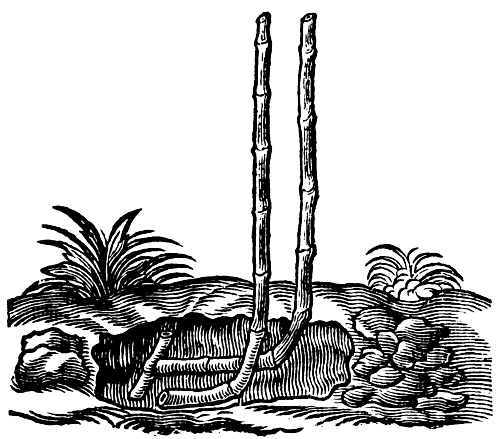
And lay them in the earth slope-wise, at least a foote déepe, leauing out of the earth, vncouered, not aboue foure or fiue ioynts, at the most, and then couer them with good earth firmely, closely, and strongly, hauing regard to raise those cyons which are without the earth directly vpward, obseruing after they be set, once in a month to wéede them, and kéepe them as cleane as is possible: for nothing is more noysome vnto them then the suffocating of wéeds: also you shall not suffer the mould to grow hard or bind about the rootes, but with a small spade once in a fortnight to loosen and breake the earth, because there rootes are so tender that the least straytning doth strangle and confound them. If the season doe grow dry, you may vse to water them, but not in such sort as you water other plants, which is to sprinckle water round about the earth of the rootes, but you shall with a round Iron made for the purpose somewhat bigger then a mans fingar, make certaine holes into the earth, close vpon the roote of the Vine, and powre therein either water, the dregges of strong-Ale, or the lées of Wine, or if you will you may mixe with the lées of Wine either Goats-milke, or Cowes-milke, and power it into the holes and it will nourish the Vine excéedingly, and not the Vine onely, but all sorts of dainty grafted Plumbes, especially Peaches.
Of proyning the Vine. Now for proyning the Vine, you shall vnderstand that it is euer to be done after the fall of the leafe, when the sappe is desended downeward, for if you shall proyne, or cut him, either in the spring, or when the sappe is aloft, it will bléede so excéedingly, that with great difficulty you shall saue the body of the trée from dying: and, in proyning of the Vine you shall obserue two things, the first, that you cut away all superfluous cyons and branches, both aboue and below, which either grow disorderly aboue, or fruitlessely below, and in cutting them you shall obserue, neither to cut the olde woode with the young cyon, nor to leaue aboue one head or leader vpon one branch: secondly, you shall in proyning, plash and spread the VINE thinnely against the wall, giuing euery seuerall branch and cyon his place, and passage, and not suffer it to grow loosely, rudely, or like a wilde thorne, out of all decency and proportion: for you must vnderstand that your Grapes doe grow euer vpon the youngest cyons, and if of them you shall preserue too many, questionlesse for want of nourishment they will lose their vertue, and you your profit. Now if your Vine be a very olde Vine, and that his fruit doth decay, either in quantitie or proportion; if then you finde he haue any young cyons which spring from his roote, then when you proyne him you shall cut away all the olde stocke, within lesse then an handfull of the young cyons, and make them the leaders, who will prosper and continue in perfection a long time after, especially if you trimme the rootes with fresh earth, and fresh dunge. Againe, if you be carefull to looke vnto your Vine, you shall perceiue close by euery bunch of grapes certaine small thridde-like cyons, which resemble twound wyars, curling and turning in many rings, these also take from the grapes very much nutriment, so that it shall be a labour very well imployd to cut them away as you perceiue them.
Experiments of the Vine. Now from the Vine there is gathered sundry experiments, as to haue it tast more pleasant then the true nature of the grape, and to smell in the mouth odoriferously, or as if it were perfumed, which may be done in this sort: Take damaske-Rose-water and boyle therein the powder of Cloaues, Cynamon, thrée graines of Amber, and one of Muske, and when it is come to be somewhat thicke, take a round goudge and make a hole in the maine stocke of the Vine, full as déepe as the hart thereof, and then put therein this medicine, then stopping the hole with Cypresse, or Iuniper, lay gréene-waxe thereupon, and binde a linnen cloath about it, and the next grapes which shall spring from that Vine will tast as if they were preserued or perfumed.
If you will haue grapes without stones, you shall take your plants and plant the small ends downeward and be assured your desire is attained.
The Vine naturally of himselfe doth not bring forth fruit till it haue béene thrée yéeres planted: but if euening and morning for the first month you will bath his roote with Goats-milke or Cowes-milke, it will beare fruit the first yéere of his planting. Lastly, you may if you please graft one Vine vpon another, as the swéet vpon the sower, as the Muskadine grape, or gréeke, vpon the Rochell or Burdeaux, the Spanish, or Iland grape, on the Gascoyne, and the Orleance vpon any at all: and these compositions are the best, and bring forth both the greatest and pleasantest grapes: therefore whensoeuer you will graft one grape vpon another, you shall doe it in the beginning of Ianuary, in this sort: first, after you haue chosen and trimmed your grafts, which in all sorts must be like the grafts of other fruits, then with a sharpe knife, you shall cleaue the head of the Vine, as you doe other stockes and then put in your graft, or cyon, being made as thinne as may be and sée that the barkes and sappes ioyne euen and close together, then clay it, mosse it, and couer it, as hath béene before declared.
The medicining of the Vine. If your Vine grow too ranke and thicke of leaues, so that the sappe doth wast it selfe in them, and you thereby lose the profit of the fruit, you shall then bare all the rootes of the Vine, and cast away the earth, filling vp the place againe with sand & ashes mingled together: but if the Vine be naturally of it selfe barraine, then with a goudge you shall make a hole halfe way through the maine body of the Vine, and driue into the hole a round pible stone, which although it goe straitly in, yet it may not fill vp the hole, but that the sicke humour of the Vine may passe thorrow thereat: then couer the roote with rich earth, and Oxe dunge mixt together, and once a day for a month water it with olde pisse, or vrine of a man, and it will make the trée fruitfull: if the Vine be troubled with Wormes, Snailes, Ants, Earewigges, or such like, you shall morning and euening sprinckle it ouer with cowes-pisse and vinegar mixt together & it will helpe it: & thus much for ordering the Vine.
Chap. IX. The office of the Fruiterrer, or the Gatherer, and keeper, of Fruit.
After you haue planted euery seuerall quarter, allye, and border within your Orchard, with euery seuerall fruit proper vnto his place, and that you haue placed them in that orderly and comely equipage which may giue most delight to the eye, profit to the trée, and commendations to the workeman, (according to the forme and order prescribed in the first Chapter) and that now the blessing of the highest, time, and your indeuours hath brought forth the haruest and recompence of your trauell, so that you behould the long-expected fruit hang vpon the trées, as it were in their ripenesse, wooing you to plucke, tast, and to deliuer them from the wombes of their parents, it is necessary then that you learne the true office of the Fruiterer, who is in due season and time to gather those fruits which God hath sent him: for as in the husbanding of our grayne if the Husbandman be neuer so carefull, or skilfull, in ploughing, dungging, sowing, wéeding and preseruing his crop, yet in the time of haruest be negligent, neither regarding the strength or ripnesse thereof, or in the leading and mowing respects not whether it be wet or dry, doth in that moments space loose the wages of his whole yéeres trauell, getting but durt from durt, and losse from his negligence: so in like case houlds it with all other fruits, if a man with neuer so great care and cost procure, yet if he be inrespectiue in the gathering, all his former businesse is vaine and to no purpose; and therefore I hould nothing more necessary then the relation of this office of the Fruiterer, which is the consummation and onely hope of our cost, and diligence, teaching vs to gather wisely what wée haue planted wearily, and to eate with contentment what we haue preserued with care.
Of gathering and preseruing Cherries. Know then, that of all fruits (for the most part) the Cherry is the soonest ripe, as being one of the oldest children of the summer, and therefore first of all to be spoken of in this place, yet are not all Cherries ripe at one instant, but some sooner then other some, according to the benefit of the Sunne, the warmth of the ayre, and the strength of sappe in the branch on which the Cherry hangeth: they are a fruit tender and pleasant, and therefore much subiect to be deuoured and consumed with Byrds of the smallest kindes, as Sparrowes, Robins, Starlings, and such like, especially the Iay, and the Bull-finch, who deuoure them stones and all, euen so fast as they rypen: for preuention whereof; if you haue great abundance of Cherry trées, as maine holts that be either one or many akers in compasse, you shall then in diuers places of your holts, as well in the midst, as out-corners, cause to be errected vp certaine long poales of Fyrre, or other woode, which may mount somewhat aboue the toppes of the trées, and one the toppes of those poales you shall place certaine clappe-milles made of broken trenchers ioyned together like sayles, which being moued and carryed about with the smallest ayre, may haue vnderneath the sayles a certaine loose little board, against which euery sayle may clap and make a great noyse, which will afright and scare the Byrds from your trées: these milles you shall commonly sée in Husbandmens yards placed on their stackes or houells of Corne, which doth preserue them from fowle and vermine: but for want of these clap-milles you must haue some boy or young fellow that must euery morning from the dawning of the day till the Sunne be more then an houre high, and euery euening from fiue of the clocke till nine, runne vp and downe your ground, whooping, showtying, and making of a great noyse, or now and then shooting of some Harquebush, or other Péece: but by no meanes to vse slings or throwing of stones, least by the miscarriage of his hand hée either beate downe the fruit or bruise the trees. In this sort hauing preserued your Cherries from destruction, you shall then know there ripenesse by their colours, for euer those which are most red, are most ripe, and when you sée any that are ripe, you shall take a light ladder, made either of fyrre or sallow, and setting it carefully against the branches, so as you neither bruise them nor the fruit, you shall gather those you finde ripe, not taking the fruit from the stalke, but nipping the stalke and fruit both together from the trée: also you shall be carefull in gathering to handle or touch the Cherry so little as may be, but the stalke onely, especially if your hands be hot, or sweaty, for that will change the colour of your Cherries, and make them looke blacke: if there be any ripe Cherries which hang out of the reach of your hands, then you shall haue a fine small gathering hooke of woode, whose bout shall be made round, and smooth, for nipping the barke of the branches, and with it you shall gently pull vnto you those branches you cannot reach: you shall also haue a little round basket of almost a foote déepe, made with a siue bottome, hauing a handle thwarte the toppe, to which a small hooke being fastned, you shall with that hooke hang the basket by you on some conuenient cyon, and as you gather the Cherries, gently lay them downe into the same, and when you haue filled your basket you shall descend and empty it into larger great baskets made of the same fashion, with siue bottomes, and hauing vnderneath two broad lathes or splinters, at least thrée fingers broad a péece, within foure inches one of the other, and going both one way crosse ouerthwart the basket, that if either man or woman shall carry them vpon their heads, which is the best manner of cariage, then the splinters may defend the bottome of the basket from the head of the party, and kéepe the Cherries from hurt or bruising, and if you haue occasion to carry your Cherries farre, and that the quantitie grow beyond the support of a man, then you shall packe them in hampers or panniers made with false bottoms like siues, and finely lyned on the out side with white straw, and so being closely trust on each side a Horses-backe, to carry them whether you please. You shall by no meanes suffer your Cherries to lye in any great or thicke heapes one vpon another, but vntill you sell them, or vse them, lay them as thinne as may be, because they are apt of themselues to sweat and catch heate, and that heate doth soone depriue them of the glory of their colour. When you gather any Cherries to preserue, you shall gather those which are the greatest, the ripest, you shall pull them from their stalkes one by one, and vse them at furthest within xxiiij. howers after the time they are gotten.
The gathering of stone Fruit. For the gathering of Plumbes in generall, it is in the same manner as you did gather your Cherries, both with such a like ladder, such a like hooke, and such like vessels, onely some more speciall obseruations are to be obserued in gathering your dainty grafted Plumbes, then of the others, which are of a more hard and induring nature. You shall know then that for gathering of Abricots, Peaches, Date-Plumbes, and such like grafted Plumbes, you shall duely consider when they are perfectly ripe, which you shall not iudge by their dropping from the trée, which is a signe of ouer-much ripnesse, tending to rottennesse, but by the true mixture of their colour, and perfect change from their first complexion: for when you shall perceiue that there is no gréenenesse nor hardnesse in their out-sides, no, not so much as at the setting on of the stalke, you may then iudge that they are ready to be gathered, and for a perfecter tryall thereof you may if you please, take one which you thinke ripest from the trée, and opening it if you sée the stone comes cleane and dry away and not any of the in-part of the fruit cleauing vnto it, then you may assure your selfe that the fruit is ready to be gathered, which you shall with great deligence and care gather, not by any meanes laying one Plumbe vpon another, but each seuerally by another, for these dainty Plumbes are naturally so tender that the least touch, though of themselues, doth bruise them, and occasion rottennesse. Now when you haue gathered them, if either you haue desire to send them any iourney, as in gratulation to your friends, or for other priuate commoditie, you shall take some close, smooth, boxe, answerable to the store of fruit you are to send, and first line it within all ouer with white paper, then lay your Plumbes one by one all ouer the bottome of the boxe, then couering them all ouer with white paper, lay as many moe vpon the toppe of them, and couer them likewise with paper, as before, and so lay row vpon row with papers betwéene them, vntill the boxe be sufficiently filled, and then closing it vp sende it whether you please, and they will take the least hurt, whereas if you should line the boxe either with hay or straw, the very skinnes are so tender that the straw would print into them and bruise them excéedingly, and to lay any other soft thing about them, as either wooll or bumbast, is excéeding euill, because it heateth the Plumbes, and maketh them sweat, through which they both loose their colour and rot spéedily. Of gathering hard Plumbes. As touching the gathering of Plumbes when they are hard, and to ripen them afterward by laying them vpon nettles, to which consenteth the most of our London-Fruiterrers, I am vtterly against the opinion, because I both know Nature to be the perfectest worke-Mistris, and where she is abridged of her power there euer to follow disorders and imperfections, as also that when such things are done, as it were through an ouer-hasty constraint, there cannot procéede any thing but abortiuenesse, and a distastfull rellish: from whence I thinke it comes to passe that in London a man shall very seldome tast a delicate or well rellisht Plumbe, vnlesse it be from such as hauing fruit of their owne, make no commoditie thereof more then their owne pleasures: Of keeping of Plumbes. yet thus much I would perswade euery one, that if they haue moe Plumbes ripe at once then they can vse, or spend, that then after they are gathered, to spread them thinnely vpon Nettles or Vine-trée leaues, and it will preserue them sound and well coloured a long time together, but if your store be so superabundant that in no reasonable time you can spend them, then what you doe not preserue, or make Godiniake, or Maruulade of, the rest you shall take and sprinkling them ouer with swéet-worte, or growt, and then laying them one by one (yet so as they may not touch one another) vpon hurdles or fleakes made of wands, or twigges, and put them into an Ouen after bread or Pyes haue béene taine thereout, and so leasurely dry them, and they will not onely last, but tast pleasantly all the yéere after: and in this sort you may vse all kindes of Plumbes, or Peares, whatsoeuer. Now for the gathering of the other ordinary sorts of vngrafted Plumbes, which haue both much stronger rindes, and are lesse subiect to rotting, you shall gather them, carry, or transport them, in the same manner that you did your Cherries, onely in these, as in all other sorts of fruit whatsoeuer, you shall not omit neuer to gather, or pull them from the trée, till the dewe be dryed cleane both from the grasse and from the trées, and that the day be dry, faire, and full of sunne-shine: for the least wet or moisture doth canker and rot the fruit.
Of the gathering of Peares. As touching the gathering of Peares, though sundry Fruiterrers obserue sundry wayes in gathering them, as some making more hast then good-spéed, as either to haue the first tast, or the first profit, some vsing more negligence, thincking their store so great it will neuer be consumed, and some so curious that they will not gather till the Peares fall into their bosomes, all which are dispraiseable fashions, yet I for my part would euer aduise all diligent husbands to obserue a mediocritie, and take the fittest season for the gathering of his fruit: as thus for example. If because you are vnexperienced or vnacquainted with the fruit you doe not know the due time of his ripening, you shall obserue the colour of the Peare, and if you sée it doe alter, either in part, or in all, you shall be assured the fruit is neare ripening, for Peares doe neuer change their colours, but when they doe desire to be taken from the trée: and of all fruit the Peare may be gathered the hardest, because both his owne naturall heate and peculiar quallittie will ripen him best with lying: yet to be more strongly fortefied in the knowledge of the ripenesse of your fruit, and because it is better to get a day too late, then an hower to earely, you shall before you gather your Peares, whether they be Summer fruit or Winter fruit, or whether you meane to spend them soone or preserue them long, take one of them from the trée, which is neither the ripest nor the gréenest, but betwixt both, and cut it through the midst with your knife, not longwise, but ouerthwart, and then looke into the coare where the kirnells lye, and if it be hollow so as the kirnells lye as it were hollow therein, the neather ends thereof being turned either blacke, or blackish, albeit the complexion of the Peare be little, or not at all altered, yet the Peares haue their full growth, and may very well be gathered: then laying them either vpon a bedde of ferne, or straw, one vpon another, in great thicknesse, their owne naturall heate will in short space ripen them, which you shall perceiue both by the spéedy changing of their colour, & the strength of their smell, which will be excéeding suffocating, which as soone as you perceiue, you shall then spread them thinner and thinner, vntill they be all ripe, and then lay them one by one, in such sort as they may not touch one another, and then they will last much the longer, you shall also after they be ripe, neither suffer them to haue straw nor ferne vnder them, but lay them either vpon some smooth table, boards or fleakes of wands, and they will last the longer.
Of transporting, or carrying of Peares farre. If you be to carry or transport Peares farre, you shall then gather them so much the sooner, and not suffer any ripe one to be amongst them, and then lyning great wicker baskets (such as will hould at least quarters a péece) finely within with white-straw, fill them vp with Peares, and then couer them with straw, and corde them aboue, and you may either transport them by land or Sea, whether you please, for they will ripen in their cariage: but when you come to your place of residence, then you must néeds vnpacke them and spread them thinner, or else they will rot and consume in a sodaine.
Of gathering diuersly. There be sundry wayes of gathering Peares, or other fruit, as namely, to climbe into the trée and to haue a basket with a line fastned thereto, and so when it is filled to let it downe, and cause it to be emptied, which labour though some of our southerne Fruiterers doe not much commend, yet for mine owne part I doe not sée much errour therein, but that it is both allowable and conuenient, both because it neither bruiseth the fruit, nor putteth the gatherer to any extraordinary labour, onely the imaginary euill is, that by climbing vp into the trée, hée that gathereth the fruit may indanger the breaking, slipping, and disbranching of many of the young cyons, which bréedeth much hurt and damage to the trée, but iudgement, and care, which ought to be apropriate to men of this quallitie, is a certaine preuenter of all such mischeifes. Now for such as in gathering of their fruit doe euery time that the basket is full bring it downe themselues from the trée, and empty it by powring the fruit rudely, and boystrously forth, or for beating of fruit downe with long poales, loggets, or such like, they are both most vilde and preposterous courses, the first being full of too much foolish and carelesse trouble, the latter of too much disorder, & cruelty, ruyning in a moment what hath béene many yéeres in building: as for the climbing the trée with a ladder, albeit it be a very good way for the gathering of fruit, yet if it be neuer so little indiscréetly handled, it as much hazardeth the breaking and bruising both of the fruit and the small cyons, as either climbing the trée, or any other way whatsoeuer.