A FORMER PART, before the first Part: Being an absolute perfect Introduction into all the Rules of true Husbandry; and must first of all be read, or the Readers labour will be frustrate. (continued 2)
Reading edition
Of Winter-ridging. About the beginning of Nouember you shall Winter-ridge your fallow field, I meane that part which you doe preserue for Barley (for the other part is furnished with séede) and this Winter-ridging differeth nothing from the Winter ridging of other soiles, onely you shall a little more precisely obserue to set vp your lands more straight and high then in other soiles, both to defend them from wet, which this soile is much subiect vnto, because commonly some great riuer is neare it, and also for the preseruing of the strength and goodnesse of the Manure within the land which by lying open and vnclosed would soone be washt forth and consumed.
Of the clensing of lands, or drawing of water-furrowes. Now sith I haue here occasion to speake something of the draining of lands, and the kéeping of them from the annoyance of superfluous wet, whether it be by invndation or otherwise, you shall vnderstand that it is the especiall office and dutie of euery good Husbandman, not onely in this soile, but in all other whatsoeuer, to haue a principall respect to the kéeping of his land dry, and to that end hée shall diligently (as soone as he hath Winter-rigged his land) take a carefull view how his lands lie, which way the descent goes from whence annoyance or water may possibly come, and so consequently from those obseruations, with a Spade or strong Plough, of extraordinary greatnesse, draw certaine déepe furrowes from descent vnto descent, by which meanes all the water may be conuayed from his lands, eyther into some common Sewer, Lake, Brooke, or other maine Riuer: and to this end it is both a rule in the common Lawes of our Land, and a laudable custome in the Common-wealth of euery Towne, that for as much as many Townes haue their lands lie in common, that is to say, mixed neighbour with neighbour, few or none hauing aboue two or three lands at the most lying together in one place, therefore euery man shall ioyne, and make their water-furrowes one from another, vntill such time as the water be conuayed into some common issue, as well hée whose lands be without all danger, as he that is troubled with the greatest annoyance, and herein euery one shall beare his particular charge: which is an Act of great vertue and goodnesse.
Of the Plough. Now for the Plough which is to plow this white sand it doth differ nothing in size, proportion, and vse of handling from the Plough described for the red Sand, onely it hath one addition more, that is to say, at the further end of the maine Beame of the Plough, where you fixe your Plough-foote, there you shall place a little paire of round whéeles, which bearing the Beame vpon a loose mouing Axletrée, being iust the length of two furrows and no more, doth so certainly guide the Plough in his true furrow that it can neither lose the land by swaruing (as in these light soiles euery Plough is apt to doe) nor take too much land, eyther by the gréedinesse of the plough or sharpnesse of the Irons, neither can it drownd through the easie lightnesse of the earth, nor runne too shallow through the fussinesse of the mould, but the whéeles being made of a true proportion, which should not be aboue twelue inches from the centre, the Plough with a reasonable hand of gouernment shall runne in a direct and euen furrow: the proportion of which Plough is contained in this Figure.
The Plough with Wheeles.
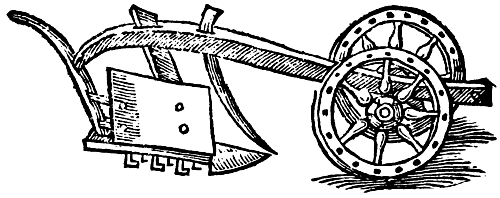
This plough of all others I hold to be most ancient, and as being the modell of the first inuention, and at this day is preserued both in France, Germany, & Italy, and no other proportion of Ploughes knowne, both as we perceiue by our experience in séeing them plow, & also by reading of their writings: for neither in Virgil, Columella, Xenophon, nor any olde Writer: nor in Heresbachius, Steuens, nor Libault, being later Writers, finde wée any other Plough bequeathed vnto our memories. Yet it is most certaine, that in many of our English soiles, this Plough is of little profit, as we finde by daily experience both in our clayes, and many of our mixt earths: for in truth this Plough is but onely for light, sandy, or grauelly soiles, as for the most part these forraine Countries are, especially about the sea-coast, or the borders of great Cities, from whence these Writers most generally tooke the presidents for their writings.
Now for the parts of this Plough, it consisteth of the same members which the former Ploughs doe, onely that in stead of the Plough-foote it hath a paire of whéeles. It hath also but one Hale, in such sort as the Plough for the gray or white clay. The beame also of this Plough is much more straight then the former, by which meanes the Skeath is not full so long. Of the plough-Irons. The Irons belonging vnto this Plough are of the fashion of the former Irons, onely they be somewhat lesse, that is to say, the Coulture is not so long, neyther so full bent as that for the red Sand, nor so straight as that for the blacke clay, but as it were holding a meane betwéene both: so likewise the Share is not fully so broad as that for the red sand, nor so narrow as that for the gray clay, but holds as it were a middle size betwéene both, somewhat leaning in proportion to the shape of that for the blacke clay. As for the Plough-slip, Plough-clouts, and other implements which are to defend the wood from the hardnesse of the earth, they are the same, and in the same wise to be vsed as those for the red Sand.
Of the draught. Now for the Draught or Teame which drawes this Plough, they are as in all other Draughts, Oxen or Horses, but for the number thereof they differ much from those which are formerly written of: for you shall vnderstand that in this white sandy soile, which is of all soiles the lightest, eyther two good Horses, or two good Oxen are a number sufficient to plow any Ardor vpon this soile whatsoeuer, as by daily experience we may sée in those countries whose soile consists of this white light Sand, of which wée haue now written: neyther shall the Plow-man vpon this soile néede any person to driue or order his Plough more then himselfe: for the soile being so light and easie to cut, the Plough so nimble, and the Cattell so few and so neare him, hauing euer his right hand at libertie (because his plough hath but onely a left hand Hale) he hath liberty euer to carry a goade or whip in his right hand, to quicken and set forward his Cattell, and also a line which being fastned to the heads of the Beasts, hée may with it euer when hée comes to the lands end, stop them and turne them vpon which hand he pleases. And thus much for the tillage and ordering of this white Sand.
Chap. IX. The manner of plowing the Grauell with Pible stones, or the Grauell with Flint, their Earings, Plough, and implements.
Hauing in the plainest manner I can written sufficiently already of the foure simple and vncompounded soiles, to wit, two Clayes, blacke and gray, and two Sands, red and white, it now rests that I also giue you some perfect touch or taste of the mixt or compounded soiles, as namely, the grauell which is a kinde of hard sand, clay and stone mixt together: and of Grauels there be two kindes, that is to say, one that is mixt with little small Pible stones, as in many parts of Middlesex, Kent, and Surry: and the Grauell mixt with broad Flints, as in many parts of Hartford-shire, Essex, and sundry such places. These Grauels are both, in generall, subiect to much barrainnesse, especially if they be accompanied with any extraordinary moisture, yet with the good labour of plowing, and with the cost of much Manure, they are brought to reasonable fruitfulnesse, where it comes to passe that the Plow-man which is master of such a soile, if either he liue not neare some Citie or Market-towne, where great store of Manure, by the concourse of people, is daily bred, and so consequently is very cheape, or else haue not in his owne store and bréede, meanes to raise good store of Manure, hée shall seldome thriue and prosper thereupon. Now although in these grauell soiles there is a diuersity of mixture, as the one mingled with small Pibles, which indéede is the worst mixture, the other with broad Flints, which is the better signe of fruitfulnesse: yet in their order of tillage or Earings, in their wéeding and cleansing, and in all other ardors and obseruations, they differ nothing at all, the beginning and ending of each seuerall worke being all one.
Now for the manner of worke belonging vnto these two soiles, it altereth in no respect nor obseruation eyther in Plough, plowing, manuring, weeding, or any other thing whatsoeuer, from that of the white sand, the same times of the yéere, the same Séedes, and the same Earings being euer to be obserued, wherefore it shall be needlesse to write so amply of these soiles as of the former, because being all one with the white Sand, without alteration, it were but to write one thing twice, and therefore I referre the Reader to the former Chapter, and also the Husbandman that shall liue vpon either of these soiles, onely with these few caueats: First, that for the laying his lands, hée shall lay them in little small stitches, that is, not hauing aboue foure furrowes laid together, as it were for one land, in such sort as you sée in Hartford-shire, Essex, Middlesex, Kent and Surry: for this soile being for the most part subiect to much moisture and hardnesse, if it should be laid in great lands, according to the manner of the North parts, it would ouer-burden, choake and confound the séed which is throwne into it. Secondly, you shall not goe about to gather off the stones which séeme as it were to couer the lands, both because the labour is infinite and impossible, as also because those stones are of good vse, and as it were a certaine Manuring and helpe vnto the ground: for the nature of this Grauell being colde and moist, these stones doe in the winter time, defend and kéepe the sharpnesse of the Frosts and bleake windes from killing the heart or roote of the séedes, and also in the Summer it defends the scorching heate of the Sunne from parching and drying vp the Séede, which in this grauelly soile doth not lie so well couered, as in other soyles, especially if this kinde of earth be inuironed with any great hils (as most commonly it is) the reflection whereof makes the heate much more violent. And lastly, to obserue that there is no manure better or more kindly for this kinde of earth then Chaulke, white Marle, or Lyme: for all other matters whatsoeuer the former Chapter of the white Sand, will giue you sufficient instructions.
Chap. X. The manner of plowing the blacke Clay mixt with red Sand, and the white Clay mixt with white Sand, their Earings, Plough and Implements.
Next to these grauelly soiles, there be also two other compounded earths, as namely, the blacke Clay mixt with red Sand, and the white Clay mixt with white sand, which albe they differ in composition of mould, yet they hold one nature in their Tillage and Husbandry: wherefore first to speake of the blacke Clay mixt with red Sand, which (as before I said) is called of Husbandmen an hassell earth, you shall vnderstand that it is a very rich and good soile, very fruitfull both for Corne and Grasse: for Corne, being apt to beare any séede whatsoeuer: and for Grasse, as naturally putting it forth very earely in the yéere, by which your Cattell shall get reliefe sooner then in other soiles of colder nature: for both the blacke and white claies doe seldome flowrish with any store of Grasse before Iune, which is the time of wood-seare, and this soile will boast of some plenty about the beginning of Aprill at the furthest: but for Grasse we shall speake in his proper place.
Of fallowing. Now for his tillage it is thus: you shall about the middest of Ianuary, beginne to fallow that field which you intend that yéere shall lye at rest or tilth, and you shall fallow it in such sort as is specified in the Chapter of the blacke clay: onely you shall raise small furrowes and Plow the land cleane, being sure to open and cast the land downeward if the land lie high and round, otherwise you shall neuer at any time cast the land downe but ridge it vp, that is to say, when you fallow it, you shall cast the first furrow downeward, and so likewise the second, which two furrowes being cleane ploughed, will lay the land open inough, that is, there wilbe no part of the ridge vnploughed: which done, by changing your hand and the gate of your Plough, you shall plough those furrowes backe againe and lay them vpward, and so plough the whole land vpward, also laying it round and high: the reason for this manner of plowing being this, that for as much as this land being mixt of clay and sand, must néedes be a sore binding land, therefore if it should be laid flat, if any great raine or wet should fall, and a present drought follow it, neither should you possibly force your Plough to enter into it and breake it, or being broken should you get so much mould as to couer your Corne and giue the séede comfort, whereas vpon the contrary part, if it be laid high and vpright, it must necessarily be laid hollow and light, in so much that you may both Plough it at your pleasure, and also beget so perfect a mould as any other soile whatsoeuer, both because the wet hath liberty to auoide through the hollownesse, and also because the Sunne and weather hath power to enter and season it, wherefore in conclusion you shall fallow this field downeward if it lye high and vpright, otherwise you shall fallow it vpward as the meanes to bring it to the best Ardor.
Now for this fallow field it must euer be made where the yéere before you did reape your Pease, in case you haue but thrée fields, or where you did reape your Wheate, Rye, and Maslin, in case you haue foure fields, according to the manner of the blacke clay.
Of sowing Pease. About the middest of February, which is within a day or two of Saint Valentines day, if the season be any thing constant in fairenesse and drinesse, you shall then beginne to sow your Pease, for you must vnderstand that albeit this soile will beare Beanes, yet they are nothing so naturall for it as Pease, both because they are an hungry séede and doe much impaire and wast the ground, and also because they prosper best in a fat, loose, and tough earth, which is contrary to this hard and drie soile: but especially if you haue foure fields, you shall forbeare to sow any Beanes at all, least you loose two commodities, that is, both quantitie of graine (because Beanes are not so long and fruitfull vpon this earth, as vpon the clayes) and the Manuring of your ground, which Pease out of their owne natures doe, both by the smoothering of the ground and their owne fatnesse, when your Beanes doe pill and sucke the hart out of the earth.
Now for the manner of sowing your Pease, you shall sow them aboue furrow, that is, first plough the land vpward, then immediately sow your Pease, and instantly after Harrow them, the Plough, the Séedes-man, and the Harrower, by due course, following each other, and so likewise you may sow Oates vpon this soile.
Of sowing Barley. About the middest of March, which is almost a fortnight before our Lady day, you shall beginne to sow your Barley, which Barley you shall sow neither vnder-furrow nor aboue, but after this order: first, you shall plow your land downeward, beginning at the furrow and so assending vpward to the ridge of the land, which as soone as you haue opened, you shall then by pulling the plough out of the earth, and laying the shelboard crosse the ridge, you shall fill the ridge in againe with the same mould which you plowed vp: this done, your séedes-man shall bring his Barley and sow the land aboue furrow: after the land is sowne, you shall then Harrow it as small as may be, first with a paire of woodden Harrowes, and after with a paire of Iron Harrowes, or else with a double Oxe Harrow, for this earth being somewhat hard and much binding, will aske great care and dilligence in breaking.
Of sleighting. After your Barley is sowne, you shall about the latter end of Aprill beginne to smooth and sleight your land, both with the backe Harrowes and with the rouler, and looke what clots they faile to breake, you shall with clotting beetles beate them asunder, making your mould as fine and laying your land as smooth as is possible.
Of Summer-stirring. About the middest of May, you shall, if any wet fall, beginne to Summer-stirre your land, or if no wet fall, you shall doe your indeauour to Summer-stirre your land, rather aduenturing to breake two ploughes, then to loose one day in that labour, knowing this, that one land Summer-stird in a dry season, is better then thrée Summer-stird in a wet or moist weather, both because it giues the earth a better temper, and kils the wéedes with more assurednesse, and as I speake of Summer-stirring, so I speake of all other Ardors, that the drier they are done the better they are euer done: and in this season you shall also gather the stones from your ground.
Obiection. Now it may be obiected, that if it be best to plough in drie seasons, it is then best to fallow also in a dry season, and by that meanes not to beginne to fallow vntill the beginning of May, as is prescribed for the blacke clay, and so to deferre the Summer-stirring till the next month after, sith of necessitie Ianuary must either be wet or else vnkindely.
Answere. To this I make answere, that most true it is, that the land which is last fallowed is euer the best and most fruitfull, yet this mixt earth which is compound of sand and clay, is such a binding earth, that if it be not taken and fallowed in a moist-time of the yéere, as namely, in Ianuary or February, but suffered to lye till May, at which time the drought hath so entered into him, that the greatest part of his moisture is decaied, then I say, the nature of the ground is such and so hard, that it wilbe impossible to make any plough enter into it, so that you shall not onely aduenture the losse of that speciall Ardor, but also of all the rest which should follow after, and so consequently loose the profit of your land: where contrary wise if you fallow it at the beginning of the yéere, as in Ianuary, and February, albe they be wet, yet shall you lay vp your furrowes and make the earth more loose, by which meanes you shall compasse all the other Earings which belong to your soile: for to speake briefely, late fallowing belongs vnto claies, which by drought are made loose and light, and earely fallowings vnto mixt soiles, such as these which by drinesse doe ingender and binde close together.
Of weeding. About the middest of Iune, you shall beginne to wéede your Corne, in such sort as hath béene before described in the former Chapters: and although this soile naturally of it selfe (if it haue receiued his whole Ardor in due seasons, and haue béene Ploughed cleane, according to the office of a good Husband) doth neither put forth Thistle or other wéede, yet if it want either the one or the other, it is certaine that it puts them forth in great abundance, for by Thistles and wéedes, vpon this soile, is euer knowne the goodnesse and dilligence of the Husbandman.
Of Foiling. About the middest of Iuly, you shall beginne to foile your land, in such sort also as hath béene mentioned in the former Chapters, onely with this obseruation that if any of your lands lie flat, you shall then, in your foiling, plough those lands vpward and not downeward, holding your first precept that in this soile, your lands must lie high, light, and hollow, which if you sée they doe, then you may if you please in your foiling cast them downeward, because at Winter ridging you may set them vp againe.
Of Manuring. Now for as much as in this Chapter I haue hitherto omitted to speake of Manuring this soile, you shall vnderstand that it is not because I hold it so rich that it néedeth no Manure, but because I know there is nothing more néedfull vnto it then Manure, in so much that I wish not the Husbandman of this ground to binde himselfe vnto any one particular season of the yéere for the leading forth of his Manure, but to bestow all his leasurable houres and rest from other workes onely vpon this labor, euen through the circuit of the whole yéere, knowing this most precisely, that at what time of the yéere so euer you shall lay Manure vpon this earth it will returne much profit.
As for the choise of Manures vpon this soile they are all those whatsoeuer, of which I haue formerly intreated in any of the other Chapters, no Manure whatsoeuer comming amisse to this ground: prouided that the Husbandman haue this respect to lay vpon his moystest and coldest ground his hottest Manures, and vpon his hottest and driest earth his coolest and moistest Manures: the hot Manures being Shéepes-dung, Pigions-dung, Pullen-dung, Lyme, Ashes, and such like: the coole being Oxe-dung, Horse-dung, the scowrings of Ponds, Marle, and such like.
Of Winter-ridging. About the middest of September you shall beginne to Winter-ridge your Land, which in all points you shall doe according as is mentioned in the former Chapters of the Clayes: for in this Ardor there is neuer any difference, onely this one small obseruation, that you may aduenture to Winter-ridge this mixt earth sooner then any other: for many of our best English Husbandmen which liue vpon this soile doe hold this opinion, that if it be Winter-ridged so earely in the yéere, that through the vertue of the latter spring it put forth a certaine gréene wéede like mosse, bring short and soft, that the land is so much the better therefore, being as they imagine both fed and comforted by such a slender expression which doth not take from the land any hart, but like a warme couering doth ripen and make mellow the mould, and this cannot be effected but onely by earely Winter-ridging.
Of Sowing of Wheate, Rye, and Maslin. At the end of September you shall beginne to sow your Wheate, Rye, and Maslin, all which Graines are very naturall, good, and profitable vpon this soile, and are to be sowne after the same manner, and with the same obseruations which are specified in the former Chapter of the blacke clay, that is to say, the Wheate vnder furrow, and vnharrowed, the Rye and Maslin aboue furrow, and well harrowed. And herein is also to be remembred all those precepts mentioned in the Chapter of the blacke Clay, touching the diuision of the fields, that is to say, if you haue three fields, you shall then sow your Wheate, Rye and Maslin in your fallow-field, and so saue both the Foyling and double manuring of so much earth: but if you haue foure fields, then you shall sow those graines vpon that land from whence the same yéere you did reape your Pease; your Wheate hauing no other Manure then that which came by the Pease, your Rye hauing, if possible, eyther Manure from the Cart, or from the Folde, in such sort as hath béene shewed in the Chapter of the blacke Clay, and this of Husbandmen is called Inam-wheate or Inam-rye, that is, white-corne sowne after white-corne, as Barley after Barley, or hard-corne after hard-corne, which is wheate after Pease.
Of the plough. Now for the Plough which is most proper for this soile it is to be made of a middle size betwixt that for the blacke Clay, and that for the red Sand, being not all out so bigge and vnwieldy as the first, nor so slender and nimble as the latter, but taking a middle proportion from them both, you shall make your Plough of a competent fitnesse.
Of the plough-Irons. As for the Irons, the Share must be of the same proportion that the Share for the red Sand is, yet a little thought bigger, and the Coulture of the fashion of that Coulture, onely not full so much bent, but all-out as sharpe and as long: and these Irons must be euer well maintained with stéele, for this mixt earth is euer the hardest, and weareth both the Plough and Irons soonest, and therefore it is agréed by all Husbandmen that this Plough must not at any time want his Plough-slip, except at the first going of the Plough you shall finde that it hath too much land, that is to say, by the crosse setting on of the beame, that it runneth too gréedily into the land, which to helpe, you shall let your Plough goe without a plough-slip, till the plough-head be so much worne, that it take no more but an ordinary furrow, and then you shall set on your Plough-slips and Plough clouts also: but I write this in case there be imperfection in the Plough, which if it be otherwise, then this obseruation is néedlesse.
Of the Teame. Now for the Teame or Draught which shall draw this Plough, they are as the former, Oxen or Horses, and their number the same that is prescribed for the blacke Clay, as namely, eight or sixe Beasts for Pease-earth, for Fallowing, and Summer-stirring, and sixe or foure for all other Ardors: for you must vnderstand that this mixt and binding soile, through his hardnesse, and glutenous holding together, is as hard to plow as any clay-soile whatsoeuer, and in some speciall seasons more by many degrées.
Of the white clay with white Sand. Now for the white clay mixt with white sand, it is an earth much more barraine, then this former mixt earth, and bringeth forth nothing without much care, diligence, and good order: yet, for his manner of Earings, in their true natures euery way doe differ nothing from the Earings of this blacke clay and red Sand, onely the Séede which must be sowne vpon this soile differeth from the former: for vpon this soile in stead of Barley you must sow most Oates, as a Graine which will take much strength from little fertilitie: and in stead of Rye you shall sow more Wheate and more Pease, or in stead of Pease then you shall sow Fitches of eyther kinde which you please, and the increase will be (though not in abundance, yet) so sufficient as shall well quit the Plow-mans labour.
Of Manuring. Now for the Manuring of this ground, you shall vnderstand that Marle is the chiefest: for neyther will any man suppose that this hard soile should bring vp cattell sufficient to manure it, nor if it would, yet that Manure were not so good: for a barraine clay being mixt with a most barraine sand, it must consequently follow that the soile must be of all the barenest, insomuch that to giue perfect strength and life vnto it, there is nothing better then Marle, which being a fat and strong clay, once incorporated within these weake moulds, it must néedes giue them the best nourishment, loosening the binding substance, and binding that weaknesse which occasioneth the barrainnesse: but of this Marle I shall haue more occasion to speake hereafter in a particular Chapter, onely thus much I must let you vnderstand, that this soile, albe it be not within any degrée of praise for the bringing forth of Corne, yet it is very apt and fruitfull for the bréeding of grasse, insomuch that it will beare you corne for at least nine yéeres together (without the vse of any fallow or Tilth-field) if it be well marled, and immediately after it will beare you very good bréeding grasse, or else reasonable Medow for as many yéeres after, as by daily experience we sée in the Countries of Lancaster and Chester. So that the consequence being considered, this ground is not but to be held indifferent fruitfull: for whereas other soiles afore shewed (which beare abundance of Graine) are bound to be manured once in thrée yéeres, this soile, albe it beare neither so rich graine, nor so much plenty, yet it néedes marling not aboue once in sixtéene or eightéene yéeres: and albe Marle be a Manure of the greatest cost, yet the profit by continuance is so equall that the labour is neuer spent without his reward, as shall more largely appeare hereafter.
Of the Plough. As touching the Plough, it is the same which is mentioned in the other soile of the blacke Clay, and red Sand, altering nothing eyther in quantitie of timber, or strength of Irons: so that to make any large description thereof, is but to double my former discourses, and make my writings tedious.
For to conclude briefely, these two soiles differ onely but in fatnesse and strength of nature, not in Earing, or plowing, so that the labours of tillage being equall there is not any alteration more then the true diligence of much manuring, which will bréede an affinitie or alyance betwixt both these soiles. And thus much for this blacke Clay and red Sand, or white Clay and white Sand.