THE SECOND PART OF THE FIRST BOOKE OF the English Husbandman, Contayning the Art of Planting, Grafting and Gardening, either for pleasure or profit; together with the vse and ordering of Woodes. (continued 2)
Reading edition
The gathering of Apples. Now for the gathering of your Apples: you shall vnderstand that your summer fruit, as your Ieniting, Wibourne, and such like, are first to be gathered, whose ripenesse, you may partly know by the change of colour, partly by the pecking of Birds, but cheifely by the course formerly discribed for your knowledge of the ripenesse of the Peare, which is the hollownesse of coare, and liberty of the kirnell onely, and when you doe perceiue they are ripe, you shall gather them in such wise as hath béene declared for the gathering of your Peares, without respecting the state of the Moone, or any such like obseruation, but when you come to gather your Winter-fruit, which is the Pippin, Peare-maine, Russetting, Blacke-annat, and such like, you shall in any wise gather them in the wane of the Moone, and, as before I said, in the dryest season that may be, and if it be so that your store be so great that you cannot gather all in that season, yet you shall get so much of your principall fruit, the youngest and fairest, as is possible to be gotten, and preserue it for the last which you intend either to spend, or vtter. Now for the manner of gathering your Apples I doe not thinke you can amend or approue a better way then that which hath béene discribed for the gathering of Peares, yet some of our late practitioners (who thinke themselues not cunning if they be not curious) dislike that way, and will onely haue a gathering apron, into which hauing gathered their fruit, they doe empty it into larger vessells: this gathering apron is a strong péece of Canuas at least an ell euery way, which hauing the vpper end made fast about a mans necke, & the neather end with thrée loopes, that is, one at each corner, & one in the midst, through which you shall put a string, and binde it about your waste, in so much that both the sides of your apron being open you may put your fruit therein with which hand you please: this manner of gathering Apples is not amisse, yet in my conceit the apron is so small a defence for the Apples, that if it doe but knocke against the boughes as you doe moue your selfe, it cannot chuse but bruise the fruit very much, which ought euer to be auoyded: therefore still I am of this opinion, there is no better way, safer, nor more easie, then gathering them into a small basket, with a long line thereat, as hath béene before declared in the gathering of Peares. Now you shall carefully obserue in empting one basket into another, that you doe it so gently as may be, least in powring them out too rudely the stalkes of the fruit doe pricke one another, which although it doe appeare little or nothing at the first, yet it is the first ground, cause, and beginning of rottennesse, and therefore you shall to your vttermost power gather your Apples with as small stalkes as may be, so they haue any at all, which they must néedes haue, because that as too bigge stalkes doth pricke and bruise the fruit, so to haue none at all makes the fruit rot first in the place where the stalke should be: you shall also kéepe your fruit cleane from leaues, for they being gréene and full of moisture, when by reason of their lying close together they beginne to wither they strike such an heate into the Apples, that they mil-dew and rot instantly.
Of Fallings. As touching your Fallings, which are those Apples which fall from your trées, either through too much ripenesse, or else through the violence of winde, or tempests, you shall by no meanes match them, or mixe them, with your gathered fruit, for they can by no meanes last or indure so long, for the latter which falleth by force of winde, wanting the true nourishment of the earth and the kindly ripening vpon the trée, must necessarily shrinke wither, and grow riuelled, so that your best course is to spend them presently, with all spéede possible: for the other which hath too much ripenesse from the earth, and the trée, though it be much better then the other, yet it cannot be long lasting, both because it is in the falling bruised, and also hath too much ripenesse, which is the first steppe to rottennesse, so that they must likewise be spent with all expedition. Of carriage and keeping Fruit. For the carriage of your Apples, if the place be not farre whether you should carry them, you shall then in those large baskets into which you last emptied them, carry them vpon cole-staues, or stangs, betwixt two men, and hauing brought them carefully into your Apple-loft, power them downe gently vpon bedds of ferne or straw, and lay them in reasonable large heapes, euery sort of Apples seuerall by themselues, without mixture, or any confusion: and for such Apples as you would haue to ripen soone, you shall couer them all ouer with ferne also, but for such as you would haue take all possible leasure in ripening, those you shall lay neither vpon ferne, nor straw, but vpon the bare boards, nay, if you lay them vpon a plaster floare (which is of all floares the coldest) till Saint Andrewes tide, it is not amisse, but very profitable, and the thinner you lay them so much the better. Now if you haue any farre iourney to carry your Apples, either by land, or by water, then trimming and lyning the insides of your baskets with ferne, or wheat-straw wouen as it were cleane through the basket, you shall packe, couer, and cord vp your Apples, in such sort as you did your Peares, and there is no danger in the transportation of them, be it by shippe, cart, waggon, or horse-backe. If you be inforced to packe sundry sorts of Apples in one basket, sée that betwixt euery sort you lay a diuision of straw, or ferne, that when they are vnpackt, you may lay them againe seuerally: but if when they are vnpackt, for want of roome you are compeld to lay some sorts together, in any wise obserue to mixe those sorts together which are nearest of taste, likest of colour, and all of one continuance in lasting: as for the packing vp of fruit in hogsheads, or shooting them vnder hatches when you transport them by Sea, I like neither of the courses, for the first is too close, and nothing more then the want of ayre doth rot fruit, the other is subiect to much wet, when the breach of euery Sea indangereth the washing of the Apples, and nothing doth more certainely spoyle them. The times most vnseasonable for the transporting of fruit, is either in the month of March, or generally in any frosty weather, for if the sharpe coldenesse of those ayres doe touch the fruit, it presently makes them looke blacke, and riuelled, so that there is no hope of their continuance.
The place where you shall lay your fruit must neither be too open, nor too close, yet rather close then open, it must by no meanes be low vpon the ground, nor in any place of moistnesse: for moisture bréedes fustinesse, and such naughty smells easily enter into the fruit, and taint the rellish thereof, yet if you haue no other place but some low cellar to lay your fruit in, then you shall raise shelues round about, the nearest not within two foote of the ground, and lay your Apples thereupon, hauing them first lyned, either with swéet Rye-straw, Wheate-straw, or dry ferne: as these vndermost roomes are not the best, so are the vppermost, if they be vnséeld, the worst of all other, because both the sunne, winde, and weather, peircing through the tiles, doth annoy and hurt the fruit: the best roome then is a well séeld chamber, whose windowes may be shut and made close at pleasure, euer obseruing with straw to defend the fruit from any moist stone wall, or dusty mudde wall, both which are dangerous annoyances.
The seperating of Fruit. Now for the seperating of your fruit, you shall lay those nearest hand, which are first to be spent, as those which will last but till Alhallontide, as the Cisling, Wibourne, and such like, by themselues: those which will last till Christmas, as the Costard, Pome-water, Quéene-Apple, and such like: those which will last till Candlemas, as the Pome-de-roy, Goose-Apple, and such like, and those which will last all the yéere, as the Pippin, Duzin, Russetting, Peare-maine, and such like, euery one in his seuerall place, & in such order that you may passe from bed to bed to clense or cast forth those which be rotten or putrefied at your pleasure, which with all diligence you must doe, because those which are tainted will soone poyson the other, and therefore it is necessary as soone as you sée any of them tainted, not onely to cull them out, but also to looke vpon all the rest, and deuide them into thrée parts, laying the soundest by themselues, those which are least tainted by themselues, and those which are most tainted by themselues, and so to vse them all to your best benefit.
Now for the turning of your longest lasting fruit, you shall know that about the latter end of December is the best time to beginne, if you haue both got and kept them in such sort as is before sayd, and not mixt fruit of more earely ripening amongst them: the second time you shall turne them, shall be about the end of February, and so consequently once euery month, till Penticost, for as the yéere time increaseth in heate so fruit growes more apt to rot: after Whitsontide you shall turne them once euery fortnight, alwayes in your turning making your heapes thinner and thinner; but if the weather be frosty then stirre not your fruit at all, neither when the thaw is, for then the fruit being moist may by no meanes be touched: also in wet weather fruit will be a little dankish, so that then it must be forborne also, and therefore when any such moistnesse hapneth, it is good to open your windowes and let the ayre dry your fruit before it be turned: you may open your windowe any time of the yéere in open weather, as long as the sunne is vpon the skye, but not after, except in March onely, at what time the ayre and winde is so sharpe that it tainteth and riuelleth all sorts of fruits whatsoeuer.
To keepe Fruit in frost. If the frost be very extreame, and you feare the indangering your fruit, it is good to couer them somewhat thicke with fine hay, or else to lay them couered all ouer either in Barley-chaffe, or dry Salte: as for the laying them in chests of Iuniper, or Cipresse, it is but a toy, and not worth the practise: if you hang Apples in nettes within the ayre of the fire it will kéepe them long, but they will be dry and withered, and will loose their best rellish.
Of Wardens. Now for the gathering, kéeping, ordering, and preseruing of Wardens, they are in all sorts and in all respects to be vsed as you doe vse your Peares, onely you are to consider that they are a fruit of a much stronger constitution, haue a much thicker skinne, and will endure much harder season: neither ought you to séeke to ripen them in hast, or before the ordinary time of their owne nature, and therefore to them you shall vse neither straw, ferne, nor hay, but onely dry boards to lay them vpon, and no otherwise.
Of Medlars and Seruices. For your Medlars, you shall gather them about the midst of October, after such time as the frost hath nipt and bitten them, for before they will not be ready, or loosen from the stalke, and then they will be nothing ripe, but as hard as stones, for they neuer ripen vpon the trée, therefore as soone as you haue gathered them, you shall packe them into some close vessell, and couer them all ouer, and round about, with thicke woollen cloathes, and about the cloathes good store of hay, and some other waight of boards, or such like vpon them, all which must bring them into an extreame heate, without which they will neuer ripen kindely, because their ripenesse is indéed perfect rottennesse: and after they haue layne thus, at least a fornight, you shall then looke vpon them, and turning them ouer, such as you finde ripe you shall take away, the rest you shall let remaine still, for they will not ripen all at once, and those which are halfe ripe you shall also remoue into a third place, least if you should kéepe them together, they should beginne to grow mouldy before the other were ready; and in the selfe same manner as you vse your Medlars, so you shall vse your Seruices, and they will ripen most kindely: or if you please to sticke them betwixt large clouen stickes, and to sprinckle a little olde beare vpon them, and so set them in a close roome, they will ripen as kindely as any other way whatsoeuer.
Of Quinces. Now for Quinces, they are a fruit which by no meanes you may place neare any other kinde of fruit, because their sent is so strong and peircing, that it will enter into any fruit, and cleane take way his naturall rellish: the time of their gathering is euer in October, and the méetest place to lay them in is where they may haue most ayre, so they may lye dry (for wet they can by no meanes indure,) also they must not lye close, because the smell of them is both strong & vnwholsome: the beds whereon they must lye must be of swéet straw, and you must both turne them and shift them very often, or else they will rot spéedily: for the transporting or carying them any long iourney, you must vse them in all things as you vse your Peares, & the carriage will be safe.
Of Nuts. For Nuts, of what sort soeuer they be, you shall know they are ripe as soone as you perceiue them a little browne within the huske, or as it were ready to fall out of the same, the skill therefore in preseruing of them long from drynesse, is all that can be desired at the Fruiterers hands: for as touching the gathering of them, there is no scruple to be obserued, more then to gather them cleane from the trée, with the helpe of hookes and such like, for as touching the bruising of them, the shell is defence sufficient. After they be gathered, you shall shale them, and take them cleane out of their huskes, and then for preseruing them from either Wormes or drynesse, it shall be good to lay them in some low cellar, where you may couer them with sand, being first put into great bagges or bladders: some french-men are of opinion that if you put them into vessels made of Wal-nut-trée, and mixe Iuy-berries amongst them, it will preserue them moist a long time: others thinke, but I haue found it vncertaine, that to preserue Nuts in Honey will kéepe them all the yéere as gréene, moist, and pleasant, as when they hung vpon the trée: The Dutch-men vse (and it is an excellent practise) to take the crusht Crabbes (after your verdiuyce is strained out of them) and to mixe it with their Nuts, and so to lay them in heapes, and it will preserue them long: or otherwise if they be to be transported, to put them into barrells and to lay one layre of crusht Crabbes, and another of Nuts, vntill the barrell be filled, and then to close them vp, and set them where they may stand coole. But aboue all these foresayd experiments, the best way for the preseruing of Nuts is to put them into cleane earthen pots, and to mixe with them good store of salt and then closing the pots close, to set them in some coole cellar, and couer them all ouer with sand, and there is no doubt but they will kéepe coole, pleasant, and moist, vntill new come againe, which is a time fully conuenient.
Of Grapes. Now to conclude, for the kéeping of Grapes, you shall first vnderstand that the best time for their gathering is in the wane of the Moone, and about the midst of October, as for the knowledge of his ripenesse it is euer at such time as his first colour is cleane altered, for all Grapes before they be ripe are of a déepe, thicke, greene, colour, but after they be ripe, they are either of a blewish redde, or of a bright shining pale gréene. Now for the preseruing them for our english vse, which is but onely for a fruit-dish at our Tables, for neither our store, nor our soyle, affords vs any for the wine-presse, some thinke it good, after they are gotten, to lay them in fine dry sand, or to glasse them vp in close glasses, where the ayre cannot peirce, will kéepe them long, both full, plumpe, and swéet, but in my conceit the best course is after they are gotten to hang them vpon strings bunch by bunch, in such places of your house as they may take the ayre of the fire, and they will last longest, and kéepe the swéetest.
Chap. X. Of the making of Cyder, or Perry.
Cyder is a certaine liquor or drinke made of the iuyce of Apples, and Perrye the like, made of Peares, they are of great vse in France, and very wholsome for mans body, especially at the Sea, and in hot Countries: for they are coole and purgatiue, and doe preuent burning agues: with vs here in England Cyder is most made in the West parts, as about Deuon-shire & Cornwaile, & Perry in Worcester-shire, Glocester-shire, & such like, where indéede the greatest store of those kindes of fruits are to be found: the manner of making them is, after your fruit is gotten, you shall take euery Apple, or Peare, by it selfe, and looking vpon them, picke them cleane from all manner of filthinesse, as bruisings, rottennesse, worme-eating, and such like, neither leaue vpon them any stalkes, or the blacke buddes which are and grow vpon the tops of the fruit, which done you shall put them in to some very cleane vessell, or trough, and with béetells, made for the purpose, bruise or crush the Apples or Peares in péeces, & so remoue them into other cleane vessells, till all the fruit be bruised: then take a bagge of hayre-cloath, made at least a yard, or thrée quarters, square, and filling it full of the crusht fruit, put it in a presse of woode, made for the purpose, and presse out all the iuyce and moisture out of the fruit, turning and tossing the bagge vp and downe, vntill there be no more moisture to runne forth, and so baggefull after baggefull cease not vntill you haue prest all: wherein you are especially to obserue, that your vessells into which you straine your fruit be excéeding neate, swéet, and cleane, and there be no place of ill fauour, or annoyance neare them, for the liquour is most apt, especially Cyder, to take any infection. As soone as your liquor is prest forth and hath stoode to settle, about twelue houres, you shall then turne it vp into swéet hogsheads, as those which haue had in them last, either White-wine or Clarret, as for the Sacke vessell it is tollerable, but not excellent: you may also if you please make a small long bagge of fine linnen cloath, and filling it full of the powder of Cloues, Mace, Cynamon, Ginger, and the dry pils of Lemons, and hang it with a string at the bung-hole into the vessell, and it will make either the Cyder, or Perry, to tast as pleasantly as if it were Renish-wine, and this being done you shall clay vp the bung-hole with clay and salt mixt together, so close as is possible. And thus much for the making of Perry or Cyder.
Chap. XI. Of the Hoppe-garden, and first of the ground and situation thereof.
Fit ground for Hoppes. That the Hoppe is of great vse and commoditie in this kingdome, both the Beare, which is the generall and perfect drinke of our Nation, and our dayly traffique, both with France, the low-Countries, and other nations, for this commoditie, is a continuall testimony, wherefore the first thing to be considered of in this worke, is the goodnesse and aptnesse of the ground for the bringing forth of the fruit thereof, wherein I thus farre consent with Maister Scot, that I doe not so much respect the writings, opinions, and demonstrations, of the Gréeke, Latine, or French authors, who neuer were acquainted with our soyles, as I doe the dayly practise and experience which I collect, both from my owne knowledge, and the labours of others my Countrymen, best séene and approued in this Art: therefore to come to my purpose, you shal vnderstand that the light sand, whether it be redde or white, being simple and vnmixed is most vnfit for the planting of Hoppes, because that through the barrainenesse, it neither hath comfort for the roote, nor through his seperate lightnesse, any strong hould to maintaine and kéepe vp the poales: likewise the most fertill rich, blacke clay, which of all soyles is the best and most fruitfull, is not to be allowed for a Hoppe garden, because his fatnesse and iuyce is so strong that the roote being as it were ouer-fedde, doth make the branches bring forth leaues in such infinite abundance that they leaue neither strength nor place for the fruit, either to knit, or put forth his treasure, as I haue séene by experience in many places: as for the earth which is of a morish, blacke, wet nature, and lyeth low, although I haue often times séene good Hoppes to grow thereupon, being well trencht, and the hils cast high to the best aduantage, yet it is not the principall ground of all others, because it is neuer long lasting, but apt to decay and grow past his strength of bearing. The grounds then which I haue generally séene to beare the best Hoppes, and whose natures doe the longest continue with such fruit, are those mixt earthes which are clayes with clayes, as blacke with white, or clayes and sands of any sorts, wherein the soyle is so corrected as neither too much fatnesse doth suffocate, nor too much leannesse doth pine: for I had euer rather haue my Hoppe-garden desire increase, then continually labour in abatement. And although some doe excéedingly condemne the chauke-ground for this vse, yet I haue not at any time séene better Hoppes, or in more plenty, then in such places, as at this day may be séene in many places about Hartford-shire. To conclude, though your best mixt earths bring forth the best Hoppes, yet there is no soyle, or earth, of what nature soeuer it be (if it lye frée from inundation) but will bring forth good Hoppes, if it be put into the hands of an experienced workman.
Of the Situation. Now, for the situation or site of your Hoppe-garden: you shall so neare as you can place it neare some couer or shelter, as either of hils, houses, high-walles, woodes or trées, so those woodes or trées be not so neare that they may drop vpon your Hoppe hils, for that will kill them: also the nearer it is planted to your dwelling house it is somuch the better, both because the vigilance of your owne eye is a good guarde thereunto, and also the labours of your work-Maister will be more carefull and diligent. A Hop-garden as it delighteth much in the pleasantnesse of the sunne, so it cannot endure by any meanes, the sharpenesse of the windes, frosts, or Winter weather, and therefore your onely care is your defence and shelter. For the bignesse of your ground, it must be ordered according to your abillitie or place of trade for that commoditie, for if you shall haue them but for your owne vse, then a roode or two roodes will be inough, albeit your house kéeping match with Nobillitie: but if you haue them for a more particuler profit, then you may take an Aker, two or thrée, according to your owne discretion; wherein you shall euer kéepe these obseruations: that one mans labour cannot attend aboue two thousand fiue hundred hils, that euery roode will beare two hundred and fiftie hils, euery hill beare at least two pounds and an halfe of Hoppes, (which is the iust quantitie that will serue to brew one quarter of Malt) and that euery hundred waight of Hoppes, is at the least, in a reasonable yéere, worth foure-nobles the hundred: so that euery roode of ground thus imployed, cannot be lesse worth, at the meanest reckoning, then sixe pounds by the yéere: for if the ground be principall good for the purpose, and well ordered, the profit will be much greater, in as much as the bells of the Hoppes will be much greater, full, and more waighty: And thus much for the ground and situation.
Chap. XII. Of the ordering of the Garden, and placing of the Hils.
As soone as you haue chosen out your platforme of ground, you shal either by ploughing, or digging, or by both, make it as flat & leuell as is possible, vnlesse it be any thing subiect vnto water, and then you shall giue it some small desent, and with little trenches conuaye the water from annoying it: you shall also the yéere before you either make hill or plant it with Hoppe-rootes, sowe it all ouer with hempe, which will not onely kill, and stifle all sorts of wéeds, but also rot the gréene-swarth, and make the mould mellow, and apt to receiue the rootes when they come to be planted.
Now, as soone as your ground is thus prepared, you shall then take a line, and with it measure your ground ouerthwart, and to euery hill allow at least thrée foote of ground euery way, and betwixt hill and hill, at the least sixe foote distance: and when you haue marked thus the number of thirty or forty places, where your hils shall be placed, intending euer that the time of yéere for this worke must be about the beginning of Aprill, you shall then in the center, or midde part of these places made for the site of your hils, digge small square holes of a foote square each way, and a full foote déepe, and in these holes you shall set your Hoppe-rootes, that is to say, in euery hole at least thrée rootes, and these thrée rootes you shall ioyne together in such wise that the toppes of them may be of one equall height, and agréeing with the face or vpper part of the earth, you shall set them straight and vpright, and not seperating them, as many doe, and setting at each corner of the hole a roote, neither shall you twist them, and set both ends vpward, nor lay them flat or crosse-wise in the earth, neither shall you make the hils first and set the rootes after, nor immediately vpon the setting cast great hils vpon them, all which are very vilde wayes for the setting of Hoppes, but, as before I sayd, hauing ioyned your rootes together, you shall place them straight and vpright, and so holding them in one hand, with the other put the moulds close, firme, and perfectly about them, especially to each corner of the hole, which done you shall likewise couer the sets themselues all ouer with fine moulds, at least two fingers thicke, and in this sort you shall plant all your garden quite ouer, making the sites for your hill to stand in rowes and rankes, in such order that you may haue euery way betwéene the hils small alleyes and passages, wherein you may goe at pleasure from hill to hill, without any trouble or annoyance, according to that forme which I haue before prescribed touching the placing of your Apple-trées in each seuerall quarter in your Orchard: and herein you are to vnderstand, that in this first yéere of planting your Hoppe-garden you shall by no meanes fashion or make any great hils, but onely raise that part of the earth where your plants are set, some two or thrée fingers higher then the ordinary ground.
The choise of Rootes. Now, before I procéede any further, I thinke it not amisse to speake some thing touching the choise, gathering and trimming of Hoppe-rootes: wherefore you shall vnderstand that about the latter end of March is the best gathering of Hoppe-rootes, which so neare as you can you shall select out of some garden of good reputation, which is both carefully kept, and by a man of good knowledge, for there euery thing being preserued in his best perfection, the rootes will be the greatest and most apt to take: and in the choise of your rootes you shall euer chuse those which are the greatest, as namely, such as are at the least thrée or foure inches about, & ten inches long, let euery roote containe about thrée ioynts, and no more, and in any case let them be the cyons of the last yéeres growth: if they be perfectly good they haue a great gréene stalke with redde streakes, and a hard, broad, long, gréene, bell; if they be otherwise, as namely, wilde-Hoppes, then they are small and slender, like thriddes, their colour is all redde, euen when it is at least thrée yards high, whereas the best Hoppe carieth his reddish colour not thrée foote from the earth. Now hauing gotten such rootes as are good and fit for your purpose, if the season of the weather, or other necessitie hinder you from presently setting them, you shall then either lay them in some puddle, neare to your garden, or else bury them in the ground, vntill fit time for their planting: and of the two it is better to bury them then lay them in puddle, because if you so let them lye aboue xxiiij. houres, the rootes will be spoyled.
Now after you haue in manner aforeshewed, planted your garden with rootes, it shall not be amisse, if the place be apt to such annoyance, to pricke vpon the site of euery hill a few sharpe Thornes to defend them from the scratching of poultry, or such like, which euer are busie to doe mischeife: yet of all house-fowle Géese be the worst, but if your fence be as it ought, high, strong, and close, it will both preuent their harme and this labour.
Of Poales. Next vnto this worke is the placing of Poales, of which we will first speake of the choise thereof, wherein if I discent from the opinion of other men, yet imagine I set downe no Oracle, but referre you to the experience or the practise, and so make your owne discreation the arbiter betwéene our discentions. It is the opinion of some, that Alder-poales are most proper and fit for the Hoppe-garden, both that the Hoppe taketh, as they say, a certaine naturall loue to that woode, as also that the roughnesse of the rinde is a stay & benefit to the growth of the Hoppe: to all which I doe not disagrée, but that there should be found Alder-poales of that length, as namely, xvj. or xviij. foote long, nine, or ten, inches in compasse, and with all rush-growne, straight, and fit for this vse, séemeth to mée as much as a miracle, because in my life I haue not beheld the like, neither doe I thinke our kingdome can afford it, vnlesse in some such especiall place where they are purposely kept and maintained, more to shew the art of their maintenance, then the excellency of their natures: in this one benefit, and doutlesse where they are so preserued, the cost of their preseruation amounteth to more than the goodnesse of their extraordinary quallitie, which mine author defends to the contrary, giuing them a larger prerogatiue, in that they are cheaper to the purse, more profitable to the plant, and lesse consumption to the common-wealth: but I greatly doubt in the approbation, and therefore mine aduise is not to rely onely vpon the Alder, and for his preheminence imagine all other poales insufficient: but be assured that either, the Oake-poale, the Ashe, the Béeche, the Aspe, or Maple, are euery way as good, as profitable, and by many degrées much longer lasting.
Now, if it be so that you happen to liue in the champian Country, as for the most part Northampton shire, Oxford-shire, some parts of Leycester and Rutland are, or in the wet and low Countries, as Holland, and Kesten in Lincolne-shire, or the Ile of Elye in Cambridge-shire, all which places are very barraine of woode, and yet excellent soyles to beare Hoppes, rather then to loose the commoditie of the Hoppe-garden I wish you to plant great store of Willowes, which will afforde you poales as sufficient as any of the other whatsoeuer, onely they are not so long lasting, and yet with carefull and dry keeping, I haue séene them last full out seauen yéeres, a time reasonably sufficient for any young woode, for such a vse. The proportion of the Poale. Thus you sée the curiositie is not very great of what woode so euer your poale be, so it be of young and cleane growth, rush-growne, (that is to say, biggest at the neather end) eightéene foote in length, and ten inches in compasse. Of cutting and erecting Poales. These poales you shall cut and prepare betwixt the feast of Al-Saints, and Christmas, and so pile them vp in some dry place, where they may take no wet, vntill it be midde-Aprill, at which time (your Hoppes being shot out of the ground at least thrée quarters of a yarde, so that you may discerne the principall cyons which issue from the principall rootes) you shall then bring your poales into the garden, and lay them along in the alleyes, by euery hill so many poales as shall be sufficient for the maine branches, which happely the first yéere will not be aboue two or thrée poales at the most to a hill, but in processe of time more, as foure or fiue, according to the prosperitie of the plants, and the largenesse of the hils. After you haue thus layd your poales, you shall then beginne to set them vp in this sort: first, you shall take a gaue-locke, or crow of iron, and strike it into the earth so neare vnto the roote of the Hoppe as is possible, prouided alwayes that you doe not bruise, or touch the roote, and so stroake after stroake, cease not striking till you haue made a hoale at least two foote déepe, and make them a little slantwise inward towards the hill, that the poales in their standing may shoote outwards and hould their greatest distance in the toppes: this done you shall place the poales in those hoales, thus made with the iron crow, and with another péece of woode, made rammer-wise, that is to say, as bigge at the neather end as the biggest part of the poale, or somewhat more, you shall ramme in the poales, and beate the earth firme and hard about them: alwayes prouided, that you touch not any branch, or as little as you may beate with your rammer within betwéene the poales, onely on the out-side make them so fast that the winde, or weather, may not disorder or blow them downe: then lay to the bottome of euery poale the branch which shall ascend it, and you shall sée in a short space, how out of their owne natures, they will imbrace and climbe about them.
Now, if it happen after your Hoppes are growne vp, yet not come to their full perfection, that any of your poales chance to breake, you shall then take a new poale, and with some soft gréene rushes, or the inmost gréene barke of an Alder-trée, tye the toppe of the Hoppe to the toppe of the new poale, then draw the broken poale out of the Hoppe (I meane that part which being broken lyeth vpon the ground) and as you saw it did winde about the olde poale (which is euer the same way that the sunne runnes) so you shall winde it about the new poale: then loosening the earth a little from the neather part of the broken poale, you may with your owne strength pull it cleane out of the earth, and place the new poale in his roome. Now, there be some which are excéeding curious in pulling vp these olde poales, and rather then they will shake the earth, or loosen the mould, they will make a paire of large pincers, or tarriers of iron, at least fiue foote long with sharpe téeth, and a clasping hooke to hould the téeth together, when they haue taken fast hould vpon the poale so neare the earth as is possible, and then laying a peice of woode vnder the tarriers, and poysing downe the other ends to rest the poale out of the earth without any disturbance, the modell or fashion of which instrument is contained in this figure:
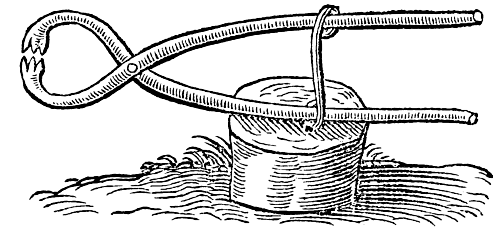
This instrument is not to be discommended, but to be held of good vse, either in binding grounds where the earth hardneth and houldeth the poale more then fast, or in the strength and heate of summer, when the drynesse of the mould will by no meanes suffer the poale to part from it: but otherwise it is néedlesse and may without danger be omitted.
As soone as you haue sufficiently set euery hill with poales, and that there is no disorder in your worke, you shall when the Hoppes beginne to climbe, note if their be any cyons or branches which doe forsake the poales, and rather shoote alongst the ground then looke vp to their supporters, and all such as you shall so finde, you shall as before I sayd, either with soft gréene rushes, or the gréene barke of Elder, tye them gently vnto the poales, and winde them about, in the same course that the sunne goes, as oft as conueniently you can: and this you shall doe euer after the dew is gone from the ground, and not before, and this must be done with all possible speede, for that cyon which is the longest before it take vnto the poale is euer the worst and brings forth his fruit in the worst season.
Of the Hils. Now, as touching the making of your hils, you shall vnderstand that although generally they are not made the first yéere, yet it is not amisse if you omit that scruple, and beginne to make your hils as soone as you haue placed your poales, for if your industry be answerable to the desert of the labour, you shall reape as good profit the first yéere, as either the second or the third. To beginne therefore to make your hils, you shall make you an instrument like a stubbing Hoe, which is a toole wherewith labourers stubbe rootes out of decayed woode-land grounds, onely this shall be somewhat broader and thinner, somewhat in fashion (though twice so bigge) vnto a Coopers Addes, with a shaft at least foure foote long: some onely for this purpose vse a fine paring spade, which is euery way as good, and as profitable, the fashion of which is in this figure.
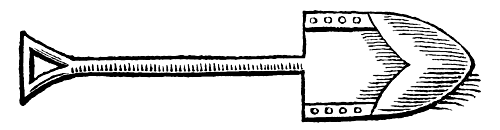
With this paring spade, or hoe, you shall pare vp the gréene-swarth and vppermost earth, which is in the alleyes betwéene the hils, and lay it vnto the rootes of the Hoppes, raising them vp like small Mole-hils, and so monthly increasing them all the yéere through, make them as large as the site of your ground will suffer, which is at least foure or fiue foote ouerthwart in the bottome, and so high as conueniently that height will carry: you shall not by any meanes this first yéere decay any cyons or branches which spring from the hils, but maintaine them in their growth, and suffer them to climbe vp the poales, but after the first yéere is expired you shall not suffer aboue two or thrée cyons, at the most, to rise vpon one poale. After your hils are made, which as before I sayd would be at least foure or fiue foote square in the bottome, and thrée foote high, you shall then diligently euery day attend your garden, and if you finde any branches that being risen more then halfe way vp the poales, doe then forsake them and spread outward, dangling downe, then you shall either with the helpe of a high stoole, on which standing you may reach the toppe of the poale, or else with a small forckt sticke, put vp the branch, and winde it about the poale: you shall also be carefull that no wéeds or other filthinesse grow about the rootes of your Hoppes to choake them, but vpon the first discouery to destroy them.
Chap. XIII. Of the gathering of Hoppes, and the preseruing of the Poales.
Touching the gathering of Hoppes you shall vnderstand that after Saint Margarets day they beginne to blossome, if it be in hot and rich soyles, but otherwise not till Lammas: likewise in the best soyles they bell at Lammas, in the worst at Michaelmas, and in the best earth they are full ripe at Michaelmas, in the worst at Martillmas; but to know when they are ripe indeede, you shall perceiue the séede to loose his gréene colour, and looke as browne as a Hares backe, wherefore then you shall with all dilligence gather them, and because they are a fruit that will endure little or no delay, as being ready to fall as soone as they be ripe, and because the exchange of weather may bréede change in your worke, you shall vpon the first aduantage of faire weather, euen so soone as you shall sée the dewe exhaled and drawne from the earth, get all the ayde of Men, Women, and children which haue any vnderstanding, to helpe you, and then hauing some conuenient empty barne, or shedde, made either of boards or canuas, neare to the garden, in which you shall pull your Hoppes, you shall then beginne at the nearest part of the garden, and with a sharpe garden knife cut the stalkes of the Hoppes asunder close by the toppes of the hils; and then with a straite forke of iron, made broad and sharpe, for the purpose, shere vp all the Hoppes, and leaue the poales naked. Then hauing labouring persons for the purpose, let them cary them vnto the place where they are to be puld; and in any case cut no more then presently is caryed away as fast as they are cut, least if a shower of raine should happen to fall, and those being cut and taking wet, are in danger of spoyling. You shall prouide that those which pull your Hoppes be persons of good discretion, who must not pull them one by one, but stripe them roundly through their hands into baskets, mixing the young budds and small leaues with them, which are as good as any part of the Hoppe whatsoeuer. After you haue pulled all your Hoppes and carried them into such conuenient dry roomes as you haue prepared for that purpose, you shall then spread them vpon cleane floares, so thinne as may be, that the ayre may passe thorrow them, least lying in heapes they sweat, and so mould, before you can haue leasure to dry them. After your Hoppes are thus ordered, you shall then cleanse your garden of all such Hoppe-straw, and other trash, as in the gathering was scattered therein: then shall you plucke vp all your Hoppe-poales, in manner before shewed, and hauing either some dry boarded house, or shed, made for the purpose, pile then one vpon another, safe from winde or weather, which howsoeuer some that would haue their experience, like a Collossus, séeme greater then it is, doe disalow, yet it is the best manner of kéeping of poales, and well worthy the charge: but for want of such a house, it shall not be amisse to take first your Hoppe-straw, and lay it a good thicknesse vpon the ground, and with sixe strong stakes, driuen slant-wise into the earth, so as the vppermost ends may be inward one to another, lay then your Hoppe-poales betwéene the stakes, and pile them one vpon another, drawing them narrower and narrower to the top, and then couer them all ouer with more Hoppe-straw, and so let them rest till the next March, at which time you shall haue new occasion to vse them.
Winter businesse. As soone as you haue piled vp your Hoppe-poales, dry and close, then you shall about mid-Nouember following throw downe your hils, and lay all your rootes bare, that the sharpenesse of the season may nip them, and kéepe them from springing too earely: you shall also then bring into the garden olde Cow-dunge, which is at least two yéeres olde, for no new dunge is good, and this you shall lay in some great heape in some conuenient place of the garden vntill Aprill, at which time, after you haue wound your Hoppes about your poales, you shall then bestow vpon euery hill two or thrée spade-full of the Manure mixt with earth, which will comfort the plant and make it spring pleasantly.
After your hils are puld downe, you shall with your garden spade, or your hoe, vndermine all the earth round about the roote of the Hoppe, till you come to the principall rootes thereof, and then taking the youngest rootes in your hand, and shaking away the earth, you shall sée how the new rootes grow from the olde sets, then with a sharpe knife cut away all those rootes as did spring the yéere before, out of your sets, within an inch and an halfe of the same, but euery yéere after the first you shall cut them close by the olde rootes. Now, if you sée any rootes which doe grow straight downward, without ioynts, those you shall not cut at all, for they are great nourishers of the plant, but if they grow outward, or side-wayes, they are of contrary natures, and must necessarily be cut away. If any of your Hoppes turne wilde, as oft it happens, which you shall know by the perfect rednesse of the branch, then you shall cut it quite vp, and plant a new roote in his place. After you haue cut and trimmed all your rootes, then you shall couer them againe, in such sort as you were taught at the first planting them, and so let them abide till their due time for poaling.
Chap. XIIII. Of drying, and not drying of Hoppes, and of packing them when they are dried.
Although there be much curiositie in the drying of Hoppes as well in the temperature of heate (which hauing any extremitie, as either of heate, or his contrary, bréedeth disorder in the worke) as also in the framing of the Ost or furnace after many new moulds and fashions, as variable as mens wits and experiences, yet because innouations and incertainty doth rather perplexe then profit, I will shunne, as much as in me lyeth, from loading the memory of the studious Husbandman with those stratagems which disable his vnderstanding from the attaining of better perfection, not disalowing any mans approued knowledge, or thinking that because such a man can mend smoking Chimnyes, therefore none but hée shall haue license to make Chimnyes, or that because some men can melt Mettall without winde, therefore it shall be vtterly vnlawfull to vse bellowes: these violent opinions I all together disacknowledge, and wish euery one the liberty of his owne thoughts, and for mine English Husband, I will shew him that way to dry his Hoppes which is most fit for his profit, safe, easie, and without extraordinary expences.
First then to speake of the time which is fittest for the drying of your Hoppes, it is immediately as soone as they are gotten, if more vrgent occasions doe not delay the businesse, which if they happen, then you haue a forme before prescribed how to preserue them from mouldinesse and putrifaction till you can compasse fit time to effect the worke in. The manner of drying them is vpon a Kilne, of which there be two sorts, that is to say, an English Kilne, and a French Kilne: the English Kilne being composed of woode, lath, and clay, and therefore subiect to some danger of fire, the French, of bricke, lime, and sand, and therefore safe, close, and without all perill, and to be preferred much before the other: yet because I haue hereafter more occasion to speake of the nature, fashion, and edifice of Kilnes in that part of this Volumne where I intreate of Malting, I will cease further to mention them then to say that vpon a Kilne is the best drying your Hoppes, after this manner, hauing finely bedded your Kilne with Wheate-straw, you shall lay on your hayre cloath, although some disallow it, but giue no reason therefore, yet it cannot be hurtfull in any degrée, for it neither distasteth the Hoppes, nor defendeth them from the fire, making the worke longer then it would, but it preserueth both the Hoppes from filthynesse, and their séede from losse: when your hayre-cloath is spread, you shall cause one to deliuer you vp your Hoppes in baskets, which you shall spread vpon the cloath, all ouer the Kilne, at the least eight inches thicke, and then comming downe, and going to the hole of the Kilne, you shall with a little dry straw kindle the fire, and then maintaining it with more straw, you shall kéepe a fire a little more feruent then for the drying of a kilne-full of Malt, being assured that the same quantitie of fuell, heate, and time, which dryeth a kilne-full of Malt, will also dry a kilne-full of Hoppes, and if your Kilne will dry twenty strikes, or bushels of Malt at one drying, then it will dry forty of Hoppes, because being layd much thicker the quantitie can be no lesse then doubled, which is a spéede all together sufficient, and may very well serue to dry more Hoppes then any one man hath growing in this kingdome.
Now, for as much as some men doe not alow to dry Hoppes with straw, but rather preferre woode, and of woode still to chuse the gréenest, yet I am of a contrary opinion, for I know by experience that the smoake which procéedeth from woode, (especially if it be greene woode) being a strong and sharpe vapour, doth so taint and infect the Hoppes that when those Hoppes come to be brewed with, they giue the drinke a smoakie taste, euen as if the Malt it selfe had beene woode-dryed: the vnpleasantnesse whereof I leaue to the iudgement of them that haue trauelled in York-shire, where, for the most part, is nothing but woode-dryed Malt onely.
That you may know when your Hoppes are dry inough, you shall take a small long sticke, and stirring the Hoppes too and fro with it, if the Hoppes doe russell and make a light noyse, each as it were seperating one from another, then they are altogether dry inough, but if in any part you finde them heauy or glewing one to another, then they haue not inough of the fire: also when they are sufficiently and moderately dryed they are of a bright-browne colour, little or nothing altered from that they held when they were vpon the stalke, but if they be ouer dryed, then their colour will be redde: and if they were not well ordered before they were dryed, but suffered either to take wet or mould, then they will looke blacke when they are dry.
Of the drying Hoppes. There be some which are of opinion that if you doe not dry your Hoppes at all, it shall be no losse, but it is an errour most grose, for if they be not dryed, there is neither profit in their vse, nor safty in preseruing them.
As soone as your Hoppes are sufficiently dryed, you shall by the plucking vp of the foure corners of your hayre-cloath thrust all your Hoppes together, and then putting them into baskets, carry them into such dry places as you haue prepared of purpose to lay them in, as namely, either in dry-fats, or in garners, made either of plaster, or boards: and herein you shall obserue to packe them close and hard together, which will be a meanes that if any of them be not dry, yet the heate they shall get by such lying will dry them fully and make them fit for seruice.
Of packing Hoppes. Now to conclude, if your store of Hoppes be so great that you shall trade or make Marchandize of them, then either to conuay them by land or Sea, it is best that you packe them into great bagges of canuas, made in fashion of those bagges which woole-men vse, and call them pockets, but not being altogether so large: these bagges you shall open, and either hang vp betwéene some crosse-beames, or else let downe into some lower floare, and then putting in your Hoppes cause a man to goe into the bagge and tread downe the Hoppes, so hard as is possible, pressing downe basket-full after basket-full, till the bagge be filled, euen vnto the toppe, and then with an extraordinary packe-thriede, sowing the open end of the bagge close together, let euery hollow place be crammed with Hoppes, whilst you can get one hand-full to goe in, and so hauing made euery corner strong and fast, let them lye dry till you haue occasion either to shippe or cart them. And thus much for the ordering of Hoppes, and their vses.
Chap. XV. The office of the Gardiner, and first of the Earth, Situation, and fencing of a Garden for pleasure.
There is to be required at the hands of euery perfect Gardiner thrée especiall vertues, that is to say, Diligence, Industry, and Art: the two first, as namely, Diligence (vnder which word I comprehend his loue, care, and delight in the vertue hee professeth) and Industry (vnder which word I conclude his labour, paine, and study, which are the onely testimonies of his perfection) hée must reape from Nature: for, if hée be not inclined, euen from the strength of his blood to this loue and labour, it is impossible he should euer proue an absolute gardiner: the latter, which containeth his skill, habit, and vnderstanding in what hée professeth, I doubt not but hée shall gather from the abstracts or rules which shall follow hereafter in this Treatise, so that where nature, and this worke shall concurre in one subiect, there is no doubt to be made, but the professor shall in all points, be able to discharge a sufficient dutie.
Now, for as much as all our antient and forraine writers (for wée are very sleightly beholding to our selues for these indeauours) are excéeding curious in the choise of earth, and situation of the plot of ground which is méete for the garden: yet I, that am all English Husbandman, and know our soyles out of the worthinesse of their owne natures doe as it were rebell against forraine imitation, thinking their owne vertues are able to propound their owne rules: and the rather when I call into my remembrance, that in all the forraine places I haue séene, there is none more worthy then our owne, and yet none ordered like our owne, I cannot be induced to follow the rules of Italie, vnlesse I were in Italie, neither those of France, vnlesse I dwelt in France, nor those of Germany except in Germany I had my habitation, knowing that the too much heate of the one, or the too much coldnesse of the other, must rather confound then help in our temperate climate: whence it comes, that our english booke-knowledge in these cases is both disgraced and condemned, euery one fayling in his experiments, because he is guided by no home-bredde, but a stranger; as if to reade the english tongue there were none better then an Italian Pedant. This to auoide, I will neither begge ayde nor authoritie from strangers, but reuerence them as worthies and fathers of their owne Countries.
Of the ground. To speake therefore first of the ground which is fit for the garden, albeit the best is best worthy, the labour least, and the profit most certaine, yet it is not méete that you refuse any earth whatsoeuer, both because a garden is so profitable, necessary, and such an ornament and grace to euery house and house-kéeper, that the dwelling place is lame and maymed if it want that goodly limbe, and beauty. Besides, if no gardens should be planted but in the best and richest soyles, it were infinite the losse we should sustaine in our priuate profit, and in the due commendations, fit for many worthy workmen, who haue reduced the worst and barrainest earths to as rare perfection and profit as if they had béene the onely soyles of this kingdome: and for mine owne part, I doe not wonder either at the worke of Art or Nature, when I behould in a goodly, rich, and fertill soyle, a garden adorned with all the delights and delicacies which are within mans vnderstanding, because the naturall goodnesse of the earth (which not induring to be idle) will bring forth whatsoeuer is cast into her: but when I behould vpon a barraine, dry, and deiected earth, such as the Peake-hils, where a man may behould Snow all summer, or on the East-mores, whose best hearbage is nothing but mosse, and iron stone, in such a place, I say, to behould a delicate, rich, and fruitfull garden, it shewes great worthinesse in the owner, and infinite Art and industry in the workeman, and makes me both admire and loue the begetters of such excellencies.
But to returne to my purpose touching the choise of your earth for a garden, sith no house can conueniently be without one, and that our English Nation is of that great popularitie, that not the worst place thereof but is abundantly inhabited, I thinke it méete that you refuse no earth whatsoeuer to plant your garden vpon, euer obseruing this rule, that the more barraine it is, the more cost must be bestowed vpon it, both in Manuring, digging, and in trenching, as shall be shewed hereafter, and the more rich it is, lesse cost of such labour, and more curiositie in wéeding, proyning, and trimming the earth: for, as the first is too slow, so the latter is too swift, both in her increase and multiplication.
Now, for the knowledge of soyles, which is good, and which is badde, I haue spoken sufficiently already in that part which intreateth of Tillage, onely this one caueat I will giue you, as soone as you haue markt out your garden-plot, you shall turne vp a sodde, and taking some part of the fresh mould, champe it betwéene your téeth in your mouth, and if it taste swéetish then is the mould excellent good and fit to receiue either seedes or plants, without much Manuring, but if it taste salt or bitter, then it is a great signe of barrainenesse, and must of necessitie be corrected with Manure: for saltnesse sheweth much windinesse, which choaketh and stifleth the séede, and bitternesse that vnnaturall heate which blasteth it before it sprout.
Of the situation. Now, for the situation of the garden-plot for pleasure, you shall vnderstand that it must euer be placed so neare vnto the dwelling house as is possible, both because the eye of the owner may be a guard and support from inconueniences, as also that the especiall roomes and prospects of the house may be adorned, perfumed, and inriched, with the delicate proportions, odorifferous smells, and wholsome ayres which shall ascend and vaporate from the same, as may more amply be séene in that former Chapter, where modelling forth the Husbandmans house, I shew you the site and place for his Garden, onely you must diligently obserue, that neare vnto this garden doe not stand any houells, stackes of hay, or Corne, which ouer-pearing the walls, or fence, of the same, may by reason of winde, or other occasion, annoy the same with straw, chaffe, séedes, or such like filthinesse, which doth not onely blemish the beauty thereof, but is also naturally very hurtfull and cankerous to all plants whatsoeuer. Within this garden plot would be also either some Well, Pumpe, Conduit, Pond, or Cesterne for water, sith a garden, at many times of the yéere, requireth much watering: & this place for water you shall order and dispose according to your abillitie, and the nature of the soyle, as thus: if both your reputation, and your wealth be of the lowest account, if then your garden aford you a plaine Well, comely couered, or a plaine Pump, it shall be sufficient, or if for want of such springs you digge a fayre Pond in some conuenient part thereof, or else (which is much better) erect a Cesterne of leade, into which by pippes may discend all the raine-water which falls about any part of the house, it will serue for your purpose: but if God haue bestowed vpon you a greater measure of his blessings, both in wealth & account, if then insteade of either Well, Pumpe, Pond, or Cesterne, you erect Conduits, or continuall running Fountaines, composed of Antique workes, according to the curiositie of mans inuention, it shall be more gallant and worthy: and these Conduits or water-courses, you may bring in pippes of leade from other remote or more necessary places of water springs, standing aboue the leuell of your garden, as euery Artist in the profession of such workes can more amply declare vnto you, onely for mée let it be sufficient to let you vnderstand that euery garden would be accompanied with water.
Also you shall haue great care that there adioyne not vnto your garden-plot any common-shewers, stinking or muddy dikes, dung-hils, or such like, the annoyance of whose smells and euill vapors doth not onely corrupt and bréede infection in man, but also cankereth, killeth and consumeth all manner of plants, especially those which are most pleasant, fragrant, and odorifferous, as being of tenderest nature and qualitie: and for this cause diuers will not alow the moating of garden-plots about, imagining that the ouer great moistnesse thereof, and the strong smells which doe arise from the mudde in the Summer season, doe corrupt and putrifie the hearbes and plants within the compasse of the same, but I am not altogether of that opinion, for if the water be swéet, or the channell thereof sandy or grauelly, then there is no such scruple to be taken: but if it be contrary, then it is with all care to be auoyded, because it is euer a Maxime in this case, that your garden-plot must euer be compassed with the pleasantest and swéetest ayre that may be.
The windes which you shall generally defend from your garden, are the Easterne windes and the Northerne, because they are sharpest, coldest, and bring with them tempers of most vnseasonablenesse, & albeit in Italie, Spaine, and such like hot Countries, they rather defend away the Westerne and Southerne winde, giuing frée passage to the East and North, yet with England it may not be so, because the naturall coldenes of our Climate is sufficient without any assistance to further bitternesse, our best industry being to be imployed rather to get warmth, which may nourish and bring forth our labours, then any way to diminish or weaken the same.
This plot of ground also would lye, as neare as you can, at the foote or bottome of an hill, both that the hill may defend the windes and sharpe weather from the same, as also that you may haue certaine ascents or risings of state, from leuell to leuell, as was in some sort before shewed in the plot for the Orchard, and shall be better declared in the next Chapter.
Of fencing the garden. Now lastly for the fencing or making priuate the garden-plot, it is to be done according to your abillitie, and the nature of the climate wherein you liue: as thus, if your reuenewes will reach thereunto, and matter be to be got, for that purpose, where you liue, then you shall vnderstand that your best fence is a strong wall, either of Bricke, Ashler, rough-Stone, or Earth, of which you are the best-owner, or can with least dammage compasse: but for want either of earth to make bricke, or quarries out of which to get stone, it shall not then be amisse to fence your garden with a tall strong pale of seasoned Oake, fixt to a double parris raile, being lined on the inside with a thicke quicke-set of white-Thorne, the planting whereof shall be more largely spoken of where I intreate of fencing onely. But if the place where you liue in, be so barraine of timber that you cannot get sufficient for the purpose, then you shall make a studde wall, which shall be splinted and lomed both with earth and lime, and hayre, and copt vpon the toppe (to defend away wet) either with tile, slate, or straw, and this wall is both beautifull, and of long continuance, as may be séene in the most parts of the South of this kingdome: but if either your pouerty or climate doe deny you timber for this purpose, you shall then first make a small trench round about your garden-plot, and set at least foure rowes of quicke-set of white-Thorne, one aboue another, and then round about the outside, to defend the quick-set, make a tall fence of dead woode, being either long, small, brushy poales prickt into the earth, and standing vpright, and so bound together in the wast betwéene two other poales, according to the figure set downe,
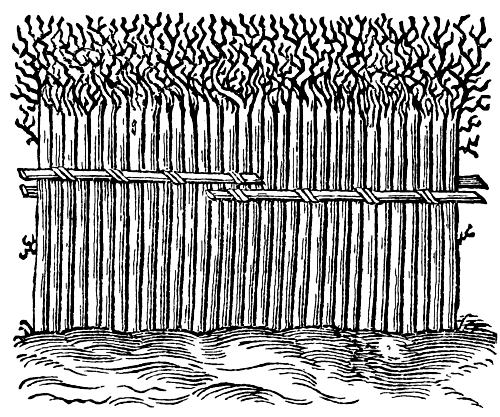
being so high that not any kinde of Pullen may flie ouer the same, or else an ordinary hedge of common woode, being beyrded vpon the toppe with sharpe Thornes, in such wise that not any thing may dare to aduenture ouer it: and this dead fence you shall repaire and maintaine as occasion shall require from time to time, till your quicke-set be growne vp, and, by continuall plashing and interfouldings, be made able and sufficient to fence and defend your garden, which will be within fiue or seauen yeeres at the most, and so continue with good order for euer. And thus much for the situation of gardens.
Chap. XVI. Of the fashion of the garden-plot for pleasure, the Alleyes, Quarters, Digging and Dungging of the same.
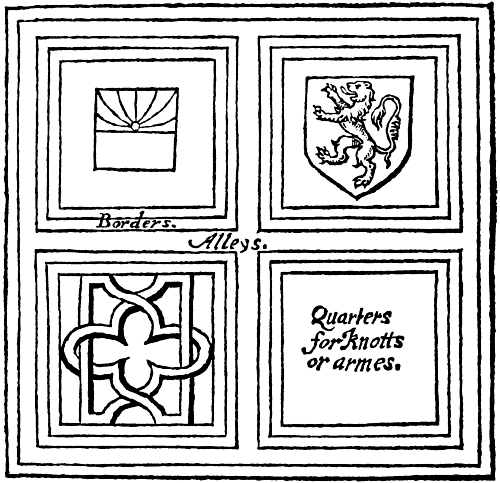
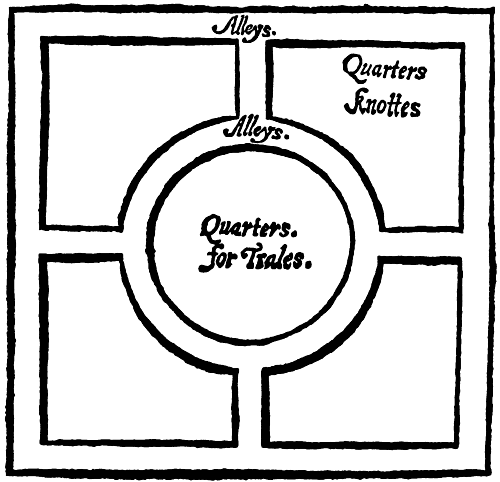
After you haue chosen out and fenced your garden-plot, according as is before sayd, you shall then beginne to fashion and proportion out the same, sith in the conuayance remaineth a great part of the gardiners art. The fashion. And herein you shall vnderstand that there be two formes of proportions belonging to the garden, the first, onely beautifull, as the plaine, and single square, contayning onely foure quarters, with his large Alleyes euery way, as was discribed before in the Orchard: the other both beautifull and stately, as when there is one, two or thrée leuelled squares, each mounting seauen or eight steppes one aboue another, and euery square contayning foure seuerall Quarters with their distinct and seuerall Alleyes of equall breadth and proportion; placing in the center of euery square, that is to say, where the foure corners of the foure Quarters doe as it were neighbour and méete one another, either a Conduit of antique fashion, a Standard of some vnusuall deuise, or else some Dyall, or other Piramed, that may grace and beautifie the garden. And herein I would haue you vnderstand that I would not haue you to cast euery square into one forme or fashion of Quarters or Alleyes, for that would shew little varytie or inuention in Art, but rather to cast one in plaine Squares, another in Tryangulars, another in roundalls, & so a fourth according to the worthinesse of conceite, as in some sort you may behould by these figures, which questionlesse when they are adorned with their ornaments, will breed infinite delight to the beholders.
The Plaine Square.
The Square Triangular or circular.
The Square of eight Diamonds.
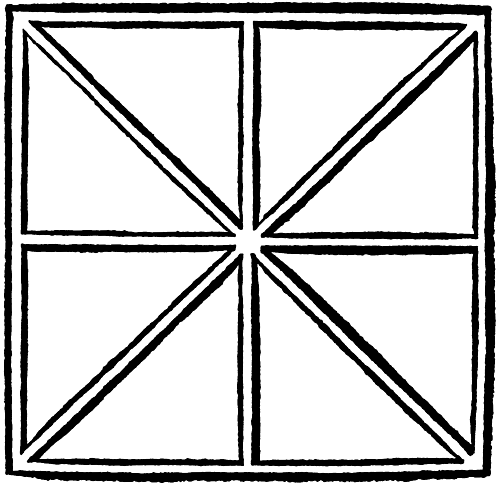
From the modell of these Squares, Tryangles, and Rounds, any industrious braine may with little difficulty deriue and fashion to himselfe diuers other shapes and proportions, according to the nature and site of the earth, which may appeare more quaint and strange then these which are in our common vse, albeit these are in the truth of workmanship the perfect father and mother of all proportions whatsoeuer.
The ordering of Alleyes. Now, you shall vnderstand that concerning the Alleyes and walkes in this garden of pleasure, it is very méete that your ground, being spacious and large, (which is the best beauty) that you cut through the midst of euery Alley an ample and large path or walke, the full depth of the roote of the gréene-swarth, and at least the breadth of seauen or eight foote: and in this path you shall strow either some fine redde-sand, of a good binding nature, or else some fine small grauell, or for want of both them you may take the finest of your pit-coale-dust, which will both kéepe your Alleyes dry and smooth, and also not suffer any grasse or gréene thing to grow within them, which is disgracefull, if it be suffered: the French-men doe vse, to couer their Alleyes, either with the powder of marble, or the powder of slate-stone, or else paue them either with Pit-stone, Frée-stone, or Tiles, the first of which is too hard to get, the other great cost to small purpose, the rather sith our owne grauell is in euery respect as beautifull, as dry, as strong, and as long lasting: Onely this héedfulnesse you must diligently obserue, that if the situation of your garden-plot be low and much subiect to moisture, that then these middle-cut paths or walkes must be heightned vp in the midst, and made in a proportionall bent or compasse: wherein you shall obserue that the out most verdges of the walke must be leuell with the gréene-swarth which holded in each side, and the midst so truly raised vp in compasse, that the raine which falles may haue a passage to each side of the gréene-swarth. Now, the lesse this compasse is made (so it auoyde the water, and remaine hard) the better it is, because by that meanes both the eye shall be deceiued (which shewes art in the workman) and the more leuell they are, the more ease vnto them which shall continually walke vpon them.
Obiection. Now, if any shall obiect, why I doe not rather couet to haue these Alleyes or walkes rather all gréene, then thus cut and deuided, sith it is a most beautifull thing to see a pleasant gréene walke, my answere is this, that first the mixture of colours, is the onely delight of the eye aboue all other: for beauty being the onely obiect in which it ioyeth, that beautie is nothing but an excellent mixture, or consent of colours, as in the composition of a delicate woman the grace of her chéeke is the mixture of redde and white, the wonder of her eye blacke and white, and the beauty of her hand blewe and white, any of which is not sayd to be beautifull if it consist of single or simple colours: and so in these walkes, or Alleyes, the all gréene, nor the all yealow cannot be sayd to be most beautifull, but the gréene and yealow, (that is to say, the vntroade grasse, and the well knit grauell) being equally mixt, giue the eye both luster and delight beyonde all comparison.
Againe, to kéepe your walkes all gréene, or grassy, you must of force either forbeare to tread vpon them, (which is the vse for which they were onely fashioned,) or treading vpon them you shall make so many pathes and ilfauored wayes as will be most vglie to the eye: besides the dewe and wet hanging vpon the grasse will so annoy you, that if you doe not select especiall howers to walke in, you must prouide shooes or bootes of extraordinary goodnesse: which is halfe a depriuement of your liberty, whereas these things of recreation were created for a contrary purpose.
Now, you shall also vnderstand that as you make this sandy and smooth walke through the midst of your Alleyes, so you shall not omit but leaue as much gréene-swarth, or grasse ground of eache side the plaine path as may fully counteruaile the breadth of the walke, as thus for example: if your sandy walke be sixe foote broad, the grasse ground of each side it, shall be at least sixe foote also, so that the whole Alley shall be at least eightéene foote in breadth, which will be both comely and stately.
Of the Quarters. Your Alleyes being thus proportioned and set forth, your next worke shall be the ordering of your Quarters, which as I sayd before, you may frame into what proportions you please, as into Squares, Tryangles and Rounds, according to the ground, or your owne inuention: and hauing marked them out with lines, and the garden compasse, you shall then beginne to digge them in this manner: first, with a paring spade, the fashion whereof is formerly shewed, you shall pare away all the gréene-swarth, fully so déepe as the roote of the grasse shall goe, and cast it away, then with other digging spades you shall digge vp the earth, at least two foote and a halfe, or thrée foote déepe, in turning vp of which earth, you shall note that as any rootes of wéedes, or other quickes shall be raised or stirred vp, so presently with your hands to gather them vp, and cast them away, that your mould may (as neare as your dilligence can performe it) be cleane from either wilde rootes, stones, or such like offences: & in this digging of your Quarters you shall not forget but raise vp the ground of your Quarters at least two foote higher then your Alleyes, and where by meanes of such reasure, you shall want mould, there you shall supply that lacke by bringing mould and cleane earth from some other place, where most conueniently you may spare it, that your whole Quarter being digged all ouer, it may rise in all parts alike, and carry an orderly and well proportioned leuell through the whole worke.
Of Dunging. The best season for this first digging of your garden mould is in September: and after it is so digged and roughly cast vp, you shall let it rest till the latter end of Nouember, at what time you shall digge it vp againe, in manner as afore sayd, onely with these additions, that you shall enter into the fresh mould, halfe a spade-graft déeper then before, and at euery two foote breadth of ground, enlarging the trench both wide and déepe, fill it vp with the oldest and best Oxe or Cow-Manure that you can possibly get, till such time that increasing from two foote to two foote, you haue gone ouer and Manured all your quarters, hauing a principall care that your dunge or Manure lye both déepe and thicke, in so much that euery part of your mould may indifferently pertake and be inriched with the same Manure.
Diuersitie of Manures. Now, you shall vnderstand that although I doe particularly speake but of Oxe or Cow-Manure, because it is of all the fattest and strongest, especially being olde, yet their are diuers respects to be had in the Manuring of gardens: as first, if your ground be naturally of a good, fat, blacke, and well tempered earth, or if it be of a barraine, sandy, hot, yet firme mould, that in either of these cases your Oxe, Cow, or beast Manure is the best & most sufficient, but if it be of a colde, barraine, or spewing mould then it shall be good to mixe your Oxe-dunge with Horse-dunge, which shall be at least two yéeres olde, if you can get it, otherwise such as you can compasse: if your ground be good and fertill yet out of his drynesse in the summer-time it be giuen to riue and chappe as is séene in many earths; you shall then mixe your Oxe-dunge well with Ashes, orts of Lime, and such like: lastly, if your earth be too much binding and colde therewithall, then mixe your Oxe-dunge with chalke or marle and it is the best Manure. And thus much for the generall vse of earths.
Now, for perticular vses you shall vnderstand that for Hearbs or Flowers the Oxe and Horse-dunge is the best, for rootes or Cabbages, mans ordure is the best, for Harty-chockes, or any such like thisly-fruit, Swines-dunge is most sufficient, and thus according to your setled determination you shall seuerally prouide for euery seuerall purpose, and so, God assisting, seldome faile in your profit. And this dunge you shall bring into your garden in little drumblars or whéele-barrowes, made for the purpose, such as being in common vse in euery Husbandmans yarde it shall be néedlesse here either to shew the figure or proportion thereof. And thus much for the fashion, digging, and dunging of gardens.
Chap. XVII. Of the adornation and beautifying of the Garden for pleasure.
The adornation and beautifying of gardens is not onely diuers but almost infinite, the industry of mens braines hourely begetting and bringing forth such new garments and imbroadery for the earth, that it is impossible to say this shall be singular, neither can any man say that this or that is the best, sith as mens tastes so their fancies are carried away with the varietie of their affections, some being pleased with one forme, some with another: I will not therefore giue preheminence to any one beauty, but discribing the faces and glories of all the best ornaments generaly or particularly vsed in our English gardens, referre euery man to the ellection of that which shall best agrée with his fancy.
Of Knots and Mazes. To beginne therefore with that which is most antient and at this day of most vse amongst the vulgar though least respected with great ones, who for the most part are wholy giuen ouer to nouelties: you shall vnderstand that Knots and Mazes were the first that were receiued into admiration, which Knots or Mazes were placed vpon the faces of each seuerall quarter, in this sort: first, about the verdge or square of the quarter was set a border of Primpe, Boxe, Lauandar, Rose-mary, or such like, but Primpe or Boxe is the best, and it was set thicke, at least eightéene inches broad at the bottome & being kept with cliping both smooth and leuell on the toppe and on each side, those borders as they were ornaments so were they also very profitable to the huswife for the drying of linnen cloaths, yarne, and such like: for the nature of Boxe and Primpe being to grow like a hedge, strong and thicke, together, the Gardiner, with his sheares may kéepe it as broad & plaine as himselfe listeth. Within this border shall your knot or maze be drawne, it being euer intended that before the setting of your border your quarter shall be the third time digged, made exceeding leuell, and smooth, without clot or stone, and the mould, with your garden rake of iron, so broken that it may lye like the finest ashes, and then with your garden mauls, which are broad-boards of more then two foote square set at the ends of strong staues, the earth shall be beaten so hard and firme together that it may beare the burthen of a man without shrinking. And in the beating of the mould you shall haue all diligent care that you preserue and kéepe your leuell to a hayre, for if you faile in it, you faile in your whole worke.
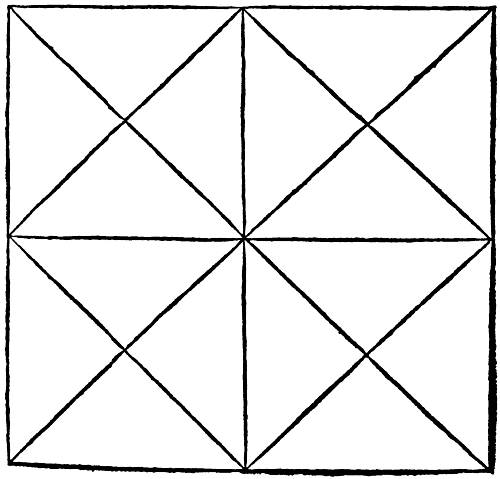
Now for the time of this labour, it is euer best about the beginning of February, and indifferent, about the midst of October, but for the setting of your Primpe, or Boxe-border, let the beginning of Nouember be your latest time, for so shall you be sure that it will haue taken roote, and the leafe will flourish in the spring following: at which time your ground being thus artificially prepared, you shall begin to draw forth your knot in this manner: first, with lines you shall draw the forme of the figure next before set downe, and with a small instrument of iron make it vpon the earth.
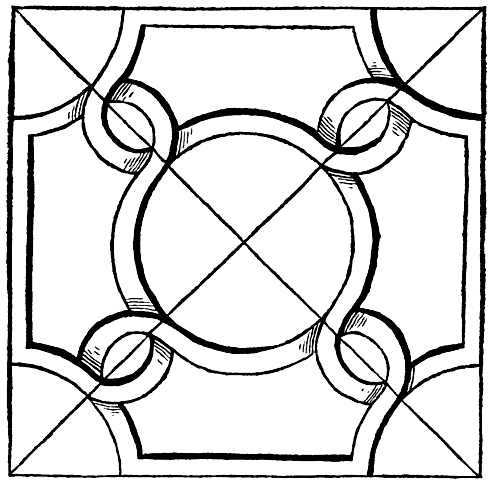
Which done, from the order and proportion of these lines you shall draw your single knots or plaine knots of the least curiositie, as may appeare by this figure, being one quarter of the whole Knot: euer proportioning your Trayles and windings according to the lines there discribed, which will kéepe your worke in iust proportion.
But if you desire to haue knots of much more curiositie being more double and intricate, then you shall draw your first lines after this proportion here figured, pinning downe euery line firme to the earth with a little pinne made of woode.
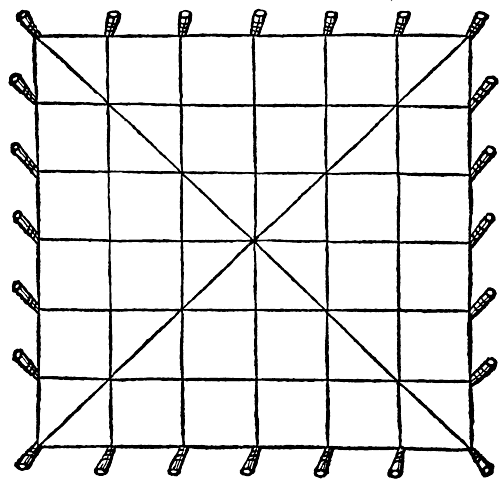
Which done you shall draw your double and curious knots after the manner of the figure following, which is also but one quarter of the whole knot, for looke in what manner you doe one knot in like sort will the other thrée quarters succéede, your lines kéeping you in a continuall euen proportion.
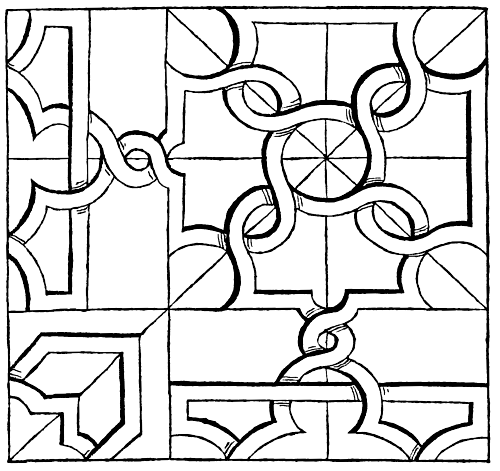
And in this manner as you draw these knots, with the like helps and lines also you shall draw out your Mazes, and laborinths, of what sort or kind soeuer you please, whether they be round or square. But for as much, as not onely the Country-farme, but also diuers other translated bookes, doe at large describe the manner of casting and proportioning these knots, I will not persist to write more curiously vpon them, but wish euery painefull gardiner which coueteth to be more satisfied therein, to repaire to those authors, where hée shall finde more large amplifications, and greater diuersities of knots, yet all tending to no more purpose then this which I haue all ready written.
Now, as soone as you haue drawne forth and figured your knot vpon the face of your quarter, you shall then set it either with Germander, Issoppe, Time or Pinke-gilly-flowers, but of all hearbes Germander is the most principall best for this purpose: diuers doe vse in knots to set Thrift, and in time of néed it may serue, but it is not so good as any of the other, because it is much subiect to be slaine with frost, and will also spread vpon the earth in such sort that, without very painefull cutting, it will put your knot out of fashion.
Now there is another beautifying or adorning of Gardens, and it is most generally to be séene in the gardens of Noblemen and Gentlemen, which may beare coate-armor, and that is, instead of the knots and mazes formerly spoken of, to draw vpon the faces of your quarters such Armes, or Ensines, as you may either beare your selfe, or will preserue for the memory of any friend: and these armes being drawne forth in plaine lines, you shall set those plaine shadowing lines either with Germander, Issop, or such like hearbes: and then for the more ample beautie thereof, if you desire to haue them in their proper and liuely colours (without which they haue but one quarter of their luster) you shall vnderstand that your colours in Armory are thus to be made. Yeallow. First, for your mettalls: you shall make your Yeallow, either of a yeallow clay, vsually to be had almost in euery place, or the yeallowest sand, or for want of both, of your Flanders Tile, which is to be bought of euery Iron-monger or Chandelor; and any of these you must beate to dust: White. for your White you shall make it of the coursest chalke beaten to dust, or of well burnt plaister, or, for necessity, of lime, but that will soone decay: Blacke. Red. Blew. your Blacke is to be made of your best and purest coale-dust, well clensed and sifted: your Red is to be made of broken vselesse brickes beaten to dust, and well clensed from spots: your Blew is to be made of white-chalke, and blacke coale dust mixed together, till the blacke haue brought the white to a perfect blewnes: Greene. lastly your Gréene, both for the naturall property belonging to your Garden, as also for better continuance and long lasting, you shall make of Camomill, well planted where any such colour is to be vsed, as for the rest of the colours, you shall sift them, and strow them into their proper places, and then with a flat beating-Béetell you shall beate it, and incorporate it with the earth, and as any of the colours shall decay, you shall diligently repaire them, and the luster will be most beautifull.
There is also another beautifying of gardens, which although it last not the whole yéere, yet it is most quaint, rare, and best eye-pleasing, and thus it is: you shall vpon the face of your quarter draw a plaine double knot, in manner of billet-wise: for you shall vnderstand that in this case the plainest knot is the best, and you shall let it be more then a foote betwixt line and line (for in the largenesse consists much beauty) this knot being scored out, you shall take Tiles, or tileshreds and fixe them within the lines of your knot strongly within the earth, yet so as they may stand a good distance aboue the earth and this doe till you haue set out all your knot with Tile: then precisely note the seuerall passages of your knot, and the seuerall thrids of which it consisteth, and then betwixt your tiles, (which are but as the shadowing lines of your knot) plant in euery seuerall third, flowers of one kinde and colour, as thus for example: in one thrid plant your carnation Gilly-flower, in another your great white Geli flower, in another your mingle-coloured Gilly-flower, and in another your blood-red Gilly-flower, and so likewise if you can compasse them you may in this sort plant your seueral coloured Hyacinths, as the red, the blew, and the yealow, or your seuerall coloured Dulippos, and many other Italian and french flowers: or you may, if you please, take of euery seuerall plant one, and place them as afforesaid; the grace of all which is, that so soone as these flowers shall put forth their beauties, if you stand a little remote from the knot, and any thing aboue it, you shall sée it appeare like a knot made of diuers coloured ribans, most pleasing and most rare.
Many other adornations and beautifyings there are which belong to the setting forth of a curious garden, but for as much as none are more rare or more estéemed then these I haue set downe, being the best ornaments of the best gardens of this kingdome, I thinke them tastes sufficient for euery husbandman, or other of better quality which delighteth in the beauty and well trimming of his ground.
Chap. XVIII. How for the entertainment of any great Person, in any Parke, or other place of pleasure, where Sommer-bowers are made, to make a compleat Garden in two or three dayes.
If the honest English husbandman, or any other, of what quallity soeuer, shall entertaine any Noble personage, to whom hee would giue the delight of all strange contentment, either in his Parke, or other remote place of pleasure, néere vnto Ponds, Riuer, or other waters of cléerenesse, after hée hath made his arbors and Summer-bowers to feast in, the fashion whereof is so common that euery labourer can make them, hée shall then marke out his garden-plot, bestowing such sleight fence thereon as hée shall thinke fit: then hée shall cast forth his alleys, and deuide them from his quarters, by paring away the gréene-swarth with a paring spade, finely, and euen, by a direct line (for a line must euer be vsed in this worke) then hauing store of labourers (after the vpper-most swarth is taken away) you shall cast vp the quarters, and then breaking the mould and leuelling it, you shall make sad the earth againe, then vpon your quarters you shall draw forth either Knots, Armes, or any other deuise which shall be best pleasing to your fancie, as either knots with single or double trayles, or other emblemicall deuise, as Birds, Beasts, and such like: and in your knots where you should plant hearbes, you shall take gréene-sods of the richest grasse, and cutting it proportionably to the knot, making a fine trench, you shall lay in your sod, and so ioyning sod to sod close and arteficially, you shall set forth your whole knot, or the portrayture of your armes, or other deuise, and then taking a cleane broome that hath not formerly béene swept withall, you shall brush all vncleanenesse from the grasse, and then you shall behold your knot as compleat, and as comely as if it had béene set with hearbes many yéeres before. Now for the portrayture of any liuing thing, you shall cut it forth, ioyning sod vnto sod, and then afterward place it into the earth. Now if within this plot of ground which you make your garden piece there be either naturall or arteficiall mounts or bankes vpon them, you may in this selfe-same manner with gréene sods set forth a flight, either at field or riuer, or the manner of hunting of any chase, or any story, or other deuise that you please, to the infinit admiration of all them which shall behold it: onely in working against mounts or bankes you must obserue to haue many small pinnes, to stay your worke and kéepe your sods from slipping one from another, till such time as you haue made euery thing fast with earth, which you must rame very close and hard: as for Flowers, or such like adorments, you may the morning before, remoue them with their earth from some other garden, and plant them at your best pleasure. And thus much for a garden to be made in the time of hasty necessity.
Chap. XIX. How to preserue Abricots, or any kinde of curious outlandish-stone-fruit, and make them beare plentifully be the Spring or beginning of Summer neuer so bitter.
I haue knowne diuers Noblemen, Gentlemen & men of vnder quallitie, that haue béene most laborious how to preserue these tender stone-fruits from the violence of stormes, frost and windes, and to that end haue béene at great cost and charges yet many times haue found much losse in their labours, wherefore in the end, through the practise of many experiments, this hath béene found (which I will here set downe) the most approuedst way to make them beare without all kinde of danger. After you haue planted your Abricot, or other delicate fruit, and plasht him vp against a wall in manner as hath béene before declared, you shall ouer the tops of the trées all along the wall, build a large pentisse, of at least sixe or seauen foote in length: which pentisse ouer-shaddowing the trées, will, as experience hath found out, so defend them, that they will euer beare in as plentifull manner as they haue done any particular yéere before. There be many that will scoffe, or at least, giue no credit to this experiment, because it carrieth with it no more curiositie, but I can assure thée that art the honest English Husbandman, that there is nothing more certaine and vnfallible, for I haue séene in one of the greatest Noblemens gardens in the kingdome, where such a pentisse was made, that so farre as the pentisse went, so farre the trées did prosper with all fruitfulnesse, and where the pentisse ended, not one trée bare, the spring-time being most bitter and wonderfull vnseasonable.
Now I haue séene some great Personages (whose pursses may buy their pleasures at any rate) which haue in those pentisses fixed diuers strong hookes of Iron, and then made a canuasse of the best Poldauie, with most strong loopes, of small corde, which being hung vpon the Iron hookes, hath reacht from the pentisse to the ground, and so laced with corde and small pulleys, that like the saile of a ship it might be trust vp, and let downe at pleasure: this canuasse thus prepared is all the Spring and latter end of Winter to be let downe at the setting of the Sunne, and to be drawne vp at the rising of the Sunne againe. The practise of this I referre to such as haue abillitie to buy their delight, without losse, assuring them that all reason and experience doth finde it most probable to be most excellent, yet to the plaine English Husbandman I giue certaine assurance that the pentisse onely is sufficient enough and will defend all stormes whatsoeuer. And thus much for the preseruation and increase of all tender Stone-fruit, of what nature, or climbe bred, soeuer.
Chap. XX. How to make Grapes grow as bigge, full, and as naturally, and to ripen in as due season, and be as long lasting as either in Fraunce or Spaine.
Diuers of our English Gardiners, and those of the best and most approued'st iudgements, haue béene very industrious to bring Grapes, in our kingdome, to their true nature and perfection: and some great persons I know, that with infinit cost, and I hope prosperous successe, hath planted a Vineyard of many Acres, in which the hands of the best experienced french-men hath béene imploied: but for those great workes they are onely for great men, and not for the plaine English Husbandman, neither will such workes by any meanes prosper in many parts of our kingdome, especially in the North parts: and I that write for the generall vse, must treate of vniuersall Maximes: therefore if you desire to haue Grapes in their true and best kinde, most earely and longest lasting, you shall in the most conuenient part of your garden, which is euer the center or middle point thereof, build a round house, in the fashion of a round Doue-coate, but many degrées lower, the ground worke whereof shalbe aboue the ground two or thrée brickes thickenesse, vpon this ground-plot you shall place a groundsell, and thereon, fine, yet strong studs, which may reach to the roofe: these studs shalbe placed better then foure foote one from another, with little square bars of woode, such as you vse in glasse windowes, two betwixt euery two studs, the roofe you may make in what proportion you will, for this house may serue for a delicate banqueting house, and you may either couer it with Leade, Slate or Tile, which you please. Now, from the ground to the top, betwéene the studs, you shall glase it, with very strong glasse, made in an excéeding large square pane, well leaded and cimented. This house thus made, you shall obserue that through the bricke worke there be made, betwéene euery two studs, square holes, cleane through into the house; then on the out-side, opposite against those holes, you shall plant the roote of your Vine, hauing béene very carefull in the election and choise thereof: which done, as your Vine groweth you shall draw it through those holes, and as you vse to plash a Vine against a wall, so you shall plash this against the glasse window, on the in-side, and so soone as it shall beginne to beare Grapes you shall be sure to turne euery bunch, so that it may lye close to the glasse, that the reflection of the Sunne heating the glasse, that heate may hasten on the ripening, & increase the groath of your Grapes: as also the house defending off all manner of euill weather, these Grapes will hang ripe, vnrotted or withered, euen till Christmas. Thus haue I giuen you a tast of some of the first parts of English Husbandry, which if I shall finde thankefully accepted, if it please God to grant mée life, I will in my next Volumne, shew you the choise of all manner of Garden Hearbes and Flowers, both of this and other kingdomes, the seasons of their plantings, their florishings and orderings: I will also shew you the true ordering of Woodes, both high and low, as also the bréeding and féeding of all manner of Cattell, with the cure of all diseases incident vnto them, together with other parts of Husbandry, neuer before published by any Author: this I promise, if God be pleased: to whom be onely ascribed the glory of all our actions, and whose name be praised for euer. Amen.