Front matter
Reading edition
William J. Flynn Recently Retired Chief of the U.S. Secret Service
THE
EAGLE'S EYE
A True Story of the Imperial German Government's Spies and Intrigues in America from facts furnished
BY
WILLIAM J. FLYNN
Recently Retired
Chief of the U.S. Secret Service
NOVELIZED BY
COURTNEY RYLEY COOPER
ILLUSTRATED
NEW YORK
PROSPECT PRESS, Inc.
186-192 West 4th Street
Copyright, 1919, by
PROSPECT PRESS, Inc.
CONTENTS
Chapter Page
I. The Hidden Death 7
II. The Naval Ball Conspiracy 29
III. The Plot Against the Fleet 50
IV. Von Rintelen—the Destroyer 71
V. The Strike Breeders 91
VI. The Plot Against Organized Labor 113
VII. The Brown Portfolio 133
VIII. The Kaiser's Death Messenger—Robert Fay 163
IX. The Munitions Campaign 192
X. The Invasion of Canada 217
XI. The Burning of Hopewell, Virginia 246
XII. The Welland Canal Conspirators 271
XIII. The Reign of Terror 297
XIV. The Menace of The I.W.W. 328
XV. The Great Decision 354
ILLUSTRATIONS
William J. Flynn, recently retired Chief of the U.S. Secret Service Count Johann von Bernstorff and Dr. Heinrich Albert This medal, designed to commemorate the sinking of the Lusitania, was distributed in Germany two days before the vessel was torpedoed The Ansonia Hotel, New York City Portfolio secured from Dr. Albert containing documents relating to official German intrigue The counterfeit passport A munitions plant destroyed by the Kaiser's agents The devastation caused by German spies who razed the town of Hopewell, Va
THE EAGLE'S EYE
Chapter I
THE HIDDEN DEATH
Below the great oil painting of Kaiser Wilhelm, in the Imperial German Embassy at Washington, a slightly wrinkled, nervous man sat at a massive desk, an almost obsolete German dictionary before him, his fingers running the pages, figuring out the numbers, then running them again, his lips repeating the numerals of many a scattered sheet of paper before him, repeating, re-repeating, then matching up those numerals with the page numbers and word numbers of the old dictionary.
Quite still the room was, except for the whirr of the pages and the slight crinkle of the many sheets of papers as he referred from one to the other. There was little need for reference, however, for every page bore the same numerals, the same messages written in strange conglomerations of numbers that were apparently meaningless—even to many of the persons who had brought or sent them to this wrinkled, nervous being who sat beneath the painting of the Kaiser. And reason enough—for those pages of numbers, those jumbled sequences of numerals, were nothing more nor less than the smuggled code messages by which Wilhelm Hohenzollern, Emperor of Imperial Germany, sent his daily instructions via the great wireless at Nauen, Germany, to the man who directed his spider's web of spy activity in the United States, Count Johann von Bernstorff, Imperial Ambassador!
Each morning since the war began, Von Bernstorff had received those numeral inscribed pages, caught on wireless outfits owned privately throughout the United States by German spies, who had been placed in America for that very purpose. Each day the instructions had come from Berlin—instructions for the beginning of propaganda campaigns, for connivance against the Allies, for the handling of the thousand and one methods by which Germany sought to strike its enemies through neutral America.
Each morning at 3 o'clock, American time, those messages flashed from the tremendous wireless tower at Nauen, Germany—to find spies waiting everywhere in America for them. On interned ships, in shacks, built far from the roar and bustle of the city, even in Fifth Avenue residences, were wireless outfits concealed, each equipped with its Audien detector, so necessary to the catching of wireless waves from a great distance. Nor had the members of the Embassy itself neglected to take a part in the reception of orders from across the sea. Nearly every morning at 3 o'clock found Capt. Franz von Papen, military attache of the Imperial German Embassy, and Capt. Karl Boy-Ed, naval attache, at a secluded part of Long Island, standing beside a racing motor car, to which was attached antennae, detectors and receiving apparatus, that they might personally assure themselves that the code messages from overseas were received and started on their way to Bernstorff, the master spy.
So it was that one day in April, 1915, Count Johann von Bernstorff worked hard at his task of deciphering the maze of numerals that had come to him during the night. One by one he traced out the numbers, matching them first with the page of the old German dictionary, then with the words of the aged book, each of which was carefully numbered for easy transcription. When he had finished, his head bobbed slightly, he pressed a button and almost snapped an order at the hurrying man servant.
"Send Dr. Albert in," he announced.
"Yes, Your Excellency."
A moment later a tall, dark-haired man, his left cheek scarred from a schoolday duel at Heidelberg, stepped into the room. He was Dr. Heinrich Albert, fiscal spy for Imperial Germany, master of its exchequer in America, and second only to Bernstorff in what he termed "the battle on the American front." Just a second he hesitated, and then:
"You sent for me, sir?"
"I did. Just got a message from Wilhelmstrasse." Bernstorff was talking jerkily, somewhat excitedly. "The Lusitania must be sunk on its next voyage."
"Yes?" Dr. Albert asked the question with the calmness of a person ordering a cab—or choosing a meal. "Well—all arrangements are made, are they not?"
"As far as the submarines are concerned, yes. The entire Irish coast has been charted into squares, each square carrying the name of some fish indigenous to that region. The moment that the word is flashed that the Lusitania has sailed, a U-boat will be assigned to each one of those squares. Then it will be an easy matter for fishing smacks, each with a spy aboard, to patrol the coast, and send a message from the nearest wireless station—"
"Something like: 'Shipping ten cases of mackerel,'" broke in Dr. Albert.
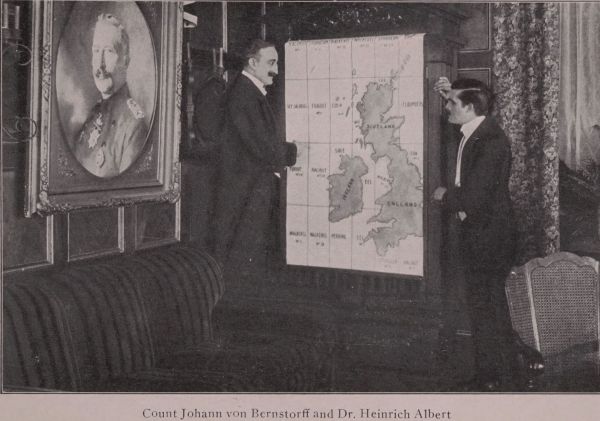
Count Johann von Bernstorff and Dr. Heinrich Albert
"Exactly." Bernstorff looked up with a smile. "You and I have discussed that before, haven't we? I had forgotten. Well, you know the rest. No one will pay any attention to the messages except our U-boat captains. They will know by them that the Lusitania is entering the square named after that particular fish. It should be an easy task for them to sink the ship. And it must be sunk!"
"How about the international complications?"
"They must take care of themselves—after we have done all we can do to keep things running smoothly. The point is that the Lusitania must be sunk! We have a lesson to teach America! If we sink a few of their citizens, perhaps they'll be more chary about sending their representatives abroad to sell goods to the Allies. It may make them stop and think awhile before they ship their goods to the Allies too—and that's what we're after."
"Suppose America objects to the loss of its citizens?" Albert was smiling in a quiet, quizzical way.
"We'll sympathize, of course." Bernstorff looked up with an answering smile. "Really, we'll be very sorry. We will mourn for a week—but, in the meanwhile, we also will point to our manufactured fact that the Lusitania carried guns and contraband. That's where you are needed. Take the night train to New York, see Paul Koenig, of the Hamburg American line, and arrange for him to find someone not averse to forging a few affidavits, one to the effect that the Lusitania is loaded with contraband, and another that she carries defensive guns. And be very sure on that point. The rules of war prohibit the sinking of an unarmed ship without due warning. We must have those affidavits."
"Very good, sir."
"And, Albert—"
"Yes?"
"Here"——Ambassador Bernstorff lifted a sheet of closely written paper from his desk—"is an advertisement I have written, warning all American citizens from the Lusitania. See that it is inserted in the New York papers as close to the Cunard Line advertisements as possible. It will be our alibi when the Lusitania is sunk."
"Very good, Your Excellency."
And so it was that with Ambassador Bernstorff at the head of the great spy organization which Germany had built up in America, with Dr. Albert, Capt. Von Papen, Karl Boy-Ed, Paul Koenig and a half a hundred others working on the various details of the scheme, that the preparations for the sinking of the Lusitania went forth in America.
Day after day passed, while Bernstorff translated his code messages from Wilhelmstrasse and sent replies in the guise of death messages and business telegrams to neutral countries, where they were received by German spies, translated and telephoned by long distance to Germany. Day by day, and then—
It was April 29, forty-eight hours before the sailing of the Lusitania. In the great rooms of the Criminology Club in New York, where cosmopolite members daily gathered to discuss the themes which formed their chief aim in life, the apprehension of the genus criminal, an important meeting was in progress. Harrison Grant, the president and organizer of the great private criminal chasing brotherhood, stood before them, a telegram in his hand.
"Fellow members," he announced, "I have just received the most vital communication that has ever come to this club. It is a telegram from William J. Flynn, chief of the Secret Service, which changes the aims and purposes of our organization to ideals far greater than ever were dreamed of when we banded ourselves together to follow out our individual hobbies in the chase and capture of dangerous criminals. For this telegram pits us against the most shrewd violators of the laws of God and man that ever were known—the paid criminals of Imperial Germany, protected by the power of international law, yet criminals nevertheless!
"All of you know the reason for this telegram. It is in answer to the letter we sent to Chief Flynn at the last meeting of this club, when our various members displayed the evidence that had come to them of the perfidy of Imperial Germany in assuming friendship for this country while seeking to violate our neutrality in its efforts to maim the Allies. More than that, my charge you will remember, was that Germany had considered America also in its aims of conquest, and that it fully believed at the beginning of this war that it would crush England and France easily, then reach forth for our own country. But the danger of active invasion is past now—it stopped at the battle of the Marne. What we must battle against is the more insidious invasion of Germany's spies—and their name is Legion! Therefore, gentlemen, I have the honor to announce to you that Chief Flynn has accepted our offer of services and that the Criminology Club is now and henceforth devoted to the defense of America and the outwitting of the paid tools of Imperial Germany who seek to use our nation as a battlefield!"
A cheer that resounded through the great rooms of the Criminology Club echoed Grant's speech. Then the members gathered into little groups to discuss the new development and to plan for the future. As for Harrison Grant—
He shifted from his position and veered toward Cavanaugh, his most trusted operative.
"Billy," he announced, "our first blow in this matter falls to you. You have seen the advertisements in the newspapers advising passengers not to sail on the Lusitania?"
"Of course."
"Very well. I believe that means the beginning of more direct plots against America. There is only one way to learn. Von Papen, Boy-Ed, Dr. Albert, Heinric von Lertz, their unofficial agent in New York—even Ambassador Bernstorff himself—make a habit of lounging at the Hohenzollern Club. We want a dictograph in those club-rooms."
Billy Cavanaugh twisted his already tightly waxed mustache and smiled ever so slightly.
"I'll attend to the details," he announced quietly.
And while Harrison Grant gave his orders, four men were gathered about the big table in the Imperial German Embassy in Washington. One of them was Bernstorff. Another was Albert, with his ever-present portfolio in which he carried the reports of spies operating in every city of the United States. A third was Boy-Ed and the fourth was Capt. Von Papen.
The meeting, incidentally, seemed to have been a happy one. A supercilious smile skimmed the lips of Franz von Papen as he gazed at his co-plotters. He waved his cigar slightly before him.
"These idiotic Yankees will wake up next week," he announced, "it will be something for them to think about."
"It will be something for the world to think about," echoed the fastidious Boy-Ed.
"Do you suppose," Dr. Albert was rummaging in his portfolio, "it could possibly act as a boomerang? America has had its eyes shut, you know. For instance, I think Capt. Von Papen recently reported the burning of several million bushels of wheat in its elevators, as well as a train wreck or two that have so far been classified as accidents. Now, my query is: will the deliberate, pre-arranged killing of Americans and the fore-announced destruction of American property on board the Lusitania, cause this country to open its eyes and inquire about other things that have happened? Or will it—"
Capt. Franz von Papen smiled with one corner of his mouth.
"If you have ever noticed," he replied, "I have always used the term 'idiotic Yankees.'"
Bernstorff laughed. Albert bobbed his head.
"Quite so," he said finally. "I yield the point. Now, regarding the Lusitania, when is it destined to sink?"
Bernstorff rummaged in some papers, at last to bring forth a code message.
"Potsdam plans the sinking for next Wednesday, May 5. It has already ordered medals struck off to commemorate the victory."
And while the arch-spies of Imperial Germany continued to plot the murder of American citizens on the high seas, a lithe, dark-eyed girl walked to the stenographer's desk of one of the largest hotels of New York City, with apparently no purpose in life save to be pretty and attractive and likeable. Spirited she was, with a dash of animation which caused people to look at her more than once, with a sparkle in those big eyes which told of a love of life and zest for adventure, a tilt to her chin that spoke of determination, a smooth grace about her which spelled birth and breeding and aristocracy. Time was—and not so very far in the past—when her name had glittered in the electric lights of Broadway. But the love of adventure had been too strong and Dixie Mason, daughter of Brentwell Mason of Sou' Car'lina, sur, had forsaken the stage to take her place as a quietly commissioned captain of women operatives in the Secret Service. And now—
Now she was walking toward the public stenographer's desk, smiling and speaking to friends in the lobby, apparently thinking of nothing in the world, but in reality straining with every nerve to catch the message in the Morse code that the stenographer was ticking off on the space-bar of her typewriter:
"This ... is ... the ... man ... I ... spoke ... of.... He ... thinks ... he's ... a ... lady ... killer."
Dixie Mason's sense of humor could not resist a trifle of a smile, and quite accidentally, as she smiled, she glanced toward the rather tall, sleek German who stood reading a dictated letter he just had received from the stenographer. The German's eyes rolled. Quite "accidentally" again, Dixie Mason allowed her swagger stick to fall to the floor. An instant later the German had bent forward, started to pick up the stick, and with intentional clumsiness, stepped on it, breaking it. He swept his silk hat in a flourishing bow.
"Dunnerwetter!" he exclaimed, "such clumsiness! And I had such good intentions!" Dixie Mason smiled again. She started to speak—then stopped suddenly as the stenographer's voice broke in.
"I'm sure he is more than sorry," she interrupted. "Miss Mason, this is Mr. Heinric von Lertz. He is such a gentleman, and I know that he is so sorry!"
Dixie Mason had not placed Molly Farris in that hotel lobby for nothing. Quietly she pressed the "stenographer's" hand and listened to Heinric von Lertz's apologies. With the result that a half hour later found them at luncheon, and with the further result that three hours later found Dixie Mason back in her apartment and smiling to herself as she brought forth an innocent appearing letter from a small filing cabinet. The twinkling little lines of humor gathered about her lips as she scanned the lines:
"My Dear Miss Mason:
"Thanks for your letter. James is doing fine and by hard work has gotten into a position of trust in the private bank of two fine old Germans, Schneider and Wurtz. However, he intends to tell no one until he receives his first raise.
"Sincerely, "Wallace J. Claflynn." Universal Salvage Sales Co. RRF-WJC
"Code signal RRF," said Dixie Mason as she looked at the stenographer's signature, then scanned the letters and signals in the cabinet, finally to bring forth a bit of celluloid, perforated here and there with aimless appearing holes. A quick motion and the celluloid had covered the paper. Then the message stared forth:
work into trust of Ger mans tell no one W J. flynn U S S S
A low laugh sounded as Dixie Mason returned the code letter and celluloid to its resting place.
"Not bad," she breathed happily. "The Chief sent me that letter four days ago. Already I've taken luncheon with Heinric von Lertz, chief henchman for Bernstorff, Von Papen, Boy-Ed and Albert, and he has asked me to go to the theatre with him tonight. And if I don't continue to keep in his company, it won't be my fault! I rather think," and Dixie Mason laughed softly, "that Heinric von Lertz is going to be quite valuable!"
But time was short. Two days later, the great, sleek Lusitania glided out of New York harbor and started upon the first phase of its journey across the seas, carrying with it 1,250 passengers, more than a hundred of whom were Americans, the pride of America's theatrical, editorial and financial worlds; American aristocracy and American common people, but all Americans, all equal in their standing in the light of the Liberty statue, supposedly safe from warring nations, innocents, traveling toward a deliberate German murder.
Too short a time for Harrison Grant and his men to gain their knowledge of what was going on in the Hohenzollern Club. Only that morning, Cavanaugh had reported progress—the assurance that the dictograph would be in the Hohenzollern Club by the end of the next week. Too short a time for Dixie Mason to obtain the confidence of Heinric von Lertz and learn from him the details of the plot against America. Too short a time! The Lusitania was doomed!
The very moment of her sailing, a furtive-eyed spy had rushed to a cable office, to send the following cablegram to Europe:
"L.H. Guerz—Amsterdam, Holland.
"Lucy has entered last phase of illness. Doctors say progress until Thursday normal. After that, difficult to diagnose. Therbold."
Already the message was traveling under the sea, while the spy reported to Von Lertz, and while another spy in Amsterdam anxiously awaited its arrival. And when he received it, his code-educated eyes read an entirely different message from that of a mere announcement of an illness, a message which thrilled his craven soul with the information:
"Lusitania has sailed. Course until Thursday normal. After that, unknown."
A hurried ten minutes in which the spy turned to a specially installed telephone, sent the message to Nauen and thereby to Cuxhaven and to every other U-boat base of Germany, where waited the scavengers of the sea, Germany's submarines and their commanders. More, from Nauen the message flashed to hundreds of men on the Irish coast, apparently fishermen, who arranged to speed forth as far as possible into the ocean, and to wait day and night for the sight of the vessel, that they might spy it to its doom. Expensive—of course! But all battles are expensive, and Germany was planning the death of women and children in what it would call one of the greatest "victories of the war." Were not the medals that would be issued to commemorate the "victory" already being struck off? And had not even the date been placed thereon in characteristic German "efficiency?" Germany had named May fifth. And May fifth they would be distributed. For where was there a chance for the Lusitania to escape?
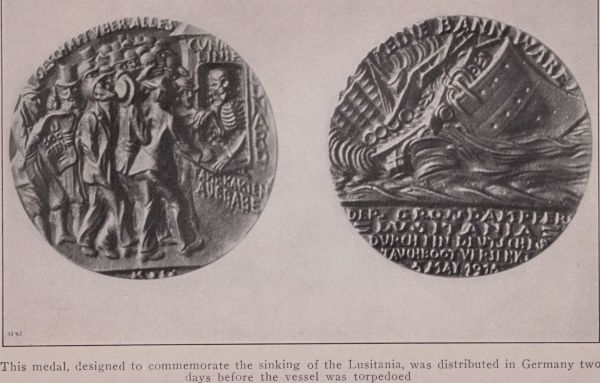
This medal, designed to commemorate the sinking of the Lusitania, was distributed in Germany two days before the vessel was torpedoed
Nor did the fact that May fifth passed with no message from the U-boats cause Germany to hold back those medals. On they went to the populace, while flags fluttered in Berlin to announce the "victory" that had not yet happened. Everywhere were the U-boats. Everywhere were the fishing smacks, flashing out the supposed business message that carried the code word of the position of the great ship. Time and again the sleek greyhound of the sea dodged destruction only through her speed. But in the distance more U-boats were lurking. The end was inevitable.
May sixth. Then May seventh. Into the rooms of the Criminology Club hurried Billy Cavanaugh to seek out Harrison Grant and to report with a little smile:
"There's something interesting for you in a room adjoining the Hohenzollern Club."
Harrison Grant raised his eyebrows.
"Got it fixed, Billy?"
"Yes, sir. Broke a water pipe leading into the club, then hurried for the plumber shop that always attends to their work. Good fellow there—thorough American. He let me fix the leak. And while I was fixing it, I also fixed the dictograph—just behind the picture of His Imperial Majesty, William Hohenzollern."
Harrison Grant laughed happily and reached for his hat. A half hour later he lifted the receiver of a dictograph to his ear. Stewart, the relief operator, watched him.
"I've just been listening," he announced. "Think Von Papen, Boy-Ed and Wolf von Igel just came into the club. Couldn't swear to it, though."
Harrison Grant nodded slightly, the dictograph still to his ear. Then he started. Hurriedly he turned:
"Put this down:
"'Paul Koenig has assured us that a man will swear that the vessel carried guns. Also that an affidavit will be given that she was loaded with contraband. Dumba can be counted on to espouse our cause—.'"
"What does it mean?" Cavanaugh stepped forward. Grant frowned. "Can't tell, Von Papen's doing the talking. Now Boy-Ed has joined him:
"'Surely we should have heard before this. Do you suppose anything could have gone wrong? Surely they were prepared. But today's May seventh, and it should have happened May fifth. If—.'"
"All right. What's the rest?" Stewart looked up from his copying. Grant shook his head.
"They're mumbling—I can't hear. They seem to have all gotten over in a corner with their heads together and are trying to talk so that no one around the club will hear them. But—wait a minute—they're talking louder now—no, they've settled down to that buzzing again—I think I hear a telephone ringing—Von Papen has just told Boy-Ed to answer it. Wait now—wait—"
A strange silence in the dictograph room. Harrison Grant adjusted the receiver closer to his ears. He pressed a hand strainingly against it, as though to aid him in the hearing of what was going on over in the next room. But impossible.
And at that moment, out on the open sea, the passengers of the Lusitania were strolling happily about the decks after a jovial luncheon. Someone looked at his watch to absently note that the time was 2.32. And as he raised his eyes——
The deadly, gray serpent-like form of a periscope as it raised itself above the waves. The wake of a torpedo as it hissed its way through the water. Then a great rolling roar, a shock that trembled through the whole vessel, a sickening lurch and plunge, the thunder of an explosion—
Hours later, in the dictograph room, Harrison Grant again leaned forward.
"That telephone again!" he announced. "I wonder what it means? Boy-Ed always answers it. There he goes again. Guess he'll mumble into it, just as he's done all day—no, he's talking louder this time—it's something about a ship—"
His hand clenched.
"I can't get it," he grumbled. "If he'd only talk louder—what's that—the Lusitania?"
"Lusitania?" The two other operatives looked up quickly. Harrison Grant nodded slightly.
"Yes. Heard him say something about the Lusitania. Seems to be getting some kind of a report over the telephone, as though some spy were telling him something that had happened. Now he's left the telephone—he's gone back to the others—good God!"
The two operatives leaped to their feet at the ejaculation from their chief. Their staring eyes saw that his cheeks were white, that the blood was slowly leaving his lips, leaving them purplish, ghastly.
"They've ordered a toast to the Kaiser!" he announced coldly, "a toast—in commemoration of Germany's 'victory' over the Lusitania! It can mean only one thing—!"
And as if in answer, up from the streets of New York there radiated the shouts of the newsboys, calling the headlines of the first "extra:"
"Lusitania sunk! Lusitania sunk by German submarine! Klein, Vanderbilt, Hubbard and thousand others missing. Extry paper! Extry paper, all about the sinking of the Lusitania!"
So that was the German victory! The Lusitania sunk! Wearily Grant sank into a chair, the dictograph receiver still to his ear. On the other side of the wall three men had raised their steins to the picture of the Kaiser, toasting him for the idea which had enabled the fishing smacks to wireless the news of the Lusitania's course to the waiting submarines, for the distorted brain which had devised the messages of fishermen into instruments of death, for the ungodly, demon-like cunning that had conceived the death of women and children to be a German "victory!" Droningly the words come over the dictograph:
"To the Kaiser! May he continue his glorious victories, abroad—and here!"
"Abroad—and here!" murmured Harrison Grant between his clenched teeth. "And 'here' means America!"
Chapter II
THE NAVAL BALL CONSPIRACY
Thus the news of the sinking of the Lusitania came to New York, to throw a saddening cloud upon what was planned to have been the happiest week of many years. For in the Hudson River, great, sleek leviathans of the deep, the sixty-four vessels of the Atlantic fleet had dropped anchor to await the President's review, while the streets, the theatres, the restaurants, bore the glorious flutter of flags and bunting, and the blue and white of the navy uniforms were everywhere.
And now that the Lusitania had been sunk, now that the lives of more than a hundred of America's best citizens had been sacrificed to the lust of Imperial Germany, those big vessels seemed to take on a new meaning, a new significance. In New York harbor primarily only for a review and for a jollification, they now assumed their real proportions in the eyes of the populace, displaying to Eastern America just for what they could be depended upon in case of war. And with every day, that danger seemed closer. For America resented the sinking of the Lusitania. The great crowds around the bulletin boards, watching daily the steadily lengthening list of the dead, called for vengeance, for repayment from this monster nation across the Atlantic that could kill women and children and glory in it as a "victory." Every telegram from Washington, every news dispatch, emphasized the gravity of the situation. And no one knew better that gravity than did Harrison Grant of the Criminology Club.
Working day and night with his companions of the Club, Grant had hurried to the uncovering of the conspiracy to present forged affidavits asserting that the Lusitania carried guns and contraband. Clue after clue was run down, while in Washington, the Imperial German Embassy worked just as hard in the opposite direction, covering the tracks of its plotters and its spies, seeking to proclaim to America the sorrow which it assumed over the sinking of the great British liner. To some the sorrow seemed sincere. To others—Harrison Grant among them—that sorrow was known to be only a mask, thrown hastily on to deceive America and to keep America at peace until Germany felt itself able to cope with it and strangle it as it sought to strangle the rest of the world.
And so the days went, in moves and counter moves. Day after day the populace, by the hundreds of thousands, gathered on the banks of the Hudson to look at the tremendous battleships and to glory in their power and effectiveness. And while they did so—
Four men were meeting again in the embassy at Washington—the same four who generally gathered there, Franz von Papen, Karl Boy-Ed, Dr. Heinrich Albert and their leader, Ambassador Bernstorff. Point after point they discussed regarding the sinking of the Lusitania and the possibility of war. At last—
It was Dr. Albert who was speaking, pawing through the reports that he had dragged from his beloved portfolio:
"Marsden reports," he announced, "that the feeling in the West is quite strong over the Lusitania. While I believe our foreign office may be able to drag the situation out until the fever heat of war is passed, still I fancy it would not be a bad idea on our part to make such preparations as may be necessary in case the United States should suddenly determine to avenge the death of its citizens. Now—"
Karl Boy-Ed, naval attache, interrupted.
"I believe we have anticipated you there, my dear Dr. Albert," he said smoothly. "Kindly tell us what you believe to be the greatest defensive and offensive agent which America has against Germany at the present time."
"Why the great Atlantic fleet, of course."
"You mean the one that is in New York at the present time for review?"
"Of course."
"And if my good comrade Von Papen and myself should tell you that we have already made arrangements to make this fleet incapable of working either for the defense of America or for an offense against Germany, what would you say?"
Dr. Albert brought his hand down on the desk with a thumping bang. "I should call it a master stroke!" he announced.
Boy-Ed looked at Von Papen and smiled. Then he turned to Dr. Albert again.
"Then, my dear Doctor, your mind may rest easy. Capt. Von Papen and I have arranged a scheme which will make the great Atlantic fleet wholly useless in event of war. Rather, we have arranged two schemes. One of them is planned for the Naval Ball at the Ansonia Hotel in New York tonight, which will be attended by practically every navigating officer of the fleet. The other is held in reserve in case the attempt to-night fails. It is a trifle more daring—and I might say, a bit more spectacular. Even his Imperial Highness, the Emperor, would delight in seeing it! But of course, we are holding that for the coup de etat, as it were, in case the plan tonight fails."
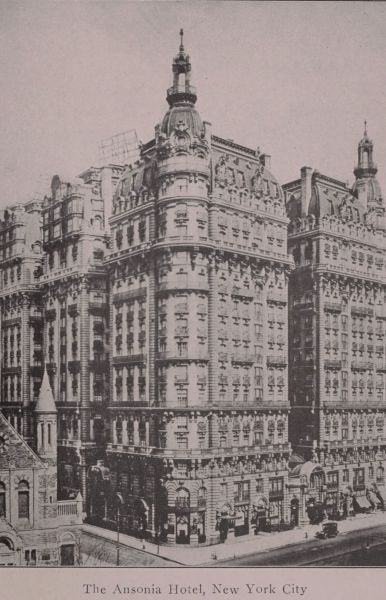
The Ansonia Hotel, New York City
It was as they discussed the details of their plot for the night that Harrison Grant hurried from his office in the Criminology Club in answer to a call from an operative:
"They want you in the dictograph room!"
Ten minutes later, the investigator of crime leaped from a taxi around the corner from the Hohenzollern Club and made his way to the room adjacent to the German meeting place. Stewart and Cavanaugh were awaiting him anxiously.
"Something doing," said Stewart as he raised his eyes to his chief. "I've been catching stuff for the last half hour."
"What about?"
"The Ansonia Hotel."
"The Ansonia?" Grant came forward quickly.
"Yes. Anything special going on there tonight?"
"A good deal," was the quick answer of Harrison Grant. "The Officers of the navy are going to have their review ball there. Why?"
"Because," and the operative leaned closer to the dictograph, "the indications are that the Germans intend to blow it up—and our navy officers along with it."
"Impossible!" Harrison Grant's face went white. "Impossible! Why, all the navigating officers of the fleet are to be there tonight—the whole brains of the Great Atlantic Squadron! It would cripple our whole Eastern system of defense!"
"Then you'd better get word to them not to attend" came the cold answer of Stewart, "because the plans are made—to bomb that hotel tonight!"
Harrison Grant's brow wrinkled. He looked hurriedly at his watch.
"We can't get word to them now. Most of them are away from their ships at entertainments—leaving the ships with only skeleton crews. Besides, we can't empty that whole hotel and just let it lie there, a target for some German bomb! No, there must be some other way—but Stewart, are you certain about all this?"
"Here are my notes," came the answer of the operative. "Von Lertz came into the club about a half hour ago. Some old German who seemed to have some decency in his heart, was reading the Abendpost and repeating an editorial in it which said that the sinking of the Lusitania might cause war with Germany. He appeared to be worried about it and that such a thing would mean the death of all of Germany's ambitions. Von Lertz listened to him for a while and then began to sneer at him. He said that after tonight, it would be impossible for the United States to declare war on anyone. Then—" Stewart referred to his shorthand notes—"he used this sentence:
"'There's the Ansonia, tonight, you know. And there's Kroner, who's finishing his masterpiece in the way of a bomb. And when Kroner makes a bomb it generally destroys what it's intended for. After he pays his little visit to the Ansonia tonight, there'll be no danger of America fighting anyone.'"
"And there wouldn't," echoed Harrison Grant, "not with navy officers dead and no one to handle the navigation of her battleships."
He turned to the telephone. A short conversation and he was facing Stewart and Cavanaugh again.
"Every member of the Criminology Club will attend the Naval Ball tonight as guests," he ordered. "Chief Flynn is sending fifty men there. The police department will co-operate with a special guard. They'll watch the outside. It will be our duty to guard the interior. Come—we'll pick up the rest of the members of the Club."
And as the three men hurried away, a queer appearing, raw-boned scientist hurried about a small workroom in a faraway part of New York. Before him was a heavy thing of steel and springs and clockwork and trinitrate of toluol, the most horrible explosive known. Almost lovingly he fingered it. Then he turned to his assistant.
"See that it's timed for 12.20," he ordered. "That is the time agreed upon. All the German contingent will be at the ball tonight to divert suspicion. When things are moving their best, we will slip in and plant the bomb under the main stairway. That will give it more breadth for destruction when the explosion comes. But be sure—" and he wagged a bony finger—"that it is set for not earlier than 12.20. Our people must have time to leave the ball and be well away before the explosion comes."
"Don't worry," answered the assistant quietly. "I've set bombs before."
But when the Naval Ball started that night, it had more than a hundred guests who had been furnished tickets at the last moment. More than that, every person of German appearance in the great ball room was within the vision of The Eagle's Eye, the United States secret service, while outside—
Up Broadway, in platoons and in columns, came hurrying squads of police, to divide suddenly, to take their positions at the doorways, at the hallways, beside the elevator shafts—even on the roofs. Everywhere was Harrison Grant, directing activities.
"Keep your eyes open, men," he announced. "Allow no one in this building who carries any kind of satchel or parcel. Cavanaugh!" he called to his operative, just passing, "how about the cloakrooms?"
"They've all been searched."
"Found nothing?"
"Nothing."
"Good. Take four of these men and put two on each cloak room. Have you attended to searching any new employees who might have taken employment here lately?"
"Yes. All done. The management furnished me a list of everyone they weren't sure of. I looked them all over. Everything's safe there—they're all loyal!"
"Thank goodness for that. They may help us."
"That's been attended to. They all have instructions from Mr. McBowman, the general manager."
Grant smiled.
"You've been on the job, I see," he said. Then he glanced at Cavanaugh's immaculate evening clothes. "Looking the way you do, Billy, I don't think it would be a bad idea for you to see if you can't pick out a nice little German girl to dance with. It might cause her escort some worry." Cavanaugh winked and stepped away. Grant turned once more to a group of policemen whom Stewart was hiding in the palms at the head of the stairway.
"Take no excuse," he ordered quietly. "If necessary, shoot to kill. And in any event, if anything looks suspicious, arrest first, investigate afterward."
Grant turned at a touch on his arm. It was Turner, his operative, assigned to the roof.
"I've placed men all around up there," the operative said. "There were two or three places—at the head of the dumbwaiter and that sort of thing, that would have made good hiding places. So I took no chances."
"Correct. Now pick out a German and trail him."
"Yes sir. And you—?"
"I'll do the same—as well as every other member of the Criminology Club. I want to know every move they are making."
Turner moved away. Harrison Grant stepped forward, chatted a moment with a young woman of his acquaintance—then stared.
Before him, coming toward the young woman at his elbow, was quite the prettiest girl—to Harrison Grant's eyes—that he had ever seen. Vivacious, beautifully dressed, full of the dash and verve that Harrison Grant so admired, quick, decisive in her movements, yet thoroughly girlish, there was an element about her that Harrison Grant had never before noticed in another woman. Something within him seemed to leap, hesitate, then begin to thump with the quickness and persistence of a triphammer. Vaguely Grant knew that it was his heart. And just as vaguely, he knew that he was being introduced to this brown-eyed, smiling little being, whose hand was so small that it seemed almost cruelty to press it—yet with a grasp so firm and steady that it carried with it the sensing touch of a true, strong companion—whose hair was black and yet brown, whose smile was frank and yet elusive, whose whole being was of the sort to enthrall Harrison Grant and to hold him prisoner.
Then a sudden change. The beating of his heart slowed. The sparkle of his eyes dulled. The smile faded from his lips—for just behind the girl whose name he had vaguely heard to be Miss Dixie Mason, had shown the figure of her escort, a man whom Grant had come to hate, a man he knew to be responsible for the working out of the plot against the Ansonia Hotel that night, Heinric von Lertz, unofficial agent for Imperial Germany's murderers.
As for Von Lertz, he turned somewhat quizzically toward the policeman at the door of the ballroom, looked at him in a sneering fashion, then with a short nod in acknowledgment of the introduction to Grant, he asked:
"Police? Is it the usual thing in America for them to attend social functions?"
"Not unless they're invited—or needed," answered Harrison Grant caustically.
A quick glance shot between the two men. A moment more and Von Lertz had turned to the ballroom, taking Dixie Mason with him, while Harrison Grant watched after her, wondering what such a pretty, wholesome appearing girl could be doing in the company of a man whose business was the representation of murderers. That she carried a Secret Service commission, Grant did not know. The instructions of Chief Flynn, ordering her to work into the confidence of the Germans without letting even the fellow members of the Secret Service know her true purpose, had attended to that. And Grant saw in her only a girl who had chosen as a companion a man who was at that moment plotting the very downfall of America!
However, it was only natural that they should meet again during the evening. And it was only natural that Grant should ask her to dance with him. More, it was only natural that as he looked into her eyes, as he felt the firm swing and graceful lift of her to the swaying music of the foxtrot, that he should wish more than ever that the stain of her apparent friendship for Von Lertz should some day resolve into an innocent one after all. As for Dixie—
As she was swept away again in the arms of Harrison Grant, following the encore, Dixie wished with a sudden impulse that the touch of those arms might some day mean more than the embrace of a dance, she wished that she might tell this man whom she knew to be the president of the Criminology Club that she was really a compatriot, that she was working along the same lines as himself, struggling for the same ideals fighting for—
But one could only obey orders. Besides, the dance had ended, and in the foreground, waiting and fretting, stood Heinric von Lertz.
A few brief acknowledgments of the pleasure of the dance and they parted, Dixie Mason to take her place at the side of the German plotter, Harrison Grant to hurry forward at the signal of Cavanaugh from the doorway. Grant found him nervous, irritable.
"The dangerous moment has come," he announced shortly. "Look!"
Far at one side of the room stood a tall German, apparently chatting with his fellow country-people as they strolled about after the dance. But as he watched, Grant saw that the conversations were extremely short and that following each one, every German and his companion turned toward the cloakrooms. Billy Cavanaugh's voice broke in once more.
"He's warning them all to leave," said the operative. "He's been doing it for the last five minutes. Half the Germans in the place are gone now. It's nearly time for the attempt."
Harrison Grant bent close.
"Send the men to make the rounds of the patrolmen," he ordered quickly. "Tell them to keep their eyes open wider than ever. Allow absolutely no one to enter this hotel."
"Yes sir."
"Double the guards on every door. What has been done in regard to the other searches that I ordered?"
"Everything's been accomplished. The hotel management has made the rounds of the whole place with pass keys. Every piece of baggage that cannot be vouched for has been examined. Nothing has been found."
"Good. Hurry to those patrolmen. I—"
For Grant had seen in the entrance to the cloakroom, the form of Heinric von Lertz, his coat over his arm, waiting impatiently for Dixie Mason. With a sudden determination, he hurried forward, to reach the entrance, just as Miss Mason came forth, adjusting a loose fold of her opera cloak. Grant bowed.
"Not going?" Miss Mason smiled.
"I assure you it isn't my desire," she said quickly. "Mr. Von Lertz simply insists on it, though. I never was having a better time in my life!"
Harrison Grant turned, to smile into the face of Heinric von Lertz.
"Surely, you wouldn't spoil the pleasure of anyone so sweet as Miss Mason."
"I can't help it, you know," answered Heinric von Lertz somewhat testily. "My head aches."
"Your head aches?" Grant laughed. "And you're going home on account of that? I'd lose my head for a person like Miss Mason!"
"Mr. Grant, you're Irish!" Dixie laughed up at him. Grant smiled again.
"I only wish I were, so I could say the things I'd like to say in the way I'd like to say them. But come now, Mr. Von Lertz, you're only joking about leaving. Why it's only midnight."
"Midnight?" Von Lertz started. "Then we must go. It's imperative. That is—"
And while he hesitated and explained, a taxi had driven up outside, at the little triangle which divides Broadway at 72nd Street. From the darkness within, a high cheeked, raw-boned man had started forward, a grip in his hand, only to be halted by a cowering individual who shot forth from a bench at the sidewalk.
"Back in that cab!" he ordered in a whisper. The raw-boned bomb maker started.
"Why—?"
"Don't ask any questions. Back in that cab!"
"But I've got the bomb! Von Lertz said everything would be ready for me. I—"
"Everything is ready—but in a way that we didn't look for," answered the spy on the sidewalk. "Look!"
Quickly and surreptitiously, he pointed upward. Where the flaring sign of the Ansonia Hotel blazed out upon the night, was silhouetted the figure of a man. Ten feet away was another—and another—and another. Down on the sidewalk, a solid cordon of police in uniform was drawn about the building. Not a person could approach without being seen—the guarding arm of the police was absolute.
"And that's not all," growled the spy on the sidewalk. "That's just the beginning. There are fifty secret service men scattered about the entrances and the areas. Bluer just signalled me by the electric light code that even the elevator shafts are full of them. I signalled him back to tell Von Lertz that everything is off. As for you—move away from here quick! There'll be twenty policemen on our shoulders in another minute!"
The taxicab turned swiftly. In another moment it had vanished down the street, while in the hotel—
Von Lertz still stood at the entrance of the cloakroom, arguing with Harrison Grant and Dixie Mason, a scant veneer of pleasantness covering his words.
"But I simply can't stay," he was repeating for the fiftieth time, "I tell you my head aches."
And certainly something was causing a pallor to spread over his features, and the cold sweat to break forth on his forehead. Harrison Grant knew what it was. From far away, the chimes of a church had sounded midnight and faded away into nothingness. Grant knew what Heinric von Lertz was thinking about—about that bomb and the fact that he was practically the only German left within the confines of the Ansonia Hotel. And so, that he might obtain a trifle of satisfaction against this cowardly plotter of Imperial Germany, he deliberately turned to Miss Mason and began the telling of an incident which could not be interrupted. And Grant knew how the passing of every second ate into the soul of Heinric von Lertz!
Then a movement. Someone passed—and in passing, slipped a bit of cardboard into the cupped hand of Heinric von Lertz. Hurriedly the German shifted his hand to the interior of his silk hat, and under its protection, read the message. Involuntarily, his hands clutched. For there, scrawled on the cardboard, were the words:
"Affair abandoned. Too dangerous."
Von Lertz coughed, and at the sound, Harrison Grant and Dixie Mason turned. The German forced a smile.
"I've changed my mind—er—that is, my headache's better," he announced. "We'll stay."
"Thank you," said Harrison Grant, with quietly suppressed meaning, "my hopes are raised on a veritable bomb of happiness. Miss Mason, may I have this dance?"
"Most certainly."
Happily, bouyantly they went toward the ballroom, while Heinric von Lertz stared after them.
"I wonder what that idiotic Yankee meant by a 'bomb of happiness,'" he mused, "Could he have known what I was plotting?"
The thought brought back the memory of that card. Once again he glanced at it, then tore it to bits and stuffed it in his pocket. Then, throwing his coat to the check boy, he strode toward the ballroom.
"At any rate," he growled under his breath, "they haven't stopped preparations at the shack."
And at the same moment, the taxicab containing the old bomb maker had drawn to the curbing, forty blocks away, where another cab stood waiting. A figure came forth from the darkness and peered into the first cab.
"Are you there, Kroner?"
"Yes."
"Alright. Everything's safe. Why don't you hurry?"
"There's no need. I didn't use the bomb."
"You didn't use it?"
"You heard what I said," came testily from within the taxicab. "It's up to you to hurry. Get out to the shack and tell those men to work night and day to finish up their job!"
A muffled conversation of an instant more, then the taxis parted. An hour later, as Harrison Grant again danced with Dixie Mason and Von Lertz seethed over the frustration of his scheme, a man hurried into a ramshackle old building on Staten Island, near Fort Wadsworth, aroused the slumbering figures there and pushed them toward a great thing of polished steel, nickel and brass that lay nine-tenths finished before them.
"Get to work!" he ordered. "Is this the way Imperial Germany is to conquer the earth—by sleeping?"
Grumbling the men obeyed. The spy looked about him.
"Where's Schmidt?"
"Here," came a voice from a corner where a man was unrolling himself from a dirty blanket.
"How's that wireless controller?"
"I'm having trouble with it."
"And yet you sleep?" The spy was raging now. "You get up here and find out what's wrong and remedy it. That wireless controller must be in absolute working order—understand? It can't fail! And what's more, it's night and day work for every one of you men from now on. This thing must be ready to launch the minute the fleet weighs anchor. The Ansonia plot's failed. Everything depends on us now!"
The men grumbled again in answer. A curse from the spy and they settled down to work—to put the finishing touches on a wireless controller and on a torpedo, large enough and powerful enough to tear even a battleship to fragments!
Chapter III
THE PLOT AGAINST THE FLEET
"What's happening on the dictograph?"
Harrison Grant asked the question as he entered the room adjacent to the Hohenzollern Club and looked anxiously toward Dick Stewart the operative who sat with the receiver to his ear. Stewart shook his head.
"Same old thing. Arguments. Conversation. Jokes. Drinks. Toasts to the Kaiser. That's all I can catch. It's just the same as it's been ever since the night of the Naval Ball. You don't suppose that they could have gotten a tip that we're in here, do you?"
Harrison Grant shook his head.
"Hardly," was his answer. "We would have known something about it. They'd rip that dictograph out so quickly they'd drag you through the hole after it. No—they're simply doing their talking in other places, that is all."
The investigator looked at his watch.
"Nearly midnight," he yawned. "I—"
"You'd better go home and get some sleep," the operative broke in. "Cavanaugh and I will keep watch—and let you know the minute anything happens. Don't you think that's a wise plan?"
Harrison Grant, with his ever present happy nature, smiled in spite of the fatigue that hung heavily upon him.
"I think you must know how much sleep I haven't had!" was his comment. "And to tell the truth—I haven't had any since the night of the Naval Ball."
He turned to the door, giving his men their final instructions for the night. And as he made his way homeward, the telephone lines were crackling between New York and Washington, Ambassador Von Bernstorff at one end and Karl Boy-Ed, Naval Attache, at the other. Nearby sat Capt. Franz von Papen and Dr. Heinrich Albert, waiting for the result of the conversation. At last Boy-Ed turned from the telephone.
"Bernstorff's anxious about our plans for tomorrow," he announced. "I told him not to worry."
"Well, there isn't anything to worry about, is there?" Von Papen hunched forward in his chair.
"Not if everything's all right at the shack," answered Boy-Ed. "That's up to Von Lertz. I instructed him to examine the torpedo and to be sure that the men had everything in working shape. Then he was to report to us."
"Wait just a minute—" It was the somewhat plotting, methodical Dr. Albert who had interrupted. "Let me understand this thing clearly: The torpedo is to be fired when the Fleet is going through the Narrows. Is that right? Then what happens?"
"A great deal," laughed Karl Boy-Ed. "The principal thing of which is that the Great Atlantic Fleet will be forced to remain in New York harbor and the United States of America will be taught just how foolish it would appear in a war with a real country like Germany."
Albert bobbed his head.
"I simply wanted to be sure that I understood. Personally, I shall watch the fleet sail with a great deal of interest."
"No doubt." Von Papen turned with a growling laugh, "I will watch it stop with more interest. Now, Boy-Ed, where is Von Lertz to report?"
"At the Hohenzollern Club."
"Then we'd better be strolling over. It's after midnight now. Good night, Albert."
"Good night. Good luck—for Imperial Germany!"
Meanwhile, Dixie Mason was looking into the eyes of Heinric von Lertz as they hesitated in front of the Midnight Frolic.
"If you don't mind, I'd rather take a trip out in the country somewhere—to the October Farm or something like that."
Heinric von Lertz rubbed his chin in thought.
"I'll tell you a better place," was his announcement. "There's the Ten Mile House. Quite racy, it's true, but very entertaining. What do you say?"
Dixie Mason smiled most engagingly.
"Why should I worry—as long as I am sheltered by the protecting arm of Heinric von Lertz? Besides—" and she allowed a bit of unsophistication to creep into her voice, "I'm afraid my education in roadhouses has been too much neglected. It's—it's all right for me to go, isn't it?"
"Oh, of course," Heinric von Lertz drew himself up pompously, "I'll look after you."
A moment later, Dixie settled back in a corner of Heinric von Lertz's machine and smiled in the darkness. She was to have her chance after all—the chance to learn what had been on Heinric von Lertz's mind all evening, why he had been so preoccupied, so nervous, so agitated. Dixie could not see the pictures in the camera of Heinric von Lertz's brain, she could not see mirrored there—
A rambling shack on Staten Island near Fort Wadsworth. The figures of men as they hurried about the tool-strewn room, one of them working on an intricate wireless controller, the other polishing and fitting the last necessities of a great, shining torpedo, which rested in place to be swung to a manhole connecting with a tunnel below, which in turn ran to a wharf facing almost the Narrows of New York Harbor.
No, Dixie could not see—all she could know was that something was on Heinric von Lertz's mind, that he acted tonight like he had acted the night of the Naval Ball and that she was sure that before morning she would have some clue—some means of knowing what was engaging his attention: And while they rode to the Ten Mile House, the rendezvous of fast society, the sporting element and habitues of the lavender life, two members of the Criminology Club suddenly straightened and listened harder than ever at the dictograph connecting them with the Hohenzollern Club. Dick Stewart turned.
"It sounds like Boy-Ed and Von Papen," he announced. "But they're not talking about anything in particular. They're settled down to a game of cards—and they're acting like they're waiting for someone. Maybe we'll get a tip on who it is."
Four hours later, the tip had come.
"Boy-Ed and Von Papen are in there waiting for Von Lertz," announced Stewart as Grant, somewhat sleep-eyed, hurried into the room, following a hasty summons. "They've been in there ever since a little after midnight, playing cards and drinking. Then about an hour ago they began to get nervous. After that, they began to watch the clock and to talk about Von Lertz. I didn't think there was any necessity for waking you up. Then one of them said something about the fleet, and I got nervous—"
"The fleet?" Grant stared.
Dick Stewart nodded his head.
"That's all I could catch. Seems Von Lertz is attending to something about the fleet—but neither one of them has mentioned what it is. Wait a minute—"
The operative leaned forward to the dictograph again.
"They're sending a man to see why Von Lertz hasn't reported."
Grant went quickly forward. He took the receiver from Stewart's head and beckoned to Cavanaugh.
"Take Stewart's place," he ordered. "Stewart, you cover that man. See where he goes. Report to me at the club."
A quick movement and Stewart was gone. Five minutes later, Harrison Grant, lingering in the doorway of the building adjacent to the Hohenzollern Club saw the dim figures of two men walking far down the street in the grey light of dawn. One of them was the man who had been sent forth by Von Papen and Boy-Ed. The other was Dick Stewart, member of the Criminology Club, beginning the chase that was to end—where? Harrison Grant wished that he could know!
Nor did Grant know that an ally was working in his behalf, an animated, smiling little ally who stood in the entrance to her apartment, saying goodby to Heinric von Lertz. That person was laughing somewhat thickly—his glass had been filled many times during the night. Dixie Mason extended a hand, but the German plotter waved it aside.
"And you only shake hands with me?" he asked.
"Isn't that enough?"
"Not if you could know how madly I love you, how I adore you, how you fashinate—"
"Fascinate, you mean, don't you?"
"Yesh—yes—of course. What did I say?"
"Oh, nothing—oh, Mr. Von Lertz, please!"
For Von Lertz had striven to take her in his arms and was pressing his lips toward hers. As she half struggled with him the German smiled in apology and dropped his arms.
"I just wanted one teeny-weeny little kiss," he announced. "I thought—well, I just thought——"
"I'm not in a habit of being kissed," answered Dixie Mason, pouting. Von Lertz straightened.
"Goo' little girl!" he praised her. "Goo' little girl! I am now more fashinated than ever! Good night!"
"Good day," echoed Dixie Mason, glancing at the light of dawn without. Then as Heinric von Lertz strode forth, she turned quickly to one side. Hurriedly she opened a little memorandum book that she had extracted from the pocket of the German plotter while she had struggled with him to prevent the kiss that he had sought to implant on her lips. Quickly she scanned the pages, finally to start forward, an involuntary cry breaking from her lips. She glanced hastily down the street toward where Von Lertz's machine was fading in the distance, then ran toward a taxi stand at the corner.
"Follow that machine that just left here!" she ordered, as she hurried into the car. Then, taking out her secret service commission and passing it before the eyes of the chauffeur, she admonished:
"The safety of the Atlantic fleet depends on us! Don't lose sight of that machine for an instant! Where it goes—we're going—and the man who is in it must not know we're following!"
"Don't worry, Lady," came the quiet answer of the chauffeur. "I'll keep him in sight."
Dixie Mason leaned back in the machine again. Once more she brought forth the note book. Again she looked at the line which had burned itself into her brain; a line that read:
"Examine torpedo before fleet sails."
A half hour later, Von Lertz's machine was on the ferry, crossing to Staten Island, while Von Lertz himself dozed in the tonneau, little knowing that just behind him, on the same ferry was another machine containing a person very much awake, Dixie Mason, determined to learn just exactly where he was going and who he intended to see there.
So much for the Ally who was working for the said Harrison Grant. And in the meantime, the person upon whom he had really counted was having his difficulties.
Far over on Staten Island, the spy whom Dick Stewart had trailed from the Criminology Club had turned into thick underbrush, circled, seen the man behind him, lain in wait, and then, with one powerful blow, felled him, hurrying on toward the shack and workers on the torpedo.
But that delay, while it had placed Dick Stewart in a position where he could no longer follow the spy from the Hohenzollern Club, had saved Dixie Mason from an embarrassing position. For that delay had been just long enough for Dixie Mason to see Heinric von Lertz enter the shack, to watch him leave again, then to allow the little daredevil of the secret service to creep to the shack, ascend an old ladder which she found leaning against the building, and peep through the old trap in the roof. And there she saw——
Two men busily engaged upon the torpedo, which they were making ready to lower through the manhole into the sewer. One of them was talking:
"Von Lertz looked like he'd been out all night——"
"Yes. That's the way he is most of the time. But that's the way with the ones higher up. They can go out and play—while we do the work. But when the Iron Crosses are distributed, they get them, not us."
A growl from the third.
"Shut up. You're better off here than you would be in the trenches. This is easy work for you. I get tired hearing you reservists kicking on a little easy campaign work over in this country when you might be handling the minnewerfers over in Flanders. But, let's stop this talking. The fleet will sail in a few hours now. We've got to have this torpedo ready to launch at the flagship."
That sentence was enough. Dixie hurried from her position on the ladder, started down—then winced as she struck the ground. One foot had struck in a chuck-hole, twisting the ankle severely, and slowly and painfully, she limped to her car, where it was concealed in the shadow of a great, dismantled boiler. The driver hurried forward to her aid, assisting her within. At the door of the taxi, Dixie, half turning with the pain of her ankle, failed to notice that her reticule slipped from her wrist and fell to the ground. Nor did the driver. He leaped to his place at the wheel and turned expectantly.
"Where to now?" he asked.
"A telephone—just as quick as you can make it!" Dixie answered. Her voice was faint from the pain of her sprained ankle.
"How about a doctor for that foot?" the driver was staring at the expression of agony on the girl's features.
"Never mind that. Where's a telephone?"
"In a roadhouse, down the line about three miles."
"Get to it—hurry!"
A moment more and the machine was scurrying along the lonely road, toward the roadhouse and toward the warning that Dixie sought to send the Secret Service. But as the machine roared its way along through the early morning, the spy from the Hohenzollern club entered the shack on Staten Island, his eyes wide with excitement, his voice snapping as he sent the men scurrying faster than ever in their work.
"There's danger! I just knocked a Secret Service man over in the woods. They're after us! Bar that door and barricade it! We've got to get this torpedo into place before they catch our trail. Every minute means danger!"
Slowly the torpedo swung at its fastenings. The spy from the Hohenzollern Club lifted the cover of the manhole. And as the spies in the employ of Imperial Germany started to lower the torpedo into the sewer, Dixie Mason clung grimly to the telephone at the roadhouse, waiting for the answering voice from the other end of the wire. At last it came—the voice of Chief Flynn who had just entered the office for the day. His voice went keen and bright as the warning from Dixie came over the wire. Hastily he assembled the facts as she told them. Then:
"A good night's work. Go home to bed. I'll handle everything."
He lifted another 'phone and called the Criminology Club.
"Busy" reported Central. For Dick Stewart was at that moment detailing the story of the assault upon him and the reasons he had failed in his quest. But Chief Flynn was already working on another angle of the protection of the Atlantic Fleet.
A quick call to the Harbor Police. A moment later and with a scurrying rush, the power-launches of the New York Police department, their machine guns ready for instant action, shot forth into the bay. Another call and the Chief gained a clear wire to the Criminology Club. A few crisp orders and Grant and his men were hurrying by motor to Staten Island, to pick up Stewart on the way and rush to the shack that had housed the torpedo. But would they reach there in time? Grant would have given much to know.
Out in the bay, here, there, everywhere, the boats of the harbor police were scattering, up toward the great, monstrous forms of the battleships, where, flags fluttering, the preparations were being made for the start of the President's review, searching under wharves, around lighters, hurrying to the protection of the Mayflower, whence the President would review the fleet—honeycombing the harbor in their search for suspicious characters, seeking everywhere for the torpedo that was planned to send a flagship to its doom, block the Great Atlantic Fleet in New York harbor and cripple the defense of the greatest nation in the world.
But so far, the torpedo was safe from their search. In the dark confines of the sewer, it had been lowered and shunted to its mouth, where it lay concealed from view under the piling of an old dock. Back in the shack, Schmidt, the electrician, labored furiously on the last connection that would make the torpedo available for its deadly use—the wireless controller.
Hurriedly he made the finishing touches, while down at the mouth of the sewer, the plotters watched the gathering boats across the way, the waving flags, and bright hued decorations that shone and shimmered with the bright sunlight of morning. From far in the distance came the screaming of sirens and the hoarser-throated sound of hundreds of tugboats, ferries and river craft. The review had started. Aboard the Mayflower, the President of the United States was to see the pride of the navy as it steamed forth to the open sea and—
"If Schmidt only gets here with that controller," seethed the spy from the Hohenzollern Club as he watched the fleet in the distance through his binoculars, "If he only gets here!"
"How long will it take to attach it?" Another plotter was staring toward the distance.
"Ten seconds. We've got plenty of time in that way—if he only gets here with it!"
A sound from the tunnel. It was Schmidt, lugging the controller forward. The spy from the Hohenzollern Club turned with a quick order.
"You get back there and guard the shack," he ordered of the third plotter. "We'll attend to things down here."
The German retreated into the sewer. Schmidt began the placing of the wireless controller in its position. The spy from the Hohenzollern Club looked again through his binoculars.
"We'll launch the torpedo just as the flagship rounds the point there. Understand?"
"Perfectly!" Schmidt was testing his connections.
They looked at each other then—and laughed. America was at their mercy, they thought! For they did not know that as they gloated over the coming fate of the flagship, Harrison Grant and his men were forcing their way through the doorway of the shack above them!
But only emptiness greeted the members of the Criminology Club as the door crashed open. Harrison Grant glanced about him quickly.
"They're gone—they're already in the sewer!" he exclaimed despondently. "We've got just one chance—to head off that torpedo when it starts! You men hurry to Buffan's landing and get the reserve launch there. I'll investigate here."
"All right," then Stewart turned. "Here's something I picked up just outside. Should have given it to you before—but my brain's working a little slow since that blow on the head."
He passed a reticule to Harrison Grant who stuffed it in his pocket. The men departed. Grant looked hastily about the shack then veered to a corner at a sound from below.
Someone was coming back. There—the sewer manhole moved a little. Then a bit more—then it raised while the figure of a man started upward and through it. Grant crept forward. A quick leap, he seized the plotter by the throat, choking him and at the same time dragging him back on the floor. A moment more and he had bound him, dragged him to a corner and almost thrown him there, then started down the manhole. But as he groped blinking through the darkness, Schmidt and the spy from the Hohenzollern Club sighted the prow of the flagship as it rounded the point below them, swung the torpedo into position and shunted it, seething into the water!
A few steps forward and Grant saw what had been done. There were two men, both with their backs to him, one guiding the torpedo with the wireless controller, the other leaning forward, pointing out its course as it made its way, slowly at first, then faster, toward the thundering flagship.
Everywhere was noise, the screaming of whistles, the booming of guns as the battleships fired their salutes before the Mayflower. Harrison Grant crept forward unnoticed.
Ten feet—then six—then three, while the spies stared outward, unaware of the approach of the detective. Harrison Grant gathered his full strength. A tremendous kick and he had sent one of the plotters sprawling into the water. A great lunge and he was at the throat of the spy from the Hohenzollern Club, struggling to drag him from his hold at the wireless controller.
A struggle that seemed destined to fail. With almost superhuman strength the spy fought him off, still clinging to the key of the controller, feinting, dodging, squirming in the grasp of the master detective, biting, kicking, butting—but still holding to that key that was sending the torpedo faster and faster through the water, driving it on and on toward the flagship of the great Atlantic Fleet, threatening it with destruction—and the bottling of the entire fleet in the waters of New York harbor.
Doggedly they fought. Again and again Grant's hands closed about the throat of the spy, only to be thrown off. Then slowly, steadily, Grant began to bend the plotter in his grasp.
Closer, closer—Harrison Grant bent his head toward the wrist of the hand that held the key of the wireless controller. Then, a quick motion and his teeth closed upon the flesh, biting into the sinews and muscles, causing the spy to leap from his post with a cry of anguish. But the fight was not over.
"Think you've stopped us, eh?" The spy almost shouted the words. "Well, you haven't. That torpedo's got speed enough now—it'll reach that ship all right. It'll—"
But Grant had swung him about now and was forcing him to the edge of the sewer platform. Closer—closer—the end was inevitable. But would it avail anything? A glance out into the Narrows and Grant saw that the torpedo was heading straight on its course now, while far in the rear, the reserve launch, containing his men, was striving vainly to summon the speed to over-take it. On and on it was going—a moment more and it would crash into the side of that massive, thundrous battleship, a moment more—
All the strength that Harrison Grant possessed sped into the sinews of his arm and back. With a great wrench, he freed the grasp of the spy upon him. Then with a tremendous lunge, he literally raised the form of the struggling man, and threw him, high over his shoulders and into the tremendous currents below!
A great leap. Harrison Grant was at the key of the wireless controller. Quickly he reversed it, sending the current crackling out over the Narrows. But would the effect come in time? Would the electric current swerve the course of that torpedo soon enough to save the great battleship before it from destruction? Gasping and panting, Harrison Grant watched for the result, his soul agonized, his heart pounding with aching severity. A second—and the torpedo had not moved from its course. Another—Harrison Grant bent forward happily. Out there in the choppy waters of the Narrows, he believed he had seen the torpedo swerve slightly—yes, there it had moved a full three feet from its course—
Now ten—look! The men on the reserve launch were waving their arms and clambering to the top of the launch as it sped along. The torpedo had moved more in its course—now it seemed to be turning—it was turning! A great, glad cry broke from the lips of Harrison Grant. The torpedo was making a full semi-circle in the water now—on the roof of the reserve launch a Criminology Club detective was preparing to dive into the water for the desperate purpose of kicking the wireless antennae from the explosive monster and making it useless, while on beyond, there where the guns were booming, where the flags were flying and the bands were playing, the Great Atlantic Fleet, safely, triumphantly, was sailing through the Narrows, out to the freedom of the open sea!
Harrison Grant watched happily for a moment, then turned to make his way back through the tunnel and to the interrogation of the captured spy. It was then that he noticed that his brow was covered with a cold perspiration, that his collar was wilted—in spite of the almost cold day—that he was shaking and trembling from the excitement of the chase. He reached for his handkerchief, then hesitated at the touch of the reticule in his pocket. Wonderingly he brought it forth and examined it.
"A woman's party chatalaine," he mused. "Some spy that's mixed up in this thing, I guess. Dropped it coming from the shack. I wonder if there's anything in it to give a clue to her identity."
He pulled open the bag. He stared a moment at the initials of the card case which lay within, then opened it feverishly. The wondering expression of his eyes changed to grimness. His lips resolved themselves into a straight line. Slowly they repeated the name on the card:
"Miss Dixie Mason!"
The battleships in the distance seemed to fade. The sound of the sirens, the booming guns, all drifted into nothingness. Dully, monotonously, the lips of Harrison Grant framed the words:
"Dixie Mason! So she was the one! Dixie Mason—a spy!"
Chapter IV.
VON RINTELEN—THE DESTROYER
Months of apparent calm followed the plot against the fleet—a calm, however, which existed only on the surface, for beneath the veneer of friendliness for America, Ambassador Von Bernstorff and his aides, Capt. Franz von Papen, Capt. Karl Boy-Ed and Dr. Heinrich Albert still were scheming and working for the downfall of America in their insatiable desires to defeat the Allies. More, they had received aid from abroad, in the person of an intimate friend of the Crown Prince of Germany, Franz von Rintelen, sent to America for the ostensible purpose of promoting friendliness between Germany and America, but in reality with a bank account of more than fifty million dollars, to spend on any form of death and destruction that he might see fit—as long as it harmed the Allies. And whether the harming of the Allies also brought its attendant injury to America, made little difference to Franz von Rintelen or his cohorts. The United States had been described by Dr. Heinrich Albert as "the American front," and so they regarded it—as a battlefield upon which to make their advances and counterthrusts against the Allies, regardless of the consequences to the land for which they professed such friendliness and such regard.
So it was, that in the spending of that fifty million dollars, Franz von Rintelen had built himself up practically a separate organization with which he preyed upon shipping, industry and manufacture. River pirates who swarmed the Hudson to scuttle lighters, to start fires in cargoes, to cut hawsers and mangle the steering apparatus of tugs that they might crash into each other and sink with their cargoes; so called "Peace Councils," which strove for the spreading of propaganda on any kind of peace at any price—as long as it was favorable to Germany; alleged "Embargo Conferences," the sole object of which was to spread a feeling throughout America that it was wrong for the United States to manufacture arms and ammunition which could be sold to the Allies—all these things lay within the province of Franz von Rintelen, to handle as he chose, with only an occasional conference with Ambassador Von Bernstorff at which he told of his progress, and laid forth his expense accounts for the official signature of the head of Imperial Germany's spy system in America. And so quietly had his organization been built up, so thoroughly had Franz von Rintelen concealed himself behind a cloak of supernumeraries and "straw bosses" that even the cleverest of the members of the Secret Service had failed as yet to gain a clue to his real activities. But there were suspicions—and among those who held them was Dixie Mason.
"No Mamette," she was saying as she stood by the window of her apartment, watching the sunset and talking to her negro maid, "I have no positive evidence against Franz von Rintelen. I doubt if I ever will. I only know that there is something about him which makes me believe that he is at the head of the river pirates and commerce destroyers who have sprung up around the harbor recently. But I can't be sure."
"How about Mista Von Lertz?" Mamette spoke the name with a tinge of hatred. For Mamette, black though she was, could see only three colors, the red, the white and the blue. Dixie smiled at her tone.
"I've tried—and tried hard. But Von Lertz seems afraid to tell me much about him. The best clues I've gotten have been through Agnes Taylor, who is working on the switchboard at Von Lertz's apartment. She has reported several conversations between Rintelen and Von Lertz, but they have been generally meaningless. I—"
The tingling of the telephone had interrupted. Dixie answered, to hear the voice of Agnes Taylor, the operative who had been placed at the switchboard of Von Lertz's apartment house.
"Miss Mason?"
"Yes."
"Do you know—" the voice was low, guarded—"anyone named Walter Schleindel?"
"No—why?"
"He works in some bank. Reports to Paul Koenig of the Hamburg American line who pays him for information. From what I can gather he steals information from manifests and bills of lading coming into the bank for payment."
Dixie Mason smiled.
"So that's the way they know just when to rob freight cars in the yards and when to sink lighters, is it? I'll telephone the Chief. How did you learn?"
"Some man just called Von Lertz. Told him that Schleindel had reported 3,000 head of horses just received at the Allied barns at Jersey and to go at once to the shack at Crow Crossing—"
"I know where it is." Dixie Mason's eyes had narrowed. "Just above the old rock crusher on the Vernon road. What was Von Lertz to do there?"
"I couldn't catch all of it—I heard something about the 'tools' and to 'use the new methods.' I couldn't recognize the voice."
"It wasn't Paul Koenig?"
"No, nor Bernstorff, Von Papen or Boy-Ed."
"Then it must have been Rintelen."
"I couldn't be sure—he changes his voice so often."
Dixie smiled again. Then she turned from the telephone.
"Mamette," she called. "Get me out a plain dress of some kind—something that I can 'rough it' in."
"Yes, Missy—but Laws, yo' ain't goin' to stick your head into danger, is yo,' Missy?"
"I'm going to find out what's happening at Crow Crossing," said Dixie with quiet determination. "Hurry, please, Mamette."
And while she made her preparations, Harrison Grant stood in the dusk, talking to the watchman of a stevedoring plant on the Jersey side of the Harbor.
"I'm from Chief Flynn's office," he was saying, "I received an order to—"
"I know all about it," the watchman answered. "The foreman left instructions for me. We're crating automobile ambulances for shipment to France. I want to show you something that we found today."
He led the way into the stevedoring shop, there to point out the axle of a great chassis—and to swear quietly as he looked at it.
"German spies done it!" he announced. "Nobody else would have been so dirty and low. These are ambulances, y'know—ambulances for use on the battlefields. And you know what'd happen if that ever got on a shell-torn field."
He pointed to the axle of the car. There, where the putty had been removed by the workmen who had discovered it, was a great, jagged hole in the steel of the axle, a hole burnt by an acetylene torch, converting the axle into a weak, shallow shell, doomed to break with the first holting strain. Grant frowned as he looked at it.
"So that's the game, eh?" he said. "That's why so many ambulances have been breaking down in France! That's why—"
He turned sharply, the watchman with him. Far at one side of the opposite dock they had seen the shadow of a man as it slunk along, hiding behind the boxes and bales as he made his way from light to darkness. Grant sped forward, the watchman beside him. A moment more and the shadow leaped forth, to seek escape in the maze of shipping on the docks.
But impossible. Headed off by closed doors, he veered, dodged, swerved in his course and leaped past the guard of an interned liner, seeking to spring from it to the next in his effort to escape.
An effort that failed. Blocked again, he veered once more, crashed his way through the door of the ship's wireless room, then whirled, a chair lifted high over his head. But the blow: did not descend. The tactics of the football field had come into play for Grant—and with a quick motion he had blocked the blow of the spy, disarmed him and forced him against the wall. Fifteen minutes later, he was listening to the confession, forced in jerky sentences from the spy's lips:
"A guy gave me $100. to set fire to the docks," he was saying. "That's all I know. He was some fellow who worked around the waterfront here. I'd gotten a lot o' money offen him and I wanted more. I belonged to his magneto and axle gang."
"His what?" Harrison Grant bent forward.
"His magneto gang. We'd steal the magnetos offen automobiles that was goin' to France. He'd give us five dollars for every one we stole—then let us have 'em to sell."
"Another little system of harming ambulances, eh?" said Grant slowly. "What about the axles?"
"We burned 'em with an acetylene torch—so they'd break down when they hit the battlefields—"
"So they'd break down, when they were filled with wounded!" The words came from Grant's lips in scathing denunciation. "And you confess to it—you mongrel!" His hands clenched—it was all he could do to keep them from the throat of the craven being before him. "Now you tell your story and tell it quick!"
Ten minutes later Harrison Grant turned to the guard of the interned ship, meanwhile eyeing the detectors, the batteries and sending apparatus of the wireless in the room.
"This wireless in working order?" he asked sharply.
"Yes."
Harrison Grant stepped toward it quickly. A moment more and he was sending forth the code-call of the Criminology Club. For the spy, while not able to tell the names of the directorate of those who engineered the heinous business of disabling ambulances, at least had given information that was more than valuable—the fact that a "burning party" had been scheduled for that night—and naming the location and the freight yards.
Again and again Harrison Grant sent out the call—at last to receive an answer. Then his message snapped over the airlanes to the city beyond:
"Criminology Club:
"Meet me Stevens Point quick. Come armed.
"Harrison Grant."
And while Harrison Grant waited, Dixie Mason, her automobile hidden in the shadow of the old rock crusher, crept to the side of the little shack at Crow's Crossing. The sound of voices came from within, low, indistinct. Again and again Dixie strove to hear what was being said—but only failure greeted her. Then—
A pine knot, half hinging in its receptacle, caught her glance. Stealthily she wormed it loose, to peer within. Men were there, men who were pouring gasoline into small fuzeed, metal containers, men who were making their preparations for hurried flight, and receiving orders as they did so. Already two of them were at the doorway.
"Take the shortcut to the Allied stockyards," one of them was saying. "We'll burn the barns—you look after the other part of the yards. Now hurry!"
They were gone, while Dixie cowered in the shadows. Stealthily she watched them cross the patch of snow and ice before the cabin, then disappear, unable to move for fear of detection, her brain seething with plans and hopes. But they were faint! The spies had taken the "short cut"—one that Dixie did not know.
The telephone? There was none. The police? There was no way to reach them. Only one thing remained for Dixie Mason to do—to scramble as fast as possible to her machine and to race across country to the Allied horsebarns. But would she be able to reach there in time?
The battle of wits and courage was on! Over at Steven's Point, Harrison Grant had leaped to the running board of a motor car as it had rounded a corner and shouted to the chauffeur:
"Faster, old man! They're destroying Red Cross supplies in the railroad yards!"
Then as the machine spurted forward, the president of the Criminology Club leaned toward his men.
"See that your revolvers are in working order. Spies are burning the axles of ambulances. We have every right to shoot to kill!"
The men nodded. Cavanaugh opened a new box of cartridges. The machine sped on through the semi-darkness toward the railroad yards. As for Dixie Mason—
Veering into the stockyards district of New Jersey, she raised in her machine and waved madly to a crowd of horse wranglers, just coming forth from a pool hall.
"Quick!" she called, "there's danger at the horsebarns!"
Then, driving harder than ever, she sped forward, in a last vain attempt to reach the barns before the spies could light their bombs.
Before her loomed the shadows of the barns, with their thousands of animals within. And scrambling up a telephone pole toward a window showed the form of a German fire-fiend.
Harder than ever pressed the foot of Dixie Mason against the accelerator of her car, while her soul raged within her. Not content with sinking the ships that carried innocent horses and cattle to France, not content with filling their oats with steel barbs, painted yellow and designed to be eaten by the unfortunate animals, not content with poisoning the water of these beasts who were a part of the war only through the will of others, Imperial Germany now was resorting to worse measures to gain its "victories," the horror and agonizing torture of fire! Dixie's lips pressed firm. Then, her anger drowning all thought of danger, she skidded her machine until it almost overturned as she veered from the stockyards alley into the areaway of the horsebarns, made her way through the great doorways, then sent her automobile thundering up the runway to the second floor—there to leap forth and run toward the form that had just entered the haymows. But too late!
Already the tool of Imperial Germany had touched a match to the gasoline filled container. Already the fuse was spluttering, while with a great, sweeping motion, the spy threw the bomb far into the loose hay and hurled his gigantic form toward the struggling Dixie. A moment more and he had felled her, then scrambled into her machine, reversing it and sending it at perilous speed down the runway and out through the opposite doors, bowling over two of the rustlers as they strove to make their way through the already heavy clouds of smoke, and tearing on toward freedom. And in the loft of the mammoth barn, Dixie Mason lay unconscious, the fire gaining greater and greater headway all about her, where the gasoline discharge had fired the conflagration everywhere!
Imperial Germany had succeeded in a part of its scheme at least. But in another—
Out in the railroad yards came the crackle of a revolver shot as Harrison Grant and his men surprised two men in the interior of a box car, hard at their task of burning the axles of an auto with an acetylene torch. A spy fell maimed, while from seemingly everywhere, other spies broke from the cars and sought safety.
But safety that was far away. For the members of the Criminology Club had spread themselves in the lanes between the great masses of box cars, to leap forth as the spies ran aimlessly about in their search for shelter, to seize them, to shackle them. Atop a box car where he had climbed after the first onslaught, Harrison Grant moved swiftly here and there, shouting his orders to the operatives below. In ten places at once, the battle was mounting to the proportions of a life and death struggle—with the members of the Criminology Club in the ascendancy. But at the horsebarns—
Up in the loft, Dixie Mason stirred to consciousness as the flames ate closer. Down below, where the maddened animals were screaming and stamping in their fright, came the sounds of shouts, of curses and yells as the horse wranglers, summoned from every part of the yards, struggled to release the flame-frightened animals. Through a chink in the frame wall of the building, Dixie could see another red glare, starting in the distance—then the forms of thousands of beasts as they sped forth to safety, freed by the men who had rushed to their assistance the minute the alarm had been given by Dixie. Everywhere was the milling rush to save—save—save, while men risked their lives that the lives of horses and cattle might be spared, while men took risks and men braved death—and while Dixie Mason struggled impotently to fight her way through the ring of fire that seemed to have closed all about her.
The smoke ate its stinging way into her cringing lungs, choking her, gagging her. She sought to scream—but the screams were lost in the wild conglomeration of noises from below, the shrieks of fear maddened horses, the surging work of rescue. Here, there, back again she struggled, only to face everywhere a wall of fire that inch by inch was eating toward her—a lining, writhing, all consuming circle of death!
The flames had eaten their way through portions of the roof now and were spreading the flare of their flames against the sky. Over in the railroad yards, Harrison Grant, receiving the reports of his men as they checked up the list of captured spies, glanced into the distance, started, then whirled to the members of the Criminology Club.
"Shackle those men together!" he ordered sharply. "Leave them in charge of Sisson—he can handle them. Then everyone come with me—there's a fire at the stockyards!"
Quickly the orders were obeyed. Quickly the men swept forward under the leadership of Harrison Grant to aid the hundreds of horse wranglers and cattlemen in their maddened efforts to release the flame threatened animals. And as they did so, Dixie Mason was making her last desperate effort at escape.
Death in the flames or death in a leap—Dixie Mason chose the chance of the latter. She had fought her way forward, beating out the flames that caught her dress, smothering her free hand against her nostrils to shut out the paralyzing effect of smoke and gasoline vapors, seeking from the sounds from below to ascertain an area into which she might leap with some opportunity for safety.
At last it came. A lull in the milling rush from below. Dixie fought her way to a railing, swung under it, hung there for one, long, trembling instant, then, just as a whirling rush of horses cleared the way beneath her, she dropped.
The fall stunned her for a second. Then the roaring sound of plunging animals brought her to her senses, just in time to enable her to scramble out of the way of a flame crazed group of horses as they surged past her, then reeling, to seek through the smoke the freedom of the open air.
Someway, somehow, she managed to waver to the outer doors of the big barn, there to gasp at the cold, life-giving atmosphere that surged into her lungs—then to run forward whitefaced at the sight before her.
Everywhere was fire—fire which raged about the sheds, fire which licked its way along the railings of the cattlepans, which ate at the chutes and connections, fire which seethed and spit and crackled. From far in the distance came the clanging of bells and the hissing of steam—the hastily called fire apparatus of twenty stations, fighting against the flames—but fighting a losing fight. Dixie's hands clenched.
"The cowards!" she exclaimed, "the fiends!"
"Look out there, Miss!" It was the friendly shout of a horse wrangler as he pushed her aside. Down the alleyway sounded a thundering roar as twenty shouting men drove before them a great mass of wild-eyed, galloping horses. The wrangler shouted happily as they passed him.
"That's the end of 'em," he said heartily, "we were luckier'n we thought."
"The end of them?" Dixie Mason turned hopefully. "Then you managed to save——"
"Most of 'em Miss. We got some help from an unexpected quarter. Bunch of Secret Service men who were over in the yards chased over here and took the load off our minds o' loosenin' the cattle in the south end. That let us put all our work on the dangerous part of the yards."
"Secret Service men?" Dixie Mason started. "Do you know any of them——"
"Nobody. A fellow gave his name as Grant, but——"
"Harrison Grant?"
"Think so."
Dixie Mason turned sharply. Harrison Grant must not see her there—it would mean the necessity for explanations—explanations which might not be easily forthcoming. From far away came shouts—the shouts of men approaching through one of the alleys which as yet had been untouched by the flames. Dixie hardly heard. All that she knew was that she must leave the vicinity of the fire as soon as possible—content in the knowledge that her work had not gone for naught after all. Most—if not all—of the horses and cattle had been saved. Imperial Germany had destroyed American property in the shape of barns and pens—but it had at least failed to destroy the lives of the innocent beings against which it had plotted.