Front matter (continued 4)
Reading edition
"Captain Von Papen regrets the delay in complying with your telegraphed request," Dollings assured the Baroness, who showed a tendency to be a little angered over the time lost. "Canada was engaging his attention to such an extent that he could find no one to send here, but now that I have arrived——" he smiled an ingratiating smile, and the frown on the face of the Baroness faded a little, "I am ready for anything your Highness may suggest."
"It is well," she answered briefly, "we will lose no more time."
During the week the ring of conspirators was completed by the arrival of Madam Stephan and Von Lertz in Richmond, upon orders received from Von Papen that they be at hand and ready to assist in operations in case they were needed in bringing the plot for the destruction of Hopewell to a successful climax.
Dixie Mason, returning to her apartment after the strenuous days of activity in Exeter was apprised of their presence in Richmond by the discovery of a note from Von Lertz.
"Dear Miss Mason—" the note ran in Von Lertz's angular hand, "I hope this finds you at home and rested after your southern trip. The Madame and I are now in Richmond, Va., where I would like to have you join us as soon as possible. It may be that your eager wish to help us, expressed when I last saw you, can be granted here. Von Lertz."
"Lovely!" commented Dixie with a smile. "Dear Von Lertz, you have given me an unexpected pleasure." She addressed the far distant agent of Germany with an irony altogether lost. Then she bounced up with an activity purely characteristic. "Mamette, help me pack again. I'm on my way to Richmond."
Mamette appeared in the doorway, an expression of genuine anxiety on her dusky countenance. "My land! Miss Dixie! Ain't you ever going to stay home and rest?"
Dixie laughed. "No rest for me, with these German agents running around loose through the country. Be sure and put my Panelphone in the bag."
Mamette's eyes rolled till the whites of them gleamed. "You mean that new thing you kin hear through the wall with?"
"That's what I mean, but hardly through the wall, Mamette, just through a door or any high sounding surface. It's simply a super-developed telephone without any wires that the Chief invented," but seeing that this explanation was somewhat over Mamette's head, Dixie stopped abruptly. "Hurry, Mamette, please, if I can catch this train today I'll be in Richmond tomorrow morning."
The Baroness and Dollings had worked out the plan carefully for the destruction of the guncotton factory, although their preparations had of necessity been somewhat hasty.
"I've been careful," the Baroness told Dollings "to gain my information only in snatches and bits from munition workers who have come here to have their fortunes told. The fools do not realize that they tell me more than I tell them and none have suspected that they are being questioned. I have learned that the plant is least guarded between midnight and 2 o'clock in the morning. That will be the best time, then, for you to plant your bomb. I will take you to a point near the guncotton plant and leave you there. Then I will proceed at once to Richmond to join Von Lertz and Madam Stephan. Report to me there at the hotel." With a caution gained by long experience in plotting they covered each detail and arranged for any possible and unforeseen happenings to their own satisfaction.
Early one morning before the darkness and chill of night had lifted they climbed into an automobile and drove to the point agreed upon. There Dollings left the Baroness and she drove off through the black of the night to report to Von Lertz in Richmond.
The yards of the guncotton plant were surrounded by an underbrush which in the quietness of the night made a silent approach somewhat difficult. Dollings, however, crept forward as noiselessly as was within his power. A heavy detonating bomb concealed in his coat, made progress somewhat perilous. He had almost reached the fence. Suddenly his coat caught on an entangling thorn bush. As his next movement loosened it the bush cracked back with a distinct snap! Dollings stopped.
"Halt!" a challenge rang out in the night.
The guard ran toward the sound. There was little chance for escape. He had seen the shadowy form of Dollings skulking through the under-growth. Dollings clambered to his feet in a desperate dash for freedom but the flash of a rifle spat through the darkness and he felt a sharp pain in his leg. Crashing about, stumbling, tripping, fighting his way, he limped on, clinging to the bomb in his coat.
The rifle spoke again and this time Dollings dropped the bomb with an oath as the bullet passed through his wrist. A little closer and it would have exploded the bomb and he would have given up his life. Dollings did not want to die yet. He dropped the bomb, dodging and leaping, pain fighting at his throat in an endeavor to make him shriek, he plunged into the darkness of the night and escaped.
Aroused by the shots the guards were gathering at the point of the sudden alarm. The ground was being examined closely, guards walked back and forth beating about in the underbrush. In a moment the bomb was discovered, dropped where Dollings had left it in his flight.
The discovery of the blood spattered bomb and the attempt upon the factory was reported at once. A message went to Washington. From Washington a message went to Harrison Grant at the Criminology Club. And Harrison Grant having received the message lost no time in getting to Hopewell. The Secret Service needed him there.
When Dixie Mason arrived in Richmond the day after the attempt on Hopewell, she went directly to the hotel at which Madam Stephan and Von Lertz were registered. It was the hottest part of the day and the hotel lobby was deserted. Dixie asked for the proprietor. Showing him her Secret Service Commission she took him into her confidence to the extent of making him understand that she wanted a room next to the one occupied by Madam Stephan, and that she did not wish her name to appear on the register.
"It can be arranged, very easily," he assured her.
Dixie was gracious in her thanks. "But you had better make a card entry of my name so that in case I am forced to come in contact with either Von Lertz or Stephan, I can have an alibi."
"The clerk will take the blame," smiled the proprietor.
Very shortly Dixie was installed in a room next to Madam Stephan's. A door connecting the rooms was locked and bolted—on Madam Stephan's side, but this fact was of no concern to Dixie. She had brought out the Panelphone and examined its delicate mechanism; attached the batteries which gave it the telephonic electrical connection necessary to the transmission of sound, and then by means of a vacuum cup had fastened it to the door. By this device each sound within the next room would be intensified sufficiently for her to hear every word of any conversation carried on.
She placed the receiver at her ear. The low murmur of voices which she had heard a moment before now was magnified so that each sound reached her with a clarity allowing no chance for mistakes.
Madam Stephan was speaking. Her usually well-modulated voice carried an acid quality, an angry sarcasm that conveyed a deep displeasure.
"Your little plan of taking my place seems to have failed, Baroness. Your endeavor to worm your way into Von Papen's favor through Von Lertz has not met with the success you aspired to." There was a sudden rustle of a newspaper being straightened out, then the caustic tones of the Madame cut the silence once more. "Spy Fails in Attempt Against Guncotton Plant," she read. "Believed to have been injured by guard! A very good start, Baroness, for your operations in America. Three months in Hopewell and this is what you have accomplished!"
The deep tones of the Baroness resounded into the little instrument at Dixie's ear.
"Perhaps it is as much as you have done."
"Is it? At least I've covered my tracks. The newspapers haven't announced my failures! And suppose they track your spy to your fortune telling emporium? What then?"
"You are jumping at conclusions."
"On the contrary, I am giving the police and the Secret Service of this country credit for having a little sense. And if a few others who are working in the interests of Germany would do the same thing there would not be so many failures in our plans. If you could dispose of a little of this egotism with which you all are overburdened you would be of more use. You think because you are Prussian that all the rest of the world are idiots, because your blood does not flow in their veins."
Her voice had risen to an uncautious degree but it was cut short by the opening of a door in the room.
"You've said enough. Stop it at once!" It was Von Lertz's voice, angry, but low and self-possessed. "Can you not understand that this is no place for——"
"But——" Madam Stephan broke in, ineffectively, for Von Lertz brushed aside her expostulation.
"—personalities. If the Baroness had failed it is not her fault, nor the fault of the man she sent to do the work. If the plan failed, it failed, and that's all there is to it. Now I have wired him in code to proceed at once on Instruction Number Four. I must ask you to let the greatness of the cause we represent overshadow any private feelings that may arise."
"My dear Von Lertz——" but Dixie had slipped the Panelphone from the door and was packing it in her travelling bag. She had heard enough to realize that there were other places at which her services were more needed than here. Hopewell was still in danger. What was this Instruction Number Four which had been telegraphed the spy to proceed on? She must learn, but the conviction that only in Hopewell could she gain this information hurried her to an attempt to reach there as soon as possible. The next train for the little town did not leave until late at night. The distance was short so Dixie decided to make the trip by automobile. With little trouble she rented one.
Harrison Grant upon his arrival in Hopewell had taken up the work of tracing the culprit who had so nearly caused the destruction of the plant. Taking up the clue from the spot where the bomb had been found and accompanied by the Captain of the guard he had followed his blood-stained trail steadily to the door of Madam LaVere's Fortune Telling Parlor.
"This is the place we want," he announced softly to the Captain. "Don't knock. Just open the door and make a rush for it."
The Captain turned the handle of the door.
"It's locked," he announced laconically. Grant reached out and rapped sharply.
A moment's silence followed and then they heard a slow shuffle growing nearer. The key clicked in the lock and the door was opened by the pasty-faced Minna, the Baroness' maid. She stared at them dully.
Grant attempted to step into the hall, but the maid barred the way.
"The Madame's not home."
"No? Well, never mind. We'll come in anyway," and though she attempted to shove the door shut, Grant pushed her aside and followed by the Captain entered the dingy room. The maid watched them in angry silence.
"Where's the man that's in this house?" asked Grant suddenly.
The maid stared stupidly, "Man? What man?"
"Yes, the man who came here wounded. Where is he?"
She shook her head and lied ponderously.
"I don't know no—"
"Stop your lying. Where is he? There's part of the bandage that was on him." Grant pointed to a pile of rags in the corner. "Now come through. We haven't any time to waste."
But the maid shook her head in dogged silence. In an effort to frighten her out of it, the Captain and Grant settled down to a cross-examination, calling patience to their aid and overcoming the exasperation which only defeated their purpose. It was growing late. Suddenly Grant raised his head questioningly and glanced at the Captain. At the same time a gleam of satisfaction crossed the face of Minna, the maid.
A man had run past the shack shouting. Sounds of confusion drifted in to the dingy shack, and then Grant sniffed the air with a look of alarm and looked at the Captain. His anxiety was reflected there. A glance down the crooked street confirmed their worst suspicions. The town was on fire!
As soon as their knock had come on the door of the fortune telling house, Minna had done a little guerilla work and ascertained that the visitors were none she wished to see. Her assumed slowness and stubborness had given Dollings ample time to escape through the back door of the house where he had taken refuge the night before and down littered alleys despite the handicap of painful wounds. His failure of the night before had left him with a strong determination to make good at the job to which he had been assigned. In his pocket reposed a tiny book of numbered instructions. Instruction Four was marked. It was the one he was to carry out, according to Von Lertz's order:
"Remember that a north wind will blow a fire toward the guncotton plant and that Hopewell is a town of shacks. If necessary fire the town!"
All day a brisk breeze had been blowing from the north. All things were auspicious now as night had fallen and he crept along piles of lumber and hid in the shadows.
From a nearby shack a lighted lamp shed its glow through an uncurtained window. Dollings sneaked close to the house. The room was empty. In a corner of the plot a clothespile rested against the side of the house. He grasped the unwieldy piece and in a moment more had thrust the pole through the window and knocked the lighted lamp to the floor. A light of triumph glinted in his evil eyes as, not daring to wait to see the result of his handiwork, he hobbled hurriedly away. He heard a scream and looking back saw a black cloud of smoke, billowing out of the window. In a few moments the thin walls of the shack had burst into bright flame and the hastily formed bucket brigade of Hopewell was laboring in vain to check the rapid progress of the fire. The tent next door caught fire, the wind blew the cinders about and they fell on other shacks and the devouring terror spread rapidly to the southward, fanned by the brisk wind—southward to the guncotton factory.
The bright glare of the burning town lighted up the figure of a limping traveller, who stopped now and then to gaze back at it with a grunt of satisfaction.
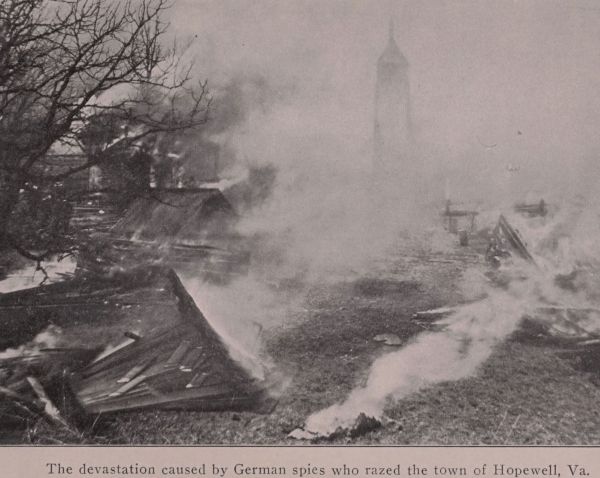
The devastation caused by German spies who razed the town of Hopewell, Va.
Harrison Grant and the Captain abandoned their cross-examination in the greater need of helping fight the fire that had broken out in Hopewell. It took no trained mind to grasp the peril that threatened the town. All its little population was out and fighting but they were powerless. The elements were fighting against them, and the lack of proper fire protection.
Minna, the maid, was handcuffed and turned over to an officer, while Grant hurried away with the Captain. "Where is the powder house?" he shouted at him above the rising confusion, and the Captain called back, "The nearest one's at the quarry."
"Good, take me to it."
Grant could see that Hopewell was doomed. The flames leaped onward in their work of destruction. While frightened mobs fought at the banks to recover their savings, looters appeared, and added their terror to that of the flames as they rushed on to what seemed the inevitable doom of the thing that had given Hopewell its life—the guncotton plant.
If the factory could be saved Hopewell might rise again, but if those scorching flames reached the great stores of guncotton there would be no plant, no Hopewell, not even a survivor—only devastation, which would mean success to Imperial Germany's plot.
Grant racing toward the powder house with a growing army of men following him, shouted orders as he went. He had reached the door and unlocked it. Appointing several men hastily to accompany him, he rushed in.
"Get the dynamite and detonators," he ordered.
With quick precision the men leaped to obey him, and then followed him back again to the scene of conflagration. The flames were gaining swift headway. Lives had been lost where people in frantic endeavor to save their few possessions had braved the fiery terror. The down town section of the small city was in ruins. The flames had reached the outskirts and were nearing the guncotton factory.
Grant stationed his men in this part.
"String those wires here," he shouted, dashing among them as they struggled to obey his orders. "Hurry! That's it," he called, lending a hand to a man whose fingers worked clumsily, "Now attach them to the detonators. Work fast boys. The fire is catching up to us! How's the dynamite?"
Above the roar of the steadily approaching flames the answer came back.
"All wired up. Ready to blow up as soon as the plungers are attached."
"Any caps to them?"
"Fulminate of mercury on every one."
"All right. Rush it. Let me know the minute you're ready!"
A moment of waiting followed, then a man shouted:
"All ready, sir!"
Grant looked back at the swiftly rushing flames, then turned to the men.
"Now boys. Each man to a detonator," he shouted. "When I say the word explode the dynamite!"
There was a rush of dark figures in the glow of light. An order cut the air—then from the distance came a tremendous roar that dwarfed the noises of the night as the outskirts of Hopewell rose into the air. Great masses of wreckage fell about the men. Clouds of smoke and dust blackened the night air and stifled the onlookers, then the flames showed through once more—but this time they faced a gaping ditch of earth so wide that they could not cross. The guncotton factory was saved! Harrison Grant turned with a smile to the Captain of the guard, while wild cheers burst from the frantic citizens.
Dixie Mason had made good speed toward Hopewell for the greater part of the distance. The car had run steadily until just as she came in sight of the columns of smoke clouds of burning Hopewell and realized that Instruction Number Four had undoubtedly been carried to a successful conclusion, her heart sank at the sound of a whistling rush of air from the rear wheel. She stopped the machine and jumped down to inspect the hopelessly flattened wheel. With grim determination she dragged out heavy tools from beneath the seat of the machine and set to work to repair the damage as best she could, her mind running mechanically to the disaster that had befallen Hopewell. So this was Instruction Number Four!
At the sound of crackling in the bushes Dixie turned apprehensively. The haggard figure of a man which dragged itself into a road was one to inspire horror. He stared wildly for a moment and then lurched forward toward her. Dixie instinctively reached for the heavy wrench for protection but he shook his head.
"I won't hurt you," he called hoarsely. "I'm in trouble. I want you to take me to Richmond, little girl."
Dixie shook her head. "I'm not going to Richmond."
"But you can!" His voice rose in the intensity of his plea. "A hundred dollars if you will get me there. I can't wait for trains. I'll raise the price. A hundred and fifty if you'll get me there."
Dixie leaned over and stared at him for a moment by the glow of the automobile lights. Surely she had seen this man before, despite the haggard appearance, the roughness, the dirt and grime and blood-stained bandages. Was this Dollings, the sanctimonious undertaker of Exeter? A recognition of him lighted her eyes for a moment. She cast a glance back at the smoke clouds darkening the sky and the glow of flames from Hopewell. Instruction Number Four! This was the man to whom Von Lertz had sent the message to proceed on Instruction Number Four!
Dixie turned to the machine.
"I can't hurry—and put this tire on too."
"Then you'll take me to Richmond?"
"If you can help me get this tire on."
"I can't help much, but I can hold the tire for you."
Dixie nodded. She rolled out the extra tire and the work progressed. Now and then Dixie reached in her pocket, and one less intent on the work in hand would have caught the sound of a racheted surface being opened. But Dollings' senses dulled by pain and anxiety did not notice.
The tire was on the wheel. Dixie rolled out the old tire to place it in position and gave it to Dollings to hold. He leaned on it, his gaze turned up the road toward the burning town. Dixie gazed up toward the rising column of smoke and sparks too, and thought of the destruction and sorrow and suffering it meant. Then very quietly she crept forward toward Dollings. His hands rested close together on the tire. He was not noticing her. She leaned over the tire and with a sharp snap slipped the handcuffs about his wrists. Dollings sprang at her with a snarl but faced the steeling glitter of a revolver.
"Put that tire back on the machine!" she ordered tersely.
He hesitated. "Go on," she urged, "And if there is any doubt in your mind about this gun holding real bullets I'll show you that it does."
He obeyed her grudgingly and with real difficulty. If Dixie felt a tinge of pity shoot through her she had but to let her thought revert to Hopewell and Instruction Number Four and Dollings' part in it to stifle it.
"Now get into the driver's seat and take the wheel. You can drive. I know it. I've seen you drive up in Exeter, you know." She smiled a little at the bewildered glance he cast on her for a moment, then resumed her orders. "Drive to Hopewell! And remember what I said about this gun."
Dollings drove the car into Hopewell with Dixie Mason holding the revolver. Circling through the fire devastated city they reached the group of cheering men just as the ditch had been blown up that saved the guncotton plant.
Above the roar of the men Harrison Grant heard a shrill little voice that made his heart backfire for an instant.
"Oh, Harrison Grant!" He turned and looked up into the glad eyes of Dixie Mason. "See what I've brought you," she said, pointing at the cringing figure of the now completely cowed Dollings. She was standing on the running board of the car.
Grant walked up to the car with a smile at Dixie. Dollings drew back with a snarl of hatred as Grant touched him on the shoulder.
"Seems to me you and I have met before," said the president of the Criminology Club, "But I can't just place you."
"Don't you remember?" Dixie laughed, leaning toward him. "It's Dollings, our good-natured undertaker from Exeter. He dealt in caskets up there you know, but the boxes they came in held guns instead of coffins. A very nice man if he had stuck to his trade, but changing it got him into trouble. You'd better search him."
Dollings helpless, cowed, beaten, was beyond resistance. Their careful search revealed that, after all, the destruction of Hopewell was but an item compared with the general plan of which Dollings was an agent. With an exclamation, Grant turned over a paper to Dixie Mason, to read.
"Here Dixie, this is your case, and here's a little lexicon of destruction that may be helpful to you."
Dixie took the paper and studied it, horror whitening her face. On it was written:
"Blow up plants at
Hopewell Wilmington Chester West Philadelphia Acton Detroit Windsor."
As she looked into Grant's face, he smiled down at her.
"After all, Hopewell has had its advantages," he said.
"How?" she questioned.
Grant pointed to Dollings. "It has caused the arrest of this man, and will either cause Imperial Germany to change all its plans or give the Secret Service a chance to guard against the attempts on the places named on this list. It may do even more——"
Dixie looked at him thoughtfully.
"If it could only awaken America to the danger that is growing here in her very heart," she said earnestly, "then indeed the destruction here would not have been in vain."
And though Harrison Grant and Dixie Mason, and all the members of the great organization they represented knew that the danger of Germany's intrigues was a vast, far-reaching, fast growing one, even they did not know the immensity of it. While they exulted over the partial failure of one of those schemes of destruction, Von Papen, Boy-Ed, and Dr. Heinrich Albert were at work on still another—and greater one.
In the rooms of the Hohenzollern Club they set in conversation one afternoon.
"Von Papen, Count Von Bernstorff complains constantly about the regular shipment of troops and supplies from Canada," said Albert turning to the military attache. "What are we to do about it? He has asked me several times for a plan."
Von Papen blew a line of smoke rings into the air thoughtfully, and broke the ashes from his cigar. Then he spoke.
"Make another attempt to blow up the Welland Canal, and this time succeed." The last word broke ringingly on the still air of the room as Albert and Boy-Ed leaned toward him expectantly.
"And if it does succeed?"
Von Papen shrugged his shoulders.
"If it does, it will stop one of the great avenues of transportation. It will cause Great Britain to ask America how a military enterprise against Canada was allowed to be set on foot in the neutral territory of the United States. And about that time Germany's propagandists will start working. And if we can't stir up a war between the United States and Great Britain out of the muddle, we're almost as stupid as these idiotic Yankees!"
Dr. Albert with gleaming eyes reached out a hand to Von Papen.
"Von Papen, you have a master mind," he said.
Chapter XII.
THE WELLAND CANAL CONSPIRATORS
Between Port Colborne on Lake Erie and Dalhousie, less than twenty-seven miles distant, on the shore of Lake Huron is a straight, narrow stretch of water which occupies a place in the winning of the world war second only to that of the English Channel. This waterway is the greatest part of the explanation of Canada's ability to keep the stream and volume of troops and supplies pouring steadily across the ocean to England and France. By means of it the troops of the provinces bordering on the Great Lakes, as well as the supplies of those of the United States which are accessible to the inland waterways, have been carried rapidly and cheaply to the ocean port of Montreal, without overtaxing the carrying capacity of the railroads of the Dominion. It is the Welland Canal, constructed and maintained by Canada to overcome the obstructions to navigation between Lake Huron and Lake Erie, afforded by the rapids and the famous falls of Niagara River.
From the early days of the war, from the time when its importance to the mobilization of Canada's resources become apparent, the Welland Canal as an objective of an underhanded attack was constantly in the minds of the army of spies and plotters maintained in America by the Imperial German Government. Its locks, constructed to raise the largest of lake vessels to the 327-foot elevation in the levels of the two lakes, offered a tempting mark for a charge of dynamite. The destruction of one of the gates would cripple the canal and render it useless for months, thus impeding greatly the extension of the help which Canada was giving Great Britain. The placing of a charge of explosive in one of the gates would be a matter of but little risk, as it could be easily done from the American side where the Canadian guards, respecters of the rights of neutral nations, could not interrupt the conspirators.
Yet there were serious objections to carrying out a plot to destroy the canal, which occurred to Johann von Bernstorff, the shrewd and cautious ambassador of the Imperial German Government at Washington, and director of the Kaiser's spy army in America. When Captain Franz von Papen first mentioned a scheme for using dynamite on one of the locks of the canal, Count Von Bernstorff, voiced his objections, and laid down the conditions upon which he would consent to such a plot in these words:
"You have impetuously fostered a plan which is fraught with the greatest menace to which our country might be called upon to face, Captain. It is the possibility of the United States entering the war on the side of the Allies. The destruction of the canal might well lead to serious complications between the United States and the Dominion of Canada in which the national honor of the Yankees might be brought into question. Let such a question be raised and the entry of the United States against Germany in the war would be inevitable. Damage within its own borders the United States will assimilate, but a threatened stain on the national honor of the country will arouse every American to a pitch of fury which nothing can withstand.
"The discovery of the perpetrators under such conditions would be a foregone conclusion. With you or anyone of the others you have mentioned active in the plot, the trail would lead directly to this Embassy and the result would be the making of the one foe Imperial Germany cannot conquer—an aroused America. Come to me when you have explosives acquired through sources which cannot be traced, and when you have men who have never been associated with those who are connected with Imperial Germany. Then, and then only, will you receive the required permission to proceed."
That was early in the fall of 1914. Captain Von Papen did not inform his chief that he already had men at Niagara Falls, prepared with explosives and directions, awaiting the word from him to go on their message of destruction. Von Papen had gone to Von Bernstorff without the faintest suspicion that the scheme would be refused the sanction of the Ambassador. Instead, he had expected congratulations for having conceived such a mighty blow as the first act of the secret warfare which had been decreed for America by the Kaiser's command. So the plan was abandoned, but Captain Von Papen kept it in mind as being a scheme which would some day be available for his peculiar talents.
That time had now arrived. Caustic comments regarding the failure of the Kaiser's forces in America to lessen exports to the Allies, had become frequent in communications received from the Berlin offices. Particular references had been made to the large amount of supplies which were being shipped from Canada, references so particular in fact, that they might have been construed into a direct order to attack the Welland Canal. So it was that at the second time when the Welland Canal was discussed it was Von Bernstorff who first mentioned it, but in Von Papen he found a ready listener and one eager for the permission which was given.
"It is with reluctance that I give you permission to proceed," said Von Bernstorff. "Success will mean a great set-back to the Allies, but I fear the consequences. Supplies are necessary to England and France, but with all the available supplies which America could send to them, Germany would still be the victor. It is the man power of America we must fear."
"Bah! The American tin soldier!" sneered the military attache. "But you need not fear that the explosion will ever be traced to you. Neither Boy-Ed nor myself will take an active part. The necessary dynamite is already in our possession. Trustworthy men who have never been active in the interest of Germany will place it and explode it."
And Von Papen, scarcely waiting for the final words of warning from Von Bernstorff, hurried out to catch the train for New York. There he sought Paul Koenig, chief of detectives of the Hamburg American Steamship Line, the man who had procured the explosives and the men for the Welland plot. After listening to Von Papen's jubilant announcement that permission had been granted for the attack on the canal, Koenig broke in:
"It is good, I can no longer keep the dynamite in my offices. It must be taken some place else tonight. The boxes have been objects of suspicion since the night my men stole them from the barge in the river, and I dare not leave them there longer."
"There is no reason why we cannot take it to the Hohenzollern Club," answered Von Papen. "Four men can easily carry it in suit cases and from your office I will summon Boy-Ed and Heinric von Lertz."
No untoward incident interfered with the transfer of the dynamite. After it had been locked in the club safe the four men sat in the favorite corner of the military and naval aides, listening to a report of the plan for dynamiting one of the locks of the canal, from Koenig.
"Two of the men made a minute examination of the locks six years ago," Koenig said. "The examination was made with the full consent of the Canadian Government, at the time," and Koenig smirked over the thought, "the Hamburg American Line contemplated the establishment of a line of lake boats to be operated in connection with the trans-Atlantic line. I had the honor of forwarding the report, which contained much valuable information, to the Imperial German War Office."
"Back to the subject," interrupted Von Papen, impatiently, "what are the plans?"
"These men have selected three points in the canal which should be reached," continued Koenig, unabashed. "Men, experts in handling dynamite are already in Buffalo awaiting instructions. It is necessary only for some one authorized to go to them and give the orders to begin. They know what to do."
"In case any of them are captured?" asked Boy-Ed.
"They will keep their mouths shut," said Von Papen. "Each one is working for an exemption from military service, for they are all reservists. No punishment which can be inflicted will make them forget the punishment which Germany will mete out to all her slacker sons when the war is over."
"To success for his Majesty," said Von Lertz arising to his feet and reaching for one of the four seidels of beer which a waiter had placed on the table while Von Papen had been talking. He turned to face the large oil painting of the Kaiser which hung but a few feet from where he stood while Von Papen and Boy-Ed rose to their feet. Koenig, slower and clumsier, stumbled as he attempted to rise, staggered a few feet and then, regaining his equilibrium, smashed heavily into the frame of the portrait, knocking the picture askew.
A ladder was quickly brought, which Von Lertz mounted, attempting to straighten the portrait.
"His clumsiness has loosened one of the wires," he announced, then to Von Papen and Boy-Ed, "Franz, Karl, catch hold, we will take it down and have it fixed in a minute."
Struggling under the weight of the heavy frame they heard a choked exclamation from Koenig in his native tongue:
"Donnenrwetter, eine dictograph!"
The trio all but dropped the picture of the Kaiser in their haste to turn and gaze at the little object at which Koenig was pointing—a little instrument fastened to the blank wall which had been covered by the picture which they all knew had made audible, to anyone listening at the other end of wires, any conversation which had been held in the room.
Koenig was the first to recover from the dumbfoundment which the discovery occasioned. Despite the clumsiness he had shown but a few minutes before he sprung up the ladder with agility and busily traced the course of the wire, which had been concealed so cunningly behind the molding by operatives of the Secret Service. Then he quickly descended and carrying the ladder with him ran to the adjoining wall of the room where his keen eyes had shown him the wires ran into the plaster. Again he mounted the ladder and ripped angrily at the wire, pulling plaster away recklessly, finally tearing a hole large enough to expose the wires running upwards by means of a water pipe.
"The plumbers—when they were here for the leak in that wall—must have been Secret Service," jerked out Von Papen between savage fervid oaths, as the explanation of how the dictograph had been installed came to him.
"Quick. Upstairs and if you find anyone at the other end kill him before he has a chance to utter a word of what he has heard tonight," he ordered and then led the way to the stairs leading to the upper floors, a drawn automatic revolver in hand.
Koenig quickly traced the wires to the office room of an untenanted loft in a building adjoining the Hohenzollern Club. The door of the room was locked but gave way easily to the burly shoulders of Koenig. Matches quickly showed conditions which caused a general sigh of relief. Three chairs in the room, the table, the floor and every piece of furniture was covered with undisturbed dust, thick enough to be the accumulation of weeks.
"No one has been in here in months," said Boy-Ed, running his hand over the table and holding it up besmirched.
"Here are newspapers five months old," announced Von Lertz, picking up several from a corner and shaking the dust from them that he might read the date lines.
The evidence that this plotting of the evening could not have been overheard by the use of the dictograph was so conclusive that they stayed in the musty smelling room but a few seconds and then returned to the more comfortable quarters of the club room they had left so hurriedly. With the portrait of the Kaiser once more restored to its accustomed place, Von Papen delivered the final instructions.
"Boy-Ed, you will accompany me to Washington so that we can be with Count Von Bernstorff as surety to him that we are taking no active part. Koenig you stick closely to your accustomed business. Von Lertz you will go to Buffalo and assume charge. For the sake of precautions take Baroness Verbecht, Madam Stephan and Miss Mason with you. I have suggested Miss Mason because of the impression she has made upon the lucky whelp Harrison Grant, president of the Criminology Club. If he should happen to appear anywhere on the scene, a thing which it not unlikely, due to his infernal luck in being wherever he can harm us most, Miss Mason must do anything to keep him away from the canal the night of the day after tomorrow. The Baroness and Madam can care for any other men who are too intrusive. Ten o'clock of the second night from tonight is the hour for the destruction of the canal. We will be awaiting word of your success at the Imperial German Embassy in Washington. Good-night."
Koenig and Von Lertz accepted their dismissal and left the club together, but parted at the door, Koenig to go to the Sixth Avenue elevated station for a train to take him to less refined but more familiar resorts in lower Manhattan, and Von Lertz to hurry to the telephone booths in the Hotel Plaza. From a telephone there he pleaded in vain with Dixie Mason for permission to see her but a few minutes at once. He finally accepted her dictum that luncheon the following day would be the earliest possible moment at which she could meet him. He could not know that his voice had betrayed the fact to her that another Imperial German plot was pending and that she wanted her meeting with the spy to be in some public place where it would be possible to get word to the Secret Service at once of any information she might acquire.
So it was not by accident that Harrison Grant, president of the Criminology Club, was seated in an automobile just outside an entrance to one of Broadway's biggest hotels when Dixie Mason emerged the following day. To the passerby it would have seemed a chance meeting, extremely pleasurable to both.
"When did you take the dictograph out of the Hohenzollen Club?" she asked as he leaned out of the car to grasp her hand.
"Last night," was his answer.
"Last night? Why Heinric just assured me that he knew for a fact that the dictograph that was discovered had not been used in months."
"The impression we want him and the other worthies to get," responded Grant, and then to appease her curiosity, "since the day we installed it I knew that it might be discovered at any time and prepared for it. It might have nullified a great deal of information if they suspected anyone knew of conversations held in the Club. I was listening last night when Koenig fell against the picture and exposed the receiver. Newspapers, six months old, were in the corners of the room prepared for this emergency and we carefully scattered bags of dust which we had there over everything. We were descending the fire escape when they broke into the room."
"Then you have all the information I have gathered from Von Lertz," said Dixie well concealing the disappointment she felt. "You know that another attempt is to be made to dynamite the Welland Canal, and there is nothing I can do to help."
"We still need plenty of help, just of the peculiar kind you can give us," said Grant. "We only know that an attempt is to be made and that the dynamite has been procured. The canal is nearly twenty-seven miles long and to learn the place where the attempt is to be made would help us. Also an idea as to when the attempt is to be made."
"Then I have some information for you," smiled Dixie. "Heinric has just invited me to go to Buffalo with Baroness Verbecht, Madam Stephan and himself tonight. The Baroness and Madam are to entice any curious men away from their duties and I am to see that you discover nothing in case your luck should guide you to the spot."
"With such an inducement nothing can prevent me from reaching Buffalo tomorrow," said Grant.
"Bye-bye, then, until we meet there," answered Dixie and turned to re-enter the hotel.
A few moments later she had rejoined Heinric von Lertz in the dining room and was assuring him that the massage which he had suggested had all but vanquished her headache. Eagerly he extended an invitation to a matinee, dinner and then an auto ride to the railroad station in Jersey for the train to Buffalo, and was boyishly pleased when she accepted. Excusing himself, he telephoned brusque orders to Baroness Verbecht and Madam Stephan to join him at the train and then rejoined Dixie for the round of pleasure he had planned.
Arriving in Buffalo the party was driven to the Algonquin Hotel. As they paused at the desk for Von Lertz to register, a bellboy hurried up to Dixie.
"You dropped this, Miss," he asserted.
"Oh, I thank you," responded Dixie, accepting a dainty lace handkerchief she had never seen before, when she caught a significant gleam in the young man's eyes.
The bellboy turned away quickly to accept, nonchalantly, a tip which Von Lertz had extended. Without attracting the attention of the rest of her party, Dixie found an opportunity to stretch the handkerchief out. On the small piece of linen in the centre was written in pencil:
"Bearer of this will be constantly with me, and will keep careful watch for any messages from you. H.G."
"A trip to the Welland Canal is really nice in an auto."
It was the voice of Von Lertz which broke in upon the pleasant musings which the message had aroused.
"If that is intended for an invitation, there is nothing I would like better," responded Dixie quickly. "Will the Baroness and Madame accompany us?"
"They must remain here, for their work may begin any time," returned the spy and then escorted Dixie to a little roadster which he had procured.
There was but little conversation on the drive out. At the canal Von Lertz drove to three of the locks and carefully surveyed the surrounding land. As the inspection progressed his spirits rose rapidly.
"Good, good," he chuckled, half to Dixie and half to himself, "Koenig certainly knew what he was doing in selecting the men for this job."
On the return trip he chatted gaily, and seemed to be in no hurry to get back to the hotel, keeping the speed of the car well down to the road limit. Despite this, just as they entered the boundaries of Buffalo, a heavily goggled motorcycle policeman, blocked the road.
"Ten miles an hour's the limit on this road," he announced gruffly and Von Lertz brought the car to a surprised stop.
"Ten miles an hour?" demanded the angered spy, "why there isn't a car built that can stand that sort of a snail's pace."
"Ten miles an hour" reiterated the officer and Dixie recognized a ring on the finger of the hand extended toward Von Lertz. Quickly her hand dropped over the side of the car and for a moment her finger was busy writing in the dust which had collected there, while the now thoroughly incensed German volleyed a heated tirade at the policeman, who contented himself with repetitions of "ten miles an hour's the limit."
The attitude of the officer suddenly changed as Dixie's hand was withdrawn into the car and lay idle in her lap.
"Oh, all right, if you are going to get mad about it," he said and stepped aside peering intently at the side of the car on which Dixie was seated. Plainly written there were these words:
"Will send message boy by tonight. Watch hotel alley."
As the machine disappeared in the distance the motorcycle policeman raised his goggles and laughed. It was Harrison Grant.
But Heinric von Lertz did not know. Defying the rules of the road he was speeding toward the hotel, his good humor of a few minutes before dissipated by the dispute with Grant. Suddenly the speed of the car slackened but a few doors from the hotel.
"Do you know those two men?" demanded Von Lertz.
Dixie Mason turned in the direction he pointed. Baroness Verbecht and Madam Stephan were aiding Cavanaugh and Stewart of the Secret Service, both of them apparently intoxicated, into a taxicab standing at the curb. Stewart noticed Von Lertz pointing at them and waved a maudlin salute as he ordered the chauffeur to drive to a roadhouse on the outskirts of Buffalo in a thick loud voice.
"Do I know them?" retorted Dixie. "Do you know Harrison Grant?"
"Yes, the dog," muttered Von Lertz.
"Those are his two best men."
"Good," said Von Lertz, smiling happily, "I will commend Verbecht and Stephan in my report."
Dixie Mason smiled quietly. She had seen the method in which Secret Service operators acquired "business jags." She had watched operatives recklessly ordering drinks of every description and downing them in gulps, knowing that harmless substitutes had been served by another operative at the bar.
"You will have to excuse me," said Von Lertz as they entered the hotel. "I have to supervise arrangements. I will meet you in Verbecht's room at eight o'clock."
Dixie kept him well in sight as he turned away and as a result was able to send Harrison Grant the information that Von Lertz and three of Koenig's men had spent the afternoon attaching detonators to sticks of dynamite, by means of the operative in the guise of a bellboy. When she went to the room of Baroness Verbecht at the appointed hour she found Madam Stephan and the Baroness already there. Von Lertz entered a few moments later.
"You two here?" he demanded angrily of the female spies. "You left the two Secret Service men to their own devices."
"Not exactly," drawled Madam Stephan. "We left them, yes, but only after they had been tucked in bed in a drunken stupor. Both of them are so dead to the world that they would not awaken if they were sleeping on the top of the gates to lock fourteen tonight."
"Good, good," once more in good humor. "Everything has gone splendidly. I watched while Arth and Gerson left the hotel through the front entrance with bell boys carrying their suit cases loaded with dynamite. To guard against any suspicion they ordered a car for the railroad station. There another is awaiting them and they will make the canal in good time. Jacobson is still here. He will take out the stuff which is too big for suit cases. A car is awaiting him in the alley. He will go down the fire escape just in time to reach the canal at ten o'clock. The dynamite will have been placed and the wires run. A few seconds later—a muffled report and England will receive but little aid from Canada for many months to come. Is it not well planned?"
He paused for a moment to hear the words of praise from the three women, then continued.
"Come. You can see from here. Jacobson's things are already on the fire escape."
Baroness Verbecht and Madam Stephan crowded close to the window at which Von Lertz was standing, but Dixie Mason remained seated in her chair nervously knotting a bit of string she had found some place. Von Lertz quickly missed her and turned to look at her.
"Why you poor child," he said coming to her, "you appear all unstrung. There is not a thing to worry about."
"I know there isn't," responded Dixie with a twisted smile, "but it is almost unbelievable to me that at last we have done something without Harrison Grant knowing of it. I feel apprehensive for some reason. Are you sure there is no one in the hallway?"
"Why this is most unlike you, Miss Mason," responded Von Lertz. "But come see for yourself and relieve your worry."
He threw the door open and gave Dixie's arm a little re-assuring squeeze and she gazed up and down the long empty corridors.
"I believe I am making myself nervous with this old string," she said, ruefully casting it from her onto the floor.
"At least you know there is no one spying," said the German as he turned back into the room.
His voice would have lost the confidence it expressed as he continued to pour assuring words into her ears, if he could have known of a happening in the corridor. Scarcely had he drawn the door shut, when the door of the room across the corridor opened and a bellboy, who a moment before had been crouching inside with his eye at the keyhole, emerged. Stooping quickly to pick up the string which Dixie had thrown away he sped noiselessly down the corridor to the elevators.
But Von Lertz did not know, and continued to enlarge upon the efficacy of the precautions which had been taken, and how impossible it was for the Secret Service to have learned anything of the present plot. As he was talking a knock came on the door and a bellboy, the same one who had taken Dixie's piece of string from the floor of the corridor, put his head in:
"Did you ring, sir?" he asked, "No, sir? I am sorry."
The door was closed but a message had been delivered. To Dixie Mason the appearance of the bellboy at the door meant that her bit of string had reached Grant and had been understood. On the string she had tied knots spaced to the dots and dashes of the Morse code spelling out the following message:
"Lock fourteen. Ten o'clock. Watch alley."
"In a moment Jacobson will be starting," said Von Lertz moving toward the window.
Dixie accepted his unspoken invitation and moved to his side at the window and gazed down into the rapidly darkening alley. A moment after she had taken her position a figure emerged onto the fire escape, and it did not take the whispered words of the spy standing next to her to identify it as Jacobson. The dynamiter gathered up two large packages which were already on the platform outside his window and then made his way gingerly to the ground by way of the frail steel stairway. An automobile crept up to him out of the shadows of the building. Jacobson got in. The car began to move forward out of the alleyway and Dixie Mason became filled with a fearful dread. Suppose her message had not been understood and no watch had been placed on the alley?
But, no. A figure suddenly launched itself from the kitchen loading platform onto the running board of the car. A second appeared from the garbage cans, and the glint of a revolver could be seen in his hand, as he vaulted into the vacant seat by the driver. The car came to a sudden halt and a terrific struggle ensued in the tonneau. The struggle was short lived however. A revolver shot, the flash of which showed it to be in the air, and Jacobson was a prisoner.
"Look, look, isn't that Harrison Grant," gasped Von Lertz clutching Dixie's arm as another figure appeared in the alley running toward the car.
"Anyone hurt here?"
It was a call from the running figure which made his identification as the president of the Criminology Club a certainty.
Von Lertz who had been cursing fervidly as he gazed into the alleyway suddenly, affrightedly, became aware of his own precarious position.
"Quick, we must get out of here," he uttered hoarsely and led the way through the door to the corridor. There was no one but a bellboy to be seen, bearing a tray with a pitcher of water. Had Von Lertz been less occupied he might have recognized him as the same one who had been to the room a short time before, and had he stopped a little he would have seen that the tray concealed from view a wicked automatic revolver which was clutched tightly in the right hand of the hotel servant. The bellboy gazed blankly past the German spies directly at Dixie Mason who was in the rear. A slight shake of her head caused the boy to step back against the wall to permit free passage for the party.
Von Lertz led the women out of the hotel by devious routes which finally emerged into the open through a side door onto a darkened street.
"Remain here," he whispered, "while I get a car."
The three women stood in the shadow of the building, Madam Stephan and Baroness Verbecht whispering together in frightened voices. Dixie Mason was startled a trifle by a subdued voice from the shadows directly in back of her.
"Operative 523, Miss Mason," said the voice, "shall I arrest the party?"
"No," answered Dixie Mason without turning her head, "Von Lertz is of more value to us at large as a means of keeping tabs on the Imperial German spies."
So it was that Von Lertz was not molested when he returned with a high powered touring car driven by a competent looking chauffeur.
"I told him Miss Mason and I were eloping," he whispered, "and that you two were friends of hers going along as witnesses. He is willing to drive us clear to New York."
Intent only upon getting away from the Secret Service, Von Lertz forgot for the time being that Count Von Bernstorff, Dr. Albert with Captain Von Papen and Captain Boy-Ed were awaiting word from him that the canal had been dynamited successfully. More than an hour had elapsed since the arrest of Jacobson before Von Lertz remembered this matter and he ordered all speed to the nearest telegraph station. There it took him some time to prepare the message and it was nearly midnight before it was delivered at the Imperial German Embassy in Washington.
The quartet of the Kaiser's arch conspirators had been waiting impatiently. All of Von Bernstorff's fears in regard to the plot had been aroused when the time passed and no message was received. When the telegram did arrive he was at his private telephone answering a call which had been received a few minutes before.
"Why it's from Ithaca," exclaimed Von Papen who had torn open the yellow envelope, "My God, it says 'failed.' What can it mean?"
"It means this gentlemen," came the cold voice of Von Bernstorff from the doorway, "that at the present moment a demand is being made upon Imperial Germany for your recall from the United States. I have just received information that Jacobson was arrested as he was leaving the hotel, that Koenig's other men were arrested at the canal in the act of placing the dynamite. It means that the Secret Service had full information of the plot, that you have been outwitted straight through."
"They couldn't have known," interposed Von Papen. "It is some more of the infernal luck of Harrison Grant."
"They did know," said the Imperial German Ambassador, "for already a conference has been called at the State Department. That can mean but one thing—that your part and that of Boy-Ed is known. It is certain that your recalls as attaches of the Embassy will be made. You had been warned. There is nothing I can do. Oh, how could you have made such blunders!"
Von Papen did not answer for a moment. Nor Boy-Ed. Nor Albert. Then Von Papen with a growl, turned to his superior.
"We did the best we could. That is all anyone can do. And we have not failed yet. We may be recalled, but when we go, I promise you, that we will leave a reign of terror behind such as no country has ever experienced."
Chapter XIII.
THE REIGN OF TERROR
Captain Franz von Papen, and Captain Karl Boy-Ed were spending their last hours in America as attaches of the Imperial German Embassy, in conference with the German Ambassador in the Embassy at Washington. The discovery of their attempt to dynamite the Welland Canal had caused the action by the United States Government which Count Von Bernstorff had predicted. A demand had been made upon the German Government for their recall as accredited representatives of the Kaiser, and Imperial Germany had no choice in the matter. The request, styled in diplomatic language but in reality a demand which brooked no denial, was acceded to and already Von Bernstorff had received notice of the cancellation of their appointments as military and naval attaches, respectively, to the Washington Embassy.
It was some weeks since they had been in the same room awaiting a telegram from Heinric von Lertz who was in charge of the attempt on the Welland Canal. There had been many details to arrange and only that same day had they received their passports and permission from the British Government to safely pass the blockade which had been established around Germany. The safe conduct passes had been a disappointment. They were made out for separate ships and Von Papen and Boy-Ed had planned many enjoyable hours together on their journey home, receiving wireless reports on the success of plans which they were discussing with Von Bernstorff and Dr. Albert.
"Von Bopp has proved a wonder at organization," said Von Papen speaking of the Imperial German Consul General in San Francisco. "We have made the mistake of failing to employ our entire forces in a general attack. As we have been operating in the past we have engaged in but minor tasks, plans which would have resulted in great damage if successful but minor in the sense that only a small percentage of our forces were engaged. The result has been that the Secret Service has always been able to oppose us with an adequate force, after they have been led to it by the damnable luck of Harrison Grant. We have them hopelessly outnumbered, however, and in the campaign which will open as soon as we have left the country we propose to make good use of our superiority in forces. Briefly the plan is this. To strike with explosives and fires simultaneously over the entire width and breadth of America with a two-fold object—first to cut off the supplies for the Allies by destroying the means for their manufacture and secondly to create such a reign of terror in America that a declaration of war against Imperial Germany will be too fearful a thing to even contemplate. Boy-Ed, will you read the latest report we have received from Von Bopp?"
"Naturally it is in code," responded the naval attache, "but I can give you the sense of it. Attacks are planned upon the Canadian Pacific Railroad in British Columbia with the main damage inflicted in the Selkirk Mountains where a little explosive will go a long way; the blowing up of a number of troop trains, and trains carrying horses and explosives also in western Canada, in fact a general renewal of the plans in Canada which Koolbargen undertook but which resulted so badly for our cause."
"Before you proceed farther," interrupted Von Bernstorff, "No more money is to be spent upon any schemes in connection with Canada. It is too costly for the result to be accomplished. Canada is practically drained now of all the help she will be able to extend England. Her supply of men is nearly exhausted, and two-thirds of the supplies she is sending are gotten from the United States. We have no one left in Canada to work through and the effort to get agents through the emigration lines is too great for the work that can be done. Instruct Von Bopp to confine his efforts to the United States."
"Exactly my own idea," said Von Papen, "but Von Bopp is a fanatic in regard to Canada. His plans in regard to Canada are harmless for I never intended that they should be started. What has he to say of this country?"
"The docks at Seattle, Vancouver, San Francisco, San Pedro and other coastwise towns have received his consideration. Munition plans which have been suggested to him have also been carefully investigated and are all available for our general scheme. He only wants orders to begin the work."
"He can wait," said Von Papen, and then turning to Von Bernstorff and Albert, "you can appreciate the advantage of having affairs directed from San Francisco. The Secret Service is paying little or no attention to affairs there. Von Bopp, assisted by Baron Eckhart H. Von Schaack, his vice-consul, Lieutenant Wilhelm von Brincken, and a number of others, has been getting the necessary men, not only for his own territory but for operations in the middle west and in the east and south. Von Lertz will have supervision over everything east of the Rockies but the men who will act for him will receive their instructions before they leave San Francisco. A whole week of explosions and fires in some of the biggest and most rushed plants in the country will be the result. Each night will see its toll taken, with the climax coming with the destruction of the Bethlehem big calibre gun works. In regard to this Von Lertz is entitled to a great deal of credit. The only unprotected portion of the plant is the coal shutes leading directly to the fire rooms. Although the idea was undoubtedly suggested to him Von Lertz was keen enough to realize its worth. Women gathering up coal which has been spilled in the unloading of cars into these shutes, is an ordinary sight. Workers of ours will go to the shutes, ostensibly to gather waste fuel, carrying lumps of coal which have been hallowed out and filled with trinitrate of toluol and will slide these chunks down the shute. Could any sight be prettier than the one which will occur when these are thrown into the fire boxes? The explosions which will follow will scatter the fires so far that nothing can save the plant from destruction. If any portion of it does escape it will be useless for the entire plant will be wrecked by the explosions within the fire boxes. Is not this plan alone, without the others worthy of commendation by Imperial Germany?"
Totally unconscious of the stamp of fiendishness which he had planned upon Germany by asking commendation of a scheme which would inevitably result in horrible deaths by scalding and fire, of stokers whose only offense was the earning of an honest living by hard work, Von Papen paused to see the effect of this announcement upon his hearers. Albert clucked his delight by clicking his tongue against his set teeth. Von Bernstorff smiled evilly:
"I might say that Germany is compensated for the loss of your services in America by the splendid work you have planned as your farewell greeting," he said. "I have heard enough. You have planned well and wisely. But let me caution you not to become too rash before you leave. Clear your office well for with your departure it will lose its sanctity, and nothing must be found. Now for a little service I wish you to perform for me."
He opened a drawer at the table at which he was sitting and after unlocking a compartment within it produced a pair of field glasses. Undoing a catch at the side divided the object into two sections showing that the interior had been cunningly arranged as a camera. From it he took two small cartridges of films.
"Some pictures, which will amuse Hindenburg," he said handing the films to Von Papen. "They contain views of the military parade which took place this morning, and as they were taken through two of the finest microscopic lenses in the world enlarged prints will give him much information about the state of training and the equipment of the American army. To me it was an amusing sight, comparable to a chorus in a musical comedy. They make a brave showing on dress parade, but everyone knows that they are few in number, inadequate in equipment, and with absolutely nothing in the way of preparation for a war."
"Tin soldiers who have no conception of discipline or the rudiments of fighting," commented Von Papen. "I doubt if a quarter of a million men could be induced to enter the army if America did declare war."
"The number who would respond would make no difference," said the German Ambassador. "Untrained they would be slaughtered in France and would leave less opposition to us here when 'Der Tag' arrives for America. Four years is the least possible time in which a civilian may be made into a soldier for it takes that time in Germany, working with the most intelligent material in the world and with the best equipped system. By that time, if training were attempted here, France and England will be subjugated and America on the defense in its own country."
Nods of approval from his three listeners gave assent to the fact that he had but expressed an idea which they all held, in fact, a belief which was held by the entire military party of Germany.
"And now we must say farewell," said Boy-Ed, "we will not see you again for you must condone our indescretions and show your revulsion of our methods by being unfriendly. For were you too friendly toward us, who have betrayed you, why even the pig-headed Americans might be led to suspect that Imperial Germany condoned, even if it did not sanction, our activities here."
A hearty laugh followed this ironic sally, and then after leave takings, Von Papen and Boy-Ed departed to take a train for New York, where many things, in addition to their packing, remained to be done before they sailed and the time was short.
Heinric von Lertz, Madam Augusta Stephan, Baroness Therese Verbecht and Wolf von Igel, were in Von Papen's New York office when they arrived.
"One matter which you will have to arrange yourself," said Von Papen immediately plunging into the matter which was engrossing the attention of all. "With Von Bopp making the arrangements for the actual explosions and fires with the exception of the one at Bethlehem, I want you to devote your time to the propaganda work. Have a correspondent near each place at the time the event occurs, prepared to exaggerate everything in connection with it. The story may contain suggestions of the existence of a league of British and French born workingmen who have been active in the neighborhood which had for its object the stoppage of manufacture of supplies for the Allies in order to prevent a war which is forcing the British and French workmen into the army, training women for their positions, doing everything to disrupt labor while providing capital with the means of intrenching itself. Arrange, if possible, to have German reservists in the vanguard of those who protect the property which remains. In each story emphasize the number of German reservists in this country. You understand the object?"
Von Lertz shook his head hopelessly.
"It is for this reason," continued Von Papen. "At the time when America is appreciating its own helplessness, because of inability to prevent property destruction with the attendant loss of life, such stories will drive home the fact that Germany already has a trained army in this country which outnumbers the entire regular army of the United States. We have tried to persuade America, tried to make them see the justice of our cause, and failed. Now we will browbeat them into remaining neutral.
"Stephan and Verbecht will remain under your orders. Von Igel will remain with me. Now get out, and get busy. I will see you here tomorrow morning before my steamer sails."
Von Papen turned into his private office to begin the packing of all documents, which, if they fell into the hands of the Secret Service, would reveal the full extent of the complicity of the Imperial German Government itself in the many outrages which had been committed in America. Madam Stephan, Baroness Verbecht and Heinric von Lertz, left the office together to separate when the street was reached, the two women to return to their own apartments and Von Lertz to attend to some business which had suddenly become urgent since Von Papen would expect a report upon it on the morrow.
Before proceeding on it, however, Von Lertz stepped to a telephone, to speak to Dixie Mason, asking to be excused from a luncheon engagement with her. He did not know how long the business he had in hand would take and stood in too wholesome fear of the departing military attache of the Imperial German Government to neglect it for pleasure.
"Perhaps I am derelict in my duty to my country," said Dixie Mason to Harrison Grant, at an appointment she had arranged with him after she had received the telephone call from Von Lertz. Grant had promptly extended a luncheon engagement and the two of them were seated at a window table in one of the more exclusive New York hotels. "Von Lertz is slipping away from me, and I cannot bring myself to make the necessary effort to hold him. Since the Baroness Verbecht joined the German spy army he has found a woman who will cater to all of his beastly instincts, and the demands he makes on me are impossible."
"America does not demand such a sacrifice from her womanhood," said Grant heatedly, "if such methods are necessary to gain information then we will go on without any information he can furnish us."
"It isn't that he has lost confidence in my loyalty to his cause," continued Dixie, after a grateful little nod to Grant for his understanding of her position, "but most of my information was gained through little chats over a dining table. Now he has no time for these between entertaining the Baroness and his own work. Something is brewing, I know, for he is not with the Baroness today since she is at home. I haven't the least inkling as to where he is, but Heinric is not such a lover of work that he will do it for the mere sake of having it done. It means he is doing something under instructions, and that means something against America."
"Nothing will be attempted until after Von Papen and Boy-Ed are safely out of the country," said Grant, "and by that time we may strike a lead of some kind."
"If only you could bring yourself to meet Madam Stephan half way," bantered Dixie, for the admiration which the German woman spy had for him was an aggravating matter to the president of the Criminology Club. "I think she knows what it is all about and might tell you in return for just a little affection."
"Please, please," said Grant, "but tell me, how does she feel about the way in which the Baroness is pushing her out of her position as leader of the women spies because of the attraction Von Lertz has found in the Baroness?"
"Much hurt at it, for she has a sincere affection for Heiny."
"Do you think a letter from me appealing to jealousy might result in a confession from her?"
"No," answered Dixie after a thoughtful pause. "She is intensely loyal to the master she serves and will let nothing personal interfere with that. No information could be gotten from her because of the deflection of Von Lertz unless something happens. But I have to leave you, it is understood that you will keep Von Papen in sight until he is on his steamer and I am to do the same for Boy-Ed."
Dixie found that circumstances aided her greatly in the task she had selected for herself. Despite the fact that Von Papen and Boy-Ed were being dismissed in disgrace, a large number of people called at the office which housed both of them to wish bon voyage to the discredited emissaries. When she arrived at the office she found that Baroness Verbecht, Madam Stephan and Von Lertz were already closeted with Von Papen and that Boy-Ed was receiving all the callers who were of sufficient importance to be met personally. So it naturally fell to Dixie, as an intimate of both the former Embassy aides, to act as hostess to the throng which gathered.
It was to her liking. She flitted here, there and everywhere throughout the offices, greeting a person here, and bidding adieu to one there, but all the time with her eyes open for any information which might be of value. Only one thing did she find. This was a bill submitted by a telegraph company which Von Igel was working upon, checking on the receipt of the message from the office files. To aid himself he had carefully written on the blank the name of the sender of the message, or the name of the person to whom it had been sent. The frequent repetition of "Von Bopp" on the blank caused Dixie to pocket it for future investigation. Another thing which she noticed was that Boy-Ed was sending most of his personal and private papers into Von Papen's rooms, which led to the surmise that Von Papen had undertaken the task of caring for all the important papers of the office.
It was of this she first spoke when she met Harrison Grant after both Von Papen and Boy-Ed had been escorted to their separate boats.
"It is a shame that we had to observe the rules of civilized nations by letting them take those papers," she said, "when they themselves have violated every one."
"I noticed how careful Von Papen was of two bags, a portfolio and one trunk," said Grant, "so I have cabled the British authorities that it might not be amiss to search them for information which might be of comfort to the enemy when the ship touches at Falmouth."
"Oh, good," exclaimed Dixie. "And now I am starting for San Francisco this afternoon. I think I have a lead worth working on."
Then she told him of her reasons for wanting to watch the movements of Franz von Bopp, the Imperial German Consul General at San Francisco. Grant heartily agreed with her. Then on finding that she had already engaged her train he accompanied her to the station and saw her start on her week's journey.
He chafed at the idleness which confronted him. Shadows had been sent on the Baroness, Madam Stephan and Von Lertz, as well as others who had been active in previous German activities. Von Lertz was reported as having interviewed and retained the services of a larger number of publicists whom he had dispatched to various parts of the country. Grant decided that perhaps acts of violence as a part of the German propaganda were to end with the departure of the two arch-conspirators, and that Von Lertz was directing a campaign of publicity work in an effort to regain American sympathy.
Finally through sheer inactivity he began thinking of the letter to Madam Stephan of which he had spoken to Dixie. He finally decided that sending it could do no harm, and he dispatched a short note, telling her that it might be wise for her own safety to give up any information she might possess.
The note was destined to have a far reaching effect, but not in the way in which Grant thought. Madam Stephan received it and after reading it tore it to small pieces, enraged at the idea that Grant had such a poor opinion of her that he could believe she would turn informer. Baroness Verbecht called a short time later while Madam Stephan was busy with her morning toilet. The Baroness was a natural spy and when she saw the torn bits of letter on the table she gathered them up carefully, and carried them with her when she left. At her own apartment she spent the day piecing them together until the whole note stood revealed. Then she had a hearty laugh at the stupidity of the American who would expect an agent of the Wilhelmstrasse to turn informer and brave the mighty wrath of Imperial Germany.
The dispatch published the following day, however, telling of the seizure of Von Papen's papers at Falmouth caused her to think of the letter. A plan whereby she could put Madam Stephan in a position where she could no longer claim the leadership of the women spies of the Kaiser in America occurred to her and she put it into instant execution.
She hurried to the former office of Von Papen where, as she expected, she found Von Lertz seething with rage at this new disaster to Germany. She had counted upon rage and fear dulling the never too sharp wits of Von Lertz, and he was in the mood which she had anticipated willing to believe almost any explanation.
"How, how could they have known of those papers, check stubs and everything else which should have been destroyed, instead of being taken to Germany as proof of our fidelity?" he groaned.
"Here is your explanation," said the Baroness extending the note to Madam Stephan from Grant on the letterhead of the Criminology Club. The fact that it was undated made her story plausible. "She received that five days ago and since then I have watched her. She has met Grant four times and was with him four days ago when he sent a long cablegram to England. I could not get the contents of that message but it was without a doubt notification of the papers which Von——"
But Von Lertz had not waited to hear her finish. He had fallen a ready victim to Baroness Verbecht's scheme for discrediting Madam Stephan and had dashed from the office to confront the supposed traitor with her perfidy.
He was forced to wait at her apartment, for Madam had not yet arisen and as he strode up and down in her study his rage momentarily increased. An open book lay on the table. Hardly aware of what he was doing he picked it up and read two or three passages before he even noted the title.
"Bah," he suddenly exclaimed in disgust. "'A Tale of Two Cities.' She has so far forgotten Germany that she turns to English books for entertainment."
Then Madam Stephan entered the room. Enraged at the cool unruffled appearance of the woman he hurled forth a violent denunciation of her as a being unworthy of the respect of anyone, and ending by accusing her of being a traitor to Germany. A finer grained man would have read the falsity of the charge in the effect the accusation of disloyalty had upon Madam Stephan. In the moment she was turned from a bright, vibrant, keenly alert woman to a crushed, heart-broken, dull eyed, horror stricken, pleading wretch.
"No, Heinric, no," she moaned, falling to the floor at his feet. "Tell me that you don't mean it. I have forgotten compassion, sympathy and kindness that I might be faithful to Germany. I have given my every thought, my life, my right to love and happiness, and even virtue itself to carry out Germany's command. Am I not now even worthy of trust?"
Her voice had gained in strength as she made her plea, and she paused, kneeling, with tear streamed face upturned, and out-stretched arms.
Even the dull witted Heinric von Lertz was affected by the sincerity of the appeal, but it was not for a German gentleman, a disciple of Hun Kultur, to weaken at the misery of a woman.
"Imperial Germany demands that your fealty be above question, or that you die," he said brusquely. "Unless you can send me absolute proof within one week that you have communicated in no way with Harrison Grant you must die. One week of grace I grant you, because last night the reign of terror for America began, and I will be very busy. One week from today—absolute proof or death."
As he was talking Madam Stephan had fallen forward and had grasped him tightly around the knees. As he finished Von Lertz disentangled the clutching arms, threw her violently to the floor and hurried from the apartment. Madam Stephan lay still. A faint had quieted for the time being her tortured brain.
Von Lertz had spoken truly of being busy. As he re-entered his office Von Igel met him.
"There was a long distance telephone call," said Von Papen's former secretary. "The message was 'O.K. at Buffalo' and also this telegram."
Von Lertz grasped the yellow envelope and hastened into the former private office of the military attache. There he took a long list of cities in America from his pocket and put a check after Buffalo. Then he tore open the telegram.
"O.K. at Wilmington," read the printed message.
And throughout the day similar messages continued to arrive from all parts of the country, each denoting the destruction by fire or explosion of American property and in many instances American lives. Many were from the West for Franz von Bopp was busy. As proof after proof came to his hand that the crimes were proceeding unmolested, showing that the Secret Service had been totally unwarned, Von Lertz thought of Madam Stephan.
"I must see her tomorrow," he told himself as he closed his desk late that night. "Perhaps there is a mistake, but I am too tired tonight."
He overslept the next morning and arose too late to stop at her apartments before he was due at his office, and by this little chance happening the entire course of Franz von Papen's reign of terror for America was changed. Madam Stephan, following her recovery from the first shock of the accusation had set herself to thinking clearly. She knew of the mental processes of Heinric von Lertz, and as she noted the success of the plot she felt there was hope for her. When the morning papers of the following day showed more explosions and more fires she became almost cheerful. Then the noon editions of the daily papers dashed her hopes to the ground.
Franz von Bopp's office in San Francisco had been raided by the Secret Service. The papers hinted that much documentary evidence of German plots had been seized. Many prisoners had been taken. But Dixie Mason who had caused the raid was uneasy. Evidence had been gained of plots for explosions and fires on the western coast, but explanations of the crimes in the east had not been found, and the little Secret Service operative knew that but half her work had been done.
The effect of the news upon Madam Stephan was startling. She dismissed any hope of being able to prove her innocence to such a man as Heinric von Lertz. She thought of how different it would be if he were a man of the type of Harrison Grant. Then in a flash the whole truth burst upon her. She realized in a twinkling the entire falsity, the utter worthlessness of a system which could elevate a man of Von Lertz's calibre to the position he occupied. She appreciated the vileness of the crimes in which she had participated and gained an understanding of the glorious things for which American ideals stood. With the thought came a decision based upon the fineness of her nature which she had suppressed during her entire life. She called for her wraps. It was as a woman new born that she left her apartment. She was a woman arrayed on the side of humanity as against Imperial Germany.
She made her way straight to the Criminology Club. As she walked she wondered how she could ever have thought that the thing she was about to do was abhorrent, how she could ever have thought of it as anything but her bounden duty to humanity. At the club the announcement that she was awaiting him made Harrison Grant start eagerly.
For two nights he had gone without sleep, working incessantly, trying to get some clew which would expose the whole of the plot. He knew of the messages which were being received by Heinric von Lertz, but the coincidence of each being from a city in which a fire or explosion had taken place was not sufficient evidence to warrant a raid. The news of the raid in San Francisco had not aroused hope, for he had received a long message from Dixie Mason telling of everything found in the offices and he realized that he still had before him his work of stopping the reign of terror in the East, without aid to be expected from anywhere. So he grasped the out-stretched hand of Madam Stephan eagerly.
"You came in response to my letter?" he asked.
"I had scarcely thought of that," responded Madam Stephan. "I have come as a true friend of the German people. Mr. Grant, I love my people and my country. Events of the past two days, of which you need never know, have shown me that it is only through the destruction of Imperial Germany and everything for which it stands, that they, my people and my country, can take the place I want them to have in the world. Misguided as they have been from birth they cannot throw off the yoke. With America's help it can be done. So I am here to aid America. I will be compensated if I bring the day of Germany's salvation, the day upon which the horizon of humanity is revealed to the German people, as it has been revealed to me today, one hour nearer."
She then related quickly all that she knew of Von Papen's plan for a reign of terror in America.
"Heinric von Lertz will not wait until the day set for the destruction of the Bethlehem steel works to attempt it," she said. "The news from San Francisco will cause him to attempt the climax of the plot planned by Von Papen before it is discovered. Even now he may be starting on it."
She then gave him the address of the artisan in Harlem who was inserting explosives in the hollow lumps of coal for use at Bethlehem. Grant tarried hardly longer than was required to express his thanks after receiving this information and hurried away.
But he and his men arrived too late. Evidence aplenty was found to prove that Madam Stephan's description of the work that was being done had been true. But the three men who had occupied it were gone.
"They left but a moment since, sir," volunteered a woman who lived on the same floor. "A sleek light mustached young man called, and they left with some satchels in a taxicab."
So Heinric von Lertz had taken the course which Madam Stephan expected of him. Grant did some quick thinking. Hastily running over timetables which he carried in his pocket he found that a train was leaving shortly for Bethlehem and taking a long chance he ordered his men back into the machine that had taken them to disregard speed regulations and quickly arrived at the station.
With but a few minutes to spare they burst into the large train room. Suddenly Grant raised his arm and pointed. Heinric von Lertz was at one of the track gates talking earnestly, to three men.
"Stewart, Cavanaugh, come with me, we must keep out of sight of Von Lertz," cautioned Grant. "You other men are not known to him. Keep the men to whom he is talking, in sight. We will meet you on the train."
Grant, and his two most trusted men, found their way to the train through the employee's gate, opened to them by their Secret Service badges. On the train he found the three German conspirators well covered by his men. Von Lertz had not boarded the train, according to a report of one of the operatives.
It was after night-fall when the train landed them in Bethlehem. The sky was lurid with the glare from the big gun works, incessantly turning out large calibre artillery, by means of three shifts of workmen who kept the wheels turning night and day. The three conspirators slunk off into the shadows leading toward the settlement of the foreign laborers in the big plant, closely followed by Grant and his men.
In one of the poorest sections of the city the men mounted an outer stairway leading to the top floor of a two-storied building. After some delay they were admitted. Ten minutes later the figure of a woman came down the stairway, stepping cautiously and carrying gingerly some objects in her apron. Hastily assigning two men to keep her in sight, he organized the remainder of his force for a raid.
Despite a desperate resistance the four men found in the upper part of the house were quickly overcome. One grip filled with the doctored coal was seized and on the floor lay the discarded outer clothing of a man. Taking only Stewart with him Grant started in pursuit of the figure which had left the house, a figure which he now felt sure was one of the three men who had come from New York now dressed as a woman.
The conspirator because of his acquaintance with the neighborhood had easily eluded the two men who were shadowing him. Grant came upon them hopelessly searching to pick up his trail. Without delaying Grant started, running at top speed, toward the coal shutes.
The conspirator was already there and was busy dropping bombs down the shutes. Grant fired one shot, but missed, due to the uncertain light. The man at once fled and sending Cavanaugh and the others in pursuit Grant ran to the nearest shute. Without hesitation he dropped into the yawning black pit of its mouth.
A second later, bruised and covered with coal soot, he rolled into the boiler room of the big plants. Springing hastily to his feet, he tore his coat aside to show his Secret Service shield.
"Stop, men," he shouted. "Not another shovelful until we have examined the coal."
He stooped, for almost at his feet lay a chunk of coal which he recognized as being of the same kind used for making the bombs. It was larger than the ordinary screenings used in the furnaces, but would never have attracted attention for large lumps were frequently found. Picking up the piece that had excited his suspicions, Grant found one side was of black card board. Hastily he peeled it off, and held it up before the astonished stokers, who had been watching him wild eyed, a tube filled with the most powerful explosive known!
Orders were given hastily. The firing pits were all emptied and the coal taken away for rescreening. Fresh cars were rushed up to the shutes and before the steam had dropped below the point where it would not drive the engines fresh coal, safe coal, was being poured into the gigantic fire boxes. Grant's work was done and he repaired to town to wash and dress. Hardly had he restored his usual immaculate appearance when his men arrived to report that the spy at the shutes had been captured and was in jail with his fellow conspirators.
Then telegrams began to arrive, forwarded from the Criminology Club in New York. They told of raid after raid which had been made, each nipping a plot in its budding, each conducted on information furnished by Madam Stephan. Not one of Imperial Germany's attempts had been successful. Grant's last waking thought that night, was of two women.
"Dixie and I must see to it," he murmured sleepily, "that Madam Stephan is given opportunity to appreciate to the full the life of freedom to which she has just awakened."
But Madam Stephan had already made the supreme sacrifice. She was lying at that moment in her apartment, dead, a bullet wound in her heart, victim of a system the full extent of which she had not yet realized although she had been a member of it. An hour before her maid had requested the evening out and had appeared at the office of Heinric von Lertz. He had scarcely noticed her for message after message had reached him of the frustrations of the various plots of destruction, and he was nearly frenzied. Suddenly he was drawn up taut. The maid had given him the secret sign of the Imperial German spy army.