Front matter (continued 3)
Reading edition
For a few moments a deep silence settled on the room. From far below on Wall Street sounds of traffic drifted up, shouts of drivers, newsboys, fruit venders, each sound echoed and magnified as it rose between the dark walls of the building that bordered the street.
Fay stirred uneasily. The even tones of Von Papen once more broke the silence.
"In this crusade it is inevitable that many ships will be blown up. If we who are here in public official capacity should become identified in any way with this movement it would lead to our dismissal from the country—and dismissal at this time would mean the relinquishment of many plans now under way. Therefore, if your plan should fail and you should be arrested we would, of course, be compelled to repudiate you. Like-wise it would be your duty to say that you had tried to see us but that we had denied you an interview. This is clear to you?"
Fay smiled imperturbably.
"I understand."
"Very well. We are then in a position to be of aid to you as far as possible. You will of course need explosives. It is very difficult just now to obtain these."
"In case you cannot get the T.N.T. at once I will be willing to go on with my work using dynamite until the higher explosive can be secured. But I would rather have the T.N.T. Can I count on you to procure it for me?"
"As soon as possible, but it may take some time. As I said, explosives are hard to procure now unless some good reason is given for their need."
Fay arose and pushed his chair back. "This will be agreeable to me. I will put in my time perfecting my bomb case and will report to you by the end of the week, Friday if it is convenient."
In a moment the door closed behind him and they heard his footsteps echoing down the hall.
Boy-Ed glanced at Von Papen quizzically. "The procuring of this T.N.T.—it is most important that he have it, but how can it be brought about?"
Von Papen smiled. "Do you remember the doctor that Von Igel brought to the Club one night last week?" Boy-Ed nodded. "He spoke to me of a friend who has access to explosives of all kinds. Through him I am sure I can supply Fay with the material for this wonderful bomb of his."
Friday found Fay again in enthusiastic conference with the Captain.
"I have rented a garage on Main Street in Weehawken which I will use for an experimental station," he reported. "To throw off suspicion I rented it, saying I was going to conduct an automobile repair business. I have an old motor car there which I have taken apart to carry out the illusion, but meanwhile I am working on my mine. Have you been able to learn where I can procure some T.N.T.?"
"I have worked through several people and have at last arranged for an amount of this material large enough to enable you to do some practical work, to be delivered to you as soon as I received your address. I will see now that the shipment is made in a day or so." Von Papen scribbled the address of the garage in Weehawken on a memorandum and Fay departed, pleased at the results of his visit.
A lull had fallen on the affairs of the Criminology Club. To its members, always on the alert to stamp out the first fires of intrigue before they spread their destroying flames over the peace of the country, the lull brought no illusions. They recognized it simply as the lull before another storm.
It was the day of Fay's second visit to Von Papen's office. Pat Hennessy, doorman at the Criminology Club, had just announced a visitor and shown him into Harrison Grant's office.
Grant surveyed his visitor quizzically.
"My name is Wettig, C.L. Wettig. I am a dealer in explosives," he announced simply.
Grant nodded and motioned him to a chair.
"I have something which I think will be of interest to you. I have been asked to procure for certain parties a quantity of T.N.T. You are of course acquainted with the nature of this explosive and the use it is commonly put to?"
A gleam of interest shone in Grant's eyes. "Trinitrate of Toluol? Yes."
Wettig wasted no time in words. He told his story briefly.
"I have, in fact, been approached by several people recently, all of whom seemed particularly interested in obtaining some of it. I thought it best to go ahead with the deal in an effort to gain all the information possible concerning the persons who wanted it. Now, however, something has happened which brings me to the need of advice. Today I was told to deliver the T.N.T. as soon as I could get it to a garage in Weehawken. Shortly after I was told that the purchaser had changed his address. I'm afraid he has slipped through my hands."
He surveyed Grant somewhat anxiously but appeared reassured by Grant's decision. "No, I think he is probably playing safe. You will undoubtedly hear from him in a day or so. Let me know when you do."
Wettig picked up his hat. "We'll let it stand that way then. As soon as I hear anything I will communicate with you."
A week sped by without further information regarding the personnel of those who wished the T.N.T.
Harrison Grant had put the week to good use. A casual acquaintance formed in the past with Madam Augusta Stephan, chief of Germany's women spies in America, had been cultivated with care and subtle intent on his part. Madam Stephan, somewhat blindly, renewed the acquaintanceship with the feeling that it was a heaven-sent opportunity which would enable her to gain information for the interests she served.
At her invitation Grant was spending a most enjoyable evening in her apartment. Madam Stephan was clever. Too clever, he mused as she left the room with a promise to return with "one of those American cocktails," which she professed to be an adept at mixing. His glance strayed to a little writing desk near the couch upon which he lounged. He could hear the clink of glass in the little kitchenette. With a quick move he slipped the desk top down and noiselessly ran over a pile of letters that lay in full sight. The clink of glasses on a tray grew louder. Madam Stephan was returning. He thrust the top letter into his pocket and closed the desk.
Madam Stephan's beautiful face clouded with disappointment as Harrison Grant, bewailing the necessity that forced him to leave the pleasure of her company so early, shortly after made his adieus. The disappointment turned to plain anger as the door closed behind him and she realized that her efforts to gain his confidence had not met with success.
Grant's evening had proved more profitable. The letter he had purloined from Madam Augusta's writing desk he read later with obvious satisfaction in his office at the Criminology Club.
"Dear Madame," the letter ran, "Fay will be able to obtain what dynamite he needs at the old lighthouse at Marsh's Inlet. C.L. Wettig has promised a quantity of T.N.T. Sincerely, Von Papen."
"Wettig!" It was the man who had talked with him early in the week, the explosives agent. It was probable that the Fay referred to was the man of whom Wettig had spoken. It was more than probable. Certainty grew in Grant's mind as he outlined his plans for action. He reached for the push button that summoned Cavanaugh.
"Get C.L. Wettig here as soon as you can," he ordered, handing Billy Cavanaugh the card Wettig had left on his recent visit.
Billy Cavanaugh made good time. It was scarcely three-quarters of an hour later when he returned with his man.
Grant greeted him cordially. "Well Wettig, we have a line on your man. Have you heard anything?"
Wettig pulled a slip of paper from his pocket and a card.
"Not until today when a man called at my office and told me to deliver the stuff to a boathouse on the Jersey shore tomorrow, to a Robert Fay. Here's the location of the place."
A smile of satisfaction crossed Grant's face.
"Fay. That was the name." He glanced up. "You haven't delivered the stuff yet, of course?"
"No, I was going to see you first. Thought it was too late tonight to get hold of you."
"Not us. The Criminology Club never sleeps," Grant smiled. "Tomorrow have the T.N.T. delivered to me. Then get into communication with this Fay and tell him that you are having it sent over by someone he can trust. Someone who is all right. You understand? Tell him that your messenger is a trained mechanic and is anxious to be of help to 'The Cause.'" The last was added with a sardonic smile.
Wettig nodded. "I get you. Tomorrow I'll have the stuff delivered. Here's a card that was given me when they first started negotiations. This will help you get by and show them you are the one I mentioned." He held a card, Grant, looking through it toward the light, saw the coat-of-arms of Germany watermarked on it.
"Thanks. I'll be able to make good use of it," he said slipping the card into a leather purse.
Wettig held out his hand. "Good bye, and good luck."
The men shook hands, and a moment later Pat Hennessy was closing the outside door after Wettig.
For precautionary reasons Robert Fay had moved his headquarters in Weehawken to the boat house, the description of which had been given to Wettig. He worked with the assistance only of a brother-in-law, Walter Scholz, whom he had inveigled into giving up a position in a Connecticut city to come to Jersey and help him in the manufacture of the bombs which were to play havoc with all shipping in Atlantic ports.
The afternoon after Wettig's conference with Grant, Fay, working on the model of the stern of a ship, hastily covered it with canvas as he heard the rumble of wheels outside. A wagon drew up and a moment later a heavy knock shook the weather-beaten boarding of the boat house door.
Fay gave a quick glance around the boat house to see that everything was covered. "What do you want?" he called.
There was no answer. Fay frowned, and then caught sight of a card slipping through a crack in the door. He pulled it through and held it to the light. The eagle of Germany showed clearly. It was the pass card!
Fay opened the door. Outside a laborer, dark, and roughly dressed stood holding in each hand a suit case. Striding into the boat house he laid them carefully side by side.
"T.N.T. A hundred pounds even. Dangerous stuff," he announced, rubbing his hands together. "They gave me orders to stay and help you."
Fay looked at him. "Yes, I was told." He hesitated a moment and stirred uneasily. His new assistant watched him calmly. Fay broke the silence. "We who work for Germany are watched constantly. You will therefore understand if I appear inquisitive. I must assure myself that you are entirely in sympathy with what I am working for."
The newcomer laughed easily. "If I wasn't I wouldn't be running the risk of getting pinched by carrying around this T.N.T. But if you want credentials I can tell you that I have done a few things myself in connection with the work of the German Government."
Fay looked interested. "Is it so? Then we will work well together." That his assistant's task had been to land various hired agents of the German Government in federal prisons for stays ranging from two to ten years was something that Fay was not yet destined to know and eager to be back at his work, he put aside further questioning and with the pride of a fanatic who sees his one idea about to be realized, described his invention. The canvas covering was thrown off the model of the ship's stern. The manner in which the bomb could be screwed to the rudder post, just how the wire line would lead to the rudder and how the clockwork would gradually wind and wind with the motion of the rudder until the tightened springs inside set off the plunger which would cause an explosion of sufficient force to blow the ship from the face of the ocean was described.
As they worked together in the succeeding days Fay told him of the dreams of destruction which were seemingly to be realized. He told him how first munition carrying ships would be attacked, and then the food ships. And then, his plans succeeding, his energies would be extended to war ships operating outside the three mile limit.
"And as a final blow," he finished, "one day there is the harbor of New York. With one blow—one great explosion—it can be cleared of all shipping, its docks and wharfs destroyed, New York's giant shipping industry will be crippled forever and the Allies delayed for months by being deprived of the supplies they need. Such an event would be a victory for Germany unequalled in the annals of her magnificent history!"
His assistant glanced at him with a look bordering on repulsion, but Fay, in the frenzy of imagination, was blind to it.
"And the loss of life? That also does not matter?"
"Why should we care," Fay answered recklessly. "Germany will bombard New York anyway—why not now? And the glory of the achievement——"
He was interrupted by a knock at the door, and went outside. The murmur of voices sifted into the boat house. Then Fay reappeared.
"It is a message. They are complaining at our slowness. But I was able to tell them that our bomb is finished. And the time for action has come. Tonight our first blow will be struck!"
The assistant leaned forward and smiled peculiarly. He reached back to his pocket, slowly, carefully.
"No it won't." The words fell strangely in the quiet of the dingy boat house. Fay stared.
"It won't! Why not?"
"Because I arrest you in the name of the United States of America!"
A livid light spread over Fay's face. He stared at the other speechlessly, as though his vocal organs had suddenly been stricken with paralysis. Then he gasped strangely.
"You—Secret Service? You——" he rushed at Grant madly. But Grant whipped his revolver around and pressed the trigger.
It snapped futiley.
Angrily Grant threw it at Fay's oncoming form and retreated to the wall. As Fay reached him Grant raised his foot and planted it squarely on Fay's chest. With a strange inhuman groan, Fay fell backward.
His career as a bomb plotter was over.
The news of his arrest spread quickly. Marsh's Inlet, where the boat house was located, was a rendezvous for many who came there to enjoy the winter sports. The day after Fay's arrest, Dixie Mason came with Von Lertz to the Inlet. In the crowds she was able to pick out a dozen or more people whom she could identify as being in active sympathy with German interests in America.
A short way down the shore was the lighthouse, long since abandoned though still picturesque. Dixie, somewhat wearied from an afternoon of skating had retreated to the shelter house. As she unlaced her skating shoes, she glanced up to see through the window a group of men passing. One of them she recognized as Harrison Grant. For a moment her heart throbbed wildly and a fear that he had come to the Inlet for the skating and that again she would be seen with Von Lertz, left her weak. But she stifled it. Her own hopes and fears and desires must not influence the work she had set her hand to.
She watched with relief the group of figures as they passed on their way toward the lighthouse. A vague wonder as to their intent flitted through her mind and then was blotted out by a new interest. Madam Stephan had arrived. Dixie saw her glance over the crowd outside, single out Von Lertz and beckon to him with a gesture imperceptible to one untrained to catch the slightest gesture and attach a meaning to it.
Von Lertz glided to the shore and stopped before her. They were beside the shelter house and close to the window.
Dixie heard Madam Stephan's voice, quiet but ringing with suppressed excitement.
"Grant has gone to raid the dynamite depot in the lighthouse."
"Yes?" Von Lertz's interest was instant. "And the trap?"
"Set and ready to spring."
A shiver of dread passed through Dixie Mason. What was this trap they spoke of? Grant was in danger! The man whom Dixie could not forget nor put out of her mind. The man who occupied her thoughts as no man had done before. She wavered—and then straightened up determinedly. She smiled graciously at Madam Stephan, entering the shelter house. And she walked out to where Von Lertz was awaiting her still smiling, but her heart was heavy with anxiety for Harrison Grant. A man skating in long curves glided past and then with a sudden turn faced her. He glanced at her closely as he skated slowly backward. Dixie had seen him several times during the afternoon. She had noticed him eyeing Von Papen and Boy-Ed. A faint hope came to her. Could it be that he was a "forward shadow?"—the man who takes the risks of the Secret Service to aid some other man to gain evidence?
She caught his eye, and winked quickly, her eyelids making the dots and dashes of the Morse code.
"Secret Service?" she signalled.
The man nodded. Dixie's heart bounded with hope. She signalled again.
"Grant—danger—lighthouse!"
She turned to Von Lertz. Looking back she saw the Secret Service man making for the shelter house.
The two men whom Harrison Grant and his operatives found in the lighthouse submitted to arrest with unusual alacrity. The ease with which they were taken puzzled Grant for a moment but it was forgotten in the interest awakened by the place they had raided. Grant ordered the men to drive to headquarters with the captured spies, deciding to make further investigations himself.
The lower room of the lighthouse bore all the evidences of a typical bomb manufactory. The odor of chemicals hung heavy in the air. Tables were loaded with retorts and measuring glasses. Lengths of leaden pipe and great jars of acid were stored on broad shelves. Grant marvelled at the great stores of material on hand, and the indications of preparations being made for wholesale destruction. In one corner of the room were several packing boxes labelled "Dynamite," and coiled lengths of fusing.
Grant, hands in pocket, had taken a mental inventory of the contents of the room. It would be necessary to secure further help. The lighthouse must be guarded until the destructive store of materials it held could be removed to places in which they could put them to better use. He walked musingly to the window. Far down the inlet the crowds of skaters still held away and the late afternoon sun shone brilliantly on the myriad colored throng. It was very quiet in the room. So quiet indeed that Grant started suddenly at a muffled but clearly audible "Click!" The sound was a familiar one. It was the click of the hammer of a gun that had failed to fire, and it came from above.
For one moment Grant hesitated as a succession of thoughts passed through his brain. Leading to an upper room at one corner was a ladder. His assistant, whoever he was, was in that upper room! Grant made a dash for the ladder—but his onrush was stopped midway as a revolver, thrown with heavy force, caught him above the eye and hurled his body back to the floor, unconscious.
A moment later, with a scurry of footsteps, a man rushed down the ladder. He paused to glance at the body and around the room. An end of fusing lay near at hand. With a quick movement he jerked it out and whipping a match from his pocket lighted the end. The other end lay across a box of dynamite—and the unconscious body of Grant lay on the floor.
With a grunt of satisfaction, as the red flame caught at the fuse and then died down to a glowing, growing ember that slowly but obstinately ate its way along the fuse, the spy opened the door and was gone.
An automobile was approaching, its course marked by clouds of snow. In the machine was the man to whom Dixie Mason had signalled her message of distress, and with him two others.
For an appreciable moment the spy considered his avenues of escape. They were pitiably few. One was a run for the woods in case the pursuers had not yet caught sight of him. The other was no less hazardous. Drawn up on the bank was an iceboat, left on the shore by someone evidently intending to return shortly, for it was full rigged. A swift run across the inlet in the iceboat might prove successful in throwing them off his track. As the automobile drew nearer, the spy made his decision and slipped around the lighthouse to the iceboat. With a running push it slid before his weight far out on the ice. He clambered aboard and whipped the sails into shape. The wind caught them with a wild billowing and flapping and the craft glided out on the smooth ice of the inlet like a great white bird.
For a moment the lighthouse hid him, and then it was impossible to escape observation. Now the auto had reached the lighthouse. The driver leaped out.
"Follow him," he shouted. "I'll see to Grant."
The machine plunged down the embankment of the shore and out on the ice in a spray of snow.
Inside the lighthouse Grant groped in returning consciousness. About him swirled clouds of smoke. The fuse, along which the slowly creeping red fire advanced, had ignited a bunch of chemical-soaked excelsior. Choking and fighting for breath Grant essayed to rise. In fitful moments of consciousness he realized his peril and the need for help.
Was this to be the end of his endeavors to help his country free herself from the treacherous clutch that was fast choking the breath of freedom from her? Were all his efforts to be in vain, and was he too, to fall a victim to that iron hand? In a moment more the flames would reach their objective. With a final struggle he relapsed once more into oblivion, as the flames crackled and the smoke rose smotheringly about him.
Suddenly the door banged back on its hinges and in the draft clouds of smoke eddied and whirled.
"Grant!" It was Stewart's voice. The anxious shout startled Grant into consciousness. He reached out a hand and caught at Stewart's coat. Slipping an arm under him, Stewart staggered out into the cool, fresh air with Grant a dead weight, impeding every moment of their precious progress, the progress that must take them away from that creeping tongue of flame and the dynamite.
He dragged him on and on to the edge of the woods that bordered the lake. There he stopped, he could go no farther. As Grant slipped from his grasp to the snow covered ground, a wild roar echoed across the lake and back again, and seemed to split the very heavens. Stewart saw a cloud of smoke and flame shoot up from the lighthouse. The ground about him shook with the blast and great cracks ran crazily out into the ice of the lake. Where all had been solid ice a moment before a broad expanse of black water appeared, and gliding swiftly toward it with a speed that could not be diminished, and a direction that could not be veered, Stewart saw the iceboat with its helpless occupant, Stewart saw his men in the automobile a short distance behind the iceboat. He saw the driver jam on his brakes and saw the machine skid swiftly about in a flurry of ice and snow, just as the iceboat disappeared over the brink of ice into the cold blackness of the waters of the lake.
He passed a hand over his face and turned back to Grant, who was staring up at him in bewilderment.
"What are you doing here?" Grant's voice was scarcely a murmur.
Stewart smiled and bent over him. "A girl gave me the tip—Dixie Mason. The girl with Von Lertz, you know."
Grant sat upright and stared at him. "Dixie Mason!" He rubbed his aching head. A wild conglomeration of ideas made his head whirl. Why had Dixie Mason done this? Had she too been working with the Germans for a purpose? Or had she simply allowed kindness to intervene in a plot which otherwise would have meant his death? His aching brain refused to solve the puzzle.
Grasping Stewart's hand he rose.
"We'd better go back," he said simply, brushing the snow from his clothes, "Fay must be about ready to make a full confession."
They walked to the bank of the lake and waited for the return of the operatives in the automobile.
At the club they found Fay ready to make his confession. He had signalled his willingness to do so.
"I was given 20,000 marks to come to America," he said, "I was told to get in communication with German officials here—but they would not have anything to do with me. That is all I can tell you regarding them——"
He stopped. The memory of another day had come to him—a room in an office building in lower New York, in Wall Street. The clamor of traffic and shouts of drivers echoing into a still room. Two men before him, hard, cunning, calculating. And the voice of one suavely suggesting:
"Our positions demand that we must not be known as the directors of any movement of espionage against the United States—if your plan should fail and you should be arrested, we would of course be compelled to repudiate you. Like-wise it would be your duty to say that you had tried to see us but that we had denied you an interview."
His plot had failed, and Fay, true to the in-born traditions of his nationality, was shielding those above him. But even as he realized that the end of his plotting was at hand, he knew that somehow, somewhere his work would be taken up. That the work of the German Government in undermining the peace of this nation would not stop with his failure, that its paid agents would take up the plotting and scheming and destruction where he had given it up.
Fay told them what they already knew, the story of the bomb he had invented, the bomb which was to stop all shipping and which was eventually to be used to blow up the harbor of New York. He told them of his exploits in the trenches, of the fame he had earned for bombing expeditions successfully concluded, of the iron cross that should have been his but had gone to one higher in command, but no other word regarding those others in this country who were backing him.
While the members of the Criminology Club were listening to Fay's confession, two men sat in a room of the Imperial German Embassy at Washington—Count Johann von Bernstorff and one other. Before them was a table littered with blue prints. That the plan they were discussing had been brought to a high degree of practicability, the blue prints bore evidence. Fay, the pawn in the hands of those higher up, was forgotten, his effort overshadowed by a plan the magnitude of which was beyond his wildest dreams. Bernstorff laid a clenched fist heavily on the table.
"It will be the greatest achievement Imperial Germany has yet brought about in America," he said, and his visitor smiled.
"And it will make America our unwilling ally."
Chapter IX.
THE MUNITIONS CAMPAIGN
The conference over the blue prints in Ambassador Von Bernstorff's rooms in Washington was followed by months of seeming inaction on the part of Germany's paid agents. While war held its dreadful sway over Europe and armies battled, some for right and in defense of a broken kingdom, the others for territory and conquest at the behest of a war-mad ruler, the manufacture of munitions for the warring nations and especially the Allied armies received an impetus which started their humming with feverish activity.
During this time the A.T.R. Munitions plant was erected near New York. Machinery of the latest type was installed, and experienced and competent labor employed. In the offices of the company, of which L.E. Marquis was president, long conferences were held with representatives of the French Government over plans received from Paris calling for French "75's" and "155's" in unstinted numbers. French gold went into the safes of the company and French names were signed to the mortgages and various documents necessary to the fulfillment of contracts involving millions of dollars and indirectly millions of lives. That Imperial Germany was linked with this industry in any way would have been unbelieveable, that the A.T.R. Munitions Company could be lending aid to Germany while manufacturing arms for the French Army was inconceivable, to any but those acquainted with the depths of treachery to which it was possible for Imperial Germany to descend.
The plans from Paris received the O.K. of the president of the company and its directors. They were given into the hands of one man—true, the company's secretary—but the man who had conferred with Ambassador Von Bernstorff in Washington, months before—J.S. Slakberg, smooth, suave, ingratiating, agent of the Imperial German Government and its war-crazed Kaiser!
A week or so after the final plans of the French Government had been approved by the directors of the Munitions works, Slakberg found occasion to call upon Captain Franz von Papen, Military Attache of the German Embassy in his office at 60 Wall Street, New York. That his visit was not unexpected was indicated by the obvious impatience with which the little group gathered in Von Papen's office awaited his coming. About the polished table sat Captain Karl Boy-Ed, German Naval Attache, Dr. Heinrich Albert, Von Papen and Ambassador Von Bernstorff.
Brief greetings were exchanged at Slakberg's entrance. No time was wasted in arriving at the gist of his business.
"Your report on the A.T.R. factory?" queried Von Bernstorff.
"Work has commenced at the A.T.R. Munitions works," Slakberg announced.
"Yes?" The little group unconsciously awaited the rest of his report in tense silence.
The silence of the room was now the silence of consternation.
Over Von Bernstorff's countenance a look of anger blotted out the expression of puzzlement that had followed Slakberg's announcement. Von Papen glared at the speaker.
"Himmel! For the French!"
The sinister smile which disfigured Slakberg's face did not waver.
"Yes. For the French. I am doing all in my power to see that the shells reach their purchasers as quickly as possible. Wait a minute——" He waved a deprecating hand as Boy-Ed pushed his chair back and sprang to his feet angrily. "I have done exactly as I planned to do. I have changed the plans of the shells. Employees of the A.T.R. Munitions works are now laboring night and day to produce shells that will be sold to the French Government—but the shells will fit only German guns!" He glanced around triumphantly. "Is my report approved?"
Smiles of satisfaction swept about the group. Von Bernstorff extended his hand.
"It is good work, Slakberg, and will mean great things."
Slakberg smiled smugly. "Greater perhaps than your Excellency imagines," he answered. "In the first place, it will deprive the French of some million shells of various sizes upon which they are depending. In the second place it breaks the entire embargo which the British have placed about Germany."
"But how did you accomplish it?"
"As soon as the plans were signed, they were turned over to me for safe-keeping," he smiled. "I have put them where they will be safe—forever, I tore them up. Then I placed in the safe in their stead the plans which were sent me from Berlin, drawn to the scale of German guns of nearly the same calibre. I forged the necessary signatures and acknowledgments. It was very simple. It is impossible that they suspect anything wrong. So now," he concluded, "those shells will be rushed to the French front at the earliest possible dates. They will be hoarded for the big French drive. So I learned in conference. The French drive will turn into a German drive. The French will try to use the shells. They will not fit. They will have to fall back. Our men will rush forward. In the hasty retreat the French will be compelled to leave the ammunition behind. The rest will be simple. Imperial Germany will bring up her guns to find ammunition of all calibres waiting for them. Ammunition made in America, paid for by France, shipped in spite of British interference and embargoes—for Germany!"
Slakberg regarded his audience, complacently, pleased at the evidences of pleasure they displayed.
During his recital Von Papen had reached for a check book. And now with its hastily inked signature scarcely dry he handed a check to Slakberg.
"In token of our Fatherland's esteem," he smiled.
The conference, supremely satisfactory to those who had shared its secrets, ended. It had a double sequel however.
Von Lertz, Germany's unofficial man of all work was still captive to the charms of Dixie Mason and still ignorant that she was of the Secret Service and assigned to the work of gaining all information possible by means of her feminine wiles. Von Lertz, with characteristic egotism, failed to realize that he was but a tool in her hands. The afternoon following the conference in Von Papen's office, he called upon her.
Dixie winsomely made him welcome. Mamette, with white teeth shining out of the dusky blackness of her face, relieved him of his overcoat. And in his joy at being in Miss Mason's presence once more, Von Lertz carelessly neglected to remove from his overcoat pocket a report he had brought for Dr. Albert. Over his shoulder Dixie nodded meaningly to Mamette, the faithful. The negro maid, coached by Dixie, had become almost indispensable in the carrying out of Dixie's schemes to successful climaxes, Von Lertz's coat, taken carefully into an alcove off the hall was hung up carefully—after Mamette had removed the report from the pocket. And the report was carefully replaced in the pocket after Mamette in painful scrawls had copied its message.
As soon as the door had closed behind Von Lertz, Dixie hurriedly scanned the copy which Mamette proudly handed her.
It's notation read:
"Report for Dr. Albert.
"Everything is working out to our satisfaction at the A.T.R. Munitions factory.
"J.S.S."
"Oh, Mamette," Dixie called after studying the report for a moment or two. "Get me out some clothes to wear. I'm going to the A.T.R. Munitions factory to look for employment. Hurry!"
German efficiency had tripped itself again. It had not been enough for Dr. Heinrich Albert to receive in person the report of J.S. Slakberg in the offices of Captain Von Papen. It had not been enough that months before he had lost a portfolio containing hundreds of just such papers as this—a portfolio which had allowed the Secret Service to block the schemes of Imperial Germany in a dozen different directions throughout the United States. To the spies of Imperial Germany the Americans were only "Idiotic Yankees," not capable of understanding or fathoming the machinations of Germany, and so the reports continued to be in writing with the result that now Dixie Mason was profiting by one and was preparing to start for the A.T.R. Munitions works in search of employment—and incidentally all the information she could possibly pick up.
The calm of the recent months had not deceived the Secret Service. To them it was but the treacherous calm of a sea after a storm. Smooth and disarming on its surface, but underneath the boiling of the undertow.
The second sequel of Slakberg's visit to the office of Von Papen was the result of a similar slip by Imperial Germany. Its opening scene was laid in the office of the Criminology Club a day or so after Slakberg's visit.
Grant was hastily running over the afternoon paper. Near him lounged Stewart and Cavanaugh.
"Anything doing?" asked Stewart lazily, nipping the end from a cigar and preparing to light it.
Grant shook his head in negation. "Nothing much. The A.T.R. Munitions Company have started work on a big war order for France. J.S. Slakberg, secretary of the company says that all records are to be broken for production." He paused with a puzzled expression. "Slakberg" he repeated turning to the operatives.
"Have you heard that name before?"
"Not I," said Cavanaugh, from the depths of the leather lounge.
"Not guilty," said Stewart.
"Well I have, but I can't remember now just where." Grant's reflections were interrupted by a knock on the door. "See who's there will you, Stewart?"
The door was opened to admit a young man of business-like appearance.
"Good evening, Mr. Grant. I'm the cashier of the —— Bank."
Grant motioned him to sit down but he declined. "No, I won't stay, my errand will just take a moment. If you will remember, some time ago you asked us to allow you to see any checks that Franz von Papen issued on our bank. Here is one that I think will interest you." He slipped a check from his pocket and handed it to Grant.
"To J.S. Slakberg," Grant read. "Five thousand dollars!"
"There's your Slakberg again," observed Cavanaugh.
"Yes," said Grant, slowly studying the endorsement of the check. "Now I've got him. Or at least his writing. He's the same merry little forger we trailed all the way from Chicago to Berlin on the Weymouth case—and then they refused extradition. Call a taxi. I'm going to the A.T.R. plant."
Work at the A.T.R. Munition plant was booming. Slakberg had cause for satisfaction as he stood in the doorway of one of the shell loading rooms watching the trucks loaded with shells rumbling past. And the room was filled with the rumble and roar of activity as men and women worked at high speed, pitiably ignorant that they were laboring in reality not for France but for scheming, conniving, treacherous Germany.
As a rack of shells clattered past him, Slakberg's thin lips curled back in a smile of satisfaction. "Poor fools," he muttered, "they think they are working for France." He rubbed his hands and turned away. "But for Germany—and they don't know it."
He crossed the factory yard to the power house and entered its semi-darkness, peering about. No one was in sight, but at his low whistle a figure emerged from behind a dim hulk of machinery and came toward him. It was the chief electrician.
Slakberg bent toward him with a leer. "How's the safety contrivance working?" he asked. The electrician stared at him for a moment and then laughed.
"Oh you meant the sparker—to blow up the plant?"
"Careful," warned Slakberg, "and only if necessary, always remember that."
"Certainly, I know that, only if necessary," the electrician repeated as though the words were part of a lesson he had been compelled to memorize. "As long as we can keep the plant running along the lines it is running now, everything is fine—that's right isn't it?"
"Quite right, but if anything happens, any trouble blows up and Von Papen says the plant must go, we must be prepared."
"You can count on me." The electrician held out an instrument resembling the spark plug of an automobile. "This is all we need. I've connected a dead wire in the loading room to this switch. If the plant is to be blown up, all that will be necessary will be for me to put this plug in a light socket in that room, then come back here and throw the switch. The minute the switch is thrown a streak of fire will shoot out from the spark plug. It will ignite the explosive dust with which the room is filled. The factory will be blown to pieces."
Slakberg smiled appreciatively. A moment later he left the power house. The building in which were the offices stood some distance from the factory. He followed the gravelled pathway to his office and there, after closing the door carefully, went to the safe and pulled out a roll of blue prints. They were the specifications for the shells now being turned out by the factory. To him they meant the destruction perhaps of the French Army. He started nervously from his revery as an office boy entered.
"Mr. Slakberg, Mr. Marquis wants to see you and says for you to bring the plans."
Slakberg picked up the plans and followed the boy slowly out. The request was a little unusual and a shadow of fear crossed his face as he entered the office of the president. A moment later he was looking into the inquiring eyes of Harrison Grant and the fear had returned to his face to stay. Grant's steely eyes stared into the shifty eyes below him seeking to evade his look. "Do not trouble to introduce us," Grant said slowly to Mr. Marquis who had risen, "I think Mr. Slakberg and I have met before. In case he does not remember the occasion I will seek to call it to his memory later. Just now Slakberg, I would like those plans—in the name of the Secret Service." Slakberg seemed to shrivel up before him. An ashy pallor swept his face. He tried to smile jauntily but the pitiable effort was distorted into a snarl.
The sudden convulsive movement with which he gripped the plans with the evident intention of destroying them was thwarted as Grant caught his wrist in a paralyzing grip and removed them from his limp hand.
"Thank you, Mr. Slakberg," he remarked calmly. "Perhaps you can explain a few little points about these plans to Mr. Marquis and myself. As I understand it these plans were drawn in Paris?"
"Yes—yes, of course," Slakberg returned somewhat weakly.
"And naturally they have been in your possession all the time?"
"Certainly."
"Then," Harrison Grant raised his voice a little, "I must say, Mr. Slakberg, alias Curly, alias Weasel, that while you've done a very good little job of forgery here, you've forgotten one rather strong point. Will you please put on your hat and coat and come to the Criminology Club with Mr. Marquis and myself? I would like you to explain there just how these particularly Parisian plans happen to be made on parchment bearing a Berlin watermark!"
Slakberg's only answer was a desperate rush for the door, the success of which was speedily deterred by Grant and Marquis. His impotent curses faded into silence again as Grant drew out a pair of handcuffs and dangled them before him.
"It's a bit cold out," Grant said quietly, "Would you like handcuffs?"
Slakberg scowled. "I'll go peaceably."
So meekly did he submit to his enforced departure that although Grant saw him draw a cigar from his pocket, bite it off and then throw it away as though it were distasteful to him, he paid little attention to the action. The cigar rolled along the gravelled pathway and stopped near the door of the power house. In the doorway lounged the electrician. As Grant and Marquis and their captive disappeared around the corner the electrician picked up the discarded cigar.
Dixie Mason had been working in the factory since early afternoon as shell loader. The table at which she worked was near a window overlooking the factory yard. The events of the last afternoon had not escaped her. She had watched the departure of Slakberg with Harrison Grant and a feeling of relief that unconsciously she was being helped had stolen over her. But though Grant attached no importance to the cigar Slakberg had tossed aside, Dixie from her point of vantage soon was given the opportunity to.
Scarcely had the men disappeared around the corner of the building when she saw the electrician emerge from the doorway, and pick up the cigar. The act was natural and Dixie ordinarily would have thought nothing of it. Now her gaze hung on him curiously and then brightened into interest as she saw him break the cigar open. Something white appeared as the carefully wrapped weed was broken apart. She saw the electrician unroll a tiny slip of paper, read it hurriedly and then crumple it up.
Dixie, to all appearances overcome by sudden illness, left the loading room, slipped out of the door and across the yard to the power house. The electrician was gone but where he had stood was a tiny slip of crumpled paper which Dixie snatched at eagerly and read as she hurried out of the building. It contained three words.
"Warn Von Papen."
Dixie Mason did not return to the loading room. Instead she took up the trail of the disappearing electrician. She saw him enter a saloon. In a nearby drug store she induced the operator to put her on the same line just in time to hear the electrician receive orders to go to the hill on the edge of the town when darkness fell. Dixie waited feverishly for events to resume their progress. She did not know that in the Criminology Club they had Slakberg surrounded with the evidences of his guilt and his cross examination begun. All Dixie knew was that the electrician had been told to warn Von Papen and had been ordered to await further instructions on the hill at the edge of the town.
The day faded into dusk and the dusk into darkness. The lights from the munition factory blazed out into the night as the new shift took up its duties. At last Dixie saw the electrician emerge from the saloon. She took up the trail, a trail that seemed never-ending as he walked on and on away from the town. They came to a freight yard. Out of the darkness above the freight yard a hill loomed against the sky. The electrician stopped, and Dixie sought shelter very near him by a lumber pile. The night was very dark but suddenly the sky was lighted by a series of flashes. In their brightness, Dixie could see the electrician standing with pencil and paper in hand. The flashes stopped and the electrician moved over to a switch light which gleamed with red eye into the surrounding blackness. He was examining the paper closely by the dim light. The rumble of an approaching freight train broke the silence. The electrician tossed the paper aside and glanced up the track toward the slowly nearing engine and its string of box cars. Dixie saw him hurry up the track and she guessed his purpose. He was about to catch this train back to town.
The train passed and in the dim light she discerned his figure clinging to the side of a car. Then she hurried to the switch light and picked up the scrap of paper he had thrown aside. By the light she saw a series of Morse code dots and dashes which she translated:
"Blow up the factory at once!"
This was the message he had been told to receive! And he had gone to carry out its orders! Dixie racked her mind desperately for ideas. She must get back at once, or get a message. But how? There was no telephone near. No means of getting back. The train lumbering off into the darkness was now gaining speed every moment.
She remembered passing a motor service station down the road. If she could reach that she might still be able to interfere with the electrician's orders. She would telephone back to the factory—to Harrison Grant! One idea after another flew through her mind as she hurried over the endless labyrinth of tracks and down the rough road, but when she reached the little building, to her breathless inquiries the keeper shook his head. "No telephone here," he said, "there's one about a mile down the road."
"But I've got to get word back to town somehow," Dixie urged desperately. He shook his head as though dismissing the subject.
Then Dixie brought out her Secret Service Commission.
"Let me have a motorcycle, quick," she ordered. The man visibly impressed hurried inside.
A moment later he had brought out a motorcycle and was holding it in position.
Dixie clambered up on it. Slipping a bill into the man's hand she waved good-bye and amid a swirl of dust disappeared down the road. The throbbing of her engine grew steadier as with a set purpose she rushed on in the blackness to her errand of salvation.
While Dixie Mason sped over the dark and tortuous passes of the road to town; while the electrician she was seeking to outwit was being carried to the fulfillment of his evil intent by the freight train to which he clung, Harrison Grant and the president of the munitions works were listening to Slakberg's confession, wrung at last from him by a series of cleverly tendered questions. As in the past he had entrapped others, so the spy was being entrapped. His very simple plan, worked out so carefully and seemingly flawless, had rebounded to trip him up. He had worked out every detail, had forged perfectly, had overlooked nothing as he had thought, to be at last betrayed by the innocent appearing watermark of the parchment.
He was breaking down under the strain of the cross examination. Reluctantly the details had been wrung from him.
"We wanted munitions. We didn't care how we got them. If we could make America our unwilling ally, we were more than glad to do it. We knew that if we could get these shells to the Western front they would be saved for the French drive. And we knew that just as surely as that drive came, it would fail and our soldiers would rush through the French lines without danger from barrage to find the shells waiting for them—to open the way to Paris!" He stopped with a gasp.
They waited but he did not resume his talk.
"Is that all?" Grant interrogated.
Slakberg's gaze shifted.
"Yes, that is all," he lied painfully.
Grant turned to the president of the A.T.R. "Mr. Marquis, is your car downstairs?"
Marquis nodded.
"Good. We must get to the factory at once. The extent of this plot must be investigated. The shipment of shells must be stopped. America shall not be made party to such a crime as this!"
The freight train was bearing the electrician to his destination. It had reached the munition factory, and in the darkness he dropped from it and hurried to the power house. Near the doorway on a table lay a pile of electric light bulbs. He picked up a handful and sauntered across the yard and into the main loading room on an errand conspicuously innocent in appearance. But in his pocket was the tiny sparker which when affixed meant destruction of lives and property, the death or injury of the hundreds of women who worked about him innocent of the danger that hung over them.
He removed a globe from a socket and slipped in another. Several globes were replaced. At last he unscrewed a globe and in its place slipped the little sparker. His actions were unobtrusive. He glanced hastily around. No one noticed him or guessed at his errand, for the shell loaders were all intent on their work and the filling of the great order which had just come. Picking up the remaining globes he passed down the length of the room and out into the cool night air, toward the power house.
The buzz of a motorcycle being raced at high speed jarred on the quiet of the yard outside the factory. The electrician cast an annoyed glance in the direction of the rider. The machine stopped in front of the power house and Dixie Mason slipped from the seat. She saw the electrician cast a hurried glance at her over his shoulder and she hesitated. Was she too late to stop him from carrying out his plan whatever it was? Could she stop him? An attempt to stop the spy might fail, but she could at least warn the people of their danger.
She ran into the building. Past long lines of workers she dashed screaming in a shrill voice that echoed above the roar of machinery:
"Out! Out! Everybody!"
The workers, ever conscious of the hazards under which they labored and alert for the slightest token of danger, left their work tables and rushed for exits, taking up the cry as they passed other workers. Dixie seeing that her warning was being obeyed ran back to the power house. The yard was filled with hurrying, shrieking, excited women. The electrician at the sound of shouting and confusion had stepped to the door. As he saw Dixie rushing toward him, he knew the success of his plans was frustrated.
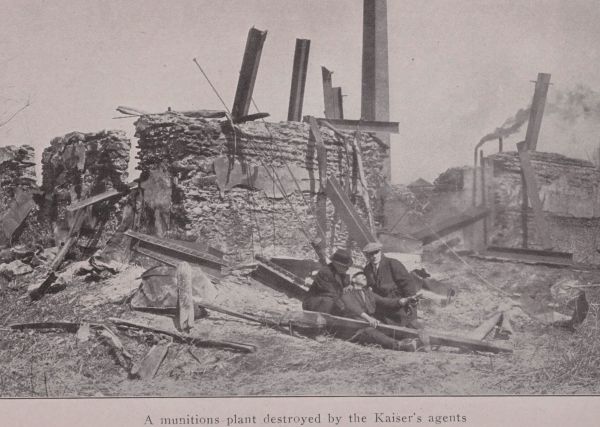
A munitions plant destroyed by the Kaiser's agents
He turned quickly to the switch. At the same moment, Dixie, knowing intuitively that this was his plan of destruction, threw her slight body at him and clung to him with a catlike tenacity, striving to stay the hand that was reaching for the switch. With a curse his great hand closed around her throat. Still she struggled but he held her now at a distance and leaned forward. She heard the switch jammed shut with a crackling contact. A second later the darkness without was pierced by a wild burst of flames, and the earth heaved and rocked with the impact of an earthquake. But Dixie Mason heard it only vaguely. She had fainted and was lying against the switch, one hand still in unconsciousness clinging to it as though the hope yet lived that she could prevent the awful catastrophe that had fallen.
Through the clouds of dust and smoke, through the crowds of injured workers, through debris piled high from which little tongues of flame were shooting, Harrison Grant reached the power house.
When Dixie returned to consciousness it was to find him bending over her. For one glad moment she recognized him.
She struggled to rise. "You!" she said, but Grant's voice, cold and unfriendly, dispelled the hopes that had risen within her.
"Yes. Miss Mason, I'm afraid you will have a somewhat difficult time in explaining your presence here beside the switch that has blown up the factory."
In spite of weakness Dixie straightened up. Her lips parted and she reached involuntarily toward the pocket that held her Secret Service Commission. But the impulse was checked, for the orders she had received months before flashed through her throbbing brain:
"Work into the trust of the Germans. Tell no one.
"W.J. Flynn."
"Why do you accuse me?" she asked.
"Miss Mason, what else could one do? We arrive in time to see the explosion, the workers running out, and——"
Dixie leaned forward.
"The workers, are they safe?" she asked eagerly.
"Most of them. Some are injured. I am glad you at least warned them."
"Thank you. Now would you mind releasing my hand?"
Grant looked at her in wonder. Would he ever fathom this mystery girl? Could it be possible that he had made a mistake? But in contraversion to this thought came the memory of her constant association with the Germans most active in promoting the interests of their government; her frequent appearances with Von Lertz and Madam Stephan. And what possible motive could have brought her to this scene and placed her in such a situation?
"Miss Mason, I can say nothing except that a watchman told me of having seen a girl running toward the power house a moment before the explosion came. I must put you under arrest. The evidence is absolute and I can do nothing else."
Dixie opened her lips, but the words were not spoken.
The sharp report of a gunshot put an end to their conversation. The sound of a low cry drifted in—then silence.
Grant stepped to the door and then hesitated.
"I'm very sorry Miss Mason," he said reaching in his pocket, "but I'm afraid this is necessary." Something glittered in his hands and Dixie heard the metallic clink of handcuffs. "I must see what is wrong outside—and I must be assured that you will remain here until I return."
Dixie held out her hands in silence. He snapped one manacle about her wrist. A strange sort of wonder possessed him that he should be thus shackling the hands of the girl who had so fascinated him in the past. She stood quietly while he attached the other cuff to the swinging door of the switchboard railing and then hurried outside.
Two hundred yards away stood a watchman and at his feet lay the body of a man.
As Grant reached his side the watchman reported briefly.
"I saw this fellow sneaking around. When I called to him to halt he started to run, so I shot."
Grant searched the body hastily with the help of his pocket flash and brought out the card of a German reservist.
It was enough. Imperial Germany had scored again, and in the usual manner, with death to innocent beings and appalling destruction of property.
He turned again to the power house where he had left his fair prisoner, but on the threshold he stopped in astonishment.
The power house was empty! One handcuff hung on the gate of the switchboard. A rubber glove lay on the floor. The other handcuff of the pair was gone and with it Dixie Mason!
Chapter X.
THE INVASION OF CANADA
Harrison Grant carried home with him that night the vision of a handcuff, its metal seared through by the electric current, hanging empty by the switch in the power house. A potpourri of emotions seethed through his mind. A feeling of distaste that one who was, in all outward appearances, so square and true, so refined, should lend her cleverness to the furtherance of German plots, mingled with his feeling of personal disappointment. He owned frankly, to himself, that he did not want Dixie Mason to be anything but as good and true as she was beautiful, that he had wanted her so because—he had cared for her. But any such feeling was impossible now. She had proved it. Her apparent friendliness with the German element was born of co-partnership in their crimes; her interest in Von Lertz had come through the fact that she, too, was a co-worker in Imperial Germany's great game of murder, a co-plotter in the destruction of American industries, American peace of mind, American lives! He could see no alternative but that he should blot out this love for her that had grown in spite of him, and once more register a report against her.
Early the next morning he made his report at the chief's office.
"We will investigate the charge," he was assured. "You need concern yourself no further with it." The similarity of the announcement to those following his other reports of Dixie Mason jarred strangely on Grant. He could not fathom the mystery of events unless—a subtle hope suddenly sprang into existence. Could it be possible that there was some good reason for her activities, other than interest in the Germans? Might it be that the main office was holding information from him that would explain it all? Grant pursued this line of reasoning because it held out a hope for him and removed the cause of his distrust for Dixie Mason. But once more it brought him up against a blank wall of useless conjectures.
If Dixie Mason had been in the Secret Service, she would have told him so in the power house instead of allowing him to think her a German spy, arrest her, and then put her to the trouble and danger of freeing herself by such precarious means. If the arrest had gone through, and she had been a member of the Service, she would have had to tell everything about herself later, so why not in the beginning? More than that, what possible reason could there be for her to conceal her affiliation with the Service—if she were in it?
All of which goes to prove how futile is the attempt of one mind to reason as another would. For there had been several reasons why Dixie Mason concealed her connection with the Secret Service. The first and biggest was her order from the Chief that she work herself into the confidence of those highest in Germany's spy system in the United States, and that she tell no one of her connection with the Secret Service. Another very good reason for her not revealing her true status to Grant flashed into her mind as she stood at the switchboard listening to Grant's accusation that she had been instrumental in causing the destruction of the A.T.R. Munitions works. If it had been so simple a thing for Grant to believe, why could she not convince Von Lertz and his German friends that she had done this thing which would mean so much to them, and so lay the foundation for a confidence which would help her obtain their secrets by established right? It was a good idea.
The night of her disappearance from the power house she called Von Lertz on the telephone.
"Can you come to my apartment, soon? At once if possible. It is very important. And please bring a sharp file with you—yes rather large—I'll explain—Thank you—Good-bye."
She hung up the receiver with a triumphant smile. The smile lingered as she deliberated on the events of the evening. She was very tired, but she must bring this latest affair to a successful close. The opportunity was too great to pass by.
She heard shortly the sound of Von Lertz's car drawn up to the curb and a few moments later the bell of the apartment rang. She ran to open it herself, and, as Von Lertz entered, she held up laughingly a little hand about whose wrist dangled one manacle of a pair of handcuffs.
"Now you know what I wanted the file for. Will you help me take it off?" She seated herself on a low stool beside the great armchair into which Von Lertz threw himself with easy familiarity.
"Take it off and I will tell you all about it. It's a long, long story, and I'm tired and when I get through I think you will agree with me that I have a right to be tired." With quick interest Von Lertz bent over the little wrist with its strange adornment, and as Dixie in low tones told her story, Von Lertz filed away at the manacle.
"The electrician mistook me for Madam Stephan, I think. I was standing by the power house and he came running past, followed by the chief watchman." She stopped meditatively. "Do you think I look like Madam Stephan?"
Von Lertz glanced up impatiently. "Hardly, to one who knows you, you are both dark. But the story. What happened then?"
"Oh, yes," Dixie, obediently and naively took up the tale convinced that she was really interesting him. "I was standing there and he called. I ran into the power house and threw the switch. Then there was this awful explosion and the whole plant went up in smoke and flame. The watchman ran in and arrested me. When someone called him out he handcuffed me to the gate. I saw a rubber glove in the electrician's box and I put it on. Then I pulled the handcuff over the switch and it melted and I got away, but I took one with me."
Dixie paused for breath and gazed at him soulfully out of great dark eyes, doubting for an instant her ability as a romancer.
Von Lertz stopped filing for a moment and gazed at her in admiration. If he had any doubts, the handcuff had convinced him.
"Poor little girl! But that was great work. Why, you are a little heroine. Ah, if I had only trusted you before, what wonderful things you might have been doing for Imperial Germany with your cleverness and willingness to be of service." With a final chilling rasp the file was applied to the steel once more and slipped through the link. "There, that's off. Tomorrow morning we will go to Captain Von Papen's office, you and I, and tell him of your wonderful exploit."
Dixie smiled. "It's very kind of you, and I will be glad to go." Just how glad she did not go into details to tell him. Her plans were working out too well.
Von Lertz called for her very early the next morning. Dixie thrilled with the excitement of the experience she was about to have as his car threaded its way down the long lanes of traffic into lower New York and the canyons of Wall Street where Von Papen's office was located.
She found Madam Stephan, Germany's greatest woman spy, there, and Captain Boy-Ed, the Naval Attache. And when Von Lertz had told of her great exploit, had gone over all the details as she had told him the night before, Dixie had to tell it all over again for them herself, while they laughed and congratulated her on her bravery and her devotion to the interests of the government they represented.
"You are wonderful, my dear," Madam Stephan assured her when Dixie protested that it was but a little thing she had done. "We can find many things that your great ability can help us to do." Dixie artlessly and very truthfully avowed she hoped they would give her the opportunity. When, shortly, Boy-Ed and Madam Stephan departed, Dixie strolled to the window while Von Papen and Von Lertz conversed in low tones, at the table. Since entering the room she had been conscious of the open desk near the window, littered with papers. Now as she stood at the window ostensibly for the purpose of gazing curiously over the tall buildings, she glanced at a letter, evidently tossed aside hastily.
"Your Excellency:" the letter ran in German, "Dr. Albert and myself today took up your suggestion of an invasion of Canada with Count Von Bernstorff. While he believes that the enterprise would be an exceedingly dangerous one and that we should use every precaution to prevent the Secret Service from charging us with any part in it, should it fail, there is reason to believe that such an enterprise would meet with a great measure of success.
"I reported to him that our plan included the raiding of all important points of Canada possessing military stores, such as Windsor, Montreal, Winnipeg, Regina, Port Hope and other centers, the demoralization of which would mean great delay in the sending overseas of large expeditionary forces on the part of Great Britain.
"B. asked what had been done and I told him that arms already had been stored in six sections, assembling at Silver Creek, Mich., there to seize the Welland Canal, Wind Mill Point, Mich., Wilson, N.Y., adjacent to Port Hope, Can., Watertown, N.Y., near Kingston, Can., Detroit, near Windsor, Can., Cornwall, N.Y., from which easy possession can be made of Ottawa, Can., and at Exeter.
"It is at Exeter, as I explained to B., that everything must be done now, inasmuch as arms and reservists are available for all the other stations. However, as you told me to explain, I showed B. that all efforts must now be centered on Exeter, and that Von Lertz and Madam Stephen should leave at once to represent us in the final work which will immediately precede the invasion.
"In this connection, might I suggest to you that this be done at once, as more than 100,000 reservists throughout the United States will shortly receive their orders to move toward the border in as inconspicuous a manner as possible, and that everything should be awaiting them when they arrive. Otherwise, we fail. Dr. Albert and myself will attend to the shipment of arms by the usual method.
"B.E."
Efficiency again—efficiency in the shape of another written report from one office to another, in the stolid, plodding desire of Imperial Germany to see that every step of its murderous progress was arranged for and made clear to those in whose hands the trend of events lay.
This time it had made clear one of its plots to Dixie Mason of the Secret Service!
Across the top of the letter, in Von Papen's scrawling hand, had been written:
"Von Lertz and Stephan ... 10:20, N.Y.C."
"N.Y.C." New York Central, of course, and they were leaving at 10:20! Dixie glanced at her watch. It was a quarter after nine. She had wondered at the extreme earliness of Von Lertz's visit. Now she knew. He must catch that train. There were things she must do, too. Suddenly she caught at the window frame and gave a little moan.
Von Lertz looked up in time to see her slide limply to the floor in a faint. He rushed to her and picking up her unconscious form laid her on the long leather lounge that stood at one side of the room.
"Call a taxi and send her home," Von Papen ordered sharply, as Von Lertz rubbed her lifeless wrists.
"No, I'll take her home. She will be all right in a moment. Poor little girl, she had a hard day of it yesterday."
"But the time!" Von Papen looked at his watch. "You have less than an hour and you must get that 10:20 train, and there are matters to be gone over before you leave."
"I'll be back all right. Don't worry," Von Lertz's efforts to bring Dixie back to consciousness were meeting with success. With bewildered eyes she sat up and looked around her, then smiling weakly, she staggered to her feet.
"Oh, I'm sorry," she apologized softly, "I don't know what made me do such a silly thing. I must have been tired out from everything I did yesterday. Can you take me home?"
Von Lertz smiled down upon her reassuringly as he held her coat for her. Dixie bade Von Papen good-bye, very sweetly and graciously. That Von Papen's farewell was somewhat short and a little impatient was due to the fear lurking in his mind that Von Lertz would not make that 10:20 train. But defying all laws defiable and conforming as little as possible to the inexorable ones, Von Lertz drove Dixie up-town and left her in her apartment a short time later.
"And don't worry about me—please," Dixie begged giving him her hand in good-bye, "because I'll be all right. If I don't I'll take a little trip, down south maybe, for a week or two."
"I may be out of town myself for a while, so if I don't call——"
"I'll understand," Dixie assured him, with perfect verity. "Good-bye."
As the door closed behind him, Dixie jumped to her feet with a sudden access of energy.
"Goodness. I'll have to hurry like everything," she told herself.
She sat down at her desk and began to scribble hurriedly on a scrap of paper. Between lines she called to Mamette.
"Mamette! Mamette! Where are you? Hurry!" Mamette appeared in the doorway wiping her hands on her apron.
"Yes'm, Miss Dixie."
"I have just about half an hour. I want you to go down the street in that old second hand store and buy me the articles on this list of clothing."
She handed Mamette the list and some money. Mamette seized them and hurried out. Dixie turned again to her desk and scrawled a letter which two hours later was delivered to Harrison Grant at the Criminology Club by special delivery. It added another jot to the mystification which had been lending zest to his life the last few days. The letter read:
"Have notified the Chief of German concentration camps along the border preparatory to invasion of Canada. Hold yourself in readiness for a big raid on German headquarters at Exeter. Will keep you informed under name of Randolph Bruce.
"Operative 324."
Grant turned to his card index of Secret Service operatives and hurriedly skimmed through the file.
"Operative 324," he slipped out the card and stared at it in irritation. The card bore no name, no address, no photograph, no thumbprints, no identification, simply the legend:
"Operative 324—Name and identification withheld for good of service."
Grant frowned, and then philosophically slipped the card back into its place and stepped toward the button to summon his operatives.
In a moment Stewart, Cavanaugh and Sisson joined him.
"Boys, there is a chance of heavy work for the Criminology Club very soon. We will have to summon every member possible who can leave his other duties. They must eat here, sleep here, wait here, until certain word comes to us." Grant glanced down at the message which he still held. "Stewart!"
"Yes, sir."
"Will you see what arrangements can be made for a special train to take a hundred men to Exeter, Vermont, if necessary? Keep it quiet, of course. Sisson!" Grant looked at the two other men. "And you, Cavanaugh, round up the other members. And if any telegrams come to the club signed Randolph Bruce, find me at once!"
After Grant had issued his orders the Criminology Club became the scene of action as its members gathered, eager for the service they held themselves in readiness at all times to tender.
Hours after Grant had received the message from Operative 324, a train which had left New York at promptly 10:20 that morning, thundered into the station at Exeter. A dirty faced boy in rough clothes jumped from the steps of the day coach and stood at a respectful distance watching those more fortunate ones being assisted with servile obsequiousness from the parlor car. When Heinric von Lertz alighted, followed closely by Madam Stephan, an expression of relief flitted across the face of the boy. He watched them curiously as a tall, cadaverous individual stepped up to greet them.
Across the dusty road from the station an undertaking shop held sway. That its proprietor was J.B. Dollings was signified by the ornate gold lettering across the window, and that the cadaverous individual who greeted Von Lertz and Madam Stephan was none other than J.B. Dollings, was a conclusion not hard to arrive at as the boy watched him conduct his visitors across the road and into the shop. From his vantage point on the platform the boy awaited developments. In a short while Von Lertz and Madam Stephan and their tall host emerged from the shop and entered the car that stood at the curb. The boy watched the car whirl away amid clouds of midsummer dust down the long road that seemed to lead out of the city to the mountains that towered in the distance.
The dirty faced boy slipped down from the truck on which he had been sitting and gazed after them ruminatively.
"So they are undertakers now. Queer business to be in." He stepped into the station and peered through the bars of the ticket window at the station agent who sat in the inner office, chair tilted back against the wall, an odoriferous corn cob pipe clutched between toothless gums.
The station agent brought his chair to a level and slowly rose and slouched to the window. Following which effort was a long argument during which the dirty faced boy finally convinced the station agent that he needed an assistant, had always needed one, and that he was the assistant needed. After due attention had been called to the ancient dirt covered floor, the dust of the station benches, and litter of bygone lunches, the job was landed and an hour later found the station undergoing a long-needed cleaning at the hands of the new assistant. The dirty faced boy had found employment, food, shelter—and the opportunity of acquiring the contents of every telegram entering or leaving the station! And as the dirty faced boy was Dixie Mason, the information was priceless to her—and the interests she served.
While members of the Criminology Club passed days of waiting, armed and ready for any emergency that might arise, Dixie pursued her purpose with relentless activity in and around Exeter.
She first of all established the fact that the undertaking business of J.B. Dollings was a comparatively new departure. That while he had several assistants constantly in attendance, his establishment was little patronized and he made no efforts to gain patronage. Dixie found that Heinric von Lertz and Madam Stephan made their daily headquarters in a new, roughly constructed building, among the hills at the outskirts of the village where a small city of tents had sprung up miraculously, housing laborers strangely inactive for a grading outfit. She found that hundreds of men were gathering daily. At night, snuggled close to a great boulder, Dixie watched the activities of the camp and saw wagons loaded to their limit with supplies winding their way along the gorge roads. And she saw the men gathering at the board building for meetings.
One afternoon Dixie, attractive in spite of dirty face, towsled mop of hair, rough clothes, ran across the street to J.B. Dolling's shop.
"A carload of caskets just came in for you, Mr. Dollings." Mr. Dollings' long clawlike fingers clutched the bill in obvious excitement.
"Where—where are they?" He reached for his hat and hurried around the counter.
"The caskets? Over on the first track. I'll show you——"
"No, never mind, never mind. The number of the car's on the bill of lading. I'll find it." As Dixie lingered outside she heard him calling hoarsely, "Bloedt! Rudolph! Mahlen! The caskets have come. Get teams at once. We must unload them at once. Hurry! Must send a telegram!"
Dixie listened speculatively. Mr. Dollings was exhibiting an unheard of amount of excitement over a carload of caskets for one who was an undertaker. And a carload of caskets for an undertaking shop that did no business!
Her speculations were cut short by the rumble of express wagons. They drove through the yards to the car. One of the men broke the seal while Dollings bustled about, excitedly issuing orders. Dixie found a place where she could watch them without being seen.
Carefully the grewsome boxes were unloaded and carried out to the express wagons. She saw two wagons loaded and driven across the street to the shop. Her ruminations over their disposal were cut short by a crash and sound of splintering wood which quickly brought her attention back to the unloading process.
Dollings' voice was raised in angry expostulation.
"Donnerwetter! Why didn't you hold on to that end? Here you, Bloedt cover up that end. Quick! Mahlen, you go too——"
Dixie slipped down behind the freight car and peeped under it. She could see plainly the splintered box. And though the men were vainly trying to conceal its contents she could see them. It was no casket that the box contained. Slipping out from its broken boards were rifles! Military rifles!
And the car had been filled with scores of boxes similar to this. This was the cause of Dollings' excitement! Here were rifles enough to fit out hundreds of men who were gathering at the borders of Canada waiting the hour to strike. The men at the grading camp were there awaiting these arms. As soon as they were fitted out the time would be ripe for the invasion which the powers above them had planned.
Then Dixie remembered the telegram that Dollings had hastened to send as soon as the car had been reported.
She hurried back into the station. The station agent had left. There were no trains due until late in the evening. She let herself into the office and reached for the telegrams which had been filed for the day. Near the top was Dollings' addressed to
"Captain Franz von Papen "60 Wall Street "New York City.
"Everything O.K.
"Dollings."
That was all. But it meant that the rifles had arrived—the rifles for which Von Lertz and Madam Stephan had been waiting, the rifles which were to equip the waiting German reservists! An armed invasion of Canada from American soil. Her mind whirled at the thought of the complications involved—perhaps war between Great Britain and the United States on the charge of having fostered this invasion by German sympathizers!
No! Dixie knew that the moment for action had come. Her fingers sought the telegraph key.
"Harrison Grant, Criminology Club, New York City," she tapped. "Danger! Come quick! Wire arrival. Randolph Bruce."
Then, womanlike, she gave herself up for a moment to wild surmisings. Had she waited too long? Would this message reach him in time to get his men to Exeter to stop this invasion? After all, had she followed the right course. Would it not have been better to have stopped the whole thing at its inception, rather than let it attain this amazing growth that threatened to be overwhelming. But time was short. Already Von Papen had received the telegram and she must wire the Chief of developments. Her fingers tapped the keys once more. She had the consolation of knowing that the Chief's men had covered all other camps along the border. This one camp had depended on her, and Harrison Grant and his men were dependent on her. As soon as the Chief received her wire his message would go back to the other camps ordering instant action. But here—at Exeter—no one could foresee the result.
The afternoon light was fading in the dim station as Dixie crept out. She took the road to the gorge, stepping into shadows as wagons lumbered past with cargoes that she dreaded to guess at. A great purring car slid past and she heard Madam Stephan's laugh tinkle out on the night air. A sudden activity had sprung into being. Everywhere were wagons, rumbling through the night and men hurrying past on strange and unwonted errands.
From the friendly shadow of a boulder Dixie looked down upon the will-o'-the-wisp lights of the camp and the greater glow of the windows of the main camp building. The shadowy outlines of wagons against the darkness of the night, rumbling into the camp yard, the silhouettes of men at the loading doors, carrying the long boxes filled with rifles for Germany's army in America!
A lump rose in Dixie's throat and she clenched her hands in a passion of earnestness.
"Make Grant get here in time!" she prayed. "He must get here in time!"
The thought brought to her the need of being on the alert at the station for messages. She rose quickly and leaving the lights of the camp hurried back over the dark road to the little station. She let herself into the little office and seated herself before the telegraph instrument, signalling for the relay station at Buffalo. She waited impatiently for a moment and then heard the answering call.
She tapped her message.
"Anything for Ex-x?" The long silence that followed was finally broken by the clatter of the instrument.
"Nothing."
Dixie sank back in the chair. Her message had gone through hours before, certainly by this time Grant should have received it and answered.
But the instrument was clicking again—calling for Exeter.
"Ex—ex—exexexex—ex—exexex."
"O.K. Ex—go ahead," Dixie tapped in an agony of impatience. The sounding key snapped back.
"Hello Ex—thought I'd tell you—wire trouble between here and New York. Ought to clear up soon."
The instrument ceased its clatter. Dixie settled back, hopeful—and yet hopeless. Now there was no means of knowing. Her communication had been cut off. She could only wait—wait—with the teeth of anxiety gnawing at her heart. Wait, while all through the northern states, Imperial Germany's reservists were hurrying to their stations. Wait—while out at the main camp, Heinric von Lertz and Madam Stephan were giving orders that would cause rebellion to flare at the first word from Von Papen.
But Dixie brightened a bit as she caught at the cheerful thought that Von Papen's message could not come through until the wires were opened—still when the wires were opened, Von Papen's wire might come through and Grant would not be there to stop the resultant activity.
Hour by hour dragged endlessly as the night wore on. Dixie sat by the telegraph key, waiting. Call after call sent through Buffalo brought back the answer:
"Wire not clear yet. Working on it."
The moon dimmed, and the chill air of night made her huddle closer in the chair and shiver. Would the night never end and the call she was waiting for come?
As the dawn lightened the dingy interior of the station it showed Dixie Mason with tumbled, towsled head fallen sleepily on one shoulder.
The staccato clicking of the telegraph sounder broke into the quiet of the room. It started Dixie from her sleep. For one bewildered moment she glanced at the instrument before her and then on the alert reached for the key to answer the call that was coming through for Exeter.
"O.K. Ex." She waited tensely for the answer.
Suddenly a shadow fell across the doorway and Dixie started violently. "Here you! What're you doing at that telegraph instrument?" The rough voice of the station agent sent a chill of fear through her. "You don't know nothing about them things. Get out of here!"
He pushed her roughly aside and seated himself at the table to take the message that in spite of nervousness and sudden fright seemed to burn itself into her brain. It was for Heinric von Lertz!
"Proceed at once!"
"F.V.P."
Von Papen! Dixie clutched at the station agent's arm as he started for the door with the message.
"Don't deliver that!" she begged. "Please—don't deliver it yet."
"Don't deliver a telegram?" the agent glared at her uncomprehendingly. "What's the matter with you? Want me to lose my job?"
"But if that telegram meant trouble—if it meant danger for our country?"
"It's a telegram and it's got to be delivered," he answered stubbornly.
Dixie's hand reached for her Secret Service Commission, then dropped. She had seen the station agent with Von Lertz and Dollings on various occasions. If he were an accomplice—which was very likely—her commission would profit her nothing and probably would work harm to her cause. She turned with an effort and laughed.
"I was just fooling," she apologized.
"Poor way to fool," grumbled the station agent, and slammed the door.
Dixie watched him shuffle across the dusty road and intercept Von Lertz and Madam Stephan as they left the hotel. She saw a hurried conference over the yellow slip of paper follow. As she watched them the telegraph instrument began to clatter once more. The station agent was across the street. This time she would not be thwarted.
"O.K. Ex," she signalled rapidly, and the answer came through.
"Randolph Bruce,
"Exeter—(delayed).
"Arriving 6:40
"Grant."
Dixie dragged herself weakly out of the office and sat down for a moment. Grant was coming at six forty! It was six ten now. She jumped to her feet. There was no time for unnecessary rejoicing. There was too much to be done.
The station agent shuffled into the station again and seating himself at the table began to take the orders that were clattering in over the wire. Dixie waited no longer.
The town boasted one garage. The garage owner, industriously cleaning a thick veneer of dust from a car, started suddenly at a light touch on his shoulder. The boyish figure standing in the doorway was very business-like.
"I want every car you have got."
The garage owner stared, "What for?"
"There's a special train coming in at six forty with a lot of men and they will have to have cars." Dixie slipped a hand into a pocket and brought out her Secret Service Commission.
"Here's the reason," she said. "And listen to me, because I want you to get this straight." For a few moments she conversed with him in low tones.
"It's all right. I'll have them there," he assured her finally and Dixie hurried away on the road leading to the camp.
The special train bearing Grant and his men slid into the station and came to a smooth standstill, and as the first men jumped to the platform, the garage owner stepped up to them.
"I have a message for Harrison Grant." Grant was pointed out to him. "Mr. Grant," he said, stepping over to where the detective stood, "A Secret Service man gave me an order a little while ago, he wasn't any more'n a boy. He says to be sure to raid that undertaking shop across the way and then go on to the main camp in the gorge."
Thanking his informant Grant called his men around him and issued quick, incisive orders. Leaving Cavanaugh and Stewart to oversee the raiding of the undertaking shop, he selected his men and loaded them into the waiting machines. Soon the streets of Exeter resounded with the roar of speeding automobiles, whirling through in a cloud of dust to the mountains beyond and the camp that lay in the gorge.
Time was too short for the Secret Service to catch up all the tangled threads of this plot. While the waiting automobiles whirled Grant's men to the camp in the gorge, the station master was telephoning frantically to Von Lertz. And a short half hour later their big automobile was grinding its way southward carrying Madam Stephan and her partner in intrigue away from the scene of the fiasco.
Up on the Canadian border, mounted troops, summoned from twenty barracks by the Chief and Grant, rushed to protect the passes, tunnels and bridges, and throw a line of soldiery along the frontier.
Out at the camp the headquarters were suddenly surrounded and under cover of guns in the hands of Grant's men the reservists were herded together and placed under arrest. Leaving them in the hands of his men, Grant started out to look about the camp. He found the powder house and supply depots hidden deep in the gorge, and as he stood and wondered at the hugeness of this plot which had been foiled just in time, his gaze wandered from one object to another. Suddenly it centered on a little figure lying just below him beside a boulder. It was a boy deep in the sleep of sheer exhaustion. He stepped down the hillside and stopped beside the boulder.
"Poor youngster," he muttered, "I'd better take him in, it's damp here."
As he stooped and lifted the sleeping form, the cap slipped from the boyish head and a mop of curly hair waved loose. Grant gasped. The sleepy dark eyes opened and looked into his. Suddenly a hand sought to pull the coat which had fallen open together. But it was too late. Grant had caught sight of the Secret Service star.
"Dixie Mason!" Grant breathed. "In the Service? Oh Dixie—" and his arms closed about her a little tighter than was necessary although Dixie Mason lay still.
While Harrison Grant stood holding Dixie Mason in his arms with the cares of the world, the troubles, the strain, slipping away from him, in the great relief of his discovery, many, many miles away the first seeds were being sown for a plot that equalled the one they had just quelled.
In the interior of a fortune telling emporium in Hopewell, Va., sat a woman in the garb of a gipsy fortune teller. Her features were cold and heavy, her eyes piercing, and her voice when she spoke, belied with guttural accents the garb of the southern people she had donned.
"Minna," she called, and as the tapestries that hung the room were pushed aside by a maid, she spoke quickly:
"Telegraph Von Papen to send me a good man at once for dangerous work."
The maid bowed.
"Yes, Baroness," she answered, and disappeared.
Chapter XI.
THE BURNING OF HOPEWELL, VIRGINIA.
After all, Imperial Germany possessed a lumbering sense of the theatrical. It had realized that the little newborn town of Hopewell, Virginia, sheltered hundreds of men drawn from the laboring classes, uneducated, ignorant save of the work they were paid for, foreign to a large extent, and among these men were those in whose minds ran the superstitious strain which breeds faith in the occult and fortune-tellers. In the hands of a clever fortune-teller these men might be made to talk, without realizing that they were giving away information to the hidden enemy of America. This was the explanation of the presence of Baroness Theresa Verbecht in Hopewell as arbitress of destinies, in the guise of Madam LaVere, Mystic. In one of the myriad clap-boarded shacks of Hopewell she ladled out the mysteries of the future and the well-known facts of the present with lavish hand, and drank in all the information she could glean by clever questioning and suggestion, from the superstitious who passed in never-ending lines through the doors of her emporium of mystery.
Hopewell held much of interest for Germany. Little more than a year before its site had been unploughed fields over which the winds blew in broad sweeps bending the green grasses in soft undulations and bobbing the heads of wildflowers that dotted the fields. Soon with war's shadows growing deeper over Europe the call had come from the Allies for explosives. The fields had been cleared and a great guncotton factory spread its broad stretches over the ground where the wildflowers had bobbed. And about the factory sprang up a town, or rather a half a mile from the factory, for guncotton is a thing to be respected whether in the maw of a cannon or in the making.
The town was a hit and miss affair, a similitude of western towns which sprang up over night in the days of gold rushes. Its streets, a crowded mass of unpainted shacks, lean-tos, and tents; cheap hotels, sub rosa gambling places, in fact all the attributes of the town of mushroom growth peopled with the polyglot population of a manufacturing town of America, the melting pot of the races.
The day that Madam Stephan and Von Lertz, fleeing from Exeter, realized that the plot which they had maneuvered to what seemed unquestionable success, had failed, Franz von Papen received a telegram from Madam LaVere.
"Everything O.K. Send me good man for dangerous work."
The telegram so tersely worded meant more than words could convey. It meant that after weeks of work Baroness Verbecht had learned as much as possible about the guncotton factory, its orders, its guards, its shipments and its most vulnerable points.
A week passed before the Baroness received a reply in any form. Then one morning the tapestry curtains of her fortune telling parlor parted to admit none other than the sanctimonious J.B. Dollings. Dollings had closed up his undertaking establishment in Exeter with what might have seemed undue haste to those unacquainted with his reasons for seeking other parts.