Front matter (continued 2)
Reading edition
Almost, aimlessly she turned to the railroad yards to escape the roaming droves of horses and cattle that were swirling everywhere. On she went, crossing track after track, as she sought the streets and the open. The light of the fire flared higher—and with it a slight exclamation came into Dixie's throat at the sight of a man before her.
Hurriedly she swerved, leaped between two closing box cars of a flying switch, and then, as the man pursued, jumped across the track upon which was approaching a rapidly traveling train, hurrying on to where her deserted automobile showed its dull form, where it had been abandoned by the fire fiend. Once she looked back—to discern the fact that the man still watched her beneath the long train. Then she hurried on again.
Back in her apartment, she reported to her Chief, to give the name of Walter Schleindel and her suspicions against Franz von Rintelen. An hour more went by and the telephone rang to bring the news of Schleindel's arrest, and his confession, of how he had used the bank as a clearing house for German Sodom, stealing the information of the manifests and bills of lading of Allied shipments which came in there for collection by the consignors, then in turn, selling this information to Paul Koenig of the Hamburg American line. Dixie smiled happily.
"How about Rintelen?" she asked. A slight ejaculation of disgust came over the wire.
"My men failed to find him. Someone must have notified him of the arrest of the auto burners in the railroad yards. At any rate he has left his hotel, without giving an address."
All of which was correct. For Franz von Rintelen was at that moment telephoning to Bernstorff, and announcing to him that in future, his name would be E.V. Gates and that his 'business' would be that of a 'purchasing agent,'—but that Imperial Germany's work of destruction would still continue.
And meanwhile also, at the Criminology Club, Harrison Grant, tired from his labors of the night, hesitated at the doorway to call an operative.
"Bailey," he said, "I want you to take a skirmish around and see what you can learn about a girl named Dixie Mason."
"Who is she?"
Harrison Grant smiled grimly.
"I'd give a good deal to know. Apparently she's an ex-actress. At least, that's what her friends tell me. Time was too, they say, when she was very communicative and friendly. Now she tells no one of her plans or of her activities. And strangely enough, my path has crossed hers twice in places where only the agents of Imperial Germany could consistently be. She was at the fire tonight."
"At the fire?" Bailey stared. "Are you sure?"
"I have a good pair of eyes." said Harrison Grant, "I saw her there—not fifty feet away. I chased her—but a train cut me off."
Bailey raised a hand to his hat.
"I'll see what I can find out," he said quietly and left the building. But Grant continued to stand there, staring at the floor—wondering—wondering what this woman whom circumstance again and again gave the accusation of being a German spy, could have played in this latest evidence of Imperial Germany's ghoulish cruelty!
Chapter V.
"THE STRIKE BREEDERS"
It was late at night. In his private office, Harrison Grant was puzzling over a report by Tom Bailey, an operative, announcing a condition rather unpleasant for the president of the Criminology Club. For the letter simply announced:
"Harrison Grant, Criminology Club. Dear Sir:
Beg to report that all I can learn about Miss Dixie Mason is that she is almost constantly in the company of the Germans, particularly Heinric von Lertz.
Yours truly, Bailey, Operative."
Thereby, for Harrison Grant, a mystery remained unsolved, a mystery which nettled him, angered him. It had been weeks—months—since he had first met Dixie Mason, months in which he had constantly seen her in suspicious surroundings—yet never in a position to betray her. Once he had even gone so far as to send a special report on her to Chief Flynn—a report which the Chief naturally received with a hidden smile and the announcement that he would have the affair investigated from his office, that Grant allow her activities to pass unnoticed in the chase for bigger game. But when a man is hovering between love and suspicion, he is not likely to allow every opportunity to slip. Hence the private investigation which Grant had ordered to be made by his operative, Bailey, with the resultant report. Half angrily Harrison Grant filed the report in his cabinet and returned to his desk, moody, silent——
Not knowing, of course, that in a faraway part of the city, Dixie Mason was reading for the twentieth time, an excerpt from the evening paper containing an interview with Harrison Grant, and musing over the visualized features of the man she loved, brought before her eyes by the cold, staring type of the interview. Naturally Grant could not know that—and Dixie could not tell him the secrets that she must tell no one, the secrets that she must hold against the inclinations of her heart, that the battle against Imperial Germany might be won.
And that the battle still was imminent, was more than apparent in the stooped, bearded figure of a man who stood fumbling at the lock of an office in one of the biggest buildings of lower New York. He had kept in the shadows on his way to the office. He had shielded his face in the elevator—and for a reason. Franz von Rintelen, arch plotter for Kaiser Wilhelm, friend of the Crown Prince, and special Emissary to the United States with more than fifty million dollars to spend on destruction, was living under an alias. He had shifted his office since the capture of his river pirates by Harrison Grant, changed his name to E.V. Gates, and even had resorted to the melodramatic level of false beards and disguises that he might carry on his devastations.
And just how far he went in this regard, was exhibited later, when Rintelen sought to flee America on a forged passport, only to be caught at Falmouth, England, and returned to the Tombs in New York, where he recently was sentenced for his activities against America. In his trunks at that time, were found more than thirty suits of clothing, each designed to give him a different personal appearance, each built in such a way that they would make him seem a different appearing man with every suit he donned. His wigs and beards he left in America, to be discovered by the members of the Secret Service who searched his office.
But this narrative must tell the activities of Rintelen in America, not of his flight. And while Harrison Grant sat musing in his office, Franz von Rintelen removed his false beard, divested himself of his coat with the humped shoulders, then turned happily at the sight of a shadow on the door. A moment later and he was chatting with Dr. Heinrich Albert, chief fiscal spy for Imperial Germany in the United States, and disburser for every fund except the activities of Franz von Rintelen. Dr. Albert held forth a telegram.
"I suppose you received one also?" he asked.
"From Bernstorff?" Rintelen looked up quickly. "Of course. I heard from Captain Von Papen and Captain Boy-Ed also. They will be here. Did Bernstorff's message to you name a time?"
"No——" Dr. Albert had removed his overcoat, displaying the usual immaculate evening clothes, "he simply told me to meet him here tonight for an important conference. By the way, is Von Lertz coming?"
"I told him. He should be here now."
But instead, Heinric von Lertz was attending to another angle of Imperial Germany's campaign against America. He was then standing in the half light of an old attic, where, tucked away from observation a German scientist, imported by Von Rintelen, had taken his quarters that he might prepare for future disease raids against American workmen in case the plans of Germany in other directions failed. With Von Lertz was Madam Augusta Stephan, chief of Germany's women spies in the United States—and together they were plotting the death of Harrison Grant and his members of the Criminology Club.
"You must remember," Von Lertz had just said, "the death of any American Secret Service man is a distinct victory for Germany 'The Eagle's Eye,' I think some of these newspaper men have called it—and it has its eye on us too frequently. Now, Meyerson, what's the danger of this affair?"
"Danger?" the old scientist looked up with a little smile. "None, that I see. I know enough about germs to take care of myself. All I have to do is to approach the club from the next roof, raise a window an inch or so and inject this. That's all there will be to it. The circulation of the air will take care of the rest of the plan."
He held up a cotton-plugged tube from which Madam Stephan recoiled. Typed on the tube were the words:
"Cholera Bacilli."
Heinric von Lertz smiled cynically.
"Good enough," he announced. "But be careful regarding yourself. We may need you in case this 'longshoremen's plot fails." The old scientist's head bobbed.
"I know how to use care," he answered. "You may count on that."
And while Von Lertz accompanied Madam Stephan to her apartment, the members of the German contingent were gathering for the "important conference" in the office of E.V. Gates. Franz von Papen and Karl Boy-Ed were already there, gathered around the desk with Franz von Rintelen and Dr. Heinrich Albert. Only two more remained to come—Heinric von Lertz and Count Johann von Bernstorff, Ambassador from Imperial Germany to the United States of America. Franz von Rintelen slid forward in his chair.
"Why is His Excellency so worried?" he asked.
"It's about the 'longshoremen's strike," answered Dr. Albert once more thumbing his telegram. "By the way, Rintelen, has there been any progress?"
"Nothing but retrogression," came the answer of the arch-plotter. "From what the papers say tonight, there is danger of failure. All the 'longshoremen are very loyal and the paid agitators that I have sent to work among them have accomplished nothing. They did succeed at one time by working the 'longshoremen up over the cost of living, but that was met by a prompt raise of wages on the part of the shipowners—with the result that all our money spent for agitation in that way, went for nothing. However——"
There was a sound at the door. A moment later and Heinric von Lertz entered the office. Then a sudden movement, a sudden circle of bows, a sudden outburst of greetings. Count Von Bernstorff had arrived.
There was a moment of silence as he faced his assistants. Then slowly he looked toward Rintelen and held forth an evening paper.
"I am sure you will pardon my transgression in your field of endeavor," he announced, "but this news is exceedingly disconcerting."
"No more to you than to me, Your Excellency," came the smooth answer of Von Rintelen. "I appreciate very much your coming tonight—and I would appreciate even more any suggestion that you might be able to make."
"How about bribery?"
"Of the Union officials?" Von Rintelen laughed slightly and held up his hands. "I have tried that—with most unfortunate results. Through outside sources, I caused an offer of $10 a week for every striking 'longshoreman, the amount to be paid for five straight weeks. The offer was made to Kelly, Butler and O'Connor, the leaders of the 'longshoremen. They also were made to understand that the money would be paid to them—totalling $1,035,000—and that there was no anxiety over what happened to it after it went into their hands—meaning of course, that they could walk away with all of it if they so desired, providing they called the strike."
"Well?" Bernstorff raised his eyebrows.
"They reported the matter at once to Secretary of Labor Wilson that someone was seeking to cause disruption in the labor ranks. I think that, more than anything else, caused the breach that was being made by my agitators, to be closed more quickly."
Bernstorff took a quick breath.
"There wasn't any mention of Germany in all this?"
"Certainly not. The offer came through a former 'longshoreman who has carefully concealed his pro-German leanings. He let them think that the whole thing was a matter of revenge on the shipowners and that he had powerful commercial friends who would be willing to pay for that vengeance."
Bernstorff breathed easier.
"Very good," he announced. "Then that does not hurt our cause—providing we can find some way of creating a strike. And understand," he clenched a hand and faced his colleagues, "this strike must go through! It means more to Germany than a victory at the front! When the 'longshoremen strike, it means that the ports of the East must inevitably be tied up. Not a ship will move. Industries will be paralyzed—and consequently the Allies will be deprived of the necessities of war. Of course," he added with a quiet smile, "It will be hard on America, but——"
"These idiotic Yankees deserve something like that anyway," growled Captain Von Papen. However, Bernstorff had turned his attention to Rintelen.
"You say that agitation has failed. Attempted bribery has failed. Then, some other means must be attempted."
Rintelen was pacing the floor. Suddenly his hands clasped.
"I have it," he announced. "I know the way! There is nothing that angers a man so much as depredation against his property. That's what our spies must commit—and then we must fasten the blame on the 'longshoremen. It will create a breach that nothing can close."
Hurriedly they gathered for conference. And while they plotted the stagnation of all Eastern America——
Harrison Grant rose from his desk and turned with a little sigh to look into the grinning face of Pat Hennessy, the Irish caretaker of the club.
"Guess you're waiting for me to close up shop?" the master detective asked a little wearily.
"It seems betchune time I'm waitin' f'r somethin' like that, Y'r Honor," answered the grinning Pat.
"Everything locked up?"
"Yes sir."
"By golly—no!" Pat clasped a hand to his head. "If it ain't me that's always forgittin'. I ain't fixed the bur-r-rglar trap!"
Harrison Grant smiled, then stood watching while Hennessy moved the firing pins of the club's burglar protection into place at the windows. One by one, the triggers of the concealed revolvers were cocked. Then Hennessy, with a little nod, started toward the stairway, Harrison Grant following. A moment later they hesitated at the door, while Hennessy fished for his keys. Then——
The crashing detonation of a revolver shot—from upstairs! Then another and another and another! The men turned. They rushed up the stairway and toward a half open window, through which could be seen the figure of a man, writhing in the agonies of death.
Old he was and bearded, the nostrils covered by a germ mask, his hands protected by rubber gloves. Beside the convulsing figure lay a "pump-gun" or air-injector, and Grant knew the contents—deadly germs!
Out the window went the master-detective, and to the side of the dying man.
"Careful now!" he ordered. "Search him—but look out for cultures and bacteria!"
A moment later and Harrison Grant was in the possession of the thing he sought—a card, carelessly left in the old scientist's pocket in his surety of success, a card which gave his name and address and which sent Harrison Grant scurrying forth to pick up Billy Cavanaugh, one of his favorite operators, and to hurry across town in search of the laboratory that he felt sure the dead bacteriologist had maintained.
But in the meanwhile, things had gone well for Imperial Germany in the office of "E.V. Gates." Only Franz von Rintelen and Heinric von Lertz remained. The others had gone to the Hohenzollern Club for a last toast to the Kaiser and a quiet chat regarding their plans—too quiet even for the concealed dictograph of the Criminology Club to detect. All the work had been left for Rintelen and Von Lertz and they were making plans hastily.
Papers were piled high on the desk of Rintelen, papers which formed reports from spies everywhere, from the thugs employed by Paul Koenig of the Hamburg American line, from spies scattered among railroad men, among the 'longshoremen, among the workmen of practically every industry in the country. Rintelen was speaking:
"From what I can gather by the reports of Schleindel, the bank spy, shipments of automobiles have been very heavy in the Jersey yards recently. Here is information that a lighter containing 150 of them will cross the river tomorrow for shipment to France. I would suggest that you choose that as your part of the plan."
Von Lertz rose.
"I know the man who can handle it for me," he said. "I'll see him at once. Good-night."
"Good-night," answered Rintelen. Already he was reaching for his coat and hat, even forgetting his inevitable disguise in his hurry to foment another part of the great scheme against New York's 23,000 'longshoremen.
But while they plotted and schemed, Harrison Grant and Billy Cavanaugh were making their way up the rickety stairway that led to the bacteriologist's laboratory in the attic of a ramshackle building on Avenue A. A quick twisting of the knob and it yielded. Harrison Grant and his operative fumbled a moment in the darkness, then finding the switch of a table light, began their search.
Desk by desk, drawer by drawer. Papers, musty old books on the development of cultures, newspaper clippings on the progress of the war, letters from Germany and at last——
An ejaculation from Harrison Grant.
"Just what I thought!" he announced as he opened a small memorandum book. "The attempt against us tonight was an afterthought. A sort of a vacation of death, as it were. This man was brought to this country from Germany for one purpose—the propagation of germ cultures to be used against American workmen in munition factories, steel-mills, mines and other industries furnishing supplies to the Allies!"
"Impossible!" Billy Cavanaugh's eyes went wide with horror. Harrison Grant pointed.
"There's the evidence," he answered as he pointed to the notes of a memorandum book he had brought from the desk. "Let's see what the rest of it has to offer."
A long silence, except for the crinkling of the pages as Harrison Grant read the notations in the old book. A long silence then——
"Careful there!"
"What's the matter?" Harrison Grant paused with a finger in the air. Billy Cavanaugh reached forward, and taking the finger in his hand, lowered it.
"Nothing—only you were about to touch that to your lips—and there's no telling how many different kinds of germs are on the pages of that book."
Harrison Grant smiled.
"Thanks, Billy," he said softly, then turned to his work again. A moment more and he had risen, his eyes wide, excited.
"Get a telephone, quick!"
"What's Up?"
"A good deal. Wasn't there something in the paper tonight about trouble with the 'longshoremen?"
"Yes—but it's all settled up. That is, the indications are that it will be settled. Why?"
"Because it's far from settled. Look here!"
A finger pointed to a scrawled line in the old memorandum book. Slowly the words were translated:
"Special notation—germs for 'longshoremen if agitation fails."
"And agitation has failed!" Harrison Grant said quickly. "Agitation has failed—and that means some other attempt against the 'longshoremen. It means——"
"But the bacteriologist is dead. He won't carry out his orders."
"Imperial Germany only begins its real deviltry after it's been blocked!" said Harrison Grant. "It's first and second line of offences have already failed in this campaign against the 'longshoremen. But you can count on it, Billy, that there's a reserve somewhere—and that the blow is going to fall and fall quick! Get to a telephone as quickly as you can! Notify every member of the Criminology Club to seek work at the docks as 'longshoremen. Tell them to keep their eyes and ears open for everything that sounds like German propaganda!"
"Nothing there that will tell what they're planning?"
"No—only the indication that they are planning something and that they'll keep on working in spite of the death of this man. What they intend to do is for us to find out—and we've got to find out quick! So hurry to the telephone. The docks are open day and night now, you know. Every member who can spare the sleep must find employment tonight. The rest of them will get jobs in the morning—we'll work in day and night shifts!"
But even as Harrison Grant gave the order, Heinric von Lertz was laying his plans for the first blow, as he talked to a furtive eyed spy in the back room of a Hoboken saloon.
"Here's the number of the lighter," he was saying. "I just got it from one of Paul Koenig's men. It will leave the Jersey side about 10 o'clock in the morning."
"Got the number of the freight cars?"
"The ones that contain the autos? Yes."
"Better give them to me. I can trace the stuff better that way. That lighter might make another load with something else. Don't guess it makes much difference though—just so we sink some stuff."
"Except," said Heinric von Lertz, "if we can strike a double blow, it's all the more to our advantage. A hundred and fifty auto ambulances laying at the bottom of the river won't do France any good, you know. So sink these cars if you possibly can."
Von Rintelen also was busy in his scheme of destruction. Far down in the lower end of New York, the arch-plotter, his hand covering his face as he talked, to prevent recognition by any possible roving Secret Service man or detective, his eyes moving constantly, his whole, hunted being nerved and ready for instant escape, had sought out the German foreman of one of the largest docks in New York and was giving him orders in the name of Imperial Germany.
"First of all," he was asking, "who am I—in case you are caught?"
"Gates is the only name I know."
"You don't know any address?"
"No."
"Good. Remember—if forced to it, Germany expects you to confess and to submit to the punishment. But we who direct you must be protected! Understand?"
"I am a German reservist," answered the foreman.
Rintelen bobbed his head slightly at the assertion. Then he leaned closer.
"Are your men experienced in the loading of a ship?"
"No—I've been working with practically new crews for the last three or four weeks."
"None of them are especially sharp—as concerns the right and wrong way of loading?"
"They all follow my orders. Besides, a number of my men are pro-Germans. I imported them for emergencies."
"Good. Be sure they are all at work in the morning. What's the boat at the docks now?"
"The Arsulus. Freighter. 2,400 tons."
"Big boat." Rintelen nodded his head with satisfaction. "How long would it take to load that boat in such a way as to make it capsize?"
"Twelve hours'll do it."
"All right, start in the morning. See that everything heavy is piled on one side, so that it will overturn the minute the hawsers are loosened. Do you understand?"
"Perfectly."
"Very well." Rintelen looked hastily around to see that he was not watched, then rose cautiously. "I shall expect you to be working for Imperial Germany in the morning!"
But when morning came, there were others at work also, not for Imperial Germany, but for the Stars and Stripes of the United States of America—Harrison Grant and the members of the Criminology Club, seeking to ferret out the trouble they knew to exist about the docks, seeking to learn what this German contamination was which they felt sure was gnawing apart the bonds that held the shipowners and the 'longshoremen in unison. But it was a hard task.
More than that, the doomed freight shipments of automobiles already had reached their lighters and were starting down the river, while concealed behind the freight cars were two of Rintelen's paid agents, waiting for the time to strike.
And that time came. Far out into the river swung the lighter. The workmen were gathered at the other end of the long, traveling track. Everything was clear. Hurriedly, the spies ran to the end of the freight cars, where they had been blocked and snubbed. Quickly the ropes were loosed. The brakes were released. A few quick movements of a pair of pinch bars and the cars had been started toward the river. And in a moment more—
A resounding, crashing splash, which seemed to echo from one side of the Hudson to the other. The boxcars, with their precious autos, had been sent, careening and bobbing, to the bottom of the river, and already a spy was on his way to a telephone to report:
"Hello, Mr. Gates? Those cars have been accounted for."
"Good!" Franz von Rintelen, alias E.V. Gates, hung up the 'phone, then turned to write a scrawling letter which read:
"Say, you shipowners. Either you give us 'longshoremen what we want or you'll get worse than what happened when we turned over those boxcars.
The Committee."
Into a mailbox went the letter, to reach the shipowners by special delivery, just as they were considering the granting of every demand of the 'longshoremen. But that letter changed their attitude entirely.
"Call up Union headquarters and tell them that all negotiations are off," roared the president. "If those 'longshoremen think they can bully us, they're badly mistaken. We'll give them nothing!"
The message reached Union headquarters. And the reply flashed back over the wire:
"We don't know anything about the sinking of your lighter. But if you can't take our word for it——"
"We have your word—the confession that you sank the lighter, signed by the men responsible," was the rejoinder.
There was only one answer for the men at Union Headquarters to make, and they made it.
"Then our only reply must come in the form of a strike. We are sorry."
Then, throughout the city the word radiated, the word that the final breach had been reached between the 'longshoremen and the shipowners that a strike had been called and that within another twenty-four hours, the docks of the east would be silent, the trucks motionless, industry paralyzed! In a private room of the Hohenzollern Club, Von Rintelen, Albert von Papen and Boy-Ed received the information and rose to drink a toast to the success of the strike. Down at the docks, Harrison Grant paled at the news, then sent his men scurrying about in a last effort to gain some information that would give him a positive clue to work on. But there was none.
And in her way, Dixie Mason also was working, for she had met Heinric von Lertz and had gone with him to the Ten Mile House, a fast roadhouse just outside the city where she might ply him with wine and seek to gain the secrets that she knew he carried concealed about him.
At Union Headquarters, arrangements were being made for the strike meeting, while other officials were making a last effort to reach the shipowners and to seek to prove to them that the depredation committed against them had not been done by 'longshoremen. But the task was almost hopeless.
Besides, Imperial Germany still lurked in the shadows with its greatest blow still unstruck, the blow that would cost the shipowners millions of dollars, that it hoped would end forever any conciliatory relations between the shipowners and 'longshoremen. And when that end came—it meant the stagnation of the industry of all Eastern America!
Chapter VI
THE PLOT AGAINST ORGANIZED LABOR
As the day wore on members of the Criminology Club, in their assumed capacity of dock hands, heard with irritating frequency the announcement of the strike meeting called for that night. The sudden change of attitude of the shipowners toward the 'longshoremen was startling and puzzling. Harrison Grant confessed his bewilderment to himself even as he tried to dispel it by joining the small groups that gathered here and there, listening for the meager information their conversation contained. The talk was mostly of an argumentative nature, discussion rising magically over the soaring cost of living, their long hours, and the wrongs, fancied or otherwise, heaped upon them by the shipowners. In each little group, Grant noticed, when excitement lagged or one more cool-headed than the rest counselled less haste and more caution, less hot-headed talk and more cool thought, that at least one of the group was ready to stir them up into argument again. But in these troublesome agitators, neither Grant nor his confreres could recognize any of the paid agents of the German government known to them.
The sinking of the lighter had become the main topic of conversation. During the noon hour excitement and agitation ran high. The 'longshoremen resented being accused of sinking the lighter. Vehemently group after group disclaimed any such guilt. And while one group, hot in its denials, still seemed to believe that the shipowners would listen to their denials of guilt, time and again Grant heard references to the sinking of the lighter as though it had been the work of the 'longshoremen and as such was a commendable act in view of the wrongs done them. These agitators he knew were a foreign element.
The air was permeated with the strike fever, and the fever was fed by remarks, actions, hints, constantly passing among the workmen but none of them traceable to men of known German leanings. Passing Billy Cavanaugh, Grant signalled to him to stop a moment, and, while he mopped his perspiring forehead, confided his doubts to him.
"Strike meeting tonight and they don't know the real reason for their strike! And we've got to find out for 'em and put a stop to it today."
Billy stared at him hopelessly. "What are you going to do? Germany is behind this but she is hiding so tight we can't find her." The Criminology Club could see hidden in this wild maze of misunderstanding the hands of Von Rintelen, Von Bernstorff, Albert, Von Papen, Boy-Ed and Von Lertz as the 'longshoremen could not; they could see the hands, but could not shackle them.
The German dock foreman, upon whom Von Rintelen had called the night before, was rushing his inexperienced crew. The work of loading the Arsulus had gone forward with a rush. Burly laborers, ignorant of the crime in which they were being used as tools, loaded crates and boxes of produce into the hold of the Arsulus. Reinforced here and there by men with whom the foreman was familiar, and who were well aware of their share in the crime, driven and roared and cursed at by the foreman, the laborers bent to their task. And the cargo of the Arsulus piled high against the hold on the water-side of the vessel. Her hawsers were pulling at their moorings. She creaked and rattled with the wash of the current, and listed slightly in her slip. But in the seething maelstrom of activity these things passed unnoticed.
Toward the end of the afternoon, Grant picked up the word that the men at Union Headquarters had taken up the question of a strike with the shipowners once more. That they were seeking to convince them that there should be one more conference before the strike was called. And at last word came that the shipowners had consented to their pleas and would confer with them.
The quitting bell clanged and the men of the day shift dropped their trucks. For a brief space comparative quiet reigned where all had been noise, clatter, ear-splitting crashes, combined with shouts of men in a fever heat of excitement.
Grant, Cavanaugh, Sisson and Stewart of the Criminology Club joined the hurrying ranks and wedged themselves into the hall where the Union meetings were held, amid a crowd of perspiring, cursing, excited 'longshoremen.
The chairman of the Shipowners Committee was speaking. As his voice was raised a silence fell upon the crowd.
"Men, we want to be fair. You say that the 'longshoremen did not sink our lighter. We will grant that there may be some mistake here. We received your letter of last night and acted as we saw best. Your chairman and others here assure us that they sent no letter; if this is the case we will listen to you. Now talk quickly. State your demands."
Instantly the hall was a bedlam of noise. Men shouted, trying to make themselves heard. Grant saw the men who had been foremost in spreading agitation among the groups on the docks now striving to add to the confusion and clamor by hurling epithets at the Shipowners Committee and urging the men at their sides to increase their demands.
Disgusted, and seeing no solutions here to the problem that absorbed their minds, Grant signalled to Cavanaugh.
"Get Stewart and Sisson and get out of here. We'll get back to the docks. This is likely to last all night and then not amount to anything."
Grant slipped out hurriedly, knowing that the others would follow him. Ahead of him slouched two men. As he passed, one stopped to scratch a match against the building. It's flare lighted a face strongly Teutonic, and as the match died down and was tossed away Grant slowed up in the darkness and strained his ear to catch their conversation.
They spoke in German. "We did good work at our dock today." Out of the darkness on the cool night air the words came clearly, though gutturally, to Grant's ears.
"Yes? What kind?"
"Loading cargo. Dock Fourteen."
They passed out of earshot. A moment later Grant heard the quick steps of Cavanaugh and the other two operatives, and soon they were swinging along to the dock. That there had been a note of pride or at least boastfulness in the voice of the man he had heard speaking by the wall, Grant was not slow to discern. To see that a man of his type, whom Grant classed with the agitators of the day on the docks, would not feel any great pride over the loading of a ship's cargo, did not take great powers of discernment. Grant with a mind trained to pick up the faintest clue leaped to the conclusion that here was a thread that led to something which could be grasped. Evidently something had taken place that day on the dock which the Criminology Club had overlooked.
"Dock Fourteen" he announced briefly to the others and silently they followed him. The great hulk of the Arsulus reared itself into the darkness of the night above the brightly lighted dock.
"Wait here unless I call," said Grant. He scrambled aboard and peered down the hatchway. His eyes swept the dark interior of the hold. One side was black, but in the side toward the water piles upon piles of packing boxes, baskets and clean-crated produce showed dimly.
A voice at his elbow startled him.
"Anything wrong here?" To Grant the figure of the dock foreman, shock-headed, heavy-jawed, with heavy arms swinging loosely, was typically bestial. With a quick sense of distaste he straightened.
"Wrong? Somewhat! Unless this is a new style of loading a vessel. How long since they have been loading the cargo on one side? Looks like incompetence or—" but the foreman seemed indisposed to listen to Grant's ideas on the matter, for a second later Grant had crumpled under his heavy fist and was sliding down the steep stairway.
The foreman leaned forward and surveyed the three figures of the Criminology Club men on the dock. Picking up a balehook he laid it within easy reach, then cupping his hands about his mouth he called in a somewhat subdued but clearly audible voice, "Help. Help!"
He saw the three men leap forward to the ship's side. He flattened himself against a pile of boxes. A moment more and the men had passed him and were clambering down the hatch. As the last one disappeared he sprang to the hatchway and battened it. Grant, Cavanaugh, Stewart and Sisson were prisoners.
The German dock foreman uttered a shrill whistle. It was answered in a moment and a figure joined him hurriedly.
"Wait until I'm off the dock and safe. Then cut the hawsers." It was the foreman who spoke and the other nodded. His huge figure disappeared down the length of a warehouse. The man he had left reached for an axe which lay on a pile of boxes. There was no sound except a straining and creaking as he hacked at the hawsers of the Arsulus. Grant and his men inside the hatchway were beating at the door in an effort to break it open. Suddenly they felt the movement of the vessel as it listed sharply. They heard the clattering and crashing of trucks, benches and tools falling from their places sliding over the floor of the hold. The vessel trembled as the last hawser parted and with a sudden lurch the Arsulus capsized, carrying with her to what seemed certain death the four members of the Criminology Club.
Perhaps to death, but a death they would fight to the last! Boxes and bales tumbled and crashed about. A porthole on the underside burst under the pressure of water and a geyserlike stream spouted up. The men knew that the water was flowing in, that it was only a matter of a short time before the vessel would be submerged and that to the chill shadows of the hold would be added the shadow of death! Scrambling from one box to another they eluded the ever-rising wave of water. At last they had reached the highest point of vantage they could find. And for a short time at least the waters seemed at a standstill. Above them was the cold steel side of the vessel. Below them the churn and rush of water.
While Harrison Grant and his friends fought for their lives in the hold of the wrecked Arsulus, the conference at the Headquarters of the Union proceeded. Order was being formulated out of chaos, the 'longshoremen's demands were being gathered into shape, and it seemed that a settlement agreeable to all was about to be reached. Suddenly the telephone on the table jangled. One of the Union officials answered it, then turned it over to the Chairman of the Shipowners Committee.
"It's for you."
There was a moment's silence while he fumbled with the receiver, his greeting, and then another silence while the voice of the speaker at the other end of the line came to their ears in squeaky accents.
As they watched him, the Chairman's face hardened.
"Here, say that over again. No! Well they've reached the limit. This means the end." The receiver banged into its socket and the chairman faced the group of tense men at the table.
"Gentlemen, the Arsulus has just been sunk at its dock. You were warned that if another depredation occurred we would lock you out whether you struck or not." His fist crashed to the table. "That ship was loaded so it would capsize. A million dollars worth of property has been destroyed. You will see that we can take no other action. Negotiations are at an end. We will fight you now to the finish. I must bid you good evening." Calmly and coldly he threaded his way through the crowds of 'longshoremen into whose minds the greatness of this new blow, just struck, was beginning to penetrate.
There was a sudden burst of sound as men tried to make themselves heard, seeking for recognition, yelling, shouting. Again and again the gavel crashed to the table for order. Finally, reluctantly it came.
The president of the 'Longshoremen's Union looked down at the upturned faces of his men.
"Boys, this meeting is not of our choice. Strange things have happened. We must remember, however, in our excitement and resentment that in the past the shipowners have treated us with a large measure of fairness. Now we must face these new problems. The Chairman of the shipowners' committee has just announced to us that they will refuse to treat with us——"
"Then let's strike. Give them their answer. Strike!"
It was the German dock foreman who had leaped to his feet and was striding up and down the aisle in defiance of the gavel beating for order. One after another the 'longshoremen joined in his cry, hypnotized by his apparent earnestness, eager to follow his evident leadership.
"Strike, Strike! We'll bring these shipowners to their senses. What have they done for us?"
In the overturned hulk of the Arsulus, still fighting the death that seemed imminent, the members of the Criminology Club racked their brains for a means of escape from the waters threatening to engulf them.
Grant reached out a hand in the darkness and encountered a clenched fist. "Cavanaugh, is that you?"
"Yes," the reply bordered on a gasp.
"Some kind of crating here. I've got a balehook I picked up somewhere."
"A balehook? Give it to me."
Cavanaugh handed the implement to Grant, who dragged himself to the pinnacle of the debris and began a systematic tapping on the steel hull of the vessel with the handle of the heavy hook.
In a moment the operatives deciphered the message he was sending in Morse Code.
"Send help! Send help!" he signalled over and over, and when his arm was about to fail, Cavanaugh scrambled to his side and took up the tapping. How long they waited they could not tell. Time dragged and the waters began to rise again while the splashing about of floating boxes, drifting among the debris drowned out the outside noises. Grant, reaching up with the balehook to begin his signalling once more was startled to see a tiny spot of red glowing above his head in the darkness. A moment more and the spot changed to white and he lurched sideways as a hissing drop of molten steel sung past his ear and dropped into the water with a burst of steam.
A greenish flame showed through the steel, the flame of an acetylene torch, lighting the watery, floating hold like a glint of summer lightning. And as they watched it, the hole grew and grew. At last a mass of steel dropped into the water and through the widened hole, Grant caught a glimpse of the stars twinkling in the sky. A shadow fell across the opening and they heard a voice bellowing to them above the sound of the water.
"Who's there?"
"Harrison Grant, Cavanaugh, Stewart, Sisson!" Four masculine voices shouted the necessary information.
"Oh, all right, gentlemen! Hold tight until the edges have cooled. Just a minute now."
Five minutes later the four members of the Criminology Club, bruised and battered, wet and ragged, stood upright on the hull of the capsized vessel, under the bright stars, with the cool breath of the river blowing into their grateful nostrils. The lights from the docks glinted on the buttons and stars which adorned the coats of their rescuers. Grant leaned forward and peered into the face of one of the patrolmen.
"Leary! So you're the one who does the Desperate Desmond act and rescues gentlemen in distress?"
"Yes Mr. Grant. And do you feel like answering any questions?"
"If they are necessary."
"They're necessary all right. If you'll just come over here on the dock, please. Muldoon's got a prisoner. Saw him running away from the dock here and tripped him up. He'll confess, all right."
Grant followed the patrolman into the warehouse. Muldoon clutched a cringing form. "That's no one I know, Muldoon. He is probably a confederate."
"He said he did it all, Mr. Grant."
"A favorite tale with these German spies, Muldoon. Here you!" He grasped the spy suddenly. "I want you to tell the truth and to tell it quick. Where's the foreman of this dock?"
The spy swallowed with evident effort, and then gasped out:
"Gone to a labor meeting."
"He gave you orders to cut those hawsers didn't he?"
The spy's eyes wavered, and then, held by Grant's glance, came back:
"Yes."
"Why?"
The spy shrugged his shoulders. "He had orders to sink the ship."
"From whom?"
"I don't know. He wanted them to think the 'longshoremen did it."
"And bring about a strike? Very simple. Now we'll go over to the labor meeting and you can tell the people you see there this same little story."
The spy with a sudden jerk tried to free himself, but Muldoon's burly fist clenched on his shoulder.
The 'longshoremen's meeting had reached its climax, and now a quiet had fallen. Human nature cannot keep itself at a high pitch of excitement indefinitely. The reaction had come. Silence reigned as Grant and his companions, and the two policemen, leading the ashy-faced prisoner, entered the hall. The voice of the clerk was raised as they took places against the back wall of the room.
"And now that the speeches have been finished, it is moved and seconded that a vote shall be taken to determine whether a general strike be called by the 'longshoreman against the shipowners of——"
A shout from Grant brushed the droning voice of the clerk aside.
"Stop! No vote must be taken until this man tells his story."
As though stirred by a giant hand, the assemblage recoiled. Men rose from their seats to see the person whose temerity thus interrupted the vote of their Union. Down the aisle the German dock foreman, whose vociferousness of a short time before had helped to keep the evening in an uproar, passed a hand over his face and slid into his seat again.
With dragging feet the spy was roughly shoved down the aisle by the two policemen, followed by Grant. They climbed to the platform and faced the listening mass of men.
For a moment Grant looked down on them in silence. Then he spoke:
"You men are laboring under a delusion. I am here to prove it to you, and this—gentleman," he ironically waved a hand toward the spy, "will help me." He turned to the spy. "Where is the man who gave you orders to turn that boat over? Remember, I know who he is. I want you to tell them."
The prisoner glanced over the audience fear-fully. He lifted a limp hand and pointed.
"There!"
Halfway down the hall the huge form of the dock foreman rose and started with a rush toward the door. But his path was blocked. Hands shot out to seize his and pinion them, struggling, to his sides. Fighting and cursing they carried him to the platform and faced him toward the spy.
Ten minutes of excited talking followed, hot with denials and accusations bandied between the foreman and the spy. Suddenly the dock foreman turned to his audience.
"He's right! I told him to cut the hawsers to sink the vessel!"
The president of the 'Longshoremen's Union broke into the silence that followed the confession.
"Phone the shipowners at once!" he called to his secretary.
The dock foreman was talking again.
"It was the intention to fasten the blame for the depredation on the 'longshoremen. We knew if that ship was turned over nothing could stop a strike. And we want a strike."
"Who hired you?" Grant cut in sharply.
"A man named Gates."
"First name?"
"I don't know."
"Address?"
"I don't know."
"No I don't suppose so." Harrison Grant smiled sarcastically. It was not the first time that he had questioned a German spy—only to find out that he knew nothing and that he was willing to confess and accept blame that the higher powers of Imperial Germany might continue their work of devastation and strife.
"All right. You've told enough. Now Mr. President, you undoubtedly have some action to take." Grant bowed to the president of the Union and stepped down from the platform.
The president took the floor. Relief was written large on his smiling countenance.
"Men, we must declare ourselves. This man has confessed that an effort has been made to make us allies of Germany in an attempt to tie up shipping and paralyze American industries. Do you consent to be tools of Imperial Germany or do you prefer to be free Americans?"
In a moment the hall resounded with shouts.
"Americans! Americans!"
The president turned as his secretary touched him on the elbow. He took a slip of paper handed him and raised his hand for silence.
"The shipowners announce that because of the removal of this very serious charge against you, they are willing to grant the demands of the 'longshoremen!"
It was as though a whirlwind had struck a forest. The mass of men went wild. Shouts resounded while men tossed their hats into the air, slapped each other on the back, wrung each other's hands. Grant watched them for a few moments, smiling. Another blow by Germany had been averted. It was worth the horror and danger of the last hour. His work for the night was over. He turned to go.
With thoughts free from the 'longshoremen and their difficulties settled, his mind reverted to the subject nearest his heart, and one which even in moments of greatest danger and suspense or wildest excitement, he was ever conscious of. Dixie Mason's dark eyes seemed to look wistfully at him from the darkness.
Dixie's little jaunt to the Ten Mile House with Von Lertz had almost proved highly worth the necessity of enduring his attentions for several hours. They had danced and dined and danced again, and Von Lertz had ordered many drinks. As he imbibed drink after drink he became with each one a little less careful, a shade more loquacious. But he dropped no word of proceedings that she recognized as of any importance. Dixie grew a little discouraged and tired as the time passed. She was about to suggest the necessity of returning to the city when a door slammed noisily. In a state of nervous tension, Dixie started, upsetting the small glass of cordial that had been served to her. The bright colored liquid ran in a quick stream toward the edge of the table, toward her. Dixie drew back.
"Wipe it up quick! I don't want it to get on me!"
There was no waiter near. Von Lertz whipped out a clean handkerchief from his pocket. Unnoticed by him a small leather-colored booklet slipped from his pocket with the handkerchief and dropped to the floor. Dixie's quick eyes saw it and while she thanked Von Lertz with a gratitude that, under different circumstances, he would have thought somewhat profuse for the service rendered, Dixie slipped her foot over the little book.
The slamming door had admitted two new-comers, a man and a girl. The girl Dixie recognized at once as a member of the Secret Service and catching her eye, she signalled to her to come over.
Von Lertz, ever on the alert for new conquests, lost no time in asking the girl to dance with him. Dixie had known this would happen. As the girl and Von Lertz circled away from the table, she excused herself to the girl's escort, leaned over, picked up the little note-book and left the room. A moment later in the dressing-room she started wide-eyed and with quickening breath at a report in which were jotted down items, all planning death and destruction and horror of a vastness beyond comprehension.
Chapter VII
THE BROWN PORTFOLIO
No one passing with the crowds that thronged Fifth Avenue at all hours would have singled out the great stone house that stood flush with the sidewalk near Fifty-second Street. Its great doors with their outer gates of iron bars were flanked on each side by anemic box trees which bravely struggled for a living amid the dust and grime of the city. Its closely curtained windows presented an impression of cold aloofness. To the passerby there was nothing to indicate that its air of ancient respectability was but assumed. It's door swung into an entrance hall whose gloomy grandeur was lightened by the subdued light of wall brackets with colored shades. Broad stairs led to the upper floors. At one side of the hall beautifully panelled oak doors opened into a long room, whose wall, hung with tapestry and great paintings, and giant fireplace gave to the interior an air of baronial splendor.
Amid this quiet luxury and display of royal grandeur the German government had established its headquarters for the system of espionage it had introduced into a peaceful country. This room was the meeting place of the chief agents of the German government. To it came Von Lertz of the susceptible heart, most recently lost to Dixie Mason; here came Boy-Ed and Von Papen, Von Rintelen of many disguises and Von Bernstorff, the German Ambassador, for conferences with Dr. Albert, paymaster for the Kaiser's spy army in America. And that their movements might be directed with greatest secrecy and expediency wireless messages were received here direct from Nauen, Germany, through the huge antennae which could be stretched upward from the chimney of the house and through the great detectors concealed behind the massive oil paintings adorning the walls.
The room was quiet save for the continuous shuffle of papers slipping and sliding into neat piles under the quick hands of Dr. Albert and the crackling of the log in the fireplace, now almost smoldering into ashes. He laid the reports from spies in all parts of the country into one pile. The most important of these were carried in the brown portfolio which lay on the table and which he kept continually in his possession.
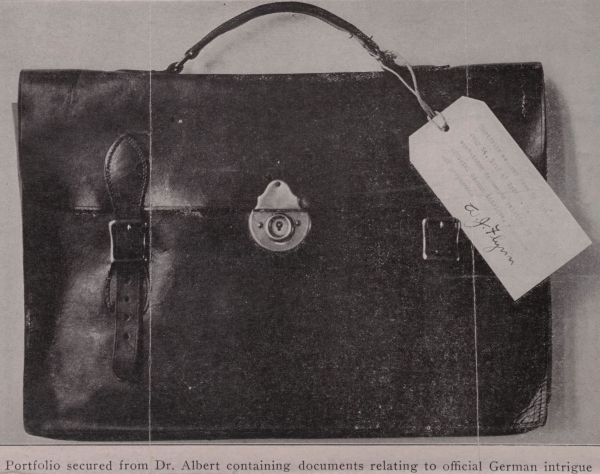
Portfolio secured from Dr. Albert containing documents relating to official German intrigue
Now he thrust into it a report from Captain Franz von Papen, suggesting that a shipment of liquid chlorine which had been ordered by the Allies be stopped by blowing up the factories in which it was being manufactured. Thus the Germans would be given a new advantage in the field by an absolute monopoly of this gas. This report was followed by another from the same source calling the doctor's attention to the possibility of obtaining the patents of the Wright aeroplane by trickery, cheating the Wright brothers out of the result of years of labor, and cornering the aeroplane market in America. A quietly personal letter from Von Rintelen advising him of the various aliases and describing the disguises under which he intended to travel for the next few weeks; documents regarding the Embargo Conference, with its membership of misguided Americans, conceived and designed to bring political influence to bear upon the munitions industry, thus enabling Germany to obtain all the arms it needed and the Allies none; letters and reports on crop conditions, telegrams suggesting means by which Germany could handle the various U-boat controversies in a way to blind the Administration and yet commit murder on the high seas, plans for buying newspapers and the dissemination of spy propaganda—prospectuses, plans and other matters of importance which came daily to the hands of this mysterious, seemingly all-seeing financial agent of the German Government, were slipped into the brown portfolio.
He started suddenly as the panelled doors creaked open to admit a visitor. His piercing eyes turned to a person advancing toward him jauntily, but with an air of familiarity that was disarming. In a moment the look of alarm on; Albert's face changed to one of relief as he recognized his visitor and nodded curtly.
"Ah Von Rintelen, glad to see you. In the future kindly have yourself announced."
"As what? Would it make it any easier to have Smith, or Gates or Levinsky or some such personage announced? Would it make this place easier of access to me?" Von Rintelen swung his cane over the back of a chair, hung his hat over the same piece of furniture and stood rolling his immaculate chamois gloves from his hands. This done, with a care and precision that seemed to make each movement a ceremony, he removed the brown Van Dyke beard that had adorned his countenance, and stood revealed to his confrere in his true personage. Stepping to Albert's side he said in lowered tones:
"You say you are glad to see me; you may feel differently when I tell you the news I bring."
Albert turned quickly.
"Good or bad?"
"Bad," answered Rintelen. He reached into his pocket and brought out a slip of paper, unfolding it as he held it for Albert to read.
Dr. Albert glanced over it, then frowned, inquiringly.
"Well, what of this? Is it not right that Germany should place bombs on ships leaving American ports? I see here a list of ten or twelve sugar vessels which are now at sea, with bombs in their cargoes due to explode some time today. What of that? These are orders being carried out."
Von Rintelen pointed.
"Read the last line again carefully, my friend. The Cragside is listed there and—the Cragside is still in port!"
For a moment of tense silence the plotters stared at each other, consternation growing in the expression Albert bent upon Rintelen.
"What! And there are bombs in the Cragside's hold?"
Von Rintelen nodded. "Five of them—sewed into sugar sacks. They are due to explode any time now."
Dr. Albert paced the floor, hands folded behind him, a frown deepening the lines of his face. He stopped and looked at Von Rintelen.
"And that means that the Cragside will burn at her dock—"
Von Rintelen nodded again. "Naturally."
"And there will be an investigation. More of these infernal American reporters asking questions and seeking to find the causes of things. More Secret Service men running about, and with their keen perception, certain to find these things we wished concealed! Who's mistake is this?" Dr. Albert glared at Von Rintelen, annoyance fast growing into anger as the danger of the situation took hold of him.
Von Rintelen shrugged his shoulders.
"No one's mistake. The agents were told to put bombs aboard sugar ships to destroy as many sugar cargoes as possible. They obeyed orders. The Cragside sailed three days ago when the other ships left port. Something went wrong, she returned for repairs, and is now in port as I have just told you. And the bomb in her hold is due to explode today."
Albert stared at Von Rintelen fiercely. The thoughts which struggled for words but were suppressed showed in his face at the nipping in the bud of this well-planned plot. He took refuge in a hard-fought silence, for Franz von Rintelen, special emissary and arch-plotter, owed no recognition to Dr. Heinrich Albert. Von Rintelen had come to America with a fund of fifty millions of dollars at his disposal and was accountable to only one for the success or failures which followed the use of the money for death and destruction and that man was—the Kaiser.
Von Rintelen picked up the beard which had disguised his features and crossing to a low hung French mirror, carefully adjusted it. Picking up his hat and cane and gloves, he turned to Albert.
"Sorry," he said. "Mistakes will occur, you know. Till we meet again," he bowed jauntily and in a moment the panelled doors closed behind him and the great iron barred doors of the front entrance clanged, marking his exit to Fifth Avenue. He was quickly lost in the hurrying crowds outside.
Albert walked to the fireplace and stared gloomily into its fast dying embers. "A happy day for Germany when he returns home," he muttered moodily. "Mistakes, mistakes, nothing but mistakes."
The past twelve hours had been filled with puzzling anxiety for Dixie Mason. Since the moment she had read the scribbled page from the note-book of Heinric von Lertz in the dressing room of the Ten Mile Mouse, her efforts had been spent on solving the mystery of its meaning, for all it said, though Dixie was not at all misled by its briefness into confusing brevity with innocence, was this:
Report for Von Lertz.
Fire bombs manufactured 400
Fire bombs delivered to agents for coming use 72
——
Balance 328
That was all. Where the bombs had been placed, when they would explode, where it was intended others should be placed could not be told. It had been with difficulty that Dixie in her preoccupation had retained Von Lertz's attention on the ride home from the Ten Mile House the night before. Her mind had been a seething mass of conjectures and forebodings. And with them had been linked her knowledge of the necessity for occupying Von Lertz's attention so that he would not discover the loss of the report book. In this she had been successful, and when he at last deposited her at the door of her apartment, it was with a feeling of relief that she bid him good night.
Dixie in the quiet of her room chided herself for not being able to make more of this report. She told herself that she had no right to be one of the Secret Service if she could do no better than this, but the information was meager—there was nothing to work on. Her smooth forehead was furrowed by a frown of anxiety. For the fiftieth time she read the report and then she shook her head.
"No use," she mused. "There's only one thing for me to do with this and that is send it to Harrison Grant without his knowing who it came from. He can start an investigation." She folded the page torn from the book and slipped it into an envelope. Then in a painfully disguised handwriting she directed it to Harrison Grant, at the Criminology Club. She held up the envelope and surveyed the writing. "He doesn't know my writing, but if he did he would never guess this was mine. Mamette!" she called sharply.
In a moment the curtain of her room was parted and a grinning black face looked in on her. Mamette had been Dixie's maid for years; in spite of her self-selected name smacking as she thought, of all that was French and gay and fashionable, she was pure African.
"Mamette," Dixie repeated, "Take this letter down to the telegraph office in the next block and have a messenger deliver it at once. Be sure not to say who is sending it. Remember!"
"Yas'm!" Mamette's dark hand grasped the envelope which was startingly white by contrast, and in a few minutes Dixie heard the door of the apartment slam and knew that the report which she rightfully guessed savored of intrigue boding ill for the peace of the land she served, was on its way to Harrison Grant.
It reached him a half hour later by messenger, at his office.
It was Jimmy McAdams, shock haired, and dreamy eyed, who ambled in and presented him with the message, and while he waited to see whether Grant wished to send an answer, Jimmy made himself comfortable in the depths of a leather chair with the nickel novel which never left him. Grant frowned over the brief report which had been the cause of Dixie Mason's dilemma. A triumphant chuckle from Jimmy aroused him. But the chuckle was merely induced by the successful effort of Old King Brady to capture the last of the counterfeiters as set forth between the lurid covers of Jimmy's nickel thriller. Grant's glance rested on him with tolerant amusement.
"Keep on reading that stuff, Jimmy, and you'll be a detective before you know it."
Jimmy pulled himself into his present surroundings with obvious effort. The eyes that met Grant's were still somewhat dreamy.
"What? Aw gee, Mr. Grant. I wish I was a detective! I bet I could be one."
"And yet you don't know where this mysterious communication you just brought me came from?"
"Aw gee! Mr. Grant. How'd I know it was mysterious? I carry so many messages. How could I guess this one was goin' to be something different. Anyway that ain't got nothin' to do with the kind of detectin' I want to do. I want to be——"
"Look here Jimmy," Grant had risen and crossed over to the boy, "Why don't you stop reading these nickel thrillers and put some of that excess energy into the Boy Scouts?"
"Well, Mr. Grant, that ain't a bad idea. They been tryin' to get me to join. But I want to be a detective."
Just how close he was to becoming a detective Jimmy did not know. A few moments later he left the Club and betook himself to the "L" station for the train that would take him back to his office.
Jimmy was followed into the car by a well-dressed, dark man of somewhat foreign appearance who carried a brown portfolio. There was nothing about him to arouse interest, but because he was the only other person in the car Jimmy stared at him with a bored curiosity which would have been disconcerting had the object of it not been in a somewhat drowsy state. Jimmy watched his head nod, fall forward on his chest, and jerked back only to allow it to go through the same performance again. It was very interesting to Jimmy, and he was somewhat sorry when the man jumped to his feet in confusion as the guard called a station and hurried out to the platform. As the train started Jimmy noticed the brown portfolio lying on the seat where the man had left it. He caught it up and thrust his head out of the window.
"Hey, hey, mister! You left your valise!" Portfolios, valises—they were all the same to Jimmy, the untravelled.
But the "L" train was pulling out. Behind, on the platform Jimmy could see the man waving his arms and gesticulating wildly.
"Well you shouldn't have left it," Jimmy commented philosophically to no one in particular, and immediately unbuckled the strap that held the case closed. He glanced inside. For a moment disappointment was written on his features, and then his eyes widened.
"Papers! German papers! Gosh I wonder if he's a spy!" Jimmy hesitated and hurried out of the car.
He was strangely deaf to the shouts of the station guard, as he rushed down the elevator steps, the newsdealer who endeavored to stop him at the guard's earnest entreaties, enforced profanities, presented no obstacle at all. A policeman, seeing the commotion, did his best to slacken the pace Jimmy had set for himself but could do nothing but follow the nimble-footed messenger.
Fifteen minutes later Jimmy dashed past Pat Hennessy at the door of the Criminology Club and threw himself, panting and wild-eyed at Harrison Grant.
"Mr. Grant!" he gasped. "Here's a whole valise full of German spies—I mean German papers."
And then he turned with a look of despair as the cumbersome form of his pursuer darkened the door. At the sight of Jimmy the ample-proportioned guardian of the law stepped forward to lay a heavy hand upon him, but Harrison Grant stopped him quietly.
"Just a minute, here, Tom. The boy's all right. I'll look after him. I think he's got something here we really want. In any event I'll take care of the bag, whatever it is—and if the boy is wrong I'll see that it gets back to its owner."
The policeman pondered dubiously. "Well," he said finally, "I seen the kid running with this brown thing and a man chasing him, and I naturally thought something was wrong. But I'll leave him with you if you say so, Mr. Grant."
Grant nodded and he left the room.
Jimmy buzzed at Grant excitedly, like an irritating mosquito.
"Open it up—please, Mr. Grant. It's full of German papers. A guy left it on the 'L' train and I picked it up."
Harrison Grant, with thoughts of Jimmy and the Adventures of Old King Brady, looked down at the youngster and laughed.
"Jimmy, it's a good thing I know you're a good boy or——" he had opened the portfolio now and was drawing out its contents. He stopped with a quick exclamation as his eyes rested on a letter.
"The spy correspondence of Dr. Heinrich Albert!"
As Harrison Grant was hastily running through the contents of the brown portfolio with which Jimmy had so unceremoniously presented him, the guests lounging about the parlors of the Ritz Carlton were somewhat startled at the sudden entrance of a tall dark man. Caution almost forgotten in the need for instant conference with his fellow plotters, Albert had hailed the first taxi driver in sight and ordered him to drive to the hotel at which Von Bernstorff the ambassador, was stopping, as quickly as possible. Paying the driver as they arrived, he had rushed into the lobby, had himself announced and impatiently fumed while the elevator with a slow elegance unappreciated by the doctor, carried him to the floor of Von Bernstorff's suite. A moment later he was somewhat incoherently pouring his recital of events into the interested ears of Von Bernstorff, Von Papen and Boy-Ed.
"I fell asleep. I've been doing much night work," this in a somewhat apologetic tone which won no sympathy from his hearers, "and awoke only when they called my station. I hurried out, forgetting my portfolio. How I did it I do not know. It never leaves my side. That I should have forgotten it now——" Albert threw himself into a chair and ran his fingers through his hair excitedly. "The boy waved at me from the window of the train," he went on. "I immediately telephoned to the next station to have him stopped and the bag taken away from him. But they say when he got there he slid past the guard, ran down the steps, tripped up a newsdealer, got away from a policeman and then ran with it."
Jimmy would have been surprised to know what importance was attached to his actions of the past hour.
Von Bernstorff frowned. "He's probably taken it to the Secret Service," he cut in. "The result will be that sooner or later every scheme outlined in that correspondence will be frustrated. It was careless, Albert, exceedingly careless work. But we must concern ourselves with the necessities of the moment."
A moment's pause ensued. "The consequences of this affair would be staggering if the papers should fall into the right hands."
Von Bernstorff spoke. "Von Rintelen must leave the country at once. He is not an attache or member of the Imperial German Embassy and therefore is not protected by international law."
Von Rintelen bowed assentingly. What Von Bernstorff said was true, and he rose.
"Auf weidersehen, Von Rintelen." Von Bernstorff held out his hand. Von Rintelen bowed and shook the hand of each of the men with whom he had been associated and with hurried expressions of farewell, left the room to make preparations for flight from the country, flight that ended for him at Falmouth, England, where he was detained and returned to New York City. In February, 1918, Judge Howe of Vermont sentenced him to imprisonment for his activities against the peace of the United States.
After Von Rintelen's exit, Von Bernstorff turned once more to his fiscal spy and Boy-Ed and Von Papen.
"As I said, we who are left must concern ourselves with the necessities of the moment which seem to be pressing upon us. Dr. Albert, what was the most important paper in the portfolio you carried?"
"Von Rintelen's report of the bombs placed on sugar ships."
Von Bernstorff smiled slightly.
"That may give us a clue! Are all the ships at sea?"
"Yes."
"Then if the papers are in the hands of the Secret Service——"
"They'll wireless the ships at sea," broke in Albert.
"Exactly." Bernstorff nodded matter-of-factly. "We can find out speedily if they're in possession of our secrets and arrange our acts accordingly. You, Von Papen, and Boy-Ed, get out the Long Island automobile wireless and catch any messages that Sayville may send out tonight. Where is Von Lertz?"
Von Papen shook his head.
"I think he has an engagement with Miss Mason."
"Miss Mason? Who is she?" Von Bernstorff glanced up sharply, but without waiting for reply went on, "he will have to break it. He must help you. I will telephone him to get Wolff von Igel and help you."
Von Papen and Boy-Ed, bowing, left the room.
Bernstorff caught up the desk 'phone and rattled the hook impatiently. He was answered in a moment, and as he gave the number of Von Lertz's apartment, the girl at the switchboard smiled to herself in the privacy of her corner, and made a double connection for the benefit of Dixie Mason, who had been careful to plant her operatives in strategic places. Dixie Mason, listening quietly, on the 'phone in her own little boudoir heard Bernstorff call for Heinric von Lertz, and in a moment caught Von Lertz's quiet answer. She heard Bernstorff's explanation of his call and the story of the loss of the reports given in a few words.
"There is no time to waste, Von Lertz. All messages must be caught. Get Wolff von Igel at once, and you two go out with Von Papen and Boy-Ed in the machine."
"I will be with them in three quarters of an hour or sooner, if I can make it," Von Lertz answered somewhat slowly. Dixie smiled broadly and suppressed a girlish giggle. The reason for Von Lertz's hesitancy was not hard to be guessed at.
But all hilarity disappeared the moment the receiver of her 'phone slipped gently into its hook. It was lifted very shortly and the voice of Dixie Mason, having called her number, was carried to the ear of the Chief of the Secret Service. A quick conversation followed.
"I will have men at Harden's Corner. Did you get that? Harden's corner," he spoke in final tones. "Give them the signal I have just told them they would get from you. Everything straight? All right. Good bye."
Dixie pushed the 'phone from her. "Mamette! Hurry! The motor togs!"
For the next half hour Dixie was extremely busy, and Mamette's services had to be called upon to assist in the unusual toilette she was making. Although Heinric von Lertz, calling shortly to convey his regrets at the necessity of breaking his engagement with her for the motor trip they had planned, found her entrancingly gowned in a dark negligee, the door had hardly closed behind him, when the entrancing negligee slipped to the floor and disclosed Dixie Mason in motor clothes of an extremely mannish cut.
Calling directions into the bemuddled ears of Mamette, donning goggles and cap at the same time, she hurried to the hall and into the elevator. As the machine of Heinric von Lertz, carrying with him Von Papen, and Boy-Ed, crossed the street intersection beyond on their way to Long Island, Dixie Mason's car fairly leaped out of the driveway and on to the road they were taking.
Across the city and over the bridge the big car with the small one following at a discreet but never faltering distance, took its way. At the bridge it was joined by the heavy wireless automobile carrying Wolff von Igel and a driver. Then out on the broad Long Island road with the course spreading smooth and straight before them. The spies were looking for a point of vantage in the hills where their wireless could be used to catch the messages going out from Sayville to the sugar ships in danger. Dixie Mason was looking for a well known intersection of roads, where a road came down from a hill and cut sharply across the high road—a road well hidden except for its intersection. Her sharp eyes travelling beyond caught a glimpse of the white cross formed by the roads. Two long shrill wails followed by three short ones pierced the air, above the steady drumming of the heavy cars ahead.
The cars containing Von Lertz and Von Papen, Von Igel and his driver dashed past the intersection of the road where a tall signpost bearing the information that this was Harden's Corner reared itself. To the men in the cars the sign meant nothing, but to Dixie Mason it meant success or failure. A moment of suspense for her followed, and then a machine dashed into the road between her car and the cars ahead. Dixie slowed down. Her services were not needed now. The other Secret Service operatives would complete her work for her, but hoping to see the finish she drove on slowly.
The spies evidently not knowing they were followed had driven their car up into a road leading to a hill overlooking the water. Von Papen and Boy-Ed were making the necessary connection of the wireless that would enable them to catch the messages at sea. Von Igel, with the driver, was standing guard. Suddenly Von Igel uttered a warning shout. Explanations were unnecessary. A glance below showed that they were discovered. Von Lertz, followed by Von Papen, leaped into his machine and swung into the road, followed by Von Igel in the wireless machine. With roaring exhausts they raced for the broad road that led to the city. Behind them, swinging and swerving, thundered the car carrying the Secret Service men.
Far away Dixie Mason, driving leisurely, heard the sounds of the race. The hills resounded with the heavy echoes of the pounding machines. As she reached the crest of the hill she saw them below her. A small stream which was crossed by a bridge lay at the foot of the hill. As Von Lertz struck the bridge his car leaped into the air, wavered a moment and then crashed ahead, over the bridge and with a grinding of brakes, up the side of the embankment. Then Dixie gave a cry of horror as Von Igel's heavy car following struck the edge of the bridge as Von Lertz's had done, but with less luck, for the car swerved, skidded, swung about, and then striking the heavy cement railing of the bridge, capsized, pinioning Wolff von Igel beneath it. A moment more and a flame shot high into the air as the gasoline tank exploded. Von Lertz and Von Papen worked madly, endeavoring to extricate Von Igel from the wrecked car. She could not see the driver. Dixie peered beyond them. In the distance she could see the car which should have carried her Secret Service co-workers to the successful climax of this affair, stalled, its erstwhile occupants working in vain endeavors to start it. Dixie groaned. After all, it was up to her.
Well acquainted with the character of the men whose schemes she combatted daily with a wit equal to theirs but with less resources to forestall, she summoned her courage and thoughts to do her bidding. Through fate, luck, she knew not what, her plan was endangered. And then this same fate played into her hands.
As her car slid slowly down the hill, Von Papen spoke quickly to Von Lertz.
"Do you know who this is coming down the hill?"
Von Lertz glanced up. "No, but we passed him back in town. Why?"
"We can use him—if he is all right. You and Boy-Ed take Von Igel in your machine and get him to a hospital quick. I'll have to try a rather dangerous stunt—work the Fifth Avenue wireless. It's risky but——"
Dixie had brought her machine to a standstill near the smoking wreck of Von Igel's wireless machine. Her heart pounded madly as Von Papen stepped toward her. Was fate favoring her? It seemed so!
She drew her cap down and adjusted her goggles more firmly as Von Papen advanced. "We've had an accident here," he said, "I've got to get back to town. Can you take me?"
Dixie nodded and opened the door. Von Papen stepped in and gave her directions as to where he wished her to drive him—little knowing that he was giving information to the woman representative of the Secret Service!
"Turn into Fifth Avenue at Fifty-second Street and then start up-town. Make it as fast as the law allows!" Captain Von Papen was snapping his orders excitedly, but in a low voice. "I've got to get there to notify the mother of the boy who has just been hurt. Understand?"
Dixie nodded. Her foot pressed the accelerator. A moment more and the finger of the speedometer climbed to forty miles, then fifty and slowly to sixty where it stayed until the outlines of the city began to show against the western sky. Then Dixie slowed down to a speed which would allow her to pass the policemen they began to encounter at intervals without interference. She crossed over to Madison Avenue, and there slowed down. Von Papen glanced out and around the machine nervously. Evidently the way was clear, for he reached into his pocket and drew out a bill which he pressed into the driver's hand. "Drive on, please, no need to wait for me," he called, hurrying to the sidewalk.
Dixie nodded and started the machine. She crossed Fifth Avenue. Just beyond the corner she stopped the car and jumped out. Scurrying to the corner she watched Von Papen enter the house. It was Dr. Albert's house, the huge Fifth Avenue mansion that German efficiency had turned into a spies' nest from which to prey upon a country with which it claimed to be on friendly terms and by whom it was trusted. Dixie Mason glanced up at its close curtained windows. Somewhere inside was Von Papen, gone there on an errand unknown to her but which she knew had some bearing on the events of the afternoon. What was his mission?
In a moment the answer was given her. High up on the roof the slender antennae of a wireless outfit was being raised. Higher and higher with slim tentacles spreading as the machinery inside that controlled it was operated.
There was no need for conjecture now. Dixie Mason knew the meaning of Von Papen's mad rush to reach this house. It was to reach another wireless depot from which messages could be caught and stopped. And she had been the means of assisting him to his purpose! Dixie Mason turned and ran to her car. A moment later she was breaking all traffic regulations as she sped toward the Criminology Club with one idea in mind—to reach Harrison Grant.
But already the message of warning to the sugar ships far out on the ocean had been flashed from Sayville. The gigantic efforts of the German spies to stop the messages had been to no purpose. Harrison Grant upon finding the report of the bombs placed in the hold of the sugar ships had stopped first to order the warning sent through Sayville, and then calling Cavanaugh, Sisson and Stewart, had hurried with them to the dock to warn the crew of the Cragside of the bomb in her hold, and prevent, if possible, a catastrophe. But as they approached the dock the black clouds of smoke darkening the clear sky told them they were too late. The Cragside was a mass of flames and the dock an inferno of smoke through which the wet rubber coats of firemen gleamed. Huge streams of water played on the ill-fated vessel, and the shouts and yells of excited dock hands mingled with the roar of flames and water and the weird sirens of newly arriving fire engines.
There was little they could do there. Grant, sickened at the appalling waste and the heartlessness of the crime, which they had been too late to prevent, turned his footsteps slowly back toward the Club. Was there no end to fiendishness which could concoct such acts as this? Would the eyes of the people never be opened to the danger that stalked abroad among them in the guise of friendship? Would this country, too, be drawn into the war that was sapping the strength of the nations and causing a depth of misery such as the world had never before experienced? Grant wondered at it all, wishing that things were not as they were, marveling that others would not see that peace could never exist with a government which fawned and smiled and offered the hand of friendship even as it planned acts too treacherous for an honorable nation to conceive of.
He had stretched his weary limbs in the deep softness of the leather couch in the lounging room of the Club. Doubtless he heard the sound of a car drawn up to the curb before the Club. If he did he was too tired to care who it was.
Dixie Mason still in her mannish auto togs signalled to Pat Hennessy at the door of the Club.
"Tell Mr. Grant to come at once and bring his best men with him, I think I can crowd three in here. Hurry, please!"
Hennessy was used to strange happenings. His affiliations with the Criminology Club had accustomed him to the need of quick action and now quick action seemed to be the desired thing. He disappeared into the Club to re-appear in a moment with Grant and Cavanaugh and Stewart.
Grant peered into the machine at the slim figure of the driver.
"Who are you?" he asked sharply.
Dixie flashed her Secret Service commission, concealing the name.
"What else?" The secret sign of the service was given him as Dixie raised her gauntletted hand. Without further questions he stepped in, followed by Stewart. Cavanaugh clung to the running board.
A moment more and Dixie Mason's little car was speeding toward Fifth Avenue, defying all law in general and policemen in particular in her mad haste to reach the house Von Papen had entered.
She slowed down at the corner where she had stopped before and pointed to the house. She spoke in a low voice and directed her speech at Stewart. "In that house there, they are working the wireless!"
Grant jumped to the sidewalk. He gave his directions in low tones. Dixie watched them seek for admittance at the door. She watched them open the iron barred gate and then with a splintering crash force their way into the house. She saw the butler that blocked their path fall under someone's heavy blow. And then they disappeared into the darkness of the gloomy reception hall.
Grant and his men strode to the panelled doorway opening into the great room in which Dr. Albert received his guests and where the conferences of the German plotters were held. From behind the heavy doors came the crackle and splutter of a wireless apparatus.
Under the strength of the three men the doors burst inward. Inside of the room, two men working the wireless rushed vainly toward the French windows for escape, only to find themselves pinioned and helpless in the handcuffs slipped on them by Grant and his operatives.
Cavanaugh and Stewart soon dismantled the wireless equipment and put out of commission forever one of Germany's most dangerous weapons in America, but Grant watching them knew that it was but one of many and that for every blow thus dealt a dozen plots would spring up elsewhere. While this evil festered in their midst the eyes of the Secret Service must never close.
He left the operatives on guard and turned toward the street with his captives.
"Good man—that fellow who brought us here," he mused as they stepped out on the stone doorstep. "He's worth a special report to the Chief. If it hadn't been for him—"
He stopped. Where the racer with its hooded, gauntletted driver had been was vacancy! His mysterious informant was gone!
Chapter VIII
THE KAISER'S DEATH MESSENGER—ROBERT FAY
A deathly calm hung over the trenches. After a day made hideous by the thunder of artillery and shriek of shells an unearthly peace had settled over the desolate stretch of shell-torn battleground. In the German trenches a sergeant leaned against the sandbag fortifications. The light from his cigarette glowed fitfully in the darkness as he puffed at it nervously, while he waited for the men he had chosen to accompany him in an attack on the French trenches. Soon he would be crawling out over the shell-pitted stretch of No Man's Land with a haversack filled with hand grenades. His proficiency in handling them had brought him fame in the ranks of the Kaiser's army. Fame! He tossed the cigarette butt aside contemptuously and then stamped on its glowing end. Fame! What was it compared to life? Why should he, for the sake of a few days of glory and a name for being successful in carrying out these bombing attacks, risk his life—his life which could be used for stopping the whole terrible business and bringing the war to a close in which Germany would be victorious? He clenched his fist in the darkness and struck at the sandbag. If his plans could be used he would stop in three months the munitions supply of the Allies and soon for want of munitions they would sue for Peace.
He reached for his watch. Its faint phosphorescence pointed the hour to him. He heard the tramp of footsteps. His men were coming. Soon he would be out there crawling through the darkness toward that other line of trenches, dodging wire entanglements, playing possum beneath the light of flares. Perhaps this raid would be his last. Perhaps in a day or so a cross would be raised for him,
"Sergeant Robert Fay, Died for Fatherland."
The footsteps drew nearer. The sergeant raised himself in preparation for taking command—and then he stopped. Out of the darkness his superior officer's voice came to him in guttural accents:
"Sergeant Fay, you are to report at once to Cologne for promotion and other duty."
Fay received the announcement with the stolidity born of long military training, but a moment later the meaning of the words transformed his features.
"My plans have been approved!" he gasped.
But the officer had disappeared. Fay could hear the tramp of his retreating footsteps.
Far removed from scenes of strife and horror and suffering, separated from them by the broad blue of the Atlantic, the tide of life rolled on peacefully in the United States. Peacefully—to all appearances. There a people torn with sympathy and pity for the wrongs wreaked on helpless Belgium by the greedy hand of Germany sought to alleviate those wrongs and bring what help they could to the suffering nation by food supplies and gifts of money and clothing. They little knew that the horrors that had waged on their own shores were to meet with success. While the American people pursued their peaceful occupations, sinuous tentacles were reaching out to entangle them in the war that was casting its shadow over Europe.
On the twenty-fifth floor of a building that reared its dark heights among other skyscrapers on Wall Street, in a luxuriously furnished office, two men sat in conference—Captain Franz von Papen, Military Attache of the Imperial German Government, and Captain Karl Boy-Ed, Naval Attache.
In an outer office sat Wolff von Igel, Von Papen's secretary. His knock at the door interrupted the conference in the inner office.
"Lieutenant Fay wishes to see you."
Von Papen glanced up with a frown.
"I can't see him now. Tell him to come back in an hour."
"I told him you were busy but he has a letter from the General Staff which indicates that his visit may be of importance."
Von Papen hesitated.
"Show him in," he ordered.
A moment later Robert Fay erstwhile expert grenade thrower of the German trenches, now promoted to a lieutenancy, saluted the Captain.
Von Papen eyed him closely.
"Your papers?"
Fay handed him a letter. Von Papen read it and handed it to Boy-Ed, his gaze returning again to Fay.
"So you are here to help us? How did you make the trip?"
"I arrived yesterday on the Rotterdam. My passport was made out to one Kearling from whom I bought it in Cologne. It is a simple matter now to buy a passport. I substituted Kearling's picture for my own. His description fitted mine nearly enough to pass."
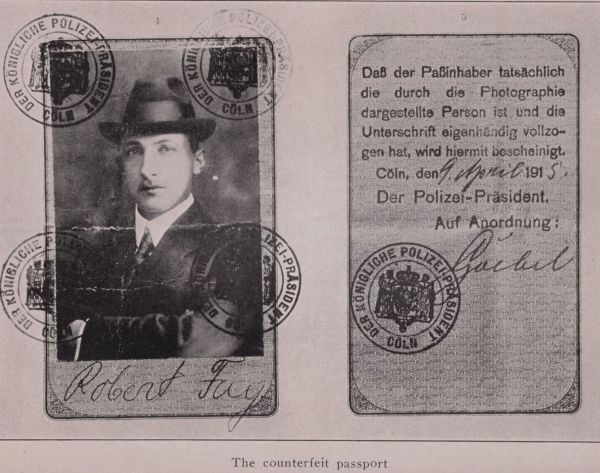
The counterfeit passport
"But the passport must be stamped," interposed Boy-Ed.
"Yes, but that too is simple. The photograph is simply perforated to match the perforations of the stamp already on the passport. You see how easy it is. I am here. I have had no trouble. But now I am Fay, no longer Kearling."
"Very good," commented Von Papen. "And now your plan."
"It is to stop the export of munitions to the Allies from the United States for three months and perhaps permanently."
His listeners looked at him somewhat incredulously.
"I am by profession a mechanic and have had in mind many inventions. My most recent one is a bomb which will not explode until the vessel is three miles out. This, when attached to munition carrying ships, will also cause the munitions to explode. My plan has meet the approval of the German Government to such an extent that they have commissioned me to come to the United States for the purpose of carrying it out. They have generously granted me 20,000 marks to further my plans."
"You will perhaps be kind enough to describe this bomb to us?" Von Papen indicated a chair and they drew close about the table.
"You are acquainted with the explosive Trinitrate of Toluol?"
They nodded. "What is known at T.N.T.?" Boy-Ed commented.
"Exactly. This bomb carries 100 pounds of T.N.T. It is so arranged that it can be fastened to the rudder post of a ship with a wire line running from that to a clamp that fits on the rudder. As the rudder is worked in the movement of the ship at sea, the line will wind up, tightening the clockwork until the spring inside is released. This will send the plunger against two rifle cartridges which will explode the T.N.T. and——" he stopped. There was no necessity for finishing the sentence. A fanatical light shown in his eyes. He clasped and unclasped his hands in an intensity of excitement, and his hearers unconsciously absorbed his mood.
"Our bomb squads have used T.N.T. effectively on various occasions," said Boy-Ed with a smile at Von Papen. "As the highest powered aeroplane bomb carries only about 80 pounds of T.N.T. we are able to judge quite accurately what 100 pounds can accomplish."
Von Papen nodded and reaching across the table for a match lighted his cigar.
"Lieutenant Fay, does anyone know of your arrival in America?"
"No one," answered Fay, "except his excellency, Count Von Bernstorff."
"That is well. You perhaps are not well acquainted with conditions here. Our position demands that we must not be known as the directors of any movement of espionage against the United States. Germany, of course, is not at war with the United States. To the United States we are a friendly nation." He flicked the ashes from his cigar with a contemptuous movement.
A cynical smile crossed the face of Boy-Ed. It was reflected on the face of Fay.