XIV FICTIONAL BIOGRAPHY
Reading edition
Ariel, by André Maurois. The Divine Lady, by E. Barrington. The Nightingale; A Life of Chopin, by Marjorie Strachey.
Biography, like history, is often the most diverting and truest of all fiction; but when it is treated severely, it frequently lacks entertainment. We stand everything save boredom, even prohibition and fundamentalism. Some who would not read a book entitled The Life of Shelley might be tempted by a novel called Ariel, which is a delightfully presented and rigorously accurate biography of a great poet. M. Maurois has not added an iota of imagination to his book; he has stated the facts with the order and precision of the Dictionary of National Biography. But he has coloured them with the art of the novelist and he has done it in pastel tone, with a light hand and warm heart. It seems the consensus of opinion that the hand has been too light, but one feels between the written words the power of a soul without a superior; the fascination of an intelligence liberated from all bonds, unfortunately at times trammelled by the dictates of a heart that was not liberated. Reading Ariel, some will wish that Shelley had been a Latin; yet, England of doughty prejudices and dour Puritanism is the country where such strange individuality phenomena are frequently displayed. One marvels at this, just as one who knows the Italian people and their profound scepticism, marvels that they had St. Francis and St. Catherine.
Ariel has had a vogue and has received praise that would not be granted the Dictionary of National Biography. This indicates the appetite of humans for facts, when they are sugar-coated, disguised or made alluring by an attractive envelope. Biography presented in the shape of fiction is one of the best kinds of biography and the most interesting kind of fiction. Shelley’s life contains material that would seem exaggerated if found in a novel, and it reveals facts that would be denied if they were set forth in fiction. Before it appeared in English translation, the book took France by storm. It did more than popularise the name of Shelley, it revived an interest in biography generally and it added allure to retrospects of the past, the past that had been so neglected and depreciated by partisans of ego-analysis, and that has been pushed aside by the psychological novel.
The lives of great men contain an inexhaustible fund of invaluable material which is at the disposal of the novelist. If he does not choose to be as frank as M. Maurois has been about Shelley, he may do what Rose Wilder Lane has done in the novel entitled He Was a Man which is a biography of Jack London. She has artfully disguised her subject while Maurois presents him to his readers with all the data of identification.
The charm of Ariel resides in the manner in which the story is told; in the graceful characterisations; in the sobriety of the style; in the portraits of the women who made Shelley’s life happy or miserable; and in the brilliant contrast that the author has drawn between his hero and Lord Byron. The portrait of the latter, though sketchy, has such emphasis on the shading that the picture is complete and arresting.
Ariel is not the most typical example of fictional biography, for though it is an account of Shelley’s life it is so faithful as to leave little room for imagination. Were it not told adroitly and gracefully, it would be no more picturesque than a record kept on index-cards. It creates a strange contrast with The Divine Lady, a biography of Lady Hamilton, true, but stamped with the hall-mark of fiction. E. Barrington (Mrs. or Miss) had the most romanesque subject at her disposal when she undertook to popularise the figure of Emma Hamilton, the Emma of Nelson, whose beauty, grace, talent and intelligence kept Europe astir for the better part of the late eighteenth century. She deviated from the strict truth in several instances, but it was to improve on the truth, and to give to her novel the epic quality that Lady Hamilton’s biographies had not heretofore displayed. The Divine Lady is more closely allied to fiction than to history, and since the author has not only great narrative power and an exquisite style, but the qualities that permitted Théophile Gautier to make Mademoiselle de Maupin a masterpiece, and genuine capacity for feeling and emotion, she presents Lady Hamilton in all her “divinity” with passionate need of admiration and achievement. Lord Nelson is likewise depicted with a sure hand. His reputation will suffer from the delineation, for in addition to the way he treated his wife, there was other conduct inconsistent with unqualified esteem. His naïveté was the seal of his doom, and it is allowed to no one to condemn a passion such as that which united Lady Hamilton and Nelson. Those who have not known it are not competent to judge—and those who have can find apologies and excuses for it.
Lady Hamilton’s career was Napoleonic in its display, and, all proportions guarded, it followed the same cycle. Obscure birth, great qualities of mind (and in her case of body), rapid and miraculous ascent to high power and reputation followed by an increase of appetites and ambitions which blurred the straight path and made both her and Nelson want more than any human being can stand, a slow but fatal lowering of their stars, then hatred and scorn of the world, and finally, for her, death obscure even as birth. In a few years, Emma had run the gamut of all the ambitions and all the tortures; she had known the greatest ecstasies of love and happiness and the lowest and most degrading debauches; she had dispensed her favours and received praises; she had scrubbed kitchens and been worshipped by Queens and Kings; she had allowed a boor to make a public exhibition of her charms, and she had sneered at the homage of a monarch.
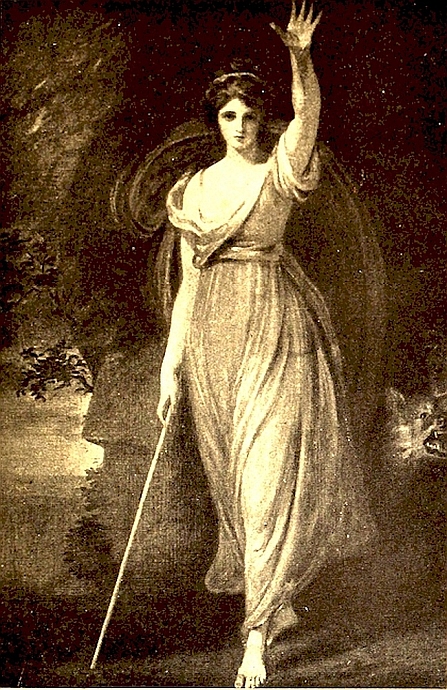
LADY HAMILTON AS CIRCE
From “The Divine Lady,” by E. Barrington Courtesy of Dodd, Mead & Co.
E. Barrington has made Lady Hamilton come to life once more in the pages of her novel; she has caught her charm and her personality, understood her perfections and vices, and she has succeeded even in so grading her praise and disparagement that the reader is constantly aware of the scullery-maid masquerading as ambassadress, and of the demi-goddess hidden in the bosom of the protected fille de joie. Her real place was with the lowly, and she was never more at home than when she could shed her acquired English and her elegant manners and indulge in the language and activities that she had loved in her youth. E. Barrington has made all this clear, and she has given each startling contradiction in the make-up of the Divine Lady its proper emphasis—with the result that we wonder at such whims of nature, at such diversity of characteristics in the same person, without ever doubting the veracity of the author. It seems scarcely plausible that Lady Hamilton should have been as adaptable and sensitive to environment as she appears to have been—that she should have loved Greville with the loyalty and patient submission which she displayed, that she should have been so faithful and loving to Lord Hamilton until she met Nelson, and that she should have felt for the latter the irresistible passion which was the cause of her ruin. We marvel at the union of talents that occurred in her; the aristocracy of her singing voice, the vulgarity of her speaking voice, her mastery of wild horses and her inborn gift for the terpsichorean arts, her tact and diplomacy, and all the qualities which made her at the same time a divine lady and a prostitute.
Her most extraordinary gift was her power to feel the rôle she had to play in order to win hearts; and the diversity of her accomplishments made such conquest easy for her. She won hearts, and she lost hearts, but when we turn the last pages of the book, we have only admiration for the Lady who inspired Nelson, and carried the renown of her country beyond its confines at a time when international affairs were nearly as muddled as they are a hundred years after her death.
The Divine Lady is the kind of biography which makes one care more for fiction—and the sort of fiction which makes one wonder why novelists do not write more about historical characters whose lives and personalities often surpass anything that imagination could dictate.
Miss Marjorie Strachey has written the latest word in the line of fictional biography: The Nightingale; A Life of Chopin. She has blended the facts of his life with the romance of fiction. By a series of sketches, of fugitive evocations, she has added to the permanency of Chopin as a man, and especially as an artist. She has made his genius permeate his actions, and she has endowed him with the dream-qualities of poetry and the realised qualities of practical life. Chopin is no longer an unapproachable genius; he is life itself seen through the veil of romance.
Miss Strachey has not done for her hero what E. Barrington did for Lady Hamilton; she has not called attention to his “amours,” not even the one with George Sand; her task lay, not in giving us the emotional understanding of the musician, but in creating a true portrait of him. This she did by interweaving his correspondence with his conversations; his friends with his surroundings. They all form part of the background on which he shines all the more brilliantly that it is never exaggerated, and his life was enough of a romance to impart to the biography its qualities of ethereal dream without addition or distortion of facts on the part of the biographer.
The Nightingale is more to be praised for what it does not say than for what it says. It shows restraint, dignity and poise, which are the accompaniment necessary to a biography of Chopin.