XI STATESMEN
Reading edition
Woodrow Wilson, by William Allen White. The True Story of Woodrow Wilson, by David Lawrence. Brigham Young, by M. R. Werner. The Life of Abraham Lincoln, by William E. Barton. Selections from the Correspondence of Theodore Roosevelt and Henry Cabot Lodge. Letters from Theodore Roosevelt to Anne Roosevelt Cowles.
William Allen White has the qualities that fit him to write about Woodrow Wilson entertainingly for his contemporaries, illuminatingly for posterity. He is versatile and perspicacious; he has a sense of humour and he is colossally industrious; he is sensitive and sensible, and has been disciplined in the art of verbal expression, by intuition and experience. He is a man of ideals and ideas; the former are realisable, the latter not persecutory; and he has a tender spot in his heart for the Irish.
Posterity and its spokesmen will render the verdict on Woodrow Wilson that will endure. I do not agree with Mr. White that his place in the history of the world will not be determined by his character. It will be determined by his character, not by his characteristics, just as George Washington’s was and just as Abraham Lincoln’s was. Nor do I agree that “the relation between character and fame is not of first importance” though I am aware that “many good men live and die unknown.” They do, indeed, but many good men have very little character. “Character” and “good” are not synonymous. A “good” man is a man who does not disobey the commandments nor transcend conventions. A man with “character” frequently does both. Woodrow Wilson did and I have no doubt George Washington did, despite the cherry tree story.
The greatest of all commandments is, “Thou shalt love thy neighbour as thyself.” If he had affectionate feeling for Dean West, President Hibben, Senator Lodge and others “too numerous to mention” he successfully concealed it. He was undoubtedly a truthful man, but he said he had written the preface to Dean West’s publicity brochure without reading it, and later, when it was shown that he had read it, he said he had written it good-naturedly and offhand, which was again at variance with the truth, for it carefully and lucidly expressed his attitude to the school. He told the Senate Committee on Foreign Relations that he never had seen the secret treaties, though there is documentary evidence to the contrary.
He had character: he was firm, fearless and free, and he had vision. He showed these qualities in Paris. In his vision it was revealed to him that from the sanguineous and agonising travail of the war a child had been born; that it did not resemble its parents; that many called it monster, others Bolshevism; and that it subscribed to none of our rules of bringing-up or behaviour. He saw that it was lusty, growing like the traditional weed, that it threatened to shut out our sunlight and our source. He realised that we must deal with communism, and gradually, day by day, the world is realising it. Woodrow Wilson was “good” enough, but unfortunately for him, for his peace of mind and happiness, he had “characteristics” and they fettered him.
Mr. White bears heavily on Woodrow Wilson’s ancestry, too heavily some will think, or too indiscriminatingly.
It may have been the Woodrow in him that told Colonel Harvey that his advocacy of him as a presidential candidate was injuring his prospects and it may have been the Wilson in him that charmed the “bawling mob, hot, red-faced, full of heavy food and too much rebellious liquor” which nominated him for Governor of New Jersey; but it was Woodrow Wilson that met the Senate Foreign Relations Committee in the White House in June 1919, when he made the misstep that lamed him for his remaining mortal days, and dislodged his country from the saddle of world-leader, in which it seemed to be riding a winning race.
Mr. White would have us believe that Woodrow Wilson got his intellect and obstinacy from the Woodrows, his emotions and charm from the Wilsons. What did he get from Ann Adams, his lynx-eyed grandmother whose mouth dropped at the angles and who neither saw nor forgave a daughter after she married beyond her approbation? From her, I suppose, he got the capacity to treat Colonel House, his polar star for the ten years of his fruition, as though he were a Judas, and Joseph Tumulty, who served him with dog-like fidelity and intelligence from the beginning of his political career to its zenith and beyond, as though he were not only mangy but had rabies as well?
The chapter entitled “The Miracle of Heredity” might more appropriately and truthfully be labelled, “Teachings of Heredity Exemplified by the Appearance, Conduct and Career of Woodrow Wilson.” The author would have us believe that environment had much to do in conditioning his limitations. He writes:
“If only there could have been in his life some shanty-Irish critic with a penchant for assault and battery, some dear beloved sweetheart to show his notes around the playground, some low-minded friend to fasten upon him the nickname 'four eyes,’ calling brutal attention to his spectacles, or some other nickname in thinly veiled obscenity which would reveal a youthful weakness and so make him truckle to the baser nature of his gang that he might remove the black curse of his sobriquet—what a world we should have to-day!”
Alas, that I should disagree again with one who has given me hours of pleasure from which enduring admiration has developed! Woodrow Wilson would have been the same had he budded in Hoboken, flowered in Montmartre and fructified in Tahiti.
If one can say there is a disappointing chapter in the book it is one entitled “The Development of Youth.” The study that will throw a penetrating light on Woodrow Wilson will be one that concerns itself chiefly with the years between 1874 and 1885, from the time he went to Columbia, South Carolina, until he left Johns Hopkins University, where “he was known as a friendly cuss in the American vernacular and never a grind.” In his school and college days he met, worked and played with other boys who were destined to become successful Americans. Perhaps there was a rule amongst them taking notes which he will print. If there was, he is the one to unleash the bridegroom “coming forth rejoicing as a strong man to run a race” better than his brother-in-law, Stockton Axson, whom Mr. White quotes.
Woodrow Wilson’s presidency of Princeton University has probably never been outlined more accurately and attractively than in the chapters, “The Lecturer Becomes the Administrator” and “Going Through the First Fire.” Not only is the chief leading actor sketched by the hand of a master, but there is a Hogarthian vignette of Dean West, and a portrait of Colonel House which is so perfect that I must quote it:
“A man of slight figure, perhaps five feet six in height, of a thin, oval cast of countenance, adorned by a short, grey, stubby moustache over a firm and yet sensitive mouth which in turn is carved above a strong chin. The whole countenance bursts into illumination with beaming, kindly eyes below a rather higher brow than one expects from the remainder of the face; and the voice, when it comes from this gentle, interesting, and intelligent face, is soft and low and modest. A certain almost Oriental modesty, a Chinese self-effacement, abides with the personality of Colonel House. He seems to be in constant and delightful agreement with his auditor. And this delightful agreement, as one knows him, expresses itself in a thousand ways in an obvious and unmistakable desire to serve. He is never servile, but always serving; gentle without being soft, exceedingly courteous with the most unbending dignity. He is forever punctuating one’s sentence with 'that’s true, that’s true’; and stimulating candour among men, which is the essence of friendship.”
Mr. White is an impartial partisan, a pleading judge. These desirable qualities of the biographer are revealed most conspicuously in the narrative of Woodrow Wilson’s first great struggle with his most deforming limitation: inability to bear and forbear, to do team work, to play the game according to the rules. No doubt he felt that he had gained a moral victory at Princeton, but the trustees were glad to see him leave.
How he got the nomination for Governor of New Jersey, how he short-circuited the political machine, how he inoculated the Democratic party of his adopted state with liberalism and how, gradually but surely, the immunisation that resulted was felt throughout the country are told most interestingly. The chapters are interspersed with pleasant references to three women who influenced his life: he got understanding, loyalty, indulgence and devotion from Ellen Axson and from Edith Boiling; from Mrs. Peck he got appeasement of his latent hedonism, encouragement of his ambition, justification of his conduct, and praise which was to Woodrow Wilson what manna was to the Children of Israel. She, “of exquisite spiritual prowess and facile charm,” is supposed to have enjoyed his confidence to a remarkable degree. Her recently published story does not tend to prove it. Until his letters to her are published, I shall continue to believe he got nothing from her save what I have enumerated.
Woodrow Wilson’s nomination and election to the Presidency of this country and the accomplishments of his first administration are passed over rather briefly. All will not agree “that when his four years’ work are considered as a whole, when they are viewed retrospectively they may be seen as the fastest moving four years in our economic and social history.”
It was in 1916, when he was renominated by his party without opposition, and re-elected, that President Wilson became a world figure. His dealings with Germany, his restraint in bringing this country into the war, the way in which he developed public opinion to back him up when there was nothing to do save to join up with the Allies, are told with candour and simplicity. Then come the glad and the sad chapters: the President’s gestation of the League of Nations plan, and his abortive attempts to deliver himself; his European odyssey; his encounter with the sirens; his shipwreck; the shattering of the raft that he got together to take him before the people when the Republican Senators convinced him they would not accept the treaty; his final illness and his tiresome wait for the ring down of the curtain are told with gratifying impartiality and in satisfactory résumé.
The relation of Woodrow Wilson’s illness to his great failure: his inability to get his country to accept the League of Nations idea and membership in that product of his brain, has never been properly recognised nor publicly discussed. But it has a definite and a pathetic relation. Mr. White says:
“He brought with him to the White House a stomach pump which he used almost daily and a quart can of some sort of coal-tar product—headache tablets; they were giving him incipient Bright’s disease until the White House doctors took hold of him and stopped the tablets. The tinkering with his intestines proved the frailty of the man.”
Alas, how frail man is, and how many men and women are frail if “tinkering” with their intestines proves such frailty!
Before he went to the White House and while he was still governor of New Jersey, and possibly even before that, Woodrow Wilson showed distinct symptoms of the disease to which he finally succumbed: arteriosclerosis. The disease was detected first in his retinal blood vessels by a famous ophthalmologist of this country and he was instructed to a régime which, subscribed to and followed, is adequate frequently to bring about a cessation of the progress of the disease. Perhaps “tinkering” with the intestines does not felicitously or appropriately describe the essential features of that prophylaxis, but if it embraces what is meant by overcoming fermentation and putrefaction in the digestive tract, then “tinkering” is the word to use and it is to be regretted that “White House doctors” were not “tinkers” too.
One day, some one will point out that President Wilson’s irascibility, obstinacy, mental inflexibility and emotional inelasticity, which he displayed so frequently, painfully to himself and humiliatingly to his people while in Paris on his second European venture, and here when he took his plan to the Senate Committee on Foreign Affairs and finally to the people at large, were mainly due to the arteriosclerosis, which at that time had made great inroads on the nutrient channels of the brain. It accentuated his limitations and minimised his possessions. It immobilised him like a hephæstic fetter, and there was no one strong or courageous enough to break the links before the fibre of the web had annealed.
Mr. White’s concluding chapter is entitled “The Assessment,” and it contains these words with which every one must agree:
“If Fame does not come to him through the conjunction of time and chance working upon the genius of the race to preserve the structure which he previsioned in his hour of trial, Fame will find a man here—a clean, brave, wise, courageous man—ready made for heroic stature.”
How unfortunate it is that Mr. White could not have interpolated the adjectives “understanding, kindly, compassionate, loyal!”
In another connection Mr. White says: “And we must not forget that from the bottom of his Irish heart always the motive which most surely moved Woodrow Wilson was the love of his kind.” Against this statement I set the following extract from my own writings:
“Woodrow Wilson does not love his fellow-men. He loves them in the abstract, but not in the flesh. He is concerned with their fate, their destiny, their travail en masse, but the predicaments, perplexities and prostrations of the individual or groups of individuals make no appeal to him. He does not refresh his soul by bathing it daily in the milk of human kindness. He says with his lips that he loves his fellow-man, but there is no accompanying emotional glow, none of the somatic or spiritual accompaniments which are the normal ancillæ of love’s display. He does not respect his fellow’s convictions when they are opposed to his own. He does not value their counsel when it is adverse to his own judgment.... In contact with people, he gives himself the air of listening in deference, and indeed of being beholden to their judgment and opinion, but in reality it is an artifice which he puts off when he returns to the dispensing centre of the world and of the law just as he puts off his gloves and hat.... Woodrow Wilson attempts to mask, with facial urbanity and a smile in verbal contact with people, and with the subjective mood in written contact, another deforming defect of character; namely, his inability to enter into a contest of any sort in which there is a strife, without revealing his obsession to win. When he attempts to play any game, his artificed civility, cordiality, amiability, are so discordant with the real man that they become as offensive as affectations of manner or speech always are, and instead of placating the individual for whom they are manifest, or facilitating the modus vivendi, they offend and make rapport with him impossible.... Mr. Wilson is a brilliant, calculating and vindictive man; brilliant in conception, calculating in motive and vindictive in execution.... Were he generous, kindly and humble, it would be difficult to find his like in the flesh or in history.”
That was my deliberate judgment after having studied Woodrow Wilson from the psychological point of view, and that is my judgment now after having read and re-read Mr. White’s book.
It is by his possessions, not by his limitations, that Woodrow Wilson will be estimated. The campaign is on. It is not a noisy one. No one can say what the outcome will be, but the straw vote now being taken suggests that his election to membership in the Academy of the World’s Immortals is assured.
Another journalist, David Lawrence, has written what he calls The True Story of Woodrow Wilson. Either the adjective should have been deleted from that title, or the indefinite article should have been substituted for the definite.
Mr. Lawrence was the correspondent of the Associated Press at Princeton from 1906 to 1910, the closing years of Wilson’s pedagogical life and the opening years of his political career. For the past fifteen years, he has done journalistic work in Washington which has brought him in close contact with the pattern makers of our national destiny. He has had therefore unusual opportunity to observe, and he is a trained and trusted interpreter of events. Small wonder that his book is readable, interesting and instructive. Were he as trustworthy an interpreter of souls as he is of events, his book would deserve high rating.
The satisfactory life of Wilson must be written from his letters, messages, memoranda and books after the disappearance of the emotional states engendered by his presence and personality, which are prejudicial to correct estimation and inimical to sound judgment. Such states of popular feeling never disappear in one generation. It is only now that we begin to realise the majesty of Lincoln’s mind, the harmony of his soul.
Mr. Lawrence’s opening sentence is “Woodrow Wilson died as he lived—unexplained and unrevealed.” He was more “explained” than any man of his time, and neither Mr. Baruch nor Mr. Bridges would, I fancy, admit that he was unrevealed. He may have been improperly explained, and insufficiently revealed, but there are thousands who saw and met him who will not believe it.
Mr. Lawrence states that his purpose was to put on record a dispassionate narrative of the man who, equipped only with the qualities of personal magnetism and intellectual power, made the unparalleled ascent from College Professor to Moral Leader of the world. Every unprejudiced reader must admit that success crowned his effort.
When Admiral Grayson shall publish his diary; when the archives of Colonel House’s mind are accessible; when all Walter Page’s letters are available, and when Mr. Robert Bridges, Mr. Norman Davis, and Mr. Bernard Baruch shall testify the qualities that the world denied him—qualities of heart—we shall be in position to estimate Woodrow Wilson and to assess his career. Had Mr. William Jennings Bryan shifted the focus of his mind from fundamentalism to fact, and told us of his intimacy with Woodrow Wilson, it would have served a useful purpose.
It was said of Brigham Young that he was a Cromwell in daring, a Machiavelli in intrigue, a Moses in executive force, and a Bonaparte in ruthlessness and unscrupulousness; and William H. Seward said that America has produced few greater statesmen. These testimonials and the universal admission that he gave Mormonism whatever permanency it has, and that he was the parent of its material prosperity prove that he was a man of uncommon personality.
Personality analysis and portrayal are the Elysian field of the biographer. Here is a man who was to the system of polytheism called Mormonism what Paul was to Christianity: preacher, organiser, administrator. A farmer lad without background or education, he supported himself by painting and glazing until he undertook the dissemination and direction of the doctrines revealed by God to Joseph Smith, Jr., who devoted all the succeeding days of his life, until his neighbours killed him, to their promulgation. Religion took the place of education in Brigham Young and aroused his latent qualities and power. It led him to the Governorship of Utah and to the Presidency of the Church of Jesus Christ of Latter-day Saints; and before he died nearly a half a million people were convinced that he, like Christ and Mohammed, partook of divinity.
He has only recently been called to his reward; fifty years ago, he was a power in the land; for more than a quarter of a century every word that he said that was fit to print was printed and archived; his life is thoroughly documented. He should be a fascinating subject for a biographer. It would be fulsome praise to say that M. R. Werner has written a satisfactory or a successful biography of him. It reveals neither diligent research nor careful reflection; it is neither skilfully composed nor effectively told; there is scant evidence in it that the most important source of such a biography, The Journal of Discourses, has been deeply studied or adequately transcribed. But its most serious shortcoming as a biography is a possession, not a lack, and that possession is the engulfing, overwhelming background. Mr. Werner says it is impossible to write the life of Brigham Young without also writing the history of Mormonism, and it is impossible to write the history of Mormonism without writing the life of Joseph Smith, Jr. I fancy few will agree with him. I should go so far even as to say that no one can write the history of Mormonism and the lives of its author and proprietor and of its administrator and perpetuator, simultaneously. To do the first of these alone would be an interminable task. It would require a discussion of the religious instinct, explaining why this instinct is so rarely appeased by what the wisdom of God and the ingenuity of man have to offer. And a detailed, specific statement of the system of polytheism which the Book of Mormon professes to teach and the Book of Doctrine seeks to justify, would require examination of the status of prophecy, of miracles, of the imminent approach of the end of the world, of personal contact with God through sight or hearing at the present day, of liberty of private judgment in religious matter, and of scores of other tenets of the Mormon creed. Moreover, it would require an explicit statement of the Mormon hierarchy, an extremely complicated structure, and a summary of the Mormon’s form of government. No biographer, however facile, could interpret Joseph Smith, Jr., who is not familiar with the psychopathology and experienced in the ways of the psychic deviate. Concerning Mr. Werner’s apology regarding the necessary scope of this book, it would be just as legitimate to say that the life of Francis of Assisi could not be written without writing at the same time the history of the Catholic Church and the story of the life of Ignatius Loyola.
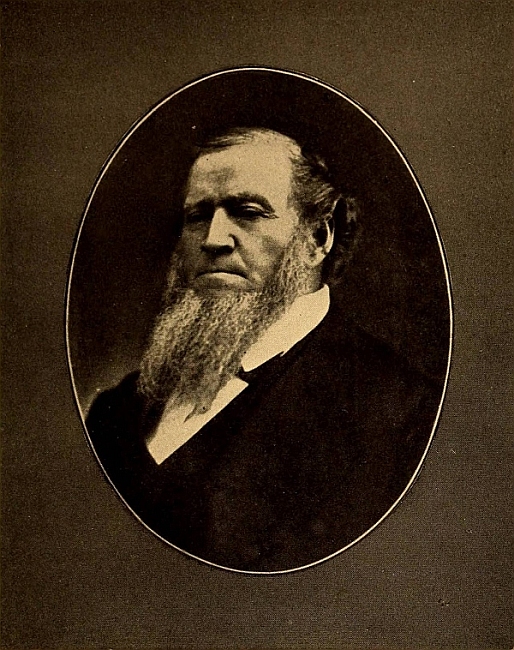
BRIGHAM YOUNG
Reprinted from “Brigham Young,” by M. R. Werner Courtesy of Harcourt, Brace & Co.
In brief, Mr. Werner bit off more than he could chew. However, one gets more from a second reading of the book than from the first. That is a poor recommendation for a book these days when people are insisting that they be enlightened by electricity. By careful and persisting digging, the reader may get a notion, form a concept, of Brigham Young’s personality, particularly if he concentrates on the chapter entitled “Sinai.”
Brigham Young said with his lips that he believed in God, but with his heart he said he believed in himself. He was self-sufficient, but not self-satisfied.
He was about as fearless as man can be. His conduct all his life testifies that he was as devoid of fear as the words of Edward W. Bok testify that he is. Brigham Young and Theodore Roosevelt had the same brand of courage and about the same supply.
Young understood the primitive and the acquired urges of man as few understand them. He curbed those of others and indulged his own; and he was the only man of his country, save Benjamin Franklin, who really understood women.
He was ruthless, and he had a vein of cruelty in him that came to the surface with increasing frequency. He imposed his will and determination upon friend and foe; he brooked no denial, no contradiction. Cast in the mould of Joshua, he firmly believed every place the sole of his foot trod was his, for the Lord had given it to him.
With it all, he had a sense of humour and he loved children. Small wonder that orators in the throes of self-excitation liken him to Pericles and Cromwell, and frenzied preachers liken him to God.
One has but to study the various photographs of Brigham Young and to keep in mind one thing he said about his father in order to be able satisfactorily to solve the mystery and guess the secret of his personality: “It was a word and a blow with Father, but the blow came first.” And Brigham Young’s method was the same. He wanted to keep polygamy as the strong link in the chain of the hierarchal organisation that was such a brilliant economical success; he kept it there until the Government imprisoned him, and when he died, seventeen wives and forty-four children were at his funeral.
He had his own way in everything save with Amelia Folsom. To her determination not to bend the knee, he owes the preservation of his character. Another young woman whom he took to wife when he was sixty-six attempted to discipline him, but without success. Even if she had not failed, his character would have been safe; that possession can not be ruined after sixty.
Like Achilles, Brigham Young had one vulnerable spot, but it was his heart, not his heel. Women acted upon him as the lamp does upon the moth. It was not face or figure, intelligence or charm that lured him. It was sex. Casanova was to him what a candle is to a phare. The illusion that most men develop when they approach senility, viz., that they are still attractive to young women, seized him early. When he was fifty-six years old, he said, preaching to his flock: “You think I am an old man? I could prove to this congregation that I am young, that I could find more girls who would choose me for a husband than any of the young men.” His experience would seem to justify the boast, but with all his understanding of women he forgot that women marry for different reasons, some for position, some for protection, some for title. But what is Princess or Duchess compared to Goddess?
“I am a great lover of good women. I understand their nature, the design of their being and their work.” Had Brigham Young left out the only adjective in that sentence and added: “Once it mattered not to me that they were old or young, homely or plain, temperamental or indifferent, but now that I am old, I like them young and pretty,” it would have been an epitome of what women meant to him in the twilight of his life, as the following sentence epitomises his general estimate of them: “Let our wives be the weaker vessels and the men be men, and show the women by their superior ability that God gives husbands wisdom and ability to lead their wives into His presence.” After looking at the pictures of scores and more of Brigham Young’s wives, one is convinced that Mark Twain was right when he said the man that marries one of them has done an act of Christian charity which entitled him to the kindly applause of mankind, and the man who marries sixty of them has done a deed of open-hearted generosity so sublime that the nation should stand uncovered in his presence and worship in silence.
The hiatus in Brigham Young’s personality was on the æsthetic side. He had no feeling for beauty in any form or display and he could not distinguish between vulgarity and refinement in conduct, thought or speech. Rabelais alone outranks him in putridity of speech, and his sermon of the first Sunday of September 1861, when he talked to his flock about how they should dress, is offered in evidence.
Shrewdness, cruelty and industry were his dominant possessions. They radiate from the daguerreotype made of him when he was fifty, like scent from a lily. He was hirsute, heavy-jawed, thin-lipped and the corners of a mouth, that seemed framed for an oath or an obscenity, dipped deeply into his cheeks. He was thick-necked, barrel-chested and his hands and feet did not fit him, but they were adapted to a man who ruled with a rod of iron. The secret of his success he said was “I am a Yankee. I guess things and very frequently I guess right.” If he had added, “I see straight; I know that original sin is fear and that all mankind is born in it; and that the real pleasure of life is in gratifying the fundamental urges,” neither his personality nor his success would be enigmatic.
It would help the searcher after explanation of Brigham Young’s success as proselyter, exhorter, guide, executive, lover and tyrant to know about his parents and his brothers and sisters. They were all steeped in seriousness and saturated with religiosity. His father, who became the right-hand man in the Church of Jesus Christ of Latter-day Saints, was an unreasoning Methodist, an uncompromising moralist. His brother Joseph “was solemn and praying all the time and he had not been seen to smile for four years or to laugh for two.” His brother Phinias was a preacher who saw visions and his sister who mediated him to Mormonism was the wife of the Reverend John P. Green. He lived in a recreationless community to which a new religion was what the County Fair, Circus and Cinema are to remote rural communities to-day.
It was as natural for Brigham Young to go into Mormonism as for a duck to go into water. When he got in, he soon found it was a quick and safe way to prosperity, power and posterity. He put his religious enthusiasm out at compound interest and in twelve years it made him a Prophet, a Seer, a Revelator and a Realtor. He pitched his economic tent in the desert plains of Utah and he directed his co-religionists to thrust fertility upon them through irrigation and bent backs. Having no capacity for spending money, he soon began to experience the feelings of Crœsus. He realised that the surest way to wealth is to be a big earner, a small spender, and a prudent investor. He urged his flock to those ends and said: “I am your avatar.”
There were two things he liked to do: to dance and to make love. He was strangely susceptible to rhythmical movement and he loved to marry women and to beget children. He acknowledged twenty-seven of the former and fifty-six of the latter.
The day Mormonism was purged of polygamy, it ceased to be an object of popular interest and likely it will remain so unless the Ku Klux Klan or the Fundamentalists can be persuaded to concentrate on it, when it shall have again its day in court, but there will never be such days as those of Brigham Young.
Mr. Werner says he is convinced that Mormonism is a perfect example of religion carried to its illogical conclusions. If he would only tell us what religion carried to its logical conclusion is, it might help us to fathom his meaning. But nothing will help us understand what he means by “demented frog” and “neurotic horse” or why one of Joseph’s sisters was enceinte and not pregnant, or what there was about Brigham Young that made him “constitutionally, and by habit, incapable of languor,” for languor shall always mean for me feebleness, faintness of body, oppression from fatigue, disease or trouble. Brigham Young was a god, but he was also a mortal.
Dr. Barton’s reasons for writing another life of Lincoln are three: he has some new facts, he wishes to correct misstatements in extant biographies, and fifty years of clearing weather have added to the visibility and luminosity of the atmosphere through which the Great Liberator is to be seen. Moreover, fifty years is the gestation period of judiciality.
There are few more puerile chapters in biography than Chapter I entitled “The Birth of Abraham Lincoln,” with its trivialities and platitudes on the birthplace of eminent men, Christ included; discourses on log cabins, their shape and size and construction; homilies on the comfortlessness of Nancy Lincoln’s bed and the relationship of plains and woods to Presidents; reflections on the relationship of child culture to sanitation; the description of Nancy’s smile when she was told that she had brought forth a man child; and the astonishing statement that the author has ridden in the Kentucky mountains many miles side by side with a doctor who died soon after 1809. Any one who can get through the first chapter, brief though it is, will be able to read the book.
Abraham Lincoln held biographies in slight esteem and could scarcely be persuaded to read them. He wanted the truth about people. Hence he read the Bible. He would probably have found Dr. Barton’s three books about him far too eulogistic, but eulogy comes naturally to clergymen. “This book attempts to tell the truth about Abraham Lincoln.” So did Nicolay and Hay’s, so did Lord Charnwood’s, Miss Tarbell’s, Herndon’s, Josiah Holland’s, and others “too numerous to mention.” Dr. Barton has no corner on truth. His new facts are important, but not so important as he thinks. Aside from putting it beyond question that Abraham Lincoln was born to Nancy Hanks while she was wedded to Thomas Lincoln, there is nothing new of importance except perhaps certain emotional sidelights. He has unearthed some documents that bear directly on Lincoln’s ancestry, but we are no more interested in his grandfather than in his great-grandfather and in him no more than the grandfather who had eight or eighty grands before his father-appellation. He has had access to the diaries of Orville A. Browning, once United States Senator, but I should not consider his Excellency George Harvey’s diary a repository of facts about Woodrow Wilson. Although Senator Browning was reputed to have known Lincoln intimately, he and Judge David Davis, discussing the Nation’s loss the day after Lincoln’s death, agreed that no one knew him through and through. Moreover, Mr. Browning was a pious man and piety is a parent of prejudice.
The writer who has new facts about Abraham Lincoln should state them in plain language at the beginning of each chapter. Dr. Barton has written an enormous book, two volumes, 500 pages each, about America’s inspired statesman, of which the only interesting portion is that which treats of the parents of Lincoln, and he had already treated that subject in a book entitled The Paternity of Abraham Lincoln.
Dr. Barton writes that now for the first time he is able to give the true story of the Hanks family from which our greatest President descended. It has the hallmarks of a true story, and henceforth it must be accepted. The investigations that the author has made of the Sparrow family have been fruitful and they should forever close the controversy concerning Lincoln’s parentage. The records of Mecklenburg County, Virginia, and of Mercer County, Kentucky, have told Dr. Barton the truth about it. We could wish that he might have told it with more brevity, directness and felicitousness. He is far stronger in research than in narrative power. Digression, circumlocution, overtake him on every page.
Joseph Hanks’ eldest daughter was Lucy. She came to young womanhood in a period of license and revolt that followed the Revolutionary War, similar to that which followed the Great War. Dr. Barton thinks this explains, but does not justify her conduct. She bore a child when she was 19 and she called it Nancy. The father has been conjectured, but history does not name him. Seven years later she married, and though she “was behaving like a perfect lady when her father died, he disinherited her.” He could not forget her seven years of sin. After she had been indicted for fornication and branded publicly “with an unpleasant name,” Henry Sparrow made his beau geste. He married her and thus vested her with virtue. The indictment was quashed. From that time Lucy was known as Nancy’s Aunt. Readers of Edith Wharton’s The Old Maid will know just how Lucy felt about it. Let us hope that Elizabeth Sparrow, the real aunt, was as good a vicarious mother as Delia Lovell, and let us also hope that some day Mrs. Wharton may write her story.
Discussing the parents of Abraham Lincoln, Dr. Barton takes occasion to say that Lea and Hutchinson’s book, The Ancestry of Abraham Lincoln is not always wrong. That is Dr. Barton’s idea of high praise.
Thomas Lincoln married Nancy Hanks and a photograph of the marriage certificate which adorns Dr. Barton’s book convinces us that it was a bona fide marriage. Whether Nancy’s mother was there we are still in doubt. Dr. Barton concludes this chapter with two brief paragraphs:
“I wonder if she was there.” “I wonder if she could keep away.”
When I read those lines, I found myself murmuring, “I wonder”; and then “I wonder why I wonder.” All readers of The Old Maid will say “I’ll say she was there,” and indeed Dr. Barton says so in the fourth chapter, which is devoted to the Hankses and the Sparrows.
Dr. Barton strangles the Mary Shipley myth. The Shipleys now fade out of the Lincoln picture. Abraham Lincoln, the pioneer who went to Kentucky from Virginia, was alleged to have married twice; first in leisure to Bathsheba Herring; then in haste to Mary Shipley. It is not true. Bathsheba was his one and only wife. Everything that has been found out about her is to her credit. Her fourth child, Thomas, was selected by Providence to father him who was to purge the world of slavery. He had no idea that he had been selected, but had he known, he could not have improved on his selection of Nancy Hanks; from her, Lincoln got his heart and his humour. His other great possession, his capacity to learn by experience, he got from the Bathsheba. The Lincolns only passed on the chromosomes, but it is now forever settled that they did that and for it they shall be glorified eternally.
Dr. Barton gives Nancy and Thomas good characters. The former was serious, but emotional, industrious, a good housekeeper and a better mother. The latter was not the shiftless, improvident migratory vacillator that he has been reputed to be, but he liked water better than land. He did not have an uncontrollable urge for work, nor did he starve himself or his family to swell a savings bank account. “He accepted his situation, and when his day’s work was done, he rested and visited and took life as comfortably as he was able.” To be sure he was evicted from Knob Creek farm, but that was due to a failure which he had in common with many others: foresight inferior to hindsight. Of Abraham Lincoln’s childhood at Knob Creek little is known. Dr. Barton indulges in some pleasant conjectures and it is known that the future saviour of the Nation did write verse in his youth. So his biographer may also be right in these surmises.
An illuminating and convincing chapter is entitled “Lincoln’s Kentucky,” for it shows that the slavery question was brought frequently and dramatically to the plastic mind of Abraham, and it reveals a people of primitive prejudices, of intense antipathies, of violent intolerance, of cowardly superstitions. Abraham Lincoln may have laid the foundation of his fair-mindedness, tolerance, kindliness, sympathy and sanity in those years; built the structure in Indiana and furnished it in Washington. Lincoln was nine years old when his mother died, but he was of a maturer mind than many boys of fourteen. A year later, he was given a stepmother. “She transformed the home of the cheerless widower into a spot of pleasant associations and happy memories.” That epitaph should satisfy any stepmother. Lincoln’s schooling is an old story. Retelling it does not improve it. Mrs. Allen Gentry’s recollections that were given to Herndon are still the most interesting. It is safe to assume that the world will always be interested in Abraham Lincoln’s love affairs, but until the ideas of George Bernard Shaw are accepted and we have acquired, like the French, an acceptable sex language, we shall not be able to appease the interest. Even then the story will have to be told by some one who had limitations and experiences similar to Lincoln’s or by some one to whom privileged communications are made—and who is invested with the power of inspiring confidence.
Dr. Barton’s treatment of John McNamar, who was the first to fan Ann Rutledge’s amatory smouldering fire into flame, will be approved by his readers. John was a poor thing and it is a pity his path ever crossed Ann’s. Posterity has aureoled the love of Ann and Abraham and time does not tarnish it, indeed brightens it. The permanency of love is a lost illusion. Even had Ann lived to marry her lover, their love might not have lasted their years. I can think of few subjects that lend themselves to discussion with less grace than “did Abraham Lincoln love Mary Todd when he proposed to her and when he married her?” I do not know—nor do I know any one who does know, but reams have been written about it. I have an opinion, but like so many others it is valueless to any one but myself. If he was in love either with Mary Owens or Mary Todd, he had strange ways of showing it. His love letters to the former, especially those indicating willingness to marry, are masterpieces of frigidity and would put out any heart-fires that were ever ignited; and the person who, reading any account of Lincoln’s conduct the day set for his marriage with Mary Todd, can say he was in love certainly never has been in love himself nor has he even observed at close range any one in the throes of the divine passion. Whether he “went crazy as a loon” when he bolted the expectant bride, as his friends alleged, or whether his heart failed him is beside the question. Sane men in love sometimes act as he acted. I doubt if there is a neurologist whose professional experience does not encompass an example of such conduct. It is astonishing the thoughts and convictions that come to sensitive, self-conscious men confronted with the obligation of obeying God’s first Command. Partisans of his head may say that he was not in love, of his heart that he was not sane.
He married Mary and his treatment of her indicates that he learned to love her, and no wonder if the account Dr. Barton gives of her is true. His conduct in this respect reflected his common sense and uncommon judgment. If Abraham Lincoln’s reputation had depended upon his knowledge of women and his proficiency in the ars amandi, it would not have outlasted his days.
Dr. Barton is a fine example of researcher: patient, industrious, indefatigable, determined. Certain investigations led him to frame a hypothesis about the ancestry of Abraham Lincoln. Then he set to work to prove that the assumptions of the hypothesis were facts. He succeeded to an astonishing degree. If Lord Charnwood will now make a few corrections, interpolate a few facts, it will be an almost perfect biography of Abraham Lincoln, and if Miss Tarbell will do the same and make a few deletions as well, it will be on the whole the most readable.
From the time Lincoln was elected President of the United States, he begins to elude his latest biographer, or perhaps it would be more just to say that Dr. Barton does not make his knowledge of Lincoln’s later motives and conduct so impressive or so convincing as he does when he writes of the twenty pre-and post-natal years. However the last chapter, most infelicitously entitled “Mr. Lincoln,” is a model of catholic taste, commendable restraint and good judgment. Deleted of its last sentence, it would be an ideal summary by a man who makes no claim to being a biologist, psychologist or personality expert and who is neither biographer nor historian by temperament. Here he pitches his pæan of praise in the right key, and he does not distract the listener with gossipy interpolation or jejune ejaculation.
Physicians whose concern it is to estimate and adjudge their fellows’ mental balance find frequently that they get more information from the writings of the individual whose sanity is in question than from his speech. It is more self-revelatory especially if it is thrown off in emotional white heat. Theodore Roosevelt was an intensely emotional man and he was the most prolific letter-writer of his time; and perhaps of all time. His biographer, Mr. Joseph B. Bishop, estimated that he wrote during his public career more than 150,000 letters—an average of more than 10 letters a day. It seemed beyond belief when we were first told, but gradually one gathers credulity as volume after volume of his letters are published. “Writing is horribly hard work to me,” he wrote in a letter dated March 26th, 1887. He liked hard work. He loved few people and it was essential to his happiness and welfare that, with these few, he should share his emotional states and discuss his intellectual preoccupations. Hence, the number of his letters. His friendship with Henry Cabot Lodge did not date from school or college days. In the Spring of 1884, when he was a member of the New York State Legislature, he was addressing him as “My dear Mr. Lodge”; in the Summer as “My Dear Lodge” and telling him he is one of the very few men he really desires to know as a friend! in the Autumn as, “Dear Old Fellow” and assuring him he is the salt of the earth whose people shall one day become cognisant of his savour, and by Winter as “Dear Cabot” and testifying his admiration, affection and spiritual intimacy. A quarter of a century later he wrote “from the Spring of 1884 Cabot Lodge was my closest friend personally, politically, and in every other way, and occupied toward me a relation that no man has ever occupied or ever will occupy.” In his entire political career he maintained that he had never formulated a policy or made an appointment without seeking the counsel and guidance of this friend. The letters in the volumes entitled Selections from the Correspondence of Theodore Roosevelt and Henry Cabot Lodge give ample proof of this friendship and intimacy. Roosevelt poured out his heart and his mind to Lodge and thus furnished us material for estimating the kind of man he was; his conscience, morality, patriotism; his sincerity, affection, hypocrisy; his imagination, intellect, culture; his idealisms and realisms; his body and his soul. Here is first-hand information, awaiting indeed inviting interpretation. Perhaps no one ever better illustrated the fact that basically every mood is the mental transformation of a bodily state than Theodore Roosevelt.
The beginning of any understanding of him must be made in his “stunts”: cow-punching, cross-country riding, big game hunting, endurance tests, soldiering, exploring. It is generally known he was a delicate youth and it is alleged he went West seeking invigoration. He went West for the same reason the Sun goes: it was a part of the divine order. Chains could not have thrust inactivity upon him. Physical activity was as fervently in his blood as lust in the blood of a normal man; no one can read his letters from Little Missouri, from Elkhorn Ranch, Dakota, or his account of participation in a fox-hunt with battered head and broken arm, and need further proof of his indomitable energy. He knew minutes of physical peace, but they were thrust upon him by mental activity; he had hours of bodily rest, but they were stolen from his urge that he might display or convey his emotional state. He had to a singular degree the capacity to concentrate all his energies on the job in hand, the task undertaken; to do it and fulfil it with all his might and main, to tolerate no distraction, to suffer no interruption, to brook no interference. Whether he was playing tennis, orienting the Civil Service Commission, directing the New York Police Department, scorning Mr. E. L. Godkin, organising the Rough Riders, framing the policies and administering the affairs of his country, or reading a book, he did it with all the punch there was in him and when his punch-exchequer got low he sought the services of a trainer. He liked to drink the wine of life with brandy in it, he says in one of these letters, and the brandy he used is now not even outlawed. As Henry Adams says, “Roosevelt more than any other man living within the range of notoriety showed the singular primitive quality that belongs to ultimate matter—the quality that mediæval theology assigned to God—he was pure act.”
The next most characteristic feature of Theodore Roosevelt is that he took himself, his beliefs and convictions with great seriousness. Early in life he convinced himself that he had come upon a brand of honesty that he must popularise and persuade his fellow citizens to use. If they would not use it after they had been appraised of its quality and source they were perfect asses like Vilas, malicious and dishonest scoundrels like Godkin, demented mugwumps like John Fiske, dogs like Carl Schurz, hypocrites like George W. Curtis and accessories to the deeds of the German governmental murderers both before and after the facts like Woodrow Wilson. G. W. Smalley’s attitude was contemptible, he would like to put the editors of the Evening Post and of the World in prison. President Eliot made himself ridiculous by his stand on civil service and ballot reform; and it would be a pleasure to shoot or thrash his colleague Parker. Only he and Cabot were right: straight talkers and hard hitters.
Theodore Roosevelt had a keen and profound sense of duty to his country, to his community, to his family and to his friends and he had a superhuman facility for conveying recognition of it to every one who saw him or heard him. To that and to his reputation for fearlessness he owed a popularity which has never been equalled in this country. He was the embodiment of the American ideal: fearless, impetuous, resourceful, self-confident, ready to throw his hat into any ring and to follow it up with a smile on his face and the exclamation, “This is bully,” escaping from his lips. He could inoculate his fellow citizens with his ideas more quickly than any man of his time and he could galvanise them into greater activity and more sustained determination than any President we have ever had. His qualities may outlive the children of those who knew him. One of the astonishing confessions of these letters is that he had few friends and fewer intimates. I have had friends who were convinced they knew him fundamentally and were in close communion with his thought and determination. From their conversation I could readily believe that he rarely made decisions without consulting them. Their names are not even mentioned in his correspondence.
Any one who has been inclined to doubt Roosevelt’s sincerity, i.e., to consider that he sometimes affected an enthusiasm which he did not feel, will have his doubts appeased by reading this correspondence. He believed in himself but he was not vain; he rated his abilities high, but his conduct displayed no arrogance; he valued his mental and physical possessions, but he was not proud. If he ever doubted his ability to do any job that presented itself, his most intimate correspondence does not betray it. What he doubted was that the opportunity would not be vouchsafed him.
The man to whom these letters were written was vain. It flattered his vanity that he had seen Theodore Roosevelt on the road to the White House while he was Police Commissioner, and that he had told him so with assurance; thus discharging in advance the obligation he was to incur by receiving such evidences of trust as the letters betray from so great a man as Roosevelt. He saw his own thoughts disseminated and his convictions popularised by his friend who knew how to gauge the feeling of the people and to raise their temperature; and in some inexplicable way there steals upon the reader a thought that when Lodge made up his mind that Roosevelt was going to the top he also made up his mind that he would link his name with that of the rising star in a correspondence that the world would not let perish.
Roosevelt was a many-sided man. He was gifted with foresight and hindsight. There has never been a President save Lincoln who had such capacity for learning by experience. For a man so emotional, he was a good judge of men and he could do team work. These qualities distinguished him from the man upon whose head he poured the vials of his wrath the last few years of his life and who may get from posterity both the laurel and the oak-leaf crowns. Scores of instances could be cited from this correspondence in support of his power to size up men, but none serves better than his letter to John Hay urging him to persuade the President to appoint General Wood to the command of all Cuba. “Wood is a born diplomat, just as he is a born soldier. I question if any nation in the world has now or has had within recent times any one so nearly approaching the ideal of a military administrator of the kind now required in Cuba.” No recorded prophecy has ever come truer than that.
Roosevelt was not a modest man, but he had a sense of propriety and fitness that was very becoming. His letters to Lodge about the hesitation on the part of the War Department to recognise his military service in Cuba by giving him the Medal of Honour, are dignified and straightforward. There is no pumped up humility. He did a good job and the labourer is worthy of his hire. In the same way his letters, when he was being groomed for the nomination of running mate to McKinley, are full of good sense and sound reasoning. He is satisfied with what he has accomplished as Governor of New York, and so were the people. What he would really like, would be to be re-elected Governor with a first-class Lieutenant-Governor, and then be offered the Secretaryship of War for four years. He knew what he wanted, and he got it, the Presidency, but the letter that describes his visit to Buffalo after McKinley had been shot should be ample testimony to convince any one that he did not want it the way it came. Any one keen to learn the tricks of the political game will be aided by perusal of the letters written from the New York State Capital. They may also observe how statesmen develop. Roosevelt’s letters from the White House are just as frank, intimate and revealing as were those from New York Police Headquarters and from Albany: full of praise for Lodge’s potential and actual accomplishments; of proffered suggestions and requests for counsel; of enthusiasm about exhausting rides and the fording of turbulent streams, “altogether it was great” or “bully fun,” full of vigorous comment and of plain characterisation of men. Discussion of literary matters which was so conspicuous in the early letters has now practically disappeared, though occasionally he makes brief comment when relating his diversions. In September, 1903, he writes, “I have been reading Aristotle’s politics and Plutarch’s miscellany and as usual take an immense comfort out of the speeches of Lincoln.” It is extraordinary how his partisanship determined his likes and dislikes even in literary matters. “The more I study Jefferson the more profoundly I distrust him and his influence.” Lodge writes to him on returning the proof of his first inaugural address, “Literary form is after all the salt that keeps alive the savour of the thoughts we would not willingly have die.” Indeed his “form” had improved enormously since he wrote the life of Thomas H. Benton in 1887, when he stated “my style is very rough and I do not like a certain lack of sequitur that I do not seem able to get rid of.” That sentence alone is proof of the first allegation, but he bettered it before he reached the White House, and the lack of sequitur disappeared forever.
Though his letters to Lodge are chiefly concerned with his political activities, realisations and prospects; with justification of his conduct, refutation of the allegations of their opponents, and comment on their sinister motives and malign trends—there is much sentiment in them and not a little play. Commenting on something Lodge wrote about the death of John Hay, he says: “It should not make us melancholy. He died within a very few years of the period when death comes to us all as a certainty, and I should esteem any man happy who lived till sixty-five as John Hay has lived, who saw his children marry, his grandchildren born, who was happy in his home life, who wrote his name clearly in the records of our times, who rendered great and durable services to the Nation, both as statesman and writer, who held high public positions, and died in the harness at the zenith of his fame. When it comes our turn to go out into the blackness, I only hope the circumstances will be as favourable.” His hope was realised, save that he was four years younger when his turn came to go.
There are many high spots in the correspondence that reveal Roosevelt’s character; one of them is his appointments to ministerial and ambassadorial positions and the comments on the appointees; they are all scratch men; he never nominates a man with a handicap and he submits the name first to his friend. Another is the genesis of the thought that led to his bringing Japan and Russia to the council table at Portsmouth, the development and maturity of it, and its success. A third is his break with Lodge that came when he decided to seek the nomination of the Republican Party, and when that was shown to be not available to the Progressive Party—his own creation. Lodge’s political conduct in the last ten years of his life alienated many admirers, but it is in a measure offset by his conduct in the trying year of 1912. He was opposed to the constitutional changes advocated by Roosevelt, therefore he could not support him; “but as for going against you that I can not do. There is very little of the Roman in me for those I love best.” There was a lot in him for those he did not love! Finally the student of political events misses the inside story of the Progressive Party. It is likely there is a series of letters to some one else on that subject.
Another thing that he misses is an explanation of his break with Taft. There is a strange and inexplicable absence of any illuminating reference to it in these letters, the place where it should be. Unquestionably our Chief Justice has hundreds of Roosevelt’s letters which will one day be published. Until then we must curb our curiosity; but there has been something in Taft’s conduct since he became ex-President and in his speeches, that leads one to believe that, when the facts are submitted to the public, it will be seen that he was not responsible for the break or for the hard feeling it engendered.
Some day also the President of Columbia University, who was once a “bully fellow,” will publish the scores, perhaps hundreds, of letters he received and they will throw a revealing light on Roosevelt’s loyalty. Mr. Bishop in a recent book, Notes and Anecdotes of Many Years, has given some personal recollections of him and his humanness which are illuminating.
If one asks men conversant with public affairs of the past thirty years, “What specifically did Roosevelt do while President that entitles him to be classed with the Immortals?” they find it very difficult to be specific in their responses. They will mention the taking of Panama and the organisation of the Commission to construct the Panama Canal, his interpretation of the Monroe Doctrine when Germany was pressing her claims on Venezuela, his vigorous enforcement of the Sherman anti-trust law, and the Peace Conference at Portsmouth. These were most creditable accomplishments, but scarcely epoch-making. It was a beautiful gesture to bring Japan and Russia to the Council table, but it takes from the glamour to know that the suggestion came from the Japanese. And the breaking up of interlocking directorates, the unloosening of the hold of corporate influences on the government, required courage, judgment and self-reliance; but the historian of the future will be puzzled when he reads that Congress was insisting in 1924 that the railroads should do what they were prosecuted for doing twenty years before. Victory in the Northern securities case may prove finally to be the equivalent of defeat.
Theodore Roosevelt was essentially a great actor, but he wrote his own lines and submitted them to Cabot Lodge for deletion, addition and correction. Stunts of every kind appealed to him. He had a natural talent for accomplishing them which was enormously enhanced by practice. He got away with nearly everything he undertook. Had he given permanency to the Progressive Party, history would credit him with few failures. He knew how to make acquaintances feel that they were friends, and friends that they were loved.
Taken all in all, the features of his personality that attract me most are those revealed in the letters published by Mr. Bishop in the volume called Theodore Roosevelt and His Time, in the letters to his children and in the letters to Anne Roosevelt Cowles. This is possibly because he does not there reveal so much bitterness, so much contempt, it must indeed be said, so much hatred, as he reveals in the last letters to his dearest friend: hatred of his successor in the Presidency. Possibly the word “hatred” is not the right one. He despised Wilson, he commiserated the country that was obliged to suffer him, it was a disgrace to continue him in office; he knew less about the conduct of War than he knew about anything, and he knew nothing save academics. Wilson could do no right. But he did one thing which took the check-rein off Roosevelt’s inhibitions. He ignored him; he took no heed of his counsels, his detractions, his desires.
Roosevelt was just as sincere in this belief as he was in others, and he had a legion of sympathisers and supporters, at the head of which stood the man to whom the letters were addressed. Every one is entitled to, and has, his own opinion of the merits of the two Presidents as men and statesmen. Those to whom the one appeals are repelled by the other; but every one will agree that one was more lovable than the other; that he understood the heart of man and that he had one himself. Theodore Roosevelt was one of Nature’s wonders and he should take a place among the great Presidents because of what he was rather than what he did.
It must be admitted that the Roosevelt-Lodge letters leave a taste—not quite bitter, not quite acrid, but slightly disagreeable. It can be removed quickly by reading for a few minutes the volume entitled Letters from Theodore Roosevelt to Anne Roosevelt Cowles. Here he is revealed as the affectionate brother, the indulgent father, the sympathetic friend of children, especially those of Roosevelt blood. Loyalty to his family and confidence in himself radiate from most of the letters. Fancy a civilian of thirty writing, “'La Guerre et La Paix,’ like all Tolstoi’s works, is very strong and very interesting. The descriptions of the battles are excellent, but though with one or two good ideas underneath them, the criticisms of commanders, and of wars in general are absurd.”
On the eve of declaration of war with Spain, when McKinley seemed bent on peace, he wrote: “I’d give all I’m worth to be just two days in supreme command ... I’d have things going so nobody could stop them.” And that was what Theodore Roosevelt always wanted to do, to get things going so that nobody could stop them.
He always wanted to start something. He never disclaimed the children of his brain; they were all legitimate. He never mistrusted the potency of his brawn, it never failed him. Courage, self-confidence, self-belief, facilitated the conviction that he was a man of destiny. Though he was not such actually, he scaled the flaming ramparts of the world more gracefully and successfully than any man of his time.
I have never been able to convince myself that Southey was right when he said, “A man’s character can more surely be judged by the letters his friends address to him than by those he pens himself, for they are apt to reveal with unconscious faithfulness the regard held for him by those who knew him best.” If Theodore Roosevelt’s character were estimated from Cabot Lodge’s letters one would have to call him a god, not a man—a god who nodded once, in 1912.