IV LITTERATEURS: FOREIGN WRITERS
Reading edition
Anatole France Himself, by Jean-Jacques Brousson. Anatole France and His Circle, by Paul Gsell. Anatole France, the Man and His Work, by J. Lewis May. Anatole France à la Béchellerie, by Marcel Le Goff. Sainte-Beuve, by Lewis Freeman Mott. Leonid Andreyev, by Alexander Kaun. Joseph Conrad, by Ford Madox Ford. John Donne, by Hugh l’Anson Fausset. The Wind and the Rain, by Thomas Burke. Robert Louis Stevenson, by John A. Steuart.
Anatole France was picturesque, enigmatic and intriguing. He attracted illuminators and interpreters. His protracted age gave biographers ample time to prepare their revelations, interpretations and judgments which came with a rush soon after his death—and before, and which still come. The last of all these biographies is the best, that is, it gives the best picture of him, both as individual and as savant. M. Brousson, his Secretary for many years, had abundant opportunity to see Anatole France without the mask he habitually wore. He has embodied his observations and reflections in Anatole France Himself, and all readers save literary historians and critics will find it satisfying.
Much was written of Anatole France during the latter years of his life. His mode of life, methods of work, political, religious and social ideas; his theoretical antinomianism and his practical conformity to convention; and more than all his erudition excited curiosity, and from attempt to satisfy it, there resulted envy in some, dislike in others, admiration in all.
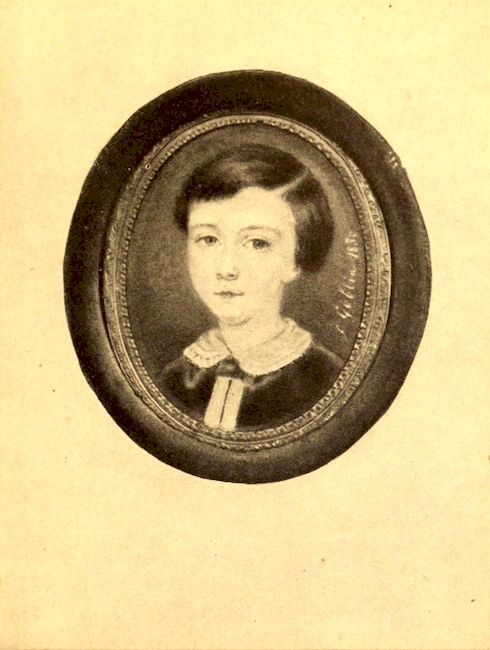
ANATOLE FRANCE
From a miniature Courtesy of Edward Wassermann
The best interpretation of him and his work in English is by Mr. L. P. Shanks, a graceful writer, a penetrating critic. The works of Anatole France have been translated into English by Mr. Lewis May who published Anatole France, the Man and His Work in the year that preceded his death. It is an agreeable introduction to the great novelist, even though it is such a left handed and inadequate one. The chief reason why Mr. May’s contribution to our knowledge and understanding of Anatole France falls short of its aim, is that the writer has not heeded the difference which exists between a biography and a panegyric. It is a custom sanctified by time that the death of a great contemporary figure should be the signal of a truce as it were; foes lay down their arms for a period of time, friends and admirers join in lauding the man who has gone to his reward. No one takes much stock in an obituary dictated by the emotional reaction engendered by death, and no one looks to such writing for constructive criticism, but when a biography is written during the lifetime of the subject—be he as old as Anatole France was when Mr. May published his—there should be less puffing and more illumination, less heat and more light. Mr. May allowed his personal feeling of friendship and his pleasure and pride of semi-intimacy with Anatole France to colour his estimate of the writer. He admires his versatility, his manysidedness, the rapidity with which he changed his point of view. These are no grounds for unqualified admiration. At most they would be occasion for wonder and amazement, but the biographer should point to the danger of such chameleon-like conduct, the weakness of such a nature. He “played all parts in turn and played them all well,” but this very versatility shows a lack of intimate convictions and standards. A philosophy which consists of having none, a religion which insists on the unsatisfactoriness of all belief—these are destructive and bewildering forms of reasoning; but Anatole France combined these traits with qualities and achievements which amply balanced their influence. What we should have liked Mr. May to do, a thing which we are still waiting for a biographer to do, is to have summed up, after consideration, the contradictions, the theories, the principles and the talent of Anatole France, from which we might obtain clear, critical, impartial, sober judgment of the writer. He was more than any other author the Proteus of modern time, an image and symbol of the constant change in man, and, like Proteus, he could undergo a metamorphosis of ideas and judgments which baffled the world at large, and made his personality a puzzle. However, he did not have the reticence that the Greek hero had, nor the loathing for answering questions; and he was so articulate that his evolution is not difficult to master.
Every one agrees with Mr. May that Anatole France was a stylist of talent, a psychologist of merit and a philosopher of profundity and penetration, of smiling scepticism and amused tolerance; but to say that a fairy bent over his cradle and endowed him with some of the “douceur angevine” sung by Du Bellay, and that his voice is “the voice of all humanity” is disregarding the claims of criticism. That is just what Anatole France lacked most of all—the inspiring, soothing, beneficial, unforgettable smile of a fairy over his cradle. Had he had it, Mr. May’s estimation of Anatole France’s poetry, “that it will endure so long as literature continues to interest mankind,” might find a more responsive acceptation.
Anatole France the man was so closely linked with Anatole France the writer that his biographers have been unable to separate them; and for this we should be thankful. From the best pictures that are presented to us, we gather an idea of the master-writer of the past generation that is complete and convincing; his life was devoted to writing; and his writing was always of life, as it appeared to him through intimacy with ancient masters; through study of history; through contemplation of his time; through deduction and observation of humanity. It is difficult to divorce him from his own personality, and the biographers who have succeeded in painting a picture of him that will endure have all recognised this impossibility.
Of the many authors who have attempted to set down some of the most interesting traits and characteristics of Anatole France, and who have done it when their personal recollections were still fresh and undimmed by time, Jean-Jacques Brousson has been the most successful. He lived in close intimacy with the Master for many years; he is himself endowed with critical faculty, with keen powers of observation and, like Anatole France, he has a leaning toward the aspect of life that puritans call the “unspeakable,” but which the French call “gauloiserie.” If Anatole France Himself is not a tribute of respect and of deference Anatole France’s admirers would wish it to be, at least, it does more than any other book has done to convince us of the flesh-and-bone reality of the savant, to destroy the legend that he was heartless. M. Brousson has written a biography in everyday language, he has Boswellised his Master with fidelity, wit and a certain amount of irony and of mockery which Anatole France would probably have enjoyed and lauded. He has made him appear not only in the flesh, but in the spoken word, so that the reader is able to “listen in” and if he has an imagination vivid enough, he may believe that he is living in the shadow of Anatole France. M. Brousson tells of his first days of work at the Villa Saïd, of the tempers and tolerance of his master, of his simplicity and his sarcasm; of his generosity and his avarice; of his method of work and manner of play. The latter has a large place in this biography, especially the only sort of play in which Anatole France in his declining years could indulge: imagination and ratiocination. We see him at times like a sensuous and pleasure-bent faun; then he becomes the ascetic monk, with one hand raised to an imaginary heaven in which the wisdom of time and the wickedness of the world blend; now he is the writer, the historian, the novelist, intent on his self-imposed task and working with industrious and painstaking love. Then he becomes the child, reprimanded by “Madame” because he refuses to tell a story with which she wishes to impress her audience, or because he procrastinates in writing an article for a Viennese newspaper; in turn he is the lover of antiques and the searcher after old “estampes”; then he is the disillusioned art-collector who finds that what his fancy believed to be genuine does not bear the stamp of antiquity, and who overwhelms his secretary with the objects that have ceased to please—generally in payment of his services. We like him best when he is shown to be a real man, with a heart and a nervous system reacting to emotional disturbance. “If you could only read in my soul,” he said to his secretary one day, “you would be terrified.”
“He takes my hands in his, and his are trembling and feverish. He looks me in the eyes. His are full of tears. His face is haggard. He sighs: 'There is not in all the universe a creature more unhappy than I. People think me happy. I have never been happy for one day, not for a single hour.’”
This reminds one of the text that Mark Twain constructed for his autobiography:
“A person’s real life is led in his head, and is known to none but himself. All day long, and every day, the mill of his brain is grinding, and his thoughts, not those other things that are his history. His acts and his words are merely the visible, thin crust of his world with its scattered snow summits and its vacant wastes of water—and they are so trifling a part of his bulk; a mere skin enveloping it. The mass of him is hidden—it and its volcanic fires that toss and boil, and never rest, night nor day.”
Anatole France hid his soul well: his volcano was frequently on the point of eruption, but nearly always he succeeded in smothering it.
Jean-Jacques Brousson has written a valuable exposition of Anatole France’s personality, of the home and the semi-public life of his hero, and his intention to bring him as close and make him as familiar to us as he could is evident in the French title of Anatole France Himself, Anatole France en Pantoufles. This is the way in which we remember him most vividly, with his felt slippers lined with purple, and his multicoloured skull cap.
Another of his admirers is Paul Gsell, who was a frequent and faithful visitor at the morning meetings at the Villa Saïd. Introduction to these famous “audiences” was not difficult to get—the difficulty was to get there a second time if the Master found the visitor a bore or a fool. He could suffer neither, unless they were hidden in the pulchritudinous envelope of an attractive woman—then everything was allowed and overlooked to leave place for admiration and gallantry. Paul Gsell has written Anatole France and His Circle, and his book reads like a court report, or a newspaper interview, withal it is full of the charm of the conversation of Anatole France, and of his unforeseen and original reactions to ideas and beliefs. Among a great many anecdotes and conversations which are interesting and instructive, the episode of Mr. Brown, the Australian “stout, robust man of florid complexion with close-shaven lips and chin,” who wore gold-rimmed spectacles and who showed in his Anglo-Saxon elegance his assiduity to golf and polo, and who came to see Anatole France in search of the mystery ... the secret of literary genius, is one of the most diverting. He may have found what he wanted, but his visit resulted, at all events, in a disclosure of literary geniuses of the past as studied by Anatole France which is remarkable in its scope and in its truth.
Paul Gsell’s book has had imitators and it has given an incentive to assiduous followers of Anatole France to set down for posterity, some of the memorable conversations and discussions at which they were present. The most successful has been Marcel Le Goff, who, in the last ten years of the Master’s life, saw him at his country home near Tours, frequently and with increasing interest and admiration. He has recorded his talks, but fortunately, he could not resist the temptation of allowing us to peep into the intimacy of Anatole France, and into his life at “La Béchellerie.” His tastes, and the trivialities which form part of every life, have been divulged and even though M. Le Goff is one of France’s admirers, he has avoided Mr. Lewis May’s pitfall and has not allowed his personal feeling to blind him absolutely:
“Perhaps M. France has had weaknesses; it would be sad to lay too much stress on them, to reveal them and to find pleasure in their recital. One might better see in him, the illustrious and permanent witness of the beauty of our language and of the genius of our people.”
But the best biography of Anatole France is still the one he wrote himself, under guise of four novels, Le Petit Pierre, Le Livre de Mon Ami, Pierre Nozière and La Vie En Fleur. They reveal the formation of the clever novelist, of the profound thinker, of the cultured critic, of the great stylist. Style was his obsession and perfect expression of thought was his constant care; he reached the heart of his subject as few younger authors have done, and never left it until he had obtained all he could from it; surveying it from one angle, then from another, he saw its shades and meanings, and this explains some of his contradictions. Anatole France, partial as he was as a man, was impartial when he wrote of universally interesting and profoundly significant events.
By his allegiance to the teachings of the past, he deserved to be called the last of the classicists; by his fidelity in maintaining the traditions of novels, he is entitled to be called “romantic”; by his love for the perfect phrase, for purity of form and loftiness of sentiments, he proved himself a true son of the ancient masters; and by his keen appreciation of intelligence, analysis and objectivity, he made a definite place for himself in the modern school. His mind has been influenced by the greatest minds of history and of literature. He adopted their thoughts, and adapted their interpretation of life to his own style, and he had neither scruples nor shyness in copying what had already been said: “When a thing has been said, and well said, have no scruples, take it. Give references? What for? Either your readers know where you have gathered the passage and the reference is useless, or else they do not know it, and you humiliate them by giving it.” That was one tenet of his creed and many have said he lived up to it. He did, indeed, and for that reason posterity is likely to rate him as an interpreter more than as a creator, and to set him below men of real creative genius, such as Ibsen, Dostoievsky, or Chekhov.
We do not need Jean-Jacques Brousson to point out to us France’s principal fault in his literary work. It is evident in all his books. He lacked a formulated plan, and had he had one, he probably would not have pursued it with the energy, determination and single-mindedness that Dostoievsky or Ibsen displayed. It was not his versatility that shortened his reach for the crown of glory, it was his distractibility. He could be diverted from a determination by whim, fancy, sentiment or appeal, and most of all by the bigotries, stupidities, vanities and selfishness of his people. He must hold them up to ridicule, lash them with stinging words, scorch them with scorn and sting them with sarcasm, before he could find peace in his “objets d’art,” satisfaction in his bibelots, and contentment in contemplation of concrete beauty.
The star of Sainte-Beuve in the literary firmament of France shone brilliantly during his lifetime; since his death its luminosity has increased. Indeed, one may say that it has become a sort of sun which lights the literary way with great brilliancy. Much has been written about Sainte-Beuve in the brief half-century since his death—brief because of the tremendous changes which have taken place in his country during that time and which have left relatively little leisure to discuss and estimate the influence and achievement of a contemporary. Moreover, the French are loath to commit themselves by placing a crown of immortality on the brow of their artists, before time and a certain unanimity of public opinion have confirmed the judgment of early admirers. Yet, in the case of Sainte-Beuve it was different. Immediately after his death he became for them the greatest critic of the nineteenth century—possibly the greatest of all ages. It has not been thought premature to attribute to him paternity of the modern school of criticism, represented by Rémy de Gourmont. In the early seventies, Matthew Arnold popularised Sainte-Beuve in England and reverberations of this publicity soon reached this country; but it is doubtful that he has the reputation here, especially among the younger writers, that he deserves.
Until recently the biography by Count d’Haussonville has been our most important document about Sainte-Beuve. It requires a delicate and refined pen to write about Sainte-Beuve and it requires an inborn distinction of mind and a responsiveness of heart such as d’Haussonville possessed to understand and render the aristocracy of Sainte-Beuve’s art—the art of one who was above all an artist, with great intellectual powers at the service of his art, and who, not content with his natural endowments, took endless pains and by prodigious industry acquired vast learning.
And now we have another biography. A cultured and scholarly American has written the most voluminous life of Sainte-Beuve that has appeared in any language. Lewis Freeman Mott has gathered all the information that previous biographers have given; garnered the most minute details, elaborated and interpreted them. He has followed his subject from birth to death, minute by minute, with closest attention. Mr. Mott’s Sainte-Beuve gives an impression of concentrated effort. He has worked close enough to the subject to detect nuances difficult to perceive, not close enough to hear the beating of the heart, and too close to comprehend, in one large inclusive sweep, the atmosphere, the local colour and the surroundings. It is a laboriously conceived study, painstakingly faithful, rigorously integral, but not alluring.
Mr. Mott is one of the few biographers to lay emphasis on Sainte-Beuve’s artistic endowment, but even he has done it more in the letter than in the spirit. We wish that this last biographer had traced Sainte-Beuve’s emotional reactions, instead of setting the finished work before us with no clue to its genesis and fabrication. We know that the French critic had more regard for good taste in literature than for talent; that he was constantly seeking truth, that he frowned on falsification of history and human nature; that he revolted against the unnatural, abhorred abstract language and found delight even in the most fugitive appearance of poetry, but all this we must divine, for Mr. Mott does not prove it. He states the case as it appears to him and is neither partisan nor judicial. He carries impartiality to the point of indifference.
In the days of Sainte-Beuve’s early maturity, literary clans were the fashion in Paris, and the Cénacle of which he was one of the shining lights, together with Alexandre Dumas, Gérard de Nerval, Alfred de Vigny, Alfred de Musset and Victor Hugo, was one of the most fashionable. The young men who met there to discuss their ambitions, to find relaxation and stimulus and to air their views, were “strangely garbed, wearing a 'Merovingian prolixity of hair,’ and were ferociously prepared to eat any stray Academician. They drank healths out of a skull, tore the green coat from the back of Dumas” and showed an effervescence and enthusiasm which has disappeared from the manners of modern writers. But the Cénacle was short lived, and Mr. Mott has skilfully rendered the change of moods in Sainte-Beuve, whose enthusiasm took him along different channels after the crisis of 1830. He soon saw the danger of isolation, and of breaking up into groups; “literature must become broader, more profound, accessible to all. The time of the Cénacle is past; the Romantic reversion to the Middle Ages, the solitary inward revery, the detachment from reality” have been replaced by sentiment for progressive and struggling humanity. Sainte-Beuve then became revolutionary and proletarian, but lost none of his delicate and artistic powers.
Sainte-Beuve had the capacity to shift quickly from one viewpoint to the other, from one belief to another, from one political opinion to its antithesis. This is common enough in men of great emotional make-up, but it seldom goes with the sangfroid, the coolness, the good sense and the clear judgment that he displayed. In him, these sudden turns had their key in his emotions. He was sick at heart, a prey to the passion that first Madame Hugo, then other women inspired in him. In order to distract or benumb himself, he played with every conceivable sort of thought. In all his love affairs, he was ardent and sincere, and entered them without reserve or calculation. Though he sought relief from the passion that possessed him, his emotional disturbance was not allowed to interfere with his intellectual labour.
Mr. Mott should have taken the following quotation from Sainte-Beuve, pondered and meditated it, for within it lies the secret of great biographies:
“I have always been fond of the correspondence of great men, of their conversations, their thoughts, all the details of their character and manners, of their biography in short; and especially when this biography has not already been compiled by another, but may be composed and constructed by oneself. Shutting yourself up for a fortnight with the writing of some dead celebrity, some poet or philosopher, you study him, turn him over and over, and question him at leisure; you make him pose for you; it is almost as though you passed a fortnight in the country making a portrait or a bust of Byron, Scott or Goethe; only you are more at ease with your model and the tête-à-tête at the same time that it requires strict attention, permits much closer familiarity. Soon, an individuality takes the place of the vague, abstract type. The moment the familiar motion, the revealing smile, the vainly hidden crack or wrinkle is seized, at that moment, analysis disappears in creation, the portrait speaks and lives, you have found the man.”
Somehow the reader feels that Mr. Mott did not make Sainte-Beuve pose for him.
It was the man in Sainte-Beuve, not the intellectual, who broke with Victor Hugo and it was the jealousy of a human being, not the superiority of a poet, that made him hate Madame Hugo when his affair with her had lost its allurement. Mr. Mott has laid much stress on that affair, and some may question the taste that guided him in this phase of Sainte-Beuve’s life; but it must be said that Mr. Mott is firm in his belief that there was more imagination, sentiment and words in the romance of the two lovers than reality. He believes that their love was based on a spiritual understanding, and one is inclined to agree with him after reading his remarks on Sainte-Beuve’s inflamed state of mind, after becoming familiar with the behaviour of the characters in his only novel, Volupté, and after learning of the health of Madame Hugo. Mr. Mott contrasts skilfully the sort of affair in which Victor Hugo plunged with robustious frankness, with that of Sainte-Beuve and Madame Hugo, it makes the latter appear like the pretty frolics of adolescence.
Sainte-Beuve had a genuine flair for literature. He justified La Bruyère’s dictum: “the test of a man’s critical power is his judgment of contemporaries.” Les Lundis, his greatest contribution to critical literature, shows rare discernment in picking literary winners. He was one of the first to express doubts regarding the permanency of Chateaubriand’s works, and this despite the affection he had for him, and his prominent place in the literature of the day. Mr. Mott’s account of Sainte-Beuve’s position in the salon of Madame Récamier, the guardian angel of the great men of her time, shows the biographer at his best. His description of the “salon” and of the charm of Madame Récamier are a fine bit of writing. Sainte-Beuve did not remain long under her influence. About the time he forsook social intercourse with her, he abandoned poetry and turned to criticism. The poet in him was perpetually in conflict with the critic, sentimentality trying to overcome reason. His heart was continually haunted by visions of romantic situations—but prose was a medium in which he was particularly happy, and to prose he remained faithful—prose and interpretation.
Occasionally, Mr. Mott rewards his readers for attention to arid pages of bibliography by giving them a piece of characterisation which is all the more welcome because of its rarity. Some critics, even Sainte-Beuve himself, have given the impression that he was devoid of merriment and of gaiety, but Mr. Mott has found traces of joyousness. “This gaiety is a note, unobtrusive though it be, that should not be omitted if we are to appreciate the full harmony of Sainte-Beuve’s character. In spite of Volupté and certain poems, he was a normal human being, with plenty of faults and weaknesses, it is true, but sincere with himself and others, remarkably endowed, universally interested and indefatigably laborious.” This is as near as Mr. Mott ever comes to letting us see behind the mask of the intellectual into the make-up of the man. But the biographer makes up for his lack of allurement with his profound and clear knowledge and understanding of Port-Royal, and some of his pages on it are not only the best in the book, but of the quality that makes literature.
Sainte-Beuve’s Port-Royal is his most permanent contribution to literature, Les Lundis excepted. The summary Mr. Mott makes of the book might apply to his own Sainte-Beuve:
“We would not convey the impression that the book is especially entertaining ... to sit down and labour consecutively through the present volumes is somewhat of a task. We appreciate and we admire, but we not infrequently look ahead to discover how many more pages the chapter contains. An unregenerate appetite might be satisfied with a smaller quantity of this very plain spiritual nutriment.”
We appreciate Mr. Mott’s remarkable labour also; and we admire his mastery of the subject, but appreciation and admiration are not synonymous with entertainment.
Mr. Mott creates a relationship between Sainte-Beuve and La Rochefoucauld, and in the examples he has chosen to illustrate this similarity of their views, he has been successful. The former had a gift for imitation and he often took on the mentality of those he admired, so that many of their thoughts can be paralleled in their work. The same comparison might be made between Mr. Mott and his subject. He, like Sainte-Beuve, supplies his books copiously with summaries and with indications of location.
“Not infrequently, a chapter may open or close with a paragraph, much in the manner of Macaulay, telling us what the author is about to do, but rarely does Sainte-Beuve persist, like Macaulay, in a consecutive fulfilment of his prospectus. The side paths are too alluring for his truant disposition.”
It is not a truant disposition that prompts Mr. Mott to follow the side paths, it is a laudable desire of going to the heart of his subject and presenting it as a whole, but the result is the same. Indeed, it may be said that the summary of the chapters in Sainte-Beuve is one of its greatest attractions, for it states in a few words the main points which the chapter never fails to develop.
Sainte-Beuve made enemies, but he did not fear them. His attacks on Balzac especially brought a suit for damages to the magazine in which he published his wrath, but the suit was mocked in an article which he undoubtedly wrote and which concluded: “He (Balzac) will find that we never in the least dreamed of contesting the intrepidity of his bad taste.” Had Sainte-Beuve lived in this age, he would have the same grounds for indignation; for “systems of inward degeneration—emulation, self-esteem, charlatanism, log-rolling, intimidation, avidity for popularity and gold” still exist.
Artistic preoccupation was one of Sainte-Beuve’s distinguishing characteristics. He joined art to literary criticism, giving his portraits creative value, and he does not renounce art when he speaks the truth. He believed in Chateaubriand and Lamennais, yet he told the truth about them, for believing with him was merely a way of understanding. And he insisted that literary criticism should never become static and dogmatic, but like art must remain dynamic and plastic. All this, Mr. Mott has explained clearly. And by so doing, he has written a book which will serve as a vade mecum to all students of Sainte-Beuve. It may not interest the general public for it lacks the divine spark which changes bread into manna, coal into diamonds. The picture he paints of Sainte-Beuve does not make those unacquainted with his writings want to read them; those who know and love Sainte-Beuve, know him and love him for the qualities which Mr. Mott’s book has revealed.
Dr. Kaun, Professor of Slavic languages at the University of California, put the American reading public under obligations when he wrote Andreyev’s biography. It is the best I have encountered since Mr. Janko Lavrin’s psycho-critical study of Ibsen, and as it is more kindly, sympathetic and tolerant than that important contribution, it is pleasanter to read and quite as illuminating.
Next to Maxim Gorky, Leonid Andreyev is more widely known in this country than any recent Russian writer. Many of his novels, sketches and plays have been translated and some, such as The Seven That Were Hanged, Satan’s Diary, The Little Angel, Samson in Chains, and various plays, have been extensively read.
The question has often been asked: “What kind of author was this soul-analyst, this student of the brute in man, this writer who caused more discord in the camp of Russian criticism than any of his fellows?” Mr. Kaun’s book not only provides the answer but gives a glimpse of literary tendencies in the Russia of yesterday which is as welcome as it is instructive.
Leonid Andreyev was forty-eight years old when he died in 1919; although he began literary work soon after his admission to the bar in 1897, it was not until the publication of Once There Lived in 1901 that the critics had intimation that a new force had appeared in Russian literature. In the next fifteen years he won a place in the literary hierarchy of his country, which since his death has become more secure. When the history of Russia in the generation from 1895 to 1920 comes to be dispassionately and judicially written the name and influences of Leonid Andreyev will frequently be mentioned.
The Slav is an enigma to most Americans and the more we learn of Andreyev the less soluble seems the riddle. He was of the manic-depressive temperament; at least three times in his life he attempted suicide; he was addicted to strong drink; he had the naïveté and egotism of a child; he was mulishly obstinate. Maxim Gorky, who was one of the first to recognise his ability, who counselled and befriended him, has recently written: “Strangely, and to his own torment, Leonid split in two; in one and the same week he could sing hosanna to the world and pronounce anathema against it.” In this respect he resembled another writer of manic-depressive temperament, Giovanni Papini.
This lack of co-ordination in Andreyev’s moods is continually shown by Dr. Kaun, who follows him through all the periods of his life. His childhood was gloomy, filled with serious thoughts and arid reading. At times he put aside all his interests in literature and became a “rough boy.” He displayed a remarkable gift for the stage and an early inclination to draw and to paint. The death of his father, which occurred when Leonid was very young, gave him a taste of poverty, privation and humility and made him realise that his future was what he alone would make it. Soon after graduation he became a court reporter and then an editorial writer. Mr. Kaun devotes an instructive and interesting chapter to this plastic period, during which he displayed few indications of possessing constructive ability.
The transformation that Russia witnessed during the years of Andreyev’s adolescence and early maturity must of necessity have influenced a mind such as his. He saw aristocracy fail to convince itself that slavery was legitimate; he saw the slow but constant development of a sentiment of democracy which soon extended to all branches of society and turned all eyes and sympathies to the peasantry.
They became the idols of the day in Russia; literature was concentrated around their activities and that new discovery, their souls. The Intelligentsia, to which Andreyev belonged, recognised and praised their long disdained brothers. In his introduction Dr. Kaun has expressed all this in clear and simple language; he has shown the tendencies of Russian literature with such authority and coolness that what seemed an abyss of darkness passing understanding becomes at once easy to penetrate. Some of his definitions dismiss the cloud of vagueness that before surrounded the object. “The term Intelligentsia may be applied to the unorganised group of Russian men and women who, regardless of their social or economic status, have been united in a common striving for the betterment of material and spiritual conditions.”
When Russian literature became as it were “single tracked,” when all its interests turned abruptly to the “street” (save for the exception of a few writers who refused to give up “art for art’s sake” and take up the defence of any one class of society), the danger was that Russian literature would become “a didactic sermon.” But Dr. Kaun hastens to reassure us that “What saved it ... was the genius of its creators, who remained artists under all circumstances.”
There was need, however, for a man who would not allow his passions to rule his emotions, whose voice could be heard and heeded above the popular outbursts, who would attempt a search into the motives and the value of life, and Leonid Andreyev was the man, the voice and the writer.
From his earliest childhood he had been obsessed by interrogations about life and he expressed them constantly in his writings; he seldom attempted an answer or a solution to the problems that pressed upon his mind, and when he did it, it was ambiguous. Dr. Kaun points out that Andreyev’s failure to define or to classify was due to his lack of philosophical theory and to his incapacity for detaching himself and viewing life in perspective; he dwelled in the reality, and disdained philosophy and theories. He was neither a student nor a reader. He would have his friends believe that he had been influenced by Schopenhauer and there is no doubt that he showed envy of Nietzsche, affection for Tolstoi and admiration for Gorky; but it is doubtful that he read them, save casually.
One appealing quality in Dr. Kaun as a critic is his unbiased opinion; he allows neither his admiration for the author nor his sympathy for the man to influence his judgment. He seeks no excuse for Andreyev’s lack of humour and lightness or for his egotism. He states his defects, and finds a reason for his admitted eminence among modern authors in his realism, which makes him address the public not as a teacher or a reformer but as an observer from the rank and file, who related what he saw and did not draw conclusions. He was neither propagandist nor missionary.
Andreyev’s aim was to describe man as he was, with all the repulsive instincts that make him a beast and all the qualities that identify him with divinity; but it was the worse side of human nature that chiefly appealed to him, and that he described at length. If we agree with Samuel Butler that “virtue has never yet been adequately represented by any who have had any claim to be considered virtuous,” and that “it is the subvicious who best understand virtue. Let the virtuous people stick to describing vice—which they can do well enough,” we must consider Leonid Andreyev the personification of virtue.
He stood aloof from literary circles, parties or affiliations all his life. Not even the revolution of 1905, which brought a split in the ranks of the intelligentsia, changed him; he retained his impersonal attitude, probing the conscience of man, “ringing his alarm bell” of man’s vices, analysing life, and attempting to explain only its illusions. He continually peered beneath the surface and questioned the reactions of mankind, discovering vices where virtue seemed to lie. He was a firm believer in the power of ideas over the actions of an individual, and he has shown in Thought how one unaccountable impulse will ruin the career of a man.
Andreyev was non-conformist to the last degree. He refused consistently to give way to the public’s tastes and held that sincerity was the first quality that one should find in an author. His sincerity was not to the taste of his readers. Andreyev neither approved of the “splendid isolation” of the Russian symbolists, decadents or other definite schools who refused to see beyond the limit of their ivory towers, nor did he join hands with the people. He confined his observations to their individual and immediate surroundings. But he also generalised events and expressed opinions that included the world in connection with an event that merely affected his country or his people. He extracted the essence of upheavals and carried them beyond his time. His passionate and ardent pen could describe horrors and cruelty better than the pen of any author of his time.
The thing that strikes one most forcibly in reading of Andreyev is the very brief period of his creative activity, fifteen years at the most. After 1902 his writings were merely repetitions or elaborations of former themes and his premise was always the same; a negative attitude toward man, life, human intellect and institutions. He involuted early, and the proof of it in his writing was that he no longer looked in the direction of hope and encouragement. He was like a man who hurries on an unfamiliar road hoping that he will arrive at a safe and comfortable stopping place before the darkness which is fast approaching enshrouds him. He became aware that his thinking faculties that once were brilliant had lost their flexibility: “I feel as though I were in a grave up to my waist.” “I am thinking of suicide, or is suicide thinking of me?” “I am living in a jolly little house with its windows opening on a graveyard”—these are entries in his diary that indicate his increasing melancholy. But this was not his only cross; he lacked money for the basic need of life. He was on the point of coming to this country “to combat the Bolsheviki, to tell the truth about them with all the power within him and to awaken in America a feeling of friendship and sympathy for that portion of the Russian people which is heroically struggling for the rejuvenation of Russia,” when he died of arteriosclerosis, as his friend, admirer and interpreter, Mr. Herman Bernstein, wrote in a letter to the New York Times.
A worthy biography of a great writer; it has the fascination of fiction and the satisfaction of fact.
Contrast of Ford Madox Ford’s book on Joseph Conrad with Henry Festing Jones’ book on Samuel Butler will show the difference between inspired and studious writing. One is life, the other is death; one is clay into which the breath of life has been breathed, tenuous, elastic, receptive, emissive; the other is inanimate, inert, rigid, and crumbles when you handle it.
Mr. Ford has megalomania and glories in it. He has systematised delusions of grandeur to which his conduct conforms. He believes he is, and has been in his generation, the finest stylist in the English language and he expresses himself as if convinced that not only did he teach Joseph Conrad to write, but that the renown of the romancer was due in large measure to his collaboration. They are harmless delusions and do not interfere one jot or tittle with my enjoyment of his books. Indeed, as he grows older and fatter he writes better and better. Few contemporary English writers could excel Some Do Not ..., none save possibly Cunninghame Graham could equal Joseph Conrad: A Personal Remembrance. I am moved to that statement after reading Mr. Galsworthy’s tribute.
The Joseph Conrad that Mr. Ford presents may not be the Conrad that Mr. Galsworthy, Mr. Doubleday, Mrs. Jones, or Mrs. Smith knew, but I am convinced that he would be pleased that I should know him as his alleged friend depicts him.
“A biography should be a novel.” That seems fair, since most novels are biographies. Mr. Ford has written a novel about Joseph Conrad and he has achieved a work of art. It will have the same effect upon readers as Rodin’s sculptures have upon searchers for æsthetic stimulation or appeasement. Some will be moved to smash, others will be thrilled. All will admit merit. It is an informative, not a documented, book, informative of a soul, not a body; it tells not how many days he lived and where he lived, but how he lived and thought; how he dreamed and loved; how he interpreted men’s conduct and how he shaped his own. The work is a remembrance, a logical unfolding of Joseph Conrad as he appeared to Mr. Ford from the first days of their acquaintance to the last. We are told little about Conrad’s political, religious, and social ideas. Mr. Ford was no more curious to know what his friend’s past was than we are to know that an English dramatist made a shapeless play out of one of Mr. Ford’s novels. Yet the latter episode becomes important when we learn that this, and Mr. Ford’s interest in the publication of a review, were the cause of the only “scolding” he ever got from Conrad. Forbearing and forgiving Conrad, diffident and reticent Mr. Ford!
The life of a man is an open book for no one, not even for himself. The characteristics and peculiarities of Conrad intrigued his biographer from the beginning. He binds them with tenuous threads to Conrad’s hereditary traits and the influence of his environment, and finally presents the picture complete, allowing his readers to draw their own conclusions.
Joseph Conrad, according to the portrait, was not the sort of man about whom a conclusion could be readily reached; and when it was, you could not bank on it. He was of cosmopolitan appearance: considerable British insularity, but more Slav and Eastern in his make-up. He gave the impression of a Frenchman, born and brought up in Marseilles! His hatreds seem to have exceeded his loves, but his life was a contradiction of his tastes and he has more friends than enemies. Mr. Ford avows that Conrad hated the sea and disliked to write. “Un métier de chien,” he used to call it. When he had made up his mind to write for a living, he had his choice of three languages: he discarded Polish instantly, French with a sigh of regret which he never overcame, and decided on English. And he hated English as a medium of prose, even more than he hated the sea! He thought in French, sometimes in Polish, never in English, unless his thoughts were confined to the most common of everyday commonplaces; when they occupied a higher sphere they were always in French. It was because of the difficulty with which Conrad was constantly confronted that he first thought of collaborating with one who was reputed to be “the finest stylist in the English language.”
Mr. Ford does not marvel at Conrad’s desire to write in English, despite the fact that he knew French so much better. Ford himself writes French better than he does English, not that he knows it better—he does not—but because “in English, he can go gaily on, exulting in his absolute command of the tongue; he can write like Ruskin or like the late Charles Garvice, at will.” In writing, but not in speaking French, he must pause for a word; it is in pausing for a word that the salvation of all writers lies. The proof of prose is in the percentage of right words—not the precious word; not even the startlingly real word. That we might have a whole book on Mr. Ford without a word about any one else!
Mr. Ford bears heavily on their collaboration, and one unfamiliar with the writings of the two authors might gather that Mr. Ford was the fons et origo of much of Conrad’s work. I have no doubt that Conrad put an appreciative valuation on Mr. Ford’s assistance, but I have the same certainty that he did not evaluate it as did his biographer.
Some will think that Mr. Ford has lately had a bad quarter of an hour reading a recent number of La Nouvelle Revue Française which is devoted wholly to Conrad. There, his colleagues and admirers, French and English, tell of Conrad’s personality and his writings but never a word of his “collaborator.” Water enters a duck’s back a thousand times more penetratingly than failure to accord him what he believes to be his right penetrates the dura mater of Mr. Ford Madox Ford.
Stephen Crane said, “You must not be offended by Hueffer’s manner. He patronises Mr. James, he patronises Mr. Conrad. Of course, he patronises me, and he will patronise Almighty God when they meet, but God will get used to it, for Hueffer is all right.” We are ready to agree with Stephen Crane even after we read as an antithesis that the words in which Henry James always referred to Mr. Ford were “votre ami, le jeune homme modeste.”
Conrad’s life revolved around his books, he was constantly occupied with the best manner in which to introduce a character of fiction. It was necessary to get the character in with a strong impression, and then work backward and forward over his past; this theory was the result of thought and experiment on the part of the collaborators. In the same manner, they devised the best opening for each type of writing; their theory was that the opening paragraph of book or story should be of the tempo of the whole performance, so that the ideal novel should begin either with a dramatic scene or with a note that should suggest the entire book. They agreed that style has no other use than to make the work interesting. Hence, they sought to render their thought in the manner which appeared the most sincere and interesting, not to make a display of erudition or of cleverness, or of juggling with words.
Mr. Ford’s book is adorned with flights into the land of constructive writing, and there is much to learn from the theories and principles expressed on the authority of both Joseph Conrad and Mr. Ford. For, there is no denying that the latter’s style is fluent and clear, picturesque enough to be original yet kept constantly within the bounds of pure English. Mr. Ford says that their greatest admiration for a stylist in any language was given to W. H. Hudson, of whom Conrad said that his writing was like the grass that the good God made to grow—when it was there, one could not tell how it came. The consensus of opinion however would seem to be that Conrad got his greatest inspiration from Turgenev.
Conrad’s philosophy was résuméd in one word, “fidelity.” He was faithful in his adhesion to Herrick’s maxim: To live merrily and trust to good letters. He never believed in using novels as a medium of preaching; if his standards of morality suffered from some of his heroes’ breaches, he would create one who would express the opinions Conrad might have been willing to express himself. Thus did Conrad expound his beliefs anonymously, and because he was a gentleman he always created another hero who would refute the preacher’s arguments. His belief was that one of the most important qualities for a novelist to cultivate was humility, to make himself as little conspicuous as possible to the reader.
Mr. Ford has a heart. Unlike his mind, it is assiduously concealed, but it pierces through the coarse envelope of the purely intellectual interest to which he attempts to confine his biography of Joseph Conrad. None of his memoir may be true, but that does not detract from it as a work of art. He shows no trace of real emotion, and his remembrances carry with them no suggestion of the broken heart which some authors would have assumed had they been writing on the same subject with the material Mr. Ford had at his disposal. His book, whether biography or autobiography, is a beautiful tribute to the man he liked and the author he loved. He says that there never was a word of spoken affection between them, never a personal note which would have revealed to either the inner sentiment the other entertained for his collaborator and playmate. But if Mr. Ford will never know what were Conrad’s feelings for him, readers of the biography will know that Mr. Ford’s book found its first inspiration in his heart, and, shaped by his affection, found expression in his intelligence. The duty which prompted him to write it was one of love, and the real sentiment, never expressed in words, is constantly watching over the author’s shoulder.
My disappointment in Mr. Ford’s book is the treatment of Conrad’s art. Conrad had a form of realism that was nearly unique, blended with an impressionism that was at once captivating and awesome. Colours, sounds, voices, visions, atmospheres, are manipulated to make a harmony and an effectiveness that are sometimes overwhelming, always stirring. He accomplished realism through impressionism, and in this he was as nearly original as one can be in literature. Then he had another great merit; he did not draw conclusions about his characters. He submitted the evidence without plea or prejudice, the reader renders the verdict. He saw life as it is, and man as he wishes to be, and he took them both in at a glance, just as Marlow did in Chance. He registered them and in his hectic leisure reproduced them, and thus made posterity his debtor. And Fidus Ford has made us his debtors for showing Conrad as he appeared to him. I have no doubt he was quite a different Conrad to Stephen Crane, John Galsworthy, Mr. Doubleday, and Mrs. Conrad, but not more lovable and not more worthy of the admiration the whole literary world gives him to-day.
Mr. Hugh l’Anson Fausset, whose English reads like translation from the French and who handles polysyllabic words as a juggler handles gilded balls, has made a study of the seventeenth century’s poet and divine, that is sure to be widely read by the cultured public and to provoke discussion and dissension. He calls his book A Study in Discord and it purports to depict the conflict that went on in Donne, throughout his whole life, between the physical and the spiritual impulses of his nature. Mr. Fausset’s thesis is that neither as poet nor preacher did Donne succeed in resolving these discords. He enjoyed neither physical nor spiritual harmony but was torn in strife between his intelligence and his impulses. The Christian ideal acted as a poison on the natural man in process of proving a purge. Self-consciousness was the only discipline by which his egoism might learn the wisdom of selfishness. The tale of that battle was Donne’s legacy to literature.
“His style, whether as poet or preacher, never achieved either the fresh effusive gaiety, or the assured serenity of absolute Beauty. He could not create beauty out of life; he could not even see the beauty in which the limbs of life were veiled which flamed through and over the bleak anatomy of fact, consecrating the perishable dust and redeeming it of squalor and grossness.”
It is the verdict of a judge, not of a jury and Mr. Fausset can not expect that the world of letters will receive it without protest. But he cites with skill and adroitness the evidence on which it is based, holding Donne up in the successive phases of Pagan, Pensioner and Preacher. Were he more advocate than judge he might have added Penitent, for the sake of both alliteration and fuller justice, for the death of the poetic dean was artistic to a high degree and in the last months of his life after he had preached his last sermon, “Unto the Lord belong the issues of Death,” he achieved an absolute harmony of his life in the ebb-tide. The strings of his character then vibrated with small amplitude in unison.
Donne may be a study in discord, but there is nothing of discord in the writing of Fausset. He uses Donne as a peg on which to hang his concrete thought, and his organised ideas of nature, philosophy and religion. While it is a biography it is also a series of essays in which the vagaries, character and personal appearance of his subject are used to point the moral and adorn the tale. It is never left to the reader to form his own opinion of Donne, his life or his acts; for Fausset blares facts about the motive and the soul and his trumpet gives forth no uncertain sound. Even when Donne in a verse letter to a friend states, “and with vain outward things be no more moved,” Fausset immediately states “yet excessive solitude can so affect a character like Donne’s that only a restoration of 'vain outward things’ can save it from myopia or even madness.”
It required courage to write the life of a man who furnished the material for a masterpiece of English biography. Izaak Walton’s affection for his friend transported him to immoderate commendation of the events of his career, but Mr. Gosse’s Life and Letters of John Donne is just and true. It will immortalise the personality of the poet, just as his somatic features will be perpetuated by the picture in a shroud he so studiously had made.
Fausset can not credit the picture of Donne given by the “gentle Walton” for the reason that Walton wrote on Donne in the spirit of love and admiration. Fausset writes of him neither with love nor hate, but with the scalpel always in hand, dissecting, getting beneath the surface. He is not the tender physician, he is the scientist at work in the laboratory of research with Donne as the cadaver. There is a charm, a beauty, and at times a poetic fervour of expression in the writing which reminds one of the Essay on Shelley by Francis Thompson. One can not help feeling that Donne was doomed from the first if we believe the picture painted of him with unerring hand by Fausset.
But Mr. Fausset is a student and exponent of personality and it is as such that we should estimate his work. Judged by the two studies that he has published: the one under consideration and Keats; A Study in Development, he has insight, sound psychology and a logical mind. With years he will grow more kindly and less turbulent. Meanwhile he shall have the benefit of our prayers that the happy day may hasten.
As Mr. Fausset sees him, John Donne was physically a genius; intellectually “possessed”; one who ranged almost every scale of experience, and upon each struck some note: harsh, cunning, arrogant or poignant, which reverberates down the roof of time; a poet who was at times near a monster, full-blooded, cynical and gross; a thinker, curious, ingenious and mathematical; a seer brooding morbidly over the dark flux of things; a saint aspiring to the celestial harmony. He served the flesh with the same ardour with which he sought the ideal. He was a sensualist and a thinker, a poet and a priest, a pagan and a Christian. More than any contemporary he reflected the three aspects of life which met in confused association in seventeenth century England: Mediævalism, the Renaissance and the Reformation. The physical, intellectual and spiritual elements each in turn dominated his personality. The purpose of his life was to bring this trinity of forces into harmony and by so doing discover a new and deeper unity in the Universe itself. It is Mr. Fausset’s belief that he did not succeed in this purpose but the tortured history of such a genius lays bare the potentialities of humanity and of civilisation. His life was one long battle with death: the death of physical grossness and mental conceit, of worldly ambition and spiritual complacence. He had explored the secret of the senses and the subtleties of the mind. And so, psychologist and sensualist as he was, he was competent in the later days of his spirituality to report adequately of the soul. He related poetry to religion, and religion to truth, and he showed us how to relate ourselves to God. His life teaches us that spiritual satisfaction is unworthy of the name, if it be achieved at the sacrifice of intellectual honesty and that religious experience is the prize of perpetual conflict. Such is the man that Mr. Fausset has composited from the creations of Walton, Gosse, Chambers and Grierson.
John Donne was born in London in 1573 and died there in 1631. His life was a stormy one, tempestuous in youth, squally in maturity, blusterous in old age. Calm overtook him but a few weeks before his death. He was a neurotic individual and his neural disequilibrium is testified by his portraits and by his conduct. A portrait of him made at the age of nineteen shows a brow slightly receding and narrowing at the temples, prominent eyes, gigantic nose coarsely flattened at the base, thick lips and pointed chin. His resistance to emotional influences was defective and he reacted strongly to inner as well as to outer influences. From boyhood there was lack of equanimity in the development of the psychic personality although his intellect made him always a conspicuous figure and he “pursued mathematics, law or theology with the same tenacious passion as an ephemeral liaison.” He was combative, satirical, arrogant, Sybaritic, Dionysiac. The sap did not ascend his tree of life gently or harmoniously; it gushed upward, often geyser-like, drenching conventions and submerging morality. He insisted upon licence to do as he pleased and clamoured for freedom and promiscuity, especially in love.
“Who ever loves, if he do not propose The right true end of love, he’s one that goes To sea for nothing but to make him sick.”
He, like St. Paul, believed that woman is the glory of the man and was created for him, and he had a contempt for women’s vaunted constancy.
“Foxes, and goats—all beasts—change when they please. Shall woman, more hot, wily, wild than these, Be bound to one man...?”
But he was soon to encounter one who was not polyandrous. Anne Moore, in a period of sixteen years, bore him twelve children. He was about thirty years old when he married her. The literary fecundity of his third decade is represented by Songs and Sonnets and Elegies. Mr. Fausset is probably correct in his claim that the poetry of Donne’s early maturity was, like Goethe’s, a reflection and refraction of his loves. Donne’s contention was that sex neither can be nor should be transcended and the Elegies are his earnest of it.
But his moral nature was awakening even before he met Anne and he began to question:
“Why should our clay Over our spirits so much sway To tie us to that way?”
And he denied that he had formerly protested
“Change is the nursery Of music, joy, life and eternity.”
The manner in which he broke with the nameless lady whose husband was a deformed man and was stationary all day in a basket-chair, affords Mr. Fausset an opportunity to discharge some verbal pyrotechnics, and to disgorge some righteous wrath. “So, at last, he turned upon the poor woman, whom so short a time before he had bent to his purpose with a militant ardour and a shameless licence. The cold and cruel cynicism, the elemental spite of his last farewell to one who must at least have given as much as she received, has no parallel in our literature. In truth, no one is so ruthlessly vindictive, so callous to every claim of sentiment and generosity as the moralist new risen from the ashes of the brute.” He then quotes “The Apparition” in which Donne taunts her as “feign’d vestal” and threatens one day to square accounts with her. It was not a pretty letter but Mr. Fausset is likely a very chivalric man and “brute” is scarcely justified.
Donne married in haste but never repented, probably because Anne never questioned her husband or tried to improve him.
The first years of their married life were lean. Parental blessing was slow in coming, and slower still was paternal allowance. But they both came and soon after conversion. “Anne Moore served as the bridge which Donne, at least as the lover, climbed from the abyss to the cheerful daylight and even to a homely eminence.” As the fruit of his passion for his mistresses had been disgusted cynicism, that of his devotion to his wife was ecstatic platonism, which now became reflected in his poetry.
Mr. Fausset takes us through the fourth decade of his life, documenting the transformation that took place in his soul from cynicism to platonism, from realist to mystic, from Catholicism to Protestantism, by quotations from his poetry, by pen pictures of his friends, particularly Mrs. Herbert who was “an idyllic retreat of sanity and piety and sympathy in a sultry world” and by descriptions of his reactions to illness, “illness the sword of God.” His religious conversion was the important thing and these are the words that Mr. Fausset uses to describe its onset:
“The young Dionysus, who had broken from the restraints of Rome, seeking his way back to some primal ecstasy, which conventions seemed at best to adulterate, was now attempting to translate his ecstasy into ideas. He had turned at first to those tortured saints of the Dark Ages in whom sensuality and science melted into mysticism, and then to the pure but tenuous conceptions of Plato. But not for him were those enchanted bridals of the soul with God, of the mind with Beauty, in which the body passed away in flame or in smoke. There was too much of the satyr in his seership, and of the casuist in his mysticism. His branches might strain up heavenward but they never forgot their native earth. His only hope was to subdue his lawlessness to logic, until the two, blended together in a rational whole, achieved an equilibrium between mind and body as he had already discovered for his passions.”
Rome suffocated him and Protestantism seemed a pallid, political compromise, but thanks to frequent prayers, to use his own words, he effected the transition. Donne succeeded in generating the spiritual from the struggle of the rational with the natural, and by so doing Mr. Fausset believes he waged a battle of human consciousness two hundred years in advance of his time.
The turn of the tide in Donne’s worldly affairs dated from 1610 when he wrote a poem, “The Funeral Elegy,” commemorative of the charms and potentialities of a girl whose death had resulted from a box on the ear administered by her adoring father. It was a shot in the dark on the part of Dr. Donne but he “got” his man. Sir Robert Drury provided him a home for three years, then took him abroad. These were years of spiritual growth, emotional equilibrium and physical exhilaration. Soon after his return he took Holy Orders and after much manœuvring, King James, before whom he preached his first sermon, capitulated. His worldly fortunes were assured. It now only remained to make his heavenly ones.
Mr. Fausset indulges in one of his frequent rhetorical rhapsodies in describing Donne’s first appearance under the stole:
“The figure who mounted the pulpit in these early days of his ministry was not the spectral divine, the emaciated, almost sardonic mystic, who was later to hypnotise his audience by the reverberations of his eloquence, the intensities of his imagination, and the sepulchral tones of his voice. He was a man, despite the ravages of ill-health, still in his prime, his beard indeed touched with grey, but his face and carriage retaining that air of buccaneering insolence, almost of dignified roguery, which we have remarked in the young man. Arrayed in vestments and uplifted by the sense of an august occasion, his appearance must have been singularly striking, suggesting indeed some challenging John the Baptist or one of Dürer’s swarthy evangelists. At the same time he did not forget the courtier in the priest. There was a 'sacred flattery’ in his address, which if it 'beguiled men to amend,’ also gratified their vanity. His learning was beyond dispute, but the crabbed style of his correspondence, no less than the angular conceits of his poetry, could scarcely have prepared his friends for the miracle of eloquence which he was speedily to achieve, pungent, rhythmical, varied, and, even in its passages of scholastic argument, strangely sinuous and compelling.”
It is Donne’s spiritual life that his latest biographer finds worthy of unstinted praise, and it is perhaps for that reason that Part Four of his book entitled The Preacher will be found least interesting by the general reader.
Although his friend Izaak Walton wrote: “Donne’s marriage was the remarkable error of his life,” it is difficult to believe him. Anne put out the fire of his concupiscence though it cost her her life, and from its ashes his soul arose. After her death, he withdrew from the world and “in this retiredness,” Walton writes, “which was often from the sight of his dearest friends, he became crucified to the world and all those vanities, those imaginary pleasures that are daily acted on that ruthless stage; and they were as perfectly crucified to him. Now his soul was elemented of nothing but sadness; now grief took so full possession of his heart as to leave no place for joy; if it did, it was a joy to be alone, where, like a pelican in the wilderness, he might bemoan himself without witness or restraint, and pour forth his passions like Job in the days of his affliction.” It was through an agony of remorse that Donne strove for harmony of body and mind. He preached to others to express and reassure himself. Mr. Fausset believes that his exhortation “was not the flower of any abstract love of humanity,” but of intense personal preoccupation.
Preaching did not provide an adequate vent for his emotions so again he turned to poetry which, in keeping with his spiritual integration, he now cast in sonnet form. In these sonnets, Donne was primarily absorbed in asserting his emancipation from worldly values, and lamenting past sin. Mr. Fausset sees him “wooing his God with both the fervour and the self-disgust with which he had before addressed his mistresses”; even the erotic imagery recurs. His religion had become a personal passion and a personal hazard to which theology was no more than a prop. Of the many judgments his interpreter has passed upon him, this is the fairest.
Serious illness thrust itself upon him soon after his promotion to the deanship of St. Paul’s. Even in those days, before “nervous breakdown” was fashionable and a euphemism for episodic mental disorder, it was attributed to overwork and emotional tension, two very rare causes of disease. But he began to be seriously ill, ill of the disease that twelve years later conditioned his death. Before Mr. Gosse published his biography of Donne, he submitted the facts of his illnesses to a London diagnostician who satisfied himself that it was malignant disease of the stomach. But in 1899 when that diagnosis was made, we knew practically nothing about the most insidious, and the most prevalent form of chronic sepsis: that which has its origin in the tonsils and teeth. With the temerity of one whose statement can not be disproven, I boldly assert that, had his tonsils been removed after the alleged attack of typhoid fever and his teeth X-rayed when he felt himself at forty-five lapsing into an infirm and valetudinarian state, he would have lived out the time allotted by the psalmist. Had he been vouchsafed these natural years of piety and preparation, he would have accomplished that synthesis of the physical and spiritual which Mr. Fausset denies him, and the world would not have had The Devotions in which Donne incorporated the features and fears of his illness. England waited three hundred years for some one to parallel his performance of clinical self-observation and then found it in the young man who under the pen name of W. N. P. Barbellion wrote a book as self-revelatory as the Confessions of Saint Augustine.
Donne came to many fertile oases in his travel through the desert of sin, to many pools of Bethesda in wading the rivers of disease. The Herbert family was the most refreshing and restoring. In George Herbert, fifteen years his junior, he saw what he would like to have been; and in Herbert’s mother, he saw his ideal of spiritual womanhood. “The Autumnal,” his poem of homage to Magdalen Herbert, embodies his idea of the platonism of the soul as distinct from that of the mind. Through it, there breathes, as Mr. Fausset says, a quiet, tender as the evening sky before it has begun to pale with premonition of night.
Donne devoted the last five years of his life to dying, and he did it with the same intensity and artistry as that with which he devoted the first five years of his maturity to living. He interpreted himself the seventeenth-century representative of him that was spoken of by the prophet Esaias and bent himself to the last atom of his strength to make straight the Lord’s paths. It is a stirring and touching narrative and Mr. Fausset has made the most of it; reading it, one is forced to agree that he has established his contention that Donne never achieved a harmonious conscience; for, even in his hours of profoundest religiosity, he was dependent in a measure upon intuition for his faith; the dread of death, and the doubt of God’s mercy were constantly recurring, even though he maintained the priestly attitude with outward calm and enviable courage. In the years of his wisdom he did his best to crucify nature and to implore grace from Him who suffered crucifixion that man might live eternally.
His whole life was a series of beaux gestes and the last the most picturesque. Standing upon an urn, with closed eyes and folded hands, shrouded as for the grave, he had his portrait painted. And of that portrait his latest biographer says:
“It was a face at once grotesque and sublime, sinister and sanctified, fiendish and devout; seared and purified, cynically ecstatic. The craftiness and arrogance of his youth were sobered into a hungry, a cadaver simper, while his mysticism seemed to glimmer through the shadowy hollows with a phosphorescent life.”
For Mr. Fausset, Donne reflects and condenses the long labour of the man to outgrow the beast and approach the divine. In his unrest we see our own reflected.
This Study in Discord puts Mr. Fausset in the class of biographers at whose head stands Mr. Lytton Strachey. The reader may be annoyed by his obvious inimicality to the realistic strain in Donne’s character; he may be wearied by the turbulence of his exposition, but he can not fail to realise that in reading this book he is companioning a man of education, imagination, sentiment and vision, though his heart sometimes dominates his head.
Throughout the biography we capture as interesting a revelation of the mind of Fausset as we do of Donne, and his desire in writing the biography is summed up in one sentence in the epilogue, “And this soul is worthy of all honour; for though defeated it never accepted a fraudulent peace.”
The reader who knows of Donne from Campbell’s British Poets will, after reading Mr. Fausset’s book, be likely to agree that “the life of Donne is more interesting than his poetry.” It is indeed, and it becomes more interesting after each biographer has had his turn at it. The last word has not yet been said but the best that has been said is the last.
Thomas Burke, a young Britisher who has familiarised readers of English with the East End of London and its motley inhabitants, who writes about unclean things in a clean way and of vicious people wholesomely, and who has rare talent for creating literary atmosphere, calls his biography The Wind and the Rain. Next to Mr. Anderson’s story it is the most captivating narrative that I have read in a long time. Scarcely are these words written before pages of the Memoirs of an Editor by Edward P. Mitchell are reflected in the mirror of memory.
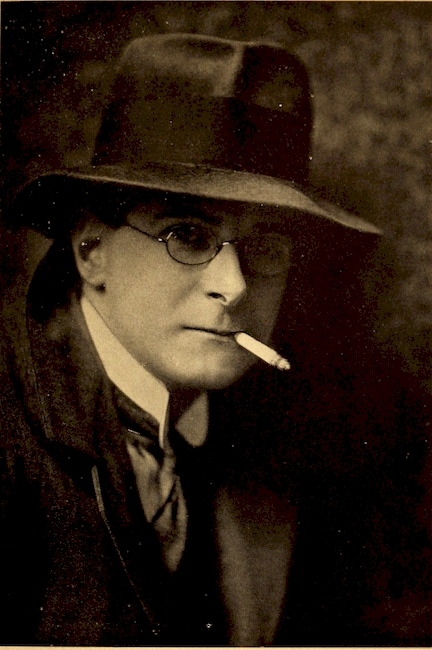
THOMAS BURKE
Thomas Burke says nothing of his parents; I fancy he did not know them. His first recollections are of his uncle, a gardener with a sense of humour, and of a Chinese with an appearance of mystery who was later deported because he trafficked in opium and morals. He got from the latter what Dostoievsky got from epileptic attacks: a sense of time arrested, crystallised; a sense of eternity; a fancy that always, behind the curtain of time, the joy of the moment had been. The secret that Pater attributed to Mona Lisa he learned from Quong Lee. Though Tommy was but ten years old, he knew all the beauty and all the evil of the heart of Asia: its cruelty, its grace, its wisdom. And the contact generated a writer, for from his sixteenth year he has been animated by a single motive: to express in writing one moment in a London side street. He has not yet succeeded to his own satisfaction. As Marcel Proust seeks to revive the memories and reveries associated with incidents and experiences of childhood and youth, Mr. Burke struggles to make come again “the pins-and-needles sensation in the back of my neck” and to have the soul feeling that accompanied it when Quong Lee beckoned him to his shop and gave him a piece of ginger.
Mr. Burke’s life seems to have been without remarkable event. He stalked poverty, and he fell in love with a snob who had an understanding friend of her own sex who shared a flat with her; he made a half-hearted attempt to get on in the City and a whole-hearted one to be a bohemian; and he saw the seams of the seamy side of life burst wide open now and then. But he also met men with hearts, like Mr. Creegan who gave him his first leg-up. This benefactor rescued him from une maison de joie et de jeux where he cleaned boots and ran errands after he left the orphanage; fed him, clothed him, lodged him, got him a job, and started him on the road that led to hobnobbing with Caruso and reminiscing in Monaco. And he met Gracie Scott. If he treated Gracie as he says in his book he did, it will be one of the sweetest memories of his life when that of Cicely shall have gone forever and that of Cosgrove shall have faded.
One of the many precious lies that grown-ups like to tell themselves is that the days of their youth were happy days. Mr. Burke is not addicted to that sort of story-telling. “I had little happiness then, partly because I was young, and partly because I had no friends, no money, bad food, and no hope. There was just one thing I had then which belongs to all youth, however miserable. Though utterly joyless, I had a tremendous capacity for joy.” One may share that tremendous capacity—for he still has it—by reading The Wind and the Rain.
“It is better to be beggared out of hand by a scape-grace nephew, than daily hag-ridden by a peevish uncle.”
R. L. S.
Mr. John A. Steuart has written two large volumes to explain our legacy from Robert Louis Stevenson, which was “a delightful contribution to the romantic literature of the world and an example of courage that will continue to inspire men to remote generations.”
A generation has come and gone since Stevenson died. Of the one now on the threshold even those gifted with imagination and those who understand the impulsiveness of their countrymen, will find it difficult to understand the esteem in which he was held in America in the beginning of the present century. To form any conception of the appreciation, praise and adulation that were bestowed on his writings, they will have to turn to contemporary criticism.
The British “discovered” Stevenson after we revealed him, but when it came to approbation they surpassed us. Then there was an earthquake in the literary world. Henley, the intimate of his early maturity and the doughty champion of his genius, who more than any one else made a public for him, published an article in the Pall Mall Magazine which seemed to give the coup de grâce to Stevenson as a great writer. The blow glanced off Stevenson and stunned Henley; the spectators howled and called the latter traitor, and ghoul. When the excitement subsided dispassionate witnesses reflected upon the matter. Some of them were moved to re-read Stevenson. Others to read him for the first time. The result was that devotees of Stevenson grew less numerous. However, when in 1914 a temperate and generous critic, a novelist of established reputation, Frank Swinnerton, published a critical study of Stevenson which was adverse to his candidacy to immortality, it precipitated a shower of abuse, less inundating than that which submerged Henley, but still disagreeable. However, since that time, indiscriminate adulation of Stevenson has given place to critical estimation. The result to-day is that most judges agree with Swinnerton that it is no longer possible for a serious critic to place him among the great writers because in no department of letters—save the boy’s book and the short story—has he written work of first class importance. His latest biographer would seem to agree, though it is difficult to say just what Mr. Steuart believes, for his writing is so overladen with verbiage, so surcharged with platitudes, so interpolated with irrelevancies and so replete with alleged inside information that one can not see the wood for the trees. But he does not agree that Stevenson was not a “great” man for when “he is summed up, when his qualities, mental and moral, have been analysed and tabulated, it will be found that a superb courage crowns all and from that master-quality flows other virtues in which he was conspicuous—chivalry, generosity, love of justice, an eager humanity, a passion for the happiness of the race. It is valour more than aught else that enchants, inspires, and endears him to the people of two hemispheres.” Probably no one will contest Mr. Steuart’s statement, but surely it is an extraordinary reason for a critical biography. No one would think of writing a life of Meredith or of Heine because they displayed courage that excites our envy and elicits our admiration. Was the courage of Heine or of Meredith inferior to that of Stevenson and what was the quality of Stevenson’s that made it so distinguished? Heine had a disease which, at the time, was never known to end in recovery, Stevenson had only a disease (so far as his latest biographer seems to know) that frequently is cured and nearly always tends to quiescence when given half a chance. Why has John Addington Symonds’ courage not been estimated properly as an asset of greatness?
In truth Mr. Steuart takes himself too seriously. He has not advanced Stevenson’s reputation an atom. Mr. Graham Balfour’s biography of Stevenson may be a barley-sugar effigy of him, and it may make him out a seraph in chocolate as Henley claimed, and the portrait may have been touched up to please the family as Mr. Steuart maintains, but taken in connection with Mr. Swinnerton’s book, Miss Masson’s Life, and the publications of the Bibliophile Society of Boston, it is a competent account of his life and accomplishments.
There is a feature of Stevenson’s personality that has never been touched upon, but which, now that Mr. Steuart has woven a crown of oak leaves for him, must be discussed, and that is his infantilism. It was his curse as it was in a large measure his shame. It showed itself in many ways: in his relationship to his mother, to Alison Cunningham, “Cunny, my second mother,” to Lady Colvin and to his wife; in his speech, dress, manner and imitativeness; in his gestures; in his emotional reactions and determinations; and more than anything else in his inability to display common sense and ordinary prudence. He was always under the dominion of women older than himself and he enjoyed it; they all mothered him. He had no more capacity to get along without mothering than a ten-year-old child has. He was as interested in his appearance as Narcissus. “He could not be in the same room with a mirror but he must invite its confidence any time he passed it; he was never so much in earnest, never so well-pleased, never so irresistible as when he wrote about himself,” Henley wrote and all his biographers agree. That this is a childish trait, no one needs to be told. His speech, manner and dress never failed to attract attention and he took great pains that they should not. Yearning for notice and efforts to secure it are equally well-known infantile traits. Many children invent fictitious parents and forebears. Stevenson was one of them. Mr. Steuart has discovered that one Margaret Lizars of French descent was his great-grandmother, and he naïvely remarks that this explains Stevenson’s oddities. His imitativeness is testified to by the way he taught himself to write and this incident is discussed in the book under consideration in a chapter entitled The Sedulous Ape. It would be difficult to say which was the most childish of all Stevenson’s beaux gestes, but I shall say, harmonious with heredity, the one he did not make; this incident suggests another illustrious victim of adult infantilism, Shelley. All admirers of that genius know that he went single-handed and inexperienced to Ireland to redress her wrongs. Stevenson, on hearing that a Kerry farmer had been murdered by “moonlighters” and his wife and children boycotted, proposed to rent the Curtis farm and to proceed there with his family!
His dealings with his father, his meeting and courtship of Mrs. Fanny de Grift Osbourne, his break with Henley, all conform to the teachings of child psychology and are harmonious with child-behaviour, and they are even more suggestive of infantilism than are the playing with tin-soldiers, and the setting up and operating a toy press, which was his diversion at Davos when, in his thirty-first year, he sought health there a second time.
But nothing shows his infirmity so conspicuously as his inability to look after his impaired health. It is one of the most pathetic chapters in all biography, Stevenson’s imbecilic neglect of his health. No sooner was he benefited by a stay at Bournemouth, Hyères, Davos, Adirondacks, South Sea Islands, than he, with what looks like deliberation, went somewhere or did something which any one but a child would know was suicidal. The climate of Hyères suited him; in later years he declared that it was the only time in his life that he was really happy. He was lazy, yet at the same time productive, and he felt well. But he must go home, and the reason for going was that “he was yearning to get back to her who had so often and so effectively comforted him.”
Time after time he did the same thing. In fact he was on his way home from Samoa and he had reached Sydney when symptoms developed that made further flight impossible. His reason for selecting Samoa instead of Tahiti or Honolulu was supremely childish, “it was awful fun.” It must be borne in mind that adult infantilism displays itself far oftener in the emotional side of the individual’s make-up than in the intellectual. Geniuses, particularly in the realm of the fine arts, are often emotionally infantile. It accounts in a measure for the quarrels, tantrums and vagaries of artists, and entirely for their reputation of being neither practical nor provident.
Any one who would convince himself that many emotional and a few physical characteristics of infancy clung to Stevenson in his maturity should read the Essay Child’s Play in the volume Virginibus Puerisque.
Mr. Steuart harbours the delusion that he has brought to light something new about Robert Louis Stevenson. One person familiar with everything that Stevenson wrote and practically everything that has been written about him fails to find it. To be sure he found out the name of the bonny lass with whom Stevenson fell in love while she was an earning guest of Mrs. Warren in Edinburgh, but he should be ashamed for having published it. He found out also that Stevenson did not live a strictly continent life, either before or after marriage. That is no business of Steuart, and it does not concern readers of Stevenson.
One feels on reading the chapter in which “Claire” is introduced that writing it, Mr. Steuart experienced a kind of salacious exaltation and his apology in behalf of Stevenson makes one creep. Why Wordsworth is dragged in, no one save the author knows. He must be aware that it was not pruriency or pathological inquisitiveness that gave rise to the Wordsworth-Vallon story. Critics and interpreters had sought for explanation of obscurities in the philosopher-poet’s work. The story explained them.
Mr. Steuart is satisfied that he did a Sherlock Holmes turn about the Henley-Stevenson break. Let us admit it. How do the details that he gives make Stevenson’s personality clearer to us? Mrs. Stevenson did not like Henley, just as Mr. Steuart does not like Mrs. Stevenson. Henley wrote Stevenson a letter and requested that it should not be shown to anybody, a thing which would indicate that, though he was captain of his fate and master of his soul, he did not know the a. b. c. of the matrimonial game. Stevenson showed it to his wife and “der Tag” dawned for her. The battle was fought and Stevenson won, but at the expense of his peace of mind and happiness. The reparations have not been made. No one can yet tell who will finally be called the moral victor, but unless all signs and portents are to be distrusted it is R. L. S.
Mr. Steuart’s book is interspersed with homilies on education and on British valour; bromidic reflections: “As all the world knows, the Casino at Monte Carlo is the centre of life and excitement to that gay community”; platitudinous moralisations: “In such matters fathers are apt to forget they were once young themselves”; and “adversity, it has been said, is the true test of manhood”; meticulous explanations such as the varieties of solicitor in Scotland; and studied padding, as an example of which may be cited seven-eighths of what he says about George Meredith. Some people may be glad to hear what he thinks of Meredith as a novelist and as a person, but there will be fewer probably after his book on Stevenson has been read.
“It is certain,” writes the author, “that Vailima, with its ever increasing strain, did much to kill Stevenson.” Not nearly so much as these two volumes, which were intended as a monument to him, have done! Had Mr. Steuart talked with every old woman in Scotland who had ever seen Stevenson, had he searched the register of every lupinaria of Stevenson’s day in Edinburgh, and had he spent twice as much time as he has in reverence before a bust of Henley, he could not understand Stevenson the man or Stevenson the romancer.
Finally there is something patronising and condescending in his attitude toward Stevenson, something contemptuous toward Mrs. Stevenson and something studiously neglectful of Lady Colvin that is very irritating. The reader who can rise from Mr. Steuart’s volume without feeling that the author takes himself with sibylline seriousness is fortunate, and the reader who can peruse the closing line without a smile should take a cholagogue. His salute of Stevenson makes one think of a wood-pecker taking leave of an eagle.