III LITTERATEURS: AMERICAN WRITERS
Reading edition
A Story Teller’s Story, by Sherwood Anderson. William Dean Howells, by Oscar W. Firkins. Lafcadio Hearn’s American Days, by Edward Larocque Tinker. Mark Twain’s Autobiography. Henry Thoreau, by Leon Bazalgette. The Pilgrimage of Henry James, by Van Wyck Brooks.
The next best thing to talking about ourselves is talking about others. Hence the lure of autobiographies, biographies, and autobiographical fiction. James Joyce wrote a book half the size of Webster’s Dictionary to tell of a few hours in his own life, and Ben Hecht seemingly cannot exhaust himself. The genesis and development of personality can be conveyed only by words. Palette and brush in master hands can preserve for posterity the lineaments, and in a measure the character, of those we love and those the world admires or fears; but the written word alone is the medium to convey the soul. Sherwood Anderson has laid bare his soul in A Story Teller’s Story, and he has drawn a portrait of his father that surpasses Velasquez’ Innocent VI.
Rarely have autistic and purposeful thinking, revery and directed mental activity, been so skilfully displayed, so successfully made vocal. In the lines, and between the lines, Mr. Anderson has told all he knows about himself and more. He has put psychologists and writers, be they Freudians or behaviourists, subjectivists or objectivists, under obligation to him, for he has permitted them to observe the gestation and travail of the poet’s fancy, the birth and growth of poetical form. His story, taken with Mr. Stieglitz’s portrait, tells all there is to know about a creature at once as simple as the heart of a child and as complex as the mid-brain of an adult who first saw the light of day in Camden, Ohio, nearly half a century ago.
He knows little of his ancestry, but that little goes a long way to explain him. His father, a fifty-fifty mixture of Colonel Sellers and Wilkins Micawber, born in the South and given to rum, romancing, and revery, was once a dandy and always a hokum expert. The origin of his mother, who had been a bound girl in a farmer’s family until she married, was something of a mystery, which her children did not care to solve; but she was kind, indulgent, faithful, and she suffered fools silently. Her mother was an Italian peasant, one eyed, polyandrous, and at times murderous. Once a tramp tried to rob her humble home. She beat him until he begged for mercy; then she filled him and herself with hard cider and the two went singing off together down the road. Marvellous germ-and sperm-plasm for a poet; wondrous parentage for one destined to be absorbed by the visual fancies of his unconscious, to see strange features in the clouds with Polonius, and faces in the fire with William Blake. No wonder Sherwood Anderson has often been called a “nut.” He is not averse to being thought a little insane, but he has been stung to the quick by charges of “personal immorality.” One with such ancestry is perhaps not so likely to be an invert as a poet, but it is from similar ancestry that they both not infrequently come. Had Mr. Anderson investigated the forebears of Judge Turner who found the boys of his town were not of his sort and was unable to understand them, who had never married, and indeed cared nothing for women, he would have found them in many respects similar to his own. The judge was very congenial to him, despite the disparity of age. They saw many things eye to eye; and the short, fat, neatly dressed man with bald head, white Van Dyke beard, cold blue eyes, soft round white cheeks, and extraordinarily small hands and feet, is as typical an example of the strange genesic anomaly as was M. de Charlus whose acquaintance we made in Marcel Proust’s much discussed Swann’s Way. To understand the long, long thoughts the judge had when as a boy he meditated poisoning some of his schoolmates, one must either have “temperament” and “fixations” like Mr. Anderson’s or else be a psychiatrist.
A Story Teller’s Story is full of portraits, mostly miniature, but here and there is a life-size done with a few sweeps of the brush. Such is that of Alonzo Berner, from whom Mr. Anderson learned as much about men as Mr. Kipling did about women from the “arf caste widow, the woman at Prome, the wife of the head groom or the girl at home.” Alonzo did not have that contempt for men that Sherwood had. He knew the great commandment “Thou shalt love thy neighbour as thyself”; he had learned there was none other greater; and it was vouchsafed him to believe. “Where had I got my contempt and how had he escaped getting it?” You got it, Sherwood, from the one-eyed grandmother who tried to kill her granddaughter with a butcher knife, who had four husbands and was ready for a fifth. Alonzo escaped it through the father who had, the night the stallion Peter Point died, “some thought about most human beings, including myself, that I haven’t ever forgot.”
Next to the evolution of the artist, the determination of Sherwood Anderson to be a writer, the transformation from slug laborer to chrysalis writer, these analyses are best in a book which is all excellent.
Freudians will find Mr. Anderson’s story of his life corroborative of their teachings. Fanciful birth, vicarious parentage, fantasying childhood, reverying manhood, sexual fixation, self-observation, unconscious fantasy following in the wake of conscious thought, conflict between authority and desire—all these and more are here. Rather than dwell upon them, and upon his artistic temperament, rather than attempt a summary of his conduct which would represent his strivings toward the beautiful, I shall discuss what may be called his urge to authorship. The most remarkable thing about it is that it did not seize him until comparatively late in life. What it lost in forwardness it made up in intensity. After having lived nearly one-half of the life of man as a laborer and business man, he began to write.
“There never was such a mighty scribbler as I later became and am even now. I am one who loves, like a drunkard his drink, the smell of ink, and the sight of a great pile of white sheets that may be scrawled over with words, always gladdens me ... oh, what glorious times I have had sitting in little rooms with great piles of paper before me; what buckets of blood have run from the wounds of the villain foolish enough to oppose me on the field of honour; what fair women I have loved, and how they have loved me and on the whole how generous, chivalrous, and open-hearted and fine I have been!”
The song chanted by Solomon that has come down the ages to testify that the wisest of men was also a poet, is not more pregnant with sincerity, no more redolent of fervor than Mr. Anderson’s record of his art which he sought in the clefts of the rock, in the secret places of the stars. By night on his bed he sought it; he sought it in city streets and country fields, from watchman and from barman, only to find it finally within himself; in his own creating, shaping intellect into which the unconscious had projected its own grist. He began to write of his observations, experiences, and fantasies; and as he wrote he seasoned them more and more generously with his aspiration: to cause his fellow men to share his love of beauty, to thrust beauty first upon the middle west and then upon the U. S. A., to show that happiness and prosperity are not synonymous. He was by nature a word-fellow who could at most any time, be hypnotised by high-sounding words, and he was to come under the influence of Gertrude Stein, a “surefire” verbal artist; all of this resulted in Many Marriages, which was the life of the author strung on a fictional clothes horse. John Webster’s grand geste in fiction is Sherwood Anderson’s in reality. It came to him like a revelation; it came with a rush: the overwhelming feeling of uncleanliness engendered by buying or selling. “I was in my whole nature a tale-teller. My father had been one and his not knowing had destroyed him. The corrupt unspeakable thing that happened to tale-telling in America was all concerned with this matter of buying and selling.” And so he walked out of his factory saying to his secretary, “You may have it, I am not coming back any more.” As he walked along a spur of railroad track, over a bridge, out of the town, he whispered to himself, “Oh, you tricky little words, you are my brothers and for the rest of my life I will be a servant to you.”
That is what he is to-day and likely will remain—a servant of words. And though their servant, he is yet their master, for he is able to assemble them in beauty and in majesty; he can march them rhythmically in single or double file, or in platoons; he can blend them as a kaleidoscope blends colors; he can draw from them a harmony that Rimsky-Korsakoff drew from sounds, that Léon Bakst drew from motion and colour. Indeed, there is a music in his style which, though not classical, is charming. There is a measured flow of words in every sentence; alliterations and rhythms, resonances and luminosities which no contemporaneous American writing exceeds. But its author has a lack and a compulsion. The former is in the ideational field, the latter in the emotional. He lacks capacity for synthesis and integration, and he is obsessed with sex. No one who reads of Nora, and of the high school graduate from an Illinois town who had married a young man of that place and come to Chicago with her husband to make their way in the great world, can fail to interpret his obsession; neither can the reader fail to understand how large it has loomed in Mr, Anderson’s life.
The stories Sherwood Anderson used to hear on every side in stable, work-shop, and factory concerned, he says, one impulse in life. He grew unspeakably weary of hearing them, and gradually a doubt invaded his mind. A similar weariness has come to many readers of his stories; and the doubt that he had of his fellow keg rollers, I have of him.
Few critics will be able to dispose of Sherwood Anderson in as brief space as his friend Mr. Ben Hecht: “I can give you all of Sherwood Anderson in a sentence—the wistful idealisation of the masculine menopause.” Like so many things Mr. Humpty Dumpty Hecht says, there is truth in it.
Sherwood Anderson of manic-depressive temperament is an artist who is a blend of many characteristics, the predominant one of which is a love of beauty, particularly of form. All of them are inherited. Had he been able, or enabled, to bring the unconscious of his make-up into consciousness early in life, he might have earned the immortality of Hawthorne, Howells, or Crane. Had he studied Fielding instead of Whitman, Chekhov instead of Clemens, he might have been the bell-cow of the literary herd of the midwest. The man who first said “It is never too late to mend” has much to answer for.
Bliss Perry, whose reputation for sanity, soundness, and penetration as a literary critic has long been established, says that Mr. Firkins’s study of William D. Howells is a great biography. I feel as a pariah should feel when I cannot share an authority’s conviction and sentiment. But there is a discursiveness, a pretentiousness, a highfalutin tone about it that distract me, and a papal atmosphere about it that I do not breathe easily or invigoratingly. Little annoying flaws of grammar and construction obtrude themselves while one reads it. “I will set down briefly the migrations and occupations of the family.” “The style has a pre-existence in the psychology, is in essence the ingress of that psychology into language.” “When an incident of travel reaches its probe into the sensitiveness of the author’s profoundest and saddest convictions,” etc.
Self-forgetfulness, it has been said, is the beginning of happiness among books; and it is because I cannot get lost to myself that I have found less pleasure in Mr. Firkins’s book than in any save Mr. Bok’s. When I read “the curious strengthening of the position of the amphibious Balzac in our day,” I immediately begin searching for the justification of “curious”—and why “amphibious”? Then there darts into my memory chamber a line from an Essay in Criticism, by Robert Lynd, that I read two or three years ago in The London Mercury: “All criticism is, from one point of view, an impertinence.” Stuart P. Sherman, reviewing recently Mr. Mencken’s latest book, said he was determined to conclude his review with a gesture of amicality. I am equally determined to say that Mr. Firkins’s book would not have received such universal praise from the reviewers had it not deserved it.
We like to read about men of genius and identify our virtues with theirs; we deny ourselves their sins, and we do not recognise our limitations in theirs. Lafcadio Hearn was a man of genius who had tremendous limitations, and undoubtedly the Reverend John Roach Straton would say he wallowed in sin. But he was an interesting human being; he had a most uncommon ancestry; and if there were any occidental and Christian conventions he did not trample upon, transcend and rail at, it was because he did not encounter them.
In one of his letters to Henry E. Krehbiel, he called himself a dreamer of monstrous dreams. The reader who gets information of Hearn from Mr. Tinker’s book will think he should have said “a monster dreamer of monstrous dreams,” for the Hearn depicted in Lafcadio Hearn’s American Days was a monster. He ate like one, he loved like one, he had no family feeling, no capacity for sustained friendship. No hand extended to help him was withdrawn unbitten; no kindness was ever accepted that he did not endeavour to repay with cruelty and abuse; no appreciation and praise were ever accorded him that he did not reciprocate with scurrility and scorn. Exceptions prove the rule: Mr. Courtney’s hand bore no teeth marks and Elwood Hendrick still speaks lovingly of him.
All that Mr. Tinker says of him may be true, but it is not a picture of Lafcadio Hearn as he really was, or as the letters published by Mrs. Elizabeth Bisland Wetmore discover him, or as Reminiscences by his widow show him to be. He was hybrid, he was oversexed, he had paranoiac trends, he was pathologically sensitive and morbidly timid, he was deformed facially and possibly morally, and he saw neither far nor straight. What has all that to do with Lafcadio Hearn, an asset of literature? He wrote like a god and he made angelic music. Chita, Kokoro, The Nun of the Temple of Amida, attest it. He was a critic in the class of Rémy de Gourmont. He was a translator that Mrs. Constance Garnett would call master. He had a flair for beauty of literary style keener than any one since Pater. He could not judge men and he could not discriminate between women; he had no colour sense, and his olfactory sense was abnormal; he had greater compassion for turtles and toads than he had for Jesuits and Jews; but he rarely hurt any one’s feelings save those of Mr. Alden. That grand old mediator of writers’ thoughts and reflections said, “Father, forgive him, he neither knows the nature of his act, nor the enormity of the offence, for he is a genius.” He may not have been “cultured” to a twisted mind like that possessed by Dr. George M. Gould, but Goethe would have thought him cultured, for he was a poet; and George Moore would have made an affirmation to that effect for, like himself, Hearn was a story-teller; Aristippus would not have denied him, for he too was a hedonist, and Anatole France would have proclaimed him, for they both held that beauty was the touchstone for worth.
Judged by his contribution to literature, he was a man of culture and he had illumination and understanding.
I can understand that it interests physicians, especially psychiatrists, to investigate the ancestry and study the conduct of men who agitated the waters of their time; but I cannot understand what bearing heritage or behaviour has on the contribution of these men to literature. How does it concern the seeker of emotional solace or intellectual sustenance to know that Poe and Verlaine were drunkards, that Rimbaud and Baudelaire were inverted genesically; that Hearn’s father was an Irish rake devoid of parental responsibility, his mother an Ionian of composite ancestry profoundly psychopathic who married a Jew?
Mr. Tinker says, “Hearn’s peculiarities and mental affinities were entirely the result of idiosyncrasies of ancestry and youthful environment.” Well, is Hearn any different in that respect from the whole world? Does Mr. Tinker aim to do what Mr. White recently attempted to do for Woodrow Wilson: allot his cardiac virtues to the Wilsons and his cerebral gifts to the Woodrows? I suppose he would attribute his bulimia and illassible sexual cravings to Charles Bush Hearn; his tenderness for cats and his desire to create beauty to Rosa Tessima; his Jesuit phobia to the strain of English blood; his penchant for gastronomies to the Turk strain; his Wanderlust to an ancestral Arab; his passion for personal cleanliness to a gipsy forebear who had learned that there are few more pleasant experiences than those of bathing; his pride to a remote Moor; but his sensitiveness came from his wall eye—all his friends say that.
Mr. Tinker thinks “his warring inherited instincts were to have a large part in moulding his life, for they made of his soul a battleground. Frank Oriental sensuousness was shamed, but not curbed, by Anglo-Saxon self-control. Gallic expansiveness tried to break through Arab impassivity, and all the while, Gipsy lure of the road and love of new location lashed his life to restlessness; in short, what one set of inherited impulses bade him do, another inhibited, until all constructive action was paralysed.”
Lafcadio Hearn’s soul as it has been revealed to me from a long intimacy with his writings is not my idea of a battleground. Undoubtedly his instincts had much to do with shaping his life. They have in shaping the life of any one who amounts to something. Lafcadio Hearn had a very high sex coefficient and he did not bend the knee to church and convention. Well, there are others, and I fancy they would deny that their souls are battlegrounds. And this paralysis of constructive action, how does that show itself? Certainly not in New Orleans, more certainly not in Japan. Perhaps in Martinique? The heat and the atmosphere there make for lassitude that is tantamount to paralysis. We are perhaps on safer ground in attributing it to them than to warring impulses. I need scarcely add that I do not admit Hearn’s “paralysis of constructive action.”
Mr. Tinker’s book is a wrong picture of Lafcadio Hearn, but it is not the author’s fault. It is Hearn’s fault. He should not have philandered with Althea Foley; he should have spurned Dr. Gould’s advances; and knowing Denny Corcoran’s record he should have avoided him; and we can never forgive him for not wearing “stylebuilt” clothes. Had he done so he would not have had Krehbiel’s door slammed in his face, nor would the great musical critic have had occasion to write the letter, Cæsarean in brevity and Nelsonian in construction: “Dear Hearn, you can go to Japan, or you can go to Hell.”
Suppose Mr. Tinker were to get drunk and stay so more or less for a week, and that I should shadow him with camera and notebook. Does any one think that my record of his conduct and my picture of him would be correct or adequate? I do not. It might do him a great injustice.
However, much should be forgiven a biographer who makes such searching criticism as: Hearn’s constant vigilance to suppress finally came to inhibit his creative power. This explains the carefully wrought artificiality—the tenuousness of subject matter, but the exquisite finish of form—which is characteristic of all his books. The truth is he was forced to spin gossamer out of hemp when he could have made it into strong rope.
William Dean Howells said that Mark Twain was the Lincoln of literature. That is the apogee of praise. The more facets of his personality we see, the more richly does he seem to deserve the praise.
The immortality of Poe, Whitman, and Mark Twain would seem to be assured. Other names have been on the roster long enough to make it fairly certain that they also will be chosen, but Hawthorne’s reputation wanes as Melville’s enhances. Edwin Robinson a generation hence may have greater renown than Longfellow, and William James may be quoted when Emerson is forgotten.
We long for a great emotional writer as the Jews long for a Messiah, and the fact that Mark Twain was vouchsafed us encourages me to believe that our chances are greater than those of the Jews. We have never had a really great poet unless Whitman was one, and not even an approach to a satirist, and Mark Twain is our signal contribution to humour. He had also the capacity to convey it, and an unawareness of the supremacy of either gift. With it all he was a philosopher, a man of culture, and fundamentally a poet.
His was the antithesis of the Messianic complex. He had a simple heart, and an intricate soul. None of his writings reveals it as does his autobiography. It is as unlike the customary autobiography as Mark Twain was unlike the average man. It does not begin with a tedious narrative of his forebears, and tiresome descriptions of their environment. Nor does it dwell upon his mental prodigiousness and moral sufficiency, followed by the enumeration of the obstacles he surmounted owing to his health, holiness, habit, and his unusual possessions. It does not end with a verbal portrait provocative of memories of Dr. Munyon and his warnings.
It is the picture of a man, happily not a one-hundred-percent-American, who lived during the second most important epoch of this country’s history, and who from early childhood was a close observer and from his youth a faithful transcriber of his observations. He began to write his autobiography in his teens and continued to write it nearly to the day of his death. Roughing It, Tom Sawyer, Life on the Mississippi, Innocents Abroad, are just as much description of his life as his autobiography.
Mark Twain’s conception of how to write biography was to start at no particular “period,” to wander at will over his life, to talk only about the thing which interested him for the moment, to drop it when its interest threatened to pale, and to turn his talk upon the new and more interesting things that intruded themselves into his mind meantime.
It is not only the picture of Samuel L. Clemens that one gets with the autobiography. There are little masterpieces of his brother Orion, of his daughter Susy, of his wife and of his mother, and there is one of General Grant that should add to his fame as a generous, kindly, big-hearted, forgiving man.
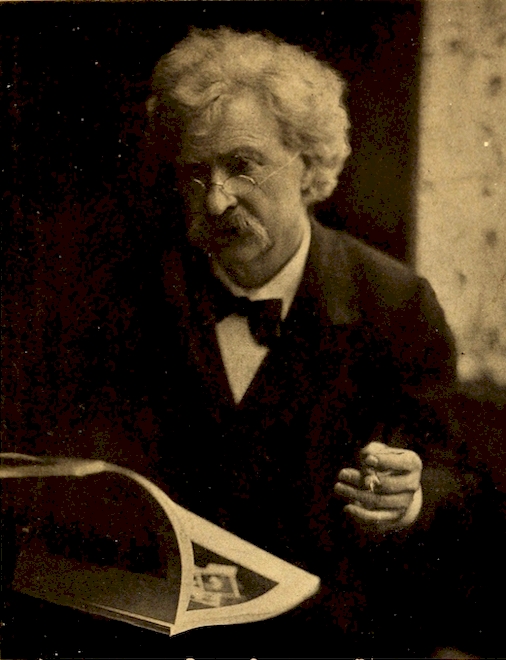
MARK TWAIN
Did any one ever describe an amiable person so well as he describes his fellow schoolboy John Robards; and did any one ever succeed better in conveying the handicap that excessive amiability puts upon its possessor? But the kohinoor of this tray of jewels is his description of his brother Orion. Mark Twain may not have succeeded in writing an account of his own life that was satisfactory, or that he considered revelatory, but the description and analysis of his brother’s personality is a real contribution to psychology and biography. It is possibly the best description of a human chameleon in all literature. It may never become as familiar as that of Colonel Sellers, for Mark Twain did not put him au naturel in his fiction. Orion Clemens was fifty-fifty optimist and pessimist. Aside from the fundamental endowments of honesty, truthfulness, and sincerity, he was as unstable as water, as inconstant as a weather vane. He had an unquenchable thirst for praise. You could dash his spirits with a single word; you could raise them unto the sky with another. He was a Presbyterian one Sunday, a Methodist the next, and a Baptist when the fancy seized him. He was a Whig to-day, Democrat next week, and anything fresh he could find in the political market the week after. He invariably acted on impulse and never reflected. He woke with an eagerness about some matter or other every morning; it consumed him all day; it perished in the night; and before he could get his clothes on he was on fire with a fresh interest next morning. He literally took no thought for the morrow, and it was inevitable that his illustrious brother should have to support him during his waning days. Psychologically, he was a splendid example of adult infantilism, manic-depressive temperament; genius is often associated with these possessions.
The outline and the penumbra of these same qualities are to be seen in Mark Twain himself. He was emotional, impulsive, explosive, avid of praise, subject to depression and exaltation, and unprovident. But he was teachable and his eldest brother was not; experience taught him and environment influenced him, but they had no more effect upon Orion than headache has upon a drunkard. Above all, the possession that distinguished Samuel from Orion was humor.
There is much inquiry these days whether man has ceased to progress, and biologists ask themselves if evolution is at a standstill. From the standpoint of intellectuality it has apparently ceased. We have had nothing the past two thousand years that compares with the eight hundred years of unfettered thought which the human race enjoyed while Greek philosophy was supreme. That progress has ceased from the standpoint of emotionality is not so apparent, and this is the ray of hope that reaches us; for if it has not ceased, we can confidently look forward to a new code of ethics that will be livable, a new dispensation that will allow the sheep and the goats to pasture in the same field and sleep in the same shed, a new religion that will be reconcilable with science.
It transcends understanding that so much attention is given to the intellect and so little to the emotions. It is the latter, together with articulateness, that distinguish us from the beast, and approximate us to God. Humour and love are the two most precious emotional possessions. Mark Twain had them both, and none of his writings reveals them more conspicuously than his autobiography. His account of Orion’s adventure at the house of Dr. Meredith, his description of how he himself caught the measles, how he found the fifty-dollar bill and the thoughts that it engendered, how he was temporarily cured of the habit of profanity by his wife, are examples of his humour; and his accounts of Susy, of his wife, of Patrick, reveal his love. His narratives about the burglarisation of his house, the interview with President Cleveland’s wife, the potato incident at the Kaiser’s dinner party, his description of the illness and death of his little boy—as well as the testimony of his family and intimates show how enslaved he was by revery.
One of the many things that make this autobiography so delightful, is its revelation of how human Mark Twain was in his sympathies and antipathies, in his loves and hatreds. His words about Susy and Livy are as tender as anything I have read in a long time, and his account of Patrick makes one regret that the juggernaut Progress has eliminated the coachman. In the jargon of the day, Theodore Roosevelt “got his goat”; and the things he said about those who sought to crush him after they had brought about his financial ruin would not be considered printable in the Victorian era.
Mark Twain was in deadly earnest about many things he said “in fun.” I choose to believe that when he wrote, “I intend this autobiography shall become a model for all future autobiographies, and I also intend that it shall be read and admired a good many centuries because of its form and method,” he meant what he said. Whether he meant it or not it is true, and his country, proud of him, should be pleased with the account he left of himself to be published posthumously. It is ideal though it is not adequate. Those who would know what sort of man Mark Twain was may find out by reading it; those who wish to learn what he accomplished, how he did it and where, may learn from Mr. Paine’s biography of him. It is to be hoped that the rumour that there are other volumes to follow is founded in fact.
Mark Twain was a spiritual composite of Patrick, the coachman and gentleman; of Mr. Burlingame whose ways were all clean, whose motives were high and fine; of Dr. John Brown who immortalised his own name with Rab and His Friends; and of his brother Orion, as they are described by himself. The best of Hermes was beaten up in the mixture. Joe Miller and Miguel Cervantes alternated as batter beaters.
The further removed we get from the time of Henry David Thoreau, the more appealing his personality and his experiment will be to us and to our descendants. He was difficult to approach, more difficult to companion, impossible to love, and hard to admire. Death took the offence out of his egotism, the meaninglessness out of his paradoxes, the repulsion out of his self-sufficiency. We forget his congenital and laboriously acquired incapacity for enthusiasm when we read how he championed John Brown. It no longer irritates us that he was determined to base the laws of the universe on his own experiences and convictions when we see through the vista of nearly a century how he lived his hermit-like life. Time pales his peculiarities and limitations, and tints his possessions and virtues. It may safely be prophesied that, as we grow individually more sophisticated and nationally less democratic, the books that have been made from his diary will be read with greater avidity and more understanding.
A new biography of the Poet-Philosopher-Naturalist and America’s first famous recluse, written by a foreign pen, justifies these statements. Mr. Van Wyck Brooks has made a translation of the book which mirrors his culture and testifies his mastery of literary technique. It is the work of a Frenchman who stresses the Gallic and Celtic strain in Thoreau, and who sympathises with his determination to create and develop himself, to live, to make of existence the most beautiful work of art. M. Bazalgette pitches his song of praise in a high key. At times, it taxes the reader’s credulity; at other times, the high notes long sustained exhaust him. The biographer loves to dwell on Thoreau’s affectivity. He not only tells how Thoreau felt, he describes his thoughts, and the thoughts he should have had. But he makes no estimate of him as a poet, philosopher or naturalist. He submits the facts of his life, the contacts of his activity, and lets the reader draw his own conclusions. It is a picture of Thoreau that many will prefer to that drawn by Sanborn, or Channing who knew him intimately, or by Marble or Salt who were dependent upon his diaries and letters for their information; for many prefer portraits that are idealised, and he depicts his physical features as no other biographer has done. M. Bazalgette essays to reincarnate and display the poet’s thoughts on his peregrinations and pilgrimages. Some of these reflections are infantile, a few puerile, such as the description of his knapsack and the little bundle he carried in his hand; the discussion of the advantages of an umbrella over a raincoat; the discourse on shoe strings and on old newspapers.
There can be little doubt that Thoreau was sometimes playful and joyous with human beings, but I doubt if he were ever so capable of self-forgetfulness as it is alleged he was on a visit to New Bedford when he executed, before his hostess at the piano, a Zulu dance in the presence of Mr. Alcott. The story reminds one of the conduct of the First Ranger in Von Weber’s romantic opera.
It was a strange freak of nature that manifested itself in Concord, Mass., July 12th, 1817, by the birth of a Thoreau child to which was given the name of Henry David. In breeding parlance he was a “sport,” but from the social standpoint, he was far removed from it. He did not have the varied ancestry that Sinclair Lewis gives Doctor Martin Arrowsmith, but it was diversified enough to satisfy any one. Three distinct chromosonic streams, French, Scotch and Saxon, confluented in him. His father was the son of a Frenchman born in the Isle of Jersey who married Jane Burns, daughter of a Quaker Scotch who emigrated to Massachusetts. His mother’s forebears, the Dunbars and the Jones, had been long enough in this country to be entitled to the designation American.
There was little of Hermes in Henry Thoreau, but that little he got from a maternal uncle, Charles Dunbar, and from him also he got his unconventionally, his wanderlust, his self-command, his equilibrium and determination. Uncle Charles had a disdain for taking thought of the morrow that amounted to contempt and nephew Henry inherited it. Where he got his self-sufficiency, his indifference to man and his comforts, his amatory dysesthesia we are still uninformed.
No biographer has ever found much material for his pen in the plastic years of Thoreau. M. Bazalgette has been no more successful than his predecessors. Thoreau’s most distinctive urge: love of nature, and the most conspicuous feature of his personality: self-sufficiency, revealed themselves early in life and accompanied him to the day of his death, and that is all there is to be said. Neither in school nor in college did his conduct suggest scholarship or antinomianism, but on leaving Harvard his Commencement Oration, in which he unrolled his map of life, suggested them both. His auditors perceived but did not apprehend that the future itinerant surveyor had had other engrossments than examinations at Harvard. For him “this curious world which we inhabit is more wonderful than it is convenient; more beautiful than it is useful; it is more to be admired and enjoyed than used. The order of things should be somewhat reversed: the seventh should be man’s day of toil wherein to earn his living by the sweat of his brow, and the other six his Sabbath of the affections and the soul.” The distinguishing feature of the paranoiac is that he reasons logically, often trenchantly, but his premises are always wrong. One could argue that the world is the most congenial place we know, that its usefulness is testified by the mouths that it feeds, that those whom it supports would not go very far should they substitute admiration for use of it.
Radicalism which had budded slowly in college flowered quickly at home. It disturbed his family and annoyed his town-folk but water on a duck’s back was a riot compared to the sensations that their disturbance and annoyance caused in him. Had he been in the habit of invoking supernatural aid he probably would have said, “God help me, I can do no other.” A college course nearly a century ago was supposed to prepare for a vocation, but Henry Thoreau manifested no sign that it had prepared him. He began to teach in the public school, but his ideas and conduct were offensive to parent and taxpayer, so he started a school of his own and began to be keenly attentive to his sole confidant, his diary; and he built a boat. In it, he and his brother John went from Concord, Mass., to Concord, New Hampshire. The description of that trip is the only tiresome section in M. Bazalgette’s book. This is all the more astonishing to one who read The Week in his boyhood, was fascinated by it, and who has read parts of it many times since then.
Thoreau’s contact with the transcendentalists is described most sympathetically, and the sketches which the author makes of some of the leading figures, Emerson, Alcott, Channing, Margaret Fuller, are animated and vigorous. If ever one falls in love with Thoreau it is when he goes to the Emersons, to work for his board, as it were. Here for the first time, he seems to be human: his playfulness with the children, his praise of Mrs. Fuller, his appreciation of Aunt Mary testify his kinship to man. The chip which he seemed always to carry on his shoulder when he frequented the haunts of man, was consigned to the woodbox and quickly burnt up. Here he indulged his tastes and developed his ambition. The fields and the woods told him their secrets and his host took him on adventurous excursions through the clouds into the realms of philosophy. The children adored him, birds trusted him, beasts loved him. Thoreau was happy and admitted it. But happiness like all other things in the world is transitory and cyclical. He found it out when he went to Staten Island to tutor the Philosopher’s nephew. Neither the child nor the parents was sympathetic, and he was soon back in Concord helping his father make pencils. Manual labour was, in his opinion, the thing which agrees best with an intellectual worker. It would seem to have been congenial to him—at times. Agrippa would probably have agreed with him but scarcely any one this side of the Roman. But that no one was in accord with him would not have disturbed Henry Thoreau. Like all possessors of paranoiac trends, he had faith and confidence in himself that transcended in intensity and depth every other kind of faith and confidence. He was not like other men. He was an American who cared nothing about getting on; a Yankee without the slightest relish for trading; a man who seemed bent on remaining poor; an individual in whose veins flowed the blood of the Celt and the Gaul, whose temperature had never been raised by any of Eve’s descendants; he was the one man in all the world who did not need a friend. He could heed nothing that was said by man and he could hear everything that was said by Nature. Public opinion was against him, but he had a contempt for public opinion and for those who made it that words are impotent to express. He liked all animal life, man least of all. The higher one goes in the scale of animal life, the less the species understood him and trusted him. His fellows found him conceited, sarcastic, uppish; animals found him kind, companionable and simple. Men doubted his sincerity and his sanity, but their doubt was founded on their own fatuity. Animals trusted him. He was in love with the world and satisfied with himself. He was more incapable of love than Amiel. He had some family feeling as a child, but as years went by, it was replaced by an affectionate feeling for poor, ignorant, simple people, and small folk. They were his real family. He did not want to live with them; he wanted to live alone, but he wanted to think of them. They were like regular work, they would prevent him from living his life. The simple life as Roosevelt understood it was a riot of luxury for Thoreau.
It is well-known that solitude whether of desert or mountain often increases self-consciousness to such a degree that the individual doubts his own identity. But the eternities did not press down on Thoreau, or submerge the boundaries of his reason. Neither solitude nor poverty, neither dreaming nor distress of mind could make a mystic of Thoreau. He was practical and pragmatic, but the world of his acquaintance would not admit it. He patted the non-conformist of religion on the back; he spat in the face of the non-conformist of life.
The whole world knows that he built himself a cabin on Walden Pond; as John the Baptist did in the wilderness, he nourished himself on locusts and wild honey with an occasional cereal and vegetable. For two years he devoted himself to finding out what life is and how it should be lived. Thoreau’s poetic biographer would have us believe that every hour in Walden was like the measure of sand passed through the sieve of the gold seeker—it left enough of residue to make a boy comfortable for the rest of his days; perhaps it did, but many of his readers other than those from Missouri will want to have other proof of it than is given in a book entitled Walden, or Life in the Woods. It is the romantic Frenchman who sees him there in this setting.
“You would say then that the earth had chosen this poor, shy boy whom you see absorbed there, on the threshold of his cabin, as an instrument for thinking in peace of its own unity and eternity. How can he say where he is? The planet is silent, time and space are strangely annihilated, the notion of any journey is lost, he may be at the antipodes. Under the pines of Walden, this man who is lost in his dream is Mir Mohammed Ali, perhaps, the painter of Ispahan; his American profile is drawn in miniature in the colours of a precious stone on the blue of the pond. Or is he some Chinese poet-philosopher in whom mingle the souls of animals, and plants, and hermits sitting under an arbour near a little lake? There comes to this man as he listens to sounds beyond music, a music that is deeper and more ample than the music of his everyday life; he feels on his palate as it were a taste of immortality—it grows clearer than the clear morning about him. This beetle that buzzes by, this sweet flag swaying on the pond are like messengers charged with transmitting to him the friendship of men who have dreamed the same dreams in the depth of the old Orient.”
But the friendship of the forest became irksome to Thoreau and he went back to the Sage’s house while the Sage himself was abroad. Again it fitted him like an old glove. He was not ecstatic there as he was in his cabin on the pond, but he was happy; this happiness was interrupted by a lady who thought to marry him, but like so many other little annoyances of life, the trouble was transitory. After a short time he tried lecturing but he did not hit it off with his audiences. They could not stomach either his paradoxes or his ferocious affirmations. He irritated, not amused them; he bored, not instructed them.
When he was in contact with a superior like Emerson or Agassiz, he curbed his tongue, but how he really felt about scientists may be learned from his journal; he considered them pedantic and pretentious. He went to Boston to consult a book but, in the Library he was so self-conscious that he could not concentrate his attention. The city, though it reeked of respectability, was full of shams and shoddy. “What,” he demanded, “is the real?”
The one great enthusiasm of Thoreau’s life was engendered by John Brown. He had no more patriotism than he had family-feeling, but he had an enormous sense of justice. The speeches and conduct of that veteran abolitionist, William Lloyd Garrison, moved him considerably, but the seizure of the arsenal at Harper’s Ferry, Virginia, on October 18th, 1859, frenzied him. He had met John Brown, he had learned something of his thought and of his plans, without being particularly moved by them. But he was agitated to the depth of his soul by the thought of the gallows’ rope strangling the rough neck of his old friend and he began a verbal and scriptural drive to prevent the violence. It was the only real storm of his blood. M. Bazalgette describes it with great artistry. Likewise Thoreau’s meeting with Whitman is well rendered, but with not quite the same attention to verity. The account of the naturalist’s encounter with his hereditary enemy, tuberculosis, of his trip to the Middle West, of his last days, is masterfully done.
The great hiatus in Thoreau’s nature, moral and physical, was his incapacity for friendship. Emerson liked him but not enthusiastically, and he was Emerson’s handy man. Harrison Blake made a hero of him, and Daniel Ricketson of Cape Cod tried to deal with him on terms of equality; but the former’s admiration annoyed him, and a little of the latter’s bonne camaraderie sufficed him for a long time. The man who came nearest to him was William Ellery Channing: whimsical, fanciful, unsociable, infantile but charming—of whom Thoreau wrote: “He will accept sympathy and aid, but he will not bear questioning. He will ever be reserved and enigmatic and you must deal with him at arm’s length.” It is not improbable that he understood Thoreau but one is not convinced of it by reading Thoreau, the Poet-Naturalist, published in 1876.
M. Bazalgette’s sympathy with his subject facilitates understanding, and the concluding pages of the seventh section of his book is the best soul-portrait of Henry Thoreau in existence. But it is not the last. Others will attempt it. Some day an interpreter of behaviour will explain the man who wrote, “For joy I could embrace the earth, I shall delight to be buried in it. And then I think of those among men who will know that I love them, though I tell them not.” The interpreter will tell why he did not tell them and why he could not.
Henry Thoreau was an intellectual monster. It showed in his face, in his prehensility, dexterity, sense-acuteness and in his conduct. He was a misogynist, teetotaler, vegetarian. He had no family or community feeling. He was wholly devoid of the sense of humour. He had no generosity, no sense of obligation, no bowels of compassion, save for animals. He was a universal dissenter, saturated with keen self-appreciation and devoted to self-indulgence. He had none of the weaknesses called vices, few of the strengths called virtues, and despite it all in life he was happy and in death he is a national asset. He will therefore always be an interesting subject for the moralist, the behaviourist and the psychologist.
His was a strange personality. He could not come out of himself, mingle with the world, lose his soul and thus save it. He had no wife, no children, no home, no town, no country as a part of himself, and yet despite this his “self” seemed not to suffer mutilation. A modern philosopher, Bradley, says: “A man is not what he thinks of, and yet is the man he is because of what he thinks of.” Thoreau was a man made by thought and he was that man because of what he thought.
Henry Thoreau did not add to the world’s knowledge, nor did his activities increase or facilitate its dissemination, but he made a contribution to the art of living at a time that was propitious and in a country that sadly needed it. He was a primitive in an artless land, an idealist in a country of materialists, a pagan in a community of puritans, a singer of nature to philistines with ears stuffed with cotton wool. He sought the ideal with the same ardour as man seeks the pleasure of the senses. He was a thinker, not a sensualist; a poet not a priest; a Pagan not a Christian; a genius not well poised who blazed the way for Burroughs and Muir and scores of others who have opened our eyes to the beauty of nature and have shown us how to appreciate and profit by familiarity with it. Personality defects fortunately do not long outlive the body. We quickly forget, when those we love are no longer with us, the things that annoyed us and we remember only their virtues. Time will remove the sting from Thoreau’s contempt, the hurt from his disdain, the injury from his indifference to the beliefs and welfare of his fellow-man. It will deal with him as it is dealing with Woodrow Wilson.
“For God’s sake, try to get at him” said Convick to his young friend when he threw Vereker’s (Henry James’) new novel into his hand and asked him to review it for the Times Literary Supplement. The young friend did it and he was convinced that he had got at him; but later when Vereker said across the dinner table at a country house where he was staying, when the review came under discussion, “Oh, it’s all right—the usual twaddle,” Convick’s young friend did not feel so puffed up. Yet he need not have felt humiliated, for Henry James himself was more lacking in specificity when he discussed his books than when he talked of anything else. The earlier ones were written that he might indulge his creative instinct (which was to produce works of art); the next that he might discover new avenues leading to art’s treasury; the last that he might guess the riddle that he propounded. There was an idea in his work just the same as there was in Goya’s. Goya was not able to describe it, neither was Henry James. A great many persons have succeeded in giving us a fairly comprehensive account of Goya’s idea; and a few, for instance, Mr. Follett, Mr. Beach, Miss Rebecca West, have laboured with considerable success to make us see the treasures of patience and ingenuosity that Henry James displayed in the perpetuation of his idea. Many readers of Henry James do not see that the texture of his books constitutes a complete representation of what he believed to be an exquisite scheme, but the initiated do and that is all he had a right to expect.
A sensitive, scholarly, sympathetic student of literature, Van Wyck Brooks, who has made a serious and laborious study of his writings which he calls The Pilgrimage of Henry James, attempts to explain why Henry James made a failure of life. If the interested reader objects that the word “failure” is too strong, he has only to study the last years of the master’s life, during which he expressed frequently to his friends a dissatisfaction with his accomplishments, and allowed them to discern that he had not received from the world the beer and skittles that he had anticipated in order to be convinced the term is not misapplied.
Mr. Brooks would have us believe that Henry James had a delusion and that it conditioned his conduct. The delusion was that somewhere in the world he could find a cordial, inviting culture; a people who would have urbanity, understanding, and charm; an arena where vulgarity of speech and conduct were rigorously excluded, where they would die of inanition did they succeed in forcing an entrance; where there would be no jostling, elbowing, or hurrying; where no one was better than his neighbour; where boasting was barred and boosting prohibited; a land where every prospect pleased and not even man was vile; the ideal land for which no one but a Henry James ever searches. Then Mr. Brooks thrusts an illusion on him as well, an optical illusion: he sees England as such a land.
After nursing the delusion for more than a quarter of a century, and after having lived intimately with the illusion for a similar period, the cloud began to lift from his mind, the scales to drop from his eyes. The delusion gradually left him and the illusion faded and vanished. Then his mind became the prey of a question: whether he might not have developed more harmoniously and survived more effectively had he remained in America. The question obsessed him and, strangely enough, since obsessions do not usually condition deliberate conduct, it compelled him to formulate a plan to “go back to America, to retrace the past, to see for himself, to recover on the spot some echo of ghostly footsteps, the sound as of taps on the window-pane heard in the glimmering dawn.” He had been in cotton-wool too long, he must experience some of the perils of exposure, otherwise, he would succumb to the first draught; moreover, he was hungry for material, for an “all-round renovation of his too monotonised grab-bag”; he needed shocks.
Had I not such a high regard for Mr. Brooks as author and interpreter, I should reply to him as M’Liss did to the school-examiner who sought to humble her beloved schoolteacher by posing the question: “Has the sun ever stood still in the heavens?” But as I have such esteem of him, of his sincerity and artistry, I content myself with saying, “It is not true.” To bring Mr. Hueffer (I assume he means Ford Madox Ford) forward to give corroborative testimony does not bolster up the case. Mr. Ford is a discredited witness; his reputation for veracity has had a tremendous dent put in it recently by Mrs. Conrad. And I am in as favourable a position to give testimony as even Mr. Gosse. When Henry James made this “come back” attempt which Mr. Brooks elaborates in the chapter entitled “The Altar of the Dead,” the arterial disease to which he finally succumbed had already progressed to such a stage as to give great anxiety and concern to his intimates. He put himself under my professional care and I saw him at close range nearly every day for two months; and talked with him, or listened to him, on countless subjects. I believe that it would not have been possible for him to have harboured and essayed the plan that Mr. Brooks credits him with having, or to have ruminated on it as he says he did, without my having become aware of its existence in his mind.
Henry James was a man out of the ordinary. He was the type of man that one, no matter how widely travelled, meets but once or twice in a lifetime. It would take a long time to enumerate his virtues, for he had them all, the cardinal and the trivial. He loved bread, music and the laugh of a child, hence no one kept him three paces distant. It would also take a long time to enumerate his defects, for though he had few of the major ones, he had a multitude of the minor.
I have always questioned whether it facilitates an understanding of Henry James the artist to understand Henry James the man. In my own case, I am sure I had as comprehensive a peep into his artistic soul after I had read The Turn of the Screw, The Princess Casamasima, The Ambassadors, and The Golden Bowl, as after I had come to know him intimately, when he was engrossed in the problem of abstract design and fundamental organisation.
Henry James had an enormous amalgam of the feminine in his make-up; he displayed many of the characteristics of adult infantilism; he had a singular capacity for detachment from reality and with it a dependence upon realities that was even pathetic. He had a dread of ugliness in all forms, banality and vulgarity that the devil is reputed to have for Holy Water, and he was solitary hearted. Unlike Hartley Coleridge’s queen of noble nature’s crowning, he had love and he had understanding friends, but he had small capacity to avail himself of the gifts which they desired to lavish on him. His life had been devoted to the pursuit of an ideal; he had never been able to formulate with precision, or to describe that ideal with words. He came as near to it in the little story called The Figure in the Carpet as he could come to it. If he were not able to describe this ideal with the lucidity and comprehensibility with which Leonardo described his, when he was at the zenith of his creative power, why are we astonished at his inability to do it when these powers were undermined by arteriosclerosis?
The great defect in the make-up of Henry James was in the amatory side of his nature. His amatory coefficient was comparatively low; his gonadal sweep was narrow. Had he had a quarter of the former that Goethe possessed or one-half the sweep of Anatole France, it would be safe to say that Henry James would have been the greatest literary figure that ever came out of America, and that there would now be many James carrying his name to perpetuity. It is a measureless impediment, inability to fall in love; it is a dreadful handicap to have feminine and masculine characteristics nearly equally proportioned in one’s make-up; adult infantilism makes tremendously for dissatisfaction with what life brings, and a low basal metabolic rate which gives rise to a race of fletcherisers or other faddists is a burden that many find too hard to bear.
Henry James had them all. Had he not had them, he would have been happier and possibly he would have had a more successful career as an author, if success is measured by the rule of popularity. If his grandfathers had not been Irish; if he had spent his youth in Hoboken and not in Newport; if he had gone to school in the fifth ward and not in Switzerland; if he had had a little judicial starving meted out to him in his early maturity, he might have had a happier old age and fewer yearnings, fewer regrets that his life had not been fuller. Not that I admit for one moment that his old age was unhappy, or that he had such regrets or yearnings. The idea is Mr. Brooks’. It is in his book we find that here was a sort of a lost soul, beating its enfeebled wings against a cage from which time had not only removed the gild, but which it had rusted as well.
Henry James did not dislike America, but the people he met here with few exceptions did not interest him, and most of them annoyed him, sometimes to the point of explosion. He had had many pleasant experiences in Italy and in France, and he treasured them as a prima donna treasures programmes and testimonials. He often took them from the strongboxes of his memory and re-invoked the pleasurable sensations that he had had in acquiring them. Above everything in the world he valued good form, and all that it implies; good taste, good manners, good breeding, good conduct, and he had convinced himself from taking thought and from experience that it was to be had in England, even without the asking. He took his tree of life there and planted it and only one root developed, the social root. The political, the scholastic, the religious, the marathon roots, did not develop. In other words, the roots that make the tree of life so compelling of admiration in England did not grow from the tree that Henry James planted there. The tree that did grow was, however, sturdy and majestic. It has given shade and protection to many travellers since its full growth. The man who planted it insured, so far as he could, that it should not soon be cut down, by making, a few months before his death, the supreme genuflection to the country of his adoption. He forfeited citizenship in the country of his birth and obtained citizenship in the country that had sheltered him during the years of his fruition. How could any such thesis as that of Mr. Brooks be maintained in view of this last great gesture of Henry James, and why is the act not mentioned in a book that aims to describe his pilgrimage?
Had James known that England is full of men like Jacob Heming, one of Stella Benson’s Pipers, he probably would not have settled there; he might have gone to Spain. There are many things about that priest-infested, ceremonious country that would have appealed to Henry James. He would have fitted Toledo as an oyster its shell.
No one need concern himself with proving to me that a man sheds his inherited possessions only with the greatest difficulty. Among his inherited possessions I place his religion, his politics, and his “Patrie.” If a man whose father was known to me as a Democrat tells me he is a Republican, I do not believe him. If a man whose parents were Roman Catholics and who was brought up in that faith tells me that he is a Baptist, I suspect his veracity. If I encounter a man living in England without obvious reason who tells me that he is an American, I immediately surmise that his conduct has been an offence to his own land. And all this despite the fact that I have known the sons of a Democrat who have always voted the Republican ticket, that I am on terms of intimacy with an Unitarian clergyman who was formerly a Roman Catholic priest, and that Mr. George Santayana seems to find England more sympathetic as a permanent residence than Massachusetts. Moreover, I do not recall having heard of a lament from Joseph Conrad that he was not back in Poland or that he could not see Marseilles every now and then. I know an American family named James whose members have identified themselves conspicuously with the material and scientific progress of this country who sent a branch to England two generations ago and its members are more English than Winston Churchill; but that knowledge does not separate me from the belief that one of the most difficult things in the world to accomplish is to transfer a human tree, after it has had vigorous growth, from the soil of one country to another with the confident anticipation that it will bear abundant fruit. In the majority of cases, it will die; very rarely will it bear lusciously as it did in the case of Joseph Conrad. In some instances it will bear every few years, but then not copiously as it did in the case of Henry James.
Henry James had a happier life than any celibate who does not dedicate his days to verbal praise of God is entitled to have. Responsibilities as well as possessions are necessary for our happiness. They create facets which permit us contact with life; they tend to frustrate the increasing activities of the canker worm, egocentrism; and they succeed in convincing him who possesses them that he is but a leaf on the tree of humanity and not a branch or a bough. Had Henry James done his share in peopling the earth he would have been as happy as any man I have ever known save William Osler.
To uphold as a major thesis that, by forsaking the land of his birth he had not given an adequate earnest of his talent, that he had failed to saturate himself with life, that in his old age he found himself astray in the gloomy wood, and that “it had been too much for him over there,” must appear contrary to common sense or sound judgment to any one who knew Henry James, who admired him as an artist and loved him as a man.
Is it not natural that a sensitive man, supremely susceptible to the seductiveness of society, should, when the pulse of life begins to intermit, dwell upon the terrors of loneliness; become apprehensive of a future that would find him bereft of the sympathy that is the balm of life, of that understanding which is the support of the inelastic artery? Henry James knew that such society, sympathy, and staff were in Cambridge, that they were composited in the family of his brother William, that he might have to go to them, as we all have to go to the spring if there is no one to bring us the water.
He minimised the defects of his countrymen and exalted the virtues of his country as he grew older. It is the way of a man with the world. How often have I heard widows whose wounds I had dressed in their matrimonial days, speak of their husbands as Anthony Burgesse spoke of the Staffordshire Puritan Thomas Blake? “His kindness towards you could not be considered without love, his presence without reverence, his conversation without imitation. To see him live was a provocation to a godly life, to see him dying might have made one weary of living.”
Any pilgrim who sets out on a journey may properly anticipate the necessities of life even though he does not take them with him, but it would be fatuous for him to hope for the comforts, and beyond belief that he should expect the luxuries. Henry James in his pilgrimage found the necessities, the comforts, and the luxuries, and we can never be sufficiently grateful to the country of his adoption for having given them to him without the asking.
François Mauriac, one of France’s coming great novelists, one indeed who may be considered as having already arrived, said something in explanation of his latest novel with which Henry James, at least in his old age, would have agreed: “Even after years of living in Paris of friendships, of loves and of travels, when the novelist is convinced that he has accumulated enough human experience to fill a thousand plots, he is astonished that his heroes always come from beyond this tumultuous life—that they take shape in the darkest period of years lived far from Paris and that they draw all their wealth from so much poverty and aridity.” This constant going back to the years of youth and early adolescence which obsesses François Mauriac has been felt by Henry James and it is something of that sort that he had in mind when, wishing to pump the pure essence of his wisdom and experience into his most brilliant disciple, Edith Wharton, he said: “She must be tethered to native pasture, even if it reduces her to a backyard in New York.”
Henry James was a master craftsman. He was concerned more with the pattern than with the material with which he worked. He was continually searching—not material but new ways of arranging it. M. Poiret reminds me of Henry James. Material does not concern him much. It is the way it is cut and basted. The finish is important too, but that is a detail. The pattern is the thing.