Chapter VII · 1497-1521.
Reading edition
While the Spanish and the English expeditions had failed to find the attractive shores of Cathay by sailing westwardly across the Atlantic, the Portuguese were more fortunate in their long-continued attempts to reach the dominions of the Grand Khan by sailing eastwardly. Restricted by the papal decree to the prosecution of her voyages of discovery on the east side of the line of demarkation, Portugal zealously persisted in seeking along the coast of Africa a way to the Orient. Vasco da Gama, an intrepid navigator, was placed in command of an expedition, and sailed from Lisbon, in March, 1497, in the path marked out by Bartolomeu Dias, in 1487. When Da Gama came to the Cape of Good Hope, or the Stormy Cape (Cabo Tormentoso), he realized that the windy headland was rightly named. The hazardous attempts which he repeatedly made to pass the stormy promontory so impressed his sailors with his extreme venturesomeness that they endeavored to persuade him to turn back. It is said that this made Da Gama comport “himself very angrily, swearing that if they did not double the cape, he would stand out to sea again as many times until the cape was doubled, or there should happen whatever should please God.” Having achieved his bold purpose, on the twenty-second of November, 1497, Da Gama made himself famous in reaching the remote coast of India, on the seventeenth of May, 1498, and entered the harbor of Calicut,[270] three days afterward. Returning on the homeward voyage, he arrived at Lisbon, about the beginning of September, 1499.
To perfect and enjoy the privileges of her inaugurated commerce with India, Portugal immediately fitted out a fleet of merchantmen to carry her commodities to the distant country over the sea-path explored by her daring navigators. Pedro Alvarez Cabral was given command of thirteen ships, with which he sailed on the ninth of March, 1500, with instructions to hold his course out at sea at some distance from the coast of Africa, in order to avoid the troublesome currents and delaying winds which had previously deterred mariners from encountering the perils of the unexplored route near the main-land. Cabral proceeded southward, but near the Cape Verd Islands lost sight of one of his ships, and while seeking her he lost his course. Fortunately, on Wednesday afternoon, on the twenty-second of April, he descried the summit of a round and high mountain on the eastern coast of Brazil, which he called Monte Pascoal.[271] Perceiving the next morning that he had anchored opposite the mouth of a river, he sent Nicolao Coelho to examine it. From this anchorage he sailed in search of a safe harbor, and on Saturday, the twenty-fifth of April, found the roadstead which he called Porto Seguro, which was in seventeen degrees of south latitude, according to the observation made there. On the first of May a large wooden cross was erected to which was affixed the declaration of Cabral’s discovery of the country for the king of Portugal. Cabral, having dispatched Gaspar de Lemos with a small vessel to Lisbon with the report of his discovery, set sail, on the third of May, for India. Cabral called the discovered country Terra de Vera Cruz (Land of the True Cross), which name was shortly afterward changed to Terra de Santa Cruz (Land of the Holy Cross), and subsequently Brazil was substituted for it.[272]
In the year 1500 the Portuguese sailed in a different direction to seek a short route to Cathay. The Portuguese historian, Galvano refers to the expedition, saying: “In this same year 1500 it is said that Gaspar Cortereal[273] begged permission of King Emmanuel to discover the New Land (Terra Nova). He departed from the island Terceira with two ships equipped at his own expense, and he sailed to that region which is in the north in fifty degrees of latitude, which is a land now called after his name. He returned home in safety to the city of Lisbon. Sailing a second time on this voyage the ship was lost in which he went, and the other vessel came back to Portugal. His brother Miguel went to seek him with three ships at his own cost, and when they came to that coast, and found so many entrances of rivers and havens, each ship entered a different river, with this regulation and command, that they all three should meet again on the twentieth of August. The other two ships did as commanded, and they, seeing that Miguel Cortereal came not on the appointed day nor afterward in a certain time, returned to this realm and never heard any thing more concerning him.... But that country is called Terra dos Cortereals unto this day.”[274]
Damião de Góes, the Portuguese historian, says Cortereal called this region Terra Verde (Greenland), on account of its remarkable verdure, and the vast forests stretching all along the coast.[275]
Ramusio, speaking of the exploration of the coast of North America says: “In the part of the New World, which runs toward the north and northwest, opposite our habitable part of Europe, many captains have navigated, and the first (by that which one knows), was Gaspar Cortereale, a Portuguese, who, in 1500, went with two caravels intending to find some strait of the sea whence by a shorter voyage than that taken around Africa he would be able to go to the Spice Islands. He sailed so far forward that he came to a place where it was extremely cold, and he found, in the latitude of sixty degrees, a river closed with snow, to which he gave the name, calling it Rio Nevado. But he had not sufficient courage to pass much beyond it. The whole of this coast, which runs two hundred leagues from Rio Nevado as far as to the port of Malvas, in fifty-six degrees, he saw full of people and along it many dwellings.”[276]
The earliest account of Gaspar Cortereal’s voyage of 1501, from which he never returned, is contained in a letter written by Pietro Pasqualigo, the Venetian ambassador at the court of Portugal, to his brothers in Italy, dated October 19, 1501. The writer says: “On the eighth of the present month, one of the two caravels which his most serene majesty sent the past year under the command of Gaspar Corterat, arrived here, and reports the finding of a country distant west and northwest, two thousand miles, heretofore quite unknown.
“They ran along the coast between six hundred and seven hundred miles without arriving at its termination, on which account they concluded it to be the same continent that is connected with another land which was discovered last year in the north, but which the caravel could not reach on account of the ice and the vast quantity of snow, and they are confirmed in this belief by the multitude of great rivers they found, which certainly could not proceed from an island. They report that this land is thickly peopled, and that the houses are built of very long beams of timber, and covered with the skins of fishes. They have brought hither along with them seven of the inhabitants, including men, women, and children; and in the other caravel, which is looked for every hour, they are bringing fifty more. These people, in color, figure, stature, and expression, greatly resemble gypsies. They are clothed with the skins of different beasts, but chiefly of the otter, wearing the hair outside in summer, and next to the skin in winter. These skins, too, are not sewed together, nor shaped to the body in any fashion, but wrapped around the arms and shoulders as they were taken from the animals.... On this account their appearance is wholly barbarous; yet they are very sensible to shame, gentle in their manners, and better made in their arms, legs, and shoulders than can be expressed. Their faces are punctured in the same manner as the Indians; some have six marks, some eight, some fewer. They use a language of their own, but it is understood by no one. Moreover, I believe that every possible language has been addressed to them. They have no iron in their country, but manufacture knives out of certain kinds of stones, with which they point their arrows.
“They have also brought from this island a piece of a broken sword inlaid with gold, which we can pronounce undoubtedly to have been made in Italy; and one of the children had in his ears two pieces (todini) of silver, which likewise appear to have been made in Venice, a circumstance inducing me to believe that their country belongs to the continent, since it is evident that if it were an island where any vessel had touched before this time we should have heard of it.[277]
“They have plenty of salmon, herring, cod, and other fish of the same kind. They have an abundance of timber, principally pine, fitted for masts and yards of ships, on which account his serene majesty anticipates the greatest profit from this country, both in providing timber for ships, of which he, at present, stands in great need, and from the men that inhabit it, who appear admirably fitted to endure labor, and will probably be the best slaves which have been found up to this time.
“This arrival appeared to me to be an event of which it was right to inform you; and if on the arrival of the other caravel I receive any additional information, it shall be transmitted to you in like manner.”[278]
Gaspar Cortereal, who was expected to return to Lisbon in the second caravel, never reached Portugal. Miguel, his brother, sailed from Lisbon in May 1502, with three ships, to search for Gaspar and the missing vessel, but he was never heard of again, and it was conjectured that both of the brothers had been slain by the savages from whom they had taken so many of their relatives to serve as slaves in Portugal.
No little enthusiasm was created at the court of Portugal by Cabral’s report of the discovery of the Land of the True Cross. King Emmanuel at once ordered three vessels to be equipped to sail to the new country. Having heard of the voyages made by Amerigo Vespucci to the Land of Pearls (Terra delle Perle), he wrote to Vespucci in Seville, and solicited him to enter his service. The illness of the explorer did not then permit him to accept the tempting offer of the king of Portugal. However, when he was afterward visited by the king’s ambassador, Giuliano di Bartolomeo del Giocondo, Vespucci consented to go to Lisbon and to be commissioned by King Emmanuel to accompany the fleet that was prepared to sail to Terra de Vera Cruz. His departure from Spain, he says, was a matter of regret to all who knew him, because there he was honored, and there the king had a right to claim his services.[279] Narrating the incidents of his third voyage to the New World, Vespucci writes:
“We departed from the port of Lisbon, three ships in company, on the tenth of May, 1501, and took our course directly for the Grand Canary Islands.... From there we sailed to the coast of Ethiopia, and arrived at the port called Beseneghe, in the torrid zone.... We left this port of Ethiopia and steered to the southwest.... In sixty-seven days we reached land lying seven hundred leagues southwest of that port.... The season was very unfavorable for the voyage, particularly when we approached the equator, where, in the month of June, it is winter.... It pleased God, however, to show us a new country on the seventeenth of August. Then we anchored at the distance of a half league from the coast. We got out our boats and went on land to see if the country were inhabited, and if it were, by what class of people. We found that it was inhabited by a people of a lower condition than that of beasts.... We took possession of it in the name of his majesty. It lies five degrees south of the equator.... We sailed in a southeasterly direction, on a line parallel with the coast, making many landings, but never discovering any natives who could converse with us. Running on this course, we found the land made a turn to the southwest. As soon as we doubled the cape, which we named the Cape of St. Augustine, we began to sail to the southwest.... This cape is eight degrees south of the equator.”[280]
While the explorers were sailing along the east coast of Brazil, they arrived at a place where they anchored five days. “Here,” says Vespucci, “we found carmine stems very large and green, and some already dry on the tops of the trees. We left this port, always sailing to the southwest in sight of the land, making many anchorages and treating with innumerable people. We went so far toward the south that we were beyond the tropic of Capricorn where the south pole is elevated thirty-two degrees above the horizon. We had entirely lost sight of the Little Bear, and the Great Bear was very low, almost on the verge of the horizon.[281] We steered by the stars of the south pole, which are many, and much larger and brighter than those of our pole. I traced the figures of the greater part of them, particularly those of the first and greater magnitude, giving an explanation of the circuits which they made around the pole, together with a description of their diameters and semi-diameters, as may be seen in my four journeys. We ran about seven hundred and fifty leagues along this coast.... We saw a great number of redwood (verzino) and cassia trees, and of those which produce myrrh.... We found ourselves in such a high southern latitude, that the south pole was elevated above the horizon fifty-two degrees.... The cold [on the seventh of April, 1502] was so severe that no one in the fleet could endure it.... We agreed that the superior captain[282] should make signals for the fleet to turn about, and that we should depart from this land and steer our course in the direction of Portugal.”
After touching at the port of Sierra Leone, and at the Azores, the explorers reached the port of Lisbon on the seventh day of September, 1502.[283]
Vespucci was again sent by the king of Portugal, in 1503, with a fleet of six ships commanded by Gonçalo Coelho, to discover an island “toward the east called Melaccha, which we know lies in the sea,” says Vespucci, “thirty-three degrees from the south pole.” Departing from the port of Lisbon on the tenth of May, the vessels stood for the Cape Verd Islands. After going to Sierra Leone on the coast of Africa, the fleet sailed toward the southwest. On this course one of the vessels struck on a rock, and was abandoned by the crew. On the east coast of Brazil, the fleet entered the harbor which the Portuguese called the Bay of All Saints (Bahia de todos os Santos). At a harbor two hundred and sixty leagues farther south, or in eighteen degrees south latitude, a fortress was erected, and garrisoned with twenty-four men. The fleet then sailed for Portugal, and entered the port of Lisbon on the eighteenth of June, 1504.[284]
The opinion of Columbus that a strait could be found to the south or southwest of Cuba through which ships might sail to Cathay, induced Vicente Yañez Pinzon and Juan Diaz de Solis in 1506 to search along the coast bordering the Bay of Honduras for a navigable passage to the Indian Ocean.[285] They held the same course as the admiral, says Herrera, “and sailing as far as the islands Guanajos steered westward as far as Golfo Dulce, but did not see it, for it lies hid. However, they observed the inlet the sea makes between the land that forms the bay and the coast of Iucatan.... From where they descried the Sierras of Caria, they steered northward and discovered a great part of the main-land of Iucatan.”[286]
The unique and peculiarly shaped map made by the German cartographer, Johann Ruysch, contained in the edition of Claudius Ptolemy’s geography, printed at Rome, in 1508,[287] is the earliest engraved chart on which appear the fields of discovery, in the western hemisphere, entered by Columbus, Cabot, Cortereal, Cabral, Vespucci, and other early explorers of the coast of the new continent.
Geographically ignorant of the longitude of the discovered part of North America, then called the New Land (Terra Nova), Ruysch represents it as if it were a part of the eastern coast of Asia, between the two hundred and eightieth and the three hundredth meridians. Better informed respecting its latitude, he delineates it as extending from the forty-fifth to the fifty-fifth parallel of north latitude.[288] Immediately north of the New Land is the Greenland Sea (Sinus Grvenlantevs), and beyond it, Greenland (Grvenlant), discovered by the Northmen. South of the New Land, between the fortieth and twenty-fifth parallels is the unnamed and falsely represented island of Cuba, on the west side of which is a scroll bearing the information: “As far as this the ships of Ferdinand, king of Spain, have come.” South of this island and that of Española (Spagnola) is the discovered part of South America, then denominated the Land of the Holy Cross or the New World (Terra Sancti Crucis sive Mundus Novus). The inscription on the represented territory embraces the following information: “At different places this region is inhabited, and it is supposed by many to be another world. Women and men appear either entirely naked or clad with interwoven leaves and the feathers of birds of various colors. They live together in common without any religion or king. They are continually at war among themselves. They eat the human flesh of captives. They exercise so much in the salubrious air that they live more than one hundred and fifty years. They are rarely sick, and then they cure themselves solely with the roots of plants. Here lions are born, and serpents and other terrible monsters found in the forests. Very large quantities of pearls and gold are in the mountains and rivers. From here Brasil-wood, or verzini, and cassia are carried away by the Portuguese.” Below this inscription is another which contains the following statement: “Portuguese navigators have inspected this part of this land, and have sailed as far as the fiftieth degree of south latitude without seeing the southern limit of it.”
On the scroll on the western part of the delineated territory of South America this information is inscribed: “As far as this Spanish navigators have come, and they have called this land, on account of its greatness, the New World. Inasmuch as they have not wholly explored it nor surveyed it farther than the present termination, it must remain thus imperfectly delineated until it is known in what direction it extends.”
On the upper part of the right margin of the map the following fiction respecting the configuration of the earth at the north pole is inscribed. “It is said in the book concerning the fortunate discovery[289] that at the arctic pole there is a high magnetic rock, thirty-three German miles in circumference. A surging sea surrounds this rock, as if the water were discharged downward from a vase through an opening. Around it are islands, two of which are inhabited.”
North of Greenland is another inscription containing a popular fiction of the dangers besetting ships in the Arctic Ocean: “Here a surging sea begins; here the compasses of a ship do not hold, nor are ships which have iron about them able to turn about.” Among the perils of the Greenland Sea were the deceptions practised by the savages inhabiting the islands in it: “It is said that those who came formerly in ships among these islands for fish and other food were so deceived by the demons that they could not go on land without danger.”
The four voyages of Amerigo Vespucci had acquainted him with so many unknown peoples and places in the New World that he was induced by his own inclinations and the suggestions of his friends to write an account of the explorations of the different expeditions with which he had been sent by the sovereigns of Spain and Portugal. In his letter, dated in Lisbon, the fourth of September, 1504,[290] he speaks of the intended publication of his voyages in a volume in the style of a geography (un uolume in stilo geografia), and calls the composition (zibaldone), “Le Quattro Giornate” (The Four Journeys).
The earliest known work containing an account of Vespucci’s four voyages is entitled “Cosmographiae introductio” (Introduction to geography), printed in St. Dié, in Lorraine, on the twenty-sixth of April, 1507.[291] This rare Latin book was the work of a German scholar named Martin Waldseemüller, a professor of geography in the gymnasium in St. Dié,[292] who having translated his surname into Hylacomylus[293] affixed this Greek pseudonym to his writings. On the reverse page of the fifteenth leaf of Hylacomylus’s Introduction to geography is the notable suggestion that the land in the western hemisphere visited by Amerigo Vespucci should be called Amerige or America. The enthusiastic geographer, having described Europe, Asia, and Africa, remarks:
“And as now these parts have been more widely surveyed, and another fourth part has been found by Americus Vesputius (as will be perceived by what follows), I can not see why any one can justly forbid the calling of this part Amerige or America, that is, the land of Americus, from Americus, the discoverer, an intelligent man, as Europe and Asia have taken their names from women.”[294]
The name America in a short time became a popular designation for the continent in the western hemisphere.[295]
Although Vespucci repeatedly mentions in his letter that he held subordinate positions under the superior captains commanding the different fleets with which he had sailed to the New World, twenty-one years after his death he was unjustly accused by Johannes Schoner, in a little geographical work, as having contrived to have the continent called by his name.[296] Schoner’s imputation was evidently caused by a spirit of ill-will, for he attempted, it would seem, to lessen the importance of the discoveries made by Spain and Portugal, by placing on a globe, made by him in 1520, this inscription designating South America: “America vel Brasilia sive papagalli terra” (America or Brasil or the land of parrots).[297] Later still a number of writers in turn undertook to defame Vespucci by asserting that he did not make the voyage of 1497, and to support their arguments quoted the erroneous statements of the different versions of his letter. The assumptions of these writers, however, are not corroborated by the Italian text of Vespucci’s letter, in part presented on the preceding pages, nor are they verified by later researches in the archives of Spain and Portugal.[298]
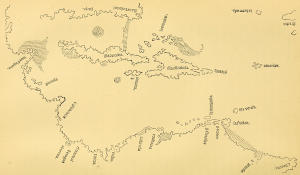
Map of the New World in the Latin work, “Legatio Babylonica, Oceani Decas,” by Pietro Martire d’Anghiera, printed in Seville in 1511. (Size of the original, 7½ × 11 inches.)
When the Spaniards were exploring the West India archipelago a report became current that on one of the more northward islands there was a fountain, the water of which possessed extraordinary virtues. Peter Martyr heard the rumor, and wrote, in 1511, to the bishop of Rome, saying: “There is an island about three hundred and twenty-five leagues from Española, as they say who have searched for it, named Boiuca or Agnaneo, on which is a never-failing spring of running water of such marvelous efficacy that when the water is drunk, perhaps, with some attention to diet, it makes old people young again. And here I must beg your holiness not to think that this is said jestingly or thoughtlessly, for they have reported it everywhere as a fact, so that not only all the common people but also the educated and the wealthy believe it to be true.”[299]
The island of Boiuca appears to be partly outlined on the small map in Peter Martyr’s “Legatio Babylonica,” printed at Seville in 1511. It is designated on the latter as a part of the island of Beimeni,—“Isla de beimeni parte.”[300]
Among those who gave credence to the fiction of the marvellous virtues of the spring of Boiuca was Juan Ponce de Leon, a Spanish cavalier, who had attained considerable military fame in the West Indies.[301] He had sailed from Spain in 1493 to Española in one of the ships of Columbus’s second expedition. In 1509 he took part in the subjugation of the Island of Borriquen, afterward called Porto Rico, of which he was made governor. Beguiling himself with the hope that he could renew the vigor of his youth by bathing in the stream of life-giving water, and at the same time add honor to his name by becoming the discoverer of the island on which the fountain was said to be, Juan Ponce fitted out three vessels and sailed from the port of St. German, Porto Rico, on Thursday, the third of March, 1512, to search for the island Boiuca, which some called Bimini. “It is certain,” says Herrera, the Spanish historian, “that Juan Ponce de Leon besides intending to make new discoveries, as all the Spaniards at that time aspired to do, was also intent on finding the fountain of Bimini and a river in Florida; the Indians of Cuba and Española affirming that old people bathing themselves in them became young again, and it was a fact that many Indians of Cuba, firmly believing that there was such a stream, had found that island not long before the Spaniards, and had passed over to Florida in search of the river, and there built a town, where their descendants reside to this day. This report so affected all the princes and caciques in those parts that it was a hobby to find a river which wrought such a wonderful change as made old people young, so that there was not a river or a brook, scarcely a lake or a puddle, in all Florida, in which they did not bathe themselves.”[302]
The explorations and discoveries of Juan Ponce are thus described by Herrera: “On Sunday, the twenty-seventh of March, the day of the Feast of the Resurrection, commonly called the Feast of Flowers, (que era Dia de Pascua de Resurreccion, que comunmente dicen de Flores,) they saw an island and passed by it. On Monday, the twenty-eighth, they steered in the same direction, fifteen leagues, until Wednesday, when the weather became foul. They then stood west-northwest until the second of April. The water grew shallower until they came into nine fathoms, a league from the land, which was in thirty degrees and eight minutes. Thinking this land was an island they called it La Florida, because it had a very pretty landscape of many green groves, and it was level and regular, and because they discovered it at the time of the Floral Feast (Pascua Florida).[303] Juan Ponce wished the name to conform to these two facts. He went on land to learn the language and to take possession.
“On Friday, the eighth, they sailed again the same way, and on Saturday, south by east, until the twentieth, when they saw some Indian huts from the place where they had cast anchor. The next day the three ships sailed along the coast and entered a current which was so swift that it drove them back, although they had the wind strong.[304] The two ships, near the land, dropped their anchors, but the force of the stream was so great that it strained the cables. The third vessel, a brigantine, being farther out, either found no bottom or was not sensible of the current, which carried her so far from the shore that they lost sight of her, although the day was bright and the weather fine.
“Juan Ponce being called by the Indians went ashore and the latter at once undertook to possess themselves of the boat, the oars, and the arms. This was tolerated till one of the Indians stunning a sailor with a stroke of a cudgel on the head, when the Spaniards were compelled to fight. They had two of their men wounded with darts and arrows pointed with sharp bones, and the Indians received little injury. Night parting them, Juan Ponce, with considerable difficulty, got his men together and sailed thence to a river, where they wooded and watered, and waited for the brigantine. Sixty Indians came to attack them, one of whom was taken to give information and to learn the Spanish language. The river they called Rio de la Cruz, (River of the Cross), planting there a stone cross, bearing an inscription.”[305]
On the twenty-third of September, after having coasted in different directions along the Flowery Land, Juan Ponce determined to return to Porto Rico. Before he set sail, he sent Juan Perez de Ortubia to make a further search for the rejuvenating fountains on the island of Bimini. Not long after Juan Ponce’s return to Porto Rico, Ortubia arrived there and reported that he had found the island, but not the wonderful spring.[306]
Juan Ponce de Leon went to Spain and obtained from the crown the appointment of adelantado of Bimini and Florida. When he heard, while living at Porto Rico, the reports of the success of Hernando Cortes in Mexico, he fitted out, in 1521, two ships, and sailed to Florida to take possession of it and to settle a colony on its attractive shores. But the natives valiantly opposed the occupation of their country and drove the ambitious invader, with the loss of many men, to his ships. Juan Ponce was wounded in the thigh by an arrow. The vessels sailed to Cuba, where the impoverished and disabled Spaniard not long after died.[307]
The exploration of Central America was continued in 1511 by Vasco Nuñez de Balboa, a native of Xeres de los Caballeros, Spain, who had accompanied Rodrigo de Bastidas when he sailed on his voyage of discovery to the New World, in October, 1500. In 1510 the Indian village on the isthmus of Darien, west of the Gulf of Uraba, was made the seat of the government of this part of the continent by the Spaniards, and called Santa Maria de la Antigua del Darien. Vasco Nuñez de Balboa was appointed alcade of the new colony. This ambitious and avaricious adventurer penetrated the dense forest belting the northern coast of the isthmus, and invaded the interior, where he found a wealthy cacique, named Comogre. The Indian chief entertained Vasco Nuñez and his fourscore followers with generous hospitality in his large and attractive palace, a wooden building one hundred and fifty paces long and eighty wide. He presented his indigent guest with four thousand ounces of golden ornaments and sixty slaves. “This gold, with as much more obtained at another place,” says Peter Martyr, “our men weighed on the porch of Comogre’s palace, to separate the fifth part due to the king’s exchequer, for it was a law that the fifth part of the gold, pearls, and precious stones should be given to the royal treasurer, and the remainder be divided among the discoverers. While our men were wrangling and contending about the division of the gold, the eldest son of Comogre, the cacique, who was present and whom we commended for wisdom, approached with some appearance of anger him who was weighing the treasure, and struck the balances with his fist, scattering the gold all over the porch.” Pointing southward toward the mountains, he told them that beyond those sierras was a great sea, on which people sailed with ships as large as theirs, and that the adjacent country contained great quantities of gold.
Balboa heard this surprising announcement with delight, and, ambitious to be honored as the discoverer of the unnamed sea and the country abounding with rich mines, began to plan to go there and achieve the notoriety that would make his name forever famous. On the first of September, 1513, Vasco Nuñez, with one hundred and ninety men and a number of Indian guides, embarked at Santa Maria de la Antigua and set sail in a brigantine for the Indian village of Coyba. Here he began his toilsome and dangerous march across the isthmus. After enduring untold hardships the pertinacious Spaniard and his small body of wayworn followers arrived at the foot of the Sierra de Quarequa, intercepting the view of the unseen ocean.[308] While climbing the rugged slope of the intervening mountain, on the twenty-fifth of September, Balboa commanded his men to halt and to remain where they were until he had reached the summit and surveyed the wide expanse of the great ocean billowing between the isthmus and the remote shores of India. When the enthusiastic Spaniard ascended to the top of the mountain and beheld the Mar del Sur (Sea of the South), he fell upon his knees and thanked God for honoring him as its discoverer, “as he was a man of moderate ability, little knowledge, and humble birth.” Calling to his men to come to him, he ordered them, after surveying the discovered sea, to construct a wooden cross, and to plant it where he had kneeled and rendered thanks for the honor conferred on him. A mound of stones was built near the cross as a monument to commemorate the discovery of the ocean and the adjacent country for his majesty, the king of Spain. Descending the southern slope of the mountain, Balboa and his followers made their way to the shore of the bay, which he called San Miguel, where the proud discoverer, with a banner embellished with the picture of the Holy Virgin and Child and the insignia of Spain, marched into the sea, and took possession of it in the name of his sovereign, King Ferdinand. Having explored a part of the southern coast of the isthmus, Vasco Nuñez and his men reëntered the wilderness and arrived at Santa Maria de la Antigua on the nineteenth of January, 1514.
In the following year Gaspar Morales and Francisco Pizarro crossed the isthmus with sixty men, and visited the island which Balboa had called Isla Rica. In 1516, Vasco Nuñez de Balboa, ambitious of obtaining greater fame, and having two hundred men and considerable money at his command, transported the timber, rigging, and other appendages of two brigantines across the isthmus, and after putting the vessels in sailing condition, launched them upon the recently discovered ocean. After a short cruise among the islands near Isla Rica, Balboa returned to the Spanish settlement at Acla, on the north coast, where he was arrested on some false charges and put in irons by Pedrarias Davila, “as a traitor and an usurper of the territories of the crown of Spain.” The enmity of Pedrarias was so bitter toward the innocent officer that the Spanish governor of Darien ordered Balboa to be executed. In 1517, at the age of forty-one years, in the plaza of Acla, the discoverer of the South Sea was publicly beheaded.[309]
To further explore the coast of Brazil, it is said that Juan Diaz de Solis sailed from Lepe, Spain, on the eighth of October, 1515. Descrying the continent at Cape San Roque, in five degrees south latitude, he steered southward along the coast to Rio de Janeiro, (River of January,) in twenty-three degrees south latitude. Thence he coasted farther southward and entered a large bay of fresh water, which he called Mar Dulce, that was afterward called Rio de la Plata. While exploring this stream, De Solis, with some of his crew, went on land, and while ashore was attacked by the natives, and falling into their hands he and his men were roasted and devoured. The vessel returned to Cape St. Augustine, and having loaded with Brazil-wood, sailed to Spain.[310]
The greed of gold, silver, and pearls,—the master passion governing Spanish capitalists and the horde of moneyless adventurers at this time in the New World,—was the cause of the fitting out of three vessels, in 1517, to go in search of new countries west of the island of Cuba. This fleet, under the command of Francisco Hernando de Cordoba, set sail, with one hundred and ten soldiers, about the beginning of February, from San Cristobal, on the north side of the island, and after a voyage of twenty-one days came in sight of the northeastern part of the peninsula of Yucatan, where an Indian town was seen, to which the Spaniards gave the name El Gran Cairo. Near this place three temples, built of stone and lime, were found, in which were many clay idols “some of them having terrible shapes, seemingly representing Indians committing horrible offences. In these temples,” says Bernal Diaz del Castillo,[311] who was connected with the expedition, “we also found wooden boxes containing other gods with hellish faces, several small shells, some ornaments, three crowns, and a number of trinkets, some in the shape of fish, others in the shape of ducks, all made of an inferior kind of gold. Seeing all these things, the gold and the good architecture of the temples, we felt overjoyed at the discovery of the country.” At a town, which the Spaniards called San Lazaro, although they were aware that the Indians called it Campeachy, they were invited to land by the inhabitants, “who wore fine mantles made of cotton.” “They took us” Diaz remarks “to some large edifices, which were strongly built of stone and lime and were in many ways attractive. These were temples, the walls of which were covered with figures representing snakes and all kinds of gods. About an altar we saw several fresh spots of blood. On some of the idols there were figures like crosses. There were some paintings representing groups of Indians. All these greatly astonished us, for we had neither seen nor heard of such things before.”
While the explorers were taking in water, near a village called Potonchan, now Champoton, on the western side of the peninsula, where there were some wells, maize-plantations, and stone buildings, the inhabitants visited them. “They all wore cotton cuirasses which reached to their knees. They were armed with bows, lances, shields, and swords. The latter,” Diaz further remarks, “were shaped like our broad swords, and are wielded with both hands.” They also had slings for throwing stones. They had bunches of feathers on their heads, and had their bodies decorated with white, brown, and black colors. Speaking of an engagement which the Spaniards had with the natives, Diaz says: “As soon as it was daylight we saw more companies of armed natives moving toward the coast with flags. They wore feather head-dresses, and were provided with drums, bows, lances, and shields. They joined themselves to the others who had arrived in the night. They divided themselves into corps, surrounded us on all sides, and began to assail us with so many arrows, lances, and stones, that more than eight of our men were wounded in the first onset. They then rushed furiously forward and attacked us man to man; some with their lances, others with their swords and arrows, and with such terrible impetuosity that we were compelled to show them opposition. We dealt them many a good thrust and blow, continuing at the same time an incessant fire with our matchlocks and crossbows; for while some loaded others fired. At last, by heavy blows and thrusts we forced them back, but they did not retreat farther than was necessary to keep us strongly surrounded.... Perceiving how closely we were hemmed in on all sides by the enemy, who not only kept getting fresh troops but were plentifully supplied in the field with meat, drink, and numbers of arrows, we soon concluded that all our valiant fighting would not benefit us. All of us were wounded. Many were shot through the neck, and more than fifty of our men were killed. In this critical position we determined to cut our way manfully through the enemy’s ranks and get to the boats, which fortunately lay on the coast near us. We therefore resolutely closed our ranks and broke through those of the enemy. You should then have heard the whizzing of their arrows, the terrible yells of the Indians, and how they incited one another to fight.... Many of our men were wounded while climbing into the vessel, especially those who clung to its side, for the Indians pursued us in their canoes, and persistently assailed us. With the utmost exertion and the help of God we escaped from the hands of this people.”
“Our vessels,” Diaz further relates, “were taken to Santiago of Cuba, where the governor [Diego Velasquez] resided. Here the two Indians were brought on shore whom we had taken with us from Punta de Cotoche, as already related, called Melchorejo and Juanillo. When, however, we brought forth the box with the crowns, the golden ducks, the fish, the idols, more noise was made about them than they really merited, so that they became the common topics of conversation throughout the islands of St. Domingo and Cuba; indeed, the report concerning them reached Spain. There it was said that none of the discovered countries were as rich as this one, and in none had there been found houses built of stone. The earthen gods, it was said, were the heathen relics of ancient times; others ventured to affirm that they [the people of Yucatan] were the descendants of the Jews who had been shipwrecked off this coast, whom Titus and Vespasian had driven from Jerusalem.... Diego Velasquez closely questioned the two Indians whether there were any gold-mines in their country. They answered in the affirmative; and when they were shown some of the gold-dust found in the island of Cuba, they said there was an abundance of it in their country. This was not true, for it is well known that there are no gold-mines on the Punta de Cotoche, or anywhere in the whole of Yucatan. They were likewise shown the beds in which the seeds of that plant are sown from whose root the cassava-bread is made, which in Cuba is called yuca. They assured us that the same plant grew in their country, and was called by them tale. As the cassava-root in Cuba is called yuca, and the ground in which it is planted by the Indians tale, so from these two words originated the name of the country, Yucatan; for the Spaniards, who were standing around the governor at the time that he was speaking to the two Indians, said: ‘You see, sir, they call their country Yucatan.’ And from this circumstance the country retained the name of Yucatan, although the natives call it by a different name.”[312]
“It was in the year of our Lord 1518,” says Diaz, “after Diego Velasquez had heard the good account we gave of the newly-discovered country called Yucatan, that he determined to send another expedition to it. For this purpose he selected four vessels, among which were the two in which we soldiers had accompanied Cordoba on our late voyage to Yucatan, purchased at our expense.... Our account that the houses in the newly-discovered country were built of stone and lime had originated an extraordinary conception of its riches, besides the Indian Melchorejo had indicated by signs that it contained gold-mines. All these things created a great desire among the inhabitants and soldiers on the island [Cuba] who possessed no official authority over the Indians to go in search of a rich country like this one; consequently, in a very short time, we mustered two hundred and twenty men.”
Commanded by Juan de Grijalva, the vessels sailed on the first of May, 1518, from the port of Santiago, Cuba. After touching at different points, the fleet at last arrived off the coast of Champoton, on the west side of Yucatan, where the Indians had attacked the Spaniards on the last voyage and had driven them to their vessels. Here they had another engagement with the natives, but the Spaniards were victorious and put the enemy to flight. They then proceeded southward to the bay called La Boca de Terminos, where Diaz relates “we found temples built of stone and lime, full of idols made of wood or clay, with other figures, some representing women, some serpents; also the horns of various kinds of wild animals. We concluded that an Indian village was near it.... We have, however, deceived ourselves, for the district was entirely uninhabited.”
At a promontory, beyond the bay, toward the west, about thirty Indians visited the explorers, bringing with them broiled fish, fowl, fruit, and maize-bread. “They also,” Diaz relates, “brought pans filled with red-hot embers, on which they strewed incense, and perfumed us all. After this ceremony was ended they spread some mats on the ground, over which they laid a piece of cotton cloth. On this they put some trifling ornaments of gold in the shape of ducks and lizards, with three necklaces made of gold.... They next presented us with some mantles and waistcoats, such as they wore, and begged of us to accept them, saying that they had no more gold to give us, but that farther toward the setting of the sun there was a country where it was found in great abundance, at the same time often repeating the word Culba, and Mexico. We however did not understand what they meant.”
At a town called Aguajaluco they saw Indians hurrying to and fro with large shields made of large tortoise-shells, which glittered so brilliantly in the sun that some of the Spaniards thought that they were of inferior gold. At an island, beyond one which they called Isla Blanca, Diaz relates: “We found two houses which were strongly built of stone and lime. Both were ascended by flights of steps, and had altars, on which stood several abominable idols, to which, on the previous evening, five Indians had been sacrificed. Their dead bodies still lay there, cut open, with the arms and legs chopped off, while every thing near was besmeared with blood. We contemplated this sight in utter astonishment, and gave the island the name of Isla de los Sacrificios.”
At another island farther to the west, Diaz says: “We found a temple on which stood the great and abominable-looking god Tetzcatlipuca, surrounded by four Indians, dressed in wide, black cloaks, their hair hanging as our canons or Dominicans wear it. These were the priests, who had that very day sacrificed two boys, whose bodies they had cut open and then offered their bleeding hearts to this horrible idol. They were about to perfume us in the same way they had done their gods; but though the perfume smelled like our incense, we would not permit them so shocked we were at the sight of the two boys whom they had recently killed, and we were disgusted with their abominations. Our captain questioned Francisco, the Indian whom we had brought with us from the Rio de Banderas, concerning the purport of all these things, for he seemed to be an intelligent person, we having, at that time, as I have already stated, no interpreter. Our captain interrogated him by signs. Francisco answered that this sacrifice had been ordered by the people of Culua; but, as it was difficult for him to pronounce this word, he repeatedly said, Olua, Olua. In honor of our commander, whose Christian name was Juan, and as the day was the feast of St. John, we gave this small island the name of San Juan de Ulua.”
Sailing northward along the coast of Mexico, “we first came,” says Diaz, “in sight of Tusta, and two days after, of the more elevated mountains of Tuspa, both of which take their names from two towns close to these mountains. Along this part of the coast we saw a number of towns lying from six to nine miles inland. It is now the province of Panuco.” On account of the approach of winter, the scarcity of provisions, and the leaky condition of one of the vessels, the explorers determined to return to Cuba; Pedro de Alvarador having previously set sail for the island.
Speaking of their subsequent explorations in the vicinity of the mouth of the Guacasualco River (now called Rio Coatzacoalcos, in Tehuantepec), the Spanish writer says: “As soon as the inhabitants of Guacasualco and the neighboring districts learned that we offered our goods for barter, they brought us all their golden ornaments, and took in exchange green glass beads, on which they set a high value. Besides ornaments of gold, each Indian had with him a copper axe, which was very highly polished, with the handle curiously carved, that served equally as an ornament and, on the field of battle, as a weapon. At first we thought that these axes were made of an inferior kind of gold. Therefore we began to take them in exchange, and in the space of two days collected more than six hundred, with which we were no less pleased, as long as we were ignorant of their real value, than the Indians were with our glass beads.... We set sail for Cuba, and arrived there in the space of forty days.... We were most graciously welcomed by the governor, Diego Velasquez, who was highly delighted with the additional gold we brought him. Altogether, it was well worth 4,000 pesos; so that, with the 16,000 brought over by Alvarado, the whole amounted to 20,000 pesos.[313] Some made this sum greater, some less; but one thing is certain, the crown officials took only the fifth of the last-mentioned sum. When they were about to take the fifth also of the Indian axes, which we had mistaken for gold, they grew exceedingly angry on finding them only to be of a fine quality of copper. This caused the people to laugh at our trading transactions.”[314]
Immediately after the return of Juan de Grijalva, in 1518, from this voyage, Diego Velasquez, the governor of Cuba, issued orders for the fitting out of a larger fleet than the one commanded by the former officer. Respecting the person who was to have command of this expedition, Diaz says that “the matter was secretly settled with Hernando Cortes, by two confidants of Diego Velasquez, Andres de Duero, secretary to the governor, and Almador de Lares, the royal treasurer.... Duero and the royal treasurer, therefore, employed all their cunning to influence the governor. They took every opportunity of placing Cortes in the most favorable light, extolling his great courage, in a word, declared him to be the most capable person whom he could intrust with the command.... Their efforts were crowned with success, for Diego Velasquez conferred the appointment of captain-general of the expedition on that gentleman.... After Hernando Cortes had been appointed captain, he immediately began to collect all kinds of arms and ammunition, as matchlocks, crossbows, powder, and the like. With the same diligence he took care to provide a large stock of goods to barter, and other necessaries for our expedition.” On the eighteenth of February, 1519, the fleet was on its way toward the west. On the island of Cozumel, near the eastern coast of Yucatan, Cortes reviewed his troops. “Without counting the pilots and marines,” says Diaz, “our number amounted to five hundred and eight men. There were one hundred and nine sailors, and sixteen horses.... Our squadron consisted of eleven vessels of different tonnage.... The number of crossbow men was thirty-three, and of those bearing matchlocks thirteen. To these add our heavy guns and four falconets, and a great quantity of powder and balls. Respecting the precise number of crossbow men I cannot aver, though it matters not whether there were a few more or less.... I have now said all that need be respecting our armament; indeed, Cortes was very particular about the merest trifles in these preparations.
“As Cortes paid attention to every circumstance, he ordered me and Martin Camos of Biscay into his presence, and asked us what our opinion was of the word Castilan, Castilan, which the Indians of Campeachy had so often repeated when we landed there, under the command of Francisco Hernandez de Cordoba. We again informed him of every transaction that had taken place there. He said that he had often turned this matter over in his mind, and could not help thinking but that the inhabitants must have some Spaniards among them, and he thought it would not be amiss to question the caciques of Cozumel upon this subject. This Cortes accordingly did, and desired Melchorejo, who by this time had gained some little knowledge of the Spanish, and perfectly understood the language of Cozumel, to question the chiefs about it. The statements made by them were alike, and plainly indicated that there were several Spaniards in the country, whom they had seen; that they as slaves served the caciques, who lived a march of two days inland; and that it was within a few days that some Indian merchants had talked to them.” Some days afterward Cortes learned that the two Spaniards were Geronimo de Aguilar and Gonzalo Guerrero. Aguilar being informed of the presence of the Spaniards joined them and served Cortes in the important position of an interpreter.[315]
When the Spaniards were in camp at the island of San Juan de Ulua, Cortes was visited, on Easter-day, by one of the farmer-generals of the Mexican empire, named Teuthlille. “He was accompanied” says Diaz, “by another person of distinction called Quitlalpitoc. We subsequently learned that they were governors of the provinces of Cotastlan, Tustepec, Guazpaltepec, Tlatateteclo, and other districts lately subdued. They were followed by a great number of Indians carrying presents of fowls and plants. Teuthlille, having ordered the others to stand aside, advanced to Cortes and bowed three times very reverentially in the Indian fashion, which he did when he turned toward us standing nearest him. Cortes cordially welcomed them, after which he embraced them. He desired them to tarry a while and told them that he would give them a definite answer [in reply to the question which their sovereign, the great Montezuma,[316] had sent them to ask: who the Spaniards were and what they came to seek in his country]. Meanwhile Cortes ordered the altar to be arranged as prettily as possible. Francisco Bartolomé and Father Juan Diaz performed mass. The two governors and the principal personages of their suite were present during the services, after which Cortes partook of dinner with them.
“After the table had been cleared, Cortes assisted by Aguilar and Doña Marina[317] entered into conversation with the Mexican officials and the caciques, telling them, that we were Christians, the subjects of the greatest monarch of the world, named Emperor Charles,[318] that he had many great personages among his subjects and servants, that we had come by his command to their country, of which and its powerful sovereign, who then reigned, his majesty had long before heard. Cortes speaking of himself said that he was desirous to become the friend of their sovereign, and had to disclose many things to him, in the name of his majesty, the emperor, which their monarch would listen to with delight. In order that a good understanding might be established between him [Cortes] and his [Montezuma’s] subjects, they should acquaint him with the place where this monarch resided, that he [Cortes] might pay his respects to him and make the necessary disclosures. Teuthlille answered in a rather imperious tone, saying: ‘Inasmuch as you have lately arrived in this country, it would be more becoming that before desiring an interview with my monarch, you should accept this present, which we have brought you in his name, and then disclose your wishes to me.’ He then took from a box, a quantity of gold-trinkets, of beautiful and artistic workmanship, and more than twenty packages of stuffs very prettily made of white cotton and feathers. These they presented to Cortes, besides various other costly gifts which, on account of the number of years that has intervened, I cannot now remember, together with provisions, as fowl, fruit, and dried fish. Cortes accepted all these with a pleased expression, and presented these gentlemen in return with glass beads resembling brilliants, and other things that we had brought from Spain. He begged them to request the inhabitants of the different districts to begin trading with us, for we possessed various articles which we desired to exchange for gold. This they promised to do.
“Cortes then ordered an arm-chair, beautifully painted and adorned with inlaid work, to be brought, also some pieces of precious stones, wrapped in cotton cloth, perfumed with musk, a necklace of imitation pearls, a scarlet cap, with a medal, on which was represented the holy St. George on horseback, with lance in hand, killing the dragon. Cortes then addressed Teuthlille, and said that he presented the chair to his monarch, Montezuma, that he might sit in it when he should pay him a visit, and the string of pearls to wind around his head on the same occasion, all of which presents were from our sovereign, the emperor, who had sent them to Montezuma in token of friendship and as a proof of the esteem in which he held him. Cortes further remarked that Teuthlille should inform us where and when he, Cortes, could personally have an audience with the monarch. Teuthlille accepted the presents, and said in reply that his master, Montezuma, as he also was a great monarch, would in turn be equally delighted to learn something about our great emperor; that he would hasten to lay the presents before him, and to return with his answer.
“Teuthlille had with him very skillful painters, for there were such in Mexico, and he ordered them to paint the portrait and entire person of Cortes, with the dress he wore; also the pictures of all the other chief officers, the soldiers, our ships, horses, Doña Marina, and Aguilar, even our two dogs, the cannon, the balls, in short, every thing that they could see that belonged to us. The paintings they took along with them to show to their monarch.”
After an absence of about six or seven days, Teuthlille returned, as Diaz further observes, “with more than a hundred Indian porters, all heavily laden, accompanied by a great Mexican cacique, who, in countenance, stature, and deportment, greatly resembled Cortes, and on that account had been selected by his monarch to accompany the deputation. For, as it was related, when Teuthlille presented the picture representing Cortes, all the grandees who were present with their monarch, Montezuma, immediately observed that he resembled a person of distinction named Quintalbor. This was the same person who now accompanied Teuthlille. We therefore called one the Cortes of this place, and the other the Cortes of that place. We must now, however, tell what the embassadors did when they came into the presence of Cortes. First of all they touched the ground at his feet with their hands. They then perfumed him and all the Spaniards who were present, with pans made of clay. Cortes gave them a very cordial reception, and desired them to sit down at his side. Quintalbor, the cacique, was commissioned to discuss matters jointly with Teuthlille. The two, therefore, told Cortes that he was most welcome to visit their country, and after considerable talking on both sides, they produced the presents”[319] sent him by Montezuma. As is further related by the Spanish historian, Juan de Torquemada, a contemporary of Diaz, “the embassador of Montezuma ordered mats to be spread on the ground before Cortes, and over them some cotton cloth, on which he arranged the presents, comprising many cotton shirts, and great quantities of other cotton stuffs, beautifully manufactured, and interwoven with feathers of the most splendid colors. There were shields made of the purest white stuffs, decorated with feathers, gold, silver, and pearls, surpassing everything in beauty and skilled workmanship that ever was seen. There was also a helmet, tastefully carved out of wood, filled with grains of gold; also a casque, made of thin plates of gold, decorated with tassels, and with stones resembling the emerald. There were numerous large bunches of feathers of different colors, set in silver and gold; fans for keeping off flies, made of the rarest feathers; a thousand lockets of gold and silver of the most curious and beautiful workmanship; bracelets and military decorations of gold and silver, splendidly embossed with green and bright yellow feathers; leather made of deer skin, curried and colored in the best possible manner; shoes and sandals of the same leather, sewed with thin gold-wire, and the soles of beautiful white and blue stone. There were other kinds of shoes, very tastefully made of cotton; mirrors of marcasite, globular-shaped, of the size of one’s fist, and most ingeniously set in gold, the small frame itself being very valuable, and worthy of the acceptance of any crowned head; coverings and curtains to beds, manufactured of variously colored cotton, more glossy and of a finer texture than silk; a number of other gold and silver trinkets; a necklace of gold, decorated with more than a hundred emeralds, rubies, and various ornaments of gold; a second necklace of many large pearls and emeralds, all of the most exquisite workmanship; numerous gold trinkets in the shape of frogs and animals; jewels in the form of medals. The cases were even more valuable than the precious stones they contained. There was also a quantity of large and small grains of gold. The most valuable of these presents, however, were two round plates, one of gold, on which was a sun with rays and the zodiac. This weighed more than one hundred marks.[320] The other plate was of silver, which in a similar manner represented the moon. It weighed about fifty marks. The two disks were massive and of the thickness of the Spanish coin of four silver reals, and as large as carriage-wheels. Those who saw these splendid presents said that, without considering the beautiful workmanship, the value of the gold and silver alone amounted to twenty-five thousand castellanos de oro; so that the full value of all these presents may rightly be estimated at fifty thousand ducats.”[321]
“When Quintalbor, the great cacique, and Teuthlille, presented these gifts to Cortes,” as Diaz further relates, “they begged him to accept of them in the same spirit of friendship with which their monarch sent them, and to distribute them among his teules.[322] Thereupon they began to tell what their monarch had particularly commissioned them to say, which was as follows: ‘He, Montezuma, was delighted with the arrival of such courageous men in his provinces, for, according to the accounts he had received, and judging from the occurrence at Tabasco [where Cortes had had an engagement with the natives], we certainly must be brave men. He wished very much to see our great emperor who was so powerful, of whom, although residing at so great a distance, he had already gained some knowledge, and he would send him a present of some valuable stones. He was likewise ready to furnish us with every thing we might require during our stay. Respecting Cortes visiting him, the undertaking should not engage our thoughts, for it was not necessary, and would be attended with great difficulties.’
“Cortes thanked them most sincerely for their kindness, gave each several shirts made of Holland linen, some blue beads, and other trifles, and requested them when they returned to their great monarch to tell him that our emperor and master would deem it very unkind, after we had come from such distant countries and crossed such vast seas, solely with the intention of paying our respects to Montezuma, if we returned without accomplishing this object. He wished, therefore, to proceed to his residence, and to receive personally his commands. The embassadors answered that they would convey these messages to their monarch, and that a visit to him was unnecessary. Cortes thereupon gave them out of our poverty a cup of Florentine workmanship, gilded and ornamented with wreaths of leaves in relief, and the shirts made of Holland linen, and other things, all of which were to be presented to Montezuma, together with Cortes’s message. The two emissaries then departed, while Quitlalpitoc alone remained behind in our camp, commissioned, as it appeared, by the two other officials of Montezuma, to provide provisions for us from the neighboring districts.
“After the Mexican embassadors had taken their departure, Cortes ordered two vessels to sail farther northward and explore the coast. The command of these was given to Francisco de Montejo, with orders to follow the same course taken by Grijalva.... Montejo departed, and sailed to the Rio Grande, near Panuco, as far as we had gone with Grijalva. On account of the strong currents he could not proceed any farther. He therefore returned to San Juan de Ulua....
“One morning the Indians, who had dwelt near us in huts, and had furnished us with provisions and brought gold to barter, secretly departed with Quitlalpitoc. This, we subsequently learned, was done by the orders of Montezuma. He had forbidden all intercourse with Cortes, believing that he was obeying the commands of his idol-gods. These were named Tetzcatlipuca and Huitzilopochtli; the former being the god of hell, and the latter the god of war, to whom Montezuma daily sacrificed a number of children in order that the gods might disclose to him what he should do with us. He intended to take us prisoners should we not re-embark—employing some to educate children, and sacrificing the others. His idol-gods, as we afterward learned, advised him not to listen to Cortes, and to pay no attention to the message that we had sent him respecting the cross and the image of the Blessed Virgin. This was what caused his men to go away so secretly.
“This being the condition of affairs, we daily expected that hostilities would begin, and we were therefore the more vigilant. It happened one day, while I was standing sentinel on the sand-hills with another soldier, that we espied five Indians coming along the shore. Not to alarm the camp with so trifling a matter, we allowed them to advance. They all appeared very good-humored, made their obeisance to us after their fashion, and requested us, by signs, to conduct them to the camp. Thereupon I said to my companion: ‘I will take them there, while you remain where you are,’ for at that time my legs were not so infirm as they are now, in my old age. When I presented them to Cortes, they manifested the utmost reverence, and continually repeated the word Lopelucio, Lopelucio, which in the Totonac language means lord, great god. In dress and language these people differed entirely from the Mexicans whom Montezuma had sent to our camp. They had large holes bored in their under-lips, in which they wore pieces of a speckled, blue stone, or thin plates of gold. The holes in their ears were quite large, from which depended similar ornaments. Neither Aguilar nor Doña Marina understood their language. The latter asked them whether there were any naëyavatos or interpreters with them. Thereupon two of them answered that they understood the Mexican language. Then the talking began. They bid us welcome, and said that their ruler had sent them to inquire who we were, and that he would be delighted to be of any use to such powerful men as we were. They said that they would have waited on us earlier, if they had not shunned the people of Culhua, namely, the Mexicans (meaning as much as villains), who had been with us. It is likely that these people had heard of our battles at Tabasco and Potonchan. They at least knew that the Mexicans had secretly departed from us three days before this time. Cortes learned many things from them which were of the greatest importance to him, particularly the information respecting the enemies and opponents of Montezuma. Cortes, therefore, was very friendly to these people. He gave them a number of presents, and desired them to return to their ruler and to tell him that he would in person shortly visit him.”
The indomitable commander now advanced northward along the coast as far as Chiahuitzla, near the roadstead where his ships were anchored. A short distance from this place Cortes began to build the city to which he gave the name Villa Rica de Vera Cruz (the Rich Town of the True Cross). From the port of the new city, Cortes, on the twenty-sixth of July, 1519, dispatched a ship to Spain, under the command of Alonso Puertocarrero and Francisco de Montejo, carrying letters to the emperor, Charles V., with accounts of the invasion of New Spain. With these communications were sent some of the presents that Cortes had received, besides several cotton and agave-scrolls of Mexican hieroglyphics. “Our agents took charge of the letters,” Diaz remarks, “and were bound by a promise not to touch at the Havannah under any pretext whatever, or to enter the harbor of El Marien, where Francisco de Montejo had possessions. This was done in order that Diego Velasquez might not receive any intelligence of our movements.”
The resolute officer, having ordered his ships to be destroyed, began about the middle of August his march toward the city of Mexico,[323] with his small band of about five hundred followers, fifteen horsemen, and seven pieces of artillery. He took with him thirteen hundred native warriors from Cempoalla, besides a thousand porters to transport the camp-baggage, provisions, and munition.
In the province of Xocotlan the invaders came to an Indian town called by the Spaniards Castilblanco, governed by a cacique who was subject to Montezuma. The hospitable ruler described to Cortes the situation of the city of Mexico, which was built on an island surrounded by water, and approachable on foot by three bridged causeways.
“A certain place in this province,” says Diaz, “I shall never forget. Here a vast number of human skulls were piled in the best manner imaginable. There must have been more than one hundred thousand; I repeat, more than one hundred thousand. In the same orderly way the remaining human bones were piled in another corner of the square. The latter it would have been impossible to count. Besides these bones there were human heads hanging from beams on both sides of the square.” On the first, second, and fifth days of September, near the village of Tehuacacinco, Cortes had victorious engagements with the Tlascallans.
“It also happened,” Diaz further remarks, “that the powerful king of Mexico, Montezuma, either in the great goodness of his heart, or because he began to fear our approach to his metropolis, dispatched five men of distinction to our camp in the province of Tlascalla to congratulate us on our advance, and to assure us of the great delight he felt when he heard of the splendid victories we had gained over such large armies. This message was sent with a valuable present of gold trinkets, differently elaborated, worth about one thousand pesos, and also packages of cotton stuffs, as much as twenty men could carry. He also wished us to know, that it was his desire to become a subject of our emperor, that he was greatly pleased to learn that we were so near his metropolis, and that he was every way well-disposed toward Cortes and all the teules, his brothers. He likewise wished to be told by us what annual tribute in gold, silver, jewels, and cotton stuffs he was to forward to our great emperor, which tribute would save us the trouble of coming to Mexico, adding that he should indeed be pleased to see us, but that our march would be a hazardous undertaking through a sterile and rocky country, and that the fatigues which we should have to undergo grieved him the more when he considered how impossible it was for him to remove the hindrances from the way.”
Cortes shortly afterward marched into the city of Tlascalla, where, when they entered it, “the streets and balconies could scarcely contain the number of men and women” who welcomed them. “Delight was depicted on every countenance,” and “twenty baskets full of roses” were “presented to Cortes and the soldiers, whom the citizens thought were officers, and particularly to those who were on horseback.” Here Cortes was told by one of the principal men of the place “that Montezuma had strong garrisons in every town, besides the warriors who marched out from the metropolis to the field of battle. Every province was compelled to pay him tribute in gold, silver, feathers, precious stones, cotton stuffs, as well as Indians of both sexes, some of whom he took into his service, and some he sacrificed. He was a monarch so powerful and wealthy that he accomplished and obtained all he desired. His palaces were filled with riches and chalchihuis stones,[324] which he seized wherever he went. In short, all the wealth of the country was in his possession.”
Cortes was further told that the city of Mexico “was abundantly supplied with fresh water from the spring of Chapultepec, which was about two miles from the city, whence the water was partly conveyed to the houses by means of pipes, and partly in boats through the canals, when it was sold in small quantities to the inhabitants. Respecting the weapons of this nation, they included two-edged lances that were projected by means of a thong and penetrated any cuirass. The warriors were excellent marksmen with the bow and arrow, and carried pikes with blades of flint, which were very ingeniously made, and were as sharp as razors. Besides these weapons, they carried shields, and wore cotton cuirasses. There was also a great number of slingers, who were provided with round stones, long pikes, and sharp swords which were wielded with both hands.
“To explain all these things, the caciques exhibited large pieces of nequen,[325] on which were pictured their battles and their art of warfare. When Cortes and we considered that we had gained sufficient information concerning these things, the conversation turned to subjects of greater importance. Our friends told us how and whence they came into this country, and how they settled there; how it had happened, notwithstanding their nearness to the Mexicans, that they resembled them so little, and lived in perpetual warfare with each other. A tradition was also handed down from their forefathers that in ancient times a race of men and women lived here who were immense in stature with large bones, and who were a very bad and evil-disposed people, whom they had mostly exterminated by continual war, and the few that had been spared, had in the course of time died.
“In order to give us a conception of the huge frames of these people, they dragged forth a bone, or rather a thigh-bone, of one of the giants, which was very strong, and measured the length of a man of good stature. This bone was still entire from the knee to the hip-joint. I measured it with my own person, and found it to be of my own length, although I am a man of considerable height. They showed us many similar pieces of bones, but they were all worm-eaten and decayed. We, however, did not doubt for a moment, that the country was once inhabited by giants. Cortes remarked that we ought to forward these bones to his majesty in Spain at the very earliest opportunity.”
Montezuma again sent embassadors to Cortes bearing presents. They said “that their monarch could not but feel astonished that we” as Diaz relates, “had made so long a stay among a poor and uncivilized people, who were not fit for slaves, but so viciously disposed, so treacherous and thievish, that some day or night when we least apprehended it they would kill us merely for the sake of plunder. Montezuma begged us to visit his city, where, at least, we might enjoy the good things it offered, even though these should be below our deserts, and not equal to what he could wish.... Cortes thanked the embassadors in a very flattering manner for their civilities and the expressions of friendship they had conveyed to him from their monarch, and he desired them to tell their sovereign that in a short time he would pay his respects to him.”
At Cholula, to which Cortes next marched, a plot was concocted to kill the Spaniards, but being warned, they were on their guard and severely punished the inhabitants for their treacherous conduct. Describing the city, Diaz says: “Cholula had more than a hundred very high towers, they were all cues or temples, in which human sacrifices were offered and idols stood. The principal temple was even higher than the one in the city of Mexico, though the latter was really magnificent and very high. The temple [at Cholula] is said to have contained one hundred courts, and an idol of enormous dimensions, (the name of which I have forgotten), which was in great repute, and people came from various places to sacrifice human beings to it and bring offerings for the dead. I well remember when we first entered the city and beheld the elevated white temples, how the whole place reminded us all of Valladolid.[326] ... I must add a word or two respecting the wooden cages we saw in this city. They were constructed of heavy timber, and filled with grown men and little boys, who were fattening for the sacrifices and feasts. Cortes ordered these diabolical cages to be pulled down, and sent the prisoners to their homes.”
While Cortes was on his way to the city of Mexico from Cholula, another embassy from Montezuma met him, bringing him again presents of gold and cotton fabrics. Montezuma desired the embassadors to express his regrets for the many hardships which Cortes was compelled to endure on his wearisome journey to see his person, that he would send to the port on the coast a great quantity of gold, silver, and jewels for the emperor, that he would present Cortes himself with four loads of gold, and one load for each of his companions, but that he forbade him to enter the city of Mexico, as all his troops were under arms to oppose him. “On this occasion” says Diaz, “Cortes again told the embassadors that he was surprised that their sovereign, who had called himself our friend so often and was so powerful a monarch, should so frequently change his mind, to desire a thing one day and not want it the next. Respecting the presents of gold for our emperor and ourselves, Cortes told them that we were thankful for Montezuma’s kind intentions, and also for the gifts they brought with them, and that he would certainly some day render their monarch valuable services in return. He asked them if it were right after we had advanced within so short a distance of the metropolis to return home without fulfilling our monarch’s commission. He said that Montezuma should place himself in our position and consider, had he sent embassadors to a monarch of his own rank, whether he would be pleased, if they returned home after going almost to his palace without seeing that monarch or fulfilling their commission to him.... Therefore he begged that their monarch would not thereafter send any more embassadors with such messages. Cortes further said that he was determined to see and speak to Montezuma personally, and to inform him of the object of our mission. All that we asked was only an audience, for the moment our stay in his metropolis became irksome to him we would depart and return to the place whence we had come.... With this answer Cortes sent the embassadors back to their monarch, and we continued our march....
“After Montezuma learned our answer to his message he dispatched his nephew, Cacamatzin, prince of Tezcuco, to us, in great pomp to bid us welcome.... The conference being ended, we continued our march. We were accompanied by the caciques and their numerous attendants, besides all the inhabitants of the neighborhood, who had come to meet us, so that we could hardly move for the vast crowds of people.
“The next morning we reached the broad high road of Iztapalapan, from which we for the first time beheld the number of cities and villages built in the lake [of Tezcuco], and the still greater number of large towns on the main-land and along the level causeway, which ran in a straight line to the city of Mexico. Our astonishment was exceedingly great, and we could not but remark to one another, that all the buildings resembled the fairy castles of which we read in Amadis of Gaul; so high, majestically, and splendidly did the temples, towers, and houses of the city, all built of massive stone and lime, rise above the water of the lake. Indeed, many of our men believed what they saw was the creation of a dream. And the reader must not be surprised at the manner in which I have expressed myself, for it is impossible to speak composedly of things which we have never before seen or heard of, or could have dreamed of.... We now entered the city of Iztapalapan, where we were quartered in palaces of large dimensions surrounded by spacious courts, and built of hewn stone, cedar, and other sweet-scented wood. All the apartments were curtained with cotton drapery.
“After we had seen all these things we visited the gardens adjoining the palaces, which were so exceedingly attractive that I could not gratify myself enough by walking about in them and contemplating the number of trees which exhaled the most delightful odors, and the rose-bushes, the different flower-beds, and the fruit-trees which stood along the paths. Here was a pond of fresh water connected with the lake by a small canal. The canal was constructed of stone of different colors, and decorated with numerous figures, and was wide enough to hold the largest canoes. In the basin various kinds of water-fowl were swimming to and fro, and every thing was so charming and so beautiful that we could find no words to express our astonishment.... But now there is not a vestige of all these things remaining, and not a stone of the beautiful city left in its place.... Iztapalapan was a city of considerable magnitude, built partly in the water and partly on the land. Its site is now all dry land, and where vessels once sailed to and fro seeds are sown and harvests gathered. Indeed, the whole face of the country is so completely changed that he who had not seen these places previously, would hardly believe that waves had once rolled over the spot where fertile maize-plantations are now, so wonderfully has every thing been changed here in a short space of time.
“On the following morning we left Iztapalapan, accompanied by all the principal caciques already mentioned. The road on which we marched was eight paces wide, and, if I rightly remember, ran straight to the city of Mexico. Notwithstanding the breadth of the causeway it was much too narrow for the great throngs of people that were constantly arriving from different places to gaze at us, and we could hardly move forward. Besides the tops of all the temples and towers were crowded with spectators, and below them the lake was covered with canoes filled with Indians, for all the people were eager to catch a glimpse of us. And who can wonder at this curiosity, for neither men like us nor horses had ever been seen here before.
“When we surveyed all this splendor we scarcely knew what to think, and we doubted whether all that we beheld were real. A succession of large cities stretched along the banks of the lake [of Tezcuco], from which much larger ones rose magnificently above the water. Innumerable canoes were plying near us. At regular intervals we crossed new bridges, and before us lay the great city of Tenustitlan Mexico in all its grandeur.[327] And we, who were beholding this spectacle, who were passing through this dense concourse of human beings, were a mere handful of men, in all four hundred and fifty, our minds filled with the warnings of the inhabitants of Huexotzinco, Tlascalla, and Tlalmanalco, and the caution they had given us not to expose our lives to the treachery of the Mexicans. I ask the kind reader to reflect a moment, and then to say whether he believes any men in this world ever attempted so bold an undertaking.
“When we had arrived at a place where another narrow causeway led toward Cojohuacan we were met by a number of caciques and distinguished personages, all attired in rich raiment. They had been dispatched by Montezuma to meet us and bid us welcome in his name. As a manifestation of their good-will they touched the ground with their hands and kissed it. We now halted for a few minutes to permit the princes of Tezcuco, Iztapalapan, Tlacupa, and Cojohuacan, to get in advance to meet Montezuma, who was slowly approaching, surrounded by other grandees of the kingdom, seated in a splendid portable chair. When we arrived at a place near the city, where there were several towers, the monarch raised himself in his chair, supported by a number of distinguished caciques, who held over his head a canopy of very great value, decorated with green feathers, gold, silver, chalchihuis stones and pearls. The bordering of the canopy ornamented with these things was exceedingly attractive.
“Montezuma, according to his habit, was richly attired. His half boots were profusely decorated with jewels, the soles were of solid gold. The four grandees who supported him were also richly clad. They must have put on this clothing somewhere on the road, before they went to attend Montezuma, for they were not so magnificently dressed when they first came to meet us. Besides these distinguished caciques, there were many other grandees around the monarch, some of whom held the canopy over his head while others again occupied the road before him, and spread cotton cloths that his feet might not touch the bare ground. No one of his attendants ever looked at him full in the face. Every one in his presence stood with eyes downcast, and it was only his four nephews and cousins, who supported him, that dared to look up.
“When it was announced to Cortes that Montezuma was approaching, he alighted from his horse and advanced to meet him. Many compliments passed between them. Montezuma welcomed Cortes, who, through Doña Marina, said, in turn, that he hoped his majesty was in good health. If I still remember rightly, Cortes, who had Doña Marina next to him, wished to concede the place of honor to the monarch, who, however, would not accept of it, but yielded it to Cortes, who then took a necklace of precious stones of very beautiful colors and shapes, strung upon gold wire and perfumed with musk, and placed it on the neck of Montezuma. Our commander was then about to embrace him, but the grandees, who surrounded Montezuma, held back Cortes’s arms, for they considered the act improper. Our general then desired Doña Marina to tell the monarch that he [Cortes] congratulated himself exceedingly on his good fortune of having seen so powerful a monarch face to face, and to thank him for the honor of coming to meet us. Montezuma replied in very appropriate words, and ordered his two nephews, the princes of Tezcuco and Cojohuacan, to conduct us to our quarters. He then returned to the city, accompanied by his two other relatives, the princes of Cuitlahuac and Tlacupa, and the other grandees of his large retinue. As they passed, we observed how all those who composed his majesty’s escort held their heads bent forward, no one daring to lift up his eyes in his presence, and also the deep veneration with which he was regarded....
“We were quartered in a large building where there was room enough for us all.... Near it were temples and Mexican idols. This building had been purposely selected for us because we were termed teules, or were thought to be, and that we might dwell among the gods as among our equals. The apartments and halls were very spacious, and those set apart for our general were furnished with carpets. Each one of us had a separate bed, which could not have been better furnished for a gentleman of the first rank. Each apartment was swept clean, and the walls were newly plastered and decorated.
“When we had entered into the great court-yard of this palace, Montezuma came to Cortes, and, taking him by the hand, conducted him to the apartments where he was to lodge, which had been prettily decorated after the fashion of the country. He then hung about his neck a chased necklace of gold, most curiously wrought with figures of crabs. The Mexican grandees were greatly amazed at all these uncommon favors which their monarch bestowed upon our general.
“Cortes returned the monarch many thanks for so much kindness, and the latter took leave of him with these words: ‘Malinche,[328] you and your brothers must now do as if you were at home, and take some rest after the fatigues of the journey.’ He then returned to his palace, which was near.” This was on the eighth of November, 1519. Later in the day Montezuma again visited Cortes, and held a long conversation with him. On the following day Cortes had an audience with Montezuma in his palace.
“The mighty Montezuma,” Diaz further observes, “may have been about this time in the fortieth year of his age. He was tall, slender, and thin; but his body was well-proportioned. His complexion was not very brown, almost the same as that of the inhabitants. His hair was not long, excepting where it hung thickly over his ears, which were hid by it. His black beard, though thin, was handsome. His face was somewhat long, but he had a cheerful countenance, and his fine eyes had an expression of amiability or of ill-will according to his humor. He was particularly clean in appearance, and took a bath every evening. Besides a number of concubines, who were all daughters of note and rank, he had two lawful wives of royal extraction, whom, however, he visited secretly without any one daring to observe him, except his most confidential servants.... In the halls adjoining his private apartments there was always a guard of two thousand men of high station in waiting, with whom, however, he never held any conversation unless to give them orders or to receive some intelligence from them.... In cold weather when he dined a large fire was made of the charcoal of the bark of trees, which emitted no smoke but a delightful perfume. That his majesty might not feel any discomfort from the heat of the fire, a screen was placed between him and it, made of gold, and adorned with the different figures of their gods. The chair on which he sat was somewhat low. It was filled with soft cushions and beautifully carved. The table was higher, and suited to the seat. The former was covered with white cloths, one of which was large. Four very neat and pretty women held before the monarch a round pitcher, called by them xicales, filled with water to wash his hands. The water was caught in other vessels, and then the young women presented him with towels to dry his hands. Two other women brought him maize-bread baked with eggs. Before Montezuma began to dine, a wooden screen, elaborately gilded, was placed before him, that no one might see him while eating. Then the young women stood at a distance. Four elderly men of high rank came to his table, whom he addressed from time to time or asked them some question. Sometimes he would offer them a plate of his food, which was considered a mark of great favor. The gray-haired, aged men, that were so highly honored, were, as we subsequently learned, his nearest relatives, his most trustworthy counsellors, and chief justices. Whenever he ordered any viands to be given them, they ate standing with the greatest reverence, not daring to look at him full in the face. The dishes in which the food was served were of variegated and black porcelain, made at Cholula. While the monarch was at table his courtiers and those who were waiting in the adjoining halls maintained strict silence....
“Sometimes during dinner he had ugly humpbacked dwarfs to act as buffoons and perform antics for his amusement. At other times he had jesters to enliven him with their witticisms. Others again danced and sung before him. Montezuma took great delight in these entertainments, and ordered the broken victuals and pitchers of cacao-liquor (chocolate) to be distributed among the performers. When he had dined the four women took away the cloths and brought him water to wash his hands. During this interval he conversed a little with the four old men, and then left the table to enjoy his afternoon-sleep.
“After the monarch had dined, dinner was served for the men on duty and the other officers of his household. I often counted more than one thousand dishes on the table of the kinds already mentioned. Then followed, according to the Mexican custom, the frothing jugs of cacao-liquor, as many as two thousand, after which came different kinds of fruit in great abundance. Then the women dined who superintended the baking department, and those who made the cacao-liquor, with the young women who waited upon the monarch....
“Besides these servants were many butlers, house-stewards, treasurers, cooks, and superintendents of maize-magazines.... I had almost forgotten to mention, that while the monarch dined two other young women of great beauty brought him small cakes, as white as snow, made of eggs and other nourishing ingredients, on plates covered with clean napkins; also a long-shaped loaf made of very substantial things, and pachol (a wafer-cake). They then brought him three beautifully painted and gilded tubes filled with liquid-amber and an herb called by the Indians tabaco. After the dinner had been removed and the singing and dancing ended, one of these tubes was lighted. The monarch drew the smoke into his mouth, and after he had done this a short time he would fall asleep.
“At this time a celebrated cacique, whom we called Topia, was Montezuma’s chief steward. He kept an account of the whole of Montezuma’s revenue, in large books of paper which the Mexicans called amatl. A house was filled with these large account-books.
“Montezuma had also two arsenals filled with arms of all kinds, many of which were ornamented with gold and precious stones. The arms comprised shields of different sizes, swords, and a broad-sword wielded with both hands, the edge of flint so extremely sharp that the swords cut much better than our Spanish ones. There were also lances, longer than ours, pointed at the end, a fathom long, set with several sharp flints. The pikes are so very sharp and hard that they will pierce the strongest shield, and cut like a razor; so that the Mexicans even shave themselves with these flints. There were also excellent bows and arrows, pikes with single and double points, and suitable thongs to project them; slings, with round stones purposely made for them; also large shields, so ingeniously made that they could be rolled up when not wanted. These shields are unrolled on the field of battle, and completely cover the whole body from the head to the feet. We also saw a great many kinds of cuirasses made of quilted cotton, which were adorned on the outside with soft feathers of different colors, and looked like uniforms. We also saw morions and helmets constructed of wood and bones, adorned with feathers. There were artificers always at work, who continually augmented this store of arms; and the arsenals were under the care of certain persons, who also superintended the manufacturing departments....