Chapter I
Reading edition
The oldest scriptures, sacred and profane, attest the antiquity of the red race.[1] As early as the antediluvian period this division of the human family had taken possession of the islands and continent of the western hemisphere, where it founded an empire, the most famous and formidable of primeval times. Great in political power, its commercial, agricultural, and other economical interests were commensurably vast and unparalleled. The skill of its architects and engineers was exhibited in large and imposing edifices and in extraordinary and extensive public works. Aggressively belligerent, its armies overran parts of Europe and Africa, exacting tribute, deposing and substituting rulers.
When the Spaniards, in the sixteenth century, began to explore the interior of the continent of America for gold, silver, and precious stones, they found populated provinces, great cities, temples, palaces, aqueducts, canals, bridges, and causeways. The astonished adventurers also discovered the vestiges of an aboriginal people, among which were many massive tablets of stone covered with columns of strange hieroglyphics and antique images, picturing a past civilization for the rise and growth of which modern archæologists have not yet satisfactorily determined dates.
In the early ages of the world the Egyptians recorded whatever they deemed important and worthy of preservation concerning the principal inhabitants of the globe. These inquisitive chroniclers of antediluvian traditions placed in their archives some remarkable information respecting the original people of the western hemisphere. The historical value of this information is enhanced by the fact that those parts of it which seem to be the most improbable are supported by similar statements in the Bible, while the less astounding are verified by the discovery, on the continent of the so-called New World, of such remains as those which are said to have existed in the country west of the entrance to the Mediterranean Sea.
About five hundred and seventy years before the Christian era, Solon, the celebrated legislator of Greece, visited Egypt, and while there became acquainted with some of the erudite priests of the country.[2] When the latter communicated to him what they had learned from the records concerning the ancient peoples of the earth, the sage of Greece was so deeply impressed with the unquestionable value of this strange information that he committed it to writing, intending to use it in an historical poem which he had undertaken to compose.[3] On his return to Athens he was not permitted the leisure that was needed to complete his agreeable task.[4] After his death, the compilations he had made in Egypt were, for a long time, preserved by his descendants, and at last became the property of Plato, the Greek philosopher.[5] The latter, when a boy, had studiously perused his eminent ancestor’s manuscript, and when he had reached the last years of his scholarly life he could not disengage his thoughts from the conviction that it was his personal duty to publish its rare information.[6] In order, therefore, to give publicity to Solon’s valuable compilations, Plato, a short time before his own death, wrote that part of the unfinished dialogue entitled “Critias, or the Atlantic,” in which appears the earliest known account of the ancient people of the western hemisphere.[7]
“When Solon interrogated the priests, who were the most distinguished for their antiquarian knowledge, he became aware that neither he nor any of the Greeks knew much concerning the history of the first ages of the world. On one occasion, for the purpose of inducing the priests to relate some of their ancient traditions he began to narrate the early history of his own country.... Thereupon one of the eldest priests exclaimed: ‘Solon, Solon, you Greeks are but children, and an aged Greek there is none!’ Solon, hearing this, asked, ‘What do you mean?’ The priest replied: ‘You are all youths in intelligence, for you have no old beliefs transmitted by tradition, nor any science hoary with age.... From the olden time we have chronicled whatever has happened in your country or in ours, or in any other region known to us,—any action, noble or great or in any other way remarkable,—and these records are preserved in our temples, whereas you and other nations have but lately been provided with letters and different things required by states....
“‘Many and great exploits of your state, therefore, are here recorded, and call forth our admiration; nevertheless, there is one in particular, which in magnitude and heroism surpasses them all. For these records relate that your state once checked the advance of a mighty force which threatened all Europe and Asia, moving upon them from the Atlantic Ocean. For at that time this ocean was navigable; and beyond the strait [that of Gibraltar], which you in your language call the Pillars of Hercules, was an island larger than Libya [Africa] and Asia put together.[8] At that time sea-faring men could pass from it to the other islands, and from them to the opposite continent, which extended along the real ocean. For the sea [the Mediterranean] inside the strait, which we have already mentioned, is like a bay with a narrow entrance, but the other sea is rightly called an ocean, and the land, which entirely surrounds it, may truly and correctly be called a continent. In this large Atlantic island a mighty and wonderful confederacy of kings was formed, which subdued the whole island and many other islands and parts of the continent. Besides this it extended its rule, on our side, over Libya as far as Egypt, and over Europe as far as Tyrrhenia.[9] At that time the united forces of this power undertook to crush at one blow both your country and ours, and all the other countries lying within the strait.’”[10]
“‘In the beginning the gods divided the whole earth, here and there, into large and small portions, that they might obtain temples and sacrifices. In this way Poseidon received as his portion the Atlantic island, and begat children by a mortal woman (ἐκ θνητῆς γυναικὸς), and placed them on a part of the island which we are about to describe.’”[11]
Incredible as this information concerning the residence of a person possessing a divine nature on the earth and his matrimonial relationship with a woman seems to be, there are some remarkable statements in the traditions of the ancients respecting celestial beings dwelling among men, and, by marriage with their daughters, being the progenitors of an illustrious offspring. The Hebrew patriarchs, it is said, had personal communications with angels, at different times and places. It is related that three, in human form, partook of food given them by Abraham, under a tree, in the plain of Mamre.[12] Herodotus was told, by certain Egyptians, that “gods had been the rulers of Egypt and had dwelt among men; and that one of them always had the supreme power.”[13] Moses, “who was instructed in all the wisdom of the Egyptians,” describing the people of the antediluvian world, writes:
“It happened, as men began to multiply on the face of the earth and daughters were born to them, the sons of the Elohim (בני האלהים) [literally, the sons of the eminent or mighty ones] saw the daughters of man (בנות האדם) that they were fair; then they took for wives among them all whom they loved.... There were giants (נפלים) on the earth in those days, and also after that the sons of the Elohim went in unto the daughters of man and they bare children to them, the same became heroes (גברים) who were of old, men of name (אנשי שם).”[14]
“‘Toward the sea, in the middle of the island, was a plain,’ the priest continued, ‘which was very attractive and fertile. About fifty stadia from the centre of the plain was a mountain with sloping sides.[15] On this dwelt one of those men begotten from the ground in the beginning (κατὰ ἀρχὰς ἐκ γῆς ἀνδρῶν γεγονότων), Euenor by name.[16] He lived there, with his wife, Leucippe. They had an only daughter named Cleito. When this girl reached womanhood, her father and mother being dead, Poseidon fell in love with her and made her his wife. He encircled the hill on which she lived with alternate girdles of land and water, greater and less, making two of land and three of water, each uniformly distant from the centre of the island, in order to render her habitation inaccessible to men, for at that time ships and sea-faring were unknown. Also by his divine power he beautifully adorned the centre of the island, causing two fountains to shoot upward from beneath the earth, one of cold and the other of hot water, and making all kinds of food to grow abundantly on the earth. He begat and raised ten male children, twins, and divided the Atlantic island into ten parts. He gave to the first-born of the eldest twins, his mother’s habitation and the land surrounding it, this being the largest and the best. He appointed him king over the other children, making the latter princes, and giving to each the control of many people and extensive domains. He likewise gave names to all of his offspring; to the eldest, the king, the name of Atlas, in honor of whom both the island and the ocean were called Atlantic.[17] To the twin born after him (who received for his portion the extreme part of the island toward the Pillars of Hercules as far as the region now called in that country Gadeirica), he gave the appellation, which we Greeks call Eumelus, but the people of that country Gadeira.[18] He called the first of the second-born twins, Ampheres, the second Eudæmon; of the third pair, he called the first-born Mnesis, and the second, Autochthon; of the fourth pair, the first Elasippus, and the younger Mestor; and of the fifth pair, to the first was given the name of Azaës, and to the last, Diaprepes.
“‘For many generations these and their descendants were the rulers and the inhabitants of the islands in the ocean, and, as it has been said, they extended their authority over all the country as far as Egypt and Tyrrhenia. By far the most distinguished was the race of Atlas; and the eldest king belonging to it always handed down in succession the government to his eldest son. All these kings in turn possessed immense wealth, such as was never known to belong to royalty or will be likely hereafter. They were provided with all things which, in a city or elsewhere, are worth having. Large revenues were received by them from foreign countries under their rule, but the greatest resources came from the island. First were such ores as are dug in mines in a crude condition, or need to be smelted, particularly the metal orichalcum,[19] which is now known only by name, but formerly was of great value. This was dug from the earth in many parts of the island, being prized above all the metals then known, except gold. The island also produced an abundance of wood for building purposes, and furnished food for wild and tame animals. Vast numbers of elephants were on the island, for there was abundant subsistence for all animals which feed in marshes and along lakes, on mountains and plains, and likewise for this animal, which by nature is the largest and most voracious of all.[20] And whatever fragrant plants the earth produces, whether roots, or grasses, or woods, or exuding gums, or flowers, or fruits, grew there and were developed to perfection. The island besides produced such cultivated fruits and dry edible fruits as we use for food and call vegetables; also the fruits which trees bear and are used for drinks, meats, and ointments; and those also which have a hard shell, used in sport and pleasure, that are collected with trouble, together with dainty fruits for dessert, which provoke the appetite or please the sick;—all these that once-existing and tropic island, sacred and delightful, produced in surprising and infinite quantities. Obtaining all these from the soil, the inhabitants employed themselves in building temples, royal palaces, harbors, and wharves in all parts of the country, constructing them as follows:
“‘First of all, the people residing in and about that ancient metropolis bridged over those girdles of water, making a causeway to and from the royal palace. In this place, which had been the residence of the gods and their ancestors, they, at the beginning, erected the palace; and each [king] in turn, receiving it from his predecessor, and further embellishing the ornamental parts, continually surpassed the one before him, until they made the building very attractive to the sight, on account of its size and the beauty of its elaborations. They dug a canal, beginning at the sea, three plethra[21] broad, a hundred feet deep, and fifty stadia in length, to the outermost girdle, and thus made a channel to it from the sea as into a harbor, by enlarging its mouth sufficiently to admit the largest vessels. Besides this, they separated by aqueducts the girdles of land which separated those of water, so that a trireme[22] could be taken from one girdle of water to another, arching the girdles of land to allow a water-way beneath them; for the banks of the girdles of land rose to a height considerably above the water. And the greatest of these girdles into which the sea flowed was three stadia in width, and the girdle of land next to it was of the same width. The second girdle of water was two stadia in width and the second girdle of land the same. The last girdle of water, environing the centre of the island, was only one stadium wide, and the island, on which the king’s palace stood, had a diameter of five stadia. This island, as well as the girdles of land, and the bridge (which was a plethron in width), they inclosed on the sides with stone walls, erecting towers and gates at intervals on the aqueducts where the water passed through [the girdles of land]. The stone for the walls they quarried within the limits of the island, both in the centre, and inside and outside the girdles; one kind of it was white, a second black, a third red; and by thus quarrying they made at the same time openings which served for two docks, having likewise a covering of rock. Of the buildings, some were of plain structure, while others they built of a composite style of architecture, using the different kinds of stone as pleased them most, thus realizing a pleasure becoming their natures. And they covered the whole circuit of the wall round the extreme outer girdle with bronze, applying it as they would plaster. The next wall inside of it they covered with melted tin, and the wall round the citadel with orichalcum that has a fiery resplendence.
“‘Further, the royal palace within the citadel was constructed in the following manner: In the centre of it a temple was erected, difficult of access, sacred to Cleito and Poseidon, surrounded by an inclosure of gold; for on this spot they begat and raised the race of the ten kings, and where also their descendants, making annual collections from all the ten allotments, offered seasonable sacrifices to each one.
“‘The temple of Poseidon was a stadium in length, three plethra in breadth, and of a proportionate height, having a somewhat barbaric appearance. All the outside of the temple, except the pinnacles, they lined with silver, but the pinnacles they covered with gold. Respecting the interior, the ceiling was wholly of ivory, variegated with gold and orichalcum, and all the other parts, the walls, the pillars, and the pavements, they covered with orichalcum. They also placed in the temple golden statues. The one of the god stood in a chariot driving with reins six-winged horses. It was of such size that the head of the god touched the ceiling, and surrounding the statue were a hundred nereids on dolphins; for the people of that day thought that this was their number. The temple also contained many other statues dedicated to private persons. On the outside of the temple golden images were also placed of all the men and women that were descended from the ten kings, and many other large statues, both of kings and of private people, both from the metropolis and from the foreign countries over which the kings had dominion. There was also an altar, in size and elaboration corresponding to these ornaments; and there were palaces also whose grandeur was in keeping with the greatness of the empire and also with the splendor of the temple.
“‘They had fountains from cold and hot springs of which there were many, the water being suited in every way to their use on account of its sweetness and purity. Around these springs they made their residences and well-watered plantations, together with their reservoirs, some open to the heavens, but the others, for use in winter, roofed over for warm baths. The kings’ bathing-houses and those of private persons were separated, as well as those of the women. There were others for horses and other draught cattle, each provided with the requisite means of cleanliness. The stream flowing from these they conducted to the grove of Poseidon, where there were all kinds of trees reaching a wonderful height on account of the fertility of the soil, and then led it away by aqueducts to the outer girdles of water. There they also erected a large number of temples, dedicated to many different gods, and many gardens and gymnasia, one for men, and others separately for horses, on the two girdles of land. To test the speed of the horses there was a race-course in the middle of the largest girdle of land, a stadium in width, that extended around its entire circumference. Around it on all sides were barracks for the household troops, corresponding to their number. To the more faithful of these troops quarters were assigned on the smaller girdle of land closer to the citadel, while those who excelled all the others in loyalty had quarters given them within the citadel, near the residences of the kings. The docks were filled with triremes and the equipments for triremes; and the triremes were all adequately provided with them. These were the arrangements for the protection of the palace of the kings. On crossing the three outer harbors one found a wall which extended entirely around the island, beginning at the sea, everywhere fifty stadia distant from the greatest girdle and harbor, and inclosed the entrance to the canal and the entrance to the sea. The whole of this part of the girdle of land was covered with many and densely-built dwellings. The canal and the largest harbor were filled with vessels and traders, coming from all parts, and these, on account of their number, made a babel of voices, a commotion, and a din all through the day and the night.
“‘We have now related from memory a description of the city and its ancient habitations; now we must attempt to describe the nature of the other parts of the country and the employment of the people. First, then, the whole region was said to be exceedingly high and precipitous toward the sea, and the plain, encircling the city, surrounded by mountains sloping down to the sea, being level and smooth, extended in one direction three thousand stadia, and the central part, from the sea, more than two thousand stadia. And this part of the island extended toward the south, in an opposite direction from the north. The mountains around it were, at that time, also celebrated, exceeding in number, size, and attractiveness all those of the present day; having on them many hamlets together with villages, as well as rivers, lakes, and marshes, furnishing ample supplies of food for all cattle, both tame and wild; with timber of different kinds and in great quantity for every special purpose. The plain, by nature, being as described, was improved in the following way by many kings through a long course of time: It was almost square in extent, generally straight and oblong, and where it terminated they bounded it by digging a canal around it. Concerning the depth, breadth, and length of which for a public work, besides other concomitant undertakings, we can scarcely believe what was said, still we must tell what we learned. The canal was excavated to the depth of a plethrum, and the breadth was a stadium in every part, the entire excavation round the plain being ten thousand stadia in length. This canal, receiving the water of the streams coming from the mountains, conducted it all around the plain and near to the city, and finally to the sea. From above, likewise, straight canals were cut about a hundred feet broad along the plain, back into the canal near the sea; distant from one another about one hundred stadia; and it was by these canals that timber from the mountains was brought to the city, and on which the rest of the shipping trade was done; transverse canals of communication being cut into the others and toward the city. Their harvest they gathered twice in a year; in winter availing themselves of the rains, and in summer irrigating the land from the canals.
“‘It was ordered for the men on the plain fit for military service that each individual leader should have an allotment of land; each allotment amounting in extent to a hundred stadia; the whole number of allotments being sixty thousand. It is said that many men from the mountains and other parts of the country were assigned, according to their dwellings and villages, certain tracts by their respective leaders. Each leader was required to furnish for war the sixth part of a war-chariot (to make the number of ten thousand), two riding horses, and a two-horse chariot without a driver’s seat, having a mounted charioteer to guide the horses, with another rider to dismount and fight at the side of them; also two heavy-armed men, two archers, two slingers, three light-armed soldiers, the same number of stone-shooters and javelin-men, besides four seamen to make up the crews of one thousand two hundred vessels. Thus were the military affairs of this city arranged. Respecting those of the nine other allotments, there were different regulations, which it would be too tedious to narrate.
“‘The following were the systems of official services and honors: Each of the ten kings ruled supreme over the people and the laws in his own allotment and over his own city, constraining and punishing whom he pleased.[23] As the law was handed down to them, the government and commonwealth in each allotment were regulated by the injunctions of Poseidon. Inscriptions [of this law] were made by the first [kings] on a column of orichalcum which was placed in the centre of the island, in the temple of Poseidon, where the kings consulted together every fifth year, (which they afterward changed to every sixth year,) each king representing at these meetings the entire kingdom and its subdivisions. The kings, when they were assembled, deliberated on matters respecting the common weal, and inquired what transgressions each had committed, and each respectively rendered his decision. Before they sat in judgment they gave one another pledges, according to the following custom: The ten, when they were assembled in the temple, after invoking the god to receive their sacrifice propitiously, went swordless, with staves and nooses, among the bulls grazing within the temple inclosure, and the bull they took they brought to the column and slaughtered it, the head of the bull being under the inscriptions. Besides the laws on the column, there was a malediction written containing denunciations of evil on the disobedient. When, therefore, in compliance with their laws, they sacrificed and burned all the limbs of the bull, they filled a goblet with the blood of the animal, and threw the remainder into the fire, in order to purify the column. Afterward dipping from the goblet with golden cups, they poured libations of blood on the fire, and swore to do justice according to the laws on the column, to punish any one who had previously transgressed them, besides swearing that they themselves would never afterward willingly transgress the inscribed laws, or rule or obey any ruler governing otherwise than according to his father’s laws. Then after invoking these denunciations on themselves and their descendants, and after drinking from the cup and depositing it in the temple of the god, and sitting the necessary time at supper, they, as soon as it was dark and the fire of the sacrifice had ceased to burn, dressed themselves in beautiful dark-blue robes, and sat down on the ground, near the embers of the sacrifice, over which they had sworn. All the fire in the temple having been extinguished for the night, they then mutually judged one another respecting any accusation of transgressing the laws. After their acts of judgment were ended, and daylight had come, they inscribed their decisions on a golden tablet and deposited it and their dresses in the temple as memorials. There were also many other special laws respecting the privileges of the kings. The principal ones were that they should never wage war upon one another, that all should lend their aid when any attempt was made in their cities to destroy the royal race, that they should consult together as their ancestors had done respecting the right course to be pursued in war and in other matters, and that they should allot the government of the empire to the Atlantic race. They did not allow the king, however, any authority to put to death any of his kinsmen, unless the execution was approved by more than five of the ten.’”[24]
The priest also related that it was “about nine thousand years ago that war was proclaimed between those dwelling outside the Pillars of Hercules and all those within them.”[25] Athens “was the leader of the latter people and directed the operations of the war, and the kings of the Atlantic island were the commanders of the forces of the former.”[26]
“‘But in a later age,’ said the priest, ‘by extraordinary earthquakes and deluges, bringing destruction in a single day and night, the whole of your formidable race was at once sunk under the earth, and the Atlantic island in like manner plunged beneath the sea and concealed from view; therefore that sea is, at present, neither passable nor to be traced out, being blocked up with a great depth of mud made by the sunken island.’”[27]
The history of the Atlantic people as it was known to the ancient Egyptians ends with this catastrophe. The inference of the priest that the mud of the submerged island made the Atlantic impassable is seemingly an assertion without any basis of fact. Had he said that the submergence of some of the islands west of the Pillars of Hercules obliterated the marked sea-path between the continents of the two hemispheres, this statement would have strictly accorded with what he had said before, that “sea-faring men, at that time, could pass from it [the Atlantic island] to the other islands, and from them to the opposite continent.”[28] The disappearance of the islands, in sight of which seamen had steered their galleys, at once isolated the peoples of the two hemispheres. Thus it happened, in the course of centuries, that the aborigines of America passed out of the recollection of the inhabitants of the so-called Old World as an early-known people.
The writer of the first book of the Bible relates that when “Yahveh saw the wickedness of man was great upon the earth and every imagination of the thoughts of his heart only evil continually, ... it repented him of having made man on the earth, and he was grieved in his heart. And Yahveh said, ‘I will exterminate man whom I have created from the surface of the ground.’”[29] The information contained in these words of the learned Hebrew so closely correspond to that imparted to Solon by the Egyptian priest concerning the subsequent degeneracy of the primitive people of the earth, that it would seem as if it had been derived from the same source. “‘For many generations,’ said the priest, ‘so long as the god-nature continued in them, they remained obedient to the laws and were happily influenced by it. But when the divine nature became extinct by the dominance and constant ascendency of the human, and the habits of men overpowered them, ... they deported themselves in an unbecoming way.... Therefore, Zeus, the god of gods, who rules justly and searches out such things, perceiving an illustrious people miserably depraved, and intending to inflict punishment on them that they might become better fitted to command their appetites and passions, collected all the gods into their own most holy habitation, which, being in the centre of the universe, commands a view of all things having a part in generation; and having assembled them, he said....’”[30]
An inscription on the interior walls of the tomb of Seti I. of Egypt contains a statement concerning a council of the gods held to consider what punishment should be visited upon the depraved descendants of the god Râ, which is similar to the declaration of the last clause of Plato’s unfinished dialogue.[31] Lenormant, commenting upon the information contained in the inscription, remarks:
“The Egyptians admitted a destruction of the primitive men by the gods on account of their rebellion and sins. This event was recorded in a chapter of the sacred books of Tahout,—certain hermetic books of the Egyptian priesthood,—that had been graven on the walls of one of the most isolated rooms of the burial crypts of King Seti I., at Thebes. The text of it has been published and translated by Edward Naville.[32]
“The scene is placed at the end of the reign of the god Râ.... Incensed by the wickedness and the crimes of the men whom he had begotten, the god summons the other gods to consult with them in the utmost secrecy, ‘in order that mankind might not know it, and that their hearts might not be dismayed.’
“Said Râ to Noun: ‘Thou, the eldest of the gods, of whom I am sprung, and you, ancient gods, behold the men who have been begotten by me. They speak words against me. Tell me what you would do in this crisis. Behold, I have waited, and I have not destroyed them before having heard your counsel.’”[33]
Singular as the fact may seem, the state, polity, and genius of the people of the western hemisphere described in the records of Egypt reappear in the strange features of the civilization of Mexico, and in the vestiges of its aborigines, which amazed the Spaniards who accompanied Hernando Cortes into the interior of the country, in the early part of the sixteenth century. The remarkable accounts given by Bernal Diaz and other contemporary writers respecting the people, the kings, the cities, the palaces, the temples, and the public works seen by the Spanish invaders, verify, in many ways, the declarations of the Egyptian priests concerning the Atlantic race.[34]
For centuries after the disappearance of the islands lying in the ocean west of the Pillars of Hercules, the wide expanse of water, dashing its foaming surges on the shores of the continents of the two hemispheres, was not only unexplored but was deemed impassable. Superstition filled its misty distances with frightful chimeras and geographical absurdities. About the beginning of the Middle Ages the vikings of Northern Europe were venturing across the North Sea in their single-masted, many-oared galleys. Until this time the superstitious seamen of Scandinavia had not attempted to sail beyond the sight of land to any great distance. Their first lessons in navigating the narrow expanse of the North Sea were taken when their boats were unexpectedly carried away from the rugged coast of Norway by tempestuous winds to the Hetland[35] and Fer öe[36] (Far islands). Whatever fears of permanent exile on these unexplored islands may at first have alarmed the deported Northmen, these were dispelled by the cheering suggestion that when the wind blew from the west they could return to their own country. As soon as the wind blew eastwardly they put to sea. Using their sails and oars they safely reached the western shore of Scandinavia. Frequent experiences of this kind in time emboldened the Norwegian seamen to undertake voyages to the westward islands in search of booty. Having no compass to guide their galleys thither, they carried with them hawks or ravens, and when uncertain respecting the course of their vessels, they let loose a cast of these birds, which instinctively flew to the nearest land. Thitherward they steered, and finding that it was their destination or not, they secured whatever plunder they could and departed. Not unfrequently the vessels of the Norse sea-kings were lost in storms on the wild waters of the Atlantic, or wrecked on the inhospitable shores of remote islands. It is said that Naddoddr, a Norwegian pirate, was drifted in his ship by an adverse wind, in 860, to Iceland, which he called Sneeland (Snowland).[37] It is also related that when the famous viking, Floki, was lost in his vessel in stormy weather, between the islands of Faroe and Sneeland, in 865, he let fly three ravens, one of which flew back to the Faroe islands, the second returned to the ship, and the third winged its way toward the more northerly island which the perplexed Northman was seeking. This sturdy seaman described the new country as volcanic and sterile, glacial and cold, and appropriately called it Island (Iceland). His companions, however, reported that they had found it to have a delightful climate and a fertile soil. One, wishing to describe its general fruitfulness in a more attractive way, averred that “milk dropped from every plant and butter from every twig.”[38] In a short time a course to Iceland was marked out by the early rovers of the North Sea, who, before the close of the ninth century, planted a colony on the bleak coast of this icy island, the most westerly land hitherto discovered by the fearless seamen of Scandinavia.[39]
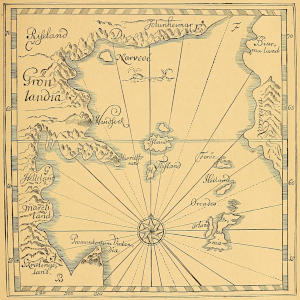
SIGURDI STEPHANII TERRARUM HYPERBOREARUM DELINEATIO, ANNO 1570.
Delineation of the Hyperborean Regions, by Sigurd Stephanus in the year 1570. (Size of the original, 6¾ inches square.)
But Iceland did not long remain the most remote part of the western world known to the people of Europe. Gunnbjörn, a Norwegian, driven westward in his ship beyond Iceland, in a storm, in 876, descried land looming up along the western horizon. In the latter part of the tenth century, Eric the Red, whom the public assembly of Iceland had declared an outlaw, determined to go in search of the land seen by Gunnbjörn. He sailed from Iceland about the year 981, and came in sight of the coast of Greenland, at a place called Midjökul.[40] He then steered southward to see whether the country were habitable. He passed the first winter near the middle of the site of the eastern settlement (eystri bygd).[41] In the following summer he reached the western uninhabited region (vestri ubygd),[42] and gave names to many places. As soon as the ice disappeared, at the close of the second winter, and the sea was again navigable, he returned to Iceland, and called the country which he had explored Graenland (Greenland), “because” he said, “people will be influenced to immigrate to it, if the land bears an attractive name.” Among those whom Eric induced to return with him as colonists to Greenland was a Norwegian, named Herjulf. Thirty-five ships (skipa) filled with emigrants set sail from Iceland for the newly explored country, but only fourteen of the vessels reached the places where the colonists were to dwell. Eric the Red settled at Brattahlid, and Herjulf erected his house on a cape called Herjulfsnes (Herjulf’s nose, or promontory).[43] “This was fifteen winters before Christianity was established by law in Iceland.”[44]
Among the traditions preserved of the voyages of the Northmen in the tenth, eleventh, and twelfth centuries, there are several that have caused considerable controversy respecting the historical and geographical value of the information contained in them; for a number of eminent writers have made use of this information to show that the Northmen were the first discoverers of America and the explorers of a large part of the eastern coast of the continent.[45] Although these sagas or legends of Iceland were unrecorded for several centuries, the manuscripts which now contain them are assumed to have been written in a manner so precise that translations of their text are presented to prove that the Norse vikings not only made frequent voyages to America, but that they have left definite and reliable information respecting the parts of the coast visited by them. Other distinguished writers consider these traditions as too mythical and vague to be deemed valuable, either historically or geographically, and argue that what is thought to describe the physical features and productions of parts of the present territory of the eastern coast of the United States describes the topography and fruits of Greenland. A brief narration of the most important particulars of the voyages of several of the Northmen who have been regarded, as the first discoverers of parts of the continent of America, will suffice to show the grounds upon which rest many of the arguments that have been advanced to support the opinion that these persons had landed upon its shores and explored a great extent of its Atlantic coast.
It is said in the saga of Eric the Red and of the Greenlanders,[46] that when Herjulf sailed, in the spring of 985, from Iceland to Greenland, his son Bjarni was in Norway. When the latter, in the following summer returned to Iceland, and learned that his father had emigrated to the country recently explored by Eric the Red, he determined to sail to it and pass the winter with his father, as had been his custom for many years. He evidently had some misgivings respecting the success of the contemplated voyage, for he said to his companions: “Our going there will be devoid of common-sense, since not one of us has traversed the Greenland Sea.” “Nevertheless,” as the tradition runs, “as soon as they had fitted for the voyage, they intrusted themselves to the ocean, and made sail three days, until the land passed out of their sight from the water. But then the bearing winds ceased to blow, and northern breezes and a fog succeeded. Then they were drifted about for many days and nights, not knowing whither they tended. After this the light of the sun was seen, and they were able to survey the regions of the sky. Now they carried sail, and steered this day before they beheld land.” They sailed near to it, and “soon saw that the country was not mountainous, but covered with trees and diversified with little hills. They left the land on their larboard side, and let the stern turn from the shore. Then they sailed two days before they saw another land [or region].... They then approached it, and saw that it was level and covered with trees. Then, the favorable wind having ceased blowing, the sailors said that it seemed to them that it would be well to land there, but Bjarni was unwilling to do so.... He bade them make sail, which was done. They turned the prow from the land, and sailed out into the open sea, where for three days they had a favorable south-southwest wind. They saw a third land [or region], but it was high and mountainous and covered with glaciers.... They did not lower sail, but holding their course along the shore, they found it to be an island. Again they turned the stern against the land, and made sail for the high sea, having the same wind, which gradually increasing, Bjarni ordered the sails to be shortened, forbidding the use of more canvas than the ship and her outfit could conveniently bear. Thus they sailed for four days, when they saw a fourth land” [or region], which was Greenland, where Bjarni found his father.[47]
Bjarni’s discoveries, it is said, were often the subject of conversation among the Northmen. It is further related that Leif, the son of Eric the Red, purchased Bjarni’s ship and set sail in it with thirty-five men from Brattahlid about the year 1000 to seek new lands. Nothing is told in the tradition concerning the direction in which these Northmen sailed, only that “they first came to the land [or region] last seen by Bjarni. They steered toward the shore, cast anchor, put out the boat, and went on land, where they saw no herbage. The whole country was filled with high icy mountains, and from the sea all the way to the icy mountains was a plain of flat stones.” Leif called the region Helluland.[48]
When Leif and his companions departed from Helluland, it is related that they “put out to sea and found another land [or region]. This was a level country and covered with trees.” Leif named it Markland.[49]
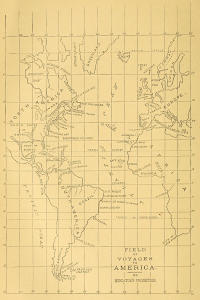
FIELD OF VOYAGES TO AMERICA.
ON MERCATOR’S PROJECTION.
As related in the saga, when they departed from Markland, “they sailed on the high sea, having a northeast wind, and were two days at sea before they saw land. They steered toward it and touched the island lying before the north part of the land. When they went on land they surveyed it, for by good fortune the weather was serene. They found the grass sprinkled with dew, and it happened by chance that they touched the dew with their hands and carried them to their mouths and perceived that it had a sweet taste which they had not before noticed. Then they returned to the ship and sailed through a bay lying between the island and a tongue of land running toward the north. Steering a course to the west shore, they passed the tongue of land. Here when the tide ebbed there were very narrow shoals. When the ship got aground there were shallows of great extent between the vessel and the receded sea. So great was the desire of the men to go on land that they were unwilling to stay on board until the returning tide floated the ship. They went ashore at a place where a river flowed out from a lake. When the tide floated the ship, they took the boat and rowed to the vessel and brought her into the river and then into the lake. Here they anchored, carried the luggage from the ship, and built dwellings. Afterward they held a consultation and resolved to remain at this place during the winter. Then they erected large buildings. There were not only many salmon in the river but also in the lake and of a larger size than they had before seen. So great was the fertility of the soil that they were led to believe that cattle would not be in want of food during winter, or that wintry coldness would prevail, or the grass wither much.”
While the Northmen were passing the winter on the shore of the unnamed lake, it happened one evening that a Southern man, named Tyrker, did not return with those who had been out exploring the country. Those who went to search for the absent man met him returning to the quarters. They were surprised when he told them that he had found wine-wood and wine-berries (vinvid ok vinber). “Is this true, my teacher?” asked Leif. “It is really true,” Tyrker replied, “for where I was brought up there was not wanting either wine-wood or wine-berries.” They passed this night in sleep, but on the following morning Leif said to the men: “Two things are now to be done on alternate days, gathering wine-berries or hewing wine-wood and felling trees, (lesa vinber, edr höggva vinvid ok fella mörkina,) with which my ships should be loaded.” Having loaded the ship and the spring approaching they prepared to depart. To designate the productions of the region, Leif called it Vinland (Wine-land). They then put to sea and had a favorable wind until they came in sight of Greenland.[50]
As a number of writers have assumed that the region of Vinland, where Leif and his companions wintered, was the country adjacent Mount Hope Bay, in Rhode Island, the following description of a part of the east coast of Greenland, given by Captain W. A. Graah, who was sent there, in 1828, by the Danish government to obtain information respecting the site of the eastern settlement (eystri bygd), will likely afford grounds for a more plausible conjecture that Vinland was a region in Greenland: “August 30 [1829].—The place we now were at was the Ekallumiut [between the sixty-third and sixty-fourth parallel of north latitude], so often mentioned. The cove, the length of which is between one and two cable-lengths, has on both sides of it, but particularly on the eastern, fields of considerable extent, covered with dwarf-willows, juniper-berry, black crake-berry, and whortleberry heath, the first-named growing to the height of two feet, and the whole interspersed with a good many patches of a fine species of grass, which, however, was very much burnt by the heat of the sun, except in the immediate vicinity of the brooks and rivulets that, in great number, ran down the sides of the hills, and intersected the level land in every direction. At the the bottom of the cove stretches an extensive valley, through which runs a stream abounding in char, [a species of salmon,] and having its source in the glaciers, of which several gigantic arms reach down into the valley from the height in the background. On the banks of this brook the grass grew luxuriantly; but it was far from being, at many places, of a height fit for mowing, so that even this spot, where grass was more abundant than anywhere else perhaps along the whole coast, does not seem calculated to furnish winter fodder for any considerable number of cattle. Various flowers, among which the sweet-smelling lychnis, everywhere adorned the fields.... At this really beautiful spot, the natives of the country round assemble for a few days during their brief summer, to feast upon the char that are to be got here in great plenty and of a great size, the black crake-berry and angelica, and to lay in a stock of them for winter use, and give themselves up to mirth and merry-making.”[51]
It is further related, in the saga, concerning Vinland, that “the days are more equal there than in Greenland or Iceland; there the sun sets at eykt time (eyktar-stad, 3:30 P.M.), and rises at day-meal time (dagmála-stad, breakfast-time), on the shortest day.”[52]
As there is no reliable information to indicate that the Northmen of the tenth century had any instruments by which they could accurately measure the changing spaces of day and night, or that their observations of the sun gave them the knowledge of astronomical time, an attempt to elucidate the exact duration of the shortest day in Vinland from the vague signification of the words eyktar-stad and dágmála-stad would consequently be futile and unsatisfactory. Nevertheless a number of scholars have attempted to determine the length of the shortest day at the place where the Northmen built their winter-quarters. Some have given the day a measurement of six hours, others seven, eight, and nine hours.[53] These different lengths of the day involve the inference that Vinland was somewhere between the forty-first and sixty-first parallels of north latitude.
It is related in another saga or legend that Vinland was visited in the eleventh century by other Northmen.[54] Among the number were Thorfinn Karlsefne, Snorro Thorbrandson, Bjarni Grimolfson, and Thorhall Gamlason. It is said that the three ships which departed from the western settlement, in the spring of 1007, had on board one hundred and forty men (40 manna ok hundrad). After sailing two days southward from Bjanneyjar they reached Helluland. “Thence they sailed two days, and turned from the south to the southeast,” and came to Markland.
When the Northmen departed from Markland, it is said in the saga that “they then sailed far to the southward along the coast and came to a promontory. The land lay on the right and had a long sandy beach. They rowed to it and found on a tongue of land the keel of a ship. They called this point of land Kjalarnes (Keel cape), and the beach Furdustrandir (Long Strand), for it took a long time to sail by it. Then the coast became sinuous. They then steered the ship into an inlet. King Olaf Tryggvason had given Leif two Scotch people, a man named Haki and a woman named Hekja. They were swifter than animals. These persons were in the ship with Karlsefne. When they had sailed past Furdustrandir they put these Scots ashore and ordered them to run to the south of the country and explore it, and return within three days.... They were absent the designated time. When they returned, one brought a bunch of wine-berries (vinberja köngul), the other an ear of wheat (hveitiax nysaid).[55] When they were taken on board, the ship sailed farther. They came into a bay, where there was an island around which flowed rapid currents that suggested the name which they gave it, Straumey (Stream island). There were so many eider ducks on the island that one could hardly walk about without stepping on their eggs. They called this place Straumfjörd (Stream inlet). They took the cargo from the ship and made preparations to remain there. They had with them different kinds of cattle. They undertook nothing but the exploration of the land. Without having provided food beforehand they sustained themselves there during the winter. In the summer the fishing was not good and they were in want of provisions. Thorhall the hunter disappeared. They had previously prayed to God to give them food, but they were not supplied as quickly as they thought their hunger demanded. They searched for Thorhall for three days. At last they found him lying on the top of a rock, looking up at the sky, gasping and muttering. They asked him why he was there. He said that his presence there should not trouble them. They prevailed on him to return home with them. A whale was stranded there, and they found it and cut it up. No one knew what kind of a whale it was, and when the cook prepared a part of it for them, they ate it and all were made sick. Then Thorhall said: ‘The red-bearded [Thor, the god of thunder,] was more helpful than your Christ; this [the whale meat] I have received for my hymns which I sing of Thor, my protector; seldom has he deserted me.’ When they heard this assertion, they cast the remainder of the whale into the sea and resigned themselves to the care of God. Then the weather favored them so that they were able to row out to fish, and thereafter they were not in want of food, for wild game was caught on land and fish in the sea, and eggs were collected on the island....
“It is said that Thorhall resolved to go northward along Furdustrandir to explore Vinland, but Karlsefne determined to sail southward along the coast. Thorhall fitted out his vessel under the island, having not more than nine men to join him, for all the others went with Karlsefne. Now when Thorhall carried water to his ship, he sang these verses:
‘People told me when I came Hither, all would be so fine; The good Vinland, known to fame, Rich in fruits and choicest wine; Now the water-pail they send; To the fountain I must bend, Nor from out this land divine Have I quaffed one drop of wine.’
“When they were about to depart and had hoisted sail, Thorhall again sang:
‘Let our trusty band Haste to Fatherland; Let our vessel brave Plough the angry wave, While those few who love Vinland, here may rove, Or, with idle toil, Fetid whales may boil, Here on Furdustrand, Far from Fatherland.’ ...
“It is now to be told of Karlsefne that he with Snorro and Bjarni and their people sailed southward along the coast. They sailed a long time until they came to a river, which ran out from the land and through a lake into the sea. The river was quite shallow, and no ship could enter it without high water. Karlsefne sailed with his people into its mouth and called the place Hóp (ok kölludu i Hópi).[56] They found fields of wild wheat (sjálfsana hveitiakra) where the ground was low, and wine-wood where it was higher.... There was a great number of all kinds of wild animals in the woods. They remained at this place a half-month and enjoyed themselves, but did not find any thing novel. They had their cattle with them. Early one morning, when they were viewing the country, they saw a great number of skin boats on the sea.... The people in them rowed nearer and with curiosity gazed at them.... These people were swart (svartir) and ugly, and had coarse hair, large eyes, and broad cheeks. They remained a short time and watched Karlsefne’s people. They then rowed away to the southward beyond the cape.
“Karlsefne and his people had erected their dwellings above the lake. Some of the houses were near the water and others were farther away. They remained here during the winter.[57] There was no snow, and their cattle subsisted on the grass.”
It is further related that when spring drew near the natives again visited the Northmen and trafficked with them. “The people preferred red cloth, and for this they gave skins and all kinds of furs. They also wanted to purchase swords and spears, but Karlsefne and Snorro would not sell them any weapons. For a whole skin the Skraelings (Skraelingar) took a piece of red cloth a span long, and bound it around their heads.”[58] In this way they bartered for a time. Then the cloth began to diminish, and Karlsefne and his men cut it into small strips not wider than one’s finger, and still the Skraelings gave as much for these as they had for the larger pieces, and often more. “It happened that a bull, which Karlsefne had with him, ran out from the wood and bellowed loudly. This frightened the Skraelings so much that they rushed to their boats and rowed away to the southward around the coast.”
Three weeks afterward a large number of Skraelings returned in their boats uttering loud cries. “Karlsefne’s men took a red shield and held it toward them. The Skraelings leaped from their boats and attacked them. Many missiles fell among them, for the Skraelings used slings (valslöngur). Karlsefne’s men saw that they had raised on a pole something resembling an air-filled bag of a blue color. They hurled this at Karlsefne’s party, and when it fell to the ground it exploded with a loud noise. This frightened Karlsefne and his men so much that they ran and fell back to the river, for it seemed to them that the Skraelings were inclosing them on all sides. They did not stop until they reached a rocky place where they stoutly resisted their assailants. Freydis [the wife of Thorvard] came out, and seeing Karlsefne’s people retreating, cried out: ‘Why do you run, stout men as you are, before these miserable wretches, whom I thought you could knock down as you do cattle! If I had weapons I know that I could fight better than you!’ They did not heed her words. Freydis then attempted to keep up with them but could not. She followed them to the woods. The Skraelings pursued her. She found a dead man in the way. It was Thorbrand Snorrason. A flat stone was sticking in his head. His sword was by his side. She grasped it and prepared to defend herself. The Skraelings came toward her. She exposed her bosom and struck her breast with the sword. The Skraelings were frightened and ran to their boats and rowed away. Karlsefne and his men then came and praised her courage. Karlsefne lost two men but the Skraelings many more....
“Karlsefne and his men now perceived that notwithstanding the country was fruitful they would be exposed to many dangerous incursions of its inhabitants if they should remain in it. They therefore determined to depart and return to their own land. They sailed northward along the coast and found five Skraelings clothed in skins sleeping on the sea-shore. They had with them vessels containing marrow mixed with blood. Karlsefne’s men believed that they had been banished from the country and they killed them. After that they came to a cape and there were many wild animals on it.... Then they reached Straum fjörd, where there was an abundance of every thing which they desired. It is said by some that Bjarni and Gudrid remained behind with one hundred men, and did not go farther, but that Karlsefne and Snorro went southward and forty men with them, and that they were not longer in Hóp than two months, and that they returned from there the same summer.... They inspected the mountains at Hóp, which they thought belonged to a range which extended in two directions to the same distance from Straum fjörd. The third winter they were in Straum fjörd.... Snorro, the son of Karlsefne, was born here the first autumn, and he was three years old when they went away from Vinland. When they sailed from Vinland they had a south wind and came to Markland.”[59]
The Northmen it seems continued their visits to Vinland as late as the fourteenth century. In the geographical treatise of Adam of Bremen, written in 1073, the author says that it was told him by Sveyn Estrithson, King of Denmark, that Vinland was an island: “Moreover he said that an island had been discovered by many in that ocean, which is called Vinland, because vines grow spontaneously there, producing excellent wine. For that fruits abound there not having been sown, we are assured not by any vague rumor but by the trustworthy report of the Danes.”[60]
The island of Vinland is described in an old geographical document as lying on the opposite side of a channel, between it and Greenland: “Now is to be told what lies opposite Greenland, out from the bay already mentioned. Furdustrandir is the name of a land. There are such hard frosts there that it is not habitable as far as is known. South of it is Helluland, which is called Skraeling’s land. From there it is not far to Vinland the good, which some think goes out from Africa. Between Vinland and Greenland is Ginnungagap which flows from the sea called Mare Oceanum that encompasses the whole earth.”[61] On a map made by Sigurd Stephanius, an Icelander, in 1570, Helluland, Markland, Skraeling’s land, and the promontory of Vinland are represented as parts of the country now called Greenland.[62]
No geographical information contained in the sagas of Iceland and Greenland verifies the statement that the Northmen discovered America and explored the coast of a part of the present territory of the United States. What tradition relates respecting the Northmen finding wine-berries in Vinland does not make it indubitably evident that they were the fruit now called grapes.[63] The wine-wood that was cut and carried on board of Leif’s ship indicates that there was no large timber in Vinland, and that the trees that were felled were of a stunted growth as those that are now found on the coast of Greenland. The statements respecting the great number of eider ducks, the natives who were frightened by the bellowing of a bull, the skin-boats used by them, the want of food by the Northmen, their eating the flesh of a stranded whale to escape starvation, and the sarcastic language of the song sung by Thorhall concerning Vinland being a land of wine, clearly establish the fact that this country or region was very near the Arctic circle. Further, all the early maps of Greenland show Helluland, Markland, and Vinland to be regions of that country.
The questionable interpretation of the characters on the rock, lying in the water, on the east side of the Taunton River, opposite Dighton, Massachusetts, by a number of foreign antiquaries, is a notable exemplification of the fictitious nature of the so-called evidence that the Northmen discovered America and explored a part of the eastern coast of the present territory of the United States.[64] The remarkable statement that the round, stone-tower, at Newport, Rhode Island, mentioned by Governor Benedict Arnold in his will, made in 1677, as “my stone-built windmill,” was erected by the Northmen, is also an instance of the infatuation of the learned men who believed it to be a Norse monument.[65]
The supposition that the Welsh adventurer, Madoc Guyneth, planted a colony on the Atlantic coast of North America, in the twelfth century, rests on some traditionary information in a history of Wales, published in 1584.[66] In this rare work it is related that the sons of Owen Guyneth, King of North Wales, on the death of their father, had many contentions respecting the heirship to his estates and who should rule after him. This strife mortified Madoc. In order to separate himself from his quarrelling brothers he fitted out a number of ships and sailed west, “leaving the coast of Ireland so far north, that he came to an unknown land, where he saw many strange things.” He then returned home and gave an account of the attractive and fertile countries “he had seen without inhabitants.” He induced a number of men and women, who desired to live peaceably, to emigrate to the western land. The second voyage was safely made to the colony in the “fair and large country.” He returned again to Wales for more colonists. Ten ships filled with emigrants shortly afterward set sail for the new settlement. It is further related that many fictions were current thereafter respecting Madoc’s discoveries in the unnamed country.[67] Meredith ap Rhees, a Welsh bard, who died in 1477, has rehearsed in a number of verses a part of the unsatisfactory tradition concerning Madoc’s voyage.[68] As said by Baron von Humboldt: “The deepest obscurity still shrouds every thing connected with the voyage of the Gaelic chief, Madoc.”[69]
The story of a Frisland fisherman, in the history of the discoveries of the Zeni brothers, published in 1558, is thought by some writers to be a true narrative of this man’s adventures on a part of the continent of America, in the fourteenth century.[70] It is related that Nicolò Zeno, a wealthy man, had a ship built, equipped, and manned at his own expense, and sailed in it from Venice, “with the intention of visiting England and Flanders.” But in a storm his vessel was cast upon an island called Frisland.[71] “The crew were saved together with most of the ship’s cargo. This occurred in the year 1380. The inhabitants of the island, having collected in considerable numbers, attacked the chevalier and his men, who, being exhausted by the hardships they had endured, and not knowing in what part of the world they had been thrown, were unable to resist them, much less to defend themselves with the spirit that the emergency demanded. They would have been treated, without doubt, in a most barbarous manner, had it not fortunately happened that a powerful chieftain, with an armed force, was in their neighborhood, who, learning that a large ship had been cast upon the island, and hearing the noise and shouts of the inhabitants as they rushed upon our poor mariners, hastened forward, and putting the islanders to flight, inquired of the Venetians, in Latin, of what nation they were, and whence they had come. When informed that they were from Italy, and natives of that country, he was filled with joy and amazement.... He was a great lord and possessed certain islands called Porland, about a half-day’s sail from Frisland, the richest and most populous of all the islands of those parts. This chieftain’s name was Zichmni.”
Nicolò Zeno then entered the service of this distinguished man. Some time afterward he wrote to his brother Antonio, and related these incidents. The latter visited Frisland, where he lived fourteen years. On the death of Nicolò, which occurred four years after Antonio’s arrival, he was appointed to take command of Zichmni’s fleet. From letters written by Antonio to his brother Carlo, the remarkable particulars of the following narrative are said to have been compiled:
“Six and twenty years ago four fishing-boats put out to sea from Frisland, and being overtaken by a storm were drifted about for many days in a helpless condition. When, at last, the tempest abated, they descried an island called Estotiland,[72] lying more than a thousand miles westward from Frisland. One of the boats was cast upon its coast, and the six men in it were taken by the inhabitants and conducted to a fair and populous city, where the king sent for many interpreters, but none could be found who understood the language of the fishermen except one man who spoke Latin, and who likewise had been cast by accident upon the same island. Ordered by the king, he asked them who they were, and where they came from, and when he reported their answer, the king desired that they should remain in that country. Accordingly, as they could not do otherwise, they obeyed his order, and remained five years on the island, and learned the language. One of them in particular visited different parts of the island, and reports that it is a very rich country, abounding in all good things. It is a little smaller than Iceland but more fertile. In the middle of it is a very high mountain, in which rise four rivers which water the whole country.
“The inhabitants are a very intelligent people and possess all the arts as we do; and it is believed that in time past they have had intercourse with our people, for he said that he saw Latin books in the king’s library, which they at the present time do not understand. They have their own language and letters. They have all kinds of metals, especially gold. Their foreign intercourse is with Greenland, where they import furs, brimstone, and pitch. He says that toward the south there is a great and populous country, very rich in gold. They sow corn and make beer, which is a kind of drink which northern people take as we do wine. They have woods of vast extent. They construct their buildings with walls, and there are many towns and villages. They make small boats and sail them, but they have not the loadstone, nor do they know the north by the compass. For this reason these fishermen were held in great esteem, insomuch that the king sent them with twelve boats to the southward to a country which they call Drogio; but in their voyage they had such stormy weather that they were in fear for themselves. Although they escaped a miserable death they afterward met a more painful one, for they were taken into the country and the greater number of them were eaten by the savages, who are cannibals and consider human flesh very savory meat. But as this fisherman and his remaining companions were able to show them the way to catch fish with nets, their lives were spared. Every day he would go fishing in the sea and in the fresh waters, and take a great number of fish, which he gave to the chiefs, and thereby ingratiated himself so much into their favor that he was greatly liked and held in high esteem by all.
“As this man’s fame spread among the different tribes, there was a neighboring chief who was very anxious to have him with him and to see how he practised his wonderful art of catching fish. With this object in view he made war on the other chief with whom the fisherman was, and being more powerful and a better warrior, he, at last, overcame him, and so the fisherman was sent to him with the rest of his companions. During the space of thirteen years that he dwelt in those parts, he says, he was sent in this manner to more than five-and-twenty chiefs, for they were continually fighting among themselves, this chief with that one, and solely for the purpose of having the fisherman to dwell with them, so that wandering up and down the country without any fixed abode, he became acquainted with almost all those regions. He says that it is a very great country, and, as it were, a new world. The people are very rude and uncultivated, for they all go naked, and suffer bitterly from the cold, nor have they the sense to clothe themselves with skins of the animals which they take in hunting. They have no kind of metal. They live by hunting, and carry lances of wood, sharpened at the point. They have bows, the strings of which are made of beasts’ skins. They are very fierce, and have deadly wars with one another, and eat the flesh of their captives. They have chiefs and certain laws, but differing in different tribes. The farther you go southwestward, however, the more refinement you meet with, because the climate is more temperate, but there they have cities and temples dedicated to their idols, in which they sacrifice men and afterward eat them. In those parts they have some knowledge and use of gold and silver.
“This fisherman after dwelling so many years in those parts resolved to return home if possible to his own country, but his companions, despairing of ever seeing it again, gave him Godspeed, and remained where they were. Accordingly he bade them farewell and made his escape through the woods in the direction of Drogio, where he was welcomed and kindly received by the chief of the place, who knew him and was a great enemy of the neighboring chief. Thus passing from one chief to another, being the same with whom he had been before, he, at last, reached, after a long time and many hardships, Drogio, where he remained three years. Here by good fortune he learned from the natives that some boats had appeared off the coast, and hopeful of being able to carry out his intention, he went to the beach, and found to his great delight that the men on board the boats had come from Estotiland. He immediately begged them to take him back with them, which they willingly consented to do. He understood the language of the country which none of them could speak, and they employed him as an interpreter. Afterward he traded in company with them to such good purpose that he became very rich, and having fitted out a vessel of his own he returned to Frisland.”[73]
When Zichmni heard the story of the returned fisherman, it is said that he prepared a fleet to go to the countries described by him. The fisherman dying about the time that the vessels were ready to sail, some of the seamen who had come from Estotiland in his ship were taken to pilot them. An island called Icaria was discovered, but no exploration of it could be made on account of the hostility of its inhabitants. The fleet afterward proceeded to the coast of Greenland, from which it sailed to Frisland.
The compiler of the history of the discoveries of the Zeni brothers says: “This discovery [made by the Frisland fisherman] Messere Antonio, in a letter to his brother Messere Carlo, related, ... saying that we have changed some old words and the antiquated style, but have left the substance entire.... Of these northern places, I [the compiler] have thought it good to draw a copy of the sailing chart, which I find I have among our family heirlooms, and, although it is rotten with age, I have succeeded with it tolerably well; and to those who take pleasure in such things, it will serve to throw light on the comprehension of that which without it could not be understood so easily.”
Inasmuch as it is difficult to disprove that the names Frislanda, Engronelanda, and Estotilanda were not early designations for Iceland, Greenland, and Scotland, the supposition that the unnamed Frisland fisherman passed thirteen years of his life on the continent of America solely rests upon the particulars of the story of his famous adventures as a maker of fishing-nets.