Chapter IV · 1492-1493.
Reading edition
Sensibly impressed with the importance of his undertaking, Columbus determined to keep a journal of such observations and incidents as were most noteworthy during the voyage. Governed by this intention, he made the following entry in his log-book, when he set sail for the remote shores of Cathay:
“In the name of our Lord Jesus Christ.
“Whereas the most Christian, high, excellent, and powerful rulers, the king and the queen of Spain and of the islands of the sea, our sovereigns, this present year, 1492, after your highnesses had ended the war with the Moors ruling in Europe, the same having terminated in the great city of Granada, where, on the second day of January, this present year, I saw the royal banners of your highnesses planted by force of arms upon the towers of the Alhambra, the fortress of that city, and beheld the Moorish king come out at the gate of the city and kiss the hands of your highnesses and of the prince, my sovereign, and in the present month, on account of the information which I had given your highnesses respecting the countries of India and of a sovereign called the Grand Khan, signifying, in our language, king of kings; how, at different times, he and his predecessors had sent to Rome soliciting instructors to teach him our holy religion, and how the holy father had never granted his request, whereby great numbers of people were lost, believing in idolatry and doctrines of perdition; therefore your highnesses, as catholic Christians and sovereigns, who love and promote the holy Christian religion, and are enemies of the sect of Mahomet, and of all idolatry and heresy, determined to send me, Christopher Columbus, (Cristóbal Colon,) to the previously mentioned countries of India, to see the said sovereigns, people, and territories, and to learn their disposition and the proper way of converting them to our holy religion; and furthermore, directed that I should not go by land to the East, as is customary, but by a westerly route, in which direction we have hitherto no certain evidence that any one has gone. Therefore, after having expelled the Jews from your dominions, your highnesses, in the same month of January, ordered me to proceed with a sufficient armament to the said regions of India, and for that purpose granted me great favors and ennobled me, that thereafter I might call myself Don and be high admiral (almirante mayor) of the sea, and perpetual viceroy and governor of all the islands and continent which I might discover and acquire, or which may hereafter be discovered and acquired in the ocean; and that this title should be inherited by my eldest son, and thus descend from generation to generation forever. Thereupon I left the city of Granada, on Saturday, the twelfth day of May, 1492, and proceeded to Palos, a seaport, where I armed three vessels very fit for such an expedition, and having provided myself with an abundance of stores and seamen, I set sail from this port on Friday, the third of August, half an hour before sunrise, and steered for the Canary Islands of your highnesses, which are in the said ocean, thence to take my departure and proceed till I arrived at the Indies, and perform the embassy of your highnesses to the sovereigns there, and discharge the orders given. Consequently, I have determined to write out daily a minute account of the voyage respecting what I do and see, and the passage, as hereafter will appear. Moreover, sovereign princes, besides recording each night my progress during the day and the run made during the night, I intend to make a new nautical chart (carta nueva de navegar), in which I shall delineate all the sea and the lands of the Ocean in their proper places under their wind; and, moreover, I shall compose a book and represent the whole like a picture by latitude, from the equator, and by longitude, from the West, wherefore it will cause me to abstain from sleep and to make many experiments in navigation, for these things will require no little labor.”[136]
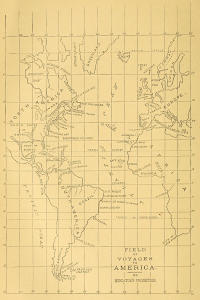
FIELD OF VOYAGES TO AMERICA.
ON MERCATOR’S PROJECTION.
The vessels of the fleet were the ship (la nao), Santa Maria,[137] commanded by Columbus, and two caravels, (carabelas,) La Pinta, commanded by Martin Alonso Pinzon, and La Nina, by Vicente Yañes Pinzon, his brother, both being natives and seamen of Palos. “Being furnished with all necessaries and ninety men,”[138] says Ferdinand Columbus, “they set sail on the third of August directly toward the Canaries, and from that time forward the admiral was very careful to keep an accurate journal of all that happened to him during the voyage, specifying the wind that blew, how far he sailed with it, the currents he found, and what he saw by the way, whether birds or fishes, or other things....
“The next day after the admiral’s departure for the Canary Islands, it being Saturday, the fourth of August, the rudder of one of the caravels, of the one called La Pinta, broke loose, and the caravel being compelled to lie to, the admiral soon reached her side, but the wind blowing hard he could render no assistance, as commanders at sea are obliged to do to encourage those that are in distress. This he did more promptly, as he conceived that the unshipping of the rudder had been brought about by the contrivance of the master to avoid going on the voyage, as he had attempted to do before they set sail.”[139]
At the Canary Islands, Columbus altered the sails of the caravel La Nina, and made a new rudder for the Pinta. On Thursday morning, the sixth of September, the three vessels set sail from the island Gomera, of the Canary group, “and stood away to the west.” On the following Sunday, at day-break, when the fleet was nine leagues west of the island of Ferro,[140] the sailors “lost sight of land, and many, fearing that it would be long before they should see it again, sighed and wept, but the admiral, after comforting them with large promises of land and of wealth, to raise their hopes and lessen their fears respecting the length of the voyage, pretended that by his computation they had sailed only fifteen leagues that day when they had really run eighteen, he having determined to keep, during the voyage, his reckoning short, in order that the men might not think that they were so far from Spain as they were, should he openly set down the progress made which he privately recorded.[141]
“Continuing his voyage in this way, on Wednesday, the twelfth of September, about sun-setting, being about one hundred and fifty leagues west of the island of Ferro, he discovered a large piece of the trunk of a tree of one hundred and twenty tons, which seemed to have been a long time in the water. There and somewhat farther the current set strongly toward the northeast. When he had run fifty leagues farther westward, on the thirteenth of September he found at night-fall that the needle varied half a point toward the northeast, and, at day-break, half a point more, by which he understood that the needle did not point at the north star, but at some other fixed and visible point. This variation no man had observed before, and therefore he had occasion to be surprised at it; but he was more amazed on the third day after this, when he was almost one hundred leagues farther, for at night the needles varied about a point to the northeast, and in the morning they pointed upon the star.”[142]
As they sailed on this westward course, they found “more weeds than they had hitherto toward the north as far as they could see, which weeds were sometimes a solace to them, believing that they might come from some land that was near, and sometimes they caused dread, because they were so thick that in some measure they impeded the ships, and fear making things worse than they are, they apprehended that that might happen to them which is fictitiously reported of Saint Amaro in the Frozen Sea, which it is said does not suffer ships to stir backward or forward, and therefore they steered away from the shoals of weeds as far as possible.[143]
“The wind at this time blew at southwest, sometimes more and sometimes less west, which, though contrary to their voyage, the admiral said he considered a very good wind and a help to them, because the men, continually grumbling, said that among the things which increased their fears this was one, for the wind being always astern, they should never have a gale in those seas to carry them back; and though sometimes they found the contrary, they alleged that it was no settled wind, and that not being strong enough to swell the sea, it would never carry them back as far as they had to sail. Although the admiral did whatever he could to make them cheerful, telling them that the land being now so near did not permit the waves to rise, and using the best argument he could, nevertheless he affirms that he stood in need of God’s special help, as Moses did when he led the Israelites out of Egypt, who forbore laying violent hands upon him, because of the wonders God wrought through him. The admiral said that he was similarly protected in this voyage. On the following Sunday the wind began to blow from the west-northwest, with a rolling sea as the men wished, and three hours before noon they saw a turtle-dove fly over the ship, and in the evening they saw a pelican, a river fowl, and other wild birds, and some crabs among the weeds; and the next day they espied another pelican, and several small birds which came from the west, and small fishes, some of which the men of the other vessels stuck with harpoons, because they would not bite at the hook.”[144]
“As often as the men were deceived by these signs of land, so often had they occasion to be suspicious and to grumble and conspire together. They said the admiral, for a foolish whim, intended to make himself a great lord at the hazard of their lives, and since they had done their duty in trying their fortune, and had gone farther from land and any succor than others had done, that they ought not to destroy themselves, nor proceed farther on the voyage, because if they did, they should have reason to repent, for their provisions would fall short and the sails of the ships would not last, which they knew were already so impaired that it would be difficult to retrace their course from where they were; and that none would condemn them for returning, but that they would be regarded as very brave men for going upon such an expedition and venturing so far, and that the admiral being a foreigner, and having nothing at stake, and as many wise and learned men had condemned his opinion, there would be nobody now to favor and defend him, and that they should get more credit than he if they accused him of ignorance and mismanagement, whatever he should say for himself. And there were some who said that to end all dispute, in case he would not consent to return, that they could make short work of it and throw him overboard, and report that while he was making his observations he fell into the sea, and that no man would trouble himself to inquire into the truth of the matter; which deed would hasten their return home and preserve their lives. Thus they conducted themselves from day to day, grumbling, complaining, and conspiring together. The admiral was not without apprehensions of their inconstancy and evil intentions toward him. Therefore, sometimes with fair words and sometimes with a strong determination to expose his life, putting them in mind of the punishment due them if they hindered the voyage, he, in some measure, quelled their fears and suppressed their evil designs. To confirm the hope with which he had inspired them, he reminded them of the previous signs and indications, assuring them that they would soon find land, which they were so eager to see that they thought every hour a year until they beheld it....
“On Sunday morning [the thirtieth of September], four rush-tails came to the ship, and as they flew there together, it was thought that land was near, especially when, not long afterward, four pelicans flew by, and an abundance of weeds was seen, lying in a line west-northwest and east-southeast, and also a great number of those fishes they call emperadores, which have a very hard skin and are not fit to eat. However much the admiral regarded these signs, still he never forgot those in the heavens and the course of the stars. He therefore observed in this place, to his great astonishment, that the stars of Charles’s wain, at night, appeared in the west, and in the morning they were directly northeast, from which he inferred that their whole night’s course was but three lines or nine hours—that is, so many parts of twenty-four,—and this he did every night. He also perceived that at night-fall the compass-needle varied a whole point to the northwest, and at day-break it came right with the star. These things confounded the pilots until he told them that the cause of it was the circuit the star took about the pole, which was some satisfaction to them, for this variation made them apprehend some danger at such an unknown distance from home, and in such strange regions....
“On Monday, the first of October, at sunrise, a pelican came to the ship, and two more about ten in the morning, and long beds of weeds extended from east to west. That day, in the morning, the pilot of the admiral’s ship said that they were five hundred and seventy-eight leagues west of the island of Ferro. The admiral said, by his reckoning, they were five hundred and eighty-four leagues; but in secret he concluded it was seven hundred and seven, which is one hundred and twenty-nine leagues more than the pilot reckoned. The other two vessels differed much in their computations, for the pilot of the caravel Nina, on the following Wednesday afternoon, said they had sailed five hundred and forty leagues, and the other of the caravel Pinta said six hundred and thirty-four....
“On Thursday afternoon, the fourth of October, a flock of more than forty sparrows and two pelicans flew so near the ship that a seaman killed one of them with a stone; and before this they had seen another bird like a rush-tail, and another like a swallow, and a great many flying-fish fell into the vessels. The next day there came a rush-tail and a pelican from the west, and great numbers of sparrows were seen.
“On Sunday, the seventh of October, about sunrise, some signs of land appeared westward, but being undefined, no one said any thing, for fear of the consequence of asserting what did not exist, and also for fear of losing the thirty crowns which their catholic majesties had promised as an annuity during the life of him who should first discover land. In order to prevent the men from crying land, land, at every turn, as they would likely have done without cause to secure the gift, it was ordered that whoever said he saw land, if it were not ascertained to exist in three days from that time, should lose the reward, even if afterward he should be declared to be the first discoverer of land. All on board of the admiral’s ship being thus forewarned, none dared to cry out land, but those in the caravel Nina, which was a better sailer, and kept ahead, once believing that they actually saw land, fired a gun, and displayed their colors to indicate land. But the farther they sailed the more their joyous expectations diminished and the indication of land disappeared. However, it pleased God to give them soon after some comforting assurances, for they saw great flocks of large fowl and others of small birds flying from the west toward the southwest. Therefore, the admiral, being now so far from Spain, and sure that such small birds would not go far from land, altered his course, which until that time had been westward, and stood to the southwest, saying, that his reason for changing his course was that he would deviate but a little from his first intention and that he would be following the example of the Portuguese, who had discovered the greater number of their islands by means of such birds, and more especially as the birds he saw flew generally in the same direction. He also had always proposed to himself to find land according to the place they were in; since, as they well knew, he had often told them that he never expected to find land until he was seven hundred and fifty leagues westward of the Canary Islands, within which distance, he had further said, he should discover Española, which, at this time, he called Cipango....
“On Monday, the eighth of October, there came to the ship twelve singing-birds of several colors, and after flying about the vessel, they held on their way. They also saw from the vessels many other birds flying toward the southwest, and that same night great numbers of large fowls were seen, and flocks of small birds coming from the north, and flying after the others. Besides they saw a good number of tunny-fish. In the morning they saw a jay, a pelican, some ducks, and small birds, flying the same way as the others had done, and they perceived that the air was fresh and odoriferous, as it is at Seville in April. But they were now so eager to see land, that they had no faith in any signs; so that, on Wednesday, the tenth of October, although they saw a great many birds pass by during the day and at night, the men did not cease to complain, or the admiral to censure them for their want of confidence, declaring to them, that right or wrong they must go farther to discover the Indies for which purpose their catholic majesties had sent them.
“The admiral being no longer able to withstand the number that opposed him, it pleased God that on Thursday afternoon, the eleventh of October, the men took heart and rejoiced, because they had unquestionable signs that they were near land. Those on board the admiral’s ship saw a green rush float by the ship, and then a large green fish of that class which go not far from the rocks. Those on board the caravel Pinta saw a cane and a staff, and picked up another staff curiously wrought, and a small board, and an abundance of fresh weeds washed from the shore. Those in the caravel Nina saw similar things, and a branch of a thorn full of red berries, which seemed to be recently broken off. By these signs and by his own consciousness, the admiral, being assured that he was near land, made a speech to all the men in the evening, after prayers, reminding them how merciful God had been in bringing them on so long a voyage with such fair weather, and comforting them with indications which every day were plainer and plainer. He begged them to be very watchful that night, for they were aware that in the first article of the instructions he had given each ship at the Canary Islands, that he had ordered that when they had sailed seven hundred leagues to the west, without discovering land, that they should lie to from midnight until daylight. Therefore, since they had not yet obtained their desires in discovering land, they should at least manifest their zeal by being watchful. And inasmuch as he had the strongest assurances of finding land that night, each should watch in his place; for besides the annuity of thirty crowns which their highnesses had promised for a life-time to the one that first saw land, to the same person he would give a velvet doublet.
“After this, about ten at night, as the admiral was in the great cabin, he saw a light on shore, but said it was so obscure that he could not affirm it to be land, though he called Pedro Gutierrez, and bid him observe whether he saw the light, who said he did. Shortly afterward they called Rodrigo Sanchez, of Segovia, to look that way, but he could not see it, because he did not come in time to the place where it might have been seen. They did not see it more than once or twice, which induced them to think that it might have been a candle or a torch belonging to some fisherman or traveller, who lifted it up and down; or, perhaps, that it was in the hands of people going from one house to another, as the light vanished and suddenly appeared again.... Being now very watchful, they still held on their course, until about two in the morning, when the caravel Pinta, which, being an excellent sailer, was far ahead, gave the signal of land, which was first discovered by a sailor named Rodrigo de Triana, when two leagues from the shore. But the annuity of thirty crowns was not given to him by their catholic majesties, but to the admiral, who had seen the light in the darkness, signifying the spiritual light that he was then spreading in those dark regions. Being now near land, all the ships lay to, those on board thinking it was a long time until morning, when they might see what they had so long desired.”[145]
This island, says Bartolomé de las Casas, the Spanish historian,[146] was “one of the Lucayos, called by the Indians Guanahani.[147] Presently they descried people, naked, and the admiral landed in the boat, which was armed, along with Martin Alonso Pinzon and Vicente Yañez, his brother, captain of the Nina. The admiral bore the royal standard, and the two captains each a banner of the green cross, which all the vessels had carried. The banner was emblazoned with the initials of the names of the king and queen[148] on each side of the cross, with a crown over each letter. When they came on the beach, they saw trees very green, an abundance of water, and fruit of different kinds. The admiral called the two captains and the other men who had come on land, and Rodrigo de Escovedo, notary of the fleet, and Rodrigo Sanchez de Segovia, and said that he had summoned them to bear witness that he, before all other men, took possession (as in act he did) of that island for the king and the queen, his sovereigns, making the requisite declarations which are more at large set down in the instrument which they made there in writing.”
The natives who collected around the Spaniards at their landing are thus described by Columbus: “I perceived that if they should have much friendship for us that it was a people that could be emancipated and converted to our holy religion better by love than by force. I gave a number of them some red caps and some beads of glass, which they placed around their necks, and many other things of little value, with which they were much pleased, and they became so friendly that their attachment seemed strange to us. Afterward they came swimming to the boats of the ships, where we were, bringing parrots and thread of cotton in hanks, javelins, and many other things, which they exchanged for other articles we gave them, such as glass beads and little bells. Finally they took every thing and gave whatever they had with good-will. But to me they seemed to be a very poor people. They were all naked, just as they were born, and even the women, although I did not see but one young girl. All the rest I saw were youths, but none more than thirty years of age; very well made, of good shape, and very attractive faces; their hair coarse as that of the tail of a horse, and short, brought over the forehead to the eyebrows, except a little on the back of the head, which is longer and never cut. Some paint themselves black, for they are of the color of those of the Canary Islands—neither black nor white; others paint themselves white or red, or with any color they find. Some paint their faces, and some their bodies; others only their eyes or their noses. They carry no weapons and they have no knowledge of them; for when I showed them swords they took them by the edge and they cut themselves through ignorance. They have no iron. Their javelins are rods without iron, and some of these have at the end a fish-tooth, and others have other things. All of them, as a class, are of a commanding stature, and are good-looking, well formed. I saw some marks of wounds on their bodies, and I asked by signs what had caused them. They answered me in the same way, that people came from the other islands thereabout to capture them, and they defended themselves. I thought then, and still believe, that those people came from the continent, (tierra firme,) to take them prisoners. They ought to be good servants and very capable, because I perceived that they repeated very readily all that I told them, and I believe that they would easily become Christians, for they seemed to me as if they had no religion. If pleasing to our Lord, I shall carry from this place, at the time of my departure, six of them to your highnesses, in order that they may learn to talk in our language. I did not see any animals of any kind on the island, except parrots....
“Soon after day-break [on Saturday, the thirteenth of October,] many of these people came to the beach, as I have said, all youths and of good stature, a very handsome people; their hair not curled, but straight and coarse, like horse-hair, and all with faces and heads much broader than any other race that I have seen; their eyes very beautiful and not small; they were not black, but the color of those of the Canaries, nor ought it to be expected otherwise, for it is east-west (Lesteoueste) with the island Ferro of the Canary group, on the same parallel.[149] ... They came to the ship in canoes, log-boats, made of the trunks of trees, all of one piece, and fashioned in a wonderful manner, considering the country. In some of the large ones were as many as forty or forty-five men, and in others that were smaller there was only one person. They rowed with an oar resembling the wooden shovel used by bakers, and went wonderfully fast, and if the canoe upset, all swam and set it right again, bailing it out with calabashes which they carried with them. They brought balls of spun cotton, and parrots, and javelins, and other things which it would be tedious to describe, and which they parted with for any thing that was given them. And I was inquisitive and endeavored to ascertain if they had gold, and I saw some who wore small pieces hanging from holes in their noses, and I learned by signs that, by going to the south, or by going around the island to the south, I would find a king who had large vessels made of gold, and great quantities of the precious metal.”[150]
Columbus describing this island, which he named San Salvador (the Holy Saviour), under whose protection he had made the discovery, continues: “This is a large and level island, with extremely flourishing trees, and streams of water. There is a large lake in the middle of the island, but no mountains. It is entirely covered with verdure and it is delightful to behold. The natives are an inoffensive people, and so desirous to possess any thing they saw with us that they kept swimming off to the ships with whatever they could find, and readily bartered for any article we saw fit to give them in return, even such things as broken platters and pieces of glass. I saw in this manner sixteen balls of cotton thread, which weighed about twenty-five pounds, exchanged for three Portuguese ceutis.[151] This traffic I forbade, and permitted no one to take their cotton from them, unless I should order it to be procured for your highnesses, if sufficient quantities could be obtained. It grows on this island, but from my short stay here I could not inform myself fully respecting it. The gold they wear in their noses is also found here. But not to lose time, I am determined to proceed and ascertain whether I can reach Cipango (Japan)....
“In the morning, [Sunday, the fourteenth of October,] I ordered the boats to be manned and furnished, and coasted along the island toward the north-northeast, to examine that part of it, for we had landed first on the eastern part. We soon discovered two or three villages, and the people all came down to the shore, calling to us, and giving thanks to God. Some brought us water, and others food. Others seeing that I was not disposed to land plunged into the sea and swam to us, and we observed that they interrogated us to know if we had come from heaven. An old man came on board my boat. The others, both men and women, cried with loud voices: ‘Come and see the men who have come from heaven! Bring them food and drink!’ Thereupon many of both sexes came to the beach, every one bringing something, giving thanks to God, prostrating themselves on the ground, and lifting their hands to heaven. They called to us loudly to come on land, but I was apprehensive on account of a reef of rocks, which, except where there is a narrow entrance, surrounds the whole island, although within there is depth of water and space sufficient for all the ships of Christendom....
“After I had taken a survey of these parts, I returned to the ship. Setting sail, I discovered so many islands that I knew not which to visit first. The natives whom I had taken on board informed me by signs that there were so many of them that they could not be numbered. They repeated the names of more than a hundred. I determined to steer for the largest, which is about five leagues from San Salvador; the others were at a greater or less distance from this island....
“We stood off and on during the night [of Monday, the fifteenth of October], determining not to come to anchor till morning, fearing to meet with shoals. We continued our course in the morning, and as the island was found to be six or seven leagues distant, and the tide was against us, it was noon before we arrived there. I found that part of it, toward San Salvador, extending from north to south to be five leagues, and the other side, along which we coasted, running from east to west, to be more than ten leagues. From this island, espying a still larger one to the west, I set sail in that direction and kept on till night without reaching the western extremity of the island, where I gave it the name of Santa Maria de la Concepcion.... I now set sail for another large island to the west.... This island is nine leagues distant from Santa Maria, in a westerly direction. This part of it extends from northwest to southeast, and it appears to be twenty-eight leagues long, very level, without any mountains, as were San Salvador and Santa Maria, having a good shore which was not rocky, except a few ledges under the water, where it is necessary to anchor at some distance out, although the water is clear and the bottom can be seen....” This island he called Fernandina, in honor of the king of Spain.
On Friday, the nineteenth of October, he descried an island, “toward which,” he remarks, “we directed our course, and before noon all three of the vessels arrived at the northern extremity, where a rocky islet and reef extend toward the north, with another between them and the main island. The Indians on board the ships called this island Saomete. I named it Isabela [in honor of the queen]. It lies westerly from the island of Fernandina, and the coast extends from the islet twelve leagues west to a cape I called Cabo Hermoso, for it was a beautiful, round headland, with a bold shore free from shoals. Part of the shore is rocky, but the remainder of it, like most of the coast here, a sandy beach.... This island is the most beautiful that I have yet seen, the trees in great numbers, flourishing and tall; the land is higher than the other islands, and exhibits an eminence, which, though it cannot be called a mountain, yet it adds a charm to the appearance of the island, and indicates the existence of streams of water in the interior. From this part toward the northeast is an extensive bay, with many large and dense groves.... I am not solicitous to examine particularly every thing here, which, indeed, could not be done in fifty years, for it is my desire to make all possible discoveries, and return to your highnesses, if it please our Lord, in April. However, should I meet with gold or spices in great quantity, I shall remain till I collect as much as possible, and for this purpose I am only proceeding in search of them.” ...
Under the date of Sunday, the twenty-first of October, while at anchor off the island of Isabela, Columbus writes: “I shall depart immediately, if the weather serve, and sail round the island till I succeed in meeting with the king, in order to see if I can acquire any of the gold which, I hear, he possesses. Afterward I shall set sail for another very large island, which I believe to be Cipango, according to the signs I receive from the Indians on board. They call the island Colba [Cuba], and say there are many large ships and sailors there. Another island they call Bosio, and inform me that it is very large. The others that are on the course I shall examine on the way, and accordingly as I find gold or spices in abundance, I shall determine what to do. Nevertheless, I am determined to proceed to the continent, and visit the city of Guisay [the city of heaven, the residence of the Grand Khan], where I shall deliver the letters of your highnesses to the Grand Khan, and demand an answer, with which I shall return....
“Tuesday, the twenty-third of October.... It is now my determination to depart for the island of Cuba, which I believe to be Cipango from the accounts I have received here of the great number and riches of the people. I have abandoned the intention of staying here and sailing round the island in search of the king, as it would be a waste of time, and I perceive there are no gold mines to be found.... And as we are going to places where there is great commerce, I judge it inexpedient to linger on the way, but to proceed and survey the countries we meet with, till we arrive at that one most favorable for our business. It is my opinion that we shall find much profit there in spices, but my want of knowledge in these articles occasions me extreme regret, inasmuch as I see a thousand kinds of trees, each kind with its particular fruit, and as flourishing at this time as the fields in Spain during the months of May and June. Likewise a thousand kinds of herbs and flowers, of the properties of which I remain in ignorance, with the exception of the aloe, which I have directed to-day to be taken on board in large quantities for the use of your highnesses....
“Wednesday, the twenty-fourth of October.... At midnight weighed anchor and set sail from Cabo del Isles of the island of Isabela, being in the north part, where I had remained preparing to depart for the island of Cuba, in which place the Indians tell me I shall find great commerce, with abundance of gold and spices, and large ships, and merchants. They direct me to steer toward the west-southwest, which is the course I am holding. If the accounts which the natives of the islands and those on board the ships have communicated to me by signs (for their language I do not understand) are credible, this must be the island of Cipango, of which we have heard so many wonderful things. According to my geographical knowledge it must be somewhere in this neighborhood.”
On Sunday, the twenty-eighth of October, Columbus’s ships arrived off the coast of Cuba and “entered an attractive river, free from shallows and all other obstructions.... The mouth of the river had a depth of twelve fathoms of water, and a breadth sufficient for ships to beat in. They anchored within the river, and the admiral remarks that the scenery here exceeded in beauty any thing he had ever seen, the river being bordered with trees of the most beautiful and luxuriant foliage of a peculiar appearance, and its banks covered with flowers and fruits of different kinds. Birds were here in great number singing most charmingly. Numerous palm trees were seen, different from those of Guinea and Spain, not having the same kind of bark. They were of a moderate height and bore very large leaves, which the natives used to cover their houses. The land appeared quite level. The admiral went ashore in a boat, and found two dwellings, which he supposed to be those of fishermen, and that the owners had fled. He found in one of them a dog unable to bark. Both houses contained nets of palm, lines, horn fish-hooks, harpoons of bone, and other implements for fishing, as also many fire-places, and each house seemed sufficiently large to shelter a great number of people. The admiral gave orders that nothing should be touched.... They returned on board the boat and ascended the river some distance.... The admiral declares this to be the most beautiful island ever seen, abounding in good harbors and deep rivers, with a shore upon which it appears the sea never breaks high, as the grass grows down to the water’s edge, a thing that never happens where the sea is rough. Indeed, a high sea they had not yet had among these islands. This island, he says, is full of attractive mountains, which are lofty, although not of great range. The rest of the country is high, similar to Sicily, abounding in streams, as they understood from the Indians of Guanahani that were on board the ships, who informed them by signs that it contained ten large rivers, and that the island was so large that with their canoes they could not sail round it in twenty days.... The Indians told them there were mines of gold here and pearls.... They further informed him that large vessels came there from the Grand Khan, and that the main-land was distant a voyage of ten days. The admiral named the river and port San Salvador.” Farther westward, along the northern side of the island, Columbus discovered the rivers which he called Rio de la Luna (River of the Moon), and the Rio de Mares (River of Seas). The houses which were built on the shores of the latter river, he says, were “the finest he had yet seen, and thinks, the nearer he approaches the continent, they will continue to improve. They were of a large size, built in the shape of a tent, and each collection of them appeared like a camp, without any order of streets, the houses scattered here and there. Their interiors were found very clean and neat, well furnished and set in order. The houses were all built of fine palm branches. They found here many statues shaped like women, and numerous heads somewhat like masks, well made; whether these were used as ornaments, or objects of worship, did not appear. Here, about the houses, were small fowl originally wild, but now tame.”
On Tuesday, the thirtieth of October, “they sailed from the river which they had named Rio de Mares, and standing to the northwest, discovered a cape covered with palm trees, which the admiral called Cabo de Palmas; it is fifteen leagues distant from the place of their departure. The Indians on board the Pinta signified to the Spaniards, that beyond this cape was a river, and from this river to Cuba was a distance of a voyage or a journey of four days. The captain of the Pinta declared that he understood Cuba to be a city, and that the land here was a continent of great extent which stretched far to the north; also that the king of this country was at war with the Grand Khan, whom the Indians called Cami, and his country or city, Fava and other names. The admiral determined to steer for this river, and to send a present and the letter of the Spanish sovereigns to the king.... Seemingly the admiral was forty-two degrees distant from the equator toward the north, if the manuscript is not corrupted from which I [Las Casas] have taken this [information], and he says that he had undertaken to go to the Grand Khan, who, he thinks, was near there or in the city of Cathay of the Grand Khan, which city is very large according to what was told before he departed from Spain.”
The vessels having returned on Wednesday to the Rio de Mares from a short exploration of the coast, the admiral at sunrise, on Thursday, sent some of his men ashore “to visit the houses they saw there. They found the inhabitants had all fled, but after some time they espied a man. The admiral then sent one of his Indians ashore, who called to him from a distance and bade him not to fear any harm as the Spaniards were a friendly people, not injuring any one nor belonging to the Grand Khan, but on the contrary had made many presents of their goods to the inhabitants of the islands. The natives, having ascertained that no ill treatment was intended them, regained confidence, and came in more than sixteen canoes to the vessels, bringing cotton yarn and other things, which the admiral ordered should not be taken from them, as he wished them to understand that he was in search of nothing but gold, which they called nucay. All day the canoes passed between the ships and the shore. The admiral saw no gold among them, but remarks that, having observed an Indian with a piece of wrought silver in his nose, he conceived it to be an indication of the existence of that metal in the country. The Indians informed them by signs that within three days many traders would come there from the interior to purchase the goods of the Spaniards to whom the traders would communicate news of the king, who, as far as could be learned from the signs of the natives, resided at a place that was a journey of four days from there. They informed the Spaniards also that many persons had been sent to tell the king respecting the admiral. These people were found to be of the same race and manners as those already seen, without any religion that could be discovered. The Spaniards never saw the Indians who were kept on board the vessels engaged in any act of worship, but they would, when directed, make the sign of the cross, and repeat the Salve and Ave Maria, with their hands extended toward heaven. The language is the same throughout these islands and the people friendly toward one another, which the admiral says he believes to be the case in all the neighboring parts, and that they are at war with the Grand Khan, whom they call Cavila, and his country Bafan. These people go naked as the others.... It is certain, says the admiral, that this is the continent, and that we are in the neighborhood of Zayto and Guinsay, a hundred leagues more or less distant from the one or the other.”[152]
With his thoughts all aglow with his seeming power to prove the correctness of his geographical conjecture that he had reached the eastern coast of Asia, Columbus sent from this place, on the second of November, Rodrigo de Jerez of Ayamonte, and Luis de Torres, a Jew, (the latter having lived with the adelantado of Murcia, and who knew Hebrew, Chaldaic, and some Arabic,) and two Indians, into the interior of the island, with letters to the Grand Khan of Cathay. “He gave them strings of beads to purchase provisions, and directed them to return within six days. Specimens of spicery were intrusted to them that they might know if any thing similar existed in the country. He took care to instruct them how they should inquire for the king, and what they were to say to inform him that the king and queen of Castile had dispatched him with letters and a present for his majesty. Furthermore, the envoys were instructed to obtain some knowledge of the country, and observe the ports and rivers, with their distances from the place where the ships lay. Here the admiral took this night the altitude with a quadrant, and found that he was forty-two degrees from the equator, and by his calculation eleven hundred and forty-two leagues from Ferro, and he was confident that it was the continent.”[153]
Among the noticeable things which the embassadors observed while journeying into the interior of Cuba was the common use of tobacco by the natives. “The two Spaniards,” says Las Casas, “met upon their journey great numbers of people of both sexes: the men always with a firebrand in their hands and certain herbs for smoking. These were dry and were placed in a dry leaf, after the manner of those paper tubes which the boys in Spain use at Whitsuntide. Lighting one end, they drew the smoke by sucking at the other. This causes drowsiness and a kind of intoxication, and according to the statement of the natives relieves them from the feeling of fatigue. These tubes they call by the name of tabacos.”[154]
While waiting the return of the embassadors to the Grand Khan, Columbus acquired some knowledge of the productions of Cuba. “The soil is very fertile, producing mames, a root like a carrot, tasting like chestnuts. Beans are also found here but very dissimilar to ours; also cotton, growing spontaneously among the mountains. I am of the opinion that it is gathered at all seasons of the year, for I observed upon a single plant blossoms, buds, and open pods. A thousand other productions I have also observed, which doubtless are of great value, but it is impossible for me to describe them.”
On the fifth of November, the party sent to the Grand Khan returned, and gave these particulars of their journey: “After having travelled a dozen leagues they came to a town containing about fifty houses, where there were probably a thousand inhabitants; each house containing a large number of people. The houses were built after the manner of large tents. The inhabitants received them, after their fashion, with great ceremony. The men and women flocked to behold them, and they were lodged in their best houses. They showed their admiration and reverence by touching the strangers, kissing their hands and feet, and manifesting astonishment. They imagined them to be from heaven, and signified as much to them. They were feasted with such food as the natives had to offer. Upon their arrival at the town the chief men of the place led them by the arms to the principal building; here they gave them seats, and the Indians sat upon the ground in a circle round them. The Indians who had accompanied the Spaniards explained to the natives the manner in which their strange guests lived, and gave a favorable account of their character. The men then left the building, and the women entered, and sat around the Spaniards as the men had done. They kissed their hands and feet and examined them to see whether they were flesh and bone like their own.... No village was seen upon the road of a larger size than five houses.... Great numbers of birds were observed, all different from those of Spain except the nightingales, which delighted them with their songs. Partridges and geese were also found in great number. Of quadrupeds they saw none except dogs that could not bark. The soil appeared fertile and under good cultivation, producing the mames already mentioned and beans very dissimilar to ours, as well as the grain called panic. They saw large quantities of cotton, spun and manufactured. A single house contained more than five hundred arrobas[155] of it. Four thousand quintals might be collected here yearly.... These people are inoffensive and peaceable. They are unclothed, but the women wear a slight covering about their loins. Their manners are very decent, and their complexion not very dark, but lighter than the inhabitants of the Canary Islands. ‘I have no doubt, most serene sovereigns,’ says the admiral, ‘that were some proper, devout, and religious persons to come among them and learn their language, it would be an easy matter to convert them all to Christianity, and I hope in our Lord that your highnesses will devote yourselves with much diligence to this object, and bring as great a multitude into the church, inasmuch as you have exterminated those who refused to confess the Father, Son, and Holy Ghost.’
“I have observed that these people have no religion, neither are they idolaters, but are a very gentle race, without the knowledge of any iniquity. They neither kill, steal, nor carry weapons, and are so timid that one of our men can put a hundred of them to flight, although they readily sport and play tricks with them. They have the knowledge that there is a God above, and are firmly persuaded that we have come from heaven. They quickly learn such prayers as we repeat to them, and also to make the sign of the cross.’ ...
“Along the Rio de Mares, which I left last evening, [Sunday, the eleventh of November,] there is undoubtedly considerable mastic, and the quantity might be increased, for the trees when transplanted easily take root. They are of a lofty size, bearing leaves and fruit like the lentisk. The tree, however, is taller and has a larger leaf than the lentisk, as is mentioned by Pliny, and as I have myself observed in the island of Scio, in the Archipelago. I ordered many of these trees to be tapped in order to extract the resin, but as the weather was rainy all the time I was on the river, I was unable to procure more than a very small quantity, which I have preserved for your highnesses.... Great quantities of cotton might be raised here, and sold profitably, as I think, without being carried to Spain, but to the cities of the Grand Khan, which we shall doubtless discover, as well as many others belonging to other sovereigns. These may become a source of profit to your highnesses by trading there with the productions of Spain and of the other countries of Europe. Here also is to be found plenty of aloe, which, however, is not of very great value, but the mastic assuredly is, as it is found nowhere else than in the previously mentioned island of Scio, where, if I rightly remember, it is produced to the amount of fifty thousand ducats annually.”
Columbus further remarks, that at this point, near the river which he had called Rio del Sol, “he found the weather somewhat cold, and, as it was in the winter, he thought it not prudent to prosecute his discoveries any farther toward the north.”[156]
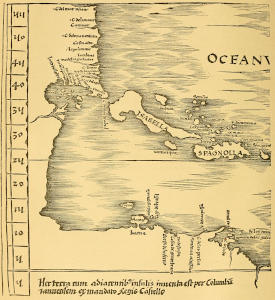
A copy of a part of the map of the New World (tabvla terre nove) contained in the edition of Ptolemy’s Geography printed at Strasburg in 1513. (This part of the original is 9½ inches long.)
Speaking of his explorations along the coast of Cuba, in his letter to Rafael Sanchez, the admiral says: “I sailed along its coast toward the west, discovering so great an extent of territory that I could not imagine it to be an island, but the continent of Cathay.... I continued on my course, still expecting to meet with some town or city, but after having gone a great distance, and not arriving at any, and finding myself proceeding toward the north, which I was desirous to avoid on account of the cold, and, moreover, meeting with a contrary wind, I determined to return to the south, and therefore put about and sailed back to a harbor that I had observed.”[157]
On Monday, the twelfth of November, they had sailed by sunset eighteen leagues, east by south, to a cape which Columbus called Cabo de Cuba. “On the following Wednesday he entered a spacious and deep harbor,” containing so many islands that they could not be counted.... He declares that it is his opinion these islands are the innumerable ones which, on the maps, are placed at the extreme part of the East, and says that he believes they contain great riches, precious stones, and spicery, and extend far to the south, spreading out on each side. He named this place La Mar de Nuestra Senora, and the port, near the strait that extends to these islands, Puerto del Principe.
On Wednesday, the twenty-first of November, when the vessels were about eighty miles southeast of Puerto del Principe, “the admiral” says Las Casas, “found they were forty-two degrees north of the equator as at Puerto de Mares,[158] but he says here that he has stopped using the quadrant until he should go on land that he might mend it. From this statement it would seem that he doubted that he was so far from the equator, and he had reason, for it was not likely since these islands are in ⸺ degrees.[159] To know whether the quadrant was in good working order, it is said that he took an observation to see if he was north as high as Castile; and if this be true, and he was as high as Florida, what is the situation of the islands already mentioned?[160] Moreover, it is said that the heat was great. It is evident that if he were along the coast of Florida, it should not have been hot, but cold.[161] And it is also manifest that in no part of the world in the latitude of forty-two degrees is great heat experienced except by some accidental cause, and even this exception I [Las Casas] believe has never been known.”
A number of other places were sailed to by the inquisitive navigator, which, in the chronological order of their discovery, he named Puerto de Santa Catalina, Cabo del Pico, Cabo de Campana, and Puerto Santo. At this last-named harbor, on Saturday, the first of December, “they planted a cross in the solid rock.” Thence he sailed to Cabo Lindo, and thence to Cabo del Monte. On Wednesday, the fifth of December, “he determined to leave Cuba or Juana,[162] which hitherto he had taken for a continent on account of its size, having sailed along the coast a hundred and twenty leagues. He therefore left the shore and steered southeast by east, as the land last discovered appeared in that direction. He took this course because the wind always came round from the north to northeast, and from there to east and southeast. It blew hard and they carried all sail, having a smooth sea and a current favoring them, so that from morning to one in the afternoon they had sailed eight miles an hour for nearly six hours. The nights here are said to be nearly fifteen hours long. After this they went ten miles an hour, and by sunset had sailed toward the southeast eighty-eight miles, which are twenty-two leagues.”
On Thursday, the sixth of December, Columbus “found himself four leagues from the harbor named Puerto Maria.” From this place he descried several headlands to which he respectively gave the names of Cabo del Estrella, Cabo del Elefante, and Cabo de Cinquin. “There appeared to be between the two last-mentioned capes a very wide channel, which the sailors said separated an island from the mainland. This island he named Tortuga. The land here appeared high, and not mountainous, but even and level, like the finest arable tracts. The whole or the great part of it seemed to be cultivated, and the plantations resembled the wheat fields in the plain of Cordova in the month of May.”
In the evening the ships entered the harbor “which he named Puerto de San Nicolas, for it was the day of that saint.” On Friday he found the harbor which he named Puerto de la Concepcion. This harbor “is about a thousand paces or a quarter of a league wide at the mouth, without a bank or a shoal, but exceedingly deep to the edge of the beach. It extends almost three thousand paces, with a fine clear bottom. Any ship may enter it and anchor without the least hazard. Here are two small streams, and opposite the mouth of the harbor several plains, the most beautiful in the world, resembling those of Castile, except that they surpass them. On this account the admiral named the island Española.”[163]
On Wednesday, the twelfth of December, “a large cross was set up at the entrance of the harbor upon a beautiful spot upon the western side, ‘as an indication,’ in the words of the admiral, ‘that your highnesses possess the country, and particularly for a memorial of Jesus Christ, our Lord, and the mark of Christianity.’ ... The admiral here ascertained the length of the day and night, and found that from sunrise to sunset there passed twenty glasses of half an hour each, although he says there may be some error in the calculation, as the glass may not have been turned quickly enough, or the contrary. He states further, that he took an observation with the astrolabe and found the latitude to be seventeen degrees....
“The people here were all naked, king as well as subjects, the females showing no evidences of bashfulness. Both sexes were more handsome than those they had hitherto seen. Their color was light, and if they were clothed and protected from the sun and air they would almost be as fair as the inhabitants of Spain. The temperature of the air was cool and exceedingly pleasant. The land is high, covered with plains and valleys, and the highest mountains are arable. No part of Castile could produce a territory comparable to this in beauty and fertility. The whole island and that of Tortuga are covered with cultivated fields, like the plain of Cordova. In these they raise ajes, which are slips set in the ground, at the end of which roots grow like carrots. They grate these to powder, knead it, and make it into bread of a very pleasant taste, like that of chestnuts. The stalk is set out anew and produces another root, and this is repeated four or five times. The largest and most excellent that had been met with anywhere (the admiral says they are also found in Guinea) were those of this island, being of the size of a man’s leg. The natives here, according to the statement of the admiral, were stoutly built and courageous, very different from the timid islanders of the other parts; agreeable in their intercourse and without any religion.... They saw a native whom the admiral took to be the governor of the district, and whom the Indians called the cacique. He had a plate of gold as large as one’s hand, with which he seemed desirous of bartering. He carried it to his house and had it cut into pieces, which he traded away one by one.”
One of the caciques of the island sent a messenger to Columbus bearing as a present to him “a girdle, to which was attached, instead of a pouch, a mask having the nose, tongue, and ears of beaten gold.”
“I think,” Columbus writes, “no one who has seen these parts can say less in their praise than I have said. I repeat that it is a matter of wonder to see the things we have beheld, and the multitudes of people in this island, which I call Española, and the Indians Bohio. The natives are singularly agreeable in their intercourse and conversation with us, and are not like the others, who, when they speak, appear to be uttering menaces. The figures of the men and women are fine, and their color is not black, although they paint themselves. The most of them paint themselves red, others a dark hue, and others different colors, which, I understand, is done to keep the sun from injuring them. The houses and towns are very attractive, and the inhabitants live in each settlement under the rule of a sovereign or judge, to whom they pay implicit obedience. These magistrates are persons of excellent manners and great reserve, and give their orders by a sign with the hand, which is understood by all the people with surprising quickness.”
On Monday, the twenty-fourth of December, as Columbus’s ship, the Santa Maria, was running along the north side of Española, off the headland named Punta Santa, “at the end of the first watch, about eleven at night, when the vessel was about a league distant from the point of land, the admiral lay down to sleep, having taken no rest for two days and a night. As the sea was calm, the man at the helm left his post to a boy, and also went off to sleep, contrary to the explicit orders of the admiral, who had throughout the voyage forbidden, in calm or storm, the helm to be intrusted to a boy. The admiral was free from any dread of rocks or shoals, for the Sunday before, when he sent the sailors in boats to the king who had invited him to visit him, they had passed three and a half leagues to the east of Punta Santa, and had surveyed the whole coast for three leagues beyond that point, and ascertained where the vessels might pass, a thing never done before in the whole voyage. But as it pleased our Lord, at midnight there being a dead calm and the sea perfectly motionless, as in a cup, the whole crew, seeing the admiral had retired, went off to sleep, leaving the ship in the care of the boy already mentioned. The current carried her imperceptibly toward the shoals in the neighborhood, upon which she struck with a noise that could have been heard a league off.”
Although every thing was done to keep the damaged vessel afloat by Columbus and the few men who remained on board, “she opened between her ribs and slowly settled down on the shoal.” On the morning of Christmas the ship was unloaded with the assistance of the natives, who with their canoes conveyed the goods in her to the beach. These were afterward stowed in some houses which the cacique of the region had offered to Columbus for that purpose. The same ruler afterward gave the admiral a large mask, with pieces of gold at the ears, eyes, and other parts of it, and also some jewels of the same metal. “All these things had a great effect upon the admiral in assuaging his grief for the loss of his ship, and he became convinced that our Lord had permitted the shipwreck in order that he might select this place for a settlement.
“‘And to this end,’ he says, ‘so many favorable things conspired, that it cannot be called a disaster, but a great turn of good fortune, for if we had not run aground, we should have kept off without anchoring here, the place being in a large bay inside of two or three shoals. Neither should I otherwise have been induced to leave any men in these parts during the voyage; even if I had, I could not have spared them the needful provisions and materials for their fortification. Many of my crew have solicited me for permission to remain, and I have to-day [Wednesday, the twenty-sixth of December] ordered the construction of a fort, with a tower and a ditch, all to be well built, not that I think such a fortification necessary as a defence against the inhabitants, for I have already stated that with my present crew I could subjugate the whole island, which I believe to be larger than the kingdom of Portugal, and twice as populous, but that I think it prudent, since the territory is at such a distance from our country, and that the natives may understand the genius of the people of your highnesses and what they are able to perform, so that they may be held in obedience by fear as well as by love. For this purpose I have directed that a quantity of timber for the construction of the fort shall be provided, also bread and wine be left to suffice for more than a year, seed for planting, the long-boat of the ship, a calker, a carpenter, a gunner, a cooper, and many other persons of the number of those who have earnestly desired to serve your highnesses, and oblige me by remaining here and searching for the gold mine.’”
The admiral further remarks “that every piece of the ship was saved, for not even so much as a thong, board, or nail was lost, for she was as complete as when she first sailed, except that which was lost by cutting her to get out the casks and merchandise. These were carried on shore and well secured, as has already been mentioned. He adds that he hopes to find, on his return from Castile, a ton of gold collected by those who remained, by trading with the natives, and that they will have succeeded in discovering the mine and the spices, and all these in such quantities that before three years the king and queen may undertake the recovery of the holy sepulchre. ‘For I have before proposed to your highnesses,’ he writes, ‘that the profits of this undertaking should be employed in the conquest of Jerusalem, at which your highnesses smiled and said you were pleased, and had the same inclination.’”
“He left on the island of Española, which the Indians called Bohio, a fort and thirty-nine men, whom he states to have been great friends of King Guacanagari. Over these he placed Diego de Arana, a native of Cordova, Pedro Gutierrez, groom of the king’s wardrobe, and Rodrigo de Escovedo, a native of Seville and nephew of Fray Rodrigo Perez, with all the powers the king and queen had delegated to him. He left them all the goods which had been sent for trafficking, a great quantity, and every thing belonging to the ship which had been wrecked. The goods he directed should be traded away for gold.”
In commemoration of the day of Christ’s nativity, on which his ship was wrecked at this place, he called the settlement Villa de la Navidad (city of the Nativity). He further writes in his journal that “he had heard of another island behind that of Juana, toward the south, in which there was a still greater quantity of gold, and where it was found in grains of the size of a bean.... This island was called by the Indians Yamaye.”[164]
“It was the admiral’s intention to coast farther along the island of Española, which he might have done upon his homeward course, but as he considered that the captains of the two caravels were brothers, namely, Martin Alonso Pinzon and Vicente Yañez, and that they had a party attached to them, and that they and their partisans had manifested considerable haughtiness and avarice, disobeying his commands regardless of the honors he had conferred upon them, which misdemeanors, as well as the treachery of Martin Alonso, in deserting him,[165] he had winked at, without complaining, in order not to throw impediments in the way of the voyage—he thought it best to return home as quickly as possible. He adds that he had many faithful men among his crews, but resolved to overlook for the time the behavior of the refractory ones, and not at such an unfavorable season undertake to punish them.”
On Tuesday, the fifteenth of January, while the caravels were anchored in the bay which he called the Golfo de las Flechas (the Gulf of Arrows), he describes the weapons of the natives. “The bows,” he says, “are equal in size to those of France and England, and the arrows like the javelins used by the inhabitants of the other islands, which are made of the stalks of the cane while it is in seed. They are very straight, about a yard and a half in length, and doubled, with a sharp piece of wood, a span and a half long, at the end. At the point of this some attach a fish’s tooth, but the most of them grass.... The bows of the Indians appear to be made of yew.” The quantity of sea-weed which he found growing in this bay led Columbus to infer that the Indies were near the Canary Islands, not more than four hundred leagues distant.
On Wednesday morning, the sixteenth of January, they set sail from the Golfo de las Flechas, to go to the island of Carib. “After sailing sixty-four miles, as they estimated, the Indians on board signified that the island was to the southeast, when they altered their course, and proceeded in that direction, and after sailing several leagues the wind freshened and blew very favorably for their return to Spain. The crews began to grow despondent at leaving their homeward course, on account of the leaky condition of the vessels, (for there was no remedy for it but the help of God,) and the admiral found himself constrained to change his course again, and steer directly for Spain.”[166]
Columbus, afterward writing to Rafael Sanchez respecting his explorations along the coast of Española, remarks that the island of Española is “greater in circuit than all of Spain, from Colibre in Catalonia, near Perpignan, round the coast of the sea of Spain, along Granada, Portugal, Galicia, and Biscay, to Fuenterabia, at the cape of Biscay.... Each native, as far as I can understand, has one wife, with the exception of the king and princes, who are permitted to have as many as twenty. The women appear to do more work than the men. Whether there exist any such thing here as private property, I have not been able to ascertain. I have seen an individual appointed to distribute to the others, especially food and such things.
“People of an extraordinary description I did not see, neither did I hear of any, except those of the island Caris, which is the second island on the way from Española to India. This island is inhabited by a people who are regarded by their neighbors as exceedingly ferocious. They feed upon human flesh. These people have many kinds of canoes with which they make incursions upon all the islands of India, robbing and plundering wherever they go. Their difference from the others consists in their wearing long hair like that of women, and in using bows and arrows of cane; these last constructed, as I have already related, by fixing a piece of sharpened wood at the larger end. On this account they are considered very ferocious by the other Indians, and are much feared by them.”[167]
Speaking of the pecuniary profits of the voyage Columbus wrote: “I am enabled to promise the acquisition, by a trifling assistance from their majesties, of any quantity of gold, drugs, cotton, and mastic, which last article is found in the island of Scio; also, any quantity of aloe, and as many slaves for the service of the marine as their majesties may need. The same may be said of rhubarb and a great variety of other things which, I have no doubt, will be discovered by those I have left at the fort, as I did not stop at any single place, unless obliged to do so by the weather with the exception of Villa de la Navidad, where we remained some time to build the fort and provide the necessary means for the defence of the place.
“Although the discoveries actually accomplished appear great and surprising, yet I should have achieved much more had I been furnished with a suitable fleet. Nevertheless the great success of this undertaking is not to be ascribed to my own merits, but to the holy catholic faith and to the piety of our sovereigns, the Lord often granting to men what they never imagine themselves capable of accomplishing, even that which appears impracticable, for he is accustomed to hear the prayers of his servants and those who love his commandments. In this way has it happened to me that I have succeeded in an undertaking never before accomplished by man.”[168]
On Thursday night, the fourteenth of February, a violent tempest arose, “the waves crossing and dashing against one another so that the vessel [the Nina] was overwhelmed, and not able to get out from between them. The foresail was set very low, in order to carry her somewhat out of her dangerous situation. They stood under it for three hours, going twenty miles, when the wind and sea increasing, they began to drive before it, not having any other deliverance. At the same time the Pinta, in which was Martin Alonso Pinzon, began to scud likewise, and they soon lost sight of her, although the two caravels made signals to each other with lights, until from the fury of the storm they were no longer visible.” The fear of being lost now overcame Columbus and his men. They prayed and made many vows. “The admiral ordered that lots should be cast for one of them [if they safely reached land] to go on a pilgrimage to Santa Maria of Guadalupe and carry a wax taper of five pounds’ weight. He made them all to take an oath that the one on whom the lot fell should perform the pilgrimage. For this purpose as many peas were selected as there were persons on board. One of the peas was marked with a cross, and all were shaken together in a cap. The first who put his hand into the cap was the admiral, and he drew out the crossed pea. So the lot fell on him, and he considered himself as bound to accomplish the pilgrimage. Another lot was taken for a pilgrimage to Santa Maria of Loretto, in the province of Ancona, the territory of the pope, where is the house in which Our Lady has performed so many miracles. This lot fell on a sailor of Puerto de Santa Maria, called Pedro de Villa. The admiral promised to furnish him with the money for his expenses. A third lot was determined upon for the selection of a person who should watch a whole night in Santa Clara de Moguer, and have a mass said there. This lot fell on the admiral. After this he and all the crew made a vow to go in procession, clothed in penitential garments, to the first church dedicated to Our Lady which they should meet with on arriving on land, and there pay their devotions. Besides these general vows, every individual made a private one, all expecting to be lost, so terrible was the violence of the hurricane. Their danger was increased by the want of ballast in the vessel, ... which the admiral had neglected to supply among the islands, because he wished to husband his time in making discoveries, and expected to take in ballast at the island of Matinino, which he intended to visit. The only thing that they could do in this emergency was to fill with sea-water such empty casks as they could find, and by doing this they obtained some relief.
“Here the admiral speaks of the circumstances which caused him to fear that our Lord would suffer them to perish, and of some which made him hope that he would bring them safe to land, and not allow the important information they were carrying to the king and queen to be lost. He seems to have felt the greatest anxiety to have his wonderful discovery known, so that the world might be convinced that his assertions had been correct and that he had accomplished what he had professed himself able to do. The thought of this not being done gave him the greatest disquietude, and he was constantly apprehending that the most trifling thing might defeat his whole intention. He ascribes this to his want of faith and confidence in a divine providence, but comforts himself by reflecting upon the many mercies God had shown him in having enabled him to succeed in his project, when so many adversities and hindrances opposed him in Castile, and afterward to accomplish his great discovery. And as he had made the service of God the aim and business of his undertaking, and as he had hitherto favored him by granting all his desires, he indulges in the hope that he will continue to favor him, and will give him a safe return. He also remembered that God had delivered him on the outward voyage, when he had much greater reason to fear; that the eternal God gave him resolution and courage to withstand his men when they conspired against him and with a unanimous and menacing determination resolved to turn back. With these thoughts, and the consideration of other wonderful favors he had enjoyed, he says he ought not to be in fear of the tempest; but he adds that his apprehensions and the anguish of his mind would not allow him to rest. Besides, he continues, his anxiety was increased by reflecting upon the condition of his two sons whom he had left at their studies in Cordova,—these would be left orphans in a foreign land, and the king and queen being ignorant of the services he had rendered them by the voyage, would not feel any inclination to provide for them. On this account, and that their highnesses might be informed that our Lord had granted success to the undertaking in the discovery of the Indies, and might know that storms did not prevail in those regions (which was apparent from the plants and trees growing down to the brink of the sea), he devised the means of acquainting them with the circumstances of the voyage in case they should perish in the storm. This he did by writing an account of it on parchment, as full as possible, and earnestly entreated the finder to carry it to the king and queen of Spain. The parchment was rolled up in a waxed cloth and well tied. A large wooden cask being brought, he placed the roll inside of it, and threw the cask into the sea, none of the crew knowing what it was, but all thinking that it was some act of devotion.”[169]
On the sixteenth of February the Nina reached the Azores, and two days afterward was riding at anchor at the island of Santa Maria. Departing from the Azores on the twenty-fourth of February, the Nina again encountered another storm, which caused Columbus to take refuge in the mouth of the river Tagus, on the fourth of March. From this roadstead he sent a courier overland to Spain bearing the intelligence of his arrival at this haven on the coast of Portugal, and another to the king of Portugal to ask permission to anchor in the harbor of Lisbon.
When, on the sixth of March, it became known in Lisbon, says Ferdinand Columbus, “that the ship came from the Indies, such throngs of people went aboard to see the Indians and to hear the news, that the vessel could not contain them, and the water was covered with boats, some of the people praising God for the success of so great an undertaking, and others storming because the Portuguese had lost the discovery through the king’s incredulity.... The next day the king wrote to the admiral congratulating him on his safe return, and expressing the desire, since the admiral was in his dominions, that he would visit him [at Valparaiso, nine leagues from Lisbon].... The king ordered all the nobility of his court to go out to meet him, and when the admiral came into the presence of the king, he honored him by commanding him to put on his cap and to sit down. The king, having heard the particulars of his fortunate voyage, offered him all he stood in need of for the service of their catholic majesties, although he thought that as the admiral had been a captain in the service of Portugal, that the discovery belonged to him. To which the admiral answered that he knew of no agreement by which he could obtain it, and that he had strictly obeyed his orders, which were that he should not go to the mines of Portugal or to Guinea. The king said that it was all well, and he did not doubt but justice would be done. Having spent considerable time in this conversation, the king commanded the prior of Crato, the greatest man then about him, to entertain the admiral, and show him all civility and respect, which was done accordingly. Having remained there all Sunday, and all Monday until after mass, the admiral took leave of the king.... As he was on his way to Lisbon, he passed a monastery, where the queen was, who sent him an earnest entreaty that he would not pass by without seeing her. She was much pleased to see him, and bestowed upon him all the favor and honor that were due to the greatest lord. That night a messenger came from the king to the admiral, to inform him that if he wished to go by land to Spain he would attend him, provide lodgings on the way, and furnish him all that he might require, as far as the borders of Portugal.
“On Wednesday, the thirteenth of March, two hours after daylight, the admiral set sail for Seville, and, on Friday following, at noon, arrived at Saltes, and came to anchor in the port of Palos,[170] from which he had departed on the third of August, the previous year, 1492, seven months and eleven days preceding his return.”[171]
Desiring as early as possible to make known his return and his remarkable discoveries, Columbus, as soon as his vessel came to anchor, sent letters to several of his friends, in which he gave brief descriptions of the people and of the islands which he had found, as he believed, in the eastern part of Asia. One of these letters, that addressed on the fourteenth of March to Rafael or Gabriel Sanchez, treasurer of Spain, was shortly afterward translated into Latin and printed at Rome. The title given to the letter expresses the popular belief respecting the situation of the discovered islands: “A letter of Christopher Columbus, to whom our age is greatly indebted, respecting the islands of India lately found beyond the Ganges.”[172]
Conscious of the greatness of his discovery, Columbus enthusiastically closes his letter with these words: “And now the king, the queen, the princes, and all their dominions, as well as the whole of Christendom, ought to give thanks to our Saviour, Jesus Christ, who has granted us such an achievement and success. Let processions be ordered, let solemn festivals be celebrated, let the churches be filled with boughs and flowers.”
When his father landed at Palos, “he was received there,” says Ferdinand Columbus, “by all the people in procession, giving thanks to God for his fortunate success, which, it was hoped, would contribute greatly to propagate the Christian religion and enlarge their majesties’ dominions. All the inhabitants of the place considered it a matter of no little fame that the admiral had sailed from that port, and that most of the men he had with him belonged to it, though many of them, through [Martin Alonso] Pinzon’s fault, had been mutinous and disobedient.... The admiral then proceeded toward Seville, intending to go from there to Barcelona where their catholic majesties were. He was compelled to tarry a little along the way thither, though it were ever so little, to satisfy the curiosity of the people where he went, who came from the neighboring towns to the road along which he journeyed to see him, the Indians, and the other things he brought. Proceeding in this manner, he reached Barcelona about the middle of April, having previously sent their highnesses an account of the good fortune attending his voyage, which exceedingly pleased them, and they appointed him a most impressive reception as a man that had performed for them an extraordinary commission. All the court and city went out to meet him. Their catholic majesties sat in public in great state, on costly chairs, under a canopy of gold-cloth; and when he approached to kiss their hands they arose as to a great lord, and were unwilling to give him their hands, and caused him to sit down by them. When he had given them a brief account of his voyage, they permitted him to retire to his apartment, to which he was attended by all the court. And he was so highly honored and favored by their highnesses, that when the king rode about Barcelona, the admiral was on one side of him, and the Infante Fortuna on the other, for before this, no one rode by the side of his majesty but the Infante, who was his near kinsman.”[173]
Galvano, speaking of the enthusiasm created by Columbus’s return, says: “Hereupon there arose so extraordinary a desire to travel among the Spaniards that they were ready to leap into the sea to swim, if it had been possible, unto these new lands.”[174]