Mrs George de Horne Vaizey (continued 5)
Reading edition
“Wedding-bells, and a wreath of orange-blossoms as a bordering?”
“Yes, yes! Just the thing! Bring the sketch to show me, and we can consult about it together, for I really can’t manage these stairs again. I’m so pleased it’s all settled?”
She rose as she spoke, and prepared to take her leave, but as she did so her eye fell on the row of photographs on the chimneypiece, and she walked forward to examine them in her usual free-and-easy fashion.
“Family pictures! There is Hope—not half pretty enough, though. That was your father, I suppose. So clever, wasn’t he! By the way, how is that young brother of yours getting on?”
If a thunderbolt had fallen through the roof, the occupants of the room could hardly have been more startled than by this simple question. This was Miss Caldecott’s first visit to the flat; Barney’s name had never been mentioned in her presence; how, then, did she come to know of his existence? The shadow which had been pushed aside for a few minutes now returned more heavily than ever, and the pale, tense faces of the four girls startled the innocent questioner.
“What is the matter? What have I said? Nothing to worry you, have I?”
“We are in trouble about our brother, Miss Caldecott. He has—disappeared,” said Philippa, resting both hands on the back of a chair to hide their trembling. “Do you mind telling us how you came to know him?”
“But I don’t know him; only heard his name casually from a friend. Handsome boy, isn’t he?—musical—sings comic songs and dances break-downs—up to all sorts of fun?”
“Yes, yes!” cried the sisters in concert, and the Hermit drew near, forgetting his embarrassment in his anxiety to hear what might be told. The five pairs of eyes were fixed hungrily on the silly, pretty face, and even as they looked they saw it change, soften into sympathy, and grow sweet and earnest and womanly.
“And he has run away, has he? And you are sitting at home waiting for him, and breaking your hearts. Poor little girls! Wouldn’t it be lovely if I helped you to find him, after all? Now, I’ll tell you all I know. I had some friends in the other night, and one of the men was turning over my songs and found ‘The Song of Sleep.’ We laughed about it a good deal, for I told him it was half my own composition. He noticed the name—Hope Charrington—and said he knew a young fellow of that name; who was one of the most amusing boys he had ever met, and could sing a rattling comic song. He is musical, this man I am speaking of, and is fond of having little singsongs at his rooms. I asked one or two questions, found out that it must be your brother, and told Jim I would warn you that he was not a fit companion for a lad. Oh, I was only in fun; there’s no real harm in Jim, but he is in rather a fast, betting set, and I have a young brother of my own. I know how I should feel about it I determined to give you a hint next time we met, and I did remember, didn’t I? I am so glad I didn’t forget!”
The look of elation which accompanied the last words brought a smile to Hope’s face. She had reason to know Miss Caldecott’s powers of forgetting, and it argued a wonderful amount of interest that she should have, remembered Barney in the midst of the exciting preparations for her benefit concert. She slipped her hand through the plump arm and pressed it gently, while Philippa asked half-a-dozen breathless questions.
“How long ago was that? Have you heard nothing since? Where had he met Barney? Is he in an insurance office?”
“Insurance? No, that is not it. He has quite a good berth somewhere—shipping office, I think. Their ships go out to the Cape.”
She drew her breath sharply as she finished her sentence, and, to judge by the startled look which went round, the same thought had flashed through every mind. Shipping! Ships that went out to the Cape! What better means by which to frustrate the most diligent search? Barney had always had a craving for the sea, and if this unknown “Jim” had influence in his office, and felt himself even indirectly responsible for the trouble in which the boy found himself, what more likely than that he would help him to a fresh start?
“I shouldn’t wonder one bit if that is the explanation,” cried Minnie triumphantly. “Two to one he has gone off in one of their boats; and a very good thing if he has. Nothing knocks the nonsense out of a boy like a good long voyage. He’ll be so thankful to get back that he will settle down to anything you like to mention. Got into trouble, I suppose, before he went? Nothing serious, I hope.”
She had shown herself so kind and sympathetic that Philippa could not refuse to reply, and Minnie listened to the story of Barney’s debts with indulgent sympathy.
“And so he ran away from them. Just what I have longed to do myself a dozen times over. Now, you will want to see Jim, and hear what he has to say. I shall be passing near his lodgings on my way home, and if Mr—er—Neil, isn’t it?—likes to come with me, we might interview him together. He gets home by half-past five, as a rule.”
She looked coquettishly at the Hermit, who was immediately seized with a paroxysm of embarrassment, twitched nervous fingers, and looked as supremely miserable as if his last hour had come. With the energy of despair he managed to blurt out a few words to the effect that—“Stephen—Mr Charrington—home presently—like to be present. After dinner, perhaps—could go together if Miss Caldecott kindly—left address.”
“Well, he doesn’t know how to flirt!” Minnie exclaimed blightingly five minutes later as she and Hope stood in the little hall for a few parting words. “Can’t understand a man like that. No patience with him either. No relation of yours, I hope, dear?”
“None whatever; but, oh Minnie, you should not want to flirt when you are engaged! I do hope you are not going to be married just because you are tired and discouraged and need a rest. I do trust you are not making a mistake,” cried Hope earnestly. “Are you quite sure you care for hint, and can be happy?”
Miss Caldecott laughed lightly. “My dear,” she said, “if I look thirty in my best new veil, it is more than time I was married. And I am so tired of paying my own bills! Jack is very well off, and I intend to make his money fly. It will be a new experience to spend money that some one else has earned.” She paused, looked for a moment into Hope’s wistful face, and added impulsively, “If you will promise faithfully never to tell Jack if you should meet him, I’ll let you into a secret. I’m frightfully happy! I’ve been in love with him for years. It was difficult to make up my mind when I had been my own mistress for so long, but now that I have given in, I wouldn’t go back for the world. It is nice to be loved and taken care of—far nicer than being independent. You will find that out for yourself some day soon.”
“Dear Minnie, I am so glad! I do congratulate you with all my heart; and ‘Jack’ too. You will make such a nice, cheerful, good-tempered wife!” cried Hope bravely; whereat Miss Minnie indulged in an elephantine byplay of bashfulness, and ran rustling down the staircase.
“An appalling woman!” the Hermit was reiterating in the drawing-room; but none of the sisters would agree with this denunciation.
“She doesn’t wear her heart on her sleeve; neither do we,” maintained Hope. “She is ever so much nicer when you know her well.”
“She shows great perspicuity in her judgment. Did you hear her say that I was sure to get on?” cried Madge; and Theo smiled as at a pleasant recollection.
“Did you notice how her face softened when we spoke of our trouble? Her lips drooped, and her eyes grew so soft and liquid. My next heroine shall have eyes like that.”
“And if she helps us to find Barney,” sighed Philippa softly, “I shall bless the name of Minnie Caldecott as long as I live.”
Chapter Twenty Three.
Rejoicings.
It can be imagined with what eagerness Steve was greeted on his return from the City that evening, how he was hurried through his dinner, and despatched forthwith, in company with the Hermit, to interview “Jim,” otherwise Mr James Matthews. The time of waiting seemed unbearably long, but when the two men returned it was at once evident that they were the bearers of good news. The companion of the newspaper shop had been found at last, while Barney himself was now on his way to the Cape, working for his passage in the capacity of steward!
Briefly, the tale which Mr Matthews had to tell was as follows. He had made the boy’s acquaintance in a luncheon-bar, had been attracted by his breezy, high spirits, and taken some pains to arrange further meetings. The two had attended theatres and concerts together, and finally Barney had visited his new friend in his rooms, and become the confidant of certain betting transactions in which he was in the habit of indulging. The boy had begun to bet on his own account, had been unlucky, and had called at the shipping office one day, declaring himself in trouble at home, and anxious to get out of the country for a time at least Mr Matthews told him that his only chance was to ship as a steward, and Barney, being not only willing but eager, was sent to wait his turn at Southampton, and had been fortunate in finding an opening three days after his arrival. “Jim,” as Miss Caldecott had called him, appeared to be a good-natured, easy-going individual with little sense of responsibility. When sternly questioned by Steve as to whether he considered it right to encourage a boy of seventeen to bet, he smilingly declared that “every one did it—even the little office-boys put their coppers on the races;” and refused altogether to acknowledge that he should have consulted Barney’s friends before sending him abroad.
“But you were the very people he wanted to avoid. There is no need to worry yourself, my good sir. He has signed for the round voyage, and you will see him back in a couple of months, all the better for having to rough it a bit and finding out what hard work means.”
This was his opinion, and, on the whole, Barney’s brother and sisters were inclined to agree. After the suspense of the past weeks it was a blessed relief to hear definite news, and, with a good ship and a good captain, there was little fear of the boy’s safety. There was just a chance that letters written at once might arrive at Capetown before the vessel sailed on her homeward voyage, and Philippa was already rehearsing loving messages, when Madge cried eagerly:
“Can’t we do something to celebrate the occasion? Not to-night, I mean, but to-morrow. We have been in the depths for so long that we need a little festivity. I’m tired of being miserable!”
She felt a passing wonder as to the moaning of Hope’s quick frown, but Theo chimed in with an eager assent, and even the grave Steve stretched himself, as if throwing off a burden, and looked pleased at the suggestion.
“I believe we should all be the better for a change. There has been too much work and too little play lately to be good for any of us. The question is, what can we do that is cheap and exciting!”
Madge’s grimace was the reverse of approving.
“The greatest change we could have would be to be expensive and lazy. It is not my idea of pleasure to stand shivering in a queue for a couple of hours, and hunt for omnibuses after a performance. I want to see how the other people live—the people who toil not, neither wear their last year’s clothes! I should like to dine at the Carlton, and sit in the hall after dinner watching the coming and going—the pretty girls in their fashion-plate cloaks, and the old ladies in sables and diamonds, going out to theatres and evening receptions—and watch the flirtations, and listen to Theo making up stories. It would be so good for us both; we should get lots of ideas.”
“I’m afraid”—began Steve the prudent, but the Hermit did not give him time to finish.
“I will engage a table at the Carlton to-morrow morning,” he cried. “You shall all come and dine with me. It is a capital idea. I’m very much obliged to Miss Madge for suggesting it.”
Polite murmurs of dissent greeted this speech. Steve cried, “No, no, my dear fellow; we couldn’t think of it.” Philippa blushed, and declared, “You mustn’t, Mr Neil; you really mustn’t.” But the Hermit was firm and would brook no refusal.
“It is impossible for me to entertain at home, and it is quite time that you dined with me for a change. I have been your guest for about fifty Sunday-night suppers.”
“Cold roast beef and beetroot in winter; cold lamb and mint-sauce in summer! There is an appalling lack of variety in the menus of an English household,” said Madge, with an expressive grimace. “When I am married I shall make a point of serving my loved one with constant surprises.”
“You will find it more difficult than painting pictures. What is one to do in winter, when poultry is so dear and none of the nice spring things have come in?” queried the dear, literal Martha, looking straight at the Hermit as she spoke, as if asking him to vindicate her housekeeping abilities; the which he proceeded to do with a zeal untempered by knowledge, while Hope studied his face with anxious eyes, and Madge sat silent, a monument of long-chinned solemnity.
No further objections were made to the Hermit’s invitation—which, in truth, was too tempting to be refused—and the next morning was spent in hunting up old fineries, turning ribbons, washing laces, and sewing them on again in as near an imitation of the latest Parisian fashion as could be obtained with insufficient quantities and ’prentice fingers.
“To think that it is eighteen months since I wore an evening-dress!” sighed Madge tragically. “Do you remember how I talked of holding a salon for all the greatest intellects in London! It is rather a come-down to reflect that the Hermit is the only youngish man who has crossed this threshold since we came. And he is no good to me either, for”—She looked round the room to make sure that Philippa was not present. “I’ll tell you a secret, Theo. He is—not falling—he could not do anything so precipitate—but crawling in love with Phil; but he will never find it out unless somebody tells him!”
“I’ll tell you another stale item. Phil is crawling in love with him too; but wild horses wouldn’t make her confess it. If he ever winds himself up to proposing, she will refuse him for the sake of the family and never say a word about it, but only snap off our heads, and grow so cross and cantankerous that there will be no living with her.”
This from Theo. The other ungrateful sister shrugged her shoulders and exclaimed, “What a nuisance it is when people will make martyrs of themselves! Now, it would really be very nice if Phil lived on the next landing, and could run in and out half-a-dozen times a day; and though the Hermit is not my passion, he is a worthy old thing, and would make a devoted husband. It strikes me, my dear, that you and I will have to take this matter in hand. It is no use asking Hope. She has grown so proper lately that I am quite afraid of her.”
“Oh no, we won’t ask Hope!” said Theo quickly. “But really it would be rather fun to see what we could do—as good as a story in real life. The first step is to make them aware of their own feelings. But how is it to be done?”
“We might try jealousy. How would it be if I flirted with him violently under her very eyes?”
“He would be horribly bored, without understanding in the least what you were trying to do, and Phil would forbid him the house in case you were blighted in your youthful affections.”
“Should we take him aside, then, and drop a casual hint of the curate who proposed to her in Leabourne?”
“My dear, he would take fright on the moment and consider it his duty to stand aside in favour of a better man. He is so absurdly quixotic that he would positively enjoy immolating himself.”
“What about pity, then? Snub Phil violently in his presence, and confide to her in secret that his cough sounds consumptive! That would make them sorry for each other, you see, and rouse a desire to help. They would sympathise, and grow sentimental, and—”
“It might do,” said Theo thoughtfully. “Really, Madge, you ought to write instead of me; you are far more inventive. My only idea is propinquity. Impress upon Phil that the Hermit is her best counsellor in all matters concerning Barney, and advise her to talk things over quietly with him when Steve is not present. The Hermit has about as much worldly wisdom as a babe in arms, and consequently would be immensely flattered by being asked to impart it. He will repeat all her suggestions with an air of wisdom, and Phil will dote upon him for helping her to her own way.”
“Propinquity does it! We will be as innocent as cherubs, and have smashing headaches when he comes to call. Also, it might be well to take a more active share in the housekeeping department, in order to show Phil that she is not so indispensable as she imagines. We must be cruel to be kind.”
Theo’s shoulders shook with laughter, and just at that moment in marched Philippa herself, looking round with an air of surprise.
“What is the matter with you two this morning! You are giggling like a couple of schoolgirls.”
“We are so excited at the prospect of this evening! What have you been so busy about in your room? Writing to Barney?”
“N-not just lately,” faltered Phil, and blushed in guilty fashion. As a matter of fact she had been trying experiments in hairdressing, and studying her profile to see which arrangement gave the best effect to—er—to any one who happened to be seated by her side! “How ore you getting on with your work?” she asked, eager to change the subject, when Madge held up the venerable chiffon bodice on which she had been sewing “applications” of lace, and regarded it with critical approval.
“Subdued elegance is to be the keynote of my costume. I shall wear no jewels! I don’t think it is in good taste for a young girl to wear valuable diamonds. What do you think of the arrangement of lace? Exact copy of one of Lady Godiva’s dinner-dresses as drawn in last week’s Queen. Wouldn’t it be thrilling if I were mistaken for her and written about in the papers? The only drop of bitterness in my cup is the want of an evening-cloak. It does give one away so horribly to go in a golf-cape!”
“No one will know you, dear. No one will look at you.”
“Do you mean that for comfort, may I ask? I want to be looked at. ‘’Tis sad to think no eye will watch for us, and grow brighter when we come,’” quoted Madge in sentimental accents, which made Philippa giggle in her turn. Then for some mysterious reason she blushed again, and strolled over towards the window.
“Hot, dear?” queried Madge blandly. “Room rather warm, perhaps—too big fire.”
“So extravagant, too, on a mild day like this! I really must speak to Mary about using so much coal,” said Theo, with a frown. She went on with her sewing, apparently unconscious of the wide-eyed amazement with which Philippa regarded her. The skies were going to fall indeed when Miss Theo troubled herself about an item of domestic economy!
There was something rather pathetic about the glee with which the four sisters made their toilets a few hours later. The night’s entertainment, which would have seemed so tame and ordinary to most girls of their age, appeared a very frenzy of excitement after their year of hard work and privation. They laughed and chattered like so many magpies, ran about from room to room in lace petticoats and pretty low bodices, and sat in turns before the dining-room fire, while Hope—happy possessor of natural curls!—heated irons and waved and crimped with such artistic skill that, as Madge gleefully declared, the three heads were ‘transformations’ indeed—far more like toupées than natural growth.
Philippa wore her mother’s lace, which gave a regal air to the old black silk dress; Hope was lovely, as usual, in her professional white; Madge’s “subdued elegance” proved exceedingly becoming; but Theo was distinctly the most imposing figure of the four. She possessed the Frenchwoman’s talent for putting on her clothes and adding those little touches which go so far towards making an effective whole, and her sisters exclaimed with surprised admiration as she came rustling into the drawing-room, a chaplet of violets crowning the graceful head, and a couple of black feathers fastened jauntily at the side of the low corsage by a paste buckle, which looked exactly like a family heirloom, and not in the least as if it had been unpicked from the side of a felt hat but ten minutes before. Thrown over her shoulders, too, was quite a vision in the way of evening-cloaks, manufactured out of a summer cape, a lace collar, and the beloved feather boa tacked on as an edging. The cape was unlined, and far too thin a covering for a winter evening; but, girl-like, Theo declared that she was “broiled,” and insisted that suffocation would be the result of wearing the nice, warm, ugly shawl which Philippa pressed upon her.
The Hermit came upstairs in his dress-clothes, bearing in his hands four immaculate white camellias, which had seemed to his old-fashioned notions appropriate offerings to present to his girl guests. It was sweet of him to have thought of flowers at all, but—camellias! Theo thanked her stars for the violets which she was already wearing, and dashed from the room to warn Madge, who promptly stole the chrysanthemums from the dinner-table and pinned them in a conspicuous position. Hope, of course, was too gentle to refuse what had been meant so kindly; while as for Philippa, to judge by her ejaculations of delight, it would appear that nothing under the sun could have given her so much pleasure.
They drove away from the door in a couple of four-wheelers, two happy, smiling girls on either back seat, faced by a hungry, dress-coated man. The dinner was everything that fancy had painted it: all sorts of delightful things to eat, disguised under French names, and looking so pretty that it seemed a sin to disturb the dishes. Music, lights, interesting people all around, at whom it was a pleasure to look, and who looked back in their turn, as if equally pleased by what they saw. Steve grew quite frisky in his enjoyment, and Philippa and the Hermit became delightfully and unconsciously absorbed in their own conversation. The little party lingered over dessert, loath to leave so interesting a position, but the settees in the hall were presently discovered to afford an even better vantage-ground for observing their neighbours.
Steve came over and demanded a place beside his three younger sisters. “Neil is submitting the synopsis of his next book to Phil. You seem much jollier over here,” he said innocently, and the girls watched Philippa’s absorbed face in an ecstasy of admiration.
“Doesn’t she do it well? Who would think, to look at her, that the very title is beyond her comprehension?”
They turned aside to hide their smiles, and became once more absorbed in their old occupation. Fascinating groups of people appeared at every moment, and it was no use deciding that you would have your next new dress made exactly like this one, and making surreptitious sketches on the back of the menu card, for it was no sooner lost to sight than another appeared fifty times more distracting.
“I do feel a worm among them all!” grumbled Madge; but when Steve considerately offered to take her home, she said, “Thank you, dear; I’m enjoying it dreadfully. I wouldn’t go for worlds.—Hope, there is a girl over there to the right who is staring at you with all her eyes. Pretend to look after this man and you’ll see her. There—by the lady in blue.”
Hope looked, exclaimed in surprise, and the next moment she and the strange girl had risen and walked forward to meet each other in the middle of the hall.
“Miss Bennett, is it really you?”
“Hope Charrington! The idea of meeting you here! I’ve so often wanted to see you again! Sit down here and talk to me for a minute. Are those your sisters? They are not like you—not so pretty; but the one with the violets looks very smart. You are thin, but you are one of those horrid creatures who always look nice. What do you think of me? Do I look worn? Brides always look wrecks; and I vowed I wouldn’t, but I’m tired to death already. I’ve come up to buy my clothes. It’s to be in February. You heard, of course?”
“Avice told me. I must congratulate you now. I suppose you are very happy?”
“He is!” laughed Truda meaningly. “Quite daft about me! You met him, of course, down at The Shanty, and he liked you awfully much. We have often talked of you, and arranged to have you down when we have a party to entertain.”
Hope smiled with stiff lips. He had liked her “awfully much,” had he? So much that he had wished to have her as a visitor when Truda was his wife! Oh, what a fool, fool, fool she had been to imagine for a moment that he had really cared!
“You will live in the country, I suppose?” she remarked; and again Truda laughed and wagged her head.
“He thinks we will, and I am very meek and submissive note, but I’ll have a town-house before a year is over; you see if I don’t! What is the use of all my lovely clothes in a poky little bit of a village? Would you like to see my dresses? I’ll take you with me to the dressmaker’s some day if you like.”
“Thank you, but I am afraid I could not spare the time. It is very kind of you to ask me.”
“Oh, not a bit! It would have amused me and been a day off for mamma. Still writing songs and giving story-telling entertainments, are you? Oh, I heard all about it. I was bothered to death to find engagements for you.” Truda lay back in her chair and looked curiously into the fair, troubled face. “Seen anything of Ralph Merrilies lately?”
Hope’s embarrassment was swallowed up in surprise at so casual a reference to a future husband. “No,” she said emphatically—“not for nearly six months. I never meet him except at my aunt’s house, and I go there very seldom. He does not call on us in our flat.”
“I wonder why not. He was awfully smitten with you; and wasn’t. I furious about it? He had been quite attentive to me before you came, and then he had eyes for no one else. I believe I was quite jealous of you, dear.”
“You had no reason to be. You feel that now, don’t you?” said Hope gently, and Truda gave a complacent little laugh.
“Oh, I don’t mind now. He may care as much as he likes. Reggie is a good little soul; I’m quite satisfied with him.”
“Reggie!”
“Reggie, of course—Charles Reginald Blake. Who else should it be? Hope Charrington, you don’t mean to tell me that you imagined—”
“Of course I did! It’s your own fault. You told me—don’t you remember?—you told me yourself that you liked him, and warned me—”
For once Truda had the grace to blush and look discomfited.
“Oh well, of course, there was always some one. I was rather smitten, but I could not go on caring for a man who had the bad taste to prefer another girl. And Reggie has been so faithful! He used to send me chocolates when I was at school in Brighton.”
“He is a dear little man—so amiable and cheery. There will be quite a competition between you as to who shall play off a trick first. I hope you will ask me down some day. You will be a merry couple,” cried Hope, with such a heart-whole laugh as had not been heard from her for many a long day.
Miss Bennett regarded her curiously.
“How pleased you seem! Oh yes, I’ll ask you. But perhaps you may be”—her eyes twinkled—“previously engaged.”
Chapter Twenty Four.
All’s Well that Ends Well.
One dark December morning Theo found a letter lying on her plate on the breakfast-table; not the long, white envelope addressed in her own writing, which her soul abhorred, but a business-looking epistle, stamped on which was the magic name of The Casket Magazine. She gulped, tore open the envelope, and read the golden news: “I have read with much interest your original little story, and have pleasure in accepting it for the magazine.” “Your original little story—have pleasure in accepting it.” Theo gulped again, and laughed with the tears in her eyes. Oh, how often she had dreamt of this moment! How she had longed for it, and sickened with dread lest it should never come! She turned a radiant face upon her sisters, and waved her letter in the air.
“Hurrah! At last! From Mr Hammond! He has accepted my story, and calls it very original. A story in the Casket! Girls, do you realise it? Do you realise how you are honoured by sitting at the same table with me!” She laughed again, in tremulous fashion, and Madge bowed elaborately, coffee-cup in hand.
“Your health, my dear! I look towards you! You have done it this time. To be a contributor to the Casket is like being hung on the line in the Academy. Sha’n’t I brag about you at the Slade?”
“It is simply splendid, dear. I do hope they will put your name to it. It will be so disappointing if they don’t,” said Philippa the tactless. She was overflowing with sympathy with Theo in her success, and yet, poor dear! she must needs call attention to the one existing drawback; for the Casket was as conservative as it was high-class—scorned to invite popularity by illustrations or artistic cover, and more often than not left a blank opposite the titles of stories and articles. It was at such moments as these that Theo felt that she could endure with resignation Philippa’s speedy marriage and departure from the home circle. Only five minutes since she had heard the wonderful news, and already a little cloud came floating across the brightness of the sky; for it was little use appearing in the best magazine of the day if no one knew of it but yourself, and an admiring public remained in ignorance of your name.
“How horrid of you to suggest such a thing! You might let me enjoy myself when I can,” she cried irritably. “You are a perfect wet blanket, Philippa—always sitting on us, and depreciating what we do. It is too bad—spoiling my pleasure when I have waited so long.”
“I! I spoil your pleasure—I depreciate you!” Philippa was fairly gasping with surprise and wounded feeling. “When I slave for you all day long! When I take everything off your hands, so that you may give your time to your work! When it is through me you are here at all! You cruel, ungrateful girl, how can you have the heart to speak to me in such a way?”
“I’m sure I don’t want you to slave for me. I am quite capable of doing my own mending, if you refer to that. I should like to take more share in the housekeeping, but you are so jealous if any one interferes.”
“Jealous! Oh, oh! Jealous!” repeated Philippa dramatically. Her eyes were beginning to grow tearful. Theo’s dark brows met in an ominous frown; there were all the signs of a row royal, when Hope came flying to the rescue.
“Girls, girls, be quiet!” she cried, banging her fist on the table in imperative fashion. “You shall not quarrel when we ought to be so happy! This is the best success we have had, and it would be disgraceful to spoil it by quarrelling like babies. You are both to blame, so no apologies are needed, but for goodness’ sake smile and look pleasant.”
“I’m sure I am only too willing. I want to smile if I am allowed,” said Theo gloomily.
“I’m sure I don’t want to quarrel. Perhaps I had better go away and leave you to yourselves, since I am such a wet blanket,” sniffed Philippa into her pocket-handkerchief. Madge gave Hope a warning kick under the table, and began to chatter as unconcernedly as if nothing had occurred.
“You can always write ‘Contributor to the Casket, etc,’ beneath your name on the back of your MSS, Theo. No need to mention that the et cetera means the Penny Penman! And if you intimate to all whom it may concern that you write anonymously for the Casket, you may get credit for half-a-dozen stories instead of one. I wonder what they will pay you for it, and how soon it will appear. Won’t the Hermit be impressed? He says it is the only magazine worth reading. Do knock at the door and tell him, Phil, as you go out for your shopping.”
Wily Madge wished to offer a sop to each of the combatants, and had the satisfaction of seeing Philippa smile faintly, and the complacent expression return to Theo’s face.
“I knew it was a splendid story when I sent it off,” said the author modestly. “Ten pounds at least, I should think, as it is such a first-class magazine. It took me less than four days, with all the correction and rewriting. Ten pounds a week; how much is that a year? If I earned five hundred a year it would make a difference in our exchequer, wouldn’t it, Phil?”
The olive branch was held out with a smile, and as Philippa checked herself on the verge of remarking that it would be difficult to sell a story a week, peace was restored once more. The housekeeper went about her duties, and the author experienced that alternate elation and depression which follows artistic success. She had created something of real merit and power; that was a thrilling reflection, but quickly following came the dreary certainty that virtue had gone out of her, and she would never be able to do so well again. She hastened to her desk, hoping to disprove the dread by writing something better still; but, alas! her heroine sulked persistently, refused to be cajoled into conversation, and after being dragged through half-a-dozen pages, was promptly condemned to the flames. It appeared that even when one had begun to ascend the ladder there was imminent danger of falling off!
Years later, when Theo had made a name for herself as an author of power and originality, she used to look back on that morning and smile at her own ignorance in having supposed for a moment that the battle was won. It was only begun, and it was a battle which had to be waged to the end. There could be no sitting down and congratulating one’s self on victory; no relaxation of care and study, for each fresh success brought its onus of responsibility, and made it more imperative for her to maintain her best. There were times when she thought wearily of Mr Hammond’s suggestion of “the bonnet-shop,” and realised that millinery would have been easier end more remunerative, but there was never an hour when she regretted her choice of a career. It seemed to her that no other work could be so absorbing—such a constant refuge from self.
Fortune had evidently made up her mind to smile upon the Charrington sisters this Christmas-tide, for Minnie Caldecott approved enthusiastically of the design for her concert programme, and the nursery frieze found a purchaser the first time it was exhibited. Madge had summoned courage to show the latter to “Pepper” on its completion, when he found a dozen faults, and made huge pencil-markings to illustrate his meaning, the while the artist writhed in agony; but finally he turned up trumps in the most delightful manner by giving her an introduction to the firm with whom she finally transacted her bargain. Judging from the experiences of the past few months, she had a future before her in this particular branch of her art, and might in time make a comfortable income; but it was not in the least the work she had coveted. She burned to create great subjects on great canvases—to paint with strong, lurid brush—and lo! it appeared that it was her mission to design pretty leaflets and comic pictures for the nursery. It was a blow, but Madge had the good sense to realise that it is better to excel in humble work than to struggle painfully after the unattainable.
As for Hope, she sang and danced about the house with a sudden return to her old light spirits, which puzzled two sisters, and furnished valuable copy to a third. The short interview with Truda Bennett had made everything rose-coloured again, though in truth it was a trifle exasperating to remember Mrs Loftus’s invitation. Oh, to think that even now she might have been at The Shanty, with no secret promise to hinder her enjoyment of Ralph’s society; that they might have been walking together along the country lanes; sitting side by side in the evenings!
“That tonic has given you quite a colour. I shall try it myself,” said Philippa, looking up from her stocking-basket to admire the sweet pink-and-white face at the opposite side of the table. “Mr Neil was saying the other day that so few town girls have any colour. I have lost mine with sitting so much in the house, but I might try what a bottle would do. It only costs a shilling at that wholesale chemist’s. I do look such a faded old creature beside you, Hope; and, after all, I am only two years older!”
Hope laughed—a delightfully scornful, reassuring laugh.
“Faded old creature, indeed! when we were only remarking this week that you were looking handsomer than ever. And happier, too. That’s because Barney will be home so soon; isn’t it, dear?”
“Of course. What else should it be?” said Philippa; and, to do her justice, she spoke in all sincerity.
Theo’s suggestion that she should consult the Hermit as to Barney’s future had been accepted with an unmoved face, and put into immediate execution; and as a result of the conference a letter was even now on its way to Mr Neil’s younger brother in Canada, asking if it would be possible to receive the boy as a pupil on his large farm and ranch, and train him for future work on his own account. Philippa shed bitter tears at the thought of parting from her boy, but the Hermit insisted that it was the right thing to do, though he was much perturbed at the sight of her distress.
“I seem fated to make you cry,” he said miserably. “Do you remember that first time! I shall never forget your face, all streaming with tears, and with such a miserable, helpless expression!”
“I must have looked very—ugly,” said Philippa, with a sob. She reflected that by the same course of reasoning she must look ugly now, and dried her eyes with remarkable promptness, while the Hermit sat in admiration of her fortitude.
If Barney was to be at home for a short time only, his sisters were determined to make that time as happy as possible, so that his recollections should carry with them no sting of reproach. In conclave together they agreed that the dear boy would be embarrassed and depressed, and that all means must be taken to convince him of their full and free forgiveness, and to put him at his ease once more.
“I shall go to meet him,” Philippa said. “It will be less trying for him than having to see us all at once. And I am going to put up new curtains in his room—he hated those old moreen atrocities—and make it look bright and cheerful, as if it had been kept ready for him all the time. I’m going to be so busy this week, I don’t know how I shall get through all I want to do in the way of preparation.”
Alas for Philippa! her work during the next few days was to lie in bed and burn and shiver with an attack of the prevalent influenza. Hope acted nurse, and Theo said blandly, “Don’t worry, dear; I will look after the house. I know exactly what to do”—a statement which the invalid received with undisguised incredulity.
“Shell make an awful mess of it,” she sighed; but Theo had no intention of failing. She was a clever, capable girl, who could do most things well if she chose to give them her attention; and, as we know, she had a special reason for displaying her housekeeping powers. She put aside her writing for the time being, studied the cookery-book and the shop windows in the morning, and in the afternoon enveloped herself in a huge white apron and put into practice what she had learned. All old housekeepers are apt to get into a rut and supply the same dishes over and over again, and Philippa was no exception to the rule, so it happened that the very novelty of Theo’s menus commanded success, and the invalid was constantly assured that she need not hurry out of bed, since all was going on swimmingly without her. If she shed tears at the intelligence, it was put down to the depression which was a part of the illness, and she was urged to take a cup of Theo’s beef-tea—“Such excellent beef-tea!”—or to take some of Theo’s jelly—“Wonderfully good jelly!”—by way of restorative.
There could be no going to meet Barney now. The most she could do was to crawl out of bed an hour before he was expected and look on feebly at the final preparations. She searched for a dozen deficiencies—hoping, if the truth were told, to see tangible proofs of her absence—but all was orderly, dainty, and appropriate: the best china on the table, flowers in the vases, the fatted chickens roasting in the oven, and Barney’s favourite pudding all ready to be served, with its whipped cream ornamented in professional style with candied cherries and angelica.
“You must sit still in that easy-chair, poor darling! I’ll carve,” said Theo kindly; but Philippa felt much more inclined to snap than to be grateful for her consideration. She hated to be out of her usual place on this evening of all others, and to be obliged to play the part of spectator while Theo issued orders for the prodigal’s reception.
“Madge, you must chatter as hard as you can. You are always bragging about your powers of conversation; now let us see what you can do. There must be no awkward pauses. It doesn’t matter what you say, but say something.—Hope, you had better run to the door and meet him first—no one could be afraid of you—and sit next to Steve at table, and stamp on his toes if he makes improving remarks. There will be plenty of time for that later on. We mustn’t spoil the first evening. We won’t let Barney linger over the greetings, but hurry him off to his own room to prepare for dinner. It shall be served the moment he comes back. It is so much less formidable to talk when one is eating!”
She had thought of everything—all the little niceties of consideration which Phil herself had planned but had not yet put into words. She could think of no objection which would have been reasonable to advance, but made a feeble plea to be allowed to be first at the door, when Theo cried loudly, “My dear, with that face! You would frighten the poor boy into running away again!” and there was plainly no more to be said.
At six o’clock Barney’s train was due at Waterloo. It was calculated that he would reach home before the half-hour, and soon after the quarter Theo set the front-door ajar, and the four sisters sat trembling with excitement, straining their ears for the first footstep. Steve and the Hermit were to bring the boy home from the station, and Philippa thought pitifully of his embarrassment as he sat opposite the two solemn faces. This home-coming must be an awful ordeal, despite the letters of encouragement and forgiveness which had been sent to Madeira, and again to Southampton, and for her own part she dreaded to see the bright face clouded and ashamed.
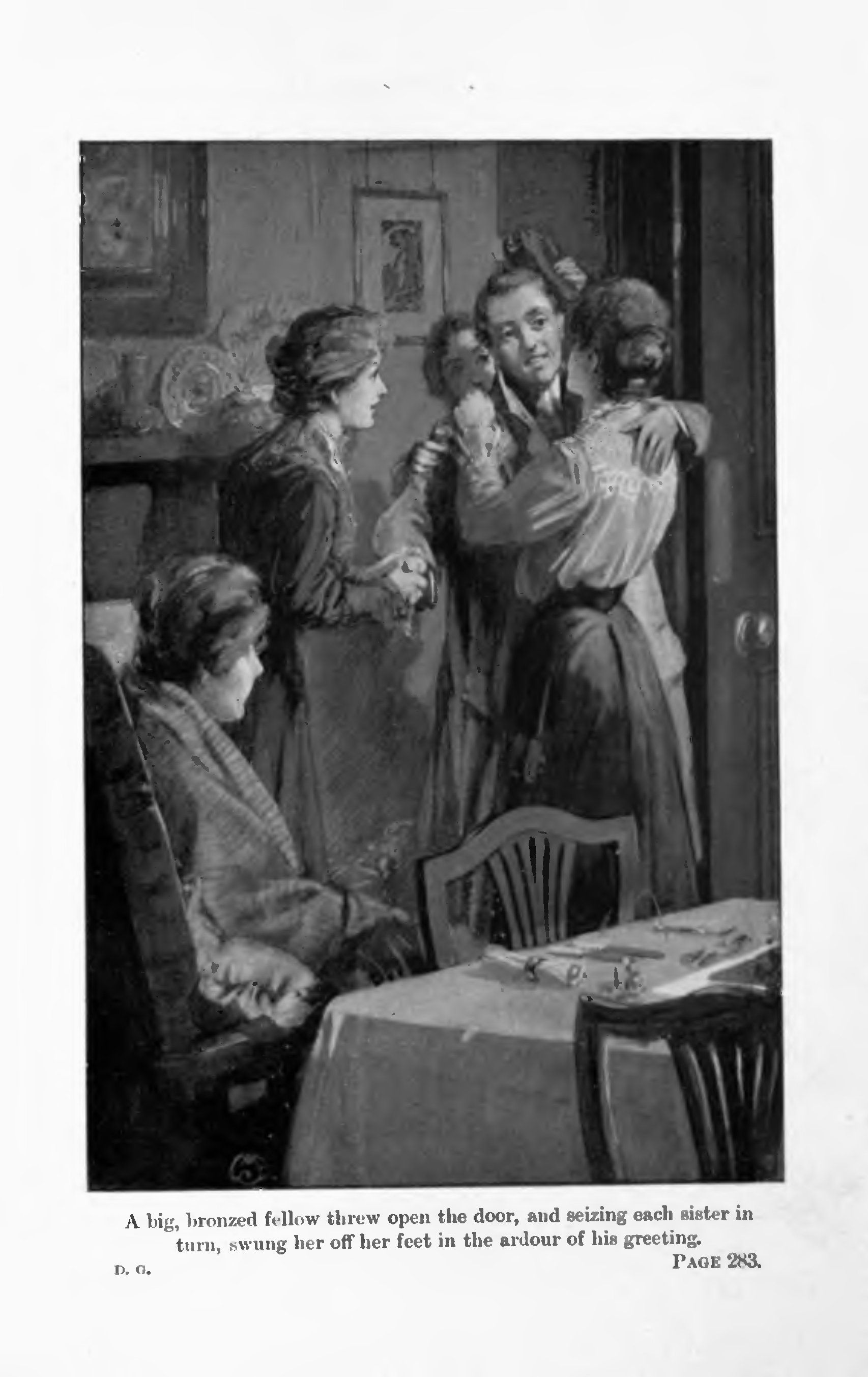
The moments passed and no one spoke; it was half-past six—twenty-five minutes to seven—and still Barney did not come. The invalid shivered and drew her shawl more closely round her; Theo poked the fire and swept the grate clear of ashes; Hope was in the act of leaving the room to peer over the banisters, when a sound from below startled all four sisters into instant attention. It was a sound with which they were all familiar; perhaps the last sound in the world which they expected to hear at that moment—a burst of merry, boyish laughter.
“Bar-ney!” gasped Phil in an incredulous whisper. The other girls stood like so many statues, frozen into the position in which the sound had reached them. The leaping footsteps drew nearer and nearer, a voice called out, “Avast, there, my hearties!” and a big, bronzed fellow threw open the door, and seizing each sister in turn, swung her off her feet in the ardour of his greeting. Madge’s embrace was every whit as loving as that given to her sisters; for Barney had forgotten that he had left her in anger, forgotten her bitter words, as, alas! he seemed to have forgotten his own folly and wrong-doing.
There was no need for Theo’s elaborate precautions; the truant was as absolutely, transparently at his ease as if he had been out for half-an-hour’s stroll, instead of a voyage across the world. It was his sisters who sat silent and embarrassed through the meal which followed, while he ate three helpings of chicken and pudding, and discoursed in picturesque fashion on a life on the ocean wave. Steve, always anxious to improve an occasion, had many questions to ask concerning the distant lands which had been visited; but though Barney could converse fluently enough on the iniquities of the sailors or the idiosyncrasies of the passengers on whom he had waited, he was but a poor hand at useful information. What he approved was “ripping,” what he disliked was “tommy rot,” but these descriptions were hardly satisfactory from a geographic or climatic point of view.
By nine o’clock Philippa was wan and spent, and went off to bed, trying in vain to reason away the ache at her heart. It was all so different—so very different from what she had expected! She did not want to see her boy broken in spirit, but this unabashed assurance frightened her, as indicating a deeper carelessness and lack of moral fibre than she had suspected. It seemed incredible that Barney should show no sign of regret for the anxiety which he had caused; yet, on the other hand, what was the sense of writing that bygones were bygones, and all offences forgiven and forgotten, and then of lamenting because she was taken at her word! Philippa tossed restlessly on her pillow, and being weak and tired, cried steadily from the time she lay down until some one came into the room with her next dose of medicine, and turned up the gas over the mantelpiece.
“Don’t, Hope,” she cried weakly; but it was not Hope, but Barney himself, who raised her head on his arm and held the glass to her lips.
“Now then, old lady! I’m no end of a good nurse nowadays, so I thought I had better come and look after you myself. There was an old Johnny coming home from the Cape, in one of the deck-cabins.” He stopped suddenly, and Philippa knew that he had noticed her tear-stained eyes. “He was very bad, and I had to dose him every hour,” he concluded lamely, then bent over her with curious gaze. “What have you been crying about? About me?”
“I’m—not well. It has upset me seeing you again, and thinking of all that has happened.”
“Was it that that made you ill to start with—my going off, I mean!”
It was a curious change of feeling to have taken place in a couple of hours, but Philippa actually found herself wishing that she could answer in the affirmative, and casting about in her mind for some honest reply which would yet lay some burden of responsibility upon those careless shoulders.
“I have been laid up only a week, but I think I was run down by all the strain and suspense. We had a terrible fortnight—”
Barney frowned and drew his hand away from the coverlet.
“So had I. I was beastly sick. It is all right, though, Phil. I’ve brought home enough money to pay you back. I got some rattling good tips. That old Johnny I told you of—”
“Oh Barney, Barney, it was not the money! I never thought of the money,” cried Phil, with such a wail of despair as brought the boy’s eyes upon her with startled questioning. The two faces confronted each other, so like, yet so unlike, and the boy flushed darkly through his tan.
“Well, you needn’t have worried about—that either. I told you I would remember. I gave my promise, and I—kept it, Phil. There were lots of things I wanted to do. It was awfully dull not being able to go about with the other fellows, but I kept my word. And I wanted to spend the money, too. There was the ’cutest little monkey you ever saw, trained to do all sorts of tricks. It was jolly hard lines not being able to bring it home as a present to you girls, but I thought under the circumstances it might be bad form.”
“Oh Barney, Barney!” cried Philippa, laughing uncontrollably even as the tears rolled down her cheeks. It was such balm in Gilead to know that the promise had been kept; it was so ridiculously, inimitably like Barney that he should mix up monkeys with the story of his repentance. “I’m so very, very thankful for everything,” she whispered; “for the things you didn’t do, and—the monkey that didn’t come. Kiss me, Barney. I shall get well quickly now that you are back.”
Barney did as he was asked, not once, but many times over, and kept his big fingers clasped closely round hers while he asked anxiously:
“You won’t want to send me back to an office, will you, Phil? The Hermit has been telling me about his brother in Canada. That’s the sort of thing I should like if it could be arranged. It will be beastly leaving home again. I never knew it was such a thundering nice place until I left this time. But it is my only chance; I should never do any good in the City. You will let me go, won’t you, Phil?”
“Yes, Barney,” said Philippa sadly. “It is the hardest thing you could ask me, but if it is for your good I must not think of myself. You shall go, dear, as soon as an opening is found; and we will give you as complete an outfit as can be bought, but after that we can do no more. You will have to stand by yourself and fight your own battles. There will be no home open if you run away from your work, and no stupid old sister to spoil you and give you a fresh start.”
The smile with which Barney regarded her was at once charming and pathetic—so full of warm-hearted affection, so radiantly complacent and assured.
“Canada is not far off; it would be as good as being in England, for it is under the old flag, and the people are so jolly loyal and brave. I could come back every two or three years, and when I get a home of my own you will have to come out and visit me. Don’t you worry, old girl; I’ll get on like a house on fire, and I promise you to keep out of mischief. There will be no chance of getting into it, for one thing, away out in the wilds.”
“Oh Barney, Barney, don’t be so sure! There will be difficulties and temptations wherever you go, and you must be prepared to meet them. Don’t be content to promise me, dear. Promise yourself—the strong, good man you were meant to be. Promise God, Barney, and ask Him to help you to stand fast.”
It was not Philippa’s habit to preach, and the fact gave additional weight to her solemn words. Barney looked awed and impressed, and thoroughly uncomfortable into the bargain. “All right, Phil, I’ll remember,” he said softly; but the next moment he discovered that she looked tired, and hurried away. Philippa heard him go into his own room, and presently the sound of his voice reached her ears, raised in happy strains:
“Jack’s the boy, when girls are sad, To kiss their tears away.”
He had been serious for five minutes on end, and the strain was evidently too much for his constitution; but Philippa lay awake far into the night, talking to God about her boy, asking His help where she had failed. It was the truest of all comforts to feel that the far-off country was still near to Him.
Fortunately for all concerned, the letter from the Hermit’s brother proved in every respect satisfactory, for the Loftus family washed their hands of Barney, going out of their way to refuse help before it was asked. The ‘mannikin’ would, no doubt, have acted differently had he been permitted, but his wife told him sternly that he could not allow all his friends to be victimised by that dreadful boy, when he said, “Yes, my dear—yes! No, my dear—no!” and collapsed, as his custom was. The Charringtons were hardly disappointed, for they had learned long ago that—except where Hope was concerned—it was useless to expect sympathy from Aunt Loftus. Avice’s affection for Hope made her a welcome guest, and she was frequently asked to fill a vacant place at a dinner-table, or presented with a ticket for an afternoon concert which she would not otherwise have been able to afford. It was at such a concert that Hope’s next meeting with Ralph Merrilies took place, and through all her embarrassment she noticed the glance exchanged between him and Avice as he seated himself in the vacant stall by her side. There was no surprise in her cousin’s languid eyes, but something very, very like triumph at the completion of a well-laid scheme. Could it be possible that the seat had been designedly reserved?
As we all know, well-bred people never dream of whispering or talking at classical concerts, and Hope’s devotion to her programme was so continual and absorbing that her next-door neighbour could study her profile at his ease, and wonder if there was another girl in the world who had such long eyelashes and such a sweet, winsome mouth. The interval seemed a long time in coming, but it came at last, and then Avice gave Ralph another eloquent glance and carried off her mother to speak to some friends at the other side of the hall. The occupants of stalls to right and left were also moving about and chattering together, and to the two who were left seated there was a sense of solitude in the midst of a crowd.
“Wasn’t it beautiful?” asked Hope, still studying her programme.
“Very!” replied Ralph; but they were not referring to the same subject. He rested his arm on the back of the seat and said softly:
“Never mind that programme just now. Talk to me. I haven’t seen you for months. Mrs Loftus told me that you refused her invitation to The Shanty. I had been hoping to meet you there.”
“And I was sorry not to go, but we were in trouble at the time, and I felt I ought to stay at home. Did you have a good time?”
“Fairly so. It suffered from contrast. It was amusing to meet Miss Bennett in her new rôle.”
“I met her a few weeks ago at the Carlton.”
“So she told me.” There was a meaning expression in his voice which made the blood rush into Hope’s face. He bent nearer to her, his eyes fixed earnestly on hers. “What made you think that? What made you imagine for a moment that she could be engaged to met.”
“I can’t tell you,” replied Hope, truthfully enough. She stared down at the programme, and became intently occupied in plaiting its cover between her fingers. “I knew it was some one whom I had met at The Shanty, and I took for granted that it was you.”
“You can’t truthfully tell me that you thought I was in love with her last year?”
“N-no.”
“Did it ever strike you that I was in love with some one else?” The elbow moved its position and encroached on the corner of her own chair. “Hope, I want you to answer a question. Did you refuse to let me call upon you in town because you knew I loved you, and thought it was impossible to care for me in return?”
The grey eyes were lifted at that with an air of startled disclaimer.
“Oh no, no! Quite the contrary!” cried Hope eagerly.
The next moment confusion seized her as she recognised the inference, but the words were spoken beyond recall, and Ralph’s glowing face showed that he was not likely to forget them.
“You darling! Hope, do you mean it? Have we been misunderstanding each other all this time?” He stretched his hand towards hen, then hurriedly drew it back as an old lady put up her pince-nez to regard him from afar. “Hang these people! What a nuisance they are! I’ll tell you a secret, Hope. I fell in love with you that very first evening while you were singing your little song, and I’ve been uncommonly miserable ever since. Well?”
“Well—what?”
“One expects some response to a statement like that!”
Hope gave a soft, contented laugh.
“I—liked you too, and I have been wretched! What made you come here to-day?”
“Truda told me about your interview, and volunteered the intelligence that you seemed relieved to discover that I was not the happy man. She spoke to Avice too, I imagine, for I was asked to join you this afternoon in a very marked manner.”
So Truda had repented her jealous exactions, and had tried to undo the mischief which they had wrought. That was generous of her, but Hope blushed with a discomfited air as she said:
“I thought I pretended so beautifully! I thought no one could guess. There is something else I want to explain. That evening last winter when you wanted to see me home—it was not my fault that I disappeared before you came back. Mrs Welsby asked me to take charge of a little girl, and sent me off in a cab.”
“Humph!” exclaimed Mrs Welsby’s brother dryly. “What a comfort it would be if people attended to their own business in this world! And were you sorry, Hope? Were you disappointed?”
“I cried,” said Hope simply; and once again Ralph Merrilies looked round at the other occupants of the stalls and breathed a wish that they were at any other part of the world than just that inhabited by Hope and himself.
At the conclusion of the interval Avice came back to her seat, and looking shyly around, found the answer to her question in two flushed, radiant faces.
“I’m so glad, Hope!” she whispered, pressing her cousin’s hand beneath the shelter of that useful programme. “It is just what I wanted. I helped you a little, didn’t I? I asked him on purpose.”
“I shall love you for it all my life,” said Hope shyly.
“So shall I,” said Ralph; “but—why didn’t you do it sooner?”
Two hours later Hope ascended the stairs leading to the little flat, having dismissed an unwilling lover who had been anxious to introduce himself to his future sisters-in-law and fix the date of his wedding without a moment’s delay. She tried hard to control her features as she entered the dining-room, and to look less ridiculously happy, but it was of no avail. The girls gaped at her in astonishment as she stood blushing and smiling before them, and Madge cried severely:
“What is the matter! You look mightily pleased with yourself, my dear. What mischief have you been up to this afternoon?”
“Please,” said Hope humbly, “I’ve been getting engaged!” and the scene which followed approached delirium in its excitement.
“And to think that I did not even know his name!” Philippa exclaimed when a hundred questions had been asked and answered, and Hope had been kissed and hugged to her heart’s content. “You were quiet about it! How did you manage to get along without some one to comfort you all these long months?”
“Theo knew,” said Hope; and at that a little frown showed itself on Philippa’s forehead. It was a blow to her vanity to find that another had been chosen before herself, and though she made no comment, she was filled with a yearning for a closer sympathy and appreciation than she received in the home circle.
“Sometimes I feel as if I had come to the end of my work,” she said wistfully to the Hermit when he came upstairs during the evening to congratulate the bride-elect. “When Barney goes abroad and Hope marries we shall be a very small family, and Theo is growing so clever at housekeeping. When I was ill they got on quite well without me. It seems as if the time had come when I was no longer needed. It makes me feel quite sad!”
“You must not feel that. Er—er—fresh duties may arise,” stammered the Hermit in consolation.
Madge looked at them across the room, and dropped her sagacious chin.
“At this rate,” she said to herself—“at this precipitate rate—they will be finding out what they want in the course of the next three or four years!”
The End.
| Chapter 1 | | Chapter 2 | | Chapter 3 | | Chapter 4 | | Chapter 5 | | Chapter 6 | | Chapter 7 | | Chapter 8 | | Chapter 9 | | Chapter 10 | | Chapter 11 | | Chapter 12 | | Chapter 13 | | Chapter 14 | | Chapter 15 | | Chapter 16 | | Chapter 17 | | Chapter 18 | | Chapter 19 | | Chapter 20 | | Chapter 21 | | Chapter 22 | | Chapter 23 | | Chapter 24 |