Mrs George de Horne Vaizey (continued 4)
Reading edition
There was an air of dignified displeasure in the manner in which Hope crossed the room to avail herself of this permission; but Miss Caldecott drank her tea in blissful unconsciousness, and when the MS was discovered, wrapped in an unopened covering, exclaimed cheerily:
“Think of that now! It would have lain there till doomsday if you hadn’t looked. Do you want me to hear it? Strum it over, then, my dear; but I give you notice that I’m full up for this season.”
“But—but it was a commission! You asked me to write it,” cried Hope, stung into retort by the keenness of her disappointment. “Don’t you remember saying you wanted a domestic song about children, to make the mothers cry? You suggested the words yourself, and we carried out your idea.”
“I suggested it, did I? How clever of me! I suppose I saw you were disappointed, dear, and wanted to let you down easily. I hate being disagreeable, but I never thought you would take it seriously. Here! let me see it. I can tell in a moment if it is any good.”
She rose, and standing by the piano, glanced over the pages once or twice, then motioned to Hope to play the accompaniment. The next moment the rich, melodious tones filled the room, and Theo held her breath in rapturous enjoyment. What a glorious organ of a voice—how sweet, how full, how true! What a melting tenderness of expression! What skill in seizing on effective phrases and bringing them delicately into prominence! If her eyes had been shut, what a lovely, spirituelle vision she would have pictured as the owner of this wonderful voice! But, alas! there stood Minnie Caldecott, flushed, fat, and tousled, enveloped in the blue silk tea-gown, which was beginning to show decided signs of age—as far removed from spirituality as it was possible for a human creature to be. She sang the song to its last note, and nodded her head approvingly at its conclusion.
“It is not at all bad, dear. Quite a fetching little song! I could make them howl over that, couldn’t I? And it is different from anything I have on hand. I might find room for it sometimes, if we could agree about other things. What was your idea as to terms?”
“Oh, thank you! You ore too kind. I did not think of charging you at all. It would be an advertisement for me if you sang it, and that would be sufficient payment.”
Hope was fully convinced that she was acting in a generous manner, and Theo agreed with this conclusion, so that it came as a shock to both when Miss Caldecott burst into a peal of laughter, and cried loudly, “Bless your innocent heart! I meant, what are you going to pay me? Didn’t you know that we were always paid for taking up a song? That is why we sing such rubbish half the time. I’m a business woman, and can’t afford to work for nothing. I’d like to oblige you, dear, and it’s a useful little song in its way—I believe I could do something with it—but I must have my commission.”
“Then I am afraid it is no use discussing the subject any longer. I cannot afford to pay anything,” said Hope quietly. She had turned very white, but her manner was calm and collected, and she rolled up the song with an air of finality which showed that she meant what she said. “Perhaps another day, when we are better off—”
“Charmed to see you, dear, at any time. But you’ll never get on in the world if you don’t pay out a bit at first; or if you do, it will be a mighty slow process. You think I’m a wretch, no doubt, but I dare say if the truth were known I’m as hard up as you are yourself; and I have no rich friends to help me. You have, and you ought to make them useful. Now, I’ll tell you what I will do for you! You mention my name when you hear of any one giving a reception, and every time you get me an engagement I’ll sing your song, and you shall play the accompaniment. That would help us both, and I’ll do as much for you if I hear of any children’s parties coming off.”
Hope’s thanks were very sweetly expressed, but disappointment was still the predominating feeling, and when the sisters found themselves in the street they exchanged a rueful glance under the light of a lamp.
“It seems as if no one wanted us,” sighed Hope sadly. “Whatever we try to do, there are a thousand people who do it a thousand times better. I wonder if we shall ever succeed.”
“As Mr Hammond said, it depends upon how much heart-breaking we can stand. We never shall if we lose heart before six months are over,” said Theo sturdily. “Cheer up, old girl; those letters will be arriving soon, and then you will be too busy to be depressed.”
Hope sighed and was silent. The ache at her heart made disappointment harder to bear, and Miss Caldecott’s offer of help seemed at present of little value. Aunt Loftus might, indeed, be willing to engage the services of a professional, but there was no one else of whom such a favour could be asked, and the reflection brought an added sense of friendlessness to the tired girl as she walked home through the crowded streets.
It is always the darkest hour before the dawn. So says the proverb, and in this instance it was fully justified, for no sooner had the girls passed the Hermit’s door than Philippa and Mudge flew to meet them, each waving a letter in her hand and keeping up a loud, excited chatter.
“For you, Hope! At last! Here they come!”
“A coat of arms. Such lovely paper! Beautiful writing.”
“Mine is from one of the agencies. Application from a client, no doubt. Be quick—be quick! We are dying to read them.”
“Why didn’t you open them, then? It is your business as well as mine.”
Hope opened the agency letter first, and shuddered dramatically at the intelligence that a certain Mrs Annesley would be glad to engage her services for the evening of December the 27th; then came the turn of the second letter, and her sisters saw the pale cheeks deepen into rose as she read its contents.
“It is from a Mrs Welsby, in Belgrave Square, a sister of the Mr Merrilies who was at The Shanty. He has told her about me, and she wants me for the 29th. I—I think I shall take a berth on an Atlantic liner and emigrate. I daren’t face it. I shall make an idiot of myself; I know I shall.”
“All right. If you don’t go—I shall!” cried Madge. “I can sing too—in a fashion—and that money would be remarkably useful to us just now. Choose between yourself and me; that is the position.”
There was no sympathy forthcoming for Hope’s nervousness; on the contrary, she was made to feel that it was her duty to overcome any such feeling, and to do her best for the sake of the family. Happy girl! her chance had come, while others were still waiting their turn; it was they who were in need of pity, not one to whom a longed-for opportunity had been given. Hope listened, assented, and let no further word of dread pass her lips. In truth, after the first shock was over, she forgot everything but one absorbing question—would Ralph be at Mrs Welsby’s party? Would she be able to speak to him? Would his face lighten at the sight of her, as it had done during that happy fortnight at The Shanty? At one moment she longed passionately to meet him; at the next she almost wished him absent, since it would be doubly difficult to be natural and unconstrained beneath his scrutiny.
Chapter Eighteen.
Meeting and Parting.
And so the weeks went by, and the eventful evening came round at last. Hope attired herself in the white dress in which she looked charming enough to enrapture any audience, seated herself in a cab, and drove away through the crowded streets, a poor little trembling Columbus going forth to discover new worlds! At Belgrave Square an awning was erected over the doorway, a babel of noise filled the air, and the big rooms were crowded with dainty little forms dancing about on long white legs, and groups of boys in Eton jackets standing by themselves and looking bored and superior. Mrs Welsby rustled forward to meet Hope with a glance and a smile, which made the girl’s heart leap with painful remembrance, and seemed unfeignedly rejoiced at her arrival.
“Oh, Miss Charrington, so charmed to see you! We have been playing games for an hour, and I am quite exhausted. What exacting little wretches they are! I will take them into the drawing-room and get them seated; and will you begin at once, please? I have really come to the end of my resources.”
She was so smiling and friendly that Hope’s shyness disappeared on the spot, and she helped to marshal the children to their seats, and took her stand on the little platform by the piano as the last few rows of chairs were being filled. A hasty glance around had discovered no sign of Mr Merrilies; but his absence, bitter disappointment though it was, brought an increase of self-confidence for the task ahead. Experience in the mission-rooms had shown that not a moment must be lost in engaging wandering attention, so no sooner had the last little white frock taken her seat than she clapped her hands to call for silence, and looking smilingly around, began her story:
“Once upon a very long time ago there lived a king and queen, who had the most beautiful little princess daughter that was ever seen. Her true name was Marie Theresa Louisa Alberta Maud Victoria Patricia Josephine, but as it was a very busy country, where the people were always going to war and having discussions among themselves, no one had time to call her by so many names, except on Sundays and bank holidays and Christmas Day. On ordinary working days she was called Princess Chrystal, because her eyes were so clear and sparkling and her laugh like a chime of bells. She had seven fairy godmothers, and they all came to her christening, and brought her the most wonderful presents you can imagine. I am going to sing you a song which tells all about the godmothers and their presents, and I want you to listen very carefully to the first verse, and to join in the chorus when I hold up my hand.”
She stepped down from the platform to seat herself at the piano, and even the superior gentlemen in Eton jackets were obliged to join in with the rest when they discovered that the words were set to the well-known rollicking tune of “Seven Little Nigger Boys.” Though the story began in the orthodox fashion, its development was decidedly original, and the numerous songs and choruses prevented attention from wandering. When it came to the turn of the Giant with his “Fe-fo-fum,” the boys in the back rows stamped with their feet to emphasise the words, and it was the prettiest thing in the world to see Hope shaking with laughter even as she sang, and nodding encouragement with her golden head.
“Pretty dear!” said the hostess to some one who stood well back in the shadow of the doorway. “How blasé you men are! The idea of describing her to me in that callous manner! I could sit and look at her all night.”
“Very pleasant for you; but, if I might make a suggestion, this must be tiring work for her. When Princess Chrystal is safely married I’ll take her downstairs and administer refreshment. As I suggested this entertainment, I am anxious to hear how it is catching on, and I haven’t seen her since she left The Shanty.”
Mrs Welsby looked up keenly, but the dark face beside her was as inscrutable as ever. It was not like Ralph to trouble himself about a girl, still less to volunteer excuses for his actions, and she watched curiously to see the meeting between the pair at the conclusion of the story-telling.
“You!” cried Hope, in astonishment, as she made her way past the applauding children and came out into the refreshing coolness of the hall. She stood still, looking at him with wide, startled eyes. “I never saw you. I thought you were not here.”
“I kept out of sight on purpose, in case it might make you nervous to see some one whom you knew. Now, will you come downstairs and let me get you some refreshment after your arduous labours! I am sure you must need it.”
Hope looked round with uncertain glance. “I—I think I do, but will it be right? Do you think I ought?”
“Right! Ought! Miss Charrington, what do you mean? Take my arm now, at any rate, and explain when you are comfortably seated. A matter of conscience cannot be discussed in this deafening noise. There is a grandfather’s chair in the corner of the dining-room, which I can confidently recommend.”
It was like a revival of old times to be waited upon with such care and consideration, and being ordered not to speak a word until she had been fed and rested. Hope sipped her wine and ate sandwiches in a dream of happiness. Mr Merrilies had not forgotten her question, however, and presently she found herself called upon for an explanation.
“I’m so new to this business that I don’t quite know ‘my place,’” she said, smiling at him in mischievous fashion. “Last Tuesday I had my first social engagement. I arrived at the hour appointed, and found that the children were dancing, and that a conjurer was engaged as well as myself. We waited our turn together, the conjurer and I, in a dreary little room, with a dreary little gas fire that sent all its warmth up the chimney. We waited nearly an hour and no one came near us, and it was very cold. We talked and talked, and he showed me tricks to keep up my spirits, for he saw how nervous I was.”
Reggie Blake would have said, “Happy conjurer!” but Ralph Merrilies was not given to compliments. He knitted his brows and inquired brusquely:
“What sort of a fellow was he? A decent sort?”
“At first I thought he was detestable. He was not, to put it mildly, quite a gentleman, and he was very familiar. I was stiff and haughty for a few minutes, and then I began to reflect that, after all, we were in the same position, trying to earn our living, and that if I snubbed him I should be as great a snob as the woman who had cared so little for our comfort. I was quite nice after that, and he really was a dear little vulgar thing. He had an invalid wife at home—and he spoke so tenderly of her—and two little conjurer boys who knew his tricks almost as well as he did himself, and a delicate daughter, for whom I have plans in the future. We exchanged addresses, and he volunteered to find me engagements, and thought we might do a very good ‘j’int business.’”
Hope laughed at the remembrance, but Ralph frowned more fiercely than before, and bending forward with his chin supported on his hands, stared fixedly at her face.
“I hate to hear of your having such experiences—of your having to work at all. I wish I had never suggested it. Do you mean to say you enjoy it yourself?”
“I enjoy it very much when I am well started, and see all the dear little faces looking at me; but I hate it beforehand, and am, oh, so frightened and nervous! And I love getting the money. I paid a coal-bill yesterday with my very own earnings, and I never enjoyed anything more in all my life!”
He pressed his lips together and was silent, and when he spoke again it was to start an entirely new subject.
“How are you going home to-night?”
“In a four-wheeler. I shall get the man to whistle for one presently.”
“Alone?”
“Of course. I am a working woman, Mr Merrilies; I have to take care of myself.”
“Well, there is no need to-night, at any rate. I shall go with you and see you safely home. If you won’t let me come inside, I shall sit on the box. It is for you to decide.”
The pale, disconcerted glance which the girl turned on him in reply would have depressed a more confident lover than himself; for the suggestion had awakened Hope to the danger of her position, and filled her tender conscience with dread lest she had already been disloyal to her vow. How much she would have enjoyed the prolonged tête-à-tête can be well imagined, but there were half-a-dozen reasons which made it unadvisable. Mrs Welsby would naturally prefer her brother to remain until the end of the evening; it would be discourteous to accept his escort and still refuse an invitation to the flat; yet such an invitation once granted might mean unlimited suffering in the future! Hope was still hesitating over a reply, when a reprieve came in the shape of a summons from her hostess, who beckoned to her brother from the doorway, and cried pleadingly, “Ralph, can you possibly go upstairs? The conjurer wants to begin, and the children are scrambling over the chairs in the most hopeless fashion. Do go to the rescue, like a good fellow.”
The “good fellow’s” expression was the reverse of amiable as he prepared to obey. A low “I’ll see you later, then; that is settled,” reached Hope’s ears; then Mrs Welsby rustled forward and took possession of the vacant seat.
In the five minutes’ conversation which followed Mrs Welsby was all that was gracious and charming, but Hope had an uncomfortable conviction that she was not altogether pleased with the tête-à-tête which she had interrupted, and that she herself was being very closely scrutinised. And then came an unexpected blow. After the usual compliments, and a promise to recommend the entertainment to her friends, Mrs Welsby said blandly:
“And now we must not detain you any longer. You look tired, and must be longing to rest. I am going to ask you to do me a favour—to take charge of a little girl who is crying to go home, and who will not be sent for for another hour. It would not be much out of your way, and you would be in time to stop the carriage from coming. I will send for your cloak, and John shall whistle for a four-wheeler.”
Poor Hope—poor, miserable, deluded Hope! A minute before she had been so wise, so prudent, so satisfied that she preferred to decline Ralph’s offer; but now that escape was made easy, a wave of bitter disappointment, of wild, incredulous rebellion, took the place of the former calm. She searched desperately for an excuse, an evasion, but short of confessing the previous engagement, there was nothing to be said. Theo would have been equal to the occasion; Madge would even have enjoyed it; but Hope found herself murmuring polite acquiescence, and five minutes later was driving away from the door, as miserable a young woman as could be found in the length and breadth of London. The little girl was still crying weakly; the big girl hugged her and cried in sympathy. “He will think I did it on purpose,” she sobbed to herself. “He will never want to speak to me again.”
Ten minutes later Ralph Merrilies asked his sister the whereabouts of Miss Charrington, for whom he had been searching in vain. “She has gone home,” was the calm reply: “drove off in a cab directly after you went upstairs.”
The glance which accompanied the reply was keenly observant; for, though Mrs Welsby was less worldly-minded than most women of her class, it did not coincide with her plans that her brother should fall in love with a girl who was working for her living. She wondered if he would show signs of disappointment; but Ralph had his feelings well under control, and gave no visible signs of the blow which her words had inflicted.
“The second time!” he said sternly to himself. “The second rebuff. That ought to be enough for any fellow. Poor little girl, her life is hard enough as it is. I’m a brute if I worry her any longer.”
Chapter Nineteen.
Shadows Ahead.
A year after the Charringtons had taken possession of their flat, the girls sat in conclave and reviewed the situation. Philippa “submitted” her accounts with the usual unpleasant results; for those who had nothing to do with the management were horrified at their amount, groaned over the total sum, and wondered “how it had gone,” until the goaded housekeeper was fain to turn the tables and inquire into the doings of her critics. That brought them quickly enough to their knees, for in truth the report was far from rose-coloured.
“I have made a decided improvement,” said Theo dryly. “My manuscripts are now refused with a written acknowledgment instead of a printed slip. In two cases I have even been asked to submit further efforts. I worked for nearly a month on one story for Mr Hammond, and he said it was ‘crude.’ I wrote another in one afternoon, and he said it was ‘charming, but not suitable for his magazine.’ I have sent it to three other editors since then, and the unanimity of opinion is most impressive. I gathered together all my rejected addresses and offered them to a publisher. He said that volumes of short stories had been overdone, and that—except in a few exceptional cases—they were not publishing any more. I was determined to earn money somehow, so I turned to children’s stories and paragraphs for penny papers. I get a sovereign each for the stories, and five shillings a page for the paragraphs. I wrote an article on ‘Advice to Young Authors,’ and it was accepted on its first journey. I also perpetrated a penny novelette, with detailed descriptions of the heroine’s frocks, and an earl for hero. The editor accepted it, and corrected my English according to his lights. I cringed over the printed copy, and blushed to my ears. Altogether I have amassed seventeen pounds—minus, of course, my expenses and the fortune expended on stamps!”
“I wish I had done as well,” said Hope sadly. She was as pretty as ever, but her face was thinner and the mischievous dimples came more rarely into sight. “I had eight ‘social engagements’ during the Christmas holidays, for four of which I have to thank my friend the conjurer. Then my market was practically closed for another year. Minnie Caldecott sang my song at Aunt Loftus’s reception, and again at the Welsby’s, and the publisher printed it ‘as sung by Miss Minnie Caldecott,’ just as I wished. They would not pay anything down, but promised a royalty if the sales exceeded five hundred. Last time I inquired they had sold forty-eight copies. Oh dear! I got some transposing and copying to do, which paid rather better than making matches. I swallowed mountains of pride and prejudice and advertised myself as an instructor of youth—the one thing I had always vowed I would not do—and I have one pupil with warts on her fingers, who snores all the while she is torturing the ‘Village Blacksmith.’ I—I always thought I was amiable before, but I have felt—I’ve felt murderous to that child! I have earned nineteen pounds, Philippa, spent five on my dress, three on my cloak, over two on cabs and gloves; grand total for a year’s effort—ten pounds sterling!”
“I’ve not made a cent, but I’ve done my best, and saints can do no more,” cried Madge breezily. “I designed Christmas-cards and composed sensible verses to be printed on them; not the—
“May all your life be bright and gay, As cloudless as a summer day!
“Kind of business, but reasonable good wishes which had some chance of being fulfilled. The first firm kept them for months, and could not be induced to return them until I had written four times, and the second said that it was too late in the season to consider new designs. I have sent headings and initial letters to magazines, and have had heaps of compliments, but nothing more substantial. I have likewise had heaps of snubs at the Slade, but I bob up again like a cork after each fresh dousing, and am more determined than ever to get on and make a name. The mistake we have made is in being too proud to begin at the beginning. Hope is the most humble-minded of the family; but she expected to become well-known in one season, and to sell her song by the hundreds. Theo wanted to write for the Casket, and I hoped to be exhibiting before now. We must crawl down, and be content to drudge before we soar. My serious studies leave much to be desired, but I can caricature with the best. The other day I amused myself in the lunch hour by drawing the pupils in the life, and one of the girls’ carried off the sketch and stuck it on her easel. Just then in came Pepper, as we call him—he is so horribly stinging and bitter in his criticisms—and walked straight up to look at it. Oh, my heart! He was quite silent, but I saw his shoulders shaking, and when he turned round his face was red. ‘Whose work is this?’ he asked; and I suppose guilt was written large on my expressive features, for he came up to me and said, ‘I shall have to inflict a punishment for this, Miss Charrington. I cannot have my pupils ridiculed and their work interrupted in this manner. The punishment is—that you draw a caricature of me on the other side of the sheet!’
“He put the paper on my easel, and all the girls giggled and peered round to witness my collapse. But I wasn’t going to be floored by a little thing like that. He stuck his hands in his pockets and stood opposite me, and I set to work to draw him then and there. He was easy to caricature, for he has a curious, sheep-dog kind of face, with two deep lines running down from the nose, humped-up shoulders, and a mop of hair. It really was like him, and what I call a polite caricature, so that his feelings shouldn’t be hurt. He tried to look solemn when I gave it to him, but his lips twitched, and he walked straight out of the room and took it with him. Next day, when he was abusing my drawing as usual, he said, ‘You had better caricature your subjects at once. You will make far more out of them in that way than in any other.’ That was quite a compliment coming from Pepper, and I’ve taken it to heart. After much cogitation I have evolved an idea which, with Theo’s co-operation, I am going to put into action forthwith. I sha’n’t tell you what it is until I see how I succeed, but I don’t mind confessing that it is hardly high-class. We might call it the lowest rung of the ladder.”
“Be careful, deary. Don’t do anything that you would be sorry for afterwards. Promise me to be careful,” pleaded the anxious housekeeper; and Madge promised gaily, and carried Theo away into another room to talk over the new idea without further delay.
Hope sat still, gazing into the fire with wistful eyes; and Philippa, watching her anxiously, wondered, as she had often done of late, if it were only the strain of money-making which had brought such sadness into the sweet face. Hope had told her nothing of Ralph Merrilies; and indeed there was little to tell, for, with the exception of two occasions when she had met him at her uncle’s house and exchanged a few commonplace sentences, he had practically dropped out of her life since the evening when he had offered his escort and had been treated with such apparent rudeness in response. Hope had given over telling herself that a fortnight’s acquaintance could not possibly influence a lifetime, for the impression was too strong to be reasoned away. The picture of the strong, dark face was imprinted on her brain; in every moment of leisure her thoughts drifted back to Ralph as the needle to the pole. The longing to see him again was sometimes so strong as to be an actual physical pain. Now, as she sat staring into the fire, she was reviewing her life, telling herself that love was a thing forbidden, and pondering on what remained, until, Philippa’s fixed gaze attracting her attention, she looked up with a flickering smile.
“I was thinking, Phil. Our talk has made me think. I have worked so hard this last year, and the result is so poor—so unsatisfactory!” She rose, and coming close to Philippa’s side, took hold of her hand and cried, with sudden passion, “Phil, I can’t do it—I can’t go on! I could give my life, I could work for nothing, gladly and cheerfully, if it were for some noble end, but I can’t sell it for a mess of pottage! I can’t go on smiling and acting and trampling on my feelings, and associating with Minnie Caldecott and her friends for the sake of what I can make out of them. And I can’t earn enough to help you. I am only a burden. I want to give it up, Phil, and devote my life to doing good. I want to enter a home for deaconesses, and be trained for work among the poor. There is no question of money there, for you get barely enough to live in the plainest way, but I should be doing some good in the world—”
“Sit down, Hope,” said Philippa quietly. She waited in silence until the trembling hand lay quietly on her own, and then began her reply. “I know a girl who went to pay a visit at a country-house. It was, on the face of it, merely a pleasure visit, but while there she managed to rouse a very selfish girl to the consciousness that there were other needs in the world besides her own. Later on she gave real hard work to the carrying out of a scheme which she had suggested, and which has put fresh life into many tired workers this summer. I know a girl who has three quick-tempered, sharp-tongued sisters, and who keeps peace among them by her sweet influence. I know a girl who can make home cheerful by the exercise of her talent, and so keep a young brother happy and occupied many times when he would otherwise be roaming about in search of amusement. He is only a boy, but he thinks himself a man, and he is so easily—so easily influenced for good or bad! If that girl left her home, and her sisters’ lives were made more difficult, and that poor boy went astray, would she be ‘doing good’? Would she be doing the duty that lay at her hand?”
“Oh Phil!” gasped Hope, dismayed; but now Philippa in her turn was roused, and squared her shoulders in her old determined fashion.
“I can’t think what has come to girls nowadays that they must take for granted that good work must needs be without their own four walls. Charity begins at home, and I call it treachery to forsake your relations when they need your help. If you go away, and anything happens to Barney—”
“Phil, don’t! I can’t bear it. Of course I will stay if you need me; and it comforts me more than anything else to feel that I can help. You are not—not anxious about Barney, are you, dear?”
“Yes, I am. I hate to put it into words, but perhaps it is better that we should consult together. The boy is changed; sometimes there is a look upon his face which I can’t bear to see—a worried, miserable, shamed look, as if there were something he was trying to hide. He keeps asking for money, too, and at last I summoned up courage and refused to give any more. I thought he would have been angry, but he only stared at me fixedly and said, ‘You’d better, Philippa! You will be sorry if you refuse.’ Perhaps it was cowardly of me, but I was frightened and gave him what he asked; but I spoke very plainly to him, all the same. I said, ‘Remember, Barney, that every unnecessary shilling you spend means extra anxiety and worry to me, and extra self-denial to the girls. We expect you to help, not to hinder. If you really love us you cannot have the heart to be extravagant just now.’ He looked miserable, but he did not offer to return the money. I have given him no more since then, but he must get it somewhere, for he spends far more than Steve. He had half-a-dozen new ties in his drawer, and is always going to the theatre, and buying little things for his room. I don’t like to speak to Steve, for the truth is, he doesn’t understand Barney, and does more harm than good by his interference. But, Hope, you and I must work together. We must save our boy before it is too late. We must not allow him to get into bad ways.”
“Poor Barney!” sighed Hope sadly. “It must be a hard life for him down in that dreary office. We have wondered that he stuck to his work so well. We won’t scold him, Phil. Boys won’t stand being scolded by their sisters. We will just make home as bright as we can, and make a point of consulting him and asking his help, so that he may feel like a man, poor darling—a man who has women depending on him, and must keep straight for their sake. We’ll appeal to the best in him by showing our trust.”
Philippa looked at her with shining eyes.
“Oh Hope, and you wanted to leave us! Bless you, dear, you are a help! I was feeling so cross and bitter, inclined to snap off the poor boy’s head, though my heart was breaking for him all the time; but yours is the right way. You are right and I am wrong. We will begin to-night and see what we can do.”
When Barney returned from town an hour or two later Hope looked at him with opened eyes, and felt a pang of remorse for the selfishness which had blinded her to the change in the boy’s face. The once smooth forehead showed a faint network of lines; his glance had lost its candour, his radiant self-confidence was replaced by nervous uncertainty. He sat down quietly, casting a quick, almost furtive glance at Philippa’s face; but when she smiled gaily in response, when she pressed dainties upon him and called him “old boy” in her old loving tones, his relief and pleasure found vent in one of his old bursts of merriment. He laughed and sang, danced up and down the room, and chattered incessantly, and as if he had never known a care in his life.
“I had a rowing from old Waxworks to-day. I expect I shall get sacked soon,” he announced complacently. “The head of our department is such a muff! He can’t see a joke, and spends half his time telling tales of me to the boss. Now, Waxworks, with all his faults, has quite a decent sense of humour. I tried him pretty high one day, and he really behaved uncommonly well. I was at the telephone when he came out of his private room and said, ‘Oh Charrington, just telephone home for me that I am bringing two of the directors to dinner to-night.’ I said, ‘Yes, sir,’ and rang up at once. Of course, I expected him to go back to his room, so after I had given the message, ‘Two directors coming to dinner to-night,’ I dropped the tube and added a little warning on my own behalf for the benefit of the clerks: ‘Don’t—have—hash!’ They were all so jolly sober about it that I looked round to see what was up, and there was every man Jack of them scribbling for his life, while old Waxworks stood at his door looking on. I tell you I felt pretty sick; but he just glared at me for a moment, and then went into his room and shut the door. My private opinion is that he wanted to laugh. One of the fellows told me that he quite snubbed Young—that’s our head—when he complained of my vaulting over the desks—waved his hand, and said, with his grandest roll, ‘Your manager has been young himself!’ I expect Young had it in for me worse than ever after that, and to-day he had his chance. He was out of the room, and it was beastly dull, so I proposed getting up a statue gallery, and posed the fellows standing up on their stools. We had the Three Graces, with their arms entwined, and their legs sticking up in the air. Ulysses meeting What’s-her-name—Penelope, wasn’t it?—and hugging her round the waist, and all sorts of heathen Johnnies wrestling and fighting. Then the other fellows got scared and went back to their desks, and I was doing ‘Ajax defying the lightning’ in fine style, when Young came sneaking in and found me at it. He told the boss, and the boss sent for me, and jawed for a quarter of an hour. ‘Willing to make excuses for youthful spirits, but must enforce discipline. Repeated complaints. Friend of your uncle. Very sorry. Give you another chance.’ You know the kind of thing.”
“Bar-ney!” cried the four sisters in chorus. But Barney only laughed and shrugged his shoulders.
“What’s the odds? I’m sick of the whole show, anyway. If he thinks I am going to spend my life making out policies he is jolly well mistaken. It’s bad enough as it is; I should go cracked if I couldn’t have a little fun.”
The lines came back to his forehead as he spoke, and Philippa regarded him in pained self-reproach. This bright, adventurous spirit was never intended by nature to be chained to an office desk. No wonder that he chafed at confinement, and occasionally broke the bounds. If circumstances would have allowed it, he would have made a resourceful middy, a soldier who would have done good work for his country; but circumstances had not allowed it, and here once more was the round peg in the square hole, here once more the inevitable failure and disappointment. Surely there is no greater wrong that can be done to a young man, no surer way of driving him into temptation, than to set him a lifelong task which he despises and abhors. Philippa determined to consult the Hermit, who was by this time a regular Sunday-night visitor at the flat, and whose understanding of the boy’s nature made him a more valuable adviser than the staid elder brother. Perhaps Mr Neil might be able to suggest a way out of the difficulty.
For the next few days Theo and Madge took their walks abroad together, and when at home remained shut up in the drawing-room together, whence came peals of mysterious laughter. Sheets of cardboard were smuggled to and fro, and finally taken out of the house and never brought back. In their place, however, appeared two bright half-sovereigns, displayed with huge pride on Madge’s outstretched palm.
“First fruits!” she cried. “The foundations of a mighty fortune! I have set up in the advertising business, my dears, and am very well satisfied with my beginning. Oh, I am going to explain; just give me time and you shall hear all about it. You may remember, Phil, that you once advised me to try poster-painting, and that I was mortally offended at the suggestion. I remembered it, though, and when Pepper advised me to go in for caricature, it seemed as if the two things might be worked together. I was afraid it was no use trying anything big as a start, so I have been parading unfashionable thoroughfares this last week, looking out for shops which advertise their wares in the window, studying the said wares, and composing something really striking and original to attract the passers-by. There was one pastry-cook’s where they had a printed cord in the window which pleased me very much—‘Mutton pies—as good as mother makes ’em!’ The inventor of that advertisement would, I was sure, be able to appreciate my efforts; so I drew a picture of a dinner-table, with a fat, motherly old dear cutting up pies at one end, while the different crowned heads of Europe sat round the table, elbowing each other for the first chance. You should have seen the delight of the proprietor when I exhibited it. He called his wife, and she came out of the little parlour, and shrieked with laughter. They wanted to know what I charged for it, and I said boldly, ‘Ten shillings; and in a couple of years it will be ten pounds. I am just starting in this business, so I am charging a nominal price.’ They whispered together, and asked if I couldn’t make it seven-and-six; but I was firm, and they were glad enough to secure it at the price. That was number one. Number two was a failure, though I thought the sketch was the best of all. The man was hard up, I think, and couldn’t afford the money. The third was a sweet-shop, for which I illustrated a rhyme of Theo’s, with figures of the ‘Shock-headed Peter’ type. There was a nice old body in charge, who was not by any means an easy prey. She did not believe that the picture would bring her any fresh custom, but I persuaded her to try it for a couple of days, and saw it safely pasted on the window before we left. When we went back she confessed that there had been crowds of children about the window when the schools came out, and ‘supposed she had better keep it now.’ That’s the second half-sovereign. And you needn’t look nervous, Phil, for I assure you I never met with greater politeness; the assistants in the fashionable entertainment bureaux might learn a lesson from my mutton-pie gentleman. Besides, it has shown me that I can do it, and I’ll be more ambitious next time. I’ll show you the sketch that the tobacconist refused, to give you an idea of the style of thing.”
She ran into her bedroom, and brought back a narrow sheet of paper on which was depicted a race-course, dotted over with the strangest, most comical of figures. The headpieces of old Toby pipes peered forth from the necks of rotund tobacco-jars, which were crowned with cocked hats, as represented by well-filled pouches. Short-stemmed pipes did service for arms, long-stemmed pipes for the wide-spread legs, and it was really astonishing how life-like and animated the figures appeared. With one exception, however, the combatants were in a very sad case, tumbling, fainting, falling to the ground, standing still with bowl-like hands pressed to their hearts, while the winner pressed nearer and nearer to the goal, and on that winner’s corpulent figure was inscribed the eloquent and touching legend, “Banks’s tobacco leads the way!”
“The name, of course, can be altered to suit the exigencies of the situation,” said Madge dryly; and at that Barney burst into a roar of delighted laughter.
“Good old Madge! Well done, you! That’s a rattling good picture, and you will sell it yet I tell you what; there’s a little shop that I patronise sometimes on my way home, where I really think they might have it. They sell newspapers and tobacco and so-called stationery, and the man is an enterprising sort of fellow, who would take up a new idea. I’ll write down the address, and you might call in some day.”
“Good old Barney! Good for you!” replied Madge in return. It was a simple enough suggestion, frankly made and as frankly accepted; neither brother nor sister suspected to what weighty consequences it was to give rise.
Chapter Twenty.
The Discovery.
Over a week elapsed before Madge was able to carry out Barney’s suggestion and offer the race-course advertisement to the tobacconist who had been mentioned as a likely purchaser. As a preliminary measure she thought it wise to prospect the shop itself to see if it boasted any speciality which could be introduced into the sketch, and also to study the neighbourhood in search of further customers. When the first sketch had been touched up, and two more executed, she sallied forth to try her fate once more. She was less fortunate this time than on her first expedition, inasmuch as she met with two decided refusals. The tobacconist came last on the list, and Madge’s thin face shone with the light of battle as she stepped across his threshold; for hers was one of the fortunate natures which holds the more firmly to its purpose when face to face with difficulty. To return home without one single sheaf to flourish was not to be thought of for a moment; by cajolery, tact, or insistence, this last chance must be turned into a success, and a bright half-sovereign transferred from the till to her purse.
It was already late in the afternoon, the gas was lit, and the master of the shop was sitting behind his counter reading an evening newspaper. He looked up in astonishment as Madge entered, for his clientele was almost exclusively masculine, and there was something about this quiet, black-robed girl which made him rise hastily and put on his best manners, as he inquired with what he could have the pleasure of serving her. She was a lady—not a pretty lady, yet there was something very taking about the way in which she smiled and said frankly:
“Well, do you know, I want you to be my customer to-day! I have heard that you are enterprising and fond of taking up new ideas, and I have drawn a picture advertisement which I thought you might like to buy to paste in your window.”
The man looked dubious and disappointed. “I hardly think”—he began uncertainly; but Madge was already unrolling her paper, and what living tobacconist could have withstood the picture that was then revealed! This one, at least, was profoundly impressed; but when the money question was approached he showed a shocking ignorance of the value of artistic efforts. “If you ’ad said ’arf-a-crown, now,” he said sadly; and then Madge thought it was time to cease cajolery and show a firm front. She spoke to him seriously on the subject of an artist’s education—of its duration, its cost, its difficulties; she hinted at a reputation which would be seriously injured by the receipt of silver coins, and gave him to understand that the day was near at hand when the sketch might be resold at a fabulous profit. The bargaining was continued for a considerable time, but Madge was sharp enough to see where she could afford to be firm, and would not concede a point.
In the end the tobacconist sighed and succumbed, but not without making a stipulation on his own side. There were one or two trifling additions which he wished made to the advertisement, and these Madge offered to do then and there if he could accommodate her with a table. There was no room in the tiny shop, but he looked towards the half-open door which led into the room behind, and whistled a summons, in response to which a thin, sad-faced woman made her appearance.
“Mother, will you give this young lady a seat in the parlour? She’s got a drawing here that you will like to see, and there are one or two little things she is going to put in to make it better still.”
“Come in, miss,” said the woman curiously; and Madge walked into a little oven of a room, which was, however, clean and tidy, and not without a certain homely charm. The pictures on the walls were almost without exception prints of racing horses, and while the tobacconist’s wife examined her sketch, Madge studied these prints with interest, and could not resist remarking on their number.
“You must be very fond of horses.”
“My husband is!” The woman spoke shortly, and in a tone which made Madge regret her thoughtlessness. The thin face grew lined and troubled; her voice sank to a whisper. “I hate ’em!” she whispered. “I hate the sight of ’em. They have been the ruin of us. We used to be in quite a big way. We’ve come down and down. I don’t know what will happen next.”
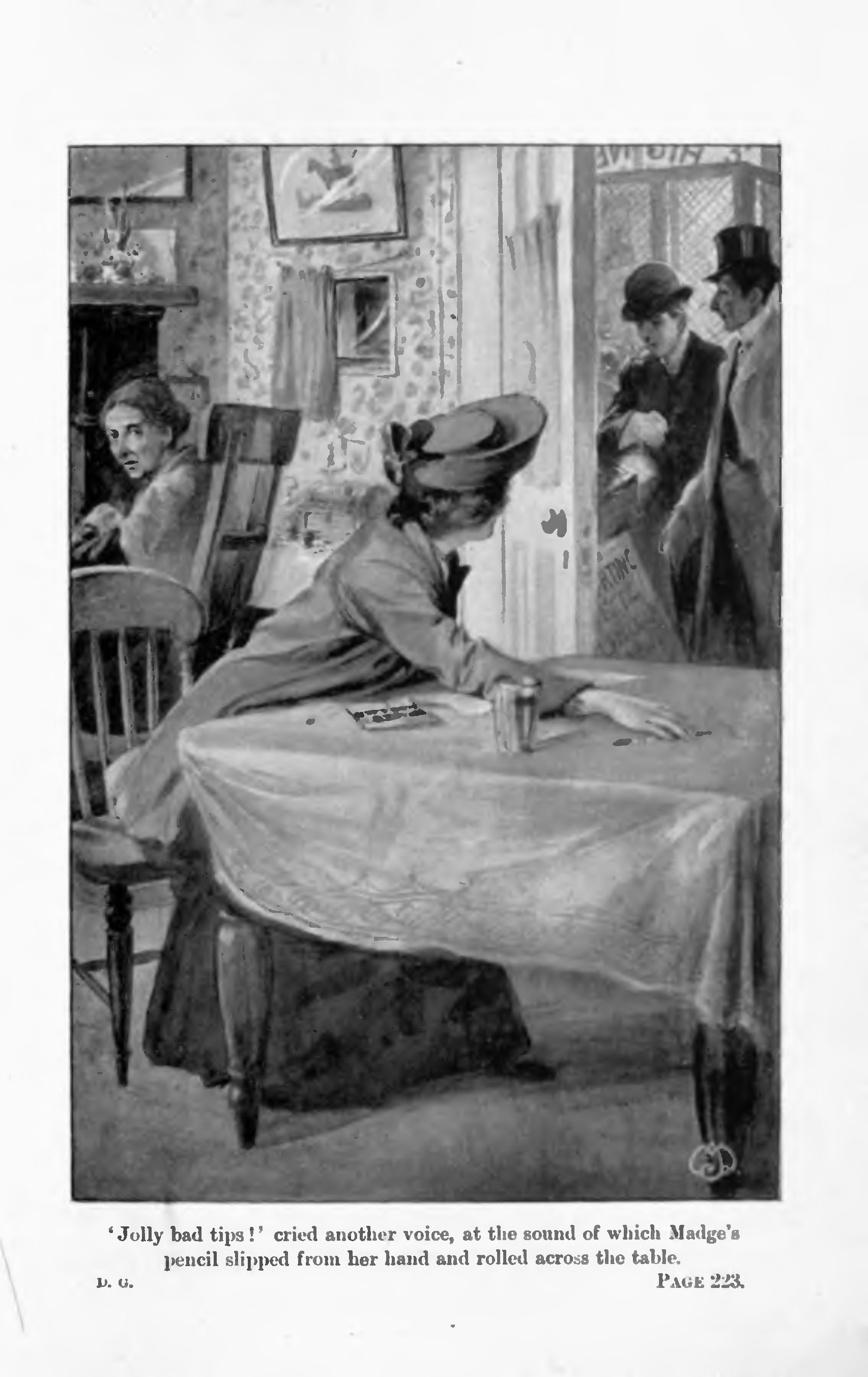
Madge murmured sympathetically and bent her head over her work. All unwillingly she had touched upon the family skeleton, and it was difficult to know how to offer consolation when the offender himself was within hearing distance. She worked steadily at her sketch, while the woman sat down to her sewing, and for several moments the silence was unbroken. Then came the tinkle of the little bell, and two customers entered the shop. Madge heard a request for tobacco and a sporting paper, but she was in the middle of some fine printing and did not lift her head from her sheet. The proprietor was evidently weighing out the tobacco while his customers studied the paper. Suddenly one of them spoke in a reproachful voice:
“You were wrong about Friday’s race, Mr Edwards. Brownie was not in it! You have not been fortunate in your tips lately.”
“Jolly bad tips!” cried another voice, at the sound of which Madge’s pencil slipped from her hand and rolled across the table. She bent forward to rescue it, casting at the same time a lightning glance through the half-opened door. The two customers were still standing before the counter, the younger of the two speaking in hot, excited tones: “I wish I had never taken your advice. It’s been a bad business for me. I’ve lost five pounds this last fortnight.”
“I wish I had got off with five pounds, sir,” sighed the tobacconist; and his wife echoed the sigh with hopeless resignation. Then the bell jingled once more, the customers left the shop, and five minutes later Madge pushed back her chair and prepared to follow their example.
“Bless me, miss, you are white!” cried the woman anxiously. “Have you turned faint? Sit down, my dear, and I’ll make you a cup of tea.”
“Thank you, you are very kind, but I shall be all right when I get into the air. The room—the room is rather warm.”
Madge gave a nickering smile, pulled herself together, and went through the concluding interview with the shopman with creditable composure; but once outside in the street, and lost in the deadliest of all solitudes—a London crowd—her agitation could no longer be restrained.
Oh Barney! beloved Benjamin of the family—radiant, clear-eyed child—honest, fearless boy—have you come to this? Betting, Barney! Losing five pounds in a fortnight—throwing it away with both hands—while at home Philippa sat sewing—sewing from morning to night—mending, turning, contriving, to save a penny—while Steve became old before his time, and Hope grew pale and thin with anxiety. A rush of colour flooded Madge’s cheeks, and the indignant blood tingled in her veins. Then came a sudden terrifying thought before which she paled again. Where had Barney got this money? It was impossible that he could have saved it out of his pittance of a salary; the home exchequer could not furnish it; then how had he come by it? Madge walked along the busy streets pondering on this question, and on another equally important—her own course of action. If she could save her sisters from this painful discovery, if she could bring Barney to a sense of his wrong-doing, and pay off his debts by her own work, Madge felt that she would not have lived in vain. It did not matter how hard she had to work; she would sit up half the night gladly—gladly; and her experience had been so encouraging as to justify her in more ambitious flights. She would set to work at once on a design for a nursery frieze which had been in contemplation for some time past, offer it to a West End firm, and boldly ask a good price. If only Barney would be frank, and confess the whole truth! She reviewed his conduct for the last few weeks, and realised that, with the exception of one outburst of spirits, the boy had been preoccupied, silent, inclined to be irritable. She studied his face throughout the evening which followed, and was startled at what it told, even as Hope had been before her.
It was not until the house was quiet, and Barney had retired to his room, that Madge found her opportunity. Then she knocked softly at the door, was told to come in, and entered, to find Barney hastily covering up a bundle of papers. The action, the glimpse at the papers which showed them so surely to be tradesmen’s bills, fired Madge with fresh indignation. She looked fixedly at the boy, and he returned her gaze with surprised inquiry.
“Well! What do you want?”
“I want a little conversation with you apart from the rest. I was in that tobacconist’s shop this afternoon when you came in, Barney—that is to say, I was in the room behind the shop putting a few last touches to my sketch.”
“Well!”
“The door was open, and I heard what you said.”
Barney sat down on a chair, stretched out his legs, stuck his hands in his pockets, and looked at her with an air of insolent calm. The worried, downcast air which he had worn on her entrance disappeared as if by magic; his face was hard, stubborn, and defiant.
“Well—and what if you did?”
“What if I did? You can ask me that, when by your own confession you are betting and gambling, and leading a double life—when you are throwing away money which is needed for daily bread!”
“I never threw away any of your money, did I? You mind your own business, Madge, and leave me to mind mine.”
“It is my business to look after you and keep you out of mischief. Where did you get that five pounds? It is bad enough that you should have lost it, but did you get it honestly, in the first place?”
“You’d better be careful what you say. You are not talking to a thief, remember!”
“How am I to know that?” cried Madge wildly. “If a man begins to bet, one can never tell to what he may sink next. And how could a boy like you have such a sum to spare? Where did you get it, Barney? Wherever you got it, it must be paid back at once.”
There was no reply. Barney folded his arms, and set his lips in sullen determination. The question was repeated, to be ignored once more, when the tide of the girl’s indignation could no longer be restrained.
“Coward! Despicable! To see your sisters slaving for a pittance, and to be content to be a shame and a burden! If you cannot work, at least you might try to be a man, and not disgrace our name.”
Bitter words—bitter words I what need to repeat them? The girl had worked herself into a frenzy of anger, and hardly realised what she was saying, and the boy eat still and listened—the boy of seventeen, who all his life had been the spoiled darling of the household. Ten minutes before the stress of accumulated troubles was upon him, and he had been wrestling with an agony of repentance. A kiss from Philippa, a soft word from Hope, would have brought him to his knees in a flood of penitent tears; but the lash of Madge’s words hardened his heart within him. He made no attempt to stop the torrent of reproach, but when at last she came to a pause he rose slowly, and standing at his full height, looked down upon her.
“If you have quite finished, will you kindly leave my room?” He pointed to the door as he spoke, and there was a look on his face which Madge had never seen before. Barney the boy was dead: Barney the man confronted her with haggard face, and spoke in a tone of authority which she dared not disobey. She turned towards the door, murmuring disjointed words of warning:
“If you will not tell, I must. Philippa—she will have to know.”
“There is no necessity to disturb Philippa to-night. In the morning, no doubt, she will hear that—and other things!”
There was an ominous sound in those last three words which chilled Madge with a sense of trouble to come, but the door was closed against her even as they were spoken, and she crept back to bed shivering and dismayed. Perhaps if she had been gentler, more conciliating—if she had fought with the weapons of love instead of anger—she would not have been so signally defeated. Like many another quick-tempered sister, Madge’s anger ended in self-reproach, and when too late she would have given the world to withdraw her bitter, pitiless words.
Chapter Twenty One.
Dark Days.
The next morning, when the four sisters were seated at breakfast, Steve entered and stationed himself before the fire to read a long, business-looking letter. His exclamations of dismay as he read roused the girls’ attention, but Steve did not reply—to their eager questioning. With set face he handed them the letter, and one by one they read the unwelcome intelligence, and swelled the chorus of sighs. Barney was dismissed from his situation! The manager wrote a courteous explanatory letter to the effect that an inexcusable escapade—the last of a long series—made it necessary for the lad’s connection with the office to cease. He regretted this conclusion, not only from the fact that his old friend Mr Loftus would have cause for disappointment, but also, he might add, for the sake of the boy himself, who had many good points and was a favourite among his companions. If he might be pardoned for making a suggestion, an office desk was hardly the right position for a youth of so much spirit. Given more congenial work, he would no doubt do better. It was a kindly letter, and one which made its import as palatable as possible. Philippa sighed, and said, “Just what I have been thinking! It was too hard on the boy to expect him to settle to that humdrum life. Perhaps this is the best thing that could have happened.”
But Steve was not disposed to take such a lenient view of the matter.
“If Barney had told us honestly that he could not stand it, we would have done our best to find another opening. But to be dismissed like this—to be turned away at an hour’s notice—it is disgraceful! Uncle Loftus will have every right to be angry. ‘An inexcusable escapade’! What can that refer to, I wonder?”
Theo covered her lips with her hands, for even at that moment she could not restrain a smile at the recollection.
“I think I know. Barney told me the night before last. One of the clerks bought an alarm and left it on his desk while he went out to lunch. He had previously announced that he was going to meet his fiancée in town, and take her to a concert after dinner. Barney got hold of the alarm and set it for nine o’clock. He knew the poor creatures would be sitting in cheap seats, and that there would be no cloak-room for their things. The man would put the clock in his hat under the seat, and at the appointed time, Cr-r-r-r-r, off it would go! He would not be able to stop it. I asked Barney last night what had happened, but he would not tell me much. I suppose he was in low spirits about his dismissal. The alarm had gone off in the midst of a classical concerto, and the people around had been so cross that the clerk had to rush out with it as fast as he could go. He was very angry, and went straight to the manager to complain.”
“Oh! oh! how naughty!” cried Philippa. Hope was laughing softly to herself, but Phil looked at Steve’s stern face and dared not show any amusement. “Where is Barney!” she asked. “Perhaps he does not like to come in until we have read our letters. Call him, Theo dear, will you! His breakfast will be cold.”
Theo stepped across the narrow passage and tapped at the door of Barney’s room, waited a moment, opened it gently, then came running back, all scared and breathless.
“He is not there! The bed has not been slept in. Oh Phil, what does it mean?”
But she knew what it meant; they all knew. There was no need for explanation. Together they crushed into the little room and looked around with haggard eyes. Theo had a dreary sense of having been through it all before; and indeed it was an old, old story, even to the torn-up papers on the hearth and the letter of farewell on the dressing-table. It was addressed to Philippa, and she read it aloud, with short, gasping breaths:
“‘I have lost my situation, and have got into debt, and lost money betting on races, and the best thing I can do is to take myself off and not trouble you any longer.—I can’t stay here to be a shame and a burden.’—(Oh Barney!)—‘If you and Steve will pay off my bills, you can look upon the money as my share in what was left. I will never trouble you for any more.’”
Here came a great dash as if the writer had intended to end the letter, but at the bottom of the sheet were a few words scribbled in uncertain letters: “Good-bye, Phil. I’ll try to keep straight for your sake.”
Philippa looked up; agony was written on her face, but her first words were of thanksgiving. “Thank God! He is alive and well; he will do himself no harm. My poor boy! We must find him and bring him home again.”
“Betting!” echoed Steve. “Debts! I can’t understand it. We kept him supplied with pocket-money; he had a comfortable home; what more did he want? I don’t wonder he was ashamed to face us, but it is a cowardly thing to run away from the consequences of his wrong-doing and bring fresh anxiety upon us. I wouldn’t have believed it of Barney.”
“It is my fault! Blame me; I drove him to it,” said Madge desperately.
Her sisters stared at her in amazement, while she told the history of the last afternoon and evening, omitting nothing, extenuating nothing, repeating her bitter words with unflinching honesty. Only her face betrayed the inward agony of remorse, but that was eloquent enough, and when she had finished not one of her hearers had the heart to utter a reproach. Philippa looked appealingly at Steve, as if asking what could be done next; but for once the set face refused her comfort in her need. Stephen could be trusted to do what was right, but his search would lack the inspiration which would come from a thorough understanding of the boy’s character.
“And I’m only a woman; I haven’t the knowledge that a man would have,” sighed poor Phil to herself; then she stretched out her hands and cried sharply, “I want to see the Hermit. Barney liked him so much! They used to talk together; he will know best what was in the boy’s mind, and be able to help us.”
“I’ll bring him up,” said Steve, and turned straightway to the door. He, too, was eager for a man’s advice—a calm, masculine judgment—to temper the discussion with these distracted girls. Relief was apparent in his manner when he followed the Hermit into the dining-room five minutes later, and summoned his sisters to meet him.
“Barney has gone!” said Philippa simply as she put her hand into the one outstretched to meet it. Then as she met the grave tenderness of the gaze that was turned upon her, for the first time she broke down and sobbed out a wild appeal: “Oh, find him for me—find him for me! He has run away, and it is all my fault. I brought him to this terrible city, and shut him up in an office all day long; and Barney is such a restless creature; he can’t endure confinement. If he got into trouble here, when we were all near him, what will Income of him now when he is alone? Oh, find him for me! Bring him back—”
“I will, Miss Philippa, if it is humanly possible,” replied the Hermit gravely. And then Madge’s story was retold, and the question raised again as to how Barney had come into possession of so much money.
“I can account for some of it at least,” Mr Neil said. “I saw that the boy was troubled, and found out that he was in need of money. Eventually he asked me for the loan of five pounds. I said, ‘My boy, you must not begin borrowing at your age. It is a bad habit, and I won’t encourage you in it. But I had made up my mind to give you a cheque for a Christmas present; and you shall have it in advance, if that would be a help to you.’ He said it would, and I gave him the five pounds for which he had asked.”
“It was not right of you. No! you should not have done it. It was leading the boy into temptation.” Philippa spoke in tones of strong reproach; but though Mr Neil’s face was troubled, it was in nowise repentant.
“I have been a boy in an office myself, Miss Philippa,” he said gently, “for two years—two long, miserable years—and I know—forgive me for saying so—that there is an even greater temptation in being too short of money. When a lad gets his first taste of independence it goes hard with him if he cannot indulge in the little luxuries which his companions enjoy; and the shops seem irresistible. I hoped that by means of my gift Barney might be able to pay off his debts and start afresh.”
“You have been very generous and very forgiving, Mr Neil,” said Steve; “and we are much indebted to you. But what can we do this morning? I must get to the office as soon as I can, for there are already two men away. It won’t do for me to lose my berth into the bargain.”
Steve spoke with a tinge of bitterness, for in truth he found himself in a painful position—the position of the elder brother in the parable. He had never got into debt, nor betted, nor failed in a single instance in his duty to his sisters, and it was a little hard to realise, as he did this morning, that to each one of the four—Phil included—the curly-headed prodigal was dearer than himself. He looked at the Hermit, and asked anxiously, “Can you come with me?”
“It is what I was about to propose. I am my own master, and can give all my time to the search. We had better go to the office first, and try to discover who was the companion of the tobacconist’s shop; then if we get a clue I will follow it up.”
“Right,” said Steve, and went into the little hall, to find Hope already brushing the coat which she had taken down from its peg. She helped him to put it on, turned down the collar at the back, and let her hand rest against his neck as she murmured a few low words: “Dear old Steve! What should we do without you?” It was always Hope’s way to divine a wound and lay a healing hand upon it.
The two men went straight to the insurance office, and interviewed the manager in his room. “Waxworks,” as Barney had irreverently dubbed him, was unaffectedly grieved to hear of the boy’s flight, and repentant of his own share in the catastrophe. “I liked the lad,” he said. “One could not help liking him. If I had consulted my own wishes only I should have lectured him and let him stay on, but in a big place like this it is necessary to keep a firm hand. I had overlooked several breaches of discipline, and it could not go on. He must be found, of course; and then, if you take my advice, you will let him live an out-of-door life. Send him abroad. He is just the type that is wanted in the colonies. Now I’ll send for Young, and you can question him as you please.”
Mr Young, however, had no light to throw upon the subject; neither had Barney’s special companions among the clerks, who were interviewed in their turn. The lad had left the office alone, so that the identity of his companion still remained a mystery, which the tobacconist alone could solve. The two therefore made their way to the little shop, where Madge’s sketch was displayed in all its glory in the window, but neither brother nor friend had the heart to laugh at it to-day. The tinkling bell announced their entrance to the proprietor, and they lost no time in telling him the object of their visit. Two young gentlemen had been in the habit of visiting his shop and asking his advice on racing matters, their last call happening the night before, somewhere about five o’clock. The younger of the two was tall, dark, and handsome; for private reasons his friends were anxious to interview his companion. Who was he, and where employed?
Did the man know or did he not? He professed utter ignorance, but there was a slyness on his face which did not escape the notice of his questioners. A number of gentlemen came to his shop; sometimes they did happen to talk of a race if it was near at hand; but he never inquired a customer’s name. Gentlemen wouldn’t like it. Couldn’t say for certain that he remembered the two just mentioned.
“The man lies. We will waste no more time on him,” said the Hermit sternly as he turned away from the door. “Go back to your office, Charrington, and leave me to see the police and put an advertisement in the papers. That is all that we can do at the moment, though I shall not rest until I have tracked that unknown friend. He will probably be able to tell us more than any one else. I’ll think out a plan of action for the next few days. This is my business as well as yours; for the boy has been like a young brother to me this last year.”
Looking back on the days which followed Barney’s disappearance, the Charringtons were often puzzled to understand how they endured the strain and suspense, and marvelled at their own composure. Day after day the Hermit continued his search, and came home weary and disappointed; day by day Philippa listened to his report with a steady face, and abated not one of her usual efforts for the comfort of the household, while the three younger sisters set their teeth and went on doggedly with their work.
“If we were actresses or public singers we should have to keep our appointments, and smile and look cheerful; if we were clerks or teachers we should have to turn out as usual, and be patient and forbearing; if we were shop assistants we should have to stand on our feet all day long, and be polite, however much we were aggravated. We are poor things if we call ourselves working women and then indulge our feelings like any fine lady,” Theo had said sternly to two drooping figures who sat by the fire gazing at idle fingers, and she had no need to speak a second time. In the temporary eclipse of Madge’s bright spirits, Theo had taken upon herself to be the cheery, inspiring member of the family, which rôle shook her out of the old self-engrossed groove, and suited her well. Now, as she went into her room and sat down at her desk, her heart swelled with a sense of joy and gratitude for the talent which had been entrusted to her care. She took up her manuscript and set to work with none of the difficulty and hesitation which often hampered her progress: the thoughts crowded into her brain; the right word came of itself and did not need to be sought; the difficult point was overcome, and she laughed with delight at the wittiness of her own dialogue. Here, then, was a discovery, that even sorrow had its compensation, since it brought with it fresh understanding, earnestness, and delicacy of touch. When she went in to lunch, the light on her face made her sisters look and wonder.
“No need to ask how you have fared to-day, Theo,” Hope said. “I don’t know who your characters are at the moment, but they have been good children this morning.”
“Couldn’t be better,” said the author brightly. “So charmingly alive, and saying such witty things! It is a curious delusion, but when I do my best work I always feel as if some one else suggested it. I was sad enough in my own heart to-day, but as I wrote a little sprite seemed to whisper in my ear. The good things came! I didn’t create them. I suppose the really great writers often feel like that I am quite sure that when they read over their books they are astounded at their own cleverness.”
“It must be a very—a very agreeable sensation. I have never been the least little bit surprised at mine. I tried to work, too, but I didn’t get on well. You two girls make me ashamed of myself, but I think sometimes that I was never meant to be a public character,” sighed Hope, wrinkling her forehead in her pretty, wistful fashion. “I don’t seem to have the faculty of earning money.”
“Because nature intended some one else to make it for you, darling! You are one of the dear, frightened, humble little creatures who need a big strong man to stand between them and the world. I do hope you will marry, Hope! Do, please, the first chance you get. You’d be ever so much happier, and it would be so agreeable for us. Marry a rich man who lives in the country, and send us hampers every week!” cried unsuspecting Madge. It seemed natural enough to the others that Hope should blush at the suggestion; only Theo understood the meaning of that blush, and the train of thought which suggested the reply.
“I think I shall go to see Avice this afternoon. I promised Steve that I would call before the end of the week if we had no news. He doesn’t want uncle to hear about Barney in town; he might be annoyed that we had not told him ourselves.”
When Hope saw her aunt’s face, however, she knew at a glance that she was too late with her news, and sat meekly listening to the tirade which followed, thankful that she was the listener instead of Philippa. Her gentleness was her best weapon, however; for, having said her say, Mrs Loftus began to soften and to regret having spoken so strongly. Argument or contradiction would have incensed her still further; but how could one go on scolding a pretty, timid creature who merely sat still and looked miserable? She paused, frowned, and finally asked the amount of the debts which Barney had left behind. “Everything, I mean—the whole sum for which you are liable.”
“I think, perhaps—I’m afraid nearly t-twenty pounds!”
The gasp with which Hope replied was for the magnitude of the sum mentioned; the echoing gasp from the other side of the fireplace was for an exactly opposite reason.
“Only twenty pounds!” cried Avice; “the price of a gown! The poor boy ran away for that! Hope dear, I will pay it myself; I will give it to you this afternoon before you go. You sha’n’t be worried about it any more.”
“It is paid already, dear. Steve saw to that at once. You are very kind, but Barney would not like it, and we have a good deal of money still left. Philippa drew it out of the bank.”
“You will be in the workhouse soon,” Mrs Loftus prophesied cheerfully. “I never heard anything more mad than to spend your capital as you are doing. Just think of the inroads you must have made into it this year!”
“I’d rather not, Aunt Loftus, if you don’t mind. It is always the first step which costs, but we have made a start, and hope to do wonders next year. At the worst I shall avoid the workhouse by throwing myself on Avice’s mercy.—You would have me down at the lodge, wouldn’t you, dear?”
The glance exchanged between the two cousins was full of confidence and affection, and Avice’s voice had a new ring of animation as she replied:
“I should like to have you always. Oh Hope! I do enjoy shopping now, and seeing the girls who were with us in summer. Mother is quite scandalised because we talk so much, but being with them does me more good than I can say. And the conjurer’s daughter is going to be married—to a magic-lantern man! I thought of having them down for their honeymoon.”
“Avice is far more interested in that engagement than she is in Truda Bennett’s; and she is to be one of Truda’s bridesmaids, too,” said Mrs Loftus in a puzzled tone as she pushed back her chair and rose from her place before the tea-table. Hope rose too, with an impulse of escape, and bent down to pick up muff and gloves. Her heart had given a great leap of fear, and was beating in heavy throbs, but she said savagely to herself, “You sha’n’t blush! You sha’n’t look startled!” and turned an unmoved face to her aunt.
“Miss Bennett engaged! I didn’t, know.”
“You can’t have used your eyes, then, when you were with us last year. They flirted shockingly! It ought to have been announced long ago. By the way, Hope, we go down to The Shanty next week. You had better come with us for a little visit. I meant to write and ask you, and you look pale—as if you needed a change. We shall be almost the same party as before.”
“Dear aunty, I can’t. It is good of you to think of it, but I couldn’t leave home just now. I should be so anxious and troubled that I should be of no use to you.”
“You must come later, then. It will be all the same to us, but the others will be disappointed. Truda asks after you continually, and Ralph Merrilies said he looked forward to some more delightful music. I wish you could come, Hope.”
“He wanted to meet me, then,” said Hope drearily to herself as she took her way home. “It’s just as I always thought: he cared for me only as a friend, and was kind to me because I was poor and friendless. He must have grown fond of Truda, after all. She is so bright and amusing! I suppose she showed him tricks and made him laugh; and he is so serious himself that he needs some one cheerful. I hope he will be very, very happy.” Her eyes smarted suddenly, and a sob swelled in her throat. “But oh, I wish I had never met him! I wish I was not so wretched! Truda had so many other things, and I could have made him happy. It is hateful of me, but I believe I should make a nicer wife. I should have been so good to him! Oh Ralph! Ralph!”
Alas, poor Hope! She pulled down her thick veil, and cried quietly behind its shelter as she wended her way home through the busy streets.
Chapter Twenty Two.
An Unexpected Clue.
Ten days passed by and brought no news of Barney. Steve devoted every spare moment to the search, the Hermit was unremitting in his efforts, but with the best will in the world they proved but poor detectives. The tobacconist remained stubbornly uncommunicative, and as Madge would not have recognised Barney’s companion if she had seen him, it was little use watching the shop. The insurance clerks were interviewed again and again, but Barney had been prudent in one respect at least—he had not breathed a word of his betting transactions in the office. He had vaguely mentioned “a friend of mine”—“a fellow I know,” but had given no names, and the consensus of opinion was that he must have picked up acquaintances in the luncheon hour, when, boy-like, he was fond of wandering about from place to place. The Hermit lunched diligently in all the principal restaurants in the neighbourhood of the office, and made a point of entering into conversation with his companions, but he failed to meet any one who remembered Barney.
“I am at a standstill. I don’t know what to do next. I am afraid there is very little of the Sherlock Holmes about me, Miss Philippa,” he said dejectedly on the tenth afternoon, as he detailed the history of the day’s search. It had become a custom for him to come upstairs to tell his story and to be refreshed with tea and scones, and the girls welcomed his advent as a break in the long, anxious day. So far he had brought no good news, but while he was devoting so much time to their service, they felt bound to cheer him for his disappointments, and the effort was good for themselves also.
“Never mind; if you were Sherlock Holmes you wouldn’t be yourself, and you are a much pleasanter neighbour as you are,” replied Philippa as she lifted the little copper kettle from its stand and poured the water into the teapot. She kept her face turned aside so that he might not see the disappointment written upon it, and reminded herself for the hundredth time that she could afford to be patient. Had not Barney promised to keep straight for her sake? Perhaps, after all, this separation from home might teach him its value as no amount of petting and spoiling would have done, and on his return he would show a gentler, more disciplined spirit. Philippa would never allow herself to believe that this absence was more than temporary. She handed the plate of home-made scones to the Hermit, smiling the while with some of her old mischievous brightness.
“Hungry?”
“I had steak to-day. I find, on the whole, that steak suits me best,” replied the Hermit, screwing up his eyes in judicial fashion. “It’s so tough that it takes a long time to despatch. Then, again, it takes ten minutes to prepare. I calculate that I can while away a good half-hour on a plate of steak, to say nothing of after-courses. In this way I get several changes of companions, and I manage to work round the conversation until I can bring in Barney’s name, and inquire if they happen to have met him. I am getting quite skilled in the exigencies of small-talk.”
“Poor thing, and you hate it so! It is noble of you to persevere as you do, for I am sure there is nothing you dislike more.”
“No, no; don’t say that. It is good for me. I have studied books too much, and men too little, in my life—to my own great loss. Before you took me in hand a year ago I was a veritable hermit, and the old habits cling about me still. I feel terribly rusty among all those bright, alert young fellows, and they treat me as if I belonged to a different species. Do you—do you notice anything pedantic in my manner?”
All four girls were in the room, but it was to Philippa that he addressed the question; he had a way of looking at her when he spoke, of which the girl herself was gratefully conscious. Theo and Madge—even Hope herself—had a way of treating her with affectionate patronage as a dear, kind, preoccupied Martha who could not be expected to understand their higher flights. She had suffered beneath this treatment, and was delighted that these fledglings should now see in what estimation she was held by a scholar of repute.
“You are the kindest man I ever met. There is no one else among our friends who would jeopardise his digestion by eating tough steak day after day in the hope of doing us a service,” she cried, deftly evading a direct answer, which, if honest, must needs have been in the affirmative. Theo’s hand advanced cautiously and gave a meaning pressure to Madge’s elbow. Madge stared into space, with wooden stolidity of feature. Hope looked wistfully from Philippa to the hermit, from the Hermit back to Philippa once more.
Then suddenly came the sound of the electric bell, followed by a silence of expectation. It might portend a letter or a telegram. It might be even Barney himself!
Mary opened the door, and some one entered the tiny passage to an accompaniment of gasps and groans and rustlings of silken skirts; the air became laden with scent, and a second after Minnie Caldecott staggered into the room and sank down on the nearest chair.
“Where is your lift? You horrible girls, what do you mean by not having a lift? I’m dead!” she announced tragically, fanning herself with the ends of a chiffon boa, and puffing and blowing in quite an alarming fashion, until, suddenly catching sight of the Hermit at the other end of the room, she sat up straight in her chair and recovered her breath with remarkable celerity.
The Charrington girls had never before seen the fair Minnie in the presence of a member of the opposite sex, and the scene which followed filled them with delighted amusement. The lady elaborately prepared herself for the fray, set her hat at a more becoming angle, pulled out the little curls under the veil, and while ostensibly addressing herself to her friends, sent fascinating glances across the room with her big blue eyes. The man hunched his shoulders, screwed up his brows, and looked helplessly miserable and ill at ease. He would have given the world to escape, but the buxom figure barred the way, and he lacked the courage to pass by. There was nothing for it but to sit still until she chose to depart.
“Well, I’m thankful I have found you at home after that climb. You must think twice before you go out, when you live in a bird’s nest like this. I nearly turned back, but I wanted particularly to see you about some business.” She caught Hope’s eager glance, and shook her head in reply. “Nothing for you, dear. No more songs just now. I say! you are white. What’s the matter? Have you been ill?”
“Not ill exactly. We have had an anxious time lately.”
Hope could not bring herself to speak of Barney to Minnie Caldecott, and her cheeks grew pink even as she spoke, for she knew that she was using the boy’s disappearance as a cloak behind which to hide the real trouble which was sapping her strength. Miss Caldecott nodded her head, however, as though she understood all about the matter, and said cheerfully:
“Still trying to make your fortune! Better give it up, my dear, and follow my example: I’m going to be married.” She threw a deprecatory glance at the Hermit, as though condoling with him on his own late arrival on the scene. “Told you I should come to that before long! Fact is, the public is getting tired of me and running after newer singers, and I must do something to improve my position, so the day is fixed for the third week in January; and on the fifteenth of December Minnie Caldecott gives a grand farewell concert, when all her friends in the profession will give their services for her benefit.”
“How kind of them!” said Hope. “I hope you will be very happy. But are you really going to retire so soon? Your voice is so fresh still—you are so young—”
The bride-elect laughed her large, hearty laugh. “How old should you think I was!” she inquired; and this time she addressed the Hermit in such a marked manner that he could not choose but reply. He looked annoyed, however, and the pedantic manner was at its height as he said shortly, “I am afraid I must confess that I have not thought about the subject at all.”
“Think now!” said Minnie, staring at him with her wide blue eyes. She was like a big baby, Madge reflected—a huge wax doll—just as smooth and pink-and-white and chubby—just as vacant and soulless in expression. “Out with it! Don’t be afraid,” she cried; and the Hermit, thus goaded, ventured a leap in the dark:
“I should say somewhere about thirty.”
Miss Caldecott turned a horrified face towards her friends.
“Well, he doesn’t know how to pay compliments.—Thirty, indeed! I’m only twenty-nine, and in the profession we always knock off at least five years. No, I am not going to retire. I know a trick worth two of that. A few months later there will be another concert—‘first appearance since her marriage’—and a year or two after that a second farewell; but I want to make a big splash with this first one, and it occurred to me the other day that you might help me.” Her eyes wandered round the room until they rested on Madge’s thin face. “You are the one I want. You designed that swell leaflet for your sister’s entertainment. Don’t you think it would be a good chance for you to do one for me now?”
Madge looked at her quizzically. The Charringtons had learned by this time that, in spite of her beaming good-nature, Miss Caldecott was a keen business woman, and that in dealing with her it was necessary to look well after one’s own interests.
“I am not certain that I can undertake any fresh orders just now; I am so busy with my advertisements,” Madge replied grandiloquently, glancing at the table in the window on which lay the roll of the nursery frieze, now approaching completion.
As she had expected, Miss Caldecott insisted upon seeing it, and went into raptures over a spirited rendering of “Hi Diddle, Diddle.” The cat was evidently of Cheshire origin, to judge from its bland and benign expression; the cow was in the act of drawing itself together for the fateful leap, while the moon rolled apprehensive eyes towards it, and the little dog clasped its fore-legs over its heart in an ecstasy of amusement. In the distance a gentlemanly-looking dish was dragging a swooning spoon in its wake. It was very funny, very clever, very original; for Madge, like Theo, had been working at high pressure, and had been inspired to do her best in the hope of paying off a part at least of Barney’s debts, and thereby giving a sop to her troubled conscience.
“I am not quite sure who shall have it, Mason’s or Fearing’s,” she said languidly, mentioning the two largest West End furnishers, in reply to Miss Caldecott’s inquiry as to the destination of the design. “It depends, of course, upon which makes the highest offer.”
She turned her head cautiously to grimace at her sisters, and beheld the Hermit wreathed in smiles, nodding encouragement, waving his hand as if imploring her to keep it up. His delight, contrasted with the baffled expression on Minnie’s chubby face, proved almost too much, for Madge’s composure, but she busied herself with covering up the sketches, and presently returned to her seat, and smiled with bland patronage upon her visitor.
“And now—er—about this concert!”
“Herman is going to sing, and Marie Ross, and—” Miss Caldecott reeled off the names of half-a-dozen well-known artistes, checking them on her fingers with an air of triumph. “They are all giving their services. My dear, it would be the finest advertisement you could have. Make up something original and striking in the way of a programme, and they will all be eating out their hearts with jealousy. You don’t know what we are in the profession, but I do. And you may take it from me that every one of them will determine on the spot that she will have something even better when it comes to her turn. You will have your name printed in the corner. I will crack you up as the coming artist, and they will all be running after you, and giving you more commissions than you can take—”
“On the same terms?” queried Madge blandly. “Because if so, I hardly see where the artist comes in. There must be reciprocity in these things, Miss Caldecott. I cannot work for nothing. Now, for instance, if you were going to sing Hope’s song—”
Miss Caldecott looked shocked at the suggestion.
“My dear girl, it’s impossible. I’m booming three songs for publishers just now, and get half-a-guinea apiece every time I sing them. That is what Hope should do: get some firm to push her things, and pay for having them sung. She will never make a name until she does.”
“Just so; but as she is young and unknown, they don’t feel inclined to help her. It would help matters considerably if you would give ‘The Song of Sleep’ at your concert. You might possibly lose ten-and-sixpence, but, on the other hand, my charge for an illustrated programme is five guineas! You would have the best of the bargain.”
In the silence which followed the Hermit’s chuckle of delight was distinctly audible. Minnie looked at him sharply, nodded her head as if in sympathy with his enjoyment, and cried laughingly:
“She’ll get on! No fear for her! Knows how to look after herself, and her sister too. Very well, then, it shall be an encore; but you must do your best for me, mind—something very fetching. If you could give a hint of a wedding it would be a good idea. I don’t want the audience to think I am retiring through old age. Thirty, indeed!” and she threw an indignant glance at the Hermit, the while Madge laughed, and suggested: