Mrs George de Horne Vaizey (continued 3)
Reading edition
“So to us all comes the end of the day. When our playmates are lost, and our toys cast away; Tired children of earth, when the shadows fall deep, The Father in Heaven will grant to us - sleep!”
The pause before the last word gave to it an added emphasis, and Hope let her hands fall on her lap with a sigh of pent-up emotion. Her eyes were bright with unshed tears; but there were no signs of emotion in the audience.
“How sweetly pretty!” cried Truda in the very accents which the singer had heard in imagination.
“I say! Quite touching, isn’t it?” said the youth with the fair moustache.
There was a babel of “Thanks—thanks awfully!” and Aunt Loftus said graciously, “You must be tired, my dear. Come and sit down. We must really give you a rest.”
For five minutes afterwards Hope was the centre of an admiring throng, and tasted the bitter-sweet of an applause which failed to appreciate the true merit of her work. It was pleasant enough, so far as it went, but it left a disappointed ache behind, and she was not sorry when Truda asserted her rights, and by means of a trick with a lead pencil, a piece of paper, and a hand-glass succeeded once more in gathering the company round herself.
Hope remained on the outside of the circle, a little tired after her exertions, and thankful for a moment’s breathing-space. As she stood she became conscious of a steady gaze levelled upon her from the other end of the room. Mr Merrilies had not taken up a position with the other men, but was leaning against the mantelpiece, studying her face with a grave, intent questioning. For a moment each looked deep into the other’s eyes; the rest of the figures in the room seemed to fade away, and these two saw each other as they really were, shorn of all the pretence and artificiality of society.
“It is true,” he said to himself: “her mind is as lovely as her face. She could not have composed that song—she could not have sung it as she did—if she were not everything that is sweet and good. Hope! I wonder—I wonder if—at last—”
He raised his arm from the mantelpiece and walked forward to join the group by the table, while Hope shrank still farther into the shadow. Her cheeks flushed, her heart beat with an unaccustomed quickening. “I believe,” she said to herself—“I believe he understood!”
Chapter Eleven.
New Friendships.
Three days passed, and Hope thoroughly enjoyed the novel experience of life in a crowded and constantly changing household. Certain of the guests were fixtures, among whom were numbered Truda Bennett, Mr Merrilies, and the fair and facetious Reggie Blake; but for the rest, every day saw fresh arrivals, fresh departures, all involving a certain amount of extra work to the busy servants. Hope could not help realising the truth of Madge’s shrewd surmise that she had been asked to make herself of use, for her aunt did not foil to claim her services a dozen times a day. She arranged the flowers, decorated the dinner-table, answered business letters, made up and unpacked parcels, and, in short, discharged all the little duties which ordinarily fall upon the daughter of the house.
The work kept her more or less separate from the rest of the party, and there were occasions when she listened longingly to the bursts of laughter which sounded from the hall or from the billiard-room when on a wet day the resourceful Truda organised a billiard tournament for the entertainment of the men. But for the most part she was delighted to be of use, to watch her aunt’s hard manner gradually soften into something closely approaching affection, and to receive from time to time one of her cousin’s rare caresses. Avice never offered to take any part in the work, but the listless eyes noted more than was imagined; and looking back over the day’s history, Hope often realised that it was to a quiet word or suggestion from Avice’s lips that she owed what little pleasure came her way.
With Mr Merrilies she had few opportunities of conversation, for he was out shooting all day long; and in the evening Truda claimed him for her own, and allowed him no chance of leaving her side. She had dozens of what she called “parlour tricks,” and every evening produced some new device to attract attention. Now it was a ring slung on a piece of string, which must be separated without undoing the knot; now a feat of balancing; now some marvellous thought-reading, carefully prearranged with a confederate. She was a young person whom it was impossible to ignore, who systematically made herself the centre of attraction, laughing, talking at the pitch of her voice, and gesticulating with her little ringed hands. Hope felt a curious fascination in watching Mr Merrilies’ expression as he passively played the part of assistant, and asked herself curiously if he returned Truda’s feeling of “especial interest”. Impossible to say. His inscrutable face was no index to his feelings, but if he showed no special pleasure in being thus singled out, he at least made no effort to escape it. In spite of the warning which she had received, Hope could not help feeling more interest in this man than in any other member of the party; and she realised, with a little thrill of satisfaction, that the interest was mutual. If she took advantage of an unobserved moment to study him, he lost no opportunity of watching her in return, and the knowledge that his dark eyes were fixed on her as she talked, and sang, and moved about the room filled her with a new and delightful self-consciousness.
Now, Hope was a warm-hearted girl, and, as was only natural, had given many a thought to the lover of the future; but it never occurred to her that there was any danger in the interest which she felt in Ralph Merrilies, or in her intense consciousness of his presence. She deluded herself into the belief that she was less cordially disposed to him than to any other member of the party, for she had been warned that another girl considered him her individual property, and was by no means willing to share his attentions. So it came to pass that she kept quietly in the background, and had little or nothing to say to Truda’s cavalier.
On the third evening of Hope’s stay at The Shanty the sportsmen came home unusually tired, and for once Truda’s after-dinner tricks failed to entertain. The men had no inclination to exert their minds or their muscles either, and turning to Hope, begged her for “a tune.”
“The worst of Miss Charrington,” sighed Reggie Blake regretfully, “is that she is so painfully classical and superior. She never condescends to play a piece whose composer hasn’t seven syllables to his name and a sneeze in the middle. They are very clever and all that sort of thing, don’t you know, but I always wonder when the tune is going to begin. Squeak, squeak! in the treble; bang, bang! in the bass; a rolling like heavy machinery, and all sorts of jerks and breaks when you are least expecting them: that is what you call a ‘Gigue.’ A bit of a scale repeated over and over again like the tune the old cow died of: that is a ‘Fugue.’ I’ve a musical sister at home, so I know. Now, I don’t pretend to be classical; I like a good, rousing air—something that makes you want to stamp your feet and beat time with your head. Look at Miss Charrington laughing at me! I suppose as a matter of fact you don’t know any airs, Miss Charrington?”
“I have a schoolboy brother,” answered Hope demurely. She wheeled round on the music-stool and looked at him with dancing eyes; and when Hope looked mischievous, it was something very well worth seeing in those days of young womanhood. “I blush to say,” she said slowly—though as a matter of fact she did not blush at all, but looked particularly beaming and complacent—“I blush to say that there is not a single tune at present performed upon the barrel-organs with which I am not intimately acquainted. I shall be happy to accompany you, and to coach you in the words, whenever you feel inclined to perform.”
“Hurrah! Good business! Will you really!” cried Reggie, jumping to his feet and hurrying across to the piano, abeam with delight. “Can you manage ‘Mrs ’Enry ’Awkins’? That is my stock song, and I sing it wherever I go.—Mrs Loftus, you are dying to hear me sing ‘Mrs ’Enry ’Awkins’? I know you are.—Let’s tune up at once, Miss Charrington; and a chorus, mind—a rousing old chorus!”
Every one was laughing, and looking of a sudden bright and animated; no one was sleepy any longer. There was a secondary accompaniment of chuckles as Reggie screwed up his thin, ugly face into the most comical of grimaces and half-sang, half-recited the celebrated coster love-song. Hope’s spirited playing made him sing his best, and her clear voice started the chorus with such spirit that presently every one was taking part, tentatively at first, then with quickly growing ardour, until at last the volume of sound became overpowering. Uncle Loftus bellowed himself hoarse in his corner, and even his wife’s lips moved in sympathetic echo. At the conclusion of the song there was an outburst of applause and laughter which made the performer beside himself with delight.
“To think,” he cried, “that we have wasted our time over Wagner and Grieg, and all those foreign Johnnies, when we might have had music like this! I’ll sing every night; and we must work up some more choruses. Mrs Loftus, have you any Gilbert and Sullivan operas in the house? Couldn’t we have a try at them?”
Why not, indeed? No sooner said than done. Out came the operas from the music cabinet, and as half-a-dozen voices urged the claims of half-a-dozen favourites, there was plainly nothing to be done but take each in turn. The chorus was by way of being a scratch combination—one treble; one alto, who had to accompany as well as sing, and also to put in all the high notes, because the treble declared that she could not possibly “go” above F; two tenors, by no means as correct as they might have been; and an army of heavy, dragging bass—but what was lacking in ability was made up by fervour.
Mr Merrilies did not sing, but he volunteered to turn over the pages, and seating himself by Hope’s side, watched her face for the signal which was to guide his inexperience. At first this signal was a quick glance at his face, but as time went on this was replaced by a nod of the head or an upward jerk of the hand—for there was something in the expression of those watchful eyes which was embarrassing to meet at close quarters. They talked quietly together between the choruses, while the different parts were wrangling loudly, each laying the blame upon the other, and calling attention to his own superior performance: and it was not in girl nature to be ignorant of the fact that Ralph seemed far less concerned about the music than her own comfort. The lamp was moved because it dazzled her eyes; the book was raised to a more convenient angle; a door was closed to avoid a draught; and all in a quiet, unobtrusive manner that made the attention doubly acceptable. Members of large families are not accustomed to have their wishes gratified almost before they are realised, and are all the more ready to appreciate such consideration from a stranger.
Hope played, and sang, and instructed—gave leads, banged insistently upon notes which the singers rendered flat instead of sharp, and even finished a tenor solo which had hopelessly come to grief—until hand and voice and head alike ached with fatigue; but still the insatiable chorus clamoured for more, remembering another and another favourite which it would be a sin to leave untried.
“You are tired,” said a low voice in her ear. “You shall not play any longer;” and before she had time to protest, Ralph Merrilies had risen from his seat and closed the book with a determined hand. “It is nearly eleven o’clock. Do you realise how long you have kept Miss Charrington? She has surely earned a rest. Do come and sit down, Miss Charrington; your back must need support.”
“Better come upstairs with me, Hope. I am just going,” said Avice, rising from the sofa and slipping her hand through her cousin’s arm. The singers, contrite at their own lack of consideration, busied themselves putting away the music, and gathered into little groups round the piano, so that Mr Merrilies and the two girls were alone in their corner, and their conversation was not overheard. “I am afraid we have been very selfish,” he said, looking at Hope’s tired face; “but the music has been such a pleasure that we have gone on and on without noticing the time, and Miss Charrington was too good-natured to remind us that she was growing tired.”
“Hope never thinks of herself,” said Avice quietly; and the colour flamed into Hope’s white cheeks and her blue eyes brightened with pleasure at this unexpected tribute. Avice—Avice the languid, the undemonstrative—to praise her aloud, and in company! She was too much taken aback to protest in the conventional way, but she noticed that Mr Merrilies looked even more pleased than herself. He smiled at Avice with a new interest in his eyes, and said quickly:
“In that case it is our duty to look after her. I should suggest fresh air in the first place. How is it that she never joins us at our out-of-door luncheons?”
“She stays at home to help mother; but she shall come to-morrow. I will bring her,” replied Avice in a voice that for once was not languid, but quite brisk and decided. Wonders would never cease! Could it be that friendship for a girl of her own age was about to rouse the listless Avice to an active interest in the life which was going on around her!
Chapter Twelve.
A Shooting Luncheon.
It was with the exultation of a child on a holiday that Hope prepared to start for the picnic lunch the next day. Hitherto she had watched the departure of the other ladies with a spasm of not unnatural envy, but now she was going herself. The day was bright and mild, and it was so pleasant to drive in the open behind Pipeclay, the little white pony which was Avice’s special favourite. Truda had driven on ahead with the luncheon-baskets, accompanied by a young married lady who was the latest addition to the house-party, so the two cousins were alone, and could talk together without fear of interruption. Hope was all brightness and animation, for she was experiencing at that moment a mysterious lightness of heart which made her see everything through rose-coloured spectacles. She admired everything—the grey stretches of the landscape, the outline of the trees against the skies, the tumble-down cottages by the roadside—while Avice listened to her animated talk with a wistful smile on her face.
“You enjoy everything, Hope. How do you manage it? I wish I knew your secret, for to me it all seems so stale and uninteresting. I do not believe there is anything in the world which would make me so bright and happy as you seem this morning.”
“Nothing?”
“No—nothing. I enjoy some things more than others, of course; but, honestly, for me the happiest moment of the day is when I lie down in bed and feel that for eight hours at least I need do nothing but rest.”
“Poor darling!” cried Hope sympathetically—“poor darling! That is a matter of health, of course. But, Avice, don’t you think that perhaps if you—”
“Yes; if I what?”
Hope knitted her brows and looked distressed and nervous.
“Oh, I don’t want to preach, but perhaps if you had something to do—if you did not think quite so much of—I mean to say that if one is feeling weak and listless, and has nothing to do, one goes on feeling worse and worse. But if one gets interested—”
“Yes, I know what you mean; but how is one to get interested? That is the question. I am not clever like you, and have no hobbies to occupy my mind, and I get so bored with myself. Mother won’t let me help her. She thinks I am too delicate; and, apart from that, she is quick and I am slow, and it would fidget her to see me droning through what she could do in half the time. It is all very well to say, ‘Have an interest.’ Everything that seems new and exciting to you here is stale to me. I am sick to death of living in public as we do, entertaining one set of visitors after another, who all say the same things and amuse themselves in the same way. I am not strong enough to go out ‘slumming’ or visiting hospitals, as some girls do. Where would you find your interest if you were in my place, Hope?”
“I’d find it somewhere,” said Hope sturdily. “You have plenty of money and plenty of time, and there must be a hundred ways of putting them to account. I—I think I would try to help girls who are alone in the world and struggling to make their living. We are all together, and have enough money to keep us from actual want, but I can imagine how awful it must be for girls who are all alone, with no one to help them if they fall ill; whose lives are one long, colourless struggle, with never a ray of brightness or pleasure from Monday morning until Saturday night. Could you not think of some way of helping them? What could you do? I know; I have it! There is that sweet little lodge with no one living in it but old George and his wife, and she was lamenting to me only yesterday that her daughters were married, and there were no young folks left in the house. Why should you not furnish two rooms upstairs, and invite poor shop assistants and girl-clerks to come down for their holidays, two at a time, so that they would be companions for each other? It would be so easy to manage, for you need not think of expense; and Mrs Moss would wait upon them, while you provided their amusements. You could go round with Pipeclay and take them out for drives; you could lend them books and papers, and have them up to the house to tea. They would confide their joys and troubles to you, and tell you about their ‘friends,’ and write letters to you when they went home. When they married, you could help to provide the trousseaux. And when the first little girls were born they would be called after you, and you would knit their socks. They would be brought up to love you because you had been kind to their mothers, and it would be the dream of their lives to be asked down to see all the places of which they had heard so much. In a dozen homes all over the country people would be blessing you, and looking upon you as the good fairy who had brought them health and happiness. Oh Avice, you lucky girl! What would I give to have such a chance? I would begin to-morrow—to-day—this very afternoon!”
“Well,” said Avice reflectively—“well!” It was not in her nature to be enthusiastic like her cousin, but she smiled as if the idea found favour in her sight, and her dull eyes brightened. “It does sound nice. I suppose I could do it if I liked. Mother wouldn’t mind, and Mrs Moss would be delighted. She is one of those women who are never so happy as when they are nursing some one; and she would coddle the girls from morning till night, and give them beaten-up eggs and black-currant Jelly for their throats, and her celebrated cough mixture made out of nine ‘ingrediencies’! I really will think about it, Hope. I believe it would be interesting. Would you help me to furnish the rooms and make them pretty and artistic?”
“Rather! I adore buying things—when some one else has to pay. We would have one room blue, and one pink, with white paint and dear little white beds, and bookcases full of nice books, and comfy wicker chairs by the window, where the girls could sit and read, and rest their poor, tired backs. And I would be your town agent, and look out for likely subjects. If I were in a shop and saw a poor, anaemic-looking girl, I could find out her circumstances from the manager or head of the department; and if she had no one to look after her, and was living in the shop, or in poky little lodgings, I could send on her name to you, and you would invite her to come here for the holidays. Oh, you are going to do it, my dear! You’ll have to do it! I’ll give you no peace till you do.”
“I’ll think about it. I can’t decide things in a moment; but I would like to work with you, Hope, and it doesn’t sound too formidable. I really think I could arrange a pleasant holiday for the girls.”
“I really think you might,” agreed Hope, laughing; and then suddenly came a halloa of welcome, and over the fence appeared one head after another as the shooting party rose to receive the new-comers.
Truda and Mrs Inglis had arrived some ten minutes earlier, and luncheon was laid on a cloth under the shelter of the hedge, mackintosh sheets being spread upon the ground, on which the guests could sit without fear of rheumatic consequences. A few yards away the beaters were already refreshing themselves with Irish stew and copious draughts of beer, while from the hampers had come forth all manner of tempting viands, to which the sportsmen did ample justice, the while they protested at such dainties.
“Mrs Loftus spoils us altogether. I don’t approve of luxuries at a shooting lunch. We are getting too soft as a nation; that is what is the matter with us. It would be a lot better if we went back to simpler ways.—Cut me a chunk more of that galantine, that’s a good fellow. A chunk, I said; cut it thicker, can’t you?” and Reggie Blake bent forward to superintend the carver’s movements with an anxiety of expression which evoked a hearty laugh from his companions.
Mrs Nash, the new-comer, was offering “a handsome wife and ten thousand a year,” in the shape of the lost roll upon a plate, to an old bachelor of sixty, who appeared much delighted at the prospect. Truda was playing tunes on the rim of her tumbler; Avice had actually a tinge of colour in her checks; and Hope sat perched on a cushion, looking down on them all like a queen on her throne. Before the meal had begun she had found herself seated uncomfortably between two of the least interesting of the sportsmen; but she had hardly time to realise her disappointment before—presto! the scene was changed. Mr Merrilies had strolled towards the pony-cart, and returned with an armful of cushions, which he placed on the ground close to where he himself had been sitting.
“There!” he said; “those are for you, Miss Charrington. You have evidently not mastered the art of lunching comfortably on the ground, and we shall have to break you in by degrees. Let me take your plate.”
Thus in the most open and natural fashion the change was effected which was fraught with so much satisfaction to the two people most concerned. It was so much pleasanter than the old position, thought innocent Hope—the view was more extended, more beautiful, more sunny and cheerful; and to judge from his unusual animation, Ralph Merrilies was of the same mind as herself. There was no chance of private conversation; but there are occasions when the most commonplace phrases become interesting and the very passing of the mustard is a thrilling incident!
When lunch was over the ladies agreed to walk a little way with the men, leaving the carts to pick them up at another point. Once again Hope found herself carried off by Ralph Merrilies, and guided by such a circuitous path that the other members of the party were soon ahead and safely out of hearing. For a time they talked of matters connected with the day’s sport, but gradually the conversation took a more personal tone, and Hope found Mr Merrilies confiding details of his life to her attentive ears. It appeared that his parents were dead, and that he owned an estate in Hampshire, where he lived in much luxury, and greater boredom, during such portions of the year as he was not visiting or risking his life abroad in search of adventure; that he was, in short, one of those wealthy, idle men of whom she had often read, but whom she had never met. As for him, he was charmed by her naïve interest and curiosity concerning himself and his doings. She asked for a description of the house, of his housekeeper-aunt’s appearance, character, and attainments; she wondered how he employed himself all day, suggested improvements in his grounds, and was much concerned to hear of a fire among the stacks at the home farm. Then he adroitly led the conversation to herself, beginning with a reference to the subject in which she appeared most deeply interested.
“I suppose you amuse yourself with music. As you sing and play and compose, you have plenty of variety to keep you going. The worst of possessing so many talents is, that they are so much appreciated by other people that they want to work you to death for their amusement. Last night, for instance! It was too bad to keep you at the piano all evening, and treat you as though you were a professional accompanist.”
“I wish I was,” sighed Hope wistfully; and when her companion looked at her with a start of surprise, “That is what I want to be,” she added simply. “I have to earn my living in some way, and neither my voice nor my playing is good enough for public performances; but I can accompany. I should be thankful if any one would hire me for the purpose.”
Ralph Merrilies looked at her in silent astonishment. He had taken for granted that, as the niece of the wealthy Mr Loftus, Hope Charrington occupied the same position in society. Man-like, he had noticed none of the signs of poverty in her attire which were plain as print to feminine eyes. What if her attire was always of the simplest description? She invariably looked better than any other girl in the room. If one solitary dress did duty every evening, a new arrangement of laces transformed it in his eyes; and if she wore no jewels, the round white throat and arms looked all the better for their lack of adornment. It gave him a shock of surprise to hear her speak of making her own livelihood.
“Do you really mean that?” he asked gravely; and in reply Hope gave him a short biographical sketch, which explained the present position of the family. “So you see I am responsible for a share of our expenses,” she said in conclusion, “and it is not so easy to earn as I expected. I thought I should have little difficulty in getting songs published, but I find it is very difficult indeed; and even if I sold one or two in the year, they would bring in very little, so I must find something that is more certain. I should make a good accompanist, for I can read at sight and transpose as I go, and know when to humour a singer and when to pull him up. But the difficulty is to find an opening. I do hope that I may not be reduced to giving lessons! That would be a real trial of patience, and the prospect is so hopelessly limited.”
“Oh, you must not give lessons! That would never do,” said Ralph, drawing his brows together in a disapproving frown. That she should need to work at all was an idea still disagreeably new. “You speak of becoming an accompanist. What does that mean exactly! Is there an opening for accompaniment playing, apart from taking a more prominent place in a programme?”
“Oh yes. Professionals often insist upon having their own accompanists, for it is so easy for a stranger to spoil their effects. Even among amateurs they are occasionally required. Suppose a lady gets up a concert for charity, or gives a musical ‘At Home,’ or has private theatricals, it is an immense help to have some one who can play for all the performers alike, improvise a few bars if things go wrong, and fill up awkward gaps by appropriate ‘selections.’ That is the work which would suit me best, if I could make a start and become fairly well-known.”
“I see. Yes, as you explain it, there certainly is an opening in that direction; but forgive me for saying that the position seems too subordinate for your talent. Why should you not sing yourself? You would be better paid, and it seems to me that you are very well fitted to do so.”
Hope shook her head with pathetic candour.
“No. My voice is not strong enough. I am a fair amateur, but most people can find friends to sing for them quite as well as I could do; and if they hire professionals at all, they want something better—a beautiful voice like Minnie Caldecott’s, for instance. As you said yourself the day I arrived, it is a fastidious age, and mediocrity cannot hope for success.”
“Did I say that? What a singularly unhappy remark! You must forgive it, please, because of course I had no idea what was in your mind. I don’t think, however, that you ought to use the word ‘mediocre.’ It is more a question of appropriateness. Your voice may not be suited for big entertainments—and, to speak quite frankly, I can hardly imagine your facing such an ordeal—but surely there are quieter ways of setting to work. What about children, now—children’s parties? My little nieces have a party every year, and it is a serious business to find a change from the everlasting conjurer and magic-lantern. Could you not find some songs which they would like to hear?”
He looked at her inquiringly, and Hope stood still in the middle of the lane and stared at him with kindling eyes. “Children!” she whispered beneath her breath—“children!”
It was the prettiest thing in the world to see the different emotions chase each other over the sweet face: surprise first, and puzzled questioning; then the gradual dawning of an idea, the flush of radiant triumph.
“Children’s parties! Oh, what an idea! What a brilliant, brilliant ideal Mr Merrilies, how can I ever thank you? I don’t know why I did not think of it myself, for it is the very thing I should love above all others; and I believe I could make it a success.”
She turned and began to walk rapidly forward, waving her hands and unfolding her programme with characteristic Charrington enthusiasm.
“I know what I will do—I know exactly. I will tell them a story, and sing descriptive little songs at intervals. Theo shall write the words and share in the profits; and the songs shall be set to well-known airs, for children love what they know, and would enjoy joining in the choruses. Oh, it will be charming!—a new fairy tale introducing all the dear old characters—the Giant who lives alone in his Castle, and eats up every one who comes in his way. ‘Fe-fo-fum!’ that shall be his song—‘Fe-fo-fum, I smell the blood of an Englishman!’ Can’t you hear the deep chords in the bass? Then there must be the Prince, of course, and the most beautiful Princess that ever was seen—”
“With golden hair and dark-blue eyes,” put in the listener, with a look in his eyes that passed unnoticed by his excited companion.
“Yes, yes; and—and a wicked fairy who was not asked to the christening, and a good fairy who undid all her spells. Theo will bring them all in. I will write to her this very night, for there is not a minute to be lost. I shall have no difficulty in setting the songs to music, and should not feel a scrap nervous singing to children. Deal little souls! What fun it will be watching their faces and hearing them join in the choruses! Oh, what a charming ideal! Do you really think any one would allow me to try?”
“I will give you your first engagement now, at this moment! My sister will be only too eager to secure you; and she will tell her friends of the new idea. I shall say that your fee is rather high, but that at all costs you must be engaged if she wishes the party to be a success. You must charge a good deal, you know, or people won’t think half so much of you.”
Hope looked at him with shy delight.
“Must I? I should like that. Mr Merrilies, I am so grateful to you that I don’t know what to say. You have made me feel so happy. If I get on at all, it will be all your doing.”
“It will be nothing of the kind. I simply mentioned the word children, and you pounced upon it and evolved the whole scheme. There is no gratitude due to me,” declared Ralph Merrilies sturdily.
At that moment voices broke upon the ear, and turning a corner, they saw the three remaining ladies of the party walking back to meet them. Avice came forward to ask Mr Merrilies some question about the carriage, while Truda turned to Hope and studied her face with gloomy eyes.
“You look very jubilant. What is the matter with you to-day?”
“I’ve got an idea!”
“Goodness! Is that all? I’ve got hundreds.” She fell a few steps behind the others, and added resentfully, “You have managed to keep him pretty well to yourself, at any rate. He hasn’t spoken a word to me all day. I don’t call that keeping your promise.”
Chapter Thirteen.
Prickings of Conscience.
Truda was very silent all the way home; in plain words, she sulked, and refused to give more than monosyllabic replies to Hope’s gentle overtures. When the house was reached she pleaded headache—that convenient cloak for every feminine ill, from a heartache to had temper—and retired to her room for the remainder of the afternoon. Hope went into the empty library and wrote a long letter home, telling all about her new plans, asking Theo’s co-operation, and sending a list of certain points to which she wished special attention to be given. She wrote with interest, it is true, but with none of the elation which she had known an hour earlier; for at the back of her mind lay a consciousness that something disagreeable lay before her—a painful situation to be faced so soon as leisure should be hers. When later on she sat before her bedroom fire, in the interval before dressing for dinner, she stared into the heart of the glowing coals and thrashed out the subject—quietly, sweetly, fairly, as her nature was.
Truda was annoyed, and considered that she had been unfairly treated, in that another had monopolised something to which she possessed a prior claim. After that first very candid statement she had naturally relied on the loyalty of the girl in whom she had confided, and although no actual promise had been given, that girl had also considered herself bound in honour. Had she kept faith? For the most part Hope could honestly answer in the affirmative, but looking back over the last few days, she acknowledged that she had been sufficiently “off guard” to allow herself to be monopolised without protest, and so had engrossed the lion’s share of Ralph Merrilies’ attention. Without protest! The blood rushed over Hope’s face at the misleading sound of the words. There had been no thought of protest—no wish for it—nothing but purest delight and satisfaction in being thus monopolised. So far from feeling any dismay, her heart had given a leap of triumph each time he had come to her side. What did this mean? Did it—could it possibly be falling in love? Was she beginning to care more for Ralph Merrilies than for any man whom she had known? She mentally placed the image of one masculine friend after the other beside this acquaintance of a week’s standing, and lo! they were as nothing—their weal or woe touched her not at all, compared with the lightest interest of this comparative stranger. Beginning to care! She cared already—cared with all her heart—cared more than she had even known it was possible to care. Realising this, Hope grew frightened, and clasped trembling hands in her lap. What madness was it, what will-o’-the-wisp, for which she had bartered her peace? She, Hope Charrington, poor, insignificant, friendless, and he the owner of a fine estate, handsome, distinguished, influential, with the entrée into any society which he desired to affect, the world a playground over which to roam at will! With such a choice before him, such a stage on which to play his life, how was it possible that he could cast a thought in her direction? What attention he had paid her had been but that which a man would naturally show towards any girl who happened to be to him—for the time at least—the most interesting member of a house-party. Hope did not delude herself that Ralph had any penchant for the lively Truda, but since the two moved in the same circle, and had many opportunities of meeting, it was possible that in time to come he might return the girl’s fancy; in any case she could not be the one to stand between them.
“I’ll go home,” decided Hope drearily. “My time is up on Tuesday, and though I know Avice will beg me to stay longer, this children’s entertainment will be a good excuse for getting back to town. I’ll keep out of his way as much as possible until I go, and forget all about him when I step into the train. Ten days! Only ten days! It must be easy enough to forget a little time like that. It would be cowardly to let ten days interfere with one’s life.”
She was very quiet that evening, very subdued all next day, and so much engrossed in helping her aunt that she was hardly seen by the rest of the guests until evening came round. That she had been missed was evident, but while the other men loudly regretted her absence, and plied her with tiresome questions as to its cause, Ralph was silent, watching her face with an anxious glance, and attending to her comfort with even more than his usual quietly unobtrusive care. Hope felt that he had divined a secret trouble, and she was sure of it the next morning after breakfast, when, Mrs Loftus having sent her into the library to write some notes, he suddenly remembered his own correspondence and followed her into the room. Hope would have settled down to work at once, but she could not be so ungracious as to refuse to help in his search for some mislaid articles, and in the middle of commonplaces another question was put, suddenly, briefly, but with an earnestness of manner which showed what was his real purpose in following her to the library.
“You are not yourself; something is troubling you. Have you had bad news?”
Hope fell back a pace and looked at him with startled eyes. Before his earnest scrutiny ordinary denials became impossible; she could answer nothing but the truth.
“Not bad news—no; but something troubles me a little. Please take no notice; it will pass away.”
“Is it nothing in which I can help?”
A faint smile flitted across Hope’s charming face, and she shook her golden head. “You are very kind, but—”
“If I can help at any time, in any way, will you give me the opportunity? Will you believe that nothing could possibly give me so much pleasure?”
He stepped towards her as he spoke; but even as he did so there came from without the sound of Truda’s voice, loud and insistent, approaching nearer and nearer to the room. With a shiver of dismay, Hope realised that in another moment the door might be thrown open and a tête-à-tête discovered, which, however innocent in reality, would certainly have a romantic appearance in the eyes of a beholder. She broke into a forced laugh and turned aside to seat herself at the desk.
“Oh, thank you! You have helped me already by your charming suggestion about the children’s entertainment. I have written to my sister, and hope to find the story ready when I get home.”
Even to her own ears the reply sounded curt and ungracious, an obvious turning aside from the point at issue, and Ralph showed that he felt the same by saying no more, and leaving the room as soon as he had written a short note. It was painful to be obliged to appear ungracious, but painful things have to be done occasionally, and Hope longed for the day to arrive that would put an end to her suffering. Avice pleaded hard for an extension of her stay, and could only be pacified by the promise of a longer visit in spring, when the lodge rooms were to be furnished and the new scheme inaugurated by which she was to play the part of fairy godmother to less fortunate girls than herself. That was one good thing that seemed likely to arise from this visit, and it was some compensation to Hope to receive her cousin’s affectionate embrace at parting, and to hear her say, “Goodbye, sweet Hope. Don’t forget me among all your duties. We shall be in town again in a fortnight, and I sha’n’t be content unless you come at least once a week to see me. You have done me lots of good. I’ll try—I really will try—to think more of other people.”
That sent Hope away with a thankful heart, and with courage to go through the farewells downstairs. Her new friends seemed sorry to say good-bye, but it was not a sorrow that would imperil their peace of mind. Truda had received a longed-for invitation to a country-house in the neighbourhood, and was in the highest of spirits, and Mr Merrilies was not present. Hope wondered if she were not to see him to say good-bye, but when she stepped out of the carriage on to the platform of the little station, a tall figure appeared within the threshold of the waiting-room, and Ralph Merrilies himself stepped forward to meet her.
“I thought I would walk home this way and see you off. Are you alone! Will you come in here beside the fire or walk up and down?”
Hope glanced at the clock, found she had still five minutes to wait, and decided that it would be less embarrassing to move about than to remain within the confines of that little room.
“I shall have to sit still for the next three hours, so I think I will walk about, please, if you don’t mind. I hope you will have good sport this afternoon, and to-morrow at Benckley. Did Miss Bennett tell you she had received her invitation for next week? She is quite excited about it, for so many of Aunt Emma’s guests seem to be going on there. You are one of the number, aren’t you?”
“I think not I left it indefinite, and I rather fancy I shall write to say that I must go home. I thought of leaving The Shanty to-morrow or Saturday.” He was silent for a moment, his eyes on the ground; then he said suddenly, “You will give me your address? I must have it for my sister, who will want to write to you about the date of her party.”
“Yes, of course. Thank you so much for remembering. I have not a card in my purse, but our number is ten—Number 10 Whately Mansions.”
“And may I—will you allow me to come to see you sometimes? I am often in town, and it would give me so much pleasure!”
He did not look at her as he spoke, and Hope was thankful that he did not see her flush of dismay. She had never anticipated such a request, and was terrified by a suggestion that would make all her good resolutions of no effect. During every hour of the last three days she had congratulated herself that her time of probation was short, and that with her return home would come back peace and contentment. What prospect of recovery could there be, what chance of work well done, if the expectation of Ralph’s coming was ever before her as the one great possibility of the day? And what would Truda say? The thought that she might perhaps be endangering Truda’s happiness nerved her to boldness of speech.
“You are very kind, but we are business women, and our sitting-rooms are our work-rooms also. I fear we must deny ourselves the pleasure of visitors yet awhile.”
She cost a hurried glance at the clock to see how many of the five minutes still remained. Only one! The porter was carrying her box to the farther end of the station, a group of rustics were strolling out of the ticket-office, and Mr Merrilies was saying quietly:
“Art is long. You find, as do all her disciples, that she demands undivided allegiance. I shall look forward to hearing the result of your labours. Here is your train. You would like the small bag in the carriage, wouldn’t you?”
There was a note in his voice which gave Hope actual pain to hear, and the remembrance of his set white face was not a pleasant one for her to carry away on her journey.
Chapter Fourteen.
Home Again.
The little flat looked bright and cheery when the traveller reached home. A new lampshade had replaced the one which Mary had burned, sixpence-worth of flowers were displayed to the utmost advantage against a background of dried fern, and the three sisters were beaming with joy at the return of their peacemaker. They asked questions steadily for an hour on end, and even then were far from being satisfied; for, though Hope smiled and declared that she had had “a lovely time,” they were vaguely conscious of the difference which she herself felt only too surely. Hitherto home had meant the centre of interest, and its walls had practically bounded the world; now her heart was a wanderer, and at every pause in the conversation roved away to that distant spot where it had found fresh anchorage. Fortunately for the keeping of her secret, the girls were enthusiastic on the subject of the children’s entertainment, and encouragingly sanguine of success. Theo had finished writing the story, and read it aloud after dinner to an appreciative audience, who unanimously decided that she must give her attention to children’s stories forthwith, since nothing more poetically graceful, and at the same time interesting and exciting, could be wished to while away the children’s hour. Hope was humming over the refrain of a chorus, and trying to decide which of two well-known airs would be more suitable, when Madge drew a sheet of paper from a portfolio and held it towards her with conscious pride.
“My share in the Amalgamated Sisters’ Enterprise, Limited! I never like to be out of a good thing, so, though I was not asked, I determined to have a finger in the pie. You will want some sort of advertisement to take round to entertainment agencies, and to distribute among friends. There you are!”
There Hope was indeed, for Madge was never more happy than when she could give full play to her fancy. For years past she had amused herself by designing artistic programmes for the small bazaars and concerts that had taken place at her country home, so that she had experience as well as interest to help her on this occasion. Hope grew quite pink with pleasure and embarrassment as she looked down the sheet and tried to realise that she herself was the performer of whom it spoke.
“Tell me a story!” ran the heading, in quaint, uneven lettering; while immediately underneath came a sketch of two children, a boy and a girl, with hands outstretched as though they were offering the petition. Madge had copied the figures from an old sketch, altering only the dress to suit the occasion; and a dainty little pair they made, most eloquent in their dumb entreaty. Beneath came more lettering, setting forth that Miss Hope Charrington, the children’s entertainer, was prepared to give her charming recitals at Christmas parties, bazaars, or charity gatherings for the sum of two guineas an hour. A waving, ribbon-like border edged the sheet, held up at the corners by four characters dear to the childish heart—the Prince, the Princess, the Fairy, and the Giant.
“Madge, you darling! How perfectly lo-ovely!” gasped Hope, in delight. “So clever, so dainty, so—so beautifully professional! But oh, dare I? ‘Charming recital’! Suppose it is a terrible failure. ‘Children’s entertainer’! I have never entertained any one in my life. Suppose I were to break down.”
“Practice makes perfect. Of course, you will have to try your hand. The vicar of Saint Giles’s called on us yesterday, and asked if we would help in the parish. I asked—just as a feeler—if he would like a treat for the school children, and he snatched at the idea. You are to let him know what you can do; and if you run the blockade of his street-arabs you need fear no longer. They won’t pretend to be amused if they are not, that is certain.”
“It will be pleasant for me if they hoot in the middle! But I’ll put my feelings in my pocket and do my very best. I must do something with my life, and I am determined that nervousness sha’n’t stand in my way;” and Hope sighed once more—the short, stabbing little sigh that had come so often since her return.
When the sisters retired to bed that evening Theo chatted pleasantly about ordinary matters until the gas was put out; then she stretched out an arm, and asked in a tenderer tone than was often heard from her lips:
“What is it, deary! What is the trouble? Can you tell me?”
“Oh Theo, how did you know?” cried poor Hope guiltily. “I thought I had hidden it so well.”
And then out it came—the poor little love-story, that was hardly a love-story at all, but only a “might have been;” the happiness of those few days, the awakening, the bitter wrench of parting. The soft voice trembled as it came to the end of the story, and a little sob was swallowed with the last words: “He was hurt! I could see he was hurt. There was a sort of strained look on his face as he stood looking after the train. Oh Theo, do you think I did right? Do you think I have made a mistake?”
Theo’s arm pressed tenderly against the heaving shoulder. “I think,” she said quietly—“I think you did what seemed to you best at the time, and what was very hard to do; and that, having done it, you must not regret. When you have chosen the narrow way, dear, you must not look back.”
“No,” said Hope faintly; “but still—I can’t—help—regretting. It is cowardly, Theo, but he was so—I liked him so very much. Do you think it is all over—that I shall never see him again?”
“He can see you at his sister’s next month if he wishes to. Try to put him out of your mind until then. Work hard, and let off steam to me when you feel particularly blue. This new plan is going to be a success; I feel convinced of it.”
Theo was too prudent to give more definite comfort, but when by herself she laughed scornfully at the idea that a solitary refusal could discourage a true lover. If this Mr Merrilies had been simply attracted by a pretty face, and was likely to forget the fancy as quickly as it was formed, why, then, the less Hope thought of him the better. But the artless narrative had given Theo a different impression of his feelings. Dear, modest Hope had no idea of her own winsome charm, but her sister felt it impossible that a man of taste could live in the same house, learn the unselfish sweetness of her disposition, share in her light-hearted gaiety, and watch the different emotions flit over her face as she sang, and still call his heart his own. “If he is a thousand times all she thinks him, he is not good enough for Hope,” she told herself proudly. “But oh, what a comfort it would be if she married happily, and had no need to fight for her bread! She is too sensitive to bear the ‘heart-breaking’ that is my apprenticeship.”
The slow tears rose in Theo’s eyes and trickled on to the pillow. The “worrying story” had been returned for the third time. It was looking quite dog-eared and shabby!
Chapter Fifteen.
Enter the Hermit.
The next morning Hope and Theo seated themselves at the piano, and tried over the songs which were to be included in the musical recital. The words had been written to fit certain tunes, but on singing them over little hitches and awkwardnesses were discovered, which made it necessary to reconstruct certain lines or introduce a new word for an old. As Philippa sat darning stockings in the dining-room, she smiled to herself at the sound of the disconnected snatches of song and the monotonous repetition of airs which were in such strange contrast to the classical music in which Hope delighted. All the same, the refrains were very catching; and when the “Giant’s Song” was practised in its turn, Philippa found herself instinctively swelling the chorus, and emphasising the last words of the lines in merry, schoolgirl fashion:
“Whether he be alive, or whether he be dead, I’ll have his bones to make my bread!”
At lunch-time author and composer made their appearance, rather blue as to complexion and red as to fingertips—for the luxury of a fire in the drawing-room could not be indulged in before three o’clock at the earliest—but jubilantly pleased with themselves, and with the improvements which they had accomplished.
The next thing on the programme was to have a number of circulars lithographed for distribution, and for these Hope proposed to arrange that very afternoon, Madge accompanying her, the better to give instructions. “I can pay for them out of uncle’s present,” she explained smilingly. “He drove down to the lodge with me, and slipped a note in my bag in his usual fussy, disconnected fashion. ‘Something to pay your fare, my dear—just to pay your fare! Serious thing to live upon capital! Mustn’t allow you to be out of pocket by visiting us.’ I thought it would be a couple of sovereigns just to cover expenses, and forgot to open the envelope until just now when I was getting ready for lunch and wanted something out of the bag. Then I came across it, and what do you think I found? A ten-pound note! Wasn’t it sweet of the little mannikin?”
“Very decent. Fancy your forgetting about it! I should have torn it open the moment his back was turned,” cried Madge in amazement, while Hope sighed at the remembrance of how her thoughts had been occupied. It was a relief to be up and doing, and she started on the important expedition directly after lunch. Theo turned out also in search of adventure, while the busy housekeeper toiled away at her basket of mending, building castles in the air about that happy time when her fledglings would be full-grown geniuses, and poverty and anxiety known no more.
Three o’clock struck, and almost at the same moment came the sound of the electric bell to startle Philippa in the midst of her dreams. In response to the summons the little maid went to the door, and a man’s voice was heard inquiring if Miss Charrington was at home. Philippa gasped in dismay, and offered up a mental prayer that Mary would remember to show the visitor into the drawing-room. But Mary had no intention of doing anything of the kind. Of experience she had none, but her sense of fitness told her that when a gentleman wished to see the missus he should be shown into her presence as speedily as possible. She opened the door of the dining-room for about the space of six inches, peered round the corner, announced, “Here’s a gentleman,” and promptly retired to her lair, leaving the stranger standing on the mat. Philippa groaned in spirit over her own negligence, vowed that not another day should elapse before Mary was instructed in the art of introducing visitors, and walked forward to discover the identity of the stranger.
Alas! the first glance brought a prevision of trouble; she saw before her the stooping form, the thin, cadaverous face of the “Hermit,” occupant of Number 9. He bowed, she bowed, invited him into the room by a wave of the hand, and stood before him in questioning silence. Seen close at hand, the Hermit was younger and less austere than he had appeared from a distance; his features, though emaciated, were delicately moulded, and the eyes that looked out of the hollow caverns were bright and alert with life. It was the face of a man whose body was the slave of his brain—a man who forgot his meals in the interest of work; who turned day into night, and persistently ignored physical ills—a striking contrast to the girl beside him, with her glowing cheeks and tall, well-developed figure.
“You wished to see me?” asked Philippa, to end the silence. The Hermit coughed nervously, and turning his hat to and fro, nicked the dust from the brim.
“I—er—yes. I came to the conclusion that a personal interview was necessary. I have tried—er—other means of protest, but, as you are aware, without success. The case in point is—er—briefly this, that I cannot any longer submit to the annoyance which I have suffered since you have taken possession of this flat, and by which my work is seriously interrupted. The ordinary noise of a household I must of course, endure, but that is a different thing from wilful, intentional disturbance.”
“Wilful! Intentional!” Philippa’s cheeks grew rosy red, and she squared her shoulders in her old determined fashion. All the danger-signals were flying, and if any members of the family had been present they would have given little indeed for the chances of the stranger in the battle which loomed ahead. “I think you can hardly mean to insult me by insinuating that we have deliberately tried to annoy a neighbour, however wanting in courtesy we may have found him. I presume the immediate reason of this complaint was the music this morning; but I may remind you that for the last ten days the piano has not been opened, as my sister was from home. Does it not strike you as somewhat unreasonable to complain if a neighbour plays the piano once in a fortnight?”
“I was not aware that the interval had been so long; but even so, there ought to be moderation in all things. People who live in these establishments ought to remember that, however gratifying to their own tastes it may be to sing comic songs for hours at a stretch”—the thin lips curved into a barely concealed sneer—“it may be a most painful penance for their neighbours.”
“Even so, I am afraid it was necessary in this case. My sisters were not practising for their own amusement; strange to say, they also were at work. It is not necessary to go into details, but I can assure you that what they were doing was as important to them as your studies are to yourself. You misjudged them altogether if you supposed they wore performing for your edification.”
“I am sorry if I have made a mistake; though, of course, this was only one occasion out of many. As a matter of fact I did not intend to speak of music primarily, but of the other noises, which are more difficult to explain: a constant tapping outside my study window, for instance, which has a most trying effect on the nerves, and has made connected thought impossible every evening during the last week; and an extraordinary jarring sound which wakes me out of sleep before it is light, so that not only is my day’s work marred, but my nights are disturbed into the bargain.”
Philippa rested her hands on the table and stared at him with distended eyes. Was the man mad? Was he one of those morbid creatures who develop hallucinations in their lonely hours, and who, having once become possessed of an idea, proceed to nurse and coddle it into a full-grown mania? She tried to keep calm and cool, but her voice vibrated with indignation.
“And do you seriously mean to tell me that you believe us to be responsible! Do you blame us because something has gone wrong with your window-frame, or because the noises in the street disturb you in the morning? They disturb me too. I can rarely sleep after five o’clock, but I have certainly never dreamt of blaming you for the fact. You cannot possibly mean that you think—”
“I do more than think: I am as sure as it is possible to be. It is no ordinary street noise which wakens me, but something much nearer, and more jarring. It appears to be immediately outside my window, and it happens once each morning—and only once—sometimes at five, sometimes later, sometimes earlier still. With regard to the tapping, it has never happened before; and so far as I am aware, nothing is wrong with my window. I believe, as I said before, that both these noises are the result of intention, not accident.”
Philippa looked at him steadily with her bright, dark eyes. “And suppose,” she said quietly—“suppose I tell you in return that you are entirely mistaken, and that we have nothing to do with either one or the other. What then? Will you refuse to believe me?”
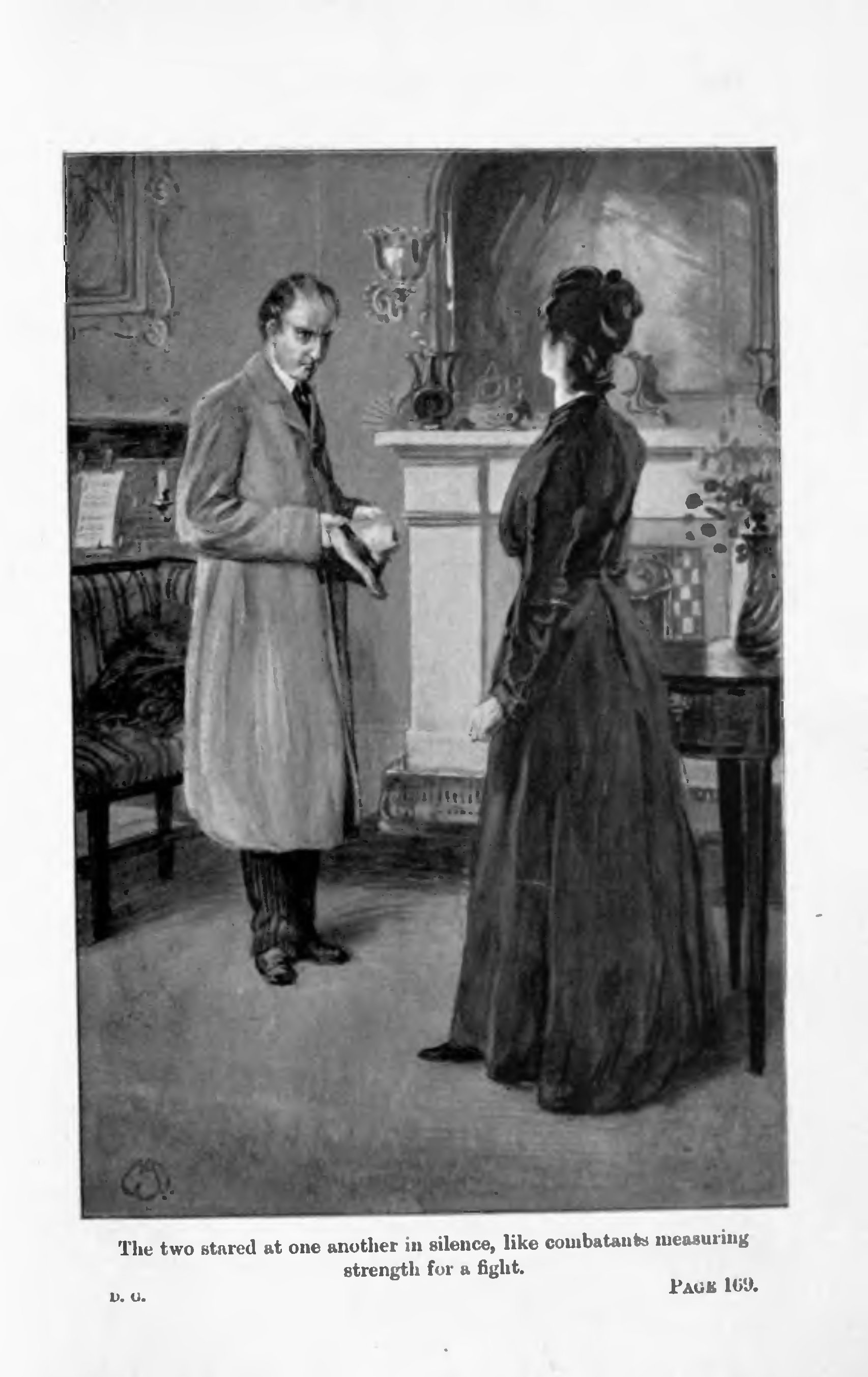
The two stared at one another in silence, like combatants measuring strength for a fight. It was the man whose eyes were the first to fall, the man who first showed signs of relenting.
“Of course, if you give me your word, Miss Charrington, I am bound to take it.”
“Then I give you my word, Mr Neil, that we are absolutely innocent of annoying you in the way you describe.”
The Hermit bowed, laid his hat on the table, and fumbled nervously with his coat.
“I can only say that the matter is most mysterious and annoying. Perhaps, however, you will be willing to promise that in other respects you will be more considerate for the future, so that I may be able to work with less disturbance from the noise overhead?”
“I am afraid I cannot see my way to giving any such promise, for I fail to see how we can be quieter without interfering with our own duties. I have three sisters, and music is the profession by which one of them hopes to make a living. If she gave up practising it would seriously injure her prospects. The others are busy all day long, and naturally wish for a little relaxation at night. Although you give us no credit for consideration, I may tell you that we are constantly calling our young brother to order in case he should disturb you, but I should not feel it right to make home dull and cheerless by forbidding any noise whatever.”
“It does not occur to you that under those circumstances you are hardly the right tenants for a flat, but ought to be in a house of your own?”
“It occurs to me that we are the best judges of our own actions,” returned Philippa icily, fighting down the wild longing that arose, even as she spoke, for a place of their own—a nest, however small, where they might dwell in peace and freedom. “You are not the only tenant, Mr Neil, who has to endure disagreeables from his neighbours; we also might find ground for complaint, if we wished to be disagreeable. My sisters sleep above your study, and they say you keep poking the fire until two in the morning and waking them up with a start. Then, too, you have a hanging lamp or chandelier which you push up, and which makes a most unpleasant noise; and in the autumn evenings you smoked strong cigars on your balcony until we were poisoned with the smell. Oh, there are a thousand things which I could mention,” cried Philippa—though in truth she would have been puzzled to add one more complaint to her list—“but I would not stoop to it! It is too miserably petty and degrading to be everlastingly picking quarrels. I am sick of it.”
“Not more heartily than I am. I have lived in these buildings for nearly ten years and have only once before made a complaint—which, I may remark, was met in a very different spirit.” The Hermit was evidently growing ruffled in his turn, and could not resist a parting shot before he left the room. “As I said before, I should be sorry to have to complain at headquarters, but I do not intend to have my comfort ruined by new-comers who have no claim on the establishment. If it becomes impossible for us both to live under one roof, I have little doubt who would be asked to remain.”
He was gone. The door closed behind him, and Philippa sank into a chair with a sudden feeling of collapse. “Oh! oh!” she cried, and her hands went up to her head, and her breath grew short and strangled. All her pride and independence were swept aside by the remembrance of those last pregnant words: “Impossible for us both—little doubt in whose favour!” Suppose—oh, suppose, the Hermit complained to the committee, and she were served with a notice to quit! Suppose, with one set of bills barely settled, she were called upon to incur a second! With characteristic Charrington impetuosity she beheld ruin stalk towards her, and the faces of brothers and sisters filled with a pale reproach. Her head dropped forward on to the table; the tears rolled down her cheeks. She was just about to indulge in the luxury of a good cry, when suddenly there was a sound in the room, an exclamation of distress, and there stood the Hermit, picking up the hat which still lay on the table, and murmuring disconnected sentences of explanation.
“I forgot my hat. The door was still open; I forgot to shut it. I turned back—Crying! I hope that I—that nothing that I have said—I should be most distressed—”
Philippa stared at him helplessly. Her impulse was to deny the suggestion with scorn, but how was that possible with the tears rolling down her cheeks? She tried to control herself, to steady her voice sufficiently to reply, but the floodgates were open and could not be restrained. An agony of dread seized her lest she should humiliate herself still further, and, pointing to the door with childlike helplessness, she sobbed out a pitiful “Please, go—please, go!” and buried her face in her hands.
The Hermit crept back to his room, but he could not work. Between himself and his books rose the vision of a girl’s face, tremulous and tearful. The dark eyes looked into his with pathetic reproach. He called himself a brute and a coward for having dared to distress her.
Chapter Sixteen.
The Culprit Discovered.
Acting on the rule of all good housewives, Philippa breathed no word of the unpleasant incident of the afternoon until dinner was over, and the workers had been fed and rested after their day’s labours. Stephen, it is true, noted the pucker on her brow, and questioned her dumbly across the table; but she frowned a warning, and eagerly questioned the girls as to the success of their expedition. The circulars, it appeared, were promised in a week’s time; and pending their arrival Hope had called on the vicar on the way home, and arranged to give her first performance to the members of his infant class on the following Monday. She had confided to him her anxiety to rehearse her entertainment, and he had laughingly promised to find her occupation for as many nights as she liked to give, either in his own parish or in those neighbouring ones which were even more in need of help.
“So you will gain experience and do good at the same time—a most agreeable arrangement,” said Philippa, smiling. “The next thing is to buy yourself a really smart frock with the remainder of Uncle Loftus’s cheque, so that you may be ready for the social engagements when they come. You have nothing suitable, and in this case it is a duty to be provided with the prettiest and most becoming gown you can find.”
“That’s the sort of duty I should like. I could be a martyr to it if I had the chance,” cried Madge, with a sigh. “No mortal being knows how it harrows my artistic soul to wear ugly clothes. I sometimes feel inclined to kneel down and, do obeisance before the dresses in the Bond Street shops. And they look so lovely just now! I’ve had a horrible temptation sometimes to ask for things to be sent on approval, just for the pleasure of trying them on and seeing how I look in them.”
“Do you think it is an honourable thing to send for things that you have no earthly intention of buying?” asked Philippa the literal, with a solemn air, which delighted her mischievous sister.
“No, I don’t; I think it’s a mean trick. But I’m so dull! I want to do something reckless for a change. You needn’t alarm yourself, Philippa; if I wrote asking for a selection of Court dresses to be sent on approval to an address off the Tottenham Court Road, they wouldn’t pay much attention to the order, I’m afraid.”
Theo thought not, indeed; while Hope looked pained and penitent, and said, “I seem to have all the changes—all the good things. I suppose I ought to dress for the part. But remember the ‘Amalgamated Sisters’! Whatever I gain must be divided in equal shares.”
“If you want excitement, it is a pity you weren’t at home this afternoon, Madge,” said Philippa. Dinner was over by this time, and she felt free to unburden her mind and receive the longed-for sympathy. “I had an adventure all to myself, and found it more exciting than I liked. The Hermit called, and Mary announced him in her own original fashion—that is to say, left him standing on the mat. He came to lodge some more complaints, and we had a row royal. I think he is mad, for he made the most extraordinary statements. But he is worse than mad; he is dangerous, and means to complain and get us turned out if he can. There is not the slightest ground for his complaints, but he is an old tenant and we are new, and it is only natural that his word should be taken before ours.”
“Don’t worry yourself about that old girl,” said Stephen kindly. “I have not the slightest fear of being turned out Neighbours in flats are constantly having these little frictions, and the authorities must turn a deaf ear to complaints if they wish to succeed or to have any peace in life. I’ll go down some night and talk to the old fellow, and see if I can bring him to reason. We have been so quiet, too, since Hope went away. What on earth did he find to grumble about?”
“Oh, my dear, the wildest fancies! He didn’t like Hope practising the children’s songs this morning, and was blightingly superior about her taste; but the worst grievance is that there is a tapping at his study window which gets on his nerves, and that something wakes him up every morning before it is light. It sounds too ridiculous to be true, but he actually supposed that we were responsible.”
“What utter folly!” began Stephen angrily; but the next moment he stopped short, and with one accord four pairs of eyes followed his towards the corner of the room where Barney sat—shaking, red-faced, apoplectic. “Barney!” cried the head of the house in a terrible voice. “What is the meaning of this? Do you mean to say that this is your doing? Have you had any hand in this business? Speak up this moment.”
“I should think I had!” cried Barney. “Both hands in it! Didn’t I vow when Hope went away that I would find some plan of keeping the old fellow occupied? I flatter myself that I hit on something original this time, and secured a fine effect with next to no trouble. The tapping was made by a little lead weight hung on the end of a string fastened outside the girls’ window. It swung about in the air, just at the top of his panes, and when there was a breeze, tapped away like a machine. I fastened it up one day, and left it to do its work. It’s there still, if you choose to look. The waking-up business was more difficult. I found out, by watching the lights at night, that he slept beneath my room, and I borrowed an alarum from a fellow in the office. I told him why I wanted it, and he nearly died with laughing. I set it for different hours, and lowered it down by a cord so that it lay against the pane. I left my window open, and when it went off it woke me too, and I hopped out of bed and pulled it up before he opened his window. It was too dark for him to see anything, but I could hear him muttering to himself in a tearing rage. It came off splendidly, but I’m not sorry to give up that part of the business, for it was jolly cold getting out of bed and standing by that open window. It isn’t good enough in this weather;” and Barney doubled himself up in another burst of laughter at the success of his plot.
For once nobody joined in the chorus; the girls were dumb and horrified, while Stephen was filled with righteous indignation.
“Stop laughing this moment, sir,” he cried sternly. “You have done mischief enough; don’t make it worse by triumphing over it. If you have not enough consideration for your sisters to teach you how to behave, I must find some other way of keeping you in order. I won’t have the peace of the house ruined and Philippa worried to death.”
“Leave him to me, please, Steve,” said Philippa quietly. She walked forward until she stood immediately before Barney, and the smile faded from the boy’s lips as he saw her face. She was not flushed as he had often seen her under the stress of passing irritation, but white—deadly white—with a look in her eyes before which his own fell to the ground.
“You have made me tell a lie,” she said slowly. “Do you hear? I gave Mr Neil my word that we had had no part in these annoyances. He did not want to believe me, but I made him; I gave him my word. I will not wait a minute before going to him and apologising for saying what was not true. Get up! Come downstairs with me. You shall tell him the whole story as you have told it to us, and ask his pardon like a gentleman. Are you coming?”
Barney scowled and looked at her darkly; he opened his lips to say that he would do nothing of the kind, but Philippa looked at him again, and the words died away. She walked to the door, and he marched after her; she held it open, and he passed through. They stood together before the Hermit’s door, and Philippa pressed her fingers on the bell.
Chapter Seventeen.
Rehearsals.
Half-an-hour passed by, fraught with the deepest suspense and anxiety to the waiting party in Number 10; then Philippa’s step was heard running up the stairs, and in she came, white no longer, but smiling, rosy, abeam with complacency.
“Where is Barney?” cried four voices eagerly; and she seated herself before the fire, crossed her hands on her lap, and regarded her audience with the prospective satisfaction of one who knows that she is about to make a sensation.
“Barney,” she said slowly, “is enjoying himself so much that he refused to come away! He is invited to stay for the evening. He is at present employed in helping Mr Neil to catalogue specimens for his microscope.”
“Wh-at!” gasped Stephen incredulously, while Theo caught hold of her sister by the shoulders and gave her an impatient shake. “Phil, be sensible! Tell it properly. Begin at the moment when you knocked at the door, and go right through to the end. Now then, begin!”
“We-ll,” drawled Philippa comfortably, “I rang, and a boy came to the door—I don’t think there is a woman on the premises. Mr Neil heard our voices, and came out to see what was wanted. He took us into his room, which is all books and litter, and a great big microscope on a stand by the window. Don’t ask me what I said, for I don’t know. I only remember his face looking so startled and sorry. He is really very nice-looking, you know; and he wears a velvet coat Barney behaved well. He said, ‘I’m sorry, sir, if I have annoyed you. It was only a joke.’ And Mr Neil said, ‘All right, my boy, that is settled. We won’t say anything more about it. Are you interested in microscopes!’ After that we went over to the stand, and he explained what he was doing, and showed us the workings. It was very exciting. Barney was in raptures, and I was quite horrified to find how long we had stayed. He was as nice and kind as he could be, and I believe it is the beginning of peace. Oh, my dears, such dust! I longed for a brush and shovel. No wonder he looks ill, living alone in that dreary place, with only a boy to attend to him. I believe he is starved.”
“He is a real good sort, anyway, to behave so well to that boy. I’ll call on him some night, and perhaps we can return his kindness by asking him here occasionally. I am glad peace is settled, but I am not done with Mr Barney yet. He must promise me to give up these foolish tricks,” said Stephen severely. He himself had never played a trick in his life, and could not imagine wherein the fun lay.
When Barney came upstairs an hour later he was taken into the dining-room and lectured in solemn, elder-brotherly fashion; and being in the highest of spirits, obediently promised all that was desired.
“I sha’n’t want to rag him any more, because, you see, we shall be pals,” he explained. “He wants me to go down whenever I feel inclined, and that will be pretty often; because, though the girls are bricks, a man does like another man to talk to sometimes. He’s terrifically clever! You should see all the things he has made himself—little mechanical businesses that you can’t buy. He is going to let me watch him when he is at work. I fancy he felt a bit bad when Phil ate humble-pie, and wants to make up by being extra amiable and friendly.”
It was just as well that the Hermit had been conciliated, for in the days which followed Hope was constantly practising her songs and reciting her story to an imaginary audience in the drawing-room. Mary, sweeping the tiny hall, would open her eyes in amazement as a voice cried dramatically: “Fairy Godmother! Fairy Godmother! can you not help me now? I’m so lonely up here in this deserted tower. Is the spell not broken yet, dear Godmother?” And the fairy answered: “Patience, Princess Chrystal! Wait but a few hours longer. To-morrow morn, as the sun creeps round the corner of the poplar tree, look out of your casement window, and you will see”—Mary was all agape to know what the Princess Chrystal would see, but Philippa came bustling out of the dining-room and, half-laughing, half-frowning, sent her about her work. Later on a message-boy who was waiting for an answer to a note grew quite pale with agitation as an unseen giant hissed out, “To your knees, rash youth! Before another hour is past you shall be chained in the lowest dungeon beneath the castle moat!” It was really quite alarming, and the message-boy informed his companions who were waiting for him in the road below that there was a lunatic upstairs, who was raging and carrying on “somethink krool.”
The first performance was a nervous occasion, and Hope realised the full difficulty of the task which she had undertaken when she stood upon the platform of the mission-room vainly trying to gain a hearing from a crowd of noisy, excited children. Appeal was useless, but at length the happy idea struck her to begin with a song; so down she sat at the piano, struck up a lively air, and gave the first verse with such spirit and go that at the word “Chorus!” there was quite a creditable attempt at the refrain. After that it was comparatively easy to keep the attention which she had gained, although she had rarely before experienced such tiring work. For a first attempt the performance was a distinct success—ay, more than a success—for it proved the existence of many weak spots, demanded more prominence for dramatic incidents, and proved that, given time and experience, she need not fear the most critical juvenile audience.
Twice more did Hope give a performance of the fairy play before the long-delayed circulars were ready, and she started forth on the difficult work of distribution, with Madge as companion, guide, and administrator of much-needed courage. Any girl who has tried to earn her own living will have discovered how different becomes the demeanour of those in authority when the supposed customer turns out to be herself in need of help. It is a painful revelation, and the moral which it teaches us is, to be gracious to other poor suppliants if it ever comes to our turn to be in authority. Madge had made a list of those entertainment bureaux where tickets can be obtained for theatres and concerts, and arrangements made for drawing-room entertainments; but when the first of these establishments was reached Hope made three successive bolts post the door before she could be induced to enter. Her embarrassment was greatly increased by the fact that several other people were in the shop, ready to listen and to stare with curious eyes as she mumbled her request. The assistant ran his eye carelessly over the leaflet—Madge’s masterpiece, printed regardless of expense on thick rough paper with torn edges—did not think there was any demand for that sort of thing; was afraid it was not in their line. No, did not object to keeping the advertisement; would put it on the stand if there was room; and before the girls had turned aside, had flicked it carelessly into a drawer.
Hope was trembling, crimson of cheek, and inclined to turn tail and make a short cut for home; but Madge’s chin was in the air, and her face set in determined lines.
“Snob!” she cried scornfully; “working himself, and despising others because they try to do the same. Dear Hope, don’t look so doleful. You surely won’t let yourself be discouraged by a worm like that.”
“Oh, it is so hateful!” murmured poor Hope tremulously. “Suppose they all treat us in the same way. You know very well, Madge, that that circular will never see the light.”
“Oh, won’t it, though? It shall be up on that board before a week is over,” returned Madge obstinately; and when breathlessly questioned how and why, she answered imperturbably, “Haven’t the slightest idea, but I’ll find out a way. Cheer up now, and for goodness’ sake don’t look as if you were ashamed of yourself. I’d send you home and go the round myself if we could exchange faces for the occasion, but if you will only perk up you can do far better than I. Look smiling and self-possessed, and as if you were rather conferring than asking a favour.”
It was admirable advice, but, alas! Hope was not the girl to carry it into effect. Her cheeks would flush; her voice would shake; she looked so unmistakably the amateur that, in spite of her charming appearance, she met with but scant success wherever she went. No one actually refused her circular, but the manner of its acceptance was so lukewarm and careless that it would have depressed the stoutest heart. Even Madge looked downcast when home was reached, but she was smiling again by dinner-time; and what was more, Philippa and Theo were smiling too, with a mischievous enjoyment which seemed strangely unsympathetic to the crushed adventurer.
For several days no explanation was forthcoming; then came an afternoon when housekeeper and author arrayed themselves in all the splendour they possessed and sallied forth on a mysterious errand. Hope wondered, questioned, and was amiably snubbed for her pains; but at five o’clock back came two flushed, triumphant conspirators, only too eager to tell the tale of their adventures.
“We have been working for you, my dear,” cried Phil, nodding cheery encouragements at the dear, pretty sister who had grown to look so pathetically pale and wistful of late; “but the idea came from Madge, so you have to thank her most of all. Well, we sallied forth, and went the round of the shops where you had left your circulars. Theo took one direction, I took another, and we met at the Stores. The first shop I went into was empty, and I had quite a long talk with the man. I wanted to know what entertainment he could provide for a juvenile party. He suggested a magic-lantern—cinematograph—Punch and Judy—conjurer. I looked profoundly bored, and drawled out, ‘So terribly commonplace! Have you nothing new?’ He declared there was nothing else, and I was feeling very baffled and angry, when suddenly he remembered your circular, and began searching for it in a drawer. I regarded it with judicial calm, thought the terms rather high, but on the whole was much taken with the idea. The difficulty, of course, was to withdraw without settling anything definitely; but some other people came in, and I murmured polite nothings about ‘thinking it over,’ and beat a retreat. At the next place my pumping failed, for the wretch had forgotten all about you, or had thrown your circular into the fire. You must send him another with a polite reminder of his promise to find you engagements, ‘subject, of course, to the usual commission.’ Number three had actually pinned you up on the board, beside the Performing Brothers and the Negro Troupe. He ought to have been an author, for he had a beautiful imagination! When I inquired about you he waxed quite enthusiastic about your abilities and popularity. I regarded him more in joy than in anger, and hoped he embroidered as eloquently to all his customers.”
“Oh! oh!” cried Hope, aghast. She was torn in twain between elation and pangs of conscience. “How sweet of you, Phil! But—do you think it is quite right?”
“Why not? Does not every unknown author implore his friends to ask for his books at their libraries and express untold surprise because they are unknown? Why should not we advertise you in your turn?”
“You must be boomed, my dear, or you may wait for ever for an engagement. I was even more bold than Phil,” confessed Theo, “for I purposely hung about until other people went into the shop, and then spoke in such a loud voice that they were obliged to hear what I said. They seemed quite interested, and I left one lady reading the circular and asking questions about you. In another shop I said in an anxious voice, ‘I hope she will be able to come to me when I want her. Will it be necessary to engage her a long time ahead?’ The man looked as solemn as an owl, and said, ‘Well, madam, it would be wise. There is sure to be a rush in the Christmas holidays.’ What do you think of that? Won’t it be exciting when the letters come in?”
There was no doubt about that, but unfortunately no letters arrived; and the weeks passed by, and the Christmas holidays began, and not a mother in the whole Metropolis expressed the slightest desire to engage the services of the “children’s charming entertainer.” Hope’s wistful look each time that the postman’s knock came to the door moved her sisters to fresh efforts on her behalf, and an ingeniously worded inquiry was despatched for publication in the pages of a popular fashion magazine:
“Can any lady recommend a new form of entertainment for a children’s party? No lanterns, conjurers, or marionettes. Early answer much appreciated.”
An early answer was, in fact, in readiness from the hour when the inquiry was posted, wherein Theo was prepared to certify that, having heard Miss Hope Charrington’s entertainment (at the mission-room of Saint Paul’s Church!), she was able most enthusiastically to recommend it to all mothers and guardians. Alas! the all-important inquiry was one of many more “unavoidably delayed through want of space,” and how to reply to an advertisement which had never appeared was a problem which baffled even Madge’s ingenuity.
“I shall go to see Minnie Caldecott this afternoon,” announced Hope one Tuesday morning when the post had produced nothing more inspiring than a couple of circulars and a coal-bill. “I can’t sit here any longer doing nothing, and it is evidently no use writing to her. I have not even heard if the song arrived. Would any one like to come with me and get a peep into professional life?—Theo?”
“Yes,” said the author quickly. “It will be ‘copy,’ and I want it badly. I have quite a stock of heroes and heroines on hand—fascinating creatures, every one—but I can’t think what to do with them! Perhaps one might be a public singer. I’ve given her a lovely voice already. I’ll come, Hope, and make a study of the lady while you discuss business.”
A few hours later, therefore, behold the two sisters seated in the warm, flower-scented little room, where the portraits of becurled ladies still smirked from the walls, and the presiding goddess dispensed tea, and kept up a stream of cheerful, inconsequent babble. She appeared overjoyed to see her visitors, kissed them effusively, addressed Hope affectionately as “Miss What’s-your-name,” and declared that she remembered her quite well. “You brought me a song with ridiculous words; and you have all come up to town to make your fortunes. It isn’t too easy, is it? I’m supposed to be one of the lucky ones, but it is the solemn truth, my dears, that there are only a few pounds between myself and the workhouse. It is a hand-to-mouth business, and what with cabs and gloves, there is precious little to be made out of these suburban engagements. I shall have to get married one of these days. There is one man now—that is his portrait on the mantelpiece—the one with the big nose! He has been worrying me for years, and I tell him the first time I get a really bad cold on my chest I’ll marry him then and there. I could never stand the expense of an illness. Look at that girl laughing! It is your sister, isn’t it, dear? What is her name! Theo! I say, how toney! Are you clever too, Theo? What is your line?”
“I—write!” replied Theo, shrinking in anticipation of the question which is fraught with so much humiliation to the would-be author. Of course, Miss Caldecott would instantly want to know what she had written and where it could be found, and then how agonising to be obliged to explain that; with the exception of a few stories in a village paper, not a word of her writing had yet appeared in print! Hope came to the rescue with a reply which was at once tactful and diplomatic, since it turned the conversation into the desired channel.
“I have been keeping her busy lately. She has been writing children’s stories for an entertainment which I am hoping to give. I brought one of the advertisements to show you, as I thought you might be interested.”
The undisguised yawn with which Miss Caldecott greeted this announcement was the reverse of encouraging; but she read the circular with increasing interest, pronounced the idea to be “rattling good,” and wanted to know who was responsible for the design. “I’ll have a programme got up like that some day,” she declared; but she yawned again when the girls expatiated on the skill of their artist-sister, and interrupted with another question:
“Have you written any more songs lately?”
Hope looked at her gravely, and found it impossible to keep a tinge of reproach out of her voice as she replied, “Why, of course! You know I have. I have been waiting for weeks to hear what you thought of the one I wrote especially for you.”
“Gracious!” ejaculated Miss Caldecott; “I never got it. I remember now that you did write to me about it, but I get so many letters that I forget half what’s in them. I’ve never seen it, anyway. Perhaps it is in that cupboard with the newspapers. That is my bogy-hole, and if I haven’t time to open things I stick them in there, and forget all about them. You can look if you like, dear; I’m too lazy.”