Mrs George de Horne Vaizey (continued 2)
Reading edition
“Nice little pipe, hasn’t she? Sweet and simple like herself. I say! it wouldn’t go far in the Albert Hall, would it? Let me try a verse.” She put down her hands on either side, lifted herself from her low chair, and went over to the piano. “What are the words? Oh, I can see. Fire away, then, and I’ll see what I can make of it.
“Pack clouds away, and welcome day— With night we’ll banish sorrow.
“Funny words, dear! Where did you get hold of them? It’s not bad, you know—not half bad—what I call graceful. Let’s try again, and go on to the next verse.”
This time she drew herself up and sang with careful attention. The full, rich tones of her voice flooded the room, and Hope thrilled with delight at the sound of her own creation. Never—no, never—had she imagined that it could be so charming; and the last verse was the prettiest of all. Surely if Miss Caldecott liked the beginning, she would be enraptured with the end!
But, alas! at the conclusion of the second verse Miss Caldecott crossed the room and threw herself on the sofa, with a resounding yawn.
“Thanks awfully, dear. How clever of you! It really is sweet. Doesn’t quite suit my voice, though, does it? And I don’t like those accidentals. They are tricky, and I’m such a careless creature. Where did you pick up the words? I don’t know the author, but you can tell him from me that he can’t write songs. Not at all catchy words. He’ll have to do better than that. Don’t sit perched up there any more, dear; you look so uncomfortable. There’ll be some other people coming presently, and we’ll have tea. I bought some lovely cakes from Buzzard’s. Always make a bit of a splash on my at-home afternoons, you know, for it’s the only entertaining I do. I’m in digs here, and very bad they are, too. But what can one do? They don’t send for me at the Albert Hall, dear. It’s a shame, for I could do ever so much better than some of those old, worn-out things who only trade on a name. My voice is fresh, and a jolly good one, too, though I say it myself. Where are you living, dear? In this neighbourhood?”
Philippa replied. Hope was too disappointed, too cast down, to be able to speak. Miss Caldecott had seemed so pleased; the song had sounded so charming from her lips. At one minute acceptance had seemed certain; at the next the subject was waved aside, and apparently dismissed from consideration. She pressed her lips together and stared at the mantelpiece, with its bank of chrysanthemums in cream-jars, its photographs of becurled beauties. Philippa was talking about the flat, and removal expenses generally, and Miss Caldecott was lavishing floods of sympathy upon her, and abuse upon those who had disappointed or thwarted her plans.
“Wretched, good-for-nothing things, the pack of them! But you are so near Maple’s. Why don’t you go to Maple and let him do the whole thing? Expense! Bills! Oh, bother bills! You can let them run, you know. I do! If I want a thing I get it, and think about the bill afterwards. Do you like this tea-gown? I bought it at the autumn sales. Such a bargain! I have to spend a fortune in clothes. What would you advise me to get for this winter, for really swell affairs, you know? I go to a good many private receptions. I got some patterns this morning. I look so huge in white! What would you think of yellow—eh? Blue is so ordinary.”
“Really, I—really, I don’t know.” Philippa thought it was better to laugh outright than in a covert manner, so she laughed as she spoke, and Miss Caldecott joined in the strain with the greatest good-humour.
“I’m sure you have good taste, dear; you look so stylish. I never wear black myself; it makes me doleful. I do get doleful sometimes, though you wouldn’t think it. I live all alone, and sometimes business gets so slack. I get plenty of suburban work, but I don’t come to the front somehow. Can’t think why. My voice is far better than that Marah Bryce’s, whom they all rave about nowadays. Have you heard her lately?”
Philippa felt relieved to be able to reply in the negative, and Miss Caldecott enlarged at great length on the personal deformities, mental blemishes, and vocal limitations of her rival, even condescending to imitate her rendering of a favourite song.
“High-flown rubbish, I call it! Something like that song of yours,” she said blandly, turning to Hope. “You might offer it to her. Far more her style than mine. Don’t you say I sent you, though.”
“Thank you,” said Hope softly. “I think I should hardly like to venture. I don’t know her at all, so it’s quite different. You knew our name at least, and I thought—I hoped—”
Despite herself, Hope’s voice broke with a little quiver of disappointment, for she had counted so much on this woman’s help; and if she refused, what could be expected from a stranger on whom she had no possible claim for sympathy? Her face looked so drawn and pale that Miss Caldecott’s good-nature could not look at it unmoved.
“What’s the matter, dear? Disappointed! Hateful of me, isn’t it? But I couldn’t sing that song even to please you. I’ll tell you what we will do, though; you shall write another especially for me. Mezzo-soprano, you know; I don’t mind a G now and then, but don’t let me have them too often. And be sure to give me a catchy refrain—something the people want to move their feet to at the end of the second verse—see? Then the words must be domestic. I want a song badly, to sing down Clapham way and places like that, for charities and subscription concerts. Let me see—something about children, I think. Nothing fetches them like children! First verses, major, ‘Happily homeward the children go;’ and about their little troubles, you know, and their little fears, little smiles, and little tears. There! that’s rhyme. I believe I could write it myself. Then comes the refrain—a little swing to it, a little lilt—the same words for the first two verses. Oh, you know the kind of thing! Something to make the mothers cry, and the papas rush off to buy the song next morning. Nothing draws so well as children. And you might change to the minor key at the third verse, and point a moral: we are all children, life’s a journey, and we shall grow tired, too, and fall asleep at the end of our day. There! Never say I didn’t give you an idea. You write that for me, and we’ll make a fortune out of it.”
“Thank you. Oh, how kind you are! I see it exactly. I’ll try my very beat. It is so very, very good of you to give me the chance!”
Miss Caldecott yawned wearily. “So close, isn’t it?” she said. “I hate this muggy weather. Some people say it’s good for the complexion, but I don’t believe it. I use that new American powder. Have you tried it? There’s the bell! I expect it is the Elliotts. They said they were coming.”
“Then perhaps we ought to—We have stayed a long time already,” said Philippa, rising. “Thank you so very much for seeing us at all.”
“Oh, won’t you wait for tea? Good-bye, dear,” cried Miss Caldecott all in one breath, and without waiting for a reply to her question; and the sisters went out into the narrow passage, to squeeze their way post three tall, smartly dressed girls who were engaged in arranging their veils and pulling out their fringes before the little strip of mirror in the hat-stand. They walked down the street in silence, turned the corner, and exchanged bright, amused glances.
“Our first introduction into professional circles! How very, very funny she was! How many times did she call us ‘dear,’ I wonder? Not very formidable, was she?”
“But, oh, what a lovely voice! So rich and full! I suppose it is because she has not had a thorough musical education that she hasn’t come to the front, and because she isn’t quite—quite—But it is a shame to criticise,” cried loyal Hope. “How kind she was! How perfectly sweet of her to ask me to write that song! Phil, Phil, don’t you think I am fortunate! Don’t you think it’s a good beginning? I have an idea for the song already, and she is almost sure to take it; it is as good as a commission.”
Philippa looked at the shining eyes, and could not endure to breathe discouragement; but in her heart of hearts she reflected that she should be sorry indeed to place any reliance upon the promises of Miss Minnie Caldecott.
Chapter Seven.
A Private Reading.
Theo was pressed into the service to write the words of the song for Miss Caldecott, and composed a graceful little ditty which was sufficiently touching even to the spinster mind, and might safely be trusted to melt the hearts of parents “in the front rows.” The task kept her happy and occupied while waiting for the answer to her letter, and Mr Hammond was both prompt and kind in his reply.
“I shall be happy to give what help I can to your father’s daughter,” he wrote. “He always appeared to me to have a very special gift, and I regretted that he did not cultivate it to the full. I hope that you have inherited his powers, but at the same time I feel it my duty to beg you to earnestly consider the matter before deciding on your life’s work. Many young people seem to imagine that they can ‘take up literature’ as they would typewriting or clerical work, which is a vast mistake, and it would be cruel to encourage you unless you possess the inherent qualifications. Would it not be better for the aiding of my judgment if, before coming to see me, you forwarded some short MS for my perusal? The time at my disposal is limited, but I will contrive to read anything you send before, say, Monday next, when I shall be pleased to see you at any time that may be convenient between eleven and one.”
The letter was read aloud at the breakfast-table, and the audience commented on it with the candour which distinguishes family conclaves.
“Very sensible! Short and to the point. How can he tell what sort of rubbish you write!” said Steve.
“Hope you notice the dash under the ‘short’! No chance for your novel, my dear. He doesn’t see himself sitting down to read hundreds of pages of your appalling fist. Grows more like lattice-work every day!” Philippa cried severely.
“I can just imagine what he is like! A proper little person, with a shiny bald head. Fancy writing love-scenes for his inspection! My hat!” and Madge lengthened her chin in an expressive grimace.
“The worst of it is, I don’t know what to send. I have nothing short that’s good enough. It ought to be striking, arresting, original. I—I want an idea,” cried poor Theo, staring frantically at the coffee-cups, and wrinkling her brow until she looked ten years older on the spot. “It’s finding a subject that is the hardest part. I love the writing when I’m once well started. I can’t possibly send anything before next week.”
“Don’t try. Take your time, and do your very best. Send a letter to say you will forward a MS in the course of the next few weeks. It’s important that you should send your best work, and you can’t write happily with a feeling of hurry. It must be a story, of course, not an article.”
“Mind you have a nice hero: six feet high—broad shoulders—big moustache—”
“No, no; clean shaven—clean shaven, with a firm, determined chin; big feet and hands, quick-tempered, but too sweet for anything to the girl he loves.”
“Make her slim and willowy, with grey eyes; rather wistful-looking, not exactly pretty, but with ‘a way with her’ that simply mows ’em down!”
“Give her some spirit, mind!” cried Madge once more. “I hate your mawkish heroines—sort of creature you would call ‘The Maiden.’ Don’t call her ‘The Maiden,’ Theo, if you wish me to buy a copy; and whatever you do, I pray and beseech you, don’t write in the present tense: ‘I am leaning against a stile; the roses are falling in heavy clusters by my side; the rays of the sun are pouring on my uncovered head and turning to gold the wayward curls which refuse to lie straight despite all my efforts.’ Don’t you know the kind of thing! I feel inclined to throw a book in the fire when it begins like that. Don’t let your heroine have ‘wayward curls,’ Theo. Don’t let her have ‘little tendrils wandering over her brow.’ Don’t say in every chapter that ‘she had never looked more lovely;’ and for goodness’ sake don’t let the husband and wife behave like idiots, and quarrel all the time, though they are really expiring of love!”
“Well, really! Any more instructions? It’s a pity you don’t write the whole thing while you are about it,” said Theo testily as she pushed her choir from the table.
The family had grown to dread the times when Theo was settling on a plot for a new story. She was so restless; she wandered about in such an aimless manner; she looked so thoroughly worried and unhappy. Sometimes the girls would try to help her with suggestions, and then she would listen with a forbearing smile, and say, “Oh, thank you! Yes, it’s very good. I should think a capital story might be made out of it, but somehow it doesn’t appeal to me.”
At other times, when they were never thinking of helping, and were engaged in what seemed the most ordinary conversation, Theo would suddenly clap her hands and cry, “Oh, that will do! Good! Now I’ve got it!” and rush excitedly from the room, leaving her sisters to discuss what in the world they had said that could possibly suggest a romance. Verily, an author in the household was a difficult person with whom to deal!
For the next few days Theo sat alone in her room making futile efforts at a beginning, going out for long walks along the crowded streets, or sitting shivering on the seats in the Park. In deference to her condition, Hope kept away from the piano while she was at home; but no sooner was the door closed behind her than she flew to try the effect of the new song, and to alter and re-alter the more troublesome bars. She must practise, too, for with the hope of public work before her it would never do to lose execution and flexibility of finger. Already she was making arrangements for lessons in harmony, and her time seemed filling up.
In the energy which distinguishes all beginnings, Hope practised scales and exercises for a good three hours one Saturday afternoon, and towards the end of the time was much exercised to account for the meaning of a thumping noise that seemed to rise from the ground beneath her feet. She stopped playing; the noise stopped also. She began again; the noise was repeated. Philippa, summoned to decide whether or no they were the proud possessors of a unique sort of echo, immediately arrived at a more prosaic explanation.
“It’s some one knocking from underneath. It must be the Hermit, that bachelor creature who lives just below. He wants you to stop.”
“What cheek!” cried Hope. She was, as a rule, discreet and punctilious in her language, but there are points upon which the meekest among us are keenly sensitive, and when it came to interference with her practising, propriety flew to the winds. “What hateful cheek! What right has he to interfere! Has he hired the whole building? Does he think we are going to consult him about what we do? What next, indeed? I’ll try chromatics now, and see how he will like them. Cheek! Abominable cheek?”
She went to work more vigorously than ever, and Philippa thought it prudent to refrain from interference, but contented herself with hurrying preparations for tea; and for the time being there was no more knocking. Presumably the chromatics had reduced the listener to a condition of helpless despair.
On the third evening Theo made her appearance wearing her best fichu, and with a face wreathed in smiles. “I’ve got it!” she announced; and there was no need to ask to what she referred. The tension was over for the time being, and the young author worked up her subject with the usual enjoyment. When the story was finished the girls begged for a private reading; a request against which, as a rule, the author steadily set her face, so that, as usual, the first response was a refusal.
“I can’t. It is too cold-blooded. The members of one’s own family are too painfully critical. I’d rather face a dozen editors than you three girls.”
“Very unkind of you, then; that’s all I have to say,” said Philippa severely. “You know how interested we are; and if we are critical, surely it’s better to discuss faults with us than to let them go uncorrected. This is a special story, and in consideration of our anxiety—”
“Oh, well!” said Theo unwillingly, “I’ll read it if you like. Get your sewing, and don’t stare at me all the time. It’s quite short. You won’t like it, I expect. Let me sit near the lamp.”
She was evidently nervous, and her voice was decidedly shaky for the first few pages; but after that she forgot herself, and read with expression and power. If one of the girls moved, she looked up with a frown; and when Madge groaned and clasped her hands over her heart at a particularly touching part of the love-story, she stopped short and fixed her with a basilisk glare. It was a story of a truly modern type, which, so to speak, began at the end and worked slowly but surely back to the beginning. It was by no means certain, too, what the heroine did, or why she did it; and if one had been sceptically minded, one would have doubted whether the author knew herself. Hope was puzzled, Madge engrossed and curious; Philippa was frankly bored. Her own nature was straightforward and outspoken, and she had no patience with what seemed to be wilful obtuseness. Her attention waned as a Martha-like anxiety seized her in its grip; her eyes wandered to the clock, and her brow grew furrowed. Alas for the trials of the author in the household! At the very moment when Theo was preparing to deliver the crucial sentence on which hung the whole construction of the plot—in that thrilling moment wherein she paused and drew breath, the better to deliver it with due emphasis and dramatic effect—an anxious voice claimed precedence and cried loudly:
“Hope! It’s after five. Did you remember to order the fish?”
It was too much for flesh and blood to endure. Up bounced Theo; down dashed the MS on the table; bang went the door after her departing figure as she fled to her bedroom for refuge, while the two younger sisters stared across the room with eyes large with reproach.
“Phil, how could you? How cruel! At the most exciting point! How could you do it?”
“I’m sorry,” said Philippa; and she really looked it. “I didn’t mean to vex her; but Steve will be home in less than an hour, and there is only cold meat. I was so anxious about the fish. Was there much more to read? You might finish it, and then we can tell her what we think of it. I don’t like it; do you?”
“It’s clever,” said Madge decidedly. “It’s atrociously clever. I’m dying to know how it ends.”
But when the MS was finished Madge’s curiosity remained unsatisfied, for what happened to the heroine was as uncertain as everything else in her career.
Theo did not make her appearance again until dinner was on the table, when she came into the room with her head in the air and her lip curled in disdain. “I have to live with these poor, grovelling worms, but at least I need not associate with them!” So said her expression as plainly as words could speak. She had, however, reckoned without her sense of humour, which, fortunately for her readers, was particularly acute; and no sooner was the cover removed from the belated fish than her lips began to twitch and her eyes to twinkle. Her cheeks grew red, her shoulders heaved, and finally out came a great burst of laughter; and there she sat, rocking to and fro in her chair, gasping out short, strangled sentences, with her hands gripped convulsively over her heart.
“Oh-h! Oh! Have you ordered the fish? The fish! Oh, a prophet—is not a prophet—Fish! Oh!”
“Might make a joke somehow about fish and Jonah, mightn’t you?” said Madge, laughing, scarcely less heartily, in the relief of seeing Theo’s descent from her high horse. “I can’t quite see how it is to be done, but it has possibilities. I finished reading your story, my dear, and I feel inclined to shake you. Why couldn’t you make a happy ending while you were about it?”
“Too commonplace!” said the author scornfully. “You didn’t expect me to make them ‘live happily ever after,’ did you? I haven’t quite descended to that, I hope. Well, what do you think of it?”
“I don’t like it nearly so well as some of your others. I was sorry that I interrupted you, dear; but I am afraid it was because I didn’t like it,” confessed Philippa honestly. “I loved that pretty little story about the poor governess and the rich lover who came home from Australia. Do send that to Mr Hammond; it is really very much nicer.”
“Nicer!” repeated Theo. “Pretty!” Her voice rang with an incredulous disdain. “I want something strong and powerful. Hope, what do you think? Don’t you like it either?”
Hope wrinkled her brows, and looked puzzled and distressed.
“I can’t decide. It’s so queer! Does it really mean that she marries him in the end, or that she refuses him because she loves him? I keep thinking and thinking, and it is so confusing.”
“It is the most maddening story I ever read,” chimed in Madge decisively, “for it tells you nothing that you want to know, and it makes you want to know so much that you can hardly live for suspense. You ought to hate that exasperating girl, and yet you feel that life is not worth living without her. I will say for you, my dear, that you have achieved the most worrying, unsatisfactory muddle I can possibly imagine. I believe I shall dream of it to-night.”
“Hurrah!” cried Theo—“hurrah!” and she tossed her bread in the air, and caught it again with a wave of triumph. “I am pleased! I won’t alter a single word, but will send it off to-night. If Hope keeps worrying about it while she is awake, and Madge dreams of it while she is asleep, I don’t want any higher praise. Never mind if the impression is painful; it is an impression, and that’s the great object of story-telling. Thank you both. I’m so relieved.”
“Humph!” muttered Philippa shortly, and added something under her breath about “executions making a painful impression, if you come to that;” which the others judiciously affected not to hear. Phil had her own grievance by this time, for it is not pleasant to have one’s criticisms overlooked as beneath consideration, and to be calmly ignored by artistic striplings as a good, commonplace creature who cannot be expected to rise to the intellectual level of her companions. Like all housekeepers, Philippa experienced moments of weariness and revolt against the everlasting “trivial round”—moments of longing for a more interesting life-work—and at such times the attitude of her younger sisters made her lot doubly hard. She struggled against the temptation to say something sharp and cutting, and Stephen, watching her face from the other end of the table, divined the hidden thoughts. He was not a brilliant nor, to outsiders, a particularly interesting young fellow, but just one of those kindly, single-hearted men who are born to make some woman’s life safe and happy; and as, so far, Philippa was his lady-love, he could not rest while that shadow was on her brow. Before they went to bed he made an excuse to call her into the dining-room, and to lead the conversation in such a direction as would invite her to give him her confidence.
“It is a little hard, isn’t it?” she said wistfully. “You saw how Theo ignored my criticism, and the others never even seemed to notice. I work for them all day long, keeping the house comfortable and mending their things, to set them free for their own work, and I am only despised for it. It makes me mad, Steve; and, worse still, it makes me sad.”
“Poor old girl!” said Stephen softly. He leant his elbows on the mantelpiece and ruffled his hair nervously. If Philippa had been his wife he would have taken her in his arms and spoken all that was in his heart, but a man feels an embarrassment in “letting himself go” before a sister not known in the nearer and dearer relationship. He wanted to say that the woman who makes a home has achieved a greater and nobler work than the one who produces a mere book or picture, and that in his eyes at least she is first and best. But he had a horror of appearing sentimental, and what he really said was: “Horribly bad form! Upsetting young cubs! They will get a little of the starch knocked out of them when they find what a poor place they take among the rest.”
“Oh, I don’t want that! I want them to succeed,” cried Philippa quickly; and then she began to laugh and to look herself once more. “We are like a nice, prosaic old father and mother, Steve, whose children are so alarmingly clever that we are half-afraid of them. I am glad you are ordinary like myself. You wouldn’t be half such a strength to me if you were a genius too.”
“Poor old girl!” said Stephen again, and let his hand drop on her shoulder with a helpful grip. He did not say that she could trust him to stand by her always, and to uphold her in every difficulty, but she understood the unspoken promise, and went to bed soothed and comforted.
Theo’s MS was posted to Mr Hammond, and in due course an answer was received containing no reference to the story, but simply naming an hour for the proposed interview. The young author tried to read signs of increased deference and respect for her attainments between the lines, but even her optimism failed in the attempt. She grew nervous as the time approached, and looked decidedly pale as she partook of a strengthening cup of cocoa before dressing for the important expedition.
“What are you going to wear?” Madge inquired, and the author curled her lip in disdain.
“My dear, how ridiculous! As if it mattered! Do you suppose for one moment that it will make any difference to Mr Hammond whether I look charming or a perfect fright! Are you so innocent as to believe that he would accept a story that he didn’t like from the greatest beauty on earth?”
“Humph!” said Madge reflectively. “The heart of man is desperately wicked! Not that story, perhaps, but he would be much more willing to look at another. Take my advice and put on your toque. A girl never loses anything by making herself attractive when dealing with a man. I have never met any editors, but I have reason to suppose that they are not different from the rest of mankind.”
“Nineteen, and country-bred! Where did your worldly wisdom come from, my dear?” cried Theo, holding up her hands in astonishment. But she wore her toque all the same, and took off her veil three times over because one little curl refused to lie exactly in the right place. She desired, above all things, to arouse Mr Hammond’s interest and sympathy.
The first visit to a publisher’s office! It was a nervous occasion, and Theo walked once, twice, thrice past the dreaded door before summoning courage to enter. A board on the wall informed her that she must mount to the third story, so she raised her skirts, ascended a narrow and not too clean staircase, and stood outside a door labelled “Office,” wondering what to do next. Neither knocker nor bell was to be seen; what, then, was she to do? If she tapped on the pane and waited for the door to be opened, she would appear humble and amateurish; if she entered unannounced, it would seem bold and presumptuous. She determined to err rather on the side of overrating her own importance, hoping thereby to prove the truth of the old adage; so, turning the handle with a firm hand, she walked into the office, and found herself confronted by—a small and shabby boy, perched on a high stool!
All this fuss about a child! Theo’s indignation lent an added haughtiness to her manner as she demanded to see the editor of the Casket, and Jack-in-office stared at her curiously, up and down, down and up, before he replied. His expression seemed to imply that he had seen her like before, and that he more than suspected a MS tied with blue ribbon was hidden skilfully beneath her coat.
“Have you an appointment?” he asked severely; and though Theo affected a smile of superiority, she felt an inward conviction that without that same appointment she would have been compelled to make her way to Mr Hammond’s presence over the dead body of his vassal. As it was, he carried away her card, and came back almost immediately to escort her to the editor’s room, where he pointed to a chair, and remarked encouragingly that Mr Hammond would be disengaged in a few minutes’ time.
Theo threw a glance at her reflection in a dusty mirror, and seated herself with much the same tremulous sinking of heart as that with which she was accustomed to settle herself in the dentist’s chair. On the desk before her lay a litter of papers and proofs; her eye fell absently on the slip nearest to herself, and lightened into eager interest. Here was a treat indeed, for what she saw was the next month’s instalment of a powerful serial as to the termination of which the sisters had frequently and hotly debated. A sentence here, a sentence there, gave the needed clues, and she smiled with mischievous delight at the advantage she had gained. That evening she would lead the conversation to the Count and his lady, and would give graphic prophecies of the next stage in their adventures. Even the conversations she would foretell, so that when the new number arrived her character of wizard would be fully established. The interesting prospect dispelled her nervousness, and she was smiling to herself in bright, natural fashion when the door opened and Mr Hammond appeared.
The editor was short and dark, middle-aged, and carelessly dressed; an undignified little figure, on whom the literary aspirant looked with instant lightening of heart. “I’m not afraid of him,” she told herself; but the thought was no sooner formed than revoked; for Mr Hammond spoke, and at the first sound of his voice he became aloof, formidable—a personage! He greeted the girl kindly enough, but Theo felt strangely humbled as she faced him, and realised with painful clearness that she was a girl, a tyro, and that this man was accustomed to associate with the master-minds of his day. Her complacency about the “worrying” story fell from her like a cloak, and she awaited his verdict with sickening suspense.
“It is kind of you to see me; I know you are very busy. I sent you a MS, as you asked for one. I suppose you—received it?”
“Yes.” Mr Hammond’s face gave no clue as to his opinion of the masterpiece in question. “I am pleased to see you, and to give you any help in my power. As I said in my note, I had a great admiration for your father. And so you have determined to settle in town and enter the great arena?”
“Yes. We are very poor, and must work for ourselves. I have been writing for my own amusement ever since I was a child, and if it were possible to make a livelihood in that way I should like it better than anything else. I would rather live on half the money and do the work I love.”
She looked appealingly at the impassive face, but no approval of her prospective renunciation was forthcoming. Mr Hammond merely bent his head in grave assent and remarked:
“Literature is a good crutch, but a very inefficient staff. If you have no private means, and are seeking for a profession which is to be your entire support, you would be wiser to go in for millinery. Brain-work is uncertain, trying, and badly paid. Even at the best an author’s spell of popularity is short-lived in these degenerate days. A new writer comes along with a fresh trick, and the old friend is promptly forgotten and despised. For the sake of L.S.D. he is compelled to write twice as much as he ought to do, and so dooms himself even more completely. In millinery, I should suppose, experience adds to capacity, and the demand for bonnets is a happy certainty.”
This time it was the editor who smiled and Theo who was unresponsive. She was deeply offended, and hope had sunk to the lowest ebb. Surely if Mr Hammond had found any merit in her story he would not have humiliated her by such a suggestion. She lowered her eyes, and trifled nervously with her furs.
“Then you think—after reading my story—you think I have no chance?”
“No; I don’t say that. That depends entirely upon—”
“Yes?”
Mr Hammond looked at her with a kindly pity. “Upon how much heart-breaking you can stand!” he said solemnly. “The apprenticeship which you will have to serve is weeks, months—it may be even years—of steady, persistent, unsuccessful work; weary disappointment after weary disappointment; nothing to show for your labour but a drawer full of dog-eared papers which nobody will accept. Realise what it means, and ask yourself if you have strength to bear it; if you have sufficient courage and self-confidence to work on undaunted, and find fresh inspiration in the midst of defeat.”
He looked at her gravely, and Theo lifted her head and returned the look with flashing eyes.
“If I had the prospect of success in the end—yes! a hundred times, yes! I am not a child. I don’t expect to make a name in a day. You can judge better than I. Is there a chance for me if I work hard? Have I a gift which is worth cultivating? You promised to tell me the truth, and I ask it of you now.”
Then for the first time Mr Hammond gave a hint of encouragement. He smiled whimsically, as at an amusing recollection, and studied the girl’s face with a new interest.
“Oh yes; you have the faculty. It is there; there is no doubt it is there. I read your story, and with all its faults it escapes the two unpardonable crimes—it is neither dull nor commonplace. I don’t pretend to say that you will be a great writer, but when you have learned your trade you will probably be able to place your stories with little difficulty. Study style; study the best masters; don’t think any time wasted that is given to cultivating pure, forcible English. Study the people around you, and write of what you know, not of what you imagine. It is difficult to describe an emotion which one has never felt, or a life in which one has no part. Study the magazines also, and note what style is adopted by each, the length of story taken, and so on. These things are but the technicalities of the profession, but the mastery of them will save you needless disappointments. When a MS is returned for the sixth time, put it away for a month, then read it over in a critical spirit, and try to discover wherein the fault lies. A little altering and rewriting may make it a marketable article.”
“Y-es,” said Theo faintly. That “sixth time” fell sadly on her ear, for it was one thing to assert that she did not expect to win in a day, and quite another to hear repeated failure predicted in that cool, unemotional fashion. She wondered if Mr Hammond would refer to her story in any more definite fashion, and seeing that he began to play with the papers on his desk, as if to intimate that the “five minutes” were drawing to a close, she summoned courage to put a direct question.
“And the MS that I sent you, Mr Hammond—was it pretty good? Do you think it suitable for—er—for—”
Her courage failed as he looked up in grave inquiry, and she dared not say “the Casket,” as she had intended; but Mr Hammond finished her sentence, as if he had not divined the unspoken word.
“Publication! There would be no harm in trying. I have read many less interesting stories, though it bears the mark of inexperience. Try some of the smaller papers, like the Companion; and, if necessary, cut it down to their length. I have it here in this drawer, I think. Yes—thank you. Pleased to have seen you.”
Theo rose to her feet a-smart with mortification. To be recommended to the Companion, and advised to cut down her masterpiece for the approval of its twopenny-halfpenny editor, was humiliation indeed for the would-be contributor to the Casket. She followed Mr Hammond to the door, and held out her hand in silence, her only desire being to end the painful interview at once. But the smitten look on the young face, the sudden collapse of the former audacious complacency, were too marked to pass unnoticed. The editor looked at her, and recalled his own youth, when a kind word was as a magic wand, and a harsh one shut the door so hopelessly against a cherished dream. He gave her hand an encouraging pressure.
“You have the stuff in you; you have the stuff! Work hard, and when you have served your apprenticeship come back to me, and I’ll help you all I can. Send me one MS in three months—one, remember. If you send more I sha’n’t read them. When one is accepted you will have reached the first rung of the ladder. No, don’t thank me! I will accept nothing from you, nor from any one else, that does not deserve a place on its own merits. Good-morning.”
His eyes fell on the roll of paper in her hand, and he pointed to it with an outstretched finger.
“Don’t—er—don’t overdo it,” he said meaningly. “Don’t try to be too clever.”
Then the door shut, and Theo groped her way down the stairs. Her cheeks were crimson; she beat the banisters savagely with the paper roll. Jack-in-office looked out of his open door and grinned to himself in amused understanding. He had seen “them” look like that before.
Chapter Eight.
Visitors Arrive.
Theo’s pride made her represent the interview with Mr Hammond in its most favourable light to her sisters. He was satisfied that she had the makings of a successful author, was anxious to consider MSS from time to time, and had suggested a likely home for the present story. The future, in fact, was assured, but a period of probation must necessarily elapse while she served what he called her “apprenticeship.” The girls appeared duly impressed, and Theo felt with satisfaction that this verdict from a high authority would go far towards procuring for her that respect and admiration which it is so difficult to obtain from the members of one’s own family.
“He advises me to read a great deal, to study the styles of the best masters, and to write only what I know. I think that is rather a mistake. If one possesses the literary instinct, it must surely be possible to project one’s self, as it were, into the place of another, and so create an environment. How can one be expected to experience personally the whole gamut of human emotions?”
“Cast your ruminating eye upon me, my love,” said Madge suavely, pointing with a thin forefinger to herself. Behind Theo’s back she had been occupied in rolling her eyes and waving her hands in dramatic illustration of the other’s high-flown phrases, so that Hope had rushed to the window to stare at the chimney-pots, while Philippa had dropped her needle on the floor and grovelled on all-fours in order to redeem it. The two returned to their seats with expressions of preternatural gravity, while Madge continued to declaim her offers of help.
“Study my character! It is full of rich and unexpected qualities. When you get to an impasse, ask my advice, and I’ll tell you how I should behave in the circumstances. Though young in years I am old in wisdom, and you would go far before you discovered a better preceptor.”
Theo laughed with good-natured disdain. “Old in experience, indeed! Poor little country mouse, what do you know of life? You have never even been in love.”
“Oh, haven’t I, though! Shows how little you know,” cried Madge darkly. “I have never been out of it since I was eight years old. The first one was Tommy Egerton. Do you remember those Egertons who took The Chase for a year? Tommy was the little boy who wore a fawn coat with a sealskin collar, and dear little brown gaiters. I doted on him! And one day his mother brought him to call, and I had on a soiled pinafore. Oh, my feelings! I consider that my character has been warped for life by the humiliation I endured that afternoon. Then there was that freckled boy who used to send me valentines:—
“The rose is red, the violet blue, And sugar’s sweet, and so are you.
“Dear, dear, how bashful I felt the first time I met him after that special valentine arrived! Then there was the curate who spoke through his ‘dose.’ That was the love that was born of pity! Every one abused him, so there arose in my heart that almost maternal tenderness and compassion which is inseparable from the love of every good woman. Ahem!” Madge glanced up with dancing eyes, then grew grave again and added slowly, “And now there’s that student at the Slade School. I asked him some questions the other day, and he was so kind! He has a lovely chin. I expect we shall be great friends. Look at Philippa growing pale with anxiety.”
“It’s all very well,” cried Philippa irritably. “I like young men myself, and wish we knew many more than we do, but we must be careful. I hope you girls will not make any friends until you have had time to judge whether they are the sort of people we ought to know. I don’t want to preach. I hate preaching. It is very hard to be in the position when it falls to me to say all the disagreeable things, but, situated as we are, we can hardly be too particular. We want to make friends who will be a help to us, not a hindrance, and whose influence can never be hurtful to Barney when he is with us.”
The mention of Barney brought a smile to each face, followed by sighs of anxiety, for it was impossible not to realise that the reckless, high-spirited boy would be a care as well as a pleasure. Stephen was already looking out for a suitable opening in the City, and, with Philippa’s consent, had written to Mr Loftus to ask his assistance in the search. As an influential shareholder in many large concerns it was likely that he would be able to find a situation, and his kindness of heart made it seem probable that he would put himself to some trouble on the boy’s behalf. So far no letter had been received in reply; but one afternoon about five o’clock the electric bell sounded through the little flat, and Hope ran to open the door to save trouble to the one small servant who was wrestling with preparations for the evening meal. She thought it might possibly be the postman with a letter from Miss Caldecott to say how delighted she was with the new song; but instead she found herself confronted by two life-size fashion-plates and, hidden away behind flowing skirts and ruffling chiffons, one small and dejected lord of creation!
The Loftus trio! Aunt Loftus come to pay her first call, on the very occasion when Mary had set fire to the pretty lampshade, so that the smell of burning pervaded the air, and a naked “chimney” took the place of rosy frills; when Philippa had felt too tired to change her morning-blouse, and naughty Madge had taken advantage of an idle hour to wash her hair, and was even now stretched before the fire in all the glory of a dressing-gown too old to be spoiled! Hope was speechless with consternation, but with the drawing-room distant about two yards from the front-door escape was hopeless, and she was obliged to introduce the visitors with what composure she might.
To the credit of their breeding, be it said, Philippa and Madge rose nobly to the occasion, and welcomed the unwelcome guests without either apology or confusion. Madge smiled sweetly through her wisps of hair, and discussed the weather in orthodox fashion, before sailing out of the room to clothe herself in more suitable attire. Hope was proud of her sisters, and unselfishly annoyed that she should appear to better advantage than they; for she had dressed early after her return from a wet and tiring walk. She met her cousin’s curious gaze, and sat down beside her with a friendly smile.
“You are Avice. I have so often wondered about you?”
“You are Hope. I have a picture of you as a little girl. It is so pretty! You haven’t changed a bit.”
“Oh, oh, you shouldn’t! But how nice of you, all the same! I love compliments,” confessed pretty Hope, blushing in bewitching fashion between gratification and embarrassment. She looked at Avice in her turn, and decided that she was not at all pretty. But, oh, what clothes! What a dream of a hat! What distracting ruffles and laces peeping from between the sables! What twinkling lights of diamond brooches! She paused for a moment to do obeisance before a vision of herself clad in similar garments, then continued, with a smile, “I am so glad to meet you! It feels lonely to be absolutely without friends in this great London, and so far we know no one at all.”
“You are the musical one, aren’t you?” Avice asked curiously. “You are all geniuses, father says, and determined to make a name in the world. Have you begun work? What have you done so far?”
Hope smiled with pardonable satisfaction.
“Well, really, I think we have made a good start. Theo has interviewed one of the most influential editors in Fleet Street, and has been asked to send MSS to his paper. Madge has sent in her two show-pictures to the Slade School, and is to begin regular work there at the half-term. Meantime she is studying the different exhibitions and collections, and, as she says, picking up ‘quite valuable hints’ from old masters. She is so amusing! She comes home every evening with absurd accounts of her adventures. Most people would find it rather dull spending a whole day at the National Gallery, for instance, but Madge has the faculty of finding amusement wherever she goes, and, even apart from the pictures, has a dozen little histories and romances to recount.”
“Y-es,” assented Avice flatly. She herself had little sense of humour, and was by no means prepossessed by the plain, elf-like figure of her youngest cousin Hope, on the contrary, was graceful and charming, and had been already mentally adopted as the friend of the future. “What are you doing?” she asked, with an interest which could not fail to be flattering, and Hope moved her chair a trifle closer with an impulse of girlish confidence.
“Oh, I am getting on so well! I have had my first lesson in harmony, and my master is so kind and encouraging. He seems to think that I know a great deal already, and his work is so interesting. In the mornings I study and practise, and in the afternoons I try to hear as much music as I can. I go to cheap seats at concerts and recitals, or to service at the Abbey or Saint Paul’s. And fancy! I have had a commission to write a song for a professional—a real professional—a lady who sings at concerts all over the country. You may know her name—Miss Minnie Caldecott.”
Yes, Avice knew it quite well, and was duly impressed by the news. She passed it on to her mother, who was sitting silently criticising the details of the room, while her husband talked to the older girls. She also appeared impressed, and expressed a desire to hear Hope perform one of her own compositions. Accordingly the piano was opened, and the girl sang, not one song, but two, so that her relations might appreciate the variety of her style: first the graceful and would-be classical setting to the words which Miss Minnie had despised, and then the more taking, if less high-class, “domestic” ditty. Mrs Loftus had little of the maternal instinct in her composition, but even her hard face softened as Hope’s fresh voice sang the sweet, simple words. Uncle Loftus cried “Bravo! bravo!” and Avice opened wide surprised eyes. Mrs Loftus put up her eyeglasses and examined the singer in critical fashion. So young; so pretty; so exceptionally gifted! Really, the girl would be a useful addition to an evening’s entertainment or a house-party in the country. She made a mental note that Hope was the “presentable” member of the family, then rose to take her departure, murmuring society nothings as she shook hands with Philippa, and checking Avice’s farewell words with a warning frown.
“Oh yes, we must arrange to meet again. I will look over our list. Don’t make any plans to-day, dear; you are so overdone with engagements.”
She rustled to the door, followed by her obedient spouse, who was allowed no time to speak, but instead delivered himself of a succession of mysterious nods and smiles, which left the girls in a state of amused mystification. The explanation was, however, speedily forthcoming, for ten minutes had not elapsed after the departure of the three when a second bell sounded, and there stood Mr Loftus, erect and self-confident, a man on his own account, with no overwhelming feminine element to keep him in the background.
“Back again like a bad penny!” he cried jocosely. “Just a word to say to you, my dears—a word in your ears. Put the ladies into the carriage, and went on ‘to my club.’ He, he! Useful things, clubs! About that boy, now. Don’t approve of your spending capital—never approved of that, you know—but pleased to help you all the same. Edgar’s children. Yes! Ought to give you a lift. Fifteen—eh? Young to leave school, but can’t be helped, I suppose. Was speaking to Spence the other day—most influential man—thinks he might take him in there. Eh? Insurance office—huge place—hundreds of clerks. Spence is manager. Always taking in new fellows. What do you think of that—eh?”
“Please sit down, uncle,” said Philippa, greatly puzzled by the short, jerky sentences; and, so far as she could judge of the proposal, thinking about as badly of it as it was possible to do. “It is very kind of you to remember Barney, and we are most anxious to find him an opening, but I don’t know that insurance—and such a number of clerks, too! Would not a boy be likely to be lost among them, and drudge on year after year without promotion?”
“In an ordinary way, yes; but this would be different. I’m on the Board, you see—on the Board—chairman last year. Spence a personal friend. Could help him on if he stuck to his work. Don’t know the boy, but if Spence took a fancy to him, there isn’t a man in town who has more in his power. Peculiar man, Spence! Difficult temper—autocratic; but if he takes a fancy, there’s nothing he won’t do. Barney, now—what kind of a boy is Barney?”
“All kinds,” replied Philippa, smiling. She felt perfectly satisfied that Mr Spence would take a fancy to Barney, but whether that young gentleman would “stick” to his work was another and a very different question.
“He is a very handsome boy, Uncle Loftus, and full of fun and mischief. He is clever, but I’m afraid not too industrious. We hope that he will settle down and realise that he has his way to make; but he is young, as you say. Mr Spence might not have patience with him.”
“Oh, Spence would have nothing to do with him at first. He would have to obey the head of his department. Send Stephen to me to talk it over. Men understand business; girls, you know—pretty girls like you—think only of bonnets. That’s it, Hope, isn’t it? Quite right, too. Get a becoming one, my dear, and come and see me in it when it is bought. Now I must be off. Glad to have seen you all Pretty little nest at the top of the tree! Hope it may be prophetic. Hard on my legs, though. Stiff in the knees. Not so young as I was, my dears—not so young as I was.”
He went toddling out of the door, smiling and chuckling to himself, and as he descended the staircase the echo of disjointed phrases reached the girls’ ears: “Top of the tree! Ha, ha! Not so young as I was. Prophetic—eh! Hope it is prophetic.”
“Poor little mannikin!” said Philippa pitifully. “I feel like a mother to him. He daren’t even be kind in his wife’s presence, he is so kept down. How I do detest to see women snub their husbands and fathers! When I marry I intend to look up to my husband and think him the finest man in the world. I’d rather be ruled by some one stronger and wiser than myself than have it all my own way. My husband is going to be master of his own house, or I’ll know the reason why.”
She was leaning over the banisters as she spoke, listening to the departing footsteps of the “mannikin” as he trotted along the stone entrance-hall; but as she finished speaking she drew back with a gasp of dismay, for a cadaverous countenance was raised to hers from the landing immediately beneath, and the tenant who had objected to Hope’s practising stood for a moment buttoning his coat, then slowly took his way downstairs. With one bound, as it seemed, the girls were back in their own sitting-room, confronting each other with horrified, scarlet faces.
“The Hermit!”
“The author creature who writes all day and sits up all night. Do you suppose he heard?”
“Heard! My dear, he has ears; how could he help it? If you will air your ideas as to your future husband on the landing of public buildings, what can you expect? Never mind. Perhaps it’s just as well that you should understand each other from the first.”
“Don’t be vulgar, Madge. That kind of joke is in the worst possible taste.”
“’Pologise! My vulgar nature, I suppose. Didn’t he stare? He looks shockingly ill. I should say his nerves were overstrained, and he wouldn’t be too pleasant a companion. I hope he won’t call.”
“People never call in London, child, unless they have some sort of introduction or a mutual friend. Besides, the porter told me that the Hermit is quite a celebrity. Why should he call upon us? He writes articles for the reviews, and long, learned books which no one can understand. I will never try to, for one. I hope I may never, never see his face again!” cried Philippa, in a sudden outburst of passion, for it was really most trying to discover a strange man playing the part of audience on the one occasion on which she had “let herself go.”
Stephen called upon Mr Loftus as suggested, was taken to interview the eccentric Mr Spence, and eventually decided to accept the offered opening for Barney. It was not exactly the position which he would have chosen, but beggars cannot be choosers, and his uncle’s influence, backed by a personal introduction to the manager, seemed to hold out a reasonable chance of promotion. At the worst, the experience would give the boy some knowledge of office life, and prevent his running wild over London, getting into fresh mischief with every hour, as his custom was.
The half-term arrived, and with it Mr Barnard himself. The lad drove up in a hansom, and smiled patronisingly upon the sisters assembled to welcome him in the bare entrance-hall. He was nearly as tall as Philippa herself, and very like her in appearance, though his sparkling face lacked as yet her characteristic strength and earnestness of expression. So far, indeed, life had appeared one huge joke to Barney, and his radiant spirits had suffered no eclipse. He allowed himself to be kissed and hugged by one sister after another, and was then escorted up the stone staircase with all the honours of a returned hero, the while his bright eyes roved from side to side in search of adventure. He tested the banister, calculated its length from top to bottom, and offered to race Madge down with a handicap of half a minute. He pointed to the bottles of fire-extinguishers ranged on each landing, and cried genially, “We’ll start an alarm of fire one night, and watch the Johnnies rush out and smash ’em!” Then seeing the words, “Do not knock unless absolutely necessary,” printed on a card nailed to the “Hermit’s” door, he lingered behind to give such a resounding rat-tat-tat to the knocker as woke the echoes to life. The girls scuttled upstairs like so many frightened mice; but what was the good of that? They could not hide the noise of their footsteps, and once in the precincts of their own flat they one and all fell upon Barney, covering him with reproaches. How could he? How dared he? It was rude, ungentlemanly, unfair to his sisters. He must never—no, never—do such a thing again!
“Well, scarcely ever!” cried the beaming culprit. “So this is the rabbit-warren, is it! What a rummy little show! When will the feed be ready? I’m dying of hunger. Hope you’ve slain a jolly big calf while you were about it.”
When the “calf” appeared, and the reunited family seated themselves round the dining-room table, Barney wished to bet some one “a tanner” that without leaving his chair he could ring the bell, poke the fire, pull up the blind, and put a plate on the sideboard; and proceeding to give practical illustration of his words, overbalanced himself, grazed his head against a corner of the bookcase, and made an ugly stain upon the wall-paper with the contents of his overturned plate.
“Really, Barney—really! That’s not at all amusing. I don’t feel in the least inclined to laugh,” protested Philippa severely; but she belied the truth of her words by smiling lovingly on the culprit throughout the meal. It was easy to see who was going to be master of that flat!
Chapter Nine.
An Anonymous Letter.
Barney’s infectious spirits were a godsend to his sisters, who, truth to tell, were beginning to experience a reaction from their first elation, and to realise how many weary rungs of the ladder had to be ascended before success was gained. Theo felt that she was condescending sadly when she sent off her MS to the editor of a threepenny magazine; but that gentleman evidently differed from her opinion, for he sent it back again with admirable promptitude, with only a printed rejection by way of criticism. Hope received no answer from Miss Minnie Caldecott, and Madge found herself ranked with other new-comers in the antique room at the Slade School, and treated with patronising disdain by the older pupils. These latter worked “in the life,” and had merry little lunches together in the corridors, while she ate sandwiches in the dreary cloak-room in the basement, and sadly reflected that she was not the genius she had imagined. Her talent lay in caricature and bright original design, and pray how was she to have a chance of exhibiting these gifts in a copy of the Venus de Milo? The probabilities of earning money seemed to retreat into the dim distance, and poor Philippa realised as much, and sighed more and more heavily over the weekly bills.
It was a relief to all to listen to Barney’s merry voice, and to sun themselves in his radiant presence. The account of his luncheon in town was a daily amusement; for he had strongly objected to coming home in the middle of the day, and had finally been allowed the lordly sum of eight-pence by the head of the exchequer.
“It is twice as much as your return fare in the Tube, so I calculate that would be about the cost of your lunch here. If you go to the right places, Steve says, you can get quite a comfortable meal for eight-pence—a plate of warm, nourishing soup, or a cup of chocolate and sandwiches.”
So spoke Philippa in her wisdom, but Barney was too much of a schoolboy to condescend to warm and nourishing diet while sweetmeats were within his reach. On a chill and rainy day he would make a selection of three custard-tarts and a bottle of lemonade, or a cold mince-pie, a slice of plum-cake, and a glass of milk; after which exploit he would return home in the best of health and spirits, to eat at one meal as much as his four sisters put together.
As to his business experiences, Barney was curiously reticent, but he pronounced the office “not bad sport,” talked of the heads of departments by their Christian names, alluded to the manager as “Old Waxworks,” and was so uncomplaining about the long confinement that Philippa cherished the fondest hopes of his success. The boy had settled down far better than she had expected, and if he were a trifle uproarious at home, it was not to be wondered at. Before his arrival Hope had played favourite classics for the amusement of her sisters during the evening, but Master Barney had little patience with such a tame performance. He preferred to hear popular street ditties, coached Hope in the airs in a loud, cracked treble, and insisted on a chorus, as often as not throwing in a step-dance by way of improvement. From time to time one of his sisters would offer a mild protest: “Don’t, Barney—don’t!” “Barney, be quiet!” Whereupon Barney would give a louder stamp than before, or, by way of reply, elegantly wave a foot over the head of the protester.
On one of these convivial occasions there sounded once again that eloquent echo from below; but the performer was happily unconscious, and his sisters, rolling meaning eyes, exerted every device to divert his attention in another direction. Well they knew that if Mr Barney once grasped the nature of the message his energy would increase tenfold, and he would dance until he dropped, if only to prove his free and independent spirit!
Then one evening came the formal opening of the war.
At an unorthodox hour of the night the letter-box clanked, and an undirected note fell into the box. Philippa read it, and grew pale with anger; Madge read it, and grew flaming red; Hope cried, “Oh! oh!” and Theo tossed her head like a tragedy queen. The note was short and to the point; it bore neither address nor signature:
“If the occupants of flat Number 10 would have the consideration to remember the existence of their neighbours, it would add greatly to the comfort of the other dwellers in the mansions. Such establishments could not continue to exist if rowdiness and horseplay were permitted without protest. It is sincerely to be hoped that the matter may be remedied before appeal be necessary to those in authority.”
“Anonymous, too! As if we did not know perfectly well who wrote it!” Philippa cried, with curling lip. “Cranky, sallow-faced wretch! He ought to live in a den, and not among ordinary flesh-and-blood mortals. I’ll write an answer! I’ll settle him!”
“He banged on the ceiling one day when I was practising,” chimed in Hope, with smouldering resentment. “It isn’t as if I were a schoolgirl and couldn’t play.”
“Thinks we make too much noise, does he?” murmured Barney thoughtfully. “Sweet innocent! He doesn’t know he is born. Wait a bit until I have really given my mind to the subject.”
“No, no; none of that now, Barney! If we live in a flat we are bound to keep within bounds,” interrupted Stephen anxiously. He reviewed the past fortnight, and was bound to acknowledge that the writer of the note had some just ground for complaint. “I am afraid we have been rather noisy since you arrived.—But perhaps you can explain in your reply, Phil, that there have been—er—special circumstances—er—not likely to occur again. Smooth him down. Great mistake to quarrel with one’s neighbours.”
Philippa looked her brother over, her head erect, her shoulders squared in the defiant manner he had learned to know. She made no reply in words, but he understood full well what was meant by that look. If he were prepared to give in meekly, she was not; if he would not fight for the rights of the family, she would do it for him; and it would not be to-day nor to-morrow either that she would write an apology in response to so audacious a complaint.
All that evening Philippa sat with pursed-up lips, composing and revising an answer which should be at once haughty, sarcastic, and to the point; and no sooner was Stephen safely out of the way next morning than it was written, submitted to Theo for professional revision, and safely deposited in the “Hermit’s” letter-box:
“Miss Charrington is in receipt of an anonymous letter, the source of which, however, she is at no lose to decide. She agrees with the writer that forbearance and consideration are necessary where several tenants live beneath the same roof, but she would impress upon his notice that such consideration should be mutual and not one-sided. It is unreasonable to expect a large and still young family”—(“Still young! he won’t like that—it implies that he is so old himself!”)—“to live in a condition of absolute inaction; and repeated and varied complaints”—(“That means the rapping on the ceiling”)—“are at least as disagreeable to its members as their musical efforts appear to be to their neighbour.”
“That ought to settle him for some time to come,” cried the girls complacently; and when by chance they met the “Hermit” on the stairs they stared at him beneath haughtily contracted brows, and held their skirts well to the side, lest by chance they should brush against him as they passed.
November was half-way through when a second letter arrived to introduce a little excitement into the daily routine. It bore the postmark of a small Norfolk township, on the borders of which Mr Loftus had his shooting-box. It was addressed to Hope, and was of an import which brought a flush of excitement to her cheeks. Her “Ohs!” and “Ahs!” of surprise were aggravatingly uninstructive, and in the end Madge took forcible possession of the sheet, and glancing over it rapidly, read out the sentences in slow, sententious accents:
“My dear Hope,—As the address will show, we are staying in Norfolk, and I write to ask if you would pay us a visit from Monday next to Tuesday the 30th. We expect to have several big shoots during the week, and as you are distinctly the most presentable of the family, and your musical abilities can be usefully employed in providing free amusement for my guests, I think you will be quite a valuable addition to our house-party. You will find the 11:15 a convenient train, and we will send to the station to meet you, if we have no better use for the carriages.”
“Madge!” cried Hope, aghast.
“What an extraordinary letter!” gasped Philippa, too much stunned by surprise to protest. “Give it to me. Let me see.”
Madge handed it over, with a shrug of the shoulders and a slow, whimsical smile.
“Oh, well,” she admitted, “that’s not a literal rendering. I read between the lines and found the true meaning. Aunt Loftus is all politeness, of course. ‘You don’t look strong—would be better for a change. Can leave London more easily than your sisters. Be sure to bring plenty of music.’ But my reading is the right one, all the same. Bah! Sickening! If you want to be mean, be mean, and don’t try to wrap it up in the form of philanthropy. I might be as ill as I liked, but I should never be asked. Your face is your fortune, Hope. Make the most of it before you grow old and ugly.”
“I won’t go. I shall write and refuse,” said Hope quickly; for she had noticed a shadow fall across Theo’s face, and divined the reason of its presence. Theo would not grudge her a pleasure, but from a professional point of view, could not help wishing that the invitation had fallen to her own share. Life at a shooting-box would be a new experience, a useful background for future stories; and the guests would supply the young author with the opportunity of valuable character-study. Unfortunately Theo’s talent was not of value to a hostess, and she was conscious that her chance of an invitation to her uncle’s shooting-box was not much greater than that of Madge herself. For a moment she was silent, battling against a host of conflicting emotions; then she said bravely:
“You must go, Hope; it is your duty. You may meet people who will take an interest in you and be able to help you on, and we can’t afford to lose opportunities. You can take your own compositions, and sing them whenever you have a chance; it will be quite an advertisement in a small way.”
“It seems mean to pay a visit with an idea of making something out of it,” said Hope, with a sigh. “That is the worst of being poor. The money question seems eternally hovering in the background, whatever one may do. I shall enjoy seeing Avice, of course; and if I can really help Aunt Loftus, it will be comforting to feel that the advantage is mutual. I wonder—What about clothes?”
“That is just what I have been thinking. We can’t afford anything new just now, for the bills are to heavy,” replied Philippa sadly. “We can only bestow our united treasures upon you, dear, and make you as smart as possible. You shall have mother’s old lace for your evening-frock; but be careful of it, for if you damage it you need never face me again! It is going to trim my wedding-dress one of these days.”
“When the lordly male arrives before whom she is to grovel in the dust! You shall have my feather boa, too. It will hide the shabby front of your jacket;” and Theo sighed, for the feather boa was the pride of her wardrobe, and represented months of saving and self-denial. It was none of your thin, lanky wisps, but a really handsome boa, with a bloom on the feathers like that on a hot-house grape. Theo was fastidious, and would rather do without a thing altogether than accept a poor imitation. She thought of her reduced appearance without the beloved fluffiness, and heaved another sigh.
“Nothing to offer you, my dear. My wardrobe is of so limited a character that if I gave anything away I should have to stay in bed until it was returned,” cried Madge cheerfully in her turn. “Accept my blessing, and my earnest hope that the head of a great musical publishing house may be among the guests, and will recognise in you the coming genius of the day.”
“So likely, isn’t it? That sort of thing happens only in novels. The house will probably be full of sporting men, who don’t know one composer from another, but who find it enlivening to listen to a ‘tune’ in the evening. Oh, if Minnie Caldecott would only write! I look out for that letter every morning, but it never comes. Do you think I might send a little note to jog her memory?”
“Certainly I do. I should think she was the sort of woman who needed a good deal of jogging. Say that you are anxious to know whether she wishes to secure the song, as, if not, you will offer it elsewhere. There is nothing like appearing confident and unperturbed. I am sorry you are going away, Hope, for I wanted you to sit for me as fair Rosamond in the picture I have to show to get permission to draw in the life-room. I’ll have to send in an old one, I suppose. Look over these for me, and tell me which you like best.”
Hope turned over the sketches in the portfolio, smiling with sisterly pleasure as she recognised one old favourite after another. It seemed incredible to her partiality that Madge should not have immediately ranked as a genius among the students of the school, for surely there was something peculiarly original in the treatment of these figures!
She held out a sheet towards her sisters, and cried eagerly, “There! That is my choice. What do you think of that?”
“Good—suggestive—full of atmosphere!” pronounced Theo in her most professional manner; while Philippa put her head on one side, and in all innocence of heart launched a bombshell into their midst.
“Wouldn’t it make a good poster? Doesn’t it look exactly like some of the posters you see upon the hoardings?”
It was seldom indeed that a speech of Philippa’s could wound her faithful friend and admirer, but this time the arrow went home, and Madge’s thin cheek flushed with displeasure. She gathered together the scattered sketches in silence, keeping her head rigorously turned aside, while Hope made strenuous efforts to redeem the situation.
“Well, really, so it does! They say poster-painting is quite an art nowadays. I hear it pays so well that many artists would be thankful to take it up, if it were not that it requires a special talent. Personally I hope it will be cultivated. It would be so delightful to see the old eyesores replaced by really artistic pictures.”
In vain! Madge remained silent, red, and angry. Poster-painting may be admirable in its way, but when a student dreams of becoming a female Leighton or Alma Tadema, the alternative is not welcomed with enthusiasm. Philippa reflected sadly that another unfortunate remark was scored against her; but Madge was of too happy a disposition to harbour a grudge, and in half-an-hour’s time the grievance was dismissed from her mind, and she was once more her own sunny self.
When Barney returned home that evening he joined in the general chorus of lament at Hope’s departure, though his sorrow flowed from a somewhat different source from that of his sisters.
“What a fag!” he cried. “Now that old Hermit Johnny will think that we are quiet because he complained. I wish to goodness I had taken up the flute; I would tootle all the evening for his amusement.” He sat for a while gazing at the ceiling in deep reflection, then slapped his knee ecstatically. “There’s a fellow in the office who belongs to the London Scottish and has a bigpipe. I say, wouldn’t it make the Hermit sit up if I borrowed it and practised reels! McGregor wouldn’t lend it, though. He is a stingy beast who will never do a fellow a good turn. I have a score against him! Well, cheer up, Hope; I’ll do my best to fill your place while you’re away. I’ll find some way of keeping our friend alive, or I’m mistaken.”
“Barney dear—Barney!” murmured Philippa softly.
Barney smiled at her with indulgent tenderness. “Keep your hair on, old lady!” he said encouragingly; and Philippa could only gasp and pant beneath his bear-like hug, and declare that never—no, never—had she met such an unmanageable, disrespectful, vulgar boy!
Chapter Ten.
The Shanty.
A week later Hope travelled down to Norfolk with the united fineries of the family in her box, a mind stored with good advice from the stock of worldly wisdom of her sisters, and a heart filled with mingled expectation and foreboding. It was the first time in her life that she had paid a visit on her own account, and she realised, with a shock of surprise, what a child she remained in spite of her three-and-twenty years, and how unlimited was her inexperience! Now that she was really on her way and it was too late to turn back, she sat aghast at her temerity in daring to face a houseful of strangers, and trembled at the ordeal of appearing before them. She would arrive at the station at half-past four; after that would follow a drive of, say, half-an-hour. If she arrived at the house at five o’clock, would tea be over, or only in progress? Would the men have returned from their day’s sport? Would many guests be present to whom she must be introduced, and who would all want to know if she were tired, if the train had been punctual, if she had had a comfortable journey? Would there be any girls in the party besides herself? And if so, would they be very superior and fashionable! Would Avice be friendly and affectionate, or too much taken up with her duties to waste time on insignificant Hope Charrington! All these and a thousand other questions occupied Hope’s busy brain till she reached the end of her journey.
Insignificant Hope Charrington looked, if the truth were told, anything but insignificant as she took her place in the high dogcart that was waiting at the station. As she drove through the little country town, more than one admiring glance was cast upon the pretty young lady whose golden hair and pink-and-white complexion showed to such advantage against the severe black of her attire. Tired shop assistants gazed at her through the shop windows, and sighed with envy as they looked. It must be so nice to be a lady and have nothing to do but enjoy one’s self, and look pretty, and never know an anxious thought all one’s days? That lovely young lady, for instance, was going to stay at The Shanty, where there was already a houseful of guests: handsome men ready to fall in love at a moment’s notice; girls over whom the new-comer would reign as queen! Her luggage was no doubt following in the cart: box upon box of fineries; different dresses for every day in the week; jewel-cases full of glittering gems!
So much for imagination, while in reality poor Hope was clenching her hands to keep from trembling, hoping with all her might that the one black silk evening-dress would not be a mass of creases when unpacked; wondering if it were possible that where she was going she would meet a friend who might be able to help her to earn some money—a little money to put towards those terrible household expenses.
Ten minutes’ drive and they had loft the town behind them; another ten minutes and the lodge gates of The Shanty came in sight; three minutes more and Hope was stepping inside an entrance-hall lined with fine old tapestries, and stretching the whole length of the house. The sound of voices came to her ear, but she could not locate them until she had walked half-way down the hall. Then a deep recess came in view on the right-hand side—a recess as big as an ordinary room—wherein a dozen people sat round a blazing fire, drinking tea with leisurely enjoyment. At sight of the new-comer there was a general pause in the conversation. Mrs Loftus rustled forward to greet her; Avice smiled and extended a languid hand; and Uncle Loftus murmured jocosely, “Hope on, Hope ever! So here you are, my dear—eh! Glad to see you. Have a cup of tea!”
“Sit here, Hope. Let me introduce you,” said her aunt; and Hope listened confusedly to a long list of names, bowed automatically from time to time, then thankfully subsided into a seat in a corner. There were two ladies present besides her aunt and cousin—one elderly and prosaic matron, and one young and sparkling brunette, who was busily occupied flirting with three men at the same time, and seemed capable of adding indefinitely to their number. For the rest, there were men in shooting-coats and leather gaiters—old men, middle-aged men, young men, all bronzed and healthy, and remarkably well satisfied with themselves and their day’s sport.
Hope studied them shyly as she nibbled at her scone. The buzz of conversation had begun again by this time, and as her presence was apparently forgotten, she was at leisure to pursue her investigations. The stout, grey man was the husband of the prosaic lady. The merry little man with the round bald head and the short legs was evidently an intimate of the family, for he threw fresh logs on the fire, and even dared to chaff Mrs Loftus herself. The fair youth with the eyeglass was only pretending to be captivated by Miss Brunette; the older man with the fair hair was seriously smitten; the tall, distinguished-looking personage with the haughty eyelids and drooping moustache had the air of being bored by everything and every one. Hope looked at him critically, with a view to describing him to Theo. “He would make a splendid hero. Dark features, sharply cut; two horizontal lines in his forehead; lazy eyes that give a flash now and then, and show that he could be active enough if he chose; a square chin; and such great, wide shoulders. He looks quite different from the other men; and yet I don’t know why he should.”
She looked him critically up and down, and her eyes, travelling upwards again, found his studying her in return. It might have been an embarrassing discovery, but before it had time to become so the man who was different from other men had strolled across the hall, taken possession of the seat by her side, and was inquiring if she felt tired after her journey, in a tone which seemed to imply that he took not the faintest possible interest in her reply.
“A little tired,” said Hope prosaically, conscious that if Madge had been in her place she would have been ready with a vivacious retort which would have broken the ice of formality. She felt quite unable to frame such a retort. Instead she said simply, “I am not particularly fond of railway travelling, and I dislike changes. I never feel that I can settle down comfortably when there is a change before me. Even if it is two hours ahead, I cannot determine to undo a rug and make myself comfortable.”
“No?” said Mr Merrilies; and once again his voice sounded so flat and uninterested that she wished she had not been so explicit in setting forth her feelings. She allowed herself to be helped to a second cup of tea, then relapsed into silence, waiting patiently for a fresh lead. The other men were discussing the day’s sport, and presently her companion must needs report on “the bag” in his turn.
“We have been over the Tansy Woods to-day, seven of us, and the bag was two hundred and fifteen pheasants, a brace of partridges, thirty hares, and ninety-five rabbits. Pretty fair, isn’t it?”
“I don’t know,” said Hope simply. “I know nothing about shooting. Neither my father nor brother was a sportsman, so I cannot judge what is bad or good. It seems a tremendous number.”
She looked so pretty and so winsome as she glanced at him with her childlike eyes that his face relaxed from its set lines, and he smiled in involuntary friendliness.
“A few years ago it would have been a record day, a day to put in the papers, but now it is nothing at all extraordinary. In shooting, as in everything else, the standard has risen, and we are less easily satisfied. It is an age of great expectations; don’t you think so?”
“I don’t know,” said Hope again; but her brow clouded, and presently she asked in an anxious little voice, “Do you really think the standard has risen in everything! Would it be more difficult to do well in—er—in any profession, for instance, than it was a dozen years ago! Would you have to be much cleverer?”
“Oh dear, yes! certainly you would. It is a different thing altogether. A dozen years ago people were easily pleased, and ready to make allowances, but nothing short of perfection satisfies us nowadays. The days of the amateur are past; even professionals need constant study to maintain their high standard.”
“Y-es,” assented Hope faintly. She thought of her poor little songs, of Theo’s “worrying” story, and Madge’s poster-like pictures, and felt a sinking of heart that took away her appetite for scones and plum-cake. She and her sisters had thought themselves geniuses at dear little Leabourne, but three months’ experience of London had brought a bitter disillusionment. She stared at the ground, and Mr Merrilies in his turn stared at her charming profile, and sighed to think that the prettiest girls were generally the most stupid. He was unfeignedly relieved when Avice came forward to take her cousin upstairs to dress for dinner.
The room which had been set apart for Hope was one of the smallest and least handsomely furnished in the house, as became the abode of a poor relation; but it looked attractive enough, all the same, with a bright little fire burning in the grate and the curtains drawn cosily over the windows. Hope’s box had already been unpacked, and as there could be no question of “What will you wear for dinner?” there lay the black silk on the bed, solid and sober. Avice glanced at it carelessly.
“Oh yes, that will do very well. We shall be quite alone,” she said, with a nod; then leant against the mantelpiece and smiled at her cousin with languid friendliness. She gave the impression of wishing to be really kind, but of lacking the energy to put her intention into effect; as a matter of fact, the girl was too anaemic to feel keen interest in anything or anybody. “Sure you have all you want? If you require anything just ring, and it will be brought to you at once. You needn’t be downstairs for an hour and a half. There are some books over there if you would like to read.”
“Couldn’t you stay and talk to me?” asked Hope shyly; but Avice thought not—thought she had better lie down—thought there would be plenty of time to talk another day, and glided listlessly away, leaving the new-comer chilled and disappointed.
A little reading; a home letter written with a “detaily” description of journey, arrival, and first impressions; a careful if simple toilet, made short work of the hour and a half’s waiting, and Hope stopped shyly out of her room to find her way along the corridor. Half-way down a door creaked, a pair of dark eyes peered cautiously forth, followed by the whole of a curly dark head, and Miss Brunette’s voice accosted her with the ease and geniality of an old acquaintance.
“There you are! I have been looking out for you for an age! Do come and lace up my dress, there’s a kind creature! I have rung the bell three times over, but I suppose it is broken, as nobody has appeared. I didn’t bring a maid with me this time; did you?”
“I? A maid! I never possessed such a thing in my life,” cried Hope, laughing; at which Miss Brunette stared, looked her critically up and down, and affected to frown.
“Really? But then it doesn’t matter to you. You are one of those exasperating people who can’t help looking nice, whatever they do. I did bless you when you walked in this afternoon! If there is one thing that makes me wild, it is to have a better-looking girl than myself staying in a house. I have had it all my own way here so far, for Avice is too lazy to count, but now I shall have to play second fiddle. Men are so silly about pretty faces. Do you think I am pretty? Honestly? Yes, most people do; but, to tell you a dead secret, it is all a mistake. I am really barely good-looking, but I give an impression of prettiness by my vivacity and strict attention to business.”
Hope laughed, and the two girls chattered gaily together over the belated toilet. When it was finished Truda Bennett slid her hand through Hope’s arm in friendly confidence.
“You are a dear,” she said. “I like you. When you came in I thought you were bound to be slow and proper. I always mistrust fair girls with blue eyes. Nine times out of ten they are deadly uninteresting; but I can see you are an exception. I will try not to be jealous of you, if you will promise not to flirt with Ralph Merrilies. I’m especially interested in him; so play fair, won’t you? You may have all the others.”
“How wholesale of you! Are you sure you mean it? From what I have seen, I should imagine you would hardly be satisfied with one.”
In dealing with such a very outspoken young lady, it seemed best to reply in the same strain, but Hope marvelled inwardly at the eccentricities of human nature. Imagine—just imagine—being “interested” in somebody, and confiding the fact to a stranger the very first time one spoke to her! It would be difficult enough to speak of it even to Theo, her lifelong friend and companion; but to a stranger—it was incredible! She studied the girl’s dark face with curious eyes as they walked downstairs, while the men gathered round the fireplace below, watched them as they approached, and admired the pretty picture. They made a charming contrast—the sparkling brunette in her amber draperies, and the tall figure in the black dress, with the sweet pink-and-white face.
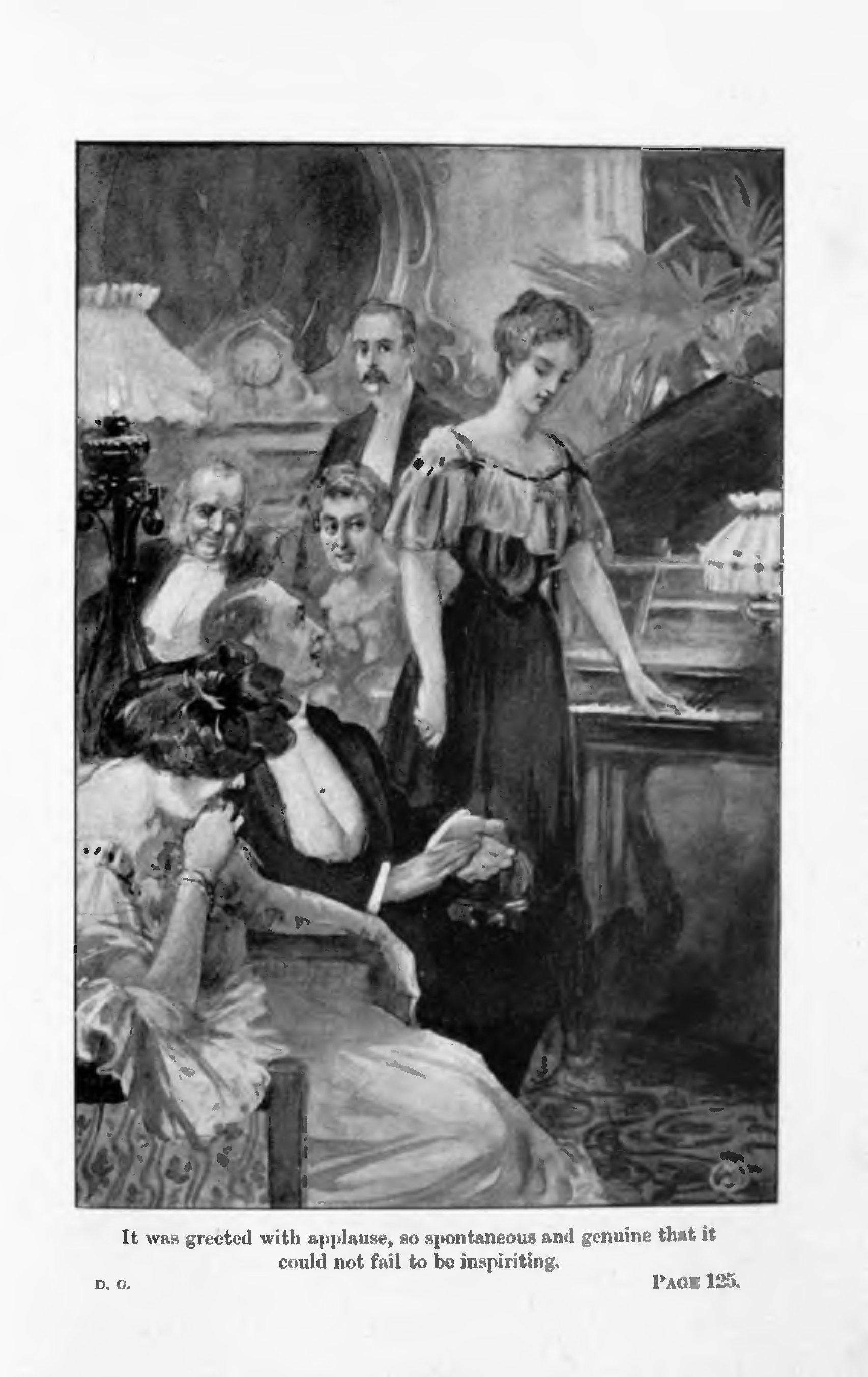
Directly after dinner Mrs Loftus sent Hope to the piano, and the girl sat down unaffectedly, and played several pieces in succession, to the complete satisfaction of the company, who apparently found it much more agreeable to discourse to music than without it. Mr Merrilies, indeed, did stroll across the room, to stand by her side and say “Thank you” at the conclusion, as if he meant what he said; but from a general point of view the performance was a failure, and Mrs Loftus felt disappointed. Hope had been invited with the especial intent of providing amusement for her guests, and if she failed to do so there was really no reason for her presence.
“Sing something to us, Hope,” said Mrs Loftus imperiously. “Sing some of your own songs.—Miss Charrington has composed some charming little things,” she explained to the company at large, who murmured politely in response.
“Compose? How wonderful of you! How do you manage to do it?” queried Truda eagerly, while the fair youth pulled his moustache and looked at Hope as if she were a wild animal escaped from the Zoo, and Uncle Loftus began humming what he fondly supposed to be the air of “The Song of Sleep” to his companion on the sofa.
Plainly, the best thing to do was to begin at once before the situation grew more embarrassing, so Hope broke into the accompaniment of song number one, a simple but taking little production which had been published two years before. It was greeted with applause, so spontaneous and genuine that it could not fail to be inspiriting. Hope forgot to be nervous, and sang “Pack Clouds Away” in her best style, sweetly, smoothly, and with that distinctness of enunciation which is so rare a charm. More applause followed, more exclamations of appreciation, more queries as to how she did it, and then Uncle Loftus must needs begin humming again, and put in a request for “The sleepy one, you know—the one you wrote to order. That is the gem of the collection, in my opinion. We should like to hear the sleepy one, my dear.”
Now, as it happened, Hope was by no means anxious to grant this request, for the idea which Miss Caldecott had so slightly suggested had appealed very strongly to her sensitive nature, and she had put into it her best work, with the hope that when listening to it its hearers might feel something of the same thrill, the same earnestness, which she had experienced in its composition. She had never been able to go through it unmoved, and it seemed almost sacrilege to sing it in this room full of noisy strangers, who would miss its point, and at best pronounce it “sweetly pretty.” She tried to protest, to declare that she had already monopolised the piano too long, but it was of no avail. The more she hung back, the more eager became her audience. “The sooner begun, the sooner it’s done,” she said to herself, with a sigh of resignation, and began to sing forthwith.
Theo had clothed the idea in simple and touching words, and Hope had seconded her with something akin to inspiration; the last few lines, with their subtle change of key, containing an effect at once charming and pathetic. “So to us all comes the end of the day,” Bang Hope softly—so softly that the crackle of the firewood sounded loudly in the ears of the listeners: