X Planetary and Astral Influences of Precious Stones
Reading edition
THE talismanic influence of the stones associated with the planets and also with the signs of the zodiac is closely connected with the early ideas regarding the formation of precious stones. In an old work on the occult properties of gems we read:
The nature of the magnet is in the iron, and the nature of the iron is in the magnet, and the nature of both polar stars is in both iron and magnet, and hence the nature of the iron and the magnet is also in both polar stars, and since they are Martian, that is to say, their region belongs to Mars, so do both iron and magnet belong to Mars.
The author then proceeds to describe an analogous relation between a man and any natural object or product to which his imagination draws him, and shows that, if this object be one that stands in a sympathetic relation with the star beneath which the man was born, the man, the star, and the object will constitute a triplicity of great utility. As an explanation of the peculiarly intimate relation between stars and precious stones we read, on page 12:
Metals and precious stones usually lie with their first seeds deep down in the earth and require continuous moisture and a mild heat. This they obtain through a reflection of the sun and the other stars in the manifold movement of the heavens.... Therefore, also, the metals and precious stones are nearest related to the planets and the stars, since these influence them most potently and produce their peculiar qualities, for they are enduring and unchangeable and show therein their concordance [with the stars and the planets].441
Hence it is that the influence over human fortunes ascribed by astrology to the heavenly bodies is conceived to be strengthened by wearing the gem appropriate to certain planets or signs, for a subtle emanation has passed into the stone and radiates from it. A combination of several different stones, each partaking of this special quality, was believed to have an influence similar to that exercised by several planets in conjunction,—that is, grouped in the same “house” or division of the heavens.
The same is true of the stones dedicated to the guardian angels; the color and appearance of the stone was not merely emblematic of the angel, but, by its sympathetic quality, it was supposed to attract his influence and to provide a medium for the transmission of his beneficent force to the wearer. The whole theory, whether consciously or unconsciously, rested on the idea of harmony, of the accord of certain ethereal vibrations, either those of the visible light of the stars and planets or the purely psychic emanations from the spiritual “powers and principalities.”
The wearing of the appropriate zodiacal gem was always believed to strengthen the influence of the zodiacal sign upon those born under it, and to afford a sympathetic medium for the transmission of the stellar influences. The gem was thus something more than a mere symbol of the sign. The same was true of the stone of the saint who ruled the month and that of the holy guardian angel set over those born in the month. In each and every case the material form and color of the stone was believed to attract the favor and grace of the saint or angel, who would see in the selection of the appropriate gem an act of respect and veneration on the part of the wearer.
The old writers are never tired of insisting upon the idea that, while the image graven upon a stone was in itself dead and inactive, the influence of the stars during whose ascendancy the work had been executed communicated to the inert material talismanic qualities and virtues which it before lacked. In these instances the images could be regarded as outward and visible signs of the planetary or zodiacal influence. Even in the case of the bezoar stone, a generally recognized antidote for all sorts of poisons, it was held that the scorpion’s bite could be most effectually healed by a bezoar upon which this creature’s figure had been cut during the time when the constellation Scorpio was in the ascendancy.442
In the production of engraved stones to serve as amulets, the influence of the respective planet was made to enter the stone by casting upon the latter, during the process of engraving, reflections from a mirror which had been exposed to the planet’s rays. In addition to this, the work was executed while the planet was in the ascendant, and the design was emblematic of it. With these combined influences the gem was believed to be thoroughly impregnated with the planetary virtue.443
An old writer finds in the hardness of precious stones a reason for their retaining longer the celestial virtues they receive. After they have been extracted these virtues persist in them and they keep “the traces and gifts of mundane life which they possessed while clinging to the earth.”444 These “gifts of mundane life” signify the stored-up energy derived from the stars and planets, which penetrates the matter of the stone, and each stone is peculiarly sensitive to the emanations from a certain planet, star, or group of stars.
A fine carnelian gem engraved with a design consisting of a star surrounded by the images of a ram, a bull, and a lion, is described by M. Mairan.445 He sees in the star the emblem of the splendid comet which appeared shortly after the assassination of Cæsar, and which, according to Suetonius, was believed to be the soul of Cæsar newly received into the sky; the ram, bull, and lion are the symbols of the zodiacal signs Aries, Taurus, and Leo, the first-named sign referring perhaps to the death of Cæsar on the Ides, or fifteenth of March; while the other two signs may allude to the position of the comet at different dates.
In the Cabinet du Roi, in Paris, there was an engraved carnelian, the design showing Jupiter enthroned, with thunderbolt and sceptre, and Mars and Mercury standing on either side of the central figure. Separated from the gods of the upper air by a bow, probably representing the arch of the sky, appears the bust of Neptune, emerging from the sea. The border of the design is formed by the twelve signs of the zodiac, Virgo being of an unusual type,—the virgin and a unicorn,—said to have been used only during the reign of Domitian (81-96 A.D.).446
Some choice examples of astrological gems may be seen in the Metropolitan Museum of Art, New York; among these is a green jasper bearing symbols of Luna, Capricorn, and Taurus. This gem is from the collection of the late Rev. C. W. King, which has been acquired for the Museum, and is described as figuring the horoscope of the owner. In the same collection is a banded agate engraved with Sagittarius as a centaur, surrounded by the stars of this constellation in their proper order. King states that this was the earliest horoscopical gem known to him. Still another gem of this collection is a sard bearing the symbol of Aries carrying a long caduceus; this type appears on the coins of Antioch, because that city was founded in the month over which the sign Aries presides.447
The Austrian Imperial Collection in Vienna contains the celebrated Gemma Augustea, sometimes called the Apotheosis of Augustus. This commemorates the Pannonian triumph of Tiberius, 13 A.D., and above the figure of Augustus appears the sign of Capricornus, the constellation of his nativity; beneath the figure of Tiberius is engraved the sign of Scorpio, under which that emperor was born. This celebrated cameo, the work of the famous gem-engraver Dioskorides, is mentioned in an inventory of the treasury of St. Sernin, in Toulouse, dated 1246. It is said to have been offered by Francis I of France to Pope Clement VII, on the occasion of their meeting in Marseilles in 1535; however, as the gem only reached Marseilles two days after the pope’s departure, Francis decided to retain possession of it. The royal treasure at Fontainebleau was plundered in 1590, and the stone was offered for sale, and was purchased, in 1619, by Emperor Rudolph II, for the sum of 12,000 ducats.
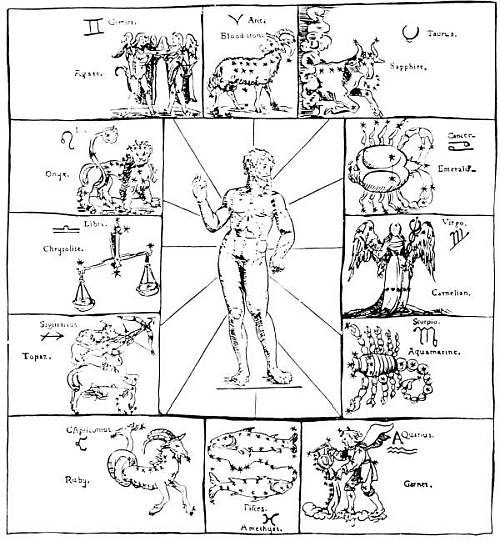
THE ZODIACAL STONES WITH THEIR SIGNS.
Old print illustrating the influence believed to be exerted on the different parts of the body by the respective zodiacal signs, and through their power by the stones associated with them. This belief often determined the administration of special precious-stone remedies by physicians of the seventeenth and earlier centuries.
A ruby called sandastros is described by Pliny as containing stellated bodies which he compares to the Hyades; hence, says he, they are the objects of great devotion with the Chaldæi or Assyrian Magi. According to Morales (De las piedras preciosas), the ruby and the diamond were both under the influence of the sign of Taurus; the same writer informs us that the Hyades and the sun were supposed to have a potent effect upon the ruby or carbuncle. In ancient Babylonia the sign of Taurus was regarded as the most important, and Winckler believes that the presence in this sign of the five stars of the Hyades and the seven of the Pleiades was brought into connection with the twelve-fold division of the zodiac. The Hyades signified the five signs visible in Babylonia at the summer solstice, while the Pleiades typified the seven invisible signs. It seems probable that the Pleiades were associated with the diamond, although Morales, who was very familiar with the Moorish astrology current among the Spaniards of his time, attributed the crystal to this group. His attribution proves at least that the stone of the Pleiades was a colorless one.
In Sanskrit the diamond is called vajra, “thunderbolt,” and also indrâjudha, “Indra’s weapon”; another name is açira, “fire,” or “the Sun.”448 All these designations are probably suggested by the brilliant flashes of light emitted by this stone. It is not easy to determine the reason that induced the Hindus to dedicate the diamond to the planet Venus rather than to the Sun or to the Moon. However, as the most brilliant of the planets, Venus was not unworthy of the honor, and if we substitute the Goddess of Love for her planet, it seems quite appropriate that she should be adorned with the most brilliant of precious stones. Certainly these sparkling gems are often enough offered at the shrine of Venus in our own day, and they often serve to win the good graces of the divinity to whom they are presented.
The Sanskrit name for the sapphire, nîla, signifies “blue,” so that, as the topaz is the “yellow stone” par excellence, the sapphire is the blue stone (nilaçman). In both cases the name indicates a variety of corundum, distinguished merely by the coloring matter. As a talisman the Hindus believed that the sapphire rendered the planet Saturn favorable to the wearer, an important consideration from the astrological point of view, for Saturn’s influence was generally supposed to be unfavorable. The Hindus distinguished four classes of sapphires, corresponding to the four castes: Brahmins, Kshatriyas, Vaisyas, and Sudras. The respective sapphires were light blue, reddish blue, yellowish blue, and dark blue. The same distinction is made in the case of the diamond, and a like rule applies to both stones, namely, that only the appropriate stone should be worn by the members of each caste, in order to profit by the virtues inherent in the sapphire or diamond.449
One of the Sanskrit appellations of the hyacinth (zircon) is râhuratna,—that is, the jewel dedicated to the mysterious “dragon,” that was supposed to be the cause of the periodic eclipses of the Sun and Moon.450 As the stone was sacred to this malevolent influence, we need not be surprised that it was believed to avert misfortune, for nothing was so effective against the lesser spirits of evil as an evil genius of great power.
According to the Hindu mystics it was very lucky to have a turquoise at hand at the time of the new moon, for whoever, after first looking at the moon on the pratipada (the first day after new-moon), should cast his eyes upon a turquoise, was destined to enjoy immeasurable wealth.451
ZODIACAL GEMS
Aquarius. January 21 to February 21. The Garnet. If you would cherish friendship true, In Aquarius well you’ll do To wear this gem of warmest hue— The garnet. Pisces. February 21 to March 21. The Amethyst. From passion and from care kept free Shall Pisces’ children ever be Who wear so all the world may see The amethyst. Aries. March 21 to April 20. The Bloodstone. Who on this world of ours his eyes In Aries opens shall be wise If always on his hand there lies A bloodstone. Taurus. April 20 to May 21. The Sapphire. If on your hand this stone you bind, You in Taurus born will find ’Twill cure diseases of the mind, The sapphire. Gemini. May 21 to June 21. The Agate. Gemini’s children health and wealth command, And all the ills of age withstand, Who wear their rings on either hand Of agate. Cancer. June 21 to July 22. The Emerald. If born in Cancer’s sign, they say, Your life will joyful be alway, If you take with you on your way An emerald. Leo. July 22 to August 22. The Onyx. When youth to manhood shall have grown, Under Leo lorn and lone ’Twill have lived but for this stone, The onyx. Virgo. August 22 to September 22. The Carnelian. Success will bless whate’er you do, Through Virgo’s sign, if only you Place on your hand her own gem true, Carnelian. Libra. September 22 to October 23. The Chrysolite. Through Libra’s sign it is quite well To free yourself from evil spell, For in her gem surcease doth dwell, The chrysolite. Scorpio. October 23 to November 21. The Beryl. Through Scorpio this gem so fair Is that which every one should wear, Or tears of sad repentance bear,— The beryl. Sagittarius. November 21 to December 21. The Topaz. Who first comes to this world below Under Sagittarius should know That their true gem should ever show A topaz. Capricorn. December 21 to January 21. The Ruby. Those who live in Capricorn No trouble shall their brows adorn If they this glowing gem have worn, The ruby.
An old Spanish list of the gems of the zodiacal signs differs from those given above, and probably represents Arab tradition:452
Aries—Crystal
Taurus—Ruby and diamond
Gemini—Sapphire
Cancer—Agate and beryl
Leo—Topaz
Virgo—Magnet
Libra—Jasper
Scorpio—Garnet
Sagittarius—Emerald
Capricorn—Chalcedony
Aquarius—Amethyst
Pisces—
Of planetary stones453 there is assigned to the sun the jacinth and the chrysolite, when this latter name was applied to the yellow Brazilian chrysoberyl, while the moon controls the beryl, the rock-crystal and also the pearl. To the share of Venus fall the sapphire and carbuncle as well as coral and pearl; usually the emerald is the stone of Venus. Mars lays claim to the diamond, jacinth, and ruby, the last-named stone according with the ruddy hue of our neighbor planet. Under the control of Jupiter are placed the emerald, sapphire, amethyst, and turquoise, so that this planet has the richest assortment of gems; it will be remarked that the celestial sapphire unites the influence of Venus and Jupiter, the two especially propitious planets. Lastly, far-away Saturn must be content with all dark, black, and brittle stones; there was, indeed, little inducement to wear a Saturnian stone, for the influence of this cold and distant planet was always regarded as baleful.
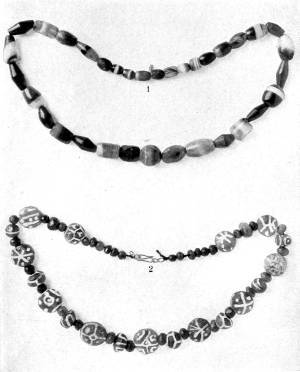
1. A necklace of banded and variegated agates, onyx, carnelians and sards. First Century A.D.
2. Beads of carnelian artificially marked for “good luck.” The marking is produced by an application of potash and soda. Ancient Persian.
The planetary controls of precious stones as given in the Lapidario of Alfonso X, according to “Chaldaic” tradition, show that the same stone was influenced in many or most cases by more than one of the “seven planets” (including the Sun and Moon). Thus the diamond, belonging to the first degree of the sign Taurus, was dominated by both Saturn and the Sun; the emerald was controlled by Jupiter, and also by Mercury and by Venus. The red jargoon was influenced by Mars, the yellow variety by Jupiter and the white jargoon by Venus. The carnelian received virtue from the Sun and from Venus. The ruby, although more especially a sunstone, came as well under the influence of the Planet of Love. Coral belonged both to Venus and to the moon, while lapis-lazuli and chalcedony only owed allegiance to Venus; this planet also lent virtue to the beryl.454
Among the Mohammedans, six of the seven heavens were supposed to be made of precious substances: the first was of emerald; the second, of white silver; the third, of large white pearls; the fourth, of ruby; the fifth, of red gold; and the sixth, of jacinth. The seventh and highest heaven, however, was of shining light.455 Here we have the three precious colored stones, emerald, ruby, and sapphire (jacinth), to which is added the pearl.
The scarcity of the diamond in early times, and its comparative lack of brilliancy before the invention of rose and brilliant cutting, account for the absence of this king of gems.
Rabelais,456 describing the temple of the oracle of the “Dive Bouteille,” says that of its seven columns the first was of sapphire; the second, of jacinth; the third, of “dyamant”; the fourth, of the “male” balas-ruby; the fifth, of emerald, “more brilliant and glistening than were those which were set in place of eyes in the marble lion stretched before the tomb of King Hermias”; the sixth column was of agate, and the seventh of transparent selenite, “with a splendor like that of Hymettian honey, and within appeared the moon in form and motion such as she is in the heavens, full and new, waxing and waning.” We are then told that these stones were attributed to the seven planets by the Chaldæans, as follows:
Sapphire Saturn
Jacinth Jupiter
Diamond Sun
Ruby Mars
Emerald Venus
Agate Mercury
Selenite Moon
Some of these attributions differ from those usually made and may represent another tradition.
PLANETARY INFLUENCES OF STONES457
Jasper Venus and Mercury.
Sapphire Jupiter and Mercury.
Emerald Venus and Mercury.
Chalcedony Jupiter, Mercury, and Saturn.
Sardonyx Saturn and Mars.
Chrysolite Mercury and Venus.
Beryl Venus and Mars.
Topaz Saturn and Mars.
Chrysoprase Mercury and Venus.
Jacinth Mars and Jupiter.
Amethyst Mars and Jupiter.
Pearl Venus and Mercury.
Carbuncle Mars and Venus.
Diamond Jupiter.
Agate Venus and Mars.
Alectoria Sun.
Turquoise Venus and Mercury.
Chelidon Jupiter.
Ætites Sun.
Dionesia Saturn.
Hematite Mercury.
Lapis-lazuli Venus.
Armena Mercury and Venus.
Garnet Sun.
Amber Sun.
Jet Saturn.
Lyncurius Sun.
Crystal Moon and Mars.
Bezoar Jupiter.
Armenia Jupiter.
Selenite Moon.
Magnet Mars.
Judaica,}
Hegolite or } Mercury.
Cogolite }
Iris Jupiter.
Halcyon Saturn and Mars.
Asbestus Saturn.
Sarcophagus Moon.
Arabian, white Moon.
Arabian, green Jupiter.
Hyena Sun.
Androdamas Moon.
Pyrites:
Copper-colored Sun, Venus.
Gold-colored Sun.
Silver-colored Moon.
Tin-colored Moon, Saturn.
Ash-colored Jupiter.
Calatia Moon.
Stalactite Venus.
Thenarcus Sun.
Carnelian Jupiter, Mars, Venus.
Opal Sun, Mercury.
Fixed stars associated with precious stones:458
Diamond. Caput Algol 18° of Taurus.
Crystal. The Pleiades 24° of Taurus.
Ruby, carbuncle. Aldebaran 3° of Gemini; also the Hyades.
Sapphire. The Goat 15° of Gemini.
Beryl. Sirius 10° of Cancer.
Garnet. Heart of Lion 23° of Leo.
Magnet. Tail of the Great Bear 8° of Scorpio; also the Pole Star.
Topaz. Right and left wing of Raven 8° of Libra.
Emerald and Jasper. Spica Virginis 17° of Libra.
Amethyst. Scorpion 3° of Sagittarius.
Chrysolite. Tortoise 8° of Capricorn.
Chalcedony. Tail of Capricorn 15° of Aquarius.
Jacinth. Shoulder of Equis Major 18° of Pisces.
Pearl. Umbilicus Andromedæ 20° of Aries.
Sardonyx. Same as Topaz.
Images and virtues of the constellations as engraved on gems:459
Ursa Major, Ursa Minor, and Draco. Both bears are represented in the folds of a serpent, the Great Bear in the upper and the Lesser Bear in the lower folds. In almost all the signs. Nature: Ursa Major, Mars and Venus. Ursa Minor: Saturn. Draco: Saturn and Mars. Renders the wearer wise, cautious, versatile, and powerful.
The boundary lines of the various signs are carried up to the pole, and any constellation that is within these lines is considered to belong to the respective sign; thus, every constellation belongs to one or more signs.
Corona Borealis. A royal crown, with many stars; sometimes the crowned head of a king. Sign: Sagittarius. Nature: Venus and Mercury. Engraved on the stone of one who is fitted for honors and knowledge, it gives him great favor with kings.
Hercules. A man with knees bent, holding a club in his hand and killing a lion; sometimes a man with a lion’s skin in his hand or on his shoulder and holding a club. Sign: Scorpio. Nature: Venus and Mercury. Engraved on a stone that brings victory, like the agate, it renders the wearer victorious in all conflicts in the field.
Cygnus. A swan with outstretched wings and curved neck. In the North. Nature: Venus and Mercury. Renders the wearer popular, increases knowledge, and augments wealth. Cures gout, paralysis, and fever.
Cepheus. A man girt with a sword and holding his hands and arms extended. Sign: Aries. Nature: Saturn and Jupiter. Causes pleasant visions if placed beneath the head of a sleeping person.
Cassiopeia. A woman seated in a chair and with hands extended in the form of a cross; sometimes with a triangle on her head. Sign: Taurus. Nature: Saturn and Venus. Restores the sickly, worn body to health, gives quiet and calm after labor and procures pleasant and tranquil sleep.
Andromeda. A young girl with dishevelled hair, and hands hanging down. Sign: Taurus. Nature: Venus. Reconciles husband and wife, strengthens love, and protects the human body from many diseases.
Perseus. A man holding a sword in his right hand and the Gorgon’s head in his left. Sign: Taurus. Nature: Saturn and Venus. Guards the wearer from misfortune and protects, not only the wearer but the place where it may be, from lightning and tempest. Dissolves enchantments.
Serpens. A man in the folds of a serpent and holding its head in his right hand and its tail in his left. Sign: Taurus. Nature: Saturn and Venus. Antidote to poisons and to the bites of venomous creatures.
Aquila. A flying eagle with an arrow beneath his feet. Sign: Cancer. Nature: Jupiter and Mercury; the arrow, however, is of Mars and Venus. Preserves former honors, adds new ones, and helps to victory.
Pisces or Delphinus. Figured in relief(?) Sign: Aquarius. Nature: Saturn and Mars. If this engraved gem be attached to nets it causes them to be filled with fish, and it renders the wearer fortunate in fishing.
Pegasus. Some represent the half of a winged horse; others the whole figure and without a bridle. Sign: Aries. Nature: Mars and Jupiter. Gives victory in the field, and makes the wearer swift, cautious, and bold.
Cetus. Figure of a large fish with curved tail and capacious gullet. Sign: Taurus. Nature: Saturn. Renders the wearer fortunate on the sea and makes him prudent and agreeable. It also restores lost articles.
Orion. With or without armor, man holding a sword or a scythe in his hand. Sign: Gemini. Nature: Jupiter, Saturn, and Mars. Gives the wearer victory over his enemies.
Navis. A ship with prow curved back and spread sails; sometimes with and sometimes without oars. Sign: Leo. Nature: Saturn and Jupiter. Renders the wearer fortunate in his undertakings; he runs no risk on sea or water, neither can he be injured by water.
Canis Major. Figure of a dog for coursing hares, with a curved tail. Sign: Cancer. Nature: Venus. Cures lunacy, insanity, and demoniacal possession.
Lepus. Figure of a hare with ears pricked up and the feet represented as though in swift motion. Sign: Gemini. Nature: Saturn and Mercury. Cures frenzy and protects from the wiles of demons. The wearer cannot be hurt by a malignant spirit.
Centaur. Half-figure of a bull, bearing a man on whose left shoulder rests a lance, from which depends a hare. In his right hand the man holds a small, supine animal with a vessel attached to it. Sign: Libra. Nature: Jupiter and Mars. Gives constancy and perpetual health.
Canis Minor. Figure of a dog, sitting. Sign: Cancer. Nature: Jupiter. Guards from dropsy, pestilence, and the bites of dogs.
Sacrarius Turubulus (Ara). An altar with burning incense. Sign: Sagittarius. Nature: Venus and Mercury. Gives the wearer power to recognize spirits, to converse with them, and to command them; also confers chastity.
Hydra. A serpent, having an urn at its head and a raven at its tail. Sign: Cancer. Nature: Saturn and Venus. Gives riches and all good gifts to the wearer and makes him cautious and prudent.
Corona Australis. An imperial crown. Sign: Libra. Nature: Saturn and Mars. Augments wealth and makes the wearer gay and happy.
Auriga. A man in a chariot, bearing a goat on his left shoulder. Sign: Gemini. Nature: Mercury. Makes the wearer successful in hunting.
Vexillum. A flag flying from the extremity of a lance. Sign: Scorpion. Gives skill in war and confers victory in the field.
FIGURES OF THE PLANETS
Saturn. An old man holding a curved scythe in his hand and with a not very heavy beard. Engraved on a stone of the nature of Saturn, it renders the wearer powerful and augments his power continually.
Jupiter. A seated figure, sometimes in a chariot, holding a staff in one hand and a spear in the other. It renders the wearer fortunate, especially if engraved on a Kabratis stone, and he easily gains what he wishes, especially from priests. He will be raised to honors and dignities.
Mars. Represented sometimes with a banner and sometimes with a lance or other weapon. He is, indeed, always armed and at times mounted on a horse. Gives victory, boldness in war, and success in everything, especially if engraved on an appropriate stone.
Sun. Sometimes as the solar disk with rays, sometimes as a man in a chariot, and this occasionally is surrounded by the signs of the zodiac. Renders the wearer powerful and a victor; this gem is prized by hunters.
Venus. Many forms, among them that of a woman with a voluminous dress and a stole, holding a laurel in her hand. Gives skill in handling affairs and usually brings them to a successful issue; removes the fear of drowning.
Mercury. Figure of a slender man, usually with a beautiful beard, but sometimes without. He has winged feet and holds the caduceus. Increases knowledge and confers eloquence. It aids merchants, enabling them to acquire wealth.
Moon. Various forms. Sometimes as a crescent, sometimes as a young woman in a chariot and holding a quiver, and at others as a woman with a quiver and following the chase with dogs. Aids the fortunes of those who are sent on an embassy, and enables them to acquire wealth and honor thereby. Is said to confer speed and facility in undertakings and a happy issue.460
When Hudibras attacked and overcame the sorcerer Sidrophal, he rifled the latter’s pockets of all his mystic treasures. Among these were
Several constellation stones, Engraved in planetary hours, That over mortals had strange powers, To make them thrive in law or trade, And stab or poison to evade, In wit and wisdom to improve, And be victorious in love.461
These manifold influences exerted by the stars and planets through the medium of the gems, not only concerned those actually present in a material form, but also those that were seen in dreams, and interpretations of such dreams are given by old writers.
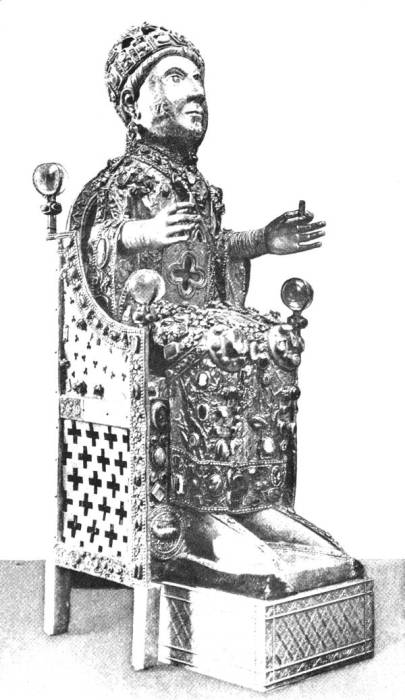
STATUETTE KNOWN AS THAT OF SAINTE FOY, IN THE ABBEY-CHURCH AT CONQUES, DEPT. AVEYRON, FRANCE.
It is studded with precious and semi-precious stones and engraved gems, dating from various epochs, the pious offerings of those whose prayers have been answered. The figure is 85 cm. (33½ inches) high and is of gold in a core of wood. Probably of the tenth century. Two of the four crystal balls adorning the seat are said to replace golden doves. Rock-crystal was especially dedicated to the moon.
Many Oneirocritica, or “dream-books,” were written or compiled in the early centuries of our era, one of the most noted being the work of Artemidorus, who flourished in the second century A.D. Every object seen in a dream was given a special meaning, and it is interesting to note that Artemidorus believed dreams of rings or other ornaments, as well as of precious stones, to be of favorable significance only for women. Such dreams indicated marriage for unmarried women, and the birth of children for those already married. If a woman was both wife and mother when she saw sparkling jewels in her dream, then the vision portended the acquisition of great wealth. Artemidorus here sagely remarks that women are by nature devoted to riches and passionately fond of ornaments. For men, on the other hand, to dream of jewels was an ill omen; probably because it foreshadowed the necessity of buying them for a good friend or a faithful wife.462
Another of these dream-books, probably composed in the eighth century A.D., appears under the name of Achametis and is of Arabic origin. Many of the interpretations in this book are referred to a Hindu source, and among these are visions of crowns that appear to kings. Such a dream, in itself, usually portended increased power and success for the sovereign, but this depended upon the color and character of the jewels which adorned the crown. For example, we read that if the gems were red and of the kind known as lychnites (carbuncles or rubies), the dream indicated that the king would have great joy and good fortune and would be more feared by his enemies than before; but if he saw blue gems in the crown, it was a bad omen, foreshadowing the loss of part of his kingdom. If the stones were of a light green hue (the color of the leek), the king would gain a great name in the world, both by his good faith and by the greatness of his kingdom; for, the writer adds, “this color in precious stones is universally accepted as signifying good-faith and religious devotion to God.”463
There is signified by dreaming of
AgatesA journey.
AmberA voyage.
AmethystsFreedom from harm.
AquamarinesNew friends.
BerylsHappiness in store.
BloodstonesDistressing news.
CarbunclesAcquirement of wisdom.
CarneliansImpending misfortune.
Cat’s-eyesTreachery.
ChalcedonyFriends rejoined.
ChrysoberylsA time of need.
ChrysolitesNecessary caution.
CoralRecovery from illness.
CrystalFreedom from enemies.
DiamondsVictory over enemies.
EmeraldsMuch to look forward to.
GarnetsThe solution of a mystery.
HeliotropesLong life.
HyacinthsA heavy storm.
JacinthsSuccess.
JasperLove returned.
JetSorrow.
Lapis-lazuliFaithful love.
MoonstonesImpending danger.
Moss-agatesAn unsuccessful journey.
OnyxA happy marriage.
OpalsGreat possessions.
PearlsFaithful friends.
PorphyryDeath.
RubiesUnexpected guests.
SapphiresEscape from danger.
SardonyxLove of friends.
TopazNo harm shall befall.
TourmalinesAn accident.
TurquoisesProsperity.
If precious stones be so combined in a ring, or other jewel that the initial letters of their names spell words significant of a tender sentiment or implying good fortune, or else the name of someone dear to the giver of the jewel, this is also supposed to strengthen their astral or planetary influence and to render them more potent charms. In the following examples the gems in the first column are the more expensive, those in the second column being comparatively inexpensive ones.
ACROSTICS FORMED WITH STONES
In France and England, during the 18th century, rings, bracelets, brooches, etc., were often set with gems the first letters of which, combined, formed a motto or expressed a sentiment. The following is a list of those that may be used in this way. The choice of stones afforded here brings these pretty devices within the reach of all.
FAITH
Fire-opal.Feldspar.
Alexandrite.Amethyst.
Iolite.Idocrase.
Tourmaline.Topaz.
Hyacinth.Heliotrope.
HOPE
Hyacinth.Hematite.
Opal.Olivine.
Pearl.Pyrope.
Emerald.Essonite.
CHARITY
Cat’s-eye.Carbuncle.
Hyacinth.Hematite.
Aquamarine.Amethyst.
Ruby.Rose quartz.
Iolite.Idocrase.
Tourmaline.Topaz.
Yellow sapphire.Yu (Jade).
GOOD LUCK
Golden beryl.Garnet.
Opal.Onyx.
Olivine.Obsidian.
Diamond.Dendrite.
Lapis-lazuli.Labradorite.
Uralian emerald.Unio pearl.
Cat’s-eye.Carnelian.
Kunzite.Krokidolite.
FOREVER
Fire-opal.Flèches d’amour.
Opal.Onyx.
Ruby.Rutile.
Emerald.Essonite.
Vermeille.Verd antique.
Essonite.Epidote.
Rubellite.Rose quartz.
REGARD
Ruby.Rubellite.
Emerald.Essonite.
Garnet.Garnet.
Alexandrite.Amethyst.
Ruby.Rock-crystal.
Diamond.Demantoid.
ZES
Greek, meaning “Mayest thou live.”
Zircon.Zonochlorite.
Emerald.Essonite.
Sapphire.Sard.
MIZPAH
Moonstone.Moldavite.
Indicolite.Idocrase.
Zircon.Zonochlorite.
Peridot.Pyrope.
Asteria.Aquamarine.
Hyacinth.Hematite.
FRIENDSHIP
Flèches d’amour.Feldspar.
Ruby.Rock crystal.
Indicolite.Idocrase.
Emerald.Epidote.
Nephrite.Nicolo.
Diamond.Diopside.
Sapphire.Sard.
Hyacinth.Hematite.
Iolite.Idocrase.
Pearl.Pyrite.
DEAREST
Diamond.Demantoid.
Emerald.Essonite.
Alexandrite.Amethyst.
Ruby.Rubellite.
Essonite.Epidote.
Sapphire.Spinel.
Turquoise.Topaz.
SOUVENIR
Sapphire.Sunstone.
Opal.Onyx.
Uralian emerald.Utahlite.
Vermeille.Verd antique.
Emerald.Epidote.
Nephrite.Nephrite.
Iolite.Indicolite.
Ruby.Rock-crystal.
BONHEUR
Beryl.Bloodstone.
Opal.Onyx.
Nephrite.Nephrite.
Hyacinth.Hematite.
Emerald.Essonite.
Uralian emerald.Utahlite.
Ruby.Rhodonite.
AMITIÉ
Alexandrite.Almandine.
Moonstone.Moonstone.
Indicolite.Indicolite.
Tourmaline.Topaz.
Idocrase.Idocrase.
Emerald.Essonite.
LOVE ME
Lapis-lazuli.Labrador spar.
Opal.Onyx.
Vermeille.Verd antique.
Emerald.Essonite.
Moonstone.Moonstone.
Essonite.Epidote.
AEI
Greek, meaning “forever,” “eternity.”
Alexandrite.Almandine.
Emerald.Essonite.
Indicolite.Idocrase.
An attractive engagement ring can be formed of a central diamond from which extend the rays of a five-pointed star. Between the rays are set the stones emblematic of the zodiacal sign, of the guardian angel of the month, of the planet control of the hour and also the two stones indicating the initial letter of the two Christian names. This ring is in the form of the mystic Pentagon, the grand symbol of constancy and durability, since the number five is composed of three, which signifies creative power, and two, which typifies the balance, that is, stability.
As, according to the old fancy, the influences due to the light emanations from the planets or fixed stars, or from the combination of the stars in a zodiacal sign, would have a peculiar and more or less intimate connection with the fate of one country rather than of another, an attempt is here made to give a characteristic stone for each country. In the case of the United States the various gem-stones found within the boundaries of each of the States of the Union are given. That this special influence was exceptionally potent in regard to those born in the countries in question was also taught and hence a national gem would have a greater talismanic power than any other for the natives of each separate country. For those who may feel a certain degree of sympathy for time-honored fancies, and who may perhaps also have a trace of superstition hidden away in some part of their consciousness, one of our State gems would have a similar significance.
GEMS OF COUNTRIES
AlaskaGarnet
AlgiersCoral
ArabiaPearl
Austria-HungaryOpal
BelgiumCrystal
BohemiaGarnet
BokharaLapis-lazuli
BoliviaLapis-lazuli
BrazilTourmaline (Brazilian emerald)
BurmaRuby
CanadaSodalite
CeylonCat’s-eye
ChiliLapis-lazuli
ChinaJade
CongoDioptase
DenmarkAgate
EgyptPeridot
EnglandDiamond
FrancePearl
GermanyAmber
German West AfricaDiamond
GreeceSapphire
HollandDiamond
HungaryOpal
IndiaPearl
IrelandPrecious serpentine (Connemara)
ItalyCoral
JapanRock-crystal
KoreaAbalone pearl
MadagascarMorganite
MexicoObsidian
MoroccoCoral
New EnglandTourmaline
New South WalesOpal
New ZealandJade
Norway-SwedenCarnelian
PanamaAgate
PersiaTurquoise
PeruEmerald
PhilippinesPearl
PortugalChrysoberyl
RoumaniaAmber
RussiaRhodonite
Sandwich IslandsOlivine
ScotlandCairngorm (smoky quartz)
ServiaCoral
SiamRuby
SicilyAmber
South AfricaDiamond
SpainEmerald
SwitzerlandRock-crystal
TurkestanJade
TurkeyTurquoise
United StatesSapphire
UruguayAmethyst
UNITED STATES STONES
Precious, semi-precious, or gem stones are found in nearly every State of the Union. The most important are enumerated below:
AlabamaBeryl, blue and yellow; smoky quartz.
ArizonaAgatized wood, azur-malachite, turquoise, garnet, peridot.
ArkansasRock-crystal, smoky quartz, agate, diamond, novaculite.
CaliforniaAgate, benitoite, californite, diamond, gold quartz, tourmaline, abalone pearl, chrysoprase, kunzite, morganite.
ColoradoBeryl, aquamarine, phenacite, garnet, amethyst, agate, gold quartz, pyrite.
ConnecticutBeryl, yellow and green; rose quartz, tourmaline
DelawarePearl.
FloridaChalcedony, conch pearl.
GeorgiaRuby, beryl, amethyst, gold quartz, garnet.
IdahoOpal, agate, obsidian.
IllinoisFluorite, pearl.
Indian TerritoryObsidian, pearl.
IndianaPearl.
IowaFossil coral, pearl, chalcedony.
KansasChalcedony.
KentuckyPearl.
LouisianaChalcedony.
MaineTourmaline, beryl, rose quartz, pearl, topaz, amazonite, smoky quartz, rock-crystal.
MarylandBeryl, clam-pearl.
MassachusettsBeryl.
MichiganAgate, hematite.
MinnesotaChlorastrolite, thomsonite, agate.
MississippiPearl, chalcedony.
MissouriPearl, fluorite, pyrite.
MontanaSapphire, beryl, smoky quartz, agate, amethyst, agatized wood, obsidian.
NebraskaChalcedony, pearl.
NevadaGold quartz, rock-crystal.
New HampshireBeryl, rock-crystal, garnet.
New JerseyFowlerite, willemite, prehnite, smoky quartz, agate, pearl.
New MexicoTurquoise, garnet, obsidian, peridot, rock-crystal.
New YorkBeryl, brown tourmaline, rose quartz, fresh-water pearl, clam-pearl, chondrodite.
North CarolinaAquamarine, beryl, emerald, almandite garnet, rhodolite, prope garnet, diamond, cyanite, hiddenite, amethyst, ruby, sapphire, smoky quartz, rock-crystal, rutile.
North DakotaChalcedony, agate.
OhioFossil coral, chalcedony.
OregonAgate, obsidian, hydrolite.
PennsylvaniaAmethyst, beryl, sunstone, moonstone, amazonite, almandite garnet, pyrope garnet, rutile.
Rhode IslandHornblende in quartz, amethyst, rock-crystal.
South CarolinaBeryl, smoky quartz, rock-crystal.
South DakotaQuartzite, beryl, agate.
TennesseePearl.
TexasBeryl, pearl, tourmaline.
UtahTopaz, garnet.
VirginiaAmethyst, spessarite, garnet, beryl, moonstone, staurolite, allanite.
VermontBeryl, pearl.
WashingtonPearl, agate.
West VirginiaRock-crystal.
WisconsinAgate, pearl.
WyomingMoss-agate, agate.