III On the Talismanic Use of Special Stones36
Reading edition
III On the Talismanic Use of Special Stones36
Agate
THE author of “Lithica” celebrates the merits of the agate in the following lines:37
Adorned with this, thou woman’s heart shall gain, And by persuasion thy desire obtain; And if of men thou aught demand, shalt come With all thy wish fulfilled rejoicing home.
This idea is elaborated by Marbodus, Bishop of Rennes, in the eleventh century, who declares that agates make the wearers agreeable and persuasive and also give them the favor of God.38 Still other virtues are recounted by Camillo Leonardo, who claims that these stones give victory and strength to their owners and avert tempests and lightning.39
The agate possessed some wonderful virtues, for its wearer was guarded from all dangers, was enabled to vanquish all terrestrial obstacles and was endowed with a bold heart; this latter prerogative was presumably the secret of his success. Some of these wonder-working agates were black with white veins, while others again were entirely white.40
The wearing of agate ornaments was even believed to be a cure for insomnia and was thought to insure pleasant dreams. In spite of these supposed advantages, Cardano asserts that while wearing this stone he had many misfortunes which he could not trace to any fault or error of his own. He, therefore, abandoned its use; although he states that it made the wearer more prudent in his actions.41 Indeed, Cardano appears to have tested the talismanic worth of gems according to a plan of his own,—namely, by wearing them in turn and noting the degree of good or ill fortune he experienced. By this method he apparently arrived at positive results based on actual experience; but he quite failed to appreciate the fact that no real connection of any kind existed between the stones and their supposed effects. In another treatise this author takes a somewhat more favorable view of the agate, and proclaims that all varieties render those who wear them “temperate, continent, and cautious; therefore they are all useful for acquiring riches.”42
According to the text accompanying a curious print published in Vienna in 1709, the attractive qualities of the so-called coral-agate were to be utilized in an air-ship, the invention of a Brazilian priest. Over the head of the aviator, as he sat in the air-ship, there was a network of iron to which large coral-agates were attached. These were expected to help in drawing up the ship, when, through the heat of the sun’s rays, the stones had acquired magnetic power. The main lifting force was provided by powerful magnets enclosed in two metal spheres; how the magnets themselves were to be raised is not explained.43
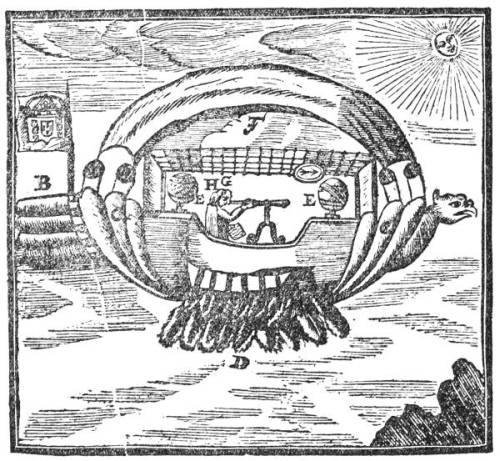
AN AIR-SHIP OF 1709.
In the network above the figure were to be set coral-agates, supposed to possess such magnetic powers as to keep the craft aloft. From Valentini, “Museum Museorum,” Pt. III, Franckfurt am Mayn, 1714, p.35. Author’s library.
In the network above the figure were to be set coral-agates, supposed to possess such magnetic powers as to keep the craft aloft. From Valentini, “Museum Museorum,” Pt. III, Franckfurt am Mayn, 1714, p.35. Author’s library.]
About the middle of the past century, the demand for agate amulets was so great in the Soudan that the extensive agate-cutting establishments at Idar and Oberstein in Germany were almost exclusively busied with filling orders for this trade. Brown or black agates having a white ring in the centre were chiefly used for the fabrication of these amulets, the white ring being regarded as a symbol of the eye. Hence the amulets were supposed to neutralize the power of the Evil Eye, or else to be emblematic of the watchfulness of a guardian spirit. The demand for these amulets has fallen off greatly, but when it was at its height single firms exported them to the value of 40,000 thalers ($30,000) annually, the total export amounting to hundreds of thousands of thalers. Even at present a considerable trade in these objects is still carried on. That there is a fashion in amulets is shown by the fact that, while red, white, and green amulets are in demand on the west coast of Africa, only white stones are favored for this use in Northern Africa.
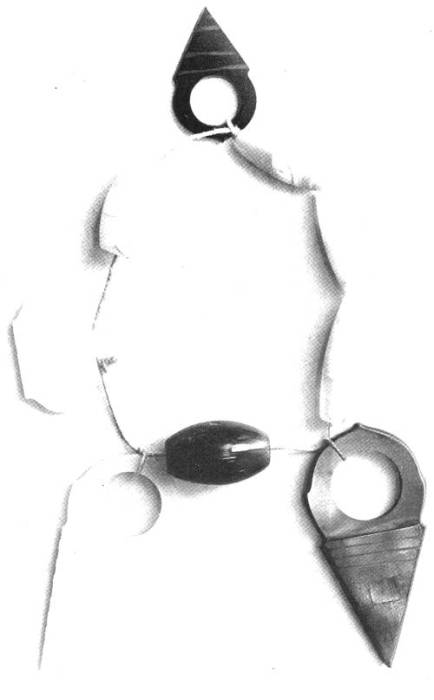
AFRICAN AGATE CHARMS.
Made of Brazilian agate at Oberstein, Germany, for African trade. Field Museum, Chicago.
Alexandrite
There are a few talismanic stones which have gained their repute in our time, notably the alexandrite, a variety of chrysoberyl found in Russia, in the emerald mines on the Takowaya, in the Ural region. The discovery of this variety is stated to have been made in 1831 on the day Alexander II (then heir-apparent) reached his majority, and it was therefore named alexandrite, by Nordenskjöld, the mineralogist. The stone as found in gem form rarely weighs over from one to three carats, and is characterized by a marked pleochroism of a splendid green changing to a beautiful columbine red. But in Ceylon much larger gems are found, some few weighing 60 carats each, although rarely of more than one or two carats. The color is of a darker and more bottle-like green, and the change by night renders them darker and more granitized than the Russian stones, which are extremely rare. As red and green are the Russian national colors, the alexandrite has become a great favorite with the Russians, and is looked upon as a stone of good omen in that country. Such, however, is its beauty as a gem that its fame is by no means confined to Russia, and it is eagerly sought in other lands as well.
Amber
Amber was one of the first substances used by man for decoration, and it was also employed at a very early period for amulets and for medicinal purposes. More or less shapeless pieces of rough amber, marked with circular depressions, have been found in Prussia, Schleswig-Holstein, and Denmark, in deposits of the Stone Age. These depressions are sometimes regularly disposed and at other times irregularly, and seem intended to imitate similar depressions found in large stones and rocks, often the work of man’s hand, but occasionally the result of natural causes. In Hoernes’ opinion they marked the resting place of the spirit or spirits believed to animate the stone, and hence it is probable that the amber fragments were used as talismans or amulets.44
For the ancient Greek poets, the grains of amber were the tears annually shed over the death of their brother Phaëthon by the Heliades after grief had metamorphosed them into poplars growing on the banks of the Eridanus (the modern river Po).45 In a lost tragedy of Sophocles, he saw the origin of amber in the tears shed over the death of Meleager by certain Indian birds. For Nicias it was the “juice” or essence of the brilliant rays of the setting sun, congealed in the sea and then cast up upon the shore. A more prosaic explanation likened amber to resin, and regarded it as being an exudation from the trunks of certain trees. Indeed, the poetic fancy we have just noted is the same idea clothed in a metaphorical or mythological form. Another fancy represented amber to be the solidified urine of the lynx, hence one of its names, lyncurius.46
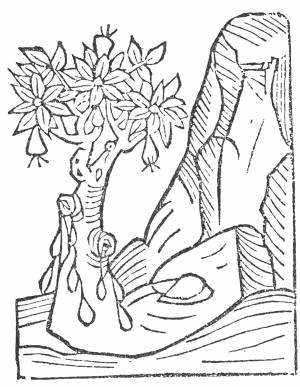
THE TREE THAT EXUDES AMBER.
From the “Hortus Sanitatis,” of Johannis de Cuba [Strassburg, Jean Pryss, ca. 1483]; De lapidibus, cap. lxx. Author’s library.
The brilliant and beautiful yellow of certain ambers and the fact that this material was very easily worked served to make its use more general, and it soon became a favorite object of trade and barter between the peoples of the Baltic Coast and the more civilized peoples to the south. Schliemann found considerable amber from the Baltic in the graves of Mycenæ, and the frequent allusions to it in the works of Latin authors of the first and succeeding centuries testify to its popularity in the Roman world.
Probably the very earliest allusion in literature to the ornamental use of amber appears in Homer’s Odyssey,47 where we read:
Eurymachus Received a golden necklace, richly wrought, And set with amber beads, that glowed as if With sunshine. To Eurydamas there came A pair of ear-rings, each a triple gem, Daintily fashioned and of exquisite grace. Two servants bore them.
Amber ingeniously carved into animal forms has been discovered in tumuli at Indersoen, Norway.48 These curious objects were worn as amulets, and the peculiar forms were supposed to enhance the power of the material, giving it special virtues and rendering it of greater value and efficacy.
Pieces of amber with singular natural markings were greatly esteemed, especially when these markings suggested the initials of the name of some prominent person. Thus, we are told that Friedrich Wilhelm I of Prussia paid to a dealer a high price for a piece of amber on which appeared his initials. The same dealer had another piece on which he read the initials of Charles XII of Sweden. When he received the news of this king’s death, he bitterly lamented having lost the opportunity of selling him amber for a high price. But he was cleverly consoled by Nathaniel Sendal, the relator of the story, who easily persuaded the dealer that the markings could just as well signify the initials of some other name. Sendal adduces this as a proof that the letters read on such pieces of amber were as much the product of the observer’s imagination as of the markings on the material.49 Those who secured amber so mysteriously marked by Nature’s hand probably felt that they had obtained a talisman of great power, especially destined for their use.
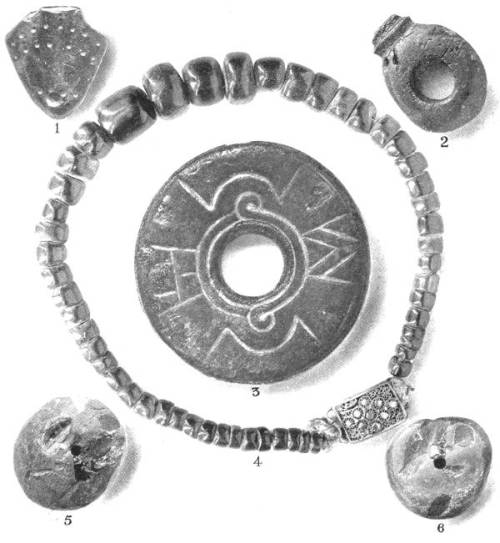
1. Amber ornament, perforated, from Assyrian grave.
2. Amber ring ornament from Pompeii.
3. Large annular bead of amber from Mexico. Aztec work.
4. Amber wedding necklace. Eighteenth century. Baltic Provinces.
5. Amber beads. Worn by African natives.
Amethyst
While the special and traditional virtue of the amethyst was the cure of drunkenness, many other qualities were attributed to this stone in the fifteenth century. For Leonardo,50 it had the power to control evil thoughts, to quicken the intelligence, and to render men shrewd in business matters. An amethyst worn on the person had a sobering effect, not only upon those who had partaken too freely of the cup that intoxicates, but also upon those over-excited by the love-passion. Lastly, it preserved soldiers from harm and gave them victory over their enemies, and was of great assistance to hunters in the capture of wild animals. The amethyst shared with many other stones the power to preserve the wearer from contagion.51
A pretty legend in regard to the amethyst has been happily treated in French verse. The god Bacchus, offended at some neglect that he had suffered, was determined to avenge himself, and declared that the first person he should meet, when he and his train passed along, should be devoured by his tigers. Fate willed it that this luckless mortal was a beautiful and pure maiden named Amethyst, who was on her way to worship at the shrine of Diana. As the ferocious beasts sprang toward her, she sought the protection of the goddess, and was saved from a worse fate by being turned into a pure white stone. Recognizing the miracle and repenting of his cruelty, Bacchus poured the juice of the grape as a libation over the petrified body of the maiden, thus giving to the stone the beautiful violet hue that so charms the beholder’s eye.52
From the various descriptions of this stone given by ancient writers, it appears that one of the varieties was probably the purple almandine or Indian garnet, and it is not improbable that we have here the reason for the name amethyst and for the supposed virtue of the stone in preserving from drunkenness. For if water were poured into a vessel made of a reddish stone, the liquid would appear like wine, and could nevertheless be drunk with impunity.
Beryl
Arnoldus Saxo, writing about 1220, after reciting the virtues of the beryl as given by Marbodus, after Evax and Isidorus, reports in addition that the stone gave help against foes in battle or in litigation; the wearer was rendered unconquerable and at the same time amiable, while his intellect was quickened and he was cured of laziness.53 In the old German translation of Thomas de Cantimpré’s “De Proprietatibus Rerum,” we read that the beryl reawakens the love of married people (er hat auch die art daz er der elaut lieb wiederpringt).54
Bloodstone
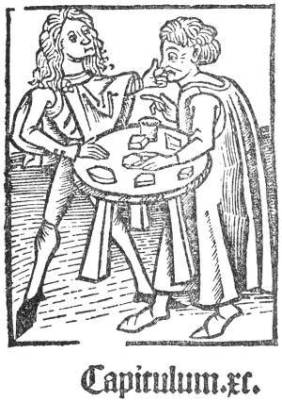
A PRACTICAL TEST OF THE VIRTUES OF THE BLOODSTONE TO PREVENT NOSE-BLEED.
From the “Hortus Sanitatis” of Johannis de Cuba [Strassburg, Jean Pryss, ca. 1483]; De lapidibus, cap. xc. Author’s library.
The heliotrope or bloodstone was supposed to impart a reddish hue to the water in which it was placed, so that when the rays of the sun fell upon the water they gave forth red reflections. From this fancy was developed the strange exaggeration that this stone had the power to turn the sun itself a blood-red, and to cause thunder, lightning, rain, and tempest. The old treatise of Damigeron relates this of the bloodstone, adding that it announced future events by producing rain and by “audible oracles.” Probably the conjurors, before proceeding to use the stone for their incantations, watched the heavens and waited until they noticed the signs of an approaching storm. They then interpreted the sounds of the wind and thunder in various ways, so as to give apt answers to the questions addressed to them touching future events. It is well known that the sighing of the wind, and, indeed, all those natural sounds which constitute the grand symphony of Nature, were interpreted by prophets and seers into articulate speech. Damigeron also declares that the bloodstone preserved the faculties and bodily health of the wearer, brought him consideration and respect, and guarded him from deception.55
In the Leyden papyrus the bloodstone is praised as an amulet in the following extravagant terms:
The world has no greater thing; if any one have this with him he will be given whatever he asks for; it also assuages the wrath of kings and despots, and whatever the wearer says will be believed. Whoever bears this stone, which is a gem, and pronounces the name engraved upon it, will find all doors open, while bonds and stone walls will be rent asunder.56
Carbuncle
The carbuncle was recommended as a heart stimulant; indeed, so powerful was its action, that the wearers were rendered angry and passionate and were even warned to be on their guard against attacks of apoplexy.57 The blood-red hue of the stone also suggested its use as a symbol of the divine sacrifice of Christ on the cross. However, not only in Christianity was this stone used to illustrate religious conceptions, for the Koran affirms that the Fourth Heaven is composed of carbuncle. In mythical fancies too this stone played its part, for dragon’s eyes were said to be carbuncles.
Rumphius58 states that in 1687 he was told by a chirurgeon that the latter had seen in the possession of one of the rulers in the island of Amboin a carbuncle said to have been brought by a serpent. The story ran that this ruler, when a child, had been placed by his mother in a hammock attached to two branches of a tree. While there a serpent crept up to him and dropped a stone upon his body. In gratitude for this gift the parents of the child fed and cared for the serpent. The stone is described as having been of a warm yellow hue, verging on red; it shone so brightly at night that a room could be illuminated by it. It eventually passed into the possession of a King of Siam.
Carnelian
Talisman ist Karneol Gläubigen bringt er Glück und Wohl; Steht er gar auf Onyx’ Grunde, Küss’ ihm mit geweihtem Munde! Alles Übel treibt er fort, Schützet dich und schützt den Ort; Wenn das eingegrabene Wort Allah’s Namen rein verkündet; Dich zu Lieb’ und Tat entzündet; Und besonders werden Frauen Sich am Talisman erbauen!59 Carnelian is a talisman, It brings good luck to child and man; If resting on an onyx ground, A sacred kiss imprint when found. It drives away all evil things; To thee and thine protection brings. The name of Allah, king of kings, If graven on this stone, indeed, Will move to love and doughty deed. From such a gem a woman gains Sweet hope and comfort in her pains.
The wearing of carnelians is recommended by the Lapidario of Alfonso X60 to those who have a weak voice or are timid in speech, for the warm-colored stone will give them the courage they lack, so that they will speak both boldly and well. This is in accord with the general belief in the stimulating and animating effects produced by red stones.
On a carnelian is engraved in Arabic characters a prayer to keep away evil and to deliver the wearer from all the tricks of the devil and from the envious. The inscription reads in translation:
In the name of God the Just, the very Just! I implore you, O God King of the World, God of the World, deliver us from the devil Who tries to do harm and evil to us through Bad people, and from the evil of the envious.
Throughout all the East people are afraid of the envious. They believe that if you envy a person for his health or his wealth or any good thing he may have, he will lose it in a short time, and it is the devil who incites the envy of some people against others. So it is supposed that by wearing this stone, bearing this prayer against the envious, their envy will cease to do you harm.
The popularity of the carnelian as a talismanic stone among Mohammedan peoples is said to be due to the fact that the Prophet himself wore, on the little finger of his right hand, a silver ring set with a carnelian engraved for use as a seal. One of the most famous of the imâms, Jafar, lent the weight of his authority to the belief in the virtue of the carnelian, for he declared that all the desires of any man who wore this stone would be gratified. Hence in Persia the name of one of the twelve imâms, comprising Ali and his successors, is frequently engraved on this stone.61
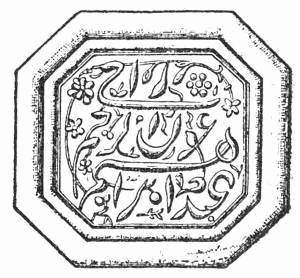
CARNELIAN SEAL, WORN BY NAPOLEON I, NAPOLEON III, AND THE PRINCE IMPERIAL.
This most interesting seal is described by the Rev. C. W. King, the writer on Antique Gems. It is carnelian, octagonal-shaped, and upon it is engraved the legend: “The slave Abraham relying upon the Merciful (God).” Napoleon III wore it on his watch-chain. He said about it: “The First Consul picked it up with his own hands during the campaign in Egypt and always carried it about him, as his nephew did later.” The Prince Imperial received it with the following message: “As regards my son, I desire that he will keep, as a talisman, the Seal which I used to wear attached to my watch.” He carried the seal upon a string fastened about his neck in obedience to the injunction of his father. At the time of his lamentable death it must have been carried off in South Africa by the Zulus, when they stripped his body, and it has never been recovered.
An Armenian writer of the seventeenth century reports that in India the lâl or balas-ruby, if powdered and taken in a potion was believed to banish all dark forebodings and to excite joyous emotions. To the carnelian was attributed a virtue somewhat analogous to that ascribed to the turquoise, as anyone wearing a carnelian was proof against injury from falling houses or walls; the writer emphasizes this by stating that “no man who wore a carnelian was ever found in a collapsed house or beneath a fallen wall.”62
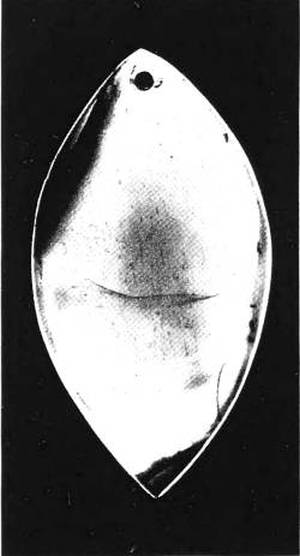
CHALCEDONY VOTIVE CHARM FROM MEXICO. Aztec. Field Museum, Chicago.
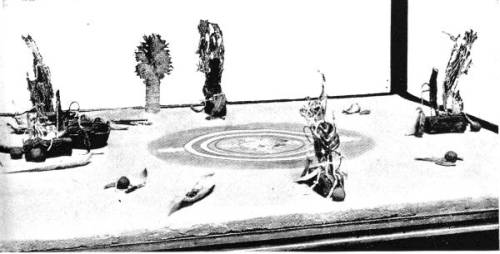
CURIOUS ALTAR OF POWALAWA INDIANS OF ARIZONA. The ceremonial objects are grouped around a crystal of rock-crystal in the centre. (See page 254.)
Chalcedony
An ingenious though far-fetched explanation of the power attributed to chalcedony of driving away phantoms and visions of the night is supplied by Gonelli, writing in 1702. For him the source of this asserted power was to be found in what has been erroneously termed the alkaline quality of the stone. This dissipated the evil humors of the eye, thus removing the diseased condition of that organ which caused the apparitions to be seen.63 However absurd this explanation may be, it nevertheless shows that the author put little faith in visible ghosts, and rightly enough recognized the purely subjective character of such phenomena.
Chrysoberyl
The cat’s-eye variety of chrysoberyl, or precious cat’s-eye, is used by the natives of Ceylon as a charm against evil spirits. As a proof of the high value set upon the gem in India, De Boot states that a cat’s-eye estimated as worth ninety gold pieces in Lusitania was sold for six hundred in India.64 Some of the finest specimens come from Ceylon.
Chrysolite
The “Serpent Isle,” in the Red Sea, was stated by Agatharcides to be the source whence came the topaz (chrysolite); here, by the mandate of the Egyptian kings, the inhabitants collected specimens of this stone and delivered them to the gem-cutters for polishing.65 These simple details are elaborated by Diodorus Siculus into the legend that the island was guarded by jealous watchers who had orders to put to death any unauthorized persons who approached it. Even those who had the right to seek the gem could not see the chrysolite in daytime; only after nightfall was it revealed by its radiance; the seekers then marked well the spot and were able to find the stone on the following day.66
From this Egyptian source, and possibly from others exploited by the Egyptians, have come the finest chrysolites (peridots, or olivines), the most magnificent examples of this gem. These found their way into the cathedral treasures of Europe, evidently by loot or trade at the period of the Crusades, and are generally called emeralds. Those most notable are in the Treasury of the Three Magi, in the great “Dom,” or Cathedral at Cologne. Some of these gems are nearly two inches long.
In our own land beautiful specimens can be seen in the Morgan collection at the American Museum of Natural History and in the Higinbotham Hall in the Field Museum of Natural History, Chicago, Illinois.
Pliny quotes from Juba the tradition that the topaz (chrysolite) derived its name from the Island of Topazos, in the Red Sea, the first specimen having been brought thence by the procurator Philemon, to Berenice, mother of Ptolemy II, Philadelphus. This monarch is said to have had a statue of his wife Arsinoë made from the stone.67 If there be any foundation for this latter statement, the precious gift sent by Philemon must have been a mass of fluorspar, or some similar material. More than three hundred years after Pliny’s time, Epiphanius, evidently repeating another version of this tradition, states that the “topaz” was set in the diadem of the “Theban queen.”
Chrysolite (olivine, peridot), to exert its full power, required to be set in gold; worn in this way it dispelled the vague terrors of the night. If, however, it were to be used as a protection from the wiles of evil spirits, the stone had to be pierced and strung on the hair of an ass and then attached to the left arm.68 The belief in the virtue of the chrysolite to dissolve enchantments and to put evil spirits to flight was probably due to the association of the stone with the sun, before whose life-giving rays darkness and all the powers of darkness were driven away.
Chrysoprase
Wonderful things are told of the virtue of the chrysoprase, for Volmar states that, if a thief sentenced to be hanged or beheaded should place this stone in his mouth, he would immediately escape from his executioners.69 Although we are not informed in what way this fortunate result was attained, it seems likely that the stone was believed to make the thief invisible, and thus possessed a virtue often attributed to the opal.
A strange story regarding a magic stone reputed to have been worn by Alexander the Great is related by Albertus Magnus. According to this recital, Alexander, in his battles, wore a “prase” in his girdle. On his return from his Indian campaign, wishing one day to bathe in the Euphrates, he laid aside his girdle, and a serpent bit off the stone and then dropped it into the river.70 Even Albertus, who is far from critical, admits that the story seems like a fable, and it probably belongs to a comparatively late period. As the term “prase” is used very loosely by early writers, this “victory stone” may have been an emerald or possibly jade.
Coral
The appreciation of coral as an ornament, or for amulets, seems to presuppose a certain development of civilization, for savage tribes greatly prefer glass ornaments. Many attempts have been made to introduce coral beads instead of glass beads among such tribes, but with no success, as the cheaper, but brighter, glass always commands a higher price.71
To still tempests and traverse broad rivers in safety was the privilege of one who bore either red or white coral with him. That this also stanched the flow of blood from a wound, cured madness, and gave wisdom, was said to have been experimentally proved.72
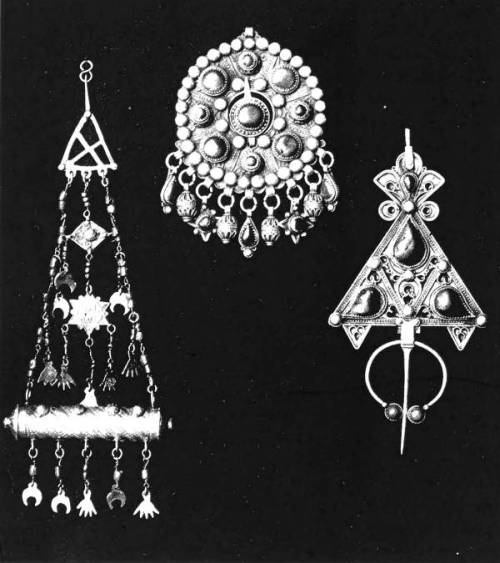
KABYLE JEWELRY. Of Mediterranean coral and pearls. Field Museum, Chicago.
Coral, which, for twenty centuries or more was classed among the precious stones, to retain its power as an amulet, must not have been worked, and in Italy only such pieces are valued for this purpose as have been freshly gathered from the sea or have been cast up by the sea on the shore. To exercise all its power against spells, or enchantments, coral must be worn where its brilliant color makes it conspicuous; if, however, it should by accident be broken, the separate pieces have no virtue, and the magic power ceases, as though the spirit dwelling in the coral had fled from its abode. The peasant women are careful to guard the corals they wear for a special purpose from the eyes of their husbands, for the substance is believed to grow pale at certain seasons, regaining its pristine hue after a short interval of time. Indeed, the women believe that the coral shares their indisposition with them. All this serves to show that a kind of vital force is believed to animate the material, gaining or losing in vigor according to certain conditions, and finally disappearing when the form is broken. These beliefs are all clearly traceable to the animistic ideas of primitive man.73
Diamond
The diamond is to the pearl as the sun is to the moon, and we might well call one the “king-gem” and the other the “queen-gem.” The diamond, like a knight of old,—brilliant and resistant, is the emblem of fearlessness and invincibility; the pearl, like a lady of old,—pure and fair to look upon, is the emblem of modesty and purity. Therefore it does not seem unfitting that the diamond should be presented as a token to the pearl, and that pearls should go with the diamond. The virtues ascribed to this stone are almost all directly traceable either to its unconquerable hardness or to its transparency and purity. It was therefore thought to bring victory to the wearer, by endowing him with superior strength, fortitude, and courage. Marbodus74 tells us it was a magic stone of great power and served to drive away nocturnal spectres; for this purpose it should be set in gold and worn on the left arm. For St. Hildegard the sovereign virtue of the diamond was recognized by the devil, who was a great enemy of this stone because it resisted his power by day and by night.75 Rueus76 calls it “a gem of reconciliation,” as it enhanced the love of a husband for his wife.
Cardano77 takes a more pessimistic view of the qualities of the diamond. He says:
It is believed to make the wearer unhappy; its effects therefore are the same upon the mind as that of the sun upon the eye, for the latter rather dims than strengthens the sight. It indeed renders fearless, but there is nothing that contributes more to our safety than prudence and fear; therefore it is better to fear.
The diamond was often associated with the lightning and was sometimes believed to owe its origin to the thunderbolt, but we do not recall having seen elsewhere the statement made in an anonymous Italian manuscript of the fourteenth century. Here it is expressly asserted that the diamond is sometimes consumed or melted when it thunders.78 Certainly, that the same force that was supposed to have formed the stone should be able to dissolve it, is not an illogical idea. That the diamond can be entirely consumed at a high temperature was a fact not known in Europe in the fourteenth century, and therefore the belief in the destructive effect of the electric current must have arisen from superstitious or poetic fancies, and not from any vague conception of the true nature of the diamond.
In the Talmud we read of a gem, supposed to have been the diamond, which was worn by the high priest.79 This stone served to show the guilt or innocence of one accused of any crime; if the accused were guilty, the stone would grow dim, but if he were innocent, it would shine more brilliantly than ever. This quality is also alluded to by Sir John Mandeville, who wrote:
It happens often that the good diamond loses its virtue by sin and for incontinence of him who bears it.
The Hindus classed diamonds according to the four castes. The Brahmin diamond gave power, friends, riches and good luck; the Kshatriya diamond prevented the approach of old age; the Vaisya stone brought success, and the Sudra, all manner of good fortune. On the other hand, in the treatise on gems by Buddhabhatta80 we read:
A diamond, a part of which is the color of blood or spotted with red, would quickly bring death to the wearer, even if he were the Master of Death.
The Arabians and Persians, as well as the modern Egyptians, agree in attributing to the diamond a wonderful power to bring good fortune, and Rabbi Benoni, a mystic of the fourteenth century, treating of its magic virtues, asserts that it produces somnambulism, and, as a talisman, so powerfully attracts the planetary influences that it renders the wearer invincible; it was also said to provoke a state of spiritual ecstasy. An alchemist of the same century, Pierre de Boniface, asserted that the diamond made the wearer invisible.
A curious fancy, prevalent in regard to many stones, attributed sex to the diamond, and it is therefore not surprising that these stones were also supposed to possess reproductive powers. In this connection Sir John Mandeville wrote:
They grow together, male and female, and are nourished by the dew of heaven; and they engender commonly, and bring forth small children that multiply and grow all the year. I have oftentimes tried the experiment that if a man keep them with a little of the rock, and water them with May dew often, they shall grow every year and the small will grow great.
The following lines from a translation of the celebrated Orphic poem, written in the second century, show the high esteem in which the adamas was held at that time:
The Evil Eye shall have no power to harm Him that shall wear the diamond as a charm, No monarch shall attempt to thwart his will, And e’en the gods his wishes shall fulfil.
This probably refers either to colorless corundum, the so-called “white sapphire,” or to quartz. The writer is disinclined to believe that the ancients knew the diamond.
The ancient Hindu gem-treatise of Buddhabhatta asserts that the diamond of the Brahmin should have the whiteness of a shell or of rock-crystal; that of the Kshatriya, the brown color of the eye of a hare; that of the Vaisya, the lovely shade of a petal of the kadali flower; that of the Sudra, the sheen of a polished blade. To kings alone the sages assigned two classes of colored diamonds,—namely, those red as coral and those yellow as saffron. These were exclusively royal gems, but diamonds of all other shades could be set in royal jewels.81
A typical diamond is thus described in a Hindu gem-treatise:82
A six-pointed diamond, pure, without stain, with pronounced and sharp edges, of a beautiful shade, light, with well-formed facets, without defects, illuminating space with its fire and with the reflection of the rainbow, a diamond of this kind is not easy to find in the earth.
According to a wide-spread superstition, the talismanic power of a diamond was lost if the stone were acquired by purchase; only when received as a gift could its virtues be depended on.83 The same belief is noted regarding the turquoise. The spirit dwelling in the stone was thought to take offence at the idea of being bought and sold, and was supposed to depart from the stone, leaving it nothing more than a bit of senseless matter. If, however, the diamond (or turquoise) were offered as a pledge of love or friendship, the spirit was quite willing to transfer its good offices from one owner to another.
The Talmud shows us that the Jewish Rabbis sometimes endeavored to enliven their exhaustive discussions of ritual and legal questions by telling “good stories” to each other. One of these may be given as illustrating at once the wild improbability of some of these recitals and the belief in the wonderful magic virtues of the diamond:84
R. Jehudah of Mesopatamia used to tell: Once while on board of a ship, I saw a diamond that was encircled by a snake, and a diver went to catch it. The snake then opened its mouth, threatening to swallow the ship. Then a raven came, bit off its head, and all water around turned into blood. Then another snake came, took the diamond, put it in the carcass, and it became alive; and again it opened its mouth, in order to swallow the ship. Another bird then came, bit off its head, took the diamond and threw it on the ship. We had with us salted birds, and we wanted to try whether the diamond would bring them to life, so we placed the gem on them, and they became animated and flew away with the gem.
It is said that the first large diamonds discovered by Europeans in South Africa were found in the leather bag of a sorcerer. Although large stones or fragments of rock are usually the objects of adoration as fetiches in Africa, any small stone that is wrapped in colored rags and worn on the neck may be regarded in the same way.85 Several competent authorities state that these diamonds were the playthings of some Boer children.
Al Kazwini relates as follows the marvellous tale of the Valley of Diamonds:86
“Aristotle87 says that no one except Alexander ever reached the place where the diamond is produced. This is a valley, connected with the land Hind. The glance cannot penetrate to its greatest depths and serpents are found there, the like of which no man hath seen, and upon which no man can gaze without dying. However, this power endures only as long as the serpents live, for when they die the power leaves them. In this place summer reigns for six months and winter for the same length of time. Now, Alexander ordered that an iron mirror should be brought and placed at the spot where the serpents dwelt. When the serpents approached, their glance fell upon their own image in the mirror, and this caused their death. Hereupon, Alexander wished to bring out the diamonds from the valley, but no one was willing to undertake the descent. Alexander therefore sought counsel of the wise men, and they told him to throw down a piece of flesh into the valley. This he did, the diamonds became attached to the flesh, and the birds of the air seized the flesh and bore it up out of the valley. Then Alexander ordered his people to pursue the birds and to pick up what fell from the flesh.”
“Another writer states that the mines are in the mountains of Serendib (Ceylon) in a very deep gorge, in which are deadly serpents. When people wish to take out the diamonds they throw down pieces of flesh, which are seized by vultures and brought up to the brink of the gorge. There such of the diamonds as cling to the flesh are secured; these are of the size of a lentil or a pea. The largest pieces found attain the size of a half-bean.”
In his version of the tale, one form of which appears in the seventh voyage of Sindbad the Sailor, Teifashi states that the finest corundum gems were washed down the streams that flowed from Adam’s Peak, on the island of Ceylon; in time of drought, however, this source of supply ceased. Now it happened that many eagles built their nests on the top of this mountain, and the gem-seekers used to place large pieces of flesh at the foot of the mountain. The eagles pounced upon these and bore them away to their nests, but were obliged to alight from time to time in order to rest, and while the pieces of flesh lay on the rock, some of the corundums became lightly attached to this, so that when the eagles resumed their flight the stones dropped off and rolled down the mountain side.88
These oft-repeated tales are explained by Dr. Valentine Ball as originating in the Hindu custom of sacrificing cattle when new mines were opened, and leaving on the spot a certain part of the meat as an offering to the guardian deities. As these pieces of meat were soon carried away by birds of prey, the legend arose that the diamonds were obtained in this way. This custom still prevailed in some parts of India when Dr. Ball wrote.89
The effect exercised by Hindu superstition on even the most enlightened Europeans of our day may be recognized in the fact that the gifted prima donna, Mme. Maeterlinck, the wife of the foremost living European poet, has confessed that she wears a diamond suspended on her forehead because her husband believes that this brings good fortune to the wearer. This forehead-jewel is characteristically Hindu and enjoys in India the reputation of being especially auspicious.
Emerald
The emerald was believed to foreshow future events,90 but we do not learn whether visions were actually seen in the stone, as they were in spheres of rock-crystal or beryl, or whether the emerald endowed the wearer with a supernatural fore-knowledge of what was to come. As a revealer of truth, this stone was an enemy of all enchantments and conjurations; hence it was greatly favored by magicians, who found all their arts of no avail if an emerald were in their vicinity when they began to weave their spells.91
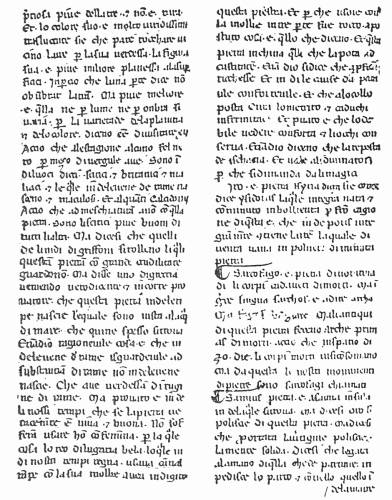
SPECIMEN PAGE OF ITALIAN MANUSCRIPT OF THE FOURTEENTH CENTURY.
Containing an Italian version of the “De Mineralibus” of Albertus Magnus. On this page is the account of the emerald, set in a ring worn by King Bela IV of Hungary (1235-1270), that was fractured when he caressed his wife. Author’s library.
A larger image is available here.
To this supernatural power inherent in the stone, enabling it to quicken the prophetic faculty, may be added many other virtues. If any one wished to strengthen his memory or to become an eloquent speaker, he was sure to attain his end by securing possession of a fine emerald.92 And not only the ambitious, but also those whose hearts had been smitten by the shafts from Cupid’s bow found in this stone an invaluable auxiliary, for it revealed the truth or falsity of lover’s oaths. Strange to say, however, the emerald, although commonly assigned to Venus, was often regarded as an enemy of sexual passion. So sensitive was the stone believed to be in this respect that Albertus Magnus relates of King Bela of Hungary, who possessed an exceptionally valuable emerald set in a ring, that, when he embraced his wife while wearing this ring on his finger, the stone broke into three parts.93
In Rabbinical legend it is related that four precious stones were given by God to King Solomon; one of these was the emerald. The possession of the four stones is said to have endowed the wise king with power over all creation.94 As these four stones probably typified the four cardinal points, and were very likely of red, blue, yellow, and green color respectively, we might conjecture that the other three stones were the carbuncle, the lapis-lazuli, and the topaz.
After stating that the emerald sharpens the wits and quickens the intelligence, Cardano declares that it therefore made people more honest, for “dishonesty is nothing but ignorance, stupidity, and ill-nature.” The same writer adds that the stone was believed to make men economical and hence to make them rich, but of this he was very sceptical, since the experience of others as well as his own showed that the emerald possessed very little power in this direction.95
A talismanic emerald, once the property of the Mogul emperors of Delhi, has recently been shown in Europe. The stone is of a rich deep green, and weighs 78 carats. Around the edge in Persian characters runs the inscription: “He who possesses this charm shall enjoy the special protection of God.”
Emerald sharpened the wits, conferred riches and the power to predict future events. To evolve this latter virtue it must be put under the tongue. It also strengthened the memory. The light-colored stones were esteemed the best and legend told that they were brought from the “nests of griffons.”96
Gypsum
Gypsum when fibrous—the fibres being long and straight—is known as “satin spar.” This material is frequently cut rounded, or en cabochon, across the fibres; sometimes it is cut in the form of beads, or of pear-shaped drops, which are mounted in ear-rings, scarf-pins, or necklaces. The material is frequently found in Russia, England, and elsewhere, and is cut in England or Russia. Some of the cut stones are mounted in brass, or gilded brass, and sold as luck stones at Niagara, the claim being made that the “satin spar” was taken from beneath the Falls at great peril, as occasionally small deposits of this kind of gypsum are found under the Falls.
From time to time small consignments of this material have been sent to Japan, as the Japanese value it possibly on account of its purity, or owing to the fact that it has the effect of the cat’s-eye. It is quite cheap, and at the same time very soft, so that it can be scratched with the finger-nail. That found in Russia is of a golden-yellow or salmon color, and is worked into various ornaments, the one popular form being egg-shaped, and, because of their form, such objects are frequently given as Easter gifts. The same material is also known in Egypt, and is cut in the same egg form, the ornaments being called “Pharaoh’s eggs,” although just which Pharaoh this refers to is not stated. They are also believed to possess qualities of protection and to bring good fortune.
Hematite
The virtues of the hematite were praised in an ancient gem-treatise written by Azchalias of Babylon for Mithridates the Great, King of Pontus (d. 63 B.C.), a sovereign who was passionately fond of precious stones, and possessed a splendid collection of them, both engraved and unengraved. Azchalias, as cited by Pliny97 taught that human destinies were influenced by the virtues inherent in precious stones, and asserted that the hematite, when used as a talisman, procured for the wearer a favorable hearing of petitions addressed to kings and a fortunate issue of lawsuits and judgments. It is a red oxide of iron, which when abraded shows a red streak; whence the name hematite, from the Greek haima, “blood.” As an iron ore and hence associated with Mars, the god of war, this substance was also considered to be an invaluable help to the warrior on the field of battle if he rubbed his body with it. Probably, like the loadstone, it was believed to confer invulnerability.
The high degree of skill possessed by the Pueblo workers is strikingly shown in a finely inlaid hematite cylinder found in Pueblo Bonito. The inlays are of turquoise and are designed to make the cylinder a conventional representation of a bird. The wings are indicated by turquoise inlays of pyramidal outline, curved so as to follow the curvature of the cylinder, the head being figured by a conical piece of turquoise attached to one end. This conical termination bore a small bird-figure carved in relief.98 When we consider the difficulties the Indian workers had to overcome in the execution of this artistic task with the tools at their command, we can well realize that this object, probably an amulet, must have been considered very valuable, and was most likely the property of some one of high rank in the tribe or community.
Jacinth
The jacinth was more especially recommended as an amulet for travellers, because of its reputed value as a protection against the plague and against wounds and injuries, the two classes of perils most feared by those who undertook long journeys. Moreover, this stone assured the wearer a cordial reception at any hostelry he visited.99 It was said to lose its brilliancy and grow pale and dull if the wearer or any one in his immediate neighborhood became ill of the plague. In addition to these qualities the jacinth augmented the riches of the owner, and endowed him with prudence in the conduct of his affairs.100
St. Hildegard, the Abbess of Bingen (d. 1179), gives the following details as to the proper use of the jachant (jacinth):101
If any one is bewitched by phantoms or by magical spells, so that he has lost his wits, take a hot loaf of pure wheaten bread and cut the upper crust in the form of a cross,—not, however, cutting it quite through,—and then pass the stone along the cutting, reciting these words: “May God, who cast away all precious stones from the devil ... cast away from thee, N., all phantoms and all magic spells, and free thee from the pain of this madness.”
The patient is then to eat of the bread; if, however, his stomach should be too feeble, unleavened bread may be used. All other solid food given to the sick person should be treated in the same manner. We are also told that if any one has a pain in his heart, the pain will be relieved provided the sign of the cross be made over the heart while the above mentioned words are recited.
The wearer of a jacinth was believed to be proof against the lightning, and it was even asserted that wax that had been impressed by an image graven on this stone averted the lightning from one who bore the seal. That the stone really possessed this power was a matter of common report, it being confidently declared that in regions where many were struck by lightning, none who wore a jacinth were ever harmed. By a like miracle it preserved the wearer from all danger of pestilence even though he lived in an air charged with the disease. A third virtue was to induce sleep. Of this, Cardano states that he was in the habit of wearing rather a large jacinth, and had found that the stone “seemed to dispose somewhat to sleep, but not much.” He adds, in explanation of its slight efficacy, that his stone was not bright red, nor of the best sort, but of a golden hue, differing much from the best.102
Jade
The name jade includes two distinct minerals, nephrite and jadeite. The former is a silicate of magnesia, of exceedingly tough structure, and ranks 6.5 in the scale of hardness, while jadeite, a silicate of alumina, is more crystalline and not as tough as nephrite and has a hardness of 7. A variety having a rich emerald-green hue is called by the Chinese fei ts’ui, “Kingfisher plumes”; it is also denominated Imperial jade.
The original form of the Chinese character pao, signifying “precious,” consists of the outline of a house, within which are the symbols of jade beads, shell, and an earthen jar. This shows that at the very early time when these characters were first used, the Chinese already collected jade and employed it for personal adornment.103 The oldest form of the ideograph for “king”, , appears to be the symbol for a string of jade beads, which are even now used in China as insignia for high rank and authority.104

Jade amulets of many different forms are popular with the Chinese. One representing two men is called “Two Brothers of Heavenly Love,” and is often given to friends. A phœnix of jade is a favorite ornament for young girls and is bestowed upon them when they come of age. To a newly-wedded pair is given the figure of a man riding on a unicorn and holding castanets in his hand; this signifies that an heir will be born in due time.
Such is the fondness of the Chinese for jade that those who can afford the luxury of its possession are wont to carry with them small pieces, so that they may have them always at hand; for they believe that, when handled, something of the secret virtue of the substance is absorbed into the body. When struck, jade is thought to emit a peculiarly melodious sound, which for the Chinese poet resembles the voice of the loved one; indeed, jade is termed the concentrated essence of love.
Fashioned into the form of a butterfly, a piece of jade acquires a special romantic significance in China, because of a Chinese legend which relates that a youth in his eager pursuit of a many-hued butterfly made his way into the garden of a rich mandarin. Instead of being punished for his trespass, the youth’s unceremonious visit led to his marriage with the mandarin’s daughter. Hence the figure of a butterfly is a symbol of successful love, and Chinese bridegrooms are wont to present jade butterflies to their fiancées.
A Chinese jade ornament constituting a child’s amulet assumes a form approximating to that of a padlock. When this is attached to a child’s neck, it is supposed to bind the little one to life and protect it from all danger in infantile diseases. A jade object of a different kind is sometimes used at nuptial feasts in China. This is a cup having the form of a cock, and both bride and groom drink from it. The form of this vessel is accounted for by a legend to the effect that when a beautiful white cock saw its young mistress, who had often petted it, throw herself into a well in a transport of despair at the loss of her lover, the faithful fowl sought and found death in the same way, so as not to be separated from its mistress.
Among the splendid Chinese jade carvings of the Woodward Collection is a curious symbolic ornament carved out of the rare fei-ts’ui yü, or “kingfisher-green jade,” a rich emerald green jadeite with translucent green shading. This ornament, executed in the beginning of the eighteenth century and believed to be a product of the Imperial Jade Works in Peking, figures the natural form of a so-called “hand-of-Buddha” citron, the finger-like protuberances of the fruit suggesting this strangely fanciful name. The Chinese regard this as a most felicitous emblem, denoting at once a long life and abundance of riches for its enjoyment. In the present carving the figure of a bat clinging to the foliage enveloping the fruit constitutes an added omen of good fortune, the Chinese character fu signifying at once “bat” and “happiness,” another proof of what we are prone to call Chinese queerness, for with the superstitious of our race the bat is always looked upon as especially ill-omened.105
It is a well-known fact that many analogies have been found between the customs, usages, and products of the more civilized aborigines of the New World and those of the ancient Egyptians. Another instance is offered by the custom of placing a piece of chalchihuitl (jade?) or of some other green stone in the mouth of a noble, after his death, and calling this his heart. Among the lower classes a texaxoctli, a stone of small value, was used for the same purpose. We shall see that, in the Egyptian “Book of the Dead,” directions are given for putting a semi-precious stone on or in a mummy, as a symbol, and designating this the heart of the deceased person. For the use of a green stone for this purpose by the ancient Mexicans, Mrs. Zelia Nuttall finds a reason in the two meanings of the Nahuatl word xoxouhqui-yollotl, which is used to signify a “free man,” the literal meaning being a “fresh or green heart.” Hence, the stone was a symbol of the rank of the deceased as well as of his heart.106 The fact that jade celts have been found cut into several pieces is taken to indicate the high value placed upon this material; for it has been conjectured by Dr. Earle Flint, that a living chief would cut a piece from the jade he wore as a sign of his rank, in order to provide a suitable ornament or amulet for a dead kinsman.
To certain of the Chinese “tomb-jades”—that is, jade amulets deposited with the dead—has been given the name han-yü, or “mouth-jade,” because these amulets, supposed to afford protection to the dead, were placed in their mouths. The Metropolitan Museum of Art in New York contains a fine collection of 279 specimens of jade from Chinese tombs, found within the past five or six years, and presented to the museum by Mr. Samuel F. Peters. In color these jades are not especially attractive, for the material has acquired a brownish stain, due to the products of decomposition of the body, and also to the absorption of some of the chemical constituents of the other objects in the tomb, during the long period of time, in many cases a thousand years or more, since the bodies were consigned to their final resting place.
So multifarious are the uses to which jade is put by the Chinese, and so great is their admiration of its qualities, that they regard it as the musical gem par excellence. A series of oblong pieces of jade, of the same length and width, usually about 1.8 feet long and 1.35 feet wide, and numbering from 12 to 24, constitute a chime, the difference in the notes emitted by the material when sharply struck depending upon the varying thickness of the separate pieces. What is designated the “stone chime” used in court and religious ceremonials, is composed of 16 undecorated stones, while a series known as the singers’ chime consists of from 12 to 24 pieces carved into fantastic shapes. This use of jade for the production of musical sounds dates far back in the Chinese annals. We are told that when Confucius was much troubled at the ill-success of his efforts to reform the Chinese morals of his day, he sought consolation in playing on the “musical stone.” A peasant who noted this in passing by, exclaimed, as he heard the sounds: “Full indeed is the heart of him who beats the musical stone like that!”107
A jade ornament greatly favored by the Maoris of New Zealand bore the name hei-tiki (“a carved image for the neck”). The ornaments of this class are very rude and grotesque representations of the human face or form, and were generally regarded as schematically figuring some departed ancestor. The head sometimes slanted right or left, so that the eyes, which were very large and occasionally inlaid with mother-of-pearl, were on an angle of forty-five degrees. These ornaments were prized not only as memorials, but because, having been worn by successive ancestors, they were supposed to communicate something of the very being of those ancestors to such descendants as were privileged to wear the treasured heirloom in their turn. In many cases, when the family was dying out, the last male member would leave directions that his hei-tiki should be buried with him, so that it might not fall into the hands of strangers.108
So rare was this New Zealand jade, known to the Maoris as punamu (green-stone), that the aid of a tohunga, or wizard, was regarded as necessary to learn where it could be found. On setting forth on a search for this material, the jade-seekers would take with them a tohunga, and when the party reached the region where jade was usually found the tohunga would retire to some solitary spot and would fall into a trance. On awaking he would claim that the spirit of some person, dead or living, had appeared to him and had directed to search in a particular place for the jade. He would then conduct the party to this place, where a larger or smaller piece of jade was invariably found. Of course the wizard had previously assured himself of the presence of the stone in the place indicated.
To this jade was given the name of the man whose spirit had revealed its location, and in many cases the grotesque form given to the stone was conceived to represent this man. We can easily understand the reverence accorded to the hei-tikis when we consider that they were not only prized as heirlooms, which had been handed down by the successive heads of the family, but were also believed to have been originally found in such a mysterious way.
When the head of the family died, his hei-tiki was generally buried with his body, but was exhumed after a shorter or longer time by the nearest male relative. As we have noted, if no representative of the family remained, the heirloom was allowed to remain in the grave. The fact that tribal or intertribal feuds sometimes arose in regard to the possession of a hei-tiki serves to prove the peculiar virtues ascribed to them.
While there can be little doubt that the heirloom was supposed to represent, in a very general way, the person whose name it bore, the particular form given it was largely determined by the natural shape of the mass, which was slowly and patiently fashioned into the form it eventually acquired. Though this was mainly due to the imperfect means of which the artist disposed, there was probably a conviction that the form of the natural stone was not the result of accident, but was in itself significant and required only to be rendered more clear and definite. The fabrication of the hei-tikis of the Maoris is said to have ceased in the early part of the last century. The greater number of those that have been collected in New Zealand appear to have been made from one hundred to one hundred and fifty years ago.109
Jasper
The jasper had great repute in ancient times as a rain-bringer, and the fourth century author of “Lithica” celebrates this quality in the following lines:110
The gods propitious hearken to his prayers, Whoe’er the polished grass-green jasper wears; His parched glebe they’ll satiate with rain, And send for showers to soak the thirsty plain.
Evidently the green hue of this translucent stone suggested its association with the verdure of the fields in an even closer degree than was the case with transparent green stones such as the emerald, etc. Another early authority, Damigeron, mentions this belief, and states that only when properly consecrated would the jasper do service in this way.111 Jasper was also credited in the fourth century with the virtue of driving away evil spirits and protecting those who wore it from the bites of venomous creatures.112 An anonymous German author of the eleventh or twelfth century recommends the use of this stone for the cure of snake bites, and states that if it be placed upon the bitten part the matter will come out from the wound.113 Here the cure is operated, not by the absorbent quality of the stone, but by its supposed power to attract poison or venom to itself, thus removing the cause of disease.
A popular etymology of the Greek and Latin name for jasper is reported by Bartolomæus Anglicus, who writes that “in the head of an adder that hyght Aspis is founde a lytyl stone that is called Jaspis.” The same authority pronounces this stone to be of “wunder vertue,” and says that “it hath as many vertues as dyvers coloures and veines.”114 This is fully in accord with tradition, for, as color was at least as important as chemical composition in determining the talismanic or therapeutic worth of the different stones, the great variety of colors and markings in the different jaspers naturally indicated their use in many different ways.
Jet
Jet has been found among the palæolithic remains in the caves of the “Kesslerloch,” near Thayngen, Canton Schaffhausen, Switzerland. The material was evidently derived from the deposits in Würtemberg and was shaped by flint chips. Quite possibly jet, as well as amber, was already regarded as possessing a certain talismanic virtue. Such ornaments, when worn, were believed to become a part of the very body and soul of the wearer, and were therefore to be guarded with jealous care.115 In the palæolithic cave-deposits of Belgium also, jet appears, the supply being in this instance derived from northern Lorraine. The fragments had been rounded and pierced through the centre.116 This indicates their use as parts of a necklace or as pendants. Necklaces, bracelets, and rings were especially favored for the wearing of talismanic gems, since the stones could easily be so set that they would come in direct contact with the skin.
Jet was one of the materials used by the Pueblo Indians for their amulets. An exceptionally well-executed figure of a frog made of this material was found in Pueblo Bonito, in 1896, by Mr. Pepper. The representation is much more realistic than is the case in the other figures of this type from this region. Turquoise eyes have been inserted in the head of the figure and a band of turquoise surrounds the neck.117
Lapis-Lazuli
Both in Babylonia and in Egypt, lapis-lazuli was very highly valued, and this is shown by the use of its Assyrian name (uknu) in poetic metaphor. Thus, in a hymn to the moon-god Sin, he is addressed as the “strong bull, great of horns, perfect in form, with long flowing beard, bright as lapis-lazuli.”118 This may remind us of the “hyacinthine locks” of classical literature.
Lapis-lazuli, “a blue stone with little golden spots,” was a cure for melancholy and for the “quartern fever,” an intermittent fever returning each third day, or each fourth day counting in the previous attack.119
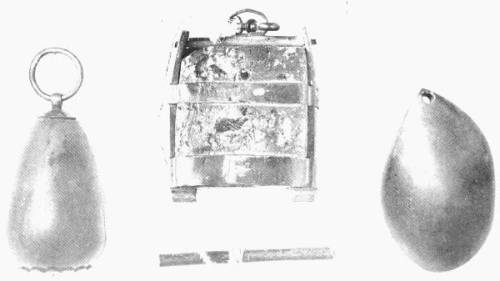
JASPER PENDANT. PIECE OF NATURAL LOADSTONE. ARAGONITE PENDANT.
Aztec Mexican. Used to stanch blood. Used in sixteenth century for medicinal purposes. Used for votive purposes in Armenia. Field Museum, Chicago.
Loadstone
We have the authority of Plato (Ion, 533 D) for the statement that the word magnetis was first applied to the loadstone by the tragic poet Euripides (480-405 B.C.), the more usual name being “the Heraclean stone.” These designations refer to two places in Lydia, Magnesia and Herakleia, where the mineral was found.120 Pliny states, on the authority of Nicander, that a certain Magnes, a shepherd, discovered the mineral on Mount Ida, while pasturing his flock, because the nails of his shoes clung to a piece of it.121
We are told by Pliny that Ptolemy Philadelphus (309-247 B.C.), planning to erect a temple in honor of his sister and wife Arsinoë, called in the aid of Chirocrates, an Alexandrian architect. The latter engaged to place therein an iron statue of Arsinoë which should appear to hang in mid-air without support. However, both the Egyptian king and his architect died before the design could be realized.122 This story of an image held in suspense by means of powerful magnets set in the floor and roof, and sometimes also in the walls of a temple, is repeated in a variety of forms by early writers. Of course, there was no real foundation for such tales, as the thing is altogether impracticable.
The Roman poet Claudian (fifth century A.D.) relates that the priests of a certain temple, in order to offer a dramatic spectacle to the eyes of the worshippers, caused two statues to be executed,—one of Mars in iron, and another of Venus in loadstone. At a special festival these statues were placed near to each other, and the loadstone drew the iron to itself. Claudian vividly describes this:
The priests prepare a marriage feast. Behold a marvel! Instant to her arms Her eager husband Cythereia charms; And ever mindful of her ancient fires, With amorous breath his martial breast inspires; Lifts the loved weight, close round his helmet twines Her loving arms, and close embraces joins, Drawn by the mystic influence from afar. Flies to the wedded gem the God of War. The Magnet weds the Steel: the sacred rites Nature attends, and th’ heavenly pair unites.123
There was current as early as the fourth century a curious belief that a piece of loadstone, if placed beneath the pillow of a sleeping wife, would act as a touchstone of her virtue. This first appears in the Alexandrian poem “Lithica,” and it has been thus quaintly Englished by a fourteenth century translator:
Also magnes is in lyke wyse as adamas; yf it be sett under the heed of a chaste wyfe, it makyth her sodenly to beclyppe [embrace] her husbonde; & yf she be a spowse breker, she shall meve her oute of the bed sodenly by drede of fantasy.124
The same writer attempts an explanation of the popular fancy that when powdered loadstone was thrown upon coals in the four corners of a house, the inmates would feel as though the house were falling down; of this he says: “That seemynge is by mevynge [moving] that comyth by tornynge of the brayn.”125
In classical writings the fascination exercised by a very beautiful woman is sometimes likened to the attractive power of the loadstone, as notably by Lucian,126 who says that if such a woman looks at a man she draws him to her, and leads him whither she will, just as the loadstone draws the iron. To the same idea is probably due the fact that in several languages the name given to the loadstone indicates that its peculiar power was conceived to be a manifestation of the sympathy or love of one mineral substance for another. This is commonly believed to be the sense in which we should understand the French designation aimant, namely, as the participle of the verb aimer, “to love”; however, some etymologists prefer to derive the word from adamas, sometimes used in Low Latin for the loadstone, although properly signifying the diamond. It is certainly worthy of note that in two such dissimilar languages as Sanskrit and Chinese, the influence of this idea appears in the names given to the loadstone. In Sanskrit the word is chumbaka or “the kisser,” and in Chinese t’ su shi, or “the loving-stone.” Chin T’sang Khi, a Chinese author of the eighth century, wrote that “the loadstone attracts iron just as does a tender mother when she calls her children to her.”127
A rich growth of Mohammedan legends grew up about the exploits of Alexander the Great, a striking example being given on another page, and in one of them it is related that the Greek world-conqueror provided his soldiers with loadstones as a defence against the wiles of the jinns, or evil spirits; the loadstone, as well as magnetized iron, being regarded as a sure defence against enchantments and all the machinations of malignant spirits.128
In the East Indies it is said that a king should have a seat of loadstone at his coronation; probably because the magnetic influence of the stone was supposed to attract power, favor, and gifts to the sovereign. But it is not only in the Orient that magnetite is prized for its talismanic powers, for even in some parts of our own land this belief is still prevalent. Large quantities of loadstone are found at Magnet Cove, Arkansas, and it is estimated that from one to three tons are sold annually to the negroes to be used in the Voodoo ceremonies as conjuring stones. The material has been found in land used for farming purposes, and many pieces have been turned up in ploughing for corn; these vary from the size of a pea to masses weighing from ten to twenty pounds. They occur in a reddish-brown, sticky soil; their surface is smooth and brown and they have the appearance of water-worn pebbles. In July, 1887, an interesting case was tried in Macon, Georgia, where a negro woman sued a conjuror to recover five dollars which she had paid him for a piece of loadstone to serve as a charm to bring back her wandering husband. As the market value of this mineral was only seventy-five cents a pound, and the piece was very small, weighing but a few ounces, the judge ordered that the money should be refunded.129
Malachite
For some reason not easy to fathom, malachite was considered to be a talisman peculiarly appropriate for children. If a piece of this stone were attached to an infant’s cradle, all evil spirits were held aloof and the child slept soundly and peacefully.130 In some parts of Germany, malachite shared with turquoise the repute of protecting the wearer from danger in falling, and it also gave warning of approaching disaster by breaking into several pieces.131 This material was well known to the ancient Egyptians, malachite mines having been worked between Suez and Sinai as early as 4000 B.C.
The appropriate design to be engraved upon malachite was the image of the sun. Such a gem became a powerful talisman and protected the wearer from enchantments, from evil spirits, and from the attacks of venomous creatures.132 The sun, as the source of all light, was generally regarded as the deadly enemy of necromancers, witches, and demons, who delighted in the darkness and feared nothing more than the bright light of day.
Moonstone
The moonstone is believed to bring good fortune and is regarded as a sacred stone in India. It is never displayed for sale there, except on a yellow cloth, as yellow is an especially sacred color. As a gift for lovers the moonstone takes a high rank, for it is believed to arouse the tender passion, and to give lovers the power to read in the future the fortune, good or ill, that is in store for them. To gain this knowledge, however, the stone must be placed in the mouth while the moon is full.133
Antoine Mizauld134 tells us of a selenite or moonstone owned by a friend of his, a great traveller. This stone, about the size of the gold piece known as the gold noble, but somewhat thicker, indicated the waxing and waning of the moon by a certain white point or mark which grew larger or smaller as did the moon. Mizauld relates that to convince himself of the truth of this he obtained possession of the stone for one lunar month, during which time he sedulously observed it. The white mark first appeared at the top. It was like a small millet-seed, increasing in size and moving down on the stone, always assuming the form of the moon until, on reaching the middle, it was round like the full moon; then the mark gradually passed up again as the moon diminished. The owner declared that he had “vowed and dedicated this stone to the young king [Edward VI], who was then highly esteemed because he had good judgment in regard to rare and precious things.”
Onyx
The onyx, if worn on the neck, was said to cool the ardors of love, and Cardano relates that everywhere in India the stone was worn for this purpose.135 This belief is closely related to the idea commonly associated with the onyx,—namely, that it provoked discord and separated lovers. The close union and yet the strange contrast between the layers of black and white may have suggested this.
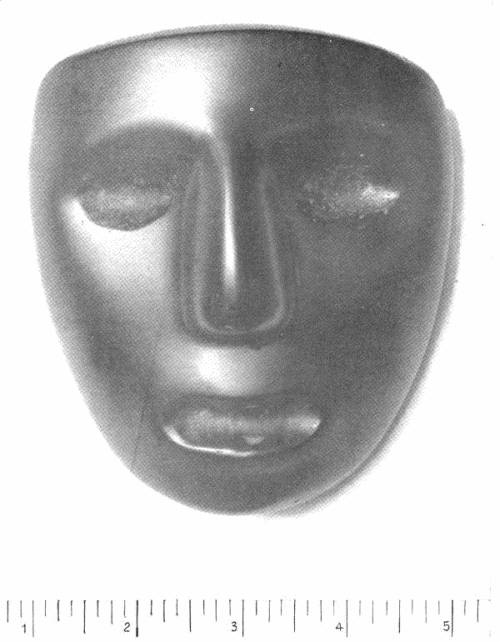
OBSIDIAN MASK, FROM THE FAYOUM, EGYPT. Twelfth Dynasty. Late De Lesseps Collection. Collection of Mrs. Henry Draper. The obsidian is the typical stone of Mexico.
Pyrites
Crystals of iron pyrites (pyrite, native iron disulphide) are sometimes used as amulets by the North American Indians, and the belief in their magic power is attested by their presence in the outfit of miscellaneous objects which the medicine-men use in the course of their incantations. Because these gleaming yellow crystals are occasionally mistaken for gold, the name “fool’s gold” has been popularly bestowed upon them.136
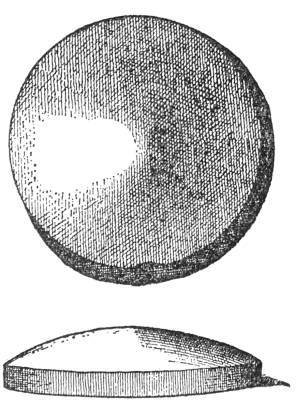
OBSIDIAN MIRROR, FROM OAXACA, MEXICO. NOW IN TROCADÉRO MUSEUM, PARIS.
See “Gems and Precious Stones of North America,” by George Frederick Kunz, New York, 1890, p. 299.
Of this material the ancient Mexicans made wonderful mirrors, one side being usually polished flat, while the other side was strongly convex. Frequently this side was curiously carved with some symbolic representation as appears in the case of a pyrite mirror of the Pinard collection in the Trocadéro, Paris.137
Rock-crystal
The popular belief in his time as to the origin of rock-crystal is voiced by St. Jerome, when, using the words of Pliny, although not citing his authority, he says that it was formed by the congelation of water in dark caverns of the mountains, where the temperature was intensely cold, so that, “While a stone to the touch, it seems like water to the eye.” This belief was evidently due to the fact that rock-crystal was so often found in mountain clefts and caverns. Symbolically, it signified that those within the portals of the Church should keep themselves free from stain and have a pure faith.138
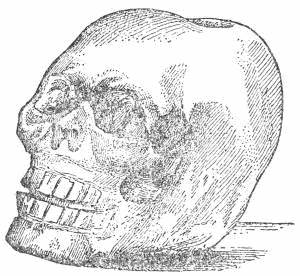
ROCK-CRYSTAL SKULL, ANCIENT MEXICAN Weighing 475¼ oz. Troy. Now in the British Museum, London. From “Gems and Precious Stones of North America,” by George Frederick Kunz, New York, 1890, p. 285.
The Chinese emperor Wu was devoted to the service of the gods and of the immortal spirits. He built many edifices for religious purposes, and all the doors of these buildings were made of white rock-crystal, so that a flood of light poured into the interior. Although the Chinese texts call this material rock-crystal, it is possible that the name was applied to glass when that substance was but recently introduced into China.139
Regarding this same “rock-crystal” a humorous tale is related. Muan-fen, a mandarin who had a great terror of draughts, was once received in the palace by one of the Chinese emperors. The doors of the audience chamber were of rock-crystal and were tightly closed, but, because of the transparency of the material, they seemed to be wide open, and the emperor was greatly amused to note that Muan-fen was shivering with cold, although the temperature of the room was quite comfortable.140
An exceptionally fine specimen of Aztec work is a skull carved out of rock-crystal. It weighs 475¼ ounces Troy, and measures 8¼ inches in width.
Ruby
The ruby has many names in Sanskrit, some of them clearly showing that it was more valued as a gem by the Hindus than any other. For instance, it is called ratnaraj, “king of precious stones,” and ratnanâyaka, “leader of precious stones;” another name, applied to a particular shade of ruby is padmarâga, “red as the lotus.”141
The glowing hue of the ruby suggested the idea that an inextinguishable flame burned in this stone. From this fancy came the assertion that the inner fire could not be hidden, as it would shine through the clothing or through any material that might be wrapped around the stone.142 If cast into the water the ruby communicated its heat to the liquid, causing it to boil. The dark and the star rubies were called “male” stones, the others, more especially, however, those of lighter hue, being considered as “female” stones. All varieties served to preserve the bodily and mental health of the wearer, for they removed evil thoughts, controlled amorous desires, dissipated pestilential vapors, and reconciled disputes.143
In the “Lapidaire” of Philippe de Valois, it is said that “the books tell us the beautiful clear and fine ruby is the lord of stones; it is the gem of gems, and surpasses all other precious stones in virtue.” In the time of Marbodus (end of the eleventh century A.D.) the same proud place was assigned to the sapphire. The ruby is spoken of in similar terms in the “Lapidaire en Vers,” where it is called “the most precious of the twelve stones God created when He created all creatures”. By Christ’s command the ruby was placed on Aaron’s neck, “the ruby, called the lord of gems; the highly prized, the dearly loved ruby, so fair with its gay color.”144
As with diamonds, rubies also were divided by the Hindus into four castes. The true Oriental ruby was a Brahmin; the rubicelle, a Kshatriya; the spinel, a Vaisya, and lastly, the balas-ruby, a Sudra. The possession of a padmarâga, or Brahmin ruby, conferred perfect safety upon the owner, and as long as he owned this precious stone he could dwell without fear in the midst of enemies and was shielded from adverse fortune. However, great care had to be taken to preserve this ruby of the first class from contact with inferior specimens, as its virtue would thereby be contaminated, and its power for good correspondingly diminished.145
The many talismanic virtues of the ruby are noted in the fourteenth century treatise attributed to Sir John Mandeville.146 Here the fortunate owner of a brilliant ruby is assured that he will live in peace and concord with all men, that neither his land nor his rank will be taken from him, and that he will be preserved from all perils. The stone would also guard his house, his fruit-trees, and his vineyards from injury by tempests. All the good effects were most surely secured if the ruby, set in ring, bracelet, or brooch, were worn on the left side.
The gorgeous ruby, the favorite gem of Burma, where the finest specimens are found, is not only valued for its beauty, but is also believed to confer invulnerability. To attain this end, however, it is not thought to be sufficient to wear these stones in a ring or other piece of jewelry, but the stone must be inserted in the flesh, and thus become, so to speak, a part of its owner’s body. Those who in this way bear about with them a ruby, confidently believe that they cannot be wounded by spear, sword, or gun.147 As it is often remarked that the most daring and reckless soldiers pass unscathed through all the perils of war, we can understand that this superstition may sometimes appear to be verified.
Sapphire
The sapphire is noted as a regal gem by Damigeron, who asserts that kings wore it about their necks as a powerful defence from harm. The stone preserved the wearer from envy and attracted divine favor.148 For royal use, sapphires were set in bracelets and necklaces, and the sacred character of the stone was attested by the tradition that the Law given to Moses on the Mount was engraved on tablets of sapphire.149 While we should probably translate here “lapis-lazuli” instead of “sapphire,” all such passages were later understood as referring to the true sapphire, which is not found in pieces of the requisite size.
In the twelfth century, the Bishop of Rennes lavishes encomiums upon this beautiful stone. It is quite natural that this writer should lay especial stress upon the use of the sapphire for the adornment of rings, for it was in his time that it was beginning to be regarded as the stone most appropriate for ecclesiastical rings. The sapphire was like the pure sky, and mighty Nature had endowed it with so great a power that it might be called sacred and the gem of gems. Fraud was banished from its presence and necromancers honored it more than any other stone, for it enabled them to hear and to understand the obscurest oracles.150
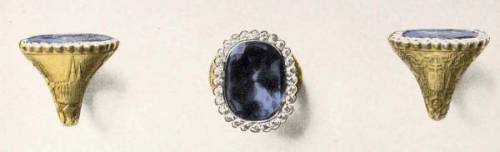
SAPPHIRE RING WITH ENCIRCLING DIAMONDS. Presented to John Cardinal Farley on the occasion of his elevation to the cardinalate.
The traditional virtue of the sapphire as an antidote against poison is noted by Bartolomæus Anglicus, who claims to have seen a test of its power, somewhat similar to that recorded by Ahmed Teifashi of the emerald. In John of Trevisa’s version this passage reads as follows:151
His vertue is contrary to venym, and quencheth it every deale. And yf you put an attercoppe152 in a boxe and hold a very saphyre of Inde at the mouth of the boxe ony whyle, by vertue thereof the attercoppe is overcome & dyeth as it were sodenly, as Dyasc. sayth [pseudo Dioscorides]. And this same I have assayed oft in many and dyvers places. His vertue kepeth and savyth the syght, & clearyth eyen of fylthe wythout ony greyf.
Voicing the general belief that the sapphire was endowed with power to influence spirits, Bartolomæus says that this stone was a great favorite with those who practised necromancy, and he adds: “Also wytches love well this stone, for they wene that they may werke certen wondres by vertue of this stone.”153
There was in the South Kensington Museum, in London, a splendid sapphire of a peculiar tint. In the daylight it shows a beautiful rich blue color, while by artificial light it has a violet hue and resembles an amethyst. In the eighteenth century this stone was in the collection of Count de Walicki, a Polish nobleman, and Mme. de Genlis used it as the theme of one of her stories, entitled “Le Saphire Merveilleux.” Here the sapphire is used as a test of female virtue, the change of color indicating unfaithfulness on the part of the wearer. If the owner of the stone wished to prove that the subject of the test was innocent, she was made to wear the sapphire for three hours of daylight; but in the opposite case the test was so timed that it began in daylight and ended when the candles or lamps had been lighted. This sapphire, still known as the “Saphire Merveilleux,” was for a time in the collection of the Duke of Orleans, who bore the name of Philippe Egalité during the French Revolution.
The star sapphire is that variety of sapphire in which, when the stone is cut and rounded off horizontal with the dome of the crystal, the light is condensed across the three lines of crystalline interference. Three cross lines produce a star which moves as a source of light, or as it is moved from the source of light. Star sapphires very rarely possess the deep blue color of the fine blue sapphire; generally the color is somewhat impure, or of a milky-blue, or else a blue-gray, or sometimes almost a pure white. The blue-gray, gray, and white stones frequently show a much more distinct star, possibly from the fact that there are more inclusions between the layers of the crystals than with the darker blue stones, as it is the set of interference bands that produces the peculiar light. Just as the eye agate was used in some countries to preserve against the Evil Eye, so the moving star is believed by the Cingalese to serve as a protection and a guard against witchcraft of all kinds.
The great Oriental traveller, Sir Richard Francis Burton, had a large star sapphire or asteria, as it was called. He referred to it as his talisman, for it always brought him good horses and prompt attention wherever he went; in fact, it was only in those places where he received proper attention that he would show it to the natives, a favor they greatly appreciated, because the sight of the stone was believed to bring good luck. The fame of Burton’s asteria travelled ahead of him, and it served him well as a guiding-star. De Boot, writing in the seventeenth century, states that such a stone was called Siegstein (victory-stone) among the Germans.
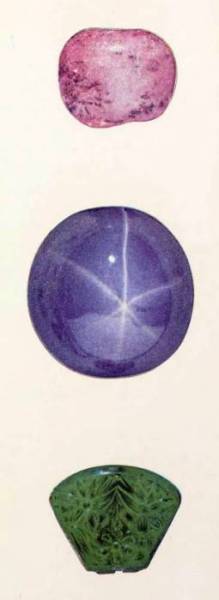
Rubellite from the Shan Mountains, China. Used as an idol’s eye in India Star of India—Star Sapphire Engraved Emerald—East Indian Carving—17th Century GEMS FROM THE MORGAN-TIFFANY COLLECTION.
The remarkable asteria, known as the “Star of India,” in the Morgan-Tiffany Collection in the American Museum of Natural History, has a more or less indefinite historic record of some three centuries, but after its many wanderings it has now found a worthy resting-place in the great Museum. Its weight is 543 carats.154
The asteria, or star sapphire, might be called a “Stone of Destiny,” as the three cross-bars which traverse it are believed to represent Faith, Hope, and Destiny. As the stone is moved, or the light changes, a living star appears. As a guiding gem, warding off ill omen and the Evil Eye, the star-sapphire is worn for the same reasons as were the oculus mundi and the oculus Beli. One of the most unique of talismanic stones, it is said to be so potent that it continues to exercise its good influence over the first wearer even when it has passed into other hands.
Sard
The sard was regarded as a protection against incantations and sorcery, and was believed to sharpen the wits of the wearer, rendering him fearless, victorious, and happy.155 The red hue of this stone was supposed to neutralize the malign influence of the dark onyx, driving away the bad dreams caused by the latter and dispelling the melancholy thoughts it inspired.
Serpentine
The Italian peasants of to-day believe that pebbles of green serpentine afford protection from the bites of venomous creatures. These stones are usually green with streaks or veins of white, and the name was derived from their fancied resemblance to a serpent’s skin. In addition to their prophylactic powers, if any one has been bitten by such a creature, the stone, when applied to the wound, is supposed to draw out the poison. Here, as in the case of coral, the hand of man must not have shaped the amulet; it should be in its natural state. As a general rule, however, the belief that the touch of any iron instrument, such as the tool of the gem-cutter, destroys the magic efficacy of the substance, is less firmly held in regard to stones than in reference to coral.156
Topaz
See Chrysolite.
Turquoise
While there was a tendency to attribute the virtues originally ascribed to one particular stone to others of the same or similar color and appearance, certain stones were regarded as possessing special virtues not commonly attributed to others. A notable instance of this is the quality supposed to inhere in the turquoise. This stone was known in Egypt from a very early period and is later described by Pliny under the name of callais. For Pliny, and for all those who derived their information from him or from the sources he used, the turquoise only participated in the virtues assigned to all blue or greenish-blue stones; but from the thirteenth century, when the name turquoise was first employed, we read that the stone possessed the power to protect the wearer from injury by falling, more especially from horseback; later, this was extended to cover falls from a building or over a precipice. A fourteenth century authority, the “Lapidaire” of Sir John Mandeville, states that the turquoise protected horses from the ill-effects resulting from drinking cold water when overheated by exertion, and it is said that the Turks often attached these stones to the bridles and frontlets of their horses as amulets. They are also so used in Samarcand and Persia. We might therefore be justified in supposing that the turquoise was originally used in the East as a “horse-amulet,” and the belief in its power to protect from falls may have arisen from the idea that it rendered the horse more sure-footed and enduring. As the horse was often regarded as a symbol of the sun in its rapid course through the blue heavens, the celestial hue of the turquoise may have caused it to be associated in some way with the horse. We can only hazard this as a plausible conjecture.
Probably the earliest notice of the peculiar superstition in regard to the turquoise—namely, that it preserves the wearer from injury in case of falling—is contained in Volmar’s thirteenth century “Steinbuch,” where we read:
Whoever owns the true turquoise set in gold will not injure any of his limbs when he falls, whether he be riding or walking, so long as he has the stone with him.157
Anselmus de Boot, court physician of Emperor Rudolph II, tells a story of a turquoise that, after being thirty years in the possession of a Spaniard, was offered for sale with the rest of the owner’s property. Every one was amazed to find it had entirely lost its color; nevertheless De Boot’s father bought it for a trifling sum. On his return home, however, ashamed to wear so mean-looking a gem, he gave it to his son, saying, “Son, as the virtues of the turquoise are said to exist only when the stone has been given, I will try its efficacy by bestowing it upon thee.” Little appreciating the gift, the recipient had his arms engraved on it as though it had been only a common agate and wore it as a signet. He had scarcely worn it a month, however, before it resumed its pristine beauty and daily seemed to increase in splendor. Could we accept this statement as true we would have here an altogether unique instance of the recovery by a turquoise of the blue color it had lost.
Not long after, the powers of De Boot’s turquoise were put to the test. As he was returning to Bohemia from Padua, where he had just taken his degree, he was forced to traverse a narrow and dangerous road at night. Suddenly his horse stumbled and threw him heavily to the ground, but, strange to say, neither horse nor rider was injured by the fall. Next morning, while washing his hands, De Boot remarked that about a quarter of his turquoise had broken away. Nevertheless the stone did not lose its virtue. Some time afterward, when the wearer was lifting a very heavy pole, he felt all at once a sharp pain in his side and heard his ribs crack, so that he feared he had injured himself seriously. However, it turned out that he had not broken any bones but had simply strained himself; but, on looking at his turquoise, he saw that it had again broken into two pieces.158
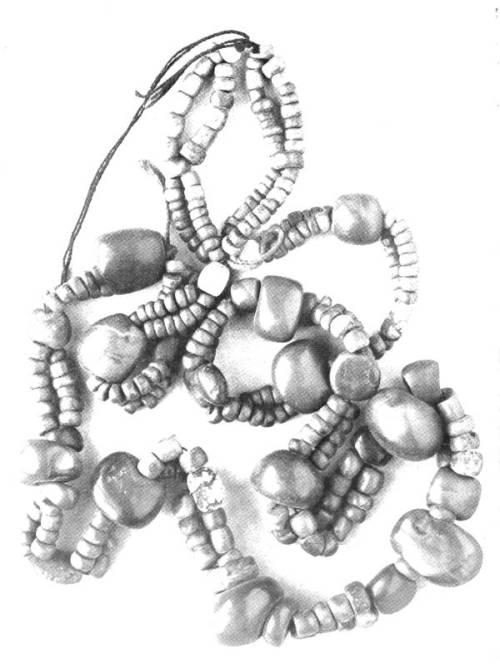
TURQUOISE NECKLACE, THIBET. Field Museum, Chicago.
A singular virtue ascribed to the turquoise was that of striking the hour correctly, if the stone were suspended from a thread held between the thumb and index-finger in such a way that a slight vibration would make the stone strike against the side of a glass. De Boot states that he made the experiment successfully, but he very sensibly explains the apparent wonder by the unconscious effect of the mind on the body. The expectation that the stone was going to strike a certain number of times induced an involuntary movement of the hand.159
The turquoise seems to have been worn almost exclusively by men at the beginning of the seventeenth century, for De Boot, writing in 1609, said that it was so highly regarded by men that no man considered his hand to be well adorned unless he wore a fine turquoise. Women, however, rarely wore this gem.160 This custom was much in vogue among the Englishmen who travelled in the Orient, until a score of years ago.
The Persians fully appreciate the beauty and power of this, their national stone, and they have a saying that to escape evil and attain good fortune one must see the reflection of the new moon either on the face of a friend, on a copy of the Koran, or on a turquoise,161 thus ranking this stone with two most precious things, a friend and the source and warrant of religion. Possibly we should take this proverbial saying to indicate that whoever has a true friend, a copy of the sacred volume or a turquoise will be preserved from harm.
The turquoise of the Los Cerillos mines in New Mexico is rudely extracted by building large fires at the base of the rock until it becomes heated, when cold water is dashed over it, the sharp change of temperature splitting up the rock. Some of the fragmentary material thus secured is worked up in the region into heart-shaped ornaments, or amulets, locally called malacates. The religious veneration with which many of the New Mexico Indians still regard the turquoise was noted by Major Hyde, when he explored the region in 1880, for some Pueblo Indians from Santo Domingo, New Mexico, expressed strong disapproval of his action in extracting turquoise from the old mine, as they looked upon this as a sacred stone which should not pass into the possession of those whose Saviour was not a Montezuma.162
The ruins called Los Muertos, situated nine miles from Tempe, Arizona, have furnished a peculiarly interesting amulet or fetish of Zuñi workmanship. This is a seashell which has been coated with black pitch, in which are encrusted turquoises and garnets so disposed in mosaic as to represent clearly enough the figure of a toad, the sacred emblem of the Zuñis.163
The sacred character with which this stone was invested is shown by the wealth of turquoise ornaments found in some of the burials, notably in those of Pueblo Bonito, unearthed by Mr. George H. Pepper in 1896.164 This is one of the Chaco Cañon groups of ruins, in the northwestern part of New Mexico. In one case nearly nine thousand beads and pendants of turquoise were found on or about a single skeleton. There was abundant evidence in the special care bestowed upon the burial that the deceased must have been a man of high rank, and the condition of the skull plainly indicated that he had met a violent death. The 1980 beads found on the breast of the skeleton are believed to have been strung as a necklace, and the position of other masses of these beads renders it probable that they had been used for bracelets or anklets, the strings having decayed and disappeared in the course of time. The most interesting of the turquoise objects are, however, the pendants worked into various forms designed to favor the entrance of some guardian spirit into the stone. In this single burial were found pendants shaped more or less roughly into the forms of a rabbit, a bird, an insect (?), a human foot and a shoe. Around another burial in the same chamber were strewn nearly six thousand turquoise beads and pendants.165 In all 24,932 beads were found in these burials.