VII
Reading edition
Religious Uses of Precious Stones, Pagan, Hebrew, and Christian.
THE use of stones for the decoration of images of the gods, and in religious ceremonies, more especially in those connected with the burial of the dead, can be traced back to a remote antiquity. Indeed, we may regard this religious use of precious or peculiar stones as the natural development of the original idea of their talismanic virtue. If a certain supernatural essence manifested itself in the stone, what more fit object could be imagined for the decoration of statues of the gods, or to bear engraved texts from the sacred writings, and to be placed with the bodies of the dead as “passports” to ensure the safe entry of the souls of the departed into the better land?
While this employment of mineral substances for religious purposes is practically universal, the earliest recorded instances come from Egypt, and concern the Egyptian custom of engraving texts from a very ancient ritual composition, called the Book of the Dead, upon certain semi-precious stones which had been cut into various symbolical forms. This “Book of the Dead,” composed of a number of distinct chapters, each complete in itself, describes the passage of the soul of the deceased through the realm of the dead (Amenti). Here the soul addresses the gods and other beings who receive it, and the prayers and invocations recited in the chapters are supposed to procure a safe passage and protection from all evil influences or impediments.
One of the most usual of the engraved amulets is the buckle or tie (thet). This was generally of red jasper, carnelian, or red porphyry, or else of red glass or faience or of sycamore wood. The wood was symbolical of the blood of Isis, and the amulets were sometimes engraved with the 156th chapter of the Book of the Dead; they were placed on the mummy’s neck. The formula engraved reads:
Chapter of the buckle of carnelian which is put on the neck of the deceased.
The blood of Isis, the virtue of Isis; the magic power of Isis, the magic power of the Eye are protecting this the Great one; they prevent any wrong being done to him.
This chapter is said on a buckle of carnelian dipped into the juice of ankhama, inlaid into the substance of the sycamore-wood and put on the neck of the deceased.
Whoever has this chapter read to him, the virtue of Isis protects him; Horus, the son of Isis, rejoices in seeing him, and no way is barred to him, unfailingly.338
Another amulet is the tet. The hieroglyph represents a mason’s table and the word signifies “firmness, stability, preservation.” These figures, made of faience, gold, carnelian, lapis-lazuli, and other materials, were placed on the neck of the mummy to afford protection.339
The “papyrus scepter,” uat, is usually cut from matrix-emerald or made of faience of similar hue. Uat means “verdure, flourishing, greenness”; placed on the neck of the mummy it was regarded as emblematic of the eternal youth it was hoped the deceased would enjoy in the realm of the dead. In the 159th chapter of the Book of the Dead, we read of an uat of matrix-emerald; it was believed to be the gift of Thoth, serving to protect the limbs of the deceased.340
The amulet representing the pillow, urs, was generally made of hematite. The 166th chapter of the Book of the Dead is sometimes engraved thereon. Dr. Budge renders this as follows:
Rise up from non-existence, O prostrate one! They watch over thy head at the exalted horizon. Thou overthrowest thine enemies; thou triumphest over what they do against thee, as Horus, the avenger of his father, this Osiris341 has commanded to be done for thee. Thou cuttest off the heads of thine enemies; never shall they carry off from thee thy head (?). Verily Osiris maketh slaughter at the coming forth of the heads of his enemies; may they never remove his head from him.
Of all these amulets, the type most frequently encountered has the shape of a heart, ab. These are found of carnelian, green jasper, basalt, lapis-lazuli, and other hard materials. The heart, regarded in ancient Egypt as the seat of life, was the object of especial care after death. Enclosed in a special receptacle it was buried with the mummy, and the belief was that only after it had been weighed in the balance of the underworld, against the symbol of law, could it regain its place in the body of the deceased. The heart was symbolically represented by the scarab.342
A fine example of a heart amulet shows on one side the figure of the goddess Neith with the pennu bird or phœnix, an emblem of the resurrection, and bears inscribed the chapter of the heart.343
The following extract from the Book of the Dead treats of the formula to be recited over a funeral scarab cut from a hard stone, perhaps the lapis-lazuli. Egyptian tradition assigned this chapter to the reign of Semti, the fifth king of the 1st Dynasty, about 4400 B.C.344
Chapter of not allowing a man’s heart to oppose him in the divine regions of the nether world.
My heart which came from my mother, my heart necessary for my existence on earth, do not rise up against me, do not testify as an adversary against me among the divine chiefs in regard to what I have done before the gods; do not separate from me before the great lord of Amenti. Hail to thee, O heart of Osiris, dwelling in the West! Hail to you, gods of the braided beard, august by your sceptre! Speak well of the Osiris N; make him prosper by Nehbka. I am reunited with the earth, I am not dead in Amenti. There I am a pure spirit for eternity.
To be said over a scarabæus fashioned from a hard stone, coated with gold, and placed on the heart of the man after he has been anointed with oil. The following words should be said over him as a magic charm: “My heart which came from my mother, my heart is necessary for me in my transformations.”
Take your aliments, pass around the turquoise basin, and go to him who is in his temple and from whom the gods proceed.
The most ancient inscription of this especially favorite text is on the plinth of a scarab in the British Museum bearing the cartouche of Sebak-em-saf, a king of the XIV Dynasty, 2300 B.C. It is made from an exceptionally fine piece of green jasper, the body and head of the beetle being carefully carved out of the stone, while the legs are of gold, carved in relief. The scarab is inserted into a gold base of tabloid form, and was found at Kurna (Thebes) by Mr. Salt. As green jasper was believed to possess altogether exceptional virtues as an amulet, this particular scarab was probably regarded as especially sacred.
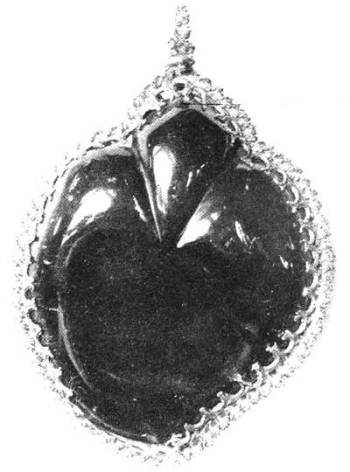
AMBER HEART-SHAPED AMULET. Italian, seventeenth century.
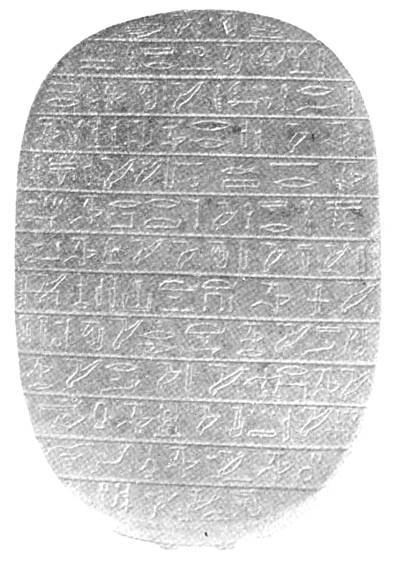
AN INSCRIBED SCARAB (GREEN STONE) OF THE TYPE KNOWN AS A HEART-SCARAB. DATE ABOUT 1300 B.C.
The Scribe Pa-bak: Let him say: “O Heart that I received from my mother (to be said twice), O Heart that belongs to my spirit, rise not against me as witness, oppose me not before the judges, contradict me not in the presence of the Guardian of the Scales. Thou art the spirit that is in my body, Khnum that makest sound my limbs. When thou comest to the place of judgment whither we go, cause not my name to be rejected by the assessors, but let the pronouncement of judgment be favorable, and such as causes joy to the heart.”
It appears to have been the rule to engrave certain special chapters of the Book of the Dead, among those referring to the heart, upon particular stones. Thus, for instance, the 26th chapter was engraved on lapis-lazuli, the 27th upon feldspar, the 30th upon serpentine, and the 29th upon carnelian.345 This may perhaps have been originally due to some association of the god principally invoked in the text with the precious substance upon which the text was engraved.
The form of an eye, fashioned out of lapis-lazuli and ornamented with gold, constituted an amulet of great power; it was inscribed with the 140th chapter of the Book of the Dead. On the last day of the month Mechir, an offering “of all things good and holy” was to be made before this symbolic eye, for on that day the supreme god Ra was believed to place such an image upon his head. Sometimes these eyes were made of jasper, and could then be laid upon any of the limbs of a mummy.346
Of the image of Truth, made from a lapis-lazuli and worn by the Egyptian high-priest, Ælian aptly says that he would prefer the judge should not bear Truth about with him, fashioned and expressed in an image, but rather in his very soul.347
Among the Assyrian texts giving the formulæ for incantations and various magical operations, there is one which treats of an ornament composed of seven brilliant stones, to be worn on the breast of the king as an amulet; indeed, so great was the virtue of these stones that they were supposed to constitute an ornament for the gods also. The text, as rendered by Fossey, is as follows:348
Incantation. The splendid stones! The splendid stones! The stones of abundance and of joy.
Made resplendent for the flesh of the gods.
The ḥulalini stone, the sirgarru stone, the ḥulalu stone, the sându stone, the uknû stone.
The dushu stone, the precious stone elmêshu, perfect in celestial beauty.
The stone of which the pingu is set in gold.
Placed upon the shining breast of the king as an ornament.
Azagsud, high-priest of Bêl, make them shine, make them sparkle!
Let the evil one keep aloof from the dwelling!
The names of two of these gems, the ḥulalu and the ḥulalini, suggest that they were of similar class. As the fundamental meaning of the root whence the names are formed is “to perforate,” it is barely possible that we have here the long-sought Assyrian designation for the pearl, which was commonly regarded in ancient times as a stone. In Arabic the perforated pearl has a special name to distinguish it from the unperforated, or “virgin pearl.” All we know of the sându is that it must have been a dark-colored stone. The uknû, however, is almost certainly the lapis-lazuli. It is often mentioned in the Tel el Amarna tablets as having been among the gifts sent by the kings of Babylonia and Assyria to the Pharaohs of Egypt, and also by the latter to friendly Asiatic monarchs. Of the sirgarru and dushu stones nothing is known, but the elmêshu, the seventh in the list, was evidently regarded as the most brilliant and splendid of all; indeed, Prof. Friedrich Delitzsch hazards the conjecture that it is the diamond. In any case this stone must have been set in rings and considered very valuable, for in an Assyrian text occurs the following passage: “Like an elmêshu ring may I be precious in thine eyes.”349 The fact that this stone is described as having “a celestial beauty” might incline us to believe that it was a sapphire.
The idea of this mystic ornament, composed of seven gems, probably originated in Babylonia, where the number seven was looked upon as especially sacred. As we shall see, there is some reason to attribute a Hindu origin to the nine gems, “the covering” of the King of Tyre, enumerated by Ezekiel, while the breastplate on the ephod of the Hebrew high-priest, with its twelve stones, symbolizing the twelve months of the year, appears to be of later date, and seems to belong to the time of the return from the Babylonian Captivity and the building of the second temple. Certainly, the historic and prophetic books of the Old Testament know nothing of it, although the Urim and Thummim are mentioned and the elaborate description given in Exodus is generally regarded by Biblical scholars as belonging to the so-called “Priestly Codex,” the latest part of the Pentateuch, gradually evolved during the Exile and given its final form in the fifth century B.C.
In the very ancient Assyrio-Babylonian epic narrative of the descent of the goddess Ishtar to Hades, the guardian of the infernal regions obliges the goddess to lay aside some part of her clothing and ornaments at each of the seven gates through which she passes. At the fifth, we are told that she stripped off her girdle of aban alâdi, or stones which aided parturition.350 It has been asserted, and perhaps with some reason, that of the many mineral substances supposed to possess this virtue, jade (nephrite) or jadeite was the earliest known.
The Babylonian legends also tell of trees on which grow precious stones. In the Gilgamesh epic a mystic cedar tree is described. This grew in the Elamite sanctuary of Irnina and was under the guardianship of the Elamite king Humbaba. Of this tree an inscription relates:
It produces samtu-stones as fruit; Its boughs hang with them, glorious to behold; The crown of it produces lapis-lazuli; Its fruit is costly to gaze upon.
Another tree bearing precious stones was seen by the hero Gilgamesh, after he had passed through darkness for the space of twelve hours. This must have been a most resplendent object, to judge from the following description on a cuneiform tablet:351
It bore precious stones for fruits; Its branches were glorious to the sight; The twigs were crystals; It bore fruit costly to the sight.
One of the rarest and most significant specimens illustrating the use of valuable stones for religious ceremonial purposes in the pagan world is in the Morgan-Tiffany collection. It is an ancient Babylonian axe-head made of banded agate. So regular, indeed, is the disposition of the layers in this agate that one might be justified in denominating it an onyx. Its prevailing hue is what may be called a “deer-brown”; some white splotches now apparent are evidently due to the action of fire or that of some alkali. This axe-head bears an inscription in archaic cuneiform characters, and presumably in the so-called Sumerian tongue, that believed to have been spoken by the founders of the Babylonian civilization. The form of the inscription indicates that the object dates from an earlier period than 2000 B.C.
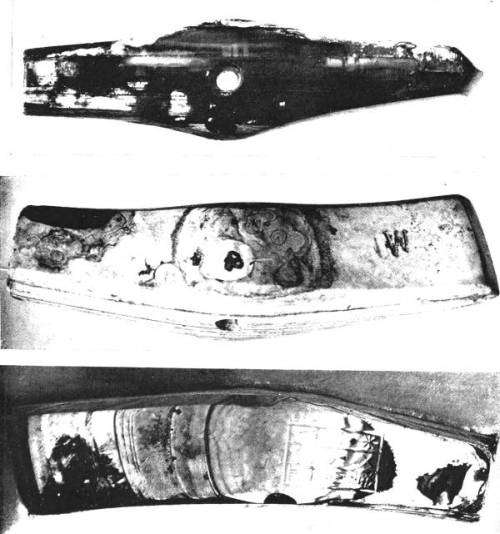
BABYLONIAN AXE HEAD. Agate, with inscription. Morgan collection, American Museum of Natural History, New York.
While the characters are clearly cut and can be easily deciphered, the inscription is nevertheless exceedingly difficult to translate. It is evident that the axe-head was a votive offering to a divinity, probably on the part of a certain governor named Adduggish; but whether the divinity in question was Shamash (the sun-god), or the god Adad, or some other member of the Babylonian pantheon, cannot be determined with any finality. The French assyriologist, François Lenormant, who first described this axe-head in 1879, and Prof. Ira Maurice Price, of the Semitic Department of Chicago University, both, admit that it may have been consecrated to Adad. As the weather-god, the thunderer, the axe-symbol would have been more especially appropriate to him in view of the usage, almost universal among primitive peoples, of associating stone axe-heads or axe-shaped stones with the thunderbolt, and hence with the divinity who was believed to have launched it toward the earth.
This Sumerian axe-head measures 134.5 mm. in length (5.3 inches), 35.5 mm. in width (1.4 inches), and 31 mm. in thickness (1.22 inches). It was originally secured by Cardinal Stefano Borgia (1731-1804), for some time secretary of the College of the Propaganda in Rome, who probably acquired it from some missionary to the East. From the cardinal’s family it passed for 15,000 lire ($3000) to the Tyszkiewicz Collection, and when the objects therein comprised were disposed of at public sale, the writer purchased it for the American Museum of Natural History in New York, April 16, 1902.352
At Alicante, in Spain, cut upon the pedestal of an ancient statue, supposed to have been that of Isis, was found an inscription giving a list of the offerings dedicated by divine command, by a certain Fabia Fabiana in honor of her granddaughter. Evidently the fond grandmother had given of her best and choicest jewels which were used to adorn the statue. They consisted of a diadem set with a “unio” (a large round pearl) and six smaller pearls, two emeralds, seven beryls, two rubies, and a hyacinth. In each ear of the statue was inserted an ear-ring bearing a pearl and an emerald; about the neck was hung a necklace consisting of four rows of emeralds and pearls, eighteen of the former and thirty-six of the latter. Two circlets bound around the ankles contained eleven beryls and two emeralds, while two bracelets were set with eight emeralds and eight pearls. The adornment was completed by four rings, two bearing emeralds, while two, placed on the little finger, were set with diamonds. On the sandals were eight beryls.353
A notable instance of an antique votive offering is the necklace of valuable precious stones dedicated to the statue of Vesta. The Byzantine historian Zosimus attributes the tragic end of Stilicho’s widow, Serena, to her having despoiled the image of Vesta of this costly ornament, and finds a sort of poetic justice in the manner of her death, since she was strangled by a cord which encircled her neck.
It is not only in the works of the Fathers of the Christian Church that we find precious stones used as similes of religious virtue, in Buddhist writings also we have examples of this. In the “Questions of King Milinda,” composed perhaps as early as the third century of our era, occur the following passages:354
Just, O King, as the diamond is pure throughout; just so, O King, should the strenuous Bhikshu, earnest in effort, be perfectly pure in his means of livelihood. This, O King, is the first quality of the diamond he ought to have.
And again, O King, as the diamond cannot be alloyed with other substance; just so, O King, should the strenuous Bhikshu, earnest in effort, never mix with wicked men as friends. This, O King, is the second quality of the diamond he ought to have.
And again, O King, just as the diamond is set together with the most costly gems; just so, O King, should the strenuous Bhikshu, earnest in effort, associate with those of the highest excellence, with men who have entered the first or second or third stage of the Noble Path, with the jewel treasures of the Arahats, of the recluses of the threefold wisdom, or of the sixfold insight. This, O King, is the third quality of the diamond he ought to have. For it was said, O King, by the Blessed one,355 the god over all gods, in the Sutta Nipâta:
Let the pure associate with the pure, Ever in recollection firm; Dwelling harmoniously wise, Thus shall ye put an end to griefs.
The description of the New Jerusalem in the book of Revelations finds a curious parallel in the Hindu Puranas. Here we are told that the divine Krishna, the eighth incarnation of Vishnu, took up his abode in the wonderful city Devârakâ, and was visited there by the various orders of gods and geniuses.356
Gods, Asuras, Gandharas, Kinnaras began to pour into Dwáraká, to see Krishna and Valaráma.
Some descended from the sky, some from their cars—and alighting underneath the banyan tree, looked on Dwáraká, the matchless.
The city was square,—it measured a hundred yojonas, and over all, was decked in pearls, rubies, diamonds, and other gems.
The city was high,—it was ornamented with gems; and it was furnished with cupolas of rubies and diamonds,—with emerald pillars, and with court-yards of rubies. It contained endless temples. It had cross-roads decked with sapphires, and highways blazing with gems. It blazed like the meridian sun in summer.
As compared with the description in Revelations we cannot fail to note the lack of definiteness. Instead of the well-ordered scheme of color as represented by the twelve precious stones dedicated to the twelve tribes of Israel, the mystic Hindu city is simply a gorgeous mass of the most brilliant gems known in India.
The poetic description of the royal city Kusavati, given in the Maha Sudassana Suttanta, may perhaps have originated in some tradition regarding Ecbatana or Babylon. Seven ramparts surrounded Kusavati, the materials being respectively gold, silver, beryl, crystal, agate, coral and (for the last) “all kinds of gems.” In these ramparts were four gates—one of gold, one of silver, one of crystal and one of jade—and at each gate seven pillars were fixed, each three or four times the height of a man and composed of the seven precious substances that constituted the ramparts. Beyond the ramparts were seven rows of palm trees, the fourth row having trunks of silver and leaves and fruit of gold; then followed palms of beryl, with leaves and fruit of beryl; agate palms, whose fruit and leaves were of coral, and coral palms, with leaves and fruit of agate; lastly, the palms whose trunks were composed of “all kinds of gems,” had leaves and fruits of the same description, “and when these rows of palm trees were shaken by the wind, arose a sound sweet and pleasant, and charming and intoxicating.”357
In Greek literature also there is a “gem-city,”—namely, the city of the Islands of the Blessed, described by Lucian in his Vera Historia.358 The walls of this city were of emerald, the temples of the gods were formed of beryl, and the altars therein of single amethysts of enormous size. The city itself was all of gold as a fit setting for these marvellous gems.
Hindu mythology tells of a wonderful tank formed of crystal, the work of the god Maya. Its bottom and sides were encrusted with beautiful pearls and in the centre was a raised platform blazing with the most gorgeous precious stones. Although it contained no water, the transparent crystal produced the illusion of water, and those who approached the tank were tempted to plunge into it and take a refreshing bath in what appeared to be clear, fresh water.359
The Kalpa Tree of Hindu religion, a symbolical offering to the gods, is described by Hindu poets as a glowing mass of precious stones. Pearls hung from its boughs and beautiful emeralds from its shoots; the tender young leaves were corals, and the ripe fruit consisted of rubies. The roots were of sapphire; the base of the trunk of diamond, the uppermost part of cat’s-eye, while the section between was of topaz. The foliage (except the young leaves) was entirely formed of zircons.360
The Chinese Buddhist pilgrim Heuen Tsang, who visited India between 629 and 645 A.D., tells of the wonderful “Diamond Throne” which, according to the legend, had once stood near the Tree of Knowledge, beneath whose spreading branches Gautama Buddha is said to have received his supreme revelation of truth. This throne had been constructed in the age called the “Kalpa of the Sages”; its origin was contemporaneous with that of the earth, and its foundations were at the centre of all things; it measured one hundred feet in circumference, and was made of a single diamond. When the whole earth was convulsed by storm or earthquake this resplendent throne remained immovable. Upon it the thousand Buddhas of the Kalpa had reposed and had fallen into the “ecstasy of the diamond.” However, since the world has passed into the present and last age, sand and earth have completely covered the “Diamond Throne,” so that it can no longer be seen by human eye.361
In the Kalpa Sutra, written in Prakrit, one of the sacred books of the Jains, the rivals of the Buddhists, it is said that Harinegamesi, the divine commander of the foot troops, seized fourteen precious stones, the chief of which was vajra, the diamond, and rejecting their grosser particles, retained only the finer essence to aid him in his transformations. In the same sutra the following glowing description is given of the adornment of the surpassingly beautiful goddess Sri:362
On all parts of her body shone ornaments and trinkets, composed of many jewels and precious stones, yellow and red gold. The pure cup-like pair of her breasts sparkled, encircled by a garland of Kunda flowers in which glittered a string of pearls. She wore strings of pearls made by clever and diligent artists, strung with wonderful strings, a necklace of jewels with a string of Dinaras, and a trembling pair of ear-rings, touching her shoulders, diffused a brilliancy; but the united beauties and charms of these ornaments were only subservient to the loveliness of her face.
As engraved decoration of a fine Chinese vase of white jade with delicate crown markings, appear eight storks, each of which bears in its beak an attribute of one of the Eight Taoist Immortals. Thus we have the double gourd as attribute of the most powerful of these demi-gods known as “Li with the Iron Crutch,” whose aid is sought by magicians and astrologers; the magic sword, with which Lu T’ung-pin vanquished the spirits of evil that roamed through the Chinese Empire in the form of terrible dragons; the basket of flowers, attribute of Lan Ts’ai-ho, the patron of gardeners and florists; the royal fan used by Han Chung-li, of the Chow Dynasty (1122-220 B.C.), to call again to life the spirits of the departed; the lotus flower, emblematic of the virgin Ho Hsien-Ku, venerated somewhat as a patron saint by Chinese housewives, and who acquired the gift of immortal life by the help of a powder of pulverized jade and mother-of-pearl; the bamboo tubes and rods with which the mighty necromancer Chang Kuo, patron of artists, evoked the souls of the dead; the flute of the musicians’ patron, Han Hsiang-tzu, who owed his immortality to his craft in stealthily entering the Taoist paradise and securing a peach from the sacred tree of life; and, lastly, the castanets of Tsao Kuo-chin, especially revered by Chinese actors.
The prevailing belief in India, that treasures offered to the images or shrines of the gods will bring good fortune to the generous donor, finds expression in many ancient and modern Hindu writings. In the Rig Veda it is said that “by giving gold the giver receives a life of light and glory.” In the Samaveda Upanishad we read: “Givers are high in Heaven. Those who give horses live conjointly with the sun; givers of gold enjoy eternal life; givers of clothes live in the moon.” Another text (Hâiti Smriti) reads:363
Coral in worship will subdue all the three worlds. He who worships Krishna with rubies will be reborn as a powerful emperor; if with a small ruby, he will be born a king. Offering emeralds will produce Gyana or Knowledge of the Soul and of the Eternal. If he worships with a diamond, even the impossible, or Nirvâna, that is Eternal Life in the highest Heaven, will be secured. If with a flower of gold a man worships for a month, he will get as much wealth as Kuvera, the Lord of Rubies, and will hereafter attain to Nirvâna and to Muskwa, or Salvation.
At Multan, one of the most ancient cities of India, situated in the Punjab, 164 miles southwest of Lahore, there was in the Hindu temple an idol having for eyes two great pearls. The eyes of the rude image of Jagganath at Puri, in Bengal (Orissa), are said to have at one time been formed of precious stones, as were also those of the idols of Vishnu at Chandernagore and in the great seven-walled temple at Srirangam, whence appears to have come the Orloff diamond.
In ceremonial worship the Hindus recognize sixteen offerings, the ninth consisting of gems and jewelry, and a divine assurance of adequate return to the giver appears in the Bhagavat Purana, where Krishna says, “Whatever is best and most valued in this world and that which is most dear to you should be offered to me, and it will be received back in immense and endless quantity.” On certain appointed days the holy images are decorated with the choicest garments and the richest jewelry in the temple treasury; this is especially the case on the day celebrated as the birthday of the respective divinity. However, the gifts are believed to retain their sacred character as dedicated objects only for a comparatively brief period, varying from a month or more for garments and vestments, to ten or twelve years for jewels, such as the naoratna or the panchratna, the prized and revered jewels, composed respectively of nine and five gems. The panchratna usually consists of gold, diamond, sapphire, ruby, and pearl. After the gifts have ceased to be worthy of use in the temples, they may be disposed of to defray the expenses of the foundation, including the cost of supporting the numerous priests and attendants. As the objects still retain their sacred associations, they are eagerly bought by pious Hindus, who undoubtedly regard them as valuable talismans. Thus they not only serve to bring blessings upon the donors, but also constitute one of the chief sources of income for the temples.364
One of the oldest and perhaps the most interesting talismanic jewel is that known as the naoratna or nararatna, the “nine-gem” jewel. It is mentioned in the old Hindu ratnaçastras, or treatises on gems, for example, in the Nararatnaparîkshâ, where it is described as follows:365
Manner of composing the setting of a ring:
In the centre The Sun The Ruby
To the East Venus The Diamond
To the Southeast The Moon The Pearl
To the South Mars The Coral
To the Southwest Râhu The Jacinth
To the West Saturn The Sapphire
To the Northeast Jupiter The Topaz
To the North The descending node The Cat’s-eye
To the Northwest Mercury The Emerald
Such is the planetary setting.
From this description we learn that the jewel was designed to combine all the powerful astrological influences. The gems chosen to correspond with the various heavenly bodies, and with the aspects known as the ascending and descending nodes, differ in some cases from those selected in the West. For instance, the emerald is here assigned to Mercury, whereas in Western tradition this stone was usually the representative of Venus, although it is sometimes associated with Mercury also.366 On the other hand, the diamond is dedicated to Venus, instead of to the Sun as in the Western world.
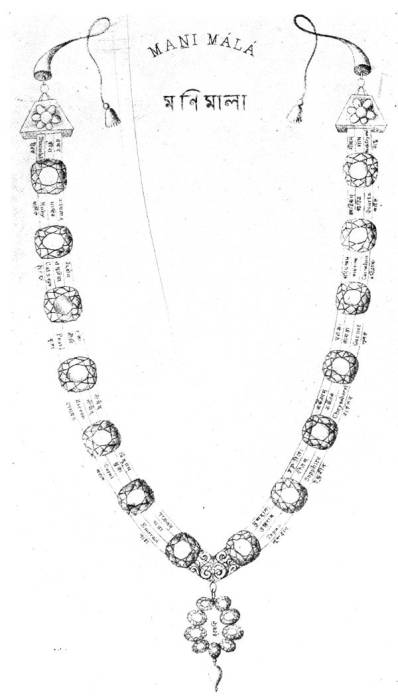
MANI MÁLÁ, OR CHAIN OF GEMS.
Comprising diamond, ruby, cat’s-eye, pearl, zircon, coral, emerald, topaz, sapphire, chrysoberyl, garnet, carnelian, quartz and rock-crystal. A pendant is the naoratna, or “nine-gem” ornament, suspended from which is a pear-shaped pearl.
In possession of the late Rajah Sir Surindro Mohun Tagore, of Calcutta. From his “Mani Málá,” Calcutta, 1879, Vol. I, iv-506 pp., 2 plates, portrait and plate; Vol. II, xiv + ii 507-1046 pp. Contains 49 figures on 10 plates.
In the naoratna the five gems known to the Hindus as the mahâratnâni, or “great gems,”—the diamond, pearl, ruby, sapphire, and emerald,—were, as we see, associated with the Sun and Moon, Venus, Mercury, and Saturn, while the four lesser gems (uparatnâni)—namely, the jacinth, topaz, cat’s-eye, and coral—represent Mars, Jupiter, Râhu, and the descending node. The two last named are very important factors in astrological calculations and are often called the Dragon’s Head and the Dragon’s Tail. These designations signify the ascending and descending nodes, indicating the passage of the ecliptic by the Moon in her ascent above and descent below this arbitrary plane.
In three somewhat obscure passages of the Rig Veda there are references to the seven ratnas. Whether these were gems cannot be determined, since the primary meaning of the word ratna is “a precious object,” not necessarily a precious stone; but it is possible that we may have here an allusion to some earlier form of talisman, in which only the Sun, Moon, and the five planets were represented.
It is easy to understand that such a talisman as the naoratna, combining the favorable influences of all the celestial bodies supposed to govern the destinies of man, must have been highly prized, and we may well assume that only the rich and powerful could own this talisman in a form ensuring its greatest efficacy. For the Hindus believed that the virtue of every gem depended upon its perfection, and they regarded a poor or defective stone as a source of unhappiness and misfortune.
In modern times this talisman is sometimes differently composed. A specimen shown in the Indian Court of the Paris Exposition of 1878 consisted of the following stones: coral, topaz, sapphire, ruby, flat diamond, cut diamond, emerald, amethyst, and carbuncle. Here the cut diamond, amethyst, and carbuncle take the place of the jacinth, pearl, and cat’s-eye.
Instead of uniting the different planetary gems in a single ring, they have sometimes been set separately in a series of rings to be worn successively on the days originally named after the celestial bodies. We read in the life of Apollonius of Tyana (first century A.D.) by Philostratus: “Damis also relates that Iarchas gave to Apollonius seven rings named after the planets, and the latter wore these, one by one, in the order of the weekdays.”367 Although it is not expressly stated that the appropriate stones were set in the rings, the custom of the time makes it probable that this was the case.
NINE GEMS.
EnglishSanskritBurmeseChinese (Canton)Arabic
Diamond Vajra Chein Chun-syak Mâs
Ruby Manikya Budmiya Se-fla-yu-syak Yâkût bihar
Cat’s-eye Vaidûrya Châno Mâu-ji gan Ain al-hirr
Zircon Gomeda Gomok Pi-si Hajar yamânî
Pearl Muktâ Pa-le Chun-ti Lûlû
Coral Pravâla Tadâ Sau-ho-chi Murjân
Emerald Marakata Mujâ Luk-syak Zumurrud
Topaz Pushyaraga Outfiyâ Si-lang-syak Yâkût al-azrak
Sapphire Nîla Nîlâ Chang-syak Yâkût al-açfar
Among the Burmese the value for occult purposes of the nine gems composing the naoratna, or nararatna, is strictly determined in the following order: first, the ruby; second, the diamond, or rock-crystal; third, the pearl; fourth, the coral; fifth, the topaz; sixth, the sapphire; seventh, the cat’s-eye; eighth, the amethyst; and ninth, the emerald.368 That the ruby, diamond and pearl should occupy places of honor is quite natural, but the relegation of the sapphire to sixth place, after coral and topaz, seems to be a rather unfair treatment of this beautiful stone.
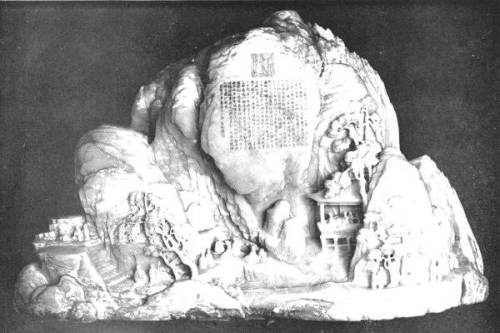
SCULPTURED JADE MOUNTAIN.
Probably the largest mass of sculptured jade in existence. The design commemorates the meetings of a literary club of the fourth century. The Chinese characters (colored red) in the side of the cliff express the famous Lan Ting Hsu, or “Epidendron Pavilion Essay,” by Wang Hi-che (A.D. 321-379), ever since used by the Chinese as a model of elegant caligraphy, and were engraved directly from the autograph of the Emperor Ch’ien-lung, written by him in 1784. Height 23 inches, width 38½ x 18½ inches; weight 640 pounds. From the Summer Palace, west of Peking. Collection of T. D. Walker, of Minneapolis, Minn.
The yellow girdles worn by the Chinese emperors of the Manchu dynasty were variously ornamented with precious stones according to the different ceremonial observances at which the emperor presided. For the services in the Temple of Heaven, the very appropriate choice of lapis-lazuli ornaments was made; for the Altar of Earth, yellow jade was favored; for a sacrifice on the Altar of the Sun, the gems were red corals, while white jade was selected for the ceremonies before the Altar of the Moon. Jade of different colors was used for the six precious tablets employed in the worship of heaven and earth and the four cardinal points. For the worship of Heaven there was the dark-green round tablet; for that of Earth, an octagonal tablet of yellow jade. The East was worshipped with a green pointed tablet; the West was worshipped with the white “tiger-tablet”; the North with a black, semi-circular tablet, and the South with a tablet of red jade.369
Of all the Chinese works on jade the most interesting and remarkable is the Ku yü t’ou pu or “Illustrated Description of Ancient Jade,” a catalogue divided into a hundred books and embellished with upward of seven hundred figures. It was published in 1176, and lists the magnificent collection of jade objects belonging to the first emperor of the Southern Sung dynasty. One of the treasures here described was a four-sided plaque of pure white jade over two feet in height and breadth, and it was regarded as of altogether exceptional value, for on it was a design miraculously engraven. This was a figure, seated on a mat, with a flower-vase on its left and an alms-bowl on the right, in the midst of rocks enveloped in clouds. The figure was an image of the Buddhist saint, Samantabahadra, and the plaque is said to have been washed out of a sacred cave in the year 1068, by a violent and mysterious current.370
Jade talismans are very popular at the present day in the Mohammedan world, and among the Turks they are so highly prized as heirlooms that it is difficult to secure any of them. There is an orthodox Mohammedan sect, whose members call themselves Pekdash, and who during their whole lifetime carry about with them a flat piece of jade as a protection against injury or annoyance of every kind.371
The four rain-making gods are shown wearing necklaces of coral and turquoise in the ceremonial sand-paintings of the Navajos. These four gods are respectively colored to denote the four cardinal points; black for North, blue for South, yellow for West, and white for East. The whole painting, measuring nine by thirteen feet, is guarded on three sides by magic wands; toward the East it is left unprotected, as only good spirits are believed to dwell in this direction. Each of the rain-gods carries suspended from his right wrist an elaborately decorated tobacco pouch, bearing the figure of a stone pipe. The Navajos believe that in this pouch the god places a ray of sunlight with which he lights his pipe; when he smokes, clouds form in the sky and the rain descends. In the sand-picture representing the God of the Whirlwind this divinity also wears ear-pendants and a necklace of turquoise.372
Of the turquoise in Aztec times we have the testimony of the missionary Bernardino de Sahagun that one variety, presumably that regarded as the finest and most attractive, bore the name teuxivitl, which signified “turquoise of the gods.” No one was allowed either to own or wear this as it was exclusively devoted to the service of the gods, whether as a temple offering, or for the decoration of the divine images. Sahagun describes this turquoise as “fine, unspotted and very clear. It was very rare and was brought to Mexico from afar. Some specimens were of rounded shape, like a hazel-nut cut in half; others were broad and flat, and some were pitted as though in a state of decomposition.”373
The god of fire, Xiuhtecutli, or Ixçocauhqui, presided over the ceremony of piercing the ears of the young boys and girls. The image of this god was decorated with ear-rings encrusted with a mosaic of turquoise. He held in his left hand a buckler on which were five large green stones called chalchiuitl (jadeite), placed in the form of a cross on a plate of gold almost covering the shield.374
At the time of the Spanish Conquest an immense emerald, almost as large as an ostrich egg, was adored by the Peruvians in the city of Manta. This “emerald goddess” bore the name of Umiña, and, like some of the precious relics of the Christian world, was only exhibited on high feast days, when the Indians flocked to the shrine from far and near, bringing gifts to the goddess. The wily priests especially recommended the donation of emeralds, saying that these were the daughters of the goddess, who would be well pleased to see her offspring. In this way an immense store of emeralds rewarded the efforts of the priests, and on the conquest of Peru all these fine stones fell into the hands of Pedro de Alvarado,375 Garcilasso de la Vega, and their companions. The mother emerald, however, had been so cleverly concealed by the priests of the shrine that the Spaniards never succeeded in gaining possession of it. Many of the other emeralds were destroyed because of the ignorance and stupidity of some of their new owners, who, supposing that the test of a true emerald was its ability to withstand hard blows, laid the stones on an anvil and hammered them to pieces. The old and entirely false notion that the genuine diamond could endure this treatment may have suggested the unfortunate test.
Garcilasso likens the growth of the emerald in its mine to that of a fruit on a tree, and he believed that it gradually acquired its beautiful green hue, that part of the crystal nearest the sun being the first to acquire color. He notes an interesting specimen found in Peru, half of which was colorless like glass, while the other half was a brilliant green; this he compares with a half-ripened fruit.376
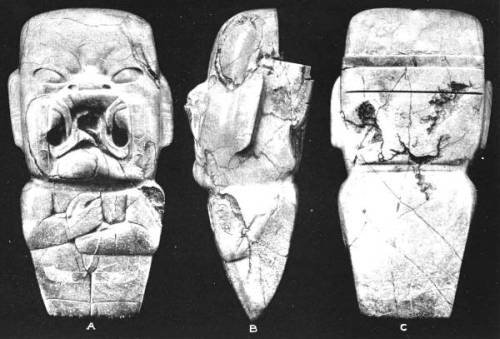
VOTIVE ADZE OF JADEITE FROM MEXICO. a, Front view. b, Side view. c, Rear view. Kunz Collection, American Museum of Natural History, New York. 1013/16 × 6 × 4⅝ inches, Weight, 19 pounds Troy.
The remarkable jade adze, generally known as the “Kunz adze,” was found in Oaxaca, Mexico, brought to the United States about 1890, and is now in the American Museum of Natural History, New York. Of a light greenish-gray hue, with a slight tinge of blue, this jade artefact is 272 mm. long (1013/16 inches), 153 mm. wide (6 inches) and 118 mm. thick (4⅝ inches); its weight is 229.3 Troy ounces, nearly sixteen pounds avoirdupois. Rudely, but not unskilfully, carved upon its face is a grotesque human figure. Four small, shallow depressions, one under each eye and one near each hand, may have served to hold in place small gold films, but no trace of gold decoration is now extant. In its mechanical execution this adze offers evidence of considerable skill on the part of the Aztec lapidary, the polish equalling that of modern workers. In the fact that a large piece, which must apparently have weighed at least two pounds, has evidently been cut out of this implement by some one of its Indian owners, we can see a proof of the talismanic power ascribed to jadeite in Aztec times, for there can be little doubt that nothing less than a belief in the great virtue of jadeite coupled with the rarity of the material could have induced the mutilation of what must have been regarded in its time as a remarkable work of art.377
The source of the prehistoric jade (nephrite and jadeite) found in Europe, and also of that worked into ornaments by the Indians before the Spanish Conquest of America, was long the subject of contention among mineralogists and archæologists. In Germany this question was denominated the Nephritfrage, and the most notable contribution to the discussion was the great scientific and scholarly work issued by Heinrich Fischer.378 His conclusion was that as there was no evidence of the existence of these minerals outside of a few localities in Asia, the European and American supply must have been brought to these parts of the world from Asia, and that hence the presence of these jade artefacts in America clearly pointed to commercial intercourse at an early period between the American continent and Asia, and might be regarded as offering a strong argument in favor of an Asiatic origin for an American civilization. According to this theory the prehistoric jade objects found in Europe must have had a similar source, and would constitute a proof of the existence of traffic with remote points in Asia at a date long previous to that commonly accepted.
This view was strongly opposed by Prof. A. B. Meyer, of Dresden, and recent discoveries have effectively disproved the theory in the case of Europe at least, for nephrite has been found there in situ in several places. The largest mass of this material that has been taken from a European deposit is that found by the writer at Jordansmühl in Silesia, in April, 1899, and which weighed 4704 pounds.379 The origin of American jade in the forms of nephrite and jadeite has not yet been definitely determined, but we have every reason to suppose that deposits of these minerals will eventually be discovered in various parts of the American continent, as they have already been in Europe. Indeed, the existence of nephrite in Alaska is already well attested.
The peculiar and characteristic qualities of these substances have made them favorite materials for ornamental objects from the earliest ages down to our own day, and in almost all parts of the world. A most important element contributing to the popularity of jade has been its supposed possession of wonderful talismanic and therapeutic virtues, and while the Western world has not the same belief in these matters as the Eastern world, a more or less definite appreciation of what jade still signifies for many in the Orient, continues to exercise an influence over both Americans and Europeans, making objects of nephrite or jadeite highly prized everywhere at the present time.
The term chalchihuitl was indifferently applied by the ancient Mexicans to a number of green or greenish-white stones; quetzal chalchihuitl, which was regarded as the most precious variety, may perhaps have more exclusively denoted jadeite. This is somewhat indefinitely described by Sahagun as being “white, with much transparency, and with a slight greenish tinge, something like jasper.” Of eight ornamental objects of green stone examined some years ago by the writer, four were of jadeite, one of serpentine, another of green quartz, and the remaining two of a mixture of white feldspar and green hornblende. An inferior kind of chalchihuitl, said by Sahagun to have come from quarries in the vicinity of Tecalco, appears to have been identical with the so-called “Mexican onyx” which is found in veins in that place and is an aragonite stalagmite. This material, from which figures, ornaments and beads were made by the ancient Mexicans, is to-day greatly valued as an ornamental stone.
The greater number of ancient Mexican jadeite beads appear to have been rounded pebbles of this material, assorted as to size and drilled for use in making necklaces. Other green stones used at this time in Mexico were green jasper, green plasma, serpentine and also the “Tecalco onyx” or “marble” above mentioned. In many cases these substances are of such rich green that they might easily be mistaken for jadeite by those who lacked the tests or the experience at the command of modern mineralogists. Should jadeite ever be found in situ in Mexico, it seems probable that the discovery will be made in the State of Oaxaca, whence came the finest ancient specimens, including the splendid votive adze. Moreover, one of the few materials by which jadeite can be worked is furnished by the streams of this region, whence have been taken several rolled pebbles which the writer has identified as yellow and blue corundum, the quality being equal to that of specimens from Ceylon.380
Gesner describes one of the lip ornaments worn by the aborigines of South America in the following words:381
A green stone or gem which the inhabitants of the West Indies use. They pierce their lips and insert this stone so that the thicker part adheres to the hole and the rest protrudes. We might call these ornaments oripenduli [mouth-pendants]. This stone was given me by a learned Piedmontese, Johannes Ferrerius, and he wrote of it as follows: “I send a cylindrical green stone, as long as a man’s middle finger, and having at one extremity two ridges. It is stated that the Brazilians of high rank wore these, from their youth, in their pierced lips; one or more being worn according to the dignity of the wearer. While eating, or whenever they so wish for any other reason, these ornaments are removed from the lips.”
Similar ornaments, made of a green quartz and of beryl, are in the Kunz collection in the Field Museum of Chicago.
The reason for these strange mutilations, which often cause serious discomfort to those who practice them, is not at all easy to determine. Some have conjectured that by the insertion of bright, colored objects in the ears, nose and lips, members of the same tribe were enabled to recognize each other at a distance; each tribe having selected a particular color. However, although certain local preferences are shown in the matter of color or material, there is no hard and fast rule in this matter, and frequently neighboring tribes will employ stones or shells of the same or similar hue and appearance. Others find in this custom a religious significance and suppose that the mutilation represents a form of sacrifice to the spirits, good or bad, who must be rendered favorable to man by some act on his part showing his unconditional submission to them. Originating in this way the idea of adornment was a secondary impulse. It is a fact that ancient peoples regarded the wearing of ear-rings as a badge of slavery, and, according to a Rabbinical legend, Eve’s ears were pierced as a punishment for her disobedience, when she was driven from the Garden of Eden.
A curious theory was advanced by Knopf.382 He calls attention to the habit children have of thrusting small bright objects into their noses and ears, and suggests that this indicates a natural propensity which, coupled with the early-developed love of adornment, induced primitive man to affix ornamental objects on or in the nose, ear, or mouth. There may be more in this than we are willing to admit, but on the whole it seems most probable that ceremonial and religious considerations gave rise to the custom.
One of the largest masses of sculptured Chinese jade is in the collection of T. B. Walker, Esq., of Minneapolis. This shows a jade mountain, with groups of figures artistically placed at its base, and winding pathways up to its summit. On the face of the rock is inscribed in beautiful Chinese characters the Epidendron Pavilion Essay of Wang Hi-che, a masterpiece of Chinese calligraphy.
An enormous mass of New Zealand jade (punamu, “green stone”) weighing 7000 pounds, found in South Island in 1902, is to be seen in the Museum of Natural History, New York; it was secured by the writer and was donated to the Museum by the late J. Pierpont Morgan. This is the largest mass of jade known, or of which we have any record. On it is placed a remarkable and, in its own peculiar way, an artistic decoration, serving as a type of old Maori life, and at the same time designating the geographic source of the jade in a striking and unmistakable manner calculated to appeal to the least intelligent visitor. This is a statue of a Maori warrior of the old days, executing a war dance, characteristics of which were a distortion of the features and a thrusting out of the tongue intended to express defiance and contempt of the enemy; the time or cadence of the dance was marked by slapping the thigh with the flat of the left hand. This figure was executed from life by Sigurd Neandross; indeed it was actually cast from the model, so that there can be no doubt as to its fidelity.
Rock-crystal is included among the various objects used as fetiches by the Cherokee Indians. This stone is believed to have great power to give aid in hunting and also in divining. One owner of such a crystal kept his magic stone wrapped up in buckskin and hid it in a sacred cave; at stated intervals he would take it out of its repository and “feed” it by rubbing over it the blood of a deer. This goes to prove that the stone, as a fetich, was considered to be a living entity and as such to require nourishment.383
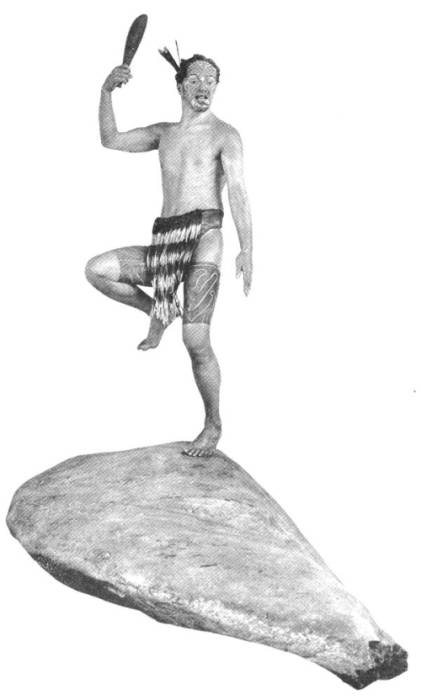
STATUE OF A MAORI WARRIOR, BY SIGURD NEANDROSS. The base is a block of New Zealand jade from South Island, weighing three tons. It was donated by Mr. J. Pierpont Morgan to the American Museum of Natural History.
Precious stones have been everywhere regarded as especially appropriate offerings at the shrine of a divinity, for the worshipper naturally thought that what was most valuable and beautiful in his eyes must also be most pleasing to the divinity he worshipped. However, we rarely find the usage which was remarked by Francisco Lopez de Gomara among the Indians of New Granada about the time of the Spanish Conquest.384 These natives “burned gold and emeralds” before the images of the sun and moon, which were regarded as the highest divinities. Certainly to use precious stones for a “burnt offering” was an original and curious idea, although we have abundant proof that pearls were offered in this way by the mound-builders of the Mississippi Valley. In this case great quantities of pearls were burned at the obsequies of the chiefs of the tribes, or at those of any one belonging to the family of a chief.
In ancient Mexico the lapidaries adored the four following divinities as their tutelary gods: Chiconaui Itzcuintli (“nine dogs”), Naualpilli (“noble necromancer”), Macuilcalli (“five horses”), and Cintectl (“the god of harvest”). A festival was celebrated in honor of the three last-named divinities when the zodiacal sign called chiconaui itzcuintli was in the ascendant. A feminine divinity represented this sign and to her was attributed the invention of the garments and the ornaments worn by women. The four gods of the lapidaries were looked upon as the discoverers and teachers of the art of cutting precious stones and of piercing and polishing them, as well as of the making of labrets and earflaps of obsidian, rock-crystal, or amber. They also were the inventors of necklaces and bracelets.385
The stones worn by Chinese mandarins as a designation of their rank were undoubtedly determined originally by religious or ceremonial considerations. They are as follows; it will be noticed that red stones are given the preference:
Red or pink tourmaline, ruby (and rubellite) 1st rank.
Coral or an inferior red stone (garnet) 2d rank.
Blue stone (beryl or lapis-lazuli) 3d rank.
Rock-crystal 4th rank.
Other white stones 5th rank.
The knowledge of classical mythology was so slight among the ecclesiastics of the Middle Ages that some very queer attributions of the subjects engraved on Greek and Roman gems were made during this period. A reliquary containing a tooth of the Apostle Peter, preserved in the Cathedral of Troyes, was set with antique gems which had been plundered by French and Venetian crusaders from the treasure-house of the Greek Emperor in Constantinople, when that city was sacked in 1204 during the Fourth Crusade. Among these gems was one representing Leda and the Swan—certainly a curious subject for the adornment of a Christian reliquary. Another Greek or Roman gem, long preserved in a church, was furnished by its Christian owners with an inscription indicating that the figure engraved upon it was that of St. Michael, while in reality it was a representation of the god Mercury. Still another gem was provided with an inscription signifying that the subject was the temptation of Mother Eve in the Garden of Eden, but the Greek gem engraver’s intent had been to carve the figures of Zeus and Athena, standing before an olive tree, a design which appears on some Athenian coins; at the feet of the divinities appears a serpent. In a similar way the grain-measure crowning the head of Jupiter-Serapis led to the attribution of a gem so engraved to the patriarch Joseph.386
An engraved amethyst bearing the figure of a little Cupid is said to have been worn in a ring by St. Valentine. While this may be somewhat doubtful, it is by no means impossible, for many pagan gems were worn by pious Christians, who reconciled their consciences to the use of these beautiful but scarcely religious ornaments by giving to the pagan symbols a Christian meaning. Certainly, in view of the time-honored customs connected with St. Valentine’s Day, there seems something peculiarly appropriate in the design of the ring supposed to have been worn by St. Valentine.
That precious stones had sense and feeling was quite generally believed in medieval times, and a legend told of St. Martial illustrates this idea. The gloves worn by this saint were studded with precious stones, and when on a certain occasion a sacrilegious act was committed in his presence, the gems, horrified at the sight, sprang out of their settings and fell to the ground before the eyes of the onlookers.
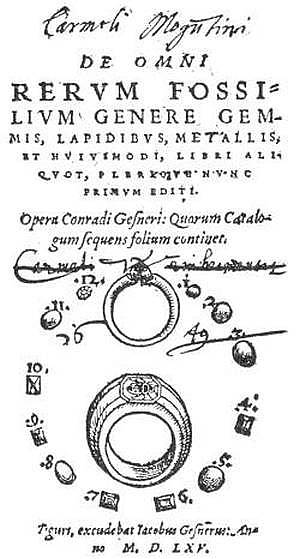
TITLE PAGE OF A GROUP OF TREATISES BY VARIOUS AUTHORS, COLLECTED AND EDITED BY CONRAD GESNER AT ZÜRICH IN 1565.
The upper one of the two rings figured is set with a natural pointed diamond, the lower one with a piece of amber enclosing an insect; grouped around are twelve stones representing those of the Breastplate.
The St. Sylvester or St. James stone is a banded agate in two colors, the one dark and the other light, with a cat’s-eye effect so that both colors are equally visible. The light side represents the old year, with its known occurrences, and the opaque side represents the new year, which is dark like futurity. This is a typical stone for a New Year’s present or for one born on St. Sylvester’s Day, the last day of the year. The popular tradition is that the member of a family or a household who is last to arise on that day will be the last to arise all the year around.
The famous “Sacro Catino” preserved in Genoa was long believed to be made of a single immense emerald, but careful investigation proved that it was of no more valuable material than green glass. A legend still current in the early part of the sixteenth century represented this cup, or dish, as having been used by Christ at the Last Supper, and stated that it was one of the utensils which King Herod ordered to be brought from Galilee to Jerusalem for the celebration of the paschal feast; but his purpose having been changed by Divine Providence, he made other use of it.387
A queer story has been told regarding the Genoese emerald. At one time when the government was hard pressed for money, the Sacro Catino was offered to a rich Jew of Metz as pledge for a loan of 100,000 crowns. He was loath to take it, as he probably recognized its spurious character, and when his Christian clients forced him to accept it under threats of dire vengeance in case of refusal, he protested that they were taking a base advantage of the unpopularity of his faith, since they could not find a Christian who would make the loan. However, when some years later the Genoese were ready to redeem this precious relic, they were much puzzled to learn that a half-dozen different persons claimed to have it in their possession, the fact being that the Jew had fabricated a number of copies which he had succeeded in pawning for large sums, assuring the lender in each case that the redemption of the pledge was certain.
Among the celebrated emeralds noted by George Agricola388 (1490-1555) was a large one preserved in a monastery near Lyons, France. This is also mentioned by Gesner, who states that it was shaped as a dish, or shallow cup, and was held to be the Holy Grail, like its rival at Genoa.389 Another of Agricola’s emeralds was somewhat smaller, but nevertheless measured nine inches in diameter and was in the chapel of St. Wenceslaus, at Prague; this may have been a chrysoprase, as at the present day many fine specimens of this stone can be seen in St. Wenceslaus, where the walls are inlaid with the golden green gem-stone. Still another, larger than the last named, was set in the gold monstrance in Magdeburg, and was believed to have been the handle of Emperor Otho I’s knife, since it was perforated. Possibly, however, the emerald, if genuine, was an Oriental stone, for it was customary to pierce rubies, sapphires, emeralds, etc., in the East so as to string them for necklaces or attach them as pendants to a jewel.
In the convent-church of St. Stephan, in Persian Armenia, erected about the middle of the seventeenth century, it is related by the French traveller Tavernier that there was preserved a cross said to be made out of the basin in which Christ washed the feet of the Apostles. Set in this cross was a white stone, and the priests asserted that when the cross was laid upon the body of one seriously ill, this stone would turn black if he were about to die, but would regain its white hue after his death.390
No jewelled sacred image has been the object of greater reverence than has been accorded to the rude little wooden carving popularly known as the “Sacro Bambino” or “Sacred Baby,” in the old church of Ara Coeli in Rome. This figure was carved, in 1847, by a monk, out of a piece of olive-wood from one of the ancient trees growing on the Mount of Olives near Jerusalem. The carving was executed in the Holy Land and was sent thence to Italy, and although the ship bearing it was shipwrecked, this precious freight was miraculously preserved and is supposed to have been conveyed to its destination in some mysterious way. The reverence of the thousands of pilgrims who in the course of time have gazed with veneration upon this quaint and curious work of art, has found expression in the bestowal of a wealth of gems and jewels, including necklaces, brooches, rings, etc., with which the silken dress of the image is studded. A crown of gold adorned with precious stones rests upon the head of the olive-wood figure, which is jealously guarded by the priests and only shown to the faithful as a particular favor, except on the occasion of certain religious festivals.
One of the most renowned emeralds in the world surmounted the elaborately jewelled imperial crown that was placed upon the head of the venerated image of the Virgen del Sagrario in the Cathedral of Toledo. This emerald, of a rich green color, was cut as a perfect sphere and measured about 40 millimetres, or 1½ inches, in diameter. The crown itself was the work of the Toledan goldsmith, Don Diego Alejo de Montoya, who began his task in 1574 and devoted twelve years to its completion. It is described as being of almost pure gold and executed in the Renaissance style. Curiously chased in arabesque designs and enamelled in various colors, the framework of the crown served as a magnificent background for the gems constituting its adornment, which comprised rubies, emeralds, and Oriental pearls; a row of angels and cherubs sustained the arches which bore at their summit the allegorical figures of Faith, Hope, and Charity; upon that representing Faith rested the splendid emerald. This precious ornament was still preserved in the Cathedral in 1865, but was so carelessly guarded that it was stolen in 1869.391
If we are to believe the following anecdote, the emerald disappeared at an earlier date: It is said that in 1809, during the French occupation of Spain, Marshal Junot visited this cathedral, and the emerald was pointed out to him as one of the chief glories of the shrine. As soon as the marshal’s covetous glance rested upon the gem, he plucked it from its setting, remarking, coolly, to the astonished and horrified bystanders, “This belongs to me.” Then, smiling and bowing, he left the cathedral with the emerald safely ensconced in his waistcoat pocket. Later, it was replaced by an imitation in glass.
The famous collection of jewels gathered together in the treasury of the Santa Casa, at Loreto, Italy, was plundered during the French occupation in 1797, and all trace of most of the magnificent ornaments has been lost. These represented the gifts of many crowned heads and titled personages; among the former was the unfortunate Henrietta Maria, wife of Charles I, who donated a golden heart-shaped jewel with the words “Jesus Maria” incrusted in diamonds. This jewel is described as being “as big as both a man’s hands, opened onto two leaves, on one of which was the figure of the Blessed Virgin and on the other a portrait of the queen herself.”392 Of the many rich vestments for decorating the statue of the Virgin in the sanctuary, the most splendid was the gift of the Infanta Isabel of Flanders, and was valued at 40,000 crowns. In a seventeenth-century account by an English traveller it is thus described:393
Its set thick with six rows of diamonds downe before, to the number of three thousand, and its all wrought over with a kinde of embroidery of little pearle set thick everywhere within the flowers with great round pearle, to the number twenty thousand pearles in all.
The same writer tells us the niche in which the statue was placed was bordered with a row of precious stones of great number, size, and value, the colors being so varied that this bordering formed “a rich Iris of several colors.” There is also said to have been a great pearl, set in gold, and engraved with the image of the Virgin and Child.394 It seems probable that this was a jewel made of a baroque pearl, or pearls, completed by enamel-work so as to represent the sacred figures.
The pectoral cross worn in solemn processions by the prior of the monastery of San Lorenzo del Escorial was adorned with eight perfect emeralds, five diamonds, and five pearls. From it hung a splendid pear-shaped pearl, the gift of Philip II in 1595, and one of the finest of those acquired by this monarch. In 1740 the cross was valued at 50,000 crowns, Philip’s great pearl not being included in this valuation.395
The monastery of Streoneshalh, later Whitby Abbey, was founded about 656 A.D. by Oswy, King of Northumbria, in fulfilment of a vow made before his victory over the pagan king Penda, at the battle of Winwidfield, fought in November, 654. St. Hilda was made abbess of this monastery, and Oswy’s daughter Aelfleda took the veil and eventually, in 680, succeeded Hilda as abbess; she died in 713.396 Tradition relates that at this early date crosses and rosaries were made for the inmates of the monastery from the jet found in the neighborhood. The “Whitby jet,” so popular and fashionable in the eighteenth century, was largely derived from the same source, and since then has had several revivals, until replaced by black-stained chalcedony, the so-called onyx, and, later still, by steel carved with glass and glass itself.
In the sixteenth century jet was popularly called “black amber,” and Cardano states that in his time beads of this material were made up into rosaries. He also says that curious figures made of jet were brought from Spain to Italy.397
Many are unaware of the fact that a number of ornamental objects made of nephrite and jadeite—unquestionably of European origin—are to be seen in the quiet little town of Perugia. These objects, collected principally in central and southern Italy, constitute the Belucci Collection, in that city. This collection also contains other specimens of worked jadeite, which must have been brought to Europe at the time of the Spanish conquest of Mexico and Peru. A very interesting example shows us the utilization of a pagan celt to form a Christian emblem. By the removal of a rectangular piece from each of the four corners of the jadeite celt, a perfect cross has been made, the back and front of which still offer the original polish given to the material centuries ago by the native American worker. The superstitious belief propagated in Europe by the returning Spanish sailors, very probably an invention of their own to enhance the value of their jade and jadeite, that these minerals were worn by the natives as a cure for diseases of the kidneys, whence the name lapis nephriticus, rendered the material exceptionally precious in the eyes of many, and quite possibly it may have been thought that, by transforming this object into the sacred form of the cross, a talisman would be produced that would not only effect the cure of a special disease, but would also by its superior virtue guard the wearer from harm and danger of all kinds. Here may also be seen some celts of European jade sewed up in little bags to be worn on the loins.
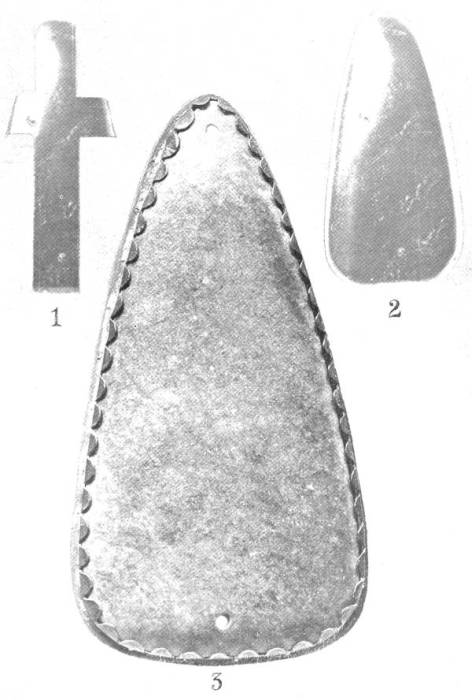
1. Cross made from a celt of jadeite (Mexican), bought from a peasant in Perugia. This was originally a celt and was divided into four pieces. Of Mexican origin and brought to Italy in sixteenth century. Belluci Collection.
2. Jadeite celt, from Guatemala.
3. Celt, Aboriginal. A small stone hatchet made of jade nephrite, of the kind believed by the peasants to be thunderbolts. Mounted in silver to be worn as a charm. This specimen, tied over the loins, is said to have been worn as recently as fifty years ago by a Scottish gentleman as a cure for kidney disease. British Museum.
Certain curious amulets called magatama (crooked jewels) have been found in Japanese graves of the iron age;398 they are formed of various materials, among others of steatite, jasper, carnelian, agate, rock crystal, chrysoprase and nephrite (jade). In the shell heaps of a period preceding the iron age, the magatama are frequently made of horn, or of boar’s or wolf’s teeth, and their peculiar form, which is variously explained as a symbol, may have been conditioned by the shape of the materials originally used. The magatama were evidently regarded as amulets. “They are generally perforated at the thick end, and were worn on a string, together with beads and bugles of the same material.” These peculiar ornaments were used to adorn the statues of the gods and were also employed as imperial insignia and distinctive marks of high rank. At the present day they are numbered among the three emblems of sovereignty in Japan.
A green and a red magatama are combined in the national emblem of Korea and a similar figure is used in China to symbolize the union of the masculine and feminine principles (Yang and Yin) in nature. Dr. Baelz believes that the swastika emblem, encountered in so many different parts of the world, belongs to the same order of ideas.
The Bghai tribes of Burma have many superstitions in regard to stones, such as garnets, rock-crystal, chalcedony, carnelian, agate, onyx and others of less value, their repute not depending entirely or principally upon their quality as gem-stones. In almost every household is installed a stone fetish, and blood offerings are on occasion made to this. A question as to the reason for this offering elicited the following reply: “If we do not give it blood to eat it will eat us.” A common belief was that spirits good or bad dwelt in the stones, and in case a great misfortune befell a family, this was sometimes laid to the charge of such a spirit. The father of a family having died, his widow commanded her son to throw away their magic stone. This he did, but the spirit was not to be denied, for shortly afterward this very stone was found to have returned to its accustomed place, and had even brought two companion stones with it!399
Ruy Gonzalez de Clavijo, who travelled in the East during the years 1403-1406, gives a description of a slab of stone bearing the outlines of a “natural picture,” and placed in the church of St. Sophia, in Constantinople:400
In the wall, on the left-hand side, there is a very large white slab, on which, among many other figures, was drawn, very naturally, without any human artifice of sculpture or painting, the most sacred and blessed Virgin Mary, with our Lord Jesus Christ in her most holy arms, with his most glorious forerunner, St. John the Baptist, on one side. These images, as I said before, are not drawn or painted with any color, or inlaid, but the stone itself gave birth to this picture, with its veins, which may be clearly seen; and they say that when this stone was cut, to be placed in this most holy place, the workman saw these most wonderful and fortunate images on it, and, as this church was the most important one in the city, that stone was deposited in it. The said images appear as if they were in the clouds of heaven, and as if there was a thin veil before them.
Many other examples of these “natural gems” are noted by early writers. Among them was an agate gem in the treasury of the Basilica of St. Mark, in Venice. Upon this gem appeared the head of a king, adorned with a diadem, the whole design being figured naturally by the veining of the agate, and not owing anything to artifice. In the same city, upon a column in the church of San Georgio Maggiore, could be seen the likeness of Our Lord, hanging from the Cross.401
Such stones, with peculiar markings indicating the form of human heads and figures, were regarded as the work of higher powers.
Another remarkable example is described by Kircher as follows:402
In Rome, in the Chapel of the Sacred Virgin, near the organ to the right hand of those who enter the Church of St. Peter, an image may be seen in which the Blessed Virgin of Loreto is so artistically depicted by Nature that it appears to be the work of an artist’s hand. She is attired in a triple garment, divided by a zone, and holds in her arms the child, who is distinguished by a crown, as is the mother. Around may be seen the figures of angels.
The red spots upon the bloodstone were said in Christian legend to represent the blood of Christ. This idea has been beautifully utilized in some gems cut from this stone, whereon the thorn-crowned head of Christ is so placed that the red spots of the bloodstone figure the drops of blood trickling down the hair and face of the Saviour. Such a gem might well be looked upon as a Christian amulet and one that could be reverently worn by any believer.
The ignorance in the Middle Ages of the art of gem-engraving often induced the belief that engraved stones were the work of nature. A striking instance of this was the celebrated stone over the figure of the Mother of Jesus, on the tomb of St. Elizabeth of Marburg. On this gem appeared two heads touching each other, and it was, according to tradition, not a work of art, but a freak of the sculptress Nature. An oft-repeated legend tells us that a former Elector of Mainz offered the whole district of Amöneberg for this costly stone, which robber hands removed at Cassel. It is in reality a fine onyx engraved with the heads of Castor and Pollux.403
We might be disposed to regard rather sceptically the tales regarding wonderful stones bearing the image of Christ, or that of the Virgin Mary, and we may be inclined to believe that the old accounts are exaggerated or distorted by the pious imaginations of the writers. Nevertheless, in our own time we have a well-attested case of the discovery of such a stone.
In 1880, while visiting the village of Oberammergau, Bavaria, to witness the Passion Play, Mrs. Eugenia Jones-Bacon, of Atlanta, Georgia, found on Mount Kopfel, which overlooks the village, a small stone composed of chert and limestone, and having on its surface excrescences so disposed that, when the stone was held at a certain angle, the shadows cast by them formed a striking likeness of the head of Christ as depicted in Christian art. This peculiar freak specimen has been carefully examined by experts and has been pronounced to be entirely a work of nature. The mineralogist is not disposed to see here anything more than coincidence, and yet the most sceptical cannot fail to be impressed by the fact that such a stone was found at the time and place of the Passion Play. As Max Müller said, in commenting on this strange discovery: “The chapter of accidents is much larger than we imagine,” and the present writer feels disposed to add that it is remarkable how often we find what we are looking for, especially if we are only looking or thinking of one object or subject.
The religious symbolism of the diamond was a favorite theme with the thirteenth century “lapidaria,” or rhymed treatises on precious stones. Just as it could only be discovered by night—an old fancy—so was the Incarnation a hidden mystery; it gave forth a great light, just as Jesus illumined the depths of Hades when he descended thither; it was unconquerably hard, and who can resist the might of God?404
The mediæval Italians who were fond of seeking some hidden and significant meaning in the names of precious stones, in the case of the diamond (diamante), read the phrase amante di Dio, or “lover of God.”405 This was a reason for regarding the brilliant gem as a sacred stone and one especially suitable for religious use.
The Rosicrucians, who sought to combine pagan with Christian types and figures, saw in the amethyst and the amethystine color a symbol of the divine male sacrifice, since the stone and the color were typical of love, truth, passion, suffering, and hope. The love of Christ led him to make the supreme sacrifice and suffer the agony of the Cross, and the Crucifixion was followed by the Resurrection, whence came the hope of mankind to enjoy eternal happiness in heaven.
The chiastolite, or macle, shows the representation of a cross on its surface, this effect being produced by the regular arrangement of carbonaceous impurities along the axes of the crystal. The name signifies a marking resembling the Greek letter Χ (chi). This marking is often very striking in appearance, and the crystal was naturally regarded as having a mystical and religious significance. It was said to stanch the flow of blood from any part of the body if worn so as to touch the skin, and it was also believed to increase the secretion of milk. All kinds of fevers were cured by this mineral if it were worn suspended from the neck, and the divine symbol it bore served to drive away evil spirits from the neighborhood of the wearer.
This very interesting mineral occurs very frequently in mica schists. When found, it appears about the thickness of a small finger, tapering slightly at each edge. If broken near one end, it often shows a white cross with a veined outline of black, making a distinct cross with black markings. The crystals frequently measure from two to four inches in length, and are found in Massachusetts, California, and other places. If small segments are broken off, it will be found that the black outline will become stronger, and the white less marked, until finally a black cross will appear, with white markings. The white material is the result of two white wedges pushed point onward until the ends meet, the narrow end of one wedge being crossed by the broad end of the second wedge, and the black filling in the balance of the square. No two of these square crosses can thus ever be exactly alike, and, when polished, the crystals naturally form an interesting stone that was known as lapis crucifer, or cross-stone by the ancients.
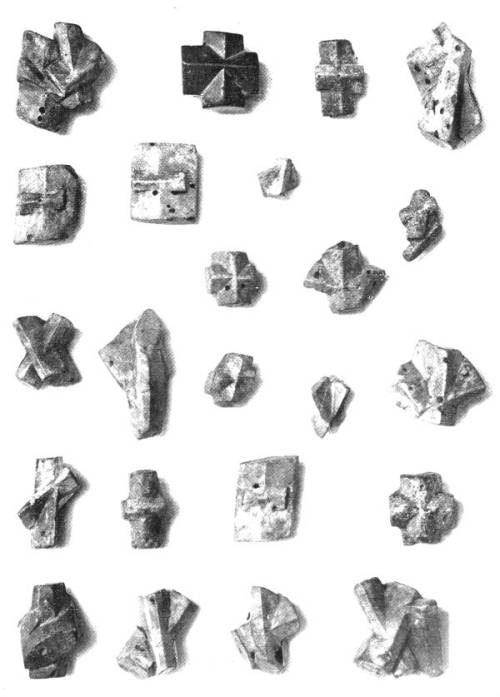
STAUROLITE CRYSTALS (FAIRY STONES). Patrick County, Virginia.
The peculiar form of the mineral known as staurolite (from the Greek σταυρός cross) is due to the twinning of two crystals at right angles. In Cronstedt’s treatise on mineralogy, published in Stockholm in 1758, we are told that the staurolite was sometimes called Baseler Taufstein (baptismal-stone) or lapis crucifer, the former name being used in Basel, where the stone was employed as an amulet at baptisms. However, the lapis crucifer of De Boot appears from his description to have been the chiastolite. In Brittany these twin crystals were worn as charms, and local legends state that they had dropped from the heavens.
Fine crystals of staurolite have been found in Patrick County, Virginia, and there is said to be a beautiful local legend in regard to their origin. Near where they are found there wells up a spring of limpid water, and the story goes that one day, long, long ago, when the fairies were dancing and playing around this spring, an elfin messenger winged his way through the air and alighted among them. He bore to them the sad tidings of the crucifixion of Christ in a far-off city. So mournful was his recital of the sufferings of the Saviour that the fairies burst into tears, and these fairy tear-drops, as they fell to earth, crystallized into the form of the cross. These natural crosses are in great demand as charms, and ex-President Roosevelt is said to wear one of them mounted as a watch-charm.
There has been found in the southern part of New Mexico, and in northern Mexico, a blue variety of calamine, a hydrous silicate of zinc, colored blue by an admixture of copper. This stone has been cut into gem form and has been sold to a certain extent as a cheap gem. It is translucent and is sometimes veined with white wavy lines. The Mexican Indians employed in the mines often set up a cross and a candle near where they are working, so that they may pay their devotions at this improvised shrine. In Sonora and Western Chihuahua the Indians frequently place a piece of the stone to which we have alluded alongside the cross. They may be attracted by its beautiful blue color, or they may believe that it is a turquoise, although it does not resemble this latter stone, which is more opaque, of a different shade of blue and of a different composition.
In some epitaphs the hope of the resurrection finds expression in likening the body enclosed in its narrow coffin to a precious jewel in its casket. The following lines from a tombstone erected in 1655 to the memory of Mary Courtney, at Fowell, Cornwall, England, give a good example of this class of inscription:406
Near this a rare jewell’s set, Clos’d up in a cabinet. Let no sacrilegious hand Breake through—’tis ye strickte comaund Of the jeweller: who hath sayd (And ’tis fit he be obey’d) I’ll require it safe and sound Both above and under ground.
In a churchyard at Prittlewell, Essex, England, a rather whimsical treatment of the same idea is offered by some verses engraved on the stone marking the graves of two wives of a certain Freeborne, the first of whom died in 1641 and the second in 1658. The bereaved husband seems to have been perfectly willing to await the Day of Judgment for the return of his lost spouses:407
Under this stone two precious gems do ly Equall in weight, worth, lustre, sanctity: Yet perhaps one of them do excell; Which was’t who knows? ask him yt knew yem well By long enjoyment. If he thus be prest, He’el pause, then answere: truly both were best: Were’t in my choice that either of ye twain Might be returned to me to enjoy agayne, Which should I chuse? Well, since I know not whether; Ile mourne for the losse of both, but wish for neither, Yet here’s my comfort, herein lyes my hope, The tyme a comeinge cabinets shall ope Which are lockt fast: then shall I see My Jewells to my joy, my Jewells mee.
The Christian symbolism of colors has in many cases determined the use of certain colored gems for religious ornaments, and therefore the following summary of their principal significance is of interest here:408
White is regarded as the first of the canonical colors, and as emblematic of purity, innocence, virginity, faith, life, and light. For this reason it is used in the ceremonies of Easter and Christmas, as in those of the Circumcision and Epiphany of Our Lord. As the color of virginity it is especially appropriate for the festival of the Virgin Mary, and as that of faith not sealed with blood, for the festivals of the saints who were not martyred. The heavenly host of angels and saints wear white robes, and in pictures of the Assumption of the Virgin she is frequently clad in white.
Red is used at the feasts of the Exaltation and Invention of the Cross, at Pentecost, and at the Feast of Martyrs. It suggests and symbolizes suffering and martyrdom for the faith, and the supreme sacrifice of Christ upon the Cross. Divine love and majesty are also typified by this color.
Blue is an emblem of the celestial regions and of the celestial virtues. Nevertheless, as this is not one of the five canonical colors, it is not employed for the decoration of churches or for ecclesiastical vestments. In Christian art, however, the Virgin and the saints and angels are often robed in blue.
Yellow of a golden hue is emblematic of God’s goodness and of faith and good works, but it is not a canonical color. A dull yellow, however, has the opposite signification, and is a type of treachery and envy. Hence Judas is garbed in yellow of a dull hue, and heretics wore garments of this shade when they were condemned to the stake.
Green is the canonical color for use on Sundays, week-days, and ordinary festivals. Hope and joy and the bright promises of youth are signified by green.
Violet, another canonical color, is appropriate for use on Septuagesima and Quinquagesima Sundays, during Lent, and on Advent Sunday. The chastening and purifying effects of suffering find expression in this color.
Black, also a canonical color, is a symbol of death and of the mourning and sorrow inspired by death. Therefore it is only used in the Church on Good Friday, to symbolize the sorrow and despair of the Christian community at the death of Christ, a sorrow soon to be turned to joy by His glorious resurrection.
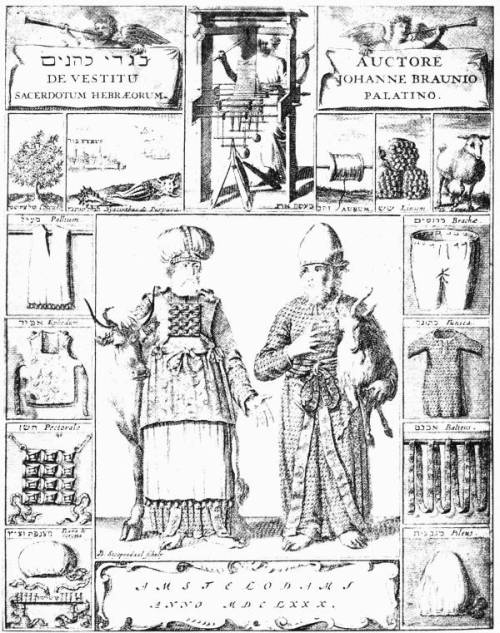
FRONTISPIECE OF THE “VESTITUS SACERDOTUM HEBRÆORUM,” OF JOHANN BRAUN, AMSTERDAM, 1680.
The vignettes at the top illustrate the source of the materials of the vestments, etc.; as the nopal, source of the cochineal insect; gold-thread; linen; a sheep for wool; Tyre and the purple murex. The other vignettes show separate parts of the high-priest’s attires and in the centre appear two figures of the high-priest, each garbed in different sets of vestments.