VI On Crystal Balls and Crystal Gazing
Reading edition
WE have evidence of the use of crystal balls as means of divination in medieval times, and “scrying” in some of its many forms was by no means rare in the Greek and Roman periods. The essential requisite for the exercise of this species of divination is a polished surface of some sort upon which the scryer shall gaze intently; for this purpose mirrors, globules of lead or quicksilver, polished steel, the surface of water, and even pools of ink, have been employed and have been found to insure quite as satisfactory results as the crystal ball. The points of light reflected from the polished surface (points de repère) serve to attract the attention of the gazer and to fix the eye until, gradually, the optic nerve becomes so fatigued that it finally ceases to transmit to the sensorium the impression made from without and begins to respond to the reflex action proceeding from the brain of the gazer. In this way the impression received from within is apparently projected and seems to come from without. It is easy to understand that the results must vary according to the idiosyncrasy of the various scryers; for everything depends upon the sensitiveness of the optic nerve. In many cases the effect of prolonged gazing upon the brilliant surface will simply produce a loss of sight, the optic nerve will be temporarily paralyzed and will as little respond to stimulation from within as from without; in other cases, however, the nerve will be only deadened as regards external impressions, while retaining sufficient activity to react against a stimulus from the brain centres. It is almost invariably stated that, prior to the appearance of the desired visions, the crystal seems to disappear and a mist rises before the gazer’s eye.
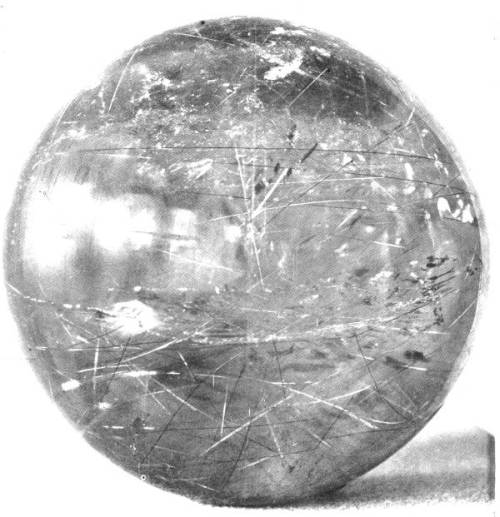
ROCK-CRYSTAL BALL PENETRATED BY CRYSTALS OF RUTILE. MADAGASCAR.
The Achaians, as Pausanius relates, frequently used a mirror to divine diseases or to learn whether there was danger of sudden death. Of the Temple of Demeter, or Ceres, at Patras, he writes:266
In front of the temple of Demeter there is a well. A stone wall separates this well from the temple, but steps lead down to it from the outside. Here there is an infallible oracle, although it does not answer all questions, but only those touching diseases. They attach a slender cord to a mirror and let it down into the well, balancing it carefully so that the water does not cover the face, but only touches the rim. Then, after making a prayer to the goddess and burning incense to her, they look into the mirror, and it shows whether the sick person will die or recover. Such is the power of truth in this water.
This sacred well with its oracle of the magic mirror must have been in Lucian’s mind when, in his description of the palace of the Moon-King, he says:267
Another wonderful thing I saw in the palace. Suspended over a rather shallow well there is a large mirror, and anyone who goes down into this well will hear every word that is spoken on earth, while, if he gazes on the mirror, he will see there every city and every nation just as clearly as though he were looking down upon them from a slight elevation. At the time I was there, I saw my native country and its inhabitants. Whether I myself was seen by them in turn, I am not sure.
Lucian adds, with a fine touch of irony, “Anyone who doubts this assertion needs only to go there himself and he will find out that I speak the truth.” As no one has yet made a trip to the moon, the assertion is still uncontradicted.
In their religious legends the ancient Mexicans taught that their god Tezcatlipuco had a magic mirror in which he saw everything that happened in the world.268 He was sometimes named Necocyautl, “sower of discord,” because he often stirred up war and strife among men, but he was also lord of riches and prosperity, which he bestowed and took away again at his will. To the influence of this divinity were attributed many omens and certain strange visions, announced by repeated knockings.269
In the Orphic poem “Lithica,” a magic sphere of stone is described. The substance is called “sideritis” or “ophitis,” and is said to be black, round, and heavy; possibly some metal, rather than a stone, is designated by these names. Helenus, the Trojan soothsayer, is said to have used this sphere to foretell the downfall of his native city. He fasted for twenty-one days and then wrapped the sphere in soft garments, like an infant, and offered sacrifices to it until, by the magic of his prayers, “a living soul warmed the precious substance.”
A strange variety of divination by means of mirrors placed on the heads of boys, who, with eyes blindfolded, were supposed to perceive forms or signs of some description in the mirrors, is noted by Spartianus in his life of the Emperor Didius Julianus (ca. 133-193). This ruler is said to have resorted to this form of divination, and the boy entrusted with the task is asserted to have announced the approaching accession of Septimius Severus (146-211) and the dethronement of Didius Julianus.270
An indication that the usage of divination by means of a silver cup existed among the primitive Hebrews has been found in the story of Joseph and his brethren. In Genesis xliv, 1-5, we read that Joseph concealed a silver cup in the sack of grain borne away by Benjamin, making of this a pretext for requiring the return of his brethren. He sent messengers to overtake them and directed them to demand the return of the cup, using these words: “Is not this it in which my lord drinketh, and whereby indeed he divineth?”
The Arabic author, Haly Abou Gefar, tells of a golden ball used by “the Magi, followers of Zoroaster,” in their incantations. It was incrusted with celestial symbols and set with a sapphire, and one of these magicians, after attaching it to a strip of bullhide, swung it around, reciting at the same time various spells and incantations.271 Probably the magician, by fixing his gaze upon the brilliant revolving sphere, gradually fell into a hypnotic trance, during which visions appeared to him. These he could afterward interpret to those who had sought his aid to read the future, or obtain information regarding things that were happening far away.
An important side-light on the beliefs of Western Europe, in the fifth century, regarding crystal-gazing, is afforded by one of the canons of the synod held about 450 A.D. by St. Patrick and the bishops Auxilius and Issernanus. Here it is decreed that any Christian who believes there is a Lamia (or witch) in the mirror is to be anathematized, and is not to be again received into the Church unless he shall have renounced this belief and shall have diligently performed the penance imposed upon him.272 In this case, as in many others, the vision in the crystal or mirror did not represent some former or contemporaneous happening, but the figure of an evil spirit, who, either by signs or words, imparted to the scryer the information he was seeking.
The power to see images of evil spirits on the surface of water was claimed by those called hydromantii in the ninth century. This is attested in a work composed about 860 A.D. by Hincmar, Archbishop of Rheims, who characterizes the supposed appearances as “images or deceptions of the demons.” These diviners asserted that they received audible communications from the spirits, and they therefore evidently believed that the appearances were realities.273
Although, as we have seen, many different materials were used for scrying, the preference was often given to polished spheres of beryl; in modern times, however, the rock-crystal is considered the best adapted for the purpose.
In his introduction to “Crystal Gazing,” by N. W. Thomas,274 Andrew Lang writes of what he terms hypnagogic illusions—images which appear when the eyes are closed and before sleep supervenes. When faces appeared to him in this way, they were always unfamiliar ones, with the single exception of having once seen his own face in profile. The same was almost invariably true of landscape and inanimate objects. These forms seemed to grow out of the bright points of light which frequently appear when the eyes are closed, and Lang suggests a similar origin for the visions of the “scryers”—namely, the development of the images from dark or light points in the glass.
In regard to this, we have an interesting passage in the works of Ibn Kaldoun, a Persian writer, born in 1332, who gives the following very acute analysis of the phenomena accompanying crystal-gazing.275
Some believe that the image perceived in this way takes form on the surface of the mirror, but they are mistaken. The diviner looks at this surface fixedly until it disappears, and a curtain, like a mist, is interposed between him and the mirror. Upon this curtain are designed the forms he wishes to see, and this permits him to give indications, either affirmative or negative, concerning the matter on which he is questioned. He then describes his perceptions as he has received them. The diviners, while in this state, do not see what is really to be seen (in the mirror); it is another kind of perception, which is born in them and which is realized not by sight but by the soul.
As to the character and quality of the crystal to be used, Abbot Tritheim, the master of the famous Cornelius Agrippa, says:276
Procure of a lapidary a good, clear, pellucid crystal of the bigness of a small orange,—i.e., about one inch and a half in diameter; let it be globular, or round each way alike; then you have got this crystal fair and clear, without any clouds or specks. Get a small plate of pure gold to encompass the crystal round one-half; let this be fitted on an ivory or ebony pedestal. Let there be engraved a circle round the crystal; afterwards the name: Tetragrammaton. On the other side of the plate let there be engraved, Michael, Gabriel, Uriel, Raphael, which are the four principal angels ruling over the Sun, Moon, Venus, and Mercury.
The four letters constituting the Tetragrammaton are the Hebrew characters yôdh, hê, wâw and hê, יהוה. As this divine name was regarded in later Judaism as too sacred to be pronounced, the word lord, adonai, was substituted for it in the reading of the Scriptures. For this reason, when the vowel signs were added to the text to indicate the traditional pronunciation, the consonants Yhwh were provided with the vowels of adonai and the name was therefore read Jehovah by Christian scholars.
The Persian poet Jâmi writes thus of a magic mirror in the poem “Salamân and Absal”:277
Then from his secret Art the Sage Vizyr A Magic Mirror made; a Mirror like The bosom of All-wise Intelligence, Reflecting in its mystic compass all Within the sev’nfold volume of the World Involved; and looking in that Mirror’s face The Shah beheld the face of his Desire.
Roger Bacon (1214-1292) was probably the most gifted man of the thirteenth century, and his writings testify to an extraordinarily clear perception of the essential principles of scientific research. However, his true greatness was not generally appreciated in his own age, and popular fancy wove about his name a fabric of legend in which he appeared as an arch-necromancer and magician. The curious old work entitled “The Famous Historie of Fryar Bacon” gives a number of the strange recitals which became current in England in regard to Bacon’s wonderful powers.
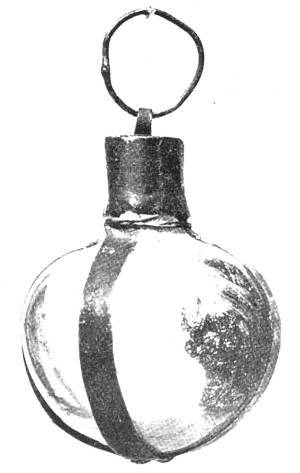
GLASS BALL, PERFORATED AND MOUNTED IN METAL, SO THAT IT CAN BE SUSPENDED AND USED FOR OCCULT AND CURATIVE PURPOSES.
Period of about tenth or twelfth century. Collection of Sir Charles Hercules Read.
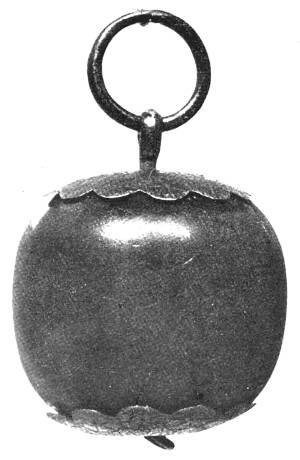
BALL OF JET, PERFORATED, MOUNTED IN METAL, SO THAT IT CAN BE SUSPENDED AND USED FOR OCCULT AND CURATIVE PURPOSES.
Period of about tenth or twelfth century. Collection of Sir Charles Hercules Read.
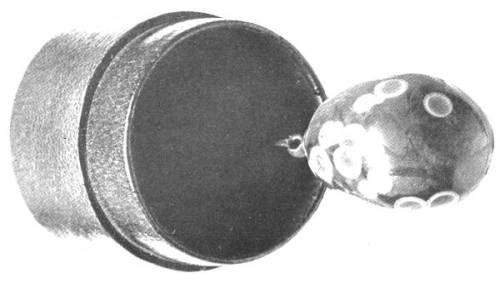
EYE AGATE, SHOWING A NUMBER OF CIRCULAR MARKINGS. Mounted in metal and kept in a box, as a votive or curative stone. About fourteenth century. British Museum. (See page 149.)
One of these treats of a marvellous “glass” made by the friar, in which events happening at far-distant places were mirrored. On one occasion two young men, between whom the friendliest feelings existed, came to Bacon and requested him to let them see in the mirror what their fathers were doing at the time. The friar consented, but the experiment, while successful, was the cause of a terrible misfortune. The story is as follows:
The Fathers of these two Gentlemen (in their Sonnes absence) were become great foes: this hatred betweene them was growne to that height, that wheresoever they met, they had not onely wordes, but blowes. Just at that time, as it should seeme, that their Sonnes were looking to see how they were in health, they were met, and had drawne, and were together by the eares. Their Sonnes seeing this, and having been alwayes great friends, knew not what to say to one another, but beheld each other with angry lookes. At last one of their Fathers, as they might perceive in the Glasse, had a fall, and the other, taking advantage, stood over him ready to strike him. The Sonne of him that was downe could then containe himselfe no longer, but told the other young man, that his Father had received wrong. He answered againe, that it was faire. At last there grew such foule words betweene them, and their bloods were so heated, that they presently stabbed the one the other with their Daggers, and so fell downe dead.
The sceptre of the Scottish regalia is surmounted by a crystal globe, two inches and a quarter in diameter, and the mace by a large crystal beryl. In former times these stones were regarded as amulets and their use was traced back to the Druids. Sir Walter Scott tells us that in his time they were still known among the Scottish Highlanders as “Stones of Power.”278
The testimony of John of Salisbury (1120?-1180) shows that in the twelfth century, in England, divination by means of the arts of the specularii was often practised. The prelate writes that when a boy, he himself and a companion a few years older received instruction from a priest who was addicted to the use of these magic arts. This priest used to polish the finger-nails of the boys with a consecrated oil or ointment, and then direct them to look upon the polished surface until some figure or form should appear. Sometimes the smooth, polished surface of a basin was used. John of Salisbury regarded it as a mark of divine favor that he himself saw nothing upon the smooth and lustrous surface, but he states that his companion observed certain vague and shadowy forms. Certain names pronounced by the priest on these occasions terrified the boy, for he believed them to be the names of evil spirits; indeed, such was his reluctance to participate in the unholy rites that his presence was believed to interfere with the production of the phenomena.279
In another part of his “Policraticus,” John of Salisbury states that the specularii claimed that their gift of seeing visions on polished surfaces was never used to injure any one, but was often useful in the detection of theft and in counteracting magic spells.280
Under the comprehensive chapter heading: “How to conjure the crystal so that all things may be seen in it,” Paracelsus (1493-1541) declares that “to conjure” means nothing more than “to observe anything rightly, to learn and to understand what it is.” The crystal was of the nature of the air, and hence all things movable and immovable that could be seen in the air could also be seen in the crystal or speculum.281
Paracelsus showed keen insight, and his conclusions are excellent. One might add, however, that it is a fact that these are images condensed in the double convex lens, forming as it were, an internal crystal sphere. These images are reversed, distorted and twisted, and when they become visible to one who is expecting strange things, they form mental impressions which it is often very difficult to erase. Many crystal gazers are frequently very highly wrought, nervous and susceptible, and other influences uniting with the impressions produced, may give the brain for a time the power to evolve kaleidoscopic effects.
Directions for the use of an Erdenspiegel, or “earth-mirror,” are given in an old German manuscript written in 1658 by a Capuchin priest.282 The mirror is to be set about two inches above a board, and the questions to be answered are to be placed beneath it. The scryer is recommended to place three grains of salt upon his tongue, whereupon he is to repeat a prayer and cross himself. He now takes the mirror in his hand and breathes upon it three times, repeating the words, “In the name of the Father, of the Son, and of the Holy Spirit. Amen.”
These preliminaries having been accomplished, the following prayer, or rather invocation, is repeated:
O thou holy Archangel N. N., I pray to thee most fervently through the great and unsearchable name of the Lord of all Lords and King of all Kings, Jod, He, Vau, He, Tetragrammaton, Adonay, Schaday, receive my greeting and give ear to the humble petition which I offer in the name of the great and highest God, Elohim, Zebaoth, that thou shalt appear to me in the world-mirror, and give me knowledge and instruction in answer to my questions.
The strong religious tone of these directions for the use of the mirror and the fact that it is a priest who gives them, shows that there was a disposition to tolerate the employment of such “white magic.”
In medieval times it was believed that the vision in the crystal was produced through the agency of an indwelling spirit, and, therefore, it was necessary to use some very potent spell to force this spirit to enter the stone. Many of these ancient spells have been preserved, and they contain a strange and incongruous mixture of religious and magical formulas. In one of these, dating from the end of the fifteenth century, after a recitation of a long and rambling conjuration, we read: “And yen ask ye chylde yf he seethe any thyng, and yf no, let the mr begin his conjuratyō agayn.” As usual the scrying was done by a child, the conjuration being spoken by the minister. An important part of the conjuration consisted in the repetition of a number of divine names, most of them originally Hebrew, but so much corrupted by reciters who did not know their meaning that it is now exceedingly difficult to interpret them correctly.
A proof that this form of magic was often regarded as quite compatible with religion is offered us in a passage from a sixteenth century manuscript,283 where we read that the crystal should be laid on the altar “on the Side that the gospell is read on. And let the priest say a mass on the same Side.” If the conjuration is successful, the same manuscript tells us that “these angells being once appeared will not depart the glasse or stone untill the Sonne be sett except you licence them.” It also seems that “scrying” was looked upon as a special gift, only granted to a favored few as a peculiar privilege, and we read that “Prayer and a good beleefe prevailed much. For faith is the cay to this and all other works, and without it nothing can be effected.” The child scryer, either maid or boy, should not be more than twelve years old.
That a certain religious spirit, however mistaken, often animated the crystal-gazers of the sixteenth century, is shown in the case of the “speculator” of John a Windor, who confessed that when he led an impure life the “dæmons” would not appear to him in his glass. He would then proceed to fumigate the apartment, as though believing that the very air was contaminated by the sins of the operator. We may hope that the seer was not content with this, but also tried to reform his evil ways. Another scryer, a woman named Sarah Skelhorn, declared that the spirits that appeared to her in the glass would often follow her about the house from room to room, so that she at last became weary of their presence.284 Both of these scryers had regular employment, for it was quite customary for a gentleman to have a household seer, just as he would have a body-physician, if he could afford it.
A sixteenth century work on magic, the “Höllenzwang” of Dr. Faustus, whose name has been immortalized for all ages by Goethe, gives very particular and detailed directions for the preparation and consecration of a crystal, whether glass or quartz. Faust asks his “Mephistophelis” whether such crystals can be made, and the spirit replies: “Yes, indeed, my Faust,” and directs Faust to go, on a Tuesday, to a glass-maker, and get the latter to form a glass. It was requisite that this work should be done in the hour of Mars, that is, in the first, eighth, fifteenth or twenty-second hour of Tuesday. The crystal when completed must not be accepted as a gift, but a price must be paid for it. When the object had been secured, Mephistopheles directs that it be buried in a grave, where it must be left for the space of three weeks; it was then to be unearthed; if a woman purchased it, she must bury it in a woman’s grave. However, these preliminaries only served to prepare the crystal for the final consecration, as the mere material mass was regarded as inert and possessing no virtue until certain spirits were summoned to dwell within it. Mephistopheles confesses that he alone would not be powerful enough, and he directs Faust to call upon the spirits Azeruel and Adadiel also. Faust is assured that the three spirits will show him in the crystal whatever he may wish to know. If anything has been stolen, the thief will appear; if any one is suffering from disease, the character of his malady will be revealed, etc.285
Another way of preparing a crystal glass or mirror is given in the same work. After the glass has been bought it is to be immersed in baptismal water in which a first-born male child has been baptized, and therein it is to remain for three weeks. The water is then to be poured out over a grave and the sixth chapter of the Revelation of St. John is to be read. Hereupon the following conjuration should be pronounced:
O crystal, thou art a pure and tender virgin, thou standest at one of the gates of heaven, that nothing may be hidden from thee; thou standest under a cloud of heaven that nothing may be hidden from thee, whether in fields or meadows, whether master or servant, whether wife or maid. Let this be said to thee in the name of God, as a plea for thy help.286
The visions seen in crystal gazing were often supposed to be the work of evil spirits, seeking to seduce the souls of men by offering the promise of riches or by according them an unlawful glimpse into the future. Here, as in other magical operations, there was both white and black magic, recourse being had in some cases to good, and in others to evil spirits. As an illustration of the latter practice, a sixteenth century writer relates that in the city of Nuremberg, some time during the year 1530, a “demon” showed to a priest, in a crystal, the vision of a buried treasure. Believing in the truth of this vision, the priest went to the spot indicated, where he found an excavation in the form of a cavern, in the depths of which he could see a chest and a black dog lying alongside it. Eagerly the priest entered the cavern, hoping to possess himself of the treasure, but the top of the excavation caved in and he was crushed to death.287
The famous charlatan, Dr. Dee, who was for a time a prominent figure at the court of Emperor Rudolph II, was highly favored by Queen Elizabeth. The queen visited him several times, and even appears to have consulted him on political matters. In his diary the doctor relates that the queen called at his house shortly after his wife’s death, which took place March 16, 1575. Of this visit he gives the following details:
The Queen’s Majestie, with her most honorable Privy Council, and other the Lords and Nobility, came purposely to have visited my library: but finding that my wife was within four hours before buried out of the house, her Majestie refused to come in; but willed to fetch my glass so famous, and to show unto her some of the properties of it, which I did. Her Majestie being taken down from her horse by the Earle of Liecester, Master of the Horse, at the church wall of Mortlake, did see some of the properties of that glass, to her Majestie’s great contentment and delight.288
It was at Mortlake, on December 22, 1581, that Dr. Dee made his first essay with his crystal ball. The proceedings were conducted with a certain religious ceremonial, and began with a pious invocation to the angel of the stone. This celestial being soon graciously deigned to manifest himself in the stone and—presumably by the voice of the scryer—answered the questions put by those present.
There can be little doubt that Dee used more than one crystal in the course of his experiments; that now in the British Museum is of cairngorm, or “smoky-quartz.” This variety of quartz may have been chosen because of the Scotch superstitions regarding its virtues; for, as a rule, charlatans seek to avail themselves of already existing superstitions in order to make their innovations more acceptable.
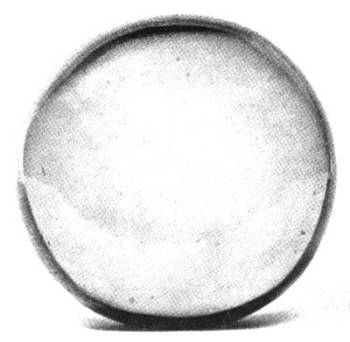
DR. DEE’S SHEW STONE.
Natural size. British Museum. This sphere of smoky-quartz came to the British Museum in 1700 with the Cottonian Library, donated at that time by the grandson of the original collector, Sir Robert Bruce Cotton (1571-1631).
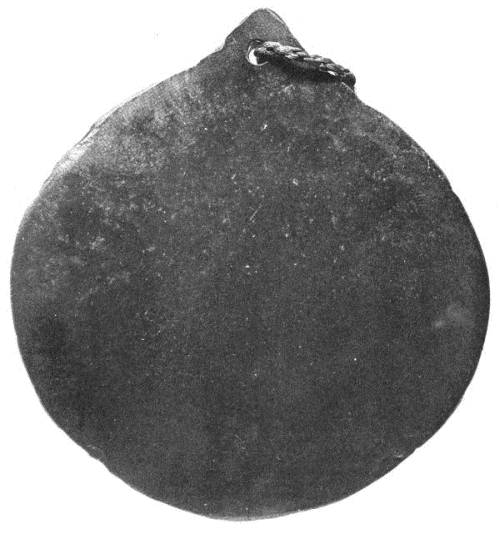
OBSIDIAN MIRROR, WITH NATIVE TEXTILE STRING.
Used by Aztecs and ancient Mexicans for various purposes. British Museum. Identical in shape and size with that known as “Dr. Dee’s Mirror,” now in the possession of Prince Alexis Soltykoff, of Russia. This was enclosed in a leather-covered case.
To give assurance to those who consulted such crystals that no diabolical agency was involved in the production of the phenomena, it was customary that a child should be the crystal-gazer. In Dr. Dee’s experiments, however, it was usually the notorious Kelley, his âme damnée, who undertook this task of interpreting the crystal visions. The description given by Dee of a little girl who frequently acted as the intermediary of the higher powers suggests one of the fanciful creations of our great novelist Hawthorne. Her mystic name was Madimi, and she is depicted as a pretty girl about eight years old, and with long flowing hair. To make her appearance more conspicuous, she was attired in a silk dress with chatoyant effects in red and green. At times, during the séances, this gay little figure could be seen flitting about the study, rendered even more whimsical and strange from its contrast with the piles of dusty old books, the curiosities, and the magical instruments collected there.289
This visionary maiden Madimi, of whom Dee relates so much in his diary, was apparently a child of fancy, a creation of Kelley’s fertile brain. The diary is somewhat obscure in this particular and easily misunderstood; but there can be little doubt that where Madimi is represented as speaking, it is Kelley’s voice that transmits to Dee her revelations. One passage, often overlooked, gives evidence of this. Madimi has appeared and is addressing her remarks to Kelley and to Dee by turns; finally, Dee says, “I know you see me often and I see you only by faith and imagination.” To this Madimi quickly retorts, “pointing to E. K.” (Kelley), “That sight is perfecter than his.” Evidently we must understand this to signify something that Kelley has told Dee, for the latter’s words show that he did not himself see the little fairy pointing to his friend. In many respects little Madimi may recall another “spiritual” maiden of whom we heard much a few years ago, the sprightly little Indian spirit “Bright Eyes,” whose love for candy and jewelry was so very earthly.
Not only the quality of the crystal had to be considered, but also its support and surroundings. Of this we have an interesting instance in the case of Dr. Dee’s crystal. In one of his manuscripts is recorded the fact that on the 10th of March, 1582, Kelley saw in the crystal a representation of the form and arrangement of the table on which it should be set; particular instructions on the matter were also directly imparted to the scryer by the angel Uriel. The table was to be square, measuring two cubits each way and two cubits in height; and it was to have four feet. The material was to be “swete wood” and upon it was to be placed the Sigillum Dei (Seal of God) impressed upon the purest, colorless wax, the disk being 1⅛ inches thick and 9 inches in diameter. It bore a cross and the magic letters A. G. L. A., a transliteration into Roman characters of the initials of the Hebrew words signifying “Thou are great forever, O Lord.” Four other and smaller seals were to be provided, one to be placed under each leg of the table; each of these seals being impressed with geometrical figures within or upon which were the seven sacred names of God and the names of the seven angels ruling the seven planetary heavens; Zabothiel, Zedekiel, Madiniel, Semeliel [Semeshiel], Nogabiel, Corabiel [Cocabiel] and Levaniel, the angels, respectively, of Saturn, Jupiter, Mars, the Sun, Venus, Mercury and the Moon. There then appeared to the scryer the figure of the table with the crystal resting upon it. Of this it is said:290
“Under the table did seeme to be layd red sylk to lye four square somewhat broader than the table, hanging down with four knops or tassells at the four corners thereof. Uppon the uppermost red silk did seme to be set the stone with the frame, right over and uppon the principal seal, saving that the sayd sylk was betwene the one and the other.”
It therefore seems that the prejudice in favor of a black or at least a dark background for the crystal did not appeal to Dr. Dee, and indeed the effect of color may perhaps better serve to neutralize troublesome reflections than does black.
The personages Kelley pretended to see in or around the magic crystal were described by him to Dr. Dee in the greatest detail, and this undoubtedly served to lend more reality and authority to their communications. As an illustration of Kelley’s inventiveness in this matter, we may take his description of “Nalvage,” a spirit that first appeared while the doctor and his famulus were in Cracow, April 10, 1584, and was subsequently a frequent visitor. The seer introduces his new “control” as follows:291
He hath a Gown of white silk, with a Cape with three pendants with tassels on the end of them all green; it is fur, white, and seemeth to shine, with a wavering glittering. On his head is nothing, he hath no berd. His phisiognomy is like the pictures of King Edward the Sixth; his hair hangeth down a quarter of the length of the Cap, somewhat curling, yellow. He hath a rod or wand in his hand, almost as big as my little finger; it is of Gold, and divided into three equal parts, with a brighter Gold than the rest. He standeth upon his round table of Christal, or rather Mother of Pearl.
When reading the words spoken by Kelley and so carefully preserved by Dr. Dee, we are reminded, aside from the archaic turn of speech, of the minute descriptions so glibly given by modern mediums. It is true that lately, in America, the spirits of the former owners of the land, of the blameless aborigines, seem to have acquired a quasi monopoly of the intercourse with the other world.
Most of the early records of crystal-gazing show conclusively enough that the images revealed in the stone were produced by the expectations, the hopes, or the fears of the gazer. In many cases, indeed, the vision is only prophetic because it determines the future conduct of the person who consults the stone. Fully persuaded that what has been seen must come to pass, he, or she, proceeds more or less consciously to make it happen, to fulfil the prediction.
As an instance of this we may take from an old German book292 the tale of a lovelorn maiden who seeks the aid of an enchantress to learn whether she will marry her lover, upon whom her parents look with disfavor. The mystic crystal is brought out wrapped in a yellow handkerchief, and is placed in a green bowl beneath which is spread a blue cloth, the reflections from these different colors being probably calculated to stimulate the optic nerve and favor the appearance of some picture upon the polished surface of the crystal. The young girl, in rapt attention, looks long and earnestly; at last she cries out that she sees her own form and that of her lover. Both look pale and sad, and they appear to be about to set forth upon a long and perilous journey, for the lover wears riding-boots and carries a brace of pistols. The girl is so terrified at the sight that she faints away. The sequel of this vision is a runaway match, and we can easily understand that when the lover proposed this adventure, the girl believed that it was written in the book of fate and willingly agreed to undertake it.
The great humorous poem “Hudibras,” wherein all the foibles of the seventeenth century are castigated, does not fail to make mention of Dee and Kelley and their crystal. Of the sorcerer whose aid Hudibras seeks we are told:293
He’d read Dee’s prefaces before, The Dev’l and Euclid o’er and o’er; And all th’ intrigues ’twixt him and Kelley, Lascus and th’ Emperor, would tell ye. Kelley did all his feats upon The devil’s looking-glass, a stone Where, playing with him at bo-peep He solved all problems ne’er so deep.
In his experiments in crystal-gazing, Dr. Dee evidently used more than one crystal, and did not indeed confine the operations of his scryer or scryers to brilliant spheres. In the collection of Horace Walpole, at Strawberry Hill, was a polished slab of black stone, obsidian, from Mexico. This came into the possession of Mr. Smythe Piggott and later (1853) into that of Lord Londesborough; it is now in the collection of Prince Alexis Soltykoff. Horace Walpole wrote a label for the stone, in which he says that it had long been owned by the Mordaunts, Earls of Peterborough, and was described in the catalogue of their collection as the black stone into which Dr. Dee used to call his spirits. Later it was owned by John Campbell, Duke of Argyle, who gave it to Horace Walpole.294 Undoubtedly any polished surface, whether flat or convex, might serve the purpose of the scryer almost equally well; the possible advantage of a convex or a spherical form consists in the multiplying of the reflections and light points so that the sight is induced to wander from point to point, and that forms and even motions are suggested by the superposition and combination of the various reflections. Often, too, a light point visible to one eye will not be so to the other, this sometimes provoking the phenomenon of binocular vision, which asserts itself for a moment or two, when the diverse images coalesce again, though imperfectly, giving an impression of movement. For one gifted with imagination and the natural quality of visualizing brain-pictures, these shifting light-points and the more or less definite and repeated reflections of surrounding objects offer abundant material out of which to construct lifelike pictures apparently seen in the crystal. That the brain-pictures thus thrown out, so to speak, upon the crystal, may or may not have a peculiar psychic value, other than their value as mere phenomena, depends upon the significance we are inclined to attribute to the processes of the subconscious intelligence; of its existence, indeed, there can be no doubt, and many of our best thinkers incline to the belief that through it the narrow limits of our personality are occasionally transcended.
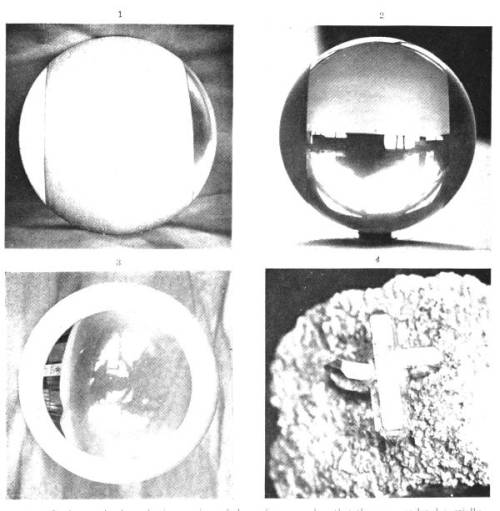
1, 2, 3. Rock-crystal spheres having portions of the surface ground so that they are rendered partially opaque.
4. Natural cross of rock-crystal. On dolomite, Ossining, New York.
The following history and description of a crystal ball is given by John Aubrey (1626-1697):
I have here set down the figure of a consecrated Beryl—now in the possession of Sir Edward Harley, Knight of the Bath, which he keeps in his closet at Brampton Bryan in Herefordshire amongst his Cimelia, which I saw there. It came first from Norfolk; a minister had it there, and a call was to be made with it. Afterwards a miller had it and he did work great cures with it (if curable), and in the Beryl they did see, either the receipt in writing, or else the herb. To this minister, the spirits or angels would appear openly, and because the miller (who was his familiar friend) one day happened to see them, he gave him the aforesaid Beryl and Call; by these angels the minister was forewarned of his death. This account I had from Mr. Ashmole. Afterwards this Beryl came into somebody’s hand in London who did tell strange things by it; insomuch that at last he was questioned for it, and it was taken away by authority (it was about 1645). This Beryl is a perfect sphere, the diameter of it I guess to be something more than an inch; it is set in a ring, or circle, of silver, resembling the meridian of a globe; the stem of it is about ten inches high, all gilt. At the four quarters of it are the names of four angels, viz: Uriel, Raphael, Michael, Gabriel. On the top is a cross patee.295
In his “Saducismus Triumphatus,” Joseph Glanvil writes that “one Compton of Summersetshire, who practised Physick, and pretends to strange Matters,” demonstrated his power to evoke the image of a distant person on the surface of a mirror. Glanvil relates that Compton offered to show to a Mr. Hill any one the latter wished to see. Hill “had no great confidence in his talk,” but replied that he desired to see his wife who was many miles distant. “Upon this, Compton took up a Looking-glass that was in the Room, and setting it down again, bid my Friend look in it, which he did, and then, as he most solemnly and seriously professeth, he saw the exact Image of his Wife, in that Habit which she then wore and working at her Needle in such a part of the Room (then represented also) in which and about which time she really was, as he found upon enquiry when he came home. The Gentleman himself averred this to me, and he is a very sober, intelligent, and credible Person. Compton had no knowledge of him before, and was an utter stranger to the Person of his Wife. He was by all accounts a very odd Person.”296
A contemporary record recites that when a certain Sir Marmaduke Langdale (of the seventeenth century) was in Italy, he went to a sorcerer and was shown in a glass his own figure kneeling before a crucifix. Though a Protestant at this time, he shortly after became a Catholic.297 If we exclude all idea of trickery, it is likely enough that the idea of becoming a Catholic was already present to the scryer’s mind and called up this picture before him.
The celebrated Cagliostro, a Sicilian whose real name was Giuseppe Balsamo, among his other arts to excite curiosity and play upon the superstition of his contemporaries, had recourse to a species of crystal-gazing. In the only authentic biography of this extraordinary impostor occurs the following passage, which we give in Carlyle’s version:298
Cagliostro brought a little Boy into the Lodge, son of a nobleman there. He placed him on his knees before a table, whereon stood a Bottle of pure water, and behind this some lighted candles: he made an exorcism round the boy, put his hand on his head and both, in this attitude, addressed their prayers to God for the happy accomplishment of the work. Having bid the child look into the Bottle, directly the child cried that he saw a garden. Knowing hereby that Heaven assisted him, Cagliostro took courage, and bade the child ask of God the grace to see the angel Michael. At first the child said: “I see something white; I know not what it is.” Then he began jumping, stamping like a possessed creature, and cried: “There now! I see a child like myself, that seems to have something angelical.” All the assembly, and Cagliostro himself, remained speechless with emotion.... The child being anew exorcised with the hand of the Venerable on his head, and the customary prayer addressed to Heaven, he looked into the Bottle, and said he saw his sister at that moment coming down stairs, and embracing one of her brothers. That appeared impossible, the brother in question being then hundreds of miles off; however, Cagliostro felt not disconcerted; said they might send to the country-house where the sister was, and see.
Taken all in all this experiment does not seem very satisfactory; but we have in it all the essential phases of crystal-gazing. Excitement and expectation produced their usual effect upon an impressionable child, and suggestion did the rest; the final vision may have been corroborated in some way, or, if not, it would be explained so as to convince those present at the experiment that the child had really seen a representation of some actual happening.
During the Terror, among those upon whom fell the suspicions of the Jacobins was General Marlière. He knew that a trial and quite probably a condemnation awaited him. A few days before the date fixed for his appearance before his judges, he met a colonel in the French army, who had served in the American Revolutionary War, and who was a firm believer in the truth of the visions seen in crystal balls. In the course of the conversation this subject was alluded to, and the general immediately declared that he was eager to put the matter to the test, and learn, if possible, what fate was in store for him. The colonel was at first very unwilling to undertake the experiment, probably he thought that General Marlière’s doom was sealed, and, believing as he did in the revelations of the crystal, he dreaded the results; however, the general insisted and the experiment took place. As usual, the medium was an “innocent child.” In the crystal appeared a man wearing a private’s uniform of the National Guard struggling with one wearing a general’s uniform. The child was much excited and terrified by the sight, exclaiming that the general’s assailant had thrown him down and was beheading him. That the vision portended the general’s execution was clear enough, but the peculiar dress of the executioner was a mystery to those present at the test, for the official garb bore no resemblance whatever to a soldier’s uniform. The prediction was, however, fulfilled to the letter. General Marlière was tried, found guilty, and guillotined. This in itself did not mean much in view of the innumerable executions in the time of the Terror; but, on the day of this execution, Samson, the official executioner, desiring to gratify his personal vanity and to attract the gaze of the spectators, dressed himself in the uniform of a national guardsman.299 That this altogether unusual circumstance, which could scarcely have been known to any of those who assisted at the crystal-gazing, should have been revealed in the crystal, is certainly very mysterious. If we had positive assurance that the events narrated happened exactly in the way they are said to have happened, this would be one of the few instances in which the vision seen in the crystal reproduced something entirely unknown to the scryer.
Many extraordinary visions are said to have been seen in crystal balls by a French scryer whose grandmother had clairvoyant powers and was sometimes consulted by Napoleon I. It is claimed that the grandson has enjoyed the patronage of many royal personages, and had predicted, in a more or less definite way, the assassination of King Humbert of Italy, and the attempted assassination of Alfonso XIII and of his young bride, when they were returning to the palace after the conclusion of the marriage ceremony. This French scryer has stated that he is powerfully affected when he is consulted by any one destined to die a violent death; on such occasions he feels, in his own organism, a modified form of the particular kind of suffering they are fated to experience. This exceptional sensitiveness to occult influences was also shown when the crystal-gazer went to the Boulaq Museum in Cairo, and gazed upon the rows of mummies exhibited there; he immediately felt, as intensely as though it were a personal experience, the mingled sorrow and rage of the disembodied spirits at seeing their embalmed bodies exposed to the view of the idle crowd, when they should have been permitted to rest in their tombs until the hour of the Resurrection.
In England all those who attempted, with a greater or less degree of success, to reveal the hidden secrets of the future, were expressly designated as rogues and vagabonds according to the terms of an act passed June 21, 1824.300 Such offenders, on being duly convicted before the Justice of the Peace, could be committed to the House of Correction, “there to be kept at hard Labour for any time not exceeding Three Calendar Months.” This class of undesirable citizens comprised all using “any subtle Craft, Means, or Device, by Palmistry or otherwise” for the deception of his Majesty’s subjects.
The h’men, or diviner, of Yucatan, places great reliance upon his zaztun, or “clear stone.” This may be a quartz crystal, or else some other translucent stone; but in order to serve for divining purposes it must be sanctified according to special rites, gum-copal being burned before it, and certain magic formulas recited, which have been transmitted from generation to generation in an archaic dialect. When thus rendered fit for use, the diviner claims to be able to see in the depths of the crystal the whereabouts of lost articles, and also what absent persons are doing at the time he makes his observation. Not only this, but the future is also laid bare before his eyes. As these stones are supposed to possess such miraculous powers we need not be surprised that one of them should be found in almost every village in Yucatan.301
The Apache medicine-men are also fully persuaded that crystals possess the virtue of inducing visions, and they have used them for the purpose of finding lost property. To aid in the recovery of stolen ponies is one of the most important tasks of the Apache medicine-man, and to this end his crystal offers great assistance. Capt. John G. Burke relates that he made a great friend of a medicine-man named Na-a-che by giving him a large crystal of denticulated spar, much superior to the crystal he had been in the habit of using for his visions. That this was thoroughly satisfactory to the medicine-man at least, is shown by his statement to Capt. Burke that by looking into his crystal he could see everything he wanted to see. Of the way this came about he did not attempt any explanation.302
The magic power supposed to dwell within rock-crystal has been recognized in a peculiar way by some natives of New South Wales. They have the barbarous custom of knocking out one or more of the front teeth of their boys at the obligatory initiation ceremonies, and on one occasion Dr. Howitt was entrusted with the care of a number of these teeth, which are believed to preserve a certain undefined connection with the health and fortunes of their former possessors, and on this account great fear was expressed lest the custodian should place the precious teeth in the same bag with some rock-crystals, for the natives thought that the magic power of these crystals would injuriously affect the teeth, and through them the boys, from whose jaws they had been broken.303
In a paper entitled “The Origin of Jewelry,” read before the British Association, Professor W. Ridgeley says:
Australians and tribes of New Guinea use crystals for rain-making, although they cannot bore them, and this stone is a powerful amulet in Uganda when fastened into leather. Sorcerers in Africa carry a small bag of pebbles as an important part of their equipment. So it was in Greece. The crystal was used to light the sacrificial fire and was so employed in the church down to the fifteenth century. Egyptians used it largely under the XII Dynasty, piercing it along its axis after rubbing off the pyramid points of the crystal, sometimes leaving the natural six sides, or else grinding it into a complete cylinder. From this bead came the artificial cylindrical glass beads made later by the Egyptians.
Professor Ridgeley believes that the primary use of all these objects was because of their supposed magic powers. He holds the same view in regard to cylinders and rings, considering that the use of these as signets only became habitual at a later time, and he finds a proof of this theory in the fact that unengraved Babylonian cylinders and Mycenean gems have been discovered. This is, of course, perfectly true, but does not in the least prove that such ornaments may not have been originally worn simply for purposes of adornment; unquestionably, the custom of engraving them so as to render them signets must have arisen at a much later date.
Flacourt stated that the natives of Madagascar used crystals to aid them in divining. These stones, which were said to have fallen from heaven, were attached to the corners of the boards whereon the sorcerers produced their geomantic figures.304 Here, however, the crystals were not directly used, but were only supposed to attract influences propitious to the diviner’s efforts.
In the notes to the 1888 edition of the Chinese criminal code, some curious details are given of a practice called Yuan-kuang-fuchou (the magic of the round glittering). While this designation certainly seems to indicate the use of a polished sphere of some description, the details given refer to a different practice. We are told that when anything was stolen appeal was sometimes made to a certain Sun-Yuan Sheng, who would then hang up a piece of white paper and utter a spell, while a boy gazed upon the paper until he saw the figure of the thief. This magician was punished for carrying on an unlawful practice.305
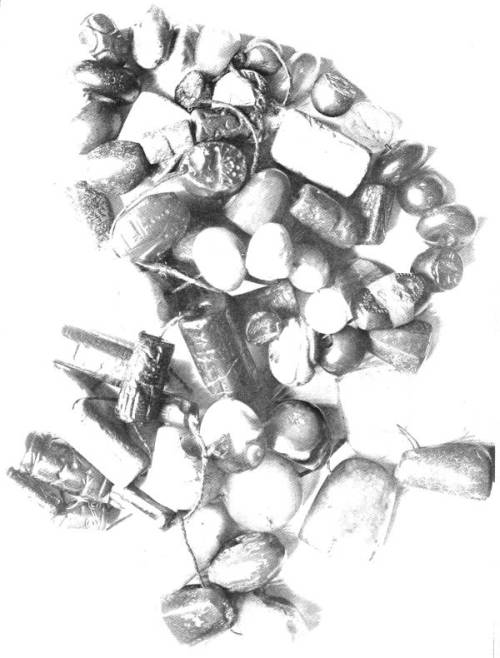
BABYLONIAN CYLINDERS AND PERSIAN BEADS. Of hematite, rock-crystal, lapis-lazuli, chalcedony, banded agate, and other stones. From 3000 B.C. to the Christian era. (See page 121.)
The Mexicans made images of their god Tezcatlipoca of obsidian, and the name of this divinity is interpreted as signifying “shining mirror.” This is supposed to refer to, or to have been expressed by, the brilliant effect of the polished surface of the obsidian. Mirrors of this material are said to have been used for divination in ancient Mexico and the neighboring countries.306 One of these Mexican mirrors seems to have been employed by Dr. Dee in his experiments in crystal vision.
A remarkable series of tests in the art of scrying, given in the presence of Lane, the great Arabic scholar, and translator of the Arabian Nights, illustrates the fallibility of most of the evidence adduced in such matters, for, at first, Lane was strongly impressed by the exhibition. Although no crystal was used, the process of scrying was precisely the same as in crystal-gazing,—that is to say, the vision called for by the visitors was seen by the scryer on a polished surface. The master of ceremonies was an Arab magician, though, of course, he did not do the scrying himself, but employed a boy for this purpose, for it is generally thought that half-grown boys or girls are more receptive. Although Lane himself was perfectly familiar with Arabic, an interpreter was always present in the interest of the other Europeans who assisted at the experiments.
After invoking many mysterious geniuses and burning incense and scraps of paper inscribed with magic formulas, the magician drew a magic square on a large sheet of paper and dropped a quantity of ink in the centre. On this the boy was directed to fix his gaze, and after he had shown that he was thoroughly under the magician’s influence, by describing the images suggested to him, the visitors were permitted to ask him questions. The answers were successful in most cases; a single instance will suffice. When the boy was asked to describe Admiral Nelson, he replied: “I see a man clothed in a dark garb; there is something strange about him, he has but one arm.” Then, quickly correcting himself, he added: “No, I was mistaken, he has one of his arms across his breast.” This correction impressed those present more than the first statement, for it was well known that Nelson usually had the empty sleeve of his coat pinned to his breast. It also seemed as though there could be no collusion, for both the magician and the boy were ignorant of everything English and evidently knew nothing of Nelson. Unfortunately, however, for those who would fain believe that there is something supernatural in scrying, it was later discovered that the interpreter was a renegade Scotchman, masquerading as an Arab, and there can be little doubt that he managed to suggest the boy’s answer. The fact that no satisfactory results were obtained when this interpreter was absent, makes this explanation almost certainly the correct one.
The Armenians sometimes practised divination by watching the images that appeared, or were supposed to appear, on the smooth surface of the waters of a well, and the person who saw such images was called hornaiogh, “he who looks into a well.” An Arab woman living in the neighborhood of Constantinople enjoyed a great reputation for her power in this respect, and was frequently consulted by Armenians and by other dwellers in the Turkish capital. Whoever wished to question this woman regarding the cause of an illness, the whereabouts of stolen objects, etc., usually took along a child of the household, and the actual scrying was generally performed by this child, who would describe or identify the forms it saw on the water’s surface. If, however, for one reason or another, no child was brought, the witch herself did the scrying. In regard to illness, a distinction was made between “natural” maladies and those directly caused by some spirit. Should the spirit (peri) supposed to cause the dire malady known as drsévé, a kind of consumption, be seen to glide over the surface of the water, the sorceress would find it necessary to invoke the whole race of peris to come to the aid of the patient, who was expected to pay more than the usual fee for this very special service.307
The peris of Armenian legend were sometimes good and sometimes evil spirits; in the former case these were supposed to perform the functions of guardian angels, and every one was said to have a peri especially delegated to watch over him. This found expression in the fact that when one Armenian felt at first sight an instinctive sympathy for another, he would say, “My peri loves you dearly (peris chad siretz kezi).” In the contrary case, the feeling of antipathy was also attributed to the attitude assumed by the guardian spirit toward the new acquaintance.308 These spirits were therefore supposed to encourage or discourage greater intimacy with newcomers in accord with the true interests of those over whom they watched.
The power to see images in a crystal does not appear to depend to any great extent upon a morbid nervous condition of the seer, for many of the most successful experimenters have been of good and even of exceptionally vigorous physique. Indeed, illness seems to diminish or destroy this power, at least in the case of those who are habitually healthy.309 This does not imply that some highly nervous and even hysterical individuals have not been favored with “crystal visions.” Very probably the rule here is the same as in ordinary hypnotism. Those persons who have a strong will and sound nerves are able to hypnotize themselves, while those whose nerves are disordered are subject to the hypnotic influence of others.
A well-known lady in New York City, in conversation with the writer, a few years ago, on the subject of crystal balls, was advised by him to try a ball herself and see what results she obtained. At the end of two years she found that by concentration she had been able to better her understanding of herself; and this effect is not only obtainable now by means of a crystal ball, but by fixing her gaze upon any bright object. This visual fixation has centred her whole being in such a way that her health has notably improved.
What are the laws that govern the production of these phenomena? That the “visions” are real enough has been proven time and again, but it seems almost certain that they do not offer anything but the ideas or impressions existing in the minds or optic nerves of the gazers. One of the most painstaking students of the subject, Miss Goodrich-Freer, gives many instances in proof of this, which show how easy it would be for a less critical observer to suppose that the crystal revealed something unknown to the gazer. On one occasion this lady was at a loss to remember the correct address of a friend whose letter, received a few days before, she had torn up. She resorted to her crystal, and after a few minutes saw in it, in gray letters on a white ground, the address she had forgotten. She mailed her answer to this address, and the reply came duly to hand, with the address stamped in gray upon the white paper of the note, which was identical with that she had first received.310 The visual impression had been stirred up and “externalized” itself when she gazed upon the crystal. We believe that this explains the larger number of such visions, and that the rest are only inexplicable because the scryer has forgotten the source of the impression that is projected on the surface of the crystal.
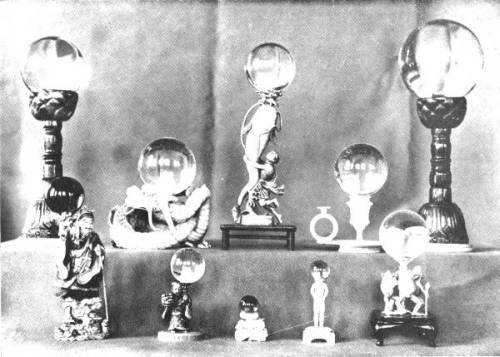
ROCK-CRYSTAL SPHERES. JAPANESE. (See page 217.)
It is true that both Miss Goodrich-Freer and many other crystal-gazers note instances in which the vision appears to represent something the scryer does not and cannot know. However, even in these cases, when carefully examined, there is little difficulty in finding an explanation. Coincidence accounts for much, and imagination for more, since it is not the vision itself, but the memory of the vision, that is later brought into comparison with actual facts. We all know how exceedingly hard it is to repeat, after a short lapse of time, all the circumstances and details of any occurrence. There is a natural growth and modification of mental impressions, due to association of ideas, and where there exists the least wish to make the prophecy accord with the event, or the vision with the coincident happening, this growth and modification will be in the direction of agreement. This takes place quite unconsciously, and the informant will be fully persuaded that all the circumstances are related exactly as they occurred.
The attempt to identify either persons or scenes observed by the scryer with real persons and real scenes unknown to him, must always be open to the objection that the one who makes the identification has no photographic impression upon which to base his judgment, but merely the words of the scryer. When we remember what mistakes have been made in identifying individuals from photographs, we can easily appreciate the great chances of error entailed by the use of a verbal description of a visionary experience, even when the person giving the description is both willing and able to make it as exact and adequate as possible.
A very impartial witness, Andrew Lang, states that, in the course of a series of experiments he made in crystal-gazing, he saw nothing himself, but found that a surprisingly large proportion of those who tried were successful in seeing pictures of some sort on the polished surface. Almost invariably, when the gazer fixed his eyes upon the sphere, it appeared to grow milky-hued and then became black; upon this dark background the pictures showed themselves. One of the scryers, a lady, said that as a child she had seen pictures in ink that she had spilled for the purpose.311 This method has been much favored by Orientals. While Lang does not quite venture to assert that all the “visions” reported to him were genuine ones, he inclines to the belief that this was the case with many of them. Experience has shown, however, that not all of those who see pictures in, or on, a glass or crystal sphere, can also see them in ink.312 Nevertheless, in view of the fact that the crystal sphere is said to appear black to the eye before the pictures are seen, it would seem that some naturally black surface would be particularly adapted for the purpose.
An interesting point regarding the phenomena of crystal-gazing is the effect produced by magnification upon the images seen in, or on, the crystal ball. As to this matter there is considerable difference of opinion, for, while some experimenters assert that the interposition of a magnifying-glass enlarges the image, others have not remarked any difference in its size under these conditions. Indeed, one of the most critical witnesses, Mrs. A. W. Verrall, declares that her vision entirely disappeared when she held a magnifying-glass before her eyes. On the other hand, we have the case of a subject who had been told, while in the hypnotic state, that he would see a play-bill on the crystal. When he was awakened and the crystal ball was placed before him, he said that he could see only detached letters, but when he looked through a magnifying-glass he saw all the letters distinctly and read the name of the play, in perfect accord with the suggestion.313
This image may have been reflected from some part of the room where the gazer had not noticed it, and may have been either before or behind the operator. The magnifying-glass would naturally make the small, condensed letters legible, as a play-bill would be many times larger than a crystal ball, and its minute image naturally too small to read, being reduced by the circular surface.
Usually, however, the image is not on the surface of the crystal, but in the beholder’s eye; therefore when this image appears more clearly under magnification, the result is due to the expectation of the gazer based upon his experience of an invariable rule. This acts as a stimulus upon the visual function, which must be in an exceedingly sensitive state to produce visions at all. When, however, no result or a negative result follows the use of the glass, then we can safely assume that the gazer was naturally of a critical turn of mind, and was disposed to distrust sensual impressions; hence the glass became a disturbing influence, interfering with or even completely obliterating the eye-picture.
Many attempts have been made to establish distinctions between the different materials used for crystals, proceeding on the theory that subtle emanations from them affected the gazer and played an important part in producing the desired vision. That the beryl produced a greater number of these visions than any other mineral was the old belief which is still upheld in some quarters to-day; one scryer, indeed, asserts that his clearest and most satisfactory visions were seen in a cube of blue beryl, the beautiful color appearing to dispose the soul to a harmonious unfolding of its latent aptitudes.314
Among the instructions given to a would-be crystal gazer, the question of a proper and wholesome diet is not overlooked, as anything which tends to disturb the serenity of the organism will also interfere with the due exercise of the special clairvoyant faculty that expresses itself in crystal visions. A curious special recommendation made by one of the exponents of the art is that good results can be had by drinking an infusion of mugwort (Artemisia vulgaris), or of chicory (Cichorium intybus), because of their tonic and antibilious qualities. Moreover, we are told that these herbs are under the influence of the zodiacal sign Libra, the sign controlling the virtues of the beryl.315 Above all the portion of the lunar month when the moon is on the increase is said to be far the best season for scrying, as the old astrologers recognized an affinity between the moon and rock-crystal.
The claim is made that the adept at crystal-gazing can determine by the apparent difference in proximity of the visions whether they refer to the present or to a more or less remote past or future, that is to say, are nearer or farther removed in time from the period when the vision appears. The distinction between past and future is admitted to offer greater difficulty and a decision as to this point must depend upon a kind of intuitive and undefined impression on the part of the scryer.
Those who have made a sympathetic study of crystal-gazing recognize that the “visions” seen in or on the crystal differ according to the mental and psychic temperament of the scryer. Two broad distinctions are sometimes established, the one class comprising those whose mental attitude is a “positive” one while the second class includes the “passive” subjects. In the former case the crystal visions are more apt to be symbols denoting some past or future event than a clear picture of the event itself, the mentality of the “positive” subject being, perhaps, too strong merely to mirror the image cast upon it. Instead of so doing it transforms the impression received from this image into some symbolic form. This process is not, however, consciously done, but the scryer of this type is supposed nevertheless to have an instinctive appreciation of the fact that what he sees is purely and simply a symbol, and he proceeds to interpret this in accord with certain generally received rules, or in accord with his own personal experience.
The passive subject on the other hand is more apt to see a clear and definite picture of the persons or events revealed to him. Sometimes that picture is distinctly perceptible on or about the surface of the crystal, while at other times the visual perception will be rather indefinite and clouded, although accompanied by a strong mental impression in itself equivalent to that which would have been induced by an actual and objective vision.316
The proper use of the crystal is the prime factor in the art of scrying and great attention is paid to this point by all those who treat seriously of the subject. Among other things they recognize that freedom from pain, or even from a sense of physical discomfort, is quite essential, for the mind must assume a purely passive and receptive attitude, and not be forced to take cognizance of bodily discomfort. Moreover the nervous system must be in repose, for which reason a reasonable time should be allowed to lapse after taking a meal, before trying for crystal visions.317
An author on “psychomancy” affirms that fixing the gaze upon a crystal ball is one of the very best means of bringing out the latent faculty of astral vision, and he finds a reason for this in the atomic structure, the molecular arrangement of the material. He does not, however, impart any definite information as to what special structural characteristics render glass or rock-crystal particularly efficient in this direction.318 The help that may be derived from crystal-gazing by those who are striving to pierce the veil that separates the “real life” about us from that spiritual life which is so much more real for those who believe in it, is also admitted by many.319
We cannot refrain from citing here the words spoken by Sir Oliver Lodge at Birmingham, Sept. 10, 1913, before the British Association for the Advancement of Science, affirming his conviction, as a result of scientific investigation of occult phenomena, “that memory and affection are not limited to that association with matter by which alone they can manifest themselves here and now, and that personality persists beyond bodily death.”
One of the latest types of glass balls for crystal-gazing has a small, circular, flat surface on the sphere. This may possibly be of service in furnishing a better field for the expected vision, and may also lessen the troublesome and baffling reflections which interfere so seriously with the projection of the mental picture.
A method that has been recommended to crystal-gazers is to place the crystal on a table, protect it from the reflections of surrounding objects by means of a velvet screen, and set seven candlesticks with wax tapers in front of the screen. The tapers are then to be lighted, the room being otherwise in perfect darkness, and the would-be scryer is to seat himself comfortably before the table, laying his hands flat upon it, and to gaze fixedly upon the crystal for half an hour or longer. The light from the tapers will certainly ensure a multitude of light points in the crystal. That the molecules forming the sphere may always remain en rapport with the gazer, he is advised to put it beneath his pillow when retiring to rest.320
The crystal gazer is strongly advised by some to limit the duration of his experiment at first to five minutes, during which he is to avoid thinking of anything in particular while keeping his eyes fixed intently upon the ball, but without any undue straining of attention. Should the eyes “water” after the test is concluded, this is to be regarded as an indication that the gazer has persisted too long; for brain-fag is to be strictly avoided, as such a state depresses instead of arousing the hidden and higher psychic faculties. Even after considerable practice, the scrying should not be carried on for more than a few minutes at a time. The faculty of visualization plays a most important part in crystal-gazing. The image thought to be seen on, before, or behind the surface of the crystal, is in its essence a fancied projection of a purely mental image conceived in the brain; such an image as is present to the consciousness of many when they call to mind a scene of some vivid past experience, or the face of someone they have known, and see it as an element of consciousness. When it is possible to externalize this interior vision, then we have at least a beginning of successful scrying. That it may go far beyond this, that it may reveal to the gazer events happening in some distant place, or even events yet to transpire in the dim future, is often claimed. An acceptance of this claim must depend largely upon our attitude toward premonitions and prophecies in general. Here, as in the simple picture evolved by an image of the past, the crystal is merely the background upon which are cast the mind-pictures or soul-pictures arising within our being.321
A use of crystal gazing to aid literary composition has been reported in the case of an English authoress of note, who, if she lost the thread of the story she was writing, would resort to her crystal, and would see mirrored therein the scenes and personages of her tale, the latter carrying on the plot in dramatic action. Aided by this suggestion she was able to resume her composition and successfully terminate her story.
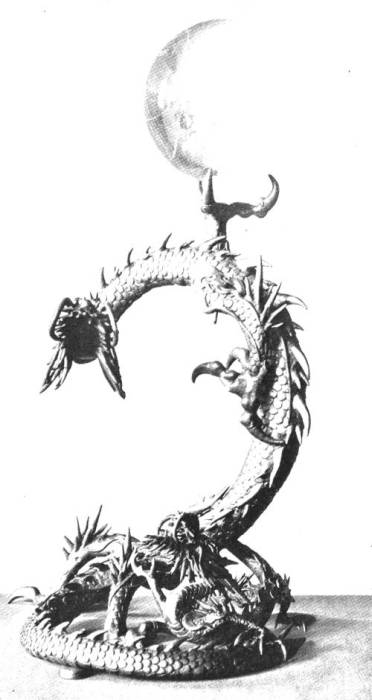
CRYSTAL BALL, SUPPORTED BY BRONZE DRAGON. JAPANESE.
In Japan the smaller rock-crystals were believed to be the congealed breath of the White Dragon, while the larger and more brilliant ones were said to be the saliva of the Violet Dragon. As the dragon was emblematic of the highest powers of creation, this indicates the esteem in which the substance was held by the Japanese, who probably derived their appreciation of it from the Chinese. The name suisho, used both in China and Japan to designate rock-crystal, reflects the idea current in ancient times, and repeated even by seventeenth century writers, that rock-crystal was ice which had been so long congealed that it could not be liquefied.
For the Japanese, rock-crystal is the “perfect jewel,” tama; it is at once a symbol of purity and of the infinity of space, and also of patience and perseverance. This latter significance probably originating from an observation of the patience and skill shown by the accurate and painstaking Japanese cutters and polishers of rock-crystal.
A crystal ball, one of the largest perfect spheres ever produced, has been made from rock-crystal of Madagascar. It is a very perfect sphere and of faultless material. The diameter is 6⅛ inches and the ball was held at about $20,000.
Many fine crystal balls are made in Japan, the materials being found in large, clear masses in the mountains on the islands of Nippon and Fusiyama and also in the granitic rocks of Central Japan. It is stated, however, that much of the Japanese material really comes from China. The Japanese methods of working rock-crystals are extremely simple and depend more upon the skill and patience of the workers than upon the tools at their command. Our illustration, taken from a sketch made by an Oriental traveller, shows the process of manufacturing crystal balls. The rough mass of crystal is gradually rounded by careful chipping with a small steel hammer. With the aid of this tool alone a perfect sphere is formed. The Japanese workmen thoroughly understand the fracture of the mineral, and know just when to apply chipping and when hammering. The crystal, having been reduced to a spherical form, is handed to a grinder, whose tools consist of cylindrical pieces of cast iron, about a foot in length, and full of perforations. These cylinders are of different curvatures, according to the size of the crystal to be ground. Powdered emery and garnet are used for the first polishing. Plenty of water is supplied during the process, and the balls are kept constantly turning, in order to secure a true spherical surface. Sometimes they are fixed on the end of a hollow tube and kept dexterously turning in the hand until smooth. The final polishing is effected with crocus or rouge (finely divided hematite), giving a splendid lustrous surface. As hand labor is exclusively used, the manufacture of crystal objects according to the Japanese methods is extremely laborious and slow.322
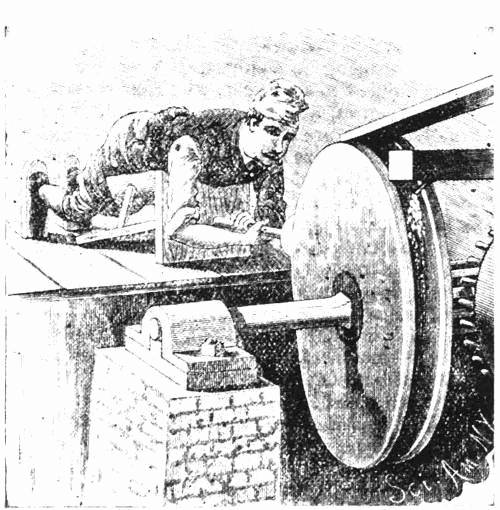
By permission of the “Scientific American.” METHOD OF GRINDING CRYSTAL BALLS AND OTHER HARD STONE OBJECTS IN GERMANY AND FRANCE.
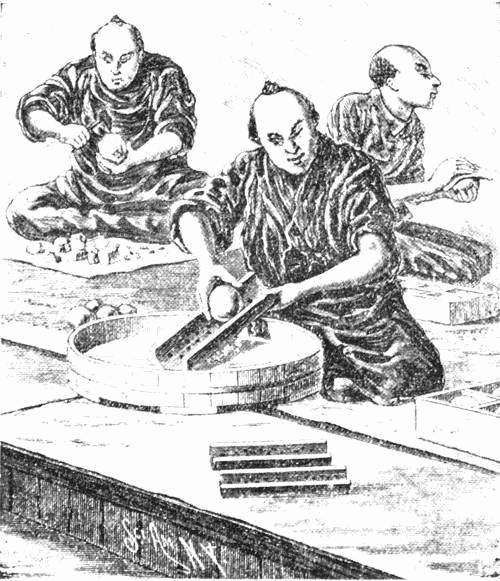
By permission of the “Scientific American.” JAPANESE METHOD OF CHIPPING, GRINDING AND POLISHING ROCK-CRYSTAL BALLS.
In Germany and France and in the United States, the fabrication of rock-crystal is accomplished almost entirely by machinery. The crystal to be shaped into a ball is placed against a semicircular groove worn in huge grindstones. This is illustrated in the case of the method practised in Oberstein, Germany. The workman has his feet firmly braced against a support, and, resting upon his chest, presses the crystal against the revolving grindstone. It is unnecessary to add that the practice is extremely unwholesome and develops early consumption among the workers. A constant stream of water is kept flowing over the stone so that the crystal shall always be moist, as the friction would otherwise hurt it, and the subsequent addition of water would be liable to cause a fracture. The final polishing is done on a wooden wheel with tripoli, or by means of a leather buffer with tripoli or rouge.323
There are three fine crystal balls in the collection of the American Museum of Natural History. One, apparently perfect, measures 5½ inches in diameter and was cut from a crystal found in Mokolumne, Calaveras Co., California; the second is 6½ inches in diameter and is from the same locality, but not entirely perfect. These were shown in the department of the Tiffany Collection prepared by the author, and were exhibited at the Paris Exposition of 1900 as part of the J. Pierpont Morgan gift to the American Museum of Natural History. Another fine crystal ball is now to be seen in the American Museum of Natural History, New York; this was donated to the institution. It measures 411/16 inches in diameter, is of wonderful purity, and the cutting has been executed with such a high degree of precision that an ideally perfect sphere has been produced.324
Crystal balls have been found occasionally in tombs or in funerary urns, and their presence in sepulchres may perhaps be considered to have been due to a belief that they possessed certain magic properties. In the tomb of Childeric (ca. 436-481 A.D.), the father of Clovis, a rock-crystal sphere was found which was for a time preserved in the Bibliothèque Royale, Paris, and later in the Louvre Museum; it measures 1½ inches in diameter.325 The chance discovery of a number of crystal balls is related by Montfaucon. Towards the end of the sixteenth century, the canons of San Giovanni in Laterano, Rome, wished to have some repairs made to a house they owned, just outside of the city walls, and sent thither some workmen with the order to break up or remove two large, superimposed stones, which were much in the way. The workmen proceeded to break the upper stone, but were much astonished to find embedded within it an alabaster funerary urn with its cover. This had been hidden between the two stones, a space for its reception having been hollowed out in the upper and lower stones, so that it fitted within them. Opening the urn there were found inside, mingled with the ashes, twenty crystal balls, a gold ring with a stone setting, a needle, an ivory comb, and some bits of gold wire. The presence of the needle was taken to indicate conclusively that the ashes were those of a woman.326
The discovery of the tomb of Childeric was made, May 27, 1653, by a deaf-mute mason, named Adrien Quinquin, while he was excavating for the restoration of one of the dependencies of the church of Saint Brice de Tournai. One of the most interesting objects found in the tomb was the golden signet of Childeric bearing his head and the legend Childerici regis. The earliest description is given in a work by Chiflet entitled “Anastasis Childerici,” “Resurrection of Childeric,” published by Plantin of Antwerp in 1655. The various ornaments were sent by the Spanish Governor-General of the Netherlands to the Austrian treasury in Vienna, and were not long afterward, in 1664, graciously donated by Emperor Leopold I to King Louis XIV, at the instance of Johann Philip of Schonborn, Archbishop of Mainz, who was under great obligation to the French sovereign.
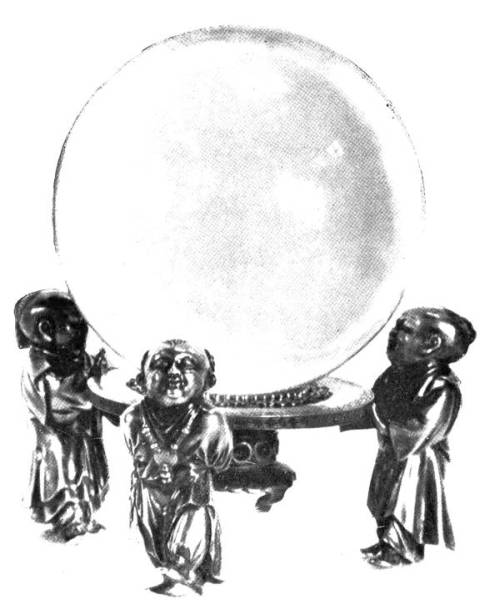
ROCK-CRYSTAL SPHERE. Japan, five inches diameter. Morgan collection, American Museum of Natural History, New York.
In Paris the various ornaments were preserved in the Bibliothèque Royale until the night of November 5-6, 1831, when many of them, with other valuables, were stolen by an ex-convict. Closely pursued by the police, the thief threw his booty into the Seine; much of the plunder was subsequently recovered, but the signet of Childeric was lost for ever. The crystal ball had not seemed of sufficient value to tempt the thief and was left undisturbed; it was later, in 1852, deposited in the Louvre Museum.327
In a personal communication to Abbé Cochet made in 1858 by Mr. Thomas Wright, the latter stated that he had seen at Downing in Flintshire with Lord Fielding five crystal balls, bearing labels declaring that they came from the sepulchres of the kings of France violated at the time of the French Revolution. They had been purchased about 1810 at the sale of the Duchess of Portland’s effects.328
Among the crystal balls found in French sepulchres may be noted one discovered by Rigollot in 1853 at Arras, and preserved in the Museum of that city; this still has the original gold mounting serving to attach it to the necklace from which it had been worn suspended. Another found at or near Levas was in the possession of M. Dancoise, a notary of Hénin-Liétard, dept. Pas de Calais.329 In the Bibliothèque at Dieppe there is a crystal ball, 32 mm. in diameter, found at Douvrend, dept. Seine-Inferieure, in 1838, in a Merovingian tomb; this is pierced through.330 The department of Moselle supplied three discoveries of this kind, crystal balls having been found in a tomb at St. Preux-la-Montagne, Sablon and Moineville near Briey, the latter measuring 36 mm. in diameter.331
The Saxon tombs of England have also furnished a contingent of crystal balls, for example at Chatham, at Chassel Down on the Isle of Wight, where four were discovered, at Breach Down, Barham, near Canterbury, at Fairford, Gloucestershire, and also in Kent.332
We should also note a crystal ball found in a funerary urn at Hinsbury Hill, Northamptonshire;333 this as well as the one found at Fairford was facetted.334 From St. Nicholas, Worcestershire, is reported a crystal ball 1½ inches in diameter.335
In his “Hydrotaphia, or Urn Burial,” published in 1658, Sir Thomas Browne (1605-1682), author of the “Religio Medici,” relates that there was at that time in the possession of Cardinal Farnese, an urn in which, besides a number of antique engraved gems, an ape of agate, and an elephant of amber, there had been found a crystal ball and six “nuts” of crystal.336
One of the largest and most perfect crystal balls is in the Dresden “Grüne Gewölbe” (Green Vaults). This weighs 15 German pounds and measures 6⅔ inches in diameter; it was undoubtedly used for purposes of augury. Ten thousand dollars was the price paid for it in 1780.
A crystal ball known as the Currahmore Crystal, because it is kept at the seat of that name belonging to the Marquis of Waterford, has long enjoyed and still enjoys the repute of possessing magical powers. It is of rock-crystal, and the legend runs that one of the Le Poers brought it from the Holy Land, where it had been given him by the great crusader Godefroy de Bouillon (1058-1100). The ball is a trifle larger than an orange and a silver ring encircles it at the middle. The chief and much-prized virtue of this crystal is its power to cure cattle of any one of the many distempers to which they are subject. Its application for this purpose is rather peculiar, for the cattle are not touched with it, but driven up and down a stream in which it has been laid. Not only in the immediate neighborhood of Currahmore is resort had to this magic stone by the peasants, but requests for its loan are often made from far distant parts of Ireland. The privilege is almost always accorded and has never been abused, the crystal being in every case conscientiously returned to its rightful owner.337
The names “ghost-crystals,” “phantom-crystals,” “spectre-crystals,” “shadow-crystals,” etc., are applied to a form of quartz in which the crystallization was interrupted from time to time, so that in the transparent successive layers there is an occasional opaque layer, often no thicker than the finest possible dusting of a whiter material. Sometimes as many as fifteen or twenty of these successive growths are observable, one over the other. When these crystals are in the natural form, they show beautifully from the sides and ends. Sometimes such crystals are found after they have been rolled in the beds of mountain torrents until they have become entirely opaque, but when the surfaces are polished, the “phantom,” “spectre,” or “ghost,” appears with wonderful beauty. Occasionally the entire crystal has been worn down to a small part of the original prism, in which case it is cut into a ball. The ball may seem to be absolutely pure, but when held in certain lights little tent-like markings can often be observed; sometimes only one marking is visible, but there may be as many as twenty. These are occasionally due to a layer of smoky material, and, though they add a charm to the ball, they detract from its value. Nevertheless, crystal-gazers may find an additional interest when the “ghostly” or “spectral” interior exists in a crystal ball. This growth is similar in kind to that seen at times in opaque quartz, forming what is known as cap-quartz; here the crystallizations can frequently be broken apart so that they fit one over the other in many successive layers. Occasionally the regular crystalline development will be interrupted, as it were, and in place of the original crystal continuing its growth harmoniously, a larger crystal will form on a smaller one, forming a sort of mushroom, or “cap,” or “stilt” quartz, as it is termed.
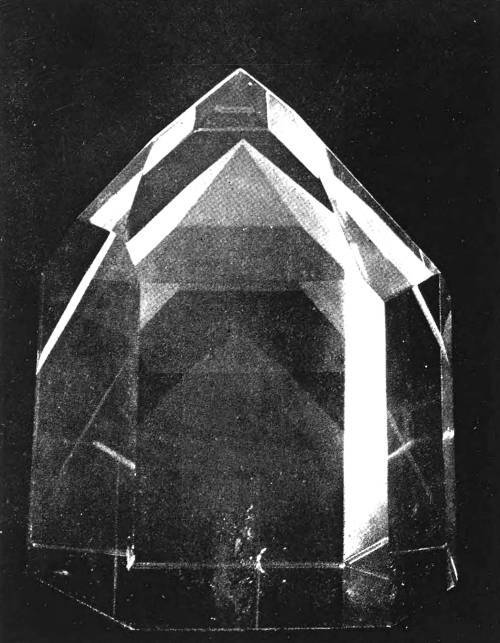
“PHANTOM CRYSTAL” OF QUARTZ (ROCK-CRYSTAL) MADAGASCAR. In possession of the author.
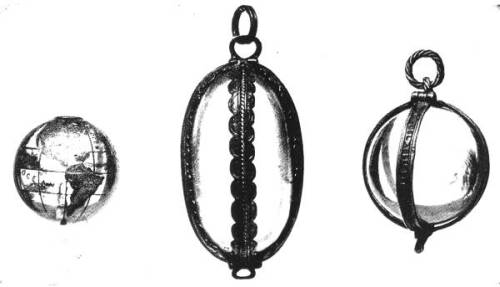
1. Rock-crystal, engraved with a map of the world. Russian work. 2, 3. Rock-crystal balls (one elipsoidal) mounted in silver. Probably twelfth or thirteenth century. Used for ornaments and possibly for scrying purposes. Collection of Sir Charles Hercules Read.