"A Story of Arctic Adventure" (continued 5)
Reading edition
So light were Allan’s slumbers that the snapping of a twig or branch, some distance away in the thicket, caused him to spring up at last and seize his rifle. He listened, but there was no unusual sound to alarm him. The forest he knew was filled with wolves, but he also knew from experience that the courage of the brutes is of no very high standing, and unless they came in numbers they would hardly dare to attack him.
He heaped branches of wood and logs on the fire nevertheless. While so engaged there fell upon his startled ear the sounds of hurried breathing close behind him, and next moment, even before he had time to raise his rifle to defend himself, an animal bigger and more powerful than a buffalo-wolf had sprung upon and rolled him to the ground.
And this animal, reader, was none other than his own great honest Oscar. When McBain and his party, still on Allan’s trail, had encamped for the night, this good dog had stolen away and left them. Night and darkness were nothing to him, nor did he fear bears or wolves, or anything else that makes a forest dangerous to traverse after sundown. He was instigated by the love he bore for his master, and guided by scent alone.
But what a change his presence made on Allan’s mind!
He felt no longer gloomy and hopeless, and as he hugged the giant Saint Bernard, he could not help dropping tears upon his broad brow. Only they were tears of joy, and tears that relieved his pent-up feelings and cooled his burning brain.
If the dog could only have spoken, a most animated conversation would have ensued forthwith.
But as soon as Oscar had relieved his feelings by a series of wild gambols and quixotic performances that are simply indescribable, Allan plied him with a hundred questions, and talked to him just as if the poor animal knew every word he uttered.
“And how did you find me, dear old boy? What a blessing you are, to be sure! But do you know I took you for a great wolf, and it is a wonder I didn’t shoot you? Oh! think what a thing it would have been if I had killed my dear kind Oscar. It won’t bear thinking about. And where did you leave our friends? They are coming to seek for me, I know; but you, you impatient boy! you must give them the slip and come paddling along through the dark dreary forest to look for your beloved master. Heigho! but I am so glad you’re here. I am so happy, and I am so hungry too. And, by the way, that reminds me I roasted a rabbit last night, Oscar, and could hardly touch it. But we’ll have it now. What have you got in the little barrel at your collar? Coffee, I declare! Well, well, well!”
Talking thus, Allan shared his supper with his friend, and then laid himself down by his side, using the dog as his pillow, just as he had often done when resting at home, among the blooming heather on the braes of Arrandoon. That was the sweetest and most refreshing hour’s slumber ever he remembered having enjoyed.
He awoke at last like the proverbial giant refreshed, and found his pillow sitting up alongside of him, and gazing down at him with loving hazel eyes.
“Hullo, Oscar!” he said: “day is breaking yonder in the east; it is almost time we were moving.”
The dog shook himself as much as to say,—
“I’m ready at a moment’s notice to guide you safely home.”
There was a broad belt of red light in the distant horizon and towards this Oscar attempted to lead his master, with many a bound and many a bark.
But Allan wouldn’t budge.
“Not in that direction, Oscar, old boy,” he said; “our road lies towards the setting, not the rising sun.”
“Bow, wow!” barked Oscar, as if reasoning with him, “bow, wow, wow, wow!”
There was something in the dog’s demeanour that set Allan a-thinking. Could the animal really be right and he wrong? He examined the belt of red light more carefully now. Was that the east? Was that indeed the crimson clad vanguard that heralds the coming day? Nay, it could not be, the red was a more lurid red, the light was a fitful light, and as he gazed he could distinctly make out a confused rolling of great clouds over it. Then all at once the truth flashed across his mind.
The forest was on fire!
How this happened the reader may at once be told: sparks from McBain’s camp fire had towards morning ignited the withered needles that had fallen from the pine-trees, the brushwood had caught, and next the underwood of the spruce-trees, and at the very moment that Allan was gazing skywards his friends were rushing headlong through the woods, pursued by the devouring element.
Would they ever meet Allan again?
Chapter Twenty One.
Narrow Escape—A Terrible Scene—Allan and Oscar—A Gloomy Evening—Reunion—Seth’s Adventure—A Welcome Back.
For a minute or more escape from the terrible fire seemed to our heroes an utter impossibility. The smoke that curled and swirled around them was blinding, the roar of the flames was deafening. No wonder they hesitated what to do or which way to flee. Their camp fire had been lit not far from the river’s brink, but the stream at this part ran deep, and dark, and sullen; to plunge into it was only to court death in a different form. But all at once the wind seemed to increase to almost a gale; it blew in their faces cold and fierce, the smoke lifted off, and suddenly their senses and presence of mind were restored; and while behind them the flames mounted higher and higher, and seemed to rage more fiercely every moment, they dashed off and away against that wind. It was terribly strong now; they felt as if they were breasting the waves against the tide, but it was their only chance. Farther down the stream they would doubtless find a ford, and once across the river they were safe.
It was indeed a race for life, and for fully half-an-hour it was doubtful if they would win it. The withered heath and grass, and the stunted shrubs which grew next to the banks of the stream, caught fire even against the wind, and this communicated with the forest, so that the flames seemed to chase them, and to keep alongside of them, at one and the same time. But at last they reach a spot where the river widens out, and they know by the ripple on it that it cannot be deep, so in they plunge and begin to ford, and they have not gone ten yards ere the fire has taken possession of the bank they left. There can be no going back now, but the current is strong, and deeper in some places than their waists, yet they stem it manfully, holding their rifles high, and supporting each other whenever a slip is made. They reach the opposite bank at last, and Seth is the first to clamber out and to help the others up. They climb to the top of the ravine, ere ever they pause to gaze behind them.
The scene they looked upon was awful in its sublimity.
The flames were doing their work with fearful speed. The fire had rolled backwards and appeared embracing all the wooded country. The spruce thickets seemed to suffer the worst; from them the flames rose the highest, shooting hundreds of feet into the air in great gleaming tongues of fire, that fed upon and licked up the very clouds of smoke themselves. The air, for miles to leeward, was filled with sparks as dense as snowflakes. But strangest sight of all was to see the tall alpine pines. Other trees tottered and crashed and fell as the fierce heat attacked them; not so they, they seemed to defy the flames, and as the fire rolled back seeking for more pliant material on which to vent its fury, and the wind blew round their stems, their bark caught fire and they stood forth against the blackness like trees of molten gold.
There were here and there in the forest bold rocky bluffs, rising hundreds of feet above the trees. These were lighted up as the fire swept past them, as with the brightness of the noontide sun, and on their summits our heroes could distinctly perceive flocks of tall antlered deer, and near them frightened cowering wolves and even bears; all alike had taken refuge on these heights from the fury of the flames that held sway beneath them.
For a short time only the scene held the little party spellbound. Ralph was the first to speak.
“Alas! poor Oscar!” he said in a mournful tone, “he must have perished in the flames.”
It was only natural they should come to this conclusion, but at that moment Oscar and Allan too were safe enough, and journeying onwards in hopes of finding them.
Allan could now understand perfectly and clearly every phase of the situation. His friends if alive were some miles, many miles in all probability, up-stream, the dog had escaped from their camp fire, the fire had originated at their camp, and to escape destruction they must have crossed the stream. Allan had never seen a forest on fire before, but he had seen the heather, and he knew something about the dangerous rapidity with which flames can spread along in the open. As soon, therefore, as there was a glimmering of daylight, he stripped at the river’s brink, tied his clothes into a bundle with his plaid, and swam to the other side, the dog following as if he understood the move entirely and quite approved of it.
It was well he had done so, for another hour’s journey along that winding river’s banks brought him face to face with the raging fire. But wind as it might, Allan determined not to lose sight of it again; he made all speed nevertheless. He knew his friends must wait now until the charred and blackened ground cooled down before they re-crossed the river and recommenced the search.
Yet, reader, we who know that Allan is safe cannot fully sympathise with his friends in the gloom and anxiety that settled down on their hearts. When the excitement caused by the fire and their narrow escape from destruction wore off, it left behind it an utter hopelessness and despair, which it is difficult to describe. When they had lain down to sleep on the previous evening, they were full of confidence that they would soon come up with Allan. Seth had pronounced the trail a fresh one, and assured them he would find the lost boy before another sunset. Rory was full of fun, even pronouncing Allan a “rogue of a runaway,” and saying that “sure the search for him was only a wild-goose chase after all said and done, and Allan the goose.”
But now where was that confidence? Where was hope? Dead. Dead, just as they had not a single doubt Allan and his poor dog were at that moment. And oh! to think that it was their own carelessness that had caused that dreadful fire, which they felt sure must have cost Allan his precious life. They would, however, so they determined, resume the search; but what an aimless one it would be now, with track and trail gone for ever!
Seth lit a fire; he even cooked food, but no one cared to speak, much less to eat! and so the day wore gloomily away. The wind, which had gone down at noon, began to rise again and moan mournfully among the swaying branches, and a few drops of rain fell. There would be neither moon nor stars to-night. The sky was overcast with grey and leaden cumulus drifting before the restless wind, and night was coming on a good hour before its time.
They crept closer together. They gathered more closely to the log fire.
“Boys,” said McBain, and he spoke with some difficulty, as if his heart were very full indeed—“boys, the shieling (Highland cot) where I lived when a child on the braes of Arrandoon was a very humble one indeed; my father was a poor man, but a brave and pious one; not that I mean to boast of that, but there wasn’t a morning passed without a prayer being said, and a song being sung in praise of Him we children were all taught to fear, and reverence, and trust. He taught us to say those beloved words, ‘Thy will be done.’ Oh! boys, it is easy to breathe that prayer when everything is going well with us, but in gloom and trouble like the present, it is true courage and true worship if we can speak the words not with lips but with hearts.”
After a pause,—
“I think,” McBain continued, “if anything has happened to poor Allan, it will be our duty to get back as speedily as may be to Scotland, and forego our voyage farther north.”
Now, at that very moment Allan and his dog were within sight of the camp fire; he was holding Oscar by the collar, and meditating what would be the best and least startling way to make known his presence.
Should he fire his rifle in the air? That would be better than suddenly appearing like a ghost among them.
But Oscar settled the difficulty in a way of his own. He bounded away from his master’s grasp with a joyful bark, and next moment was careering like a mad thing round and round the group at the fire.
This way of breaking the intelligence of Allan’s safety was very abrupt, but it was very satisfactory.
When the surprised greetings with which Allan was hailed had in some measure subsided—when he had explained the part that Oscar had played, and told them that but for the great fire he never would have believed that he had been going eastwards instead of west—then McBain said, in his old quiet manner,—
“You see, boys, there is a Providence in all things, and, on the whole, I’m not sorry that this should have happened.”
But twenty years at the very least seemed to have fallen off the load of the trapper’s age.
Seth knew what men were, and so he heaped more wood on the fire, and set about at once getting supper ready.
Sapper would never have suggested itself to anybody if Allan had not returned.
The journey “home,” as the good yacht was always called, was commenced the very next morning, and accomplished in eight-and-forty hours.
A red deer fell to Allan’s gun by the way.
“I do believe,” said Allan, “it is the self-same rascal that led me such a dance.”
“We’ll have a haunch off him, then,” said McBain, “to roast when we go back, and so celebrate your return.”
“The chief’s return,” said Ralph, laughing.
“The prodigal son’s bedad,” said Rory; “but I’m going to have that stag’s head. Isn’t he a lordly fellow, with his kingly antlers! I’ll stuff it, an oh! sure, if we ever do get back to Arrandoon, it’s myself will hang it in the hall in commemoration of the great wild-goose chase.”
By means of their compasses and trapper Seth’s skill they were able to march in almost a bee-line upon what they termed their own ravine. But not during any portion of the journey was Seth idle. He was scanning every yard of the ground around him, studying every feature of the landscape, and making so many strange marks upon the trees, that at last Rory asked him,—
“Whatever are you about, friend Seth? Is it a button off your coat you’ve lost, or what is the meaning of your strange earnestness?”
Seth smiled grimly.
“I guess,” he replied, “we may have to make tracks across this bit of country once or twice after the snow is on the ground. Shouldn’t like to be lost, should you?”
Rory shrugged his shoulders.
When they were having their mid-day meal Rory returned to the charge.
“Were ever you lost in the snow?” he said to Seth.
“More’n once,” replied Seth.
“Tell us.”
“Once in partikler,” said Seth, “three of us were movin’ around in a wild bit o’ country. It were skootin’ after the b’ars we were, with our snow-shoes on, for the snow were plaguey deep. I was a bit younger then, and I calculate that accounted for a deal of my headlong stupidity. Anyhow, we lost our way, and when we got our bearings again, night was beginning to fall, and as we didn’t fancy passing it away from the log fire, we just made about all the haste we knew how to. I knew every tree, even with snow on ’em, but I hadn’t taken correct note of the rocks and gullies and such. And presently, blame me, gentlemen, if I didn’t miss my footing and go tumbling down to the bottom of a pit, twenty feet deep if it were an inch. I didn’t go quite alone, though. No, I just drops my gun and clutches Jager by the hand, and down we goes together in the most affectionate manner ever you could wish to see.
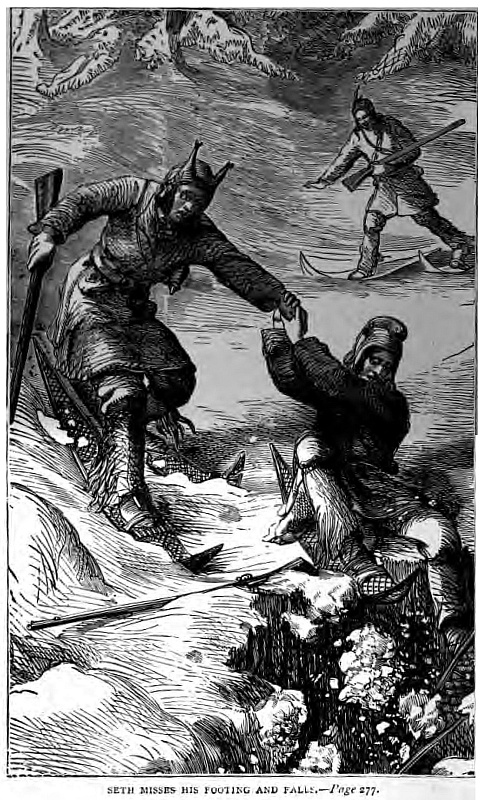
“Nat Weekley was a-comin’ sliding up some ways in the rear. He was lookin’ at his toes like, and didn’t see us disappear, but he told us afterwards he kind o’ missed us all of a suddint, you see, and guessed we’d gone somewheres down into the bowels o’ the earth. He was an amoosin kind of a ’possum, was old Nat. Presently he discovered our hole, and laying himself cautiously down on the lower side of it, so’s he shouldn’t fall, he peers over the brink. He couldn’t see us for a bit, with the blinding snow-powder we’d raised. But Nat wasn’t going to be done.
“‘Anybody down there?’ says Nat, quite unconcernedly.
“‘To be sure there is,’ says we; ‘didn’t you see us go in?’
“‘No,’ said Nat; ‘what did you go in for?’
“‘Don’t know,’ said I, sulkily.
“‘How are you going to get out?’ says Nat.
“‘Nary a bit o’ me knows,’ I says; ‘we came down so plaguey fast we didn’t take time to consider.’
“‘Went to look for summut, I reckon?’
“‘Oh!’ cries Jager, ‘cease your banter, Nat.’
“‘A pretty pair o’ babes in the wood you’ll make, won’t you! Do you know it’ll soon be dark?’
“‘Poor consolation that,’ I says.
“‘Pitch dark,’ roars Nat, ‘and nary a morsel o’ fire you’ll be able to light. And I reckon too it’s in a b’ar’s hole you are, and presently the b’ar will be coming home, and then there’ll be the piper to pay. There’ll be five minutes of a rough house down there, I can tell ye.’
“We felt kind o’ riled now, and didn’t reply, and so Nat went on:
“‘I kind o’ sees ye now,’ he says. ‘I can just dimly descry ye, you looks about as frisky as a pair o’ bull buffaloes. Ha! ha! ha! You’ll be precious cold before long, though,’ Nat continues. ‘Now don’t say Nat’s a bad old sort. He’s going to throw ye down his flask; maybe ye can’t catch it, so behold, Nat puts it in the pocket of his big skin coat, and pitches it down into your hole. Don’t think it’s the b’ar, cause he won’t come home till it’s just a trifle darker, and then—ha! ha! ha!—I thinks I sees the dust he’ll raise. Good-bye, my sylvan beauties. Good night, babies. Take care of your little selves; don’t catch cold whatever ye do.’
“But all this was only Nat’s fun, ye see. He carried a right good heart within him, I can tell you, and he wasn’t above five hours gone when back he comes with two more of our friends carrying a big lantern, a long rope, and an axe, and in about ten minutes more Jager and I were both on the brink; but I can tell ye, gentlemen, it was about the coldest five hours ever trapper Seth spent in his little existence.”
The anxiety on board the yacht for the past few days had been very deep indeed, but as our heroes drew once more near to their home, and Stevenson made sure they were all there, dogs and all.
“Hurrah, boys!” he cried to his men; “man the rigging!”
Ay, and they did too, and it would have done your heart good to have heard that ringing cheer, and it wasn’t one cheer either, but three times three, and one more to keep them whole.
McBain and his little party made noble response, you may be well sure; and meanwhile Peter, with his bagpipes, had mounted into the foretop and played them Highland welcome as they once more jumped on board of the saucy Snowbird.
What a delightful evening they spent afterwards in the snuggery! They were often in the habit of inviting one of the mates aft, or even weird little Magnus, with his budget of wonderful tales, but to-night they must needs have it all to themselves, and it was quite one bell in the middle watch ere they thought of retiring, and even after that they must all go on deck to have a look around.
Not a breath of wind, not a cloud in the sky, and stars as big as saucers.
“Jack Frost has come while we’ve been talking,” said McBain. “Look here, boys.”
He threw a bit of wood overboard as he spoke; it rang as it alighted on the surface of the ice.
Chapter Twenty Two.
Frost and no Skates!—Rory Disconsolate—McBain to the Rescue—A Roaring Day and a Merry Night—A Mysterious Pool.
King Frost had come—and come, too, with a will, for when Rory went on deck next morning the ice was all around the yacht, hard and smooth and black.
“It is frozen in we are,” said Rory—“frozen in entirely, and never a vestige of a skate in the ship. Just look, Allan, that ice is bearing already! What could have possessed us to leave Scotland without skates?”
“It is provoking,” remarked Allan, looking at the ice with a rueful countenance.
“Well, we can’t go back home for them, that is certain sure. D’ye think, now, that old Ap could manufacture us a few pairs?”
“He is very handy,” Allan said; “but I question if he could manufacture skates.”
“However,” said Rory, “the ice is bearing; we can slide if we can’t skate. So I, for one, am going over the side presently.”
“Not to-day, Rory boy,” said a quiet voice behind him, while at the same time a hand was laid gently on his shoulder—“not to-day, Rory, it wouldn’t be safe,” said McBain. “I know you would risk it, but I love you too well to allow it.”
“And sure, isn’t your word law, then?” replied Rory.
McBain smiled, and no more was said on the subject; but for all that Rory had the ice on his mind all day, and that accounted for his having been seen in close confab with old Ap for a whole hour, during which pieces of wood and bits of iron were critically looked at, and many strange tools examined and designs drawn on paper by Rory’s deft artistic fingers. But the result of all this may be summed up in the little word nil. Ap had taken much snuff during this consultation, but, “No, no; look, you see,” he said, at last, “if it were a box now, or a barrel, or a boat, I could manage it; but skates, look you, is more science than art.”
So Rory had rather a long face when he came aft again, which was something most unusual for Rory. But his was the nature that is easily cast down, and just as easily elevated again. His spirits were about zero before dinner; they rose somewhat during that meal, and fell once more when the cloth was removed.
“Do you think,” asked Ralph of McBain, “that the frost will hold?”
“Oh,” cried Rory, “don’t talk of the frost! sure it is the provokingest thing that ever was, that the three of us should have forgotten our skates. I’m going to get my fiddle.”
“Wait a moment,” said McBain.
“Steward,” he continued, “serve out warm clothing to-morrow for these young gentlemen, and remind them to put on their pea-jackets; we are going to have such a frost as you never even dreamt of in Scotland. Don’t forget to put them on, boys; and Peter, ‘dubbing’ for the boots mind, no more paste blacking.”
“Ay, ay, sir!” said Peter.
“And don’t forget the paper blankets.”
“That I won’t, sir!” from Peter.
Now while McBain was speaking Rory’s face was a study; the clouds were fast disappearing from his brow, his eye was getting brighter every moment. At last, up he jumped, all glee and excitement.
“Hurrah!” he cried, seizing the captain by the hand. “It is true, isn’t it? Oh! you know what I’d be saying. The skates, you know! Never expect me to believe that the man who thought beforehand about warm clothes for his boys, and dubbing and paper blankets, was unmindful of their pleasures as well.”
“Peter, bring the box,” said McBain, quietly laughing.
Peter brought the box, and a large one it was too.
Three dozen pairs of the best skates that ever glided over the glassy surface of pond or lake.
Rory looked at them for a moment, then admiringly at McBain.
“I was going to get my fiddle,” says Rory, “and it would be a pity to spoil a good intention; but troth, boys, it isn’t a lament I’ll be playing now, at all, at all.”
Nor was it. Rory’s fiddle spoke—it laughed, it screamed; it told of all the joyousness of the boy’s heart, and it put everybody in the same humour that he himself and his fiddle were in.
Next morning broke bright and clear; Rory and Allan were both up even before the stars had faded, and by the time they had enjoyed the luxury of the morning tub—for that they meant to keep up all the year round, being quite convinced of the good of it—and dressed themselves, laughing and joking all the time, Peter had the breakfast laid and ready.
The ice was hard and solid as steel, and glittered like crystal in the rays of the morning sun, and you may be sure our heroes made the best of it, and not they alone, but one half at least of the yacht’s officers and crew. The whole day was given up to the enchanting amusement of skating, and to frolic and fun. Wonderful to say, old Ap proved himself quite an adept in the art, and the figures this little figure-head of a man cut, and the antics he performed, astonished every one.
But Seth, alas! was but a poor show; he never had had skates on his feet before, so his attempts to keep upright were ridiculous in the extreme. But Seth did not mind that a bit, and his pluck was of a very exalted order, for, much as his anatomy must have been damaged by the innumerable falls he got, he was no sooner down than he was up again. Allan and Ralph took pity on him at last, and taking each a hand of the old man, glided away down the ice with him crowing with delight.
“But, sure, then,” cried Rory, “and it’s myself will have a partner too.”
And so he linked up with old Ap, old Ap in paper cap and immensity of apron, Rory in pilot coat and Tam o’ Shanter. What a comical couple they looked! Yes, I grant you they looked comical, but what of that? Their skating far eclipsed anything in the field, and there really was no such thing as tiring either Ap or Rory.
And hadn’t they appetites for dinner that day! Allan’s haunch of venison smoked on the board; and Stevenson, Mitchell, and the mate of the Trefoil had been invited to partake, as there was plenty for everybody, and some to send forward afterwards.
“Now,” said McBain, after the cloth had been removed, and cups of fragrant coffee had been duly discussed, “what say you, gentlemen, if we leave the Snowbird to herself for an hour or two, pipe all hands over the side, and go on shore and open the new hall?”
“A grand idea!” cried Ralph and Allan in a breath. “Capital!” said Rory.
And in less than an hour, reader, everything was prepared: a great fire of logs and coals was cracking and blazing on the ample hearth of the hall, a fire that warmed the place from end to end, a fire at which an ox might have been roasted. The piano had been transported on shore; at this instrument Ralph presided, and near him stood Rory, fiddle in hand. McBain was duly elected chairman, and the impromptu concert had commenced. The officers occupied the front seats, the men sat respectfully on forms in the rear. Had you been there you would have observed, too, that the crew had paid some little attention to their toilet before coming on shore; they had doffed their work-a-day clothing, and donned their best. Even Ap had laid aside his immensity of apron, and came out in navy blue, and Seth was once again encased in that brass-buttoned coat of his, and looked, as Rory said, “all smiles, from top to toe.”
McBain felt himself in duty bound to make a kind of formal speech before the music began. He could be pithy and to the point if he couldn’t be eloquent.
“Officers and men,” he said, “of the British yacht, Snowbird,—We are met here to-night to try,—despite the fact, which nobody minds, that we are far from our native land,—if we can’t spend a pleasant evening. We have been together now for many months, together in sunshine and storm, together in our dangers, together in our pleasures, and I don’t think there has ever been an unpleasant word spoken fore or aft, nor has a grumbler ever lifted up his voice. But we have a long dreary winter before us, and perils perhaps to pass through which we little wot of. But as we’ve stood together hitherto, so will we to the end, let it be sweet or let it be bitter. And it is our duty to help keep up each other’s hearts. I purpose having many such meetings here as the present, and let us just make up our minds to amuse and be amused. Everybody can do something if he tries; he who cannot sing can tell a story, and if there be any one single mother’s son amongst us who is too diffident to do anything, why just let him keep a merry face on his figure-head, and, there, we’ll forgive him! That’s all.”
McBain sat down amidst a chorus of cheers, and the music began. Ralph played a battle piece. That suited his touch to a “t,” Rory told him, and led an encore as soon as it was finished. Then Rory himself had to come to the front with his fiddle, and he played a selection of Irish airs, arranged by himself. Then there was a duet between Allan and Ralph; then McBain himself strode on the stage with a stirring old Highland song, that brought his hearers back to stirring old Highland times in the feudal days of old, when men flew fiercely to sword and claymore, as the fiery cross was borne swiftly through the glen, and wrong had to be righted in the brave old fashion. Stevenson followed suit with a sea song; he had a deep bass voice, and his rendering of “Tom Bowling” was most effective.
It was Rory’s turn once more. He brought out a real Irish shillalah from somewhere, stuck his hat, with an old clay pipe in it, on one side of his head, and gave the company a song so comical, with a brogue so rich, that he quite brought down the house. It was not one encore, but two he got; in fact, he became the hero of the evening. Both Mitchell and the mate of the Trefoil found something to sing, and Ap and Magnus something to say if they couldn’t sing. Magnus’s story was as weird and wild as he looked himself while telling it; Ap’s was a simple relation of a daring deed done at sea during the herring-fishery season. After this Seth spun one of his trapper yarns, and the music began again. A sailor’s hornpipe this time—a rattling nerve-jogging tune that set the men all on a fidget. They beat time with their fingers, they tapped a tattoo with their toes; and when they couldn’t stand it a moment longer, why they simply started up in a bold and manly British fashion, cleared the floor, and gave vent to their feelings through their legs and their feet.
The dancing became fast and furious after that, and when Ralph and Rory were tired of playing they came to the floor, and Peter took their place with his bagpipes. But the longest time has an end, and at last Ap’s shrill pipe summoned all hands on board.
There was little need of sleeping-draughts for any one on board the Snowbird that night.
The frost held, our heroes could tell that before they left their beds, so intensely cold was it. Glad were they now of the addition of the paper blankets served out by Peter; eider-down quilts could hardly have made them feel more comfortable.
The frost held, they could tell that when they went to their tubs. Peter had placed the water in each bath only an hour before, but the ice was already so hard that instead of getting in at once Rory squatted down to look at it, and he did not like the looks of it either. The sponge was as hard as a sledge-hammer, so he took that to break the ice with. Then he tried one foot in, and quickly drew it out again and shook it. The water felt like molten lead.
“I wonder now,” he said to himself, “if brother Ralph will venture on a cold plunge on such a morning as this.”
And, wondering thus, he rolled his shoulders up in his door-curtain, and, poking his head into the passage, hailed Ralph.
“Hullo, there!” he cried; “Ralph! Porpy!”
“Hullo!” cried Ralph; “I’ll Porpy you if I come into your den!”
“Well, but tell me this, old man,” said Rory; “I want to know if you’re going to do a flounder this morning?”
“To be sure!” said Ralph. “Listen!”
Rory listened, and could hear him plashing.
McBain passed along at the moment, and, hearing the conversation, he took part in it to this extent,—
“Boys that don’t have their baths don’t have their breakfasts.”
“In that case,” said Rory, “I’m in too!” And next moment he was plashing away like a live dolphin. But hardly was he dressed than there came all over him such a glorious warm glow, that he would have gone through the same ordeal again had there been any occasion. At the same time he felt so exhilarated in spirits that nothing would serve him but he must burst into song.
The frost held, they could tell that when they met in the saloon and glanced at the windows; the tracery thereon was so beautiful, that even at the risk of letting his breakfast get cold, Rory must needs run for his sketch-book and make two pictures at least. Meanwhile, Ralph had settled down to serious eating. You see, there was very little poetry about honest Ralph, he was more solid than imaginative.
After breakfast our trio took to the ice again. They soon had evidence that some one had been there before them, for about a mile along the shore, and a little way out to sea, they saw that several poles had been planted, and on each pole fluttered a red flag. They looked inquiringly at McBain.
“You wonder what the meaning of that is?” said McBain; “and I myself cannot altogether explain it.”
“But you had the flags placed there?”
“True,” said McBain; “and they are placed around a pool of open water.”
“Open water!” exclaimed Rory, “and the sea frozen everywhere all around!”
“Ah, yes!” replied McBain; “that is the mystery. But we are in the land of mysteries. This pool of open water may be situated over a warm spring, or it may be there is some kind of a whirlpool there which prevents the formation of the ice, only there it is, sure enough, and howsoever hard the frost should become, or howsoever long it may last, I think that that pool will never, never close and freeze.
“The ice,” he continued, “was thin at the edge, but I have had it broken off, and will try to keep it so, and thus you will be enabled to go quite close to the water’s edge; and if my experience is anything to go by, you’ll see many a startling apparition there before the winter is past and gone.”
“You astonish me,” said Rory.
“And me,” said Allan.
“But what,” persisted Rory, “will the apparitions be like?”
“Nothing that can harm us, I think,” said McBain. “But as the ice extends farther seaward, sea-monsters will come to the pool to breathe and to disport themselves in the sunshine.”
“Perhaps the sea-serpent, for instance?” said Rory.
“Perhaps,” said McBain.
“Och! sure then,” cried Rory, losing all his seriousness at once, “we’ll have a shot at the old boy, that’s all?”
Chapter Twenty Three.
The Great Black Frost—Funny Jack Frost—The Cold Half-Hour—A Terrible Apparition under the Ice—Blowing Soap-Bubbles—Strange Effect—Snow and Snow-Shoes.
For week after week the great black frost continued, seeming only to wax more and more intense as the time went on. With the exception of the mysterious pool, mentioned in last chapter, and the small hole kept open alongside the yacht, there was no water to be met with anywhere. The sea, as far as the eye could reach, was a smooth unbroken sheet of glass, two feet in thickness if a single inch. If there was any ripple or swell in the now far-off blue water, it did not affect the ice for miles around the Snowbird in the slightest. There was never a crack and never a flaw in it. It was hard, solid, and black, adamantine one might almost say in its extreme hardness. The chips broken off from the edge of the ice-hole looked like pieces of greenish rock crystal. The ice-hole itself required to be broken every time a bucket was dipped in it.
Meanwhile the days grew shorter and shorter, but there was never a breath of wind, and never a cloud in the sky. And the sun looked cold and rayless, yet at night the stars shone out with extraordinary brilliancy.
Breakfast was now a meal to be partaken of by lamplight, and so too was dinner, but they both passed off none the less pleasantly for that.
“It seems to me,” said Allan one morning, “that one of these days the sun won’t trouble to get up at all.”
“We are just in the latitude,” remarked McBain, “where even at midsummer there is a little night, and at mid-winter a little day.”
“But we will never be positively in the dark, I should think, while the stars are so brilliant?” Allan asked.
“We’ll have the glorious aurora borealis by-and-bye,” said McBain, “to say nothing of long spells of moonlight; but we are, as I said before, in the very centre of a land of wonders, and there will doubtless be nights when the storm spirit will be abroad in all his might and majesty, clothed in clouds and darkness, a darkness more intense and terrible than any we have ever experienced in our own country.”
“It is a good thing,” said Rory, “that you thought of taking such an array of beautiful lamps.”
Yes, Rory was right, it was a beautiful array. As Ralph remarked, “the Snowbird was strong in lamps.”
They hung in the passage, they hung in the snuggery, and four of them lit up the saloon, with a brightness almost equal to that of day itself.
And those lamps gave heat as well as light, but large fires were kept constantly roaring in the stoves. The stove that stood in the snuggery was a very large one, and to make the place all the more comfortable the deck was almost buried in skins—trophies of the prowess of our heroes in the hunting-field. And yet with all this it must be confessed that at times the cold was felt to be very severe; indeed, the thermometer kept steadily down many degrees below zero. There was one way of defying it during the day, however, and that way lay in action.
“Keep moving is my motto,” said Rory one day on the ice.
“Indeed, Rory boy,” said McBain, “you act well up to it; if I were asked to define you now, do you know the words I would use?”
“No,” said Rory.
“Perpetual motion personified,” said McBain.
“Thank you,” Rory said, lifting his cap.
There was an excellent way of keeping out the cold after dinner, and that was to make a circle round the snuggery stove, reclining on the skins with cups of warm fragrant coffee, and engaging in pleasant conversation. There was another way of keeping out the cold in the long evenings, and that was to retire to the new hall and give a dance. This was the favourite plan with the crew at all events, and McBain, well knowing the value of healthful happy exercise, was always delighted when Rory professed himself ready and willing to discourse sweet music to the men tripping it on the light fantastic toe.
But the time of all others when our heroes really did feel the effects of the excessively low temperature, was the cold half-hour immediately after turning into bed. Of course the curtains would be carefully and closely drawn, ay, and heads carefully covered with bedclothes, but for all that, shiver they must for the cold half-hour. But gradually the feeling wore away, warmth stole over them, then noses could be protruded over the quilts, and by-and-by sleep sealed up their senses.
When they awoke in the morning, lo and behold they were lying in caves of snow! Top and bottom of the bed, back and roof, were covered with snow to the depth of half an inch; and so were the curtains, and so were the quilts. Where in the name of mystery had the snow come from? The explanation is easy enough. The snow was nothing more nor less than their frozen breath.
I do not think a single day passed that Rory did not, during this black frost, make a sketch from a frozen pane of glass. The frost effects on the frozen glass were simply magical, and it was very curious to notice that some of the panes had been but lightly touched with the frost; they were unfinished sketches, so to speak, while others represented whole landscapes, mountain and forest and sky as well.
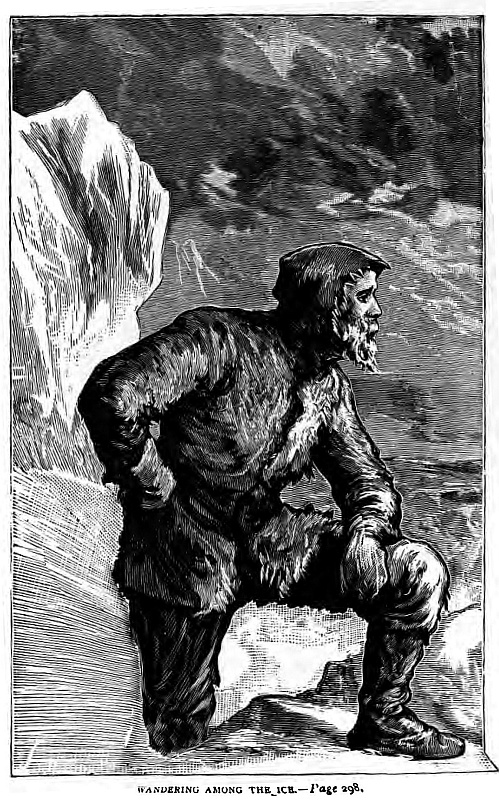
“Look at this pane,” said Rory, one morning. “Now I wonder what Jack Frost meant to have filled that picture in with?”
“Jack seems to have been having a frolic,” said Allan. “Why, there is only one long white thread down the centre of the pane, and this is all hung over with battle-axes and crosses. Jack’s a funny fellow.”
“Jack is,” said Rory.
“Poor Seth!” he continued; “d’ye know the trick he played him yesterday?”
“No,” said Allan.
“Oh! then,” said Rory, “what should John Frost, woe worth him! do but go and freeze the poor man’s nose, and sure enough to-day it is as big as the teapot; there is no looking at him without laughing.”
“Poor fellow!” Allan remarked.
Frost-biting was far from a rare accident now, and when on the ice it was found necessary for both men and officers to keep a sharp look-out on each other’s faces; a white spot represented a sudden frost-bite, unfelt by the person most interested, and only visible to his companion. But it had at once to be rubbed with ice to gradually restore the circulation, else the part, after the lapse of some hours, would mortify.
Here is a strange thing. For the first day or two of frost, while the ice was still comparatively thin, by lying flat down and gazing beneath, they were in a short time able to perceive fishes and other denizens of the deep close underneath them. Even sharks, and creatures with shapes still more dreadful, at times appeared. There was a strange fascination in this to Rory, these dark, turning, twisting shapes close under him, that stared at him with their terrible eyes, or mouthed at the ice as if they would fain swallow him, appearing and disappearing in the dark water; it was fascinating, yet fearful.
When coming from the shore on the evening of the second day, “Let us skate for a mile or two in the starlight,” said Rory.
“Agreed!” said Allan, and off they went.
They skated quite a mile from the shore.
“Now,” said Rory, “let us have a peep through the ice.”
“We can’t see anything in the dark,” replied Allan.
But Rory was of a different opinion, and no sooner had he lain down than, “Oh, Allan, Allan! look, look!” he cried.
Allan saw it too—a terrible shape, seemingly made of fire, wriggling up from the dark depths and approaching the spot where they lay, until they could see it easily. A gigantic snake apparently, as big as the stem of the tallest oak, all quivering and phosphorescent, with crimson eyes and a mouth of awful teeth! The boys felt fear now if they never felt it before. They were spellbound, too; they could not remove their gaze from the apparition, and a kind of nightmare dread took possession of their hearts.
But the thing disappeared at last; it vanished as it had come, leaving only the blackness of darkness. The spell was broken, and they skated back again towards the yacht in silence, but wondering greatly at what they had seen.
The country around them, with its hills and its forests, looked dismal enough now at times. There was no cloud scenery, and consequently no lovely sunrises or sunsets, but just in the gloaming hour, soon after the sun had gone down, the lower part of the sky all round, between the immediate horizon and the upper vault of blue, used to assume a strange sea-green hue, in which the bright stars sparkled and shone like diamonds of the purest water.
“Hallo!” said Rory, one day, “I’ve got an idea.”
The day was one of intensest frost—probably the coldest they had ever yet experienced.
“Yes, an idea,” he continued—“and that is more than ever you had, you know, Ralph.”
“Well, then, tell us,” said Ralph; “but I should think it will get frozen hard if you attempt to put it into words.”
“But I won’t,” said Rory; “I mean to put it into action.”
Rory dived down below, and his two companions remained on deck, wondering what he was going to be up to.
But presently Rory returned, bearing long clay pipes and a basin of soapsuds. “The idea is a very ridiculous one,” he said, “but a funny one. Fancy, old sailors like ourselves, and mighty hunters, blowing soap-bubbles like so many babies! But here, boys, take your pipes and heave round.”
Next moment both Ralph and Allan entered into the business with spirit, and everybody looked on astonished, for, strange to say, the beautiful soap-bubbles were no sooner blown than they were frozen, and instead of floating away and fading shortly, they remained in existence. The boys blew them by the score and by the hundred, until the deck of the yacht and the top of the companion, and even the bulwarks, were laden with them.
“Now then,” cried Rory, in ecstasy; “what d’ye think of that, captain? Troth! there is a beautiful cargo for you.”
“It’s a very fragile one,” said McBain.
“Ah! but,” said Rory, “it is poetic in the extreme, and entirely new, and I’m sure nobody ever saw such a sight before.”
“Nobody but yourself,” said McBain, “could have conceived so very strange an idea.”
“Truly,” said Rory, “Jack Frost is a funny fellow.”
“Jack Frost and you are a pair then, Rory; but I’ve got news for you.”
“What is it?”
“The glass is going down, and I think we’ll soon have a change.” McBain was right. That same day, shortly before sundown, a strange mist or fog gathered in the sky all around them, but not close aboard of them; the country was nowhere obscured, only the sky itself; and through this mist the great sun glared ruddy and angry-like.
“It is the snow-mist,” said McBain.
But still there was no wind; all nature was hushed, as if she held her breath and waited expectant.
The powdery snow began to fall as soon as the sun went down, and ere nightfall it lay inches deep on the decks, and on all the sea of ice beside them. It soon changed in its character—from being powdery it now came down in huge flakes; and when the morning broke, so deep was the fall, that there was little to be seen of the yacht save her tall and tapering masts. She was now, indeed, a Snowbird!
The fall had seemingly stopped, however, but the clouds with which the sky was now overcast were dark and threatening.
It was now “all hands on deck to clear the ship of snow,” and in less than an hour the yacht looked quite herself again, only all around her was the white waste of snow. There would be no more skating for a time, at least. A look of disappointment crept over Rory’s face, and he sighed as he saw Peter restoring the now useless skates to their box and putting them away. He had to fly to his fiddle for relief. That, at all events, was a never-failing source of comfort to this strangely-tempered Irish boy.
The men were very busy now for a few days. A road had to be dug through the deep snow to the shore, and a clearance made all around the new hall, as well as around the ice-hole. Had Rory had his will, he would have set the men to work on the ice itself, to clear roads all over it, so that he might still enjoy his favourite pastime, skating.
The snow was soft and powdery, and when he got over the side and attempted to walk on it, he almost disappeared entirely, but there was a remedy for even this evil.
From his store-room McBain produced half-a-dozen pairs of snow-shoes, and old Ap and his assistant were invited aft to study their construction, with the intention of imitating them, and making many more pairs, for all hands must be furnished with these curious “garments,” as Rory called them.
Our heroes felt very awkward in them at first, especially Ralph, but Seth came to the rescue and volunteered a few lessons.
“I guess,” he said to Rory, “you imagines you’ve got a pair of dancing-pumps on, and you wants to do a hornpipe. It ain’t a mortal bit of use trying that. You mustn’t lift your feet so high; you must just skoot along as I do, so, and—so.”
“Why, I wish I could skoot along like you,” said Rory, picking himself up the best way he could, for in trying to imitate the old trapper he had gone over and almost disappeared, shoes and all. “Troth, Seth, my bright young boy, these pedal appliances don’t suit me at all. Och! my poor ankles. I do believe the whole lot of the two of them is fairly out of joint. But one can’t learn anything useful without trying, so here goes again. Come along, Porpy. Cheerily does it. Hullo! Where is Porpy?”
There was at that present moment nothing of Porpy, as Rory often facetiously called his companion Ralph, to be seen except a pair of legs with snow-shoes at the end of them, and these were waggling most expressively.
But Ralph soon got up and alongside again, and then Rory did not call him Porpy any longer, because he did not like to have his ears pulled.
“I say, Ralph,” he said, slyly, “you’ve no idea what a pair of elegant legs you have.”
“Indeed!” said Ralph.
“Yes,” continued his tormentor, “and eloquent as well as elegant. They are a speaking pair. Had you only seen yourself two minutes ago, when there was nothing of you visible at all, at all, but just them same pair of beautiful limbs, you’d—”
But Rory never finished his sentence. He had stuck the toe of one of his snow-shoes into the snow, and away he went next.
Well, you see this learning to “skoot along,” as Seth called it, was not devoid of interest and fun, but in a few days they could skoot as well as Seth himself, and even carry their guns under their arms in the most approved fashion.
It was well for them that they had learned to hold their guns while walking with snow-shoes, for one day the trio had an adventure with some illustrious strangers, that taxed all their skill both in walking and shooting. I will introduce them to you in the next chapter.
Chapter Twenty Four.
The Dogs and the Snow—The Sledge-Dog—Training Caribou—A Dinner-Party Interrupted—The Race for Life.
“What’s ‘agley’?” asked Rory of Allan, on the morning after the great snowfall.
“What is what?” Allan replied, looking at his friend in some surprise.
“What’s ‘agley’?” repeated Rory. “Sure, now, can’t you speak your own language?”
“Oh yes,” said Allan; “but I don’t know that anything in particular is agley this morning. Is there anything agley with you?”
“Be easy with a poor boy,” said Rory. “Troth, it is the meaning of the word I’d be after getting hold of.”
“Ah! now I see,” said Allan. “Well, ‘agley’ means ‘deviation from a straight line;’ ‘out of the plumb,’ in other words.”
“I thought as much,” Rory remarked in a thoughtful manner, “and it is your own darling poet that says,—
“‘The best-laid schemes of mice and men Gang aft agley, And leave us nought but grief and pain For promised joy.’”
Rory finished the quotation with a bit of a sigh, that caused McBain to say,—
“What is the matter with you, boy Rory? Have you received a disappointment of any kind?”
“Indeed, and I have then,” replied boy Rory, “and I suppose I must confess, for haven’t Ap and myself been busy at it for the last three weeks, making an ice-ship, and hadn’t we got her all complete, keel and hull and sails and all? and troth, she would have gone gliding over the surface of the ice like a thing of life. It was only the wind we were waiting for, and then we would have given you such a surprise, but instead of the wind the snow comes. Isn’t it a pity?”
“Oho!” cried Ralph, “and so that accounts for Rory’s mysterious disappearances; that accounts for Ap and he being closeted together for an hour or two every day for weeks back. Sly Rory!”
“Yes,” said Rory; “sly if you like, but it would have been such fine fun, you know; and there isn’t one of the three of you that wouldn’t have followed my example and gone in for ice-yachts too. And from all I can learn it is the rarest sport in existence. Seth knows all about it, and he says skating isn’t a circumstance to it. Fancy gliding along over the ice, on the wings of the wind, boys, at the rate of twenty knots an hour!”
“It would have been nice, I must confess,” said Ralph. “Something else will turn up, though,” McBain said. “What?” cried Rory, all excitement; “are you going to invent a new pleasure for us, captain?”
“Your ice-yacht,” replied McBain, “would have been a glorious idea if the snow hadn’t fallen, and in calm days I had meant to have got up games of curling on the ice; and that, you know, is the most charming game in the world.”
“Without exception,” said Allan, enthusiastically. “But the snow, the snow!” sighed Rory. “The beautiful snow has fallen and spoiled everything.”
“Not quite so bad as that,” said McBain, with an amused smile. “In a day or two the snow will harden; we can then go long journeys and resume our hunting expeditions.” Walking on snow-shoes soon became not only easy to our heroes, but positively pleasurable, so that they were able to enjoy their rambles over the snow-clad country very much indeed.
As for the dogs, they seemed to feel that they could not possibly get enough of the snow. The exuberance of great Oscar’s joy when he went out with his mister for a walk, the first thing every morning, was highly comical to witness. Out for a walk, did I say? Nay, dear reader, that word but poorly expresses the nature of Oscar’s pedal progression. It was not a walk, but a glorious compound of dance, scamper, race, run; gallop, and gambol. Had you been ever so old it would have made you feel young again to behold him. He knew while Allan was dressing that he meant to go out, and begin at once to exhibit signs of impatience. He would yawn and stretch himself and wriggle and shake; then he would open his mouth and endeavour to round a sentence in real verbal English, and, failing in this, fall back upon dog language pure and simple. Or he would stand as steady as a pointer, looking up at Allan with his beautiful head turned on one side, and his mouth a little open, just sufficiently so to show the tip of his bright pink tongue, and his brown eyes would speak to his master. “Couldn’t you,” the dog would seem to ask—“couldn’t you get on your coat a little—oh, ever so little!—faster? What can you want with a muffler? I don’t wear a muffler. And now you are looking for your fur cap, and there it is right before your very eyes!”
“And,” the dog would add, “I dare say we are out at last,” and he would hardly give his mister time to open the companion door for him.
But once over the side, “Hurrah!” he would seen to cry, then away he would bound, and away, and away, and away, straight ahead as crow could fly, through the snow and through the snow, which rose around him in feathery clouds, till he appeared but a little dark speck in the distance. This race straight ahead was meant to get rid of his super-extra steam. Having expended this, back he would come with a rush and a run, make pretence to jump his master down, but dive past him at the very last moment. Then he would gambol in front of his master in such a daft and comical fashion that made Allan laugh aloud; and, seeing his master laughing, Oscar would laugh too, showing such a double regiment of white, flashing, pearly teeth, that, with the quickness of the dog’s motions, they seemed to begin at his lips and go right away down both sides of him as far as the tail.
Hurroosh! hurroosh! Each exclamation, reader, is meant to represent a kind of a double-somersault, which I verily believe Oscar invented himself. He performed it by leaping off the ground, bending sideways, and going right round like a top, without touching the snow, with a spring like that of a five-year-old salmon getting over a weir.
Hurroosh! hurroosh!
Then Allan would make a grab at his tail.
“Oh, that’s your game!” Oscar would say; “then down you go!”
And down Allan would roll, half-buried in the powdery snow, and not be able to get up again for laughing; then away Oscar would rush, wildly round and round in a complete circle, having a radius of some fifty yards, with Allan McGregor on his broad back for a centre.
After half-an-hour of such furious fun, is it any wonder that Allan and Oscar returned to breakfast with appetites like hunters?
The Skye terrier enjoyed the snow quite as much in his own little way as Oscar did, and, indeed, he used to live in under it a goodly part of his time every day. He in a manner buried himself alive. Plunket, the mastiff, on the other hand, was always in the habit of taking his pleasures in a quiet and dignified manner.
“Now, gentlemen,” said old Seth one day, “I guess I can a kind o’ prove to you that my dog Plunket is useful, if he ain’t ornamental.”
And so the trapper set himself to manufacture a light sledge, and when he had done so, and harnessed the great dog thereto, and seated himself among the skins, it seemed about the most natural thing in the world for that dog to draw the sledge, and Seth had never seemed so much at home before as he did sitting behind him.
Oscar took very great interest in the yoking of the sledge-dog, as Plunket soon came to be called, so much so that the happy thought occurred to Rory to try him in harness too, and this was accordingly done. He was made tracer to Plunket, and although he managed sometimes to capsize the sledge in the snow, he soon became less rash, and settled quietly down to the work.
A larger and very lightly-constructed sledge was then made, and in this both Allan and Rory could travel over the snow with great ease, dragged along by the two faithful dogs.
“What a glorious thing it would be,” said Allan one day, “if we could tame and harness a real caribou!”
“We can if we try, I think,” said McBain. “Love and kindness will tame almost any animal.”
“First catch your hare,” said Ralph.
But through Seth’s skill a week had not passed before they were in possession of not only one, but a pair of deer. A rude kind of a stable was built for them on shore, and the taming commenced, and with such good results that in little over three weeks they were both broken to harness. Sledging now became quite a pastime, and great fun they found it.
Although, owing to the rugged nature of the ground, it was impracticable to venture far inland with the deer-sledge, they were able to take quite long journeys along the seashore, and here many strange birds and beasts fell to their guns, and they met with many adventures.
It is doubtful whether there is any animal in the world, that, for strength and ferocity combined can be compared, to the polar bear, the king of the sea of ice. I do not say that he is the bravest animal ever I have met, but he is nevertheless daring enough in all conscience. Daring and cunning too. A bear will attack one man, and even come out of his way a long distance to do so, but I have never known an instance of a single bear attacking a party of even two, unless he were chased, and had to stand at bay.
Hitherto our heroes had not met, nor ever seen, this gigantic monster. But the time came.
Allan and Rory were one morning very early astir, for in the company of trapper Seth they were to make a long journey in pursuit of game, the game in question being a smaller kind of seal, to be found in abundance some distance along the coast to the east. So sledges were got out and harnessed, a long time before the stars paled before the light of the short Arctic winter day. The deer had been well fed, and were consequently in fine form; they tossed their tall antlers in the air, and seemed to spurn the very ground on which they trod.
It was a glorious morning for a sledge-drive; the snow was hard, and just sufficiently packed to make an easy path. They skirted a great forest that at times grew almost close to the edge of the sea, and long before the sun gleamed up from the north-east, to sink again in the north-west in little over an hour, they had put twenty goodly miles between them and the Snowbird.
They were now at the scene of action—their shooting-ground—and, much to their joy, they found the creatures they had come so far to seek. The seals had come up out of the water to bask in the sun, and therefore lay close, so that in little over an hour they had possessed themselves of as many skins as they could conveniently carry, and were on the eve of returning to the wood, where they had tied up their deer and left their sledges.
“I wonder,” said Rory, “what is at the other side of that far-off point of land yonder, and what we would see if we rounded it.”
“What a fellow you are for wondering, Rory!” said Allan. “Suppose now, instead of wondering, we go and have a look?”
“Agreed,” said Rory; and off they set, Seth preferring to stay behind and get the skins packed.
It was a long road and a rough one; the snow was deeper than they could have believed, but they had donned their snow-shoes, and so they reached the point at last, just as the setting sun was tipping the far-off hills with gold.
The scene beyond the point was indeed a strange one; as far as the eye could reach it was a sea of ice, but ice entirely different from the smooth unbroken snow-clad plain that lay around the Snowbird. For here the ice, exposed to the whole force of the heaving billows, had been broken up into a chaos of pieces of every conceivable size and shape. Nor was this ice quite untenanted. On the contrary, Allan and Rory had arrived in time to be witnesses of a very busy scene indeed, and one that they would be unlikely ever to forget. Half-a-dozen enormous bears were feasting on the body of an immense whale, not fifty yards from where Rory and Allan now stood.
“Down, Rory!” cried Allan, throwing himself on his face; “here is a chance for a bag, the like of which we never even dreamt of.”
It was evident that the bears had not become aware of their presence, either by sight, or scent, or sound; they kept on with their ghastly feast.
Not quietly, though, but with much snarling and growling.
“Just hear them,” whispered Rory. “Wouldn’t you think they’d be content with a whole whale? But, big and all as they are, it will be many a day before they finish their dinner.”
“They never will finish it,” said Allan, “unless I have lost the art of holding my rifle straight. Are you ready, Rory? Well, you take the nearest Mr Bruin; aim straight for the skull. I mean to give that centre gourmand a pill to aid his digestion.”
They both fired at once, and with this result—the centre bear sprang into the air, then fell dead on the snow; the near bear was only wounded, he sprang on one of his fellows, and a most desperate combat ensued. Another volley from behind the rock put a different complexion on the matter, and one more bear dropped never to rise.
“Hand me a cartridge,” said Rory, “I’ve just fired my last.”
“In that case,” cried Allan, in some alarm, “let us be off, for I have only two more cartridges; and look you, we have irritated these monsters, they are making directly for us.”
This was true. A polar bear is at no time an animal of a very sweet temper, but only just interrupt him at his dinner, and he will have revenge if he possibly can.
“Shall we fire again?” said Rory.
“No, Rory, no. Come on quick, boy, there isn’t a moment to lose.”
Even as he spoke the foremost bear had gained the shore, and as soon as he spied our heroes he uttered a growl of rage that seemed to awaken every echo in the rocks, and with head down he came ferociously and quickly on to the attack.
It was to be a race for life, that was evident from the first. On level ground I think the advantage would have been all on the side of the men, but here on the snow, and encumbered with their snow-shoes, the odds were all on the side of the pursuers. Before they had run a hundred yards this was evident. The bears were gaining, and there was fully a mile to be covered.
“Come on quicker if you can,” said Allan, who was the better runner.
“Couldn’t we stop and drop the foremost?” said Rory.
“No, no; that would be madness. The others would have all the more time to come up.”
Presently Allan had recourse to a ruse which he had read of, but never thought he would have to put in practice in order to save his life. He took off his jacket and threw it upon the snow. The bears stopped to sniff at it, and the temptation was now strong to fire, but he resisted it. They had only two cartridges between them and death, so to speak, and they did well to reserve them.
When old Seth had quietly stowed away the skins, he sat down to rest himself on the edge of one of the sledges, and so, dreaming and musing, a whole half-hour passed away. Then he began to get uneasy at the non-appearance of the boys.
“And it’s getting late, too,” he said, as he shouldered his rifle. “Seth will even go and seek them. Why,” he added, after he had gone some distance, “if yonder isn’t both on ’em coming runnin’. And what is that behind them? Why, may I be skivered if it ain’t b’ars! Hurrah! Seth to the rescue!”
And, so saying, the old trapper increased his walk to a run, and the distance between him and the boys was rapidly lessened.
And dire need too, for both Allan and Rory were well-nigh exhausted, and the foremost bear was barely forty yards behind them.
But Allan’s time had come for decisive action. He threw himself on his face, the better to make sure of his aim, and almost immediately after the foremost bear came tumbling down. And now Seth came up, and another Bruin speedily followed his companion into the land of darkness. The others escaped into the forest.
It had been a very narrow escape, but McBain told Allan that very evening that he was not sorry for it, as the adventure would surely teach him caution.
Chapter Twenty Five.
The Dead Leviathan—The Mate of the “Trefoil” Makes a Proposal—A Rich Harvest—Christmas Cheer—Something like a Dinner.
The mate of the Trefoil was a quiet and sober-minded man, as old travellers in the Arctic regions are sometimes wont to be, but when Allan McGregor told him the story of the bears and the dead whale stranded in the frozen bay, he evinced a considerable deal of genuine excitement. He sought out the captain.
“I would fain see the fish, captain.”
(Greenland sailors always call a whale a “fish,” although, as must be well-known, it is a gigantic mammal.)
“Well, my dear sir,” said McBain, “that is a desire that can very easily be gratified. We can start for the bay to-morrow early.”
“I shall be so pleased,” said the mate.
This expedition consisted of three guns—McBain himself, Allan, and the mate of the Trefoil.
There were still one or two bears prowling around the spot where the dead leviathan lay, but they seemed to scent danger from afar, and made off as soon as the expedition hove in sight. Probably they remembered the events of yesterday, and cared not to renew so unequal a combat.
The mate was evidently a man of business, for no sooner had they got on to the ice alongside the whale, than he proceeded to open a small parcel he carried, and to extract therefrom a pair of spiked sandals.
“I’m going on board of her,” he said to McBain, with a quiet smile.
Next moment, pole in hand, he was walking about on top of the dead leviathan, probing here and probing there with as much coolness as though he had been a fanner taking stock in a patch of potatoes.
He smiled as he jumped on shore again.
“That is what doctors would call a post-mortem examination,” said McBain, smiling too. “Now, sir, can you tell us the cause of death?”
“Oh! bother the cause of death,” said the mate, laughing, as he stooped down to undo his sandals. “Do you think I came all this way to ascertain the cause of death in a dead fish? But if you really want to know, I’ll tell you. You see from the state of the ice there has been a heavy swell on here, and the ice has been knocked about anyhow; that shows there has been a gale away out at sea. Well then, the fish,”—here the mate poked his stick at the whale’s ribs in a manner that, had the monster been alive, must have tickled him immensely—“this fish, look you, came nearer land to avoid the broken water, and ran ashore in the dark; he hadn’t got any steam, you know, to help him to back astern, and he couldn’t hoist sail, so he had to be content to lie on his little stomach until—”
“Until death relieved him of his sufferings,” put in McBain.
The conversation concerning the whale was renewed after dinner that evening, the mate and Mr Stevenson having been, as was usual when anything extra was on the tapis, invited to partake of that meal.
Since they left the bay the mate had been unusually silent; he had been thinking, and now his thoughts took the form of speech. He spoke slowly, and with many a pause, as one speaks who well weighs his words, toying with his coffee as he did so, and often changing the position of the cup. Indeed, it was the cup he seemed to be addressing when he did speak.
“Gentlemen,” he said, “as man and boy, as harpooner, second officer, or mate, I have been back and fore to Greenland for little less than twenty years. I’ve been shipwrecked a time or two, you may easily guess, and I’ve come through many a strange danger in the wild, mysterious regions around the Pole. But it is not of these things I would now speak, it is about the last sad affair—my poor dear ship Trefoil, whose charred ribs lie deep in the Arctic Ocean. Oh, gentlemen! oh, men! that was a sad blow to me. Had we been a full ship we would have been home ere now, and I would have been wedded to one of the sweetest girls in all England. Now she is mourning for me as for one dead. But blessed be our great Protector that sent the Snowbird to our assistance in our dire extremity! Where, now, would we—the survivors of the Trefoil—have been else? Our fate would have been more terrible, than the fate of those that went down in that doomed ship.
“I can assure you, my dear friends,” he continued, “I have felt very grateful, and have longed for some way of showing that gratitude. I can never prove it sufficiently. But I have a suggestion to make.”
“Well, we are willing to hear it,” said McBain; “but really, sir, you owe us no gratitude, we only did our duty.”
“That ‘fish,’” said the mate—“what do you reckon its value to be?”
“I know,” said McBain, smiling, “that if we could tow it along to London it would fetch a long price; but if we could tow an iceberg there about ten millions of people would come to see it?”
“How romantic that would be?” said Rory; “and fancy the Union Jack floating proudly from the top of it!”
“Charge them a shilling a head,” said Allan, “and land 500,000 pounds!”
“And spoil the romance!” said our boy-bard.
“Oh, bother the romance!” said Ralph, “think of the cash!”
“Well, but,” said McBain, laughing, “we can no more tow the whale than we can the iceberg.”
“That fish,” said the mate, “myself and my men can flensh, cut up, and refine. The produce will be worth three thousand pounds in the English market; and beside, it will be work for the men for the winter months.”
“But you and your men must accept a share,” said McBain.
“If,” replied the mate of the Trefoil, “you but hint at such a thing again, that fish may lie there till doomsday. No, captain, it is but a poor way of showing our gratitude.”
Once convinced of the feasibility of the mate’s proposal, McBain lost no time in setting about carrying the plan into execution. It would be a sin, he argued, to leave so much wealth to waste, when they had ample room for carrying it. Even romantic Rory came to the same conclusion at last.
“Had it been base blubber now,” he said, “you’d have had to excuse me, Captain McBain, from sailing in the same ship with it I’d have asked you to have built me a cot in these beautiful wilds, and here I’d have stopped, sketching and shooting, until you returned with a clean ship to take me back to bonnie Scotland. But refined oil, sweet and pure,—indeed I agree with you, it would be a sin entirely to leave it to the bears.”
A busy time now ensued for the officers and men of the Snowbird; they had to be up early and to work late. Nor was the work free from hardship. Had the bay where lay the monster leviathan—which the mate of the Trefoil averred was one of the largest “fishes” he had ever seen—lain anywhere near them, the task would have been mere play to what it was. First and foremost, sledges had to be built—large, light, but useful sledges. The building of these occupied many days, but they were finished at last, and then the working party started on its long journey to Bear Point, as our heroes had named the place—Bear Point and Good Luck Bay.
As during the flenshing and the landing of the cakes of blubber, the men would have to remain all night near their work, every precaution was taken to protect them from cold in the camping-ground. Rory, Allan, and Ralph must needs make three of the party, with Seth to guide them in the woods, where they meant to spend the short day shooting.
By good fortune, the weather all the time remained settled and beautiful, and the four guns managed easily enough to keep the camp well supplied with game of various kinds. The cold at night time, however, was intense, and the roaring fires kept up in the hastily-constructed huts, could scarcely keep the men warm. This was the only time during the whole cruise of the Snowbird that McBain deemed it necessary to serve out to his men a rum ration. The time at which it was partaken may seem to some of my readers an odd one, but it was, nevertheless, rational, and it was suggested by the men in camp themselves. It was served at night, just at that hour when Arctic cold becomes almost insupportable. They did not require it by day, they could have hot coffee whenever they cared to partake of it, but at half-past two in the morning all hands seemed to awake suddenly. This was the coldest time, and the fires, too, had died low, and the men’s spirits, like the thermometer, were below zero. But when more logs were heaped upon the fires, and the coffee urn heated, and the ration mixed with a smoking bowl of it and handed round, then the life-blood seemed to return to their hearts, and re-wrapping themselves in their skins, they dropped off to sleep, and by seven o’clock were once more astir.
Several days were spent in the work of landing the treasure-trove, then the tedious and toilsome labour of conveying it to the Snowbird commenced. There was in all nearly thirty tons of it to be dragged in the sledges over a rough and difficult country, yet at last this was safely accomplished, and the mate of the Trefoil had the satisfaction of seeing it stored in one immense bin, where it could await the process of boiling down and refining, previously to being conveyed into the tanks of the yacht.
“I feel happier now,” said Mr Hill, as he quietly contemplated the result of their labours. “It is a goodly pile, thirty tons there if there is an ounce; it will take us two good months’ hard work to refine it.”
“Meanwhile,” said McBain, “we must not forget one thing.”
“What is that?” said Mr Hill.
“Why,” replied the captain, “that to-morrow is Christmas. You must rest from your labours for a few days at least, there is plenty of time before us. It will be well on to the middle of May ere the ice lifts sufficiently to permit us to bear up for the east once more.”
“Well,” said the mate, “the truth is, I had forgotten the season was so far advanced.”
“You have been thinking about nothing but your ‘fish,’” said McBain, laughing.
“I have been full of that fish,” replied the mate; “full of it, and that is a curious way to speak. Why, that fish is a fortune in itself. And I do think, captain, it is a sad thing to go home in a half-empty ship.”
“Ah!” McBain added, “thanks to you, and thanks to our own good guns, we won’t do that.”
“Talking about fortunes,” said Allan, who had just come on deck, “we ought to have a small fortune in skins alone.”
“In fur and feather,” said Rory.
“There is more of that to come,” quoth McBain. “As soon as the days begin to lengthen out we will have some glorious hunting expeditions, and the animals our good Seth will lead us against, are never in better condition than they are during the early spring months.”
Christmas Day came. McBain resolved it should be spent as much as possible in the same way as if they were at home. There was service in the morning on shore in the hall. Was there one soul in that rough log hut, who did not feel gratitude to Him who had brought them through so many dangers? I do not think there was.
After service preparations for dinner were commenced. It was to be a banquet. There was to be no sitting below the salt at this meal; all should be welcome, all should be equal. I am afraid my powers of description would utterly fail me if I attempted to give the reader an idea of the decorations of the new hall. Almost every lamp in the Snowbird was pressed into the service. The hall was a galaxy of light then, it was a galaxy of evergreens too, and everywhere on the walls were hung trophies of the chase, and the part of the room in which the table stood was bedded with skins. But how Peter, the steward, managed to get the tablecloth up to such a pitch of snowy whiteness, or how he succeeded in getting the crystal to sparkle and the silver to shine in the marvellous manner they did, is more than I can tell you. And if you asked me to describe the viands, or the glorious juiciness of the giant joints, or the supreme immensity of the lofty pudding, I should simply beg to be excused. Why that pudding took two men to carry it in and to place it on the table, and when it was there it quite hid the smiling face of Captain McBain, whose duty it was to confront it. If you had been sitting at the other end of the table you couldn’t have seen him. Ah! but McBain was quite equal to the occasion, and I can assure you that the hearty way he attacked that pudding soon brought him into view again.
Well, everybody seemed, and I’m sure felt, as happy as happy could be. Old man Magnus looked twenty years younger, old Ap’s face was wreathed in smiles, and Seth looked as bright as the silver. I can’t say more. Rory was in fine form, his merry sallies kept the table in roars, his droll sayings were side-splitting; and Ralph and Allan kept him at it, you may be sure. Yes, that was something like a dinner. And after the more serious part of the business was over, mirth and music became the order of the evening; songs were sung and stories told, songs that brought them back once more in heart and mind to old Scotland, where they knew that at that very time round many a fireside dear friends were thinking of them and wondering how they fared.
Chapter Twenty Six.
Hockey with Snow-Shoes on—The Ice Breaks up—Change of Quarters—Going on a Big Shoot—The Great Snow Lake—Indians—The Fight in the Forest.
Winter wore away. Did our people in the Snowbird think it long and dreary? They certainly did not. To begin with, every one on board was as healthy as a summer’s day is long. It was mindful and provident of McBain to have laid in a good supply of medicines, and these were about the only stores in the ship that had never been as yet applied to.
The captain was a good and a wise disciplinarian, however. He well knew the value of exercise in keeping illness far away, so he kept his men at work. On dry days they would be sent in parties to the forest, to cut down and drag home wood to keep up roaring fires in the ship and in the hall as well. When snow was falling, which was less often than might be imagined, he had them under cover in the hall, where there was room enough for games of many kinds, and these were varied by regular exercise with clubs in lieu of dumb-bells. In open weather games were not forgotten out of doors, you may be quite sure. Rory proposed lawn tennis.
“We could easily get it up, you know,” he said.
“Nothing would be more simple,” was McBain’s reply, “but it is far too slow with the thermometer at zero. There isn’t chase enough in it.”
“I have it,” cried Allan, joyously.
“What?” asked Rory, eagerly.
“Why, hockey, to be sure; what we in Scotland call shinty, or shinny.”
“It is shinny enough at times,” added McBain, laughing; “but how would you set about it? You’d need a large ball, a small one would get lost in the snow.”
“Yes,” said Allan, “a large cork ball as big as a football, covered with laced twine. Ap can make the balls, I know.”
“And we can go off to the woods and cut our hockey sticks,” said Rory; “it will be capital fun.”
There was no mistake about it, it was capital fun, Hockey is at all times a glorious game, but hockey on the snow with snow-shoes on! Why it beggars description. No wonder all hands entered into it with a will. The amusement and excitement were intense, the fun and the frolic immense, the tumbling and the scrimmaging and scrambling were something to see, and having seen, to go to sleep and dream about and awake laughing, and long to go to sleep and dream about it all over again. The game ended at the goal in a mad mêlée, a medley of laughter and shouting, a mixture of legs in the air, arms in the air, snow-shoes and hockey clubs in the air, and heads and bodies anywhere. No wonder the short winter’s day wore to a close before they knew where they were. No wonder that at the end of the games Allan McGregor, the inventor, was dubbed the hero of the day, that he was cheered until the welkin rang, that he was mounted shoulder high, and borne triumphantly back to the Snowbird, Rory marching on in front with brandished hockey club, leading a chorus which he had composed on the spot and for the occasion.
But it must not be supposed that their life was all play; no, for independent of long hours spent in the forest in quest of game, Rory, Ralph, and Allan set themselves with a will to clean, dress, and arrange the many hundreds of beautiful and valuable skins they had possessed themselves of. This was a labour of love. These skins were part of the cargo with which they hoped to reach their native land once more in safety. Some of the smallest and prettiest of them Rory took extra pains with, and when he had got them as soft and pliable as silk, he perfumed them and stowed them in the big box Ap had made for him, and where his sketch-book—well-filled by this time—lay, and a host of curious nameless pebbles and crystals, polished horns, strange moths, butterflies and beetles, beautifully-stuffed birds and rare eggs. It was a splendid collection, and Rory’s eyes used to sparkle as he gazed upon them, and thought of the time when in the old castle he would show all these things to Helen McGregor and her mother.
“Just look at him,” Ralph would say at times like these; “he hasn’t got the pack-merchant idea out of his head yet.”
Winter wore away. It was nearly three months since they had all sat down together to their Christmas dinner in the hall. The mate of the Trefoil, and the men more immediately under his command, hadn’t been idle all this time. They had been busy refining the oil, and a grand lot they made of it, and it was now carefully stowed away in the Snowbird’s tanks. The mate had not been disappointed in the size of his fish, it had turned out even better than he expected, and would greatly add to the wealth of the cargo of the lucky yacht. The water had to be pumped from the tanks to make room for it, but that was no loss, for fresh-water ice was procurable in any quantity. It lay on the decks of the Snowbird abaft the foremast in gigantic pieces, and a very pretty sight it looked when the sun shone on it.
Fresh food and game of various kinds were now to be had in abundance. Ay, and fish as well. Old Seth still continued to act as fisherman. He caught them in that mysterious pool, which all the winter long had never shown a single sign of freezing.
When all was quiet of a night, probably in the moonlight or under the light from the splendid aurora, our heroes used to take a walk sometimes towards the strange pool. They took their guns with them, but only to protect themselves from prowling bears. Awful-looking heads used to appear over the surface of the pool. In daylight these creatures never showed—only when all was still at night. What they were they could not tell; nor can I. Probably they were merely gigantic specimens of bearded seals or sea-lions come up to breathe, and looked larger and more dreadful in the uncertain light of moon or aurora.
Many though our heroes’ adventures were, and thoroughly though they enjoyed themselves, when the days began to get longer, when the snow began to melt, and whistling winds blew softer through the forest trees, and everything told them spring was on ahead, the thoughts that ere long the Snowbird would burst her icy bounds, that they would be once more free, once more at sea, were very far from unpleasant to them.
On days now when there was but little frost in the air, and a breeze of wind with sunlight, the Snowbird’s sails would be unstowed, bent, and partially unfurled, to air them. Even this made the saucy yacht look quite coquettish again. “Ho! ho!” she seemed to say to herself, “so there is a possibility, is there, that some of these days I may once more sport my beauty in waters blue? Oh! then, blow, breezes, blow, and melt the ice and snow, for indeed I’m heartily tired of it.”
It would almost seem that the country around where the Snowbird lay was chosen as a winter residence par excellence for the great Polar bear. Perhaps the winter in the faraway and desolate regions around the Pole is too rigorous for even his constitution; be this as it may, here they were by the score, and all in all, well-nigh a hundred fleeces were bagged in little over two months.
These snow-bears got more chary at last, however, and when the March winds blew they entirely disappeared.
One day the beginning of the end of the ice came; a wind blew strong from the east, and by noon all the bay behind the yacht was one heaving mass of snow-clad pieces. It was well for the Snowbird she was sturdy and strong; the grinding bergs, small though they were, tried her stability to the utmost, but the wind went down and the swell ceased; yet fearing a repetition of the rough treatment, McBain determined to seek a less exposed position farther to the west. The ice was now loose, so as soon as there was enough wind to fill her sails progress was commenced. It was slow hard work, but by dint of great exertion and no little skill, a portus salutis was found at last fifty miles farther west, and here the captain determined to rest until the spring was more advanced, and there was a likelihood of getting safely out to sea:
The region in which they now found themselves was even more romantic and wild than that which they had left. There was still room for more skins in the Snowbird, so a big shoot was organised—quite a big shoot in fact, for it would probably be the last they would enjoy in this strange country.
The season was now sufficiently mild to render camping out to such weather-beaten wanderers as the people of the Snowbird practicable, not to say enjoyable. So everything being got in readiness, the start was made for up country, McBain himself taking charge of the expedition, which mustered twenty men in all, ten or more of whom carried rifles, but every one of whom was well armed. The principal tent was taken, and the largest camping-kettle, a wonderful multum-in-parvo, that Seth described as “a kind of invention that went by spirits-o’-wine, and was warranted to cook for fifty hands, and wash up the crockery arterwards.”