"A Story of Arctic Adventure" (continued 4)
Reading edition
There were many words in this sailor’s vocabulary that I do not think it right to repeat, as they were not fit for ears polite.
“What!” he cried, when McBain assured him they neither of them cared to drink—“what, a teetotal ship! Why, how the humpty-dumpty do you manage to keep the cold out, then?”
“Coffee,” was the laconic reply.
“Well, well, well!” said the Greenland captain, filling himself up half a tumblerful of rum, and drinking it off at one gulp. “But sit down all the same, and give us all the news.”
That they would, and that they did, and they answered all his questions with extreme politeness, and were just on the eve of asking him some in return anent his own adventures, when that cry, so musical and exciting to the ear of the Greenland whaler, was shouted from the mast-head, and taken up by those below, and resounded all over the ship from stem to stern, and back again—“A fall! a fall! a fall!”
The captain sprang to his feet, almost capsizing the bottles in his excitement.
“Hurrah, men! hurrah!” he roared, as he sprang up the companion, “luck’s going to turn after all. Hurrah, men! a fall!—yes, a fall in good earnest! Away, boats! Tumble in, lads! tumble in!”
Our friends were left in the Trefoil’s saloon, all staring in blank astonishment save McBain. “Listen!” said the latter.
They did, and could hear every now and then three blows struck on the deck, as if by a sledge-hammer, followed immediately by a sentence bellowed from stentorian lungs, but of which they could only distinguish the first word and the last. These were “Away!” and “Ahoy!”
“Whatever is up?” cried Rory at last; “is the ship going down, or has everybody taken sudden leave of his senses?”
“There’s a whale in sight; that’s it!” McBain replied.
“But what is the knocking?” continued Rory.
“Oh, that is to awaken the sleepers,” explained McBain; “they have no boatswain’s pipe in these ships, so they knock with their booted feet. But come, let us go on deck and see the fun.”
The captain met them at the top of the companion.
“We’re off, you see!” he cried, hurriedly. “Come on board and dine with me. I’m going to spear that fish myself; I haven’t a harpooner worth a dump. Keep in the rear of my boat if you’re going to follow, and you’ll see the fun and be in at the death?”
In at the death! Strangely prophetic were the captain’s words; our heroes remembered them afterwards for many a long day.
“A fall! a fall! Yonder she rips! yonder she spouts! A fall! a fall!”
The men were tumbling up the hatches—pouring up. You could hardly have believed so many men had been below. They ran along the decks and trundled into the hanging boats like so many monkeys; the tackles are let go, blocks creak, and one by one they disappear beneath the bulwarks and reach the water, with a flop and a plash that tell of speed and excitement. And now they are off. The men bend well to their oars, and, encouraged by the shouts of the coxswain and harpooner, they fly over the water—together first, but soon in a line, for it is a race, and the first harpooner that strikes the fish will be well rewarded.
But where is the whale? Why, yonder; two goodly miles to leeward. You can only see three parts of it—black dots above the water; the skull, the back, and the tail tip.
McBain and his boys were left almost alone, for here were hardly men enough to work the ship, and the silence that had succeeded the noise and shouting was intense in its gloominess.
“Come, lads!” cried McBain, “we mustn’t stop here; let us see the fun; let us follow the hunt, and be in at the death!”
The Snowbird’s gig was speedily alongside, and in a few minutes more was bounding over the rippling waters to where the other boats were. It needed not McBain’s “Give way, my lads! give way with a will!” to make the men do their utmost. They too were wild with excitement.
But see, the boats are spreading out; they are no longer together; the whale has dived, and there is no saying where she may come up. Ten, fifteen, twenty minutes of suspense creep slowly away; the crew of the gig have been lying on their oars. But look! there she is again! her huge bulk appears in the very midst of the boats. Let her go either way, or any way, she is sure of a shot. She makes a dash for it. Bang, bang, bang! from the bows of three of the boats. She is struck—twice struck—but she but increases her speed, the line goes spinning over the bows; there is blood in her wake, and the men bend now to their oars with the fury of maniacs. She is badly hurt; she is confused; she stops for a moment to lash the water madly with her tail, then dives once more. But she cannot sulk long, breathe she must. And the boats still go tearing on, and the lines are being coiled in again. The other boats move on ahead, too; they want to surround “the fish.” One of these is the captain’s boat; they can see his burly form in the bow. Mindful of his words, the gig keeps on in her wake.
“Back astern, men!” cries McBain, as the giant whale rises almost under their very bows. “Back, back for your lives!”
To say that our heroes were astonished at the size and strength of the angry monster, would but poorly express the amount of their surprise. Their hearts seemed to stand still with awe. They were thunderstruck. Ah! and here was thunder too, those awful blows! The sound may be heard miles and miles away on a still day. I know, reader, of nothing in nature that gives one a greater idea of vastness, of strength and power, than a whale’s body raised high in air and curved round in the attitude of striking; the skin seems tightened over, it glitters like a gigantic piston-rod, and it seems trebly powerful. But oh! to be under that dreadful tail.
When, awestruck and half-drowned with spray, our heroes managed to look around them, the thunder had ceased, the whale was gone; there were blood and foam in front of them, beyond that the wreck of the captain’s boat. She was so smashed up that she hadn’t even sunk; her timbers lay all about, and clinging to them the drowning and maimed wretches that had not been killed outright. The gig and two other boats made haste to assist. In at the death! They were indeed in at the death. The captain was among the slain. His body was found floating, strange to say, at some considerable distance from the wreck. He seemed in a deep quiet sleep. Alas! it was a sleep from which he would awake no more in this world.
And the whale had gone. She had made direct for the island of ice and dived beneath it, and there the lines were cut.
But hark! adown the wind comes the sound of a signal-gun; a minute goes by, then there is another. All eyes are turned towards the Trefoil, and now smoke can be distinctly seen rolling slowly up from her decks, near the bows.
Once again the signal-gun.
The Trefoil is on fire!
Chapter Sixteen.
Old Seth Becomes Surgeon—A Terrible Danger—Ralph Floods the Magazine—Fighting the Fire—Wreck of the “Trefoil”—Buried at Sea—“Land Ho!”
The second mate had been left in charge of the Trefoil when the boats left the vessel to go in pursuit of the whale. How sadly that pursuit ended the reader has already been told. Besides this officer, when the fire broke out there were only on board the cook, the steward, and three or four ordinary seamen. Smoke was first seen issuing from the fore hold, and, whether for good or for bad, the mate at once ordered the hatches to be battened down, then he hoisted the boat’s recall, and commenced firing minute-guns as a signal of distress.
It had been a race for wealth with the Trefoil’s boats when leaving her. As they sped back again to their burning ship it was a race for life itself, or at all events for all they held dear in life. Yonder, with the smoke hanging like a dark and ominous cloud over her forecastle, and rolling slowly upwards hiding yards and shrouds, was their home upon the waters, the good ship in which they had sailed from England more than a year ago. If anything were to happen to her, how were they ever to reach their native shores, where wives and children, fathers, mothers, and sisters, were even now pining for the return of the absent sailors?
The bold, straightforward character of McBain was never so well seen as in times of emergency and danger, and then, too, the goodness of the man’s heart shone forth. Our heroes’ boat was among the first, if not the first, to render assistance, after the terrible wreck of the captain’s whale-boat, as described in the last chapter; and as soon as it was discovered that the Trefoil was on fire, McBain had an interview with the mate.
“A burning ship,” he said, “is no place, sir, to convey wounded men to, nor dead either. Place them in my boat, they will receive every attention on board our little craft. Meanwhile, you speed away to your ship, and presently we will follow you, bringing to your assistance all the men we can spare from the Snowbird.”
“God bless you, sir!” said the mate, much affected. “What a blessing that your vessel was here! It shows me that He has not altogether deserted us, bad though our fortunes have been.”
Out of the crew of the lost whale-boat, numbering eight in all, including the harpooner, the captain himself, and the coxswain, only three escaped intact, while three were killed outright, and the remaining two badly hurt, one having both bones of a leg broken, the other sustaining a grievous wound in the forearm. In solemn silence, and with all due respect, the captain and his two brave fellows who had lost their lives were laid side by side on the quarter-deck, and their bodies covered over with the Union Jack—the sailors’ pall, for surely it is meet and proper that the flag a man sails or fights under while alive shall cover his poor body when life has fled, and ere yet it is committed to the cold, dark, fathomless ocean.
The wounded men were carried below, and placed in comfortable cots between decks.
“I daresay,” said McBain, “my duty for a time will keep me here by these two poor fellows, though I would like to be hastening away to the assistance of that unhappy ship.”
“Nary a duty, sir,” said trapper Seth.
McBain looked up. Here was this tall, ungainly Yankee, with the lantern jaws and the iron fists, standing forth in quite a new light, namely, that of surgeon. He had stripped off coat and waistcoat and rolled up his sleeves. Beside him stood little Magnus, holding in his two hands a basin of warm water, in which a sponge floated, holding under his arm a bundle of hastily-manufactured bandages.
“Nary a duty!” repeated Seth. “I guess you’d better leave the wounded to the care of the two old ’uns here. Seth has done up more cuts and skivers in his time, than there are days in leap year. As for the broken leg, we’ll soon cooper that, won’t we, Magnus?”
“That will we!” Magnus replied, cheerfully.
Nothing loth to be relieved of a somewhat unpleasant duty, McBain at once called for volunteers, and was considerably surprised to be almost immediately surrounded by every man in the ship except the man at the wheel.
“I didn’t pipe all hands,” he said, with a quiet smile.
However, he picked out twelve of the sturdiest of his fellows, and with these in the cutter—he himself holding the tiller—he was soon alongside the Trefoil.
The pumps had been already manned and the hoses rigged, and two lines of men were ranged along the decks, drawing water in buckets from the starboard and port sides. The smoke was spewing up the forehatch, the decks were wet and slippery, and the men, stripped to the waist with the exception of their guernseys, were working away with such a will that the perspiration stood in beads on their arms, and trickled down their smoke-begrimed faces.
Something like a cheer arose when our heroes and their volunteers sprang on deck, and at once set about preparations for work. McBain beckoned the mate aft, and a consultation was held, at which Rory, Ralph, and Allan were present.
Very much to his surprise, the captain of the Snowbird speedily discovered that the mate of the Trefoil had completely lost his head, as the saying is.
“This is a bad business, sir,” McBain began. “Oh, it is dreadful—it is fearful!” cried the mate; “it is—it is—whatever shall we do?”
“We’ll keep cool to begin with,” said McBain; “nothing is to be gained by hurry or excitement. Tell me this: How did the fire originate?”
The mate gave him a strange glance. “It is not for me to guess even,” he said. “There is one, perhaps, on board who could tell you.”
“Then where did it originate?”
“Ah! that I can tell you,” said the mate. “Among the coals—under the galley in the hold. The fire is confined to that place now; but look you, sir! smashed up among those coals are the bodies of six pigs that we took out with us. For warmth on the voyage out they buried themselves among the coals, and were killed by the roll of the ship. Their bodies are, we know, cut into piecemeal and intimately mixed with the coals. No wonder they burn!”
“But you are simply pouring water into the ’tween decks,” said McBain; “you’re not even sure if it be reaching the fire.”
“I didn’t think of that,” said the poor confused mate. “But,” he continued, “there is worse to tell you!”
“Go on, and quickly!” cried McBain. “What is the worse?”
The mate’s reply was gasped out rather than spoken, and he turned as pale as death as he uttered the words.
“The magazine is not flooded, and it is close to where the fire is raging!”
The blood sprang to McBain’s cheek, the fire seemed to flash from his eye, as he brought his fist down with a ringing crash upon the hatchway, near which he stood.
“What sinful folly!” he cried. “Call for volunteers at once. Call for volunteers, I say, and flood your magazine, man!”
“Stay!” said the mate, now fully aroused, and regaining a little common sense—“stay! You little know my men; they are not picked Englishmen like yours, they are principally stevedores and fishermen. Did they know the magazine was not flooded it would be sauve qui peut. They’d take to the boats and leave the Trefoil to her fate. I have myself been down below, and had to be dragged up through the smoke, fainting. Besides, it needs two hands, and I’ve no one to trust.”
“But the danger is imminent; we may all be blown to pieces without a moment’s warning,” said McBain.
“See here, mate!”
It was Ralph who spoke—brave, quiet, English Ralph—and bravely and quietly did he speak, while his comrades looked on astonished. Courageous they all knew he was, in a fine old lazy Saxon fashion; but to see him stand forth in the hour of need, six feet and over of brawny stalwart heroism, ready and willing to lead a forlorn hope, took his friends aback.
“See here, mate. I’ll go with you to flood the magazine. If it’s only the smoke you fear, I know how to steer clear of that. I was at the burning of Castle Bryn Mawr, and gained an experience there that will last me a lifetime. Come below with me quickly. Now get me towels and a basin of water. Thanks! now watch what I do. Your handkerchief, Rory; yours, Allan. See here now—with this tiny pair of scissors I first cut two small eyeholes in the towel. Then I wet it in the water. Now I tear a handkerchief in two, and wet the parts and fold them into pads. Sit down, mate, sit down. One little pad I place at each side of the nose, the towel I bind firmly round the head and fasten behind. Now, mate, you can only breathe through the wet towel, and no smoke can harm you. Now, boys, here is the other wet towel and the pads, do the same by me.”
In less time than it has taken me to describe them, these simple operations were completed, and next minute Ralph was stepping manfully forward to the forehatch, followed by the mate.
The latter seized the hose with his left hand, and took Ralph’s left hand in his own right. He could thus guide him, for the mate knew where the magazine lay, but Ralph could not. Then they disappeared.
The bucket-men had, at the mate’s orders, ceased to work for a time, and took their turn at the pumps to relieve the others. They stood quietly with their backs to the bulwarks and with folded arms. Something they knew was being done below—something connected with the safety of the ship, and they were content.
Minutes, long minutes of terrible suspense to McBain and his two boys, went slowly, slowly by. Rory, who was passionately fond of Ralph, thought the time would never end, and all kinds of horrible fancies kept creeping into his mind. But look—they come at last; the heroes come. They stagger to where their friends are standing, and Rory notices that Ralph’s hands are sadly blackened, and that his finger-nails drip blood. It had been trying work. The magazine lid had fouled, and it took them fully five minutes to wrench it off, and five minutes more to flood the compartment. But it is done at last, and safety, for a time at least, is insured.
And now to fight the fire, to flood the hold, without admitting too much air to feed the flames.
McBain’s proposal was carried unanimously. It was to scuttle the lower deck, and fasten into the hole so made, the end of the long copper ventilator which stood between the fore and the main masts, and was used for giving access to air into the men’s living and sleeping rooms.
Ralph determined to go down again, and could not be restrained from doing so. His work, he averred, was but half finished; the mate and he between them could scuttle the deck with adzes and axes, and fix the funnel-shaped ventilator, in a quarter of an hour. They were too anxious to stop long for refreshment. Only a draught of water, and seizing their implements, down they went once more.
So perfect were the simple face-guards they wore, that they might have stopped below until the work was completed, had it not been necessary to come on deck to have them removed and re-rinsed in clean water. Happily the fire was not raging immediately beneath the spot where they cut the hole, or the flames might have defied all their efforts to fix the copper funnel. It was no easy task to do so as it was, for the smoke rolled up in blinding volumes, and the heat was intense. But they finished the work nevertheless, and finished it well, carefully surrounding the end of the ventilator with wet swabs.
With pumps and with buckets the water was now poured down the communication thus effected with the hold, and surely men never worked harder for dear life itself than did the crew of the Trefoil and the Snowbird volunteers, to save that burning ship. The danger was very urgent, for if the water were not constantly kept pouring down in volumes the heat must soon melt the end of the ventilator, and the fire gain access to the ’tween decks.
At first volumes of sparks flew upwards, and it was feared this might fire the sails. Hands were told off, therefore, to clew them. Then came volumes of dense smoke only, and this for a whole hour without abatement; but gradually the smoke grew less and the steam more.
Gradually the ’tween decks cleared of smoke; and ere long steam alone, and but little of that, came up the ventilator. Then they knew the fire was mastered, that the danger was past.
McBain parted that evening from the mate, now master of the Trefoil, with the promise that the Snowbird would keep near his barque for a day or two at least, until the chance of the fire once more breaking out was no longer to be dreaded. Although the sun sets every night, even at midsummer time, in the latitude in which the yacht was now sailing, there is very little darkness, only just a few hours of what might be called a deepened twilight, then day again.
The breeze had freshened. Just before turning in for good, our heroes noticed they were approaching a stream of somewhat heavy ice. They were but little alarmed at this, however; they were used to the sight of ice by this time, and could sleep through the din of “boring” through fields of it.
“I’m glad the wind keeps strong, Stevenson,” McBain said, previously to going below. “Keep her stem-on to the big pieces, and don’t bump her amidships, if possible. Call me if anything unusual occurs.”
It was precisely three bells in the middle watch when the mate entered Captain McBain’s room.
“Well, Stevenson,” said McBain, sitting up in bed, for he was a light sleeper; “we’re clear of the ice, I suppose?”
“Yes, sir,” said Stevenson. “We’re in open water. We’re dodging, sir. I’ve hauled the foreyard aback, to wait for the Trefoil.”
“She’s in sight, then, of course?” asked McBain.
“No, sir, that is the curious part of it. I can’t see a sign of her; not a vestige, even from the crow’s-nest.”
“What?” cried McBain.
“It is true, sir,” continued the mate. “We were both working through the ice-stream just before darkling. I was too busy to look much about me till we got outside; then I missed her. There are two or three large bergs among the smaller. She may be hidden by one of these. If she isn’t I greatly fear, sir, something has happened to her.”
The captain was on deck in a few minutes, and found the mate’s words were sadly true.
He tacked up and down for hours, so as to see both sides of every large berg in the stream, but no Trefoil was there. She was gone. Never more would this goodly barque sail the northern seas.
Towards noon that day one solitary boat was seen to emerge from the bergs of the ice-stream, and begin advancing towards the Snowbird. One boat—eleven men and the first mate—were all the survivors of the ill-fated ship. She had been struck amidships. A three-cornered piece of ice had gone half-way through her, then receded, and in three minutes’ time she had filled and gone down, the mate and the watch on deck having barely time to cut a boat away.
(The same fate befell the Innuit, of Peterhead, some fifteen years ago; she went down in the short darkling of a summer’s night, a very few minutes after being struck. She had been lying beset, with my own ship and several others, in an ice-pack, to the south-west of Jan Mayen. The hands, however, were saved.—The Author.)
That day, after dinner, the mate told the short but sad history of the Trefoil’s cruise.
“The same captain was in her,” he said, “for three years, and never yet succeeded in getting a paying voyage. His owners weren’t pleased, you may be well sure. Unscrupulous men they are, every one of them. They told him, and they told me and our second mate, before we left England last, that if we were a clean ship this voyage they would rather never see the ‘Trefoil’ again! We knew what that meant. We knew the Trefoil was heavily insured. But the captain was a gentleman; he would have died sooner than harm a timber of the dear old Trefoil. But the second mate—ah! it is wrong, I know, to speak ill of the dead, but I have reasons, strong reasons, for believing that it was he who fired the ship.
“We had bad luck last summer; we never struck a fish. Then we got beset among such terrible ice as I had never seen before, and there we had to winter. There was another ship not far off in the same predicament, though she lay on an evener keel.
“It was because our poor captain was so unhappy that, during the winter, he began to acquire sadly intemperate habits. We could not see him dying by inches before our faces; we loved the man, and tried to save him. We mutinied—ay! it was mutiny, but if ever mutiny was excusable it was in this case. We marched aft and seized the keys of the room where the grog was stored, and, with the exception of a few gallons, which we kept for the spring fishing, we poured every drop down the ice-hole. Two weeks after that the captain sent for me and thanked me before the men for what I had done. You know the rest of our story, gentlemen.”
Next morning it had fallen calm again; the sky was of a deeply azure blue, the sea a sea of glass, with one or two beautiful Arctic birds floating lazily on its surface. And thus lazily floated the good yacht Snowbird, rising and falling on the gentle swell. All hands were aft at an early hour listening to the solemn words of the Burial Service. The bodies had been sewn in hammocks and weighted with portions of iron, and at the words, “Earth to earth, dust to dust,” the flag was quietly withdrawn, the grating on which they lay was tilted, and, one by one, they were allowed to drop into the depths of that dark mysterious ocean, where shall repose the bodies of so many of England’s bravest sons, till the sea gives up its dead.
By noon the glassy surface of the water was touched here and there by what sailors term “cat’s-paws.” Half-an-hour later the sea was all of a ripple; then the Snowbird’s sails filled again, and she bore away to the west. And so west and west she went for several weeks, only altering her course at times to avoid the heavier ice, or when compelled to do so by a change of wind. Then for days and days they kept nearly south and by west, till one morning there was a shout from the mast-head that thrilled every heart with joy,—
“Land ho!”
Chapter Seventeen.
On Shore for a Run—Noontide on the Seashore—A Natural Harbour—The Land of Adventure and Sport—After the Antelope—Face to Face with a Grizzly.
Yes, yonder lay the land. A mere cloud-land as yet, though; a long streak of darkish blue, higher at some places than at others, and running all along one half of the southern horizon. There was much speculation on board as to what the country they were approaching would turn out to be, whether or not they would find inhabitants in it, and what their reception would be, what their adventures, and what their chance of sport. Judging from his latitude and longitude McBain put it down as some portion of the northern shores of British America, and old Seth “guessed” and “calculated” that if there were any inhabitants they would be “blueskin Injuns,” and they would have to make a welcome for themselves if they wanted one.
Before many hours were over, however, they had sailed near enough to scan the coast with their glasses. The foreshore was low and rocky; beyond that was a wilderness of wood and forest as far as the eye could reach, but no signs of smoke, no signs of human life. Everything seemed as peaceful and still as though it were a world newly evolved from the hands of its Creator.
“I’m very much mistaken,” said McBain, “if this isn’t just the kind of country you boys wished to find.”
“The land of our dreams,” said Rory.
“The land,” said Ralph, “on which the ubiquitous Englishman has never yet set foot. There is nothing hackneyed about this country, I’ll wager.”
“Well, then,” said Rory, who was always the first to suggest something new, “if Captain McBain will call away a boat, Allan and I will go on shore for a walk, and if we do find anything hackneyed we’ll come on board and let you know, Ralph.”
McBain laughed.
“I don’t mind,” he said. “We came out from England bent on enjoying ourselves, so off you go, but mind you don’t get lost this time. You won’t find a trapper Seth everywhere to look after you. I’ll give you four hours, and expect you to bring something fresh and nice for dinner.”
Allan and Rory were delighted to find themselves once more in their own little boat, and bounding away shore-wards over the blue and rippling sea. It was a gladsome and joyous day, and its joy seemed to instil itself into their hearts, and cause them to feel in unison with all nature.
When near the shore they pulled in their oars, and allowed the boat to drift or float as she pleased, for, on rounding a point of land they came upon a scene of animation that, although I have gazed on many like it, I never could find words in which to describe. It was noontide on that peaceful seashore, and both beasts and birds were enjoying themselves to the full, each in his own fashion. Although they must have wondered what species of animal Rory and Allan were, and where they had dropped from all of a sudden, of fear they evinced not the slightest vestige. Here, in the foreground, a pair of young seals gazed at them with their marvellous eyes, but seemed hardly to care to move.
“They are curious-looking creatures, I admit,” one seal seemed to be whispering to the other; “but they are just as tame as we are, and I’m sure they won’t harm us.”
Malleys and gulls came floating around them, nearer and nearer, tack and half tack, so close at last that they could have stretched out their hands and touched them on their beautiful breasts. Fulmars trotted about, nodding their heads and looking for the little fishes the tide had left in the pools. Looms, love-making on stone tops, stared at them with a kind of sleepy surprise. Great auks and penguins, that lined the shore in rows, flapped their apologies for wings, but never dreamed of making their escape. High in air, too, circled their friend and namesake the snowbird; and not far off the restless allan and the jet-black boatswain bird; while on the land itself were dozens of strange fowl that they could not even name.
The very tameness of all these creatures seemed proof, that they had never before been disturbed in their haunts by the presence of man.
Allan and Rory rowed into a beautifully-wooded bay, and inland along a quiet, broad-bosomed river. They landed on many parts of its banks, but remembering McBain’s words, they did not venture too far into the forest, but nevertheless they found track of deer, and trace, too, of heavier and wilder game. They did not make much of a bag, only a few birds and a hare or two (probably the Lepus Americanus, or Jack Rabbit), but they were quite satisfied with their four hours on shore, and were off to time, much to McBain’s joy and satisfaction.
In the saloon that day, while the Snowbird lay quietly at anchor in-shore, there was a dinner-party, at which were present not only the two mates belonging to the yacht, but the mate of the unfortunate Trefoil.
“Farther to the west,” McBain observed, “the land gets much more wild and hilly, and with the glass I can from the crow’s-nest see rugged mountains covered with snow. To the west, then, I purpose going; but I have not forgotten,”—this to the mate of the Trefoil—“that you, Mr Hill, and your men, are passengers. I would fain send you home, but how can I do so?”
“You can’t, that is evident,” said Mr Hill, “and both myself and my men have made up our minds to stop in your ship as long as you’ll let us—all the voyage, indeed, and return with you to England.”
“Well, I’m glad of that,” McBain said, “it relieves me of all anxiety.”
So it was arranged that both Mr Hill and the rest of the shipwrecked mariners should sign articles, and become part and parcel of the crew of the Snowbird. It must be remembered that she was a roomy yacht, and that the addition of twelve or thirteen new hands could hardly crowd her.
Ralph’s father was right when he advised our heroes to seek for adventures in the far west before journeying onwards to the more desolate and mysterious regions of the far north. He was a man of experience, and as such knew well that the sportsman, unlike the poet, is not born but made. But the wild land in which the travellers found themselves a day or two after their little dinner-party in the saloon, was just the place to brace the nerves and steel the muscles, for here was game of every kind, and it only wanted a certain amount of daring to bring it to bag.
The Snowbird was brought to anchor in a land-locked arm of the sea, a natural harbour large enough for the combined fleets of the whole world to ride with safety in. As there would be barely three months before the onset of the severe Arctic winter, McBain lost no time in preparing for the rigours they would doubtless have to encounter, before spring would once more return and release them from their self-chosen imprisonment. The vessel was anchored as close to the shore as was compatible with her safety. Here she could ride and here she could swing, until King Frost descended from the distant mountains and locked her in his icy embrace.
About half a mile from where she lay there fell into the sea a broad and placid river. They found this navigable, even to the cutter, for many miles inland, and the scenes that lay before them, as reach after reach and bend after bend of it was opened out, was romantic and beautiful in the extreme. The stream ran through the centre of a lovely glen or gorge, “o’erhung,” as the poet says, “by wild woods thickening green.” Here was every variety of foliage—trees, and shrubs, and flowers. At times it would be a dense forest all around them, but in the very next reach perhaps, the banks would be green-carpeted with moss and grass, with rocks rising upwards here and there be-draped with wild vines. On the higher lands commenced a forest of pines; far beyond these weird-looking trees the snow-clad peaks of rugged mountains could be seen. In exploring this river they were much struck at the multitude of tributaries it had, little streamlets that stole down through bosky ravines, following the course of any of which brought the travellers to the table-land above. Here was the forest, and here too were broad tracks of a kind of prairie land covered with a carpet of buffalo-grass.
In a country like this it would be patent to any one that there existed unlimited scope for sport of all kinds, for while the woods and jungles and plains abounded in game of every sort, from the strange little rock rabbit to the lordly elk and bison, the rivers they soon found out teemed with fish. They were not long, however, in making a discovery of not quite so pleasing a character. This was due to Seth’s sagacity.
“I guess,” he said one evening, “we’ve got some of my old friends here.”
“What! not Indians?” asked Rory, opening wide his eyes.
“I don’t allude to them ’xactly,” said Seth; “but I does allude to the grizzlies.”
“Oh! I should like to have an adventure with one of these chaps, shouldn’t you, Ralph?”
“I don’t know,” replied Ralph, with a quiet smile; “I think I should rather run from one than fight him, if all stories I’ve heard about them be true.”
“What is your opinion of their character?” asked McBain of Seth.
“They’re the all-firedest fellows to fight, when they do fight,” said Seth, “in creation! I’ve had a bit of fun in my time with pumas and panthers both, down south, but I’d rather fight a dozen o’ either than one grizzly after he turns rusty.”
“Do you mean rusty in coat?” asked Rory.
“No, sir,” said the Yankee, “I guess I means rusty in temper. But then it ain’t often that that occurs, for he’ll run like a deer if he gets a chance; but just wound him, then is the time to see him with his birse on end, I can tell you! But I don’t like ’em. Down in Texas a companion o’ mine, when out shooting, ran right agin one o’ these gentry; a great she one it was, with two cubs alongside of her. That was what made her so touchy, I reckon. Howsomever, she didn’t give my poor friend Obadiah Johnson much time to prepare. I never seed such a sight in my life! She was on to him, and downed him before you’d say ‘bullet.’ One great claw had gone right over his shoulder and ripped his side clean open. With the two hind claws of her she just about tore his legs into piecemeal. I fired right down her throat. Then she was on to me, and my knife was into her. But she didn’t seem to have a kill. I don’t remember very much more o’ that fight—kind o’ fainted, I reckon. Anyhow, we were all found in a heap, maybe an hour afterwards. Obadiah was dead, and so were the b’ar, and trapper Seth had only as much life in his body as saved him from being buried. ’Twere two months ere I got over that skivering, and I guess I’ll bear the marks to my grave unless I loses both arms and legs afore I goes there.”
Little thought Ralph when frankly confessing that he would rather run from than fight a grizzly, and listening to the story of old Seth’s adventure, that not two days thereafter he himself would be the subject of an attack by one of these terrible monsters. But so it turned out, and well was it for him that assistance was at hand, or one of my heroes would have dropped out of the tale.
They had enjoyed an unusually fine day’s sport, principally among the antelope, away up among the plains. I allude, of course, to the North American antelope, that saucy little fellow, so sprightly and graceful, yet so curiously impudent withal as to sometimes bring himself needlessly into trouble. With the exception of the saddle-back seal of the Greenland seas, I know of no wild animal that evinces a larger degree of inquisitiveness. Perhaps it was this very trait of antelope character that led to the size of our heroes’ bag on the day in question. They had found the animals principally in spruce and cedar thickets, and here one or two fell to their guns, while others escaped into the open, across which there was nothing in the world except their inquisitiveness to prevent their having got clear away, but they must needs stop to have a look at their hunters.
“I reckon they hav’n’t been shot at all their little lives before,” said Seth. “Now you just creep round behind while I keep their ’ttention occupied.”
One way or another, Seth had managed to “keep their ’ttention occupied,” and so venison had been the result, and plenty of it too.
It was near evening, the men had already shouldered their game and had begun the homeward march; McBain himself, with Allan and Rory, had also had enough of hunting for one day, and were preparing to follow. Ralph and Seth were invisible, so was their little companion the Skye terrier. No dog, I daresay, ever enjoyed sport more than did this little morsel of canine flesh and fury. Even before the adventure I am going to relate it had been the custom to take him out with the shooting party almost constantly, but after the adventure it was constantly, without any almost.
While they were yet wondering where Ralph and his companions were, bang went a rifle from the wooded gorge beneath them.
“They’ve got another of some kind,” said McBain.
“I expect,” said Allan, “it is a black tail, for if it were antelopes some of them would be already seeking the open, and Seth tells me the black tails prefer hiding when in danger.”
(The black-tailed or “mule” deer is one of the largest and most gracefully beautiful animals to be found in the hunting-grounds of the far west.)
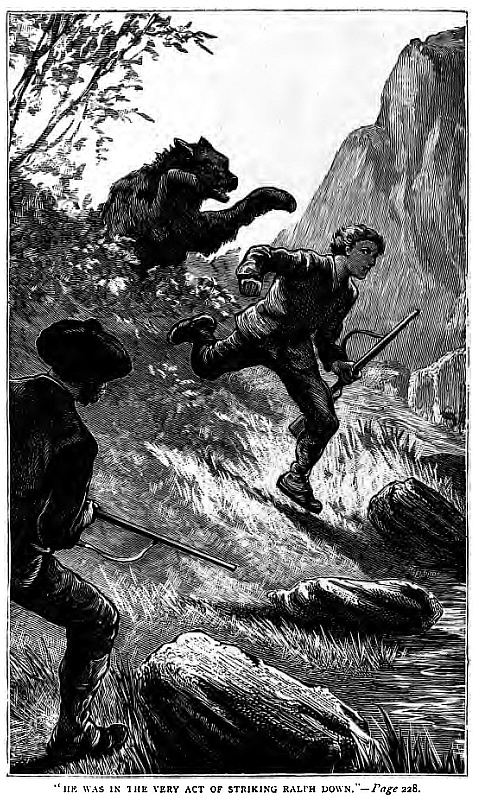
A few minutes afterwards there came up out of that gorge a sound that made our heroes start, and stand to their rifles, while their hearts almost stood still with the dread of some terrible danger. It was not for themselves but for Ralph they feared. It was a deep, appalling, coughing roar, or bellow—the bellow of some mighty beast that has started up in anger. A minute more, and Ralph, breathless and bareheaded, with trailing rifle, rushed into the open, closely followed by an immense grizzly bear. He was on his hind legs, and in the very act of striking Ralph down with his terrible paw.
The danger was painfully imminent, and for either of his friends to fire was out of the question, so close together were bear and man. But lo! at that very moment, when it seemed as if no power on earth could save Ralph, the grizzly emitted a harsh and angry cry, and turned hastily round to face another assailant. This was no other than Spunkie, the Skye terrier, who had seized on Bruin by the heel. Oh! no mean assailant did the bear find him either. But do not imagine, pray, that this little dog meant to allow himself to be caught by the powerful brute he had tackled. No; and as soon as he had bitten Bruin he drew off far enough away to save his own tiny life. You see, in his very insignificance lay his strength. A dog of Oscar’s size would have been at once grappled and torn in pieces. Feint after feint did the terrier make of again rushing at the grizzly, but meanwhile Ralph had made good his escape, and next minute bullets rained on the grizzly, for Seth’s rang out from the thicket, and McBain’s and Rory’s and Allan’s from the open, so he sank to rise no more.
Ralph determined to learn a lesson from this little adventure; he made up his mind that he would never follow a wounded deer into a thick jungle without, at all events, previously reloading his rifle.
Chapter Eighteen.
Rory Poet, Dreamer, and Merchant-Minstrel—Who Says Shore?—All among the Buffalo—“A Big Shoot”—Preparations for Winter.
“Would you believe it, boys,” said McBain one morning, “that we have been here just two months to-morrow?”
They were seated at breakfast, and had you cast your eye over that table, reader, and seen the dainties and delicious dishes “seated” thereon, as Rory called it, you would hardly have believed you were in a far-off foreign land. Here were cold joints of venison, and pasties of game, and pies of pigeon, and the most delicious fish that ever smoked on a board, to say nothing of eggs of wild fowl and sea-birds, the very colours of which were so charming it seemed a sin to crack the shell. But how Seth basted those broiled fish, or what those fish were, only Seth himself knew. But Seth would be out in a boat in blue water, just as the first breakfast bugle went—and that was Peter and the pipes playing a pibroch—and in five minutes more he was back with the fish—Arctic salmon, our heroes called them, for want of a better name. The life was barely out of them ere they were split down the back, and nailed to a large hard wood board and done before the fire, but Seth himself served them ready to eat. It was a magic performance, and when amber tears from a slice of lemon were shed over it, lo! a dish fit for a king.
“How speedily time wings its flight!” said Ralph, looking wise; “and it never flies more quickly than when people are happy.”
“Not that there is anything very original in your remark, my grave old Ralph,” said Rory, smiling mischievously.
Ralph pinched Rory’s ear, and told him he was always the same—saucy.
“Steward,” continued Ralph, “send to Seth for another hot fish; but be sure to say it’s for the captain.”
“That’s right, Ralph,” said Irish Rory; “salmon and sentiment go well together.”
“You’re wonderfully bright this morning, Rory,” Allan put in.
“And it’s myself that’s glad I look it then, for I feel bright,” quoth Rory. “I feel it all over me, and sure if I’d wings I’d fly.”
“You didn’t want any wings to help you along,” remarked McBain, with his eyes bent on his plate, “last week when that Cinnamon bear went for you.”
“Be easy now,” says Rory; “bother the bear! Sure I feel all of a quiver when I think of him. He was Ralph’s grizzly’s father, I believe. I ought to have had my fiddle with me. You remember what Shakespeare says:
“‘Music hath charms to soothe the savage beast, A hungry Scotchman or a butcher’s dog.’”
“It wasn’t Shakespeare at all,” said Ralph.
“Och! no more it was. I remember now. It was the fellow who makes the matches; what’s his name?”
“Lucifer?” suggested Allan.
“No,” cried Rory; “I have it. It was Congreve. But sure I shot the beast right enough, and it was only his fun chasing me after he was dead.”
Poor Rory could laugh and make light of his adventure now, but it had been a narrow escape for him. There is no animal in the world more fierce than that dweller among rocks, the Cinnamon bear (Ursus ferox), but there is no heart more brave than an Irishman’s, and our light-hearted boy had followed one up and fired. Then, though desperately wounded, the monster gave chase. He had struck Rory down without wounding him. They were both found together, and both seemingly dead. Rory soon came round, and the bear’s skin was a beauty.
“What are you going to do with that skin, boy Rory?” asked McBain.
“Indeed, then,” replied boy Rory, “it’s a mat I’ll be after making of it for Bran’s mother.”
“Ah! you haven’t forgotten the poor old hound, then?” said Allan.
“I never forget a dog,” said Rory; “but won’t the old lady look famous lying on it before the fire of a winter’s evening!”
“We’ll have quite a cargo of furs,” said Allan.
“Yes,” McBain said, “and a priceless one too. They will more than pay for our trip north.”
“What a valuable old fellow that Seth is, to be sure!” Ralph remarked; “I really don’t know what we would have done without him.”
There was a pause, during which neither the captain nor Ralph, nor Allan was idle, as the music of their knives and forks could testify; but poetic Rory was leaning his chin upon his hand, and evidently his thoughts were far away.
“I say, boys,” he said, at last, “if I had lived in the days of yore—some hundreds of years ago, you know—do you know what I should have liked to have been?”
“No,” said Ralph; “something very bright, I’ll wager my gun. More coffee, steward.”
“I’d have been,” continued Rory, “a wandering merchant-minstrel.”
“A what!” cried Ralph, looking up from his plate.
“He means a packman,” said Allan.
“No,” said Ralph; “he means a hawker.”
“Oh! bother your hawkers and your packmen!” cried Rory; “sure, you send all the romance out of the soul of me! You serve me as the colleens served the piper, who was playing so neat and so pretty, till—
“A lass cut a hole in the bag And the music flew up to the moon, With a fa la la lay.”
“Well,” persisted Allan, “but tell us about your merchant-minstrel. If it isn’t a pack-merchant selling German concertinas, I don’t know what he can be.”
“Well, then, I’ll tell you; but, troth,” said Rory, “neither of you deserve it for chaffing a poor boy as you chaff me. Listen, then. It is two hundred years ago and more, and a calm summer gloaming. In the great tartan parlour of Arrandoon Castle, whose windows overlook all the wild wide glen, are seated the wife of the chief McGregor of that golden age, and her lovely daughter Helen. The young girl is bending over her harp, playing one of the sweet sad airs of Scotland, while her mother sits before a tall frame quietly embroidering tapestry. And now the music ceases, and with a gentle sigh the fair musician moves to the window. There is the blue sky above, and the green waving birches on the braes, with distant glimpses of the bonnie loch, and there are sheep browsing among the purple. The wail of Peter’s pipes comes sounding up the glen—the Peter of two hundred years ago, you know—but no living soul is to be seen. Oh, yes! some one issues even now from the pine forest, and comes slowly up the winding road towards the castle. ‘Mother, mother!’ cries the girl, clapping her hands with joy, ‘here comes that dear old merchant-minstrel.’ And her mother puts away her work, and presently the Janet of a bygone age ushers me in, and I place my bundle of wares on the floor.”
“Your pack,” said Allan.
“My bundle of wares,” continued Rory, “and kneel beside it as I undo it. How eagerly they watch me, and how Helen’s bright eyes sparkle, as I spread my silks and my furs before her, and my glittering jewels rare! And how rejoiced I feel as I watch their happy faces; and sure I let them have everything they want, cheaper than anybody else would in all the wide world, because of their beautiful eyes. And then I tell them all the news of the outer world, and then—yes, then I take my fiddle, and for an hour and more I hold them enthralled.”
“What a romancist you’d make?” said Allan. “But stay!” cried Rory, waving his hand, “the two hundred years have rolled away, but I’m still the wandering merchant-minstrel. The Snowbird is lying once more, with sails all furled, in the old place in the loch; we’re home again, boys—home again, and I’ve had that big, big box that you’ve seen Ap making for me brought up to the castle; and your dear mother and sweet sister, Allan boy, are bending over me as I open it; and don’t their eyes sparkle as I spread before them the curios I’ve been collecting for months—my best skins and my stuffed birds, my ferns and my mosses, my collection of eggs and my ivory and precious stones!”
“So ho!” said Allan, “and that is what that mighty box is for, is it?”
“Yes, indeed,” said Rory; “but don’t you like my picture?”
“Will you try this potted tongue?” said Ralph; “it’s delicious.”
“So are you, bedad,” quoth Rory, “with your chaff and your chaff.”
“Boys,” cried McBain, “it is sweet to dream of home sometimes; it is one of the greatest pleasures of a traveller’s life. But we’ve many more wild adventures to come through yet, ere the Snowbird sails up the loch. Who says shore?”
Shore! That was indeed a magic word. Allan and Rory jumped up at once. Ralph had some marmalade to finish, but he soon followed them. He found Seth fully equipped, and the bear-hound, as they called the Skye terrier, all alive and full of fun. The men, too, were ready. They were going off for a three days’ hunt on the rocky plains, miles and miles beyond the forest.
It was only one of many such they had enjoyed; and there is, in my opinion, no life in the world to compare for genuine enjoyment with that of the wild hunter, especially if he be lucky enough to find pastures new, as did our heroes. For the first few days of roughing it in forest and plain one feels a little strange, and often weary; but the free fresh air, the constant exercise, and the excitement, soon banish such feelings as these, and before you are a week out your muscles get hard, your skin gets brown, and your nerves are cords of steel; if on horseback, you fear not to ride anywhere; if on foot you will follow the lion to his lair, or the panther to his cave in the rocky hillside, and never think once of danger. It is a glorious life.
On hunting expeditions like that on which we find our friends starting to-day, they went out with no intention of sticking to any one kind of game. They made what they called “harlequin bags;” they were armed, prepared for anything, everything, fur or feather, fish or snake. They had fowling-pieces for the smaller game, express rifles for bigger, and bone-smashers for the wild buffalo of the plains. These latter they shot for their skins. The sport was at all times exciting, and, as our heroes were on foot, sometimes even dangerous, as when one day Stevenson, who had fired at and only wounded a sturdy bull, was chased by the infuriated animal and narrowly escaped with his life. Do these animals think the flashing and cracking of the rifles some kind of a thunderstorm, I wonder? I do not know, but certain it is that often, on a herd being fired into, it will take closer rank and stand in stupid bewilderment, instead of dashing away at once; and thus hundreds may be killed in an hour or two.
As an experienced trapper, old Seth had the whole management of these hunting expeditions.
He often made our heroes wonder at the amount of tact and wisdom he displayed, as a plainsman and wild hunter.
“I guess we’ll have moosie to-night,” he said, one evening. It was the first day they had fallen among buffalo.
“What kind, Seth?” asked McBain. They were seated round the camp fire, having just finished dinner.
“Wolves,” said Seth.
“Have you seen their tracks?” inquired McBain.
“Nary a track,” answered Seth. “They don’t make much, but they’ll come a hundred miles to feast off dead buffalo. They’ll be at the crangs (skinned carcasses) afore two hours more is over.”
And Seth was right; and night was made musical by their howling and growling, fighting and snarling.
On this particular day they had very fine sport indeed; bears principally—not grizzlies—and a few bison. This latter is usually a wild and wary animal, with ten times more sense under his horns than that “bucolic lout” the buffalo; but never having seen man before, they were, as Seth said, “a kind o’ off their guard.” About a dozen wolves followed them at a respectable distance whenever they got trail of a bison. When the hunters advanced the wolves advanced, when the hunters stopped they stopped, generally in a row, and licked their chops and yawned, and tried all they possibly could to look quite unconcerned.
“Never mind us,” they seemed to say. “Take your time; you’ll find the bison by-and-bye, and then we’ll have a bit, but don’t hurry on our account.”
Once or twice Ralph or Allan would take a pot-shot at one of them. This Seth declared was a waste of good powder and lead.
“’Cause,” he added, “their skins aren’t any mortal use for nothin’.”
Towards afternoon they approached a woody ravine, in which the stream they had been following lost itself in a world of green. In here went Master Spunkie first, and came quickly back, mad with excitement and joy. He wagged his tail so quickly you could hardly see it; then his tail seemed to wag him, and he quivered all over like a heather besom bewitched.
“I guess it’s b’ars,” said Seth, and in went Seth next, and then there was a most appalling roaring, that seemed to shake the hills.
“Hough-oa-ah-h!” They might roar as they liked, but Seth’s rifle was telling tales. Crack, crack, went both barrels, and soon after crack, crack, again. This was the signal for our heroes to file in. It was dark, and even cold among the pines—dark, ay, and dangerous. They found that the whole of the little glen, which was of no very great extent, formed the residence of a colony of black bears. They had not gone far before one sprang from under a spruce-tree full tilt at McBain. The brute seemed to repent of the action in the very act of springing, and well for the captain he did. He swerved aside, and was shot not two rifle lengths away. This little incident taught our heroes caution, and the great danger of rushing into spruce thickets, where a wild beast has all the odds against the hunter, being used to the dim light under the cool green boughs. The Skye was in his glory. He had become quite a little adept at leg-biting, and here was a splendid field for the display of his skill, and he certainly made the best of it, for over twenty skins were bagged in less than three hours.
The days were getting short, and even cold, so they had to go early to camp. The skins of the day would be stretched and cleaned, and well rubbed with a composition made by Seth’s own hands. Then they would, at the end of the big shoot, be taken on board and undergo further treatment before being carefully put away in the hold.
The camp-kettle was an invention of McBain’s. It was, indeed, a multum in parvo, for in it could be stored not only the saucepans and a frying-pan, but the plates, and knives and forks, and spoons, and even the saucers and salt. Seth was cook, and when I have told you that, it is a waste of ink to say that about dinner-time a wolf or two would generally drop round. They would not come too near, but would stand well down to leeward, sniffing all the fragrance they could, smacking their lips and licking their chops in the most comical way imaginable. This was what Rory called “dining on the cheap.” After dinner it was very pleasant, rolled in Highland plaids, to lounge around the camp fire for an hour or two before turning in. What wonderful stories of a trapper’s life Seth used to tell them, and with what rapt attention Rory used to listen to them.
“Wherein he spake of most disastrous chances, Of moving accidents by flood and field, Of hair-breadth ’scapes, On rocks and hills whose heads touch heaven.”
Perhaps the greatest charm about these yarns of Seth’s was their truthfulness. They were as far above your ordinary traveller’s tales as the moon in the sky is from the moon in the mill-dam—as substance from shadow.
When gloaming deepened into night, when the call of the wild drake resounded far beneath them, and the cry of the white owl fell on the ear, when the north star looked down on them with its bright, clear, kindly eye, then, spreading their blankets under the tents, and wrapping their plaids more closely around them, they committed themselves to Heaven’s protection, and sweetest dreamless slumber.
The few days succeeding a “big shoot” were nearly always spent in fishing. Strange to say, the fish in the river, of which there were abundance, could not be got to look at the flies our heroes had brought with them from home, so Seth came to the front again. He busked great gaudy flies, that the daintiest trout hadn’t the heart to resist.
It was autumn now, the leaves in the forest had first turned a dingier green, then the sunset of life stole over them. Rory had never seen such tinting before. You may be sure our dreamy boy couldn’t resist a temptation like this. He was painter as well as poet, and so he forgot to fish, forgot to shoot, forgot everything in his wanderings except the gorgeous scenery around him. He sketched and sketched, and stored his portfolio.
“How delighted she will be!” he often caught himself thinking, if not saying, when he succeeded with some happier effect than usual.
Autumn waned apace.
They went less often now to the distant shooting-grounds, but they went to the forest, McBain and all his merry men—at least, all that could be spared. They went to fell the trees and bring them home, for the captain had an idea, and this idea became a plan, and the plan was to build a house close to the shore near which lay the Snowbird—not a living-house, but a hall in which the men could take exercise, during the short and stormy days of the long Arctic winter that would very soon surround them. So every morning now a party went to the woods, with axe and adze, to fell and trim the pine-trees. The portion of the forest which was chosen stood high over a little green and bosky glen, adown which a streamlet ran, joining the great river about a mile below. One by one the trees were hurled down the steep sides of the glen, and dragged to the rivulet; they were then floated on to the river, and here formed into a raft, which could be guided seawards with long poles; the rest of the journey was easily accomplished by help of the cutter and gig. And so the work went cheerily on.
Old Ap was in his element now; his turn seemed to have come for enjoyment. He had rehabilitated himself in that wonderful old head-to-feet apron and his paper cap, and bustled about as lively as a superannuated cricket from “morning’s sun till dine,” giving orders here and orders there, and always humming a song, and never without his snuff-box.
The days grew shorter and shorter, winds moaned through the woods and brown leaves fell, and soon they sighed through leafless trees; then the birds of migration were found to have fled, even the buffaloes and the bisons went southwards after the sun, and the bears were no longer seen in the woods. But the building of the new hall went steadily on, and soon the roof was up and the flooring laid; and a fine strong structure it looked, though, as far as shape and architecture went, a stranger would have been puzzled to know what it was—whether church or market, mill or smithy. Never mind, there it was, and inside, at one end, there was a large fireplace built, big enough to accommodate a bull bison if he wanted roasting whole.
Ap was proud of his work, I can assure you, and after he had built a few forms for seats, he waxed still more ambitious, and commenced making chairs.
I am sorry to say a death occurred on board about this time: it was that of the yellowhammer, that had flown aboard after they had left Shetland. It was universally lamented, for though not much of a singer, it did what it could, and its little humble song could at any time recall to memory broomy braes and moorlands clad in golden-scented gorse.
The mornings were cold and sharp now, and in the long fore-nights the big lamp was lit in the snuggery, and a roaring fire in the stove was quite a treat.
On coming on deck one evening about sunset, this is what they saw on looking skywards. All around the horizon, for two spear-lengths high, was a slate-coloured haze; above this the mist was of a yellow hue, gradually merging into the blue of the open sky; and the sun was going down, looking like a great molten gong, his upper two-thirds a deep blood-red, the lower a lurid purple. The sea was waveless, yellow and glassy. A change was coming.
Chapter Nineteen.
Winter Comes Apace—New Visitors from the North—A “Perwision o’ Natur’”—A Mad but Merry Scene—The Downfall of Snow-Stars—An Adventure, but where will it End?
In the far north—up in the high latitudes, as sailors are wont to call them—winter often comes on with startling rapidity. Nobody unaccustomed to these regions would believe that there could be so short an interval between the beautiful Indian summer, and the stern and rigorous Arctic winter. A few bright and almost balmy windless days, perhaps, herald its approach—days when there is a deep-abiding silence on mountain, plain, and sea, and silence in the great forests themselves, where all nature seems to be breathless, expectant, waiting for something to happen, something to come. The softer-leaved trees, the willows and water-ashes, the planes and the mountain mahoganies, that erst clad the glens in a cloud-land of green, are now stripped and bare, and the few brown leaves that cling here and there on some of the branches, tremble in the uncertain air, just as if the trees were things of life and were nervous, and were whispering to each other and saying, “Oh! we all know what is coming; would that we could be up and be off like the beasts and the birds of the forest that have all fled south! But we cannot, and our branches will be rent, our limbs will be torn and severed by the stormy breath of swift-advancing winter!” But those giants of the woodlands and hilltops, the cedars and tamaracs, the spruces and pines, stood forth bold and stately as in summer. No nervousness about them, their roots were fixed in the rocks themselves, and their sturdy limbs, still clothed in black and green, could bid defiance to every blast that could blow.
The beasts had not all gone away, though; there were bears in the woods, and wolves, and many kinds of smaller game, still left to afford sport for our wanderers; and there were gulls and guillemots, and innumerable wild fowl as well: and lo! here were several new visitors from the regions of the Pole itself; an Arctic fox or two might sometimes be seen skipping hither and thither, and in the water four or five different kinds of seals often came up to stare and marvel at the Snowbird, A whale, with her calf, was seen ploughing through the still waters of the bay, probably going still farther south for the winter months. A narwhal came quite a mile out of his lonely way to gaze at the yacht. He did not like her; he tossed his ivory spear angrily in the air, and plunged sullenly down into the depths again; and giant walruses would suddenly pop their terrible tusked and bearded heads, high out of the water to have a look at the intruder. But there were many more signs and wonders that told our heroes, in language that could not be mistaken, that King Winter would soon sweep down from his icy caves in the frozen north, and claim all the land and the sea round them as his own. Many of the denizens of the forest, for instance, got greyer in colour, and some even white, while every bird and every beast became sensibly larger.
“You see, young gentlemen,” said Seth, explainingly, to Allan and Rory, “here is how it be: soon’s they sniffs the change in the air they kinder knows winter is coming, so they just begins to tuck in and tuck in, and the more they tucks in the fatter they grows; and the fatter they grows, the longer and softer the fur or the feather grows. It’s a sort of a perwision o’ Natur’, ye see, to help them to stand the cold.”
“But,” said Rory, “this development of fat and fur or feather isn’t confined to wild animals and birds; just look at our dogs!”
The great Saint Bernard was coming trotting along the deck as Rory spoke, and all eyes were immediately bent upon him. Oscar seemed intensely pleased about something, but he really had got fat, and the coat which he had developed—all in one week, apparently—was simply marvellous to behold. And now Seth’s wolf, as he was called, came aft, and Oscar seemed actually to laugh all over, so did everybody else when they saw him; Plunket was no longer a wolf, all gaunt and lean and grim, there was not a rib to be seen in him, his skin was soft and sheeny, his gait no longer an ambling shamble, but a stately “pedal progression.” No wonder Oscar laughed; but when Spunkie joined the group, the Saint Bernard could not contain himself, and he must needs roll the terrier into the lee scuppers. “Just look at him!” Oscar seemed to cry; “why, he’s all coat together; no eyes, no tail, no nothing! Who’s for a game at football? Hurrah!” At this moment Ralph came on deck, and joined the group to see what all the fun was about. He had been down below having a bit of lunch. His presence seemed at once to bring the merriment to a sudden climax, for there was no mistake about it, Ralph had been getting stouter of late, though it had never struck anybody before. But now the moment they glanced at him both his friends went into fits. Allan laughed till the tears ran out of his eyes, and he had to lean against the bulwarks and hold his sides. Rory was worse; he was bent double like a jack-knife, and had to raise his right leg and slap his knee a dozen times before he was anything like composed. Meanwhile, poor quiet Ralph’s face, as he gazed wonderingly first at one and then at the other, was a perfect study.
“Have you both gone out of your minds?” he inquired at last.
“No, no?” cried Rory, “we’re laughing at you; you’ve got so fa—fa—fat! Ha! ha! ha!”
“You’re perfectly obese?” laughed Allan.
“He’s perfectly podgy, bedad!” cried Rory, turning Ralph round and round to examine him.
Seth looked on at the fun, chewing the end of a capstan bar, and Oscar kept on rolling Spunkie in the scuppers, but when McBain joined the group order was somewhat restored.
“Boys,” said McBain, smiling, “I declare to you I see a change in you all; one needn’t laugh at the other. Oh, don’t look at me! I know I’m adding inches to my waist, and so is Allan. And as for you, boy Rory—”
“Yes,” said Rory, “as for me?”
“You’re rotund already,” said McBain.
“No more shape than a sun-fish,” added Ralph, revengefully.
Of course, after so daring a remark Ralph had to run for it, and so away he went, scampering along the deck with Rory in hot pursuit, but he had to save himself by making a back, over which Rory vaulted, and placed himself in position a few yards beyond.
“Oh?” cried Allan, “if it’s leapfrog, I’m in too.”
And off he went, bounding like a deer over Ralph, and over Rory.
“Keep the pot a-boiling!” cried Ralph.
And so, with many a shout and many a joke, round and round the Snowbird’s deck vaulted and ran our merry boy-heroes; but when it came to shoulders high, then their increase in bulk—the “perwision o’ Natur’,” as Seth termed it—told a tale. Ralph cleared Rory, but floundered over Allan, then Rory jumped on top of them both, and the whole three went rolling over on the deck, and Oscar and the wolf and the little Skye, who had been making bears of them, and legging them, all got mixed.
They extricated themselves at last, and then settled seriously to work. Off went their jackets.
“No more high leaps,” cried Ralph.
But behold, the fun gets infectious. McBain has joined the group, then Stevenson and Mitchell, and the mate of the Trefoil, and in less time than I take to tell it, there was a complete circle round the deck of the Snowbird. Every man Jack was there; it was pleasure without end; it was wonderful. But to see the performance of old Ap! In his flight around the charmed circle he leaped all in a piece, as it were, but he seemed positively to rebound like a cricket-ball; to ricochet like as shot upon water. Even Seth, with his long legs, who went about the game as if it were a matter of life and death, confessed afterwards that neither kids nor kangaroos were a circumstance to Ap.
And so on they went for half-an-hour and over; and had you gazed on that mad, merry scene, you would have declared that all hands had taken leave of their senses. No, you wouldn’t, though, for you would have joined the fun yourself.
“I reckon,” said Seth, after the ship had resumed its wonted calm, “that although we are going to be soldered up up here all winter, we ain’t going to let down our hearts about it.”
Now although the new hall was complete, and Ap had almost finished the last chair in it, it must not be supposed that the officers and crew of the Snowbird were idle. By no means; every day was now precious. They were as busy laying up stores as the Alpine hare. Stores of wood to burn, and stores of fresh provisions in case of emergency. The deer they shot, and one or two of the younger and smaller bison, were cut up with great precision and exactness by the old trapper, and the carcasses afterwards lashed against the masts in the fore and main tops to be frozen, and thus to remain fresh throughout the coming winter.
One morning, just after such a sunset as I tried to describe in last chapter, when Rory and Allan went on deck for their matutinal run before breakfast, they found, to their astonishment, that the shore and the trees, ay, and the ship itself, were clad in dazzling white. Not snow, though, but hoar-frost; only it was a hoar-frost such as it had never entered into their minds to imagine the like of. The sky seemed overcast with a strange purplish haze that hid the distant hills, and only revealed the scenery in the immediate neighbourhood. There wasn’t a breath of wind. There was silence everywhere shoreward, broken only now and then by the sullen splash of some giant sea mammal diving into the dark waters. And the hoar-frost kept falling, falling, falling.
It was a downfall of snow-stars and their spiculae; but these alighted on everything—on the sheets and shrouds and every horizontal spar, making them look five times their usual thickness; and the whole ship appeared as if enchanted; the men’s caps were white, their clothes were white, and their beards and hair, so that they looked like old, old men.
A great silvery-haired animal crept softly along the deck. Was it a polar bear? No, it was Oscar. He looked up in their faces with his plaintive brown eyes, as if beseeching them to tell him what it all meant.
But when, about an hour afterwards, they came on deck again and looked about them, they found that the purple mist had all cleared off, and that the sun was shining in a bright blue sky, towering high into which were the dazzling hills. The scene was extraordinary; it was magical, glorious. No snow that ever fell could have changed the landscape as those falling snow-stars had; for every twiglet, stem, and branch was white and silvery, and radiant as the sun itself, and the pines and soft-leaved trees were clad in a foliage more beautiful than that of summer itself.
It was a scene such as few men ever behold, and which but once to see is to remember for ever and ay.
It faded at last, though, as everything lovely does fade in this world, and before twelve of the clock the hoar-frost had melted and fallen from the branches, like showers of radiant diamonds.
Away through the dripping woodlands went Rory, Ralph, and Allan, in pursuit of game. Seth was to spend the day in fishing, for ere long the waters would be frozen over, and but few fish to be had, so all those that had been taken during the past week had been carefully salted, dried in smoke, and stored away.
With our three heroes this afternoon went a party of men with a rudely-constructed sledge, to bring back a load of logs for the general store.
“Who is the laziest of us three, I wonder?” said Ralph, as soon as they had got to the high ground, and the men had commenced to wood.
“Oh, I am, I think,” said Allan. “That leapfrog business is too much for a fat old fellow like me.”
“Very well,” said Ralph, “for once in a way we’ll grant that you are right, so you just stop and keep the ‘b’ars’ from the working party, and Rory and I will go down to the creek and see if we can’t find a duck or two.”
“All right,” said Allan; and down he sat on a fallen tree, and pulling a book from his pocket he began to read. So Allan sat there reading, and some fifty or sixty yards beneath him the men worked, singing and laughing as they plied the axe and saw. A whole half-hour was thus passed.
“This is slow work,” he thought at last, placing the book in his pocket. “I’ll creep quietly over to that bit of jungle—I’m sure to get a shot at something.”
If there was anything to shoot in the jungle the wind was all in his favour. He was down to leeward.
When he neared the thicket he threw himself on his hands and knees, and approaching, entered with caution.
There is no sport in the world a Scottish Highlander loves so much as that of deer-stalking. Is it any wonder, then, that when he found himself within fifty yards of a tall an tiered red deer his heart jumped for joy?
“One hundred and fifty pounds,” he said to himself, “if he weighs an ounce.”
He was just about to raise his rifle, when a dead branch snapped under him, and next moment the quarry had glided silently away.
“Anyhow,” thought Allan, “I’ll follow him up a little way. I’ve done a bit of this work at home, and he is a wary scamp, indeed, if he escapes me.”
He searched all through the piece of jungle first. This led him a goodly mile along the ravine, and into the forest, and he was about to give up the quest when he caught a glimpse of the animal’s white flag about a hundred yards away, but quickly getting farther off, though seeming in no great hurry. Keeping well under cover, Allan went on and on, determined if possible not to go back without a lordly haunch of venison on his shoulder. Before very long he found himself on the brink of a ravine. This puzzled him not a little. It was a ravine, but was it the ravine at the end of which he was sure to find his comrades? He did not care whether it was or not; he would cross and risk it, for yonder, on the opposite “brae,” were antlers; not one pair but many pairs.
So down he went, and, to his joy, found the stream was fordable.
Upwards now, with all the caution imaginable, crept this enthusiastic sportsman, upwards to where the all-unconscious herd were browsing. He was near them now, and was pushing the boughs aside to obtain a view, when, as ill luck would have it, a twig caught the trigger, the rifle went off, the deer stampeded, and poor Allan was left to mourn.
“Back homewards now, Allan,” a voice seemed to whisper to him. “Back, back; it isn’t the first time a deer has brought misfortune to the house of Arrandoon.”
Allan was a good mountaineer, and an excellent walker; he felt sure he could regain his party in an hour at most, but would daylight hold out as long? He feared it would not, and he knew it would get dark much sooner under the pine-trees, so he determined to follow the course of the stream. If it flowed at the bottom of the right ravine he was bound soon to rejoin his party. “Oh, of course it is the right ravine!” He found himself making this remark to himself a dozen times in a minute, as he commenced hurrying along the banks of the rivulet.
But now the shades of night began to fall, great black clouds rolled up and obscured the sky’s blue; there would neither be moon nor stars to guide him, so he increased his pace to as nearly a run as the rough nature of the ground would permit. But presently the trees got thicker and darker overhead, and he could no longer see the stream, and to advance farther were but madness.
He pauses now, and the dread of some coming evil falls like a shadow over his heart. In vain he shouts. There is no answer from the hills above; no answer from the dark woods. He fires his rifle again, it reverberates from rock to rock as if a volley had been fired. But the echo is the only response.
Chapter Twenty.
Alone in the Beast-Haunted Wilderness—The Search Party—Agony of Thought—A Midnight Visitor—The Forest on Fire.
The feeling of consternation on the minds of Ralph and Rory, when they returned to the working party and found that Allan was missing, may be better imagined than described. Mitchell was in command of the woodcutters, and not only he, but every one of the men, was interrogated as to what they knew or could tell of the sudden disappearance. They had all the self-same story to relate. They simply missed him, all at once as it were, from his seat. They had not noticed which way he had gone. They certainly did not hear the crack of his rifle; he had disappeared as quietly and suddenly as if he had been spirited away, and they very naturally imagined that he had got tired of waiting, and had gone along down to the river and creek to meet his friends.
Any search for a trail was altogether a waste of time. Had Seth himself been there, hardly could he have picked it up, for the gloom of night was fast settling down over mountain, and forest, and sea.
One thing, however, they could and did do. Coming speedily to the conclusion that Allan had gone more inland, probably after big game of some kind, they took a middle course, ’twixt east and south, and in a body marched upon a high bluff of barren ground, that rose up like an island in the centre of the spruce pines. Once on the top they could hear from all directions, if anything were to be heard. But alas! there was no answering shout to theirs, and the only reply to their firing was the faint echo of the rifles among the distant hills. Then a hopeless kind of sorrow seemed to settle down on every heart.
Neither Ralph nor Rory dared to express their thoughts in words. Allan their beloved companion was gone. The chances of their ever seeing him alive again were few, for what might not have happened to him already, or what might not happen to him during the night, all alone in this beast-haunted wilderness!
Was there any comfort to be had from the thought that he was simply lost? None. For how could they forget the many stories trapper Seth had told them of men lost on the prairies, on the plains, or in the woods and jungles; of how some suddenly lose all hope and heart, throw themselves on the ground, fall into a stupor, shiver and die; of how others lose all control over themselves, and rush hither and thither like wild beasts in confinement, and others who, instead of keeping cool and waiting for friendly help, become the victims of a restless mania?
It is strange how two people in an emergency like the present may be, at precisely the same moment of time, thinking of exactly the same thing, so that almost without the aid of words they may read each other’s soul. I have seen many instances of this, but am not psychologist enough to be able to account for it; but here now we have Ralph turning suddenly round to his companion, and looking for a brief moment inquiringly into his face, and Rory replying, “No, he left his compass in his cabin this morning, with his watch and chain.”
This was an answer to the very question Ralph was about to ask.
“Heaven help him, then!” said Ralph, with one brief glance skywards. Perhaps, reader, Heaven even then helped the utterer of that little prayer himself, and granted him presence of mind.
Anyhow, he at once began to give orders. Ralph had what might be called a larger and more grasping mind than Rory; the latter was as brave as brave could be, but Ralph was ever the better man in an emergency.
“Mitchell,” said our English hero, “there is no time to be lost. Take a few men with you, and go on board at once, and report this sad business to Captain McBain. He will know what to do as soon as it is daylight.”
“Ay, ay, sir,” said Mitchell, and choosing three men he ran quickly down the side of the hill, and the spruce forest swallowed them up.
“Now, lads,” continued Ralph, “go to work and collect wood, there is plenty about; we’ll build a fire on the hill here, and trust the rest to Providence.”
The men were glad to set to work, it revived hope in their hearts.
From the deck of the Snowbird, the eminence which Ralph and Rory occupied could be seen by daylight, so the fire could be seen burning steadily all the livelong night. Just after midnight McBain threw himself wearily on his cot to snatch a few hours’ rest. He was up again before daybreak, the fire was burning brightly then.
Trapper Seth was on deck even before McBain. He was quite ready to go over the side as soon as the order was given, so were the dogs. The mastiff would go with his master as a matter of course, who on this particular occasion had resumed his former useful, if not picturesque, costume of skins.
Had one of even those few individuals in this world who neither care for nor admire man’s true friend, the dog, been on the Snowbird’s deck and witnessed the quiet, eager anxious looks of great Oscar, as he took his seat in the boat along with McBain, he could not have begrudged a word of pity for the poor fellow.
Meanwhile, how fared it with Allan in the solitude of the forest? Brave as he was, he could not help experiencing a feeling of awe as night deepened around him. He determined, however, to make the most of his position, and selecting a spot close under a rock, he collected wood and lit a fire; there was some comfort in that, and its fitful light, although it seemed to deepen the darkness all around him, made him feel more cheerful. He rolled himself in his Highland plaid, and placing his rifle handy, lay down to watch the blazing logs, without, however, any very serious intention of going to sleep. He felt more sorry for his companions than for himself, for when daylight returned he never doubted for a moment that he would be able to find his way, but he would have given a good deal to be able to relieve their anxiety. It was some consolation to him in his loneliness to have the companionship of a book. But reading by the firelight made him drowsy, and it was not very long ere the book dropped from his powerless grasp, and he fell fast asleep. When he awoke it was broad daylight, the fire had gone out, and he felt very cold and stiff and tired. But he was sure now he would soon regain the creek.
But the mistake he fell into was a very terrible one. He had forgotten that he had crossed the stream, or rather that he had not re-crossed it. When he left the ravine, therefore, and commenced walking in a direct line north-west as he imagined, he was in reality going quite the opposite way. He hurried along, too, at a very rapid rate, sometimes even running, so that by the time McBain and Seth reached the hill-top, where Rory and Ralph were, and the search was begun in earnest, there must have been a distance of at least fifteen miles between himself and his anxious companions.
It was probably an hour longer before Seth found the trail and Oscar took it up. Both dogs started off on the same scent apparently, but they had not followed it for a mile ere they seemed to disagree, the mastiff going up to the higher ground, the Saint Bernard keeping far lower down. Both animals were right, only the former was on the track of deer, following the bent he had been trained to; the latter was on his master’s trail. This put Seth out, however; he naturally had more faith in the wisdom of his own dog, so Oscar was called away, and it was not until deer were seen that the mistake was discovered, and steps had to be retraced in order to seek once again for the right trail, and thus much valuable time was lost.
When, about five hours after this, Allan found himself once again at the top of a ravine, adown which a stream meandered, “I declare,” he said to himself, “this is provoking; I’ve been going round in a circle, and here I am very near the spot where I started from.”
Now this was not the case. He had been walking almost in a bee-line, and had struck quite another river.
The probability that this might be the case did cross his mind, but, he reasoned with himself, this stream must reach the sea, and if I follow it I am bound to come upon the beach; then, if I am not in sight of the Snowbird, I have only to walk along until I do see her. But little did he know then that the course of this river was a very winding one indeed, and that it fell into the sea after running among a ridge of high mountains, twenty good leagues to the eastward of the bay in which lay the yacht. To make a resolve, however, was with Allan to keep it, so he recommenced his journey and hurried onwards as before. He walked all day, and as the shades of evening began to fall he found himself very tired and weary, having eaten nothing for over four-and-twenty hours. He had the good fortune, however, to find food in the shape of a jack rabbit. This, after being cleaned, he rolled in clay and cooked gipsy-fashion in the fire he had built. Then, once again rolling himself in his plaid, he lay down to rest and to think. It must be confessed that his position was far from an enviable one, and his thoughts anything but pleasant. He began to fear he had made some strange mistake, for why, if he were indeed going in the right direction, were there no signs that his friends were seeking for him, as he knew they must be? Should he start to-morrow and walk again up-stream, or should he leave this river that seemed endless and plunge once again into forest and hill? Or should he remain stationary? This last was precisely what one in his situation ought to have done, but already the spirit of unrest had taken possession of his mind, and he longed for the night and the darkness to wear away, that he might resume his toilsome march, albeit the probability dawned upon his mind that he might wander in this wilderness until he died. Would this be the end of all his ambitions? Would he never again sail up his own lovely lake in the Scottish Highlands, and receive the tender greetings of his mother and sister? He asked himself such questions over and over again till they almost maddened him, and he was obliged at last to start up and pace rapidly up and down in front of the fire. He walked thus for hours, until ready to drop, then he heaped more logs on the burning pile, and again sat down. The sounds that issued from the forest were far from reassuring. There was a whisper of wind through the branches of the pine-trees, there was the mournful cry of some night bird, or the scream of some frightened bird trying in vain to escape the clutches of the owl, and there was the barking yelp of the great grey wolf.
Again and again poor Allan threw himself down in front of the fire, and attempted to compose himself to sleep, but all in vain. He tried to read, but there was no connection between the author’s words and his own thoughts, so he threw the book aside at last, and pressed his palm to his burning brow. His head ached and his eyes felt like balls of fire. Was he going mad? The very thought that he might be caused him such agony, that the sweat stood in on beads his forehead. He found his way to the river side and bathed his face and head in the cool water; this soothed him; then his troubled mind found solace in prayer, and laying himself down once more, just like a tired child, he began to repeat to himself psalm after psalm, and hymn after hymn, that he had learned at school. And so gradually his eyes began to droop, and troubled dreams took the place of waking thoughts.
And the night wore on, and on, and on.
But it still wanted many hours of morning.