"A Story of Arctic Adventure" (continued 2)
Reading edition
He placed the birds in the basket, tied it to the rope, signalled to McBain, who signalled to the cliff by raising two arms, and up to the brink went the precious burden. A few minutes afterwards and the rope once more dangled before Rory’s eyes.
But why does poor Rory turn so pale, and why does he tremble so, and crouch backward against the wet rock’s side?
The rope dangles before his eyes, it is true, but it dangles a goodly foot beyond his reach. The top of the cliff projects farther than the eyrie itself; in his descent the rope had oscillated with his weight, and he had unknowingly been swung on to the ledge of rock. But who now will swing him the empty bight of rope?
Rory recovered himself in a few moments. “Action, action,” he said aloud, as if the sound of his own voice would help to steel his nerves. “Action alone can save me, I must leap.”
As he spoke he cleared the ledge of rock of the rotting sticks and of the bones, for these might perchance impede his feet, and signalled to McBain to lower the rope still farther. Then he stood erect and firm, leaning backwards, however, against the precipice, for nearly a minute. Rory is no coward, but see, he is kneeling down with his face to the cliff; he is seeking strength from One more powerful than he.
Reader, at five bells in the morning watch on board a man-o’-war, the midshipmen are roused from their hammocks, and many of them kneel beside their sea-chests for some minutes before they dress, and not one of these did I ever know who was not truly brave at heart, or who failed to do his duty in the hour of danger.
Now Rory is erect again, his elbows and back are squared, his hands half open, his face is set and determined, and now he—he springs.
Has he caught it? Yes; but he cannot hold it. It is slipping through his grasp, struggle as he may; but now, oh! joy, his foot gets in the bight, and he is saved!
He is soon to brink, and his comrades receive him with a joyful shout Rory says but little; but when they reach the head of the glen he runs forward at the top of his speed to meet McBain.
“McBain,” he says, quickly, “not one word of what you saw, to either Ralph or Allan.”
“Give me your hand, dear boy,” replied McBain, with a strange moisture in his eyes; “I appreciate your kindly motive as much as I admire the brave heart that prompts it.”
Chapter Six.
Cruising round the Hebrides—Caught in a “Puff”—Man Overboard—Dinner on the Cliff—Bright Prospects.
Three months have passed away since the adventure at the eagle’s nest. So swiftly, too, they have fled that it seems to our heroes but yesterday that the little cutter spread her white sails to the wind, and headed down the loch for Fort Augustus. And all the time they have been cruising, with varied fortunes, up and down among the Western Isles. When I say that the time has passed swiftly, it is equivalent to telling you that the brave crew of the Flower of Arrandoon have enjoyed themselves, and this again you will readily guess is equivalent to saying that it had not been all plain sailing with them; had it been so, the very monotony of such a cruise, and the lack of adventure, would have rendered it distasteful to them. In this bright, beautiful world of ours you may find seas in which, during the months of summer, you can cruise in the most flimsy of yachts, among islands, too, as lovely as dreamland, where the wind is never higher than a gentle breeze, nor the waves than a ripple, and where danger is hardly ever to be encountered; but such a dolce far niente existence is not for youth; youth should be no lotus-eater, and so McBain had done well in choosing for his young pupils the cruising ground on which they now were sailing. They had had a taste of all kinds of Highland summer weather—true it had been mostly fine—but many a stiff breeze they had had to face nevertheless, and they soon learned to do so cheerily, and to feel just as happy under their glittering oilskins and sou’-westers, with half a gale tearing through the rigging, and the spray dashing most uncomfortably in their teeth and eyes, as they did when, with all sail set, they glided calmly over the rippling sea, the sun shining brightly overhead, and the purple mist of distance half hiding the rugged mountains. McBain knew exactly what the cutter could do, and to use his own phrase, he just kept her at it. In fact he got to love the boat, and he used to talk about her as a living thing. And so she really appeared to be, for although she almost invariably did all that was required of her, there were days when she seemed to evince a will and determination of her own, and to want to shake herself free of all control.
“Wo, my beauty?” McBain would say when she was particularly disobedient, talking to her as if she were a restless hunter; but he would smile quaintly as he spoke, for the vessel’s little eccentricities only served to show off his seamanship. He said he knew how to manage her, and so he did. So he used to play with her, as it were, while in a sea-way or on a wind, and delighted in showing off her good qualities. Not that he did a great deal of the manual labour himself. Was he not master, and were not Ralph, Allan, and Rory not only his crew, but his pupils as well? It would have been unfair to them, then, if they had not been allowed to do all they had a mind to, and that, I assure you, was nearly everything that was to be done. But McBain had all the orders to give when sailing, especially if there was a bit of a blow on.
I am rambling on with my tale now in a kind of a gossiping fashion; but it is not without a purpose. I wish you to know as clearly as possible what manner of man McBain was, because you will see him in several different strange positions before he finally disappears from off the boards.
Well, then, when giving his orders, he never talked a bit louder nor quicker than there was any occasion for. He knew by experience that a command given in a sharp, loud key, was very likely to cause nervousness and slight confusion in obeying it. Woe is me for your officers on board big ships—and there are many of them too—who, while giving orders, strut about the decks, and stamp and yell at their men; they do but excite them, and cause them to give proof of the proverb, “The more hurry the less speed.” More than once have I seen a good ship’s safety jeopardised in a squall, and all through this fault in the officer carrying on duty. But you see McBain loved the crew—he loved “his boys,” as he was fond of calling them, and he was wishful to impart to them in a friendly way all the knowledge of boats that he himself possessed.
If you had called McBain a sailor, he would have replied,—
“No, sir, I’m not a sailor; I’m only a boatman, or a fisherman if you like it better.”
But this was only McBain’s modesty. A sailor by profession he certainly was not, although he had, as I before told you, spent a portion of his younger life at sea; but from his infancy he was used to rough it, not only on the stormy lakes of the inlands, but in open or half-decked boats all along the western shores of romantic Scotland, and that, too, in winter as well as in summer; nor was there a loch, nor cape, nor kyle he did not know every bearing of, from Handa Isle in the north, southwards as far as the Ross of Mull. And that is saying a great deal, for on that wild, indented coast, exposed as it is to the whole force of the wide Atlantic, stormy seas are met with and sudden squalls, such as are happily but little known on the shores of Merrie England.
“He is a good seaman, isn’t he?” Rory had said one day to old Ap, referring, of course, to McBain.
“Is it seamanship you talk of?” old Ap replied. “Look, you see, sir; I’d rather be in a herring boat with McBain in half a gale of wind, although he was managing the sails by himself look, you see, and steering with his teeth or knees, so to speak, than I’d be in a 200-ton schooner, with a score of dandified yachtsmen; yes, yes, indeed.”
Hearing old Ap talk thus enthusiastically about quiet, non-assuming McBain, the latter gained an ascendency in Rory’s estimation that he never after lost.
Often, in fact as a rule, McBain smiled when he gave an order to his boys, but his was not a stereotyped smile. His smile played not only around his lips, but it danced around his eyes and lighted up all his face. It was not, however, so much the smile of mirth as that of genuine good-heartedness.
Often, even when in a difficult position, he would allow the young men to handle the boat according to their own judgment, but at the same time his grave grey eyes would be cautiously watching their every movement, and his hand would be ready at a moment’s notice to grasp a sheet or rectify a foul, and so prevent unpleasantness. I am not sure that McBain’s method of teaching was not somewhat unique in many ways, but it was at times very effective.
“I’m not sorry that this should have happened, my boys,” was one of McBain’s favourite expressions, after any little accident or mishap. His crew knew well that he meant that a lesson given roughly, and sent well home, was likely to be remembered.
One day, for example, with Rory as steersman, their course led them pretty close to the passenger boat Crocodile. Perhaps they needn’t have gone near enough to have most of the wind taken out of their sails, and their way considerably lessened; perhaps, though, Rory was just a little proud of his pretty vessel, and of being looked at by the lady passengers, looked at and probably admired; be this as it may, he forgot a warning that McBain had often given him, to have an easy sheet for the sudden rush of wind that would meet them, immediately after passing to leeward of anything, and so, on this particular day, his pride had a most disagreeable fall, and he himself, with the rest of his companions, had a good wetting, for down went the Flower of Arrandoon on her beam ends as soon as they had cleared the Crocodile. But she was well ballasted, the sliding hatch was on, and when sheets were eased she righted again, though it was a considerable time before Rory righted again.
McBain shook himself a bit, much in the same way that a Newfoundland dog does.
“I’m not sorry that this should have happened,” he said, quietly.
Rory was, though. Especially when Ralph laughed pointedly at, or towards him.
Well, but another day Rory had his revenge, and the laughing was all on the other side.
It happened thus: they were cracking on nicely with every inch of canvas spread, sailing pretty close to the wind. The light breeze was on to the land, from which they were distant about a mile and a half, and although the sea was very far from being rough, there was a bit of a swell rolling in. Now Ralph was tall, and stout, and strong; he was no feather-weight therefore, but for all that the cutter did not require him to sit upon her weather gunwale, in order to keep her from capsizing. She could have done just as well had he kept on the seat, and by so doing he would have been consulting his own safety. Many a time and oft had McBain pointed this out to him, but he seemed forgetful on this particular point, and so, on the day in question, he was lazily occupying the forbidden quarter. One would have thought that the saucy wee yacht had done it on purpose; be that as it may—when down in the trough between two seas she simply gave a kind of a swing—hardly a lurch—in the wrong direction for Ralph’s stability, and over he went, literally speaking, heels over head, into the sea, a most ungraceful and unscientific way of taking to the water.
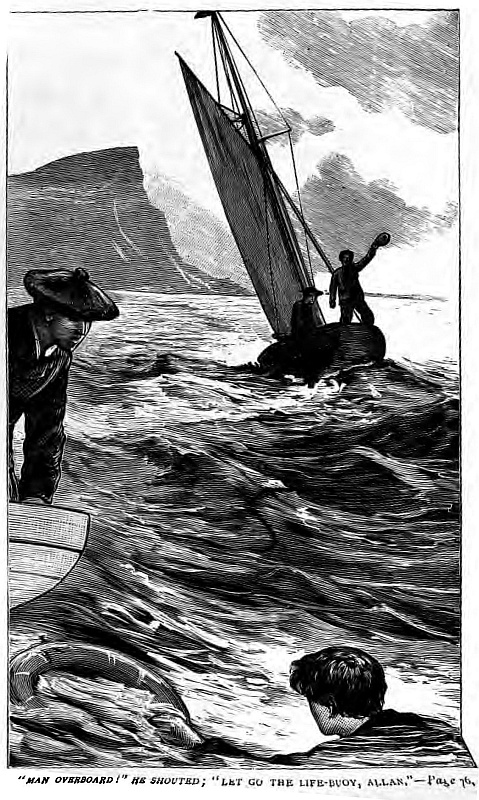
Both Allan and Rory knew well that their friend could swim, and the latter at all events seemed to treat the affair as a very pretty piece of entertainment.
“Man overboard?” he shouted. “Let go the life-buoy, Allan.”
Instinctively Allan did as he was told, and sent the big cork ring flying after Ralph, but seeing the merry twinkle in Rory’s eye, and knowing there was no necessity for it, he repented having done so next minute.
“Lower away your dinghy,” cried McBain to Allan, as he hauled the headsails to windward and stopped the cutter’s way, “it will be a bit of practice for you.”
Allan was pulling away astern two minutes after in the little boat, dignified by the undignified name of dinghy, for she was very tiny indeed, but Allan could have sculled a wash-tub.
He soon met Ralph coming ploughing and spluttering along, breasting the billows, for he was a powerful young swimmer, with the life-buoy in front of him, which, however, he scorned to make use of.
“Take your little joke on board,” he cried laughing. Allan picked up the buoy and threw Ralph a rope.
“That’s better,” said Ralph, and in a few minutes more they were alongside and on board.
Rory was singing “A life on the ocean wave,” and the merry twinkle had not left his eyes.
When Ralph had changed his dripping clothes for dry ones, and reappeared looking somewhat blue, Rory had his laugh out, and all hands were fain to join.
“I caught a crab indeed,” said poor Ralph.
“Caught a crab is it?” cried Rory. “It wasn’t a crab but a turtle you turned. Och! it was the beautifulest sight ever I saw in the world to see the long legs of you go up. You know, Ralph, my brother tar, you couldn’t see it yourself, or it’s delighted you’d have been entirely!” and Rory laughed again till the tears came into his eyes.
“I’m not sorry that this happened,” said McBain, “after all.”
For her size I do not think there was a more comfortable little yacht afloat than the Flower of Arrandoon. Small though the box was they called by courtesy the saloon, it was fitted with every comfort, and there was not an inch of space from stem to stern that was not well economised for some useful purpose. One useful lesson in yacht life our heroes were not long in learning, and that was to put everything back again in its proper place as soon as it was done with; in other words, the circumstances under which they were placed taught them tidiness, so that there was no lubberliness about their little ship. And everything in and about her was the perfection of cleanliness and neatness, for they were not only the crew, but the cook and the cabin-boy as well. And so, plain woodwork was as white as snow, paint-work clean, polished wood looked as bright as the back of a boatman beetle, and brass shone like burnished gold. Their meals they managed to serve up to time, and cooking was performed by means of a spirits-of-wine-canteen.
But it is not the cruise of the Flower of Arrandoon I am writing, else would I love to tell you of all the adventures our heroes had among these islands, and how thoroughly they enjoyed themselves. No wonder they felt well, and happy, and jolly; no wonder that Allan said to his companions, one beautiful day early in August, “I do wonder that more fellows don’t go in for this sort of life.”
They had just been dining gipsy-fashion on shore when he made the remark. They were reclining on the top of a high cliff on the western coast of Skye. Far down beneath them was the sea, the blue Minch, bounded on the distant horizon by the rugged mountains of Harris and Lewis. To their right lay the rocks of the Cave of Gold; beyond that, on a lofty promontory, the ruins of Duntulm Castle; then green hills; while downwards to the left sloped the land until quite on a level with the water; and there in a little natural harbour of rock lay the yacht, looking, as Rory always said, as tidy and neat as nine pins, but wonderfully diminutive as seen from the spot where Allan McGregor and his friends were indolently lounging.
The day was exceedingly bright and beautiful, the sun shone with unclouded splendour, the hills were purple-painted with the heather’s bloom, and the air was laden with the perfume of the wild thyme.
No one answered Allan’s remark; perhaps everybody was thinking how pleasant it all was, nevertheless.
“Boys!” said Ralph, at length.
“Hullo!” cried all hands, but nobody moved a muscle.
“Boys!” said Ralph, in a louder key.
“That means ‘attention,’” said Allan, sitting up. All hands followed his example.
“Och! then,” cried Rory, “just look at Ralph’s face. Sure now if we could believe that the dear boy possesses such a thing as a mind, we’d think there was something on it.”
“Well,” said Ralph, smiling, “I sha’n’t keep you longer in suspense; the letter I got to-day from Uig brought me—that is, brought us—glorious news.”
“And you’ve kept it all this time to yourself?” said Rory. “Och! you’re a rogue.”
“I confess,” said Ralph, “it was wrong of me, but I thought we could talk the matter ever so much more comfortably over after dinner, especially in a place like this.
“I’ve got the best father in the world,” said Ralph, with an emphasis, and almost an emotion, which he did not usually exhibit.
“No one doubts it,” said Allan, somewhat sadly; “I wish I had a father.”
“And I,” said Rory.
“Well, would you believe it, boys?” continued Ralph, “he now in this letter offers me what we all so much desire a real yacht, a big, glorious yacht, that may sail to any clime and brave the stormiest seas. He said that though I had never even hinted my wishes, he gathered from my letters that my heart was bent upon sailing a yacht, and that his son should own one worthy of the family name he bore. Oh! boys; aren’t you happy? But what ails you?”
He looked from the one to the other as he spoke.
“What ails you? What ails you both, boys? Speak.”
“Well!” said Rory, “then the truth is this, that the same thought is running through both our two minds at once. And there is only one way out of the trouble. We won’t go with you, there! We won’t go in your yacht, in your yacht. Mind you, Ralph, dear boy, I say we won’t go in your yacht.”
“That’s it,” said Allan, repeating Rory’s words; “we won’t go in your yacht.”
“Ha! ha! ha!” laughed Ralph, right heartily. Then he jumped to his feet, and smilingly doffing his cap, “I respect your Celtic pride, gentlemen,” he said. “It shall not be my yacht. It shall be our yacht, and we’ll go shares in expenses.”
“Spoken like men, every one of you,” roared McBain, no longer able to restrain himself. “I’m proud of my boys. Indeed, indeed, old McBain is proud of his pupils.”
And he shook hands with them all round. This is Highland fashion, you know, reader.
They spent fully four hours longer on that cliff-top; they had so much to talk of now, for new prospects were opening out before them, and they determined to try at least to turn them to good account.
The sun was setting ere they reached their little vessel once again, and prepared to turn in for the night.
Chapter Seven.
A Summer’s Day at Sea—Strange Scenery—The Squall—Adventure among Bottle-Nosed Whales—The “Snowbird.”
The cutter yacht had been riding at anchor for two whole days and nights in the beautiful little bay of Talisker. This bay lies on the west-by-south side of the wonderful Isle of Wings, which we call Skye, and forms, in fact, the mouth or entrance to one of the prettiest glens in all the Highlands. (It is called in the Gaelic language “the winged island,” owing to its peculiar formation.) Let me try to describe it to you then in a few words, but I shall be very clever indeed if I can give you anything like a just conception of its beauty. Suppose you have been standing in from the sea, and have just dropped anchor at the mouth of the glen, which is not more than half a mile in width, you will find on your right hand and on your left tall beetling cliffs, the tops of which are often hidden by the clouds. You may judge of their height when I tell you that the eagles have built their nests for ages on the southern rock. The bay itself is perfectly crescentic, receiving in its centre the waters of a fine salmon stream, while its waves break upon silver sand instead of the usual shingle. The bottom of the glen is perfectly flat, and occupied by well-tilled land; its sides descend precipitously from the table-land above, so much so that the burns or streamlets that form after every summer shower come roaring down over them in white foaming cascades. The upper end of the glen is wooded, and from above the trees peep out the white chimneys of the mansion house of Talisker. This glen or ravine ends in a sugar-loaf mountain of great height, the little pathway to the top of which winds round and round, so that looking at it from below it reminds you forcibly of the pictures of the Tower of Babel, as seen in old-fashioned illustrated Bibles.
Our heroes had been enjoying themselves, fishing in the stream all day, dining with the hospitable squire in the evenings, and going off at nights to sleep on board their little yacht.
“Boys,” said McBain, early in the morning of the third day, “rouse out like good fellows.”
Rory and Allan were soon stirring. Ralph contented himself with simply turning himself round in his oblong hammock, and feebly inquiring,—
“What’s the matter?”
“What’s the matter?” said McBain, sitting down near him; “this is the matter—the morning is far too bright to please me; there is a little wind from the nor’ard, and it seems increasing, and the glass is tumbling down, and we can’t lie here unless we want to leave the bones of the Flower of Arrandoon to bleach on the sands.”
“Och!” cried Rory, in his richest brogue; “it’s very wrong of you to bother the poor English crayture so much. Bring him a cup of tea and leave him alone.”
But Ralph was now fully aroused, and three minutes afterwards the three friends were splashing and dashing in the sea, mounting the rollers, diving and treading water, laughing and joking, and making more noise than all the gulls and kittywakes that screamed around them.
McBain had stopped on board to cook the breakfast, and it was all ready by the time they were dressed—fresh salmon steaks, new-laid eggs, and fragrant coffee.
“Now then, my lads,” cried McBain, “on deck all of you, and stand by to get the anchor up. I’ve sent a message to the squire, saying we must start, and bidding him good-bye for the present.
“Which way are we going, captain?” asked Rory.
“Up north, my lad,” was the reply. “Portree is our destination, and though by going south we would have a favouring wind at first, we would never get past Loch Alsh; besides, if you look at the chart you’ll find that northwards is nearer. And now, Rory, please, no more talk; you just untie the mainsail cover and undo the tyers, that’s your work, because you’re neat.”
“Thank you,” said Rory.
“Mainsheet all right?”
“All right, sir.”
“Well, heave away and shorten cable.
“So—top the boom, hook on, hoist together. Up goes the gaff. Well done, lads, and handily. Belay—why, I have hardly to speak. Well done again. Now, if your sheets are shipshape, up with the jib and foresail.
“Trip the anchor, and on board with it. There we are, Rory; we’re going on the starboard tack a little way; just cant her head. Now she feels it. Belay halyards, and coil the slack. That’s right and not lubberly. Rory, you’ll make the best sailor of the lot of us. No, never mind the topsail for a bit. Presently though. Now I’ll steer for a little. We may have a puff when we clear the cliffs. Meanwhile, hoist your morsel of ensign, and, Rory, fire that farthing gun of yours.”
“The farthing gun made a deal of noise for the price of it, anyhow,” said Rory.
Hardly had the sound ceased reverberating from among the cliffs, when two white puffs of smoke rose up from under the nearest tree, and then, bang! bang! came the sound towards them. “Good-bye” it seemed to say. It was Macallum, the keeper, with his double-barrelled gun.
There was not much of a breeze after all, and plenty of sail being carried, they bowled along beautifully on the starboard tack, sailing moderately, but not too close to the wind. Although every now and then the cutter elevated her bows, and brought them down again with a peevish thud that sent the spray flying from stem to stern, nobody minded that a bit; the weather was warm, the water was warm, and besides they were all encased in oilskins.
Indeed it was one of the most enjoyable cruises they had ever had, counting from their departure from Glen Talisker to their arrival at Portree. McBain knew the coast well. He did not hug it, neither did he put far out to sea; he put her about on the other tack shortly, as if he meant to go up Loch Bacadale. Presently they were not far off Idrigail Point, and the cutter was once more laid on the starboard tack, and sails being trimmed, and everything working well, there was time for conversation.
“Shall I steer?” said Rory, who was never happier than when he was “the man at the wheel.”
“Not just yet,” said McBain; “when we’re round Point Aird, very likely I’ll let you do as you please; but, boys, I’ve got that falling glass on the brain, and I want to take every advantage, and fight for every corner.”
“Look now, Ralph and Rory, you’ve never been so close in-shore before. Allan, don’t you speak, you have. The day is bright and clear; do you see McLeod’s Table?”
“The never a table see I,” said Rory.
“Well,” continued McBain, “that lofty mountain with the flat top is so called.”
“And a precious big feast McLeod could spread there too,” said Allan.
“And a precious big feast he did one time spread,” replied McBain, “if an old Gaelic book of mine is anything to go by.”
“Tell us,” cried Rory, who was always on tiptoe to hear a tale.
“It would seem, then, that the McLeods and the McDonalds were, in old times, deadly foes; although at times they appeared to make it up, and vowed eternal friendship. The chief McLeod invited the McDonalds once to a great ‘foy,’ and after eating and drinking on the top of that great hill, until perhaps they had had more than enough, three hundred armed Highlanders sprang from an ambush among the rocks and slew the McDonalds without mercy. Their flesh was literally given to the eagles, as Walter Scott expresses it, and their bones, which lay bleaching on the mountain top, have long since mouldered to dust.
“On another occasion,” continued McBain, “the McLeods surprised two hundred McDonalds at worship, in a cave, and building fires in front of it, smothered them. The poor half-burned wretches that leapt out through the flames speedily fell by the edge of the sword.”
“What cruel, treacherous brutes those McLeods must have been,” remarked Ralph.
“Well,” said McBain, “war is always cruel, and even in our own day treachery towards the enemy is far from uncommon; but, mind you, the McDonalds were not sinless in this respect either. A chief of this bold clan once invited a chief of the McLeods to dinner in his castle of Duntulm.”
“I wouldn’t have gone a step of my toe,” cried Rory.
“But McLeod did,” said McBain, “and he went unarmed.”
“Ha! ha!” laughed Allan; “it strikes me they were playing the rogue’s game of ‘confidence.’”
“Something very like it, but McDonald apparently didn’t know how kind to be to his guest, and pressed him to eat and drink galore, as we say. McDonald even showed McLeod to his bedroom, and, for the first time perhaps in his lifetime, poor McLeod began to quake when he found himself within the donjon-keep.
“‘There is your bedroom,’ said the stern McDonald. ‘Yonder is where your body will lie, and yonder is where your bones will repose when the rats have done with them.’
“McLeod would have tried to rush out, but strong arms were there to thrust him back. No one came near the prisoner for two days, then through the barred window food was handed him, salt-sodden flesh and a flask of water. He ate greedily, then applied the jar to his lips to quench his thirst. Horror! the water was seawater.”
“And he perished of thirst?” inquired Ralph.
“So the story goes,” replied McBain.
“A chief of the McLeods,” said McBain, “one of the very, very oldest of the chiefs, had a large family of grown-up daughters, and they wouldn’t always obey the old man, and one day, instead of attending upon him—for he was blind—they went to bathe and disport themselves among the billows, but a sea-nymph came and turned them all into stone.”
“And served them right,” said Rory.
“And there they stand; those tall black rocks, well in towards the point yonder, with the white waves dashing among their feet. They are called McLeod’s maidens until this day.”
“Well,” said Ralph, with a quiet smile, “there is no mistake about it—there were giants in those days.”
They were nearly at Dunvegan Head by this time, standing, in fact, well in towards it on the port tack, for the waters are deep even close in-shore. When they had left it on the beam they opened out broad Loch Follart, when McBain, pointing landwards, said,—
“In there is a little bay, called Loch Bay, and by it a rural hamlet or village, which is claimed as the real capital of Skye. It is called Stein.”
“But see, see,” cried Rory. “Is that a geyser rising out of the sea between us and the shore?”
“Why, it is very like a fountain,” said Ralph.
“It is very like a whale,” said Allan, and McBain laughed.
“It is a whale,” he added. “It is the solitary, or caa’in’ whale, and the rascal is in there after the herrings. A more independent brute doesn’t swim in the sea. He ignores a boat. He looks upon mankind as poor, miserable, puny creatures, and I don’t think he would go very far out of his way for a line-of-battle ship.”
An hour or two afterwards they came in sight of Duntulm Castle, previously having passed the little church of Kilmuir, with its bleak-looking stone-built manse. Near it is a graveyard, which had very great interest for poetic Rory.
“Poor Flora McDonald!” he almost sighed. “I always think that Prince Charlie should have taken her away with him to sunny Italy and married her. How beautifully the story of the ill-fated prince would have read had it ended thus!”
“Rory,” said Ralph, “I’ll leave you to dream and romance while I go and see about the luncheon.”
“So like an Englishman,” said Rory.
“Never mind,” replied Ralph; “we can’t be all alike. What if I do prefer roly-poly to romance; don’t the English win all their battles on beefsteak?”
“Yes, it is time for you to dive in,” said Rory, laughing; “but there, hand out my fiddle and I’ll forgive you. If the sea-nymphs will only be kind now,” he continued, “and keep me dry, I’ll play and sing you something appropriate.”
He did, in his sweet tenor voice, accompanying himself with his favourite instrument. He sang them the old song that begins:
“Far over the hills and the heather so green, And down by the corrie that sings to the sea, The bonnie young Flora sat weeping alane, The dew on her plaid and the tear in her e’e. She looked at a boat with the breezes that swung, Away on the wave like a bird of the main, And ay as it lessened, she sigh’d and she sung, ‘Fareweel to the lad I shall ne’er see again.’”
“’Deed, indeed,” said Rory, in his richest brogue, and with a moisture in his eye, “it is very pretty, and would be romantic entirely if the frizzle, frizzle, frizzle of that Saxon’s frying-pan wouldn’t join in the chorus.”
“Ham and eggs, boys; ham and eggs?” cried Ralph. “Away with melancholy.”
Not far from Duntulm Castle was a house, of which our friends bore the kindliest of recollections, for here they had been most hospitably entertained.
“I wonder,” said Ralph and Rory, almost in the same breath, “if they’ll see us and know us.”
“Fire your gun again, anyhow, Rory,” said McBain.
The gun was run in, loaded and fired, and they had the satisfaction of seeing their friends in the garden waving welcome to them with a Highland plaid. Then the ensign was dipped, the headsails hauled to leeward again, and away they went.
But see, it is getting wonderfully dark ahead, and a misty cloud seems rapidly nearing them, with a long white line right under it.
“Stand by the jib-sheet,” cried McBain. “Ease away; now luff, my lady.”
The cutter was laid nearly lee-rail under, but she bore it wonderfully well. Then sail was taken in, for, said McBain, “We’ll have more of these gentry.” And so they had, and it was more than an hour ere they doubled Ru-Hunish Point, and bore away for the Aird. Once round here the danger was over, and they were no longer on a lee shore.
I myself never could see the good of a squall, either white or black, and either of them are dangerous enough in all conscience when they take you unawares, but it is said there is good in all things. Be this as it may, the squalls the cutter had gone through seemed to clear the summer air in a remarkable manner, for even the glass began to rise, and with it the spirits of those on board.
It was a fair wind now all the way to Portree, and they made the best of it, Rory being once more in his favourite seat with tiller in hand. Past that mysterious mountain called Quiraing, onwards and past the tartan rock, over the precipitous sides of which a cataract was pouring into the sea, so that you might have sailed a boat between the water and the cliff; past the bay of Steinscholl, past the point of Braddan, past the strange weird rocks of Storr, with Rona Isle and Raasay on the weather beam, and the wild white hills of Cuchullin in full view in the far distance, and past Prince Charlie’s cave itself, and now they keep her in more towards the shore, for they are not far from the loch of Portree. Just past the cave they sail through a fleet of fishing boats. The men on board seem greatly excited. They have hauled in their oars, and stand by with great stones in their hands—part of the boat’s ballast—as if watching for a coming foe. But where is this foe? Why, look ahead, the whole sea for half a mile is darkened with an immense shoal of porpoises, driving straight towards the cutter and the boats, turning neither to right nor left, leaping from the water, splashing and dashing, and apparently wild with glee. Small respect have these “sea pigs,” as they are termed in the native language, for the poor fishermen’s nets; if the nets happen to come in their way, through they go, and there is an end of it. How the men shout and scream, to be sure! The bottle-noses take not the slightest heed of them; they are in their own element, so on they come and on they go, the wild shouts of the fishermen are nothing to them, and the stones thrown glide harmlessly off their greasy backs; but they are gone at last, gone like a whirlwind, and the boatmen are left lamenting over their bad luck and their broken nets.
Three hours after this the storm came on in earnest, but the little yacht lay snug at her moorings, and her owners were sipping their coffee after a good dinner in peace.
It was quite late that night before they retired. It mattered little in one way at what time they turned in, for there was small likelihood that the storm now raging across the island would abate before twelve hours at least. And what do you think they talked about? Why, the sea, the sea, and nothing but the sea, and wild adventures here and there in many lands. Again and again they plied McBain with questions about that strange country up in the frozen north, where it was said the mammoth caves lay. And McBain told them all he knew, and all he had ever heard concerning them. It was determined that northwards they should sail and nowhere else.
“What shall we call our coming queen?” said Rory. “What shall we name the yacht?”
“Oh! wait till we see her first,” said Allan.
“Ridiculous!” cried the impetuous Rory. “No, let us call her the Snowbird.”
Chapter Eight.
Rolling Home—A Rough Passage—The Welcome Back—The Way a Sailor Sleeps.
When the royal eagle, the bird of Jove, paid a visit to the Castle of Arrandoon, and dropped so daringly into the poultry yard, intent only on turkey, it will be remembered that his presence created no little commotion, but I question if the din of even that memorable morning equalled the hubbub that arose when Allan and his friends returned from their four months’ cruise in the cutter.
A letter from Oban had reached Mrs McGregor three days beforehand, so that they were quite expected, and even the probable hour of their arrival in the creek in Glentroom was known.
The voyage from Portree to Oban had been an uneventful one. The wind was favourable all the way, but strong enough to make a glorious passage with a close-reefed mainsail and storm-jib, so they bowled along, impatient now to get back to bonnie Arrandoon. But they did not mind the roughness of the passage; they did not mind the tumbling and the tossing they got; they despised even the danger of being pooped. They made heavy weather just off Ardnamurchan Point. McBain stuck to the tiller, and for a whole hour, or more, perhaps, there was not a word spoken by any one. They are fearful cliffs, those around the wild highlands of Ardnamurchan, black and wet and fearful; the largest ship that ever floated would be dashed to pieces in a few minutes if it had the misfortune to run amongst them. Perhaps our heroes were thinking how little chance their cockle-shell of a cutter would have, if she got carried any where near them, but they kept their thoughts to themselves, and meanwhile the yacht was behaving like the beauty she was. Indeed she seemed positively to enjoy rolling homewards over these great, green, foam-crested seas; for she bobbed and she bowed to the waves; she curtseyed to them and she coquetted with them as if she were indeed a nymph of the sea and a flirt as well. Sometimes she would dip her bowsprit into a wave, as if she meant to go down bows first, but in a moment she had lifted her head again, and tossed the water saucily off, ere ever it had time to reach the well; next she would flood the lee-rail, and make the waves believe they could board her there, then righting again in an instant, after a nod or two to the seas ahead, as much as to say, “Please to observe what I shall do now,” she would sink herself right down by the stern, with the foam surging around her like a boiling cauldron, but never admitted a drop. There were times though, when she sank so far down in the trough of the sea that her sails began to shiver, yet for all that she was uphill again in a second or two, and scudding onwards as merrily as ever.
The seas were shorter in Loch Sunart, they were choppy in the Sound of Mull, and seemed to get bigger and rougher every other mile of the journey; the crew were not sorry, therefore, when the anchor was let go, and the mainsail clewed, in the Bay of Oban.
“Why,” said Ralph, after dinner that day, “we haven’t had such a tossing all the cruise. I declare to you, boys, that every bone of my body aches from top to toe.” McBain laughed.
“You ought to go out,” he said, “for a few nights with the herring boats.”
“Is it rougher,” queried Ralph, “than what we have already gone through?”
“Ten times,” replied McBain.
“Then, if you please,” said Ralph, “don’t send me. I’d rather be excused, Captain McBain, I do assure you.”
“And so our summer cruise is ended,” said Allan, with something very like a sigh.
“And haven’t we enjoyed it too!” said Rory, who was lying on the sofa locker, book in hand. “Troth, boys,” he added, “I didn’t notice, till this very minute, that my book was upside down. It is dreaming I was entirely. Oh! those, beautiful mountains of the Cuchullin, raising their diamond tops into the summer air, with the purple haze beneath them, and the blue sea flecked with white-winged birds! Scenery like this I’ll never get out of my head, and what is more I never wish to, and if ever it does attempt to slip away, sure I’ve only to shut my eyes and play that sweetest of old reveries, ‘Tha mi tinn leis a ghoal,’ (The Languor of Love), and it will all, all come back again.”
“And we’ve had the very best of eating and drinking all the time, you know,” Ralph said.
“And it hasn’t cost us much,” added Allan.
Rory looked first at one and then at the other of his friends, apparently more in sorrow than in anger; then he resumed his book, this time with the right side up.
“I’ve been keeping tally,” continued Allan, addressing himself more particularly to McBain, “of all that our voyage has cost us, and taking everything into consideration, I find that we couldn’t have travelled half so cheaply on shore, nor could we have lived as cheaply even at home. We did not pay much for the cutter and all her fittings, and if we had cared to do a little more fishing, and sent more boxes of lobsters down with the southern steamers, I think we would positively have made a good deal of profit.”
“You are thoroughly practical,” said Ralph; “I like you for that.”
“Well, but,” said Allan, half apologetically, “neither of us, you know, is extra rich, and I think it is some satisfaction to look back to a time spent most pleasantly and enjoyably, without either extra expenditure, or—or—what shall I say?”
“Prodigality,” suggested Ralph.
“That word will do,” said Allan; “but I do declare I’m nearly half asleep.”
“I expect,” said McBain, trying to repress a yawn, “that we will all sleep to-night without rocking.”
Two hours afterwards they were all asleep, and the yacht rose and fell gently on the rippling water, the moon shone over the mountains, making the houses in the little town all look as if their walls were marble and their slated roofs were burnished gold.
They would have gone right up Loch Linnhe, instead of calling at Oban, only Rory wished to do a little extra varnishing and gilding before their return, so they stopped here for two days.
Yes, there is no mistake about it, there was a commotion in and around the old castle. As Allan and his friends came filing up the glen, headed by Peter, who had gone to meet them with the bagpipes, in true Highland fashion, I think the dogs were the first to hear the wild joyous notes of the pibroch. Every one of them found his way out into the courtyard; the inner gate of the drawbridge was closed, so Oscar and Bran stood and barked at it, just as if that would open it; the smaller dogs yapped at their heels, for whatsoever Bran and Oscar did, the collie and Skyes followed suit; every feathered biped about the place joined in the chorus, and then, for just a moment, there was a slight lull, and Allan’s favourite pony was heard laughing loud and shrill to himself in the stables.
“Och! and och!” cried old Janet, rushing out to open the gate for the dogs, “it’s the happy day for old Yonish (Janet) and it’s the happy day for the whole of us. Go doggies, go craytures, and meet the dear master!”
The dogs needed no pressing. Headed by Bran, with Oscar in the rear—for these dogs always kept up a certain decorum in presence of the others—out they rushed, and next moment Allan was in the midst of them.
He would not check them in their glee for all the world, but, with Bran on one side of him, and Collie on the other, and all the Skyes dancing round his feet, it must be confessed that for fully five minutes he had rather a rough time of it. Oscar, after kissing his master on the ear, picked off his hat, and trotted away back with it to the castle.
So Allan returned bareheaded, but laughing, to receive the affectionate greetings of his mother and sister. But who is that tall, handsome, elderly gentleman in company with the latter? You would have required no answer to that question had you but seen the rich blood mantling in Ralph’s cheeks the moment he saw him, or marked the glad glitter in his eyes. He seemed to clear the drawbridge at a couple of bounds.
“Father! father!”
“Ralph, boy!”
“Your runaway son,” said Ralph, laughing.
“My sailor boy!” said his father, smiling in his turn.
Those last words made Ralph’s heart bound with joy. He knew his father well, and he knew when he said “my sailor boy” that he did not mean to repent his promise anent the yacht.
Allan was talking to his mother and sister, Helen McGregor hanging on his arm, and looking fondly up in his face.
But poor Irish Rory stood shyly by himself, close by the drawbridge gate. At present there was nobody to speak to him; for the time being, at all events, there was no one to bid him welcome back.
“Och!” he said to himself, with a sigh, “the never a father nor mother have I. Sure I never remember feeling before that I was an orphan entirely.”
A big cold nose was thrust into his hand. Then a great dog rubbed its shoulder with rough but genuine kindness against his legs. It was Bran’s mother, and her behaviour affected him so that he was almost letting fall a tear on her honest head, when he suddenly spied old Janet, and off went the cloud from his brow in a moment—and off went he, to pump-shake the old lady by the hand, and vow to her that this was the happiest day in his life.
And old Janet must needs wipe her eyes with her apron as she called him, much to his amusement, “mo chree” and “mo ghoal” (love), and “the bonnie boy that he was,” and a hundred other flattering and endearing epithets, that made Rory laugh and pump-shake her hand again, and feel on the whole as merry as a cricket. But when Helen herself came running towards him, and placed both her hands in his and welcomed him “home,” then his cup of joy was about full, and he entirely forgot he was an orphan. Then she dragged him over to her mother, and the first greetings over—
“Isn’t he sunburnt?” said Helen; “but do, mamma, look at Allan and his friend.”
“Well,” said Allan, “what colour are we?”
“Oh, just like flower-pots,” said Helen, laughing.
That same afternoon Allan was sitting talking to Rory in his “sulky,” when in burst Ralph. He had just returned from a long walk with his father, and he was looking all over joyous.
“Why, what do you think, boys?” he cried, rubbing his hands, and then making believe to punch Allan in the ribs; “what do you think, old man?” he added.
“Something very nice, I’ll be bound,” said Allan, “or staid steady Ralph would not be so far off his balance.”
“It is pleasant in the extreme,” said Ralph, taking a seat in front of them, “and so very unexpected too.
“Now guess what it is.”
“Oh; but we can’t, we never could,” said his friends.
“Out with it, Ralph,” cried Allan, “don’t keep us in ‘tig-tire.’”
“Yes, don’t be provoking, Ralph,” added Rory.
“Well, then,” said Ralph, speaking very slowly, just a word at a time, “father—has—been—down—to Cowes—and—bought—”
“The yacht!” cried Allan, interrupting him. “Hurrah!”
“Just one moment, my boys,” cried Rory. “I must blow off steam or I’ll burst.” So saying, he seized his violin and commenced playing one of the wildest, maddest Irish melodies ever they had listened to. You might have called the air a jig, but there was a certain sadness in it, as there is in even the merriest of Ireland’s melodies; tenderness breathed through every bar of it. You might have imagined while Rory played that you saw his countrymen dancing at a wake, and heard even their wild “Hooch!” but at the same time you could not help fancying you saw the mourners crooning over the coffin, and heard the broken-hearted wail of the coronach.
Both Allan and Ralph were pretty well used to all Rory’s queer, passionate, and impulsive ways, and so they always gave him what sailors call “plenty of rope,” and landsmen call “latitude.”
When he had finished and quieted down, then did Ralph explain to his friends all about the purchase of the yacht.
“Not a toy, mind you,” he said, “a really first-rate seagoing schooner-yacht, A1 at Lloyd’s, and all that sort of thing. New only three years ago, copper fastenings, wire rigging, and everything complete.”
“And what is her size?” said Allan.
“Oh?” said Ralph, “there is plenty of room to swing a cat in her, I can assure you; she is nearly two hundred tons.”
“Two hundred tons! why she’ll take some managing, won’t she?”
“Father says she will be as easily sailed with the crew we will have, and with ordinary caution, as our little cutter yacht.”
“Of course,” said Rory, “we will have trial trips and all that sort of thing.”
“Ay, ay, lad,” said Ralph; “but don’t you imagine that my father will trust this fine yacht in such juvenile hands as ours, without an experienced sailing-master being on board.”
“And I wonder who that will be,” said Rory, “for you know we wouldn’t take to every stranger.”
“Boys,” said Allan, “I don’t think we will have a stranger over us as sailing-master. I can tell you a bit of a secret; or perhaps, Ralph, you can guess it, if I ask you a question or two. Well, then, what do you think McBain has been studying his Rosser so earnestly for these last many months?”
“I have it,” cried Rory, “sure he’s going to take out a Board of Trade certificate as master.”
“You’re right,” said Allan, “and I think he could take one now even, for he is well up in navigation. He is well up in logarithms, and a capital arithmetician, I won’t say mathematician, though he knows something of mathematics as well. He can take his latitude and longitude, and can lay the place of a vessel on the chart. He knows how to use his sextant well, and can adjust it by the sun; he can take lunars and find his latitude by a star, and he knows everything about compasses and chronometers, and mind you that is saying a good deal. And he can observe azimuths too, and he knows many things more that I can’t tell you about; he says himself he can work a day’s work well, and I for one wouldn’t mind sailing anywhere with him; but he doesn’t mean going up yet for three months. McBain may be slow, but he is sure.”
“And we know,” said Rory, “he can pass in seamanship.”
“I should think he could,” said Allan; “in that respect I’m proud of my foster-father; he can make sail and take it in, and work a ship in the stormiest weather; he can secure a mast, or cut one adrift, and he can rig a jury, and I needn’t tell you he knows all about the lead and the log-line. Oh yes, he is a thorough seaman, and he is well up in something else too, which I don’t think the Board of Trade ever think of examining people on. He is a good weather prognosticator; he knows the signs of the clouds, and from which direction the wind is likely to blow, and by looking at the sea he can tell you the wind’s force, and whether the sea is going down or rising, and also the rate the ship is going at. Nor is the barometer a mere toy with him, it is a friend in need, and positively seems to speak to him. Well, boys, what else would you have? He is a sailor every inch, and dearly loves the sea; he tells me, too, he can sleep like a sailor.”
“How should a sailor sleep?” asked Ralph.
“Why, with one eye open, figuratively speaking,” replied Allan. “He ought to be able to sleep soundly through all natural and legitimate noises. He ought to know the position of the ship before he lies down, how her head is, what sail she carries, how the wind is, and how it is likely to be, and whether the glass is rising, falling, or steady. With this knowledge, commending himself to the kind God who rules and governs all things, his slumbers will be deeper and sweeter, I do verily believe, than any that ever a landsman knows. Rocked in the cradle of the deep, the creaking of the ship’s rudder will not awake him, nor the labouring of her timbers, nor the dull thud of striking seas, nor the howling of the wind itself; but let anything go wrong, let a sail carry away, ay, or a rope itself, or let her ship more water than she ought to with a good man at the wheel, then your sailor awakes, and very likely his head will appear above the companion hatch about five seconds afterwards.”
“Allan,” said Rory, “you’re quite eloquent. Troth, it strikes me you’re a sailor yourself, every inch of you.”
“I should like to be,” said Allan, earnestly.
“And so should we all,” said Rory; “but, Ralph, dear boy,” he added, “where is this yacht? Where is the Snowbird?”
“She is called the Sappho at present,” replied Ralph, “and she is safely in dock at Dundee.”
“Dundee?” exclaimed Rory, in some amazement.
“Yes, Dundee,” repeated Ralph; “that is the place to fit out ships for the far north. You see, she’ll want an extra skin on her to withstand the ice, and she must be fortified, strongly fortified in the bows, inside with wood and outside with iron. Father told me all about it. Father is very clever.”
“And I know he is very, very good,” said Rory; “but did you tell him where we purposed cruising?”
“I did, of course,” replied Ralph; “that was the reason he sent the yacht to be fortified. In my very last letter I explained all our hopes and wishes to him.”
“And what does he say?”
“Why, that an English gentleman, with youth on his side, ought to be able to go anywhere and do anything.”
“Bravely spoken,” cried Allan.
“Bravely indeed,” said Ralph; “but father added that in this great cruise of ours we must not be rash.”
“We will look upon that wish of your father’s,” said Allan, “as a sacred command, never to be broken.”
“That will we,” said Rory, enthusiastically.
“And he advised us, when thoroughly fitted and ready for sea, not to go right up icewards all at once, but to take Shetland on our way.”
“That would indeed be nice,” said Rory. “I’ll warrant we’ll find many things well worth seeing in both places.”
“Yes,” said Ralph, “and he says we should then bear up for Baffin’s Bay, and not attempt the far northern ice till we have done some exploring there, and got acclimatised, and well versed in the knowledge and nature of the ice. ‘Working a ship,’ he says, ‘among ice is very different from ordinary seamanship.’ But look, there is father down in the courtyard, playing with the dogs. Let us all go down and join him.”
Chapter Nine.
The “Snowbird” at Anchor—Preparations for Departure—Farewell to the Land of the Rock and the Wild Wood.
The Snowbird lay at anchor in the lake, not far from the creek where the cutter used to swing, and just beneath the birch-clad braes of Arrandoon. A steady breeze was blowing from the west-sou’-west, a breeze that made the landsman’s heart glad. It was a balmy wind and a drying wind—a wind that chased away the winter from the glens, that breathed encouragement to the green and tender corn peeping shyly up from the brown earth; a wind that went sighing through the woods, and whispered to the trees that spring had come; ay, and a breeze that rejoiced the heart of the sailor; a breeze he liked to stand against, and feel, and wave his arms in, as he gazed skywards, and longed to be “up anchor and away.”
And the saucy Snowbird never felt a bit more saucy than she did that morning. She felt impatient, and she showed it, too, in many little ways. She pulled and “titted,” as Ap phrased it, at her anchor; she bent forwards and she bent sternwards; then she would roll, perhaps once to port and twice to starboard, or vice versâ, as the thought struck her; then she would positively stop steady for a few moments, as if listening for an order.
“What can the captain be thinking about?” she seemed to say. “Why don’t they hoist the Blue Peter? Oh! shouldn’t I like to spread my wings in this beautiful wind and be off!”
But we must leave the Snowbird to herself for a little while, impatient though she be, and pay a visit to the castle, from the higher windows of which the yacht could be seen, both masts and hull. Had we come here about two weeks ago, we would have found a great deal of bustle and stir going on, especially among the female portion of the establishment, for Mrs McGregor and her gentle daughter Helen had, with the help of their maids, undertaken the superintendence not only of the upholstering and decoration of the cabins and staterooms of the Snowbird, but of all the purely domestic arrangements therein. This had cost them months of work, and entailed besides a great many journeys, not only to Inverness, but to Glasgow itself. The duties they had undertaken had been instigated by love, and they were not without good results to the performers. They had kept them from thinking. An only son and an only brother, Allan had never been very far away from home as yet, and it is needless to say that he was very dearly loved indeed. But now that he was to leave his home and leave his country, and to journey far over the sea, to lands unknown, where dangers were to be encountered, the nature of which could hardly be guessed at, or even dreamt of, it is no wonder that his mother and sister felt sad and sorrowful as the time drew near for parting.
Ah! these partings, reader! Surely one of the joys of heaven will be to think we never again will have to breathe the painful word “Farewell.”
And the Snowbird was now ready for sea; all was done to her, inside and out, that could be done. Even the crew were on board, and, as soon as Ralph should return with his father from the south, they would weigh anchor, and the cruise would be begun in earnest. If I were to analyse the feelings uppermost in Mrs McGregor’s mind at this time, I should find sorrow without doubt, but no regrets at granting her boy permission to roam over sea and land for a year or two. Why, she reasoned, should not she suffer bereavement for a little while as well as many other mothers, when it would be for Allan’s advantage and good? So her sadness never found vent in tears—at least nobody ever saw them. She went about as cheerfully, to all appearance, as before, only—and this Allan felt and knew—she tried now to have her boy near her as often as she could. Helen was less brave. Helen was but a girl, little more than a child, and if the truth must be told, she very often cried herself to sleep of nights. Her mother used to find the pillow wet in the morning, and well knew the cause.
But there was one thing they both could do—they could pray. And what a comfort that was! Oh! what a weary, dreary wilderness this world of ours would be if this power of praying were denied us, if we could not appeal in times of grief or danger to our kind Friend, who is nigh us everywhere, whether we are at peace and at home, or amidst the din and strife of battle, or far away at sea, fighting for life ’mid billows and tempest. I myself have travelled much and far, and I have oftentimes had reason to thank Him who gave me a mother who taught me to pray.
Rat, tat, tat! at the red parlour door, where the McGregor family and Rory are enjoying quiet conversation. Rat, tat, tat! and enter Peter, as Rory more than once lately remarked, not looking like the same Peter at all, at all; in fact, he was now a blue Peter, for he was rigged out from top to toe in a suit of bran new pilot, cut shipshape and sailor fashion, and very gay and sprightly Peter looked.
“Well, Peter,” said Allan, “what is it? You look as if you had seen a ghost.”
“And I’m not so sure I haven’t; but pray, sir, come to the window in the staircase, and look for yourself.”
Rory and Allan both followed Peter.
“What call you that?” cried the latter, pointing to a white sail that came skimming like a sea-bird across the dark bosom of the lake.
“Why, that is the cutter?” said Allan, in amazement.
“Or her ghost,” said Peter, with a long face.
“Come on, Rory, to the creek,” cried Allan, “and we’ll meet her.”
And they were just in time to see Ralph and his father land.
“Glad to see you both at last,” said Allan; “but tell us what is the meaning of this? You went away to sell the Flower, and behold you come back in her.”
“My father,” Ralph replied, “wouldn’t part with her; he has bought her.”
“Yes,” said the knight smiling; “she is far too good to part with. When you sail, I will accompany you a few miles on your voyage. And, please God, when you return, I will be the first to welcome you in that same boy’s yacht.”
Even my youngest readers know how quickly time flies when one wishes it to linger, and the few days that intervened betwixt Ralph’s return and the sailing of the Snowbird passed on eagle’s wings. Helen McGregor, with a tiny bottle of wine that might have been sent from Elfinland for the occasion, named the beautiful yacht. Then there was a dinner on board, at which every one tried to seem gay, but failed for all that.
Next day the wind was fair, and no time was lost in getting the anchor up and setting sail for Inverness. The ladies accompanied the expedition so far in the Snowbird, then farewells were said, blessings murmured, and once again the good yacht’s foresails were filled, and she bore bravely away up the Moray Firth, the little cutter keeping her company until right off Fort George, when waving them once more a fond adieu, the Flower of Arrandoon was put about, and very soon the point of land hid her from their view.
The cruise of the Snowbird had begun in earnest.
The breeze was light, but well aft, so all sail was clapped on her, and with her head north and by east, she glided slowly onwards as if loth to leave the land. We will take this opportunity of having a look over the goodly yacht, that is destined to be the home of our heroes for many a day to come.
The Snowbird then was a schooner-yacht of nearly two hundred tons, as well fitted and found for cruising in the northern seas as ingenuity could make her. Rising and falling, rocking and nodding on the waves, with her white canvas spread out to the breeze, she looked a very pretty craft indeed. She had just enough free-board and enough breadth of beam to make her safe and comfortable in a sea-way. Her hull was painted black, her ports only being picked out with vermilion; her masts were rakish, but not too much so; her jibboom had the graceful bend that sailors love to see, and every bit of her rigging, fore and aft, running and standing, was as taut and trim as hands could make it, or eyes wish to gaze upon.
Her deck was flush both fore and aft, with never a cabin or house thereon, for the seas they would probably ship, in the wild ocean they were about to traverse, would be little likely to brook obstruction. Her decks were as white as snow, her brass-work shone like burnished gold, her binnacle would have been an ornament even in a drawing-room, every rope-end was neatly coiled, and not a bar nor a marling-spike was out of its place.
Light and graceful though the Snowbird appeared, she was nevertheless well fortified and strong. Hers was a double skin, one that would be likely to resist the dread embrace of the ice king, while her bows were of triple strength, and shod with bars of steel. Her ballast was water in unshiftable iron tanks. Her boats were three in number, but of these I may speak again, merely saying here that they were unique of the kind.
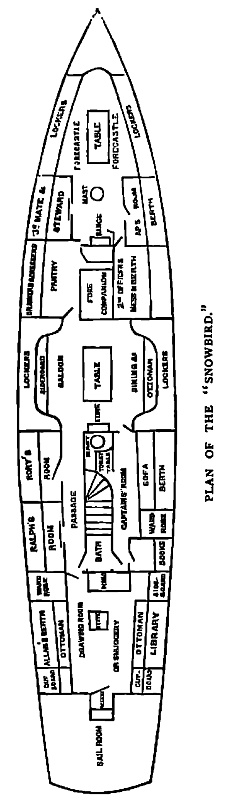
Let us go between decks and have a look at the living-rooms. Entering by the after companion, then, we find ourselves in the passage that leads to the dining-saloon. Here are the cabins of Ralph and Rory, and, as the door of each stands invitingly open, we take a peep in. They are large and roomy; the sofas are covered with crimson velvet, the curtains on the berths are of the same colour, and the pillows and counterpanes therein are white as the driven snow. There is a bookshelf in each, filled with the owner’s favourite authors, a little swing table, and a silver spring-candlestick hung in gymbals, and the nattiest of marble basin-stands; there is every comfort and luxury in these cabins, and the bulkheads are adorned with pictures, and, wonderful to say, these cabins do not even smell of varnish—no, but of sweet spring flowers, and I need not tell you who placed the vases there. Passing forward we enter the saloon (see plan). Here is a comfortable table, luxurious ottoman, side-board, cushioned lockers, chairs, and stove, and everywhere around us taste and luxury are displayed. It was the hand of an artist that painted those panels, that devised and positioned the mirrors, and that hung those polished circular swing-tables, radiant as the rainbow with sparkling coloured glass—there are three of these in all, and so cunningly are they devised that they look like bouquets of beautiful flowers pendent from stems of sterling silver. The hanging lamps, ay, and even the stoves and coal-vases in this saloon and in the drawing-room, were works of art, but space warns me that I must enlarge no more on the fittings of the rooms; in a word, then, comfort and refinement reigned supreme in the between decks of the Snowbird.
The third mate and old Ap, with the second officer of the ship, had a mess-place to themselves, and very snug it was. The men messed forward, and here, in the forecastle, a few hammocks were hung at night, but the bulk of the crew slept under, where was plenty of room for bunks, and plenty of warmth, with no lack of ventilation. The cooking-range, or galley-fire, was abaft the foremast, adjoining Ap’s room and that of the steward and third mate; and at sea, around this same galley-fire, both men and second officers would find a snug retreat in many a long, long winter’s night in the stormy regions of the north; for here, when the ship was snug, they would gather together and spin many a yarn about their own adventurous lives, and their homes far away in Scotland.
But, so far as our heroes were concerned, the snuggest corner of the ship was the drawing-room right aft. Here was the library, and here the piano, and a stove in the centre of the room, that all could sit around and make themselves happy and generally jolly.
Captain McBain’s room was next in size to the saloons, as befitted his position.
The crew were twenty hands all told. Ap was boatswain and carpenter; our friend Peter was steward. In addition to his duties as captain or master of the yacht, McBain had been duly elected supercargo. He had seen to the victualling department, and the catering for all hands, both fore and aft. Rory got hold of his list one morning, and from the extracts he read therefrom to his companions, it was evident that Captain McBain had done his work right well.
“Why,” said Rory, “I wouldn’t mind a bit living forward among the crew, for, in addition to preserved meats, and biscuits and butter, and barley, and bacon and beans, they have pork and potatoes, and pepper, and pickles, and peas, and raisins for pudding, and suet for dumplings, and oatmeal and sugar, and coffee and tea. But oh! boys! aren’t we going to live like fighting-cocks! We have all the good things they’ve got forward, and lots of cabin luxuries besides—potted milk and potted meats, and potted fish of every name, and almonds and arrowroot, and curries and capers, and all kinds of fruit, and jellies and jams galore. But what is this? I can understand the dried herbs and celery seed, but Birmingham wares! Old guns and beads!”
It was McBain’s turn to laugh, as poor Rory, with a puzzled countenance, looked beseechingly at him for an explanation.
“Indeed,” was his reply, “it is those same old guns and those beads we’ll maybe have to eat when our stock of fresh provisions wears down.”
“Oh! I see,” said Rory, a light suddenly breaking in on him. “You mean we’ll barter them with the natives for food.”
“Just so.”
“Just so; and here is an item that proves how good an officer you are, Captain McBain. You are like a king, indeed, who is mindful of the welfare and necessities of even his meanest subjects. The item speaks for itself: Dog biscuits, ten sacks.”
Yes, reader, for independent of the crew all told there were on board two passengers of the race canine—namely, honest Oscar, the Saint Bernard, and Spunkie, the wildest and weirdest-looking Skye terrier that ever barked in the kennels at Arrandoon. These two dogs lived in the forecastle, and very useful they ultimately proved, as the sequel will show.
Two days more and our heroes had gathered on the quarter-deck, to have the last look they would have for a long time on their native land.
Most of them gazed in silence at the rugged and wild scene to windward. Their hearts were rather full to speak; but Rory, leaning on the taffrail—he were nothing unless he were romantic, so he must needs say, or sigh, or sing, I do not know which it was,—
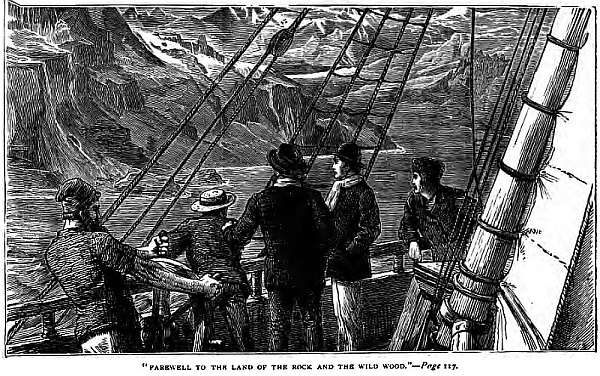
“‘Farewell to the land of the rock and the wild wood, The hill and the forest, and proud swelling wave, To the land where bliss smiled on the days of our childhood,— Farewell to dear Scotland, the land of the brave.’”
Then the breeze freshened, and the sails flapped as she leaned steadily over to it.
“Keep her away,” cried McBain, waving his hand to the helmsman.
And when they came on deck again, after dinner that evening, great seas were rolling in from the Pentland Firth, from which came the glorious wind. Nor was there any land visible in the west, where the sun was dipping down into the waves like a great vermilion shield, his beams making a bright red pathway betwixt them and the horizon. Long grey clouds were floating in the sky above, clouds of a dark and bluish grey, and yet every cloud was bound with a fringe of silver and gold.
Ere darkling some sails were taken in, and a couple of reefs in the mainsail, but shortened even thus the good yacht seemed to fly over the waves, bounding along like a thing of life, as if she positively loved the sea and felt made for it, but in all her glee she behaved herself well, and hardly shipped a drop of water.
Next morning there was a terrible noise and row on deck, and a dire rattling of chains, and a shouting of words of command, and when Rory ran up to see what was the matter he found that the anchor had just been let go, and that they were lying in Bressay Sound, right abreast of the strangely picturesque little town of Lerwick.
“As soon,” said Captain McBain, “as we’ve had breakfast we’ll go on shore. You can make the best of your time, and enjoy yourselves all you can. There is lots to see, and ponies to ride that I reckon will tax all your equestrian powers, but mind you’re off by three o’clock. There is nothing to keep us here, and we’ll weigh again this afternoon.”
“But aren’t you going to be with us?” asked Rory.
“Nay, boy, nay,” replied McBain. “I go to pick up another passenger; and one, too, whose presence on board is bound to affect for evil or for good our voyage to the far north.”
“Dear me!” said Rory, “a bit of mystery, is it? Well, that makes it all the more romantic; but get ready, boys, get ready. I, for one, mean to make a regular forenoon of it. I want to see the pony I can’t ride, that’s all.”
Chapter Ten.
Onshore in Shetland—A Family of Guides—A Wild Ride and a Primitive Lunch—Westward Ho!—Racing a Whale.
“What shall we do and where shall we go?” These were the questions which naturally presented themselves for solution to our three heroes, on first stepping out of their boat on Lerwick beach.
“We’ll take a turn up the town,” suggested Allan, “and see the place.”
“And then go and have lunch somewhere,” said Ralph.
“To be sure,” said Rory. “An Englishman will never be long without thinking about eating. But let us take pot-luck for the lunch. We’ll just get a quarter of a dozen of Shetland ponies, that’ll be one to every one of the three of us, and ride away over the island. We’ll fall on our feet, never fear.”
“More likely,” said Allan, with a laugh, “to fall on our heads and break our necks; but never mind, I’m ready.”
There were many listeners to this conversation. The town “loafers” of Lerwick are not a whit more polite than town “loafers” anywhere else, and seeing three smartly-dressed young yachtsmen, evidently the owners of the beautiful vessel that lay at anchor in the harbour, they gathered around them, crowded them in fact, and were profuse in their offers of their services as guides to either town or country. But for the present our friends declined their assistance, and set off on a brisk walk away up the curious straggling narrow street. Here were few shops worth a second look; the houses stand end on to the pavements, not in a straight row, but simply anyhow, and seem to shoulder the passengers into the middle of the road in the most unceremonious fashion. The street itself was muddy and fishy, and they were not a bit sorry when they found themselves out in the open country, quite at the other end of it. By this time they had shaken themselves clear of the crowd, or almost, for they still had four satellites. One of these was quite a giant of a fellow, with a pipe in his mouth and a tree in his right hand by way of a walking-stick, and looking altogether so rough and unkempt that he might have been taken for the presiding genius of this wild island. In striking contrast with this fellow there stood near him a pretty and interesting-looking young girl, with a little peat-creel on her back, and knitting materials in her hand, which betokened industry. She had yellow hair floating, over her shoulders, and eyes as blue as summer seas.
“My daughter, gentlemen,” said the giant, “and here is my son.”
Our heroes could not refrain from laughing when they looked at the latter. Such a mite he was, such a Hop-o’-my-thumb, such a mop of a head, the hair of which defied confinement by the old Tam o’ Shanter stuck on the top of it! This young urchin was rich in rags but wreathed in smiles.
This interesting family were engaged forthwith as guides.
They would all three go, not one would be left behind: the father and son would run, the daughter would ride, and the price of their services would be half-a-crown each, including the use of the ponies.
Oh! these ponies, I do so wish I could describe them to you. They were so small, to begin with, that Ralph and Allan looked quite ridiculous on their backs, for their feet almost touched the ground. Rory looked better on his charger. The ponies’ tails swept the heather, their coats were like the coats of Skye terriers, and their morsels of heads were buried in hair, all save the nose. Cobby as to body were these diminutive horses, and cunning as to eye—that is, whenever an eye could be seen it displayed cunning and mischief.
Rory mounted and rode like a Centaur, the young lady guide sat like a Shetland-queen. But woe is me for Ralph and Allan,—they were hardly on when they were off again. It must be said for them, however, that they stuck to their bridles if they couldn’t stick to the saddles, and again and again they mounted their fiery steeds with the same ignominious results. Two legs seemed enough for those ponies to walk upon, and it did not matter for the time being whether they were, hind legs or fore legs. They could stand, on their heads too, turn somersaults, and roll over on their backs, and do all sorts of pretty tricks.
“It’s only their fun,” cried Rory, “they’ll shake down presently.”
“Shake down!” said Ralph, rubbing his leg with a wry face. “I’m pretty well shaken down. Why, I don’t believe there is a whole bone in my body.—Whoa! Whoa! Whoa!”
But when the ponies had gone through their performances to their own entire satisfaction, and done quite enough to maintain their name and fame as wild Shetland ponies, they suffered their riders to keep their seats, but tossed their manes in the air, as if to clear their eyesight for the run they were now determined to have.
Then off started the cavalcade, rushing like a hairy hurricane along the mountain road. Swiftly as they went, however, lo! and behold, at every turn of the road the giant and his little boy were visible, the former vaulting along on his pole, the latter running with the speed of a wild deer.
It was early summer in Shetland; the top of lonely Mount Bressay was still shrouded in snow, but all the moorlands were green with grass and heather, and gay with wild hyacinth and crimson-belled bilberry bushes; the light breeze that blew over the islands and across the blue sea was balmy and yet bracing—it was a breeze that raised the spirits; yes, and it did something else, it appealed to the inner man, as Ralph expressed, and so, when after a ride of over a dozen miles a well-known roadside hostelry hove in sight, our heroes positively hailed it with a cheer. What mattered it that the little parlour into which they were shown was destitute of a carpet and possessed of chairs of deal? It was clean and quiet, the tablecloth was spotless as the snows of Ben Rona, the cakes were crisp, the bread was white, the butter was redolent of the fragrant herbage that the cows had browsed, and the rich milk was purer and better far than any wine that could have been placed before them; and when hot and steaming smoked haddocks were added to the fare, why they would not have changed places with a king in his banqueting-hall.
All confessed they had never spent a more enjoyable forenoon. The ride back was especially delightful. Before they left their guides to return on board, little Norna, the giant’s lovely daughter, produced from the mysterious depths of her peat-creel quite a wonderful assortment of gauzy mits and gauntlets, and tiny little shawls, and queer old-fashioned head-dresses, all knitted by her own fair fingers. Of course they bought some of each as souvenirs of their visit to the sea-girdled mainland of Shetland, and they paid for them so liberally too, that the tears stood in the girl’s blue eyes as they bade her good-bye. Norna had never been so rich in her life before.
Captain McBain was in his cabin poring over a chart when our heroes returned.
“Bravo! boys,” he said, heartily; “you’re up to time, and now, as the breeze is from the south with a point or two of east in it, I think we’d better make sail without delay. We’ll work her quietly through the sound. We’ll keep to the south of Yell, but once past Fiedland Point, good-bye to the British Islands for many a day. What more can we wish, boys, than a fair wind and a clear sea, light hearts, and a ship that can go?”
“What more indeed?” said Rory.
“Are we going to touch at Faroe and Iceland?” asked Ralph.
“That,” said McBain, “is, of course, as you wish. I’m at and in your service.”
“Yes, yes,” said Ralph; “but we don’t forget you are our adviser as well, and our sea-father.”
“Well,” replied McBain, “I’ve taken the liberty of writing to your real father to say that we thought it better to leave Faroe out of the chart, for the voyage out, at all events. We don’t know what may be before us, boys, nor how precious time may be.”
That evening about sunset old Ap’s boatswain’s pipe was heard high above the whistling wind; the breeze had freshened, and sail was being taken in, and the starboard courses were hauled farther aft. They passed very close to some of the numerous outlying islands, the last land their eyes would rest upon for some time. The tops of these isles were smooth and green, their sides were beetling cliffs and rocks of brown, with the waves breaking into foam at the foot, and white-winged gulls wheeling high around them. Little sandy alcoves there were too, where dun seals lay basking in the evening sunshine, some of whom lazily lifted their heads and gazed after the yacht, wondering probably whether she were not some gigantic gannet or cormorant. And the Snowbird sailed on and left them to wonder. The sun sank red behind the waves, the stars shone brightly down from a cloudless sky, and the moon’s pale crescent glimmered faintly in the west, while the wind kept steady to a point, the yacht rising and falling on the waves with a motion so uniform, that even Ralph—who, as regards walking, was the worst sailor of the three—felt sure he had his sea-legs, and could walk as well as any Jack Tar that ever went afloat. The night was so fine that no one cared to go below until it was quite late.
They needed their pea-jackets on all the same.
When morning broke there was not a bit of land to be seen, not even a distant mountain top for the eye to rest upon.
“Well, boys,” said McBain, when they all met together on the quarter-deck, “how did you enjoy your first night on blue water? How did you sleep?”
“I slept like a top,” said Rory.
“I believe,” said Allan, looking at Ralph, “we slept like three tops.”
“Like three tops, yes,” assented Ralph.
“Oh! I’m sure you didn’t, Ralph,” said Rory; “I wakened about seven bells in the morning watch, just for a moment, you know, and you were snoring like a grampus. And tops don’t snore, do they?”
“And how do you know a grampus does?” asked McBain, smiling.
“Troth,” said Rory, “it’s a figure of speech entirely.”
“But isn’t Rory getting nautical?” said Ralph; “didn’t you observe he said ‘seven bells’ instead of half-past three, or three-thirty?”
“Three-thirty indeed!” cried Rory, in affected disdain. “Ha! ha! ha! I can’t help laughing at all at all; 3:30! just fancy a fellow talking like an old Bradshaw, while standing on the white deck of a fine yacht like this, with a jolly breeze blowing and all sail set alow and aloft.
“Poor little Ralph!” continued Rory, patting his friend on the shoulder, and looking quizzingly up into his face, “and didn’t he get any letters this morning! Do run down below, Allan, my boy, and see if the postman has brought the morning paper.”
“Hurrah?” shouted Allan, so loudly and so suddenly that every one stared at him in astonishment.
“Hurrah!” he shouted again, this time flinging his cap in true Highland fashion half-way up to the maintop.
“Gentlemen,” he continued, in mock heroic tones, “the last mail is about to leave—the ship, bound for the distant Castle of Arrandoon.”
And away he rushed below, leaving Ralph and Rory looking so comically puzzled that McBain burst out laughing.
“Is it leave of his seven senses,” said Rory, seriously, “that poor Allan is after taking? And can you really laugh at such an accident, Captain McBain? it’s myself that is astonished at you?”
“Ah! but lad,” said McBain, “I’m in the secret.”
Allan was on deck again in a minute.
He was waving a basket aloft.
“Helen’s pigeon, boys! Helen’s pigeon!” he was crying, with the tears actually in his eyes. “I’d forgotten Peter had it till now.”
Ten minutes afterwards the tiny missive, beginning “At sea” and ending “All’s well,” was written, and attached to the strong bird’s leg. It was examined carefully, and carefully and cautiously fed, then a message was whispered to it by Rory—a message such as a poet might send; a kiss was pressed upon its bonnie back, and then it was thrown up, and almost immediately it began to soar.
“The bravest bird that ever cleaved the air,” said Allan, with enthusiasm. “I’ve flown it four hundred miles and over.”
In silence they watched it in its circling flight, and to their joy they saw it, ere lost to view, heading away for the distant mainland of Scotland. Then they resumed walking and talking on deck.
That was about the only incident of their first day at sea. Towards evening a little stranger came on board, and glad he seemed to be to reach the deck of the Snowbird, for he must have been very tired with his long flight.
Only a yellowhammer—the most persecuted bird in all the British Islands—that was what the little stranger was. McBain had caught him and brought him below with him to the tea-table, much to the wonderment of his messmates.
“It is a common thing,” said McBain, “for land birds to follow ships, or rather to be blown out to sea, and take refuge on a vessel.” A cage was constructed for the bird, and it was hung up in the snuggery, or after-saloon.
“That’ll be the sweet little cherub,” said Rory, “that will sit up aloft and look after the life of poor Jack.”
Westwards and northwards went the Snowbird, the breeze never failing nor varying for three whole days. By this time the seagulls that had followed the ship since they left the isles, picking up the crumbs that were cast overboard from the galley, had all gone back home. They probably had wives and little fledgling families to look after, and so could not go any farther, good though the living was.
“When I see the last gull flying far away astern,” said McBain, “then I think myself fairly at sea. But isn’t it glorious weather we are having, boys? I like to begin a voyage like this, and not with a gale.”
“Why?” said Rory, “we’re all sea fast now, we wouldn’t mind it much.”
“Why?” repeated McBain, “everything shakes itself into shape thus, ay, and every man of the crew gets shaken into shape, and when it does come on to blow—and we cannot always expect fine weather—there won’t be half the rolling nor half the confusion there would otherwise be.”
“Give me your glass,” cried Rory, somewhat excitedly; “I see something.”
“What is it?” said Allan, looking in the same direction; “the great sea-serpent?”
“Indeed, no,” replied Rory, “it’s a whale, and he is going in the same direction too.”
“It’s my whale, you know,” continued Rory, when everybody had had a good peep at him, “because I saw him first.”
“Very well,” said McBain, “we are not going to dispute the proprietorship. We wish you luck with your whale; he won’t want to come on board, I dare say, and he won’t cost much to keep out there, at any rate.”
All that day Rory’s whale kept up with the ship; they could see his dark head and back, as he rose and sank on the waves; he was seldom three-quarters of a mile off, and very often much nearer.
Next day at breakfast, “How is your whale, Rory?” said Ralph.
“Oh!” said Rory, “he is in fine form this morning; I’m not sure he isn’t going to give us the slip; he is right away on the weather bow.”
“Give us the slip!” said McBain; “no, that she won’t, unless she alters her course. Steward, tell Mr Stevenson I want him.”
Stevenson was the mate, and a fine stalwart sailor he was, with dark hair and whiskers and a face as red as a brick.
“Do you think,” said McBain, “you can take another knot or two out of her without carrying anything away?”
“I think we can, sir.”
“Very well, Mr Stevenson, shake a few reefs out.”
Ap’s pipe was now heard on deck, then the trampling of feet, and a few minutes afterwards there was a saucy lurch to leeward, and, although the fiddles were across the table, Rory received the contents of a cup of hot coffee in his lap.
“Now the beauty feels it,” said McBain, with a smile of satisfaction.
“So do I,” said Rory, jumping up and shaking himself; “and its parboiled that my poor legs are entirely.”
“Let us go on deck,” said Allan, “and see the whale.”
Before the end of the forenoon watch they had their strange companion once more on the weather quarter.
“It is evident,” said McBain, “we could beat her.”
Racing a whale, reader, seems idle work, but sailors, when far away at sea, do idler things than that. They were leaning over the bulwarks after dinner that day gazing it this lonely monster of the deep, and guessing and speculating about its movements.
“I wonder,” said Ralph, “if he knows where he is going?”
“I’ve no doubt he does,” said Allan; “the same kind Hand directs his movements that makes the wind to blow and the needle to point to the north.”
“But,” said Ralph, “isn’t there something very solemn about the great beast, ploughing on and on in silence like that, and all alone too—no companion near?”
“He has left his wife in Greenland, perhaps,” said Rory, “and is going, like ourselves, to seek his fortune in the far west.”
“I wonder if he’ll find her when he returns.”
“Yes, I wonder that; for she can’t remain in the same place all the time, can she?”
“Now, boys,” said Allan, “you see what a wide, wide world of water is all around us—we must be nearly a thousand miles from land. How, if a Great Power did not guide them, could mighty fishes like that find their way about?”
“Suppose that whale had a wife,” said Ralph, “as Rory imagines, and they were journeying across this great ocean together, and supposing they lost sight of each other for a few minutes only, does it not seem probable they might swim about for forty or fifty years yet never meet again?”
“Oh, how vast the ocean is!” said Rory, almost solemnly. “I never felt it so before.”