"A Story of Arctic Adventure" (continued 3)
Reading edition
“And yet,” said Allan, “there is One who can hold it in the hollow of His hand?”
“Watch, shorten sail.”
McBain had come on deck and given the order.
“The glass is going down,” he said to Allan, “and I don’t half like the look of the sea nor the whistle of the wind. We’ll have a dirty night, depend upon it.”
Chapter Eleven.
The Storm—A Fearful Night—The Pirates—A Fight at Sea.
“All hands shorten sail.”
The glass had not gone “tumbling down,” as sailors term it, which would have indicated a storm or hurricane in violence equal perhaps to the typhoons of lower latitudes, but it went down in a slow determined manner, as if it did not mean to rise again in a hurry, so McBain resolved to be prepared for a spell of nasty weather. The wind was now about south-west by south, but it did not blow steadily; it was gusty, not to say squally, and heavy seas began to roll in, the tops of which were cut off by the breeze, and dashed in foam and spray over the rigging and decks of the Snowbird.
It increased in force as the sun went down to something over half a gale, and now more sail was taken in and the storm-jib set. McBain was a cautious sailor, and left no more canvas on her than she could carry with comparative safety.
The Snowbird began to grow exceedingly lively. She seemed on good terms with herself, as the captain expressed it. All hands, fore and aft, had found the necessity of rigging out in oilskins and sou’-westers; the latter were bought at Lerwick, and were just the right sort for facing heavy weather in these seas. They were capacious enough, and had flannel-lined side-pieces, which came down over the ears and cheeks.
“I think I’ve made her pretty snug for the night,” said McBain, coming aft to where Allan and Rory stood on the weather side of the quarter-deck, holding on to the bulwarks to prevent themselves from falling. “How do you like it, boys? and where is Ralph?”
“Oh, we like it well enough,” said Rory, “but Ralph has gone below, and is now asleep on the sofa.”
“Sleepy is he?” said McBain, smiling; “well, that is just the nearest approach to sea-sickness. We won’t disturb him, and he’ll be all right and merry again to-morrow.”
“What do you think of the weather, captain?” asked Allan.
McBain gave one glance round at sea and sky, and a look aloft as if to see that everything was still right there, ere he replied,—
“The wind is fair, Allan, that’s all I can say, but we’ll have enough of it before morning; the only danger is meeting ice; it is often as far south as this, at this time of the year.”
The night began to fall even as he spoke, for great grey clouds had rolled up and hidden the sinking sun; sky and sea seemed to meet, and the horizon was everywhere close aboard of them. The motion of the Snowbird was an unpleasant jerky one; she pitched sharply into the hollows and as quickly rose again; she took little water on board, but what little she did ship, made decks and rigging wet and slippery. Presently both Allan and Rory were advised to go below for the night, and feeling the same strange sleepiness stealing over them that had overcome Ralph, they made a bolt for the companion. Allan succeeded in fetching it at once, and when half-way down he stopped to laugh at Rory, who was rolling porpoise-fashion in the lee scuppers. But Rory was more successful in his next attempt. In the saloon they found Ralph sound enough and snoring, and Peter, the steward, staggering in through the doorway with the supper. The lamp was lighted, and both that and the swing-tables were apparently trying to jump out of their gymbals, and go tumbling down upon Ralph’s prostrate form. In fact everything seemed awry, and the table and chairs were jerking about anyhow, and, as Rory said, “making as much creaking as fifty pairs of new boots.”
“Ah! Peter, you’re a jewel,” cried Rory, as the steward placed on the table, between the fiddle bars, a delicious lobster salad and two cups of fragrant coffee. “Yes, Peter,” continued Rory, “it’s a jewel you are entirely; there isn’t a man that ever I knew, Peter, could beat ye at making a salad. And it isn’t blarney either that I’m trying to put upon you.”
With supper the sleepy feeling passed away, and Rory said he felt like a giant refreshed, only not quite so tall.
“Bring my dear old fiddle, Peter,” he cried, “like a good soul. This is just the night for music.”
He played and Allan read for two hours at least, both steadying themselves as best they could at the weather side of the table; then they wakened Ralph, and all three turned in for the night and were soon fast asleep.
It was early summer, and Ralph, so he thought in his dream, was reclining, book in hand, on a sweet wild-thyme-scented green bank in Glentroom. A blue sky was reflected from the broad bosom of the lake, the green was on the birch, the milk-white flowers on the thorn, and the feathery larch-trees were tasselled with crimson; bees went droning from wild flower to wild flower, and the woodlands resounded with the music of a thousand joyous birds.
Ding-dong, ding-dong!
“It is the first dinner-bell from the Castle of Arrandoon,” said Ralph to himself; “Allan and his sister will be waiting, I must hurry home.”
Ding-dong, ding-dong-ding!
Ralph was wide awake now, and sitting up in his little bed. It was all dark; it must be midnight, he thought, or long past.
Ding-dong, ding-dong-ding again, followed by a terrible rush of water and a quivering of the vessel, the like of which he had never known before.
Ding, ding, ding! It was the seas breaking over the Snowbird and ringing her bell.
“What an awakening!” thought poor Ralph, and he shivered as he listened, partly with cold and partly, it must be confessed, with an undefinable feeling of alarm. And no wonder!
It was, indeed, a fearful night!
The gale had burst upon them in all its fury, and, well prepared though she was aloft to contend with it, it would require all the vessel’s powers of endurance and all the skill of the manly hearts on board of her, to bring her safely through it. Every time a sea struck her it sounded below like a dull, heavy thud; it stopped her way for a moment or two. It was then she quivered from stem to stern, like some creature in agony, and Ralph could hear the water washing about the decks overhead and pouring down below. The seas, striking the ship, gave him the idea of blows from something soft but terribly strong, and, ridiculous though it may seem, for the life of him Ralph could not help thinking of the bolster fights of the days of his boyhood. What other sounds did he hear? The constant and incessant creaking of the yacht’s timbers, the rattle of the rudder chains, and, high over all, the roar of the tempest in the rigging aloft. In the lull of the gale every now and then, he could hear the trampling of feet and voices—voices giving and voices answering words of command.
“Starboard a little! Steady?”
“Starboard it is, sir. Steady!”
“Hard down!”
“Hurrsh-sh!” A terrible sea seemed here to have struck her; the din below was increased to a fearful extent by the smashing of crockery and rattling of furniture and fittings.
“Another man to the wheel! Steady as you go. Steady.”
Then there was a sound like a dreadful explosion, with a kind of grating noise, followed by a rattling as if a thousand men were volley-firing overhead; meanwhile the good ship heeled over as if she never would right again. It was a sail rent into ribbons!
“I can’t stand this!” said Ralph, aloud. “Up I must get, and see if Allan and Rory be awake. They must be.”
Getting out of bed he discovered was a very simple proceeding, for he had no sooner begun the operation than he found himself sprawling on the deck. The floor was flooded, and everything was chaos. Feeling for his clothes, he could distinguish books by the dozen, a drawer, a camp-stool, and a broken glass. At last he managed to find a dressing-gown, and also his way along to the saloon. Here a lamp was burning, and here were Allan and Rory both, and the steward as well.
All three were somewhat pale. They were simply waiting—but waiting for what? They themselves could hardly have told you, but at that time something told everyone in the saloon the danger was very great indeed.
On deck McBain and his men were fighting the seas; two hands were at the wheel, and it needed all their strength at times to keep the vessel’s head in the right direction, and save her from broaching-to. In the pale glimmer of the sheet lightning every rope and block and stay could at one moment be seen, and the wet, shining decks, and the men clustering in twos and threes, lashed to masts or clinging to ropes to save themselves from destruction. Next moment the decks would be one mass of seething foam. It was by the lightning’s flash, however, or the pale gleam of the breaking waves, and by these alone, that McBain could guide his vessel safely through this awful tempest.
So speedily had the gale increased to almost a hurricane, that there was no time to batten down; but with the first glimpse of dawn the wind seemed to abate, and no time was lost in getting tarpaulins nailed down, and only the fore companion was left partially unprotected for communication between decks.
Soon after the captain came below, looking, in his wet and shining oilskins, like some curious sea-monster, for there was hardly a bit of his face to be seen. “What!” he cried, “you boys all up?”
“Indeed,” said Rory, who was nearly always the first to speak, “we thought it was down we soon would all be instead of up?”
The captain laughed, and applied himself with rare zest to the coffee and sandwiches the steward placed before him. “Don’t give us cups at breakfast to-morrow, Peter,” he said, “but the tin mugs; we’re going to have some days of this weather. And now, boys, I’m going to have a caulk for an hour. You had better follow my example; you will be drier in bed, and, I believe, warmer too.”
Breakfast next day was far from a comfortable meal. The gale still continued, though to a far less extent, and the fire in the galley had been drowned out the night before, and was not yet re-lit. But every one was cheerful.
“Better,” said McBain, “is a cold sardine and a bit of ship biscuit where love is, than roast beef and—”
“Roast beef and botheration!” said Rory, helping him out.
“That’s it! Thank ye,” said McBain. “And now, who is going on deck to have a look at the sea?”
“Ha! what a scene is here!” said Allan, looking around him, as he clung to the weather rail.
Well might he quote Walter Scott. The green seas were higher than the maintop, their foaming, curling tops threatening to engulf the yacht every minute.
“I may tell you, my boys,” said McBain, grasping a stay and swaying to and fro like a drunken man, “that if the Snowbird weren’t the best little ship that ever floated, she couldn’t have stood the storm of last night. And look yonder, that is all the damage.”
From near her bows, aft as far as the mizen-mast, the bulwarks were smashed and torn by the force of the waves.
“We have two men hurt, but not severely, and the pump’s at work, but only to clear her of the drop of water she shipped; and we’ll soon mend the bulwarks.”
All that day and all the next night the gale continued to blow, and it was anything but comfortable or pleasant below; but the morning of the third day broke brightly enough, albeit the wind had forged round and was now coming from the west; but McBain did not mind that.
“We made such a roaring spin during the gale,” he said, “although scudding under nearly bare poles, that we can afford to slacken speed a little now.”
The sea was still angry and choppy, but all things considered the Snowbird made goodly way.
The forenoon was spent in making good repairs and in getting up the crow’s-nest, a barrel of large dimensions, which in all Greenland-going ships is hoisted and made fast, as high as high can be, namely, alongside the main truck. A comfortable place enough is this crow’s-nest when you get there, but you need a sailor’s head to reach it, for at the main-top-gallant crosstrees the rattlins leave you, and you have a nasty corner to turn, round to a Jacob’s-ladder, up which you must scramble, spider fashion, and enter the nest from under. You need a sailor’s head to reach it and a sailor’s heart to remain there, for if there is any sea on at all, the swinging and swaying about is enough to turn any landsman sick and giddy.
Hardly was the crow’s-nest in position when the look-out man hailed the deck below.
“A vessel in sight, sir.”
Here was some excitement, anyhow.
“Where away?” bawled the captain.
“On the weather quarter, sir; I can just raise her topmasts; she is holding the same course as ourselves.”
Shortly after, Mr Stevenson, who had gone aloft, came below to report.
“She is no whaler, sir, whatever she is,” he said.
“But what else can she be?” said Captain McBain. “She might have been blown out of her course, to be sure, but with this wind she could make up her leeway. Keep our yacht a bit nearer the wind, Mr Stevenson, we’ll give her a chance of showing her bunting anyhow.”
Dinner-hour in the saloon was one o’clock, and it was barely over when Mr Stevenson entered, and with him a being that made our heroes start and stare in astonishment. What or who was he? They had never seen him before, and knew not he was on board—a very little, thin, wiry, weazened old man, all grey hairs, parchment skin, and wrinkles. Was he the little old man of the sea?
McBain saw their bewilderment and hastened to explain.
“My worthy friend Magnus Green,” he said, “the passenger I took on board at Lerwick.”
“There is precious little green about him,” thought Rory.
“The ship is not far off, she is flying a flag of distress, but Magnus says he knows her, and bids us keep clear of her.”
“Well, Magnus, what do you know about her?” asked McBain.
The little old man talked fast, almost wildly,—it was a way he had,—and gesticulated much.
“What do I know?” he cried; “why, this,—she is a Spaniard, and a thief. She came into Lerwick two weeks before you, took stores on board, sailed in the night, and paid nobody. She is armed to the teeth, and in my opinion is after you. Keep away from her, keep away, keep away.”
“But how could she be after us?” asked McBain, incredulous.
“How? ha! ha!” laughed Magnus; “you speak like a child. She herself sailed from Inverness to Lerwick: she’d heard of you, a gentleman’s yacht, with everything good on board. She couldn’t tackle you near shore, but out here on the high sea, ha! ha! the case in different.”
“There is something in what Magnus says,” said McBain. “Let us go on deck. Hoist the flag, Mr Stevenson.”
Up went the roll of bunting, one touch to the lanyard, and out on the breeze floated the red ensign of England.
(The white ensign is flown by the Royal Navy only, the blue by the Naval Reserve, the red by merchantmen and others.)
The Spaniard was hardly a mile to windward, a long, low, rakish craft, as black as a Mother Carey’s chicken. She had ports as if for guns; and though there was no answering signal, she was seen to alter her course and bear down on the Snowbird.
“She’s too like a hawk to be honest,” said McBain, “and too big for us to fight. We’ll try how she can sail; keep her away, Stevenson.”
The Snowbird began to pay off, but not before a white puff of smoke was seen rising from the stranger’s bows. Next moment down the wind came a cannon’s roar, and a shot ricocheted past the bows of the yacht.
“Ha! ha! ha!” shrieked little Magnus, “yon’s the answering signal—ha! ha! ha!”
At the same moment down went the flag of distress, and up went the black flag that pirates like to display when they really mean mischief. Something else went up at the same time, namely, Captain McBain’s Highland blood. This is no figure of speech; you could have seen pride and anger mantling in his cheek and glancing like fire from his eye.
“The black flag, indeed!” he growled; “only cowards hoist it; they think it startles their would-be prey, like the hiss a cat or a goose emits, or the images and figures idiot savages carry in their battle-van. They will not frighten us. Stevenson, load the six-pounder Armstrong. Lucky we took that little tool with us. Tell Ap to see to the small arms. We’ll show them the metal we’re made of ere we surrender the Snowbird. Stand by tacks and sheets, we’ll put her before the wind. A stern chase is a long chase; we may give her the slip after nightfall.”
There was a cheeriness in McBain’s voice as he spoke, that communicated itself to all hands fore and aft. There was no bombast about the captain, mind you, no vulgar jingoism. He merely meant to hold his own, even if he had to fight for it.
All sail was set that the Snowbird could carry, both below and aloft, an example that was speedily followed by the pirate, for pirate she seemed, from her bunting, to even brag in being, and so the chase began in earnest. The stranger fired once or twice only, but the shots falling short she gave it up, and concentrated all her attention in endeavouring to get within reach.
For the next hour there was silence on board the Snowbird, except for some brief words of command given in quiet quick tones, and just as speedily obeyed. Rory, Ralph, and Allan were clustered astern, watching the pirate. This was a kind of danger to which they had never dreamed they would be exposed; yet still the confidence they had in brave, cool McBain banished all fear from their hearts.
But the captain’s anxiety was extreme, and his eyes roved incessantly from the Snowbird to the vessel in chase, not without many a glance at the fast-declining sun.
“Are we quite prepared?” he asked Stevenson.
“All ready, sir,” was the reply, with an uneasy glance astern, “but I think she is coming up, sir, hand over hand and now she is actually setting stunsails.”
“Then God help us, Stevenson, for that chap is bound to win the battle if he can only win the race.”
The stunsails set by the stranger, however, were no sooner set than they were blown away, booms and all.
“Hullo?” cried the captain, “that is providential. Now Stevenson, get the Armstrong aft.”
This was soon accomplished.
“Here, Magnus Green,” cried McBain, “come on you’re the best shot in the ship. Many a harpoon gun I’ve seen you fire. Pepper away at that pirate till you’re tired. Cripple her if you can. It’s our only chance.”
The fire was briskly returned from the bows of the pirate, and it was soon evident that she was getting nearer and nearer to them, for the shots went over the Snowbird, and some even pierced the sails, proof positive that it was not her intention to sink but to capture the beautiful yacht.
The captain whistled low to himself.
“This is awkward,” he muttered, gloomily. He was gazing aloft, wondering if he could do nothing else to keep clear of the pirate until nightfall, when a shout behind him, followed by a ringing cheer from all hands, made him turn hastily round. Old man Magnus was capering around the quarter-deck wild with glee, rushing hither and thither, only returning every moment to pat the little Armstrong, as though it were a living thing.
“He! he! he!” he cried, “I’ve done it, I’ve done it.”
He had indeed done it. The stranger’s foremast had gone by the board, mast and sails and rigging lay about her forepart in dire confusion, burying guns and gunners.
“Glorious old Magnus!” shouted McBain, rubbing his hands with glee. “Now, Stevenson, ready about.”
The yacht came round like a bird, and sailing wonderfully close to the wind, began rapidly to near the smitten pirate. Presently it was “ready about” again on the other tack, and all the while never a shot came from the foe, but the dastardly flag still floated sullenly aloft.
Ten men were stationed in the weather bow of the Snowbird with rifles, their orders being to fire wherever they saw a head.
“Now then, Magnus,” cried McBain, “fifty guineas are yours if you’ll splinter the enemy’s mainmast. I want to let her have two jury masts to rig instead of one.” McBain carried the Snowbird cruelly near to the pirate, dangerously near too, for presently there was an answering fire of small arms, and two men fell wounded.
Crang! went the Armstrong. Faithfully and well had Magnus done his work, and down went the pirate’s other mast.
“We’ll leave her the mizen,” said McBain; “down with the helm.”
His voice was almost drowned in that deafening shout of victory. Even Oscar the Saint Bernard and the wiry wee Skye felt bound to join it, and Peter the steward rushed below for his bagpipes.
And when the moon rose that night and shone quietly down on the waters, the Snowbird was bravely holding on her course, and the discomfited pirate was far away.
Chapter Twelve.
Containing a Strange, Strange Story, Told by the Snuggery Fire.
“It never rains but it pours,” said McBain, entering the saloon rubbing his hands, and smiling as he seated himself at the breakfast-table. “Steward, I hope it is beefsteak this morning, with boiled eggs to follow, for I declare to you honestly I don’t think I ever felt half so hungry in my born days before! Bravo, steward! bravo, Peter! Be thankful, boys, for all His mercies, and fall to!”
“One would think, captain,” said Ralph, “that you had got good news this morning.”
“Why, it makes one laugh just to look at you,” said Rory.
“Laugh away, lad?” said McBain; “laugh and grow fat, but eat as well, boys! And why haven’t you been on deck, eh?”
“Overslept ourselves,” observed Allan; “Well, no wonder! You’re young, and the excitement of the past few days has been great: even I have felt it. But to-day, my boys, there isn’t a pirate in sight; the wind has gone back to the south-east, and in five more days, if it holds we’ll be on shore shooting the denizens of the scented pine forests of the farthest north lands of America.”
Our heroes were soon on deck, the Snowbird was bounding along before a beautiful breeze, with all her fair-weather sails set and nicely trimmed. Every one on board seemed joyful; the laugh and the joke were heard from the second officer’s cabin, and the men in the forecastle were trolling a song.
That same evening a very happy group were assembled around a bright fire in the cosy snuggery. They were our heroes three, squatted or reclining on mats before the stove, not sitting on chairs—certainly not, they knew a trick worth two of that. The captain occupied a rocking-chair, as became his dignity; Oscar the Saint Bernard’s nose was turned stovewards; and Rory was making a pillow of him. Oscar was eyeing the cheerful blaze, but every other eye was directed upon wee weazen-faced Magnus Green, the mysterious little stranger that McBain had picked up in Lerwick, and who had done them such noble service in crippling the pirate. He was seated on a camp-stool in the corner.
“Now, Magnus!” cried McBain, “we’re all waiting for your yarn.”
“Jan Jansen, then,” said Magnus, after a moment’s pause or two—“Jan Jansen, gentlemen, was first mate of a merchant brig, as neat and tight a little craft as ever sailed the seas. He had been in her, man and boy, for nearly twenty years—in the same ship and with the same captain. This captain was a Dane, but he hailed and he sailed from a little town in Shetland. And dearly did this sailor captain love his profession; he was never really at home except when afloat on the billowy ocean, when he was as happy as the sea-birds.
“Many a long and prosperous voyage he had made to distant lands, and never as yet had misfortune—apart from the usual ups and downs of a sailor’s life—befallen him. He had a wife—ay, and a family. Before the latter had increased the skipper’s wife had used to sail with her husband, but latterly she had stayed at home. And now that she could no longer share his perils, all she could do—and that wasn’t little, either—was to pray for him, and teach his dear children to do so likewise. But she thought that if her house were only close to the sea it would seem like living nearer to the loved one. So the captain built a house on the slope of a hill, and planted pine-trees thereon to shelter it from the cutting winds, that in winter and spring swept downwards from the north and north-east. And the windows of the house looked away over the broad Atlantic. In his outward voyages the captain’s ship, after leaving the port of embarkation, passed within two miles of his cottage door, and his wife and children used to watch the trim-built brig as she glided away from the land, lessening and lessening, until she looked but like a bird on the horizon, and finally disappeared. On stormy nights, when the wind howled around the cottage, and the angry waves lashed themselves into foam against the dark cliffs that bounded the sea-beach, the little lonely family would assemble in the parlour to pray for poor father, far at sea, to Him who can quiet the raging of the winds, and say to the troubled ocean, ‘Peace, be still!’
“But the Danish captain was not only a fortunate sailor but a very ambitious man as well, and ever after each successful voyage his wife would entreat him to remain on shore now for the rest of his life. Several times indeed the husband had acceded to her wishes, and settled down on shore. But only for a time, for woe is me! the heart of a true sailor is often as restless as the great sea itself.
“The pet of the captain’s household was his only daughter, a bright-faced, lovely girl of sweet seventeen. With her fair flowing hair, her laughing blue eyes, her cheerful voice, and her winsome ways, no wonder Nanette was a favourite. But why did she so love to roam down by the rocks where the seagulls screamed, and why, when her father was abroad, did her eyes so often fill with tears as she gazed across the sea? She was her father’s darling, it is true; but she was something else—she was brave Jan Jansen’s promised bride. And his thoughts were always on shore with Nanette, and hers were on the little barque with Jan. When he was at sea the months seemed to her like long gloomy years, and the few weeks he was at home like bright short hours of sunshine and joy.
“And they were going to be married after the very next voyage; then Jan was to have a ship of his own, and take her away with him to the sunny lands he was so fond of describing to her, and about which she so loved to hear, as they walked arm in arm on the breezy cliff-tops.
“If previous voyages had seemed long to Nanette, this last appeared an age in itself. But one summer’s morning when Nanette, awoke and opened her window to admit the sweet sea air and the song of the lark, oh! joy, there was the dear old brig with her sea-washed sides, standing close in towards the land, and she was sure—yes, there was no mistake about it—those were her father and Jan waving their handkerchiefs to attract her attention. How quickly did Nanette dress that morning and hurry out; and how speedily did she bend on and hoist the red flag on the garden staff, to tell her anxious father and lover that all was well at home!
“Then away stood the brig on the starboard tack, and next day Nanette had beside her all that she loved on earth—father, mother, her brothers, and Jan.
“There seemed to be a cloud on the captain’s brow, which his wife was not slow to notice, and even honest Jan appeared to be possessed of some gloomy secret, that sat but uneasily on his mind. Yet each when asked had only replied,—
“‘’Tis nothing, you will hear it all in good time.’
“But that evening, after supper was cleared away, and Jan with the captain sat beside the fire in the cosy parlour,—
“‘Wife,’ said the mariner, ‘I have news for you that is both good and bad. Tell them, Jan, I can’t.’
“Jan dared not meet the loving eyes of poor Nanette, but gazed dreamily into the fire as he told them the news that some shipwrecked sailors had brought to the port of Katrinesand, from which they had last sailed, of wealth immeasurable to be made on an island far away in the frozen ocean, and of mines of ivory to be had for the gathering, and of the captain’s resolve to make one last—certainly the last—Jan little knew how prophetically he spoke—voyage in the brig, and that this voyage was to be to the Arctic regions; and that neither he nor the captain doubted that this single voyage would make wealthy men of them both.
“The wife was the first to reply, for poor Nanette was sobbing as if her heart would break.
“‘Oh!’ cried the captain’s wife, ‘it is ever, ever thus. Do not go, I beseech you, oh! my husband. Do not rashly brave the terrors of that dreadful sea of ice. There has been a cloud on my heart for weeks that I could not understand till now, and both Nanette and myself have dreamed dreams that bode no good to us or ours. Husband, husband, stay at home!’
“But a determined man will have his way, and the captain’s mind was so bent on the new project that nothing would induce him to give it up. What his wife must suffer, but Nanette even more, for wherever her father went Jan was bound to follow, and the danger would be the same to both!
“On the twenty-first day of April, in seventeen hundred and ninety-six, there sailed away from Shetland the sturdy brig Danish Queen, well manned, mated, found and commanded, and with it went the hearts of the gentle Nanette and her mother.
“The day was mild and balmy. A soft south wind blew over the sea and filled the sails, and wafted the brig—oh! how fast she seemed to fly—away and away and away, till she disappeared on the northern horizon, and the poor bereaved ones, clasped in each other’s arms, wept in silence now, for neither could find a word of comfort for the other; hope itself had fled from their hearts.
“And the Danish Queen returned again no more to Shetland shores.
“Two years and a half had barely passed since she sailed away, and the autumn leaves were mingling with the long green grass in the little churchyard of Dergen, when two new-made graves might have been seen there, side by side. One was that of little Nanette, the other the grave of her heartbroken mother.
“And the time flew by, and the Danish Queen was soon forgotten, and people had ceased to speak of her, and the friends of her brave sailors had doffed the garb of mourning for five long years.
“But one day there arrived in Shetland the whaling barque Clotho, direct from the Greenland Ocean, and one passenger, the sole survivor, by his own account, of the ill-fated Danish Queen. If it were indeed as he said, there must be some strange mystery about his existence for so many years on the sea of ice, which even Jan Jansen himself—for it was he—could not, or rather would not, then explain. He was found dressed in bear-skins, a young man, but with snow-white hair and beard, wandering purposelessly on the ice, and taken on board. All that he would tell was that his unfortunate vessel had been dashed to pieces against the ice just three months after he had left Shetland, and that he alone of all on board had been saved from a watery grave.
“Jan Jansen never shed a tear when he heard of the death of the two beings he had loved far better than any one else on earth, but he never smiled again. He built himself a small cottage and tilled a little farm quite close to the graveyard of Dergen, and in sight of the sea. Years softened the poor man’s grief, and to many an earnest child-listener, not a few of whom have long ago gone grey and passed away from earth, he used to tell the tale of his strange adventures in the far-off sea of ice.
“It was on winter evenings, when the snow was sifting in beneath Jan Jansen’s cottage door, and the roar of the wind mingling with the dash of the waves on the cliffs beneath, that Jan would draw closer to the fire, and rake the blazing peat together till the shadows danced and flickered on the walls: then his little friends felt sure that he was going to repeat to them his strange, strange story.
“‘But I never told you, did I,’ old Jan would say, ‘of the lonely island of Alba, in the frozen ocean?’
“He had told them scores of times, but the tale never palled upon them.
“‘Yes, yes, Father Jan,’ they would cry, ‘but we have quite forgotten a great deal that you told us. Do tell us once again of that wonderful island, and all the strange things you saw there.’
“And Jan would begin, keeping his eyes on the fire, as if the curling smoke and the blazing peat aided his recollections.
“‘It was almost summer when the good brig Danish Queen left Shetland. A favouring breeze filled our sails, and in less than fourteen days we made the ice, and the ripple left the water, but still the wind blew fair. Onward we ploughed our way in the sturdy brig, now through fields of floating slush and snow, now through streams of small bergs, but little larger than sheep or swans. Farther north still, and the bergs grew as large as oxen, then as big as elephants, then bigger than houses, then bigger than churches; and as they rose and fell on the smooth dark billows they threatened us every moment with destruction. Then we knew we had at last reached the sea of perpetual ice; ’twas the season of the year when the sun never sets, but goes on day and night, round and round in the cold blue sky, where never a cloud is seen. We saw strange birds and beasts in the water and on the ice, beasts that glared at us with a stony fearless stare, and birds that floated so close we could have captured them by hand. The beautiful snowbird, with plumage more white than the lily’s petal, with eyes and legs of crimson, and bill of jet; the wild pilot bird, and a hundred curious gulls, and little sparrow-like birds that fluttered from berg to berg in the breeze, as if it were very much against their will they were there at all; and flocks of curious blackbirds with white mottled breasts, that laughed in the air as they flew around us, with a sound like the voices of little children just let loose from school. We saw the lonely narwhal, the unicorn of the sea, with his one long ivory horn appearing and disappearing in the black waters as he pursued his prey. Seals in thousands popped their heads above the water to stare at us with their beautiful eyes; sea cows basked on the snowy bergs; whales played their gigantic fountains on every side of us; and the great Greenland bear, king of these regions of ice, stalked majestically around on many a floe, waiting a chance to pounce on some unwary seal.
“‘Northwards still, and now we sailed into an open sea, where no icebergs were anywhere visible—nothing but water, water, wherever we looked, except on the northern horizon, where was one small snowy cone, no bigger it would seem than a sugar-loaf. Taller and taller and broader and broader it grew, as we sailed towards it, till it formed itself into a lofty table-land, and we found ourselves under the ice-bound cliffs of the Isle of Alba.
“‘Imagine if you can a large and mountainous island covered with the snows of ages, with one gigantic cone, the shaft of an extinct volcano, towering upwards until lost in the heavens; imagine all around an ocean of inky blackness, a sky above of cloudless blue, with a sun like a rayless disc of molten silver; imagine neither sight nor sound of life, saving the mournful cry of the wheeling sea-bird, or the sullen plunge of the narwhal and whale; and imagine if you can the feeling of being all alone in such a place, where foot of mortal man had never been planted before.
“‘But for all this, little recked the brave crew of the Danish Queen, for we found the ivory we had braved every danger to seek.
“‘Caves full of it!
“‘Mines of it!
“‘For days and weeks our boats did nothing but ply between ship and shore, laden to the gunwale with our pearly treasure. We had but room for one more ton. It was ready packed on shore, and I was left to watch. Alas and alas! that same night it came on to blow great guns from off the ocean. I could not see our brig for the foam and spray that dashed over the cliffs. But, ah me! I soon heard a mournful and piercing shriek, rising high over wail of wind and wash of wave, and I knew then she had gone down and all on board had perished. Shuddering with cold and horror, I sheltered myself in the inner recesses of a cave, careless even of falling a victim to a bear. I wandered in, and I wandered on and on, till I could no longer hear the surging of the storm-lashed waves, and the light behind me was swallowed up in obscurity. And now I could distinctly perceive a glimmering light and a rising mist far away ahead, while at the same time the air around me waxed sensibly warmer; still a spirit of curiosity seemed to impel me forward, until I found myself standing in front of a vast waterfall, which disappeared in the bowels of the earth beneath my feet, while floating in the vapoury mist above me were beings the most lovely I had ever imagined, in gauzy garments of pink and green.
“‘With their strange eyes bent pityingly on me, those water-spirits floated nearer and nearer. Then I felt lifted off my feet and borne gently but swiftly upwards through the luminous haze, upwards and into day once more; and what a blissful day!
“‘In this lovely land, where I dwelt so long, there was no alloy of sorrow, and the strange, bright beings that inhabited it were as happy and joyous as the birds that sang on every bough, or the flowers that wooed the wind and the sunshine.
“‘Five years passed away like one long and happy dream; then one day my spirit-friends came towards me with downcast looks and tear-bedimmed eyes. They came to tell me that, as with joy they had found me, so in sorrow they must now part with me—that no mortal must stay longer in their land than my allotted time. Then they clad me in skins and conveyed me up the mountain-side, even to the top of the highest cone. Looking down from this height, I could behold all the sea of ice spread out like a map before me, with sealers at work on the southern floes.
“‘“Yonder are your countrymen,” said the beautiful spirits; then sadly they bade me farewell.
“‘It must have been days afterwards when I was picked up by the Clotho’s men, who had gone to look for fresh-water ice.’
“The old man,” continued Magnus Green, “used to sigh as he finished his story, and we—for I, gentlemen, was one of his child-listeners—just whispering adieu, would steal away homewards through the winter’s night, seeing as we went spirits in every curling snowdrift, and hearing voices in every blast.”
“And what do you now think,” asked McBain, after a pause, “of this old man’s strange story?”
“Of the spirit portion of it,” said Magnus, “I cannot give an opinion, but that a sea of open water does lie to the far north, my experience as sealer and whaler has long since convinced me. The Isle of Alba is known to many Norwegian narwhal and walrus-hunters, and I know the mammoth caves of ivory to be not only probable, but a fact.”
“And you think,” continued McBain, “you could guide us and pilot us to these strange regions?”
“Yes, yes?” cried Magnus, producing from his bosom an old and much stained parchment chart, and tapping it with his skinny hand as he spoke, “it is all here, even if my memory failed me. Yes, yes; I can guide you, if the hearts of your crew do not fail them before the dangers to be encountered.”
“I could answer for the hearts of my crew,” said McBain, smiling; “they are hearts of oak, my Magnus! You will know that before you are long with us. As to the mammoth caves Magnus, if we ever attempt to reach them, I promise you that you shall be our pilot.”
Chapter Thirteen.
Was it an Old Man’s Dream?—Sunday on Mid-Ocean—Land Ho!—A Strange Adventure—Lost in the Great Forest.
Captain McBain and our heroes stayed up for hours that night after old man Magnus left, talking and musing upon the strange story they had just been listening to.
“Think you,” said Ralph, “there is much in it, or is it merely an old man’s dream?”
“An old man’s dream!” said McBain. “No, I do not; old men do not dream such dreams as those, but, like Magnus himself, I put little faith in the spirit part of the story.”
“The question then to be answered,” said Allan, “is, where did Jan Jansen stay during the four or five years of his sojourn in the polar seas?”
“Well,” said McBain, “I have thought that over too, and I think it admits of a feasible enough answer, without having recourse to the spirit theory. There is a mystery altogether about the regions of the Pole that has never been revealed.”
“In fact,” said Rory, “nobody has ever been there to reveal it.”
“That is just it,” contained McBain; “our knowledge of the country is terribly meagre, and merely what we have gleaned from sealers or whalers—men, by the way, who are generally too busy, looking after the interests of their owners, to bother their heads about exploration—or from the tales of travellers who have attempted—merely attempted, mind you—to penetrate as far north as they could.”
“True,” said Ralph.
“England,” continued McBain, “has not all the credit to herself, brave though her sailors be, of telling us all we know about the Pole and the country—lands and seas—around it. Why, I myself have heard tales from Norwegian walrus-hunters, the most daring fellows that ever sailed the seas, that prove to my facile satisfaction that there is an open ocean near the North Pole, that there are islands in it—the Isle of Alba if you like—and that these islands are inhabited. You may tell me it is too cold for human beings to live there; you may ask me where they came from. To your first assertion I would reply that the inhabitants may depend to a great extent for heat on the volcanic nature of the islands themselves, just as they depend in winter for light on the glorious aurora, or the radiant light of stars and moon. When you ask me where they came from, I have but to remind you that Spitsbergen and the islands around it were, before their glacial period, covered with vegetation of the most luxuriant kind, that mighty trees grew on their hills and in their dales, and that giants of the lower animal kingdom roamed through the forests, the wilder beasts preying on the flocks and herds that came down at mid-day to quench their thirst in the streams and in the lakes; Man himself must have lived there too, and if he still exists in the regions of the Pole, he is but the descendant of a former race.
“With some of these tribes Jan Jansen no doubt lived: they were good to him, perhaps so good that he got lazy and wouldn’t work, and so they were glad to get rid of him.”
“And what about the mammoth caves—do you believe in them too?” said Allan.
“Ah! ha!” cried Ralph, laughing; “our brother Allan has an eye to the main chance, you see; he wants to ‘malt’ money.”
“I want to see all I can see on this cruise,” said Allan, reddening a little as he spoke, “and I want if possible to make the voyage pay. Well, bother take you, Ralph, call it ‘makin’ money’ if you like.”
“The gigantic mammoth,” continued McBain, “used inhabit the far northern regions, where they existed in millions. Now human nature is the same all over the world, and, I suppose, always has been. Man is a collecting animal; the North American Indians collect scalps—”
“Misers collect money,” said Rory, “and little boys stamps.”
“In some parts of the world,” McBain went on, “the natives make giant pyramids of the antlers of deer; the King of Dahomey prefers human skulls, and if there be caves filled with mammoth tusks, as the traditions of the Norwegians would lead us to believe, they were doubtless collected by the natives as trophies of the hunt, and stowed away in caves. The mammoth you know was the largest kind of elephant—”
“Och!” cried Rory, interrupting McBain; “what an iconoclast you are to be sure; what a breaker of images?”
“Explain, my boy,” said McBain, smiling, for he could spy fun in Rory’s eye.
“You say the mam-moth was an elephant,” said Rory. “Och! sure it was myself was thinking all the time it was a kind of a butterfly.”
“Indeed, indeed, Rory,” said Ralph, “I think it is time little boys like you were in bed.”
“Well, boys,” said McBain, rising, “maybe it is time we all turned in, and thankful we have to be for a quiet night, for a fair wind, and a clear sea. Dream about your ‘butterfly,’ Rory, my son, for depend upon it we’ll see him yet.”
Next day was Sunday. How inexpressibly calm and delightful, when weather is fine and wind is fair, is a Sunday at sea. It is then indeed a Sabbath, a day of quiet rest.
On this particular morning, saving a few fleecy cloudlets that lay along the southern horizon, there was no cloud to be seen in all the blue sky, and the sun shone warmly down on the snowy canvas and white decks of the Snowbird, as she coquetted over the rippling sea. The men, dressed in their neatest suits, were assembled aft on the quarter-deck, near the binnacle, so that even the man at the wheel could join in the beautiful Form of Prayer to be used at Sea, read by McBain in rich and manly tones. Had you climbed into the maintop of that yacht, that white speck on the ocean’s blue, and gazed around you on every side, you would have scanned the horizon in vain for a sight of a single living thing. They were indeed alone on the wide ocean. Alone, yet not alone, for One was with them to whom they were now appealing. “One terrible in all His works of wonder, at whose command the winds do blow, and who stilleth the raging of the tempest.”
Prayers over, Ap pipes down, the men move forward to read or to talk, and by-and-bye it will be the dinner-hour; this is “plum-dough” day, and, mind you, sailors are just like schoolboys, they think about this sort of thing. Oscar, the Saint. Bernard, has mounted on top of the skylight—his favourite resting-place in fine weather—and laid himself down to sleep in dog fashion, with one eye a little open, and one ear on half-cock to catch the faintest unusual sound.
“Do you know,” said Ralph, looking over the bulwarks and down at the gliding water, “I think I should like to live at sea.”
“Ay, ay,” said Rory, “if it was always like this, O! thou fair-weather sailor, but when we’re lying-to in a gale of wind, Ralph, that is the time I like to see you, fast in your armchair, with the long legs of you against the bulkheads to steady yourself, and trying in vain to swallow a cup of tea. Oh! then is the time you look so pleasant.”
Ralph looked at this teasing shipmate of his for a moment or two with a kind of amused smile on his handsome face, then he pulled his ear for him and walked away aft.
About five days after this Rory came on deck; he had been talking to Captain McBain in his cabin. The captain was working out the reckoning, during which I don’t think Rory helped him very much.
“Well, Rory,” said Allan, “you’ve been plaguing the life out of poor McBain, I know. But tell us the news—where are we?”
“Indeed,” said Rory, with pretended gravity, “we’re in a queer place altogether, and I don’t know that ever we’ll get out of it.”
“Out of what?” cried Ralph; “speak out, man—anything gone wrong?”
“Indeed then,” replied Rory, “there has been a collision.”
“A collision?”
“Yes, a collision between the latitude and the longitude, and they’re both standing stock still at 60.”
“I’ll explain,” said McBain, who had just joined them. “The good ship Snowbird, latitude 60 degrees North, longitude 60 degrees West.”
“Now do you see, Mr Obtuse?” said Rory.
“I do,” said Ralph, “but no thanks to you.”
Next morning land was in sight on the lee bow, and by noon they had cast anchor and clewed sails in a small bay near a creek.
“Not a very hospitable-looking shore, is it?” said McBain; “but never mind, here are birds in plenty, and no doubt we’ll find fur as well as feather. So be ready by to-morrow for a big shoot.”
“I’m ready now,” said Rory, “just for a small ‘explore,’ you know, and we’ll come back by sunset and report.”
“And I’ll go with him,” said Allan.
“Mind you don’t get lost,” cried McBain; “and we don’t expect a big bag, you know.”
Rory carried his rifle, Allan his gun; they were armed for anything, and felt big enough to tackle a bear for that matter. They pulled straight in-shore and up the creek, and to their joy they found at the head of it a nice stream; not a river by any means, but still navigable enough for more than a mile for their little craft. They soon came to a rapid, almost a waterfall, indeed, and not thinking it expedient to carry their boat, or to proceed farther on water, they landed, made her fast to the stump of an old tree, and trudged on in quest of adventure, with their guns over their shoulders.
“Now,” said Rory, pausing to gaze around him, after they had walked on in silence over a wild and scraggy heath for more than an hour, “if we had merely come in quest of the beautiful and the picturesque, and if I had brought my sketch-book with me, it strikes me we would have been rewarded, but as for shooting, why, we would have done well to have stopped on the seashore and kept potting away at the gulls.”
The scenery about them was indeed lovely, with a loveliness peculiarly its own. It was summer in this wild northern land; everywhere the moorlands and plains were carpeted with the greenest of grass, or bedecked with mosses and lichens of every hue imaginable, from the sombrest brown to the brightest scarlet. Of wild flowers there were but few, but heaths, still green, there were in abundance, and many curious wild shrubs they had never seen before; but they knew the juniper-plant and the sweet-scented wild myrtle. Why, it was the same that adorned the braes of Arrandoon! Then there were fruit-trees of various kinds, and trees that bore large pink and white flowers. It seemed odd to our heroes to see big flowers growing on tree-tops, but this, and indeed everything else around them, only served to remind them that they were in a foreign land. What they missed the most were the wild flowers and the song of birds. Birds there were, but they were silent: they would rush out from a bush, or flutter down from a tree, to gaze curiously at them, then be off again. The horizon was bounded by rugged hills, surrounded by a forest of pine-trees.
“I think,” said Rory, “we should climb that sugar-loaf hill. What a grand view we would get. Let us walk towards the wood; we are sure to find game there.”
“Do you know in what direction our ship lies?” said Allan.
“That I don’t,” said Rory; “but if we follow the stream we are sure to find the boat.”
“But we have left the stream. Do you think you know in what direction that lies?”
“Pooh! no!” cried Rory. “Oh, look, Allan! look at that lovely blue and crimson bird! Fire, boy, fire!”
Allan fired and Rory bagged the beauty.
Then on they went, firing now at some strange bird and now at a weasel or polecat, taking little heed of where they were going, just as heedless as youth so often is.
There was a ravine between them and the forest, which the purple haze of distance had hidden from their view, but, as they were bent on reaching the pines by hook or by crook, they descended. The grass grew greener at the bottom of this dale, and here they found a stream of pure water, with a bottom of golden sand and boulders. This was a temptation not to be resisted, so they threw themselves down on the bank after quenching their thirsty and proceeded, in a languid and dreamy kind of manner, to watch the movements of the shoals of speckled trout that gambolled in the stream, chasing each other round the stones, and poking each other in the ribs with their round slimy noses.
“Don’t they look happy?” said Rory, “and wouldn’t they eat nicely?”
“Which reminds me,” said Allan, “that I’ve something good in my bag.”
“And ain’t I hungry just!” Rory said; and his eyes sparkled as Allan produced, all neatly begirt with a towel of sparkling whiteness, a dish containing a pie of such delicious flavour that when it was finished, and washed down with what Rory, mimicking the rich brogue of his countrymen, called “a taste of the stramelet,” they both thought they had never dined so well before.
Half-a-dozen wood-pigeons flew hurriedly over them. Rory seized Allan’s gun and fired, and one dropped dead within a dozen yards of them. Such a beauty, so plump and so large.
“That is our game,” cried Rory; “let us on to the wood. We’ll get such bags as will make Ralph chew his tongue with regret that he wasn’t with us.”
“Hoo-hoo-hooo-o!” resounded from the spruce thickets as they neared the woods.
“Here, at them?” cried Allan, excitedly. “Now for it, my boy!”
“Yes,” said Rory; “it’s all very well, but I can’t pot them so well with the rifle.”
“Then in all brotherly love and fairness we’ll exchange guns every twenty minutes.”
As it was arranged so it was carried out. They crept along under the trees.
“Hoo-hoo-hooo-o!” cried the great blue-grey birds, rising in the air on flapping wings. Bang, bang, bang! Down they came thick and fast. The sportsmen had many little mishaps, and tore their clothes considerably, but the fun was so “fine” they did not mind that much.
After about three hours of this,—
“I say,” says Rory, “isn’t it getting duskish!”
“Bless me!” cried Allan, looking at his watch, “I declare it is long past seven o’clock. Let us start for the brook at once and find our boat.”
“You mustn’t shout,” said Rory, “till you’re out of the wood.”
“We came this way, I know,” said Allan.
They went that way, but only seemed to get deeper and deeper into the forest. They tried another direction with the same result; another and another, but all to no purpose. Then they looked at each other in consternation.
“We’re lost!” cried Allan. “How could we have been so mad?”
“We can gain nothing, though,” said Rory, “by crying about it;” and down he sat.
“I see nothing for it but to follow your example,” said Allan, dolefully; and down he sat also.
“What a pretty little pair of babes in the wood we make, don’t we?” continued Allan, after a pause.
“What a pity we ate all Peter’s pie, though,” says Rory; “but we won’t let down our hearts. The moon will be up ere long, but sleep here to-night we’ll have to. If we tried now to find our way we’d only be going round and round, with no more chance of finding our way than a dog has of catching his tail.”
Presently there was a whirring noise, and a great black bird, apparently as big as a Newfoundland, alighted on an adjoining tree.
“It is an eagle,” said Rory. “Down with him.”
“It’s a wild turkey,” said Allan, coming back with the spoil.
He had hardly laid it down when an immense, great, gaunt, and hungry-looking wolf seemed to start from the very earth in front of them. Rory fired, but missed.
“In case,” said Allan, “we have a visit from any more of these gentry, let us light a fire.”
This was soon done, and the blaze from the burning wood caused the gloom of the forest to close around them like a thick black pall, and, lit up by the glare of the fire, their faces and figures stood out in bold relief. It was like a picture of Rembrandt’s.
“In the morning, you know,” Allan remarked, “we will find our way out of the wood by blazing the trees.”
“What, would you set fire to the forest?” laughed Rory.
“No, Mr Greenhorn,” said Allan, “only chip a bit of bark here and there off the trees’ stems to prevent us from going round in a circle.”
“Well,” said Rory, “you know how the thing is done, I don’t.”
The night wore on; it was very quiet in that gloomy pine-wood. The moon rose slowly over the horizon, but her beams could hardly penetrate the thick branches of the spruce firs. The fire burnt low, only starting occasionally into a fitful blaze; the two friends from talking fell to nodding, then their weary heads dropped on their arms, and they slept.
But is this forest quite so deserted as the two friends imagined? No; for behold that dark figure gliding swiftly from tree to tree through the chequered moonlight; and now the branches are pushed aside, and he stands erect before them. Tall he is, gaunt and ungainly, dressed from the crown of the head to his moccasined feet in skins, and armed with gun, dagger, and revolver. He stands for a moment in silence, then quite aloud, and with a strong Yankee nasal twang,—
“Well, I’m skivered!” he says.
Rory rose on his feet first, and had his rifle at the stranger’s neck in the twinkling of an eye.
“Who are you?” he cries. “Speak quick, or I fire!”
“Seth,” was the reply. “Now put aside that tool, or see if I don’t put a pill through you.”
“What seek you here?”
“Well!” said Seth, “I do like cheek when it is properly carried out. Here you two chaps have been a-prowling round my premises all day, and a-potting at my pigeons; you’ve been and shot my pet turkey, and you’ve fired at my mastiff, and now you ask me what I want on my own property. I’ve heard of cheek before, but this licks all.”
“Well, well, well!” cried Allan, laughing, “I declare we thought the land uninhabited.”
“So it is,” said the Yankee; “there ain’t a soul within three days’ journey o’ here, bar old trapper Seth that you see before you.”
“And we took your mastiff for a wolf,” said Rory, “and your turkey for a gaberlunzie. Troth, it’s too bad entirely.”
(Gaberlunzie, Scottice for an old beggar man. Rory no doubt meant to say capercailzie, the wild turkey of the Scottish woods.)
“You see there are no game laws in this land, and no trespass laws either,” said Seth, “else I’d take you prisoners; but if you’ll come and help old Seth to eat his supper, it’ll be more of a favour than anything else, that’s all.”
“That we will, with pleasure,” said Rory and Allan, both in one breath.
Seth’s cottage was about as wild and uncouth as himself or his mastiff. No wonder, by the way, they took the latter for a wolf, but the trapper made them right welcome. The venison steaks were delicious, and although they had to “fist” them, knives and forks being unknown in Seth’s log hut, they enjoyed them none the less. After supper this solitary trapper, who felt civilised life far too crowded for him, entertained them with tales of his adventures till long past midnight; then he spread them couches of skins, and their slumbers thereon were certainly sweeter than they would have been in the centre of the cold forest.
Chapter Fourteen.
Oscar Finds the Truants—Breakfast for Seven—Seth Spins a Yarn—The Walrus-Hunters—The Indians—Beautiful Scenery—A Week’s Good Sport.
Rap—rap—rap! Rat—tat—tat—tat!
“What, ho! within there.” Rat—tat—tat!
Bow—wow—wow.
Old Seth had been up hours ago, and far away in the forest, but sleep still sealed the eyelids of both Allan and Rory, although it must have been pretty nearly eight bells, in the morning watch.
Rat—tat—tat! “Hi! hi! any one within?”
After a considerable deal of the silly sort of dreaming that heavy sleepers persist in conducting on such occasions, when you are trying your very best to awake them, Rory first, then Allan heard the sound, became sensible at once, and sprang from their couches of skins.
“Why,” cried Rory, “it is McBain’s voice as sure as a gun is a gun.”
“That it is,” said the gentleman referred to, entering the wigwam, accompanied by Ralph and Oscar, “and if I had known the door was only latched, it is in I would have been to shake you. Pretty pair of truants you are.”
“Indeed,” said Ralph, “we had almost given you up for lost, and a weary night of suspense we have had.”
You may be sure Oscar the Saint Bernard was not slow in expressing his delight at this reunion. Some large dogs are not demonstrative, but Oscar was an exception; he was not even content with simply leaping on Allan’s shoulders and half smothering him with caresses. No, this would not satisfy a dog of his stamp; he must let off the steam somehow, so he seized Allan’s hat, and next moment he was careering round and round among the forest trees, in a circle with a radius of about fifty yards, and at the rate of twenty knots an hour. Having thus relieved himself of his extra excitement, he returned to the hut, gave up the hat, and lay quietly down to look at his master.
“Yes,” said McBain, “but there was no good starting a search expedition last night, you know, so we left the yacht at daybreak and here we are.”
“And here we wouldn’t be,” added Ralph, “but for that honest dog.”
While they were talking, Seth returned with dog and gun, bearing on his shoulders a young doe, its eyes not yet glazed, so recently had it been shot.
“Well, gentlemen,” he said, throwing down his burden at the door, while Oscar ran out to say “How d’ye do?” to the mastiff, “I’m skivered. A kind o’ right down skivered.”
“Well,” said McBain smiling, “I trust it is a pleasant sensation.”
“Sensation?” said Seth, “here’s where the sensation lies. I go out to shoot a doe for breakfast, and when I come back, if I don’t find three more on ye. Seven of us and only one doe! But never mind, the old trapper’ll do his level utmost. But I say, though, seven of us to one doe. Well, I am skivered!”
When men of the world meet in foreign lands, especially in wild foreign forests, they can dispense with a deal of ceremony, and the old trapper was soon talking away as free-and-easily, and as merrily, with our travellers as if he had known them all his life.
But it would have done your heart good to have seen Seth preparing breakfast. He built a log fire outside the hut and placed an immense tripod over it; on this he hung an immense pot, all in gipsy-fashion. This was what Seth called the “dirty work.” That finished, this curious old trapper at once set about transforming himself into chef, first and foremost placing a basin and spoon handy for each of his visitors, not forgetting the dogs, and the former were surprised to see everything scrupulously clean. Seth retired for a few minutes with the deer, and in a surprisingly short time reappeared with a large wooden tray, containing evidently everything that would be required for the morning’s meal, and old Seth had divested himself of his coat and skin cap, and now wore an immense leathern apron, with a clean linen cap, while his sleeves were rolled up above the elbows.
Our heroes lay on the grass talking and laughing and looking lazily on, but enjoying the sight nevertheless. It was evidently a curry on a grand scale that Seth was going to give them, and he soon had about a dozen sliced onions simmering in fat; when they were enough done the doe’s flesh was added, and then Seth set about compounding his curry out of freshly-grated turmeric and many curious herbs. His pestle and mortar were rude but efficient. This was the longest part of the operation, and he had to pause often to take off the lid and stir up the flesh, and every time he did this the two dogs, who had sworn eternal friendship when first they met, must needs walk round to the lee side of the old trapper, and hold their heads high in the air to sniff the fragrant steam.
And now Seth added the goat’s milk, then the curry, and lastly the flour; after this he left the mess to simmer while he busied himself in preparations for dishing up. Our heroes were intensely hungry, but they were also intensely happy, and when hunger and happiness both go together, it is a sure sign that a man is in health.
“Well, I do declare,” said Ralph, passing his dish for the third if not the fourth time, “I don’t think I ever enjoyed a breakfast more in my life.”
“Nor I either; and fancy getting freshly-baked bread,” said Allan.
“And the drink,” said McBain, lifting a foaming mug to his lips, “what a glad surprise!”
Simple heather ale it was, reader, made from the heath-tops and sweetened with wild honey.
“And you tell us,” said McBain, “that you’ve been alone in this forest for twelve long years?”
“Not alone,” said Seth, pointing with his foot to the mastiff. “I had he, and his father and mother before him.”
“And you’re your own baker and brewer?”
“Blame me,” replied Seth, “if I ain’t my own everything, and bar a couple of journeys a year of a hundred odd miles to sell my furs, and buy powder and an old newspaper, I never sees a soul save the Yack Injuns. A little civilisation goes a long way with Seth.”
“I dare say,” says Rory, “you built your house yourself?”
“Shouldn’t wonder if I did,” said Seth. “And I cleared all the space you see around; I knocked the forest about a bit, I can tell you, gentlemen; the spruce pines that grow to the north and east of the wigwam are left on purpose for shelter, for in winter it does blow a bit here—ay, and snow a bit as well, and there is sometimes a week and more that old Seth can’t put his nose over the threshold. And that’s just the time, gentlemen, that I receives visitors, skiver ’em!”
“What, Indians?” asked Rory.
“Oh! no, sirree,” said the Yankee trapper; “’tain’t likely any Injun could live in a storm that Seth couldn’t stand. No, b’ars, sir, b’ars.”
“Ah! bears! yes, I see, and I suppose you give them a warm reception?”
Seth chuckled to himself as he replied, “Whatever I gives ’em, gentlemen, I serves it up hot. Then their skins come in handy for blankets and such, you see.”
“And the Indians—when do they pay you a visit?”
“After the first fall of snow,” said Seth—“soon as they can chivey along in their caribou sledges.”
“It must be grand fun,” said Allan, “that chiveying along, as you call it, in a caribou sledge.”
“It is,” said Seth, “when once you get used to it, and you have a deer you can trust. I remember the time when the Yacks knew nothing at all about training deer for the work. A party of Norwegians, in a tub of a walrus brig, got stranded round north here some years ago. Well, sir, the Injuns were going to kill every man Jack of them.”
“Savage are they, then?” said McBain. “Not a bit of it!” replied Seth; “they were going to kill them for fun, that was all!”
“Troth?” says Rory, “they must have a drop of the rale ould Oirish blood in them, these same Yacks?”
“They ain’t Yacks quite, though,” says Seth, “though I calls ’em so; they ain’t so indolent as a Yack; they are bigger, too, and a deal more treacherous.”
“Did they kill the poor fellows?” asked McBain. “Not a bit of it!” Seth replied. “Nary a one o’ them. Seth interceded. Though I say it,” continued the trapper, “as mebbe shouldn’t say it, and wouldn’t say it if there was anybody else to say it for me, Seth had some little influence with these wily blueskins—it ain’t red that they be, mind you, but blue. They’ll never forget the first taste of my temper they had. Plunket’s mother were livin’ then, and a fine dog she was, and so was Plunket himself, although not much more’n a year old. The old lady was left to keep the house one day, and Plunket and I went to look for caribou. When we returns in the evening I could tell at a glance the Injuns had been on to us. Everything was upside down; everything was taken away they could carry, and poor Ino was lying wounded and bleeding in a corner; the scoundrels had tomahawked her. You should have seen the way Plunket set his back up and ran round and round the place. But his turn didn’t come then for a bit. We just kept quiet for a few weeks, and nursed Ino back to life. We knew they’d return, and they did. Lying awake I was one morning, when I hears Plunket give a low growl. I knew something was up, so I kept the dogs still and waited to see what the next move would be. Half-an-hour and more passed, then a great brown bare arm stole in through the hole in the door-top; in the hand was a knife, which was moved across the leathern hinges. Gentlemen, Plunket had a mouthful of that arm ere ever you’d say ‘axe’! ‘Hold on, Plunket!’ I cried, and the good dog didn’t need two biddings, I can tell you; he stuck to his prisoner like grim Death to a dead nigger, until, with a bar and a rope, I had made sure the arm couldn’t be withdrawn. Well, you should have heard the yell that blueskin gave. But a louder yell than his rang all around the hut next minute, and I knew then, gentlemen, it was to be war to the knife-hilt. My windows are small, but the walls are strong, and I was safe enough for a bit. I fired through each shutter as a kind of warning to ’em; then I crept upstairs to the little garret and prepared to give them pepper! Fifteen I could count in all, armed with tomahawks and spears; fifteen, and Plunket’s prisoner. Sixteen in all, and only three of us! No use their trying to get in in an ordinary way, they soon gave up that game, and drew off and held a council. I didn’t want to begin the game of killing, gentlemen, or now I could have had three with one bullet. The conclusion they came to was to burn this old trapper out. But you see, gentlemen, this old trapper didn’t mean to be burnt out if he could help it. Shame on the wretches! they didn’t mind even burning the poor Injun who was fast to the door. Well, when they began to make the faggots, I just let them have it as hot as ever I could. It was my six-shooting rifle, and it didn’t seem a moment ere three had bit the dust, and a fourth, wounded, jumped over the ravine yonder. Well, after this it ’peared to me the fight just began in real earnest. They tried to scale the hut, and they tried to scale the trees. From both positions they came down faster than they went up. They threw their hatchets and they threw their spears, but, worse than all, they fired and threw their faggots. In that case, thinks I, it’s time I brought out my reserves, so, giving them one other rattling volley, I got down as quick as feet would take me. ‘Come, good dogs!’ I cried; ‘now to give them fits!’ Gentlemen, I was about as “mad” (a Yankeeism signifying angry) as ever I was in my life, and the dogs were madder, and the way I laid around me with my club when I got out must have been fine to see; but the way that mastiff went for them blueskins was finer. The field was all our own in five minutes; the garrison was unscathed, the enemy had six killed, and it must have taken the others weeks to mend their dog-holes.”
“What about Plunket’s prisoner?” asked Rory.
“Plunket’s prisoner,” said Seth, “came in very handy. It was spring, you see, and there were potatoes to plant and maize and onions to sow, and what not I tied the creature to Plunket for safety. He had plenty of rope, and when he saw I didn’t mean to kill him he started and worked away like a New Hollander. When everything was in the ground—and that took us three weeks—I started him off with a message to Quimo, his chief, and I can tell you, gentlemen, no Yack Injun has ever drawn knife on old Seth since.”
“But,” said Rory, “weren’t you going to tell us about the Norwegian walrus-hunters?”
“Oh!” said Seth, “it was like this. I heard of the shipwreck, and I went right away over with Plunket to see if I could be of any service. And it was well for those hunters I did. I found fires alight to torture them, and irons heating to make them skip and jump. The blueskin chief was in high glee; he was expecting rare fun, he told me, ‘Well, Quimo,’ says I to him, ‘you always was about the peskiest old idgit ever I came across.’ ‘How now,’ says he, ‘great and mighty hunter?’ ‘You’re an almighty squaw,’ says I; ‘why don’t you wear a “neenak” and carry an “awwee”? Come now, Quimo, let me be master of ceremonies, I’ll show you better fun than you could make.’ ‘My white brother,’ said Quimo, ‘is very wise.’ ‘And you’re an old fool,’ says I. This wasn’t flattery, gentlemen, I own, but old Seth knows the Indian character well.”
(Neenak: the short apron of sealskin the women of some tribes of Yack Indians wear.)
(Awwee: baby or young one, applied to animals as well as human beings.)
“I goes straight to where the Norwegians were lying bound, and cuts their cords. ‘Now,’ says I to them, ‘you’ve got to dance and sing and do all you can to please these Injuns; and, mind, you’re doing it for dear life!’ Gentlemen, I laugh to myself sometimes even yet when I think of the capers them four poor chaps cut. Old Quimo roared again, and laughed till the tears rolled down his dirty cheeks; then he vowed by the sun (the god of the Yack), that the hatchet should be buried for ever between him and the white man.
“But these Norwegians stopped and settled down among the tribe, and they have taught them caribou sleighing and hunting the walrus with iron-shod spears, instead of the old caribou-horn toasting-forks they used to use. But come, gentlemen, old Seth would keep you talking here all day. Let us get up and be doing, for I reckon you came ashore for a bit of a shoot.”
“That we did!” said McBain, “and if you’ll be our guide, you shall have as much tobacco as will last you for a year.”
The tears seemed to stand in Seth’s eyes with delight at the prospect. “I guess,” he said, “this old trapper knows where the best caribou are to be had, and so does Plunket too.”
With Seth, to make up his mind was to act, and in five minutes he had rehabilitated himself in his skins, slung on his shot-belt, and shouldered his rifle. Rory was now bemoaning his fate in not having brought his rifle instead of a fowling-piece, but Seth soon got him over that difficulty. He strode into the wigwam, and presently reappeared with a very presentable weapon indeed, and soon after, in true Indian file, they were threading their way through the forest, the mastiff first and Oscar second, seeming determined to follow the lead and do whatever the other dog did. The road—or rather, I should say, their way, for path there was none—led upwards and inland, and after a walk of fully an hour they came out into a broad open plain. This they crossed, and then wound round some hills—high enough to have been called mountains in England—when suddenly, on rounding a spur of one of these, a scene was opened out before them that my pen is powerless to describe. They stood at the mouth of a beautiful glen, or ravine, the whole bottom of which was a sheet of water that reflected the sky’s blue and the cloudlets that floated like foam flakes above, while the lofty and rugged cliffs that surrounded the lake were green-fringed with trees, the silvery birch and the white-flowered mountain ash showing charmingly out against the more sombre hues of pine and firs; and above all were the everlasting hills, their jagged peaks white-tipped with snow, on which the sun shone with silver radiance. Patches of colour here and there relieved the green of the trees, for yonder was a bold bluff, covered with scarlet lichens, and closer to the water were patches of crimson and white foxglove. Cascades, too, formed by the melting snows, could be descried here and there, and the noise they made as they joined the lake fell upon the ear like the hum that arises from a distant city.
They stood entranced, and Rory was thinking he would rather be armed with sketch-book than rifle, when—
“Hist!” cried Seth.
They followed his eye. On a rock right above them stood boldly out against the sky a tall stag; you might have counted every branch in his antlers.
“Don’t fire!” cried Seth.
It was too late. Bang went Rory’s rifle, and the echoes reverberated from rock to rock, fainter and more faint, till they were lost in the distance. Down rolled the stag.
“I guess that has spoiled our day’s sport,” said Seth, quietly. “Listen.”
What is it they hear? The whole earth seems to tremble, and there is a sound comes from the woods like that of far-off thunder?
“They’re off,” said Seth; “that was a general stampede. In half-an-hour more we’d have had some fine skirmishing. They had been down to drink and were resting afterwards.”
Rory had to pay for his experience anyhow in a three hours’ manoeuvring march. They did outflank the deer at last, but they were somewhat wild, and the sport was only fair.
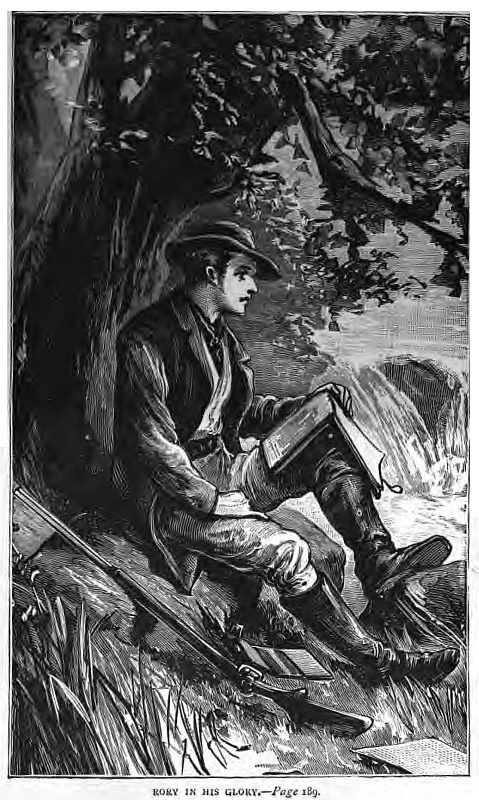
It was nightfall ere they reached Seth’s wigwam once more, and they were thoroughly tired, and glad to rest while Seth cooked the supper in a way that only Seth could.
That night they spent in the wigwam; next day they went on board, and Seth went with them, their object being to organise a little expedition against the caribou. McBain meant to make a week’s stay here to replenish his larder fore and aft, ere they tripped anchor and made sail for wilder regions to the westward and north.
You may be sure Rory did not forget his sketch-book, nor a light canoe he had which one man could carry on his back.
They had a week of such glorious sport, both in fishing and shooting, that when the last evening came round both Ralph and Rory averred that they would like to stay among these wooded hills for ever.
“I guess,” said Seth, “you’d get tired of it.”
“Do you ever tire of it?” asked McBain, and he asked the question with a purpose.
“There are times,” said Seth, looking into the log fire around which they sat, and giving a kind of sigh, “when I think that a little change would do myself and Plunket a power of good.”
“You shall have it,” cried McBain, jumping up and catching the old man by the hand, “you and Plunket too. Come with us in the Snowbird, we’ll make you as comfortable and happy as the day is long.”
“If I thought I’d be of any use—” began Seth.
“Of use, man,” cried McBain; “you’re the handiest fellow ever I met in my life.”
“And that you’d bring me home again.”
“If we don’t we’ll never return more ourselves,” said McBain.
“Then, gentlemen,” said the trapper, “I’ll accept your offer. There!”
Chapter Fifteen.
The Old Trapper Buries his Valuables—The “Snowbird” Goes on her Voyage—Ice—A Whale in Sight—A Fall! A Fall!—In at the Death—The “Trefoil” on Fire.
Old Seth the trapper had a deal to do before he could accompany our heroes on board the Snowbird. “For ye see, gentlemen,” he explained to them, “as soon’s they find out that the Old Bear, as they somewhat irreverently nominate this child, has left his wigwam, I guess the Yacks’ll pretty quickly come skooting around here, to pick up whatever they’re likely to lay their dirty hands on, so I reckon I’ll just bury my valuables.”
A very practical individual was Seth, and when once he made up his mind to do a thing he just did it straight away; so, as soon as they had eaten their last breakfast at his wigwam, assisted by one or two of the yachtsmen, the burial of the valuables commenced. A large hole was dug not far from the door of the hut, and this was carefully lined with hay, and on the hay were piled Seth’s household goods, in the shape of pots and pans, and plates and dishes, and every variety of cooking and kitchen utensil, with the greater portion of the old man’s armoury plus his wardrobe. Not the best portion of the latter, however; no, only some of his skin suits, for shortly before these were deposited in their temporary grave, Seth had retired for a space to the privacy of his garret.
“I reckon,” he said to himself, with a smile, as he began to undress, “that old Seth’ll kinder astonish the weak nerves of these English sailors.” Don’t suppose they’d guess the old trapper was in possession of anything decent to put on. He reckoned upon astonishing our travellers, and he certainly was not far out of his reckoning, for when he again appeared in their midst, arrayed in a long blue coat with brass buttons, shoes with silver buckles, silk stockings, and knee-breeches, white collar up to his eyes, and crowned with a beaver hat of immense longitude, and with a face as serious and long as your own, reader, when you look into the bowl of a silver spoon, Rory, whose risibility was never under the most perfect control, simply rolled on the grass and screamed. Allan was the next to go off, and then Ralph exploded, and finally McBain. Even Oscar joined the chorus in a round of bow-bows, and the only two of the whole party that contained themselves were Seth and his mastiff.
“Guess,” said Seth, quietly recommencing the burial of his valuables, “you’re kinder ’stonished to find Seth can be civilised when he likes.”
Well, as soon as more hay had been placed in the grave, and the earth packed down over all.
“P’r’aps,” said Seth, “you gentlemen think the funeral’s over now.”
“It’s finished now, isn’t it?” asked McBain.
“Nary a bit of it,” said the old man; “I know the Yacks too well to leave the grave like that. They’d spot it at once, and have ’em up before you’d say bullet.”
The trapper’s wisdom was well shown in his next move. This was to heap a quantity of brushwood and logs on the top of all, and set fire to them.
He watched the progress of the fire until it was well alight, and the biggest logs began to crackle.
That same forenoon the first and second mates of the Snowbird were leaning over the bulwarks, looking at the shore, when the sound of oars fell upon their ears, and next minute the yacht’s cutter hove in sight round the point.
“Why,” said Stevenson, “who on earth have they got on board?”
“Old John Brown, I should think,” said the second mate.
“Well,” continued Stevenson, “I do wonder how many queer old customers the captain will pick up before the end of the cruise. Ap ain’t a chicken, and Magnus isn’t a youth, but this new old one beats all. Shouldn’t wonder if it ain’t Methuselah himself. Anyhow, Mitchell, if we do happen to want to rig a jury mast one of these days, this venerable old bit o’ timber in the long hat will be just the thing.”
When the anchor was up once more, sail set, and the Snowbird again holding on her voyage, bowling along under a ten-knot breeze, Stevenson approached to where Seth stood against the capstan.
“I say,” says Stevenson.
“Sir to you,” says Seth.
“You’re a friend o’ the captain’s, ain’t you?”
“That’s so,” from Seth.
“Well, that makes you a friend of mine,” from Stevenson. “Shake hands.”
Seth did shake hands, and Stevenson winced as he pulled his hand away.
“What an iron-fisted old sinner you are!”
“I reckon,” said Seth, quietly, “I can hold pretty tight for an old ’un.”
“Now,” continued Stevenson, “let me give you a piece of advice.”
“Spit it out,” said Seth.
“Well then, it is this: get rid of these antediluvian togs o’ yours. I won’t say you look a guy, but the suit ain’t shipshape, I assure you, and it makes you look—well, just a little remarkable; and mind you, if it comes on to blow only just a little bit, that venerable tile o’ yours’ll go overboard—sharp, and your wig too, if you wear one.”
“Look here, young man,” said Seth, “you talk pretty straight, you do; but as far as the wig is concerned, I wear my own hair as yet; as regards the togs, as you call ’em, I hain’t got nothing else to put on but skins. Skins wouldn’t suit a civilised ship. So unless you can fix me up decent and different, don’t talk, that’s all.”
“That’s fair, that’s right, Methus—I mean, Mr Seth.”
“Bother your misters,” said the old trapper; “I’m Seth, simply Seth.”
“Well, Seth,” said Stevenson, “see here, I can fix you in a brace of shakes; you ain’t much more’n a yard taller than me. Come below, Methus—ahem! Seth. Mind your hat. It would be a pity to crush that, you know.”
When Seth appeared on deck again, rigged out in a suit of Stevenson’s, albeit his legs stuck rather far through their covering, and his long bony wrists were nicely displayed, it must be confessed that he did look a little less remarkable.
Where was Seth to sleep at night? Was he to be a cabin passenger? Nay, Seth himself decided the matter by simply taking the big mastiff in his arms, and lying down on a skin in front of the galley-fire.
As for the dog himself, he began to improve in condition from the very day he came on board, and before he was a week at sea he was positively getting fat. But the Yankee trapper remained as lanky as ever. Do not think, however, that honest Seth was of no service on board; old as he was, he proved a very useful fellow. He assisted the cook, the cooper, and the sailmaker all in turns; and when he was not assisting them he was squatting on deck, making and mending fishing-tackle, and busking fishhooks with feathers, to make them represent flies.
The Snowbird had now got so far into the northern and western bays that, summer although it was, the weather was far from warm, but it continued fine. Immense snow-clad pieces of ice were to be seen daily, sometimes even hourly, and the yacht often sailed so closely to them that the very blood and marrow of the onlookers felt as if suddenly frozen into ice itself.
One morning a berg was reached larger than any they had yet seen, and the vessel had to alter her course considerably in order to avoid it. To all appearance it was an island in the midst of the dark sea, and quite an hour elapsed ere it was rounded, and the ship could again be kept away on the right tack. Hardly had she been put so, when,—
“A sail!” was the shout from the crow’s-nest—“a sail on the weather bow.”
Captain McBain went aloft himself to have a look at her, the yacht in the meantime being kept close to the wind. When he came down Rory and Allan went eagerly to meet him.
“What is she?” said the former. “Our old friend the pirate?”
“Nay,” said McBain, “not this time; it’s a whaler, right enough; all her boats are hanging handy, and she is evidently on the outlook for blubber. Peter!” he cried, speaking down the main hatch, “have lunch ready in a couple of hours. I think,” he continued, addressing our heroes, “we’ll board her. Would any of you like to go?”
Of course they would, every one of the three of them.
While they were discussing luncheon Stevenson came below.
“We’re nearly close abreast of her,” he said, “and I’ve been signalling. She’s an English barque—the Trefoil, from Hull.”
“Been whaling, I suppose?” said McBain.
“Yes, sir,” said Stevenson; “she’s been wintered, and is now engaged at the summer fishing. She’s dodging now; and I’ve had the foreyard hauled aback.”
“Thank you, Mr Stevenson. Call away the gig if the men have dined. Let them dress in their smartest. We’ll be up in a few minutes.”
It was a lovely day; a gentle swell was on, broken into myriads of rippling wavelets by a southern wind, and on it the tall-masted barque rocked gently to and fro. The gig was soon lowered and manned, and, with Rory as coxswain, they left the Snowbird’s side. How pretty she looked! This thought must have been in every one’s mind as they gazed on her beautiful lines, and thence at the large but cumbersome vessel they were rapidly approaching. Hard weather and hard usage she must have experienced since leaving England. The paint was planed and ploughed off her bows and sides in all directions, and the woodwork itself deeply furrowed and indented.
“It is evident enough she has been in the nips,” said McBain, “pretty often, too.”
A Jacob’s-ladder was thrown overboard as they approached, and a rope, when up they sprang, and next moment stood on the deck of the Greenlandman, lifting their hats with true sailor courtesy as soon as they touched her timbers.
Rough and unkempt both the seamen and officers looked beside our smart, gaily-dressed yachtsmen, but they accorded them a kindly welcome nevertheless. They were invited down below, and found themselves in a little octagon-shaped saloon, with a stove on one side, and doors opening off every other. So small was this crib, as one might call it, that, with the captain and the mate, our friends quite filled it.
The captain was a tall, stout, blustering fellow of about forty years of age, who welcomed them in, roughly but not unkindly, and showered upon them about a dozen questions without waiting for an answer to either. What was the latest from England? Were we at war? Was Hool (Hull) still in the same place? Had they brought newspapers? What would they drink? Ending up with—
“Steward, bring the bottles—confound you! what are you standing grinning there at, like a vixen fox? Sharp’s the word, quick’s the motion.”