Front matter (continued 6)
Reading edition
Venezuela, in spite of its nearly three million inhabitants, is an unimportant country, largely hybrid with extensive Negro infiltrations. As in many other Latin American countries, the number of Whites is officially put down as about 10 per cent, but as in most such instances it is doubtful whether one resident in fifty can properly be called a white man, except by courtesy.
Guiana. The three Guianas, British, French, and Dutch, represent one of the least attractive parts of South America in almost every way.
British Guiana has 300,000 inhabitants of whom one-third are Negroes, another third Orientals, mostly Hindu, and the remainder is largely made up of crosses between these two elements, of a few thousand native Indians, and of a handful of Whites.
Dutch Guiana has a population well under a hundred thousand, largely Orientals imported to furnish coolie labor and including Hindus, Javanese, and Chinese. There are many Negroes and a couple of thousand Whites.
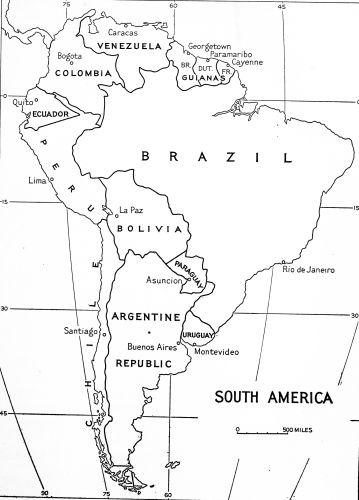
SOUTH AMERICA
French Guiana differs from the Dutch settlement mainly in being smaller, its population being not much more than 30,000, including many convicts or ex-convicts, for this has long been a French penal settlement.
Brazil with a territory larger than the continental United States differs from its neighbors in many striking ways, apart from the fact that it was settled by Portuguese, not Spanish, and that its language and culture are therefore Portuguese rather than Spanish.
The Indian population was killed off or driven westward by the early settlers just as in the United States, so that it is now confined largely to the untracked and almost unpopulated forests of the Amazonian Basin, where perhaps a couple of a million aborigines may still exist.
To provide labor the Portuguese imported slaves from Africa, and then fused with them to produce the present-day pre-dominantly Negro population. The Portuguese here thus repeated the experience of the mother country. During the great years of Portuguese exploration and colonization in the fifteenth, sixteenth, and seventeenth centuries, it has been estimated that a million Portuguese, mainly young men, went to the tropics, and for the most part never came back. Negroes were imported to take their places and to do the work of the country. Intermarriage of these Negroes with the old population left Portugal with a larger amount of Negro blood than any other European country, and greatly impaired its ability to contribute to the progress of civilization. Thus Portugal, which, when dominated by the Nordics, had set an extraordinary example of progress in many ways, now contributes relatively little to such progress and only the rebirth of a reasonable pride of race, and the application of a sound eugenics program will enable it to regain a position of leadership.
History has repeated itself in Brazil. The salvation of Brazil has been the arrival during the past century of European immigrants. Thousands of Germans poured into the Highlands of the Southern States where large regions have an almost Teutonic civilization at the present time. If a false interpretation of the Monroe Doctrine had not helped to interfere with this process, the results for South America might have been most beneficial.
But the main currents of immigration have been from Latin countries of the Old World. During the past century Brazil has received more than four million foreigners, of whom a million and a half were Italians, a million and a quarter Portuguese, and half a million Spanish. Thus more than three-fourths of the immigration has been from the Latin countries, and only about a quarter of a million from Germany and Austria. Since the World War this overwhelming migration from the Latin countries has slowed down. The German migration has, on the contrary, increased.
Brazil thus consists of two distinct areas: a relatively small, fertile, and healthful highland region in the south, where the main activities of the country are carried on largely under the influence of Mediterranean and Alpine immigrants; and a huge tropical area given over mainly to the Negro and Mulatto element and the Indians.
With a population of somewhere around 30,000,000 Brazil is not only the largest of the South American republics, but nearly as large as all the rest of them put together.
The future of Brazil depends largely on the nature of its immigration policy during the next generation or two and on the acceptance of a workable program of eugenics. Fortunately, no South American country has taken up such a policy with more interest than has this great republic. It still possesses an aristocracy which has maintained its racial purity, but this is probably too small a nucleus alone to regenerate the whole body politic.
Uruguay. Crossing the boundary from Brazil to Uruguay, one sees a new picture. Uruguay is almost entirely white. Indeed, this whole region of La Plata is one of the future dominant areas of the New World. It contains less Negro blood than does, relatively, the United States. Not only have Negroes been largely kept out, but the remnants of Indian tribes have become inconspicuous, as on the plains of the Mississippi Valley, where the Indians, mere nomads with a negligible culture, were driven back by the march of civilization. The striking parallel between the settlement of this region and that of the Western States of North America is often pointed out. Each was a sheep and cattle country, and then farmers took up land and developed it into a region of prosperity and great potentialities.
Uruguay has a cosmopolitan population almost wholly of European origin. Since the World War it has attracted not only a large part of the Spanish emigration but also large numbers of Italians, French, Germans, and others. The earlier immigration was largely of North Italians, mainly of Alpine blood with slight Nordic infusion. The total population of the country is now well over a million and a half.
A wise selection of immigration from now on will still further increase the influence of this small republic, and set a good example for all of South America.
Argentina represents one of the striking examples of a nation built up rapidly by foreign immigration. Nearly 85 per cent of its people are foreign-born or the descendants of recent immigration, with Italians forming by far the largest group. Moreover, the Argentine Republic has attracted the vigorous population of North Italy, which racially is mainly Alpine but still has a Nordic element, and forms a striking contrast to the population of South Italian and Sicilian immigrants that have filled up the slums of North American cities. The North Italians are more akin to the Swiss and the South Germans than they are to the South Italians.
Non-whites do not amount to 5 per cent of the population. The total population of something like 10,000,000 makes the Argentine Republic second only to Brazil in size in South America, and in every respect, except size, it easily takes first rank.
The racial composition of this extraordinary nation with its ultra-modern civilization, and its get-rich-quick atmosphere, deserves more extended treatment than can be given here. The English, though not the most numerous, have taken the first place in its financial world. French immigrants, though fewer in number, have become a very important factor in the progress of its civilization. A hundred thousand Germans have settled in the country and form the backbone of many regions.
Since the war Argentina has been one of the principal destinations of citizens of the former Central Empires who were going overseas. The spirit of the civilization has attracted many Jews. More than 160,000 immigrants during the last two generations are credited to Russia, and almost an equal number to Turkey. These last, however, were Turks only by force and were actually Christian Syrians from the Lebanon who became so completely identified with the retail trade of the country that the colloquial name for a small grocery store is "Turco."
All of these elements together do not begin to measure in importance with the Spanish and Italian elements. But in recent years new currents have set in which, if continued, will profoundly modify the character of the country by introducing a large number of Slavs, particularly Poles, Yugoslavs, Czechoslovaks, and Lithuanians, together with the Slavic element among the Germans. Before the World War the immigration to Argentina was about seven-eighths from the Latin countries, but since then these have furnished only about two-thirds.
Argentina therefore represents a white population largely Alpine and Mediterranean with a considerable Nordic element. It is doubtful whether it stands to gain by allowing Alpines to increase, particularly if this brings in different types of culture and traditions. Argentina might well profit by the mistakes of the United States and immediately orient its immigration policy along sound logical and constructive lines.
Chile, unlike the Indo-Spanish countries just south of the United States, is also a white man's country. The pure Indians are a vanishing minority. The Spanish and dominant element is largely made up of Basques, but there has been a substantial addition of British, whose influence is important in commerce and industry, and of Germans, who have dominated the army and education, and have been an important factor in agriculture. Chile, with four million population, is therefore the least Latin of any of the countries south of the United States. The progressiveness and prosperity of the region have long attracted the attention of every traveller.
Bolivia is another of the pre-dominantly Indian countries which have made little contribution to the world. The number of Whites here is negligible. Immigration has never been important and the Bolivian has developed a provincial arrogance and hostility to foreigners which is as prejudicial to his own interests as it is unwarranted. Scarcely one-fifth of the people even speak Spanish in their daily life, and two-thirds are primitive Indians, the others being hybrids of varying degrees.
Paraguay is an Indian republic which has not only avoided the Negro influence common elsewhere but has almost escaped the infusion of white blood. There are scarcely any pure Whites. The Guarani Indians of this region were not highly civilized like the Mayas and Incas, and therefore took on a Spanish culture instead of retaining one of their own. It would have been extremely interesting to see what an Indian republic could amount to in the nineteenth and twentieth centuries. Unfortunately the course of experiment was obstructed by one of the most sanguinary wars in history (1864-69) in which Paraguay carried on a contest with Brazil and Argentina until the greater part of its male population was destroyed. At the beginning of the war, the population of Paraguay was officially said to be 1,337,437. Even if this were extraordinarily inaccurate and exaggerated, the figures afterward were no less so, for the calculation after the close of hostilities credited the country with a loss of more than a million. More exactly, the population was returned as 221,709, of which 86,079 were children, 106,254 women, and only 28,746 men. Nothing like this situation has ever before been recorded in a large population. Whole regiments had been made up of boys under sixteen. In more than half a century since then, the country has not begun to recover. Even now its population is less than a million. Immigrants from Europe have always avoided it. Paraguay is in a class by itself.
Peru's four or five million inhabitants are mostly pure Indians, while the remainder are nearly all hybrids. Chinese and Japanese as well as Negroes have contributed to the mongrelization of the mass, and not one in ten even claims to be white, which here, as elsewhere in Latin America, by no means guarantees anything more than a homœopathic dose of European blood.
The aboriginal civilization is often described as remarkably high but seems to have been the work of peoples who antedated the Spanish by a long period; and the Conquerors themselves apparently considered the Peruvian Indians to be less intelligent than those they had encountered in Mexico. The number of Indians decreased during the early Spanish regime until some districts were almost depopulated and the loss of leaders especially was irreparable. Whether or not the present inhabitants are the descendants of the Incas, they have not been able to develop a strong and progressive state.
Ecuador is an isolated and unimportant region inhabited largely by backward Indian tribes. Probably not less than two-thirds of the 2,000,000 population are pure Indian. The handful of Whites and the few hundred thousand hybrids rule the country. The Negro element, never large, is gradually being absorbed and is leaving its stamp on the whole population.
The West Indies are more important to the United States immigration policy than would be expected from their size, because of their close proximity to American ports of entry.
Cuba has always received its immigrants pre-dominantly from Spain, and the imported Negro element, numbering about 800,000 of its three millions of population, is not increasing in importance. The island is considered less white than Puerto Rico, but more than a quarter of a million of the inhabitants are Spanish-born, these comprising nearly three-quarters of all the foreigners.
As in many other Latin-American countries, the Chinese have taken a strong hold, beginning nearly a century ago, and are intermarrying with the Whites.
Cuba does not represent a desirable or needed source of immigration to the United States, and should be put under a proper quota.
Puerto Rico has a population of nearly a million and a half. The fact that this dense population cannot make a living under the present and backward conditions on the island, and that it is continually exercising its right of entry to the United States, is one of the most serious features of the present immigration policy.
The Negro and Mulatto element makes up a majority of the population but is relatively losing ground—partly from high death rates and partly by absorption in the mass. The Indian stock is extinct. Immigration from abroad has been negligible for a long time.
As the island is a territory, the inhabitants are citizens of the United States and cannot be prevented from coming freely into the mainland. The number of Puerto Ricans in New York City was at one time estimated as high as 100,000. If economic conditions are attractive there is nothing to prevent half a million of them from migrating to the continent and adding their traits to the much-overloaded "melting pot."
It is now clear that the United States made a great mistake, after the war with Spain, in taking over territories that were already populated by aliens. Previously the territory that was acquired was largely empty and suitable for settlement by the old stock. What has been done is not easy to undo, but it may at least serve as an emphatic lesson against any further acquisitions of inhabited territory in the future. Meanwhile there is an embryonic movement for independence in Puerto Rico, which may have to, indeed should, be encouraged in order to give the United States protection from its own folly.
The Virgin Islands, which the United States bought from Denmark in 1917, have, like other West Indian islands, a population almost exclusively Negro or Mulatto.
The British West Indies are overwhelmingly black, though many of them, such as New Providence, Barbados, Bermuda, and the Bahamas, have substantial English aristocracies that guard jealously their racial heritage. These British islands, particularly Jamaica and Barbados (the latter one of the most densely populated spots in the whole world) have been fertile sources of black emigration to other islands and to the mainland.
Haiti is a purely Negro Republic, and offers a good illustration of what the Negro accomplishes if left to himself, even though given all the advantages of easy access to European civilization. The republic of Santo Domingo occupies the other part of the same island; its hybrid population has more Spanish and less Negro blood but it is not by any means civilized.
In general the islands of the West Indies now contain nearly 8,000,000 people, the descendants of Negro slaves with a very small but undiscoverable admixture of Indian blood and a somewhat larger but still unimportant admixture of European stock. They present a standing menace to the United States immigration policy, and afford one of the principal arguments for extending stringent restrictions to the Western Hemisphere. The whole Caribbean is in the process of becoming a Negro territory. Such a result may be inevitable, but adjacent nations which desire to remain white must protect themselves while there is time.
In broad outline, the picture of Latin-America is the picture of a diversified region occupied by some 80,000,000 people, mainly Indians, but with varying proportions of White and Negro blood, the former usually small in amount, the latter often large. The few countries that may properly be called white are not emigrant-exporting countries, and their inhabitants are for the most part non-Nordic, therefore not particularly well adapted to incorporation in the United States.
In conclusion, it may be remarked at this point that each successive revolution in Latin America has tended toward hastening the elimination of European blood and influence. It is usually the half-breeds who revolt and they, in turn, are subject to the increasing self-assertion of the pure native.
XVIII
THE NORDIC OUTLOOK
In the preceding chapters we have seen the unity of the nation greatly impaired in race and religion and threatened in language, but the country is still 70 per cent Nordic and 80 per cent Protestant, and no one foreign language seriously threatens our English speech. There are nearly 50 per cent of Old-Native American Whites in the country at large, although they have been swamped by aliens in New England and in the industrialized States of the Northeast.
The great majority of the senators of the United States are still of old American stock and so are the members of the House of Representatives. The leaders of the nation in science, education, industry, and in the Army and Navy are still overwhelmingly Nordic, so that with these elements in our favor we are still in a position to check the increase of the other elements and contend against their deleterious effects upon our institutions.
Much of the immigration during the last century has been identical with the old British stock in all respects. The English and the Scotch who have come over here, as well as the Scandinavians and most of the Germans, and perhaps some other elements, are to be regarded as reinforcements of the older stock. On the other hand, most of the people from southern and eastern Europe must be regarded as distinct menaces to our national unity.
The remedy is first and foremost the absolute suspension of all immigration from all countries; and the signs of the times indicate that such suspension is inevitable. Such a total suspension of immigration would remove all grounds for charges of discrimination against Asiatics, which now embarrass our foreign relations. At the very least, the same quota limitations should be imposed on the countries to the south of us as are enforced against Europe.
In view of the fact that during the great depression which began in 1929 we had millions of unemployed of our own people here, we should be deaf to sentimental pleas for the admission of relatives of any kind. If families are separated, it has not been through the fault of the American people, and the immigrant can return whence he came, if he wishes to join his family. As a matter of fact, it is only one or two groups which are so vigorously clamoring for the admission of relatives.
Not only should European immigration be entirely stopped but still more, all immigration of every sort from countries to the south of us should be barred. In the islands and on the coasts of the Caribbean, and in Mexico and in Central America, to say nothing of the countries farther south, we have a vast reservoir of Negroes, and of Indians in the interior, who sooner or later will be drawn toward the United States by the high wages of common labor. The strictest legislation at this time is necessary to prevent this impending invasion before it assumes the dimensions of a flood, such as has already happened in the case of the Mexican Indians. If immigration be not absolutely prohibited, at very least, no one should be allowed to enter the United States, unless a visitor or traveller, except white men of superior intellectual capacity distinctly capable of becoming valuable American citizens.
The law of 1790 providing that no one could become a citizen of the United States except free Whites was the law until the aftermath of the Civil War added the word "black" or "of African descent" to those who could be naturalized. This last provision should be repealed and the blacks with the South American and Central American Indians put on the same footing as the Orientals.
All Filipino immigration should be stopped before it becomes a serious menace. If possible, half-breeds from Hawaii should not be allowed entry and absolute restriction should be placed on the entrance of Negroes and Mulattoes from Puerto Rico. There are now swarms of them in the Harlem District of New York. This last is simple justice to the American Negroes.
The increasing use of machines calls for less and less common labor, and even in normal times there will be a surplus of man power for the factories and the farms. Why should outsiders be allowed to come in and take the jobs and lower the living standards of American labor? This is one of the greatest questions before the American people and the depression following 1929 has brought this truth home.
We have now in this country over five million aliens who are not citizens, more than a million of whom are said to be illegally here. These last should be deported as fast as they can be located and funds made available. There can be no better means of relieving unemployment present or future than by such wholesale deportation. We should begin with those aliens who have violated our laws or who have become public charges and all such, now in our penitentiaries and asylums, should be deported forthwith. When that has been done and done fully, it should be followed by the deportation of unemployed aliens.
Registration is necessary for the carrying out of any proper system of deportation. Why any one should object to registration as a proper means of identification is a mystery, unless there is a sinister motive behind the desire to conceal identity.
A storm of protest will arise from the vociferous and influential foreign blocs and from the radicals and half-breeds claiming to be Americans, who will all rush to the defense of their kind. It is strange to find how sensitive we are to any foreign criticism of things American, but how prone we are to listen respectfully to local aliens, who are urging their own interests at the expense of the national welfare.
In order to curb the influence of these aliens and to prevent their pernicious control by politicians, it would also be wise to suspend all naturalization for a generation at least. Our citizenship in the past has been made of little value by the absurd way that it has been thrust upon foreigners. Nothing can be more ill-advised politically than the Americanization programs of some worthy people. An American is not made by conferring upon him the franchise, but by the alien's voluntary and genuine acceptance of our language, laws, institutions, and cultural traditions.
Even though the foregoing program were put into effect, which would, possibly, be a "Counsel of Perfection," we would still have with us an immense mass of Negroes and nearly as many southern and eastern Europeans, intellectually below the standard of the average American. The proper extension to and use by these undesirable classes of a knowledge of birth control may be in the future of substantial benefit, and the practice of sterilization of the criminal and the intellectually unfit, now legally established in twenty-seven States, can be resorted to with good result.
The fundamental question for this nation, as well as for the world at large, is for the community itself to regulate births by depriving the unfit of the opportunity of leaving behind posterity of their own debased type. Our civilization has mercifully put an end to the cruel, wasteful, and indiscriminate destruction of the unfit by Nature, wherefore it is our duty, as exponents of that civilization, to substitute scientific control, that civilization itself may be maintained. Down to date the American stock has only just begun to intermarry with the immigrant stock. When this process has gone further—and it will go further—it will be more difficult to control the destinies of the nation. It is therefore the duty of all Americans, and such of the immigrant stock as are in sympathy with them, to face the problem boldly and to take all eugenic means to encourage the multiplication of desirable types and abate drastically the increase of the unfit and miscegenation by widely diverse races.
So much for our internal problems. The problems outside of our country are a different matter. In the last century the world has grown smaller, and, perhaps, in the long run America must take her part in international affairs.
The White Man's Burden
As Americans we are faced with the necessity of assuming our share of a burden which has been carried by Great Britain for the last three centuries—that is "the White Man's Burden,"—the duty of policing the world and maintaining the prestige of the white man throughout the Seven Seas. Due to the change in the industrial situation all over the world and to the spread of the fatal sentimentalism of the Anglo-Saxon, the lower races in Europe and elsewhere are beginning to assert themselves. Everywhere from one end of the world to the other is heard the cry of self-determination.
Americans already have much the same problem in the Philippines.
The attitude of the Imperial Government in London toward the native races in its various Dominions has been in the past and still is not unlike that of the Federal Government in Washington toward the Negroes in our Southern States.
Americans must sympathize with the firm resolve of the handful of white men in South Africa (less than a million and a half) to control and regulate the Negro population there—numbering some seven millions and in the midst of which they live. The same problem arises in Australia and New Zealand where the Whites are determined that their civilization shall not be swamped by Orientals.
We must also sympathize with the Whites in Kenya Colony in their opposition to a filling of their country with cheap Hindu labor. As Americans we can understand the Negro and recognize his cheerful qualities, but we can have little sympathy with the Hindu whom we have expressly barred from our Pacific Coast. These Hindus, with the Chinese, have ruined the native races of many of the Polynesian Islands. They have been for ages in contact with the highest civilizations, but have failed to benefit by such contact, either physically, intellectually, or morally.
Similar dangers exist on the Pacific Coast of Canada. The struggle for the maintenance of the supremacy of the white man over the native, or for that matter over the non-European, until now has been maintained by Great Britain alone. Her ruling class has given the world the greatest example since the days of Rome, of a just, fearless, and unselfish government, but apparently the native does not desire such a government.
The old imperial instinct that enabled Great Britain to retain control of the white man's world appears to be coming to an end. The weary Titan seems willing to turn over the burden of government to the Dominions as fast as the latter demand it. This is evidenced also by the proposal to give up the naval base at Singapore. If this base is ever actually abandoned, it means England's withdrawal from the supremacy of the Pacific. In such event, whether we Americans like it or not—whether we intend it or not—the burden of the control of the Pacific will pass in great measure to America. The future lies in the Pacific rather than in the Atlantic, and with the completion of the Panama Canal, America is brought face to face with Oriental problems.
Australia and New Zealand, still more British Columbia, look for co-operation and leadership to the United States as well as to Great Britain, and we must be prepared to accept this responsibility.
We have our own troubles in respect to the Philippines. The swarming of the Filipinos into the Pacific States brings with it a repetition of the Chinese problem of sixty years ago. California is determined that the white man there shall not be replaced by the Chinese, the Japanese, the Mexican, or the Filipino. The Eastern States should face this problem understandingly, and recognize the simple fact that the white men on the Pacific Coast of the United States and Canada are determined to maintain a white ownership of the country, even though the East has been willing to see New England swamped by French-Canadians and Polaks, and the industrial centers of the North filled to overflowing with southern and eastern Europeans.
When we talk about the maintenance of the white man's ideals and culture and about the supremacy of the white man, we are talking about two distinct things. One is the determination of the white man to keep for himself his own countries, the United States, Great Britain, Canada, South Africa, Australia, New Zealand, and many of the smaller islands. With this determination Americans sympathize and sooner or later we may be called on to help protect the White race and the English language in these countries. It seems to be a part of our destiny. The other phase of white supremacy is the white man's effort to benefit the backward races and raise them to civilization by instilling his language, his religion, and his culture into Asiatics and Africans. This is the tendency of foreign missions, and it leads sooner or later to a challenge by the natives of the control of the Whites.
To rule justly, as the English have in India and Burma, is for the best interest of the native. For example, the United States should either firmly govern the Philippines, which, in the last analysis, is for the interest and enrichment of the Filipinos, or else abandon them to their own devices. If Japan ever gets hold of these islands, she will keep them without regard to the wishes or interests of the native, as that Empire is not greatly troubled with sentimentalists and native sympathizers such as flourish in the United States.
The Japanese, the Chinese, the Hindus, and the Moslems have cultures, customs, religions, arts, literatures, and institutions of their own, which for them may be, and in many cases probably are, as good as our own. The writer does not see any gain in destroying these native elements of culture or replacing them indiscriminately with the institutions of the white man to which those races are, for the most part, unfitted. Democracy is an excellent example. It simply will not work among Asiatics. In fact, its success is yet fully to be proven in the Western World.
But the other side of the problem—whether we, the White race, shall surrender our own culture, our own lands and our own traditions, good or bad, to another race—presents a very different question. Fortunately, in this case, Reason and Sentiment march hand in hand.
The prestige and strength of Europe and Great Britain have been greatly impaired since the World War and Western civilization sooner or later may be forced to hand on the Torch to America.
We see the Nordics again confronted across the Pacific by their immemorial rivals, the Mongols. This will be the final arena of the struggle between these two major divisions of man for world dominance and the Nordic race in America may find itself bearing the main brunt.
In the meantime, the Nordic race, that has built up, protected, and preserved Western civilization, needs to realize the necessity of its own solidarity and close co-operation. Upon this mutual understanding rest the peace of the world and the preservation of its civilization.
Let us take thought as to how we can best prepare for our share of the task before us—that is, bear our share of the White Man's Burden.
BIBLIOGRAPHY
Abbott, John S.C., Peter Stuyvesant. New York, Dodd, Mead & Co., 1898.
Adams, Alexander A., The Plateau Peoples of South America. (An Essay in Ethnic Psychology.) New York, Geo. Routledge & Sons, Ltd., 1915.
Adams, James Truslow, The Founding of New England. Boston, Atlantic Monthly Press, 1921.
——, The March of Democracy. New York, Charles Scribner's Sons, 1932-33.
——, New England in the Republic, 1776-1850. Boston, Little Brown, 1926.
——, Provincial Society, 1690-1763. New York, Macmillan Co., 1927. Vol. III of series entitled A History of American Life.
——, Revolutionary New England, 1691-1776. Boston, Atlantic Monthly Press, 1923.
Alsina, Juan A., European Immigration to the Argentine, 1898.
American Council of Learned Societies, Report of the committee on linguistic and national stocks in the population of the United States. Washington, D.C., 1932. (Reprint from annual report of the American Historical Association for 1931, pp. 107-441.)
Arber, Edw. (ed.), Story of the Pilgrim Fathers. Boston, Houghton Mifflin Co., 1897.
Arbois de Jubainville, M.H. d': 1. "Les Celts en Espagne," Revue Celtique, Vols. XIV and XV.
——, 2. "Les Celts et les langues celtiques," Revue archéologique, série 2, t. XLIII, pp. 87-96, 141-155.
——, 3. "Les Gaulois dans l'Italie du Nord," Rev. Celt., Vol. XI.
Avebury, Lord (Sir John Lubbock), Prehistoric Times, 7th ed. New York, Henry Holt & Co.; London, Williams and Norgate, 1864-1913.
Avery, Elroy McKendree, A History of the United States and Its People. Cleveland, Burroughs Bros., 1905.
Babcock, Kendrick Charles, The Scandinavian Element in the U.S. Urbana, University of Illinois, 1914.
Baily, John, Esq., Central America. London, Trelawney Saunders, 1850.
Bancroft, Hubert Howe, History of Arizona and New Mexico, 1530-1888, Vol. XVII. San Francisco, The History Co., 1889.
——, History of California, 4 vols. San Francisco, A.L. Bancroft & Co., 1884, 1885, 1886.
——, History of Oregon, 2 vols. San Francisco, The History Co., 1886.
——, History of Washington, Idaho, and Montana. San Francisco, The History Co., 1890.
Barker, Eugene C. (ed.), Readings in Texas History. Dallas, Southwest Press, 1929.
Barker, Howard F., "The Founders of New England." American Historical Review 38 (4): 702-713. July, 1933.
Bassanovitch, I., Materials on the Anthropology of the Bulgars: The Lomsk District, pp. 3-186, 1891.
Beard, Charles and Mary, Rise of American Civilization. New York, Macmillan, 1927.
Beddoe, John: 1. The Anthropological History of Europe, 1893.
——, 2. "The Kelts of Ireland," Journal of Anthropology, 1870-1871, pp. 117-131.
——, 3. "On the Stature and Bulk of Man in the British Isles," Memoirs of the Anthropological Society, Vol. III, pp. 384-573. London, 1867-1869.
——, 4. The Races of Britain. Bristol and London, 1885.
Bertrand, Alexandre (with S. Reinach), Les Celts dans les vallées du Pô et du Danube. Paris, E. Leroux, 1894.
Binder, Julius, Die Plebs. Leipzig, G. Bohme, Deichert, 1909.
Biographical and Historical Memoirs of Northeast Arkansas. Chicago, Goodspeed, 1889.
Blackmar, Frank W. (ed.), Kansas. Chicago, Standard Pub., 1912.
Blegen, Theodore C., Norwegian Migration to America. Northfield, Minnesota, Norwegian American Historical Assn., 1931.
Boam, Henry J., British Columbia. London, Sells Ltd., 1912.
Boni, G. Roma, Notizie degli Sclavi; série 5, pp. 123 seq. and 375 seq., 1903.
Bork, Ferdinand, Die Mitanni Sprache. Berlin, W. Peiser, 1909.
Boule, M., "Essai de paléontologie stratigraphique de l'homme," Revue d'anthropologie, série 3, t. III, pp. 129-144, 272-297, 385-411, 647-680, 1888.
Bourinot, Sir John G., Canada under British Rule, 1760-1900. Cambridge, Massachusetts, University Press, 1900.
Bracq, Jean Charlemagne, The Evolution of French Canada. New York, The Macmillan Company, 1924.
Breasted, James H.: 1. Ancient Times, A History of the World. Boston, Ginn & Co., 1916.
——, 2. "The Origins of Civilization," Scientific Monthly, vols. IX, nos. 4, 5, 6, and X, nos. 1, 2, 3.
——, 3. A Survey of the Ancient World. Boston, Ginn & Co., 1919.
——, 4. History of Egypt, and other writings.
Bresette, Linna E., Mexicans in the United States: Report of a Brief Survey. Washington, D.C., Natl. Catholic Welfare Conf., 1929.
Breuil, L'Abbé H., "Les peintures rupestres d'Espagne," (avec Serrano Gomez et Cabre Aguilo), L'Anthropologie, t. XXIII, 1912.
Brewer, Daniel Chauncey, The Conquest of New England by the Immigrant. New York, Putnam's Sons, 1926.
Brown, John Henry, History of Texas, 2 vols. St. Louis, L.E. Daniell.
Browne, William Hand, Maryland, The History of a Palatinate. Boston, Houghton Mifflin Co., 1890.
Bruce, Philip Alexander, LL.B., LL.D., History of Virginia, 1607-1763, vol. I. Chicago and New York, American Historical Society, 1924.
——, Institutional History of Virginia. New York, G.P. Putnam's Sons, 1910.
Bruhnes, Jean, "Race et nation," Le Correspondant. Paris, September, 1917.
Bryce, George, The Remarkable History of the Hudson Bay Company. New York, Scribner, 1900.
Bryce, James, The Holy Roman Empire. Macmillan, 1904.
Buck, Solon, Illinois in 1818. Springfield, Illinois Centennial Commission, 1917.
Bureau of the Census: Reports on Population.
Burke, U.R., A History of Spain, 2d ed. London, Longmans, Green & Co., 1900.
Burrage, Henry S., D.D., The Beginnings of Colonial Maine, Portland, Me., Marks Printing House, 1914.
Bury, J.B., A History of Greece. Macmillan, 1917.
Cable, George W., The Creoles of Louisiana. New York, Charles Scribner's Sons, 1889.
Cahun, Léon, Histoire de l'Asie. Paris, Armand Colin et Cie., 1896.
Caldwell, Bishop R., A Comparative Grammar of the Dravidian or South Indian Family of Languages, 2d ed. London, K. Paul, Trench, Trübner & Co., 1913.
Campbell, Charles, Introduction to the History of the Colony and Ancient Dominion of Virginia. Richmond, B.B. Minor, 1847.
Candolle, Alphonse de, Histoire des sciences et des savants depuis deux siècles, 2me éd. Genève, H. Georg, 1806-1893.
Carpenter, Niles, Immigrants and Their Children. Census Monographs VII. Washington, D.C., Bureau of the Census, 1927.
Cartailhac, Émile, La France préhistorique d'après les sépultures et les monuments, 2me éd. Paris, 1903.
Castle, William E., Genetics and Eugenics. Cambridge, Harvard University Press, 1930. 4th ed.
Cattell, J. McKeen, "A Statistical Study of American Men of Science," Science, N.S., vol. XXIV, nos. 621-623, and vol. XXXII, nos. 827 and 828.
Chambers, Henry E., Mississippi Valley Beginnings. New York, G.P. Putnam's Sons, 1922.
Chantre, Ernest, "Recherches anthropologiques dans l'Asie occidentale," Extrait des Archives du musée d'histoire naturelle de Lyon. Lyon, 1895.
Claiborne, J.F.H., Mississippi as a Province, Territory, and State, vol. I. Jackson, Mississippi, Power & Barksdale, 1880.
Clay, Albert T., The Empire of the Amorites. Yale University Press, 1919.
Cleland, Robert Glass, Ph.D., A History of California (The American Period). New York, The Macmillan Co., 1930.
Clemenceau, Georges, South America Today. New York and London, G. Putnam & Sons, 1911.
Coan, Charles F., Ph.D., A History of New Mexico, vol. I. Chicago and New York, The American Historical Society, Inc., 1925.
Cobb, Sanford H., The Story of the Palatines. New York and London, G.P. Putnam's Sons, 1897.
Cole, Arthur Charles, The Era of the Civil War. Springfield, Illinois Centennial Commission, 1919.
Cole, Cyrenus, A History of the People of Iowa. Cedar Rapids, Torch Press, 1921.
Collignon, R.: 1. "L'anthropologie au conseil de révision, etc.," Bulletin de la Société d'anthropologie, pp. 736-805, 1890. Also Bull. Soc. d'anth., 1883.
——, 2. "Anthropologie de la France: Dordogne, Charente, Creuse, Corrèze, Haute-Vienne," Mémoires de la Société d'anthropologie, série 3, I, fasc. 3, pp. 3-79.
——, 3. "L'indice céphalique des populations françaises," L'Anth., série I, pp. 200-224, 1890.
Committee on Immigration and Naturalization, House of Representatives. Hearings, especially 67th Cong., 3d session; 68th Cong., 1st session; 69th Cong., 1st session; 70th Cong., 1st session and 2d session; 72d Cong., 1st session. (A valuable series of reports, containing testimony of H.H. Laughlin and other experts.) Washington, D.C., Government Printing Office, 1923-1932.
Conklin, Edwin G., Heredity and Environment. Princeton University Press, 1929. 6th ed.
Cooke, John Esten, Virginia, A History of the People. Boston, Houghton Mifflin Co., 1887.
Cotterill, R.S., History of Pioneer Kentucky. Cincinnati, Johnson & Hardin, 1917.
Cowan, Helen I., British Emigration to British North America, 1783-1837. University of Toronto Library, 1928.
Coy, Owen Cochran, The Great Trek. Chicago, Powell Pub. Co.
Crawford, O.G.S., "Distribution of Early Bronze Age Settlements in Britain," Geographical Journal, XL, pp. 184 seq., 1912.
Darwin, Charles, The Descent of Man, 2d ed. London, John Murray, 1901.
Davenport, Charles B.: 1. The Feebly Inhibited, Nomadism ... Inheritance of Temperament. Washington, D.C., Carnegie Institution, 1915.
——, 2. Heredity in Relation to Eugenics. New York, Henry Holt & Co., 1911.
Davidson, Alex., and Stuvé, Bernard, A Complete History of Illinois from 1673 to 1873. Springfield, Illinois Journal Co., 1874.
Davis, John, Travels in Louisiana and the Floridas in the Year 1802. New York, I. Riley Co., 1806.
Davis, Walter B., History of Missouri. St. Louis, Hall & Co., 1876.
Dawkins, W. Boyd, Early Man in Britain. London, Macmillan, 1880.
Deniker, J., "Les races de l'Europe, Note préliminaire," L'anthropologie, vol. IX, pp. 113-133. Paris, 1898.
Dill, Samuel, Roman Society in the Last Century of the Western Empire, 2d ed. Macmillan, 1906.
Eginhard, Life of Charlemagne, Glaister translation. London, George Bell & Sons, 1877.
Esarey, Logan, A History of Indiana, vol. II. Indianapolis, Bowen, 1918.
——, A History of Indiana from Its Exploration to 1850. Indianapolis, W.K. Stewart, 1915.
Fairbanks, History of Florida, 1512-1842. Philadelphia, J. B. Lippincott & Co., 1871.
Fanning, John William, Negro Migration. Bull. Univ. Georgia, June, 1930.
Farish, Thomas Edwin: 1. History of Arizona, vol. III. San Francisco, The Filmer Bros. Electrotype Co., 1916.
——, 2. History of Arizona, vol VI. San Francisco, The Filmer Bros. Electrotype Co., 1918.
Faust, Albert Bernhardt, The German Element in the United States, 2 vols. Boston and New York, Houghton Mifflin Co., 1909.
Feist, Sigismund, Address to the International Congress at Gratz. 1909.
Ferrero, Guglielmo, The Greatness and Decline of Rome. New York, Putnam, 1909.
Ferris, Jacob, The States and Territories of the Great West. New York, Miller, Orton & Mulligan, 1856.
Fish, Carl Russell, The Rise of the Common Man, 1830-1850. New York, Macmillan, 1927.
Fisher, George Park, The Colonial Era. New York, Charles Scribner's Sons, 1892.
Fisher, H.A.L., The Political History of England, vol. IV. Edited by William Hunt and Reginald Poole. London, Longmans, Green & Co., 1906.
Fisher, Sydney George: 1. The Making of Pennsylvania. Philadelphia, J.B. Lippincott Co., 1896.
——, 2. The Quaker Colonies. New Haven, Yale University Press, 1921.
Fiske, John, The Dutch and Quaker Colonies in America, vols. I and II. Boston, Houghton Mifflin Co., 1899.
Fleure, H.J. (with James, T.C.), "Anthropological Types in Wales," Journal of the Royal Anthropological Institute of Great Britain and Ireland, vol. XLVI, pp. 35-154.
——, (with L. Winstanley), "Anthropology and Our Older Histories," Jour. Roy. Anth. Inst., vol. XLVIII, pp. 155 seq.
Flint, Timothy, History and Geography of the Mississippi Valley, 2 vols. Cincinnati, E.H. Flint, 1832.
Flower and Lydekker, Mammals, Living and Extinct. London, Adam and Charles Black, 1891.
Foerster, Robert F., The Racial Problems Involved in Immigration from Latin America and the West Indies to the United States. Washington, D.C., U.S. Dept. of Labor, 1925.
Folwell, William Watts, Minnesota. Boston, Houghton Mifflin Co., 1908.
Ford, Henry Jones, The Scotch-Irish in America. Princeton University Press, 1915.
Fortier, Alcée, A History of Louisiana, 4 vols. New York, Manzi, Joyant & Co., 1904.
Fosdick, Lucian J., The French Blood in America. New York, The Baker & Taylor Co., 1911.
Frank, Tenney, "Race Mixture in the Roman Empire," American Historical Review, vol. XII, no. 4, July, 1916.
Freeman, E.A.: 1. A Historical Geography of Europe. Edited by J.B. Bury, 3d ed. London, Longmans, Green & Co., 1912.
——, 2. Race and Language. Historical Essays, series 3, pp. 173-230. New York and London, Macmillan, 1879.
Fritsch, Gustave, Das Haupthaare und seiner Bildungsstätte bei den Rassen des Menschen. Berlin, 1912.
Fuller, George W., A History of the Pacific Northwest, 3 vols. New York, Alfred A. Knopf, 1931.
Galton, Sir Francis, Hereditary Genius. London and New York, Macmillan & Co., 1892.
Gameau, F.X., History of Canada, vols. I and II. Montreal, John Lovell, 1862.
Gayarre, Charles, Louisiana, Its History as a French Colony, vol. II. New York, Wiley, 1852.
Geer, Baron Gerard de, "A Geochronology of the Last 12,000 Years," Compte-Rendu de la session 1910, du Congrès Géol. Intern., vol. XI, fasc. 1, pp. 241-257.
Gibbon, Edward, Decline and Fall of the Roman Empire.
Gindley, Anton, History of the Thirty Years' War. New York, G. Putnam's Sons, 1884.
Gjerset, Knut, The History of the Norwegian People. New York, Macmillan, 1915.
Goodwin, John A., The Pilgrim Republic. Boston and New York, Houghton Mifflin Co., 1909.
Gosnell, R.E., The Year Book of British Columbia. Victoria, B.C., Librarian Legislature Assembly, 1897.
Gosney, E.S., and Popenoe, Paul, Sterilization for Human Betterment. New York, Macmillan, 1929.
Grant, Madison, "The Origin and Relationships of North American Mammals," Eighth Annual Report of the New York Zoological Society. New York, 1904.
——, The Passing of the Great Race. 4th ed. New York, Charles Scribner's Sons, 1921.
Green, John R., A History of the English People. New York, Harper, 1878.
Greene, Evarts B., and Virginia D. Harrington, American population before the federal census of 1790. New York, Columbia University Press, 1932.
Gregory, W.K.: 1. "The Dawn Man of Piltdown, England," American Museum Journal, vol. XIV. New York, May, 1914.
——, 2. "Facts and Theories of Evolution, with Special Reference to the Origin of Man," Dental Cosmos, pp. 3-19, March, 1920.
——, 3. "Studies on the Evolution of the Primates," Bull. Amer. Mus. Nat. Hist., vol. XXXV, article xix. New York, 1916.
Griffis, William Elliot: 1. The Story of New Netherland. Boston and New York, Houghton Mifflin Co., 1909.
——, 2. The Story of the Walloons. Boston and New York, Houghton Mifflin Co., 1923.
Gue, Benjamin F., History of Iowa. New York, Century History Co., 1903.
Guillaume, H., F.R.G.S., The Amazon Provinces of Peru. London, Wyman & Sons, 1888.
Haddon, A.C.: 1. The Races of Man and Their Distribution. London, Milner & Co.
——, 2. The Study of Man. New York, Putnam; and London, Bliss Sands, 1898.
——, 3. The Wanderings of Peoples. Cambridge University Press, 1912.
Haeckel, Ernst, The Riddle of the Universe. Harper, 1901.
Hale, Will, and Merritt, Dixon, A History of Tennessee and Tennesseans, vols. I and III. Chicago, Lewis Pub. Co., 1913.
Hall, H.R., The Ancient History of the Near East, 3d ed. London, Methuen & Co., 1916.
Hall, Prescott F.: 1. Immigration, 2d ed. New York, Henry Holt & Co., 1908.
——, 2. "Immigration Restriction and World Eugenics," Journal of Heredity, vol. X, no. 3, pp. 125-127. Washington, D.C., March, 1919.
Hamilton, Peter Joseph, The Colonization of the South, vol. III of The History of North America, edited by Guy Carleton Lee. Philadelphia, George Barrie & Sons, 1904.
Hanna, Charles A., The Scotch-Irish, or The Scot in North Britain, Ireland, and America, 2 vols. New York, G. Putnam's Sons, 1902.
Harper, Roland M., The Population of Mexico: an Analysis. Pan-American Magazine 44 (4): 269-278. Apl., 1931.
Harrison, J.P., "On the Survival of Racial Features in the Population of the British Isles," Jour. Roy. Anth. Inst., vol. XII, pp. 243-258.
Hart, Albert B. (ed.), Commonwealth History of Massachusetts. New York, States History Co., 1927-28.
Hawley, James H., History of Idaho, vol. I. Chicago, The S.J. Clarke Pub. Co., 1920.
Henderson, Archibald, Conquest of the Old Southwest. New York, The Century Co., 1920.
Herodotus, History of the World.
Hewatt, An Historical Account of the Rise and Progress of the Colonies of South Carolina and Georgia, 2 vols. London, Alexander Donaldson, 1779.
Hirt, Herman, Die Indo-Germanen, ihre Verbreitung, ihre Urheimat und ihre Kultur. Strassburg, Trübner, 1905.
History of Tennessee. Nashville, Goodspeed Publishing Company, 1886.
History of Welsh in Minnesota. Hughes, Edwards & Roberts, 1895.
Hittell, Theodore H., History of California, vol. III. San Francisco, N.J. Stone & Co., 1897.
Hodgkin, Thos., Italy and Her Invaders.
Holmes, S.J., and S.L. Parker, "The Stabilized Natural Increase of the Negro." Journal of the Amer. Statistical Asso., June 1, 1930.
Holmes, S.J., "The Biological Trend of the Negro." Univ. of Calif. Chronicle, Jan., 1930.
Holmes, T. Rice, Ancient Britain, and the Conquests of Julius Cæsar. Oxford University Press, 1907.
Homer, The Iliad; the Odyssey.
Houck, Louis, A History of Missouri, vols. I, II, and III. Chicago, R.R. Donnelley & Sons, 1908.
Hulbert, Archer Butler: 1. The Ohio River. New York, G.P. Putnam's Sons, 1906.
——, 2. Soil, Its Influence on the History of the United States. New Haven, Yale University Press, 1930.
Human Betterment Foundation, Collected Papers on Eugenic Sterilization. Pasadena, Calif., 1930.
Huntington, Ellsworth: 1. Civilization and Climate. Yale University Press and Oxford University Press, 1915.
——, 2. The Pulse of Asia. Boston, Houghton Mifflin Co., 1907.
Hooton, E.A.R., Up from the Ape. Macmillan, 1931.
Jacobs, J., "On the Racial Characteristics of Modern Jews," Jour. Roy. Anth. Inst., vol. XV, pp. 23-62, 1885-1886.
James, Bartlett Burleigh, The Colonization of New England, vol. V. Philadelphia, G. Barrie & Sons, 1904.
James, T.C. (with Fleure, H.J.), "Anthropological Types in Wales," Jour. Roy. Anth. Inst., vol. XLVI, pp. 35-154, 1916.
Janson, Florence Edith, Background of Swedish Immigration. University of Chicago Press, 1931.
Jenks, Albert Ernest, Indian-White Amalgamation. Minneapolis, Bulletin of Univ. Minnesota, 1916.
Johnson, Charles S., The Negro in American Civilization. New York, Henry Holt & Co., 1930.
Johnson, Harrison, History of Nebraska. Omaha, 1880.
Johnson, Stanley C., A History of Emigration (from the United Kingdom to North America). London, George Routledge & Sons Limited, 1913.
Johnston, Sir Harry H.: 1. The Negro in the New World. London, Methuen & Co., 1910.
——, 2. "On North African Animals, A Survey of the Ethnography of Africa," Jour. Roy. Anth. Inst., vol. XLIII, pp. 375-422.
——, 3. Various writings.
——, 4. Views and Reviews. London, Williams and Norgate, 1912.
Jones, Frederick Robertson, The Colonization of the Middle States and Maryland; vol. IV of The History of North America. Philadelphia, George Barrie & Sons, 1904.
Jones, Howard Mumford, America and French Culture. Chapel Hill, N.C., University N. Carolina Press, 1927.
Jones, Sir J. Morris, "Pre-Aryan Syntax in Insular Celtic," Appendix B of Rhys and Jones, The Welsh People. London, Macmillan, 1900.
Jordanes, History of the Goths, Mierow translation. Princeton University Press, 1915.
Josephus, Flavius, De Bello Judaico, or The Jewish War of Flavius Josephus, translated by Robert Traill. London, Houlston & Stoneman, 1851.
Keane, A.H.: 1. Ethnology. Cambridge University Press, 1896.
——, 2. Man, Past and Present. Also new edition by Ouiggin & Haddon. Cambridge University Press, 1900.
Keary, C.F., The Vikings in Western Christendom. London, T. Fisher Unwin, 1891.
Keith, Arthur: 1. Ancient Types of Man. Harper, 1911.
——, 2. The Antiquity of Man. London, Williams and Norgate, 1915.
Kephart, Horace, Our Southern Highlanders. New York, Outing Publishing Co., 1913.
King, Grace, New Orleans: The Place and the People. New York, Macmillan Co., 1920.
Kingsford, William, The History of Canada, vol. I, 1608-1682; vol. II, 1679-1725. Rowsell & Hutchison, 1887.
Kuhns, Oscar, The German and Swiss Settlements of Colonial Pennsylvania: Study of the So-Called Pennsylvania Dutch. New York, Henry Holt & Co., 1901.
Levering, Julia H., Historic Indiana. New York, G.P. Putnam's Sons, 1909.
Lockley, Fred, History of the Columbia River Valley (From The Dalles to the Sea). Chicago, The S.J. Clarke Pub. Co., 1928.
Lodge, Henry Cabot, Short History of the English Colonies in America. New York, Harper & Bros., 1881.
Louhi, E.A., The Delaware Finns. New York, Humanity Press, 1925.
Lyman, Horace S., History of Oregon, 4 vols. New York, The North Pacific Pub. Society, 1903.
MacDougall, D., Scots and Scots' Descendants in America, vol. I. New York, Caledonian Publishing Co., 1917.
Martin, François-Xavier, The History of Louisiana. New York, James A. Gresham, publisher, 1882.
Mathews, Lois Kimball, The Expansion of New England (The Spread of New England Settlement and Institutions to the Mississippi River, 1620-1865). Boston and New York, Houghton Mifflin Co., The Riverside Press, Cambridge, 1909.
Matthew, W.D.: 1. "Climate and Evolution." Published by the New York Academy of Sciences, vol. XXIV, pp. 171-318. New York, 1915.
McMaster, John Bach, History of the People of the U.S.
Merriam, John C., "The Beginnings of Human History Read from the Geological Record: The Emergence of Man," Scientific Monthly, vols. IX and X, 1919-20.
Metchnikoff, Elie, Nature of Man. Putnam, 1903.
Mexicans in California. Report of Gov. C.C. Young's Fact-Finding Committee. Sacramento, State Printer, 1930.
Meyers, Albert Cook, Narratives of Early Pennsylvania, West New Jersey, and Delaware. New York, Charles Scribner's Sons, 1912.
Miller, Gerrit S., "The Jaw of the Piltdown Man," Smithsonian Miscellaneous Collections, vol. LXV, no. 12. Washington, D.C., Nov., 1915.
Minns, E.H., Scythians and Greeks. Cambridge University Press, 1913.
Mommsen, Theodor, A History of the Roman Provinces, translated by William P. Dickson. Scribner, 1887.
Montelius, Oscar: 1. "Die Chronologie der altesten Bronzezeit," Arch. f. Anth., Bd. 25, pp. 443 seq. 1900.
——, 2. The Civilization of Sweden in Heathen Times, translated by F.H. Woods. London, Macmillan, 1888.
——, 3. La Civilisation primitive en Italie. Stockholm, 1895.
——, 4. L' Anthropologie, série XVII, 1906.
Mortillet, G. de, Formation de la nation française. Paris, 1897.
Much, Mathæus, Die Heimat der Indo-Germanen im Lichte der urgeschichtlichen Forschung. Berlin, 1902.
Müller, Friedrich: 1. Grundriss der Sprachwissenschaft. Wien, 1884.
——, 2. Reise der österreichischen Fregatte Novara um die Erde in den Jahren 1857-9, unter den Befehlen des Commodore B. von Wiellerstorf. Wien, Ubair-Linguistischer Theil, 1867.
Müller, Sophus: 1. L'Europe préhistorique, tr. du Danois, ... par Emmanuel Philipot. Paris, J. Lamarre, 1907.
——, 2. Nordische Alterthumskunde. Strassburg, 1897.
Munro, Dana Carleton, A Source Book of Roman History. Boston, New York and Chicago, D.C. Heath & Co., 1904.
Munro, John, The Story of the British Race. New York, D. Appleton & Co., 1907.
Munro, R.: 1. The Lake-Dwellings of Europe. London, Cassell & Co., 1890.
——, 2. Palæolithic Man and the Terramara Settlements. Macmillan, 1912.
——, 3. Discussion in Jour. Roy. Anth. Inst. for 1890.
Myres, J.L., "A History of the Pelasgian Theory," Jour. of Hellenic Studies, vol. XXVII, pp. 170-226, 1907.
Nansen, Fridtjof, In Northern Mists. New York, Frederick A. Stokes, 1911.
Nason, Elias, A Gazetteer of the State of Massachusetts. B. B. Russell, 1874.
Nordenskiöld, Erland, "Finland: The Land and the People," Geographical Review, vol. VII, no. 6, pp. 361-375, June 1919.
Oman, Sir Charles: 1. The Dark Ages. London, Rivington's Press, 1905.
——, 2. England before the Norman Conquest. London, Methuen & Co.; or New York, Putnam, 1913.
Origin, Birthplace, Nationality, and Language of the Canadian People. Dominion Bureau of Statistics, Ottawa, 1929.
Osborn, Henry Fairfield: 1. Men of the Old Stone Age, 2d edition. New York, Scribner, 1918.
——, 2. The Origin of Life. New York, Scribner, 1917.
Owen, Thomas M., History of Alabama, vol. II. Chicago, Clarke Publishing Co., 1921.
Palfrey, John Gorham, A Compendious History of New England, vol. IV. Boston, Houghton Mifflin, 1893.
Palgrave, Sir Francis, The Rise and Progress of the English Commonwealth. London, 1832.
Parkman, Francis, The Old Régime in Canada. Boston, Little, Brown & Co., 1905.
Parrish, Randall, Historic Illinois. Chicago, A.C. McClurg, 1905.
Parsons, F.G., "Anthropological Observations on German Prisoners of War," Jour. Roy. Anth. Inst., vol. XLIX, 1919.
Paxson, Frederic L., History of the American Frontier. Boston, Houghton Mifflin & Co., 1924.
Payne, Edward John, A History of the New World Called America. Oxford Press, vol. I, 1892; vol. II, 1899.
Peake, H.J.E., Memorials of Old Leicestershire. 1911.
Pearl, Raymond, "The Sterilization of Degenerates," Eugenics Review, April, 1919.
Peck, J.M., A New Guide for Emigrants to the West. Boston, Gould, Kendall & Lincoln, 1836.
Penck, Albrecht, "Das Alter des Menschengeschlechts," Zeitschr. f. Eth., Jahrg. 40, Heft 3, pp. 390-407. 1908.
Penka, K., Die Herkunft der Arier. Wien, 1886.
Petrie, W.M.F., "Migrations," Jour. Roy. Anth. Inst., vol. XXXVI, pp. 189-233. 1906.
Pickett, Albert James, History of Alabama, vol. II. Charleston, Walker & James, 1851.
Pliny, Natural History.
Plutarch's Lives, Langhorne translation. London, Frederick Warne & Co.
Pollard, A.F., A Political History of England, vol. IV. London, Longmans, Green & Co., 1915.
Polybius, History.
Popenoe, Paul, "One Phase of Man's Modern Evolution," 19th International Congress of Americanists, pp. 617 seq. Washington, D.C., 1915.
Popenoe, Paul, and Johnson, Roswell H., Applied Eugenics. 2d ed. New York, Macmillan, 1933.
Popular History of New England, 2 vols. Boston, Crocker & Co., 1881.
Priestly, Herbert Ingram, The Coming of the White Man, 1492-1848; A History of American Life, vol. I. New York, The Macmillan Co., 1929.
Procopius, A History of the Wars, translated by H.B. Dewing, Loeb Classical Library. New York, Putnam; and London, Wm. Heinemann, 1919.
Pumpelly, Raphael, Explorations in Turkestan. Washington, D.C., Carnegie Inst., 1905 and 1908.
Ramsey, J.G. M., The Annals of Tennessee. Kingsport, Tenn., Kingsport Press, 1853.
Ranke, Johannes, Der Mensch. Leipsig, 1866-7.
Ratzel, Friedrich, The History of Mankind. Macmillan, 1908.
Reade, Arthur, Finland and the Finns. New York, 1915.
Reid, Sir G. Archdall: 1. The Laws of Heredity. London, Methuen & Co., 1910.
——, 2. The Principles of Heredity. London, Chapman & Hall, 1905.
Reinach, Salomon, "Inscription attique relative à l'invasion des Galates en Grèce," Rev. Celtique, série 11, pp. 80-85.
Reisner, George A., The Early Dynastic Cemeteries of Naga ed-Dêr. University of California publications, 1908; Leipsig, J.C. Hinrichs, 1905.
Retzius, G.: 1. Anthropologia Suecica, Beiträge zur Anthropologie der Schweden. Stockholm, 1902.
——, 2. Crania Suecica Antiqua. Stockholm, 1900.
——, 3. "The So-Called North European Race of Mankind," Jour. Roy. Anth. Inst., vol. XXXIX, pp. 277-314. 1909.
Rice, Holmes T.: 1. Ancient Britain and the Conquests of Julius Cæsar. Oxford, Clarendon Press, 1907.
——, 2. Cæsar's Conquest of Gaul. Oxford, Clarendon Press, 1911.
Ridgeway, Sir William: 1. The Early Age of Greece. Cambridge, 1901.
——, 2. The Origin and Influence of the Thoroughbred Horse. Cambridge University Press, 1905.
——, 3. "Who Were the Romans?" Proceedings of the British Academy, 1907-1908.
Riegel, Robert E., America Moves West. New York, Henry Holt & Co., 1930.
Ripley, William Z., The Races of Europe. New York, D. Appleton & Co., 1899.
Robinson, Edward, University of Minnesota Studies in Social Sciences, no. 3.
Robinson, Will H., Story of Arizona. Phœnix, The Berryhill Co., 1926.
Roosevelt, Theodore, Winning of the West, vol. IV. New York, G.P. Putnam's Sons, 1896.
Rossiter, William S., Increase of Population in the United States, 1910-1920. Washington, D.C., Bureau of the Census, 1922.
Rowland, Dunbar, Mississippi, the Heart of the South, vol. II. Chicago, S.J. Clarke, 1925.
——, Mississippi, the Heart of the South, vol. I. Chicago, S.J. Clarke, 1925.
Savigny, Friedrich Karl, Geschichte des römischen Rechtes im Mittelalter.
Sayce, Archibald Henry, The Ancient Empires of the East. Scribner, 1898.
Scharf, J. Thomas, History of Delaware (1609-1888), vol. I. Philadelphia, L.J. Richards & Co., 1888.
Schrader, Oscar, Die Indo-Germanen. Leipsig, 1911.
Sclater, W.L. and P.L., The Geography of Mammals. London, Kegan Paul, Trench, Trübner & Co., 1899.
Secret History, or The Horrors of Santo Domingo, in a series of Letters Written by a Lady at Cape François to Colonel Burr (late Vice-President of the United States) Principally during the Command of General Rochambeau. Philadelphia, Bradford & Inskeep, R. Carr, printer, 1808.
Sergi, G.: 1. Africa: Antropologia della Stirpe Cannitica (Specie Eurafricana). Torino, 1897.
——, 2. Arii e Italici. Torino, 1898.
——, 3. Italia: le Origini. Torino, Fratelli Bocca, Editori, 1919.
——, 4. The Mediterranean Race. New York, Scribner; and London, Walter Scott, 1901.
Shaler, N.S., Kentucky. Boston, Houghton, Mifflin & Co. 1893.
Skeat, W.W., The Wars of Alexander, translated chiefly from Historia Alexandra Magni de preliis. London, N. Trübner & Co., 1886.
Smith, G. Elliot: 1. The Ancient Egyptians. Harper, 1911.
——, 2. "Ancient Mariners," Journal of the Manchester Geographical Society, vol. XXXIII, parts 1-4, pp. 1-22, 1917. Manchester and London, April, 1918.
Soane, E.B., To Mesopotamia and Kurdistan in Disguise. Boston, Small, Maynard & Co.
Southern Historical Publication Society, The South in the Building of the Nation—a History of the Southern States. Richmond, Virginia, 1909.
Spangler, J.M., Civilization in Chile. San Francisco, H.G. Parsons, 1885.
Speranza, Gino, Race or Nation?
Stanard, Mary Newton, The Story of Virginia's First Century. Philadelphia, J.B. Lippincott Co., 1928.
Stark, James H., The Loyalists of Massachusetts. W.B. Clark Co., 1910.
Stella, Antonio M.D., Some Aspects of Italian Immigration to the United States. New York and London, G.P. Putnam's Sons, 1924.
Stoddard, Lothrop, The French Revolution in San Domingo. Boston, Houghton Mifflin Co., 1914.
Sykes, Mark, "The Kurds," Jour. Roy. Anth. Inst., vol. XXVIII, pp. 45 seq., 1908.
Tacitus, Germania, translated by M. Hutton, Loeb Classical Library. New York, Macmillan; and London, Wm. Heinemann, 1914.
Taylor, Isaac Canon: 1. The Origin of the Aryans. London, Walter Scott, 1890.
——, 2. Words and Places, edited by A. Smythe Palmer. New York, E.P. Dutton & Co.; and London, Routledge & Son.
Taylor, Paul S., Mexican Labor in the United States: Migration Statistics. Univ. of Calif. Pubs. in Econ. 6 (3): 237-255. Berkeley, 1929.
Thomas, William Roscoe, Life Among the Hills and Mountains of Kentucky. Kentucky, Standard Printing Co.
Thomson, J. Arthur, Heredity. New York, Putnam; and London, John Murray, 1926. 5th ed.
Topinard, P.: 1. "Carte de la couleur des yeux et des cheveux en France," Rev. d'anth., série 3, IV, pp. 513-530.
——, 2. Éléments d'anthropologie générale. Paris, Delahaye et Lecrosnier, 1885.
Trevelyan, Sir George, George III and Charles Fox. London, Longmans, Green & Co., 1914.
Utley, Henry M., Michigan as a Province, Territory and State. The Publishing Society of Michigan, 1906.
Van der Zee, The British in Iowa. Iowa City, State Hist. Society, 1922.
Van Tramp, John C., Prairie and Rocky Mountain Adventures. Columbus, Segner & Condit, 1867.
Villari, Pasquale, The Barbarian Invasions of Italy, translated by Linda Villari, 2 vols. Scribner, 1902.
Von Luschan, F.: 1. "The Early Inhabitants of Western Asia," Jour. Roy. Anth. Inst., vol. XLI, pp. 221-244.
—— (with E. Petersen). Reisen in Lykien, Milyas und Kibyratis. Wien, 1889.
Wallis, B.C.: 1. "The Rumanians in Hungary," Geographical Review, Aug., 1918.
——, 2. "The Slavs of Northern Hungary," Geo. Rev., Sept., 1918.
——,3. "The Slavs of Southern Hungary," Geo. Rev., Oct., 1918.
——, 4. "Central Hungary: Magyars and Germans," Geo. Rev., Nov., 1918.
Weeden, William B., Early Rhode Island. New York, The Grafton Press, 1910.
Wertenbaker, Thomas: 1. Patrician and Plebeian in Virginia. Virginia, The Michie Co., 1910.
——, 2. The First Americans (1607-1690). New York, The Macmillan Co., 1927.
Whitney, Orson F., History of Utah, vol. I. Utah, Geo. Q. Cannon & Sons Co., 1892.
Willcox, Walter F., International Migrations, vols. I and II. New York, National Bureau of Economic Research, Inc., 1929 and 1931.
Wilser, L., Die Germanen. Eisenach u. Leipsig, 1904.
Wilstach, Paul, Tidewater Virginia. Indianapolis, The Bobbs-Merrill Co., 1929.
Winsor, Justin: 1. The Mississippi Basin. The Struggle in America between England and France. Boston, Houghton, Mifflin & Co., 1895.
——, 2. (ed.) Narrative and Critical History of America. Boston, Houghton Mifflin Co., 1894.
Wisconsin in Three Centuries, 4 vols. New York, Century History Co., 1906.
Wissler, Clark, The American Indian. New York, Douglas C. McMurtrie, 1917.
Woodruff, C.E.: 1. The Effect of Tropical Light on White Men. New York and London, Rebman Co., 1905.
——, 2. The Expansion of Races. New York, Rebman Co., 1909.
Woods, Frederick Adams: 1. Heredity in Royalty. New York, Henry Holt & Co., 1906.
——, 2. The Influence of Monarchs. Macmillan, 1913.
——, 3. "Significant Evidence for Mental Heredity," Jour. of Hered., vol. VIII, no. 13, pp. 106-112. Washington, D.C., 1917.
Work, Monroe N., Negro Year Book, 1931-32 (Negro Census by States), vol. VIII. Tuskegee Institute, Ala. Ala. Negro Year Book Pub. Co.
Wortham, Louis J., LL.D., A History of Texas (From Wilderness to Commonwealth). Fort Worth, Wortham-Molyneaux Co., 1924.
Yoakum, H., Esq., History of Texas (Its First Settlement in 1685 to Its Annexation to the U.S. in 1846). New York, Redfield, 1856.
Zaborowski, M.S.: 1. "Les peuples aryens d'Asie et d'Europe" (part of the Encyclopédie scientifique), Octave Doin, Éditeur. Paris, 1908.
——, 2. "Relations primitives des Germains et des Finnois," Bull. Soc. d'anth., pp. 174-79. Paris, 1897.
——, 3. Les races de l'Italie. Paris, 1897.
Zeuss, J.K., Die Deutschen und die Nachbarstamme. München, 1837.
INDEX
Aberdeen, 136. Abolitionists, 210. Acadia, 308, 309. "Acadie" (Nova Scotia), 308. Achæans, invasions into Greece, 26; Nordics in West as, 39; Osco-Umbrians, kin to, 39. Africa, Negro slaves in, 9; Christianity in, 14; (Ethiopia) early races in, 19, 20. Alabama, settlement in, 183, 184; heart of Cotton Kingdom, 184; Scotch and English blood in, 184; 1930 census native population, 242. Alans, the, 44, 45, 46. Alaska, 90. Albanians, 36. Albany (N.Y.), 102, 110, 168; Ulster Scots in, 108; increase in Negroes in, 237. Albemarle, 138. Alberta, 314, 318. Alemanni, the, 42, 51, 52. Alemannish dialect, 79, 166. Alexander the Great, 23. Alien Act of 1798, 268. Aliens, public sentiment in America, 1; attitude toward, 268; restrictions of, 269; opposition to restrictions of, 269; literacy test for, 269; Quota Act of 1921, 270, 271; National Origins Act, 272, 274, 278. Alleghanies, Ulster Scots west of, 123; "poor whites" in, 135. Allentown (Pa.), 121. Alpine race, characteristics of, 29, 30; origin of, 29; similarity to Mongols, 29; extent of domain, 31; Turanians, 31, 32; Armenians, 32; increase in Central Europe, 33; in United States, 153. Alpine Slavs, 15. Alsace, 50, 116. Amazonian Basin, 335. America, Catholics in, 4; Jews in, 4, 224-227; South Germans in, 8; relative diminution of Anglo-Saxon blood in, 10; whites and blacks in, 12, 13; origin of American Indians in, 19; Norman element in, 55; Ulster Scots in, 60; sentiment for France in, 71; naval war with France in 1798, 71; motive of early settlers in, 65; migration from Leinster to, 76; "Scotch Irish" of, 92; emigration from Ireland to, 93; Huguenot migration to, 96; North German Nordics in, 143; opportunities for British race in, 156; migration toward Pacific Coast, 158; emigration of Scottish farmers to, 159; emigration of Southern England farmers to, 159; emigration of Irish to, 159; emigration of Germans to, 161, 162; South Irish Catholics in, 218; freedom of speech and press in, 219; waste in, 221; ratio of criminals in, 224; alien invasion in, 223-234; migration following the Revolution, 256; migration with panic of 1819, 256; migration at time of land speculation by Andrew Jackson, 256; minority of women among recent immigration groups in, 275; solutions of Negro elimination in, 285 ff. See also under United States. American colonies, Nordics in, 77. American Indians, Mongols and Alpines ancestors of, 30; Mongolian blood in, 37. American Protective Association, 313. American Revolution, the influence of Massachusetts during, 99; loss of population during, 100; increase in migration following, 101; New York State after, 108; migration after, 109; troops from New York and Massachusetts, 111; Calvinistic, 121. Amerinds, 26, 27. Amish, 79. Andalusia, 188, 333. Andover, 94. Angles, the, 59. Anglicans, Quakers become, 121. Angora, 41. Annapolis, 127. Apache Indians, 291. Apennines, the, 41, 51. Appalachian valleys, 74, 78; lawlessness in, 67. Apulia, 39. Arabia, 22, 27; the Mediterraneans of, 24. Arabs, in Spain, 46, 49; race mixture among, 49; period of expansion, 49; ruined by Negro women, 49 Aral Sea, 34. Argentina, 338; racial composition of, 339, 340. Argonauts, the, 216. Argyllshire, 159. Arians, 46. Arius, 46. Arizona, 152, 213, 214; Mexicans in, 162, 262; separated from New Mexico, 262; Mormons in, 262; Texans in, 263; Indians in, 289. Arkansas, 243; settlement in, 189, 190; growth of, 190; British stock in, 190. Arkansas River, 189. Armenians, 32. Armorican language, 58. Aryan language, Centum group, 24-25; Satem group, 24-25. Ashkanazim Jews, 225. Asia, Christianity in, 14; Mongoloid tribes of northeastern, 19; expansion of civilization in southeastern, 23. Asia Minor, Nordic Gauls in, 41; Turks in, 50. Asiatics, 356. Assyria, 22. Assyrians, cruelty of, 156. "Asylum for the Oppressed," 268. Atlas Mountains, 45. Attila, 44, 51. Aurora (N.Y.), 110. Austin, Moses, 209. Australia, 20, 303, 353, 354; Negroids in, 28; racial tangle in, 28. Australoids, the, 20, 21, 28; compared to Alpines, 30. Austria, 116. Austrian Empire, languages in old, 5. Aztecs, the, 324. Babylonia, 22. Bactria, 23. Bahamas, the, 345. Baltic Sea, 35, 56. Baltimore (Md.), growth of, 129; cosmopolitan population in, 239. Baltimore, Lord, 125, 126, 128. Barbadoes, 85, 86, 345. Basques, 340. Bath (N.Y.), 110. Baton Rouge (La.), 187, 245. Bavaria, Alpines in, 36. Bay of Chaleurs, 296. Beaker Makers, 57. Belcher, Thomas, 105. Belfast, 95. Belgæ, the, 41, 42, 43, 58. Belgium, languages in, 5; the Flemings of, 52. Beothics, the, 307. Berbers, the, 24; in Atlas Mountains (North Africa), 39. Berkeley, Governor (Virginia), 126, 132, 135. Berkshire, 84. Bermuda, 85, 345. Bethlehem (Pa.), Moravians in, 117. Bigot, 46. Binghamton (N.Y.), 109. Black Hawk Purchase, 198. Black Hawk War, 198. Black Hills, gold in, 254. Blacks, the, 12, 20; advance in America, 13 Blue Ridge, the, 137, 138. Bogotá, 334. Bohemia, Czechish in, 5; rise of nationalism in, 14; Mongolian characters in, 37. Bolivia, population of, 341. "Bonnie Prince Charlie," 140. Boone, Daniel, 123, 145. Boone, Daniel Morgan, 200. "Boone's Lick," 191. Boston (Mass.), 71, 82, 101, 105; Huguenots in, 97. Braddock, General, 137. Bradford (postmaster), 83. Brandenburg, 181. Branford (N.J.), 113. Brattleboro (Vt.), 89. Brazil, Portuguese in, 335; European immigrants in, 336; size of, 337. Bristol, 307. Britain, Celts in, 41; invaded by Saxons, 59; invaded by Angles and Jutes, 59; Norman conquest in 1066, 60, 61. British Columbia, 297, 354; Asiatic problem in, 315, 316. British Commonwealth, 303. British Empire, abolition of slavery in, 11. British Honduras, 331. British Islands, mixture of Nordics and Mediterraneans in, 33. British Isles, racial composition of, 57. British West Indies, 345. Brittany, Armorican language in, 58. Bronze Age, 57; Alpines in, 31. Brooklyn (N.Y.), 105. Brythons, the, 41, 42, 43, 58. Buckingham, 84. Buffalo (N.Y.), 177; increase in Negroes in, 237. Burgundians, the, 42, 46, 50. Burlington (Iowa), 197. Burlington (N.J.), 112. Burma, Sanscrit in, 25; English rule in, 355. Burnett Act, 270. Bushmen, the, 20. Byrd, Colonel, 136. Byzantine Empire, 54. Cabot, John, 307. Cæsar, Julius, 221; campaigns in Gaul, 41. Caithness, 55. "Cajans," 6. Calabria, 39. Calhoun, John C., 168. California, 152, 173; Mexicans in, 162; Indians and Spaniards in, 214; annexed to United States, 215; Spanish blood in, 215; increase in Americans in, 215, 216; gold in, 215, 263; Chinese in, 216; contrasted with other United States frontiers, 217; foreigners in, 263-267; migration to, 263, 264; Nordic element in, 264; decline of Chinese in, 265; vote against Chinese immigration, 265; racial problems in, 265, 266; Indians in, 289. California gold rush, 199. Camoens, 48. Campbelltown, 139. Canada, French language in, 5; migration of Loyalists to, 100, 110; annexed to the Union, 111; divisions of, 296, 297; Maritime Provinces, 296, 300; Quebec, 297-301; Upper Canada, 297, 302; inducements to immigrants, 302; population in 1840, 304; Irish Catholics in, 304; population in 1871, 305; British and French in, 305; Mounted Police in, 305; Indians in, 306; migration from United States to, 316-319; British immigration in, 317; "foreign stock" in, 317, 318; Jews in, 317; few Negroes in, 318; Nordic element in, 318; strength of Roman Catholic Church in, 318; 1921 census, 319. Canandaigua (N.Y.), 109, 110. Canary Islands, 188. Cape Cod Bay, 82. Cape Fear River, 139. Cape May, 112. Caribbean Sea, 12, 155, 348. Caribs, 331. Carlisle (Pa.), 122. Carpathians, the, 31. Carroll, Jesuit John, 151. Carter, Colonel John, 137. Caspian Sea, 34. Caucasus, the, 44; beauty of women in, 50. Cayuga, 110. Celtiberians, 40. Celtic Nordics, 36; conquest of Spain by, 40; in British Isles, 40. Celtic-speaking tribes, 42. Celtic tribes, in Gaul and Britain, 40, 41; "Q" and "P," 57, 58. Central America, 294, 330 ff., 348. Central Asia, 17, 44. Central Pacific Railway, 265. Cervantes, 48. Chaldea, 22. Chalons, 44; Battle of, 52. Champlain, 300, 301. Charlemagne, 31; the Franks under, 54; conquest of Saxons, 54. Charles I, 126, 135. Charleston (S.C.), 41, 42; Ulster Scots enter colonies through, 77, 78. Charlestown (Mass.), 82. Chesapeake Bay, 73. Chester, 114. Cheyenne (Wyo.), 259. Chicago (Ill.), 196, 229. Chickasaw Indians, 291. Chile, white races in, 340. China, rise of nationalism in, 14; Mongols of, 19. Chinese, the, 353; in California, 265. Choctaws, 291. Christian Syrians, 339. Christianity, Unitarian form of, 46; orthodox, 46. Christy, Howard Chandler, 3. Cid Campeador, 48. Cimbri, 42. Cincinnati (Ohio), 161, 164, 248. Circassians, the, 50. Cisalpine Gaul, 41, 51. City of Brotherly Love (Philadelphia), 114. Civil War, 2, 3, 12, 138, 158, 169-176, 193, 199, 200, 207, 212, 214, 220, 223, 229, 241, 254, 262, 267, 349; Irish in, 161; influence of "Solid South" after, 282. Civilization, development of, 22 ff. Clark, General George Rogers, 163, 167, 168, 171. Clay, Henry, 87, 211. Cleveland (Ohio), 165. Coast cities, inhabitants richer than frontiersmen, 75. Colbert, 299. Coligny, 141, 192. Coligny, Admiral, 96. Collinson, Peter, 117. Colombia, population of, 333. Colonial times, racial population in, 2; religion in, 4; intermarriage during, 8. Colonies, original racial complexion of, 75; Ulster Scots in, 78. Color, 26, 27. Colorado, 173, 203; Daniel Boone's grandson in, 123; Southeastern, 213; gold in, 258; Nordics in, 259; Mexican population in, 292. Columbia River, 260. Columbus, Christopher, 48, 56, 208. Commonwealth, Puritans under the, 66. Comstock Lode, 261. Confederate Army, 260. Congregationalists, hostile to Presbyterians, 94. Conkling, Senator Roscoe (quoted), 288. Connecticut, 94, 108; early settlement of, 72, 86, 87; growth of, 101; Western Reserve of, 164, 165; foreign-born in, 218; 1930 census native population, 236. Connecticut River, 90; migration to, 72. Connecticut River Valley, 82; "forts" of Dutch in, 104. Constitution of the United States, 155. Constitution of 1835, 177. Continental Congress, religion of, 69. Continentals, the, 139. Convention of 1787, 7, 155. Cornwall, 58. Corsica, Vandals in, 45. Costa Rica, population of, 332, 333; Nordic infusion in, 333. Creek Indians, 183. Creeks, the, 246. Crefeld, 116. Creoles, French spoken by, 6. Crete, 22. Crimea, the, 44. Cromwell, Oliver, 93, 125; and Irish Rebellion, 133. Crown Point, 108. Crusades, the, 53. Cuba, 211; population of, 343. Cumberland Gap, 145, 146 Cumberland Presbyterian Church, 122. Cymric, 58. Dacia, 44. Dacian Plains, 39. Dakota, 197; rush into, 253. Dante, 48. Danube, the, 44. Da Vinci, Leonardo, 48. Davis, John (quoted), 187, 188. Dayton (Ohio), 164. Declaration of Independence, 101; religion of signers, 69. Dedham, 81. de Lapouge, Count, 33, 49. Delaware, 73, 125; 1930 census native population, 239. Delaware River, 111; English settlers along, 73; French Huguenots along, 73; surrounding land colonized by Quakers, 112. Democracy, 356. Denmark, 22, 59, 345. de Saussure, 141. Detroit (Mich.), 176, 229. Devonshire, 307. Dippers, 115. District of Columbia, residents of, 239; Negroes in, 239, 240. Dorchester (Mass.), 82, 87, 144. Dorchester Society, 144. Drummond, James, the Earl of Perth, 113. Dubuque, John, 197. Duke of Liegnitz, 53. Duke of York, 125. Dundas (Ontario), 312. Dunkards, 79. Dutch East India Company, 102. Dutch settlement, 102 ff. East Anglia, Puritan emigration from, 84. East Jersey, 112; stronghold of Scotch Presbyterians in, 113. Ecuador, Indian tribes in, 343. Edict of Nantes, 127, 139; revocation of, 96. Egypt, 22, 25; rise of nationalism in, 14; Libyans in, 39. Elbe, the, 31, 54. Electoral College, 282. Elizabeth (N.J.), 77. Elizabethtown (N.J.), 113. Elizabethtown Association, the, 113. Emigration Society Land Company, 212. Emmet, Robert, 159. Emmet, Thomas A., 159. Empire Settlement Act, 317. England, Norman element in, 55; Norsemen in, 59; Puritan emigration from, 82; Palatines in, 107; population at time of Revolution, 154. English Quakers, 77. English Whigs, 70. Episcopalians, strength of, 69. Ericson, Leif, 56. Erie Canal, 105, 106, 110, 168, 172, 177. Erse language, 57. Eskimos, 307. Ethiopia (Africa), 27; early races in, 19, 20; true Negroes in, 28. Euphrates, Valley of the, 22. Eurasia, 18, 19; development of civilization in southwestern, 22; racial groupings in, 27; Negroids in, 27; Negritos in, 28. Europe, intermingling of peoples in, 21; racial mixtures in, 36; saved from Mongols, 53; Nordics in, at time of discovery of America, 61; monopoly of land ownership in, 65. Evangeline (Longfellow), 186. Fairfield (Conn.), 87. Fall Line, the, 73. Falmouth, 101. Fayetteville, 139. Federal Children's Bureau, 275. Federal Government, 163. Federal Supreme Court, 277. Filipinos, 224, 294. Finland, Ural-Altaic language in, 24. Finlanders, 111. Firbolgs, the, 62. Flemings, in New York, 76. Florida, 152; Spanish in, 117; South Carolinians in, 142; settlement in, 192-194; ceded by Spain to England, 193; second Nordic invasion of, 193; slow development of, 193; small population in, 193, 194; Negroes in, 193; 1930 census native population, 241. Forbes, General, 138. Foreign missions, 355. Fort Orange (N.Y.), 102. Fort Schuyler (N.Y.), 110. Fort Snelling, 196. Fort Stanwix (N.Y.), 110. Founders of the Republic, 237. France, races in, 4, 5; unity of national feeling in, 4; Alpines in, 15; decrease of Nordics in, 33, 49; Alpines in, 42; as a Nordic land, 42; eldest son of the church, 46, 47; (southern) Gothic names in, 48; variety of names in, 49. Franklin, Benjamin 84, 124; (quoted), 118-120. Franks, the, 42, 46; in Gaul and western Germany, 52; had support of Roman Church, 52; in Belgium, 52; in northern France, 53; conquer Franconia, 54; seize northern Italy, under Charlemagne, 54. Frederick County (Md.), 129. Free State Catholics, 273. Freehold (N.J.), 77, 112. French, the Nordics and Alpines among the, 36; in Quebec province, 301; emigration from Quebec to New England, 301. French Canadians, 355; influence of Roman Catholic Church on, 311. French Huguenots, in New England, 73; in New York, 76; in South Carolina, 80; in North Carolina, 139. Friesland, 116. Frontier, the, character of, 68; history of, 156, 157; effect of Indians on, 157. Gadsden Purchase, 210. Gaelic, spoken in Scotland, 58; spoken in Nova Scotia, 309. Galatia, 41, 45; Gothic blood in, 47. Galatians, 41, 42. Galena, 196. Galicia, Mongolian characters in, 37. Gallegos, the, 333. Garvey, the Negro, 287. Gaul, 221; Celts in, 41; remnant of Visigoths in, 46. Gauls, the, 42. Gelderland, 103. Gendron, 141. Geneva (N.Y.), 110. Genoa, 48, 231. "Genoese," 231, 264. Genseric, 45. "Gentiles," the, 261. Georgia, racial complexion in, 80; Palatines in, 116, 117; settlement of, 143, 144; benefited after Revolution, 145; 1930 census native population in, 241; idle farming in, 243. Georgians, the, 50, 145. Gepidæ, the, 44. German Jews, 226. Germans, among Roman Catholics in the colonies, 70; forced to the West, 73; in Pennsylvania, 73; in the colonies, 79. Germantown (Pa.), founded by Mennonites, 115. Germany, quota of immigrants from, 2; races in, 4; Nordics in eastern, 14; Revolution of 1848, 161, 181; immigrants in America, 161, 162; peak of emigration in, 228, 229. Gettysburg (Pa.), 122. Ghetto population, 227. Glenelg, 312. Glengarry (Ontario), 108, 312. Gloucestershire, 84. Gobi desert, 23. Goidelic, the, conquer the Neolithic Mediterraneans in Ireland, 62. Goidels, 40, 57. Gold, discovered in California, 215; caused increase in California population, 216. Gothia Septimania, 46. Goths, the, 43, 250; in South Russia, 44. "Great American Desert," 155. Great Britain, emigration from New England to, 86; "White Man's Burden" in, 352, 354. Great Lakes, the, 163. Great Salt Lake, 204. Great Wall of China, 34. Greece, 22; invasions of Achæans into, 26; Nordic conquest of, 39. Green Mountain Boys, 90. Greenwich (Conn.), 104, 105. Guadalquivir, the, 46. Guarani Indians, 341. Guatemala, population of, 330, 332. Guiana (British), 334; (Dutch), 334; (French), 334, 335. Guilford (N.J.), 113. Gulf of California, 210, 211. Gulf of Mexico, 12, 287. Gulf of Saint Lawrence, 296. Gulf States, extermination of Indians in, 291. Habitants, the, origin of, 298; physical type of, 299; effect of decline in birthrate on, 302. Haiti, 287; loss of white control in, 11, 12; barbarism in, 12; Negro Republic, 345. Hamitic language, 24. Hamburg, 116. Hampshire, 84, 159. Hamptons, the, 105. Hansen, Professor, 152. Hartford (Conn.), 87. Hawaii, 349; Japanese element in, 295; possible source of undesirable immigration, 295. Hawaiians, 294. Henry, Patrick, 136. Henry VII, 307. Highlands, the, mixture of races in, 61. Hindus, the, 27, 353; Aryan speech among, 27. Hittites, 32, 39. Holland, 103, 116; Palatines in, 107. Holland (Mich.), 178. Holstein, 59. Holston settlement, the, 148. Homo sapiens, 20. Honduras, population of, 331. Hottentots, the, 20. Hudson, Henry, 102. Hudson (N.Y.), 109. Hudson River, New Englanders and Germans along, 73; Dutch settlements along, 102. Hudson River valley, 110; Dutch in, 102, 103, 105; growth of towns in, 109. Hudson's Bay Colony, 314. Huger, 141. Huguenot French, during the Revolution, 7. Huguenots, migration to America, 96, 97. Humboldt, 322. Hungary, 50; Ural-Altaic language in, 24. Huns, 31, 44. Hunter, Governor (N.Y.), 106. Hussites, 79. Iberian Peninsula, 333. Iberians, 40, 61. Iberville (French explorer), 291. Idaho, first settlement in, 205; part of Washington territory, 205; growth during Civil War, 260; Nordic strength in, 260. Illinois, 149, 164, 175; settlement of, 170-176; boom in, 171; Erie Canal access to, 172; lead mines in, 172; dominated by Ulster Scots, 173; population at beginning of Civil War, 173; represented in Westward migration, 173; Germans in, 175; Irish in, 175, 176; English in, 176; Mormons in, 176; Scandinavians in, 176; Mexican population in, 293; native population in, 249; Negroes in, 249. Illinois Central Railway, 174, 176. Immigration Commission (1907), 269. Incas, 341. India, rise of nationalism in, 14; Sanscrit in, 25; Aryans in, 25; passing of Nordics in, 26; Pre-Dravidians of, 27; English rule in, 355. Indian War of 1855-1856, 207. Indiana, 164; Southerners in, 167; Ulster Scots and Quakers in, 167; "Underground Railroad" in, 167; settlement of, 167-170; Nordic influence in, 169, 170; population in, 169, 170; influence of Germans in, 181; native population in, 248, 249. Indianapolis (Ind.), 169, 170. Indians, American, 22, 66; origin of, 19; culture of, 19; cruelty of, 156; effect on the frontier, 157; 1930 population in United States, 289; distribution in United States, 289; on Pacific Coast, 290; on Atlantic Coast, 291; lived as hunters, 291, 292; intermarriage with Whites, 292. Indus, Valley of the, 25. Inquisition, the, 227. Inverness, 108, 312. Inverness-shire, 159. Invincible Armada, 208. Iowa, 175, 195, 197; delay in settlement, 198; Southerners in, 198; foreign immigrants in, 198; entered Union as a State, 200; Nordic and Anglo-Saxon, 200; native population in, 252; agricultural, 252. Iranian, division of Aryan languages, 25; distribution in Asia, 26. Ireland, quota of immigrants from, 2; Erse in, 5, 6, 57, 58; potato famine in, 7; rise of nationalism in, 14; attacked by Norse and Danes, 55; Norsemen in, 59; Neolithic Mediterraneans in, 62; the Goidelics in, 62; Norse and Danes in, 62; English language in, 63; religion in, 63; the Reformation in, 63; Protestants in, 92, 93; emigration to North America from, 159, 160. Irish Free State, 273. Irish Rebellion in 1652, 133. Iroquois Five Nations, 300, 301. Iroquois Indians, 73, 291. Isle of Man, 58. Italians, immigration in United States, 231; high birthrate of, 276. Italy, races in, 4; invasions of Osco-Umbrians in, 26, 39; Ostrogoths in, 44; northern, 116; emigration from, 231. Jackson, Andrew, 70, 256. Jamaica, 345; results of abolition of slavery in, 11. James I, 63, 92, 93. James II, 127. James River, 130. Jamestown (Va.), settlement of, 130, 297; Negroes in, 131. Japan, Christianity in, 14; "gentlemen's agreement" with United States, 266. Japanese, in California, 266. Jefferson, Thomas, 70, 208, 237, 245. Jews, 46. Johnson, Honorable Albert, 1 n.; 270. Johnson, Sir John, 108, 312. Johnson, Sir William, 108. Johnston, Gabriel, 140. Johnston, Sir Harry H., 6. Jordanes, 43. Judaism, 225. Jutes, the, 59. Jutland, 59. Kansas, 173; slavery in, 12; Daniel Boone's son in, 123; Kansas-Nebraska settlement, 200; battleground for slavery and free-soil elements, 201; few New England settlers in, 202; increase in emigration from Free States, 202; of British complexion, 202, 203; native population in, 255; settlement of, 256; Mexican population in, 292. Kassites, 39. Kearney, Dennis, 265. Kent, 84, 159. Kentaro, Baron Keneko, 9. Kentucky, 72, 157; Boone in, 123; settlement of, 145, 146; growth of, 146; English atmosphere in, 147; admitted as a State, 147; Alpines in, 153; 1930 census native population, 242. Kenya Colony, 353. Khozars (Alpine), 225. King Philip's War, 88. Kingston (Ontario), 110. Kintail, 312. Kirkhill, 312. Klondike gold rush, 130, 305. "Know Nothings," 218; principle of, 219. Knoydart, 312. Korea, 31. Krim, Götisch, 44. Kurds, the, 50. Labadists, the, 116. Labrador, 308. Lafayette, 12, 71. Lake Champlain, 90, 109, 300. Lake Erie, 110; first steamboat on, 177. Lake George, 108. Lake Ontario, 110. Lancaster (Pa.), 79, 121, 124. Land Act (1818), 189. Languages, in West Indies, 23, 24; Hamitic, 24; spoken by Alpines, 24; Aryan, 24 ff.; Erse, 57. See also under various languages. Lanier, 141. La Plata, 337. Latin America, 320, 321, 333, 334, 342, 346; Amerinds in, 26; Indians in, 321, 322; Whites in, 322, 323. Laud, Archbishop, 85. Laurens, 141. Law, John, 187. League of Nations, 294. Lebanon (Pa.), 121. Lebanon, the, 339. Lee, Richard, 135. Lehigh Valley, Germans in, 120-121. Leicester, 84. Leinster, 7, 63. Leinster Protestants, 93. LeSerrurier, 141. Liberty Loans, 3. Libyans, in Egypt, 39. Liegnitz, Battle of, 53. Lincolnshire, 83. Literacy test, for aliens, vetoed by President Wilson, 269; passed over veto, 270. Lithuania, 236. Lithuanian language, 25. Liverpool, 204. Lochiel, 312. Lombards, 46, 50, 250; in Italy, 51; overthrown by Franks, 51. London, Puritan emigration from, 84; Imperial government in, 353. Londonderry, 94. Lone Star Republic, 211. Long Island, 103, 105, 110. Lord Baltimore, 80. Los Angeles (Calif.), Mexicans in, 328. Los Angeles County, Mexicans in, 328. Louis XIV, 79, 106. Louisiana, 152; French language in, 6; settlement in, 186-189; French in, 186; Acadian refugees in, 186; Nova Scotians in, 186, 187; cosmopolitan population in, 243, 244; religious groups in, 244; illiteracy test, 244, 245. Louisiana Purchase of 1803, 149, 152, 185, 187, 188, 189, 191, 195, 208. Lower California, 210. Loyalists, 65, 68, 108, 146, 158; Episcopalians as, 69; expulsion in the North, 69; in Boston, 71; leave colonies for Canada, England, and English West Indies, 71; flee from colonies, 100; migration from New York State after the Revolution, 110; in New York State during the Revolution, 110; Scotch Highlanders as, 139; United Empire, 311. Lynn (Mass.), 82. Magna Græcia, 232. Maine, 101; scattered settlements on coast of, 87; 1930 census native population, 235. Malay Peninsula, Negroids in, 28. Malays, the, 30, 294; in the Philippines, 31; in Japan, 31. Man, ancestry of, 17. Manhattan, Negroes in, 237. Manhattan Island, 102, 111. Manitoba, 195; Riel Rebellion in, 306; settlement of, 313, 314; Russians in, 318. Mann, Elizabeth, 137. Manx, 58. Marcellus (N.Y.), 110. Marietta (Ohio), established by New England Company, 164. Maritime Provinces, 309, 315; Nordic element in, 296; population in, 300. Maryland, 73, 127, 146; settlement of, 80; religious groups in, 127, 128; Negroes in, 128; Acadians in, 128; population at time of Revolution, 129; thoroughly Anglo-Saxon at time of first census, 129; Alpines in, 153; 1930 census native population, 239; attitude toward aliens, 268. Mason and Dixon line, 172. Massachusetts, first inhabitants of, 81; expansion in, 84; naming of cities in, 84, 85; population pushed westward, 88; as parent of all New England, 89; settlement west of Connecticut River in, 89, 90; influence during Revolution, 99; loss of population in, 100; growth in interior of, 101; Revolutionary troops from, 111; cosmopolitan population in 1930, 236; attitude toward aliens, 268. Massachusetts Bay, early permanent settlements around, 72; Governor Winthrop's fleet in, 82. Massachusetts Bay Colony, antecedents of, 82; social status of English founders of, 83, 84. Mather, Cotton, 94. Maverick, Rev. John, 85. Mayas, 341. Maynard, Lord, 85. Medford (Mass.), 82. Mediterraneans, the, 24, 57, 59; characteristics of, 29; range of, 29; in southern Italy, 39; Celtic-speaking, 40; on British Isles, 57. Melanesia, Negroids in, 28; racial tangle in, 28. Mendoza, 322. Mennonites, 79; in Germantown, 115. Mesopotamia, 22, 25, 39. Mexican Indians, 327, 349. Mexican revolution, in 1810, 326; in 1910, 326, 327. Mexican War, 165, 208, 213; California annexed to United States as result of, 215. Mexicans, in California, 216; in Southwestern States, 292; lack of intelligence, 327, 328; in United States, 327-330. Mexico, 323, 348; Nordics in, 209; Spaniards in, 324, 325; Indian blood in, 326. Mexico City, 325, 328; Humboldt in, 322. Michaelangelo, 48. Michigan, 164; French atmosphere in, 177; State Constitution, 177; population in 1836, 177; Dutchmen in, 178; native population in, 250; Canadians in, 250; Indians in, 289; Mexican population in, 293. Micmacs, the, 307. Middle Atlantic States, powerful section of America, 237. Middlefield (Mass.), varied population in, 109. Milan, 51. Milford (N.J.), 113. Milledgeville (Ala.), 183. Milwaukee (Wis.), 161, 250, 251; Germans in, 251. Minnesota, 313; settlement in, 195; treaties with Indians, 195; first official census in, 195; Scandinavians in, 196, 251; Germans in, 196; Anglo-Saxon in character, 197; Indians in, 289; native population in, 238. Miocene, 17. Mississippi, heart of Cotton Kingdom, 184; settlement in, 184-189; Negroes in, 185; 1930 census native population, 243. Mississippi Bubble, 187. Mississippi River, 73; territories west of, 195-207. Mississippi Valley, 149; Norway and Sweden immigration to, 229; settlement of, 256. Missouri, 87, 172, 175; Boone in, 123; settlement in, 190-192, 201; Kentuckians in, 191; Nordic American stock in, 201; native population in, 252; Negroes in, 252. Mitanni, 39. Mobile (Ala.), 183. Mohammedan Arabs, 45. Mohammedanism, and the Negro, 49. Mohawk River, 107, 108; Loyalists and Scotch along the, 76. Mohawk Valley, 109, 110. Mohawks, the, 299. Mohenjo-Daro, 25. Mongolia, 23. Mongoloid race, physical characteristics of, 37; as distinguished from Alpine race, 37. Mongoloid tribes, 19. Mongoloids, the, 28, 64, 294. Mongols, the, 21, 53; similarity to Alpines, 29; traits in, 30; ancestors of American Indians, 30; Asiatic, 31; confront the Nordics, 356. Monongahela country, 165. Monroe, James, 136. Montana, 254; few settlers in, 205; mining industry and growth of, 260; admitted to statehood, 261; foreign stock in, 261; Indians in, 289. Montcalm, overthrown at Quebec, 99. Montgomery (Ala.), 183. Moors, 49. Moravia, 79; Mongolian characters in, 37. Moravian Brothers, in North Carolina, 80. Moravians, in Georgia, 117, 144. Mormon Church, 204. Mormon Utah settlement, converts from England, 204. Mormonism, 67. Mormons, 176; in Nebraska, 203; in Utah, 203. Morocco, 231. Moscovia, 54. Mulattoes, 131, 283; in Virgin Islands, 11; migration northward, 237; intelligence of, 284. Myjerka, 103. "Myth of the Melting Pot," 1. Naples (N.Y.), 110, 231. Napoleonic Wars, 302, 312. Nashville (Tenn.), 147. Natchez (Ala.), 183. Natchez (La.), 188. National Origins Act, 272, 274, 278. National Origins provision, 2. National Origins Quota, 323. Navajo Indians, 291. Naval war in 1798, 71. Neapolitan, the, 264. Nebraska, 173; settlement in, 203; Mormons in, 203; transients in, 203; permanent settlers in, 203, 204; attracted pioneers after Civil War, 254; Bohemians in, 254; Nordic influence in, 255. Negrillos (or Pigmies), 20. Negritos, 31; in Eurasia, 28. Negro slavery, 134, 144. Negroes, the, 21; in Virgin Islands, 11; and Mohammedanism, 49; among Roman Catholics in the colonies, 70; increase in New York State, 237; manual labor in South by, 281; in United States according to census, 282; in the North, 282; treatment by Southerners, 282, 283; in the North, 283; tendency toward Communism, 283; advantages of "white blood," 284; in Central American countries, 330 ff. Negroids, in Eurasia, 27; in Melanesia, 28; in Tasmania, 28. Neolithic Mediterraneans, in Ireland, 62; conquered by the Goidelic, 62. Nevada, 254; discovery of silver in, 205, 261; growth of, 261; admitted as a State, 262; decrease in population, 262. Nevis, 85. New Amsterdam (Manhattan Island), 102. New Bern, 139. New Brunswick, Scottish population in, 309; French-Canadians in, 310. New Brunswick (N.J.), 113. New Castle County (Del.), 116; Scotch settlements in, 122. New England, Pilgrim and Puritan migration to, 65; early religions in, 67; Episcopalians as Loyalists in, 69; at war with France and Canadian Indians, 71; early settlements in, 72; natural increase in population of Whites in, 86; emigration to Great Britain and West Indies from, 86; Nordic character in, 90, 91; Indian population of, 97, 98; smallpox in, 98; golden age of, 99; vigor of Nordics in, 155; French-Canadians in, 218; increase of Anglo-Saxon stock in, 219, 220; decline in white stock birth rate in, 220. New England Company, 164. New England Emigrant Aid Company, 201. New Hampshire, 72, 94; settlements in, 88, 89; growth of, 101; 1930 census native population, 235. New Iberia, 188. New Jersey, 72; settlement of, 77; small Dutch element in, 77; English in, 77, 111-114; East Jersey, 112; West Jersey, 112; population at time of Revolution, 114; Alpines in, 153; foreign-born in, 218; 1930 census native population, 238. New London (Conn.), 87. New Mexico, 152; Spanish language in, 6; native and Mexican Indians in, 213; population in, 213, 214; Mexicans in, 263; Indians in, 289. New Netherland, Dutch settlement of, 102. New Orleans (La.), 168, 171, 186. New Providence, 345. New Rochelle (N.Y.), 76, 106. New York City, 112; inferiority of, at time of Revolution, 105; beginning of commercial greatness of, 105, 106; arrival of French Huguenots in, 106; Puerto Ricans in, 344. New York State, 72, 229; small Dutch population in, 73; French Huguenots in, 73, 76; foreigners in, 75; Flemings in, 76; as unimportant colony, 105, 108; New England colonization of, 105; Palatines in, 107; invasion of New Englanders after the Revolution, 108; Ulster Scots in, 108; Loyalist migration from New York State after the Revolution, 110; large quantity of Revolutionary troops from, 111; Alpines in, 153; foreign-born in, 218; increase in Negroes in, 237; race mixture in, 237; Indians in, 289. New York Tribune (quoted), 216. New Zealand, 303, 353, 354. Newark (N.J.), 72, 113. Newark Bay, 113. Newfoundland, 296, 307, 308. Newport (R.I.), 88. Newton, 87. Nicaragua, population of, 331, 332. Niebelungenlied, the, 51. Nile, valley of the, 22. Nordic Frisians, 76. Nordic race, peculiar characteristics of, 34, 35; red-haired branch of, 35, 36; importance in United States, 153; necessity of close co-operation by, 357. Nordics, 21; jealousy of, 15; originators of Aryan group of languages, 24, 26; in India, 25; and the caste system, 26; passing of, in India and Persia, 26; expansion of Alpines at expense of, 31; development of, 33; mixture with Mediterraneans in British Islands, 33; question as to homeland of, 33, 34; as aggressors, 34; in Scandinavia, 35; around Baltic and North Seas, 35; Celtic, 36; Teutonic, 36, 42, 46, 50; in West as Achæans, 39; in Mesopotamia, 39; in Italy, 51; in France, 52; and the Crusades, 53; Goidels, 57, 62; in American colonies, 77; weakened as a race, 150; in Mexican territory, 209; favored in Quota Act of 1921, 271; confronted by the Mongols, 356, 357. Norfolk, 56; the Angles in, 61. Norman conquest in 1066, 60. Normandy, religion in, 60. Normans, the, 52. Norse, 59; in Scotland, 55. Norsemen, 59, 60. North, the Revolution in the, 69. North Africa, the Berbers of, 24. North Carolina, 134, 146; extended to Mississippi River, 74; Scots in, 74; Moravian Brothers in, 80; English and Ulster Scots in, 80; Boone in, 123; settlement of, 138; varied races in, 138-140; 1930 census native population, 240; Indians in, 289. North Dakota, native population, 238; admitted as a State, 253; Nordic element in, 253; Indians in, 289. North German Nordics, in America, 143. North Sea, 35. Northampton (England), 84. Northamptonshire, 83. Northern Abolitionists, 12. Northern Pacific Railway, 253. Northmen, the, in Scotland, 55; as Danes, 55; conquer Normandy, 55. Northwest Territory (old), 163-182; French in, 162; Mexicans in, 162; Ohio, 164-167; Indiana, 167-170; Illinois, 170-176; Michigan, 176-178; Wisconsin, 178-182. Norwalk (Conn.), 87. Nova Scotia, the French in, 308; Loyalists in, 308; Gaelic spoken in, 309. Offnet race, 32. Oglethorpe, Governor, 116, 143, 145. Ohio, 150; migration to, 109; settled by New England Company, 164; Pennsylvania emigration to, 165; Nordics and Pennsylvania Dutch in, 166; German and Irish immigrants in, 166; settlers of northern Indiana in, 168; native population in, 248; Canadians in, 248. Ohio Legislature, 165. Ohio River, 145, 146, 164, 167, 168. Oklahoma, pride of Indian blood in, 98; cosmopolitan population in, 245, 246; Indians in, 246, 289-292; Canadians in, 246. Old Charles Town, 141. Old Pretender, the, 139. Oneida Community, 67. Ontario, 303; Roman Catholic Scotch Highlanders in, 108; "United Empire Loyalists" in, 111; French-Canadians in, 310; Loyalist refugees in, 311; increase in population, 312; Nordic element in, 313; Poles and Italians in, 318; Russians in, 318. Orange County, Ulster Scots in, 107. Oregon, settlement in, 206, 207, 256; native population in, 267. Oregon Trail, 259. Orient, revolt against European control in the, 15; missionaries in, 15. Osco-Umbrians, 39; invasions into Italy, 26. Ostrogoths, 44, 51. Ottawa, French language in, 5. Ottawa River, 297. Pacific Coast, 155; migration westward to, 158, 217, 218; restless population on, 257; Indian population on, 290; immigration of Filipinos on, 293, 294. Pacific States, America's future in, 354; Philippines in, 354. Palatinate, the, 116, 228. Palatine Germans, along the Hudson River and Mohawk valleys, 76. Palatines, the, 8, 106; in Holland and England, 107; in New York State, 107, 117; in Pennsylvania, 107; in Georgia, 116, 117. Paleolithic Period, 32. Palmer, 94. Palmyra (N.Y.), 110. Panama, population of, 333; North American influence in, 333. Panama Canal, 354. Papua, racial tangle in, 28. Paraguay, 321; population of, 341, 342; war with Brazil and Argentina, 341. Paris, 186. Peace of Paris, the, 99. Pelham, 94. Penn, William, 114, 115, 121, 123, 125. Pennsylvania, 146; French Huguenots in, 73; settlement of, 77; Germans in, 79; Palatines in, 107; religious denominations in, 115; invasion of Palatinates in, 117, 122, 124; English alarmed over Palatine invasion, 120; Ulster Scots in, 121-122; increase in population, 123; races in, at end of Colonial period, 124; Delaware part of, 125; foreign-born in, 218; 1930 census native population in, 238; attitude toward aliens, 268. Pennsylvania Dutch, 123, 124, 137. Pennsylvanische Deutsche, 115. Perpetual Emigrating Fund, 204. Persia, passing of Nordics in, 26; Negro admixture in, 27. Persians, Islamized, 49. Perth Amboy (N.J.), 77, 113. Perthshire, 159. Peru, Indian race in, 342. Peruvian Indians, 342. Philadelphia, 105, 112, 114, 155, 309; English Quakers and Welsh around, 77; Ulster Scots enter colonies through, 77; strength of Church of England in, 121; as metropolis of United States, 123. Philippines, the, 294; rise of nationalism in, 14; American problem in, 353; in Pacific States, 354; United States should govern, 355, 356. Phrygia, Nordic conquest of, 39. Picts, 58, 61. Piedmont, 173. Piedmont (Italy), 143. Pigmies (or Negrillos), 20. Pike's Peak, 258, 259. Pilgrim Fathers, 82. Piscataqua (New Brunswick, N.J.), 113. Pittsburgh, Ulster Scots in, 123. Pleistocene glaciation, 34. Plymouth, 98. Plymouth colony, settlers of, 81; antecedents in, 82. Plymouth Rock, 82. Po valley, as Cisalpine Gaul, 41. Polaks, 355. Poland, rise of nationalism in, 14; migration of German Jews into, 225. Polish Jews, 224-226. Polk, James K., 210. Polygamy, as racial curse, 49, 50. Polynesia, Malay blood in, 30. Polynesian Islands, 353. Pomerania, 181. Port of New York, Dutch population outside, 77. Portland (Maine), 101. Portsmouth (R.I.), 88. Portugal, 47, 48, 335, 336. Portuguese, in Brazil, 335. Prairie Provinces, 314. Prince Edward Island, native population of, 309; French-Canadians in, 310. Princeton University, 113. Protectorate, the, 133. Protestant Episcopal Church, the, 69. Protestant House of Orange, 127. Providence (R.I.), 88; Huguenots in, 97. Prussia, 116, 170. Pueblo Indians, revolt against Spanish, 291. Puerto Ricans, 294. Puerto Rico, 343, 349; results of abolition of slavery in, 11; population of, 343, 344. Puget Sound, 267. Puritan emigration, from England, 82. Puritans, New England, 66; as refugees in Virginia, 135. Putnam, General Rufus, 164. "Q" Celts, 62. Quakers, 93, 125; along Delaware River, 112; become Anglicans, 121; in Albemarle, 138. Quebec, 229, 304; French language in, 5; "Habitat" French of, 8; intermarriage of French and Indians, 9; overthrow of Montcalm at, 99; stronghold of French Canadians, 310; Russians in, 318. Quebec Province (Lower Canada), 301; French settlement of, 297; physical characteristics of settlers, 297, 298; language in, 298; domination of Jesuits in, 299; centre of French population, 301. Quota Act of 1921, 270, 271; favored the European Nordic, 271. Race, in United States during Colonial times, 2 ff.; at present time, 6; definition of, 21 ff., 36; distinction between language and, 24; Mediterranean, 28, 29; Alpine, 28, 29; Nordic, 29; Alpine Slavs, 31; Mongols, 36; in Ireland, 62, 63. See also under various races. Railroads, 175. Ravenal, 141. Reading (Pa.), 121, 123. Red River, steam navigation on, 313. Red River Colony, 195, 313. Red River country, 253. Reformation, the, 42; lack of hold on Ireland, 63. "Refuge for the Oppressed," 227. "Regulators," rebellion in North Carolina, 70. Reuter, E.B., 284. Revolution, the American, hatred in New England of mother country during, 68; political and social, 70; loss of Nordic blood in America during, 71; and expulsion of Iroquois Indians, 76; Germans unloyal during, 79; Protestants in United States after, 152; Nordic invasion of Florida during, 193; migration following, 256. Revolution (French), 179. Revolution of 1689, 128. Rhode Island, settlements in, 88; source of colonization, 89; 1930 census native population, 236. Richelieu River, 301. Richmond (N.Y.), 110. Richmond (Va.), 136. Riel Rebellion, 306. Rio Grande, the, 154, 320. Robinson (clergyman), 83. Rochester, increase in Negroes in, 237. Rock Island and Pacific Railway, 196. Rocky Mountain States, 257; varying population in, 258. Roderick, 46. Roman Catholic church, growth in America, 162; hostility of Know Nothing Party to, 219; strength in Canada, 318. Roman Catholics, population in the colonies, 69, 70; Negroes and Germans among, 70; many colonies legislated against, 70. Rome, 22; sacked by Gauls, 41. Roosevelt, Theodore, 4, 269. Roxbury (Mass.), 82. Royalists, in Virginia, 135. Russia, Varangians in, 56. Sahara Desert, 26. Saint Croix, 85. Saint Kitts, 85, 86. Saint Lawrence River, 300, 301. Saint Louis (Mo.), 161, 171, 196; as French outpost, 190; marked German tinge in, 191, 192. Saint Mary's (Md.), 126, 128. Saladin, 50. Salem, 112. Salvador, population of, 331. Salzburg, 144. San Antonio (Texas), 212. San Francisco (Calif.), 216; Oriental laborers in, 265. Sanscrit, in Burma, 25; in India, 25. Santo Domingo, 287, 345; loss of white control in, 11, 12; barbarism in, 12. Saracens, at Tours, 53. Saskatchewan, 314; Russians in, 318. Savannah (Ga.), 144. Saxons, 41, 51; invaded Britain, 59. Scandinavia, 42; first Nordics in, 35; Nordic immigration from, 227, 229. Schenectady, 103. Schuylkill valley, Germans in, 121. Schwankenfelders, 79. Scituate, 82. Scotch Highlanders, importation of Roman Catholics, 108. "Scotch Irish," 63. Scotch Rebellion of 1670, 133. Scotland, 58; Nordic population in, 59; invaded by Danes, 59. Scrooby, 82. Sedgmoor, Battle of, 134. Sedition Act of 1798, 268. Selkirk, Lord, 313. Seneca Falls (N.Y.), 110. Seneca Lake, 110. Sephardim, 227. Seven Seas, the, 352. Seven Years' War, 193. Sevier, 141. Shakers, 67. Shawneetown, 172. Shays's Rebellion, 70, 90. Sheffield, 90. Shenandoah Valley, 74, 137, 146; Scotch Germans in, 122. Sicily, 231, 232. Sidonius, Appollonius, 51. Sierra range, the, 155. Silesia, 53. Singapore, 354. Sioux Indians, 291. Skrellings, 98. Slavery, 12; results of abolition on British Empire, 11; in South Africa, 11; in Jamaica, 11; in Puerto Rico, 11; and the Civil War, 12, 13; in South Carolina, 142. Slavs, Alpine, 31. Smith, Captain John, 90. Société des Amis des Noirs, 12. Sogdians, 23. "Solid South," 282. Somaliland, 29. Somerset, 159. South, the, religion in, 69; decline of leadership in, 175. South Africa, 353; results of abolition of slavery in, 11. South Carolina, 168; racial complexion in, 80; settlement of, 141; large-scale agriculture in, 141; Ulster Scots in, 142; slavery question in, 142; Nordics and loyalists in, 142; Dorchester Society in, 144; Negroes outnumbered whites, 185; 1930 census native population, 240, 241. South Dakota, rush in 1876 in, 254; Indians in, 289. South Irish Catholics, 7. South Italy, Negroid element in, 9. South of Portugal, Negro slave element in, 9. South Russia, Aryan language in, 24; the Goths in, 44. "South Sea," the, 162 Southern frontiersman, religion of, 67. Southwest, 183-194; Alabama, 183, 184; Mississippi, 184-189; Louisiana, 185-189; Arkansas, 189-190; Missouri, 190-192; Florida, 192-194. Soviet Russia, Alpines in, 15. Spain, conquered by Celtic Nordics, 40; Visigoths in, 45; ceded Florida to England, 193. Spaniards, in Mexico, 324, 325. Spanish Conquest, 324. Spanish Main, the, 98. Spencer, Herbert (quoted), 9, 10. Stamford (Conn.), 87. Statehood, 258, 261, 262. Steamboat, first on Lake Erie, 177. "Stony Mountains," 155. Stormont (Ontario), 312. Straits of Gibraltar, 45. Stratford (Conn.), 87. Suevi, the, 42, 45, 51. Suffolk, the Angles in, 61. Sumner, Senator, 288. Surrey, 159. Susquehanna River, 110. Swabia, 228. Sweden, 44, 45. Swedes, 111. Switzerland, 50; national unity in, 5; various languages in, 5. Symmes, Judge T.C., 164. Syracuse, increase in Negroes in, 237. Syria, 231. Tasmania, 20; Negroids in, 28. Taunton (Mass.), 82. Tennessee, 72, 146, 157; Scotch and Germans in, 122; settlement of, 147-149; Alpines in, 153; racial make-up of, 242. Teutonic, branch of the Nordic race, 42; as a term, 43. Teutonic Nordics, 36, 42, 43. Teutons, 42; collapse of Roman Empire under, 43; physical characteristics of, 43. Texas, 152, 174; Mexicans in, 162, 208; American settlement in, 209; importance as slave-holding territory, 209; growth of population at time of Mexican War, 212; Negroes in, 212; German emigration (Alpines) in, 212; foreign elements in, 246; Nordic absorption of, 256. The Chronicle, 260. "The Land of Little Sticks," 316. "The Provisional State of Deseret," 204. "The Refuge of the Oppressed," 1. Theodoric, 44. Thirteen Colonies, the, 163. Thirty Years War, 127. Thomson, David, 88. "Three Notch Road," 184. Tioga River, 110. Tokarian language, 25. Toulouse, 48. Tours, the Saracens at, 53. Transcontinental Railway, 203. Treaty of Paris, 163. Trenton (N.J.), 115. Troubadours, 48. Tucson (Ariz.), 214. Turanians, 31. "Turco," 339. Turkestan, Ural-Altaic language in, 24. Turks, race mixture among, 50; in Asia Minor, 50. Ukraine, the, 54. Ulster, 95; Presbyterians in, 63. Ulster Presbyterians, 93. Ulster Scots, 7, 92, 93, 96; in America, 60; hatred of England, 67; forced to the West, 73; in North Carolina, Kentucky and Tennessee, 74; in California, 78; in Ireland, 78; in Orange County, 107; established church in Albany, 108; west of Alleghanies, 123; in Pittsburgh, 123; in Maryland, 129; in South Carolina, 142; in Georgia, 144; animosity during Revolution, 150. Union, the, requirement for admission to, in 1818, 173. Union Pacific Railway, 259. Unitarian form of Christianity, 46. "United Empire Loyalists," 111, 311, 313. United Irishmen, 159. United States, mixture of racial groups in, 2; effect of sentimentalism on Nordic survival in, 12; slavery in, 12; first census, 49; distribution of free land in, 65; little Dutch blood in present population of, 104; population at time of first census, 149, 152, 153; Protestant majority in, 151, 154; Catholic hierarchy in, 151, 152; Nordic race in, 153; Alpine race in, 153; census of 1860, 158, 162; German settlement in, 180, 181; Nordics in, 220, 226, 234; national unity in, 222; Nordic immigration from Scandinavia, 227-230; Alpines in, 227, 228; European immigration to, 228; early Germans in, 228; Norwegians in farming land of, 230; immigration of English and Irish in, 230; immigration of Italians, 231; percentage of alien emigration and immigration in, 233; "gentlemen's agreement" with Japan, 266; white population in 1920, 278; percentage of Protestants in, 279; percentage of Nordics in, 279, 280; loss of unity in, 281; Negroes in, 282; increase of electoral vote in the South, 282; 1930 Indian population, 289; distribution of Indians in, 289; Mexicans in, according to 1930 census, 293; Hindu immigration prevented in, 295; Irish Catholic migration from Canada to, 304; Mexicans in, 324; disadvantages of Mexican immigration to, 327, 329; percentage of Nordics and Protestants in, 347; immigration during last century, 347, 348; restriction of immigration, 348 ff.; aliens in, 350; international affair, 352; "White Man's Burden" in, 352, 357; trouble with Philippines, 354; should govern Philippines, 355. Upland (Chester), 114. Upper Canada, 297; immigration from British Isles to, 302, 303; increase in population, 312. Ur, 25. Ural mountains, 54. Uruguay, white races in, 337; cosmopolitan population in, 338. Utah, Mormons in, 176, 204, 205, 256; Nordic population in, 204, 205; native population in, 261; foreign stock in, 261. Utica, increase in Negroes in, 237. Vaal River, 11. Valens, 44. Valley of the Syr-Daria, 22. Van Buren, Martin, 256. Vandals, 45, 46. Varangians, 56, 59. Varini, the, 52. Venezuela, population of, 334. Vermont, dispute over ownership of, 72; settlement of, 89; as a frontier, 90; migration from Massachusetts to, 90; as an independent state, 90; growth of, 101; 1930 census native population, 235. Victorian Era, 281. Vigot (or Bigot), 46. Vincennes (Ind.), 149, 168. Virgin Islands, 192; Negroes and Mulattoes in, 11, 345. Virginia, 116, 117, 146, 220; early settlements, 72; Mother of States in Colonial times, 73; tidewater population, 73, 74; extended to Mississippi River, 73; English settlement, 80; natural increase in population of whites, 86; Pocahontas tradition in, 99; as exploitation of adventurers, 130; mixed classes of immigrants in, 132 ff.; Cavaliers in, 133; refuge of Puritans during Stuart period, 135; Royalists in, 135; Kentucky veterans in, 164; 1930 census native population, 240; surplus population, 242. Virginia City (Nevada), 261. Visigoths, 46, 52; in Gaul, 44; in Spain, 45, 49. Vistula, the, 44, 54. Von Bismarck, chancellor, 282. Waldenses, 143. Wales, 58, 59; Norsemen in, 59; Iberians in, 61. Walker's Law, 276. Walla Walla Valley, 207. Walloons, 102. War of 1812, 166, 171, 177, 208, 312, 313; causes of, 163. Warwick (R.I.), 88. Washington, 289; an independent territory, 207; native population, 267; population increased by railways, 267; Nordic element in, 267. Washington (D.C.), 239. Washington Bicentennial in 1932, 6. Washington, George, 125, 148. Watauga settlement, the, 148. Watertown (Mass.), 81, 82, 87. Welsh, in England, 41. Wends, 31, 54. Wessex, Puritan emigration from, 84. West Central Asia, 64; origin of civilization in, 22, 23. West India Company, 103. West Indies, 208, 294, 325, 343; languages in, 23, 24; Nordic settlement, 85, 86; Negroes in, 86; Loyalists flee to, 100; South Carolinians in, 142; fate of colonists in, 154, 155. West Jersey, 112, 113. West Scotland, high stature in, 62. West Virginia, 138; 1930 census native population, 241, 242. Wethersfield (Conn.), 87. Whiskey Rebellion, 70, 125. "White Man's Burden," 352, 354, 357. Whites, the, 12, 20; slaves injurious to, 13. Whitesborough, 109. Whitman, Marcus, 206. Wilderness Road, 145. William III, 63. Williams, Roger, 88. Wilmington (Del.), 115, 139. Wilson, Woodrow, 14, 269, 270. Wiltshire, 84. Windsor (Conn.), 87. Winnipeg, 313. Winthrop, Governor, arrival of fleet in Massachusetts Bay, 82. Wisconsin, 164, 175, 195; lead mines in, 172, 178; settlement of, 178-182; growth, 178, 179; foreign element in, 179; climate, soil, and forest lands, 179, 180; Germans in, 179-181; non-Nordic population, 182; native population, 238; foreign element in, 250, 251; waning of wheat industry, 254; Indians in, 289. Woodbridge (N.J.), 113. Worcester, 94. World, the, racially, 26 ff. World War, 15, 116, 185, 212, 231, 246, 247, 252, 269, 283, 315, 336, 338, 340, 356; immigration law as result of, 1, 2; foreigners in draft list, 3; immigration from Scandinavia since, 229. Wright, J.K., (quoted), 40 n. Wurtemberg, 268. Wusuns, 34. Wyoming, admitted to Union, 259; native population, 259; foreign stock in, 259. Wyoming Valley of Pennsylvania, 101. Yadkin valley, 123. Yarmouth, 82. Yiddish (language), 225. York (Pa.), 79, 122. Yorkshire, 82. Young, Brigham, 204, 205. Young Pretender, the, 139. Zuyder Zee, 103.