Front matter (continued 4)
Reading edition
The ebb and flow of population in these States was so rapid as to make the task of tracing its details difficult. Thus in 1843 meetings were held in various points in Iowa to form companies of emigrants for Oregon. In 1849 the territory contributed its share to the California gold rush. Whole communities were depopulated almost as fast as they had been populated a few years previously, but many of these travellers probably returned after failing to find fortune ready to hand in the Golden State. Ohio was sending on settlers to the three States beyond her. Indiana and Illinois were attracting large bodies of settlers from Ohio but sending on others to Iowa. Iowa itself was contributing heavily to the population of Utah and Oregon. But these were all of the old native English Nordic stock.
By 1860 Iowa had a population of 674,913. The foreign-born made up nearly one-sixth of the total, two-thirds were German or Irish, and the remainder English or Scandinavian.
Iowa, by the outbreak of the Civil War, had become a Northern State, not so much from the direct New England immigration (only 25,000 of its people were New England born) as from the general drift of population, and from the fact that, as pointed out previously, many of the Southerners who came into the Northwest Territory had very little sympathy with the slave-holding point of view.
Iowa then entered the Union as a State almost completely Nordic and overwhelmingly Anglo-Saxon, populated by settlers from all parts of the original States who were moving westward in the hope of finding an advantage. What an immigrant of the 1830's said about Iowa pioneers he encountered, holds good of most of the westward movement—that it was made up of three classes: "men with families seeking to ameliorate fortune, men with families seeking to retrieve fortune, and young men attempting fortune." While the first pioneer surge into a new territory often contained a surplus of bachelors, the permanent settlement was made by men who brought their families.
Kansas-Nebraska's settlement in the decade before the Civil War is a familiar episode to every one who remembers his American history.
Daniel Morgan Boone, a son of the Kentucky Pathfinder, is often alleged to have been the first American settler in Kansas, having been sent there by the government in 1819 to aid the Indians in agriculture. But the settlement of the State did not begin seriously until 1854, when treaties were made with the tribes of what was at that time an Indian territory.
Missouri, adjoining Kansas to the east, had then nearly 600,000 inhabitants, and the counties bordering on the Kansas line contained a population of some 80,000 whites, as shown by the census of 1850. These naturally were the most available material for settlement of the new land and in a short time they had staked out the best claims in the river bottoms. While they do not bear a good reputation in the Kansas histories, where they generally go by the name of "border ruffians," they represented, worthily or not, pure Nordic American stock. Most of the Missourians who had moved into Kansas at that time were simply seeking new homes and were not even in favor of slavery. The trouble that was made on the border was due to small organized gangs of quite a different complexion.
Kansas represented a real battleground for the slavery and free-soil elements, and colonies were organized in a number of the Southern States, but particularly in Alabama and Kentucky, to move to the new territory and insure its retention for the cause. Most of the Southern settlers naturally stayed as close to the Missouri border as possible. The Free-State settlers on the other hand tended to get away from the border, to leave the belt of pro-slavery settlers behind, and to stake out their claims well within the interior of the territory.
The New England Emigrant Aid Company was the principal crusader in the campaign to make Kansas free soil, and proclaimed widely that it would send 10,000 men into the region. Its funds, however, were scanty, and beyond advertising the opportunities of the country, it gave little substantial aid to the emigration. Contrary to what is generally supposed, the number of settlers who came directly from New England to Kansas was small. As had been the history elsewhere in this country, most of the settlers came from nearby States such as Illinois; though often of New England ancestry.
In the first census of the territory, in 1855, more than half of the population was found to be from the South, although the Slave States' representatives made strong protests against the manner of taking the census which was sudden and in mid-winter when many of the Missouri settlers had returned to their old homes. The high-water mark of the Southern immigration was in 1856. Thereafter the emigration from the Free States increased until by 1860 it outnumbered the Slave-State natives nearly three to one. That year's census, crediting Kansas with 107,000 population, also revealed that Missouri and Kentucky were the principal sources of the pro-slavery immigration, while the main sources of the free-soil immigration were in the following order: Ohio, Indiana, Illinois, Pennsylvania, and New York, with only 3000 direct from all the New England States together. Indeed, there were almost as many natives of North Carolina in Kansas as there were natives of Massachusetts.
Kansas was at the end of this period a western State, of almost wholly British complexion. The streams of Scandinavians and Germans which afterward entered the State had scarcely begun at this period. Kansas was, to a marked degree, the offspring of New England through the Central States, while not much more than one-fourth of its population, arriving from the border States, had ancestral lines running back to Virginia.
Nebraska, like many other Western States, was first settled by trappers, traders, missionaries, and soldiers. In 1845 the Mormons, driven out of Illinois and Iowa, stopped in the Nebraska country, but most of them afterward moved on to Utah. Meanwhile, the State was being traversed each year by hundreds of emigrant trains on their way to the Pacific Coast, and thus became known to people from all parts of the Union. During the years 1849 and 1850 it was estimated that more than 100,000 people crossed the Nebraska plains in this way. Some of them would stop there for various reasons, while others came into the section to cater to the needs of the emigrants. Thus Nebraska was gradually built up out of the overland traffic. The early migration to Utah and to Oregon was succeeded by the rush to California, and that had scarcely died down when the boom days in Colorado brought new contingents to the region. Before this had disappeared the Transcontinental Railway opened up the territory in real earnest.
The first boom year in the territory was in 1856 when a large number of permanent settlers came in. In 1860 the population numbered 28,841, and even at this time relatively few of the settlers depended upon agriculture, most of them still "living off of the tourists," which became a recognized profession in some States half a century later.
Utah, when Brigham Young led his Saints there in 1847, was a desert as to the region of the Great Salt Lake, with scarcely even a population of Indians. The early population was almost wholly Nordic, made up of people from the New England States, New York, and those States in which the Mormon Church had temporarily settled, or through which it had moved successively to Illinois, Iowa, Missouri, and Nebraska.
The Mormon authorities made a determined effort from the outset to bring converts from Europe, the first one arriving from Liverpool in 1849. At that time the English mission was said to have 30,000 members. In the fall of 1849 the Mormon leaders established the famous Perpetual Emigrating Fund which was used thenceforth to aid the transport of converts.
The Mormon Utah settlement by 1850 had a population of 11,000. The number of converts brought from abroad during the first ten years is put at 17,000, mostly from England. By 1887 the Mormons are said to have brought more than 85,000 of the working classes from England and northern Europe to the Great Basin of the Rocky Mountains.
Brigham Young in 1849 organized his territory as "The Provisional State of Deseret," including what is now Utah and Nevada, and parts of Wyoming, Colorado, New Mexico, Arizona, and California. This had but a short existence even on paper, for in 1850 Congress passed a law organizing the territory of Utah which also included what is now Nevada.
Toward the end of this period the discovery of rich silver mines in the Nevada section began to attract a miscellaneous population from all parts of the West. By 1863 a Mormon census of Utah gave the territory a population of 88,206, of whom probably a majority were foreigners. The great bulk of these were English, particularly from the factory towns, but Brigham Young boasted that fifty nationalities were represented in his territory a few years later. On the whole, however, the population was almost entirely Nordic.
Idaho's first settlement is supposed to have been made by a party of Mormons in 1855 when it was still a part of Washington territory. At the close of the period here considered it was still a part of Washington and was just beginning to get a population of its own because of a gold rush in 1860.
Its early settlers were from Oregon, Washington, and northern California, and included an unusual proportion of men bred in the Southern and Southwestern States.
Montana had scarcely begun to receive settlers at this time.
Meanwhile the tides of colonization were flowing over the "great plains" to deposit their load on the Pacific Coast.
Oregon's settlement may be conveniently dated from the expedition of Marcus Whitman in 1836. The few trappers and traders who had arrived in early days may be disregarded. Thus began the short-lived race between the United States and Great Britain to colonize the country and to have their claims to possession based on effective occupation. American immigration did not commence in earnest until 1842 or 1843, but continued steadily, until the discovery of gold in California diverted many to that territory.
Most of the early American settlers came from Missouri or Iowa, and represented therefore either the Southern or New England pioneer stock. In general it may be said that Oregon at that time was settled from the Mississippi Valley, and mainly by men who came as genuine settlers with their families, in striking contrast to the adventurers who invaded California.
Meanwhile, the British colonizers were coming from Canada, many of them French-Canadians, while the rest were mostly of Scotch ancestry. But the American population grew so much more rapidly that by 1846, when the Treaty was made defining the parallel of 49° as the boundary between the two nations, there were nearly 8000 American settlers in the Oregon territory as against about 1500 of British allegiance.
In 1860, of the 30,500 native immigrants in the State 40 per cent were of Southern birth. Nearly half of these were from Missouri, and a large part of the others from Kentucky or Tennessee. The remainder represented principally the New England stock which has always been considered to be the foundation of Oregon.
The actual permanent settlement of the Puget Sound country began in 1845, but progress for some years was slow. Scarcely had a start been made here when the gold rush turned everyone's attention to California. Following this came the Indian war of 1855 to 1856, and shortly afterward the Civil War upset all plans, leaving the few scattered inhabitants of the Puget Sound region in the midst of a wilderness, surrounded by hostile savages, and inevitably neglected by the government to which they naturally looked for attention.
Washington was separated from Oregon and established as an independent territory in 1853. The census found there only 3965 white persons, a small number to assume the responsibilities of a separate political existence. Walla Walla Valley was opened up in 1859, when the removal of a military interdict and a survey of public lands allowed a waiting population of some 2000 to rush in and spread over the whole of eastern Washington within a short time.
XI
THE SPOILS OF THE MEXICAN WAR
It has been remarked often that it was a mere accident that gave North America to the Nordics instead of to the King of Spain, when Columbus turned from his course to follow a flock of birds and thus sighted the West Indies instead of the mainland, but several other incidents played an equally important part in giving this empire to the British. The defeat of the Invincible Armada by the captains of Elizabeth stopped the expansion of Spain and thus gave the British an opportunity to begin their colonization, and the Louisiana Purchase by Thomas Jefferson's administration virtually made certain that by far the larger part of the North American continent should belong to British stock, rather than to French or Spanish. Jefferson himself, who believed that the Purchase was illegal, saw its tremendous possibilities, but no one in his day could realize just what this action would mean in extending a Nordic civilization to the Pacific Ocean.
The settlement of the Louisiana Purchase by Americans made certain the conquest of Texas, which was extraordinarily aided by the fact that in the period after the War of 1812 there were not many more than 5000 Mexicans in that vast territory. The great Plains stretched southward as a wide-open domain, inviting settlement by those who were far-sighted and aggressive enough to possess themselves of it.
The beginning of the American settlement of Texas is always dated from 1820, when the Connecticut Yankee, Moses Austin, started his colonization scheme. Austin himself had lived for some years in Missouri, but most of his settlers, like most of the other early pioneers of Texas, came from the lower Mississippi Valley or from Tennessee and Kentucky, with a sprinkling of adventurers from the Central and New England States and even from Europe.
By 1835, when the Americans so outnumbered the Mexicans that the throwing off of the Mexican yoke was inevitable, there were 30,000 or 35,000 Nordics settled in the territory. The original background of these can easily be remembered from what has been said before in these pages about the settlement of their respective States. They were overwhelmingly English and Scotch and pre-dominantly from the trans-Appalachian part of the United States.
The idea that most of these settlers went to Texas as a deliberate plan to acquire this region for the extension of the slave-holding States seems to have little basis. Most of them went, just as most of them or their fathers had gone to Tennessee or to Louisiana a few decades previously, in search of better and cheaper land, freer opportunities, and a possible fortune. It was the accident of geographical location that gave to Texas its importance as slave-holding territory, and that led indirectly to the war with Mexico.
On technical grounds there was little justification for a declaration of war in 1846, but from a larger point of view it was one of the most important and most beneficial acts ever taken by the American Government, in spite of the feeling of the Abolitionists, because it formed the final procedure in the spread of American sovereignty to the Pacific Ocean.
The United States was indeed deprived a few years later, at the time of the Gadsden Purchase, of the outlet to the Gulf of California which it should have had. Whether this was due to the climate of that region which made the surveyors shirk their duty, as one story goes, or to the drunkenness of the mapmakers which led them to draw the boundary line crooked, as another story has it, the result is unfortunate and might yet perhaps be rectified by a further purchase. The Southwest should have an outlet on the Gulf in the logic of the case.
This does not involve any desire to take over Lower California which is a peninsula of negligible value for Nordic purposes, and contains a Mexican population which under no circumstances should be incorporated in the United States. From a racial point of view it is indeed fortunate that the desire of James K. Polk's Administration to include the whole peninsula of Lower California in the transfer of sovereignty was not accomplished. Still more disastrous would have been a realization of the wishes of an important element in Congress which desired to annex a large part of northern Mexico.
Similarly, one can scarcely avoid being grateful nowadays that Cuba did not get its independence in the first quarter of the nineteenth century instead of at the end. Henry Clay and others, encouraging the Cuban patriots, had virtually arranged to have the island taken over by the United States. In this instance abolitionist sentiment in the North, which prevented an extension of slave territory, was more beneficial to the true interests of America than it was a generation later—for the acquisition of Cuba would have brought into the union an indigestible mass of Mediterraneans and blacks.
When the suspicions and jealousies of international relations abate somewhat, it may be possible to make a slight rectification of the Arizona boundary which will give the Southwest its intended outlet on the Gulf of California. Such a step would doubtless promote the prosperity of the adjoining Mexican territory in every way. If Mexico could be persuaded to accept a gift of some of the United States' possessions in the West Indies, in return for this favor, the whole transaction would be most satisfactory.
It is now easy to see that Mexico could not have retained Texas under any circumstances, but the catastrophe (from the Mexican point of view) was made quick and certain by the encouragement of American immigration, in spite of refusals to discuss a sale of the whole territory to the United States, and by an attempt to fasten an objectionable State religion on the immigrants they had invited.
In the days of the Lone Star Republic, immigration increased rapidly. The Mexican War not only gave unlimited advertising to the region but furnished many Northerners with an opportunity to see something of it first-hand, and by the close of that conflict there were some 200,000 Americans in Texas. During the decade from 1850 to 1860 the growth of the State was exceeded by few in the Union.
Unfortunately much of this population was made up of Negroes who have ever since formed one of the real handicaps of this immense American Empire. As we have seen, the great bulk of the population of eastern and southern Texas came from the adjoining slave States, and it was not until the time of the Civil War that the northern counties had begun to attract settlers from Illinois, Missouri, and Arkansas. The war put a stop to this movement, but it was resumed later.
Meanwhile southern and western Texas had been attracting a German emigration made up largely of Alpines from the States along the Upper Rhine. This reached serious proportions as early as 1842, when a group of noblemen with uncertain motives fostered an Emigration Society Land Company. The movement continued in force up to the Civil War and indeed had not ceased altogether until the outbreak of the World War. Though Texas had but 20,000 German-born in 1860, these were so concentrated that half of the entire population of the southern part of the State, in the region surrounding San Antonio, was German. Here, as elsewhere, the Germans greatly diminished their value to their adopted country by an unwise insistence on retaining the customs and the language of the Fatherland.
The history of any country demonstrates that national unity is a necessary condition of national survival. Those who have come to the United States of their own will, to profit by what opportunities they find may well be expected to yield a whole-hearted allegiance to the country which thus benefits them, or to move elsewhere.
New Mexico, when it became a part of the territory of the United States, had a population made up of native and Mexican Indians, some of the latter having enough Spanish blood to cause them to consider themselves white men. The self-styled Spanish-American population of the present day is, properly speaking, composed of those whose ancestors were in the territory at the time of the Mexican War. The Spanish part of the description must be considered largely a courtesy title, for the amount of real Spanish blood in this hybrid population was always from a biological point of view nearly negligible, and the American part must be understood to mean native American Indians. The persistence of the Spanish language and culture is of course only a passing phase.
The Federal Census of 1850 credited New Mexico with 61,000 population not counting Indians, but the territory at that time included all of Arizona and Southeastern Colorado. By 1860 the population of the same territory was given at 82,979, plus 55,100 Indians. At this time there were less than 1200 natives of the United States in the whole territory.
Arizona had a fluctuating white population dependent upon the prosperity of the mining industry, but when the Federal troops were withdrawn at the outbreak of the Civil War most of the white men had to leave also. At that time the only real settlement was Tucson, where a few hundred Mexicans lived under mediæval conditions.
California had a population of Indians when the Spaniards coming from Mexico entered it. Most of them were of a very low order of intelligence and social development. The Spanish invaders were largely soldiers, and few of the members of these early expeditions brought their families. Hence, there was undoubtedly some mixing with the Indians from the very first days. In accordance with the custom elsewhere, those who had any white blood called themselves white, and the figures given by early writers for the number of Spanish in the colony must be understood in that light. The amount of real Spanish blood was extremely small and much of it was in the veins of missionaries who left no offspring.
The permanent population was made up of ex-soldiers who had settled down, married Indian women, and taken up land, together with occasional traders, vagabond sailors, and adventurers. The population of 1820 other than Indian could hardly have represented more than 500 men. The Mexican administration made an effort to supply women of Spanish ancestry to the colony in order to prevent too much matrimonial mixture with the Indians, which, even at that time, was regarded as somewhat disgraceful; but the number of brides who could be sent into a colony of that sort was small.
The population grew mainly by its own natural increase, and the small size of the Mexican population in California was one of the main factors that led to the incorporation of the territory in the United States. It has been computed that the "Spanish" population, most of which was of Indian blood, never exceeded 3000 persons. Prior to the American occupation there were not more than 1200 foreigners in California, three-fourths of whom were American and most of the remainder British. Thus this immense territory, which became a part of the United States in 1848 as a result of the Mexican War, was relatively empty. The amount of Spanish blood in the California population of today must therefore be quite negligible.
The whole trend of migration was changed by the discovery of gold at the end of 1848. In February of that year there were not more than 2000 Americans in all California. By the end of December there were 6000. By July of 1849 this number had grown to 15,000 and six months later it had climbed to 53,000. The earliest arrivals naturally came from the nearby regions. Oregon alone contributed more than 5000 from its scanty population. But every seaport of the Pacific sent a contingent, and the stream of men that poured into the gold fields was the most cosmopolitan group that had ever been seen in North America. In The New York Tribune for December 15, 1849, appears the following item from San Francisco:
"Foreign flags in the harbor: English, French, Portuguese, Italian, Hamburg, Bremen, Belgium, New Granadian, Dutch, Swedish, Oldenburgh, Chilean, Peruvian, Russian, Mexican, Hanoverian, Norwegian, Hawaiian, and Tahitian."
When the territory became a State, on September 9, 1850, its population was at least 150,000, and a year later had probably reached a quarter of a million. Many of the Argonauts stayed but a few months, and, failing to become rich at a stroke, went elsewhere, so that the composition of the population changed markedly from week to week. It was almost exclusively a population of males. Few brought their families; and while prostitutes went to San Francisco from all accessible seaports, they contributed little or nothing to the permanent population.
The first Chinese immigrant found his way into California in 1847, but by the summer of 1852, 20,000 others had followed him. Probably 5000 Mexicans also had come into the territory which they had so recently lost.
By the census of 1860 it appears that most of the riff-raff had drifted out of the State again, and the basis of the permanent population had been laid. The total population was 380,000 of which nearly 40 per cent was foreign-born; the percentage reaching this high mark partly because of the number of Chinese. California had a population more nearly representative of the entire Union than did any other State—about equal numbers were contributed by New England, by the Middle States, by the Northwest, and by the lower Mississippi Valley. This population, it will be remembered, was almost entirely in the northern half of the State. The more homogeneous settlement of the southern half did not get under way until about the middle of the next period.
California differs profoundly from the other frontier regions of the United States in that it was settled from all sections of the country and not mostly from the adjoining States. The vast mineral wealth of the new State supplied it from the very beginning with abundant capital for local enterprises so that it was free from the debtor complex, so characteristic of the other frontier communities.
California faces westward on the Pacific and has developed into a unique and more or less self-sufficient section with a definite self-reliant character of its own.
While the West was thus filling up and the United States was reaching the Pacific Ocean, the States on the Atlantic continued to grow in power and population, largely through their own natural increase, but partly through the immigration of the period. French Canadians began to drift down into New England, as they have continued to do to this day. The single State of New York had by the end of the period a million foreign-born in its population, of whom half were Irish and one-fourth German. New Jersey had become one-fifth foreign-born, Connecticut one-sixth, Pennsylvania one-seventh. The racial character of this immigration was not particularly harmful, as it was mostly Nordic, but the large Roman Catholic element excited widespread alarm.
The arrival of large numbers of ignorant and destitute South Irish Catholics, who occupied the lowest social status here, led directly to the formation of a native American secret political party, nicknamed the "Know Nothings," because of their refusal to discuss or divulge their aims or actions. For the purpose of membership they defined the name Native American to mean a person all four of whose grandparents were born in this country. This party's policy, in the early stage of its career, was to act secretly, supporting the candidate who most nearly represented their views, regardless of his party affiliations. The party at once developed great strength, and in 1854 and 1855 carried State elections in Massachusetts, New York, Kentucky, California, and several other States. It played a large part in national politics in 1856, but its organization was disrupted by the increasing virulence of the slavery issue.
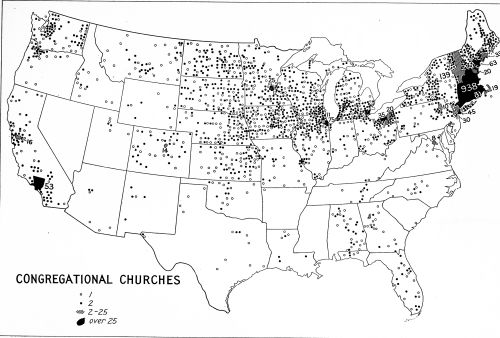
CONGREGATIONAL CHURCHES Showing distribution of the 4447 Congregational Churches in the United States. Figures indicate number of churches in shaded areas in which there are too many to be shown by dots and circles. As the Congregational Church is largely identified with New England, the map shows in a general way the westward movement of people of New England origin.
The principle of the Know Nothing party was opposition to the political power of the large masses of newly arrived aliens. This was especially directed against the Catholic Church, because it was felt that their establishment of parochial schools was inimical to the public-school system, which the Americans of that time regarded as the palladium of their liberties. This hostility to Catholics was aggravated by the attempted use of public funds derived from general taxation for parochial schools and even more by the exemption claimed and often obtained from taxation of large ecclesiastical institutions as well as churches.
Further opposition to aliens arose from their organization into compact political units which quickly demoralized our municipal governments, a scandal which has existed down to this day.
All this led to the widespread belief that these immigrants, now arriving in large numbers, refused to accept wholeheartedly the customs, principles, and institutions of the country in which they had sought refuge. This belief still persists and has given rise in each generation since the days of the Know Nothing party, to similar powerful and secret anti-foreign organizations. Our alien elements are to this day extremely sensitive to the public discussion of any of these matters. In this respect, Americans probably have less freedom of speech and freedom of press than exist in any of the countries of Europe.
During the colonial period the natural increase of the Anglo-Saxon stock in New England had made it a continual source of population for the rapidly opening West. No one State, however, contributed such a large element of the population of the subsequent United States as did Virginia, the largest and most populous of the thirteen Colonies. One cannot read the history of the movement westward of the American frontier without being impressed by the importance of the Old Dominion in supplying settlers for the West, first to Kentucky, thence to the States of the upper and lower Mississippi Valley, later to the Great Plains, and finally to the Southwest and the Pacific Coast.
But if Virginia has been the most fertile source of settlers, New England has more nearly put its stamp on American civilization; and this was made possible largely because there was an available emigrant stock in Massachusetts and her sister States, to carry this impress in person. Before the Civil War, however, the birth rate of the old white stock in New England had declined to the point where it was probably not replacing its own numbers.
In 1860 the religious unity of the United States had been somewhat impaired. The unity of language was as yet scarcely menaced. The unity of institutions, traditions, and culture was breached only temporarily. The racial unity of the country was little changed from 1790. The United States was still nine-tenths Nordic.
Earlier in these pages a description is given of the empty continent which lay open to settlement by the British stock on both sides of the Canadian border.
Let us see what use was made of this opportunity in the period from the end of Colonial times to the Civil War.
A continent was occupied and the territory of the Union was swept westward to the Pacific. The forests were cut down and the wild life destroyed. The Indians were evicted. The mineral wealth of the western mountains was ransacked. The coal was exploited, and the once fertile soil of the Southern States greatly depleted through the reckless growing of tobacco and cotton. Waste was the order of the day in America.
All this was perhaps inevitable, but never since Cæsar plundered Gaul has so large a territory been sacked in so short a time. Probably no more destructive human being has ever appeared on the world stage than the American pioneer with his axe and his rifle.
In 1860, at the end of this period, we find the essential elements of national unity still unchanged, but we were about to engage in a fratricidal war, which was to destroy the best blood of the nation. We had admitted large numbers of Irish and German immigrants who impaired, in the case of the Irish, our religious system and introduced certain undesirable racial elements. The Germans who came were largely Protestants and only temporarily disturbed our unity by clinging to their foreign language. Both of these elements, however, were pre-dominantly Nordic, and it was not until the next and final period that the unassimilable Alpines and Mediterraneans came here from southern and eastern Europe. The tragedy of the Civil War and the introduction of cheap labor were still to come, so that in 1860 the United States was at its high-water mark of national unity.
The Indians had been ruthlessly swept aside, as was unavoidable because a few hunting tribes could not be allowed to possess a continent, but the Negro question could have been postponed, and the men who died needlessly on Southern battle-fields could have been used to populate the States of the Far West.
In the next chapter we shall study the swamping of this American civilization, which reached its zenith in 1860.
XII
THE ALIEN INVASION
The period 1860-1930, with which we are now dealing, is characterized by the end of free public land in the West about 1880. It is also marked by the great development of industries in the North and East, which created a demand for cheap labor, and attracted a mass immigration of non-British and non-Nordic workmen from southern and eastern Europe. This immigration for the most part went to the cities and industrial districts.
The Southern States, which had not entered upon an industrial expansion before the Civil War, did not welcome immigrants of the low-grade factory type, hence the South has remained characteristically American. One of the strange results of the Civil War has been that while the victorious North sold its birthright of culture, religion, and racial purity for a mess of industrial pottage, the South, though defeated and impoverished, retained its racial inheritance unimpaired.
Some of the earlier immigrants in this period sought the lands in the West, while they were still to be had. The land hunger having carried most of the energetic, ambitious, and able Nordic immigrants westward, the industrial expansion of New England, Pennsylvania, Ohio, and of some of the adjacent States resulted in an unfilled demand for low-grade factory labor in the East. This demand was quickly recognized by the steamship companies, which began scouring Europe for immigrants to transport to America.
The most fertile recruiting ground for this type of humanity was in South Europe, Italy, the Balkan countries, and the provinces of the then Austrian Empire and Russia. Inducements were offered potential immigrants to come to America. There was no discrimination as to type or quality. Many criminals were rounded up, especially in southern Italy and Sicily, with the connivance if not the actual initiative of their governments.
As to the ratio of criminals to the native American population, some interesting figures have been compiled through a first-hand survey of 242 State and federal prisons in the United States during 1931-32. Most of the criminals referred to were committed for serious offenses. The criminals from northwestern Europe were well under (sometimes only one-quarter) their ratio to the general population. South Europe and eastern Europe were very much higher. The Filipinos were over twice as many as the proper allowance, native-born Negroes were two-and three-quarters above their allowance and the Mexicans were six and one-half times as many as their ratio to the general population would entitle them to be.
It was in this period that the Polish Jews began their tumultuous and frantic invasion, a flood which only recently has been checked, and that with the greatest difficulty. The great mass of immigrants from South Poland, Galicia, and Russia were Ashkanazim Jews, descendants in part of Alpine Khozars, with a Mongol admixture, who entered the eastern Ukraine from Asia in the early centuries of our era. Many of the Khozars and their Khan were converted by Jewish missionaries and they formally accepted Judaism in 740 A.D. It is doubtful whether there is a single drop of the old Palestinian, Semitic-speaking Hebrew blood among these East European Jews. They are essentially a non-European people. The language they speak, Jüdisch, or Yiddish, is a corrupt German of the Franconian dialect mixed with Slavic and Hebrew elements, which fact strengthens the tradition of a large migration of German Jews into Poland in the Middle Ages. It may be that the strain of these German Jews has died out, leaving only their language behind, but in any event the Polish Jews are now distinctly Alpine—a mixture of Slavs and of Asiatic invaders of Russia.
Exact figures of Jewish immigration are not obtainable until 1899, when this group was listed separately. Prior to that year probably 500,000 Jews had arrived; after that date nearly 2,000,000. From the beginning of this century the Jews made up 10 per cent of the total immigration into this country, and there are now more than 4,000,000 of them here, half of the number being in New York City. This is more than one-fifth of the Jews of the world.
Because they speak Yiddish, they are often colloquially referred to as "German Jews." But, in fact, the number who come from Germany is small, and, as said, the great bulk of them are more properly described as "Polish Jews" and are much despised socially by the true German Jews. Many of them are from those parts of Poland which were held by Russia prior to the World War. Immigration figures show the last place of residence of Jewish arrivals, 1899-1924, to be as follows:
Countries
Russia and Poland1,243,000
Austria-Hungary 260,000
Rumania 103,000
United Kingdom 73,000
Turkey 20,000
Germany 15,000
British North America 57,000
All other countries 67,000
————
1,838,000
Meanwhile the immigration from northern Europe declined, not only relatively but absolutely, and at the same time the native American, whose ancestry was pre-dominantly Nordic, began to be crowded to the wall. In certain sections of New England that progressive change soon became all too evident and has made them no longer American but foreign communities. The French Canadians, Irish, and Poles took over whole districts and occupied the abandoned farms. The Polish Jews, settling almost entirely in the larger cities, built up a Ghetto population similar in most respects to the congested urbanism of their homeland.
Americans were so obsessed with the idea of a "Refuge for the Oppressed" that they even welcomed the draining into our country of that morass of human misery found in the Polish Ghettos. When the objection arose that there were already 1,000,000 Jews in New York City, an effort was made to divert this migration into Texas, where the wide-open spaces were supposed to provide room for the 7,000,000 Polish Jews.
The German Jews, who also came into this country in smaller numbers at the end of the last century, were of the Alpine type, closely resembling those from Poland, Galicia, and Russia. All of these Jews are in sharp contrast to the Sephardim Jews, a superior group, largely Mediterranean in race, a very few of whom came from Holland to America in Colonial times. These latter had reached Spain by way of North Africa and later fled to Holland to escape the Inquisition.
The immigration from Scandinavia was entirely Nordic. Sweden is purely Nordic, and Norway and Denmark are overwhelmingly so. Lithuania and North Poland are also Nordic lands, as are the German provinces along the Baltic; but South Poland and Galicia are Alpine, as are the majority of the immigrants who come from South Germany. Those from the provinces of the former Austrian Empire are mostly Alpine, although a few Nordics came from the Tyrol.
The Balkans, Greece, Asia Minor, and Armenia sent over practically only Alpine immigrants. French-speaking Switzerland was originally Burgundian territory and contributed some very valuable Nordic racial elements to America. Those from German-speaking Switzerland were largely Alpine.
The period of the great European migration to the United States covered just a century. Prior to that time, since the founding of the Union, most of the immigration had been English and Scotch. Up to 1860, as will be recalled, this British character of the immigration continued, except for the beginning of the great stream of Germans who have been, next to the English, the largest single element in our population.
The early Germans in the United States were, as previously described, mostly Alpines from the upper Rhine—the Palatinate and Swabia. In the '40's the area of the German emigration spread. At first to the western states and provinces, which were much more Nordic in character (Hesse, the Rhineland, Westphalia, Thuringia). All this region had an easy outlet by the Rhine to the seaports; moreover emigration was stimulated by the result of revolutionary activities, which forced many to leave.
After transportation began to be improved by railways, the main currents of emigration began to flow from central and eastern Germany. Emigration reached its first crest in the southwest and west of Germany in the middle of the '50's, its second in Central Germany toward the end of that decade, its third in the eastern part of the empire in the '70's and '80's. This later emigration was, on the whole, more Nordic than the earlier stream.
After the World War, when business conditions in Germany brought about some years of active emigration with the United States as its main objective, the current of emigration shifted again to the northwestern and southwestern districts (the former Nordic, the latter mainly so) and away from the northeast, which was even more Nordic.
The Scandinavian immigration, another main source of the Nordic population of the United States, dates almost entirely from the period since the Civil War. The largest volume was between 1877 and 1898, when more than 1,000,000 arrived. One-fifth of the entire population of Norway and Sweden moved to the New World, nearly all of them seeking farms in the States of the upper Mississippi Valley. There has been also an active immigration from Scandinavia since the end of the World War. In general, the United States was the only destination which a Scandinavian emigrant considered. Of those who left the homeland, not one Swede in fifty directed his course elsewhere than to America. No other emigrant population has shown such a single-minded interest in the United States, though the Norwegians have not been far behind, with 96 per cent of their departures destined to the United States; and the Danes, with 88 per cent.
Arriving at New York or sometimes Quebec, the immigrants made their way to Chicago or Detroit, and thence were distributed to the States west of the Great Lakes. The Norwegian movement was the earlier, beginning with the southern and central counties of that kingdom and gradually working its way north until arrivals were giving as their birthplaces little towns far north of the Arctic Circle.
In a few decades Norwegians owned six times as much farming land in the States of Minnesota, Wisconsin, Iowa, Illinois, Michigan, and the Dakotas (four-fifths of the immigration being found in the States named) as did all the farmers in the "Old Country." No nationality has sent such a small percentage of its people into the cities—one in five of the whole, as compared with a half of the Germans, and a still higher percentage of the Irish and Italians, who seek an urban life.
This tendency to agricultural life and to prompt and whole-hearted Americanism has made the great body of Scandinavian immigrants one of the most valuable that America has received.
Meanwhile there continued a steady immigration of English and Irish. The latter envenomed our political life up to the last few years, by introducing into the United States their old political and religious feuds with Great Britain, and endeavoring to involve this country in their plans for Irish freedom. As a consequence, the friendly relations which should exist between the two great Anglo-Saxon nations have been kept disturbed, and a systematic policy of twisting the lion's tail was pursued, not merely by the Fenian agitators, but by American demagogues anxious to cultivate the "Irish vote."
Prior to 1880 only 5 per cent of the immigration was from southern and eastern Europe. Between 1860 and 1880 less than 250,000 immigrants from eastern and southern Europe came over. Then came the rush, and between 1890 and 1910 more than 8,000,000 immigrants reached our shores from southern and eastern Europe.
A group not homogeneous with the old native American population is the Italian. It began arriving after 1870, but did not reach large proportions until after 1890. Then it soon became a flood. From 1900 until the World War cut down immigration, the Italians far outnumbered all other peoples arriving on our shores.
Northern Italy has furnished us some fine types of immigrants. They are mostly Alpine with a Nordic admixture. Southern Italy, that is, Naples and Sicily, sent us almost exclusively a Mediterranean stock, which formed the great mass of Italian immigration and was of extremely inferior type. They are derived to some extent from the slaves whom the Romans gathered along the coasts of the Mediterranean from Syria to Morocco and employed on their large estates or latifundia. Among them, however, are to be found remnants of the pre-Nordic Mediterranean population of Italy.
In earlier decades the emigration from Italy was mostly of North Italians, commonly spoken of as "Genoese," but mainly from the crowded Italian Riviera west of Genoa. These went to neighboring countries, particularly France, and to South America, few of them reaching the United States. When Italian mass emigration to this country began, it was from central and southern Italy and Sicily, who are of quite different racial stock from those of the more northerly districts.
The northern Italians are well thought of in the countries to which they have gone. The southern Italians seem to be far inferior in quality. While the country of their origin, Magna Græcia, two thousand five hundred years ago was the source of a large part of the world's progress in civilization, it is doubtful whether the reader can name a single man produced in that region during the last two thousand years, whose ability or eminence was such as to give him a worthy place in the world's history.
Add to this that the United States did not receive even the best of the southern Italian population, but in some instances rather the part that the local authorities were most happy to get rid of, and it is easy to understand how the Italian children in the American schools have shown themselves in almost every test to be a group apart, widely separated from every other white racial group and close to the Negro-Mulatto children in their ability.
Of the non-English-speaking peoples who have arrived in the United States during the last century, the 4,500,000 of Italians are outnumbered by only one group, namely, the nearly 6,000,000 Germans.
The Italians have been more inclined to return home than some others. In all the immigration, it has been observed that a considerable proportion of the immigrants stayed only temporarily, sometimes for a season of work, sometimes for a generation or until they had accumulated enough money to return to the "Old Country" and live on their investments. It is usually figured that the arrivals should be diminished by about one-third to give the net of permanent immigration. There are of course exceptions—thus it is relatively rare for a Jew who came to the United States to move out of the country later.
During the sixteen years, 1908-23, the total alien emigration from the United States was 35 per cent of the total alien immigration, and the differences between the racial groups in respect to this tendency were immense.[10]
This ebb and flow of migration is often overlooked. It is impossible to understand the population figures without bearing it in mind.
While the departure of so many unassimilable aliens is highly favorable, the fact that migratory cheap labor thus floats into and out of the country to compete with the native white, may of course have most serious effects socially and economically on the older stock. Fortunately, this has now been stopped by suitable restrictions.
Taking a long view over the whole history of immigration into the United States in the century and a half before 1930 one sees that approximately half of the total was from the countries of northern and western Europe, which are largely and some distinctly Nordic in population, and which sent us people who, in most cases, were easily assimilated by the Native Americans. Most of these came in during the first century of the Republic's life, as pointed out above.
After 1890 the tide turned strongly to southern and eastern Europe, the countries of which in 1913 (the last year of unrestricted immigration) sent 85 per cent of the total as against 15 per cent from northern and western Europe. The main contributors to this later stream, often called the "new immigration" as distinct from the "old immigration" were, in order of importance, Italy, Austria-Hungary, and the Russian Empire.
FOOTNOTES:
XIII
THE TRANSFORMATION OF AMERICA
Under the impact of the "new immigration," most of it dating from the beginning of the present century, the complexion of the States which, as repeatedly shown, was almost wholly Nordic and Protestant, began to change rapidly. As concerned their native-born population, most of the States followed the rule, often mentioned in these pages, that a State is populated, in the first instance by its own increase, and secondly by movements from the States directly adjacent to it.
Maine, according to the 1930 census, with about one-tenth of the population of New England, is only five-eighths native stock, i.e., native white of native parents. These were mostly people born in Maine, with a few from surrounding States. Of its foreign stock, three-fourths were French Canadians.
New Hampshire presents a similar picture, with a slightly higher percentage of native Americans from nearby States.
Vermont's native population, aside from that portion born in the State itself, came from New Hampshire or Massachusetts and even more from New York. As in the two States previously mentioned, most of the foreign stock is from French Canada, and that which was not from Quebec is mostly Irish.
The Slavs and Italians have made little inroad in these three States.
Massachusetts in 1930 was more cosmopolitan, with 300,000 residents from other New England States and nearly 100,000 from New York. The old white stock, however, now makes up but one-third of the population of the Bay State. French Canadians, Irish, Italians, Poles, Russians, and Scandinavians, in the order named, have completely overwhelmed the native stock—even such a small country as Lithuania is represented in Massachusetts by more than 50,000 people.
Rhode Island's population, similarly, is now only one-third from the old stock. Its complexion is similar to that of Massachusetts. French Canadian Catholics control the government in many communities.
Connecticut, like Rhode Island, has about one-third old American stock. Here the Italians are the dominant element in number, with Irish, Slavs, and French Canadians almost equally numerous.
Thus New England, with its more than 8,000,000 population, has been virtually lost to the native Americans. Their birthrate in that area has long been far below the level necessary to prevent its dying out, and migration to the west is not now caused by the region's increase, as in Colonial times, but by an actual uprooting of families whose place is taken by others who in race, language, religion, culture, and institutions are quite out of harmony with American traditions.
A similar picture is observed when one turns to the 26,000,000 inhabitants of the Middle Atlantic States—the most populous, the wealthiest, and in many ways the most powerful section of the country.
The old stock makes up but one-third of New York's population. For its composition every State in the Union has been drawn on, with Pennsylvania and New Jersey furnishing the largest contingents. The State has well on to half a million Negroes—mostly in Manhattan, though the ratio of increase of Negroes in some of the other cities of the State vastly outstripped the ratio of increase of Whites between 1920 and 1930. Thus while the Whites of Buffalo increased 11 per cent in the decade, the Negroes increased 200 per cent; in Syracuse they increased twice, in Utica four times, in Rochester seven times, in Albany eight times, as fast as the whites—due, of course, to the migration of great numbers of mulattoes from the Southern States northward.
With its two million Jews, its million and a half Italians, its million Germans, and its three-quarters of a million each of Poles and Irish, together with substantial contingents from almost every other country on the map, the Empire State is scarcely able to meet the requirements of the Founders of the Republic, who, like Thomas Jefferson, feared above everything else the formation of an alien, urban proletariat as creating a condition under which a democratic form of government could not function successfully.
Three-eighths of New Jersey's population were still of the old native stock in 1930, though half of these were born in other States, particularly New York and Pennsylvania. The rest of the population was a heterogeneous mixture of half a million British (largely Irish), half a million southern Italians, a quarter of a million Poles, a somewhat larger number of Germans, and so on down the list.
Pennsylvania makes a somewhat better showing, with more than half of its population still old native Americans. Of the later arrivals the largest number, well on to a million, was of British (including Irish) extraction. Italy and Poland each sent more than half a million, Germany not much less, Russia and Czechoslovakia each more than 200,000.
In both these divisions, then, the New England and the Middle Atlantic States, containing as they do more than a third of the entire population of the United States, the old American stock is now reduced to a minority. Fortunately, this cannot be said of any of the other major divisions of the country, though it is true of a few other individual States—Wisconsin, Minnesota, and North Dakota—where the foreign-born or their offspring are in a slight majority, but of good Nordic stock. On the whole, it is the northern and central parts of the Atlantic Coast that have become the worst un-American parts of the Union. The South Atlantic States play a much less important part nowadays than they did a century ago, in furnishing population to the rest of the country; but they are still American. In the following discussion their Negro population is ignored, and consideration is limited to the Whites, unless otherwise stated.
Delaware, with more than three-fifths of its people belonging to the old stock, has drawn no great additions in late years except from its neighbors on the west and south, Pennsylvania and Maryland. Its alien element is a cosmopolitan one in which no single group particularly preponderates.
Maryland is three-fourths native. Its industrial and commercial life, centered in Baltimore, has drawn a population from an unusually wide area, and this tendency has been greatly accentuated because many of the cosmopolitan group in Washington, D.C., actually reside in Maryland. Thus in addition to the heavy contingents from Pennsylvania and Virginia, it has groups of a thousand or more each from half the States in the Union. The bulk of its foreign population is made up of Germans, Poles, Russians (including Jews), and Italians, in addition to the British.
The District of Columbia, as the seat of the Federal Government, naturally draws its residents from every part of the United States, the largest element of what may be called its permanent population being from Virginia and Maryland. There is no large foreign element, but the Negroes, more than one-fourth of the whole, are nowhere more aggressive. It is generally understood that the reason Congress has never been willing to grant the residents of the district the right to vote, even in local affairs, is that it would be likely to put the political control in the hands of this Negro block, which would always find unscrupulous white politicians ready to forget their own birthright and truckle to it.
Virginia is almost purely of old native stock, Virginian born. Its seaports and its proximity to the District of Columbia account for some residents from other States. After dealing in quarter millions and half millions to describe the foreign-born of the North Atlantic States, it is with something like incredulity that one notes only 23,000 foreign-born Whites of all sorts in the Old Dominion. The number who are native-born of foreign or mixed parentage, and therefore classified as "foreign stock," is twice as large; but many thereof are British. With Virginia, one reaches the region where the old native American holds his ground.
North Carolina makes a still more striking picture. In its population of more than three million, the 1930 census enumerators found scarcely 25,000 foreign-born or of foreign parentage. North Carolina is an active industrial State, yet it has been able to attain to its modern development from its own resources. Its neighbors on the North and South, together, have supplied a hundred thousand citizens; other regions have contributed a few; but the old white American stock in this State, as in many others of the South, has been largely self-sufficing.
South Carolina is not only of the American stock, but has had few outsiders, even from adjacent States. In addition to natives, a very few British and Germans, a very few Northerners, and moderate contingents from the nearby States make up its white population, which is still but slightly larger than the Negro element in the State.
Georgia fits into the same pattern, though it has attracted a few more of the "new immigration"—Slavs and Italians; and a few more Yankees, so that its population, on the whole, is somewhat more cosmopolitan.
Florida, on the other hand, has had an influx both of Northerners, who have almost changed the political complexion of the State; and of the foreign stock, largely Nordic, it is true, but with a West Indian element that is less assimilable. Of its million Whites, a sixth are of foreign stock, including almost every one of the nationalities found anywhere in the United States. But despite this somewhat cosmopolitan nature of its population, the State is overwhelmingly Nordic, like the other Southern commonwealths.
West Virginia, cut off from the Old Dominion by a technically questionable move at the beginning of the Civil War, showed by this very "secession" of its own that its population differed widely from that of the Tidewater. As pointed out earlier, the latter region was English and the mountains were Ulster Scotch, with a widely different outlook on life. The western part of the State had never been a great slave-holding region, partly because of the sentiment of the people, partly because there was little for a slave to do there that a free white could not do much better. To this day only one in sixteen of the population of West Virginia is colored, and it is still largely native white, despite the coal mines, which in other regions have come to depend largely on the labor of Slavs. In the 10 per cent of its foreign-stock population West Virginia has a scattering of Slavs, as also of almost every other people, but the largest element is British, the next German.
Kentucky offers no exception to the rule that the Southern States are still almost wholly native white. The only important foreign element is a small German one. It still retains a little of the tendency which made it, a century or more ago, one of the chief colonizing States, for it has more of its native sons scattered throughout the Union, than has almost any other Southern State.
Virginia still sends out a surplus population, and Georgia notably has done so, though mainly to the States nearest at hand. Kentucky and Tennessee have sent out pioneers to more distant regions. At present, for instance, they have as many representatives on the Pacific Coast as have all the South Atlantic States together.
Tennessee's racial make-up is very similar to that of Kentucky, although there is still the marked contrast in the "atmosphere" of the two States, which has existed from the beginning.
Alabama's composition is not very dissimilar to the two just mentioned, save that the Italian element is a little larger. Its main foreign stocks, however, are British and German.
What has been said of these States applies almost literally to Mississippi. The Whites, forming a little less than half of the total population, are almost all of the old native stock. The emigration of Whites (and of Negroes, too, for that matter) from the cotton States during the last fifteen or twenty years has been largely due to the ravages of the boll weevil, which made cotton less profitable and prevented many small farmers from making even their expenses.
Georgia has been hit harder than any other State, probably, by this movement out of the State and thousands of acres of good farming land are now lying idle there, for lack of hands to work them. The same holds good to some extent in other States of the region. Many of the small farmers have moved westward, first perhaps to Texas or Oklahoma, and then on to the Pacific Coast, the automobile now taking the place of the covered wagon of their forebears.
Arkansas differs in no important respect from Mississippi, save in having a much smaller proportion of Negroes. Its old white population has likewise begun to move, though more often northward, as to Missouri or Kansas. But Oklahoma and, also, Texas have been the great outlets for the Arkansas farmers.
The climate and resources of Louisiana have attracted some 50,000 Italians—a small element compared with those in the Northeastern States, but large for the South. Louisiana has always been more cosmopolitan than any of the other Southern States, and this is still the case, yet 85 per cent of its Whites are of the old native stock. Most of those not born in the State have come from States directly adjoining. While to a certain extent there has been the usual interchange, Louisianians going to other nearby States, mainly Texas, nevertheless Louisiana has been relatively unimportant in settling other States since the Civil War.
Its population is less homogeneous than most of the Southern States. The northern part of the State, with a majority of the inhabitants and with political control, is made up largely of Nordic Protestants who have come in from Arkansas, Mississippi, Tennessee, or elsewhere, and who differ little from the inhabitants of those States. The southern part of Louisiana, on the contrary, is largely Roman Catholic in religion, and to a large extent French-speaking. In some towns there are no public schools. The parochial schools teach the children in French, and the Catholic Church has made particular efforts to perpetuate the use of that language. The State Convention which revised the constitution in 1921 made the literacy qualification for the exercise of the electoral franchise, the ability of a citizen to write his application for registration "in the English language or his mother tongue."
The State has the highest rate of illiteracy of any in the Union, whether one considers the total population including Negroes, or limits the figures to the native Whites. It has been part of the United States for one hundred and thirty years, but United States officials, when going into many parts of it, still have to be accompanied by an interpreter. With only two or three exceptions, every bishop who has been in charge of Catholic interests in Louisiana since Thomas Jefferson's day has been foreign-born and foreign-trained.
For such reasons the feeling of separate interests and lack of unity and national identity have tended to continue; and when the "Cajan" representatives attend the State legislature at Baton Rouge, they address the House in eloquent English, but among themselves, discuss their program in a French patois.
Oklahoma, due to its peculiar history, is one of the cosmopolitan States. When the territory was thrown open to settlement in the great land rush of April 22, 1889, speculators from all parts of the United States were attracted to the scene. But most of the settlers in the northern part came from Kansas or Missouri and in the southern, from Texas or Arkansas. In the next year, when the territory was formally organized, one-third of its population was Indian or Negro. Subsequent land allotments and colonization tended to perpetuate this dual origin of the settlers, but after the State became a famous oil field, in the early years of the present century, the population became so mixed that this distinction was partly lost. Meanwhile the Indian population was not only swamped by the Whites, but largely intermarried with them, partly because Indian women had titles to valuable oil land. At present Oklahoma is still credited with nearly 30 per cent of all the Indians in the United States, though it is supposed that not more than one-fourth of these are full-blood, and many of those who are legally counted as Indians have but a negligible amount of Indian heredity. The Creeks and a few others have mixed to some extent with Negroes, but this has not been general.
Texas, Missouri, Arkansas, and Kansas are still the principal sources of Oklahomans, in the order named; but there is not a State in the Union which is not represented here, many of them with large contingents. The foreign stock is of equally cosmopolitan background, but makes up only one-sixteenth of the whole. Considering the geographical location, it includes a surprisingly large number of Canadians.
Texas contains nearly half a million people of foreign stock, the German element being by far the largest. Second in importance among the foreign stocks is a Czechoslovakian population which has settled largely in the southeastern part. The Germans are mainly to the west of them. The State began to attract Italians just before the World War. The British element is important, while Galveston has long been largely dominated by Jews.
North Texas enjoyed a boom in 1875 and 1876 when a flood of homeseekers poured in with their emigrant wagons. Many of these were farmers from the Middle West who had been impoverished by the great grasshopper plague.
Western Texas was settled late, and periods of drought, such as that at the time of the World War, largely depopulated some sections, farmers packing up what they could carry and abandoning everything else to move into a region where nature was less reluctant to aid them.
Texas is still the offspring of the lower Mississippi Valley States, but commercial development and the oil industry have brought in many Northerners, particularly from the Central States. On the other hand, the State's contribution to Oklahoma dwarfs all the other streams that have gone out from it; but it has also contributed liberally to New Mexico and Arizona and in recent years to California.
Turning back now to the East North Central States, which comprise those originally carved out of the Northwest Territory of 1787, one again encounters the full tide of the so-called "new immigration." Here the old native stock is scarcely more than a numerical majority—fourteen million out of twenty-five, to be more exact; a striking contrast to the Southern States, which we have just been considering, where it still forms nine-tenths or more of the total white population.
Five millions of the later arrivals in the North Central States are Nordics, but a number almost equally large are Alpines. Half a million Mediterraneans are present in the Italian immigration, while the area from which the congress of the Confederation, as one of its last acts, declared that Negro slaves should be forever excluded, has acquired nearly a million free Negroes.
Ohio is still two-thirds native, and its great industrial development has drawn population from all sides, though four out of five of its citizens still find their names on the birth records of the State itself. Besides giving population to all its neighbors it has, like the other States of this region, sent a stream westward, not merely to such places as Kansas and Colorado, but particularly to the Pacific Coast.
While the German element in Ohio which, half a century ago, made such cities as Cincinnati centers of Teutonic kultur, is still the most important numerically, it is outnumbered by the Poles, Czechoslovaks, Hungarians, Yugoslavs, Lithuanians, and the like, if they are taken together. The easy access across the Great Lakes has given Ohio, like her sister States, an important Canadian element.
Indiana, most American of States in its early period, still makes an excellent showing, with nearly 85 per cent of its population native white of native parentage. In the interchange of inhabitants it still continues, as it did in the days of its founding, to draw an important Southern element from across the Ohio River. The State of Ohio does the same. The population still tends to move westward, not eastward, from Indiana, taking with it some of the best of American family lines and the purest of American traditions.
The half million of foreign stock within the borders of the State are at least half Nordic. No single group of the Slavs or Mediterraneans is represented heavily, although there are a few of all those national elements.
The people of Indiana deserve recognition for the way they have preserved their heritage. It is no accident that the "Indiana school" of writers has long sounded the authentic American note in literature, in striking contrast to the decadent tone of the output in some of the Atlantic Coast centers where the dominant element is quite un-American.
Illinois, by contrast, is barely more than half native, and the scandals of its politics in regions where the alien vote is self-conscious, have long been manifest to every newspaper reader. With 329,000 Negroes, according to the 1930 census, Illinois ranks in this respect only after Pennsylvania and New York, among the Northern States; but corrupt political rings have made of the Negro an important factor in the government of Chicago, as he has not been in New York or Philadelphia.
Of its foreign-born stock, Nordics are far below a million, as compared with a million and a half of Alpines and a quarter of a million of Mediterraneans. Under the pressure of this competition, the old native stock has shown a strong tendency to move West and South. Texas and Arkansas, for example, have drawn more heavily from Illinois than they have from any other Northern State, and Illinois has also been the greatest single contributor to the development of the Pacific Coast.
Michigan is now just half native. Its geographical location has attracted more than half a million Canadians, many of them belonging to the French Alpine stock there. In the foreign stock as a whole, Alpines outnumber Nordics not far from two to one. Among the 100,000 Italians are many Northerners in the copper mines—big fellows so unlike the Sicilian and Neapolitan to whom the American on the Atlantic Coast is accustomed, that he does not recognize them as Italians. These northern Italians, as previously noted, are not Mediterraneans, but mostly Alpine with remnants of Nordic blood from the days of the Lombards and Goths.
Wisconsin has almost escaped the Negro invasion of the North, so its three million inhabitants are at least white; but the native stock is in a minority, due largely to the great German inrush of the last century. With this came many Scandinavians.
From 1860 to 1880 the immigrant nationalities ranked in the order—German, Norwegian, Dane, and Swede. The only difference since then is that they rank in the order—German, Norwegian, Swede, and Dane. The great Swedish tide of immigration in the last half of the nineteenth century did not acquire full force until the Norwegian had passed its crest.
As late as 1900, three-fourths of the people of Wisconsin were of foreign parentage, and the Germans made up half of these. Milwaukee, with its Socialist administration, had long been conspicuously the center of German influence in the United States. Up to 1843, was a Yankee village, earnestly trying to supplant Chicago as the center of the Midwest. By 1856 a third of its population was German. By 1890 one-half of its population was of German parentage and one-fourth actually of German birth. That census year, however, saw the high tide of Germanism in Milwaukee. Poles, Russians, Slovaks, and Italians have modified since then the racial character of the city, which is only one-third German at the present time. In the characteristic political color of the State some students profess to see evidence of the fact that many of the German immigrants were revolutionists fleeing from the Fatherland.
In Minnesota, the Germans outnumber any single group, although less numerous than the three Scandinavian groups put together, so the State is correctly thought of as Scandinavian. Considerably less than half of its population is of the old American stock, but the State is overwhelmingly Nordic, the 150,000 Slavs who have invaded it in recent decades being of little account in its 2,500,000 population. Since the days of its founding, Minnesota has drawn from Canada a desirable element, and has given freely in exchange.
Due partly to its relatively late settlement, the State has not been one of those which have contributed heavily to its neighbors. Its greatest outflow has been to the Pacific Coast, as its inhabitants became prosperous enough to move to a milder climate in their old age.
Iowa, of about the same population as Minnesota, is two-thirds native and equally Nordic. It has contributed heavily to the prairie and mountain States, and also to the Pacific Coast, but the standing joke which ascribes to Iowa the parentage of all Southern Californians seems to be not quite exact—at least California as a whole has received more of its population during the past generation from Illinois, Missouri, New York, and Ohio, than from Iowa, which stands only fifth in the list.
Iowa, being pre-dominantly agricultural, has felt particularly the unfavorable status of agriculture since the World War. During the decade 1920-30, three out of every five of the villages in the State actually lost in population, the people having either moved into the cities or "gone West." Here as elsewhere, the small village seems unable to meet the needs of the inhabitants. One of the real problems of statesmanship in the near future is to work out a social and economic system under which a larger part of the old native stock, and particularly the most intelligent portion of it, can live under the favorable biological conditions of the small village.
Missouri has nearly a quarter of a million Negroes, in contrast with such States as the three last discussed, in which the colored population is negligible. But of its white population, three-fourths is native, the rest mostly German. Slavs and Italians have only begun to get a footing. On the whole, the State is strongly Nordic and sends out large contingents of Nordics to Illinois on the East, to Kansas and Oklahoma, and to the mountain and coast States westward. The importance of the Missouri stock, coming to a large extent from that of Virginia, has been much greater than is generally recognized, in the settlement of the whole West.
The great rush into Dakota took place in the decade after 1875. The Red River country was opened up by the Northern Pacific Railway, and the model farms which were established were advertised far and wide, so that the population of 6000 in this district in 1875 increased more than 2000 per cent in the following ten years.
In 1889 the territory of Dakota was divided on the 45° 55´ parallel, and North Dakota was admitted as a State with approximately 170,000 population. Its subsequent growth has kept it fairly homogeneous from a racial point of view, the State being almost wholly Nordic. Apart from the old native Americans the main elements have been British from Canada, Germans, and Scandinavians. The Norwegian immigration which began in the early '90's was particularly noteworthy. Norwegians now form about one-fourth of the total population of the State. An interesting small group is that of the Icelanders, representatives of one of the oldest, most highly cultured, and most stringently selected of all Nordic peoples.
The Russians in the State, approaching a hundred thousand in number, are mostly German-speaking. They are farmers whose ancestors were invited to South Russia several centuries ago, but who retained their speech and culture to a marked degree.
After the discovery of gold in the Black Hills, the country which is now South Dakota had a rush in 1876 and for some years following, much like that of Nevada and Montana during the Civil War and of California in 1849. This frequently does not result in a well-balanced permanent population, and the real settlement of South Dakota dates from the succeeding period when its prairie lands were taken up by wheat growers from the States of the upper Mississippi Valley. The wheat industry in Wisconsin gradually died during the decade of 1870-80, and many who found the ground unprofitable there moved farther west, as did others with similar motives from western New York and the States of the old Northwest Territory.
South Dakota has a slightly higher percentage of old Americans than its sister to the north; otherwise the two differ remarkably little in size, composition, and resources. In 1920, half of the inhabitants of North Dakota claimed South Dakota as a birthplace; while half of the inhabitants of South Dakota claimed North Dakota as theirs. Of all the forty-eight States, these two are unmistakably the Tweedledum and Tweedledee.
Nebraska after the Civil War continued to attract mainly the old American pioneer class, but it also became a haven for several foreign groups. It is said to contain about one-eighth of all the Bohemians in the United States. The serious permanent settlement of the State began in the early '70's. Many discharged soldiers seeking to make a new start went West with their families. It was only a few years later that the foreign tide began to reach these prairies and thereafter the State attracted large fractions of the Bohemian, Scandinavian, and German immigrations. Like some of the other prairie States it also received many settlers who were listed as Russian because of their nationality, but who, in fact, were Germans whose ancestors had gone to Russia and failed to prosper there. Nebraska, therefore, though less than three-fourths native, is overwhelmingly Nordic.
Kansas is still four-fifths native and nine-tenths Nordic. It has received the same foreign contributions as Nebraska, but in much smaller quantities. At the same time it has continued to receive settlers from the Mississippi Valley, and even from Eastern States, such as New York and Pennsylvania.
On the whole, the prairie States have been notably successful in assimilating their immigrants and maintaining an American tradition. The newcomers were not segregated in slums but scattered on farms. It was almost a necessity for them to learn the speech and adopt the customs of their hosts. While some of the Scandinavians, as in Minnesota, have tried to have their children learn the language and preserve the traditions of the "old country," these have at least been Nordic traditions, and any feeling of aloofness or separateness is rapidly disappearing.
The mountain States date largely from the Civil War, when another of the country's waves of migration and settlement broke loose from its moorings and started westward.
The first great migration of the American stock began immediately after the Revolution, and resulted in the creation of Kentucky and Tennessee by the Southerners, the transformation of western New York by the New Englanders, and a mingling of these two streams as they crossed the Ohio River to open up the Northwest Territory.
The second great migration reached its crest with the panic of 1819. It completed the settlement of the Ohio Valley and of the States along the lower Mississippi and the Gulf.
The third great migration reached its height with the feverish land speculation promoted by Andrew Jackson's experiments in banking and broke with the collapse of the prosperity which Martin Van Buren inherited from his predecessor. It witnessed the settlement of the Mississippi Valley throughout almost its entire length; together with the Nordic absorption of Texas.
The fourth wave, slightly more diffuse, washed over the "great plains" and broke on the crests of the Rocky Mountains during the Civil War, though a heavy splash had meanwhile reached the Pacific Coast. It began with the settlement of Kansas, motivated in part by land hunger, but also by definite political calculations. Meanwhile the conquest of California, the discovery of gold there, the settlement of Oregon, and the Mormon appropriation of Utah, brought into existence an active traffic across the plains, which was the beginning of Nebraska's existence.
The Rocky Mountain States grew up in the first place out of this traffic, then by the mining discoveries within their limits, and the fact that there was a restless population on the Pacific Coast, ready to surge back eastward, together with a footloose population to the East ready to move into any part of the West.
This Eastern contingent received its impetus from the panic of 1857, when many men, bankrupt or dislocated, were prepared to make a new start. The mining activities in the Far West encouraged adventurers to try their hand at the gold pan, and the country was full of prospectors, some of them professional but mostly amateur. Men who had no jobs at home thought they might as well seek a fortune in this way; it would not cost them much to live, and they could at least see the country. A similar renaissance of prospecting and small-scale mining took place all over the mountains of the West when the depression of 1929 was well under way.
To this element was shortly added another composed of people getting away from the Civil War. Some of these were actual deserters from military service; others went West to escape the pressure of public opinion toward enlistment; others in the border States, ruined by the conflict or unwilling to cast their lot with either combatant, simply started in motion as their fathers and grandfathers had done before them.
The population of the mountain States varied remarkably from month to month, as the crowd moved from one reputed bonanza to another. The government at Washington showed itself unusually ready to set up new governments in that region, because it was on the whole of unquestioned Union loyalty and, if the South, at the close of the war, should be brought back into the Union on the old terms, as President Lincoln evidently planned, a dozen new senators from half as many new Western States could easily be secured, leaving the South in the minority and breaking that deadlock of almost half a century which had been the source of so many compromises and the occasion of so many conflicts.
Colorado, at that time a part of Kansas, was an almost unknown "Indian territory" when prospectors struck gold in the neighborhood of Denver in 1858 and 1859. The rush from Kansas and Nebraska, when the legend "Pike's Peak or Bust," lettered on the sides of emigrant wagons, became traditional, disclosed how little was known of the country. Pike's Peak, though not near the gold diggings, was the only place in Colorado of which most Americans had ever heard.
In 1861 there was enough population to justify territorial government. Statehood was not attained until 1876. From then on until the agricultural period, the history of Colorado was the history of its fluctuating mining camps. But by 1930 the State had reached a permanent basis and a population of more than a million, of which two-thirds was native and the other third a heterogeneous lot, partly Nordic but containing strong Slav, Italian, and Mexican elements. So far as the native American population was concerned, its geographical origin still represented a fan spreading out from Pike's Peak until it reached the Atlantic Ocean. In large or small proportions, emigrants from most of the older States had converged on the Rockies.
Wyoming, first explored by trappers and fur traders, became important because it was traversed by the Oregon Trail; but it was merely a place to pass through, until the arrival of the Union Pacific Railway and the discovery of gold in the same year (1867) gave it a life of its own. Nearly 6000 persons spent the following winter in Cheyenne—a cosmopolitan crowd of adventurers and speculators. After its organization as a territory in 1859, agriculture had begun, stock raising became important, there were local gold rushes, and the region slowly developed until admitted to the Union in 1890.
Wyoming's population, smaller than that of any other State with the single exception of Nevada, is less than two-thirds native stock, and this represents a blend from all parts of the United States. Iowa, Missouri, Illinois, have all contributed more inhabitants than either of its neighbors, Colorado and Utah. In these mountain States the general rule that a State is settled by its neighbors, quite breaks down. Its foreign stock is equally mixed; while much is Nordic the State has also attracted its quota of Slavs and Italians, and even of Mexicans.
Idaho, after small Mormon settlements of farmers, owed most of its early population to its mines. During the Civil War it grew remarkably, but the fact that it could be reached more easily from the West than from the East, due to access by the Columbia River, made its settlement somewhat anomalous in American history, for it was settled largely by Westerners moving east from Oregon, Washington, and northern California.
In Idaho the development of Mormon colonies has given Utah a strong influence in the State. Apart from this, its population is made up nowadays more from the Mississippi Valley than from the mountain and Pacific Coast States. It is only three-fourths native, but most of the remainder is Nordic, British and Scandinavians both having sought its opportunities. A territory in 1863 and a State in 1890, Idaho now has a population of nearly half a million.
Montana, in the winter of 1862 and 1863 had a total population of 670 inhabitants of whom The Chronicle complacently says: "Fifty-nine were evidently respectable women." Like Idaho, it attracted an element of Southern men escaping from the draft into the Confederate Army, but from then on a large part of its population was from the Northern States. Its growth of population was closely linked up with the fortunes of the mining industry.
Territorial status was given Montana at the time of the great gold discoveries in 1864, and the character of its population fluctuated a good deal, both as to quantity and quality, between that date and 1889 when it was admitted to Statehood. It has now more than half a million inhabitants, nearly half of whom are of foreign stock and largely Roman Catholics. Most of the natives are from the Central States; most of the foreigners are Irish, Germans, or Canadians, though Montana has also attracted more than 50,000 Scandinavians.
Utah's population is now about the size of that of Montana, and but slightly more native in character (three-fifths). These natives are to a large extent born in the State, the descendants of the Mormon pioneers. The "Gentiles" are of widely scattered origin. The foreign stock is mostly English or Scandinavian, the Mormon missionaries having worked diligently in those kingdoms. Utah, therefore, represents a Nordic population, and one with a high birthrate, whence it is evidently destined to continue spreading steadily in the Great Basin.
Nevada sprang almost full grown from the desert, as Venus did from the waves. It scarcely existed, though on the maps as a transmontane part of California, until the gold rush of 1849 brought settlements into existence to take care of the travellers. Then it was attached administratively to Utah, which was also inconveniently distant. The discovery of silver in the fabulously rich Comstock Lode (1859) led to the establishment of Virginia City, and to the inrush of a torrent of miners, particularly from California, where the gold deposits were becoming exhausted.
In 1861 Nevada was established as a separate territory, and Lincoln's administration pushed it through to Statehood in 1864 to get the advantage of two more friendly senators. With the exhausting of the silver deposits in a quarter of a century, Nevada had a severe decline, many of her inhabitants moving away. There was another mining boom in the first ten or fifteen years of this century, but the State has never made a steady and substantial growth, and the 1930 census credited it with no more than 91,058 inhabitants. Not much more than half of these were of the native stock. The foreigners were a scattered lot, with an unexpectedly large Italian contingent.
Arizona was cut loose from New Mexico in 1863, and, after the Civil War, became a typical Western mining community, with a fluctuating frontier population. A district might be active one year and a few years later abandoned.
The Mormons made some of the early settlements in the State and still form a significant part of its population. Like Colorado, Arizona has more than its share of Mexicans, while some of the other Western States, Utah and Nevada for instance, have only negligible numbers of them. The presence of more than 100,000 Mexicans in 1930 gave Arizona, with less than half a million inhabitants all told, a bad position as to its proportion of native stock. If one takes account only of the Whites, 80 per cent are natives of native parentage, the others mostly British or German, with again a surprisingly large Canadian contingent, considering how far removed the two regions are. The American population is of notably cosmopolitan origin, people having gone there from every State in the Union, in connection with mining, or for reasons of health. But Texas is by far the largest single contributor, with California a poor second.
New Mexico stands in the anomalous position of having an almost unparalleled percentage of its population born not merely in the United States, but within its own borders; and yet of having an unparalleled proportion of its population speaking an alien language. An official interpreter is still required in its State legislature, so that the local statesmen who boast of their Americanism but cannot speak English, can make their views known to the Americans. Since the "Spanish-Americans" are classified by the census as white, three-fourths of the population are listed as native white of native parentage. There were also, in 1930, about 60,000 Mexicans born south of the line, hence aliens. The other residents of foreign stock are scattering, with no one nationality greatly predominating.
California, which in 1860 had the highest percentage of foreigners, had not changed this situation strikingly in 1930, despite the great influx of old American stock from the Central States. Of its 5,677,251 residents, just over a half were native Whites of native parentage. The general character of the migration to California since the beginning of this century is too well known to require extended comment. Every part of the Union has contributed; even Florida is credited with a couple of thousand converts. On the whole, this influx has been of the purest Nordic stock, but if a constitutional convention were now to be called, its make-up would perhaps not differ greatly from that of 1849, which was attended by delegates born in thirty different States of the Union.
The foreign element in California is equally heterogeneous, though largely Nordic, so far as it is white at all. Canada has sent a quarter of a million, nearly all of English ancestry. Italy has contributed nearly a quarter of a million, who make an important part of the population in the northern half of the State. Unlike their fellow nationals in the Atlantic States, these California Italians are mostly from the northern part of that kingdom. Between North and South Italians there is not great sympathy—representatives of the two groups avoid intermarriage. They also avoid migrating to the same territories and, if the Neapolitan occupies the Atlantic States, the Genoese will push on to the other side of the continent. These northern Italians have played a much more prominent rôle around San Francisco than one would anticipate who knows only the southern Italian in New York or Boston.
The State has also attracted 150,000 Russians, partly refugees since the Bolshevik revolution, but mostly agriculturists of an earlier period; more than half a million British, including Irish, more than 300,000 Germans, more than 200,000 Scandinavians.
It is the non-white element that has attracted attention most continuously from the outside world. California had nearly half a million Mexicans, until the exodus which began after the depression of 1929 had made their manual labor less valuable.
It had 45,000 Filipinos, who created serious problems in some regions, both by competing with native labor, and by paying attention to white girls, which is resented by the Americans.
The State's population of 37,000 Chinese is declining steadily. The memorable agitation of the '70's for Chinese exclusion is now only a historical event, but it was important as helping to lay the foundation for a wise immigration policy in the United States. Mining, war times, and the building of the transcontinental railway had kept up inflated conditions for years. Chinese were pouring in, partly to the mines, and partly to the railway, which used them in construction work. Some 15,000 of these Oriental laborers, turned out of work by the completion of the Central Pacific Railway, principally in 1869-70, poured into San Francisco and made their presence unmistakable. A decade of dissatisfaction followed, particularly among American workingmen. The most conspicuous agitator was the Irish drayman, Dennis Kearney. In 1879 the State voted against the further immigration of Chinese by a majority of 154,638 to 883. There have been few issues in American history carried by a more nearly unanimous vote. In the same year the Federal Congress passed an exclusion act which established the principle that an unassimilable people may be shut out entirely, if necessary to protect American standards.
Agitation along similar lines sprang up about 1906-7, due to the rapid increase of Japanese in the State. It was settled, first by a "gentlemen's agreement" between the United States and Japan, by which the latter undertook to prevent the emigration of its laboring class to the Pacific Coast States; second, by a law later adopted in California, which prevented alien Japanese from owning land; third, by a final exclusion of all Orientals through national legislation.