Front matter (continued 3)
Reading edition
The year 1619 was racially eventful. It saw the arrival at Jamestown both of the first shipload of "uncorrupt maydes for wives," and the landing of the first cargo of Negroes. The next half-century brought the development of the plantation system and the spread of Negro slavery and the problem of miscegenation between Negro women and the lowest and most unintelligent type of white servant came into prominence. In this way originated the mulatto group which has ever since been a characteristic feature of the Negroes in the United States. Those admirers of the Mulatto who boast that he carries in his veins the blue blood of the aristocratic families of the South, would do well to read the actual records of Virginia and other colonies during the seventeenth century and see what sort of white stock actually formed the foundation of that half of this hybrid group.
The colony continued to grow for the first quarter of a century by attracting voluntary adventurers from whom the rule of the survival of the fittest exacted so heavy a toll that probably the survivors were a fairly fit lot. The abandonment of the original proprietary company in 1624 led to a marked change in the manner of populating the colony, and for the next generation the bulk of the immigrants were assisted in one way or another to get to Virginia and allowed to work out the money advanced them by their labor after their arrival.
At its best, there was little difference in the colonization plans that British colonies have always used to get desirable settlers from "home." In the case of Virginia it brought a vigorous population of all sorts, and the name of "indentured servant" covers not merely the domestic in the kitchen and the laborer in the tobacco field but artisans' apprentices and medical students. Under the extremely trying conditions many of these immigrants were unable to survive. Governor Berkeley asserted that four out of five died during the first year of residence, while Evelyn, the diarist, declared that five out of six succumbed. Such statements at least point to an excessively high mortality which must have spared most frequently those who were physically and mentally superior and well adapted to be among the founders of a new colony. Hence it seems clear that the importance of these indentured servants in the later development of Virginia, as of other colonies, is not to be reckoned in proportion to the number who arrived, but to be estimated upon the much smaller number who survived and founded families.
Another type of assisted immigrant of which a great deal has been heard was the deported convict. Some of these were evidently men who had cheated the gallows, for the Virginians continually protested against their arrival. Apparently much the larger number, however, were men of superior quality in many respects. When nearly three hundred offenses were punishable by the death penalty in England, many of those convicted were not persons marked by great moral turpitude, and the so-called "transported convict" might have been equally well a pirate, or a preacher who persisted in expounding the gospel without proper license from the ecclesiastical authorities so to do.
Large numbers were political prisoners who found themselves temporarily on the losing side; still more were mere prisoners of war. During the Protectorate, victories like Dunbar and Worcester and the suppression of the Irish Rebellion by Cromwell in 1652 were followed by deportations of prisoners of war to the colonies, and the government felt fully justified in recovering part of the expense of transportation by selling the services of these able-bodied and intelligent men for seven years to the highest bidder. Unquestionably most of the foundation stock of this kind that survived to perpetuate itself would be entirely fit for colonization. During the same period many cavaliers took refuge in Virginia.
When the royalists were again in power after 1660, a similar stream of Commonwealth soldiers and non-conformists began to come into the colonies. The Scotch Rebellion of 1670 brought another accession to Virginia, and in 1685 many of the captives at the Battle of Sedgmoor were exiled here. Such labor was welcomed by the Virginians in marked distinction to the real criminals, of whom there were apparently only a few thousand in all. After about 1700 the spread of Negro slavery reduced the demand for white indentured labor and less of it arrived.
In the great diversity of men and women brought over in these and other ways, there are some who figure in the ancestry of the best families of Virginia at the present time, and others who, from the beginning, were misfits in the colony. Such of the latter as survived the trying ordeal of the tobacco fields either ran away, or, when their term of service expired, drifted out to the borders of the settlement.
The Virginia holdings were large and far beyond the reach of an ordinary man without capital, in marked contrast to conditions in New England, where the great majority of the settlers were small landowners. The freed bondsmen therefore had to go to the frontier or drift down into North Carolina or some other region where they were not handicapped by their lack of funds. The most shiftless and least intelligent of them tended to collect in the less valuable lands at the fringe of civilization, or to drift along to other similar settlements farther west and south. In this way originated one of the peculiar elements of the Southern population, the "poor white trash." Their numbers were recruited generation after generation by others of the same sort while the able, enterprising, and imaginative members were continually drained off to the cities or sought better land elsewhere. These "poor whites" in the Alleghanies and through the swamp lands of North and South Carolina have been an interesting feature of the population for three centuries. Largely of pure Nordic stock, they are a striking example to the eugenist of the results of isolation and undesirable selection.
During the Stuart period Virginia was the refuge of many Puritans. They were, however, looked upon with disfavor by the prevailing royalist sentiment and the activities of Sir William Berkeley as Governor were such that not less than a thousand left the colony. Their place was taken by Royalists, invited by the Governor to find a refuge in Virginia as soon as news arrived of the execution of Charles I. Within the next twelve months probably a thousand Royalists appeared bringing many of the family names which have been conspicuous in the Old Dominion ever since. Richard Lee came a little earlier, in 1642, but it is after the death of Charles I that one begins to meet in Virginia such names as Randolph, Cary, Parke, Robinson, Marshall, Washington, and Ludwell.
The place of origin in Great Britain of most of the Royalists is not so easily traced as is that of the Massachusetts Puritans who came to America in groups, sometimes as entire congregations, but random samples of families which afterwards furnished distinguished leadership show that they came from practically all over England and Scotland: Washingtons from Northamptonshire, Marshalls and Jeffersons from Wales, Lees from the part of Shropshire adjoining Wales, and Randolphs from Warwickshire. James Monroe's ancestors were Scotch and Patrick Henry's father was born in Aberdeen. They had at least one thing in common, that they were of English and Nordic stock. Examination of lists in the land office at Richmond indicates that fully 95 per cent of the names of landowners during the seventeenth century were unmistakably Anglo-Saxon.
The tidewater population was fecund and spread steadily up to the fall-line of the rivers, by its own multiplication. Men and women married early. Colonel Byrd described his daughter, Evelyn, as an "antique virgin" when she was twenty. "Either our young fellows are not smart enough for her or she seems too smart for them," he moaned. With a high death rate second marriages were common. It has been the custom of late for sentimental feminists to refer to the large families of the Colonial period as having been produced by husbands who thus killed off one wife after another. Such nonsense is easily refuted by an examination of genealogies and of tombstones. Many a husband had to marry several wives because of the high death rate, but equally many wives had to marry several husbands apiece for the same reason.
The toll taken by hard work, unhygienic conditions, and childbirth without proper care among pioneer women, was no greater than the toll taken by hard work, unhygienic conditions, and Indian warfare among the men. If Colonel John Carter married five wives successively, in an age when divorce was unknown, Elizabeth Mann married six husbands.
While a purely Nordic population was thus occupying tidewater Virginia east of the Blue Ridge, another Nordic invasion from a wholly different source was entering upland Virginia on the other side of the mountains. The Shenandoah Valley is virtually an extension of the interior valleys of Pennsylvania; and while an occasional pioneer pushed his way to it through the mountains from the eastern front, the real settlement came through the side door beginning about 1725 and reaching the proportions of an invasion about 1732.
Ulster Scots coming down through Pennsylvania began that penetration of the Piedmont from north to south which is such a striking feature of the history of the South Atlantic coast during the next century. With them were some Alpines, mostly Germans from the Palatine, representative of the so-called Pennsylvania Dutch stock.
When General Braddock, whose army was nearly wiped out by the French and Indians in 1755, sighed, "Who would have thought it?" and expired, he nevertheless had cleared a road for the rapid spread of this immigration along the mountain valleys, not merely into Virginia but on through the Carolinas and to Georgia. His road was followed a few years later by General Forbes' road through the same country, and the way was open.
The upland and mountain sections of Virginia therefore came to be represented by a group with a very different outlook from those of the tidewater, dominated as it was by large landholders. This diversity of original settlement, which was of sufficient importance to effect in the Civil War a cleavage of the State and establish West Virginia as free soil, is still apparent and makes itself felt in the twentieth century.
North Carolina represents an overflowing from Virginia to the South. It was a frontier for the Old Dominion where landless men could find new homes more easily than to the westward, where they encountered the Blue Ridge. In 1653 a settlement was begun at Albemarle by Virginians who were not in accord either with the established religion or else with the political control of their colony. Most of these were Quakers.
By adopting a remarkably liberal code of laws, which welcomed insolvent debtors by cancelling their indebtedness, this colony attracted an element which the more conservative Virginians regarded with suspicion. A continual infiltration of landseekers led to steady colonization, and gradually the tidewater section of North Carolina developed as a separate region, not very thickly settled, not very prosperous, not very distinguished in any way. A few French Huguenots drifted in after the Revocation of the Edict of Nantes. In 1710 a group of Palatines, who had left their German homes because of religious persecution, and had sought refuge in England, was passed on to North Carolina through the enterprise of a couple of Swiss promoters who were looking for colonists. As a courtesy to the promoters the settlement was given the name of New Bern, which has led to a general supposition that the population were Swiss. In fact, they were nearly all German Alpines.
Another immigration, this time of Nordics, began a few years later when Scotch Highlanders, disappointed at the results of the 1715 uprising on behalf of the Old Pretender, fled the country and came to North Carolina, starting a settlement on the Cape Fear River. Later, following the collapse of the Young Pretender in 1745, the Highlanders again found themselves in a bad situation at home. Shipload after shipload landed at Wilmington in 1746 and 1747. This emigration of Scotch Highlanders continued until the Revolution, during which time they showed themselves, strangely enough, loyal to the Hanoverian dynasty and mostly fought as Loyalists against the Continentals.
The general breakup of the clan system with the accompanying distress in the Highlands caused most of this emigration, although some of the Scots were deported as prisoners of war. Campbelltown was the centre of their settlement, and it is unfortunate that its present name of Fayetteville conceals its interesting history. Some of the Highlanders are said to have brought cattle with them, and they pushed on into the interior of the State because of the great areas of succulent grass and peavine stretching toward the mountains which provided excellent fodder for their herds.
The sympathetic patronage of Gabriel Johnston, the Governor of the Province from 1734 to 1752, was largely responsible for the welcome extended to these Highlanders. Himself a Scotchman, he was under strong suspicion of not being too loyal to the Crown. At any rate, his hospitality to the Highlanders brought to North Carolina the largest group of Highland Scotch that came to the colonies. These men of the purest Nordic blood form a selected group anthropologically. It is no mere coincidence that the tallest average height of a population in the United States at the present time is in these North Carolina counties that were settled by the Scotch Highlanders after "Bonnie Prince Charlie" ceased to be a political possibility.
While the back country of North Carolina was thus being penetrated from the seacoast by the Highland Scots, the Lowland Scots were drifting into it along the foot of the mountains from Pennsylvania and Maryland through Virginia. This was the principal source of increase of the population during the eighteenth century, and still gives to the State its characteristic complexion. Along with the Ulster Scots came, as said above, some of the German settlers, thus bringing a small Alpine element to the State. The southern tidewater region also developed at the same time as a northern extension of settlement from South Carolina.
South Carolina was settled only a little later than North Carolina by the establishment of Old Charles Town in 1665. This settlement, shortly moved across and up the river to a better location, prospered and expanded until it became South Carolina.
Originally a sort of offshoot from the West Indies, this region caught the attention of the Huguenot refugees a few years later, perhaps because Coligny had marked it out a century before as a desirable home for them. It attracted a larger proportion of the French refugees than any other colony; and although they were unwelcome at first to the English who were in possession, they soon assimilated themselves to the Anglo-Saxon population with which they were racially identical and became an important element in the upbuilding of the State. In Colonial and Revolutionary times, Gendron, Huger, LeSerrurier, deSaussure, Laurens, Lanier, Sevier, and Ravenel were all Huguenots who distinguished themselves in the service of the State.
The establishment of large-scale agriculture with plantations devoted to rice or indigo sharply limited the possibilities of settlement in the tidewater region of South Carolina, and it became a country of large holdings worked by Negro slaves in charge of overseers. Meanwhile the owners largely made their homes in or near Charleston, and brought it to the position of the fourth city of the colonies in importance.
The growth of the colony would have been slow had it not been for the influx of the Ulster Scots coming along the foot of the mountains from the north after the middle of the eighteenth century. The upcountry thus became quite different from the tidewater, so different, that in South Carolina as in North Carolina and Virginia it was a question whether the State might not split on slavery a few years before the Civil War, and the Upland population was only whipped into line for secession by sharp practice on the part of the political leaders in the slave-holding regions.
Other small elements were incorporated easily in the Nordic population of the State, but the loss to the colony was heavy when the Loyalists left after the Revolution. On the 13th and 14th of December, 1782, 300 ships set sail from Charleston carrying not merely the soldiery but more than 9000 civilians and slaves. Half of these went to the West Indies, and most of the others to Florida where such of them as had not subsequently removed were presumably reincorporated into the United States a generation later. On the other hand, hundreds of Hessian deserters stayed in the community, as also occurred in others of the colonies, thus introducing the first noticeable immigration of Nordic Germans into the State. As previously noted, most of the so-called Palatine immigration of Germans in the eighteenth century was Alpine, in sharp contrast to the North German Nordics, who came to this country in large numbers in the middle of the nineteenth century after the futile revolutions of 1848.
Georgia was the last of the thirteen colonies to be settled. Even at the Revolution it was so weak that it was regarded by many of the Colonial leaders as more of a liability than an asset to the confederation. Its establishment in 1732 by Oglethorpe was on a basis appealing more to sentiment than to practical views. As in the case of some other similar schemes in contemporary times, Parliament was persuaded to appropriate nearly a hundred thousand pounds to aid the oppressed of all countries. Most of the few thousand persons who were settled by the original trustees were English, and were selected with as much care as possible from among those who were apparently "down on their luck," and who might prosper if relieved of their debts and put back on land. Many of these insolvent debtors were doubtless victims of political and economic changes, but it soon transpired that in too many cases the man who did not have sufficient capacity to make a living in England, likewise lacked sufficient capacity to make a living in the newer and more difficult conditions of Georgia.
In addition to these English debtors, Oglethorpe enlisted on the Continent small bodies of oppressed Protestants and established several other little settlements. Waldenses from Piedmont in Italy were settled in one place, a colony of Scots in another, German Moravians at still a third point, and a few French families elsewhere, as well as a colony from Salzburg, made up of a pre-dominantly Alpine stock that had suffered for its religious principles enough to deserve all the sympathy it received. The hardy Nordics (Scotch Presbyterian Highlanders) who had been settled on the southern frontier, to afford protection for Georgia from the Spaniards and Indians, were almost exterminated by the Spaniards and of all these various undertakings Savannah was the only one that prospered.
It was necessary to abandon the attempt to create a prosperous colony by means of establishing a refuge for the oppressed. Unfortunately the change was accompanied by the introduction of Negro slavery. Nevertheless, when Georgia became open to outside settlers, there was a valuable accession from colonies to the north, one of the most interesting of the groups being the Dorchester Society, which came in 1752. This Protestant congregation had left England in 1630 and founded Dorchester in Massachusetts. In 1695 a part of them had moved to South Carolina and, two generations later, some of these went still farther south to midland Georgia.
Their example was followed, or perhaps indeed preceded, by many other Carolina planters, so that the influx from this source became a real element of strength to the more southerly colony. Shortly thereafter the flood of Ulster Scots, rolling along the Piedmont, began to reach the uplands of Georgia and assured its future.
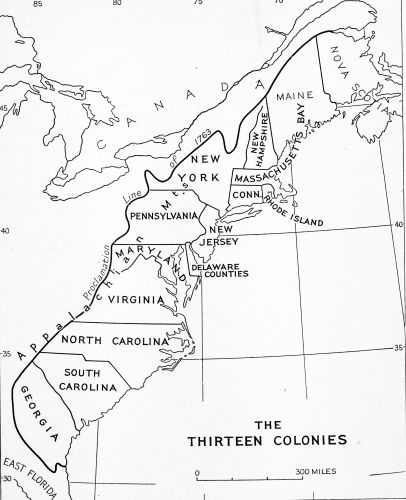
THE THIRTEEN COLONIES
The Georgians of the present day are descendants of the Oglethorpe colonists in only insignificant proportions. The Nordic settlers who came in through North Carolina, English from the tidewater region, and Ulster Scots from the Uplands, are the real founders of the State.
After the Revolution, Georgia benefited by the prevalent unrest and the tide of migration that flowed in all directions. It received settlers from all of the Southern States and some of the Northern ones, as well as new arrivals direct from Europe.
Kentucky for a generation prior to the Revolution had become known through hunters of game bringing back glowing accounts of the beauty and fertility of the level lands of central Kentucky. Access in the one case was down the Ohio River by boat, and in the other by a long and hazardous trip through the mountains, entering by the Cumberland Gap, the most practicable of several difficult passes. The danger from Indians was so great on the Ohio River that most of the invaders preferred those dangers of a different type to be encountered by the Cumberland Gap entry. It was the route which Daniel Boone, acting for a land company, had blazed: the narrow trail, six hundred miles long, that has become famous as the Wilderness Road.
By the time of the Revolution several hundred people were in Kentucky, and more were coming each year from the inland portion of Virginia, and, to a less extent, from Pennsylvania. During the Revolution the population rose and fell in accordance with local conditions on the frontier and the ravages of the Indians. With the end of the Revolution a great tide of immigration set in, composed in part of soldiers who were given land grants by the Virginia Government. With them was an element of Loyalists, as well as many families from Maryland, both seeking to get away from unpleasant associations in the East.
From 1780 onward the route down the Ohio began to be more used. The Indians were driven back or the boatmen learned how to cope with their ruses, and the annual migration began to be counted in thousands. In the year 1786 as many as 3000 went down the river, in 1788, 10,000, and in 1789, 20,000. Meanwhile, the immigration through the Cumberland Gap continued steadily. The growth of Kentucky was on a scale unparalleled in North America up to that time. Within a few decades from the day when the first cabins were erected in the region, a population of 70,000 people had entered the State, and it had half as many inhabitants as Massachusetts.
Compared with the Scotch tone of Tennessee, Kentucky was overwhelmingly English in aspect. Virginia was definitely its progenitor, a large part of its early population having come through the Shenandoah Valley. Next as feeders were Pennsylvania and North Carolina, while other regions contributed but small minorities, those from Maryland being probably the most numerous. The government of Virginia was seriously concerned by its losses of population from this cause. After the Revolution, officers who had served with the Virginia forces were compensated by allotments of land in the Kentucky region. The State attracted other settlers of a superior social and economic status. These gave a tone to its society and laid the foundation of a local aristocracy. Kentucky long remained distinctive because of its conspicuously English atmosphere and the social refinements which it showed in contrast to some of its neighbors. Kentucky remained part of Virginia until 1792 when it was admitted as a State.
Tennessee was, in fact, only the western part of North Carolina which originally stretched beyond the Appalachians as far as the Mississippi. The French had established a trading post on the site of Nashville as early as 1714. But the State was actually settled from the East rather than from the West, and, indeed, its western third was not settled until well into the nineteenth century. The first area of settlement was in the river valleys near the North Carolina border, and this remained the principal area during the period here considered. A second and less important point of growth was in the center of the State. In northeastern Tennessee the earlier settlements were from Virginia, and the settlers supposed that they were still within the limits of the Old Dominion.
The settlers from North Carolina soon began to push through the mountain passes and established the groupings that go in history by the name of the Holston and Watauga settlements. Many of the early settlers, of whom some hundreds were present before the Revolution, were, as noted, from the upland portion of Virginia, and were Presbyterians from Scotland, often by way of Ulster, while the principal early influx from North Carolina was connected with the uprising in the Piedmont section of that colony about 1770. An insurgent element known as the Regulators put itself in opposition to the royal governor, and, being beaten, fled over the mountains for safety. A large proportion of these were from Wake County. They brought in an element of Baptists contrasting with the Presbyterianism which, on the whole, characterized the State from the beginning and still does so owing to the predominance of the Scotch in its settlement.
While the eastern community was growing, settlement began in the central portion of the State in what is known as the Cumberland district. This was for years almost isolated from the neighboring settlement to the east, the center of which was Nashville, while the eastern settlement headed in Knoxville, which became the capital.
During the Revolution the settlement of this territory continued steadily until the State had 10,000 or 12,000 inhabitants. North Carolina made liberal allotments of Tennessee lands to its soldiers who had fought in the Revolution, and this continued the stream of immigration. By the time that President Washington was inaugurated the eastern section of the State had some 30,000 inhabitants, the Cumberland district about 7000, and both were growing steadily. Western Tennessee was still Indian territory.
The population of Tennessee in 1790 was typical of the upland population of the South in its racial make-up. It is definitely a mere extension of the western part of North Carolina, though its inhabitants were often born in Virginia, and to a less extent in other States, as was true of the inhabitants of North Carolina itself.
In the Mississippi Valley at this period there were a few settlements established under the French and Spanish regimes, which had attracted a miscellaneous crowd of adventurers and traders. Since this territory did not become part of the United States until the Louisiana Purchase of 1803, it will be dealt with more fully in the next section. In this period we are dealing with comparatively small numbers for this entire region.
Of nearly 4,000,000 people, both white and black, in the United States in 1790, at the time of the first census, 95 per cent were living east of the Appalachians.
In territories of the present United States other than the settlements already covered, there were three little islands of population. One lay along the Mississippi in southwest Illinois, a remnant of the old French settlements with some English and American additions. A second was around Vincennes, Indiana, with a population like that of the Illinois settlements but more strongly American. A third was in Ohio, where settlement was just beginning, the first serious colonization being that made in 1788 at Marietta by New Englanders.
Although the Revolution grew out of economic and political causes, it represents primarily one of those costly and unfortunate internecine wars in which the Nordics have been prone to indulge at intervals for two or three thousand years, and which have done so much to weaken them as a race.
Had there been no complications the effects of the Revolutionary War might have been less permanent. Winner and loser would have lived on terms of peace with each other, as they did in England after the Civil War and in the United States after the Rebellion. But the hard feeling that goes with any conflict was intensified by several factors. The Ulster Scots, in particular, had reason to feel themselves badly treated by England, and they carried into, and through, the Revolution, an unusual animosity. This feeling of resentment was shared and kept alive by many other Americans through the injudicious behavior in Canada of a number of the English governments after the Revolution.
The tradition of one hundred and fifty years of common action of the colonies and the mother country in opposing France was forgotten overnight and a sentimental attitude for which there was astonishingly little actual basis led to a glorification of France and everything French for a generation or more—an attitude that has not entirely disappeared to this day. The antagonism toward Great Britain was maintained for political reasons during the next century mostly by Irish agitators. This ill feeling prevented the close co-operation between the two greatest sections of the English-speaking races, which would have meant so much for world peace and harmony, and which would have laid the basis for a closer co-operation of all the nations of predominant Nordic stock, in the interest of the progressive evolution of mankind. A first object of statesmanship should now be to regain that solidarity of the Nordics, in the interests not merely of world progress, but of the very survival of civilization.
Denominational questions in the United States were scarcely an issue after the Revolution, for the bitter sectarian feeling that had existed earlier was rapidly disappearing, and the Roman Catholics had not yet been able to raise the issue of bigotry, for the country was overwhelmingly Protestant. Of approximately 4,000,000 persons in the United States in 1790, Catholic writers make varying claims running as high as 35,000 or 45,000 persons of their faith. Without stopping to inquire how many of those claimed for Rome were merely nominal adherents, and how many were Negroes, one may remark that at the most, about one American in each one hundred might have had some affiliation with the Roman Church. When the Catholic hierarchy was established for the first time in the United States by the appointment of the Jesuit John Carroll as bishop of Baltimore in 1789, he reported to his superiors that there were about 16,000 Catholics in Maryland, including children and Negroes; something over 7000 in Pennsylvania, some 3000 French around Detroit, and about 4000 scattered through the rest of the country. To this total of 30,000 might be added the unknown but small number of nominal Catholics on the frontier, in the Mississippi Valley, and in other regions where there were no priests to minister to them, and where their children, at least, were fairly sure to grow up outside the church. It is probably accurate to say that there never has been a nation which was so completely and definitely Protestant as well as Nordic as was the United States just after the American Revolution.
The total white population found in the United States by the first census (1790) was 3,172,444. To this should be added, for the present purpose, the population of parts of the continent that are now, but were not then, in the United States, that is Louisiana and Florida. The latter had but a few thousand inhabitants. The Louisiana Purchase territory may be credited with 36,000, of whom nearly one-half were Negroes. The French are estimated at about 12,000. Professor Hansen gives the figure of Whites only for the Louisiana Purchase area in 1790 as 20,000. The addition of Negroes would probably increase these population figures considerably. Texas may be allotted 5000 (Spanish) Whites, New Mexico and Arizona 15,000, and California 1000 at this period. But it will be shown later that the use of the word "White" in these Spanish-American lands is frequently largely a "courtesy title." Finally, the census enumerators did not reach the Old Northwest Territory, where there were already some 11,000 residents, about equally divided between American and French. The total white population of the territory now comprised in the continental United States may therefore be put at approximately 3,250,000 in 1790.
Disregarding the French and Spanish in the outlying regions, the only race, aside from the Nordic, that was important enough to be counted at this period was the Alpine, represented by the Germans. In Maine one in a hundred of the population might have been German, but in the other New England states the Alpines were negligible.[9] In the middle colonies they were an important element, perhaps one in every ten or twelve in such States as New York, New Jersey, and Maryland, and one-third of the whole population in Pennsylvania. Through the Southern States they formed perhaps one in twenty of the population, confined mainly to the upland regions and, having spread over from these uplands and from Pennsylvania into the west, they amounted to about one in seven in Kentucky and Tennessee.
Nine-tenths of the whole white population of 1790 was therefore Nordic in race, and ninety-nine hundredths of it Protestant in religion. It was all English-speaking, save for the little island of Pennsylvania Dutch, and for the French and Spanish on the frontiers. It was all living under a political and cultural tradition that was characteristically British.
At the time of the Revolution there were about 6,000,000 people in England and about half that number in the colonies.
The preceding pages have been devoted to describing the conditions in the English colonies at the end of the Colonial Period. Let us now consider the situation of the continent as a whole.
Never before in the history of the Nordic race had there been an event comparable in importance to this occupation of North America, north of the Rio Grande, by the English and Scotch. The Canadian French were too few to be a serious obstacle to the development of the country and, as will be seen in the following pages, the rest of Canada was in race, language, religion, and cultural traditions identical with the original British colonies.
Thus we have the most vigorous race in existence, with a few outside elements which were entirely in sympathy with the dominant type, in possession of the richest and most salubrious continent in the world. That this country was healthy and well fitted to breed a highly selected race is shown by the comparison of the fate of the colonists who went to the West Indies with those who went to New England.
These Puritan migrations were in their general nature identical, but the enervating climate of the Caribbean Sea proved fatal to the Nordics who went there, while the vigor of the New Englanders as a body was increased by the elimination of weaklings through a harsh but beneficent climate.
To appreciate how highly selected a race the Americans were at that time, one has only to consider the extraordinary group of men of talent and ability, some fifty-five in number, who represented the colonies at the Convention of 1787 at Philadelphia. Those men framed the Constitution of the United States, which after a hundred and fifty years of stress and strain still remains the model for such documents throughout the world.
Let the reader consider whether our 110,000,000 whites of today could produce the same number of men with corresponding ability and equally high motive, in spite of the fact that our population is more than thirty times as large as in 1787.
So we find in 1790 a practically empty continent, its eastern half buried under a mantle of forest, with a coast line broken by ports and short navigable rivers. Across low mountain ranges we first find a vast central valley traversed for hundreds of miles by wide rivers; then a belt of treeless plains covered with succulent buffalo grass; next a region long called the "Great American Desert"; then a range of mountains dimly known to the Colonials as the "Stony Mountains"; beyond them a great alkaline desert, next the Sierra range, and lastly the genial Pacific Coast. The western half of the continent abounded in mineral wealth, while in the central valley the virgin soil awaited the plow. These conditions had their counterpart in Canada. Wild game abounded, inviting the fur traders to explore the remoter places and enabling the settler to find ready food, while he built his log cabin and planted his crop.
Such was the continent and such the opportunity. In the following pages we shall see what has been done with these opportunities by the British race.
Before leaving the Colonial Period, it is well to call attention, once more, to the history of the frontier. For a hundred years and more the frontier was beset by savages often instigated by the French in Canada. The Indians killed and tortured the lonely settlers and burned their log cabins. This desultory warfare cost the English many hundreds, if not thousands of lives along the frontiers of New England as well as of Pennsylvania and Virginia.
The Indians found by English settlers on their arrival in America were probably, as to many of their tribes, the most formidable fighting men of any native race encountered by the Whites. Not only were they redoubtable warriors in their own surroundings, but they were beyond question the cruelest of mankind. The Assyrians, of all ancient peoples, were reputed to be the most fiendishly cruel, but bad as they were, they did not compare with the American Indian. The details of the torture of prisoners taken in open warfare are too revolting to describe. These tortures were carried out by the squaws while the bucks sat around and laughed at the agony of their victims. There is nothing like it in history in any part of the world and the result was that the aboriginal Indians were regarded as ravening wolves or worse and deprived of all sympathy, while the Whites stole their lands and killed their game. No one who knew the true nature of the Indian felt any regret that they were driven off their hunting grounds. This attitude was found wherever the Whites came in conflict with them and explains why they were scarcely regarded as human beings.
The effect of the existence of the Indians on the frontier was to slow down the advance westward of the settlements and to compel the backwoodsman to keep in touch with his countrymen in the rear. If there had been no hostile Indians, the settlers would have scattered widely and would have established independent communities, such as were attempted in Kentucky and Tennessee after the Revolution. In this respect the Indians were a benefit to the Whites.
At the close of the period ending in 1790, despite the loss of many valuable elements at the time of the Revolution, the American race was homogeneous and Scotch and English to the core. It was bursting the bonds of the old frontier and ready to pour a human deluge over the mountains and inundate the West.
FOOTNOTES:
VIII
THE OLD NORTHWEST TERRITORY
The second period to be dealt with covers the years from the first census, 1790, to the eve of the Civil War, 1860, and deals with the organization of our government and the extension of settlement westward to the Pacific. Free land and a very high birthrate among native Americans led to a great increase of the population, so that the white inhabitants of the United States, about three millions and a quarter in 1790, became twenty-seven millions and a half, in 1860, though immigration during the seventy-year period was not over four and a quarter million.
From 1790 to 1820, no official record of immigrant arrivals was kept. Thousands certainly arrived during those thirty years, but it seems probable that they were nearly all English and Scotch.
Just as the termination in 1790 of the preceding period was marked by a racial loss, caused by the expulsion of the Loyalists, so this later period was terminated by an internecine Civil War, costing the country three-fourths of a million Nordic lives, counting killed and died of wounds only. The descendants of those men who gave their lives for their country on both sides would have filled up the West, instead of its being largely populated by the immigrants we recklessly invited to our shores.
During the period referred to (1790-1860), there was, as said, no heavy immigration except from two sources, Ireland and Germany, and both of these occurred in the later portion of the period.
The displacement of agriculture by sheep in Scotland at the beginning of the nineteenth century dispossessed thousands of farmers who moved to America, sometimes with the active assistance of their landlords. The population of some districts, as Perthshire, Argyllshire, and Inverness-shire, fell sharply, because the people, no longer able to make a living, moved away. North America was the favorite destination.
Southern England experienced a similar movement. The price of agricultural products, which had been forced up during the Napoleonic wars, fell steadily for a long time. Farmers could not make a living. The counties of Kent, Hampshire, Somerset, and Surrey were the chief centers of emigration. These people also turned their faces toward North America.
Ireland, too, was in perpetual ferment and the emigration from that island was increased as the result of the abortive revolutionary attempts of the United Irishmen in 1798 and 1803. After the leader of the latter, Robert Emmet, was executed, his elder brother, Thomas A. Emmet, came to New York, practised law, and within a decade became the attorney-general of the state. The Emmets, like most others of these Irish refugees, were Protestants in religion.
Later, in 1845, the potato crop failed in Ireland, and soon after the starving peasantry, many of them from the lower types of western Ireland, swarmed over here. The women became domestic servants and the men day laborers, doing the heavy work of ditch digging and railroad building. They were Roman Catholic and that fact excited animosity in many sections of the country. They were not welcome in the West when they drifted there. It was not unusual to see on the frontier railroad stations and in advertisements in New York newspapers, "No Irish need apply." There was some violence and an American party was organized to check their entrance into local politics, for which they showed great aptitude.
Since then, these Irish have been forced upward in the social scale by later arriving immigrants over whom they had the advantage of speaking English. They became the nucleus in America of the present Roman Catholic Church, which has spread rapidly in this country. The Irish did not take to agriculture and have never shown much liking for the larger industries.
The total number of Irish immigrants during the forties and fifties amounted to more than a million and a half, and that first migration has been followed by a continuous stream of southern Irish down to the last few years when the quota restrictions went into effect.
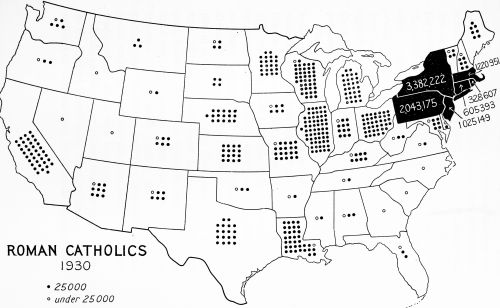
ROMAN CATHOLICS 1930
As soon as they secured a certain amount of wealth and rose in the social scale, they established schools and colleges of their own, the teachings and, indeed, the existence of which conflict with those of the public-school system of the United States, and to that extent they have impaired the unity of the nation. Some regiments of Irish fought on the Northern side in the Civil War, but the draft riots of New York were caused by the Irish who did not want to fight for the Union. In addition to the shanty Irish there came over some middle-class families of importance.
The second immigration of importance occurred a few years later when a large number of Germans were forced over here by the failure of the Revolution in Germany in 1848. These Germans were very different from those who migrated to Pennsylvania in the eighteenth century. Many of them were from northern Germany and were Nordics, including individuals of some culture and distinction. They settled in certain cities of the West, notably in Cincinnati, Milwaukee, and Saint Louis. For the most part, however, they took up public land and became hard-working farmers. They did not in the mass improve the population already here intellectually, racially, or physically, and they impaired our national unity, at least for the time being, by the introduction of their own language.
At the end of the period here considered there were in the United States more than one and a quarter millions of German-born, of whom about one-fourth were Roman Catholics. This church, which in 1790 controlled not one in a hundred of the population, could in 1860 count upon one in every nine of the Whites.
Outside of the Irish and Germans, who were preponderantly Nordic, there was not much immigration of importance. The census of 1860 enumerated 4,138,697 foreign-born persons out of a total of nearly 27,000,000 Whites. England, Scotland, and Canada accounted for most of those who were neither Irish nor German. Thus at the end of this period the racial unity of the United States was still virtually unimpaired.
The French in the old Northwest Territory were negligible in number, amounting to but a few thousands. The number of Mexicans in Texas, Arizona, and New Mexico when we took over those countries was but a few thousand more. These Mexicans considered themselves Spanish; but as a matter of fact, the veneer of religion, language, and culture was very thin, and racially most of them were at least seven-eighths Indian. The same condition prevailed in California in 1846; the number of Mexicans being even smaller than in Texas.
Many of the original Colonial charters granted by the English kings provided for a north and south boundary by latitude, but the western boundary was often defined as the "South Sea," and not unnaturally many of these boundaries overlapped. After the Revolution, the original colonies were induced to cede to the Federal Government their indefinite and conflicting claims to the western lands. This general and important cession of territory had two results: it gave the impoverished Federal Government lands which could be sold for its own benefit, and it led to the establishment of communities which looked to the Federal Government for everything they needed, which in itself was a long step toward unity of government.
In 1787 the western boundaries of New York and Pennsylvania were fixed as they are at present, and out of the country south of the Great Lakes, north of the Ohio River, and east of the Mississippi was erected the Northwest Territory under the special guardianship of the Federal Government.
This "Northwest Territory" had been seized during the Revolution by an extraordinary group of adventurers and frontiersmen under General George Rogers Clark. Thereby the Thirteen Colonies were in physical possession of these districts south of the Great Lakes when the Treaty of Paris was signed in 1783. Without such actual possession of the Old Northwest, it would have remained part of Canada, an outcome which would have limited the growth of the United States westward or, more probably, have led to another war. The reluctance of the British authorities in charge of the outposts in this territory to surrender their forts in accordance with the terms of the treaty, and their alleged backing of the Indians, were among the causes underlying the War of 1812.
As population increased, new States were created in succession out of this territory—Ohio (1803), Indiana (1816), Illinois (1818), Michigan (1837), and Wisconsin (1848).
Ohio's first straggling settlers had pushed northwesterly across the Ohio River during the Revolution, but the first real, permanent settlement was by the New England Company which established Marietta in 1788. This New England immigration, though soon swamped by that from other States, played an important part in the organization of the territory and in the shaping of its future policies.
Scarcely had the Massachusetts group, led by General Rufus Putnam, taken possession of its vast grant around Marietta, when a new group led by Judge J.C. Symmes of Kentucky occupied a grant of a million acres between the Great and Little Miami Rivers, including the sites of Cincinnati, Dayton, and many of the most important of the early settlements of the territory.
Virginia had reserved a military district of more than four million acres to reward its soldiers of the Revolution, and this quickly began to be settled largely by veterans from Kentucky which was at that time, it will be remembered, still a part of Virginia.
Connecticut on the other hand had stipulated for its own Western Reserve of nearly 3,000,000 acres, extending in an oblong, 120 miles, from the boundary of Pennsylvania along Lake Erie, and the settlement of Cleveland marked its nucleus.
Thus Ohio, within a few years after the Revolution, started with four different growing points. The Virginia element increased the most rapidly, partly because of its proximity to Kentucky, partly because of its easy access by the Ohio River, so that the English and Ulster Scots of the southern part of the State soon dominated the whole.
A similar element was continually coming across the Pennsylvania border from the Monongahela country, and before long the Pennsylvania emigration to Ohio became the greatest from any one State, filling up the central part which comprised the great wheat belt. Even as late as the Mexican War, one-fourth of the members of the Ohio Legislature were natives of Pennsylvania, exceeding the members born in any other State, or in all the New England States combined, or in Ohio itself.
Through Kentucky came not merely Virginians but a steady stream of Ulster Scots from North Carolina, many of whom, however, had previously been Virginians. The southern parts of the State, therefore, took on some of the complexion of the slave-holding States, while the northern part was tinged by the culture of New England and the Central States, many coming in from western New York, which from the present point of view is to be regarded as merely an extension of New England.
Thus for a score of years the population of the States to the south and east of Ohio, which, dammed back by hostile Indians, had been ready to overflow for some time, poured into the new territory. Then the flood slackened until after the close of the War of 1812, when it was renewed with vigor. Men from all parts of the United States who had served with the western and northern forces in the War of 1812 had seen the beauties of the new country and determined to settle there as soon as peace was declared and they could dispose of their holdings at home. So far as New England was concerned this tendency was accentuated by two remarkably cold winters in 1816 and 1817, which surpassed the memories of the oldest inhabitants. General economic and social conditions were favorable for a widespread movement of population. The northwestern part of Ohio had been cleared of Indians and was then thrown open to settlement.
This second great flood of immigration into Ohio was in general of the same character as the first, bringing into the State from all sides an almost purely Nordic population of British ancestry, except for the small element of Pennsylvania Dutch who for a while kept much to themselves, maintained their own customs and their own language, and thus cut themselves off largely from the march of progress. Their Alemannish dialect was rapidly becoming almost as far out of line with the literary language of Germany as it was with the English language of their adopted home.
Later Ohio received a quarter of a million of German and Irish immigrants. But of the 2,339,511 inhabitants whom the State contained in 1860, a million and a half were born in the State itself.
Indiana, a typical American State, owes nothing worth mentioning to the original French population. In early days it must be considered little more than an extension of Kentucky. Virginia had set aside a large tract for rewarding the men of George Rogers Clark's expedition and these were the original land agents, so to speak, for the territory. But all along the border a frontier population drifted there across the Ohio River. As late as 1850 there were twice as many Southern people in Indiana as there were from the Middle States and New England put together. A good share of these were from Kentucky, which means that they or their parents were previously from Virginia or North Carolina.
That Indiana was in sympathy a Northern State bears testimony to the fact that these migrants had little in common except original racial stock with the older slave-holding population. The Ulster Scots were the largest element, although there were also many Quakers from North and South Carolina, some of whom were of Huguenot descent. It was this element which made of Indiana a principal route of the "Underground Railroad," as the system of smuggling runaway slaves out of the slave States was called. But in the southern part of the State there was much sympathy with the slaveholders.
The settlement of Indiana falls almost entirely in the nineteenth century, the number of people there prior to 1800 being negligible and confined for the most part to lands under the protection of the little post of Vincennes. On the northerly side of the Ohio River, at the Falls, the settlement of the tract of 149,000 acres, which Virginia had conveyed in 1786 to General Clark and his soldiers, was well under way.
The rapid settlement of Indiana was a part of the great westward movement beginning with the panic of 1819, and the hard times that followed. The price of cotton was steadily declining in the South and it was easy for the poorer farmer heavily in debt to sell out or simply pack up and quit, moving on to free and richer land in a new country. Many of the Ulster Scots in the South were hostile to slavery, while others of them, strongly Jacksonian in politics, were opposed to nullification and shared the reputed death-bed regret of the hero of New Orleans that he had not hanged John C. Calhoun. South Carolina therefore sent a large contingent of Ulster Scots to the new territory, in addition to the general immigration which has already been mentioned.
The Southern stream was met in the old Northwest Territory by the stream of New Englanders coming over the line of the Erie Canal after crossing the Hudson at the great break in the highlands near Albany. Many of the settlers of northern Indiana had tarried for a season in Ohio and moved westward as they had a chance to harvest the unearned increment by selling their farms at a profit and migrating to take up cheaper land and start again.
Indiana missed the main flood of foreign immigration in the generation before the Civil War. The Germans were going elsewhere because of clannishness, while the Irish avoided Indiana because of its lack of great cities. By the time the Scandinavian flood began to come in, land values in Indiana were already high and the new settlers went farther west and north.
Indiana, therefore, of the States in the Northwest Territory is the most nearly Nordic in population and the most nearly American, and, at the end of the period under consideration, it represented an overwhelmingly native-born population originating, in not very unequal parts, from the Northern and Southern States, respectively. Though the foreign element was rapidly gaining ground, it had not begun to make itself felt even as late as 1833 when northern Indiana was a wilderness, while southern Indiana was already well peopled from Kentucky, Tennessee and the Carolinas.
The development of internal improvements together with the general migration from Northern States to all points west brought a complete change in the political complexion of the State. In 1836, alone, land sales in Indiana amounted to 3,000,000 acres and in the decade from 1840 to 1850 the population of counties bordering the new Ohio canal increased 400 per cent, while the State began to look to New York as an outlet for its products rather than to New Orleans.
From 1820, the date of the founding of Indianapolis, to 1860, Indiana had twice quadrupled her population and from almost purely American stock. During these forty years, it is calculated that a million people came to the Northwest from the slave States of the South. At the outbreak of the Civil War, Indiana had a population of 1,350,000 of which only about one in eleven was foreign-born. More than half of the aliens were from Germany, and Indiana seems to have attracted particularly the Nordic element, since Prussia contributed the largest quota. Ireland was represented by only 24,000 persons at that time and like the smaller French and English groups, they were scattered through the State and soon became lost in the general mass.
This distinctive character of Indiana, almost purely American, Protestant, and Nordic in 1860, gives the key to much of its history since then. As elsewhere the immediate surrounding States had contributed the bulk of the population. The census returns showed that the ten States constituting the birthplace of the largest number of Hoosiers in that year were, in order of importance: Ohio, Kentucky, Pennsylvania, Virginia, New York, North Carolina, Tennessee, Maryland, New Jersey, and Illinois. So far as the New England element was represented, it had come almost wholly through other States.
Illinois, like Ohio, had attracted a few settlers before the Revolution, mainly to the neighborhood of the half-dozen little French trading posts. The French population of this district had never been large, and when it was taken over by Great Britain in 1763, most of the French inhabitants who could get away hastened to do so, either returning to Canada or going down the river to Saint Louis or New Orleans.
With the withdrawal of the little French garrisons only a few hundred persons of French ancestry were left in the territory. These were of two different origins. Part had come down from Canada and represented the "Habitant" French, who were largely Alpine. The remainder had come up the river from New Orleans and represented a more heterogeneous and probably inferior group. Some of the Canadians brought their families; but for the most part the French element was made up of single men who formed loose alliances with Indian squaws. For these various reasons the French influence on the subsequent population of the region is too negligible to justify consideration.
The raid made by the Kentuckians under George Rogers Clark during the Revolution had given the Americans a more detailed knowledge of this region, and by 1800 several thousand of them had already drifted across the border and started settlements. This immigration increased up to the outbreak of Indian hostilities in 1811 followed by the War of 1812 which almost completely checked settlement along the old western frontier.
After the declaration of peace and the opening up of land sales in 1814 and 1816, Illinois began to have a real boom. By this time the choicest locations in Ohio, Indiana, and Kentucky had either been taken by settlers or bought by speculators, so that the new arrival looking for a bonanza turned to Illinois or Missouri.
Following the general rule of migration in the United States, which was not broken until the gold rush to California in 1849 introduced new conditions, the settlement of Illinois was mostly from the States closest to it, and at the beginning was almost wholly from the South, particularly from Kentucky, Tennessee, and Virginia. Insignificant little Shawneetown, on the Ohio River just below the mouth of the Wabash, gave easy access to the lower end of Illinois—that "Egypt" which is still a Southern Democratic stronghold. For a short time it was even the seat of government.
In this population the presence of a sprinkling of Northerners from Pennsylvania was resented and an occasional stray Yankee was scarcely tolerated. The settlement of the northern part of the State by New Englanders was made to a marked extent by colonies or organized groups, and from the early thirties one reads continually of the movement of caravans from all the New England States and western New York. Here again the opening of the Erie Canal gave easy access to northern Illinois by water. Prior to that time the lead mines in the northwestern part of Illinois and the southwestern part of Wisconsin had been the main attraction, and had been developed almost entirely by the Southerners.
In general, it may be said that up to that time three-fourths of the population of Illinois came from south of the Mason and Dixon line, with Kentucky making the largest single contribution, although a small foreign element was already arriving, mainly from the British Isles.
At the date of Statehood in 1818, Illinois may be said to have been dominated by the Ulster Scots who had come in from the southern Piedmont. These represented, on the whole, a class which for lack of wealth and other reasons had not been slaveholders, and had no particular sympathy with slavery, having found by personal experience that the presence of slave labor was disadvantageous to a large part of the white population. As a matter of fact, probably not more than one Southern family in four ever owned a slave.
The population required of a new State for admission to the Union in 1818 was 40,000. By the beginning of the Civil War the population of Illinois had increased to a million and three quarters. Obviously this change in little more than a generation represented only in small part the natural increase of the original settlers from Kentucky and Virginia. So rapidly, indeed, did the forces of progress act in Illinois that many of the old-timers packed up and moved on, as had happened during the previous generation among their parents, and Illinois in the following generation will be found strongly represented in the early migration to California, Kansas, Nebraska, and Colorado. To show how little slave-holding sentiment there was in the early Illinois population, in spite of its Southern origin, it is interesting to note that most of the Illinois contingent in Kansas were Free-State men whom the South regarded as enemies to its cause.
For every one of the old-timers who moved farther west, a dozen Yankees arrived along with many Pennsylvanians, while the Southern immigration almost entirely stopped, having been diverted to Texas or to territories beyond the Mississippi.
The people who left the slave-holding States in the decade prior to the Civil War were largely seeking free soil themselves. This movement of some of the best Nordic stock out of the South just before and at the beginning of the Civil War has not been given as much importance as it deserves. It was a factor in the weakening of the South and the strengthening of the North. While slavery was a curse in the opinion of many an owner of a great plantation, he was caught in the system and felt that he could not get away. The poor man, on the other hand, found conditions less and less to his liking and many of the more intelligent decided to get out of a country where they were obliged to compete with Negro slaves and were looked down upon by their white neighbors. In this way the lands along the Illinois Central Railway became a lode-stone for ambitious and dissatisfied farmers from Tennessee, Alabama, and even from Georgia. With the outbreak of hostilities this trickle became temporarily a torrent as political refugees who did not care to remain in a slave-holding republic at war with the American Union began to seek freer air.
The railroads developed a new specialty in transporting whole families with their furniture and agricultural implements to points in Illinois, Iowa, and Wisconsin, while steamers made their way up the Mississippi crowded with refugees and great numbers of Missourians crossed the river to Illinois with all their worldly goods. Many of the latter returned home after Missouri was cleared of secession, but their place was taken by new streams of Southerners released by the victories of Union armies and coming to join friends and relatives in southern and central Illinois.
The decline of leadership in the South after the war was not due entirely to the loss of its men on the battle-field. Although this was by far the principal factor, another important one was the flight from the South of many of those who were not in sympathy with the fire-eating politicians who had forced secession upon often unwilling communities.
Before this time, however, the streams of foreign-born which poured into the Mississippi Valley had already begun to influence the composition of the population of Illinois, so that even in 1850 one in four was of alien birth. The largest element was German, who formed farming communities, mainly in the northern and central part of the State. By 1860 there were 130,000 of them in Illinois, together with others who had also come from Pennsylvania.
Ireland sent the group of second importance, and the great internal improvements in this period were largely the product of their labor. As elsewhere the Irish showed little inclination for farming, which had proved so ruinous to them in Ireland, and they made a restless floating population in the large cities. In 1860 they represented four times as large a proportion of the population of Chicago as they did of the State as a whole.
The State attracted a large English immigration. The Illinois Central Railroad had been built to a considerable extent with English capital, and the stockholders saw a chance to increase the value of their shares by promoting emigration to the lands owned by the company, so that by 1860 there were 41,000 English-born in the State.
Another large element of English descent, which had come into the State in an extraordinary way, had already left. This was the group of Mormon converts who were brought over from 1840 onward. By 1844 it was estimated that of the 16,000 Mormon arrivals, 10,000 were English. Most of these went west to Utah later, or were scattered within a few years.
The last important Nordic element in the State was that of the Scandinavians who had only begun to come before the Civil War, at which time there were little more than 10,000 of them in the State as against 87,000 Irish.
Michigan, owing to its proximity to Canada, and the importance of Detroit as a headquarters, had a distinct French atmosphere in its early days. Unlike those in some of the more distant settlements, the French inhabitants at Detroit did not intermarry frequently with the Indians, and they represent therefore a relatively pure French Canadian stock. American immigration was slow, and not until 1805 did the inhabitants become numerous enough to warrant a separate territory. As late as the beginning of the War of 1812 four-fifths of the 5000 people in Michigan were French. In 1817 the first steamboat appeared on the waters of Lake Erie and the Erie Canal was begun, and from that time the Americanization of the territory was rapid.
By 1830 a hundred ships, both steam and sail, were on the Lakes, and a daily line ran between Buffalo and Detroit. In 1836 when the State Constitution was adopted the population was nearly 100,000, mainly from New England and its extension in western New York. The Empire State can very definitely be called the parent of Michigan.
Many of the New England farmers who had bought farms from the great land companies in western New York found themselves unable or unwilling to complete their payments and sold their equities for enough to buy government land in Michigan and move their families, while from the rocky hills of Vermont a steady stream came without any intervening stop. By this time many of the French Canadians had moved out, and of eighty-nine names signed to the Constitution of 1835, not more than three can be identified as French.
The tide of alien immigration at this period was late in reaching Michigan. A group not found elsewhere was that of Dutchmen who came like some of the earlier settlers, seeking religious tolerance and freedom. The town of Holland has been a centre for them since 1847. Of the 749,113 inhabitants of the State in 1860, one-fifth were foreign-born, divided not unequally between English, Irish, Germans, and mixed Canadians.
Wisconsin's first settlement was at the lead mines of the southwestern part and attracted largely Ulster Scots from Virginia, Kentucky, and Tennessee. A little later these were reinforced by another Nordic group of Englishmen from Cornwall who formed an important element in that region.
The second migration scattered agricultural communities throughout the southeastern part of Wisconsin along the lake shore. This immigration was almost wholly from the New England States and the New England part of New York State, and was accomplished roughly in the years 1835 to 1850. By 1847 when Statehood was achieved the territory had a population of nearly 250,000 and was virtually a New England colony.
Of the seventy-six men who composed the second Constitutional Convention, one-third came from New York, one-third from New England, and the rest were a scattering.
During the decade which ended with the Federal Census of 1850, the growth of the State had been nearly 900 per cent, a record rarely exceeded in America. This extraordinary surge was due largely to the sudden arrival of a foreign element which has ever since made Wisconsin a State apart from all the others. Even as early as 1850 one-third of the population was actually foreign-born. Of the foreign-born who came to the State during the territorial period, the British Isles contributed about one-half and foreign-language groups the other half. The English-speaking immigrants soon blended with the native population, with the exception of the Roman Catholic Irish who were less easily assimilated. In the decade before the Civil War there was a stream of Belgian immigrants amounting to at least 15,000. Some hundreds of Russians also came in and the Scandinavians had begun to arrive, although they did not play an important part until after the Civil War. Danes and Norwegians were beginning to come in some numbers but few Swedes as yet.
The great immigration of this period was the German, which introduced another partly Alpine element into the overwhelmingly Nordic population of the United States. These had begun to come after 1830, when the Revolution in France had stirred up similar, but less successful, political upheavals in the parts of South Germany adjoining France. Many of the politically discontented decided to leave the country or were obliged to do so, and they found in Wisconsin conditions particularly to their liking. In the first place the State offered a variety of climate and soil that was not dissimilar to that in which they were brought up. In the second place land was cheap and good and there was much forest land for which the Germans showed a notable preference. Not only was the possession of timber an asset, but it was to the German immigrant a mark of social status. Forests had largely disappeared in Germany, except on the great estates of the nobility. Hence, to own a piece of forest land was a mark of superiority. Only the few could afford the forest land in Germany but in Wisconsin every small farmer could feel himself as good as the Duke or Prince whose yoke he had renounced. A third important attraction after Statehood was a provision that the alien could vote after only one year's residence. This gave the Germans a political importance without delay which they lost no time in using.
German settlement in the United States follows a belt beginning with Pennsylvania and running due west through Ohio, Indiana, Wisconsin, Iowa, and Missouri. This was partly due to an avoidance of the Southern States with whose products they were not familiar and with whose land system and slave labor they were not sympathetic. Being in this belt Wisconsin immediately took and retained such a prominence that patriots from the "Fatherland" seriously urged that it become a genuine German colony.
The Pennsylvania Dutch had already shown how little disposed the German-speaking peoples were to become citizens of a new country with a whole heart, and the new tide of immigration followed this example. They attacked the public-school system from the beginning and insisted on having their own schools and on having their children taught German in the American schools. They kept their own social organization and even went so far as to get the State laws published in the German language in Indiana in 1858. This tendency toward hyphenation has made the Germans a less valuable element in the American population up to the present time than they should have been.
The early German immigration to Wisconsin was on the whole from southern and central Germany, and was pre-dominantly Alpine in race and Roman Catholic in religion. Statehood in Wisconsin coincided with the unsuccessful Revolution of 1848 in Germany which started the real flood of German immigration that reached its maximum numbers in 1854, and continued with noticeable strength for more than a generation longer.
The principal Nordic emigration in the '40s was from Pomerania and Brandenburg, and many of the South Germans, while largely Alpine, were Protestants rather than Catholics. In 1863, just after the end of the period here considered, the church authorities reported that Wisconsin contained 225,000 German Lutherans as against 105,000 German Catholics. After that the Germans pressed more and more into the northern and central regions of the State.
Wisconsin then at the end of the period here considered (1860) had probably the largest non-Nordic population of any of the American States, although even here the Nordics were in a great majority. With one-third of its population foreign-born, it was surpassed in this respect only by California.
IX
THE MOUNTAINEERS CONQUER THE SOUTHWEST
Meanwhile the States of the lower Mississippi Valley were coming into existence at a rapid rate.
Alabama had no American settlement until after the Revolution, save for the sporadic appearance of adventurers or traders. But in 1798, when the Mississippi territory was formed, including the present State of Alabama, there was already a movement of settlers from the adjoining States on the east and north, and this continued rapidly until checked by the war with the Creek Indians in 1813 and 1814. This war advertised the territory. Its termination threw the land open to settlement, and more than 100,000 people located in Alabama within five years. The slight French and Spanish element in Mobile and two or three other places was soon reduced to insignificant proportions.
The State was settled either by those who came down some of the rivers of that region, particularly from Tennessee, or by those who came through Georgia, stopping long enough at the land office in Milledgeville (then the State capital) to make the necessary arrangements for acquiring title to real estate. An unimproved but passable trail ran thence through Montgomery to Natchez, and over this "Three Notch Road" (so-called from the blaze which marked it) a stream of settlers from the Atlantic seaboard States passed into the broad belt of rich blackland which quickly made Alabama and Mississippi the heart of the Cotton Kingdom. Alabama is, for the most part, the offspring of Virginia, North and South Carolina, Georgia, and Tennessee, and therefore represents almost entirely Scotch and English blood. Its foreign-born population was negligible in 1860, amounting to little more than 12,000, almost half of whom were Irish, in a total of virtually a million.
Mississippi: As in most others of this group of States, the supposed influence of the earlier French and Spanish settlements is more sentimental than real. American settlers began to filter in after 1763, some coming even from New Jersey, Pennsylvania, and New England. A few Loyalists drifted down to the Mississippi country during the Revolution, joining the British who were attached to the district at that time in military or administrative capacities. One of the elements of this Loyalist immigration consisted of Scotch Highlanders from North Carolina.
The census of 1850 furnished the first opportunity to ascertain the origin of the population. The main immigration naturally was from other Southern States which contributed 145,000 against 5000 from the Northern States. In the same year 18,000 natives of Mississippi were residing in other Southern States, principally in Louisiana, Texas, Arkansas, Alabama, and Tennessee.
At the census ten years later the Mississippi natives, then located in other Southern States, had almost doubled in number. The enumeration gives an interesting picture of the way in which population was flowing backward and forward between adjoining States at that time as it has in almost every other period in American history.
Since the population of Mississippi before the Civil War was almost identical in composition with the population of the other Mississippi Valley slave States, most of which owed their inhabitants originally to Virginia and subsequently to the States which Virginia had colonized, it was not surprising that these people found it easy to move from one part of this region to another. Of nearly 800,000 population at the outbreak of the Civil War, the foreign-born, still mainly Irish, constituted only one in a hundred. But nearly half of the population of the State was colored, and thus no element of racial strength. In this respect Mississippi's record was surpassed only by Georgia and South Carolina. This latter State was the only one in which Negroes actually outnumbered Whites at that time. Other Southern States later reached the same unenviable situation, and it continued in South Carolina until after the shift of Negro population which followed the World War.
Louisiana at the time of the Purchase in 1803 presented among its 50,000 residents a more varied group than could be found in any other American State. The foundation of this population was French, the Spanish element never having been important. These French seem to have represented a much more heterogeneous lot than did the early French-Canadians. One colonization scheme after another had been launched in Paris, and settlers had been recruited by all sorts of means, many of them of more than doubtful merit.
Here, however, as in other colonies, it must be remembered that the final population represented not those who arrived, but those who both survived and left posterity. This fact has too often been disregarded in the accounts of the origins of the American population. If France shipped prostitutes to New Orleans to provide wives for its soldiers, nevertheless this is now of importance only in so far as such persons left descendants. In one case, of which the details exist, forty-four girls were sent out from France in 1722. They all married, but only one left offspring.
Another element in the population was the Acadian refugees, who, uprooted by the New England militia in 1758, were driven to almost every part of the colonies. Some made their way to Louisiana, as Longfellow has described, though drawing a very erroneous picture, in Evangeline. Others were scattered through Maryland, Virginia, and the Carolinas, in fact on almost every part of the Atlantic coast. The total number of persons expelled from Nova Scotia at this time probably did not exceed 6000, and many of these certainly died from hardships. In any case only a minority was directed to Louisiana, so that the original settlement of Acadians must represent a very small part of the population. The so-called "Cajan" population of some of the southern parishes of Louisiana is, at the present time, largely of other origins, chiefly Negro.
Another group of French refugees came from Haiti by way of Cuba after 1800, when the Negro uprising there drove out the Whites. Many of these were persons of good quality but as many as could do so went elsewhere after peace returned.
Still another source of population was the notorious Mississippi Bubble sponsored by the Scotchman John Law about 1717. This was the period at which the Germans from the Palatine and adjacent regions were emigrating in large numbers, as has been previously set forth in detail, and 10,000 or more of them were persuaded to go to Louisiana. According to accepted accounts, not more than 2000 of these Alpines actually arrived, and when the bubble burst, they settled along the Mississippi above Baton Rouge in a region which is still known as the German Coast.
An ill-natured English traveller, John Davis, visiting Louisiana in the year before the Purchase of 1803, has left the following picture of these two elements as they appeared to him:
"The Acadians are the descendants of French colonists, transported from the province of Nova Scotia. The character of their fore-fathers is strongly marked in them; they are rude and sluggish, without ambition, living miserable on their sorry plantations, where they cultivate Indian corn, raise pigs, and get children. Around their houses one sees nothing but hogs, and before their doors great rustic boys, and big strapping girls, stiff as bars of iron, gaping for want of thought, or something to do, at the stranger who is passing.
"The Germans are somewhat numerous, and are easy to be distinguished by their accent, fair and fresh complexion, their inhospitality, brutal manners and proneness to intoxication. They are, however, industrious and frugal."
A small Spanish settlement, New Iberia, was made in 1779 of colonists largely from Andalusia and the Canary Islands. At least the former element doubtless contained Moorish blood.
Finally, there was an immigration from the American colonies which had been coming in for a generation previous to the Purchase. One of the first groups was from North Carolina. From time to time other small bodies of settlers crossed the mountains to the Tennessee River, where they constructed flat boats and floated down to the Ohio and thence to the Mississippi. A few years later a group of Scotch Highlanders from North Carolina arrived, settling near Natchez. The early American immigration to Louisiana came on the whole from the upland parts of the Southern States, and was therefore Scotch and English. After the Purchase a similar immigration increased greatly in numbers.
The census of 1860, which credited the State with 708,002 people, revealed that only 81,000 of these were foreign-born, the Germans and Irish being in about equal numbers. Nearly all of the remainder who were not natives of the State were born in adjacent States of the Mississippi Valley, the Whites being made up in about equal proportions of native-born and those born in nearby States. The former contained much of the old French and mixed stock; the latter was almost entirely of British antecedents.
Arkansas, at the time of the Louisiana Purchase, did not contain 500 white people. The current of immigration down the Mississippi had gone past the Post at the mouth of the Arkansas River without taking the trouble to turn aside. Settlement can scarcely be said to have begun before 1807, and at the census three years later there were only 1000 people in the territory.
It was not until after the passage by Congress in 1818 of the Land Act that the pioneers, each carrying in a leather wallet a certificate which entitled him to a homestead, began to work their boats up the current of the Arkansas River. There was a steady though not rapid arrival of settlers from Virginia, the Carolinas, Kentucky, and particularly Tennessee—which has often been regarded as the original parent of Arkansas.
Attempts have been made to trace a line of migration from the first settlement in North Carolina, the undesirable character of which was mentioned earlier, through Tennessee and down into Arkansas, and to attribute to this element of the population the backwardness of some parts of the last-named State. A few settlers came from Georgia or Alabama up the Mississippi River but this involved a long struggle with a strong current and it was easier for them to settle in the blacklands of Mississippi or Louisiana.
There were about 14,000 persons in Arkansas in 1817 when it was created a Territory. Thereafter it made a steady growth, derived generally from all the Southern States of the Mississippi Valley, until nearly the time of the Civil War when Indiana and Kentucky began to contribute some settlers. Its population therefore was in general made up almost wholly of British stock. Its 1860 population of 435,350 was one-fourth black, the Whites being almost wholly native-born, a thousand Germans and a thousand Irish being lost in the mass.
Missouri must be considered from a double point of view. As a French outpost, St. Louis had become the refuge of much of the French population of the whole Northwest Territory when that passed under English control, and for many years the city remained a foreign settlement. Scattered settlers began to occupy the river banks after or even during the Revolution. In the westward march of population down the eastern slope of the Mississippi Valley small groups soon began to enter Missouri, until at the census of 1810, they amounted to 20,000 persons occupying a strip of land along the Mississippi with a small isolated settlement at the lead mines.
On the other hand, as a territory where slavery was permitted, Missouri naturally attracted emigrants from Virginia and North Carolina, Kentucky and Tennessee. Within ten years after the Louisiana Purchase it was estimated that four-fifths of the people in Missouri were Americans and they were rapidly moving from the river back into the interior.
The Missouri River was naturally an avenue of access for these people. The interior of the State soon began to have the collective name of "Boone's Lick" because the Boones had made salt in that district in 1807. A real rush into this region began about 1817, and Kentucky showed its loyalty to its adopted son (who it will be remembered was a Pennsylvanian by birth) by contributing 90 per cent of the immigration. The State has been called the daughter of Kentucky and within limits this is not inappropriate. Tennessee, however, was strongly represented. The whole population was in general of the upland element originally from Virginia and North Carolina, largely Ulster Scotch in its more remote origin.
By 1830 the movement of population had reached the western border of the State. Until this time the settlement was purely British in character save for the now negligible remnant of French on the Mississippi. Missouri then began to get a part of the immigration of German Alpines which makes Saint Louis still one of the American cities with a most marked German tinge. At the same time some of the old American stock who objected to slavery and its influences were passing north and west of Missouri into Iowa, Kansas, and Nebraska. On the whole, however, at the close of this period Missouri remained a Nordic community mostly of Virginian stock going back eventually to Great Britain. Its population of well over a million was nine-tenths white and eight-tenths American-born, the Germans outnumbering the Irish two to one among the foreigners. Kentucky had been by far the largest contributor, Tennessee came next, followed by Virginia, while Ohio, Illinois, and Indiana together accounted for only about as many as Kentucky alone, that is, 100,000.
This Missouri population, with its Ulster Scotch tinge, played an important part in the settlement of the trans-Missouri West. It contributed a large percentage of the plainsmen and mountain men of later date, as well as of the cowboys on the cattle ranges, to say nothing of the gun-men and bad men of the frontier.
Florida missed the establishment of one of the earliest and what might have been one of the greatest of Nordic colonies in North America when Coligny's settlement of Huguenots was massacred by the Spanish on September 20, 1565. The latter made no effective use of the territory which was looked upon by the government of Mexico probably in about the same light as the Virgin Islands are now looked upon by the government in Washington. In 1763 Spain ceded Florida to England in return for Havana, which had been captured during the Seven Years' War.
A second Nordic invasion of Florida occurred at the time of the American Revolution when the English Loyalists from the Southern colonies sought refuge there to the number of more than 13,000. If these had remained as permanent settlers the State would have benefited immensely, but most of them left in 1784, when the Spaniards reoccupied the territory and abolished religious freedom. Some went to England and others to the West Indies or Nova Scotia. The development of the peninsula was thereby long delayed.
East and West Florida became part of the United States in 1819. A Florida colonization scheme, of little importance numerically, deserves mention in passing because it represented the first real establishment in American territory of the Mediterranean peoples who have formed such an important element in the immigration of the last half-century. This was a colony established by British promoters to which they brought 1,500 Greeks, Italians, and Minorcans about 1767. Sickness soon greatly reduced their numbers, but a few of the descendants of these people are in the State at the present time.
As late as the Civil War, Florida was one of the weakest of the American States, with but 140,000 population, of which well over a third was colored. Nearly all of the Whites represented a southward thrust of the Atlantic seaboard states, from or through Georgia. Foreigners were a scattered lot, constituting but one in twenty-five of the white population.
X
FROM THE MISSISSIPPI TO THE OREGON
After the Old Northwest Territory was filled up, it began to overflow into the territories across the Mississippi which the Louisiana Purchase had provided.
Minnesota's early settlers were French and half-breeds, who came over the border from Canada, together with a small number of Scots escaping from the breakup of the Red River Colony in Manitoba in the first quarter of the last century. This Red River is, of course, the Red River of the North which forms the present boundary between Minnesota and the Dakotas.
Beginning in 1837 treaties were made with the Indians which gradually opened up the land to settlement; but in 1849, when a territorial organization was effected and the first official census taken, there were less than 5000 persons in the region.
Meanwhile the flood of immigration was reaching the nearby States, and Wisconsin and Iowa were growing with tremendous spurts. The tide soon began to flow up to Minnesota, coming by four principal routes. Some of the invaders came from Milwaukee across Wisconsin by land. Others from Chicago by land through northern Illinois and southwestern Wisconsin. Still others from Chicago to Galena, embarking there on the river steamers. Another group embarked at Saint Louis and came 800 miles up the Mississippi to Fort Snelling, the nucleus around which the Twin Cities began to develop.
When the Rock Island and Pacific Railway was built through to the Mississippi in the early summer of 1854, the gateways really opened. The next season saw 50,000 persons in the territory of Minnesota. That number was doubled in 1856. In 1854 the sales of public land had amounted to 300,000 acres, in 1856 to 2,300,000. Most of this population, which evidently came to stay, was from the Middle States. The States of the Old Northwest and New England were not far behind, but little of the Southern emigration came this far north. The years 1855, 1856, and 1857 marked the high tide of the flood of immigration of territorial days which has not since been duplicated.
The Scandinavian immigration, which has colored Minnesota so strongly, began in this decade, and brought a steady stream of hardy Nordics who avoided the cities, their objective being to acquire land, establish a home, develop a farm, and become American citizens. A substantial part of the German migration also reached Minnesota, so that in the census of 1860 one-third of the foreign-born population was German. By this time the Canadian elements had been completely swamped. The Federal Census of 1860, three years after the territory had been admitted to Statehood, found 170,000 inhabitants, of whom 58,000 were foreign-born. The Germans at this time still somewhat exceeded the Scandinavians in number. The native-born were overwhelmingly of British ancestry and represented a prolongation of the westward movement of population from New England that had been going on for more than two centuries. Minnesota at this time had a Nordic population and was pre-dominantly Anglo-Saxon in character.
Dakota was included in Minnesota in 1860 when a few settlers had already begun to enter the region. Dakota Territory, however, scarcely deserves consideration until the final period is herein reviewed.
Iowa had no real settlement until the spring of 1833, when several companies of Americans from Illinois and elsewhere settled in the vicinity of Burlington, although John Dubuque established a settlement in 1788 on the site of the city which now bears his name, and, with his descendants, carried on a business of mining lead and trading with the Indians for a generation or more. Settlements then began to be made at other points along the Mississippi, and in 1838 the country was cut off from Wisconsin and established as a separate territory.
As in the States of the Old Northwest Territory, the early population of Iowa was made up principally from the Southern States; and when Dubuque was formally declared to be a town in 1834 its 500 citizens were mostly from Tennessee, Kentucky, and North Carolina.
The delay in the settlement of Iowa, as compared with that of the States east of the Mississippi, was due mainly to the fact that it was held by the Indians. The Black Hawk War kept the country disturbed for three years. At the end of that time the chief was utterly routed and ultimately captured, and in September, 1832, a treaty was signed in which the Indians relinquished what was afterward known as the Black Hawk Purchase, comprising about one-third of the present State of Iowa.
At that time there were probably not fifty white men in Iowa, but thenceforward the settlement was extraordinarily rapid. The pioneers from the South came up the Mississippi, while those from the East could go down the Ohio. But since the purpose of most of the settlers was to take up farm land and since the livestock and implements necessary for this purpose could not be transported easily on the small river boats, the great bulk of the immigration was overland in wagons drawn by oxen, horses, or mules.
In 1836 there were 10,000 Southerners in the territory. In the following two years this number had more than doubled and the census of 1840 made it 43,000.
Foreign immigrants began to appear in small numbers, but the new arrivals were still largely of Southern upland stock, mainly of Scottish ancestry. By the Federal Census of 1850 Iowa had nearly 200,000 people and, although the settlement had begun at the most only seventeen years before, one-fourth of the population was Iowa-born.
As in the Old Northwest Territory, the direct contribution of New England was small. Most of the settlers came from adjoining States, and, while many of them went back to New England in pedigree, a still larger number in the early years came from the Southern States. This was true in Iowa nearly up to the time of the Civil War.