Front matter (continued 5)
Reading edition
The hundred thousand Japanese shown in the 1930 census are no longer increasing rapidly, in spite of a fairly high birthrate. The existence of these second-generation Japanese (and the same is true, in proportion, of the Chinese) has, however, created a serious problem all its own, since they are not accepted by either race. They usually do not speak the Japanese language. They are inclined to look down upon its institutions, and admire those of America. Hence the real Japanese element both dislikes them, and does not employ them because of the language barrier. On the other hand, the American does not accept them as Americans, and they cannot be employed easily alongside of and in competition with white natives of the United States. The second-generation Oriental is practically a man without a country. Because of these special racial problems, California has had difficulties that some of the other States have not fully or sympathetically understood.
Oregon's million inhabitants are two-thirds native Whites of the old stock. Canada, the British Isles, Germany, and Scandinavia, have been the other large contributors. The American population is largely from the Central States.
Washington now has more than a million and a half inhabitants, 56 per cent of whom are of old native stock. Eastern Washington felt a boom in 1862 when it began to accumulate population attracted partly by mines and partly by farming possibilities, until it reached an equilibrium with the Puget Sound end of the State which has always been an important political factor. Many settlers at this time were immigrants from the "border States" of the Civil War, who became disgusted with the guerrilla warfare to which they were subjected, and who were not enthusiastically for either side. During the '80's, the rapid construction of railway lines brought the population of Washington up to a respectable figure in a very few years.
The present Whites are mainly from the States of the upper Mississippi Valley. Canada has furnished 100,000 more of British ancestry, and a slightly larger number has come direct from the British Isles. Germany has contributed 100,000, Scandinavia 175,000. As against this, Italy is represented by less than 25,000, and the Slav countries altogether by not much more than 60,000. Hence Washington is entitled to claim that it is one of the most Nordic of the States.
XIV
CHECKING THE ALIEN INVASION
During the earlier part of the immigration period, the tradition of an "Asylum for the Oppressed" of all nations was the ruling principle in the national attitude towards aliens, though even then there was occasional objection to the undesirable character of some of the immigrants.
Various States adopted their own restrictions. Massachusetts, Maryland, Pennsylvania, and others tried to control the flow of new arrivals by head taxes and administrative regulations, while foreign governments sometimes opposed these measures, as in the case of Wurtemberg in 1855. The United States having sent back some paupers who had been dumped on its shores, public resolutions are said to have been passed by the Wurtembergers, protesting at this lack of hospitality. If the paupers were returned, they complained bitterly, "we shall have defrayed the expense of their journey in vain." But the right to deport undesirable aliens had been set forth by the famous Alien and Sedition Acts of 1798, and the Federal Government has never wavered in its assertion of this right.
For a generation before the Civil War, the undesirability of unrestricted immigration was debated, but without definite action. The first federal restriction was the law of 1875, excluding foreign convicts and prostitutes. President Roosevelt in 1907 appointed an Immigration Commission which made a long investigation and a voluminous report that served as a base for future measures and by 1914 most of the undesirable classes, except illiterates, were formally excluded.
The opposition to restriction was from the steamship companies, whose interest was obvious, and from the large employers of cheap labor, who were likewise not at all disinterested. It also arose among alien groups in the United States, that wished to get more of their own people into this country.
The most active forces in its favor were, primarily, organized labor, which wished no more competition from floating aliens with a wholly un-American standard of living and, most of all, the native American groups, eugenists and others who were far-sighted and unwilling to see the racial character and national unity of America destroyed and republican ideals endangered and undermined.
The first attempt at a general restriction to improve the quality of immigration was the adoption by Congress of the literacy test, which provided that those who could not read and write some language should be excluded. This was vetoed by President Wilson.
Meanwhile the outbreak of the World War had, for the time, put a virtual stop to international movements of population, and the nation had a breathing space to consider its future policies. In 1917 the Burnett Act consolidated the existing provisions for excluding undesirables, and included the literacy test. President Wilson vetoed it also, but it was passed over his veto.
At the close of the war, there was widespread apprehension that the unsettled and impoverished peoples of Europe would begin a new mass migration westward. Before the war we had been receiving a million immigrants a year; travellers and consular agents predicted that we might look forward to receiving two million or more annually. It was felt that the literacy test, and the provisions against mental and physical defectives, would not be enough to stop this flood. Congress met the emergency by the Quota Act of 1921, which provided that the number of aliens of any nationality admitted in any one year should be no more than 3 per cent of the number of foreign-born persons of such nationality residing in the United States in 1910. This law was intended to preserve the status quo. What the nation was in 1910, that it should be forever.
Such a solution could not satisfy the native Americans, whose people had made the country great. Fortunately, the demand for a more scientific approach to regulation found an adequate representative in the Hon. Albert Johnson, a member of Congress from the State of Washington, under whose leadership the whole system was revised in the famous act of 1924.
Administratively, the proceedings were made more workable and more intelligent by placing on the United States consuls abroad the duty of approving passports, without which no immigrant could enter. When the quota was exhausted, the consul was required to refuse his visa on passports until the next year. There was no longer any possibility of hardship and apparent injustice.
Restrictively, the quota was reduced from 3 per cent to 2 per cent, and based not on the 1910 census, but on the 1890 census. The purpose of this was, frankly, to encourage new arrivals from the countries of the "old immigration,"—the countries of northern and western Europe who had contributed most to the American population and whose people were, therefore, most easily assimilable in the United States; and, conversely, to discourage immigration from the countries of southern and eastern Europe, most of whose nationals had come here since 1890.
This law reduced the total possible immigration under quota to 167,750 as against 357,800 permitted by the act it supplanted, and favored the European Nordic whose people made the United States what it is, as against the European Alpine and the Mediterranean who were late comers and intrusive elements. Unfortunately it did not apply to the western hemisphere, hence offered no obstacle to the Indian peon from Mexico nor to the Negro from the West Indies, nor were the Filipinos barred.
The most interesting provision of the law of 1924 and, in one sense, the reason for the existence of this present book, was a provision that the quotas should be based only temporarily on the 1890 census. That basis had been justly criticized on the ground that it made the immigrants of recent times, rather than the old native stock, the determinants of the future composition of the United States. The quotas, it was argued, should be based not on the number of aliens here in 1890, or in any other year; but on the ratio of these aliens to the whole population. The law therefore embodied the National Origins provision—one of the decisive events in the racial history of America.
An investigation was ordered to find the proportions of the various national (not racial) groups in the United States at the time of the 1920 census. The general quota to apply from July 1, 1927 (later delayed one year), was fixed at a total of 150,000. Each nationality was to be assigned such proportion of this 150,000 as the number of its people here in 1920 bore to the total population. Thus, if it should transpire that 10 per cent of the total population in 1920 was of Swedish ancestry, Sweden would receive a quota of 10 per cent of 150,000 or 15,000. Or if it were found, for example, that 2 per cent of the total population in 1920 derived from France, the French quota would become 3000.
While a committee of experts went to work on the necessary research for this purpose, an amusing competition began among the alien groups and hyphenates, to exaggerate as much as possible their claims so that their relatives and compatriots might benefit by an increase in their nation's quota. The Irish were perhaps the most industrious in this occupation, for they could take advantage of the confusion, due to the fact, pointed out in these pages time and again, that the territory now composing the Irish Free State had long taken credit for every one who has passed through Ireland. Actually the "Irish" immigration in Colonial times was, as already shown, not Irish at all, but for the most part Scotch, though taking shipping from Ulster; and the Free State Catholics had few representatives in America at the time of the Revolution. Such facts were conveniently ignored by the Irish patriots, who wrote books to demonstrate that the "Irish" not only fought and won the Revolution, but that they made up the predominant element at the present time. "It has been estimated by good authorities," affirmed one such enthusiast, "that at least 25,000,000 of our present population have more or less Irish blood coursing through their veins. We" (i.e., the population of the United States), he went on, warming up to his job, "are no more Anglo-Saxon than we are Hindu!"
If the Irish Catholics were inclined to claim something like one-fourth of the total population, the Germans were prepared to claim anything up to one-third. The quota based on the 1890 census had, in fact, been extraordinarily favorable for the Germans, since they were the group that had been coming into the country in greatest number just before that date, hence they had the largest number of actual foreign-born here present in that year. Their allotment on that basis was almost one-third of the quota for the entire world. The obvious unfairness of basing future immigration on such conditions, and of ignoring almost entirely the English and Scotch stock which was the overwhelming element in the building of America, but which together received only 20 per cent of the quota, was generally recognized.
Scarcely had this injustice been removed and the National Origins measure gone into effect, however, when business depression began to throw men out of work, and it was universally felt that no new seekers for jobs should be brought into the country to displace the workers already here. Administrative restrictions, therefore, cut down the incoming flow of aliens to almost nothing. At the same time, many recent arrivals went back home, thinking they could weather the storm better among their own people.
A direct benefit from the depression, then, was that it practically stopped foreign immigration. When the time comes for consideration of the renewal of present administrative restrictions, the National Origins Act will be on the statute books as a protection. Meanwhile Americans can consider what further measures they need to take to extend the quota provision to the western hemisphere.
The actual contribution of the alien groups to the population of the United States is based not merely on their net immigration, but also on their fecundity after they settle here. Many familiar studies show that, in general, the immigrant women are more fecund than the old stock. They marry earlier, show a lower percentage of sterility, and have larger families.
The fact that women are in a minority among most of the recent immigrant groups has, however, tended to cut down their contribution. Of the whole foreign-born group, men and women have in late decades been in the ratio of about five to three. This means that the group, as a group, will make a smaller contribution than it would, had each man brought a wife with him. On the other hand, the surplus males usually marry women of other groups, their descendants being thus assimilated into the population more quickly, whether for good or for ill.
Again, the increase of the foreign-born groups is cut down by the fact that for the most part they have a higher rate of infant mortality. Variations among the races are striking. Thus while the native white has an infant mortality rate of 94 per 1000 births, that of the American Negro is 154, that of the Poles about the same, that of the French Canadians 171, that of the Portuguese 200, as shown in some extensive studies made by the Federal Children's Bureau.
In the second generation, the fecundity of the alien groups begins to decline. It is generally said that the immigrant's daughter bears one less child than did her mother. Hence if immigrants are let in slowly, they are not likely to swamp the native stock; and as to those already here, although some of them, particularly the Italians, have remarkably high birthrates, they will probably lose this advantage within the next couple of generations.
The question is often raised, whether the population of the United States would not be just as large today, if immigration had been permanently excluded in 1790. In other words, if no alien had arrived since the founding of the United States, would the descendants of the Colonial population have produced as many citizens as there are now here? This hypothesis, often known as Walker's Law, assumes that the fecundity of a group is cut down by the competition of immigrants, and that the latter do no more than fill the places which would otherwise have been filled by natural increase.
No one would claim that such a generalization is exact, but as a general tendency it seems to be near the truth. The United States would have grown large and strong, had immigration been shut off a century ago. It will continue to grow large and strong, with immigration shut off at the present time. That does not mean that the rate of growth which has been maintained during the last century will continue for another century. The Nordic civilization is at present near the end of a cycle of growth, and its rate of multiplication is slowing in every civilized country. In most of the Nordic nations, the population does not now replace itself. When the women now of child-bearing age pass from the scene, they will not leave enough daughters to take their places.
The influence of the "newer immigration" and its offspring is great enough to carry forward the United States population expansion a little longer, but all signs indicate that, assuming all immigration ceased, the numerical growth of the United States would come to a standstill at the end of two or three generations, probably at a figure not higher than 150,000,000 of population, and no more are needed.
All the greater is the need, then, that this stock should be sound in quality. A memorable step toward this goal was taken by the Federal Supreme Court in 1923, when it held that only white persons and persons of African descent are eligible to citizenship.
In 1790 Congress enacted the first naturalization statute, the terms of which confined its benefits to "free white citizens." The restriction remained in force until extended in 1870 by statute giving the right of citizenship to persons of African descent. At present, then, only Whites and Negroes are eligible for naturalization. Interpreting the statute of 1790, the Supreme Court held that the term "free white" must be understood in its common meaning as used by the framers, and could not include a Hindu (Sikh) or, in another case, a Japanese.
Meanwhile the immigration act of 1924 provides that "no alien ineligible to citizenship shall be admitted to the United States." The Supreme Court decisions in the cases mentioned mean that this law excludes all colored and Oriental races—all, in short, save "free Whites" and Negroes. Another safeguard is thus thrown around the American stock.
The three millions of Whites of 1790 have increased to 109 millions in 1930. Of this number, one-third are either foreign-born or the children of such. One wonders how many of the 109 millions are the undiluted descendants of Colonial stock. While mathematical exactitude cannot be expected in such calculations, the census experts have figured that about one-third of the population is of such ancestry.
There are many others who have one parent Colonial and the other going back perhaps to an immigrant of 1850. Such latter, these experts claim, is the equivalent of half of a Colonial descendant. Two of them together they count as equivalent to one Colonial descendant. By this device the experts calculated that the "numerical equivalent" of the Colonial stock amounts to nearly one-half of the entire white population.
The investigations necessary to put the National Origins provision into effect, and to defend it from partisan criticism, brought out the salient facts concerning the composition of the population today—again, of course, subject to such margin of error as is inevitable. The white population of 1920 was apportioned as follows:
England, Scotland, Wales, and North Ireland 39,242,733
Germany 14,833,588
Irish Free State 10,378,634
Poland[11] 3,626,692
Italy 3,566,396
Russia 2,108,283
Sweden 2,024,434
France 1,970,189
Netherlands 1,835,959
Czechoslovakia 1,623,438
Norway 1,431,292
Austria 976,248
Switzerland 961,406
Belgium 790,928
Denmark 735,083
Hungary 703,409
Yugoslavia 440,518
Finland 338,036
Lithuania 293,100
Portugal 272,104
Greece 185,836
Rumania 185,423
Spain 181,658
Latvia 144,844
Turkey 138,389
Danzig 81,522
All other quota countries 262,216
Non-quota countries[12] 5,488,757
—————
94,820,915
The United States is no longer 99 per cent Protestant, as it was in 1790; but it is still 80 per cent Protestant. Its white inhabitants are no longer 90 per cent Nordic, as after the Revolution; but they are still 70 per cent Nordic.[13][14] Its future course must be guided in the light of a consideration of these facts.
FOOTNOTES:
XV
THE LEGACY OF SLAVERY
The most essential element in nationality is unity. This unity can be based on race, on language, on religion, on a long tradition held in common, or on several or all of these.
In the past century the United States has to some extent lost its unity of religion, of race, and of language. In the same period it has acquired a number of unassimilable elements brought in as cheap and docile labor to develop its industries or else allowed to enter through the false humanitarianism of the so-called Victorian Era. It had been forgotten that a cheap man makes a cheap job.
In the South manual labor was performed by the Negroes, but in the North, where there were no slaves, manual labor was chiefly performed by Americans, and it still is in the districts where there are no aliens. The moment that cheap alien labor was introduced to build railroads or dig canals, such labor became distasteful to the native American, because it was done by lowly foreigners whom they despised.
Among the various outland elements now in the United States which threaten in different degrees our national unity, the most important is the Negro. Unlike the other alien elements the blacks were brought into the country against their will. They brought with them no persisting language, religion, or other cultural attribute, but accepted these elements from their masters.
At the time of the first census (1790) the Negroes numbered 757,208, being 19.3 per cent of the total population. They were naturally mostly in the Southern States. In 1860 the Negroes numbered 4,441,830 and constituted 14.1 per cent of the population. They were still in the South. In 1930 the Negroes numbered 11,891,143 and constituted 9.69 per cent of the population, but there had been a distinct migration from the agricultural districts of the South to the large cities of the North.
When, after the Civil War, the Negroes were granted the franchise the Negro problem was greatly complicated. This ill-advised measure was forced on the country by a wave of feeling aroused by the wanton murder of Lincoln. The North feared to entrust the government of the country to those who had lately been in armed rebellion, so they conferred the voting power on the Negroes and thereby greatly increased the electoral vote of the South. If the franchise had been confined to the Whites only, the influence of the "Solid South" after the Civil War would have been much less than it now is. The purpose of the measure was to make the South Republican, its actual effect was to enhance the power of the South in Congress and in the Electoral College and make that section definitely Democratic. In the words of the late Chancellor Von Bismarck this was worse than a crime—it was a blunder.
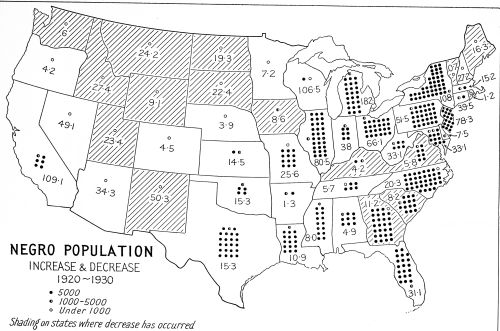
NEGRO POPULATION 1930 11,891,143
The Southerners understand how to treat the Negro—with firmness and with kindness—and the Negroes are liked below the Mason and Dixon line so so long as they keep to their proper relation to the Whites, but in the North the blocks of Negroes in the large cities, migrating from the South, have introduced new complications, which are certain to produce trouble in the future, especially if Communist propaganda makes headway among them.
In the Negro section of Harlem a further problem is arising from crosses between Negroes and Jews and Italians. These and other Mulattoes are showing a tendency toward Communism. During the World War a Communistic and racial movement was started there and a situation developed which was controlled with some difficulty, though without publicity.
The increase in the relative number of Mulattoes to Blacks is growing greater in the Northern States, as is obvious to any observer in the Negro districts of the larger cities. There can be seen many yellow and light-colored individuals, who are Negro in every other respect. Many of our dark immigrant Whites are themselves darker in color than the yellow Negroes and this enables some of these light Negroes to "pass" as Whites. This problem is one which will increase in gravity.
Evidence does not exist to show whether the number of Mulattoes being produced by primary union of Whites and Negroes is now larger than it was fifty or one hundred years ago. But evidence does exist to show that the intelligence and ability of a colored person are in pretty direct proportion to the amount of white blood he has, and that most of the positions of leadership, influence, and prominence in the Negro race are held not by real Negroes but by Mulattoes, many of whom have very little Negro blood. This is so true that to find a black Negro in a conspicuous position is a matter of comment. E.B. Reuter has calculated that a Mulatto child has a better chance than a black child to achieve prominence in the ratio of thirty-four to one.
Such a situation naturally puts a premium on white blood in the minds of Negroes, and therefore puts a prize on bastardy, discouraging any tendency to cultivate pure racial values on the part of the Blacks themselves. The black man who acquires wealth, at once wishes to show visible evidences of his affluence by acquiring a light yellow or "pink" wife, and the black girl is at a heavy discount matrimonially.
Even in adoption the same tendency is found. Child-placing societies may seek in vain to find a home for the pickaninny with black skin and curly hair, but the light-colored baby, despite other disqualifications, is eagerly adopted by darker Negro parents.
The religious world, the political world, and the educational world alike seem to have conspired to give all the rewards to the Negro with white blood and to make the bulk of the race feel that white blood is the greatest possible good for a Negro. Such a condonation of race mixture is an insidious and far-reaching menace to the racial and ethical standards of both races.
How much white blood now circulates in the veins of our Negroes cannot be told. It is generally considered, however, that at least one-third of all those classed as Negroes in the United States have, in fact, some white blood and the proportion is probably larger.
The "pass-for-white" does so purely by virtue of his physical characters which approximate those of his white ancestors. His intellectual and emotional traits may insidiously go back to his black ancestry, and may be brought into the White race in this way.
Mentally and emotionally the Negro is the product of thousands of years of evolution under the most stringent natural selection in the hot lands of Africa. He is notably lacking in just those qualities necessary for success in a modern Nordic industrial civilization, as for instance in self-control and in capacity for co-operation. Physically he is the product of the same circumstances. His tough skin gives him an advantage over the White in resisting some diseases. His lower vital capacity puts him at a disadvantage in others. Thus the Negro is liable to succumb to tuberculosis or pneumonia, and is less prone to cancer and skin affections. With the aid of white sanitation and hygiene, the Negro is holding his own, even gaining ground in the Northern cities where it was formerly supposed he would die out.
Natural selection, therefore, in view of the present vital statistics of the two races, can no longer be relied upon to solve the problem by a gradual elimination of the Negro in America. Comfort has been found in the fall of the ratio of the Negroes to the total population; but their absolute increase goes on just the same.
No satisfactory solution of the problem has been suggested. At present, from a study of past history, there appear to be but three possible solutions.
First, slow amalgamation with the Whites and an ever-increasing number of Mulattoes, who little by little will "pass" for Whites. This amalgamation might easily assume serious proportions in the near future, with an increase of mixed breeds all over the United States. But if the sentimental views about Negroes engendered by the Civil War can be lived down, it may be that the oncoming generation will resolutely face this Mulatto menace. Otherwise the absorption of 10 per cent Negroes and Mulattoes, to say nothing of East and South Europeans, in addition to Mexicans, Filipinos, and Japanese will produce a racial chaos such as ruined the Roman Empire.
A second solution would be deportation, which was seriously suggested a hundred years ago. At that time it might have been possible to re-transport the then slaves to Africa, and such action would have involved only a fraction of the cost of the Civil War. This was considered as a possible remedy by some of the wisest statesmen in the years immediately preceding the Civil War. Today it is not possible, because Africa, with the exception of Liberia, is under the control of white states, which certainly would not welcome such an enormous addition to their own color problem, aside from all other practical considerations.
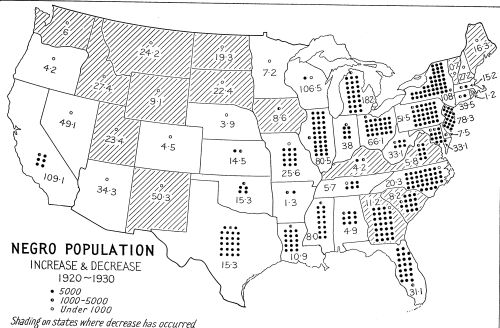
NEGRO POPULATION INCREASE & DECREASE 1920-1930 Figures in each State show the percentage of increase and decrease.
Present-day advocates of repatriation argue that lack of native population is the principal factor likely to hold back the development of some of the healthiest and most fertile parts of interior Africa. The American Negro, they say, might well carry there the education he has received in the United States, and do better for himself than he could expect to do here, especially if, through a rising race consciousness among the Whites, they show themselves less hospitable to his claims for equality.
The substantial following, gained by the Negro Garvey, who started a "Back to Africa" movement a few years ago, is cited as evidence that the Negroes in this country are not necessarily adverse to leaving it. But much more evidence will be needed before the repatriation of the Negro can be considered seriously.
As a third possibility, segregation has been suggested. This would mean the abandonment by the Whites of whole sections of the country along the Gulf of Mexico. This has actually happened in some places along the lower Mississippi River, where the numbers of the Negroes have become so overwhelming that the few remaining Whites have simply moved out and abandoned the district to them. It has happened and is happening in the West Indies. Haiti and Santo Domingo have been entirely turned over to Negroes and other examples of West Indian Islands almost abandoned to Negroes can be found.
Whatever be the final outcome, the Negro problem must be taken vigorously in hand by the Whites, without delay. States which have no laws preventing the intermarriage of white and black should adopt them. During the last quarter-century, many such bills, introduced in Northern legislatures, have been defeated by an organized pro-Negro lobby. The Christian churches in some parts of the North have also taken an unwise stand, in trying to break down the social barriers between Negro and White. This attitude goes back to the days of the abolitionists, who persuaded themselves that the Negro slave had all possible virtues and the Southern White man all possible vices. It was a primary factor in creating the tragedy of "reconstruction" after the Civil War.
Senator Roscoe Conkling hit this attitude off neatly when some one asked him what had happened in the Senate that day. He replied: "We have been discussing Senator Sumner's annual bill entitled 'An act to amend the act of God whereby there is a difference between white and black.'"
More necessary than legislation is a more vigorous and alert public opinion among the Whites, which will put a stop to social mixing of the two races. Social separation is the key to minimizing the evils of race mixture at the present time. Public opinion might well stop exalting the Mulatto and thereby putting its stamp of approval on miscegenation. Negroes should be encouraged to respect their own racial integrity. Finally, knowledge of methods of Birth Control now widespread among the Whites, should be made universally available to the Blacks.
Compared with the Negro, the American Indian offers no serious problem to American unity. On the entire continent north of Mexico there are only about 432,000. The 1930 census gives the Indian population of the United States as 332,397.
The distribution of these Indians is remarkably irregular. The West has the largest number; then comes the South, because of Oklahoma's 92,000, for the Gulf States have few. North Carolina, on the other hand, stands seventh in the list of States arranged according to Indian population. As against 137,000 in the West and 116,000 in the South, the North has but 78,000. These are widely scattered and often little known to the general public. New York State still has 7000 Indians, Michigan about the same number and North Dakota somewhat more; Wisconsin and Minnesota have 11,000 each, while South Dakota stands fourth on the list of all the States with its 22,000. In the West the Indian population is concentrated mainly in Arizona, New Mexico, California, Montana, and Washington, in the order named.
These Indians now represent 371 tribes, or remnants of tribes. How large their numbers were at the time of the first white settlement in North America has been a matter of interesting conjecture. Most estimates are not much above a million, but the population may have been considerably greater a few hundred years earlier. Since white occupation a few tribes have increased in numbers. Most have diminished, and some have become extinct, more frequently from the white man's diseases and from whiskey than from the results of fighting.
The densest Indian population at the time of the conquest was on the Pacific Coast, which did not come into close contact with the Whites until the last century. This Pacific Coast Indian population was also of a low scale of intelligence and culture, and remarkably broken up into distinct groups which could not understand each other. As many separate languages were spoken by the Indians of this region as by all the other Indians of the United States together. When the first mission on the West Coast was founded by the Spaniards, in 1769, the number of California Indians was computed at 220,000. This has decreased more than 90 per cent at this date.
The policy of the Catholic missionaries was to corral the Indians around the missions. The church considered itself the owner of all the land, and the Indians worked it as tenants. When the Mexican Government confiscated the property of the church, it took title to all the land. Hence the Indians, who had always lived on it, found themselves illegal trespassers, and until about 1913 they were landless, starving fugitives. At that time the government began to provide land for the Indians. While their treatment has decimated them nine times, their isolation prevented intermarriage with the Whites, so the California Indians are of relatively pure blood.
The revolt of the Pueblo Indians of Arizona and New Mexico against the Spanish in 1680-92 was the beginning of their decline. The Navajos and Apaches, on the contrary, have increased in numbers, at the same time avoiding white mixture.
The Indians of the Atlantic Coast were destroyed partly by disease, partly by war; and their remnants were pushed westward year after year by the Whites until they are mostly now west of the Mississippi, many of them being in Oklahoma. The Iroquois are an exception, and have perhaps increased in numbers. They got hold of firearms before their tribal neighbors and were able to destroy many of the latter, incorporating the remnants in their own tribe. The Sioux of the great plains are also said to have increased.
In the Gulf States, on the other hand, the Indians were largely exterminated before their remnants were moved to the Indian Territory. The Chickasaws told the French explorer, Iberville, in 1702, that in the preceding twelve years they had killed or captured for slave traders 2300 Choctaws, at a cost to themselves of 800 men.
In the Northwest and Alaska, whiskey and disease have been leading factors in the reduction of the number of the natives. With this, in many regions, went a low fertility, due partly to starvation.
Nearly all of the American Indians lived as hunters. When the Whites invaded the forests and drove off or killed the game, the Indian economic system was broken up, and they had little opportunity to meet the rapidly changing conditions.
There has been, since early times, some intermarriage between Indians and Whites, but it has not been on a sufficiently large scale to be serious. The estimate however is sometimes made that one-half of the census population of Indians has white blood. Naturally, there is no way of proving or disproving such a conjecture. Only in Oklahoma has such mixing been looked on with favor, and even there some tribes held themselves largely aloof from white miscegenation and punished with death any interbreeding of their members with Negroes. The discovery of oil on Indian tribal lands made the claim to Indian blood a lucrative one and oil revenues unfortunately covered a multitude of sins. Throughout the West in general the term "squaw man" is a bitter reproach.
Taking the country over, the Whites who have married Indians have not been of a high class. But the total number of Indians in the United States is so small that their future is probably that of being absorbed in the White race through miscegenation, unless it be for a few tribes cultivating a racial purity of their own and, with favorable economic conditions, perpetuating themselves for a long time to come.
The Mexican population is found mainly in the Southwestern States, but has also assumed relatively large proportions in such States as Colorado, Kansas, Illinois, and Michigan. The character of this immigration has been described elsewhere in these pages. It has given the United States an alien element with a high birthrate and very low standards of living, with which white laborers cannot and will not compete.
The census of 1930 found nearly a million and a half Mexicans in the United States. It was generally supposed that the number who had entered the country illegally was greater than those who came through the recognized routes. To prevent such a nullification of immigration regulations, mere registration of aliens is not sufficient, for that is likely to affect only those who have entered legally. Our entire population should be registered. The advantages of a universal system of proving identity are many, and extension of the system of registering births, on the one hand, and of registering voters, on the other, would take care of this without setting up much new and expensive machinery.
The menace of Chinese and Japanese immigration has for the present been stopped by immigration laws which exclude any one not eligible to citizenship. A proper application of this rule as established by the Supreme Court might shut off much of the immigration of Indians from Mexico.
Since the end of the World War the immigration of Filipino young men has become a disturbing problem on the Pacific Coast. The number of arrivals up to 1930 amounts to nearly 50,000. These, like the Greeks and some other European immigrant groups, bring but few women with them and therefore form a socially undesirable and racially threatening element wherever they are located.
Unlike the Puerto Ricans and Hawaiians, the Filipinos are not citizens of the United States, with rights of entry that cannot be abrogated. They are citizens of the Philippine Islands, and permitted to enter the United States only by courtesy. Congress, therefore, has full right to adopt legislation which will exclude them, and it should make immediate use of its power to protect white America from this reservoir of 10,000,000 Malays and Mongoloids now under the American flag and at present potential immigrants. If this cannot be done effectively, the United States will have no alternative but to admit that its adoption of the islands and its attempt to salvage them after Spanish misrule was a mistake. As a safeguard to its own racial welfare, it may become necessary to give the Filipino his independence, commend him to the benevolence of Providence and the League of Nations, and have nothing more to do with him.
In the same way there should be no thought of further acquisition of territory in the West Indies or in Central America. It is conceivable that the Central American countries might in a not too remote future be able to form a stable confederation and stand on their own feet more successfully than they have done during the last generation. If such a federation could include the West Indian Islands, the United States might well donate its possessions there.
Hindu immigration has so far been nothing more than a threat. The present immigration restrictions will prevent the immigration of these people, except for travel and study. Experience in many parts of the world has shown the folly of allowing white countries to be overrun by Hindus, and Americans should sympathize with the British possessions that are trying to maintain white supremacy in their own borders in this respect.
In Hawaii the United States has another possible source of undesirable immigration. The dominant element among its third of a million inhabitants is the Japanese, who have held themselves aloof from the other residents and shown little tendency to intermarry. Every Japanese child born in the islands is an American citizen, with the full right of entry to the mainland. The greater part of the rest of the population is a mongrel crowd. Chinese and native Hawaiians, until quite recently, have shown a marked tendency to intermarry. Every effort should be made to find some constitutional way by which Hawaii can be prevented from becoming a continuous source of supply of undesirable citizens of the United States.
While the list of unassimilable elements in the United States is a long one, it must be borne in mind that most of them are still small. A wise population policy promptly adopted and maintained henceforth will give the republic an opportunity to grow along sound and fruitful lines.
XVI
OUR NEIGHBORS ON THE NORTH
Before dealing with the countries to the north of us, it may be well to call attention to the fact that there are three major divisions of Canada. First, the Maritime Provinces, which were acquired by Great Britain at a later date than the other Atlantic Colonies, as they were originally claimed by the French. In this division Newfoundland should be considered. These territories lying east of the United States were settled directly from England or at the time of the Revolution by Loyalist refugees from New England. There is a large Scotch element in the population, which was lacking in New England. On the whole, the area is thoroughly Nordic, except on the shores of the Gulf of Saint Lawrence and the Bay of Chaleurs, where the Alpine French Habitants have infiltrated.
The second division of the Dominion is French-speaking, Roman Catholic Quebec, with a fecund population of low cultural status. The French distrust of the New England Protestants, with whom they had been at war for one hundred and fifty years, was the predominant cause of their failure to join with the revolting American Colonies in 1776. Quebec was known as Lower Canada.
Like the territories of the United States, the Dominion of Canada of today represents a part of the Nordic conquest of North America, the sole exception being the French population of Quebec Province.
The country to the west of the Ottawa River constitutes the third major division and was, after the Revolution, known as Upper Canada. Its original population was composed chiefly of American Loyalists who fled there in numbers after the Revolution. The immigration into Upper Canada from Britain was later very largely Scotch, Scotch Irish, and North of England. This is true more or less of all English-speaking Canada, except possibly British Columbia.
In a measure the Dominion is an offshoot of the United States, and its development proceeded along lines parallel to those of the States to the south of the boundary. The character of the population west of Quebec Province is much the same as that of the United States, lacking, fortunately for Canada, some of our immigrant elements. The country was settled without the terrible Indian wars that afflicted our frontier and without the lawless element so conspicuous in the history of our Far West.
The French settlement of Quebec was contemporaneous with the first English settlement in North America at Jamestown. A majority of the emigrants were from northern France. So far as one can judge at the present time by the descendants of this population, the pure Nordic stock must have been rare among them. They are today in general a stocky, short-necked people, rather of the Alpine build, with eyes often rather dark. The blond hair and tall stature of the Nordic are so rare as to attract attention at once. The type suggests the Pre-Norman population of northwestern France, rather than its Nordic conquerors. Some of the seigneurs, the explorers, and the adventurers of the early period apparently were of Nordic stock, but they were probably always in a great minority and have left few descendants.
Very little satisfactory research has been done as to the origin of the Habitants. A recent study of a typical group has given some indication of the general conditions in Quebec. In this group stature was found to be five feet and five inches, which is about the general average of the French. The cephalic index was over 83.0, which is about the mean for Brittany and is higher than that of Normandy. The hair was rather dark brown and straight, this straightness is slightly suggestive of Indian admixture. The eye color was more often brown than mixed blue and brown. Pure blue eyes were present only in 15 per cent. The tall burly build of the Norman peasant was very rare.
The language spoken in Quebec is an archaic Norman patois of the time of Louis XIV. This fact has given rise to the general belief that the Habitants came from Normandy, but the more probable reason is that the Normans were the earliest immigrants and established their patois, which was accepted by later arrivals. The Normans appeared to have been far short of a majority of the total number of immigrants and Brittany supplied still fewer. The balance was divided among the provinces of the northern half of France.
The physical type of the Habitants of today suggestive as it is of the peasants of the interior of Brittany finds confirmative evidence in their subserviency to the church.
Throughout the French period the population consisted to a marked extent of soldiers, traders, administrators, priests, and others who did not bring their families with them. Efforts of the French Government to encourage family life were not always either well directed or successful. Colbert hoped for a large French population in Canada by intermarriage with the Indians. Administrative regulations penalized bachelors, who, for instance, were refused licenses to enter the fur trade, which was the main source of wealth in the country at that time.
Many of these restrictions were directed by the priests, doubtless not so much for eugenic reasons as with the motive of protecting the morals of the young men by giving them wives. At an early date the colony fell under the domination of the Jesuits, and maintained for a long time a religious tone that in its own way was much more stern and uncompromising than that of the Puritan settlements in New England. Much of the wealth and effort that might have gone to strengthen the colony was sunk in sterile monastic foundations. Even today stone churches are a conspicuous feature of the landscape in the midst of poverty-stricken villages.
At one time there was for some years a directed migration of young women from France, sent out to become the wives of the colonists and early in the history of the country a policy of bonuses for marriage, and for large families, which has been repeated at intervals ever since, was introduced. None the less, the colony grew but slowly and to the failure to establish it on a sound biological foundation is due the collapse of French rule.
In 1665 the first census showed a population of 3215. In the next hundred years this had increased to somewhat more than 70,000, with an additional 20,000 in what are now the Maritime Provinces. That the French could maintain the contest for so long against British neighbors who outnumbered them twenty to one is to their credit, but their lack of recognition that their settlement could not be permanent unless based on a real migration of families ultimately cost them the country.
One of the chief causes of the failure of French Canada to expand beyond the narrow limits of the banks of the Saint Lawrence River, during its first century of existence, was an obscure skirmish which occurred on the west side of Lake Champlain in 1609. Champlain was advancing toward the South in company with Canadian Algonquins, when he encountered a war party of the Mohawks. In the fighting that followed, some Mohawks were killed and captured. At that time and in that place began the bitter enmity of the Iroquois Five Nations and the Canadian French. It was a feud that was never allowed to rest and yearly war parties of Mohawks went north along Lake Champlain and the Richelieu River and devastated the lower portion of Quebec Province. At the same time war parties of the Senecas descended the Saint Lawrence and attacked the French from the West. As long as the power of the Iroquois lasted, which was all through the seventeenth century, they devastated a large part of New France.
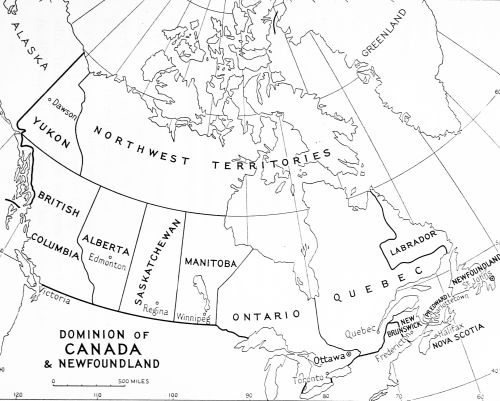
DOMINION OF CANADA & NEWFOUNDLAND
In the meantime, the Dutch and English were growing up in security to the South and East. Thus Champlain's skirmish with the Iroquois was the factor that delayed the expansion of France into the region of the Great Lakes and down the Mississippi Valley until relatively late in the eighteenth century.
The French population still centers in Quebec Province, long known as Lower Canada, but it has spread to other parts of the continent both south and west of the Quebec boundary. Their expansion in Canada has been into the neighboring provinces. Emigration to New England began in the eighteenth century but was not considerable until the nineteenth century.
While this French-Canadian population has remained so fecund as to furnish a stock example for every writer, it, too, has felt the trend of the times. For a long time the government of Quebec offered a grant of one hundred acres of land to every man who was the father of twelve living children by one wife. In less than a single year over 3000 heads of families availed themselves of this privilege and in 1907 there was published a list of 7000 families having at least twelve living children.
In spite of this fecundity, the birthrate has been declining for almost the whole of the historical period. Two hundred and fifty years ago the average for all women of child-bearing age in Quebec Province was one child every two and one-half years. By 1850 this ratio had decreased to one in five years. At present it is one in seven and one-half years. Under this method of measurement, the rate of natural increase per head is only one-third of what it was in colonial times. Even the Roman Catholic "Habitant," therefore, has felt the effect of the general decline of birthrate throughout the western world in the period since the beginning of the industrial revolution.
From the beginning of the nineteenth century there was a small but steady immigration from the British Isles into Upper Canada, though interrupted by the Napoleonic Wars. After the close of that conflict a larger movement of population took place, which brought in an extensive English population. Theretofore most of the arrivals had been Scotch or Americans, so that a visitor in 1810 commented on the fact that he met "scarcely any English and few Irish."
In 1815 the government began to assist immigrants by giving free passage and a grant of one hundred acres of land after arrival with a promise of free rations for the first six or eight months and a like amount of land to each male child on his reaching the age of twenty-one. A wise restriction required a deposit of a little less than one hundred dollars by the immigrant, to be returned to him after two years if he had complied with the terms of the contract on his behalf. These provisions were availed of mainly by Scotchmen going to Ontario. The scheme, however, had the advantage for our present purpose of establishing for the first time records of immigration, which thenceforth can be traced in detail.
In 1819 the emigration from British ports to Canada was in excess of 20,000, and continued for years at about this rate in spite of the booms which Australia and New Zealand were enjoying at the same time. There was a substantial movement of emigration toward Canada in the years 1830-34. In the nine years preceding 1837, more than a quarter of a million emigrants from the British Isles arrived at Quebec on their way westward, more than 50,000 of them in a single year.
Primogeniture in England has been a powerful factor in building up the British Commonwealth. The oldest son of a landed family inherited the estate and the titles, if any, and stayed at home. The younger sons, left to shift for themselves, were ready to emigrate. The colonies have thus received a great many more settlers of first-class ability than would otherwise have been the case. At the same time, the perpetuation of family continuity, through the preservation of the ancestral home intact, has been a strong psychological factor in maintaining a vigorous family life in the upper classes of Great Britain.
By 1840 the population of Canada was approximately a million and a half. During the next generation nearly a million more immigrants arrived from British ports—the great Irish migration changing the racial character of this movement markedly from about 1845. Prior to that time the newcomers were pre-dominantly English, with Wiltshire and Yorkshire largely represented. When the potato famine caused the Irish to seek refuge elsewhere, they naturally turned their steps to England, as the most easily and cheaply accessible of havens. Great Britain could absorb only a limited part of these and began to direct them to Canada, which, indeed, they preferred to the United States because the Catholic Church was strong there.
The emigrants were weak and in 1849 one-sixth of those who started are said to have died on the voyage. The number of Irish who left the United Kingdom in that year was 215,000, of whom nearly half were bound for Quebec. Canada became alarmed at being made the dumping ground of an enfeebled and destitute population so much in excess of its capacity to absorb, and, by increased taxes and other means, slowed down this immigration, which then headed toward the United States. Thereafter many of the Irish who had already gone to Canada moved on down into the Union, so that in the end Canada received a smaller part of the Irish Catholic migration than might be thought.
The census of 1871 furnishes a convenient point at which to take a review of the population. It then totalled 3,485,761 in the four original provinces (Ontario, Quebec, New Brunswick, and Nova Scotia). British and French together, in the ratio of two to one, made up 92 per cent. The only foreign element which contributed as much as 1 per cent of the whole was the German, numbering more than 200,000 people, or 5.8 per cent.
The French Habitants have always formed a somewhat indigestible mass, but half a century of struggle had resulted in a workable system of government and compromise in the administrative life of the country. The dominant element was the British, and save for the great mass of French there was no large foreign block to menace the country's unity.
In sharp contrast to the settlement of the West of the United States, the occupation of the prairie and mountain provinces of Canada has been marked by law and order. In our West, especially in the mining districts, law was largely disregarded and its place taken by private justice, administered by individuals.
In Canada the Mounted Police have played a most efficient rôle in controlling both the settlers and the Indians. At the time of the Klondike rush in 1898, when hordes of gold seekers scrambled over the passes to the head waters of the Yukon, a handful of Mounted Police maintained a discipline for which the Americans themselves were very grateful. In the same way the administration of the mining laws of the Klondike, which is in Canadian territory, was admired and envied by the Americans there.
The Canadian treatment of the Indians in the western provinces was also marked by an absence of the bloody wars which characterized our westward advance. The only uprising against the Whites was the Riel Rebellion in Manitoba, in 1869, which was by the half-breeds rather than by the Indians and which had special underlying causes. All this has been accomplished without the Whites in any way fraternizing with the Indians.
During the French period, the Canadian Indians always sided with the French against the English, because under the influence of the Catholic priests, the French Indian half-breed was regarded as a Frenchman and, as a result, influenced his mother's people in favor of the ruling race.
There were plenty of offspring of white frontiersmen and Indian squaws all along our frontier, but these half breeds were everywhere kicked out and despised as Indians. This attitude toward the lower race has always characterized our American frontier and while very unpopular with the natives, has served to keep the White race unmixed, in sharp contrast to the French and Spanish colonies.
Canada still has more than 100,000 Indians, four times as many in proportion to the whole population, as in the United States.
Newfoundland, for geographical reasons, even though it has politically no relation to Canada, is the most convenient starting point in reviewing in more detail the subdivisions of the country.
Larger than Ireland, the island claims to be the "senior colony" of the British Commonwealth. John Cabot, a Genoese, sailing from Bristol, discovered it in 1497, according to the traditional account, and took possession of it in the name of Henry VII. Within a few years fishermen, not merely English but French, Spanish, Portuguese, and Basque, were landing there to dry and cure the enormous quantities of cod caught on the Great Banks, which still form the principal wealth of the colony. In fact, some writers believe that the island may have been discovered long before the time of Columbus, by fishermen. At any rate, the effective occupation, though scarcely the continuous settlement of Newfoundland, long antedated the colonization of Virginia and many of the original English residents came from Devonshire.
The aboriginal inhabitants, the Beothics, disappeared half a century ago. They were probably Eskimos, or closely related to them, and are sometimes spoken of as "Red" Indians, in contrast to the "Black" Indians, the Micmacs, who have recently immigrated in small numbers from New Brunswick.
Newfoundland has nearly a quarter of a million inhabitants, but its backward stage of development still makes it little known to the outside world.
On the mainland a long strip of the Atlantic Coast and a large triangle of land behind it are attached to Newfoundland administratively, under the name of Labrador. Because of its scanty population it may well be disregarded in the present discussion.
Nova Scotia during Colonial days was almost a New England colony. It was known to the French as "Acadie" and was ceded to England in 1713.
Interposed between New England and French Canada, Acadia suffered heavily from the warfare that went on between the two regions. The existence of a large French population was always a source of irritation, and of danger, to the English. Finally in 1758 the French were cleared out, about 6000 of them being distributed throughout the English colonies, and the remainder escaping to Canada. Those who came to the thirteen colonies suffered hardships, but on the whole were more humanely treated than were those who fled to their co-religionists in Quebec Province. The place of the exiled Acadians[15] was largely taken by New England emigrants.
The American population of Nova Scotia was further greatly augmented at the time of the Revolution by an influx of Loyalists. These came in such numbers as to disturb the colony seriously, but formed an invaluable addition of the best sort of British stock. This general trend has continued so that, even in 1921, of the foreign-born population of Nova Scotia, that which originated in the United States was twice as large as all the rest of the foreign-born population put together.
The Scotch immigration which has exercised such an important influence on the eastern counties of Nova Scotia began about 1760 with the arrival of Scots and Ulster Scots. In 1772 a contingent of Highlanders direct from Scotland took up land alongside an American group from Philadelphia. From then on until about 1820, a steady stream of Highlanders came into the region; Gaelic is still spoken in parts of the colony. Nova Scotia with the other Maritime Provinces still represents the most purely British of all the Canadian provinces, and as shown, an important part of its population came to it through the United States.
New Brunswick was established on August 16, 1784, out of a part of ancient Acadia. It also received an important number of Loyalists at the time of the Revolution—indeed it might be said to owe its existence to the arrival of some 10,000 expatriates from the United States. But the bulk of the population is Scottish with a strong Highland contingent. There are few foreign-born other than a small element from the United States.
Prince Edward Island is similar as to its population and is the most purely "native" of all, only one in each one hundred in this province being foreign-born. The Roman Catholics there include a considerable number of Scotch Highlanders and number nearly a half of the population.
Quebec is still the stronghold of the French-Canadians, more than half of whom are unable to speak the English language. The French stock still numbers one-fourth of the entire population of the entire Dominion of Canada. On the northern frontier of Quebec there was some mixture with the Indians, but the half-breeds are probably not numerous enough to form a substantial part of the old population. In addition to their great movement to New England the French-Canadians have spread into Ontario, New Brunswick, and Prince Edward Island to some extent.
The French-Canadian stock is the most highly inbred of any of the large groups of the New World. It is based on original immigrants who numbered a good many less than 10,000. In the course of three centuries this nucleus has multiplied to 3,000,000, with virtually no additions of fresh arrivals from abroad. They have lived a New World life longer than have most of the Whites of the Western Hemisphere, and must be put in a class by themselves. They are not French, in spite of their language—an archaic speech at which the true Frenchman laughs. In every way they differ from the present-day French, more indeed than New Englanders of Colonial descent now differ from the present-day Englishman. From the cradle to the grave they are surrounded by the influence of the Roman Catholic Church to an extent almost as unknown to the present-day French as it is to the present-day Americans. Of late years not only those who have come to New England, but some of those living in Quebec Province have shown a disposition to break away from the church because of its heavy and inexorable taxation.
The French-Canadians, in Quebec and the neighboring provinces, were, to an extent, disloyal to the British Empire in the Great War. Under the influence of their priests they resisted the draft in several instances and there was bloodshed in Quebec on this account. As has been said elsewhere, these Frenchmen would not fight for the British Empire, which had guaranteed them extraordinary privileges as to their language and religion, nor would they fight for France, which they claimed as motherland, but which they now regarded as atheistic. Neither would they fight for Belgium, which is pretty nearly as clerical as they are. In short, their conduct during the World War was contemptible and in sharp contrast to the militant and effective patriotism of the more westerly provinces of Canada.
Ontario, called Upper Canada in distinction to French-speaking Lower Canada, received its first important population from the United States when Loyalist refugees, including many Highland Scots, mainly from northern and western New York, settled there and became known as the United Empire Loyalists. Among these immigrants, were the disbanded frontier regiments which had been organized by Sir John Johnson, including abundant Macdonalds from Glengarry and Inverness, together with Camerons, Chisholms, Fergusons, MacIntyres, Russells, and Hamiltons, who opened up the region constituting the present counties of Glengarry, Stormont, and Dundas.
In 1785, almost the entire parish of Knoydart, Glengarry, emigrated direct from Scotland and settled in a body in Upper Canada. In 1793 a contingent from Glenelg settled at Kirkhill. In 1799 came many Camerons from Lochiel, and in 1803 another delegation of Macdonalds arrived, with more people from Glenelg and Kintail. Thus Ontario, which in 1791 was set off from (French) Lower Canada and given its own government under the name of Upper Canada, became almost as much entitled to consider itself a "Nova Scotia," as did the Maritime Province of that name.
At the end of the American Revolution, Upper Canada was supposed not to contain as many as 10,000 inhabitants. By 1811 it had 83,000 and by 1817 it was estimated to have 134,000. While many Irish came at a somewhat later period, most of these eventually went on to the United States.
The interference with British immigration caused by the Napoleonic wars led to Upper Canada's offering special attraction to settlers from the United States. The lack of sympathy of these with the British Government during the War of 1812 was an embarrassment to Canada, just as the loyalty of the United Empire group, which prevented Canada from being conquered by the United States, was in turn a serious annoyance to the American Government.
The later settlement of Ontario was largely from Scotland and the northern English counties, and was pre-dominantly Presbyterian. There were enough Ulster Scots to make it an active center of the American Protective Association of forty years ago and it is definitely, at the present time, a Nordic territory.
During the present century it has received thousands of Austrians, Poles, and Italians, who introduced racial elements not easily assimilated.
Manitoba began to be settled shortly after the War of 1812, when Lord Selkirk established his Red River Colony. The Scotch Highlanders, Swiss, and others whom he planted there did not prosper, and many of them eventually drifted down into the United States, taking an active part in the formation of Minnesota. Around this nucleus, however, there gradually grew an incongruous and isolated settlement made up of three elements that had almost nothing in common; the Scotch, the French-Canadians, and the half-breeds. In 1849 the Red River Settlement was credited with 5391 people. With the establishment of steam navigation on the Red River, and the official creation of Winnipeg, both of which occurred in 1862, development began on a larger scale.
A provisional government was given to the territory in 1869, and from time to time land was generously allotted to the early white settlers, to the half-breeds, and to the Hudson's Bay Company. Thereafter the province grew slowly, from the natural increase of its founders and from a Nordic migration from Ontario and from the neighboring parts of the United States, until the mixed European immigration of the last half-century changed somewhat the character of the population. These latter now account for one-third of the whole.
The proportion of these non-Nordic Europeans, from southern or central Europe, is three times as great as the European immigration from either northern or western Europe. If this immigration continues in like proportions, Manitoba, like the other prairie provinces, is in danger of being lost to the Nordics.
Saskatchewan has a larger American-born population than Manitoba, one resident in every eight having first seen the light of day under the American flag. But it has a still larger recent European immigration amounting to nearly 40 per cent of the total population of the province. A bare half of the people of Saskatchewan are of British origin.
Alberta has both a somewhat smaller European element and the largest American-born contingent of any of the provinces, amounting to one in six. Many English of a fine type have settled there.
In all the Prairie Provinces the French-Canadian represents scarcely more than one in twenty of the population.
British Columbia has prided itself with justice on its British origin, and is exceeded in this respect only by the Maritime Provinces. Of its European immigrants (one in eleven of the whole), approximately equal numbers are Nordics from northern or western Europe, and Alpines or Mediterraneans from southeastern and central Europe. During the World War its young men showed great attachment to the mother country, and the loss from death was correspondingly great. Because of its great distance from the ports of entry, it was long avoided by immigrants. Not until about 1907 did it begin to get its fair share. Since then, it has held its own, about half of its new arrivals however coming from the United States.
The province also has its Asiatic problem, which has been the source of hard feeling on several occasions. One of the great hindrances to its more rapid development was shortage of labor, and it was natural that the Orient, which could reach British Columbia more easily and cheaply than could either Europe or even the Atlantic provinces of Canada itself, should be called upon to meet the need. Chinese soon began to enter, until stopped by a head tax of $500. Japanese came in considerable numbers, not merely in the fisheries but for day labor in railway construction. Some 6000 Hindus likewise found their way there. Orientals now amount to one in every seven of the total population. There is a real Asiatic question here and the Whites are beginning to look to the United States for protection.
Canada's immense arctic area, the Yukon and the Northwest Territories, may be neglected in this discussion because of the lack of population. Those who see in the mosquito-infested tundra of "The Land of Little Sticks," with its months of winter darkness, a future populous area of agricultural and livestock industry are destined to wait long for the realization of their dream.
So far as the British element in Canada is concerned, it has been pointed out above in several places that the country is to a certain extent an offspring of the United States. This contribution has continued up to the present time. During the 1880's there was another great period of migration from the Union to the Dominion. At that time nearly twice as many entered Canada from this country as from Great Britain, and six times as many as from the continent of Europe.
Not all of these Americans were of the old native stock. It has been calculated that at least half of this contingent was of British extraction, the other half being made up of various European nationalities who, after becoming acclimated to the New World in the United States, passed on to Canadian soil. Thus the contribution from the United States during that period did not represent a purely Nordic accession.
The 1890's represented a period of British immigration. But, with the turn of the century, Canada began to share in the great influx of miscellaneous peoples who were already deluging the shores of the United States. During the first twelve years of the twentieth century, Canada received 2,000,000 people, of whom 800,000 were British. About 700,000 others came from the United States, but more than a third of these are calculated to have been Continental arrivals who merely passed through the United States for convenience. In 1901 there were in Canada some 650,000 of "foreign stock"—that is, of neither British nor French origin. In 1921 there were more than twice as many. Since the beginning of the century Canada has acquired more than 100,000 Jews.
After the World War the Empire Settlement Act began to make itself felt, reducing markedly the proportion of immigrants from the United States into Canada while from 1900 onward Ireland began to figure heavily in the immigration statistics.
In 1930 there were, on the other hand, over 1,200,000 Canadian-born, both of British and French stock, in the United States and during the preceding eight years 300,000 had returned to Canada.
Not only have the western provinces, then, been thrown violently into a disequilibrium by the population changes of the last generation, but the stability of the whole Dominion has been menaced. Canada, like the United States, has taken on a great liability in the admission of the hundreds of thousands of non-Nordics, who will be hard to assimilate, even if it be assumed that they would become valuable when assimilated, which is by no means always the case. One of Canada's advantages, on the other hand, is the negligible proportion of Negroes, and it might well erect barriers even now against them, as it has already done against the Asiatics.
With its immense territory and more than 10,000,000 inhabitants, Canada is still to be credited to the Nordics, though, if the population trends that began with this century should continue, the balance would change rapidly. While the United States has contributed by far the largest number of foreign-born, Russia has contributed the second largest number of immigrants, Saskatchewan receiving more of these than any other province. Ontario, Quebec, and Manitoba have received about equal numbers, in each case one-third less than went to Saskatchewan. Those of Austrian birth, who are third in the list, are concentrated in the two provinces of Manitoba and Saskatchewan in about equal numbers, each of these provinces having almost twice as many Austrian-born as Alberta or Ontario. The Chinese stand fourth in numbers among the foreign-born of the Dominion, but most of them are concentrated in British Columbia. Ontario has almost as many Italians as all the rest of Canada put together, and it has also the largest number of Poles.
Because of the great body of French-Canadians, the Roman Catholic Church is proportionately twice as strong as in the United States.
The 1921 census showed the population to be made up as follows:
PER CENT
British origin 55.40
French 27.91
Other European 14.16
Indian 1.26
Asiatic .75
This computation distributes the immigrants from the United States according to their racial stock; thus the main part would be classified with those of British origin, a smaller part as "other European," and so on.
From the foregoing it is evident that Canada is now less than 60 per cent Nordic—probably less Nordic than the United States.
Canada has been the great obstacle to extending the American immigration quotas to the countries of the Western Hemisphere. The majority of its inhabitants are our own kinsmen, many of whom have already contributed elements of great value to our population. Others would be most welcome if they chose to come.
Our nation has been unwilling to put the slightest restriction on Canadian immigration, by applying a quota; and it was thought it would be invidious and discriminatory to apply a quota to the countries south of us, and not to the one to the north. That difficulty will have to be met firmly in the near future. One proposed solution has been to admit from Canada only those whose mother tongue is English.
FOOTNOTES:
XVII
OUR NEIGHBORS ON THE SOUTH
Unlike Canada on our north, the countries south of the Rio Grande have been relatively little influenced by Nordic culture, to say nothing of anything resembling a Nordic conquest. The outlying territories of Mexico which were annexed to the United States were nearly empty lands and present Mexican influences in the Southwest are matters of more recent date.
Latin America is one of the major divisions of the World, and from the present point of view should no more be discussed as a unit than could Europe or Asia. Its original population represents one of the great racial divisions of mankind. Its twenty different nations now speak several different languages, and embrace representatives of all the important races of both hemispheres.
The general area gets such unity as it possesses from the Latin and Roman Catholic aspect of its culture as contrasted with the Protestant, Anglo-Saxon culture of America north of the Mexican border. This Latin civilization was originally Spanish (in Brazil Portuguese), but since the era of the revolutions which threw off the Spanish yoke, the Spanish influence has become more and more negligible, and locally has been somewhat supplanted by the French, and, to a small extent, by the Italian influence.
Latin America was never colonized at all in the sense that North America was colonized. English settlers with their families came to the New World to found homes, but the early history of Latin America was that of a series of plundering and proselyting expeditions, and such of the adventurers as tarried were usually men without families who had no desire to stay a day longer than was necessary to acquire a fortune and return to Europe. Add to these the military forces who came under compulsion, and the missionaries, administrators, and concessionaires of all kinds and one has the bulk of the early European immigration.
Under these circumstances the number of women who came with their husbands was naturally small, and most of the Europeans took Indian wives, frequently several of them, thus laying the basis for the half-breed population of the present day. In Paraguay, for instance, some of the colonial rulers are said to have had fifty or a hundred native concubines. If every descendant of these matings carries the Spanish name but has married mainly with Indian stock in the ten or fifteen generations since, it is easy to understand that present-day families may bear the names of hidalgos, of whose genetic traits they have virtually none.
The number of European immigrants was never large. During the sixteenth century, a period of active exploitation, the entire movement from Spain to America is thought to have represented only about 1000 or 1500 persons a year. With a high death rate, and the disposition on their part to return as soon as possible, there was no opportunity for the Spaniard to establish the basis of a civilization built upon his own race.
By 1553 foundling half-breeds numbered thousands in Spanish America and the viceroy Mendoza was obliged to establish an orphan school for them. Even at the end of the eighteenth century, when Humboldt visited Mexico City, he remarked that of the European-born Spaniards there, not one-tenth were women. The proportion of women must certainly have been still smaller in the provincial towns and on the frontiers.
So far as the present population goes back to the early days of Spanish dominion, it may be said to be Spanish by name and Indian by blood. The families, which in many Spanish American countries have social prestige because of descent from the conquerors and rulers of the Colonial Period, must therefore attach all importance to the family name, and little or none to the many other lines of descent which have entered into the composition of their present generation.
Honorable exception should be made in almost every one of the Spanish American republics of a small group of Whites that has consistently maintained its racial integrity and upheld intelligent ideals of racial progress, under most difficult conditions. In many of the countries, too, there are groups of far-seeing intellectuals who are working for the adoption of wise immigration policies, presenting sound and constructive measures of eugenic reform, and striving to awaken their fellow countrymen to the fact that a nation's capital is, in the last analysis, biological, and that permanent and satisfactory progress is possible only to a people with a healthy family life.
In many of the Latin American countries the Whites, or those who pass as such (for they have, in most cases, a large proportion of Indian blood) form an oligarchy or ruling caste occupying the higher positions in the political and ecclesiastical worlds. They also constitute the land-owning and professional classes, while commerce and industry are largely in the hands of foreigners or their descendants. In many cases these foreign immigrants marry into the best native families, and thus their children become a part of the ruling caste.
Mexico. The restriction of European immigration into the United States under the National Origins Quota cutting off what had been the principal source of unskilled labor had an unexpected and undesirable effect in encouraging immigration from nearby countries of the Western Hemisphere, which were not under the quota, and particularly from Mexico. Industries accustomed to depend upon cheap, ignorant, and docile workers from Mediterranean or Alpine countries turned to the illiterate Indians on the South as a ready substitute. The stream of arrivals across the border, more illegal than legal, soon brought into the United States more than a million Mexicans. Only the unexpected depression beginning in 1929 stemmed this tide and apparently prevented Mexico from reconquering peacefully, by an immigrant invasion, the territory it had lost by the decision of war in 1848.
Since the sixteen million residents of Mexico are the nearest large body of people in a position to supply immigrants to the United States and ready to do so, a study of their composition is of the highest importance at the present time. Mexico at the time of the Spanish Conquest had seen the rise and fall of several relatively high native civilizations, and that of the Aztecs, which was destroyed by the Spaniards, had many noteworthy features. The combination of brutality and piety which dominated the conquerors led to the extermination as far as possible of every salient feature of the native culture. The country was, thereafter, exploited ruthlessly by the Spaniards, but the Spanish civilization, such as it was, did not succeed in establishing itself in this foreign soil. The history of the last four centuries has been a history of the gradual absorption of the foreigners by the Indian element. This is true alike of race and culture.
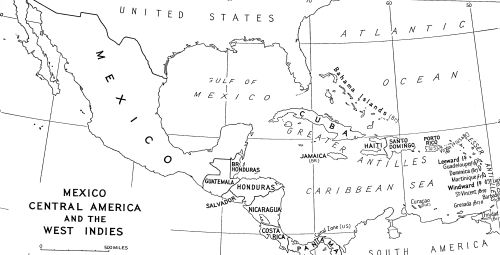
MEXICO CENTRAL AMERICA AND THE WEST INDIES
The large native population found here by the Spaniards was quickly reduced in numbers. A Spanish priest enumerates ten plagues which had decimated the people during his time, that is, during the first quarter of a century after the conquest. First the smallpox, brought by a Negro in one of Narvaez' ships. It is said to have destroyed more than half of the people in many of the provinces. The others were: the slaughter in the capture of Mexico City, the famine resulting from the widespread warfare; the abuses of overseers of the towns given in vassalage; the heavy tributes; the tremendous abuses in connection with the mines; the reconstruction of Mexico City by forced labor; the traffic in branded slaves; the abuses of transportation, with Indians as human beasts of burden; and the factional warfare among the Spaniards themselves, in which the Indians bore the brunt of the fighting. To these should be added particularly the other infectious diseases that the Spaniards introduced, such as tuberculosis and syphilis, as to which the aboriginal inhabitants had not the slightest immunity or resistance, through previous racial experience.
Under such conditions the native population of the hemisphere was probably reduced by 50 or 75 per cent in a few generations, and in the West Indies it was exterminated. Since then it has been steadily regaining ground on the mainland, though not in the islands, in many of which the Negro has replaced it.
The number of Spaniards who came at any time to Mexico is placed at 300,000 at the outside. Many of these certainly did not remain in the country and few of them brought their families. Under the conditions that existed in Mexico and the other conquered territories, it was universally recognized that the situation was not suitable for a white woman. While the Spanish Government encouraged men to take their wives out from Spain, few of them cared to do so, and probably most of the men who came to the colonies were unmarried. Spain put insuperable difficulties in the way of unmarried women who wanted to emigrate, so that Spanish women throughout the history of Mexico were few. The resulting population is therefore made up of the offspring of the Indians and of a few Spanish men mated to Indian women. Most of the Mexican population is still pure or nearly pure Indian. There is a considerable hybrid element which does most of the talking, and a negligible element that can be considered white in the strict sense of the term.
Mexican statistics commonly designate about 10 per cent of the population as white. But most of these have much Indian blood, and recent students doubt whether 3 per cent are properly to be described as white. Much of this genuine white element is in Mexico City, though the various states have their local and reputable white aristocracies, of which that in Yucatan is conspicuous for the maintenance of high standards of racial integrity.
The Mexican revolution which began in 1810 dislodged the overseas Spanish and substituted exploitation by the local hybrid group. Since then the general trend has been toward the rise to control of the Indians. The last period of revolution, which began in 1910 and may be said to be still in progress, has been marked by attempts to take away from the hybrid oligarchy the immense land properties which it had obtained and to distribute them to the Indians. While this has met with many difficulties, and has been realized only to a small extent, it has been at least the avowed objective of most of the revolutionists in the past two or three decades.
During recent years there has been a glorification of the Mexican Indian and his culture by North American writers. No doubt the Mexican Indian is well suited to his environment, and his traditional habits are well suited to him. This does not mean, however, that either has any important contribution to make to the United States which would be realized by a northward mass migration of agricultural and industrial serfs. On the contrary, the Mexican immigration to the United States, which is made up overwhelmingly of the poorer Indian element, has brought nothing but disadvantages. It has created, particularly in the Southwestern States, an exploited peasant class unconformable with the principles of American civilization. This population, neither physically nor mentally up to the prevailing standards, is producing a large contribution to the future American race, since every one of its numerous children born in the States becomes an American citizen by birth.
Tests made in the schools of southern California, in which the language handicap was discounted as far as possible, indicate that the average Mexican child was about as far below the average Negro child in abstract intellect as the average Negro child was below the average white child.
Physically, the race is conspicuous by its low resistance to tuberculosis, which has exterminated so large a part of the native population of the Western Hemisphere during the last four centuries. The New World had not been subject to tuberculosis and therefore offered a fertile field for the germs of this disease. The population of the Old World had been ravaged by it for many centuries, and in each generation the low resistants had been killed off so that a more immune stock had been gradually produced by natural selection.
Such studies as have been made in the Southwestern States indicate that the average Mexican family is at least half again as large as the average white family. Thus there is every reason to expect that, without a sharp limitation of such immigration, the Southwest will become more and more Mexicanized.
By 1928 Los Angeles County had more than a quarter of a million Mexicans, and the City of Los Angeles had the largest Mexican population of any city in the world, with the exception of Mexico City. Whole industries and whole agricultural areas had come to think themselves largely dependent on Mexican labor, while millions of American citizens were out of employment in every State of the Union. The dependence of agriculture in the Southwestern States on cheap Mexican labor, largely of a migratory nature, is particularly disastrous from a racial point of view, since the maintenance of American civilization depends largely on the maintenance of a healthy and prosperous farm population.
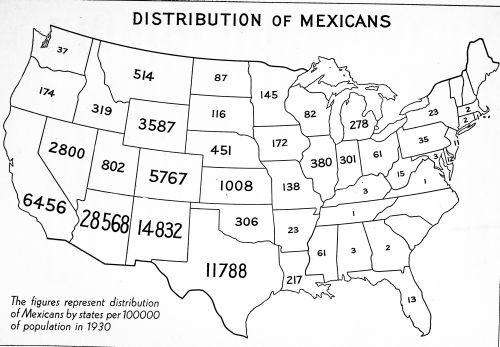
DISTRIBUTION OF MEXICANS The figures represent distribution of Mexicans by states per 100000 of population in 1930 Distribution of Mexicans by States. Except in the border States Mexicans are chiefly concentrated in large urban centers.
Nearly all of the Mexicans who came to the United States were seeking to better themselves economically and to avoid the murder and plunder that had been going on in their country for a score of years under the guise of revolution. Most of them intended to return home as soon as conditions became more satisfactory, but as conditions from year to year failed to improve, the Mexican population tended to become a permanent one. At the same time few of the Mexicans became American citizens, and in every community where they settled in racial groups there were unsatisfactory standards of education and sanitation.
Most of the Mexicans come with their families, thereby differing markedly from some of the other foreign groups, as the Bulgarians, Greeks, Spanish, and Filipinos, which consist mainly of unmarried men. These latter either return home after making money, or else intermarry with the other immigrant groups. The Mexican community, on the other hand, perpetuates itself and increases without much intermarriage with the other population.
Since the depression beginning in 1929 there has been a repatriation of a portion of the Mexican immigration of unknown size but undoubtedly considerable. Lack of work has led many to go home where they can live more economically and be among friends, and at the same time American authorities began to offer free transportation back to Mexico for those dependent on public charity, and willing to leave. Thus trainload after trainload returned, and at the same time a tightening of the immigration restrictions and procedures on the border cut down the flow of immigrants to almost nothing.
While the census of 1930 counted nearly a million and a half Mexicans in the United States, it is probable that the number has since then diminished, and it is of highest importance that it should not be allowed to increase. The Mexican Indian has no racial qualities to contribute to the United States population that are now needed, and if he has any cultural contribution to make it will not be made by the immigration of hundreds of thousands of illiterate and destitute laborers.
Guatemala. More than half of the population of Guatemala is still pure Indian, and the half breed class which plays such an important part in Mexico and other countries is relatively less conspicuous there. The inconsiderable white population is made up in part of the descendants of old Spanish families and in part from more recent immigrants, especially Germans.
The proportion of Teutonic names among the rulers of Guatemala during the last generation has been growing steadily. With two million population Guatemala is the most powerful of the Central American countries, but the Indians tend to be little more than a subject race exploited by others, and the general progress of the country is therefore in some ways slow.
Honduras suffers partly from its tropical situation but still more from the mixture of races, and the large amount of Negro blood in the population of the lowlands. By contrast with Guatemala the Indian element is here unimportant, and the people are Negroes and half-breeds, or a little of each. With its 600,000 population largely of mongrel origin, the Republic has been a backward member of the Central American group throughout most of its history. British Honduras is an unimportant area with much the same characteristics. The so-called Caribs along the coast are now scarcely distinguishable from pure Negroes.
Salvador. Smaller than the State of New Jersey, Salvador has an importance out of proportion to its size because of the dense population and large amount of cultivable land together with a smaller amount of Negro mixture than in the adjoining Republics. With a population estimated at a million and a half (such a thing as a real census is almost unknown in Latin American countries), its people are largely of mixed blood with the Indian predominating, but the number of pure-blooded Indians is not large compared with Guatemala.
Nicaragua, a synonym for turbulence in the minds of Americans, has also a population of highly mixed character. The Indians did not remain a distinct group as in Guatemala, nor were they largely exterminated as in Costa Rica. They were absorbed into a half-breed population of more than 600,000 which has also in the lowlands a large Negro admixture.
The upper classes of more or less remote European ancestry have maintained a semi-feudal political dominance that has been disastrous to the welfare of the country, and it is doubtful whether the Yankee influence, which during the last generation has been stronger in Nicaragua than in any of the other Latin American states except Panama, has been particularly useful.
Costa Rica has always prided itself on being the whitest of the Central American Republics, and its history of relative peace and prosperity reflects this fact. Apart from a fringe of Indians and Negroes in the lowlands, the population of nearly 500,000 is concentrated in a beautiful and healthful inland region. The Indians of the country having been driven out or destroyed at an early day, the settlers of Costa Rica were unable to live as parasites exploiting serfs as did the upper classes in some of the other Central American countries, but were forced to settle on the land and work out their own salvation. While they were therefore considered in colonial days to be in a pitiable situation, the result was highly advantageous in the long run, for it has given the country a more nearly genuine population of citizens prepared to contribute to the progress and welfare of the country.
A large part of the Spanish blood in Costa Rica is supposed to be Galician, and therefore to have a considerable Nordic infusion. The Gallegos, as natives of this part of the Iberian Peninsula are called, are one of the most law-abiding and hard-working of the numerous peoples that comprise the Spanish Republic, and their descendants in Costa Rica reflect credit on their origin. In most of the other Latin American countries the Spanish element is supposed to be largely from Andalusia and therefore quite different in make-up, with a noteworthy Moorish element.
Panama with its hybrid population of half a million, largely Negro in composition, is unimportant in the picture of Latin America. North American influence has transformed it economically, but cannot change mongrels into a sound and vigorous stock.
Colombia has large numbers of Negroes in the hot lowlands, but the bulk of the six million population is Indian with a slight infusion of European blood. The upper class of Colombia represents the results of geographical isolation, the region until recently having been inaccessible; and by virtue of a sort of intellectual inbreeding it has long been the most conservative and least touched by foreign influence of all the Latin American "aristocracies." The upper-class Colombian prides himself with reason on the purity of his Spanish blood, and still lives to a large degree in the memories of the ancient colonial period. In Bogotá there is an intense anti-Negro social sentiment. The isolation of the half-breeds in Colombia has come nearer to producing a new racial group than is to be found elsewhere in Latin America.