___________________________________ (continued 6)
Reading edition
The letters of Artemus Ward in "Punch" from the tomb of Shakspeare and the London Tower, had made him famous in England, and in his audience were the nobility of the realm. His first lecture in London was delivered at Egyptian Hall, on Tuesday, November 13th, 1866. The room used was that which had been occupied by Mr. Arthur Sketchley, adjoining the one in which Mr. Arthur Smith formerly made his appearances. The stage, with the curtain down, had this appearance while Artemus was delivering his prologue:
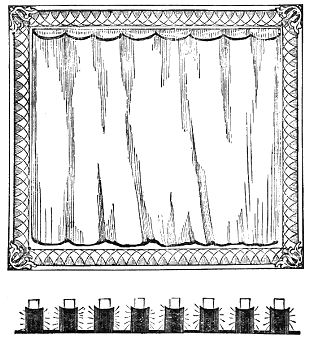
Punctually at eight o'clock he would step hesitatingly before the audience, and rubbing his hands bashfully, commence the lecture.
_______________
THE EGYPTIAN HALL LECTURE.
You are entirely welcome, ladies and gentlemen, to my little picture-shop.
I couldn't give you a very clear idea of the Mormons—and Utah—and the Plains—and the Rocky Mountains—without opening a picture-shop—and therefore I open one.
I don't expect to do great things here—but I have thought that if I could make money enough to by me a passage to New Zealand I should feel that I had not lived in vain.
I don't want to live in vain.—I'd rather live in Margate— or here. But I wish when the Egyptians built this hall they had given it a little more ventilation.
If you should be dissatisfied with anything here to-night—I will admit you all free in New Zealand—if you will come to me there for the orders. Any respectable cannibal will tell you where I live. This shows that I have a forgiving spirit.
I really don't care for money. I only travel round to see the world and to exhibit my clothes. These clothes I have on were a great success in America.
How often do large fortunes ruin young men! I should like to be ruined, but I can get on very well as I am.
I am not an Artist. I don't paint myself—though perhaps if I were a middle-aged single lady I should—yet I have a passion for pictures—I have had a great many pictures—photographs taken of myself. Some of them are very pretty—rather sweet to look at for a short time—and as I said before, I like them. I've always loved pictures.
I could draw on wood at a very tender age. When a mere child I once drew a small cart-load of raw turnips over a wooden bridge.—The people of the village noticed me. I drew their attention. They said I had a future before me. Up to that time I had an idea it was behind me.
Time passed on. It always does, by the way. You may possibly have noticed that Time passes on.—It is a kind of way Time has.
I became a man. I haven't distinguished myself at all as an artist—but I have always been more or less mixed up with Art. I have an uncle who takes photographs—and I have a servant who—takes anything he can get his hands on.
When I was in Rome—Rome in New York State I mean—a distinguished sculpist wanted to sculp me. But I said "No." I saw through the designing man. My model once in his hands—he would have flooded the market with my busts—and I couldn't stand it to see everybody going round with a bust of me. Everybody would want one of course—and wherever I should go I should meet the educated classes with my bust, taking it home to their families. This would be more than my modesty could stand—and I should have to return to America—where my creditors are.
I like Art. I admire dramatic Art—although I failed as an actor.
It was in my schoolboy days that I failed as an actor.—The play was "the Ruins of Pompeii."—I played the Ruins. It was not a very successful performance—but it was better than the "Burning Mountain." He was not good. He was a bad Vesuvius.
The remembrance often makes me ask—"Where are the boys of my youth?"—I assure you this is not a conundrum.—Some are amongst you here—some in America—some are in gaol.—
Hence arises a most touching question—"Where are the girls of my youth?" Some are married—some would like to be.
Oh my Maria! Alas! she married another. They frequently do. I hope she is happy—because I am.*—some people are not happy. I have noticed that.
*(Spoken with a sigh. It was a joke which always told. Artemus never failed to use it in his "Babes in the Wood" lecture, and the "Sixty Minutes in Africa," as well as in the Mormon story.)
A gentleman friend of mine came to me one day with tears in his eyes. I said, "Why these weeps?" He said he had a mortgage on his farm—and wanted to borrow 200 pounds. I lent him the money—and he went away. Some time after he returned with more tears. He said he must leave me for ever. I ventured to remind him of the 200 pounds he borrowed. He was much cut up. I thought I would not be hard upon him—so I told him I would throw off one hundred pounds. He brightened—shook my hand—and said—"Old friend—I won't allow you to outdo me in liberality—I'll throw off the other hundred."
As a manager I was always rather more successful than as an actor.
Some years ago I engaged a celebrated Living American Skeleton for a tour through Australia. He was the thinnest man I ever saw. He was a splendid skeleton. He didn't weigh anything scarcely—and I said to myself—the people of Australia will flock to see this tremendous curiosity. It is a long voyage—as you know—from New York to Melbourne—and to my utter surprise the skeleton had no sooner got out to sea than he commenced eating in the most horrible manner. He had never been on the ocean before—and he said it agreed with him.—I thought so!—I never saw a man eat so much in my life. Beef—mutton—pork—he swallowed them all like a shark—and between meals he was often discovered behind barrels eating hard-boiled eggs. The result was that when we reached Melbourne this infamous skeleton weighed 64 pounds more than I did!
I thought I was ruined—but I wasn't. I took him on to California—another very long sea voyage—and when I got him to San Francisco I exhibited him as a Fat Man.
This story hasn't anything to do with my Entertainment, I know—but one of the principal features of my Entertainment is that it contains so many things that don't have anything to do with it.
My Orchestra is small—but I am sure it is very good—so far as it goes. I give my pianist ten pounds a night—and his washing.
I like Music.—I can't sing. As a singist I am not a success. I am saddest when I sing. So are those who hear me. They are sadder even than I am.
The other night some silver-voiced young men came under my window and sang—"Come where my love lies dreaming."—I didn't go. I didn't think it would be correct.
I found music very soothing when I lay ill with fever in Utah—and I was very ill—I was fearfully wasted.—My face was hewn down to nothing—and my nose was so sharp I didn't dare to stick it into other people's business—for fear it would stay there—and I should never get it again. And on those dismal days a Mormon lady—she was married—tho' not so much so as her husband—he had fifteen other wives—she used to sing a ballad commencing "Sweet bird—do not fly away!"—and I told her I wouldn't.—She played the accordion divinely—accordionly I praised her.
I met a man in Oregon who hadn't any teeth—not a tooth in his head—yet that man could play on the bass drum better than any man I ever met.—He kept a hotel. They have queer hotels in Oregon. I remember one where they gave me a bag of oats for a pillow—I had nightmares of course. In the morning the landlord said—How do you feel—old hoss—hay?—I told him I felt my oats.
Permit me now to quietly state that altho' I am here with my cap and bells I am also here with some serious descriptions of the Mormons—their manners—their customs—and while the pictures I shall present to your notice are by no means works of art—they are painted from photographs actually taken on the spot—and I am sure I need not inform any person present who was ever in the territory of Utah that they are as faithful as they could possibly be.
I went to California on the steamer "Ariel."
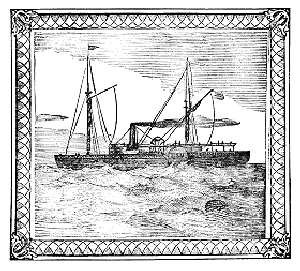
This is the steamer "Ariel."
Oblige me by calmly gazing on the steamer "Ariel"—and when you go to California be sure and go on some other steamer—because the Ariel isn't a very good one.
When I reached the "Ariel"—at pier No. 4—New York—I found the passengers in a state of great confusion about their things—which were being thrown around by the ship's porters in a manner at once damaging and idiotic.—So great was the excitement—my fragile form was smashed this way—and jammed that way—till finally I was shoved into a stateroom which was occupied by two middle-aged females—who said, "Base man—leave us—O leave us!"—I left them—Oh—I left them!
We reach Acapulco on the coast of Mexico in due time. Nothing of special interest occurred at Acapulco—only some of the Mexican ladies are very beautiful. They all have brilliant black hair—hair "black as starless night"—if I may quote from the "Family Herald". It don't curl.—A Mexican lady's hair never curls—it is straight as an Indian's. Some people's hair won't curl under any circumstances.—My hair won't curl under two shillings.*
*(under two shillings)" Artemus always wore his hair straight until his severe illness in Salt Lake City. So much of it dropped off during his recovery that he became dissatisfied with the long meagre appearance his countenance presented when he surveyed it in the looking-glass. After his lecture at the Salt Lake City Theatre he did not lecture again until we had crossed the Rocky Mountains and arrived at Denver City, the capital of Colorado. On the afternoon he was to lecture there I met him coming out of an ironmonger's store with a small parcel in his hand. "I want you, old fellow," he said; "I have been all around the city for them, and I've got them at last." "Got what?" I asked. "A pair of curling-tongs. I am going to have my hair curled to lecture in to-night. I mean to cross the plains in curls. Come home with me and try to curl it for me. I don't want to go to any idiot of a barber to be laughed at." I played the part of friseur. Subsequently he became his own "curlist," as he phrased it. From that day forth Artemus was a curly-haired man.
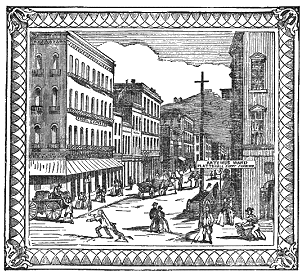
The Chinese form a large element in the population of San Francisco—and I went to the Chinese Theatre.
A Chinese play often lasts two months. Commencing at the hero's birth, it is cheerfully conducted from week to week till he is either killed or married.
The night I was there a Chinese comic vocalist sang a Chinese comic song. It took him six weeks to finish it—but as my time was limited, I went away at the expiration of 215 verses. There were 11,000 verses to this song—the chorus being "Tural lural dural, ri fol day"—which was repeated twice at the end of each verse—making—as you will at once see—the appalling number of 22,000 "tural lural dural, ri fol days"—and the man still lives.
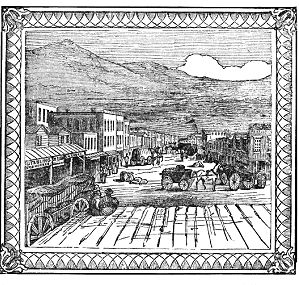
Virginia City—in the bright new State of Nevada.
A wonderful little city—right in the heart of the famous Washoe silver regions—the mines of which annually produce over twenty-five millions of solid silver. This silver is melted into solid bricks—about the size of ordinary house-bricks—and carted off to San Francisco with mules. The roads often swarm with these silver wagons.
One hundred and seventy-five miles to the east of this place are the Reese River Silver Mines—which are supposed to be the richest in the world.
The great American Desert in winter time—the desert which is so frightfully gloomy always. No trees—no houses—no people—save the miserable beings who live in wretched huts and have charge of the horses and mules of the Overland Mail Company.
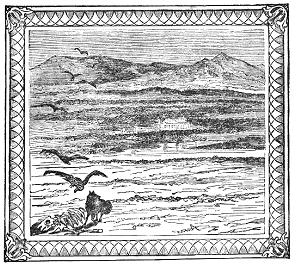
This picture is a great work of art.—It is an oil painting—done in petroleum. It is by the Old Masters. It was the last thing they did before dying. They did this and then they expired.
The most celebrated artists of London are so delighted with this picture that they come to the Hall every day to gaze at it. I wish you were nearer to it—so you could see it better. I wish I could take it to your residences and let you see it by daylight. Some of the greatest artists in London come here every morning before daylight with lanterns to look at it. They say they never saw anything like it before—and they hope they never shall again.
When I first showed this picture in New York, the audience were so enthusiastic in their admiration of this picture that they called for the Artist—and when he appeared they threw brickbats at him.
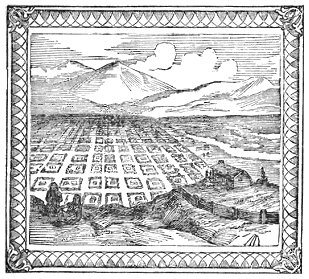
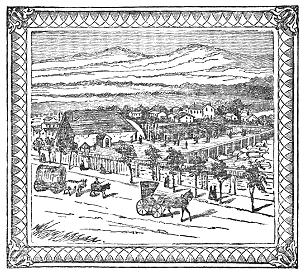
A bird's-eye view of Great Salt Lake City—the strange city in the Desert about which so much has been heard—the city of the people who call themselves Saints.
I know there is much interest taken in these remarkable people—ladies and gentlemen—and I have thought it better to make the purely descriptive part of my Entertainment entirely serious.—I will not—then—for the next ten minutes—confine myself to my subject.
Some seventeen years ago a small band of Mormons—headed by Brigham Young—commenced in the present thrifty metropolis of Utah. The population of the territory of Utah is over 100,000—chiefly Mormons—and they are increasing at the rate of from five to ten thousand annually. The converts to Mormonism now are almost exclusively confined to English and Germans—Wales and Cornwall have contributed largely to the population of Utah during the last few years. The population of Great Salt Lake City is 20,000.—The streets are eight rods wide—and are neither flagged nor paved. A stream of pure mountain spring water courses through each street—and is conducted into the Gardens of the Mormons. The houses are mostly of adobe—or sun-dried brick—and present a neat and comfortable appearance.—They are usually a story and a half high. Now and then you see a fine modern house in Salt Lake City—but no house that is dirty, shabby, and dilapidated—because there are no absolutely poor people in Utah. Every Mormon has a nice garden—and every Mormon has a tidy dooryard.—Neatness is a great characteristic of the Mormons.
The Mormons profess to believe that they are the chosen people of God—they call themselves Latter-day Saints—and they call us people of the outer world Gentiles. They say that Mr. Brigham Young is a prophet—the legitimate successor of Joseph Smith—who founded the Mormon religion. They also say they are authorized—by special revelation from Heaven—to marry as many wives as they can comfortably support.
This wife-system they call plurality—the world calls it polygamy. That at its best it is an accursed thing—I need not of course inform you—but you will bear in mind that I am here as a rather cheerful reporter of what I saw in Utah—and I fancy it isn't at all necessary for me to grow virtuously indignant over something we all know is hideously wrong.
You will be surprised to hear—I was amazed to see—that among the Mormon women there are some few persons of education—of positive cultivation. As a class the Mormons are not educated people—but they are by no means the community of ignoramuses so many writers have told us they were.
The valley in which they live is splendidly favored. They raise immense crops. They have mills of all kinds. They have coal—lead—and silver mines. All they eat—all they drink—all they wear they can produce themselves—and still have a great abundance to sell to the gold regions of Idaho on the one hand—and the silver regions of Nevada on the other.
The President of this remarkable community—the head of the Mormon Church—is Brigham Young.—He is called President Young—and Brother Brigham. He is about 54 years old—altho' he doesn't look to be over 45. He has sandy hair and whiskers—is of medium height—and is a little inclined to corpulency. He was born in the State of Vermont. His power is more absolute than that of any living sovereign—yet he uses it with such consummate discretion that his people are almost madly devoted to him—and that they would cheerfully die for him if they thought the sacrifice were demanded—I cannot doubt.
He is a man of enormous wealth.—One-tenth of everything sold in the territory of Utah goes to the Church—and Mr. Brigham Young is the Church. It is supposed that he speculates with these funds—at all events—he is one of the wealthiest men now living—worth several millions—without doubt.—He is a bold—bad man—but that he is also a man of extraordinary administrative ability no one can doubt who has watched his astounding career for the past ten years. It is only fair for me to add that he treated me with marked kindness during my sojourn in Utah.
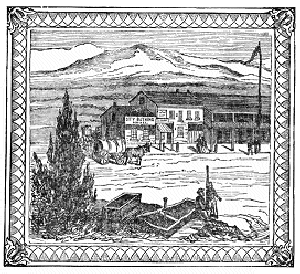
The West Side of Main Street—Salt Lake City—including a view of the Salt Lake Hotel. It is a temperance hotel*. I prefer temperance hotels—altho' they sell worse liquor than any other kind of hotels. But the Salt Lake Hotel sells none—nor is there a bar in all Salt Lake City—but I found when I was thirsty—and I generally am—that I could get some very good brandy of one of the Elders—on the sly—and I never on any account allow my business to interfere with my drinking.
*(At the date of our visit, there was only one place in Salt Lake City where strong drink was allowed to be sold. Brigham Young himself owned the property, and vended the liquor by wholesale, not permitting any of it to be drunk on the premises. It was a coarse, inferior kind of whisky, known in Salt Lake as "Valley Tan." Throughout the city there was no drinking-bar nor billiard room, so far as I am aware. But a drink on the sly could always be had at one of the hard-goods stores, in the back office behind the pile of metal saucepans; or at one of the dry-goods stores, in the little parlor in the rear of the bales of calico. At the present time I believe that there are two or three open bars in Salt Lake, Brigham Young having recognized the right of the "Saints" to "liquor up" occasionally. But whatever other failings they may have, intemperance cannot be laid to their charge. Among the Mormons there are no paupers, no gamblers, and no drunkards.)
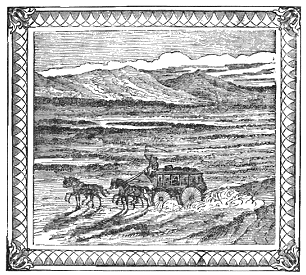
There is the Overland Mail Coach.—That is, the den on wheels in which we have been crammed for the past ten days and ten nights.—Those of you who have been in Newgate* —————————————————————————————-and stayed there any length of time—as visitors—can realize how I felt.
*(The manner in which Artemus uttered this joke was peculiarly characteristic of his style of lecturing. The commencement of the sentence was spoken as if unpremeditated; then when he had got as far as the word "Newgate," he paused, as if wishing to call back that which he had said. The applause was unfailingly uproarious.)
The American Overland Mail Route commences at Sacramento—California—and ends at Atchison—Kansas. The distance is two thousand two hundred miles—but you go part of the way by rail. The Pacific Railway is now completed from Sacramento—California—to Fulsom—California—which only leaves two thousand two hundred and eleven miles, to go by coach. This breaks the monotony—it came very near breaking my back.
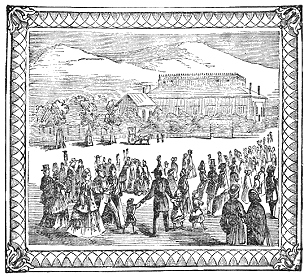
This edifice is the exclusive property of Brigham Young. It will comfortably hold 3,000 persons—and I beg you will believe me when I inform you that its interior is quite as brilliant as that of any theatre in London.
The actors are all Mormon amateurs, who charge nothing for their services.
You must know that very little money is taken at the doors of this theatre. The Mormons mostly pay in grain—and all sorts of articles.
The night I gave my little lecture there—among my receipts were corn—flour—pork—cheese—chickens—on foot and in the shell.
One family went in on a live pig—and a man attempted to pass a "yaller dog" at the Box Office—but my agent repulsed him. One offered me a doll for admission—another infants' clothing.—I refused to take that.—As a general rule I do refuse.
In the middle of the parquet—in a rocking chair—with his hat on—sits Brigham Young. When the play drags—he either goes out or falls into a tranquil sleep.
A portion of the dress-circle is set apart for the wives of Brigham Young. From ten to twenty of them are usually present. His children fill the entire gallery—and more too.
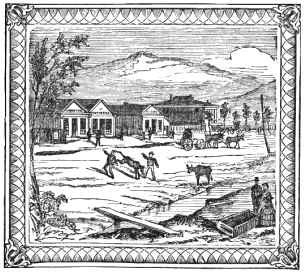
The East Side of Main Street—Salt Lake City—with a view of the Council Building—The legislature of Utah meets there. It is like all legislative bodies. They meet this winter to repeal the laws which they met and made last winter—and they will meet next winter to repeal the laws which they met and made this winter.
I dislike to speak about it—but it was in Utah that I made the great speech of my life. I wish you could have heard it. I have a fine education. You may have noticed it. I speak six different languages—London—Chatham—and Dover——Margate—Brighton—and Hastings. My parents sold a cow—and sent me to college when I was quite young. During the vacation I used to teach a school of whales—and there's where I learned to spout.—I don't expect applause for a little thing like that. I wish you could have heard that speech—however. If Cicero—he's dead now—he has gone from us—but if old Ciss* could have heard that effort it would have given him the rinderpest. I'll tell you how it was. There are stationed in Utah two regiments of U.S. troops—the 21st from California—and the 37th from Nevada. The 20-onesters asked me to present a stand of colors to the 37-sters—and I did it in a speech so abounding in eloquence of a bold and brilliant character—and also some sweet talk—real pretty shopkeeping talk—that I worked the enthusiasm of those soldiers up to such a pitch—that they came very near shooting me on the spot.
*(Here again no description can adequately inform the reader of the drollery which characterized the lecturer. His reference to Cicero was made in the most lugubrious manner, as if he really deplored his death and valued him as a schoolfellow loved and lost.)
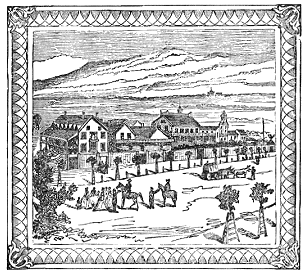
Brigham Young's Harem.—These are the houses of Brigham Young. The first on the right is the Lion House—so called because a crouching stone lion adorns the central front window. The adjoining small building is Brigham Young's office—and where he receives his visitors.—The large house in the centre of the picture—which displays a huge bee-hive—is called the Bee House—the bee-hive is supposed to be symbolical of the industry of the Mormons.—Mrs. Brigham Young the first—now quite an old lady—lives here with her children. None of the other wives of the prophet live here. In the rear are the schoolhouses where Brigham Young's children are educated.
Brigham Young has two hundred wives. Just think of that! Oblige me by thinking of that. That is—he has eighty actual wives, and he is spiritually married to one hundred and twenty more. These spiritual marriages—as the Mormons call them—are contracted with aged widows—who think it a great honor to be sealed—the Mormons call it being sealed—to the Prophet.
So we may say he has two hundred wives. He loves not wisely—but two hundred well. He is dreadfully married. He's the most married man I ever saw in my life.
I saw his mother-in-law while I was there. I can't exactly tell you how many there is of her—but it's a good deal. It strikes me that one mother-in-law is about enough to have in a family—unless you're very fond of excitement.
A few days before my arrival in Utah—Brigham was married again—to a young and really pretty girl—but he says he shall stop now. He told me confidentially that he shouldn't get married any more. He says that all he wants now is to live in peace for the remainder of his days—and have his dying pillow soothed by the loving hands of his family. Well—that's all right—that's all right—I suppose—but if all his family soothe his dying pillow—he'll have to go out-doors to die.
By the way—Shakespeare indorses polygamy.—He speaks of the Merry Wives of Windsor. How many wives did Mr. Windsor have?—but we will let this pass.
Some of these Mormons have terrific families. I lectured one night by invitation in the Mormon village of Provost, but during the day I rashly gave a leading Mormon an order admitting himself and family—It was before I knew that he was much married—and they filled the room to overflowing. It was a great success—but I didn't get any money.
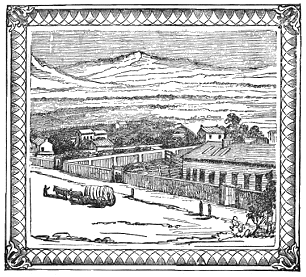
Heber C. Kimball's Harem.—Mr. C. Kimball is the first vice-president of the Mormon church—and would— consequently—succeed to the full presidency on Brigham Young's death.
Brother Kimball is a gay and festive cuss of some seventy summers—or some'ers thereabout. He has one thousand head of cattle and a hundred head of wives. He says they are awful eaters.
Mr. Kimball had a son—a lovely young man—who was married to ten interesting wives. But one day—while he was absent from home—these ten wives went out walking with a handsome young man—which so enraged Mr. Kimball's son—which made Mr. Kimball's son so jealous—that he shot himself with a horse pistuel.
The doctor who attended him—a very scientific man—informed me that the bullet entered the inner parallelogram of his diaphragmatic thorax, superinducing membranous hemorrhage in the outer cuticle of his asiliconthamaturgist. It killed him. I should have thought it would.
*(Soft music.)
*(Here Artemus Ward's pianist [following instructions] sometimes played the dead march from "Saul." At other times, the Welsh air of "Poor Mary Anne;" or anything else replete with sadness which might chance to strike his fancy. The effect was irresistibly comic.)
I hope his sad end will be a warning to all young wives who go out walking with handsome young men. Mr. Kimball's son is now no more. He sleeps beneath the cypress—the myrtle—and the willow. This music is a dirge by the eminent pianist for Mr. Kimball's son. He died by request.
I regret to say that efforts were made to make a Mormon of me while I was in Utah.
It was leap-year when I was there—and seventeen young widows—the wives of a deceased Mormon—offered me their hearts and hands. I called on them one day—and taking their soft white hands in mine—which made eighteen hands altogether—I found them in tears.
And I said—"Why is this thus? What is the reason of this thusness?"
They hove a sigh—seventeen sighs of different size—They said—
"Oh—soon thou wilt be gonested away!"
I told them that when I got ready to leave a place I wentested.
They said—"Doth not like us?"
I said—"I doth—I doth!"
I also said—"I hope your intentions are honorable—as I am a lone child—my parents being far—far away."
They then said—"Wilt not marry us?"
I said—"Oh—no—it cannot was."
Again they asked me to marry them—and again I declined. When they cried—
"Oh—cruel man! This is too much—oh! too much!"
I told them that it was on account of the muchness that I declined.
This is the Mormon Temple.
It is built of adobe—and will hold five thousand persons quite comfortably. A full brass and string band often assists the choir of this church—and the choir—I may add—is a remarkably good one.
Brigham Young seldom preaches now. The younger elders—unless on some special occasion—conduct the services. I only heard Mr. Young once. He is not an educated man—but speaks with considerable force and clearness. The day I was there there was nothing coarse in his remarks.
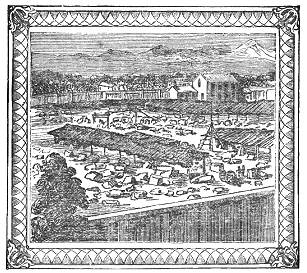
The foundations of the Temple.
These are the foundations of the magnificent Temple the Mormons are building. It is to be built of hewn stone—and will cover several acres of ground. They say it shall eclipse in splendor all other temples in the world. They also say it shall be paved with solid gold.
It is perhaps worthy of remark that the architect of this contemplated gorgeous affair repudiated Mormonism—and is now living in London.
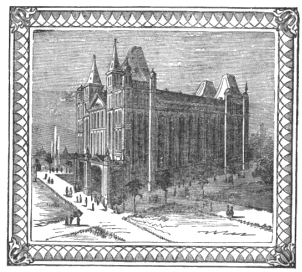
The Temple as it is to be.
Should the Mormons continue unmolested—I think they will complete this rather remarkable edifice.
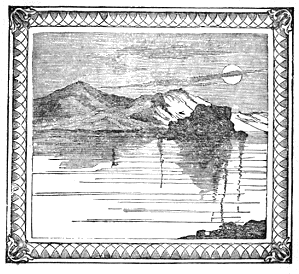
Great Salt Lake.—The great salt dead sea of the desert.
I know of no greater curiosity than this inland sea of thick brine. It is eighty miles wide—and one hundred and thirty miles long. Solid masses of salt are daily washed ashore in immense heaps—and the Mormon in want of salt has only to go to the shore of this lake and fill his cart. Only—the salt for table use has to be subjected to a boiling process.
These are facts—susceptible of the clearest possible proof. They tell one story about this lake—however—that I have my doubts about. They say a Mormon farmer drove forty head of cattle in there once—and they came out first-rate pickled beef.—
* * * * *
* * * * *
* * * * *
* * * * *
* * * * *
I sincerely hope you will excuse my absence—I am a man short—and have to work the moon myself*.
*(Here Artemus would leave the rostrum for a few moments, and pretend to be engaged behind. The picture was painted for a night-scene, and the effect intended to be produced was that of the moon rising over the lake and rippling on the waters. It was produced in the usual dioramic way, by making the track of the moon transparent and throwing the moon on from the bull's eye of the lantern. When Artemus went behind, the moon would become nervous and flickering, dancing up and down in the most inartistic and undecided manner. The result was that, coupled with the lecturer's oddly expressed apology, the "moon" became one of the best laughed-at parts of the entertainment.)
I shall be most happy to pay a good salary to any respectable boy of good parentage and education who is a good moonist.
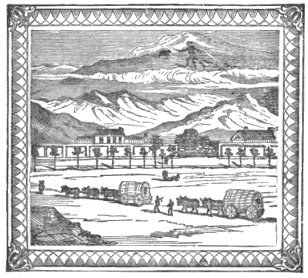
The Endowment House.
In this building the Mormon is initiated into the mysteries of the faith.
Strange stories are told of the proceedings which are held in this building—but I have no possible means of knowing how true they may be.
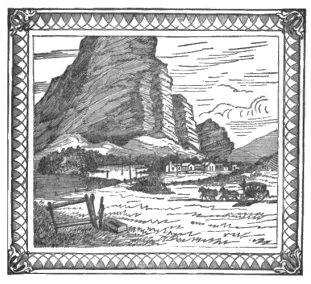
Salt Lake City is fifty-five miles behind us—and this is Echo Canyon—in reaching which we are supposed to have crossed the summit of the Wahsatch Mountains. These ochre-colored bluffs—formed of conglomerate sandstone—and full of fossils—signal the entrance to the Canyon. At its base lies Weber Station.
Echo Canyon is about twenty-five miles long. It is really the sublimest thing between the Missouri and the Sierra Nevada. The red wall to the left develops farther up the Canyon into pyramids—buttresses—and castles—honey-combed and fretted in nature's own massive magnificence of architecture.
In 1856—Echo Canyon was the place selected by Brigham Young for the Mormon General Wells to fortify and make impregnable against the advance of the American army—led by General Albert Sidney Johnson. It was to have been the Thermopylae of Mormondom—but it wasn't. General Wells was to have done Leonidas—but he didn't.
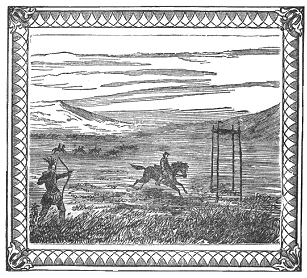
A more cheerful view of the Desert.
The wild snowstorms have left us—and we have thrown our wolf-skin overcoats aside. Certain tribes of far-western Indians bury their distinguished dead by placing them high in air and covering them with valuable furs—that is a very fair representation of these mid-air tombs. Those animals are horses—I know they are—because my artist says so. I had the picture two years before I discovered the fact.—The artist came to me about six months ago—and said—"It is useless to disguise it from you any longer—they are horses."
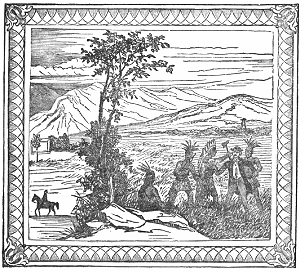
It was while crossing this desert that I was surrounded by a band of Ute Indians. They were splendidly mounted—they were dressed in beaver-skins—and they were armed with rifles—knives—and pistols.
What could I do?—What could a poor old orphan do? I'm a brave man.—The day before the Battle of Bull's Run I stood in the highway while the bullets—those dreadful messengers of death—were passing all around me thickly—IN WAGONS—on their way to the battle-field.*
*(This was the great joke of Artemus Ward's first lecture, "The Babes in the Wood." He never omitted it in any of his lectures, nor did it lose its power to create laughter by repetition. The audiences at the Egyptian Hall, London, laughed as immoderately at it, as did those of Irving Hall, New York, or of the Tremont Temple in Boston.)
But there were too many of these Injuns—there were forty of them—and only one of me—and so I said—
"Great Chief—I surrender." His name was Wocky-bocky.
He dismounted—and approached me. I saw his tomahawk glisten in the morning sunlight. Fire was in his eye. Wocky-bocky came very close to me and seized me by the hair of my head. He mingled his swarthy fingers with my golden tresses—and he rubbed his dreadful Thomashawk across my lily-white face. He said—
"Torsha arrah darrah mishky bookshean!"
I told him he was right.
Wocky-bocky again rubbed his tomahawk across my face, and said—"Wink-ho—loo-boo!"
Says I—"Mr. Wocky-bocky"—says I—"Wocky—I have thought so for years—and so's all our family."
He told me I must go to the tent of the Strong-Heart and eat raw dog*.
*("Raw dog." While sojourning for a day in a camp of Sioux Indians we were informed that the warriors of the tribe were accustomed to eat raw dog to give them courage previous to going to battle. Artemus was greatly amused with the information. When, in after years, he became weak and languid, and was called upon to go to lecture, it was a favorite joke with him to inquire, "Hingston, have you got any raw dog?")
It don't agree with me. I prefer simple food. I prefer pork-pie—because then I know what I'm eating. But as raw dog was all they proposed to give to me—I had to eat it or starve. So at the expiration of two days I seized a tin plate and went to the chief's daughter—and I said to her in a silvery voice—in a kind of German-silvery voice—I said—
"Sweet child of the forest, the pale-face wants his dog."
There was nothing but his paws! I had paused too long! Which reminds me that time passes. A way which time has.
I was told in my youth to seize opportunity. I once tried to seize one. He was rich. He had diamonds on. As I seized him—he knocked me down. Since then I have learned that he who seizes opportunity sees the penitentiary.
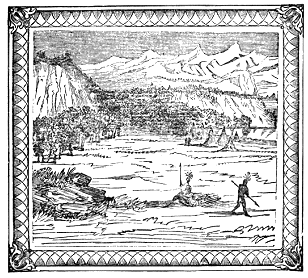
The Rocky Mountains.
I take it for granted you have heard of these popular mountains. In America they are regarded as a great success, and we all love dearly to talk about them. It is a kind of weakness with us. I never knew but one American who hadn't something—some time—to say about the Rocky Mountains—and he was a deaf and dumb man, who couldn't say anything about nothing.
But these mountains—whose summits are snow-covered and icy all the year round—are too grand to make fun of. I crossed them in the winter of '64—in a rough sleigh drawn by four mules.
This sparkling waterfall is the Laughing-Water alluded to by Mr. Longfellow in his Indian poem—"Higher-Water." The water is higher up there.
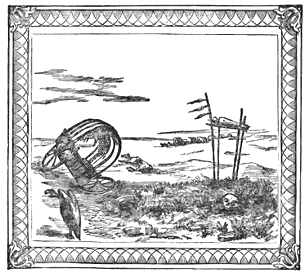
The plains of Colorado.
These are the dreary plains over which we rode for so many weary days. An affecting incident occurred on these plains some time since, which I am sure you will pardon me for introducing here.
On a beautiful June morning—some sixteen years ago—
(Music, very loud till the scene is off.)
* * * * *
* * * * *
* * * * *
* * * * *
* * * * *
—and she fainted on Reginald's breast!*
*"On Reginald's breast." (At this part of the lecture Artemus pretended to tell a story—the piano playing loudly all the time. He continued his narration in excited dumb-show—his lips moving as though he were speaking. For some minutes the audience indulged in unrestrained laughter.)
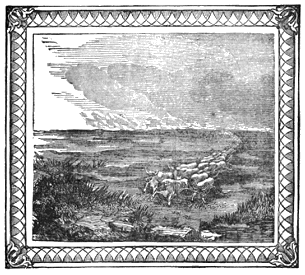
A prairie on fire is one of the wildest and grandest sights that can be possibly imagined.
These fires occur—of course—in the summer—when the grass is dry as tinder—and the flames rush and roar over the prairie in a manner frightful to behold. They usually burn better than mine is burning to-night. I try to make my prairie burn regularly—and not disappoint the public—but it is not as high-principled as I am.*
*(The scene was a transparent one—the light from behind so managed as to give the effect of the prairie on fire. Artemus enjoyed the joke of letting the fire go out occasionally, and then allowing it to relight itself.)
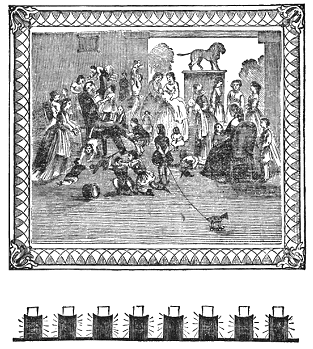
The last picture I have to show you represents Mr. Brigham Young in the bosom of his family. His family is large—and the olive branches around his table are in a very tangled condition. He is more a father than any man I know. When at home—as you here see him—he ought to be very happy with sixty wives to minister to his comforts—and twice sixty children to soothe his distracted mind. Ah! my friends—what is home without a family?
What will become of Mormonism? We all know and admit it to be a hideous wrong—a great immoral strain upon the 'scutcheon of the United States. My belief is that its existence is dependent upon the life of Brigham Young. His administrative ability holds the system together—his power of will maintains it as the faith of a community. When he dies—Mormonism will die too. The men who are around him have neither his talent nor his energy. By means of his strength it is held together. When he falls—Mormonism will also fall to pieces.
That lion—you perceive—has a tail. It is a long one already. Like mine—it is to be continued in our next.
THE END
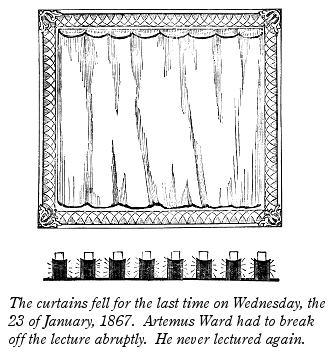
(The curtain fell for the last time on Wednesday, the 23d of January 1867. Artemus Ward had to break off the lecture abruptly. He never lectured again.)
________________________________________
PROGRAMME OF EGYPTIAN HALL LECTURE.
PROGRAMME USED AT EGYPTIAN HALL, PICCADILLY.
________________________________________

A person of long-established integrity will take excellent care of Bonnets, Cloaks, etc., during the Entertainment; the Audience better leave their money, however, with MR. WARD; he will return it to them in a day or two, or invest it for them in America as they may think best.
____________________
The Panorama used to Illustrate Mr. Ward's Narrative is rather more than Panoramas usually are.
____________________
MR. WARD will not be responsible for any debts of his own contracting.
____________________
nbsp;

I.
APPEARANCE Of ARTEMUS WARD,
Who will be greeted with applause. The stall-keeper is particularly requested to attend to this. When quiet has been restored, the Lecturer will present a rather frisky prologue, of about ten minutes in length, and of nearly the same width. It perhaps isn't necessary to speak of the depth.

II.
THE PICTURES COMMENCE HERE, the first one being a view of the California Steamship. Large crowd of citizens on the wharf, who appear to be entirely willing that ARTEMUS WARD shall go. "Bless you, Sir!" they say. "Don't hurry about coming back. Stay away for years, if you want to!" It was very touching. Disgraceful treatment of the passengers, who are obliged to go forward to smoke pipes, while the steamer herself is allowed 2 Smoke Pipes amidships. At Panama. A glance at Mexico.
III.
THE LAND OF GOLD
Montgomery Street, San Francisco. The Gold Bricks. Street Scenes. "The Orphan Cabman, or the Mule Driver's Step-Father." The Chinese Theatre. Sixteen square yards of a Chinese Comic Song.
IV.
THE LAND Of SILVER.
Virginia City, the wild young metropolis of the new Silver State. Fortunes are made there in a day. There are instances on record of young men going to this place without a shilling—poor and friendless—yet by energy, intelligence, and a careful disregard to business, they have been enabled to leave there, owing hundreds of pounds.
V.
THE GREAT DESERT AT NIGHT.
A dreary waste of Sand. The Sand isn't worth saving, however. Indians occupy yonder mountains. Little Injuns seen in the distance trundling their war-hoops.
VI.
A BIRD'S-EYE VIEW OF GREAT SALT LAKE CITY.
With some entirely descriptive talk.
VII.
MAIN STREET, EAST SIDE.
The Salt Lake Hotel, which is conducted on Temperance principles. The landlord sells nothing stronger than salt butter.
VIII.
THE MORMON THEATRE.
The Lady of Lyons was produced here a short time since, but failed to satisfy a Mormon audience, on account of there being only one Pauline in it. The play was revised at once. It was presented the next night, with fifteen Paulines in the cast, and was a perfect success. All these statements may be regarded as strictly true. Mr. Ward would not deceive an infant.
IX.
MAIN STREET, WEST SIDE.
This being a view of Main Street, West side, it is naturally a view of the West side of Main Street.
X.
BRIGHAM YOUNG'S HAREM.
Mr. Young is an indulgent father, and a numerous husband. For further particulars call on Mr. WARD, at Egyptian Hall, any Evening this week. This paragraph is intended to blend business with amusement.
XI.
HEBER C. KIMBALL'S HAREM.
We have only to repeat here the pleasant remarks above in regard to Brigham.
____________________
INTERMISSION OF FIVE MINUTES.
____________________
XII.
THE TABERNACLE.
XIII.
THE TEMPLE AS IT IS.
XIV.
THE TEMPLE AS IT IS TO BE.
XV.
THE GREAT SALT LAKE.
XVI.
THE ENDOWMENT HOUSE.
The Mormon is initiated into the mysteries of his faith here. The Mormon's religion is singular and his wives are plural.
XVII.
ECHO CANYON.
XVIII.
THE DESERT AGAIN.
A more cheerful view. The Plains of Colorado. The Colorado Mountains "might have been seen" in the distance, if the Artist had painted 'em. But he is prejudiced against mountains, because his uncle once got lost on one.
XIX.
BRIGHAM YOUNG AND HIS WIVES.
The pretty girls of Utah mostly marry Young.
XX.
THE ROCKY MOUNTAINS.
XXI.
THE PLAINS OF NEBRASKA.
XXII.
THE PRAIRIE ON FIRE.
____________________
RECOMMENDATIONS.
TOTNESS, Oct. 20th, 1866.
MR. ARTEMUS WARD:
My dear Sir,—My wife was dangerously unwell for over sixteen years. She was so weak that she could not lift a teaspoon to her mouth. But in a fortunate moment she commenced reading one of your lectures. She got better at once. She gained strength so rapidly that she lifted the cottage piano quite a distance from the floor, and then tipped it over on to her mother-in-law, with whom she had some little trouble. We like your lectures very much. Please send me a barrel of them. If you should require any more recommendations, you can get any number of them in this place, at two shillings each, the price I charge for this one, and I trust you may be ever happy.
I am, Sir,
Yours truly, and so is my wife,
R. SPRINGERS.
____________________
An American correspondent of a distinguished journal in Yorkshire thus speaks of Mr. WARD'S power as an Orator:— "It was a grand scene, Mr. ARTEMUS WARD standing on the platform, talking; many of the audience sleeping tranquilly in their seats; others leaving the room and not returning; others crying like a child at some of the jokes—all, all formed a most impressive scene, and showed the powers of this remarkable orator. And when he announced that he should never lecture in that town again, the applause was absolutely deafening."

Doors open at Half-past Seven, commence at Eight.
Conclude at Half-past Nine.
EVERY EVENING EXCEPT SATURDAY.
SATURDAY AFTERNOONS AT 3 P.M.
________________________________________
PROGRAMME OF THE DODWORTH HALL LECTURE
________________________________________
1.—- Introduction.
2.—- The Steamer Ariel, en route.
3.—- San Francisco.
4.—- The Washoe Silver Region.
5.—- The Plains.
6.—- The City of Saints.
7.—- A Mormon Hotel.
8.—- Brigham Young's Theatre.
9.—- The Council-House.
10.—- The Home of Brigham Young.
11.—- Heber C. Kimball's Seraglio.
12.—- The Mormon House of Worship.
13.—- Foundations of the New Temple.
14.—- Architect's View of the Temple when finished.
15.—- The Great Dead Sea of the Desert.
16.—- The House of Mystery.
17.—- The Canyon.
18.—- Mid-Air Sepulture.
19.—- A Nice Family Party at Brigham Young's.
It requires a large number of Artists to produce this Entertainment. The casual observer can form no idea of the quantity of unfettered genius that is soaring, like a healthy Eagle, round this Hall, in connection with this Entertainment. In fact, the following gifted persons compose the

Secretary of the Exterior.....................................................Mr. E.P. Hingston.
Secretary of the Treasury................Herr Max Field,
.(Pupil of Signor Thomaso Jacksoni.)
Mechanical Director and Professor of Carpentry..................Signor G. Wilsoni.
Crankist......................................................................................Mons. Aleck.
Assistant Crankist.......................................................................Boy (orphan).
Artists....................................................................Messrs. Hilliard & Maeder.
Reserved Chairists...................................................Messrs. Persee & Jerome.
Moppist...........................................................................Signorina O'Flaherty.
Broomist.................................................................Mlle. Topsia de St. Moke.
Hired Man...............................................................................................John.
Fighting Editor...................................................................Chevalier McArone.
Dutchman............................................By a Polish Refugee, named McFinnigin.
Doortendist...................................................................Mons. Jacques Ridera.
Gas Man..................................................................................Artemus Ward.
This Entertainment will open with music. The soldiers' Chorus from "Faust." First time in this city.
*
* *
Next comes a jocund and discursive preamble, calculated to show what a good education the Lecturer has
*
* *
View the first is a sea-view.—Ariel navigation.—Normal school of whales in the distance.—Isthmus of Panama.—Interesting interview with Old Panama himself, who makes all the hats.—Old Pan is a likely sort of man.
*
* *
San Francisco.—City with a vigilant government.—Miners allowed to vote. Old inhabitants so rich that they have legs with golden calves to them.
*
* *
Town in the Silver region.—Good quarters to be found there.—Playful population, fond of high-low-jack and homicide.—Silver lying around loose.—Thefts of it termed silver-guilt.
*
* *
The plains in Winter.—A wild Moor, like Othello.—Mountains in the distance forty thousand miles above the level of the highest sea (Musiani's chest C included).—If you don't believe this you can go there and measure them for yourself.
*
* *
Mormondom, sometimes called the City of the Plain, but wrongly; the women are quite pretty.—View of Old Poly Gamy's house, &c.
*
* *
The Salt Lake Hotel.—Stage just come in from its overland route and retreat from the Indians.—Temperance house.—No bar nearer than Salt Lake sand-bars.—Miners in shirts like Artemus Ward his Programme—they are read and will wash.
*
* *
Mormon Theatre, where Artemus Ward lectured.—Mormons like theatricals, and had rather go to the Playhouse than to the Workhouse, any time. Private boxes reserved for the ears of Brother Brigham's wives.
*
* *
Intermission of Five Minutes.
*
* *
Territorial State-House.—Seat of the Legislature.—About as fair a collection as that at Albany—and "we can't say no fairer than that."
*
* *
Residence of Brigham Young and his wives.—Two hundred souls with but a single thought, Two hundred hearts that beat as one.
*
* *
Seraglio of Heber C. Kimball.—Home of the Queens of Heber.—No relatives of the Queen of Sheba.—They are a nice gang of darlings.
*
* *
Mormon Tabernacle, where the men espouse Mormonism and the women espouse Brother Brigham and his Elders as spiritual Physicians, convicted of bad doct'rin.
*
* *
Foundations of the Temple.—Beginning of a healthy little job.—Temple to enclose all out-doors, and be paved with gold at a premium.
*
* *
The Temple when finished.—Mormon-idea of a meeting-house.—N.B. It will be bigger, probably, than Dodworth Hall.—one of the figures in the foreground is intended for Heber C. Kimball.—You can see, by the expression of his back, that he is thinking what a great man Joseph Smith was.
*
* *
The Great Salt Lake.—Water actually thick with salt—too saline to sail in.—Mariners rocked on the bosom of this deep with rock salt.—The water isn't very good to drink.
*
* *
House where Mormons are initiated.—Very secret and mysterious ceremonies.—Anybody can easily find out all about them though, by going out there and becoming a Mormon.
*
* *
Echo Canyon.—A rough bluff sort of affair.—Great Echo.—When Artemus Ward went through, he heard the echoes of some things the Indians said there about four years and a half ago.
*
* *
The Plains again, with some noble savages, both in the live and dead state.—The dead one on the high shelf was killed in a Fratricidal Struggle.—They are always having Fratricidal Struggles out in that line of country.—It would be a good place for an enterprising Coroner to locate.
*
* *
Brigham Young surrounded by his wives—Those ladies are simply too numerous to mention.
*
* *
Those of the Audience who do not feel offended with Artemus Ward are cordially invited to call upon him, often, at his fine new house in Brooklyn. His house is on the right hand side as you cross the Ferry, and may be easily distinguished from the other houses by its having a Cupola and a Mortgage on it.
*
* *
Soldiers on the battle-field will be admitted to this Entertainment gratis.
*
* *
*
* *
The Indians on the Overland Route live on Routes and Herbs. They are an intemperate people. They drink with impunity, or anybody who invites them.
*
* *
Artemus Ward delivered Lectures before
ALL THE CROWNED HEADS OF EUROPE
ever thought of delivering lectures.
TICKETS, 50 CTS. RESERVED CHAIRS, $1
Doors open at 7.30 P.M.; Entertainment to commence at 8.
____________________
ARTEMUS WARD
PART VII.
____________________
I.
THE CRUISE OF THE POLLY ANN.
In overhaulin one of my old trunks the tother day, I found the follerin jernal of a vyge on the starnch canawl bote, Polly Ann, which happened to the subscriber when I was a young man (in the Brite Lexington of yooth, when thar aint no sich word as fale) on the Wabash Canawl:
Monday, 2 P.M.—Got under wa. Hosses not remarkable frisky at fust. Had to bild fires under 'em before they'd start. Started at larst very suddent, causin the bote for to lurch vilently and knockin me orf from my pins. (Sailor frase.) Sevral passenjers on bored. Parst threw deliteful country. Honest farmers was to work sowin korn, and other projuce in the fields. Surblime scenery. Large red-heded gal reclinin on the banks of the Canawl, bathin her feet.
Turned in at 15 minits parst eleving.
Toosdy.—Riz at 5 and went up on the poop deck. Took a grown person's dose of licker with a member of the Injianny legislater, which he urbanely insisted on allowin me to pay for. Bote tearin threu the briny waters at the rate of 2 Nots a hour, when the boy on the leadin hoss shoutid—
"Sale hoe!"
"Whar away?" hollered the capting, clearin his glass (a empty black bottle, with the bottom knockt out) and bringing it to his Eagle eye.
"Bout four rods to the starbud," screamed the boy.
"Jes so," screeched the capting. "What wessel's that air?"
"Kickin Warier of Terry Hawt, and be darned to you!"
"I, I, Sir!" hollered our capting. "Reef your arft hoss, splice your main jib-boom, and hail your chamber-maid! What's up in Terry Hawt?"
"You know Bill Spikes?" said the capting of the Warier.
"Wall, I reckin. He can eat more fride pork nor any man of his heft on the Wabash. He's a ornament to his sex!"
"Wall," continued the capting of the Kickin Warier. "Wilyim got a little owly the tother day, and got to prancin around town on that old white mare of his'n, and bein in a playful mood, he rid up in front of the Court 'us whar old Judge Perkins was a holdin Court, and let drive his rifle at him. The bullet didn't hit the Judge at all; it only jes whizzed parst his left ear, lodgin in the wall behind him; but what d'ye spose the old despot did? Why, he actooally fined Bill ten dollars for contempt of Court! What do you think of that?" axed the capting of the Warier, as he parst a long black bottle over to our capting.
"The country is indeed in danger!" said our capting, raisin the bottle to his lips. The wessels parted. No other incidents that day. Retired to my chased couch at 5 minits parst 10.
Wensdy.—Riz arly. Wind blowin N.W.E. Hevy sea on, and ship rollin wildly in consekents of pepper-corns havin been fastened to the forrerd hoss's tale. "Heave two!" roared the capting to the man at the rudder, as the Polly giv a friteful toss. I was sick, an sorry I'd cum. "Heave two!" repeated the capting. I went below. "Heave two!" I hearn him holler agin, and stickin my hed out of the cabin winder, I hev.
The hosses became docile eventually, and I felt better. The sun bust out in all his splender, disregardless of expense, and lovely Natur put in her best licks. We parst the beautiful village of Limy, which lookt sweet indeed, with its neat white cottages, Institoots of learnin and other evijences of civillizashun, incloodin a party of bald heded cullered men was playing 3 card monty on the stoop of the Red Eagle tavern. All, all was food for my 2 poetic sole. I went below to breakfast, but vittles had lost their charms. "Take sum of this," said the Capting, shovin a bottle tords my plate. "It's whisky. A few quarts allers sets me right when my stummick gits out of order. It's a excellent tonic!" I declined the seductive flooid.
Thursdy.—Didn't rest well last night on account of a uprore made by the capting, who stopt the Bote to go ashore and smash in the windows of a grosery. He was brought back in about a hour, with his hed dun up in a red handkercher, his eyes bein swelled up orful, and his nose very much out of jint. He was bro't aboard on a shutter by his crue, and deposited on the cabin floor, the passenjers all risin up in their births pushing the red curtains aside & lookin out to see what the matter was. "Why do you allow your pashuns to run away with you in this onseemly stile, my misgided frend?" said a sollum lookin man in a red flannel nite-cap. "Why do you sink yourself to the Beasts of the field?"
"Wall, the fack is," said the capting, risin hisself on the shutter, "I've bin a little prejoodiced agin that grosery for some time. But I made it lively for the boys, deacon! Bet yer life!" He larfed a short, wild larf, and called for his jug. Sippin a few pints, he smiled gently upon the passengers, sed, "Bless you! Bless you!" and fell into a sweet sleep.
Eventually we reached our jerny's end. This was in the days of Old Long Sign, be4 the iron hoss was foaled. This was be4 steembotes was goin round bustin their bilers & sendin peple higher nor a kite. Them was happy days, when people was intelligent & wax figgers & livin wild beests wasn't scoffed at.
"O dase of me boyhood I'm dreamin on ye now!"
(Poeckry.)
A.W.
____________________
II.
BETSY-JAIN RE-ORGUNIZED.
I NEVER attempted to re-Orgunize my wife but onct. I shall sever attempt agin.
I'd bin to a public dinner, and had allowed myself to be betrayed inter drinkin several peple's healths; and wishin to maik 'em as Ro-Bust as posserble, I continner'd drinkin thur healths until mi Own becum afflicktid. Consekens was, I presunted myself at Betty's bedside late at nite, with considerbul licker koncealed about my persun.
I hed somehow got perseschun of a hosswhip on my way hum, and rememberin some kranky observashuns of Mrs Ward's in the mornin, I snapt the whip putty lively, and in a very loud voyce I said, "Betsy, you need re-Orgunizin! I have cum, Betsy," I continnered, crackin the whip over the bed—" I have cum to re-Orgunize yer! Ha-awe you per-aged to-night?
* * * * * * * *
I dreamed that nice that sumbody had layd a hosswhip over me sevril conseckootive times, and when I woke up I found she had.
I haint drunk mich of anythin sence, and ef I ever have anuther re-Orgunizin job on hand I shall let it out.
____________________
ARTEMUS WARD'S AUTOBIOGRAPHY.
New York, near Fifth Avenoo Hotel, Org. 31ct.
EDITER OF PLAY BILL.
Dr Sir,—Yrs, into which you ask me to send you sum leadin incidents in my life so you can write my Bogfry for the papers, cum dooly to hand. I hav no doubt that a article onto my life, grammattycally jerked and properly punktooated, would be a addition to the chois literatoor of the day.
To the youth of Ameriky it would be vallyble as showin how high a pinnykle of fame a man can reach who commenst his career with a small canvas tent and a pea-green ox, which he rubbed it off while scrachin hisself agin the center pole, causin in Rahway, N.Y., a discriminatin mob to say humbugs would not go down in their village. The ox resoom'd agricultooral pursoots shortly afterwards.
I next tried my hand at givin Blind-man concerts, appearin as the poor blind man myself. But the infamus cuss who I hired to lead me round towns in the day time to excite simpathy drank freely of spiritoous licker unbeknowns to me one day, & while under their inflooance he led me into the canal. I had to either tear the green bandige from my eyes or be drownded. I tho't I'd restore my eyesight.
In writin about these things, Mr. Editer, kinder smooth em over. Speak of 'em as eccentrissities of gen'us.
My next ventur would hav bin a success if I hadn't tried to do too much. I got up a series of wax figgers, and among others one of Socrates. I tho't a wax figger of old Sock. would be poplar with eddycated peple, but unfortinitly I put a Brown linen duster and a U.S. Army regulation cap on him, which peple with classycal eddycations said it was a farce. This enterprise was onfortnit in other respecks. At a certin town I advertised a wax figger of the Hon'ble Amos Perkins, who was a Railroad President, and a great person in them parts. But it appeared I had shown the same figger for a Pirut named Gibbs in that town the previs season, which created a intense toomult, & the audience remarked "shame onto me," & other statements of the same similarness. I tried to mollify em. I told 'em that any family possessin children might have my she tiger to play with half a day, & I wouldn't charge 'em a cent, but alars! it was of no avail. I was forced to leave, & I infer from a article in the "Advertiser" of that town, in which the Editer says, "Atho' time has silvered this man's hed with its frosts, he still brazenly wallows in infamy. Still are his snakes stuffed, and his wax works unrelible. We are glad that he has concluded never to revisit our town, altho', incredible as it may appear, the fellow really did contemplate so doing last summer, when, still true to the craven instincts of his black heart, he wrote the hireling knaves of the obscure journal across the street to know what they would charge for 400 small bills, to be done on yellow paper! We shall recur to this matter again!"
I say, I infer from this article that a prejudiss still exists agin me in that town.
I will not speak of my once bein in straitend circumstances in a sertin town, and of my endeaverin to accoomulate welth by lettin myself to Sabbath School picnics to sing ballads adapted to the understandins of little children, accompanyin myself on a claironett—which I forgot where I was one day, singing, instid of "Oh, how pleasant to be a little child,"
"Rip slap—set em up again, Right in the middle of a three-cent pie,"
which mistake, added to the fact that I couldn't play onto the claironett except makin it howl dismal, broke up the picnic, and children said, in voices choked with sobs and emotions, where was their home and where was their Pa? and I said, Be quiet, dear children, I am your Pa, which made a young woman with two twins by her side say very angryly, "Good heavens forbid you should ever be the Pa of any of these innocent ones, unless it is much desirable for them to expire igminyusly upon to a murderer's gallus!"
I say I will not speak of this. Let it be Berrid into Oblivyun.
In your article, Mr. Editer, please tell him what sort of a man I am.
If you see fit to kriticise my Show speak your mind freely. I do not object to kriticism. Tell the public, in a candid and graceful article, that my Show abounds in moral and startlin cooriosities, any one of whom is wuth dubble the price of admission.
I hav thus far spoke of myself excloosivly as a exhibiter.
I was born in the State of Maine of parents. As a infant I attracted a great deal of attention. The nabers would stand over my cradle for hours and say, "How bright that little face looks! How much it nose!" The young ladies would carry me round in their arms, sayin I was muzzer's bezzy darlin and a sweety 'eety 'ittle ting. It was nice, tho' I wasn't old enuf to properly appreciate it. I'm a healthy old darlin now.
I have allers sustained a good moral character. I was never a Railroad director in my life.
Altho' in early life I did not inva'bly confine myself to truth in my small bills, I have been gradoolly growin respectabler and respectabler ev'ry year. I luv my children, and never mistake another man's wife for my own. I'm not a member of any meetin house, but firmly bel'eve in meetin houses, and shouldn't feel safe to take a dose of laudnum and lay down in the street of a village that hadn't any, with a thousand dollars in my vest pockets.
My temperament is billious, altho' I don't owe a dollar in the world.
I am a early riser, but my wife is a Presbyterian. I may add that I am also bald-heded. I keep two cows.
I live in Baldinsville, Indiany. My next door naber is Old Steve Billins. I'll tell you a little story about Old Steve that will make you larf. He jined the Church last spring, and the minister said, "You must go home now, Brothern Billins, and erect a family altar in your own house," whereupon the egrejis old ass went home and built a reg'lar pulpit in his sittin room. He had the jiners in his house over four days.
I am 56 (56) years of age. Time, with its relentless scythe, is ever busy. The Old Sexton gathers them in, he gathers them in! I keep a pig this year.
I don't think of anything more, Mr Ed'ter.
If you should giv my portrait in connection with my Bogfry, please have me ingraved in a languishin attitood, learnin on a marble pillar, leavin my back hair as it is now.—Trooly yours.
Artemus Ward.
____________________
THE SERENADE.
Things in our town is workin. The canal boat "Lucy Ann" called in here the other day and reported all quiet on the Wabash. The "Lucy Ann" has adopted a new style of Binnakle light, in the shape of a red-headed girl, who sits up over the compass. It works well.
The artist I spoke about in my larst has returned to Philadelphy. Before he left I took his lily-white hand in mine. I suggested to him that if he could induce the citizens of Philadelphy to believe it would be a good idea to have white winder-shutters on their houses and white door-stones, he might make a fortin. "It's a novelty," I added, "and may startle 'em at fust, but they may conclood to adopt it.
As several of our public men are constantly being surprised with serenades, I concluded I'd be surprised in the same way, so I made arrangements accordin. I asked the Brass Band how much they'd take to take me entirely by surprise with a serenade. They said they'd overwhelm me with a unexpected honor for seven dollars, which I excepted.
I wrote out my impromptoo speech severil days beforehand bein very careful to expunge all ingramatticisms and payin particuler attention to the punktooation. It was, if I may say it without egitism, a manly effort; but, alars! I never delivered it, as the sekel will show you. I paced up and down the kitchin speakin my piece over so as to be entirely perfeck. My bloomin young daughter, Sarah Ann, bothered me summut by singin, "Why do summer roses fade?"
"Because," said I, arter hearin her sing it about fourteen times, "because it's their biz! Let 'em fade!"
"Betsy," said I, pausin in the middle of the room and letting my eagle eye wander from the manuscrip—"Betsy, on the night of this here serenade, I desires you to appear at the winder dressed in white, and wave a lily-white handkercher. D'ye hear?"
"If I appear," said that remarkable female, "I shall wave a lily-white bucket of bilin hot water, and somebody will be scalded. One bald-headed old fool will get his share."
She refer'd to her husband. No doubt about it in my mind. But for fear she might exasperate me I said nothin.
The expected night cum. At nine o'clock precisely there was sounds of footsteps in the yard, and the Band struck up a lively air, which when they did finish it, there was cries of "Ward! Ward!" I stept out onto the portico. A brief glance showed me that the assemblage was summut mixed. There was a great many ragged boys, and there was quite a number of grown-up persons evigently under the affluence of the intoxicatin bole. The Band was also drunk. Dr. Schwazey, who was holdin up a post, seemed to be partic'ly drunk—so much so that it had got into his spectacles, which were staggerin wildly over his nose. But I was in for it, and I commenced:—
"Feller Citizens,—For this onexpected honor—"
LEADER OF THE BAND.—Will you give us our money now, or wait till you git through?"
To this painful and disgustin interruption I paid no attention.
"—for this onexpected honor, I thank you."
LEADER OF THE BAND.—"But you said you'd give us seven dollars if we'd play two choons."
Again I didn't notice him, but resumed as follows:—
"I say, I thank you warmly. When I look at this crowd of true Americans, my heart swells—"
DR. SCHWAZEY.—"So do I!"
A VOICE.—"We all do!"
"—my heart swells—"
A VOICE.—"Three cheers for the swells."
"We live," said I, "in troublous times, but I hope we shall again resume our former proud position, and go on in our glorious career!"
DR. SCHWAZEY.—I'm willin for one to go on in a glorious career! Will you join me, fellow-citizens, in a glorious career? What wages does a man git for a glorious career, when he finds himself?"
"Dr, Schwazey," said I, sternly, "you are drunk. You're disturbin the meetin."
DR. S.—Have you a banquet spread in the house? I should like a rhunossyross on the half shell, or a hippopotamus on toast, or a horse and wagon roasted whole. Anything that's handy. Don't put yourself out on me account.
At this point the Band begun to make hidyous noises with their brass horns, and an exceedingly ragged boy wanted to know if there wasn't to be some wittles afore the concern broke up? I didn't exactly know what to do, and was just on the point of doin it, when a upper winder suddenly opened, and a stream of hot water was bro't to bear on the disorderly crowd, who took the hint and retired at once.
When I am taken by surprise with another serenade, I shall, among other arrangements, have a respectful company on hand. So no more from me to-day. When this you see, remember me.
____________________
O'BOURCY'S "ARRAH-NA-POGUE."
You axe me, sir, to sling sum ink for your paper in regards to the new Irish dramy at Niblo's Garding. I will do it, sir.
I knew your grandfather well, sir. Sum 16 years ago, while I was amoosin and instructin the intellectoal peple of Cape Cod with my justly pop'lar Show, I saw your grandfather. He was then between 96 years of age, but his mind was very clear. He told me I looked like George Washington. He said I had a massiv intellect. Your grandfather was a highly-intelligent man, and I made up my mind then that if I could ever help his family in any way, I'd do so. Your grandfather gave me sum clams and a Testament. He charged me for the clams but threw in the Testament. He was a very fine man.
I therefore rite for you, which insures your respectability at once. It gives you a moral tone at the word go.
I found myself the other night at Niblo's Garding, which is now, by the way, Wheatley's Garding. (I don't know what's bcum of Nib.) I couldn't see much of a garding, however, and it struck me if Mr. Wheatley depended on it as regards raisin things, he'd run short of gardin sass. [N.B.—These remarks is yoomerous. The older I gro, the more I want to goak.]
I walked down the isle in my usual dignified stile, politely tellin the people as I parsed along to keep their seats. "Don't git up for me," I sed. One of the prettiest young men I ever saw in my life showed me into a seat, and I proceeded to while away the spare time by reading Thompson's "Bank Note Reporter" and the comic papers.
The ordinance was large.
I tho't, from a cursiry view, that the Finnigan Brotherhood was well represented.
There was no end of bootiful wimin, and a heap of good clothes. There was a good deal of hair present that belonged on the heds of peple who didn't cum with it—but this is a ticklish subjeck for me. I larfed at my wife's waterfall, which indoosed that superior woman to take it off and heave it at me rather vilently; and as there was about a half bushil of it, it knockt me over, and give me pains in my body which I hain't got over yit.
The orkistry struck up a toon, & I asked the Usher to nudge me when Mr. Pogue cum on the stage to act.
I wanted to see Pogue; but, strange to say, he didn't act during the entire evenin. I reckin he has left Niblo's, and gone over to Barnum's.
Very industrious pepl are the actors at Barnum's. They play all day, and in the evenin likewise. I meet'm every mornin, at five o'clock, going to their work with their tin dinner-pails. It's a sublime site. Many of them sleep on the premises.
Arrah-na-Pogue was writ by Dion O'Bourcicolt & Edward McHouse. They writ it well. O'Bourcy has writ a cartload of plays himself, the most of which is fust-rate.
I understand there is a large number of O'gen'tlmen of this city who can rite better plays than O'Bourcy does, but somehow they don't seem to do it. When they do, I'll take a Box of them.
As I remarked to the Boy who squirted peppersass through a tin dinner-horn at my trained Bear (which it caused that feroshus animal to kick up his legs and howl dismal, which fond mothers fell into swoons and children cride to go home because fearin the Bear would leave his jungle and tear them from limb to limb), and then excoosed himself (this Boy did) by sayin he had done so while labourin under a attack of Moral Insanity—as I sed to that thrifty youth, "I allus incurridge geenyus, whenever I see it."
It's the same with Dan Bryant. I am informed there are better Irish actors than he is, but somhow I'm allus out of town when they act, & so is other folks, which is what's the matter.
ACK THE 1.—Glendalo by moonlite.
Irishmen with clubs.
This is in 1798, the year of your birth, Mr. Editor.
It appears a patriotic person named McCool has bin raisin a insurrection in the mountain districts, and is now goin to leave the land of his nativity for a tower in France. Previsly to doin so he picks the pockit of Mr. Michael Feeny, a gov'ment detectiv, which pleases the gallery very much indeed, and they joyfully remark, "hi, hi."
He meets also at this time a young woman who luvs him dearer than life, and who is, of course, related to the gov'ment; and just as the gov'ment goes agin him she goes for him. This is nat'ral, but not grateful. She sez, "And can it be so? Ar, tell me it is not so thusly as this thusness wouldst seem!" or words to that effect.
He sez it isn't any other way, and they go off.
Irish moosic by the Band.
Mr. McCool goes and gives the money to his foster-sister, Miss Arrah Meelish, who is goin to shortly marry Shaun, the Lamp Post. Mac then alters his mind about goin over to France, and thinks he'll go up-stairs and lie down in the straw. This is in Arrah's cabin. Arrah says it's all right, me darlint, och hone, and shure, and other pop'lar remarks, and Mac goes to his straw.
The wedding of Shaun and Arrah comes off.
Great excitement. Immense demonstration on the part of the peasantry. Barn-door jigs, and rebelyus song by McHouse, called "The Drinkin of the Gin." Ha, what is this? Soldiers cum in. Moosic by the band. "Arrah," sez the Major, "you have those money." She sez, "Oh no, I guess not." He sez, "Oh yes, I guess you have." "It is my own," sez she, and exhibits it. "It is mine," says Mr. Feeny, and identifies it.
Great confusion.
Coat is prodoosed from up-stairs.
"Whose coat is this?" sez the Major. "Is it the coat of a young man secreted in this here cabin?"
Now this is rough on Shaun. His wife accoosed of theft, the circumstances bein very much agin her, and also accoosed of havin a hansum young man hid in her house. But does this bold young Hibernian forsake her? Not much, he dont. But he takes it all on himself, sez he is the guilty wretch, and is marcht off to prison.
This is a new idea. It is gin'rally the wife who suffers, in the play, for her husband; but here's a noble young feller who shuts both his eyes to the apparent sinfulness of his new young wife, and takes her right square to his bosom. It was bootiful to me, who love my wife, and believe in her, and would put on my meetin clothes and go to the gallus for her cheerfully, ruther than believe she was capable of taking anybody's money but mine. My marrid friends, listen to me: If you treat your wives as though' they were perfeck gentlemen—if you show 'em that you have entire confidence in them—believe me, they will be troo to you most always.
I was so pleased with this conduct of Shaun that I hollered out, "Good boy! Come and see me!"
"Silence!" sum people said.
"Put him out!" said a sweet-scented young man, with all his new clothes on, and in company with a splendid waterfall, "put this old fellow out!"
"My young friend," said I, in a loud voice, "whose store do you sell tape in? I might want to buy a yard before I go hum."
Shaun is tried by a Military Commission. Colonel O'Grady, although a member of the Commission, shows he sympathizes with Shaun, and twits Feeny, the Gov'ment witness, with being a knock-kneed thief, &c., &c. Mr. Stanton's grandfather was Sec'y of War in Ireland at that time, so this was entirely proper.
Shaun is convicted and goes to jail. Hears Arrah singin outside. Wants to see her a good deal. A lucky thought strikes him; he opens the window and gets out. Struggles with ivy and things on the outside of the jail, and finally reaches her just as Mr. Feeny is about to dash a large wooden stone onto his head. He throws Mr. F. into the river. Pardon arrives. Fond embraces. Tears of joy and kisses a la Pogue. Everybody much happy.
Curtain falls.
This is a very harty outline of a splendid play. Go and see it—Yours till then,
A. Ward.
____________________
ARTEMUS WARD AMONG THE FENIANS.
To Home, April 1866.
The Finians conveened in our town the other night, and took steps toord freein Ireland. They met into the Town Hall, and by the kind invite of my naber, Mr. Mulrooney O'Shaughnessy, whose ancestors at least must have Irish blood in their veins, I went over.
You may not be awair, by the way, that I've been a invalid here to home for sev'ril weeks. And it's all owin to my own improodens. Not feelin like eating a full meal when the cars stopt for dinner, in the South, where I lately was, I went into a Resterater and et 20 hard biled eggs. I think they effected my Liver.
My wife says, Po, po. She says I've got a splendid liver for a man of my time of life. I've heard of men's livers gradooally wastin' away till they hadn't none. It's a dreadful thing when a man's liver gives him the shake.
Two years ago comin this May, I had a 'tack of fever-'n-ager, and by the advice of Miss Peasley who continues single and is correspondinly unhappy in the same ratios I consulted a Spiritul mejum—a writin' mejum. I got a letter from a cel'brated Injin chief, who writ me, accordin to the mejum, that he'd been ded two hundred and seventeen (217) years, and liked it. He then said, let the Pale face drink sum yarb tea. I drinkt it, and it really helpt me. I've writ to this talented savige this time thro' the same mejum, but as yet I hain't got any answer. Perhaps he's in a spear where they haint' got any postage stamps.
But thanks to careful nussin, I'm improvin rapid.
The Town Hall was jam-full of peple, mostly Irish citizens, and the enthusiasm was immense. They cheer'd everybody and everything. They cheer'd me.
"Hurroo for Ward! Hurroo!"
They was all good nabers of mine, and I ansered in a pleasant voice, "All right, boys, all right. Mavoorneen, och hone, aroon, Cooshla macree!"
These Irish remarks bein' received with great applaus, I added, "Mushler! mushler!"
"Good! good!" cried Captain Spingler, who desires the Irish vote for country clerk; "that's fus' rate."
"You see what I'm drivin at, don't you, Cap?" I said.
"Certainly."
"Well," I ansered, "I'm very glad you do, becaus I don't."
This made the Finians larf, and they said, "Walk up onto the speaker's platform sir."
The speeches was red hot agin England, and hir iron heel, and it was resolved to free Ireland at onct. But it was much desirable before freein her that a large quantity of funds should be raised. And, like the gen'rous souls as they was, funs was lib'rally contribooted. Then arose a excitin discussion as to which head center they should send 'em to—O'Mahony or McRoberts. There was grate excitement over this, but it was finally resolved to send half to one and half to 'tother.
Then Mr. Finnigan rose and said, "We have here to-night sum citizens of American birth, whom we should be glad to hear. It would fill our harts with speechless joy to hear from a man whose name towers high in the zoological and wax-figger world—from whose pearly lips—
Says I, "Go slow, Finny, go slow."
"We wish to hear," continued Mr. Finnigan, moderatin his stile summut, "from our townsman, Mr. Ward."
I beg'd to be declined, but it wan't no use. I rose amid a perfeck uproar of applause.
I said we had convened there in a meetin, as I understood it, or rather in a body, as it were, in reference to Ireland. If I knew my own hart, every one of us there, both grate and small had an impulse flowin in his boosum, "and consequentially," I added, we "will stick to it similar and in accordance therewith, as long as a spark of manhood, or the peple at large. That's the kind of man I be!"
Squire Thaxter interrupted me. The Squire feels the wrongs of Ireland deeply, on accounts of havin onct courted the widder of a Irish gentleman who had lingered in a loathsum dunjin in Dublin, placed there by a English tarvern-keeper, who despotically wanted him to pay for a quantity of chops and beer he had consoom'd. Besides, the Squire wants to be re-elected Justice of the Peace. "Mr. Ward," he said, "you've bin drinkin. You're under the infloo'nce of licker, sir!"
Says I, "Squire, not a drop of good licker has passed my lips in fifteen years.
[Cries of "Oh, here now, that won't do."]
"It is troo," I said. "Not a drop of good licker has passed my lips in all that time. I don't let it pass 'em. I reach for it while it's goin by!" says I. "Squire, harness me sum more!"
"I beg pardon," said the Squire, "for the remark; you are sober; but what on airth are you drivin at?"
"Yes!" I said, "that's just it. That's what I've bin axin myself during the entire evenin. What is this grate meetin drivin at? What's all the grate Finian meetins drivin at all over the country?
"My Irish frens, you know me well enuff to know that I didn't come here to disturb this meetin. Nobody but a loafer will disturb any kind of a meetin. And if you'll notice it, them as are up to this sort of thing, allers come to a bad end. There was a young man—I will not mention his name—who disturb'd my show in a certain town, two years ago, by makin remarks disrespectful of my animals, accompanied by a allosan to the front part of my hed, which, as you see, it is Bald—sayin,—says this young man, 'You sandpaper it too much, but you've got a beautiful head of hair in the back of your neck, old man.' This made a few ignent and low-mindid persons larf; but what was the fate of that young man? In less than a month his aunt died and left him a farm in Oxford county, Maine! The human mind can pictur no grater misfortun than this.
"No, my Irish frens, I am here as your naber and fren. I know YOU are honest in this Finian matter.
"But let us look at them Head Centers. Let us look at them rip-roarin orators in New York, who've bin tearin round for up'ards a year, swearin Ireland shall be free.
"There's two parties—O'McMahoneys and McO'Roberts. One thinks the best way is to go over to Canady and establish a Irish Republic there, kindly permittin the Canadians to pay the expenses of that sweet Boon; and the other wants to sail direck for Dublin Bay, where young McRoy and his fair young bride went down and was drownded, accordin to a ballad I onct heard. But there's one pint on which both sides agree—that's the Funs. They're willin, them chaps in New York, to receive all the Funs you'll send 'em. You send a puss tonight to Mahony, and another puss to Roberts. Both will receive 'em. You bet. And with other pusses it will be sim'lar.
"I went into Mr. Delmonico's eatin-house the other night, and I saw my fren Mr. Terence McFadden, who is a elekent and enterprisin deputy Centre. He was sittin at a table, eatin a canvas-back duck. Poultry of that kind, as you know, is rather high just now. I think about five dollars per Poult. And a bottle of green seal stood before him.
"'How are you, Mr. McFadden?' I said.
"'Oh, Mr. Ward! I am miserable—miserable! The wrongs we Irishmen suffers! Oh, Ireland! Will a troo history of your sufferins ever be written? Must we be ever ground under by the iron heel of despotic Briton? But, Mr. Ward, won't you eat suthin?'
"'Well,' I said 'if there's another caanvas-back and a spare bottle of that green seal in the house, I wouldn't mind jinin you in bein ground under by Briton's iron heel.'
"'Green turtle soup, first?' he said.
"'Well, yes. If I'm to share the wrongs of Ireland with you, I don't care if I do have a bowl of soup. Put a bean into it,' I said to the waiter. 'It will remind me of my childhood days, when we had 'em baked in conjunction with pork every Sunday mornin, and then all went up to the village church, and had a refreshin nap in the fam'ly pew.'
"Mr. McFadden, who was sufferin so thurily for Ireland, was of the Mahony wing. I've no doubt that some ekally patriotic member of the Roberts wing was sufferin in the same way over to the Mason-Dory eatin-house.
"They say, feller-citizens, soon you will see a Blow struck for Irish liberty! We hain't seen nothin BUT a Blow, so far—it's bin all blow, and the blowers in New York won't git out of Bellusses as long as our Irish frens in the rooral districks send 'em money.
"Let the Green float above the red, if that'll make it feel any better, but don't you be the Green. Don't never go into anything till you know whereabouts you're goin to.
"This is a very good country here where you are. You Irish hav enjoyed our boons, held your share in our offices, and you certainly have done your share of our votin. Then why this hulla-balloo about freein Ireland? You do your frens in Ireland a great injoory, too; because they b'lieve you're comin sure enuff, and they fly off the handle and git into jail. My Irish frens, ponder these things a little. 'Zamine 'em closely, and above all find out where the pusses go to."
I sot down. There was no applaws, but they listened to me kindly. They know'd I was honest, however wrong I might be; and they know'd too, that there was no peple on arth whose generosity and gallantry I had a higher respect for than the Irish, excep when they fly off the handle. So, my feller citizens, let me toot my horn.
But Squire Thaxter put his hand onto my hed and said, in a mournful tone of vois, "Mr. Ward, your mind is failin. Your intellect totters! You are only about sixty years of age, yet you will soon be a drivelin dotard, and hav no control over yourself."
"I have no control over my arms now," I replied, drivin my elbows suddenly into the Squire's stomack, which caused that corpulent magistrate to fall vilently off the stage into the fiddlers' box, where he stuck his vener'ble hed into a base drum, and stated "Murder" twice, in a very loud vois.
It was late when I got home. The children and my wife was all abed. But a candle—a candle made from taller of our own raisin—gleamed in Betsy's room; it gleamed for I! All was still. The sweet silver moon was a shinin bright, and the beautiful stars was up to their usual doins! I felt a sentymental mood so gently ore me stealin, and I pawsed before Betsy's window, and sung, in a kind of op'ratic vois, as follers, impromtoo, to wit:
Wake, Bessy, wake, My sweet galoot! Rise up, fair lady, While I touch my lute!
The winder—I regret to say that the winder went up with a vi'lent crash, and a form robed in spotless white exclaimed, "Cum into the house, you old fool. To-morrer you'll be goin round complainin about your liver!"
I sot up a spell by the kitchen fire readin Lewis Napoleon's "Life of Julius Caesar." What a reckless old cuss he was! Yit Lewis picturs him in glowin cullers. Caesar made it lively for the boys in Gaul, didn't he? He slewd one million of citizens, male and female—Gauls and Gaulusses—and then he sold another million of 'em into slavery. He continnered this cheerful stile of thing for sum time, when one day he was 'sassinated in Rome by sum high-toned Roman gen'lmen, led on by Mr. Brutus. When old Bruty inserted his knife into him, Caesar admitted that he was gone up. His funeral was a great success, the house bein crowded to its utmost capacity. Ten minutes after the doors were opened, the Ushers had to put up cards on which was prntd, "Standin Room Only."
I went to bed at last. "And so," I said, "thou hast no ear for sweet melody?"
A silvery snore was my only answer.
BETSY SLEPT.
Artemus Ward.
____________________
ARTEMUS WARD IN WASHINGTON.
[The following paper was contributed by Mr. Browne to "Vanity Fair," the New York "Punch," which terminated its career during the late war. Some of the allusions are, of course, to matters long past; but the old fun and genuine humour of the showman are as enjoyable now as when first written.]
Washington, April 17, 1863.
My wife stood before the lookin-glass, a fussin up her hair.
"What you doin, Betsy?" I inquired.
"Doin up my back hair," she replied.
"Betsy," said I, with a stern air, "Betsy, you're too old to think about such frivolities as back hair."
"Too old? Too old?" she screamed, "too old, you bald-heded idiot! You ain't got hair enuff onto your hed to make a decent wig for a single-brested grasshopper!"
The Rebook was severe, but merited. Hens4th I shall let my wife's back hair alone. You heard me!
My little dawter is growin quite rapid, and begins to scrootinize clothin, with young men inside of it, puthy clost. I obsarve, too, that she twists pieces of paper round her hair at nights, and won't let me put my arms round her any more for fair I'll muss her. "Your mother wasn't 'fraid I'd muss her when she was your age, my child," sed I one day, with a sly twinkle into my dark bay eye.
"No," replied my little dawter, "she probly liked it."
You ain't going to fool female Young America much. You may gamble on that.
But all this, which happened in Baldinsville a week ago, hain't nothin to do with Washington, from whither I now write you, hopin the iterms I hereby sends will be exceptable to the Gin-Cocktail of America—I mean the "Punch" thereof. [A mild wittikism.—A.W.]
Washington, D.C., is the Capital of "our once happy country"—if I may be allowed to koin a frase! The D.C. stands for Desprit Cusses, a numerosity which abounds here, the most of whom persess a Romantic pashun for gratooitous drinks. And in this conjunction I will relate an incident. I notist for several days a large Hearse standin in front of the principal tavern on Pennsylvany Avenoo. "Can you tell me, my fair Castillian," sed I this mornin, to a young Spaniard from Tipperary, who was blackin boots in the washroom—"can you tell me what those Hearse is kept standin out there for?"
"Well, you see our Bar bisness is great. You've no idee of the number of People who drink at our Bar durin a day. You see those Hearse is necessary."
I saw.
Standin in front of the tarvuns of Pennsylvany Avenoo is a lot of miserbul wretches,—black, white and ring-strickid, and freckled—with long whips in their hands, who frowns upon you like the wulture upon the turtle-dove the minit you dismerge from hotel. They own yonder four-wheeled startlin curiositys, which were used years and years ago by the fust settlers of Virginny to carry live hogs to market in. The best carriage I saw in the entire collection was used by Pockyhontas, sum two hundred years ago, as a goat-pen. Becumin so used up that it couldn't hold goats, that fair and gentle savage put it up at auction. Subsekently it was used as a hospital for sick calves, then as a hencoop, and finally it was put on wheels and is now doin duty as a hack.
I called on Secretary Welles, of the Navy. You know he is quite a mariner himself, havin once owned a Raft of logs on the Connethycut river. So I put on saler stile and hollered: "Ahoy, shipmet! Tip us yer grapplin irons!"
"Yes, yes!" he sed, nervously, "but mercy on us, don't be so noisy."
"Ay, ay, my heart! But let me sing about how Jack Stokes lost his gal:—
'The reason why he couldn't gain her, Was becoz he's drunken saler!'
"That's very good, indeed," said the Secky, "but this is hardly the place to sing songs in, my frend."
"Let me write the songs of a nashun," sed I, "and I don't care a cuss who goes to the legislater! But I ax your pardon—how's things?"
"Comfortable, I thank you. I have here," he added, "a copy of the Middletown "Weekly Clarion" of February the 15, containin a report that there isn't much Union sentiment in South Caroliny, but I hardly credit it."
"Air you well, Mr. Secky," sed I. "Is your liver all right? How's your koff?"
"God bless me!" sed the Secky, risin hastily and glarin wildly at me, "what do you mean?"
"Oh, nothin partickler. Only it is one of the beauties of a Republican form of gov'ment that a Cabnet offisser can pack up his trunk and go home whenever he's sick. Sure nothin don't ail your liver?" sed I, pokin him putty vilent in the stummick.