___________________________________ (continued 4)
Reading edition
It may interest you to know that I'm prosperin' in a pecoonery pint of view. I make 'bout as much in the course of a year as a cab'net offisser does, & I understand my business a good deal better than some of them do.
Respecks to St. George & the Dragon.
Ever be 'appy
A. Ward
____________________
MOSES THE SASSY; OR, THE DISGUISED DUKE.
CHAPTER I.—ELIZY.
My story opens in the classic presinks of Bostin. In the parler of a bloated aristocratic mansion on Bacon street sits a luvly young lady, whose hair is cuvered ore with the frosts of between 17 Summers. She has just sot down to the piany, and is warblin the popler ballad called "Smells of the Notion," in which she tells how, with pensiv thought, she wandered by a C beat shore. The son is settin in its horizon, and its gorjus light pores in a golden meller flud through the winders, and makes the young lady twict as beautiful nor what she was before, which is onnecessary. She is magnificently dressed up in a Berage basque, with poplin trimmins, More Antique, Ball Morals and 3 ply carpeting. Also, considerable gauze. Her dress contains 16 flounders and her shoes is red morocker, with gold spangles onto them. Presently she jumps up with a wild snort, and pressin her hands to her brow, she exclaims: "Methinks I see a voice!"
A noble youth of 27 summers enters. He is attired in a red shirt and black trowsis, which last air turned up over his boots; his hat, which it is a plug, being cockt onto one side of his classical hed. In sooth, he was a heroic lookin person, with a fine shape. Grease, in its barmiest days, near projuced a more hefty cavileer. Gazin upon him admiringly for a spell, Elizy (for that was her name) organized herself into a tabloo, and stated as follers.
"Ha! do me eyes deceive me earsight? Is it some dreams? No, I reckon not! That frame! them store close! those nose! Yes, it is me own, me only Moses!"
He (Moses) folded her to his hart, with the remark that he was "a hunkey boy."
CHAPTER II.—WAS MOSES Of NOBLE BIRTH?
Moses was foreman of Engine Co. No. 40. Forty's fellers had just bin havin an annual reunion with Fifty's fellers, on the day I introjuce Moses to my readers, and Moses had his arms full of trofees, to wit: 4 scalps, 5 eyes, 3 fingers, 7 ears, (which he chawed off) and several half and quarter sections of noses. When the fair Elizy recovered from her delight at meetin Moses, she said:—"How hast the battle gonest? Tell me!"
"We chawed 'em up—that's what we did!" said the bold Moses.
"I thank the gods!" said the fair Elizy. "Thou did'st excellent well. And, Moses," she continnered, layin her hed confidinly agin his weskit, "dost know I sumtimes think thou istest of noble birth?"
"No!" said he, wildly ketchin hold of hisself. "You don't say so!"
"Indeed do I! Your dead grandfather's sperrit comest to me the tother night."
"Oh no, I guess it's a mistake," said Moses.
"I'll bet two dollars and a quarter he did!" replied Elizy. "He said, 'Moses is a Disguised Juke!'"
"You mean Duke," said Moses.
"Dost not the actors all call it Juke?" said she.
That settled the matter.
"I hav thought of this thing afore," said Moses, abstractedly. "If it is so, then thus it must be! 2 B or not 2 B! Which? Sow, sow! But enuff. O life! life!—you're too many for me" He tore out some of his pretty yeller hair, stampt on the floor sevril times, and was gone.
CHAPTER III.—THE PIRUT FOILED.
Sixteen long and weary years has elapst since the seens narrated in the last chapter took place. A noble ship, the Sary Jane, is a sailin from France to Ameriky via the Wabash Canal. A pirut ship is in hot pursoot of the Sary. The pirut capting isn't a man of much principle and intends to kill all the people on bored the Sary and confiscate the wallerbles. The capting of the S.J. is on the pint of givin in, when a fine lookin feller in russet boots and a buffalo overcoat rushes forored and obsarves:
"Old man! go down stairs! Retire to the starbud bulkhed! I'll take charge of this Bote!"
"Owdashus cuss!" yelled the capting, "away with thee or I shall do mur-rer-der-r-r!"
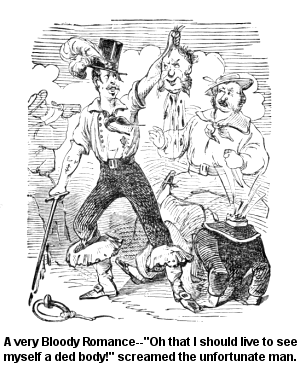
"Skurcely," obsarved the stranger, and he drew a diamond-hilted fish-knife and cut orf the capting's hed. He expired shortly, his last words bein, "we are governed too much."
"People!" sed the stranger, "I'm the Juke d'Moses!"
"Old hoss!" sed a passenger, "methinks thou art blowin!" whareupon the Juke cut orf his hed also.
"Oh that I should live to see myself a dead body!" screamed the unfortnit man. "But don't print any verses about my deth in the newspapers, for if you do I'll haunt ye!"
"People!" sed the Juke, "I alone can save you from yon bloody pirut! Ho! a peck of oats!" The oats was brought, and the Juke, boldly mountin the jibpoop, throwed them onto the towpath. The pirut rapidly approached, chucklin with fiendish delight at the idee of increasin his ill-gotten gains. But the leadin hoss of the pirut ship stopt suddent on comin to the oats, and commenst for to devour them. In vain the piruts swore and throwd stones and bottles at the hoss—he wouldn't budge a inch. Meanwhile the Sary Jane, her hosses on the full jump, was fast leavin the pirut ship!
"Onct agin do I escape deth!" sed the Juke between his clencht teeth, still on the jibpoop.
CHAPTER IV. THE WANDERER'S RETURN.
The Juke was Moses the Sassy! Yes, it was!
He had bin to France and now he was home agin in Bostin, which gave birth to a Bunker Hill!! He had some trouble in gitting hisself acknowledged as Juke in France, as the Orleans Dienasty and Borebones were fernest him, but he finally conkered. Elizy knowd him right off, as one of his ears and a part of his nose had bin chawed off in his fights with opposition firemen during boyhood's sunny hours. They lived to a green old age, beloved by all, both grate and small. Their children, of which they have numerous, often go up onto the Common and see the Fountain squirt.
This is my 1st attempt at writin a Tail & it is far from bein perfeck, but if I have indoosed folks to see that in 9 cases out of 10 they can either make life as barren as the Desert of Sarah, or as joyyus as a flower garding, my object will have been accomplished, and more too.
____________________
MARION: A ROMANCE OF THE FRENCH SCHOOL.
I.
—, Friday, —, 1860.
On the sad sea shore! Always to hear the moaning of these dismal waves!
Listen. I will tell you my story—my story of love, of misery, of black despair.
I am a moral Frenchman.
She whom I adore, whom I adore still, is the wife of a fat Marquis—a lop-eared, blear-eyed,greasy Marquis. A man without soul. A man without sentiment, who cares naught for moonlight and music. A low, practical man, who pays his debts. I hate him.
II.
She, my soul's delight, my empress, my angel, is superbly beautiful.
I loved her at first sight—devotedly, madly.
She dashed past me in her coupe. I saw her but a moment—perhaps only an instant—but she took me captive then and there, forevermore.
Forevermore!
I followed her, after that, wherever she went. At length she came to notice, to smile upon me. My motto was en avant! That is a French word. I got it out of the back part of Worcester's Dictionary.
III.
She wrote me that I might come and see her at her own house. Oh, joy, joy unutterable, to see her at her own house!
I went to see her after nightfall, in the soft moonlight.
She came down the graveled walk to meet me, on this beautiful midsummer night—came to me in pure white, her golden hair in splendid disorder—strangely beautiful, yet in tears!
She told me her fresh grievances.
The Marquis, always a despot, had latterly misused her most vilely.
That very morning, at breakfast, he had cursed the fishballs and sneered at the pickled onions.
She is a good cook. The neighbors will tell you so. And to be told by the base Marquis—a man who, previous to his marriage, had lived at the cheap eating-houses—to be told by him that her manner of frying fishballs was a failure—it was too much.
Her tears fell fast. I too wept. I mixed my sobs with her'n. "Fly with me!" I cried.
Her lips met mine. I held her in my arms. I felt her breath upon my cheek! It was Hunkey.
"Fly with me. To New York! I will write romances for the Sunday papers—real French romances, with morals to them. My style will be appreciated. Shop girls and young mercantile persons will adore it, and I will amass wealth with my ready pen."
Ere she could reply—ere she could articulate her ecstasy, her husband, the Marquis, crept snake-like upon me.
Shall I write it? He kicked me out of the garden—he kicked me into the street.
I did not return. How could I? I, so ethereal, so full of soul, of sentiment, of sparkling originality! He, so gross, so practical, so lop-eared!
Had I returned, the creature would have kicked me again.
So I left Paris for this place—this place, so lonely, so dismal.
Ah me!
Oh dear!
____________________
A ROMANCE.—WILLIAM BARKER, THE YOUNG PATRIOT.
I.
"No, William Barker, you cannot have my daughter's hand in marriage until you are her equal in wealth and social position."
The speaker was a haughty old man of some sixty years, and the person whom he addressed was a fine-looking young man of twenty-five.
With a sad aspect the young man withdrew from the stately mansion.
II.
Six months later the young man stood in the presence of the haughty old man.
"What! YOU here again?" angrily cried the old man.
"Ay, old man," proudly exclaimed William Barker. "I am here, your daughter's equal and yours?"
The old man's lips curled with scorn. A derisive smile lit up his cold features; when, casting violently upon the marble center table an enormous roll of greenbacks, William Barker cried—
"See! Look on this wealth. And I've tenfold more! Listen, old man! You spurned me from your door. But I did not despair. I secured a contract for furnishing the Army of the—-with beef—"
"Yes, yes!" eagerly exclaimed the old man.
"—and I bought up all the disabled cavalry horses I could find—"
"I see! I see!" cried the old man. "And good beef they make, too."
"They do! they do! and the profits are immense."
"I should say so!"
"And now, sir, I claim your daughter's fair hand!"
"Boy, she is yours. But hold! Look me in the eye. Throughout all this have you been loyal?"
"To the core!" cried William Barker.
"And," continued the old man, in a voice husky with emotion, "are you in favor of a vigorous prosecution of the war?"
"I am, I am!"
"Then, boy take her! Maria, child, come hither. Your William claims thee. Be happy, my children! And whatever our lot in life may be, let us all support the government"
____________________
A ROMANCE—THE CONSCRIPT.
[Which may bother the reader a little unless he is familiar with the music of the day.]
CHAPTER I.
Philander Reed struggled with spool-thread and tape in a dry-goods store at Ogdensburg, on the St. Lawrence River, State of New York. He Rallied Round the Flag, Boys, and Hailed Columbia every time she passed that way. One day a regiment returning from the war Came Marching Along, bringing An Intelligent Contraband with them, who left the South about the time Babylon was a-Fallin', and when it was apparent to all well-ordered minds that the Kingdom was Coming, accompanied by the Day of Jubilee. Philander left his spool-thread and tape, rushed into the street, and by his Long-Tail Blue, sed, "Let me kiss him for his Mother." Then, with patriotic jocularity, he inquired, "How is your High Daddy in the Morning?" to which Pomp of Cudjo's Cave replied, "That poor Old Slave has gone to rest, we ne'er shall see him more! But U.S.G. is the man for me, or Any other Man." Then he Walked Round.
"And your Master," sed Philander, "where is he?"
"Massa's in the cold, cold ground—at least I hope so!" sed the gay contraband.
"March on, March on! all hearts rejoice!" cried the Colonel, who was mounted on a Bob-tailed nag—on which, in times of Peace, my soul, O Peace! he had betted his money.
"Yaw," sed a German Bold Sojer Boy, "we don't-fights-mit-Segel as much as we did."
The regiment marched on, and Philander betook himself to his mother's Cottage Near the Banks of that Lone River, and rehearsed the stirring speech he was to make that night at a war meeting.
"It's just before the battle, Mother," he said, "and I want to say something that will encourage Grant."
CHAPTER II.—MABEL.
Mabel Tucker was an orphan. Her father, Dan Tucker, was run over one day by a train of cars though he needn't have been, for the kind-hearted engineer told him to Git out of the Way.
Mabel early manifested a marked inclination for the milinery business, and at the time we introduce her to our readers she was Chief Engineer of a Millinery Shop and Boss of a Sewing Machine.
Philander Reed loved Mabel Tucker, and Ever of her was Fondly Dreaming; and she used to say, "Will you love me Then as Now?" to which he would answer that he would, and without the written consent of his parents.
She sat in the parlor of the Cot where she was Born, one Summer's eve, with pensive thought, when Somebody came Knocking at the Door. It was Philander. Fond Embrace and things. Thrilling emotions. P. very pale and shaky in the legs. Also, sweaty.
"Where hast thou been?" she sed. "Hast been gathering shells from youth to age, and then leaving them like a che-eild? Why this tremors? Why these Sadfulness?"
"Mabeyuel!" he cried. "Mabeyuel! They've Drafted me into the Army!"
An orderly Surgeant now appears and says, "Come, Philander, let's be a-marching;" And he tore her from his embrace (P.'s) and marched the conscript to the Examining Surgeon's office.
Mabel fainted in two places. It was worse than Brother's Fainting at the Door.
CHAPTER III.—THE CONSCRIPT.
Philander Reed hadn't three hundred dollars, being a dead-broken Reed, so he must either become one of the noble Band who are Coming, Father Abraham, three hundred thousand more, or skedaddle across the St. Lawrence River to the Canada Line. As his opinions had recently undergone a radical change, he chose the latter course, and was soon Afloat, afloat, on the swift rolling tide. "Row, brothers, row," he cried, "the stream runs fast, the Sergeant is near, and the Zamination's past, and I'm a able-bodied man."
Landing, he at once imprinted a conservative kiss on the Canada Line, and feelingly asked himself, "Who will care for Mother now? But I propose to stick it out on this Line if it takes all Summer."
CHAPTER IV.—THE MEETING.
It was evening, it was. The Star of the Evening, Beautiful Star, shone brilliantly, adorning the sky with those "Neutral" tints which have characterized all British skies ever since this War broke out.
Philander sat on the Canada Line, playing with his Yard-stick, and perhaps about to take the measure of an unmade piece of calico; when Mabel, with a wild cry of joy, sprang from a small boat to his side. The meeting was too much. They divided a good square faint between them this time. At last Philander found his utterance, and said, "Do they think of me at Home, do they ever think of me?"
"No," she replied, "but they do at the recruiting office."
"Ha! 'tis well."
"Nay, dearest," Mabel pleaded, "come home and go to the war like a man! I will take your place in the Dry Goods store. True, a musket is a little heavier than a yardstick, but isn't it a rather more manly weapon?"
"I don't see it," was Philander's reply; "besides, this war isn't conducted accordin' to the Constitution and Union. When it is—when it is, Mabeyuel, I will return and enlist as a Convalescent!"
"Then, sir," she said, with much American disgust in her countenance, "then, sir, farewell!"
"Farewell!" he said, "and When this Cruel War is Over, pray that we may meet again!"
"Nary!" cried Mabel, her eyes flashing warm fire,—"nary. None but the Brave deserve the Sanitary Fair! A man who will desert his country in its hour of trial would drop Faro checks into the Contribution Box on Sunday. I hain't got time to tarry—I hain't got time to stay!—but here's a gift at parting: a White Feather: wear it in your hat!" and She was Gone from his gaze, like a beautiful dream.
Stung with remorse and mosquitoes, this miserable young man, in a fit of frenzy, unsheathed his glittering dry-goods scissors, cut off four yards (good measure) of the Canada Line, and hanged himself on a Willow Tree. Requiescat in Tape. His stick drifted to My Country, 'tis of thee! And may be seen, in connection with many others, on the stage of any New York theatre every night.
The Canadians won't have any line pretty soon. The skedaddlers will steal it. Then the Canadians won't know whether they're in the United States or not, in which case they may be drafted.
Mabel married a Brigadier-General, and is happy.
____________________
A ROMANCE—ONLY A MECHANIC.
In a sumptuously furnished parlor in Fifth Avenue, New York, sat a proud and haughty belle. Her name was Isabel Sawtelle. Her father was a millionaire, and his ships, richly laden, ploughed many a sea.
By the side of Isabel Sawtelle sat a young man with a clear, beautiful eye, and a massive brow.
"I must go," he sed, "the foreman will wonder at my absence."
"The foreman?" asked Isabel in a tone of surprise.
"Yes, the foreman of the shop where I work."
"Foreman—shop—work! What! do you work."
"Aye, Miss Sawtelle! I am a cooper!" and his eyes flashed with honest pride.
"What's that?" she asked; "it is something about barrels, isn't it!"
"It is!" he said, with a flashing nostril. "And hogsheads."
"Then go!" she said in a tone of disdain—"go away!"
"Ha!" he cried, "you spurn me, then, because I am a mechanic. Well, be it so! though the time will come, Isabel Sawtelle," he added, and nothing could exceed his looks at this moment—"when you will bitterly remember the cooper you now so cruelly cast off? Farewell!"
________________
Years rolled on. Isabel Sawtelle married a miserable aristocrat, who recently died of delirium tremens. Her father failed, and is now a raving maniac, and wants to bite little children. All her brothers (except one) were sent to the penitentiary for burglary, and her mother peddles clams that are stolen for her by little George, her only son that has his freedom. Isabel's sister Bianca rides an immoral spotted horse in the circus, her husband having long since been hanged for murdering his own uncle on his mother's side. Thus we see that it is always best to marry a mechanic.
____________________
ROBERTO THE ROVER:—A TALE OF SEA AND SHORE.
_______________
CHAPTER I.—FRANCE.
Our story opens in the early part of the year 17—. France was rocking wildly from centre to circumference. The arch despot and unscrupulous man, Richard the III., was trembling like an aspen leaf upon his throne. He had been successful, through the valuable aid of Richelieu and Sir. Wm. Donn, in destroying the Orleans Dysentery, but still he trembled! O'Mulligan, the snake-eater of Ireland, and Schnappsgoot of Holland, a retired dealer in gin and sardines, had united their forces—some nineteen men and a brace of bull pups in all—and were overtly at work, their object being to oust the tyrant. O'Mulligan was a young man between fifty-three years of age and was chiefly distinguished for being the son of his aunt on his great grandfather's side. Schnappsgoot was a man of liberal education, having passed three weeks at Oberlin College. He was a man of great hardihood, also, and would frequently read an entire column of "railway matters" in the "Cleveland Herald" without shrieking with agony.
_______________
CHAPTER II.—THE KING.
The tyrant Richard the III. (late Mr. Gloster) sat upon his throne in the Palace d' St. Cloud. He was dressed in his best clothes, and gorgeous trappings surrounded him everywhere. Courtiers, in glittering and golden armor, stood ready at his beck. He sat moodily for a while, when suddenly his sword flashed from its silver scabbard, and he shouted—
"Slaves, some wine, ho!"
The words had scarcely escaped his lips ere a bucket of champagne and a hoe were placed before him.
As the king raised the bucket to his lips, a deep voice near by, proceeding from the mouth of the noble Count Staghisnibs, cried—"Drink hearty, old feller."
"Reports traveling on lightning-wings, whisper of strange goings on and cuttings up throughout this kingdom. Knowest thou aught of these things, most noble Hellitysplit?" and the king drew from the upper pocket of his gold-faced vest a paper of John Anderson's solace and proceeded to take a chaw.
"Treason stalks monster-like throughout unhappy France, my liege!" said the noble Hellitysplit. "The ranks of the P.Q.R.'s are daily swelling, and the G.R.J.A.'s are constantly on the increase. Already the peasantry scout at cat-fish, and demand pickled salmon for their noonday repasts. But, my liege," and the brave Hellitysplit eyes flashed fire, "myself and sword are at thy command?"
"Bully for you, Count," said the king. "But soft: methinks report—perchance unjustly—hast spoken suspiciously of thee, most Royal d'Sardine? How is this? Is it a newspaper yarn? WHAT'S UP?"
D'Sardine meekly approached the throne, knelt at the king's feet, and said: "Most patient, gray, and red-headed skinner; my very approved skin-plaster: that I've been asked to drink by the P.Q.R.'s, it is most true, true I have imbibed sundry mugs of lager with them. The very head and front of my offending hath this extent, no more."
"'Tis well!" said the King, rising and looking fiercely around. "Hadst thou proved false I would with my own good sword have cut off yer head, and spilled your ber-lud all over the floor! If I wouldn't, blow me!"
_______________
CHAPTER III.—THE ROVER.
Thrilling as the scenes depicted in the preceding chapter indubitably were, those of this are decidedly THRILLINGER. Again are we in the mighty presence of the King, and again is he surrounded by splendour and gorgeously-mailed courtiers. A sea-faring man stands before him. It is Roberto the Rover, disguised as a common sailor.
"So," said the King, "thou wouldst have audience with me!"
"Aye aye, yer 'onor," said the sailor, "just tip us yer grapplin irons and pipe all hands on deck. Reef home yer jib poop and splice yer main topsuls. Man the jibboom and let fly yer top-gallunts. I've seen some salt water in my days, yer land lubber, but shiver my timbers if I hadn't rather coast among seagulls than landsharks. My name is Sweet William. You're old Dick the Three. Ahoy! Awast! Dam my eyes!" and Sweet William pawed the marble floor and swung his tarpaulin after the manner of sailors on the stage, and consequently not a bit like those on shipboard.
"Mariner," said the King, gravely, "thy language is exceeding lucid, and leads me to infer that things is workin' bad."
"Aye, aye, my hearty!" yelled Sweet William, in dulcet strains, reminding the King of the "voluptuous smell of physic," spoken of by the late Mr. Byron.
"What wouldst thou, seafaring man?" asked the King.
"This!" cried the Rover, suddenly taking off his maritime clothing and putting on an expensive suit of silk, bespangled with diamonds. "This! I am Roberto the Rover!"
The King was thunder-struck. Cowering back in his chair of state, he said in a tone of mingled fear and amazement, "Well, may I be gaul-darned!"
"Ber-lud! Ber-lud! Ber-lud!" shrieked the Rover, as he drew a horse-pistol and fired it at the King, who fell fatally killed, his last words being, "WE ARE GOVENRED TOO MUCH—THIS IS THE LAST OF EARTH!!!" At this exciting juncture Messrs. O'Mulligan and Schnappsgoot (who had previously entered into a copartnership with the Rover for the purpose of doing a general killing business) burst into the room and cut off the heads and let out the inwards of all the noblemen they encountered. They then killed themselves and died like heroes, wrapped up in the Star Spangled Banner, to slow music.
_______________
FINALE.
The Rover fled. He was captured near Marseilles and thrust into prison, where he lay for sixteen weary years, all attempts to escape being futile. One night a lucky thought struck him. He raised the window and got out. But he was unhappy. Remorse and dyspepsia preyed upon his vitals. He tried Boerhave's Holland Bitters and the Retired Physician's Sands of Life, and got well. He then married the lovely Countess D'Smith, and lived to a green old age, being the triumph of virtue and downfall of vice.
____________________
RED HAND: A TALE OF REVENGE.
CHAPTER I.
"Life's but a walking shadow—a poor player."—Shakespeare. "Let me die to sweet music."—J.W. Shuckers.
"Go forth, Clarence Stanley! Hence to the bleak world, dog! You have repaid my generosity with the blackest ingratitude. You have forged my name on a five thousand dollar check—have repeatedly robbed my money drawer—have perpetrated a long series of high-handed villanies, and now to-night, because, forsooth, I'll not give you more money to spend on your dissolute companions, you break a chair over my aged head. Anyway! You are a young man of small moral principle. Don't ever speak to me again!"
These harsh words fell from the lips of Horace Blinker, one of the merchant princes of New York City. He spoke to Clarence Stanley, his adopted son and a beautiful youth of nineteen summers. In vain did Clarence plead his poverty, his tender age, his inexperience; in vain did he fasten those lustrous blue eyes of his appealingly and tearfully upon Mr. Blinker, and tell him he would make the pecuniary matter all right in the fall, and that he merely shattered a chair over his head by way of a joke. The stony-hearted man was remorseless, and that night Clarence Stanly became a wanderer in the wide, wide world. As he went forth he uttered these words: "H. Blinker, beware! A RED HAND is around, my fine feller!"
CHAPTER. II.
"—a man of strange wild mien—one who has seen trouble."—Sir Walter Scott. "You ask me, don't I wish to see the Constitution dissolved and broken up. I answer, NEVER, NEVER, NEVER!"—H.W. Faxon. "They will join our expedition."—Anon. "Go in on your muscle."—President Buchanan's instructions to the Collector of Toledo. "Westward the hoe of Empire Stars its way."—George N. True. "Where liberty dwells there is my kedentry."—C.R. Dennett.
Seventeen years have become ingulfed in the vast and moist ocean of eternity since the scene depicted in the last chapter occurred. We are in Mexico. Come with me to the Scarlet Banditti's cave. It is night. A tempest is raging tempestuously without, but within we find a scene of dazzling magnificence. The cave is spacious. Chandeliers of solid gold hang up suspended around the gorgeously furnished room, and the marble floor is star-studded with flashing diamonds. It must have cost between two hundred dollars to fit this cave up. It embraced all of the modern improvements. At the head of the cave life-size photographs (by Ryder) of the bandits, and framed in gilt, were hung up suspended. The bandits were seated around a marble table, which was sculped regardless of expense, and were drinking gin and molasses out of golden goblets. When they got out of gin fresh supplies were brought in by slaves from a two-horse wagon outside, which had been captured that day, after a desperate and bloody struggle, by the bandits, on the plains of Buena Vista.
At the head of the table sat the Chief. His features were swarthy but elegant. He was splendidly dressed in new clothes, and had that voluptuous, dreamy air of grandeur about him which would at once rivet the gaze of folks generally. In answer to a highly enthusiastic call he arose and delivered an able and eloquent speech. We regret that our space does not permit us to give this truly great speech in full—we can merely give a synopsis of the distinguished speaker's remarks. "Comrades! listen to your chief. You all know my position on Lecompton. Where I stand in regard to low tolls on the Ohio Canal is equally clear to you, and so with the Central American question. I believe I understand my little Biz. I decline defining my position on the Horse Railroad until after the Spring Election. Whichever way I says I don't say so myself unless I says so also. Comrades! be virtuous and you'll be happy." The Chief sat down amidst great applause, and was immediately presented with an elegant gold headed cane by his comrades, as a slight testimonial of their respect.
CHAPTER III.
"This is the last of Earth."—Page. "The hope of America lies in its well-conducted school-houses."—Bone. "I wish it to be distinctly understood that I want the Union to be Reserved."—N.T. Nash. "Sine qua non Ips Dixit Quid pro quo cui bono Ad infininim E Unibus plurum."—Brown.
Two hours later. Return we again to the Banditti's Cave. Revelry still holds high carnival among the able and efficient bandits. A knock is heard at the door. From his throne at the head of the table the Chief cries, "Come in!" and an old man, haggard, white-haired, and sadly bent, enters the cave.
"Messieurs," he tremblingly ejaculates, "for seventeen years I have not tasted of food!"
"Well," says a kind-hearted bandit, "if that's so I expect you must be rather faint. We'll get you up a warm meal immediately, stranger."
"Hold!" whispered the Chief in tones of thunder, and rushing slowly to the spot; "this is about played out. Behold in me RED HAND, the Bandit Chief, once Clarence Stanley, whom you cruelly turned into a cold world seventeen years ago this very night! Old man, perpare to go up!" Saying which the Chief drew a sharp carving knife and cut off Mr. Blinker's ears. He then scalped Mr. B., and cut all of his toes off. The old man struggled to extricate himself from his unpleasant situation, but was unsuccessful.
"My goodness," he piteously exclaimed, "I must say you are pretty rough. It seems to me—."
This is all of this intensely interesting tale that will be published in the "Plain Dealer." The remainder of it may be found in the great moral family paper, "The Windy Flash" published in New York by Stimpkins. "The Windy Flash" circulates 4,000,000 copies weekly.
IT IS THE ALL-FIREDEST PAPER EVER PRINTED. IT IS THE ALL-FIREDEST PAPER EVER PRINTED. IT IS THE ALL-FIREDEST PAPER EVER PRINTED. IT IS THE ALL-FIREDEST PAPER EVER PRINTED.
IT'S THE CUSSEDEST BEST PAPER IN THE WORLD. IT'S THE CUSSEDEST BEST PAPER IN THE WORLD. IT'S THE CUSSEDEST BEST PAPER IN THE WORLD. IT'S THE CUSSEDEST BEST PAPER IN THE WORLD.
IT'S A MORAL PAPER. IT'S A MORAL PAPER. IT'S A MORAL PAPER. IT'S A MORAL PAPER.
SOLD AT ALL THE CORNER GROCERIES. SOLD AT ALL THE CORNER GROCERIES. SOLD AT ALL THE CORNER GROCERIES. SOLD AT ALL THE CORNER GROCERIES.
____________________
PYROTECHNY: A ROMANCE AFTER THE FRENCH.
I.—THE PEACEFUL HAMLET.
Nestling among the grand hills of New Hampshire, in the United States of America, is a village called Waterbury.
Perhaps you were never there.
I do not censure you if you never were.
One can get on very well without going to Waterbury.
Indeed, there are millions of meritorious persons who were never there, and yet they are happy.
In this peaceful hamlet lived a young man named Pettingill.
Reuben Pettingill.
He was an agriculturist.
A broad-shouldered, deep-chested agriculturist.
He was contented to live in this peaceful hamlet.
He said it was better than a noisy Othello.
Thus do these simple children of nature joke in a first class manner.
II.—MYSELF.
I write this romance in the French style.
Yes: something that way.
The French style consists of making just as many paragraphs as possible.
Thus one may fill up a column in a very short time.
I am paid by the column, and the quicker I can fill up a column—but this is a matter to which we will not refer.
We will let this matter pass.
III.—PETTINGILL.
Reuben Pettingill was extremely industrious.
He worked hard all the year round on his father's little farm.
Right he was!
Industry is a very fine thing.
It is one of the finest things of which we have any knowledge.
Yet do not frown, "do not weep for me," when I state that I don't like it.
It doesn't agree with me.
I prefer indolence.
I am happiest when I am idle.
I could live for months without performing any kind of labour, and at the expiration of that time I should feel fresh and vigorous enough to go right on in the same way for numerous more months.
This should not surprise you.
Nothing that a modern novelist does should excite astonishment in any well-regulated mind.
IV.—INDEPENDENCE DAY.
The 4th of July is always celebrated in America with guns, and processions, and banners, and all those things.
You know why we celebrate this day.
The American Revolution, in 1775, was perhaps one of the finest revolutions that was ever seen. But I have not time to give you a full history of the American Revolution. It would consume years to do it, and I might weary you.
One 4th of July Reuben Pettingill went to Boston.
He saw great sights.
He saw the dense throng of people, the gay volunteers, the banners, and, above all, he saw the fireworks.
I despise myself for using so low a word, but the fireworks "licked" him.
A new world was opened to this young man.
He returned to his parents and the little farm among the hills, with his heart full of fireworks.
He said, "I will make some myself."
He said this while eating a lobster on top of the coach.
He was an extraordinary skilful young man in the use of a common clasp-knife.
With that simple weapon he could make, from soft wood, horses, dogs, cats, etc. He carved excellent soldiers also.
I remember his masterpiece.
It was "Napoleon crossing the Alps."
Looking at it critically, I should say it was rather short of Alps.
An Alp or two more would have improved it; but, as a whole, it was a wonderful piece of work; and what a wonderful piece of work is a wooden man, when his legs and arms are all right.
V.—WHAT THIS YOUNG MAN SAID.
He said, "I can make just as good fireworks as them in Boston."
"Them" was not grammatical, but why care for grammar as long as we are good?
VI.—THE FATHER'S TEARS.
Pettingill neglected the farm.
He said that it might till itself—he should manufacture some gorgeous fireworks, and exhibit them on the village green on the next 4th of July.
He said the Eagle of Fame would flap his wings over their humble roof ere many months should pass away.
"If he does," said old Mr. Pettingill, "we must shoot him and bile him, and eat him, because we shall be rather short of meat, my son, if you go on in this lazy way."
And the old man wept.
He shed over 120 gallons of tears.
That is to say, a puncheon. But by all means let us avoid turning this romance into a farce.
VII.—PYROTECHNY.
But the headstrong young man went to work, making fireworks.
He bought and carefully studied a work on pyrotechny.
The villagers knew that he was a remarkably skilful young man, and they all said, "We shall have a great treat next 4th of July."
Meanwhile Pettingill worked away.
VIII.—THE DAY.
The great day came at last.
Thousands poured into the little village from far and near.
There was an oration, of course.
IX.—ORATORY IN AMERICA.
Yes; there was an oration.
We have a passion for oratory in America—political oratory chiefly.
Our political orators never lose a chance to "express their views."
They will do it. You cannot stop them.
There was an execution in Ohio one day, and the Sheriff, before placing the rope round the murderer's neck, asked him if he had any remarks to make?
"If he hasn't," said a well-known local orator, pushing his way rapidly through the dense crowd to the gallows—"if our ill-starred feller-citizen don't feel inclined to make a speech and is in no hurry, I should like to avail myself of the present occasion to make some remarks on the necessity of a new protective tariff!"
X.—PETTINGILL'S FIREWORKS.
As I said in Chapter VIII., there was an oration. There were also processions, and guns, and banners.
"This evening," said the chairman of the committee of arrangements, "this evening, fellow-citizens, there will be a grand display of fireworks on the village green, superintended by the inventor and manufacturer, our public-spirited townsman, Mr. Reuben Pettingill."
Night closed in, and an immense concourse of people gathered on the village green.
On a raised platform, amidst his fireworks, stood Pettingill.
He felt that the great hour of his life had come, and, in a firm, clear voice, he said:
"The fust fireworks, feller-citizens, will be a rocket, which will go up in the air, bust, and assume the shape of a serpint."
He applied a match to the rocket, but instead of going up in the air, it flew wildly down into the grass, running some distance with a hissing kind of sound, and causing the masses to jump round in a very insane manner.
Pettingill was disappointed, but not disheartened. He tried again.
"The next fireworks," he said, "will go up in the air, bust, and become a beautiful revolvin' wheel."
But alas! it didn't. It only ploughed a little furrow in the green grass, like its unhappy predecessor.
The masses laughed at this, and one man—a white-haired old villager—said, kindly but firmly, "Reuben, I'm 'fraid you don't understand pyrotechny."
Reuben was amazed. Why did his rockets go down instead of up? But, perhaps, the others would be more successful, and, with a flushed face, and in a voice scarcely as firm as before, he said:
"The next specimen of pyrotechny will go up in the air, bust, and become an eagle. Said eagle will soar away into the western skies, leavin' a red trail behind him as he so soars."
But, alas! again. No eagle soared, but, on the contrary, that ordinary proud bird buried its head in the grass.
The people were dissatisfied. They made sarcastic remarks. Some of them howled angrily. The aged man who had before spoken said, "No, Reuben, you evidently don't understand pyrotechny."
Pettingill boiled with rage and disappointment.
"You don't understand pyrotechny!" the masses shouted.
Then they laughed in a disagreeable manner, and some unfeeling lads threw dirt at our hero.
"You don't understand pyrotechny!" the masses yelled again.
"Don't I?" screamed Pettingill, wild with rage; "don't you think I do?"
Then seizing several gigantic rockets he placed them over a box of powder, and touched the whole off.
This rocket went up. It did, indeed.
There was a terrific explosion.
No one was killed, fortunately; though many were injured.
The platform was almost torn to pieces.
But proudly erect among the falling timbers stood Pettingill, his face flashing with wild triumph; and he shouted: "If I'm any judge of pyrotechny, That rocket has went off."
Then seeing that all the fingers on his right hand had been taken close off in the explosion, he added: "And I ain't so dreadful certain but four of my fingers has went off with it, because I don't see 'em here now!"
____________________
A MORMON ROMANCE—REGINALD GLOVERSON.
CHAPTER I.—THE MORMON'S DEPARTURE.
The morning on which Reginald Gloverson was to leave Great Salt Lake City with a mule-train, dawned beautifully.
Reginald Gloverson was a young and thrifty Mormon, with an interesting family of twenty young and handsome wives. His unions had never been blessed with children. As often as once a year he used to go to Omaha, in Nebraska, with a mule-train for goods; but although he had performed the rather perilous journey many times with entire safety, his heart was strangely sad on this particular morning, and filled with gloomy forebodings.
The time for his departure had arrived. The high-spirited mules were at the door, impatiently champing their bits. The Mormon stood sadly among his weeping wives.
"Dearest ones," he said, "I am singularly sad at heart, this morning; but do not let this depress you. The journey is a perilous one, but—pshaw! I have always come back safely heretofore, and why should I fear? Besides, I know that every night, as I lay down on the broad starlit prairie, your bright faces will come to me in my dreams, and make my slumbers sweet and gentle. You, Emily, with your mild blue eyes; and you, Henrietta, with your splendid black hair; and you, Nelly, with your hair so brightly, beautifully golden; and you, Mollie, with your cheeks so downy; and you, Betsy, with your wine-red lips—far more delicious, though, than any wine I ever tasted—and you, Maria, with your winsome voice; and you, Susan, with your—with your—that is to say, Susan, with your—and the other thirteen of you, each so good and beautiful, will come to me in sweet dreams, will you not, Dearestists?"
"Our own," they lovingly chimed, "we will!"
"And so farewell!" said Reginald. "Come to my arms, my own!" he cried, "that is, as many of you as can do it conveniently at once, for I must away."
He folded several of them to his throbbing breast, and drove sadly away.
_______________
But he had not gone far when the trace of the off-hind mule became unhitched. Dismounting, he essayed to adjust the trace; but ere he had fairly commenced the task, the mule, a singularly refractory animal—snorted wildly, and kicked Reginald frightfully in the stomach. He arose with difficulty, and tottered feebly towards his mother's house, which was near by, falling dead in her yard, with the remark, "Dear Mother, I've come home to die!"
"So I see," she said; "where's the mules?"
Alas! Reginald Gloverson could give no answer. In vain the heart-stricken mother threw herself upon his inanimate form, crying, "Oh, my son—my son! Only tell me where the mules are, and then you may die if you want to."
In vain—in vain! Reginald had passed on.
CHAPTER II.—FUNERAL TRAPPINGS.
The mules were never found.
Reginald's heart-broken mother took the body home to her unfortunate son's widows. But before her arrival she indiscreetly sent a boy to Bust the news gently to the afflicted wives, which he did by informing them in a hoarse whisper that their "old man had gone in."
The wives felt very badly indeed.
"He was devoted to me," sobbed Emily.
"And to me," said Maria.
"Yes," said Emily, "he thought considerably of you, but not so much as he did of me."
"I say he did!"
"And I say he didn't!"
"He did!"
"He didn't!"
"Don't look at me, with your squint eyes!"
"Don't shake your red head at me!"
"Sisters!" said the black-haired Henrietta, "cease this unseemly wrangling. I, as his first wife, shall strew flowers on his grave."
"No you won't," said Susan. "I, as his last wife, shall strew flowers on his grave. It's my business to strew!"
"You shan't, so there!" said Henrietta.
"You bet I will!" said Susan, with a tear-suffused cheek.
"Well, as for me," said the practical Betsy, "I ain't on the Strew, much, but I shall ride at the head of the funeral procession!"
"Not if I've been introduced to myself, you won't," said the golden-haired Nelly; "that's my position. You bet your bonnet-strings it is."
"Children," said Reginald's mother, "you must do some crying, you know, on the day of the funeral; and how many pocket-handkerchers will it take to go round? Betsy, you and Nelly ought to make one do between you."
"I'll tear her eyes out if she perpetrates a sob on my handkercher!" said Nelly.
"Dear daughters in-law," said Reginald's mother, "how unseemly is this anger! Mules is five hundred dollars a span, and every identical mule my poor boy had has been gobbled up by the red man. I knew when my Reginald staggered into the door-yard that he was on the Die, but if I'd only thunk to ask him about them mules ere his gentle spirit took flight, it would have been four thousand dollars in our pockets, and no mistake! Excuse those real tears, but you've never felt a parent's feelin's."
"It's an oversight," sobbed Maria. "Don't blame us!"
CHAPTER III.—DUST TO DUST.
The funeral passed off in a very pleasant manner, nothing occuring to mar the harmony of the occasion. By a happy thought of Reginald's mother, the wives walked to the grave twenty abreast, which rendered that part of the ceremony thoroughly impartial.
_______________
That night the twenty wives, with heavy hearts, sought their twenty respective couches. But no Reginald occupied those twenty respective couches—Reginald would never more linger all night in blissful repose in those twenty respective couches—Reginald's head would never more press the twenty respective pillows of those twenty respective couches—never, nevermore!
_______________
In another house, not many leagues from the House of Mourning, a gray-haired woman was weeping passionately. "He died," she cried, "he died without sigerfyin', in any respect, where them mules went to!"
CHAPTER IV.—MARRIED AGAIN.
Two years are supposed to elapse between the third and fourth chapters of this original American romance.
A manly Mormon, one evening, as the sun was preparing to set among a select apartment of gold and crimson clouds in the western horizon—although for that matter the sun has a right to "set" where it wants to, and so, I may add has a hen—a manly Mormon, I say, tapped gently at the door of the mansion of the late Reginald Gloverson.
The door was opened by Mrs. Sarah Gloverson.
"Is this the house of the widow Gloverson!" the Mormon asked.
"It is," said Susan.
"And how many is there of she?" inquired the Mormon.
"There is about twenty of her, including me," courteously returned the fair Susan.
"Can I see her?"
"You can."
"Madam," he softly said, addressing the twenty disconsolate widows. "I have seen part of you before! And although I have already twenty-five wives, whom I respect and tenderly care for, I can truly say that I never felt love's holy thrill till I saw thee! Be mine—be mine!" he enthusiastically cried, "and we will show the world a striking illustration of the beauty and truth of the noble lines, only a good deal more so—
"Twenty-one souls with a single thought, Twenty-one hearts that beat as one!"
They were united, they were!
Gentle reader, does not the moral of this romance show that—does it not, in fact, show that however many there may be of a young widow woman, or rather does it not show that whatever number of persons one woman may consist of—well, never mind what it shows. Only this writing Mormon romances is confusing to the intellect. You try it and see.
____________________
I.
ON THE STEAMER.
New York, Oct. 13, 1868.
The steamer Ariel starts for California at noon.
Her decks are crowded with excited passengers, who instantly undertake to "look after" their trunks and things; and what with our smashing against each other, and the yells of the porters, and the wails over lost baggage, and the crash of boxes, and the roar of the boilers, we are for the time being about as unhappy a lot of maniacs as was ever thrown together.
I am one of them. I am rushing around with a glaring eye in search of a box.
Great jam, in which I find a sweet young lady, with golden hair, clinging to me fondly, and saying, "Dear George, farewell!"—Discovers her mistake, and disappears.
I should like to be George some more.
Confusion so great that I seek refuge in a stateroom which contains a single lady of forty-five summers, who says, "Base man! leave me!" I leave her.
By and by we cool down, and become somewhat regulated.
The next day and the next pass by in a serene manner. The waves are smooth now, and we can all eat and sleep. We might have enjoyed ourselves very well, I fancy, if the Ariel, whose capacity was about three hundred and fifty passengers, had not on this occasion carried nearly nine hundred, a hundred at least of whom were children of an unpleasant age. Captain Semmes captured the Ariel once, and it is to be deeply regretted that that thrifty buccaneer hadn't made mince-meat of her, because she is a miserable tub at best, and hasn't much more right to be afloat than a second-hand coffin has. I do not know her proprietor, Mr. C. Vanderbilt. But I know of several excellent mill privileges in the State of Maine, and not one of them is so thoroughly Dam'd as he was all the way from New York to Aspinwall.
_______________
I have spoken my Piece about the Ariel, and I hope Mr. Vanderbilt will reform ere it is too late. Dr. Watts says the vilest sinner may return as long as the gas-meters work well, or words to that effect.
_______________
We were so densely crowded on board the Ariel that I cannot conscientiously say we were altogether happy. And sea-voyages at best are a little stupid. On the whole I should prefer a voyage on the Erie Canal, where there isn't any danger, and where you can carry picturesque scenery along with you—so to speak.
_______________
II.
THE ISTHMUS.
On the ninth day we reach Aspinwall in the Republic of Granada. The President of New Granada is a Central American named Mosquero. I was told that he derived quite a portion of his income by carrying passengers' valises and things from the steamer to the hotels in Aspinwall. It was an infamous falsehood. Fancy A. Lincoln carrying carpet-bags and things! and indeed I should rather trust him with them than Mosquero, because the former gentleman, as I think some one has before observed, is "honest."
I intrust my bag to a speckled native, who confidentially gives me to understand that he is the only strictly honest person in Aspinwall. The rest, he says, are niggers—which the colored people of the Isthmus regard as about as scathing a thing as they can say of one another.
I examine the New Grenadian flag, which waves from the chamber-window of the refreshment saloon. It is of simple design. You can make one.
Take half of a cotton shirt, that has been worn two months, and dip it in molasses of the Day & Martin brand. Then let the flies gambol over it for a few days, and you have it. It is an emblem of Sweet Liberty.
At the Howard House the man of sin rubbeth the hair of the horse to the bowels of the cat, and our girls are waving their lily-white hoofs in the dazzling waltz.
We have a quadrille, in which an English person slips up and jams his massive brow against my stomach. He apologizes, and I say, "all right, my lord." I subsequently ascertained that he superintended the shipping of coals for the British steamers, and owned fighting cocks.
_______________
The natives amass wealth by carrying valises, &c., then squander it for liquor. My native comes to me as I sit on the veranda of the Howard House smoking a cigar, and solicits the job of taking my things to the cars next morning. He is intoxicated, and has been fighting, to the palpable detriment of his wearing apparel; for he has only a pair of tattered pantaloons and a very small quantity of shirt left.
We go to bed. Eight of us are assigned to a small den upstairs, with only two lame apologies for beds.
Mosquitoes and even rats annoy us fearfully. One bold rat gnaws at the feet of a young Englishman in the party. This was more than the young Englishman could stand, and rising from his bed he asked us if New Grenada wasn't a Republic? We said it was. "I thought so," he said. "Of course I mean no disrespect to the United States of America in the remark, but I think I prefer a bloated monarchy!" He smiled sadly—then handing his purse and his mother's photograph to another English person, he whispered softly, "If I am eaten up, give them to Me mother—tell her I died like a true Briton, with no faith whatever in the success of a republican form of government!" And then he crept back to bed again.
_______________
We start at seven the next morning for Panama.
My native comes bright and early to transport my carpet sack to the railway station. His clothes have suffered still more during the night, for he comes to me now dressed only in a small rag and one boot.
At last we are off. "Adios, Americanos!" the natives cry; to which I pleasantly reply, "Adous! and long may it be before you have a chance to Do us again."
The cars are comfortable on the Panama railway, and the country through which we pass is very beautiful. But it will not do to trust it much, because it breeds fevers and other unpleasant disorders, at all seasons of the year. Like a girl we most all have known, the Isthmus is fair but false.
There are mud huts all along the route, and half-naked savages gaze patronizingly upon us from their doorways. An elderly lady in spectacles appears to be much scandalized by the scant dress of these people, and wants to know why the Select Men don't put a stop to it. From this, and a remark she incidentally makes about her son, who has invented a washing machine which will wash, wring, and dry a shirt in ten minutes, I infer that she is from the hills of Old New England, like the Hutchinson family.
_______________
The Central American is lazy. The only exercise he ever takes is to occasionally produce a Revolution. When his feet begin to swell and there are premonitory symptoms of gout, he "revolushes" a spell, and then serenely returns to his cigarette and hammock under the palm-trees.
These Central American Republics are queer concerns. I do not of course precisely know what a last year's calf's ideas of immortal glory may be, but probably they are about as lucid as those of a Central American in regard to a republican form of government.
And yet I am told they are a kindly people in the main. I never met but one of them—a Costa-Rican; on board the Ariel. He lay sick with fever, and I went to him and took his hot hand gently in mine. I shall never forget his look of gratitude. And the next day he borrowed five dollars of me, shedding tears as he put it in his pocket.
_______________
The Senoritas who leave us at Panama are splendid creatures. They learned me Spanish, and in the soft moonlight we walked on deck and talked of the land of Pizarro. (You know old Piz. conquered Peru! and although he was not educated at West Point, he had still some military talent.) I feel as though I had lost all my relations, including my grandmother and the cooking stove when these gay young Senoritas go away.
They do not go to Peru on a Peruvian bark, but on an English steamer. Off to Acapulco.
_______________
III.
MEXICO.
We make Acapulco, a Mexican coast town of some importance, in a few days, and all go ashore.
The pretty peasant girls peddle necklaces made of shells and oranges, in the streets of Acapulco, on steamer days. They are quite naive about it. Handing you a necklace they will say, "Me give you pres-ent, Senor," and then retire with a low curtsey. Returning, however, in a few moments, they say quite sweetly, "You give me pres-ent, Senor, of quarter dollar!" which you at once do unless you have a heart of stone.
Acapulco was shelled by the French a year or so before our arrival there, and they effected a landing. But the gay and gallant Mexicans peppered them so persisently and effectually from the mountains near by that they concluded to sell out and leave.
Napoleon has no right in Mexico. Mexico may deserve a licking. That is possible enough. Most people do. But nobody has any right to lick Mexico except the United States. We have a right, I flatter myself, to lick this entire continent, including ourselves, any time we want to.
_______________
The signal gun is fired at 11, and we go off to the steamer in small boats.
We reach Manzanillo, another coast place, twenty-four hours after leaving Acapulco. Manzanillo is a little Mexican village, and looked very wretched indeed, sweltering away there on the hot sands. But it is a port of some importance, nevertheless, because a great deal of merchandise finds its way to the interior from there. The white and green flag of Mexico floats from a red steam-tug (the navy of Mexico, by the way, consists of two tugs, a disabled raft, and a basswood life-preserver), and the Captain of the Port comes off to us in his small boat, climbs up the side of the St. Louis, and folds the healthy form of Captain Hudson to his breast. There is no wharf here, and we have to anchor off the town.
There was a wharf, but the enterprising Mexican peasantry, who subsist by poling merchandise ashore in dug-outs, indignantly tore it up. We take on here some young Mexicans, from Colima, who are going to California. They are of the better class, and one young man (who was educated in Madrid) speaks English rather better than I write it. Be careful not to admire any article of an educated Mexican's dress, because if you do he will take it right off and give it to you, and sometimes this might be awkward.
I said: "What a beautiful cravat you wear!"
"It is yours!" he exclaimed, quickly unbuckling it; and I could not induce him to take it back again.
I am glad I did not tell his sister, who was with him and with whom I was lucky enough to get acquainted, what a beautiful white hand she had. She might have given it to me on the spot; and that, as she had soft eyes, a queenly form, and a half million or so in her own right, would have made me feel bad.
Reports reach us here of high-handed robberies by the banditti all along the road to the City of Mexico. They steal clothes as well as coin. A few days since the mail coach entered the city with all the passengers stark-naked! They must have felt mortified.
_______________
IV.
CALIFORNIA.
We reach San Francisco one Sunday afternoon. I am driven to the Occidental Hotel by a kind-hearted hackman, who states that inasmuch as I have come out there to amuse people, he will only charge me five dollars. I pay it in gold, of course, because greenbacks are not current on the Pacific coast.
Many of the citizens of San Francisco remember the Sabbath day to keep it jolly; and the theatres, the circus, the minstrels, and the music halls are all in full blast to-night.
I "compromise," and go to the Chinese theatre, thinking perhaps there can be no great harm in listening to worldly sentiments when expressed in a language I don't understand.
The Chinaman at the door takes my ticket with the remark, "Ki hi-hi ki! Shoolah!"
And I tell him that on the whole I think he is right.
The Chinese play is "continued," like a Ledger story, from night to night. It commences with the birth of the hero or heroine, which interesting event occurs publicly on the stage; and then follows him or her down to the grave, where it cheerfully ends.
Sometimes a Chinese play lasts six months. The play I am speaking of had been going on for about two months. The heroine had grown up into womanhood, and was on the point, as I inferred, of being married to a young Chinaman in spangled pantaloons and a long black tail. The bride's father comes in with his arms full of tea-chests, and bestows them, with his blessing, upon the happy couple. As this play is to run four months longer, however, and as my time is limited, I go away at the close of the second act, while the orchestra is performing an overture on gongs and one-stringed fiddles.
The door-keeper again says, "Ki hi-hi ki! Shoolah!" adding, this time however, "Chow-wow." I agree with him in regard to the ki hi and hi ki, but tell him I don't feel altogether certain about the chow-wow.
To Stockton from San Francisco.
Stockton is a beautiful town, that has ceased to think of becoming a very large place, and has quietly settled down into a state of serene prosperity. I have my boots repaired here by an artist who informs me that he studied in the penitentiary; and I visit the lunatic asylum, where I encounter a vivacious maniac who invites me to ride in a chariot drawn by eight lions and a rhinoceros.
John Phoenix was once stationed at Stockton, and put his mother aboard the San Francisco boat one morning with the sparkling remark, "Dear mother, be virtuous and you will be happy!"
_______________
Forward to Sacramento—which is the capital of the State, and a very nice old town.
They had a flood here some years ago, during which several blocks of buildings sailed out of town and had never been heard from since. A Chinaman concluded to leave in a wash tub, and actually set sail in one of those fragile barks. A drowning man hailed him piteously, thus: "Throw me a rope, oh throw me a rope!" To which the Chinaman excitedly cried, "No have got—how can do?" and went on, on with the howling current. He was never seen more; but a few weeks after his tail was found by some Sabbath-school children in the north part of the State.
_______________
I go to the mountain towns. The sensational mining days are over, but I find the people jolly and hospitable nevertheless.
At Nevada I am called upon, shortly after my arrival, by an athletic scarlet-faced man, who politely says his name is Blaze.
Years ago Mr. Blaze was an agent of the California Stage Company. There was a formidable and well-organized opposition to the California Stage Company at that time, and Mr. Blaze rendered them such signal service in his capacity of agent that they were very sorry when he tendered his resignation.
"You are some sixteen hundred dollars behind in your accounts, Mr. Blaze," said the President, "but in view of your faithful and efficient services we shall throw off eight hundred dollars off that amount."
Mr. Blaze seemed touched by this generosity. A tear stood in his eye and his bosom throbbed audibly.
"You will throw off eight hundred dollars—you will?" he at last cried, seizing the President's hand and pressing it passionately to his lips.
"I will," returned the President.
"Well, sir," said Mr. Blaze, "I'm a gentleman, I am, you bet! And I won't allow no Stage Company to surpass me in politeness. I'll throw off the other eight hundred, and we'llcall it square! No gratitude, sir—no thanks; it is my duty."
_______________
I get back to San Francisco in a few weeks, and am to start home Overland from here.
I do not leave the Capital of California in a light-hearted and joyous manner. But "leaves have their time to fall," and I have my time to leave, which is now.
We ride all day and all night, and ascend and descend some of the most frightful hills I ever saw. We make Johnson's Pass, which is 6752 feet high, about two o'clock in the morning, and go down the great Kingsbury grade with locked wheels. The driver, with whom I sit outside, informs me, as we slowly roll down this fearful mountain road, which looks down on either side into an appalling ravine, that he has met accidents in his time, and cost the California Stage Company a great deal of money; "because," he says, "juries is agin us on principle, and every man who sues us is sure to recover. But it will never be so agin, not with me, you bet."
"How is that?" I said.
It was frightfully dark. It was snowing withal, and notwithstanding the brakes were kept hard down, the coach slewed wildly, often fairly touching the brink of the black precipice.
"How is that?" I said.
"Why, you see," he replied, "that corpses never sue for damages, but maimed people do. And the next time I have a overturn I shall go round and keerfully examine the passengers. Them as is dead I shall let alone; but them as is mutilated I shall finish with the king-bolt! Dead folks don't sue. They ain't on it."
Thus with anecdote did this driver cheer me up.
_______________
V.
WASHOE.
We reach Carson City about nine o'clock in the morning. It is the capital of the silver-producing territory of Nevada.
They shoot folks here somewhat, and the law is rather partial than otherwise to first-class murderers.
I visit the territorial Prison, and the Warden points out the prominent convicts to me thus:
"This man's crime was horse-stealing. He is here for life."
"This man is in for murder. He is here for three years."
But shooting isn't as popular in Nevada as it once was. A few years since they used to have a dead man for breakfast every morning. A reformed desperado told my that he supposed he had killed men enough to stock a graveyard. "A feeling of remorse," he said, "sometimes comes over me! But I'm an altered man now. I hain't killed a man for over two weeks! What'll yer poison yourself with?" he added, dealing a resonant blow on the bar.
There used to live near Carson City a notorious desperado, who never visited town without killing somebody. He would call for liquor at some drinking-house, and if anybody declined joining him he would at once commence shooting. But one day he shot a man too many. Going into the St. Nicholas drinking-house he asked the company present to join him in a North American drink. One individual was rash enough to refuse. With a look of sorrow rather than anger the desperado revealed his revolver, and said, "Good God! Must I kill a man every time I come to Carson?" and so saying he fired and killed the individual on the spot. But this was the last murder the bloodthirsty miscreant ever committed, for the aroused citizens pursued him with rifles and shot him down in his own dooryard.
_______________
I lecture in the theatre at Carson, which opens out of a drinking and gambling house. On each side of the door where my ticket-taker stands there are monte-boards and sweat-cloths, but they are deserted to-night, the gamblers being evidently of a literary turn of mind.
_______________
Five years ago there was only a pony-path over the precipitous hills on which now stands the marvelous city of Virginia, with its population of twelve thousand persons, and perhaps more. Virginia, with its stately warehouses and gay shops; its splendid streets, paved with silver ore; its banking houses and faro-banks; its attractive coffee-houses and elegant theatre, its music halls and its three daily newspapers.
_______________
I visit several of the adjacent mining towns, but I do not go to Aurora. No, I think not. A lecturer on psychology was killed there the other night by the playful discharge of a horse-pistol in the hands of a degenerate and intoxicated Spaniard. This circumstance, and a rumor that the citizens are "agin" literature, induce me to go back to Virginia.
_______________
I had pointed out to me at a restaurant a man who had killed four men in street broils, and who had that very day cut his own brother's breast open in a dangerous manner with a small supper knife. He was a gentleman, however. I heard him tell some men so. He admitted it himself. And I don't think he would lie about a little thing like that.
The theatre at Virginia will attract the attention of the stranger, because it is an unusually elegant affair of the kind, and would be so regarded anywhere. It was built, of course, by Mr. Thomas Maguire, the Napoleonic manager of the Pacific, and who has built over twenty theatres in his time and will perhaps build as many more, unless somebody stops him—which, by the way, will not be a remarkably easy thing to do.
As soon as a mining camp begins to assume the proportions of a city, at about the time the whiskey-vender draws his cork or the gambler spreads his green cloth, Maguire opens a theatre, and with a hastily-organized "Vigilance Committee" of actors, commences to execute Shakespeare.
_______________
VI.
MR. PEPPER.
My arrival at Virginia City was signalized by the following incident:
I had no sooner achieved my room in the garret of the International Hotel than I was called upon by an intoxicated man who said he was an Editor. Knowing how rare it was for an Editor to be under the blighting influence of either spiritous or malt liquors, I received this statement doubtfully. But I said:
"What name?"
"Wait!" he said, and went out.
I heard him pacing unsteadily up and down the hall outside. In ten minutes he returned, and said:
"Pepper!"
Pepper was indeed his name. He had been out to see if he could remember it; and he was so flushed with his success that he repeated it joyously several times, and then, with a short laugh he went away.
I had often heard of a man being "so drunk that he didn't know what town he lived in," but here was a man so hideously inebriated that he didn't know what his name was.
I saw him no more, but I heard from him. For he published a notice of my lecture, in which he said I had a dissipated air!
_______________
VII.
HORACE GREELEY'S RIDE TO PLACERVILLE.
When Mr. Greeley was in California ovations awaited him at every town. He had written powerful leaders in the "Tribune" in favor of the Pacific railroad, which had greatly endeared him to the citizens of the Golden State. And therefore they made much of him when he went to see them.
At one town the enthusiastic populace tore his celebrated white coat to pieces, and carried the pieces home to remember him by.
The citizens of Placerville prepared to fete the great journalist, and an extra coach, with extra relays of horses, was chartered to the California Stage Company to carry him from Folsom to Placerville—distance, forty miles. The extra was in some way delayed, and did not leave Folsom until late in the afternoon. Mr. Greeley was to be feted at 7 o'clock that evening by the citizens of Placerville, and it was altogether necessary that he should be there by that hour. So the Stage Company said to Henry Monk, the driver of the extra: "Henry, this great man must be there by 7 to-night." And Henry answered, "The great man shall be there."
The roads were in an awful state, and during the first few miles out of Folsom slow progress was made.
"Sir," said Mr. Greeley, "are you aware that I must be at Placerville at 7 o'clock to-night?"
"I've got my orders!" laconically returned Henry Monk.
Still the coach dragged slowly forward.
"Sir," said Mr. Greeley, "this is not a trifling matter. I must be there at 7!"
Again came the answer, "I've got my orders!"
But the speed was not increased, and Mr. Greeley chafed away another half hour; when, as he was again about to remonstrate with the driver, the horses suddenly started into a furious run, and all sorts of encouraging yells filled the air from the throat of Henry Monk.
"That is right, my good fellow!" cried Mr. Greeley. "I'll give you ten dollars when we get to Placerville. Now we are going!"
They were indeed, and at a terrible speed.
Crack, crack! went the whip, and again "that voice" split the air. "Git up! Hi yi! G'long! Yip—yip!"
And on they tore over stones and ruts, up hill and down, at a rate of speed never before achieved by stage horses.
Mr. Greeley, who had been bouncing from one end of the coach to the other like an india-rubber ball, managed to get his head out of the window, when he said:
"Do—on't—on't—on't you-u-u think we-e-e-e shall get there by seven if we do—on't—on't go so fast?"
"I've got my orders!" That was all Henry Monk said. And on tore the coach.
It was becoming serious. Already the journalist was extremely sore from the terrible jolting, and again his head "might have been seen" at the window.
"Sir," he said, "I don't care—care—air, if we don't get there at seven!"
"I've got my orders!" Fresh horses. Forward again, faster than before. Over rocks and stumps, on one of which the coach narrowly escaped turning a summerset.
"See here!" shrieked Mr. Greeley, "I don't care if we don't get there at all!"
"I've got my orders! I work for the California Stage Company, Ido. That's wot I work for. They said, 'git this man through by seving.' An' this man's goin' through. You bet! Gerlong! Whoo-ep!"
Another frightful jolt, and Mr. Greeley's bald head suddenly found its way through the roof of the coach, amidst the crash of small timbers and the ripping of strong canvas.
"Stop, you ——maniac!" he roared.
Again answered Henry Monk:
"I've got my orders! Keep your seat, Horace!"
At Mud Springs, a village a few miles from Placerville, they met a large delegation of the citizens of Placerville, who had come out to meet the celebrated editor, and escort him into town. There was a military company, a brass band, and a six-horse wagon load of beautiful damsels in milk-white dresses representing all the States in the Union. It was nearly dark now, but the delegation were amply provided with torches, and bonfires blazed all along the road to Placerville.
The citizens met the coach in the outskirts of Mud Springs, and Mr. Monk reined in his foam-covered steeds.
"Is Mr. Greeley on board?" asked the chairman of the committee.
"He was, a few miles back!" said Mr. Monk; "yes," he added, after looking down through the hole which the fearful jolting had made in the coach-roof—"yes, I can see him! He is there!"
"Mr. Greeley," said the Chairman of the Committee, presenting himself at the window of the coach, "Mr. Greeley, sir! We are come to most cordially welcome you, sir—why, God bless me, sir, you are bleeding at the nose!"
"I've got my orders!" cried Mr. Monk. "My orders is as follers: Get him there by seving! It wants a quarter to seving. Stand out of the way!"
"But, sir," exclaimed the Committee-man, seizing the off leader by the reins—"Mr Monk, we are come to escort him into town! Look at the procession, sir, and the brass bands, and the people, and the young women, sir!"
"I've got my orders!" screamed Mr. Monk. "My orders don't say nothin' about no brass bands and young women. My orders says, 'git him there by seving!' Let go them lines! Clear the way there! Whoo-ep! Keep your seat, Horace!" and the coach dashed wildly through the procession, upsetting a portion of the brass band, and violently grazing the wagon which contained the beautiful young women in white.
Years hence, gray-haired men, who were little boys in this procession, will tell their grandchildren how this stage tore through Mud Springs, and how Horace Greeley's bald head ever and anon showed itself, like a wild apparition, above the coach-roof.
Mr. Monk was on time. There is a tradition that Mr. Greeley was very indignant for a while; then he laughed, and finally presented Mr. Monk with a brand new suit of clothes.
Mr. Monk himself is still in the employ of the California Stage Company, and is rather fond of relating a story that has made him famous all over the Pacific coast. But he says he yields to no man in his admiration for Horace Greeley.
_______________
VIII.
TO REESE RIVER.
I leave Virginia for Great Salt Lake City, via the Reese River Silver Diggings.
There are eight passengers of us inside the coach—which, by the way, isn't a coach, but a Concord covered mud wagon.
Among the passengers is a genial man of the name of Ryder, who has achieved a widespread reputation as a strangler of unpleasant bears in the mountain fastnesses of California, and who is now an eminent Reese River miner.
We ride night and day, passing through the land of the Piute Indians. Reports reach us that fifteen hundred of these savages are on the Rampage, under the command of a red usurper named Buffalo Jim, who seems to be a sort of Jeff Davis, inasmuch as he and his followers have seceded from the regular Piut organization. The seceding savages have announced that they shall kill and scalp all pale-faces [which makes our face pale, I reckon] found loose in that section. We find the guard doubled at all the stations where we change horses, and our passengers nervously examine their pistols and readjust the long littering knives in their belts. I feel in my pockets to see if the key which unlocks the carpet-bag containing my revolvers is all right—for I had rather brilliantly locked my deadly weapons up in that article, which was strapped with the other baggage to the rack behind. The passengers frown on me for this carelessness, but the kind-hearted Ryder gives me a small double-barrelled gun, with which I narrowly escape murdering my beloved friend Hingston in cold blood. I am not used to guns and things, and in changing the position of this weapon I pulled the trigger rather harder than was necessary.
_______________
When this wicked rebellion first broke out I was among the first—to stay at home—chiefly because of my utter ignorance of firearms. I should be valuable to the Army as a Brigadier-General only so far as the moral influence of—my name went.
_______________
However, we pass safely through the land of the Piutes, unmolested by Buffalo James. This celebrated savage can read and write, and is quite an orator, like Metamora, or the last of the Wampanoags. He went on to Washington a few years ago and called Mr. Buchanan his Great Father, and the members of the Cabinet his dear Brothers. They gave him a great many blankets, and he returned to his beautiful hunting grounds and went to killing stage drivers. He made such a fine impression upon Mr. Buchanan during his sojourn in Washington that that statesman gave a young English tourist, who crossed the plain a few years since, a letter of introduction to him. The great Indian chief read the English person's letter with considerable emotion, and then ordered him scalped, and stole his trunks.
Mr. Ryder knows me only as "Mr. Brown," and he refreshes me during the journey by quotations from my books and lectures.
"Never seen Ward?" he said.
"Oh, no."
"Ward says he likes little girls, but he likes large girls just as well. Haw, haw, haw! I should like to see the d—- fool!"
He referred to me.
He even woke me up in the middle of the night to tell me one of Ward's jokes.
_______________
I lecture at Big Creek.
Big Creek is a straggling, wild, little village; and the house in which I had the honor of speaking a piece had no other floor than the bare earth. The roof was of sagebrush. At one end of the building a huge wood fire blazed, which, with half-a-dozen tallow-candles, afforded all the illumination desired. The lecturer spoke from behind the drinking bar. Behind him long rows of decanters glistened; above him hung pictures of race-horses and prize-fighters; and beside him, in his shirt-sleeves and wearing a cheerful smile, stood the bar-keeper. My speeches at the Bar before this had been of an elegant character, perhaps, but quite brief. They never extended beyond "I don't care if I do," "No sugar in mine," and short gems of a like character.
I had a good audience at Big Creek, who seemed to be pleased, the bar-keeper especially; for at the close of any "point" that I sought to make he would deal the counter a vigorous blow with his fist, and exclaim, "Good boy from the New England States! listen to William W. Shakespeare!"
Back to Austin. We lose our way, and hitching our horses to a tree, go in search of some human beings. The night is very dark. We soon stumble upon a camp-fire, and an unpleasantly modulated voice asks us to say our prayers, adding that we are on the point of going to Glory with our boots on. I think perhaps there may be some truth in this, as the mouth of a horse-pistol almost grazes my forehead, while immediately behind the butt of that death-dealing weapon I perceive a large man with black whiskers. Other large men begin to assemble, also with horse-pistols. Dr. Hingston hastily explains, while I go back to the carriage to say my prayers, where there is more room. The men were miners on a prospecting tour, and as we advanced upon them without sending them word they took us for highway robbers.
I must not forget to say that my brave and kind-hearted friend Ryder of the mail coach, who had so often alluded to "Ward" in our ride from Virginia to Austin, was among my hearers at Big Creek. He had discovered who I was, and informed me that he had debated whether to wollop me or give me some rich silver claims.
_______________
IX.
GREAT SALT LAKE CITY.
How was I to be greeted by the Mormons? That was rather an exciting question with me. I had been told on the plains that a certain humorous sketch of mine (written some years before) had greatly incensed the Saints, and a copy of the Sacramento "Union" newspaper had a few days before fallen into my hands in which a Salt Lake correspondent quite clearly intimated that my reception at the new Zion might be unpleasantly warm. I ate my dinner moodily and sent out for some cigars. The venerable clerk brought me six. They cost only two dollars. They were procured at a store near by. The Salt Lake House sells neither cigars nor liquors.
I smoke in my room, having no heart to mingle with the people in the office.
Dr. Hingston "thanks God he never wrote against the Mormons," and goes out in search of a brother nglishman. Comes back at night and says there is a prejudice against me. Advises me to keep in. Has heard that the Mormons thirst for my blood and are on the lookout for me.
Under these circumstances I keep in.
The next day is Sunday, and we go to the Tabernacle, in the morning. The Tabernacle is located on —— street, and is a long rakish building of adobe, capable of seating some twenty-five hundred persons. There is a wide platform and a rather large pulpit at one end of the building, and at the other end is another platform for the choir. A young Irishman of the name of Sloan preaches a sensible sort of discourse, to which a Presbyterian could hardly have objected. Last night this same Mr. Sloan enacted a character in a rollicking Irish farce at the theatre! And he played it well, I was told; not so well, of course, as the great Dan Bryant could; but I fancy he was more at home in the Mormon pulpit than Daniel would have been.
The Mormons, by the way, are preeminently an amusement-loving people, and the Elders pray for the success of their theatre with as much earnestness as they pray for anything else. The congregation doesn't startle us. It is known, I fancy, that the heads of the Church are to be absent to-day, and the attendance is slim. There are no ravishingly beautiful women present, and no positively ugly ones. The men are fair to middling. They will never be slain in cold blood for their beauty, nor shut up in jail for their homeliness.
There are some good voices in the choir to-day, but the orchestral accompaniment is unusually slight. Sometimes they introduce a full brass and string band in Church. Brigham Young says the devil has monopolized the good music long enough, and it is high time the Lord had a portion of it. Therefore trombones are tooted on Sundays in Utah as well as on other days; and there are some splendid musicians there. The Orchestra in Brigham Young's theatre is quite equal to any in Broadway. There is a youth in Salt Lake City (I forget his name) who plays the cornet like a North American angel.
Mr. Stenhouse relieves me of any anxiety I had felt in regard to having my swan-like throat cut by the Danites, but thinks my wholesale denunciation of a people I had never seen was rather hasty. The following is the paragraph to which the Saints objected. It occurs in an "Artemus Ward" paper on Brigham Young, written some years ago:
"I girded up my Lions and fled the Seen. I packt up my duds and left Salt Lake, which is a 2nd Soddum and Germorer, inhabited by as theavin' & onprincipled a set of retchis as ever drew Breth in eny spot on the Globe."
I had forgotten all about this, and as Elder Stenhouse read it to me "my feelings may be better imagined than described," to use language I think I have heard before. I pleaded, however, that it was a purely burlesque sketch, and that this strong paragraph should not be interpreted literally at all. The Elder didn't seem to see it in that light, but we parted pleasantly.
_______________
X.
THE MOUNTAIN FEVER.
I go back to my hotel and go to bed, and I do not get up again for two weary weeks. I have the mountain fever (so called in Utah, though it closely resembles the old-style typhus) and my case is pronounced dangerous. I don't regard it so. I don't, in fact, regard anything. I am all right, myself. My poor Hingston shakes his head sadly, and Dr. Williamson, from Camp Douglas, pours all kinds of bitter stuff down my throat. I drink his health in a dose of the cheerful beverage known as jalap, and thresh the sheets with my hot hands. I address large assemblages, who have somehow got into my room, and I charge Dr. Williamson with the murder of Luce, and Mr. Irwin, the actor, with the murder of Shakspeare. I have a lucid spell now and then, in one of which James Townsend, the landlord, enters. He whispers, but I hear what he says far too distinctly: "This man can have anything and everything he wants; but I'm no hand for a sick room. I never could see anybody die. "
That was cheering, I thought. The noble Californian, Jerome Davis—he of the celebrated ranch—sticks by me like a twin brother, although I fear that in my hot frenzy I more than once anathematised his kindly eyes. Nursers and watchers, Gentile and Mormon, volunteer their services in hoops and rare wines are sent to me from all over the city, which, if I can't drink, the venerable and excellent Thomas can, easy.
I lay there in this wild, broiling way for nearly two weeks, when one morning I woke up with my head clear and an immense plaster on my stomach. The plaster had operated. I was so raw that I could by no means say to Dr. Williamson, "Well done, thou good and faithful servant". I wished he had lathed me before he plastered me. I was fearfully weak. I was frightfully thin. With either one of my legs you could have cleaned the stem of a meerschaum pipe. My backbone had the appearance of a clothesline with a quantity of English walnuts strung upon it. My face was almost gone. My nose was so sharp that I didn't dare stick it into other people's business for fear it would stay there. But by borrowing my agent's overcoat I succeeded in producing a shadow.
I have been looking at Zion all day, and my feet are sore and my legs are weary. I go back to the Salt Lake House and have a talk with landlord Townsend about the State of Maine. He came from that bleak region, having skinned his infantile eyes in York county. He was at Nauvoo, and was forced to sell his entire property there for 50 dollars. He has thrived in Utah, however, and is much thought of by the Church. He is an Elder, and preaches occasionally. He has only two wives. I hear lately that he has sold his property for 25,000 dollars to Brigham Young, and gone to England to make converts. How impressive he may be as an expounder of the Mormon gospel, I don't know. His beefsteaks and chicken-pies, however, were first-rate. James and I talk about Maine, and cordially agree that so far as pine boards and horse-mackerel are concerned, it is equalled by few and excelled by none. There is no place like home, as Clara, the Maid of Milan, very justly observes; and while J. Townsend would be unhappy in Maine, his heart evidently beats back there now and then.
I heard the love of home oddly illustrated in Oregon, one night, in a country bar-room. Some well-dressed men, in a state of strong drink, were boasting of their respective places of nativity.
"I," said one, "was born in Mississippi, where the sun ever shines and the magnolias bloom all the happy year round."
"And I," said another, "was born in Kentucky—Kentucky, the home of impassioned oratory: the home of Clay, the State of splendid women, of gallant men!"
"And I," said another, "was born in Virginia, the home of Washington: the birthplace of statesmen: the State of chivalric deeds and noble hospitality!"
"And I," said a yellow-haired and sallow-faced man, who was not of this party at all, and who had been quietly smoking a short black pipe by the fire during their magnificent conversation—"and I was born in the garden-spot of America."
"Where is that?" they said.
"SKEOUHEGAN, MAINE!" he replied; "kin I sell you a razor strop?"
_______________
XI.
"I AM HERE."
There is no mistake about that, and there is a good prospect of my staying here for some time to come. The snow is deep on the ground, and more is falling.
The Doctor looks glum, and speaks of his ill-starred countryman, of Sir. J. Franklin, who went to the Arctic once too much.
A good thing happened down here the other day, said a miner from New Hampshire to me. "A man of Boston dressin' went through there, and at one of the stations there wasn't any mules. Says the man who was fixed out to kill in his Boston dressin', 'Where's them mules?' Says the driver, 'Them mules is into the sage brush. You go catch 'em—that's wot you do.' Says the man of Boston dressin', 'Oh no!' Says the driver! 'Oh, yes!'and he took his long coach-whip and licked the man of Boston dressin' till he went and caught them mules. How does that strike you for a joke?"
It didn't strike me as much of a joke to pay a hundred and seventy-five dollars in gold fare, and then be horse-whipped by stage-drivers, for declining to chase mules. But people's ideas of humor differ in regard to shrewdness which "reminds me of a little story."
Sitting in a New England country store one day I overheard the following dialogue between two brothers:
"Say, Bill, wot you done with that air sorrel mare of yourn?"
"Sold her," said William, with a smile of satisfaction.
"Wot'd you git?"
"Hund'd an' fifty dollars, cash deown!"
"Show! Hund'd an' fifty for that kickin' spavin'd critter! Who'd you sell her to?"
"Sold her to mother!"
"Wot!" exclaimed brother No. 1, "did you railly sell that kickin' spavin'd critter to mother? Wall, you air a shrewd one!"
_______________
XII.
BRIGHAM YOUNG.
Brigham Young sends word I may see him tomorrow. So I go to bed singing the popular Mormon hymn:
At two o'clock the next afternoon Mr. Hiram B. Clawson, Brigham Young's son-in-law and chief business manager, calls for me with the Prophet's private sleigh, and we start for that distinguished person's block.
I am shown into the Prophet's chief office. He comes forward, greets me cordially, and introduces me to several influential Mormons who are present.
Brigham Young is 62 years old, of medium height, and with sandy hair and whiskers. An active, iron man, with a clear sharp eye. A man of consummate shrewdness—of great executive ability. He was born in the State of Vermont, and so by the way was Heber C. Kimball, who will wear the Mormon Belt when Brigham leaves the ring.
Brigham Young is a man of great natural ability. If you ask me, How pious is he? I treat it as a conundrum, and give it up. Personally he treated me with marked kindness throughout my sojourn in Utah.
His power in Utah is quite as absolute as that of any living sovereign, yet he uses it with such consummate shrewdness that his people are passionately devoted to him.
He was an Elder at the first formal Mormon "stake" in this country, at Kirtland, Ohio, and went to Nauvoo with Joseph Smith. That distinguished Mormon handed his mantle and the Prophet business over to Brigham when he died at Nauvoo.
Smith did a more flourishing business in the Prophet line than B.Y. does. Smith used to have his little Revelation almost every day—sometimes two before dinner. B.Y. only takes one once in a while.