___________________________________ (continued 5)
Reading edition
The gateway of his block is surmounted by a brass American eagle, and they say ("they say" here means anti-Mormons) that he receives his spiritual dispatches through this piece of patriotic poultry. They also say that he receives revelations from a stuffed white calf that is trimmed with red ribbons and kept in an iron box. I don't suppose these things are true. Rumor says that when the Lion House was ready to be shingled, Brigham received a message from the Lord stating that the carpenters must all take hold and shingle it, and not charge a red cent for their services. Such carpenters as refused to shingle would go to hell, and no postponement on account of the weather. They say that Brigham, whenever a train of emigrants arrives in Salt Lake City, orders all the women to march up and down before his block, while he stands on the portico of the Lion House and gobbles up the prettiest ones.
He is an immensely wealthy man. His wealth is variously estimated at from ten to twenty millions of dollars. He owns saw mills, grist mills, woollen factories, brass and iron foundries, farms, brick-yards, &c., and superintends them all in person. A man in Utah individually owns what he grows and makes, with the exception of a one-tenth part: that must go to the Church; and Brigham Young, as the first President, is the Church's treasurer. Gentiles, of course, say that he abuses this blind confidence of his people, and speculates with their money, and absorbs the interest if he doesn't the principle. The Mormons deny this, and say that whatever of their money he does use is for the good of the Church; that he defrays the expenses of emigrants from far over the seas; that he is foremost in all local enterprises tending to develop the resources of the territory, an that, in short, he is incapable of wrong in any shape.
Nobody seems to know how many wives Brigham Young has. Some set the number as high as eighty, in which case his children must be too numerous to mention. Each wife has a room to herself. These rooms are large and airy, and I suppose they are supplied with all the modern improvements. But never having been invited to visit them I can't speak very definitely about this. When I left the Prophet he shook me cordially by the hand, and invited me to call again. This was flattering, because if he dislikes a man at the first interview he never sees him again. He made no allusion to the "letter" I had written about his community. Outside guards were pacing up and down before the gateway, but they smiled upon me sweetly. The veranda was crowded with Gentile miners, who seemed to be surprised that I didn't return in a wooden overcoat, with my throat neatly laid open from ear to ear.
_______________
I go to the Theatre to-night. I was an actor once, myself. I supported Edwin Forrest at a theatre in Philadelphia. I played a pantomimic part. I removed the chairs between scenes, and I did it so neatly that Mr. F. said I would make a cabinet-maker if I "applied" myself.
_______________
The parquette of the theatre is occupied exclusively by the Mormons and their wives and children. They wouldn't let a Gentile in there any more than they would a serpent. In the side seats are those of President Young's wives who go the play, and a large and varied assortment of children. It is an odd sight to see a jovial old Mormon file down the parquette aisle with ten or twenty robust wives at his heels. Yet this spectacle may be witnessed every night the theatre is opened. The dress circle is chiefly occupied by the officers from Camp Douglas and the Gentile Merchants. The upper circles are filled by the private soldiers and Mormon boys. I feel bound to say that a Mormon audience is quite as appreciative as any other kind of an audience. They prefer comedy to tragedy. Sentimental plays, for obvious reasons, are unpopular with them. It will be remembered that when C. Melnotte, in the Lady of Lyons, comes home from the wars, he folds Pauline to his heaving heart and makes several remarks of an impassioned and slobbering character. One night when the Lady of Lyons was produced here, an aged Mormon arose and went out with his twenty-four wives, angrily stating that he wouldn't sit and see a play where a man made such a cussed fuss over one woman.
Brigham Young usually sits in the middle of the parquette, in a rocking-chair, and with his hat on. He does not escort his wives to the theatre. They go alone. When the play drags he either falls into a tranquil sleep or walks out. He wears in winter time a green wrapper, and his hat in the style introduced into this country by Louis Kossuth, Esq. the liberator of Hungaria. I invested a dollar in the liberty of Hungaria nearly fifteen years ago.
I lectured here, and I can only say that I was never listened to more kindly than I was by this audience.
_______________
XIII.
HURRAH FOR THE ROAD!
TIME, Wednesday afternoon, February 10. The Overland Stage, Mr. William Glover on the box, stands before the veranda of the Salt Lake House.
We go away on wheels, but the deep snow compels us to substitute runners twelve miles out.
There are four passengers of us. We pierce the Wahsatch mountains by Parley's canyon.
We reach Weber station, thirty miles from Salt Lake City and wildly situated at the foot of the grand Echo Canyon, at 3 o'clock the following morning. We remain over a day here with James Bromley, agent of the Overland Stage line, and who is better known on the plains than Shakspeare is; although Shakspeare has done a good deal for the stage. James Bromley has seen the Overland line grow up from its ponyicy; and as Fitz-Green Halleck happily observes, none know him but to like his style. He was intended for an agent. In his infancy he used to lisp the refrain,
"I want to be an agent, And with the agents stand."
Forward to Fort Bridger, in an open sleigh. Night clear, cold, and moonlit. Driver Mr. Samuel Smart. Through Echo Canyon to Hanging Rock Station. The snow is very deep, there is no path, and we literally shovel our way to Robert Pollock's station, which we achieve in the Course of Time. Mr. P. gets up and kindles a fire, and a snowy nightcap and a pair of very bright black eyes beam upon us from the bed. That is Mrs. Robert Pollock. The log cabin is a comfortable one. I make coffee in my French coffee-pot, and let loose some of the roast chickens in my basket. Mrs. Pollock tells me where I can find cream for the coffee, and cups and saucers for the same, and appears so kind, that I regret our stay is so limited that we can't see more of her.
On to Yellow Creek Station. Then Needle Rock—a desolate hut on the Desert, house and barn in one building. The station-keeper is a miserable, toothless wretch, with shaggy yellow hair, but says he's going to get married. I think I see him.
Pass Quaking Asp Springs and Muddy to Fort Bridger. Here are a group of white buildings, built round a plaza, across the middle of which runs a creek.
We are on the road again, Sunday the 14th, with a driver of the highly floral name of Primrose. At 7 the next morning we reach Green River Station, and enter Idaho Territory. This is the Bitter Creek division of the Overland route, of which we had heard so many unfavorable stories. The division is really well managed by Mr. Stewart, though the country through which it stretches is the most wretched I ever saw. The water is liquid alkali, and the roads are soft sand. The snow is gone now, and the dust is thick and blinding. So drearily, wearily we drag onward.
We reach the summit of the Rocky Mountains at midnight on the 17th. The climate changes suddenly, and the cold is intense. We resume runners, have a breakdown, and are forced to walk four miles.
I remember that one of the numerous reasons urged in favor of General Fremont's election to the Presidency in 1856 was his finding the path across the Rocky Mountains. I wrung my frostbitten hands on that dreadful night, and declared that for me to deliberately go over that path in mid-winter was a sufficient reason for my election to any lunatic asylum, by an overwhelming vote.
Another sensation. Not comic this time. One of our passengers, a fair-haired German boy, whose sweet ways had quite won us all, sank on the snow, and said—Let me sleep. We knew only too well what that meant, and tried hard to rouse him. It was in vain. Let me sleep, he said. And so in the cold starlight he died. We took him up tenderly from the snow, and bore him to the sleigh that awaited us by the roadside, some two miles away. The new moon was shining now, and the smile on the sweet white face told how painlessly the poor boy had died. No one knew him. He was from the Bannock mines, was ill-clad, had no baggage or money, and his fare was paid to Denver. He had said that he was going back to Germany. That was all we knew. So at sunrise the next morning we buried him at the foot of the grand mountains that are snow-covered and icy all the year round, far away from the Faderland, where it may be, some poor mother is crying for her darling who will not come.
We strike the North Platte on the 18th.
At Elk Mountain we encounter a religious driver named Edward Whitney, who never swears at the mules. This has made him distinguished all over the plains. This pious driver tried to convert the Doctor, but I am mortified to say that his efforts were not crowned with success, Fort Halleck is a mile from Elk, and here are some troops of the Ohio 11th regiment, under the command of Major Thomas L. Mackey.
On the 20th we reach Rocky Thomas's justly celebrated station at 5 in the morning, and have a breakfast of hashed black-tailed deer, antelope steaks, ham, boiled bear, honey, eggs, coffee, tea, and cream. That was the squarest meal on the road except at Weber.
To Virginia Dale. Weather clear and bright. Virginia Dale is a pretty spot, as it ought to be with such a pretty name; but I treated with no little scorn the advice of a hunter I met there, who told me to give up "literatoor," form a matrimonial alliance with some squaws, and "settle down thar."
Bannock on the brain! That is what is the matter now. Wagon-load after wagon-load of emigrants, bound to the new Idaho gold regions, meet us every hour. Canvas-covered and drawn for the most part by fine large mules, they make a pleasant panorama, as they stretch slowly over the plains and uplands. We strike the South Platte Sunday, 21st, and breakfast at Latham, a station of one-horse proportions. We are now in Colorado ("Pike's Peak"), and we diverge from the main route here and visit the flourishing and beautiful city of Denver, where I lecture.
We go to the mountains from Denver, visiting the celebrated gold-mining towns of Black Hawk and Central ity. I leave this queen of all the territories, quite firmly believing that its future is to be no less brilliant than its past has been.
Back to Latham again over a marshy road, and on to Nebraska by the main stage-line.
We reach Julesberg, Colorado, the 1st of March. We are in the country of the Sioux Indians now, and encounter them by the hundred. A Chief offers to sell me his daughter (a fair young Indian maiden) for six dollars and two quarts of whisky. I decline to trade.
Kansas, 105 miles from Atchison. Atchison! No traveller by sea ever longed to set his foot on shore as we longed to reach the end of our dreary coach-ride over the wildest part of the whole continent. How we talked Atchison, and dreamed Atchison, for the next fifty hours! Atchison, I shall always love you. You were evidently mistaken, Atchison, when you told me that in case I "lectured" there, immense crowds would throng to the hall; but you are very dear to me. Let me kiss you for your maternal parent!
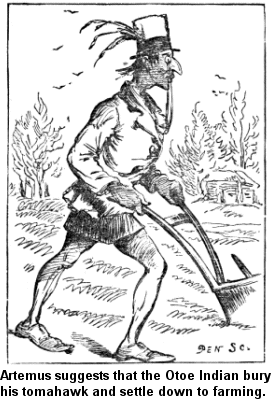
We are passing through the reservation of the Otoe Indians, who long ago washed the war-paint from their faces, buried the tomahawk, and settled down into quiet, prosperous farmers.
_______________
We rattle leisurely into Atchison on a Sunday evening. Lights gleam in the windows of milk-white churches, and they tell us, far better than anything else could, that we are back to civilization again.
_______________
XIV.
VERY MUCH MARRIED.
Are the Mormon women happy?
I give it up. I don't know.
Igive it up. I don't know. Apparently, the Mormon women are happy. I saw them at their best, of course—at balls, tea-parties and the like. They were like other women as far as my observation extended. They were hooped, and furbelowed, and shod, and white-collard, and bejewelled; and like women all over the world, they were softer-eyed and kinder-hearted than men can ever hope to be.
The Mormon girl is reared to believe that the plurality-wife system as it is delicately called here is strictly right; and in linking her destiny with a man who has twelve wives, she undoubtedly considers she is doing her duty. She loves the man, probably, for I think it is not true, as so many writers have stated, that girls are forced to marry whomsoever "the Church" may dictate. Some parents no doubt advise, connive, threaten, and in aggravated cases incarcerate here, as some parents have always done elsewhere, and always will do as long as petticoats continue to be an institution.
How these dozen or twenty wives get along without heart-burnings and hairpullings I can't see.
There are instances on record, you know, where a man don't live in a state of uninterrupted bliss with one wife. And to say that a man can possess twenty wives without having his special favorite, or favorites, is to say that he is an angel in boots—which is something I have never been introduced to. You never saw an angel with a Beard, although you may have seen the Bearded Woman.
The Mormon woman is early taught that man, being created in the image of the Saviour, is far more godly than she can ever be, and that for her to seek to monopolize his affections is a species of rank sin. So she shares his affections with five or six or twenty other women, as the case may be.
A man must be amply able to support a number of wives before he can take them. Hence, perhaps, it is that so many old chaps in Utah have young and blooming wives in their seraglios, and so many young men have only one.
I had a man pointed out to me who married an entire family. He had originally intended to marry Jane, but Jane did not want to leave her widowed mother. The other three sisters were not in the matrimonial market for the same reason; so this gallant man married the whole crowd, including the girl's grandmother, who had lost all her teeth, and had to be fed with a spoon. The family were in indigent circumstances, and they could not but congratulate themselves on securing a wealthy husband. It seemed to affect the grandmother deeply, for the first words she said on reaching her new home were: "Now, thank God! I shall have my gruel reg'lar!"
The name of Joseph Smith is worshipped in Utah; and, "they say," that although he had been dead a good many years, he still keeps on marrying women by proxy. He "reveals" who shall act as his earthly agent in this matter, and the agent faithfully executes the defunct Prophet's commands.
I have somewhere stated that Brigham Young is said to have eighty wives. I hardly think he has so many. Mr. Hyde, the backslider, says in his book that "Brigham always sleeps by himself, in a little chamber behind his office;" and if he has eighty wives I don't blame him. He must be bewildered. I know very well that if I had eighty wives of my bosom I should be confused, and shouldn't sleep anywhere. I undertook to count the long stockings, on the clothes-line, in his back yard one day, and I used up the multiplication table in less than half an hour. It made me dizzy—it did!
In this book I am writing chiefly of what I saw, and to elaborately denounce, at this late day, a system we all know must be wildly wrong, would be simply to impeach the intelligence of the readers of this book.
PART V. ARTEMUS WARD IN LONDON.
THE LONDON PUNCH LETTERS.
_______________
I.
ARRIVAL IN LONDON.
MR. PUNCH: My dear Sir,—You prob'ly didn't meet my uncle Wilyim when he was on these shores. I jedge so from the fack that his pursoots wasn't litrary. Commerce, which it has been trooly observed by a statesman, or somebody, is the foundation stone onto which a nation's greatness rests, glorious Commerce was Uncle Wilyim's fort. He sold soap. It smelt pretty, and redily commanded two pents a cake. I'm the only litrary man in our fam'ly. It is troo, I once had a dear cuzzun who wrote 22 verses onto "A Child who nearly Died of the Measles, O!" but as he injoodiciously introjudiced a chorious at the end of each stansy, the parrents didn't like it at all. The father in particler wept afresh, assaulted my cuzzun, and said he never felt so ridicklus in his intire life. The onhappy result was that my cuzzun abandined poetry forever, and went back to shoemakin, a shattered man.
My Uncle Wilyim disposed of his soap, and returned to his nativ land with a very exolted opinyon of the British public. "It is a edycated community," said he; "they're a intellectooal peple. In one small village alone I sold 50 cakes of soap, incloodin barronial halls, where they offered me a ducal coronet, but I said no—give it to the poor." This was the way Uncle Wilyim went on. He told us, however, some stories that was rather too much to be easily swallerd. In fack, my Uncle Wilyim was not a emblem of trooth. He retired some years ago on a hansum comptency derived from the insurance-money he received on a rather shaky skooner he owned, and which turned up while lyin at a wharf one night, the cargo havin fortnitly been removed the day afore the disastriss calamty occurd. Uncle Wilyim said it was one of the most sing'ler things he ever heard of; and, after collectin the insurance money, he bust into a flood of tears, and retired to his farm in Pennsylvany. He was my uncle by marriage only. I do not say that he wasn't a honest man. I simply say that if you have a uncle, and bitter experunce tells you it is more profitable in a pecoonery pint of view to put pewter spoons instid of silver ones onto the table when that uncle dines with you in a frenly way—I simply say, there is sumthun wrong in our social sistim, which calls loudly for reform.
I 'rived on these shores at Liverpool, and proceeded at once to London. I stopt at the Washington Hotel in Liverpool, because it was named after a countryman of mine who didn't get his living by makin' mistakes, and whose mem'ry is dear to civilized peple all over the world, because he was gentle and good as well as trooly great. We read in Histry of any number of great individooals, but how few of 'em, alars! should we want to take home to supper with us! Among others, I would call your attention to Alexander the Great, who conkerd the world, and wept because he couldn't do it sum more, and then took to gin-and-seltzer, gettin' tight every day afore dinner with the most disgustin' reg'larity, causin' his parunts to regret they hadn't 'prenticed him in his early youth to a biskit-baker, or some other occupation of a peaceful and quiet character. I say, therefore, to the great men now livin; (you could put 'em all into Hyde Park, by the way, and still leave room for a large and respectable concourse of rioters)—be good. I say to that gifted but bald-heded Prooshun, Bismarck, be good and gentle in your hour of triump. I always am. I admit that our lines is different, Bismarck's and mine; but the same glo'rus principle is involved, I am a exhibiter of startlin' curiositys, wax works, snaix, etsetry ("either of whom," as a American statesman whose name I ain't at liberty to mention for perlitical resins, as he expecks to be a candidate for a prom'nent offiss, and hence doesn't wish to excite the rage and jelisy of other showmen—"either of whom is wuth dubble the price of admission"); I say I am an exhibiter of startlin curiositys, and I also have my hours of triump, but I try to be good in 'em. If you say, "Ah, yes, but also your hours of grief and misfortin;" I answer, it is troo, and you prob'ly refer to the circumstans of my hirin' a young man of dissypated habits to fix hisself up as A real Cannibal from New Zeelan, and when I was simply tellin the audience that he was the most feroshos Cannibal of his tribe, and that, alone and unassisted, he had et sev'ril of our fellow countrymen, and that he had at one time even contemplated eatin his Uncle Thomas on his mother's side, as well as other near and dear relatives,—when I was makin' these simple statements the mis'ble young man said I was a lyer, and knockt me off the platform. Not quite satisfied with this, he cum and trod hevly on me, and as he was a very muscular person and wore remarkable thick boots, I knew at once that a canary bird wasn't walkin' over me.
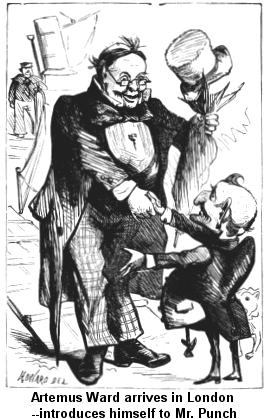
I admit that my ambition overlept herself in this instuns, and I've been very careful ever since to deal square with the public. If I was the public I should insist on squareness, tho' I shouldn't do as a portion of my audience did on the occasion jest mentioned, which they was employed in sum naberin' coal mines. "As you hain't got no more Cannybals to show us, old man," said one of 'em, who seemed to be a kind of leader among 'em—a tall dis'greeble skoundril—"as you seem to be out of Cannybals, we'll sorter look round here and fix things. Them wax figgers of yours want washin'. There's Napoleon Bonyparte and Julius Caesar—they must have a bath," with which coarse and brutal remark he imitated the shrill war-hoop of the western savige, and, assisted by his infamus coal-heavin companyins, he threw all my wax-work into the river, and let my wild bears loose to pray on a peaceful and inoffensive agricultooral community.
Leavin Liverpool (I'm goin' back there, tho—I want to see the Docks, which I heard spoken of at least once while I was there) I cum to London in a 1st class car, passin' the time very agreeable in discussin, with a countryman of mine, the celebrated Schleswig-Holstein question. We took that int'resting question up and carefully traced it from the time it commenced being so, down to the present day, when my countryman, at the close of a four hours' annymated debate, said he didn't know anything about it himself, and he wanted to know if I did. I told him that I did not. He's at Ramsgate now, and I am to write him when I feel like givin him two days in which to discuss the question of negro slavery in America. But now I do not feel like it.
London at last, and I'm stoppin at the Greenlion tavern. I like the lan'lord very much indeed. He had fallen into a few triflin errers in regard to America—he was under the impression, for instance, that we et hay over there, and had horns growin out of the back part of our heads—but his chops and beer is ekal to any I ever pertook. You must cum and see me and bring the boys. I'm told that Garrick used to cum here, but I'm growin skeptycal about Garrick's favorit taverns. I've had over 500 public-houses pinted out to me where Garrick went. I was indooced one night, by a seleck comp'ny of Britons, to visit sum 25 public-houses, and they confidentially told me that Garrick used to go to each one of 'em. Also, Dr. Johnson. This won't do, you know.
May be I've rambled a bit in this communycation. I'll try and be more collected in my next, and meanwhile, b'lieve me,
Trooly Yours,
Artemus Ward
_______________
II.
PERSONAL RECOLLECTIONS.
You'll be glad to learn that I've made a good impression onto the mind of the lan'lord of the Green Lion tavern. He made a speech about me last night. Risin' in the bar he spoke as follers, there bein over 20 individooals present: "This North American has been a inmate of my 'ouse over two weeks, yit he hasn't made no attempt to scalp any member of my fam'ly. He hasn't broke no cups or sassers, or furnitur of any kind. ("Hear, hear.") I find I can trust him with lited candles. He eats his wittles with a knife and a fork. People of this kind should be encurridged. I purpose 'is 'elth!" ("Loud 'plaws.")
What could I do but modestly get up and express a fervint hope that the Atlantic Cable would bind the two countries still more closely together? The lan'lord said my speech was full of orig'nality, but his idee was the old stage coach was more safer, and he tho't peple would indors that opinyin in doo time.
I'm gettin' on exceedin' well in London. I see now, however, that I made a mistake in orderin' my close afore I left home. The trooth is the taler in our little villige owed me for a pig and I didn't see any other way of gettin' my pay. Ten years ago these close would no doubt have been fash'n'ble, and perhaps they would be ekally sim'lar ten years hens. But now they're diff'rently. The taler said he know'd they was all right, because he had a brother in Wales who kept him informed about London fashins reg'lar. This was a infamus falsehood. But as the ballud says (which I heard a gen'l'man in a new soot of black close and white kid gloves sing t'other night), Never don't let us Despise a Man because he wears a Raggid Coat! I don't know as we do, by the way, tho' we gen'rally get out of his way pretty rapid; prob'ly on account of the pity which tears our boosums for his onhappy condition.
This last remark is a sirkastic and witherin' thrust at them blotid peple who live in gilded saloons. I tho't I'd explain my meanin' to you. I frekently have to explain the meanin' of my remarks. I know one man—and he's a man of varid 'complishments—who often reads my articles over 20 times afore he can make anything of 'em at all. Our skoolmaster to home says this is a pecoolerarity of geneyus. My wife says it is a pecoolerarity of infernal nonsens. She's a exceedin' practycal woman. I luv her muchly, however, and humer her little ways. It's a recklis falshood that she henpecks me, and the young man in our neighborhood who said to me one evenin', as I was mistenin' my diafram with a gentle cocktail at the villige tavun—who said to me in these very langwidge, "Go home, old man, onless you desires to have another teapot throwd at you by B.J.," probly regrets havin said so.
I said, "Betsy Jane is my wife's front name, gentle yooth, and I permits no person to alood to her as B.J. outside of the family circle, of which I am it principally myself. Your other observations I scorn and disgust, and I must pollish you off."
He was a able-bodied young man, and, remoovin his coat, he enquired if I wanted to be ground to powder? I said, Yes: if there was a Powder-grindist handy, nothin would 'ford me greater pleasure, when he struck me a painful blow into my right eye, causin' me to make a rapid retreat into the fireplace. I hadn't no idee that the enemy was so well organized. But I rallied and went for him, in a rayther vigris style for my time of life. His parunts lived near by, and I will simply state 15 minits had only elapst after the first act when he was carried home on a shutter. His mama met the sollum procession at the door, and after keerfully looking her orfspring over, she said: "My son, I see how it is distinctually. You've been foolin' round a Trashin Masheen. You went in at the place where they put the grain in, cum out with the straw, and you got up into the thingamyjig, and let the horses tred on you, didn't you, my son?" The pen of no liven Orthur could describe that disfortnit young man's sittywation more clearer. But I was sorry for him, and I went and nussed him till he got well. His reg'lar original father being absent to the war, I told him I'd be a father to him myself. He smilt a sickly smile, and said I'd already been wus than two fathers to him.
I will here obsarve that fitin orter be allus avided, excep in extreem cases. My principle is, if a man smites me on the right cheek I'll turn my left to him, prob'ly; but if he insinooates that my gran'mother wasn't all right, I'll punch his hed. But fitin is mis'ble bisniss, gen'rally speakin, and whenever any enterprisin countryman of mine cums over here to scoop up a Briton in the prize ring I'm allus excessively tickled when he gets scooped hisself, which it is a sad fack has thus far been the case—my only sorrer bein' that t'other feller wasn't scooped likewise. It's diff'rently with scullin boats, which is a manly sport, and I can only explain Mr. Hamil's resunt defeat in this country on the grounds that he wasn't used to British water. I hope this explanation will be entirely satisfact'ry to all.
As I remarked afore, I'm gettin' on well. I'm aware that I'm in the great metrop'lis of the world, and it doesn't make me onhappy to admit the fack. A man is a ass who dispoots it. That's all that ails him. I know there is sum peple who cum over here and snap and snarl 'bout this and that: I know one man who says it is a shame and a disgrace that St. Paul's Church isn't a older edifiss; he says it should be years and even ages older than it is; but I decline to hold myself responsible for the conduck of this idyit simply because he's my countryman. I spose every civ'lised land is endowed with its full share of gibberin' idyits, and it can't be helpt—leastways I can't think of any effectooal plan of helpin' it.
I'm a little sorry you've got politics over here, but I shall not diskuss 'em with nobody. Tear me to pieces with wild omnibus hosses, and I won't diskuss 'em. I've had quite enuff of 'em at home, thank you. I was at Birmingham t'other night, and went to the great meetin' for a few minits. I hadn't been in the hall long when a stern-lookin' artisan said to me:
"You ar from Wales!"
No, I told him I didn't think I was. A hidgyis tho't flasht over me. It was of that onprincipled taler, and I said, "Has my clothin' a Welchy appearance?"
"Not by no means," he answered, and then he said, "And what is your opinyin of the present crisis?"
I said, "I don't zackly know. Have you got it very bad?"
He replied, "Sir, it is sweepin' England like the Cymoon of the Desert!"
"Wall," I said, "let it sweep!"
He ceased me by the arm and said, "Let us glance at hist'ry. It is now some two thousand years—"
"Is it, indeed?" I replied.
"Listin!" he fiercely cried; "it is only a little over two thousand years since—"
"Oh, bother!" I remarkt, "let us go out and git some beer."
"No, Sir. I want no gross and sensual beer. I'll not move from this spot till I can vote. Who ar you?"
I handed him my card, which in addition to my name, contains a elabrit description of my show. "Now, Sir," I proudly said, "you know me?"
"I sollumly swear," he sternly replied, "that I never heard of you, or your show, in my life!"
"And this man," I cried bitterly, "calls hisself a intelligent man, and thinks he orter be allowed to vote! What a holler mockery!"
I've no objection to ev'ry intelligent man votin' if he wants to. It's a pleasant amoosement, no doubt; but there is those whose igrance is so dense and loathsum that they shouldn't be trustid with a ballit any more'n one of my trained serpunts should be trusted with a child to play with.
I went to the station with a view of returnin' to town on the cars.
"This way, Sir," said the guard; "here you ar," and he pinted to a first-class carriage, the sole ockepant of which was a rayther prepossessin' female of about 30 summers.
"No, I thank you," I earnestly replied, "I prefer to walk."
I am, dear Sir,
Very respectivly yours,
Artemus Ward
_______________
III.
THE GREEN LION AND OLIVER CROMWELL.
MR. PUNCH: My Dear Sir,—It is now two weeks since a rayther strange lookin man engaged 'partments at the Green Lion. He stated he was from the celebrated United States, but beyond this he said nothin. He seem'd to prefer sollytood. He remained mostly in his room, and whenever he did show hisself he walkt in a moody and morose manner in the garding, with his hed bowed down and his arms foldid across his brest. He reminded me sumwhat of the celebrated but onhappy "Mr. Haller," in the cheerful play of "The Stranger." This man puzzled me. I'd been puzzled afore several times, but never so severally as now. Mine Ost of the Greenlion said I must interregate this strange bein, who claimed to be my countryman.
"He hasn't called for a drop of beer since he's been in this ere Ouse," said the landlord. "I look to you," he added, "to clear up this dark, this orful mistry!"
I wringed the lan'lord's honest hand, and told him to consider the mistry cleared up.
I gained axes to the misterus bein's room, and by talkin sweet to him for a few minits, I found out who he was. Then returnin to the lan'lord, who was nervisly pacin up and down the bar, I said,
"Sweet ROLANDO, don't tremble no more! I've torn the marsk from the hawty stranger's face, and dived into the recesses of his inmost sole! He's a Trans-Mejim."
I'd been to the Beefanham theatre the previs evenin, and probly the drammer I saw affected me, because I'm not in the habit of goin on as per above. I like the Beefanham theatre very much indeed, because there a enthoosiastic lover of the theatre like myself can unite the legitermit drammer with fish. Thus, while your enrapterd soul drinks in the lorfty and noble sentences of the gifted artists, you can eat a biled mack'ril jest as comfor'bly as in your own house. I felt constrained, however, to tell a fond mother who sot immegitly behind me, and who was accompanied by a gin bottle, and a young infant—I felt constrained to tell that mother, when her infant playfully mingled a rayther oily mack'ril with the little hair which is left on my vener'ble hed, that I had a bottle of scented hair oil at home, which on the whole I tho't I preferred to that which her orfspring was greasin me with. This riled the excellent feamale, and she said:
"Git out! You never was a infank yourself, I spose! Oh no! You was too good to be a infank, you was! You slid into the world all ready grow'd, didn't you? Git out!"
"No, Madam," I replied, "I too was once a infant! I was a luvly child. People used to come in large and enthoosiastic crowds from all parts of the country to see me, I was such a sweet and intel'gent infant. The excitement was so intens, in fack, that a extra hotel was startid in the town to accomodate the peple who thronged to my cradle." Havin finished these troothful statemints, I smilt sweetly on the worthy female. She said:
"Drat you, what do you come a-chaffin me for?" and the estymible woman was really gettin furis, when I mollyfied her by praisin her child, and by axin pardin for all I'd said.
"This little gal," I observed, "this surprisingly lively gal when—" the mother said,
"It's t'other sect is he, Sir: it's a boy."
"Wall," I said, "then this little boy, whose eye is like a eagle a-soaring proudly in the azure sky, will some day be a man, if he don't choke hisself to death in childhood's sunny hours with a smelt or a bloater, or some other drefful calamity. How surblime the tho't, my dear Madam, that this infant as you fondle on your knee on this night, may grow up into a free and independent citizen, whose vote will be worth from ten to fifteen pounds, accordin as suffrage may range at that joyous perid!"
Let us now return, jentle reader, to the lan'lord of the Green Lion, who we left in the bar in a state of anxiety and perspire. Rubbin his hot face with a red handkercher, he said, "Is the strange bein a American?"
"He is."
"A Gen'ral?"
"No."
"A Colonial?"
"No."
"A Majer?"
"Not a Majer."
"A Capting?"
"He is not."
"A leftenant?"
"Not even that."
"Then," said the lan'lord of the Green Lion, "you ar deceeved! He is no countryman of yours."
"Why not?" I said.
"I will tell you, Sir," said the lan'lord. "My son-in-law is employed in a bankin house where ev'ry American as comes to these shores goes to git his drafts casht, and he says that not one has arrived on these shores during the last 18 months as wasn't a Gen'ral, a Colonial, a Majer, a Capting, or a leftenant! This man, as I said afore, has deceeved you! He's a imposture!"
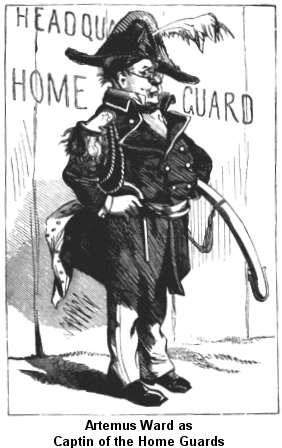
I reeled into a chair. For a minit I was speechlis. At length I murmured, "Alars! I fear it is too troo! Even I was a Capting of the Home Gards."
"To be sure," said the lan'lord; "you all do it over there."
"Wall," I said, "whatever nation this person belongs to, we may as well go and hear him lectur this evenin. He is one of these spirit fellers—he is a Trans-Mejim, and when he slings himself into a trans-state he says the sperits of departed great men talk through him. He says that to-night sev'ril em'nent persons will speak through him—among others, Cromwell."
"And this Mr. Cromwell—is he dead?" said the lan'lord.
I told him that Oliver was no more.
"It's a umbug," said the lan'lord; to which I replied that we'd best go and see, and we went. We was late, on account of the lan'lord's extensiv acquaintans with the public house keepers along the road, and the hall was some two miles distant, but we got there at last. The hall was about half full, and the Mejim was just then assumin' to be Benjamin Franklin, who was speakin about the Atlantic Cable.
He said the Cable was really a merrytorious affair, and that messiges could be sent to America, and there was no doubt about their gettin there in the course of a week or two, which he said was a beautiful idear, and much quicker than by steamer or canal-boat. It struck me that if this was Franklin a spiritooal life hadn't improved the old gentleman's intellecks particly.
The audiens was mostly composed of rayther pale peple, whose eyes I tho't rolled round in a somewhat wild manner. But they was well-behaved, and the females kept saying, "How beautiful! What a surblime thing it is," et cetry, et cetry. Among the females was one who was a fair and rosy young woman. She sot on the same seat we did, and the lan'lord of the Green Lion, whose frekent intervoos with other lan'lords that evenin had been too much for him, fastened his left eye on the fair and rosy young person, and smilin lovinly upon her, said:
"You may give me, my dear, four-penny-worth of gin—cold gin. I take it cold, because—"
There was cries of "Silence! Shame! Put him out! The Skoffer!"
"Ain't we at the Spotted Boar?" the lan'lord hoarsely whispered.
"No," I answered. "It's another kind of bore. Lis'en. Cromwell is goin' to speak through our inspired fren', now."
"Is he?" said the lan'lord—"is he? Wall, I've suthin to say, also. Was this Cromwell a licensed vittler?"
"Not that I ever heard," I anserd.
"I'm sorry for that," said the lan'lord with a sigh, "but you think he was a man who would wish to see licensed vittlers respected in their rights?"
"No doubt."
"Wall," said the lan'lord, "jest you keep a eye on me." Then risin to his feet he said, in somewhat husky yet tol'bly distink voice, "Mr. Crumbwell!"
"Cromwell!" I cried.
"Yes, Mr. Cromwell: that's the man I mean, Mr. Cromble! won't you please advise that gen'l'man who you're talkin through; won't you advise'im during your elekant speech to settle his bill at my 'ouse tonight, Mr. Crumbles," said the lan'lord, glarin' savigely round on the peple, "because if he don't there'll be a punched 'ed to be seen at the Green Lion, where I don't want no more of this everlastin nonsens. I'LL talk through 'im! Here's a sperrit," said the lan'lord, a smile once more beamin on his face, "which will talk through him like a Dutch father! I'm the sperrit for you, young feller!"
"You're a helthy old sperret," I remarkt; and then I saw the necessity of gettin him out of the hall. The wimin was yellin and screaming, and the men was hollerin' perlice. A perliceman really came and collerd my fat fren.
"It's only a fit, Sir Richard," I said. I always call the perlice Sir Richard. It pleases them to think I'm the victim of a deloosion; and they always treat me perlitely. This one did, certainly, for he let us go. We saw no more of the Trans-Mejim.
It's diffikilt, of course, to say how long these noosances will be allowed to prowl round. I should say, however, if pressed for a answer that they will prob'ly continner on jest about as long as they can find peple to lis'en to 'em. Am I right?
Yours, faithfull,
Artemus Ward
_______________
IV.
AT THE TOMB OF SHAKSPEARE.
Mr. Punch, My dear Sir,—I've been lingerin by the Tomb of the lamentid Shakspeare.
It is a success.
I do not hes'tate to pronounce it as such.
You may make any use of this opinion that you see fit. If you think its publication will subswerve the cause of litteraoor, you may publicate it.
I told my wife Betsy when I left home that I should go to the birthplace of the orthur of "Otheller" and other Plays. She said that as long as I kept out of Newgate she didn't care where I went. "But," I said, "don't you know he was the greatest Poit that ever lived? Not one of these common poits, like that young idyit who writes verses to our daughter, about the Roses as growses, and the Breezes as blowses—but a Boss Poit—also a philosopher, also a man who knew a great deal about everything."
She was packing my things at the time, and the only answer she made was to ask me if I was goin to carry both of my red flannel night-caps.
Yes. I've been to Stratford onto the Avon, the Birthplace of Shakspeare. Mr. S. is now no more. He's been dead over three hundred (300) years. The peple of his native town are justly proud of him. They cherish his mem'ry, and them as sell pictures of his birthplace, &c., make it prof'tible cherishin it. Almost everybody buys a pictur to put into their Albiom.
As I stood gazing on the spot where Shakspeare is s'posed to have fell down on the ice and hurt hisself when a boy, (this spot cannot be bought—the town authorities say it shall never be taken from Stratford), I wondered if three hundred years hence picturs of my birthplace will be in demand? Will the peple of my native town be proud of me in three hundred years? I guess they won't short of that time because they say the fat man weighing 1000 pounds which I exhibited there was stuffed out with pillers and cushions, which he said one very hot day in July, "Oh bother, I can't stand this," and commenced pullin the pillers out from under his weskit, and heavin 'em at the audience. I never saw a man lose flesh so fast in my life. The audience said I was a pretty man to come chiselin my own townsmen in that way. I said, "Do not be angry, feller-citizens. I exhibited him simply as a work of art. I simply wished to show you that a man could grow fat without the aid of cod-liver oil." But they wouldn't listen to me. They are a low and grovelin set of peple, who excite a feelin of loathin in every brest where lorfty emotions and original idees have a bidin place.
I stopped at Leamington a few minits on my way to Stratford onto the Avon, and a very beautiful town it is. I went into a shoe shop to make a purchis, and as I entered I saw over the door those dear familiar words, "By Appintment: H.R.H.;" and I said to the man, "Squire, excuse me, but this is too much. I have seen in London four hundred boot and shoe shops by Appintment: H.R.H.; and now you're at it. It is simply onpossible that the Prince can wear 400 pairs of boots. Don't tell me," I said, in a voice choked with emotion—"Oh, do not tell me that you also make boots for him. Say slippers—say that you mend a boot now and then for him; but do not tell me that you make 'em reg'lar for him."
The man smilt, and said I didn't understand these things. He said I perhaps had not noticed in London that dealers in all sorts of articles was By Appintment. I said, "Oh, hadn't I?" Then a sudden thought flasht over me. "I have it!" I said. "When the Prince walks through a street, he no doubt looks at the shop windows."
The man said, "No doubt."
"And the enterprisin tradesman," I continnerd, "the moment the Prince gets out of sight, rushes frantically and has a tin sign painted, By Appintment, H.R.H.! It is a beautiful, a great idee!"
I then bought a pair of shoe strings, and wringin the shopman's honest hand, I started for the Tomb of Shakspeare in a hired fly. It look't however more like a spider.
"And this," I said, as I stood in the old church-yard at Stratford, beside a Tombstone, "this marks the spot where lies William W. Shakspeare. Alars! and this is the spot where—"
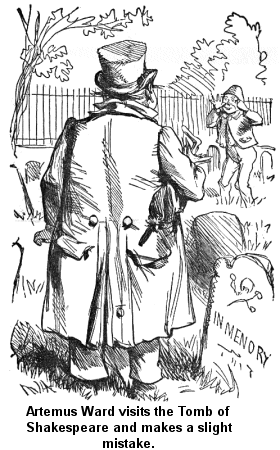
"You've got the wrong grave," said a man—a worthy villager: "Shakspeare is buried inside the church."
"Oh," I said, "a boy told me this was it." The boy larfed and put the shillin I'd given him onto his left eye in a inglorious manner, and commenced moving backwards towards the street.
I pursood and captered him, and after talking to him a spell in a skarcastic stile, I let him went.
The old church was damp and chill. It was rainin. The only persons there when I entered was a fine bluff old gentleman who was talking in a excited manner to a fashnibly dressed young man.
"No, Earnest Montresser," the old gentleman said, "it is idle to pursoo this subjeck no further. You can never marry my daughter. You were seen last Monday in Piccadilly without a umbreller! I said then, as I say now, any young man as venturs out in a uncertain climit like this without a umbreller, lacks foresight, caution, strength of mind and stability; and he is not a proper person to intrust a daughter's happiness to."
I slapt the old gentleman on the shoulder, and I said: "You're right! You're one of those kind of men, you are—"
He wheeled suddenly round, and in a indignant voice, said, "Go way—go way! This is a privit intervoo."
I didn't stop to enrich the old gentleman's mind with my conversation. I sort of inferred that he wasn't inclined to listen to me, and so I went on. But he was right about the umbreller. I'm really delighted with this grand old country, "Mr. Punch," but you must admit that it does rain rayther numerously here. Whether this is owing to a monerkal form of gov'ment or not I leave all candid and onprejudiced persons to say.
William Shakspeare was born in Stratford in 1564. All the commentaters, Shaksperian scholars, etsetry, are agreed on this, which is about the only thing they are agreed on in regard to him, except that his mantle hasn't fallen onto any poet or dramatist hard enough to hurt said poet or dramatist much. And there is no doubt if these commentaters and persons continner investigating Shakspeare's career, we shall not, in doo time, know anything about it at all.
When a mere lad little William attended the Grammar School, because, as he said, the Grammar School wouldn't attend him. This remarkable remark, comin from one so young and inexperunced, set peple to thinkin there might be somethin in this lad. He subsequently wrote "Hamlet" and "George Barnwell." When his kind teacher went to London to accept a position in the offices of the Metropolitan Railway, little William was chosen by his fellow pupils to deliver a farewell address.
"Go on, Sir," he said, "in a glorus career. Be like a eagle, and soar and the soarer you get the more we shall all be gratified! That's so."
My young readers, who wish to know about Shakspeare, better get these vallyable remarks framed.
I returned to the hotel. Meetin a young married couple, they asked me if I could direct them to the hotel which Washington Irving used to keep?
"I've understood that he was onsuccessful as a lan'lord," said the lady.
"We've understood," said the young man, "that he busted up."
I told 'em I was a stranger, and hurried away. They were from my country, and ondoubtedly represented a thrifty Ile well somewhere in Pennsylvany. It's a common thing, by the way, for a old farmer in Pennsylvany to wake up some mornin' and find ile squirtin all around his back yard. He sells out for 'normous price, and his children put on gorgeous harness and start on a tower to astonish people. They succeed in doin it. Meantime the Ile squirts and squirts, and Time rolls on. Let it roll.
A very nice old town is Stratford, and a capital inn is the Red Horse. Every admirer of the great S. must go there once certinly; and to say one isn't a admirer of him, is equv'lent to sayin one has jest about brains enough to become a efficient tinker.
Some kind person has sent me Chawcer's "poems." Mr. C. had talent, but he couldn't spel. No man has a right to be a lit'rary man onless he knows how to spel. It is a pity that Chawcer, who had geneyus, was so unedicated. He's the wuss speller I know of.
I guess I'm through, and so I lay down the pen, which is more mightier than the sword, but which I'm fraid would stand a rayther slim chance beside the needle gun.
Adoo! Adoo!
Artemus Ward
_______________
V.
IS INTRODUCED AT THE CLUB.
MR. PUNCH, My dear Sir,—It is seldim that the Commercial relations between Great Britain and the United States is mar'd by Games.
It is Commerce after all, which will keep the two countries friendly to'ards each other rather than statesmen.
I look at your last Parliament, and I can't see that a single speech was encored during the entire session.
Look at Congress—but no, I'd rather not look at Congress.
Entertainin this great regard for Commerce, "whose sales whiten every sea," as everybody happily observes every chance he gets, I learn with disgust and surprise that a British subjeck bo't a Barril of Apple Sass in America recently, and when he arrove home he found under a few deloosiv layers of sass nothin but sawdust. I should have instintly gone into the City and called a meetin of the leadin commercial men to condemn and repudiate, as a American, this gross frawd, if I hadn't learned at the same time that the draft given by the British subjeck in payment for this frawdylent sass was drawed onto a Bankin House in London which doesn't have a existance, but far otherwise, and never did.
There is those who larf at these things, but to me they merit rebooks and frowns.
With the exception of my Uncle Wilyim—who, as I've before stated, is a uncle by marrige only, who is a low cuss and filled his coat pockets with pies and biled eggs at his weddin breakfast, given to him by my father, and made the clergyman as united him a present of my father's new overcoat, and when my father on discoverin' it got in a rage and denounced him, Uncle Wilyim said the old man (meanin my parent) hadn't any idee of first class Humer!—with the exception of this wretched Uncle the escutchin of my fam'ly has never been stained by Games. The little harmless deceptions I resort to in my perfeshion I do not call Games. They are sacrifisses to Art.
I come of a very clever fam'ly.
The Wards is a very clever fam'ly indeed.
I believe we are descendid from the Puritins, who nobly fled from a land of despitism to a land of freedim, where they could not only enjoy their own religion, but prevent everybody else from enjoyin his.
As I said before, we are a very clever fam'ly.
I was strolling up Regent Street the other day, thinkin what a clever fam'ly I come of, and looking at the gay shop-winders. I've got some new close since you last saw me. I saw them others wouldn't do. They carrid the observer too far back into the dim vister of the past, and I gave 'em to a Orfun Asylum. The close I wear now I bo't of Mr. Moses, in the Commercial Road. They was expressly made, Mr. Moses inforemd me, for a nobleman, but as they fitted him too muchly, partic'ly the trows'rs (which is blue, with large red and white checks) he had said:
"My dear feller, make me some more, only mind—be sure you sell these to some genteel old feller."
I like to saunter thro' Regent Street. The shops are pretty, and it does the old man's hart good to see the troops of fine healthy girls which one may always see there at certain hours in the afternoon, who don't spile their beauty by devourin cakes and sugar things, as too many of the American and French lasses do. It's a mistake about everybody being out of town, I guess. Regent Street is full. I'm here; and as I said before, I come of a very clever fam'ly.
As I was walkin along, amoosin myself by stickin my penknife into the calves of the footmen who stood waitin by the swell-coaches (not one of whom howled with angwish), I was accosted by a man of about thirty-five summers, who said, "I have seen that face somewheres afore!"
He was a little shabby in his wearin apparil. His coat was one of those black, shiny garments, which you can always tell have been burnished by adversity; but he was very gentlemanly.
"Was it in the Crimea, comrade? Yes, it was. It was at the stormin of Sebastopol, where I had a narrow escape from death, that we met."
I said, "No, I wasn't at Sebastopol; I escaped a fatal wound by not bein there. It was a healthy old fortress," I added.
"It was. But it fell. It came down with a crash."
"And plucky boys they was who brought her down," I added; "and hurrah for 'em!"
The man graspt me warmly by the hand, and said he had been in America, Upper Canada, Africa, Asia Minor, and other towns, and he'd never met a man he liked as much as he did me.
"Let us," he added, "let us to the shrine of Bachus!"
And he dragged me into a public house. I was determined to pay, so I said, "Mr. Bachus, giv this gen'l'man what he calls for."
We conversed there in a very pleasant manner till my dinner-time arrove, when the agreeable gentleman insisted that I should dine with him. "We'll have a banquet, Sir, fit for the gods!"
I told him good plain vittles would soot me. If the gods wanted to have the dispepsy, they was welcome to it.
We had soop and fish, and a hot jint, and growsis, and wines of rare and costly vintige. We had ices, and we had froots from Greenland's icy mountins and Injy's coral strands; and when the sumptoous reparst was over, the agree'ble man said he'd unfortnitly left his pocket-book at home on the marble centre- table.
"But, by Jove!" he said, "it was a feast fit for the gods!"
I said, "Oh, never mind," and drew out my puss; tho' I in'ardly wished the gods, as the dinner was fit for 'em, was there to pay for it.
I come of a very clever fam'ly.
The agree'ble gentleman then said, "Now, I will show you our Club. It dates back to the time of William the Conquerer."
"Did Bill belong to it?" I inquired.
"He did."
"Wall," I said, "if Billy was one of 'em, I need no other endorsement as to its respectfulness, and I'll go with you, my gay trooper boy!" And we went off arm-in-arm.
On the way the agree'ble man told me that the Club was called the Sloshers. He said I would notice that none of 'em appeared in evenin dress. He said it was agin the rools of the club. In fack, if any member appeared there in evenin dress he'd be instantly expeld. "And yit," he added, "there's geneyus there, and lorfty emotions, and intelleck. You'll be surprised at the quantities of intelleck you'll see there."
We reached the Sloshers in due time, and I must say they was a shaky-looking lot, and the public house where they convened was certingly none of the best.
The Sloshers crowded round me, and said I was welcome.
"What a beautiful brest-pin you've got," said one of 'em. "Permit me," and he took it out of my neckercher. "Isn't it luvly," he said, parsin it to another, who parsed it to another.
It was given me by my Aunt, on my promisin her I'd never swear profanely; and I never have, except on very special occasions. I see that beautiful boosum pin a parsin from one Slosher to another, and I'm reminded of them sad words of the poit, "parsin away! parsin away!" I never saw it no more.
Then in comes a athletic female, who no sooner sees me than she utters a wild yell, and cries:
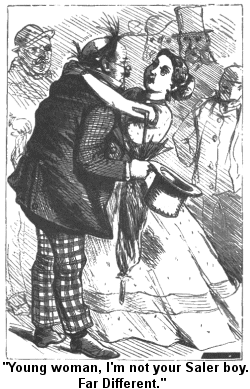
"At larst! at larst! My Wilyim, from the seas!"
I said, "not at all, Marm. Not on no account. I have heard the boatswain pipe to quarters—but a voice in my heart didn't whisper Seu-zan! I've belayed the marlin-spikes on the upper jibpoop, but Seu-zan's eye wasn't on me, much. Young woman, I am not you're Saler boy. Far different."
"Oh yes, you are!" she howled, seizin me round the neck. "Oh, how I've lookt forwards to this meetin!"
"And you'll presently," I said, "have a opportunity of lookin backwards to it, because I'm on the point of leavin this institution."
I will here observe that I come of a very clever family. A very clever fam'ly, indeed.
"Where," I cried, as I struggled in vain to release myself from the eccentric female's claws, "where is the Capting—the man who was into the Crimea, amidst the cannon's thunder? I want him."
He came forward, and cried, "What do I see? Me Sister! me sweet Adulaide! and in teers! Willin!" he screamed, "and you're the serpent I took to my boosum, and borrowed money of, and went round with, and was cheerful with, are you?—You ought to be ashamed of yourself."
Somehow my coat was jerked off, the brest-pocket of which contained my pocket-book, and it parsed away like the brest pin. Then they sorter quietly hustled me into the street.
It was about 12 at night when I reached the Green Lion.
"Ha! ha! you sly old rascal, you've been up to larks!" said the lan'lord, larfin loudly, and digging his fist into my ribs.
I said, "Bigsby, if you do that agin, I shall hit you! Much as I respect you and your excellent faml'y, I shall disfiger your beneverlent countenance for life!"
"What has ruffled your spirits, friend?" said the lan'lord.
"My spirits has been ruffled," I ansered in a bittur voice, "by a viper who was into the Crimea. What good was it," I cried, "for Sebastopol to fall down without enwelopin in its ruins that viper?"
I then went to bed. I come of a very clever fam'ly.
Artemus Ward.
_______________
VI.
THE TOWER OF LONDON.
MR. PUNCH, My dear Sir,—I skurcely need inform you that your excellent Tower is very pop'lar with peple from the agricultooral districks, and it was chiefly them class which I found waitin at the gates the other mornin.
I saw at once that the Tower was established on a firm basis. In the entire history of firm basisis I don't find a basis more firmer than this one.
"You have no Tower in America?" said a man in the crowd, who had somehow detected my denomination.
"Alars! no," I ansered; "we boste of our enterprise and improvements, and yit we are devoid of a Tower. America, oh my onhappy country! thou hast not got no Tower! It's a sweet Boon."
The gates was opened after awhile, and we all purchist tickets and went into a waitin-room.
"My frens," said a pale-faced little man, in black close, "this is a sad day."
"Inasmuch as to how?" I said.
"I mean it is sad to think that so many peple have been killed within these gloomy walls. My frens, let us drop a tear!"
"No," I said, "you must excuse me. Others may drop one if they feel like it; but as for me, I decline. The early managers of this institootion were a bad lot, and their crimes were trooly orful; but I can't sob for those who died four or five hundred years ago. If they was my own relations I couldn't. It's absurd to shed sobs over things which occurd during the rain of Henry the Three. Let us be cheerful," I continnerd "Look at the festiv Warders, in their red flannil jackets. They are cheerful, and why should it not be thusly with us?"
A Warder now took us in charge, and showed us the Trater's Gate, the armers, and things. The Trater's Gate is wide enuff to admit about twenty trater's abrest, I should jedge; but beyond this, I couldn't see that it was superior to gates in gen'ral.
Traters, I will here remark, are a onfortnit class of peple. If they wasn't, they wouldn't be traters. They conspire to bust up a country—they fail, and they're traters. They bust her, and they become statesmen and heroes.
Take the case of Gloster, afterwards Old Dick the Three, who may be seen at the Tower, on horseback, in a heavy tin overcoat—take Mr. Gloster's case. Mr. G. was a conspirater of the basist dye, and if he'd failed, he would have been hung on a sour apple tree. But Mr. G. succeeded, and became great. He was slewd by Col. Richmond, but he lives in histry, and his equestrian figger may be seen daily for a sixpence, in conjunction with other em'nent persons, and no extra charge for the Warder's able and bootiful lectur.
There's one king in the room who is mounted onto a foamin steed, his right hand graspin a barber's pole. I didn't learn his name.
The room where the daggers and pistils and other weppins is kept is interestin. Among this collection of choice cutlery I notist the bow and arrer which those hot-heded old chaps used to conduct battles with. It is quite like the bow and arrer used at this day by certin tribes of American Injuns, and they shoot 'em off with such a excellent precision that I almost sigh'd to be a Injun, when I was in the Rocky Mountain regin. They are a pleasant lot them Injuns. Mr. Cooper and Dr. Catlin have told us of the red man's wonerful eloquence, and I found it so. Our party was stopt on the plains of Utah by a band of Shoshones, whose chief said: "Brothers! the pale-face is welcome. Brothers! the sun is sinkin in the West, and Wa-na-bucky-she will soon cease speakin. Brothers! the poor red man belongs to a race which is fast becomin extink." He then whooped in a shrill manner, stole all our blankets and whisky, and fled to the primeval forest to conceal his emotions.
I will remark here, while on the subjeck of Injuns, that they are in the main a very shaky set, with even less sense than the Fenians, and when I hear philanthropists bewailin the fack that every year "carries the noble red man nearer the settin sun," I simply have to say I'm glad of it, tho' it is rough on the settin sun. They call you by the sweet name of Brother one minit, and the next they scalp you with their Thomashawks. But I wander. Let us return to the Tower.
At one end of the room where the weppins is kept, is a wax figger of Queen Elizabeth, mounted on a fiery stuffed hoss, whose glass eye flashes with pride, and whose red morocker nostril dilates hawtily, as if conscious of the royal burden he bears. I have associated Elizabeth with the Spanish Armady. She's mixed up with it at the Surry Theatre, where "Troo to the Core" is bein acted, and in which a full bally core is introjooced on board the Spanish Admiral's ship, givin the audiens the idee that he intends openin a moosic-hall in Plymouth the moment he conkers that town. But a very interesting drammer is "Troo to the Core," notwithstandin the eccentric conduck of the Spanish Admiral; and very nice it is in Queen Elizabeth to make Martin Truegold a baronet.
The Warder shows us some instrooments of tortur, such as thumbscrews, throat-collars, etc., statin that these was conkerd from the Spanish Armady, and addin what a crooil peple the Spaniards was in them days—which elissited from a bright eyed little girl of about twelve summers the remark that she tho't it was rich to talk about the crooilty of the Spaniards usin thumbscrews, when we was in a Tower where so many poor pepl's heads had been cut off. This made the Warder stammer and turn red.
I was so blessed with the little girl's brightness that I could have kissed the dear child, and I would if she'd been six years older.
I think my companions intended makin a day of it, for they all had sandwiches, sassiges, etc. The sad-lookin man, who had wanted us to drop a tear afore we started to go round, fling'd such quantities of sassige into his mouth, that I expected to see him choke hisself to death. He said to me, in the Beauchamp Tower, where the poor prisoners writ their onhappy names on the cold walls, "This is a sad sight."
"It is, indeed," I anserd. "You're black in the face. You shouldn't eat sassige in public without some rehearsals beforehand. You manage it orkwardly."
"No," he said, "I mean this sad room."
Indeed, he was quite right. Tho' so long ago all these drefful things happened, I was very glad to git away from this gloomy room, and go where the rich and sparklin Crown Jewils is kept. I was so pleased with the Queen's Crown, that it occurd to me what a agree'ble surprise it would be to send a sim'lar one home to my wife; and I asked the Warder what was the vally of a good, well-constructed Crown like that. He told me, but on cypherin up with a pencil the amount of funs I have in the Jint Stock Bank, I conclooded I'd send her a genteel silver watch instid.
And so I left the Tower. It is a solid and commandin edifis, but I deny that it is cheerful. I bid it adoo without a pang.
I was droven to my hotel by the most melancholly driver of a four-wheeler that I ever saw. He heaved a deep sigh as I gave him two shillings.
"I'll give you six d.'s more," I said, "if it hurts you so."
"It isn't that," he said, with a hart-rendin groan, "it's only a way I have. My mind's upset to-day. I at one time tho't I'd drive you into the Thames. I've been readin in all the daily papers to try and understand about Governor Ayre, and my mind is totterin. It's really wonderful I didn't drive you into the Thames."
I asked the onhappy man what his number was, so I could redily find him in case I should want him agin, and bad him good-bye. And then I tho't what a frollicksome day I'd made of it.
Respectably, &c.
Artemus Ward
_______________
VII.
SCIENCE AND NATURAL HISTORY.
MR. PUNCH, My dear Sir,—I was a little disapinted in not receivin a invitation to jine in the meetins of the Social Science Congress.
I don't exackly see how they go on without me.
I hope it wasn't the intentions of the Sciencers to exclood me from their deliberations.
Let it pars. I do not repine. Let us remember Homer. Twenty cities claim Homer dead, thro' which the livin Mr. Homer couldn't have got trusted for a sandwich and a glass of bitter beer, or words to that effect.
But perhaps it was a oversight. Certinly I have been hospitably rec'd in this country. Hospitality has been pored all over me. At Liverpool I was asked to walk all over the docks, which are nine miles along; and I don't remember a instance since my 'rival in London of my gettin into a cab without a Briton comin and perlitly shuttin the door for me, and then extendin his open hand to'ards me, in the most frenly manner possible. Does he not, by this simple yit tuchin gesture, welcum me to England? Doesn't he? Oh yes—I guess he doesn't he. And it's quite right among two great countries which speak the same langwidge, except as regards H's. And I've been allowed to walk round all the streets. Even at Buckinham Pallis, I told a guard I wanted to walk round there, and he said I could walk round there. I ascertained subsequent that he referd to the sidewalk instid of the Pallis—but I couldn't doubt his hospital feelins.
I prepared a Essy on Animals to read before the Social Science meetins. It is a subjeck I may troothfully say I have successfully wrastled with. I tackled it when only nineteen years old. At that tender age I writ a Essy for a lit'ry Institoot entitled, "Is Cats to be Trusted?" Of the merits of that Essy it doesn't becum me to speak, but I may be excoos'd for mentionin that the Institoot parsed a resolution that "whether we look upon the length of this Essy, or the manner in which it is written, we feel that we will not express any opinion of it, and we hope it will be read in other towns."
Of course the Essy I writ for the Social Science Society is a more finisheder production than the one on Cats, which was wroten when my mind was crood, and afore I had masterd a graceful and ellygant stile of composition. I could not even punctooate my sentences proper at that time, and I observe with pane, on lookin over this effort of my yooth, that its beauty is in one or two instances mar'd by ingrammaticisms. This was unexcusable, and I'm surprised I did it. A writer who can't write in a grammerly manner better shut up shop.
You shall hear this Essy on Animals. Some day when you have four hours to spare, I'll read it to you. I think you'll enjoy it. Or, what will be much better, if I may suggest—omit all picturs in next week's "Punch," and do not let your contributors write enything whatever (let them have a holiday; they can go to the British Mooseum;) and publish my Essy intire. It will fill all your collumes full, and create comment. Does this proposition strike you? Is it a go?"
In case I had read the Essy to the Social Sciencers, I had intended it should be the closin attraction. I had intended it should finish the proceedins. I think it would have finished them. I understand animals better than any other class of human creatures. I have a very animal mind, and I've been identified with 'em doorin my entire professional career as a showman, more especial bears, wolves, leopards and serpunts.
The leopard is as lively a animal as I ever came into contack with. It is troo he cannot change his spots, but you can change 'em for him with a paint-brush, as I once did in the case of a leopard who wasn't nat'rally spotted in a attractive manner. In exhibitin him I used to stir him up in his cage with a protracted pole, and for the purpuss of making him yell and kick up in a leopardy manner, I used to casionally whack him over the head. This would make the children inside the booth scream with fright, which would make fathers of families outside the booth very anxious to come in—because there is a large class of parents who have a uncontrollable passion for takin their children to places where they will stand a chance of being frightened to death.
One day I whacked this leopard more than ushil, which elissited a remonstrance from a tall gentleman in spectacles, who said, "My good man, do not beat the poor caged animal. Rather fondle him."
"I'll fondle him with a club," I anserd, hitting him another whack.
"I prythy desist," said the gentleman; "stand aside, and see the effeck of kindness. I understand the idiosyncracies of these creeturs better than you do."
With that he went up to the cage, and thrustin his face in between the iron bars, he said, soothinly, "Come hither, pretty creetur."
The pretty creetur come-hithered rayther speedy, and seized the gentleman by the whiskers, which he tore off about enuff to stuff a small cushion with.
He said, "You vagabone, I'll have you indicted for exhibitin dangerous and immoral animals."
I replied, "Gentle Sir, there isn't a animal here that hasn't a beautiful moral, but you mustn't fondle 'em. You mustn't meddle with their idiotsyncracies."
The gentleman was a dramatic cricket, and he wrote a article for a paper, in which he said my entertainment was a decided failure.
As regards Bears, you can teach 'em to do interesting things, but they're onreliable. I had a very large grizzly bear once, who would dance, and larf, and lay down, and bow his head in grief, and give a mournful wale, etsetry. But he often annoyed me. It will be remembered that on the occasion of the first battle of Bull Run, it suddenly occurd to the Fed'ral soldiers that they had business in Washington which ought not to be neglected, and they all started for that beautiful and romantic city, maintaining a rate of speed durin the entire distance that would have done credit to the celebrated French steed "Gladiateur." Very nat'rally our Gov'ment was deeply grieved at this defeat; and I said to my Bear, shortly after, as I was givin a exhibition in Ohio—I said, "Brewin, are you not sorry the National arms has sustained a defeat?" His business was to wale dismal, and bow his head down, the band (a barrel organ and a wiolin) playin slow and melancholly moosic. What did the grizzly old cuss do, however, but commence darncin and larfin in the most joyous manner? I had a narrer escape from being imprisoned for disloyalty.
I will relate another incident in the career of this retchid Bear. I used to present what I called in the bills a Beautiful living Pictur—showing the Bear's fondness for his Master: in which I'd lay down on a piece of carpeting, and the Bear would come and lay down beside me, restin his right paw on my breast, the Band playing "Home, Sweet Home," very soft and slow. Altho' I say it, it was a tuchin thing to see. I've seen Tax-Collectors weep over that performance.
Well, one day I said, "Ladies and Gentlemen, we will show you the Bear's fondness for his master," and I went and laid down. I tho't I observed a pecooliar expression into his eyes, as he rolled clumsily to'ards me, but I didn't dream of the scene which follered. He laid down, and put his paw on my breast. "Affection of the Bear for his Master," I repeated. "You see the Monarch of the Western Wilds in a subjugated state. Fierce as these animals naturally are, we now see that they have hearts and can love. This Bear, the largest in the world, and measurin seventeen feet round the body, loves me as a mer-ther loves her che-ild!" But what was my horror when the grizzly and infamus Bear threw his other paw under me, and riz with me to his feet. Then claspin me in a close embrace he waltzed up and down the platform in a frightful manner, I yellin with fear and anguish. To make matters wuss, a low scurrilus young man in the audiens hollered out:
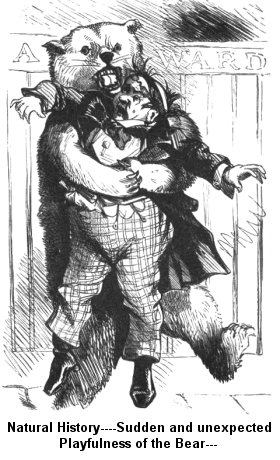
"Playfulness of the Bear! Quick moosic!"
I jest 'scaped with my life. The Bear met with a wiolent death the next day, by bein in the way when a hevily loaded gun was fired off by one of my men.
But you should hear my Essy which I wrote for the Social Science Meetins. It would have had a movin effeck on them.
I feel that I must now conclood.
I have read Earl Bright's speech at Leeds, and I hope we shall now hear from John Derby. I trust that not only they, but Wm. E. Stanley and Lord Gladstone will cling inflexibly to those great fundamental principles, which they understand far better than I do, and I will add that I do not understand anything about any of them whatever in the least—and let us all be happy, and live within our means, even if we have to borrer money to do it with.
Very respectivly yours,
Artemus Ward
_______________
VIII.
A VISIT TO THE BRITISH MUSEUM.
MR. PUNCH, My dear Sir,—You didn't get a instructiv article from my pen last week on account of my nervus sistim havin underwent a dreffle shock. I got caught in a brief shine of sun, and it utterly upsot me. I was walkin in Regent Street one day last week, enjoyin your rich black fog and bracing rains, when all at once the Sun bust out and actooally shone for nearly half an hour steady. I acted promptly. I called a cab and told the driver to run his hoss at a friteful rate of speed to my lodgins, but it wasn't of no avale. I had orful cramps, and my appytite left me, and my pults went down to 10 degrees below zero. But by careful nussin I shall no doubt recover speedy, if the present sparklin and exileratin weather continners.
[All of the foregoin is sarcasum.]
It's a sing'lar fack, but I never sot eyes on your excellent British Mooseum till the other day. I've sent a great many peple there, as also to your genial Tower of London, however. It happened thusly: When one of my excellent countrymen jest arrived in London would come and see me, and display a inclination to cling to me too lengthy, thus showing a respect for me which I feel I do not deserve, I would sugjest a visit to the Mooseum and Tower. The Mooseum would ockepy him a day at leest, and the Tower another. Thus I've derived considerable peace and comfort from them noble edifisses, and I hope they will long continner to grace your metroplis. There's my fren Col. Larkins, from Wisconsin, who I regret to say understands the Jamaica question, and wants to talk with me about it; I sent him to the Tower four days ago, and he hasn't got throogh with it yit. He likes it very much, and he writes me that he can't never thank me sufficient for directin him to so interestin a bildin. I writ him not to mention it. The Col. says it is fortnit we live in a intellectooal age which wouldn't countenance such infamus things as occurd in this Tower. I'm aware that it is fashin'ble to compliment this age, but I ain't so clear that the Col. is altogether right. This is a very respectable age, but it's pretty easily riled; and considerin upon how slight a provycation we who live in it go to cuttin each other's throats, it may perhaps be doubted whether our intellecks is so much massiver than our ancestors' intellecks was, after all.
I allus ride outside with the cabman. I am of humble parentage, but I have (if you will permit me to say so) the spirit of the eagle, which chafes when shut up in a four-wheeler, and I feel much eagler when I'm in the open air. So on the mornin on which I went to the Mooseum I lit a pipe, and callin a cab, I told the driver to take me there as quick as his Arabian charger could go. The driver was under the inflooence of beer and narrerly escaped runnin over a aged female in the match trade, whereupon I remonstratid with him. I said, "That poor old woman may be the only mother of a young man like you." Then throwing considerable pathos into my voice, I said: Then throwing considerable pathos into my voice I said, "You have a mother?"
He said, "You lie!" I got down and called another cab, but said nothin to this driver about his parents.
The British Mooseum is a magnificent free show for the people. It is kept open for the benefit of all.
The humble costymonger, who traverses the busy streets with a cart containin all kinds of vegetables, such as carrots, turnips, etc, and drawn by a spirited jackass—he can go to the Mooseum and reap benefits therefrom as well as the lord of high degree.
"And this," I said, "is the British Mooseum! "These noble walls," I continnerd, punching them with my umbreller to see if the masonry was all right—but I wasn't allowd to finish my enthoosiastic remarks, for a man with a gold band on his hat said, in a hash voice, that I must stop pokin the walls. I told him I would do so by all means. "You see," I said, taking hold of the tassel which waved from the man's belt, and drawin him close to me in a confidential way, "You see, I'm lookin round this Mooseum, and if I like it I shall buy it."
Instid of larfin hartily at these remarks, which was made in a goakin spirit, the man frowned darkly and walked away.
I first visited the stuffed animals, of which the gorillers interested me most. These simple-minded monsters live in Afriky, and are believed to be human beins to a slight extent, altho' they are not allowed to vote. In this department is one or two superior giraffes. I never woulded I were a bird, but I've sometimes wished I was a giraffe, on account of the long distance from his mouth to his stummuck. Hence, if he loved beer, one mugful would give him as much enjoyment while goin down, as forty mugfuls would ordinary persons. And he wouldn't get intoxicated, which is a beastly way of amusin oneself, I must say. I like a little beer now and then, and when the teetotallers inform us, as they frekently do, that it is vile stuff, and that even the swine shrink from it, I say it only shows that the swine is a ass who don't know what's good; but to pour gin and brandy down one's throat as freely as though it were fresh milk, is the most idiotic way of goin' to the devil that I know of.
I enjoyed myself very much lookin at the Egyptian mummays, the Greek vasis, etc, but it occurd to me there was rayther too many "Roman antiquitys of a uncertin date." Now, I like the British Mooseum, as I said afore, but when I see a lot of erthen jugs and pots stuck up on shelves, and all "of a uncertin date," I'm at a loss to 'zackly determin whether they are a thousand years old or was bought recent. I can cry like a child over a jug one thousand years of age, especially if it is a Roman jug; but a jug of a uncertin date doesn't overwhelm me with emotions. Jugs and pots of a uncertin age is doubtles vallyable property, but, like the debentures of the London, Chatham, and Dover Railway, a man doesn't want too many of them.
I was debarred out of the great readin-room. A man told me I must apply by letter for admission, and that I must get somebody to testify that I was respectable. I'm a little 'fraid I shan't get in there. Seein a elderly gentleman, with a beneverlent-lookin face near by, I venturd to ask him if he would certify that I was respectable. He said he certainly would not, but he would put me in charge of a policeman, if that would do me any good. A thought struck me. "I refer you to 'Mr. Punch'," I said.
"Well," said a man, who had listened to my application, "you have done it now! You stood some chance before."
I will get this infamus wretch's name before you go to press, so you can denounce him in the present number of your excellent journal.
The statute of Apollo is a pretty slick statute. A young yeoman seemed deeply imprest with it. He viewd it with silent admiration. At home, in the beautiful rural districks where the daisy sweetly blooms, he would be swearin in a horrible manner at his bullocks, and whacking 'em over the head with a hayfork; but here, in the presence of Art, he is a changed bein.
I told the attendant that if the British nation would stand the expens of a marble bust of myself, I would willingly sit to some talented sculpist.
"I feel," I said, "that this is a dooty I owe to posterity."
He said it was hily prob'l, but he was inclined to think that the British nation wouldn't care to enrich the Mooseum with a bust of me, altho' he venturd to think that if I paid for one myself it would be accepted cheerfully by Madam Tussaud, who would give it a prom'nent position in her Chamber of Horrers. The young man was very polite, and I thankt him kindly.
After visitin the Refreshment room and partakin of half a chicken "of a uncertin age," like the Roman antiquitys I have previsly spoken of, I prepared to leave. As I passed through the animal room I observed with pane that a benevolint person was urgin the stufft elephant to accept a cold muffin, but I did not feel called on to remostrate with him, any more than I did with two young persons of diff'rent sexes who had retired behind the Rynosserhoss to squeeze each other's hands. In fack, I rayther approved of the latter proceedin, for it carrid me back to the sunny spring-time of MY life. I'm in the shear and yeller leaf now, but I don't forgit the time when to squeeze my Betsy's hand sent a thrill through me like fellin off the roof of a two-story house; and I never squozed that gentle hand without wantin to do so some more, and feelin that it did me good.
Trooly yours,
Artemus Ward
PART VI. ARTEMUS WARD'S PANORAMA.
(ILLUSTRATED AS DELIVERED AT EGYPTIAN HALL, LONDON.)
_______________
REFATORY NOTE BY MELVILLE D. LANDON.
The fame of Artemus Ward culminated in his last lectures at Egyptian Hall, Piccadilly, the final one breaking off abruptly on the evening of the 23d of January, 1867. That night the great humorist bade farewell to the public, and retired from the stage to die! His Mormon lectures were immensely successful in England. His fame became the talk of journalists, savants, and statesmen. Every one seemed to be affected differently, but every one felt and acknowledged his power. "The Honorable Robert Lowe," says Mr. E.P. HINGSTON, Artemus Ward's bosom friend, "attended the Mormon lecture one evening, and laughed as hilariously as any one in the room. The next evening Mr. John Bright happened to be present. With the exception of one or two occasional smiles, he listened with grave attention."
The "London Standard," in describing his first lecture in London, aptly said, "Artemus dropped his jokes faster than the meteors of last night succeeded each other in the sky. And there was this resemblance between the flashes of his humor and the flights of the meteors, that in each case one looked for jokes or meteors, but they always came just in the place that one least expected to find them. Half the enjoyment of the evening lay, to some of those present, in listening to the hearty cachinnation of the people, who only found out the jokes some two or three minutes after they were made, and who laughed apparently at some grave statements of fact. Reduced to paper, the showman's jokes are certainly not brilliant; almost their whole effect lies in their seeming impromptu character. They are carefully led up to, of course; but they are uttered as if they are mere afterthoughts of which the speaker is hardly sure."
His humor was so entirely fresh and unconventional, that it took his hearers by surprise, and charmed them. His failing health compelled him to abandon the lecture after about eight or ten weeks. Indeed, during that brief period he was once or twice compelled to dismiss his audience. Frequently he sank into a chair and nearly fainted from the exertion of dressing. He exhibited the greatest anxiety to be at his post at the appointed time, and scrupulously exerted himself to the utmost to entertain his auditors. It was not because he was sick that the public was to be disappointed, or that their enjoyment was to be diminished. During the last few weeks of his lecture-giving, he steadily abstained from accepting any of the numerous invitations he received. Had he lived through the following London fashionable season, there is little doubt that the room at the Egyptian Hall would have been thronged nightly. The English aristocracy have a fine, delicate sense of humor, and the success, artistic and pecuniary, of "Artemus Ward" would have rivalled that of the famous "Lord Dundreary." There were many stupid people who did not understand the "fun" of Artemus Ward's books. There were many stupid people who did not understand the fun of Artemus Ward's lecture on the Mormons. Highly respectable people—the pride of their parish—when they heard of a lecture "upon the Mormons," expected to see a solemn person, full of old saws and new statistics, who would denounce the sin of polygamy,—and rave without limit against Mormons. These uncomfortable Christians do not like humor. They dread it as a certain personage is said to dread holy water, and for the same reason that thieves fear policemen—it finds them out. When these good idiots heard Artemus offer if they did not like the lecture in Piccadilly, to give them free tickets for the same lecture in California, when he next visited that country, they turned to each other indignantly, and said, "What use are tickets for California to us? WE are not going to California. No! we are too good, too respectable to go so far from home. The man is a fool!" One of these vestrymen complained to the doorkeeper, and denounced the lecturer as an impostor—"and," said the wealthy parishioner, "as for the panorama, it is the worst painted thing I ever saw."
During the lecture Artemus was always as solemn as the grave. Sometimes he would seem to forget his audience, and stand for several seconds gazing intently at his panorama. Then he would start up and remark apologetically, "I am very fond of looking at my pictures." His dress was always the same—evening toilet. His manners were polished, and his voice gentle and hesitating. Many who had read of the man who spelled joke with a "g," looked for a smart old man with a shrewd cock eye, dressed in vulgar velvet and gold, and they were hardly prepared to see the accomplished gentleman with slim physique and delicate white hands.