___________________________________ (continued 2)
Reading edition
I arrove at Salt Lake in doo time. At Camp Scott there was a lot of U.S. sogers, hosstensibly sent out there to smash the Mormons but really to eat Salt vittles & play poker & other beautiful but sumwhat onsartin games. I got acquainted with sum of the officers. Thay lookt putty scrumpshus in their Bloo coats with brass buttings onto um & ware very talented drinkers, but so fur as fitin is consarned I'd willingly put my wax figgers agin the hull party.
My desire was to exhibit my grate show in Salt Lake City, so I called on Brigham Yung, the grate mogull amung the mormins and axed his permishun to pitch my tent and onfurl my banner to the jentle breezis. He lookt at me in a austeer manner for a few minits, and sed:
"Do you bleeve in Solomon, Saint Paul, the immaculateness of the Mormin Church and the Latter-day Revelashuns?"
Sez I, "I'm on it!" I make it a pint to git along plesunt, tho I didn't know what under the Son the old feller was drivin at. He sed I mite show.
"You air a marrid man, Mister Yung, I bleeve?" sez I, preparin to rite him sum free parsis.
"I hev eighty wives, Mister Ward. I sertinly am married."
"How do you like it as far as you hev got?" sed I.
He sed "middlin," and axed me wouldn't I like to see his famerly, to which I replide that I wouldn't mine minglin with the fair Seck & Barskin in the winnin smiles of his interestin wives. He accordingly tuk me to his Scareum. The house is powerful big & in a exceedin large room was his wives & children, which larst was squawkin and hollerin enuff to take the roof rite orf the house. The wimin was of all sizes and ages. Sum was pretty & sum was Plane—sum was helthy and sum was on the Wayne—which is verses, tho sich was not my intentions, as I don't 'prove of puttin verses in Proze rittins, tho ef occashun requires I can Jerk a Poim ekal to any of them Atlantic Munthly fellers.
"My wives, Mister Ward," sed Yung.
"Your sarvant, marms," sed I, as I sot down in a cheer which a red-heded female brawt me.
"Besides these wives you see here, Mister Ward," sed Yung, "I hav eighty more in varis parts of this consecrated land which air Sealed to me."
"Which?" sez I, gittin up & starin at him.
"Sealed, Sir! sealed."
"Whare bowts?" sez I.
"I sed, Sir, that they was sealed!" He spoke in a traggerdy voice.
"Will they probly continner on in that stile to any grate extent, Sir?" I axed.
"Sir," sed he, turnin as red as a biled beet, "don't you know that the rules of our Church is that I, the Profit, may hev as meny wives as I wants?"
"Jes so," I sed. "You are old pie, ain't you?"
"Them as is Sealed to me—that is to say, to be mine when I wants um—air at present my sperretooul wives," sed Mister Yung.
"Long may thay wave!" sez I, seein I shood git into a scrape ef I didn't look out.
In a privit conversashun with Brigham I learnt the follerin fax: It takes him six weeks to kiss his wives. He don't do it only onct a yere & sez it is wuss nor cleanin house. He don't pretend to know his children, thare is so many of um, tho they all know him. He sez about every child he meats call him Par, & he takes it for grantid it is so. His wives air very expensiv. Thay allers want suthin & ef he don't buy it for um thay set the house in a uproar. He sez he don't have a minit's peace. His wives fite amung their selves so much that he has bilt a fitin room for thare speshul benefit, & when too of 'em get into a row he has em turnd loose into that place, whare the dispoot is settled accordin to the rules of the London prize ring. Sum times thay abooz hisself individooally. Thay hev pulled the most of his hair out at the roots & he wares meny a horrible scar upon his body, inflicted with mop-handles, broom-sticks, and sich. Occashunly they git mad & scald him with bilin hot water. When he got eny waze cranky thay'd shut him up in a dark closit, previsly whippin him arter the stile of muthers when thare orfsprings git onruly. Sumptimes when he went in swimmin thay'd go to the banks of the Lake & steal all his close, thereby compellin him to sneek home by a sircootius rowt, drest in the Skanderlus stile of the Greek Slaiv. "I find that the keers of a marrid life way hevy onto me," sed the Profit, "& sumtimes I wish I'd remaned singel." I left the Profit and startid for the tavern whare I put up to. On my way I was overtuk by a lurge krowd of Mormons, which they surroundid me & statid that they were goin into the Show free.
"Wall," sez I, "ef I find a individooal who is goin round lettin folks into his show free, I'll let you know."
"We've had a Revelashun biddin us go into A. Wards's Show without payin nothin!" thay showtid.
"Yes," hollered a lot of femaile Mormonesses, ceasin me by the cote tales & swingin me round very rapid, "we're all goin in free! So sez the Revelashun!"
"What's Old Revelashun got to do with my show?" sez I, gittin putty rily. "Tell Mister Revelashun," sed I, drawin myself up to my full hite and lookin round upon the ornery krowd with a prowd & defiant mean, "tell Mister Revelashun to mind his own bizness, subject only to the Konstitushun of the United States!"
"Oh now let us in, that's a sweet man," sed several femails, puttin thare arms round me in luvin style. "Become 1 of us. Becum a Preest & hav wives Sealed to you."
"Not a Seal!" sez I, startin back in horror at the idee.
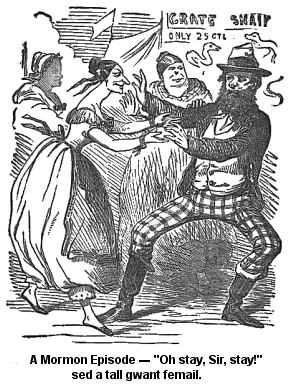
"Oh stay, Sir, stay," sed a tell, gawnt femaile, ore whoos hed 37 summirs must hev parsd, "stay, & I'll be your Jentle Gazelle."
"Not ef I know it, you won't," sez I. "Awa you skanderlus femaile, awa! Go & be a Nunnery!" That's what I sed, jes so.
"& I," sed a fat chunky femaile, who must hev wade more than too hundred lbs, "I will be your sweet gidin Star!"
Sez I, "Ile bet two dollers and a half you won't!" Whare ear I may Rome Ile still be troo 2 thee, Oh Betsy Jane! [N.B. Betsy Jane is my wife's Sir naime.]
"Wiltist thou not tarry here in the promist Land?" sed several of the miserabil critters.
"Ile see you all essenshally cussed be4 I wiltist!" roared I, as mad as I cood be at thare infernul noncents. I girdid up my Lions & fled the Seen. I packt up my duds & Left Salt Lake, which is a 2nd Soddum & Germorrer, inhabitid by as theavin & onprincipled a set of retchis as ever drew Breth in eny spot on the Globe.
____________________
THE PRESS.
I WANT the editors to cum to my Show free as the flours of May, but I don't want um to ride a free hoss to deth. Thare is times when Patience seizes to be virtoous. I hev "in my mind's eye, Hurrashio " (cotashun from Hamlick) sum editers in a sertin town which shall be nameless, who air Both sneakin and ornery. They cum in krowds to my Show and then axt me ten sents a lines for Puffs. I objectid to payin, but they sed ef I didn't down with the dust thay'd wipe my Show from the face of the earth! Thay sed the Press was the Arkymedian Leaver which moved the wurld. I put up to their extorshuns until thay'd bled me so I was a meer shadder, and left in disgust.
It was in a surtin town in Virginny, the Muther of Presidents & things, that I was shaimfully aboozed by a editor in human form. He set my Show up steep & kalled me the urbane bane & gentlemunly manajer, but when I, fur the purpuss of showin fair play all around, went to anuther offiss to git my handbills printed, what duz this pussillanermus editer do but change his toon & abooze me like a Injun. He sed my wax works was a humbug & called me a horey-heded itinerent vagabone. I thort at fust Ide pollish him orf ar-lar the Beneshy Boy, but on reflectin that he cood pollish me much wuss in his paper, I giv it up. & I wood here take occashun to advise peple when thay run agin, as thay sumtimes will, these miserable papers, to not pay no attenshun to um. Abuv all, don't assault a editer of this kind. It only gives him a note rosity, which is jest what he wants, & don't do you no more good than it wood to jump into enny other mud puddle. Editers are generally fine men, but there must be black sheep in every flock.
____________________
EDWIN FOREST AS OTHELLO.
Durin a recent visit to New York the undersined went to see Edwin Forrest. As I'm into the moral show bizness myself, I ginrally go to Barnum's moral Museum, where only moral peple air admitted, pertickly on Wednesday arternoons. But this time I thot I'd go & see Ed. Ed has bin actin out on the stage for many years. There is varis 'pinions about his actin, Englishmen ginrally bleevin that he is far superior to Mister Macready; but on one pint all agree, & that is that Ed draws like a six ox team. Ed was actin at Niblo's Garding, which looks considerable more like a parster, than a garding, but let that pars. I sot down in the pit, took out my spectacles & commenced peroosin the evenin's bill. The awjince was all-fired large & the boxes was full of the elitty of New York. Several opery glasses was leveld at me by Gothum's farest darters, but I didn't let on as tho I noticed it, tho mebby I did take out my sixteen-dollar silver watch & brandish it round more than was necessary. But the best of us has our weaknesses & if a man has gewelry let him show it. As I was peroosin the bill a grave young man who sot near me axed me if I'd ever seen Forrest dance the Essence of Old Virginny? "He's immense in that," sed the young man. "He also does a fair champion jig," the young man continnerd, "but his Big Thing is the Essence of Old Virginny." Sez I, "Fair youth, do you know what I'd do with you if you was my sun?"
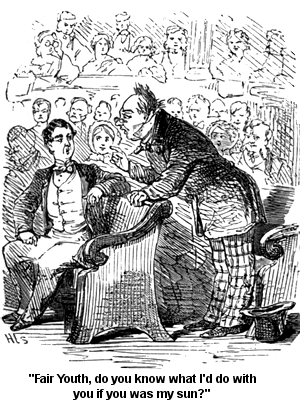
"No," sez he.
"Wall," sez I, "I'd appint your funeral tomorrow arternoon, & the KORPS SHOULD BE READY! You're too smart to live on this yearth." He didn't try any more of his capers on me. But another pussylanermus individooul, in a red vest & patent lether boots, told me his name was Bill Astor & axed me to lend him 50 cents till early in the mornin. I told him I'd probly send it round to him before he retired to his virtoous couch, but if I didn't he might look for it next fall, as soon as I cut my corn. The Orchestry was now fiddling with all their might, & as the peple didn't understan anything about it they applaudid versifrussly. Presently, Old Ed cum out. The play was Otheller or More of Veniss. Otheller was writ by Wm. Shakspeer. The scene is laid in Veniss. Otheller was a likely man & was a ginral in the Veniss army. He eloped with Desdemony, a darter of the Hon. Mister Brabantio, who represented one of the back districks in the Veneshun legislater. Old Brabantio was as mad as thunder at this & tore round considerable, but finally cooled down, tellin Otheller, howsever, that Desdemony had come it over her Par, & that he had better look out or she'd come it over him likewise. Mr. & Mrs. Otheller git along very comfortable like for a spell. She is sweet-tempered and luvin—a nice, sensible female, never goin in for he-female conventions, green cotton umbrellers, and pickled beats. Otheller is a good provider and thinks all the world of his wife. She has a lazy time of it, the hired girl doin all the cookin and washin. Desdemony, in fact, don't have to git the water to wash her own hands with. But a low cuss named Iago, who I bleeve wants to git Otheller out of his snug government birth, now goes to work & upsets the Otheller family in the most outrajus stile. Iago falls in with a brainless youth named Roderigo & wins all his money at poker. (Iago allers played foul.) He thus got money enuff to carry out his onprincipled skeem. Mike Cassio, a Irishman, is selected as a tool by Iago. Mike was a clever feller & orficer in Otheller's army. He liked his tods too well, howsever, & they floored him, as they have many other promisin young men. Iago injuces Mike to drink with him, Iago slyly throwin his whiskey over his shoulder. Mike gits as drunk as a biled owl & allows that he can lick a yard full of the Veneshun fancy before breakfast, without sweatin a hair. He meets Roderigo & proceeds for to smash him. A feller named Montano undertakes to slap Cassio, when that infatooated person runs his sword into him. That miserble man, Iago, pretents to be very sorry to see Mike conduck hisself in this way & undertakes to smooth the thing over to Otheller, who rushes in with a drawn sword & wants to know what's up. Iago cunningly tells his story, & Otheller tells Mike that he thinks a good deal of him, but he can't train no more in his regiment. Desdemony sympathizes with poor Mike & interceeds for him with Otheller. Iago makes him bleeve she does this because she thinks more of Mike than she does of hisself. Otheller swallers Iago's lyin tail & goes to makin a noosence of hisself ginrally. He worries poor Desdemony terrible by his vile insinuations, & finally smothers her to deth with a piller. Mrs. Iago cums in just as Otheller has finished the fowl deed & givs him fits right & left, showin him that he has bin orfully gulled by her miserble cuss of a husband. Iago cums in, & his wife commences rakin him down also, when he stabs her. Otheller jaws him a spell & then cuts a small hole in his stummick with his sword. Iago pints to Desdemony's deth bed & goes orf with a sardonic smile onto his countenance. Otheller tells the peple that he has dun the state sum service & they know it; axes them to do as fair a thing as they can for him under the circumstances, & kills hisself with a fish-knife, which is the most sensible thing he can do. This is a breef skedule of the synopsis of the play.
Edwin Forrest is a grate acter. I thot I saw Otheller before me all the time he was actin, & when the curtin fell, I found my spectacles was still mistened with salt-water, which had run from my eyes while poor Desdemony was dyin. Betsy Jane—Betsy Jane! let us pray that our domestic bliss may never be busted up by a Iago!
Edwin Forrest makes money actin out on the stage. He gits five-hundred dollars a nite & his board & washin. I wish I had such a Forrest in my Garding!
____________________
THE SHOW BUSINESS AND POPULAR LECTURES.
I feel that the Show Bizniss, which Ive stroven to ornyment, is bein usurpt by Poplar Lecturs, as thay air kalled, tho in my pinion thay air poplar humbugs. Individoouls, who git hard up, embark in the lecturin biznis. They cram theirselves with hi-sounding frazis, frizzle up their hare, git trustid for a soot of black close & cum out to lectur at 50 dollers a pop. Thay aint over stockt with branes, but thay hav brass enuff to make suffishunt kittles to bile all the sope that will be required by the ensooin sixteen ginerashuns. Peple flock to heer um in krowds. The men go becawz its poplar & the wimin folks go to see what other wimin folks have on. When its over the lecturer goze & ragales hisself with oysters and sich, while the peple say, "What a charmin lectur that air was," etsettery, etsettery, when 9 out of 10 of um don't have no moore idee of what the lecturer sed than my kangeroo has of the sevunth speer of hevun. Thare's moore infurmashun to be gut out of a well conductid noospape—price 3 sents—than thare is out of ten poplar lectures at 25 or 50 dollers a pop, as the kase may be. These same peple, bare in mind, stick up their nosis at moral wax figgers & sagashus beests. Thay say these things is low. Gents, it greeves my hart in my old age, when I'm in "the Sheer & yeller leef" (to cote frum my Irish frend Mister McBeth) to see that the Show biznis is pritty much plade out; howsomever I shall chance it agane in the Spring.
____________________
WOMAN'S RIGHTS.
I pitcht my tent in a small town in Injianny one day last seeson, & while I was standin at the dore takin money, a deppytashun of ladies came up & sed they wos members of the Bunkumville Female Moral Reformin & Wimin's Rite's Associashun, and thay axed me if they cood go in without payin.
"Not exactly," sez I, "but you can pay without goin in."
"Dew you know who we air?" sed one of the wimin—a tall and feroshus lookin critter, with a blew kotton umbreller under her arm—"do you know who we air, Sir?"
"My impreshun is," sed I, "from a kersery view, that you air females."
"We air, Sur," sed the feroshus woman—"we belong to a Society whitch beleeves wimin has rites—whitch beleeves in razin her to her proper speer—whitch beleeves she is indowed with as much intelleck as man is—whitch beleeves she is trampled on and aboozed—& who will resist henso4th & forever the incroachments of proud & domineering men."
Durin her discourse, the exsentric female grabed me by the coat-kollor & was swinging her umbreller wildly over my hed.
"I hope, marm," sez I, starting back, "that your intensions is honorable! I'm a lone man hear in a strange place. Besides, I've a wife to hum."
"Yes," cried the female, "& she's a slave! Doth she never dream of freedom—doth she never think of throwin off the yoke of tyrrinny & thinkin & votin for herself?—Doth she never think of these here things?"
"Not bein a natral born fool," sed I, by this time a little riled, "I kin safely say that she dothunt."
"Oh whot—whot!" screamed the female, swingin her umbreller in the air.—"O, what is the price that woman pays for her expeeriunce!"
"I don't know," sez I; "the price of my show is 15 cents pur individooal."
"& can't our Soisety go in free?" asked the female.
"Not if I know it," sed I.
"Crooil, crooil man!" she cried, & bust into teers.
"Won't you let my darter in?" sed anuther of the exsentric wimin, taken me afeckshunitely by the hand. "O, please let my darter in,—shee's a sweet gushin child of natur."
"Let her gush!" roared I, as mad as I cood stick at their tarnal nonsense; "let her gush!" Where upon they all sprung back with the simultanious observashun that I was a Beest.
"My female friends," sed I, "be4 you leeve, I've a few remarks to remark; wa them well. The female woman is one of the greatest institooshuns of which this land can boste. Its onpossible to get along without her. Had there bin no female wimin in the world, I should scarcely be here with my unparalleld show on this very occashun. She is good in sickness—good in wellness—good all the time. O woman, woman!" I cried, my feelins worked up to a hi poetick pitch, "you air a angle when you behave yourself; but when you take off your proper appairel & (mettyforically speaken)—get into pantyloons—when you desert your firesides, & with your heds full of wimin's rites noshuns go round like roarin lions, seekin whom you may devour someboddy—in short, when you undertake to play the man, you play the devil and air an emfatic noosance. My female friends," I continnered, as they were indignantly departin, "wa well what A. Ward has sed!"
____________________
THE PRINCE OF WALES
To my friends of the Editorial Corpse:
I rite these lines on British sile. I've bin follerin Mrs. Victory's hopeful sun Albert Edward threw Kanady with my onparaleled Show, and tho I haint made much in a pecoonary pint of vew, I've lernt sumthin new, over hear on British Sile, whare they bleeve in Saint George and the Dragoon. Previs to cumin over hear I tawt my organist how to grind Rule Brittany and other airs which is poplar on British Sile. I likewise fixt a wax figger up to represent Sir Edmun Hed the Govner Ginral. The statoot I fixt up is the most versytile wax statoot I ever saw. I've showd it as Wm. Penn, Napoleon Bonypart, Juke of Wellington, the Beneker Boy, Mrs. Cunningham & varis other notid persons, and also for a sertin pirut named Hix. I've bin so long amung wax statoots that I can fix 'em up to soot the tastes of folks, & with sum paints I hav I kin giv their facis a beneverlent or fiendish look as the kase requires. I giv Sir Edmun Hed a beneverlent look, & when sum folks who thawt they was smart sed it didn't look like Sir Edmun Hed anymore than it did anybody else, I sed, "That's the pint. That's the beauty of the Statoot. It looks like Sir Edmun Hed or any other man. You may kall it what you pleese. Ef it don't look like anybody that ever lived, then it's sertinly a remarkable Statoot & well worth seein. I kall it Sir Edmun Hed. You may kall it what you pleese!" [I had 'em thare.]
At larst I've had a interview with the Prince, tho it putty nigh cost me my vallerble life. I cawt a glimpse of him as he sot on the Pizarro of the hotel in Sarnia, & elbowd myself threw a crowd of wimin, children, sojers & Injins that was hangin round the tavern. I was drawin near to the Prince when a red-faced man in Millingtery close grabd holt of me and axed me whare I was goin all so bold?
"To see Albert Edard the Prince of Wales," sez I; "who are you?"
He sed he was Kurnel of the Seventy Fust Regiment, Her Magisty's troops. I told him I hoped the Seventy Onesters was in good helth, and was passin by when he ceased hold of me agin, and sed in a tone of indigent cirprise:
"What? Impossible! It kannot be! Blarst my hize, sir, did I understan you to say that you was actooally goin into the presents of his Royal Iniss?"
"That's what's the matter with me," I replide.
"But blarst my hize, sir, its onprecedented. It's orful, sir. Nothin' like it hain't happened sins the Gun Powder Plot of Guy Forks. Owdashus man, who air you?"
"Sir," sez I, drawin myself up & puttin on a defiant air, "I'm a Amerycan sitterzen. My name is Ward. I'm a husband & the father of twins, which I'm happy to state thay look like me. By perfeshun I'm a exhibiter of wax works & sich."
"Good God!" yelled the Kurnal, "the idee of a exhibiter of wax figgers goin into the presents of Royalty! The British Lion may well roar with raje at the thawt!"
Sez I, "Speakin of the British Lion, Kurnal, I'd like to make a bargin with you fur that beast fur a few weeks to add to my Show." I didn't meen nothin by this. I was only gettin orf a goak, but you roter hev seen the Old Kurnal jump up & howl. He actooally fomed at the mowth.
"This can't be real," he showtid. "No, no. It's a horrid dream. Sir, you air not a human bein—you hav no existents—yure a Myth!"
"Wall," sez I, "old hoss, yule find me a ruther onkomfortable Myth ef you punch my inards in that way agin." I began to git a little riled, fur when he called me a Myth he puncht me putty hard. The Kurnal now commenst showtin fur the Seventy Onesters. I at fust thawt I'd stay & becum a Marter to British Outraje, as sich a course mite git my name up & be a good advertisement fur my Show, but it occurred to me that ef enny of the Seventy Onesters shood happen to insert a barronet into my stummick it mite be onplesunt, & I was on the pint of runnin orf when the Prince hisself kum up & axed me what the matter was. Sez I, "Albert Edard, is that you?" & he smilt & sed it was. Sez I, "Albert Edard, hears my keerd. I cum to pay my respecks to the futer King of Ingland. The Kurnal of the Seventy Onesters hear is ruther smawl pertaters, but of course you ain't to blame fur that. He puts on as many airs as tho he was the Bully Boy with the glass eye."
"Never mind," sez Albert Edard, "I'm glad to see you, Mister Ward, at all events," & he tuk my hand so plesunt like & larfed so sweet that I fell in love with him to onct. He handid me a segar & we sot down on the Pizarro & commenst smokin rite cheerful. "Wall," sez I, "Albert Edard, how's the old folks?"
"Her Majesty & the Prince are well," he sed.
"Duz the old man take his Lager beer reglar?" I inquired.
The Prince larfed & intermatid that the old man didn't let many kegs of that bevridge spile in the sellar in the coarse of a year. We sot & tawked there sum time abowt matters & things, & bimeby I axed him how he liked bein Prince as fur as he'd got.
"To speak plain, Mister Ward," he sed, "I don't much like it. I'm sick of all this bowin & scrapin & crawlin & hurrain over a boy like me. I would rather go through the country quietly & enjoy myself in my own way, with the other boys, & not be made a Show of to be garped at by everybody. When the PEPLE cheer me I feel pleesed, fur I know they meen it; but if these one-horse offishuls cood know how I see threw all their moves & understan exackly what they air after, & knowd how I larft at 'em in private, thayd stop kissin my hands & fawnin over me as thay now do. But you know, Mr. Ward, I can't help bein a Prince, & I must do all I kin to fit myself fur the persishun I must sumtime ockepy."
"That's troo," sez I; "sickness and the docters will carry the Queen orf one of these dase, sure's yer born."
The time hevin arove fur me to take my departer I rose up & sed: "Albert Edard, I must go, but previs to doin so I will obsarve that you soot me. Yure a good feller, Albert Edard, & tho I'm agin Princes as a gineral thing, I must say I like the cut of your Gib. When you git to be King try and be as good a man as yure muther has bin! Be just & be Jenerus, espeshully to showmen, who hav allers bin aboozed sins the dase of Noah, who was the fust man to go into the Menagery bizniss, & ef the daily papers of his time air to be beleeved Noah's colleckshun of livin wild beests beet ennything ever seen sins, tho I make bold to dowt ef his snaiks was ahead of mine. Albert Edard, adoo!" I tuk his hand which he shook warmly, & givin him a perpetooal free pars to my show, & also parses to take hum for the Queen & old Albert, I put on my hat and walkt away.
"Mrs. Ward," I solilerquized, as I walkt along, "Mrs. Ward, ef you could see your husband now, just as he prowdly emerjis from the presunts of the futur King of Ingland, you'd be sorry you called him a Beest jest becaws he cum home tired 1 nite and wantid to go to bed without takin orf his boots. You'd be sorry for tryin to deprive yure husband of the priceliss Boon of liberty, Betsy Jane!"
Jest then I met a long perseshun of men with gownds onto 'em. The leader was on horseback, & ridin up to me he sed, "Air you Orange?"
Sez I, "Which?"
"Air you a Orangeman?" he repeated, sternly.
"I used to peddle lemins," sed I, "but I never delt in oranges. They are apt to spile on yure hands. What particler Loonatic Asylum hev you & yure frends escaped frum, ef I may be so bold?" Just then a suddent thawt struck me & I sed, "Oh yure the fellers who air worryin the Prince so & givin the Juke of Noocastle cold sweats at nite, by yure infernal catawalins, air you? Wall, take the advice of a Amerykin sitterzen, take orf them gownds & don't try to get up a religious fite, which is 40 times wuss nor a prize fite, over Albert Edard, who wants to receive you all on a ekal footin, not keerin a tinker's cuss what meetin house you sleep in Sundays. Go home & mind yure bisness & not make noosenses of yourselves." With which observashuns I left 'em.
I shall leeve British sile 4thwith.
____________________
OSSAWATOMIE BROWN.
I don't portend to be a cricket & consekently the reader will not regard this 'ere peace as a Cricketcism. I cimply desine givin the pints & Plot of a play I saw actid out at the theater t'other nite, called Ossywattermy Brown or the Hero of Harper's Ferry. Ossywattermy had varis failins, one of which was a idee that he cood conker Virginny with a few duzzen loonatics which he had pickt up sumwhares, mercy only nose wher. He didn't cum it, as the sekel showed. This play was jerkt by a admirer of Old Ossywattermy.
First akt opens at North Elby, Old Brown's humsted. Tare's a weddin at the house. Amely, Old Brown's darter, marrys sumbody, and they all whirl in the Messy darnce. Then Ossywattermy and his 3 sons leave fur Kansis. Old Mrs. Ossywattermy tells 'em thay air goin on a long jurny & Blesses 'em to slow fiddlin. Thay go to Kansis. What upon arth thay go to Kansis fur when thay was so nice & comfortable down there to North Elby, is more'n I know. The suns air next seen in Kausis at a tarvern. Mister Blanc, a sinister lookin man with his Belt full of knives & hoss pistils, axes one of the Browns to take a drink. Brown refuzis, which is the fust instance on record whar a Brown deklined sich a invite. Mister Blane, who is a dark bearded feroshus loohin person, then axis him whether he's fur or fernenst Slavery. Yung Brown sez he's agin it, whareupon Mister Blanc, who is the most sinisterest lookin man I ever saw, sez Har, har, har I (that bein his stile of larfin wildly) & ups & sticks a knife into yung Brown. Anuther Brown rushes up & sez, "you has killed me Ber-ruther!" Moosic by the Band & Seen changes. The stuck yung Brown enters supported by his two brothers. Bimeby he falls down, sez he sees his Mother, & dies. Moosic by the Band. I lookt but couldn't see any mother. Next Seen reveels Old Brown's cabin. He's readin a book. He sez freedum must extend its Area & rubs his hands like he was pleesed abowt it. His suns come in. One of 'em goes out & cums in ded, havin bin shot while out by a Border Ruffin. The ded yang Brown sez he sees his mother and tumbles down. The Border Ruffins then surround the cabin & set it a fire. The Browns giv theirselves up for gone coons, when the hired gal diskivers a trap door to the cabin & thay go down threw it & cum up threw the bulkhed. Their merraklis 'scape reminds me of the 'scape of De Jones, the Coarsehair of the Gulf—a tail with a yaller kiver, that I onct red. For sixteen years he was confined in a loathsum dunjin, not tastin of food durin all that time. When a lucky thawt struck him! He opend the winder and got out. To resoom—Old Brown rushes down to the footlites, gits down on his nees & swares he'll hav revenge. The battle of Ossawatermy takes place. Old Brown kills Mister Blanc, the sinister individooal aforesed. Mister Blane makes a able & elerquent speech, sez he don't see his mother much, and dies likes the son of a gentleman, rapt up in the Star Spangled banner. Moosic by the Band. Four or five other Border ruffins air killed, but thay don't say nothin abowt seein their mothers. From Kansis to Harper's Ferry. Picter of a Arsenal is represented. Sojers cum & fire at it. Old Brown cums out & permits hisself to be shot. He is tride by two soops in milingtery Jose, and sentenced to be hung on the gallus. Tabloo—Old Brown on a platform, pintin upards the staige lited up with red fire. Goddiss of Liberty also on platform, pintin upards. A dutchman in the orkestry warbles on a base drum. Curtin falls. Moosic by the Band.
____________________
JOY IN THE HOUSE OF WARD.
Dear Sirs
I take my pen in hand to inform you that I am in a state of grate bliss, and trust these lines will find you injoyin the same blessins. I'm reguvinated. I've found the immortal waters of yooth, so to speak, and am as limber and frisky as a two-year-old steer, and in the futur them boys which sez to me "go up, old Bawld hed," will do so at the peril of their hazard, individooally. I'm very happy. My house is full of joy, and I have to git up nights and larf! Sumtimes I ax myself "is it not a dream?" & suthin withinto me sez "it air;" but when I look at them sweet little critters and hear 'em squawk, I know it is a reality—2 realitys, I may say—and I feel gay.
I returnd from the Summer Campane with my unparaleld show of wax works and livin wild Beests of Pray in the early part of this munch. The peple of Baldinsville met me cordully and I immejitly commenst restin myself with my famerly, The other nite while I was down to the tavurn tostin my shins agin the bar room fire & amuzin the krowd with sum of my adventurs, who shood cum in bare heded & terrible excited but Bill Stokes, who sez, sez he, "Old Ward, there's grate doing up to your house."
Sez I, "William, how so?"
Sez he, "Bust my gizzud, but its grate doins," & then larfed as if heed kill hisself.
Sez I, risin and puttin on a austeer look, "William, I woodnut be a fool if I had common cents."
But he kept on larfin till he was black in the face, when he fell over on the bunk where the hostler sleeps, and in a still small voice sed, "Twins!" I ashure you gents that the grass didn't grow under my feet on my way home, & I was followed by a enthoosiastic throng of my feller sitterzens, who hurrard for Old Ward at the top of their voises. I found the house chock full of peple. Thare was Mrs. Square Baxter and her three grown-up darters, lawyer Perkinses wife, Taberthy Ripley, young Eben Parsuns, Deakun Simmuns folks, the Skoolmaster, Doctor Jordin, etsetterry, etsetterry. Mis Ward was in the west room, which jines the kitchin. Mis Square Baxter was mixin suthin in a dipper before the kitchin fire, & a small army of female wimin were rushin wildly round the house with bottles of camfire, peaces od flannil, &c. I never seed such a hubbub in my natral born dase. I cood not stay in the west room only a minit, so strong was my feelings, so I rusht out and ceased my dubbel barrild gun
"What on airth ales the man?" sez Taberthy Ripley. "Sakes alive, what air you doin?" & she grabd me by the tales. "What's the matter with you?" she continnered.
"Twins, Marm," sez I, "twins!"
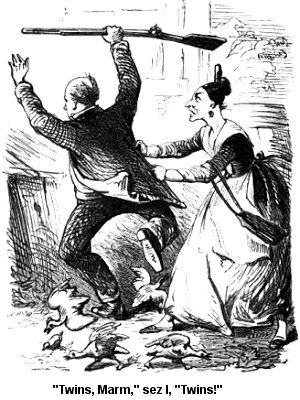
"I know it," sez she, coverin her pretty face with her aprun.
"Wall," sez I, "that's what's the matter with me!"
"Wall, put down that air gun, you pesky old fool," sed she.
"No, morra," sez I, "this is a Nashunal day. The glory of this here day isn't confined to Baldinsville by a darn site. On yonder woodshed," sed I, drawin myself up to my full hite and speakin in a show-actin voice, "will I fire a Nashunal saloot!" sayin whitch I tared myself from her grasp and rush to to the top of the shed whare I blazed away until Square Baxter's hired man and my son Artemus Juneyer cum and took me down by mane force.
On returnin to the Kitchin I found quite a lot of people sealed be4 the fire, a talkin the event over. They made room for me & I sot down. "Quite a eppisode," sed Docter Jordin, litin his pipe with a red-hot coal.
"Yes," sed I, "2 eppisodes, waying abowt 18 pounds jintly."
"A perfeck coop de tat," sed the skoolmaster.
"E pluribus unum, in proprietor persony," sed I, thinking I'd let him know I understood furrin langwidges as well as he did, if I wasn't a skoolmaster.
"It is indeed a momentious event," sed young Eben Parsuns, who has been 2 quarters to the Akademy.
"I never heard twins called by that name afore," sed I, "but I spose it's all rite."
"We shall soon have Wards enuff," sed the editer of the Baldinsville Bugle of Liberty, who was lookin over a bundle of exchange papers in the corner, "to apply to the legislator for a City Charter?"
"Good for you, old man!" sed I; "iv that air a conspickius place in the next Bugle."
"How redicklus," sed pretty Susan Fletcher, coverin her face with her knittin work & larfin like all possest.
"Wall, for my part," sed Jane Maria Peasley, who is the crossest old made in the world, "I think you all act like a pack of fools."
Sez I, "Mis. Peasly, air you a parent?"
Sez she, "No, I aint."
Sez I, "Mis. Peasly, you never will be."
She left.
We sot there talkin & larfin until "the switchin hour of nite, when grave yards yawn & Josts troop 4th," as old Bill Shakepire aptlee obsarves in his dramy of John Sheppard, esq, or the Moral House Breaker, when we broke up & disbursed.
Muther & children is a doin well; & as Resolushuns is the order of the day I will feel obleeged if you'll insurt the follerin—
Whereas, two Eppisodes has happined up to the undersined's house, which is Twins; & Whereas I like this stile, sade twins hero of the male perswashun & both boys ; there4 Be it
Resolved, That to them nabers who did the fare thing by sade Eppisodes my hart felt thanks is doo.
Resolved, That I do most hartily thank Engine Ko. No. 17, who, under the impreshun from the fuss at my house on that auspishus nite that thare was a konflagration goin on, kum galyiantly to the spot, but kindly refraned frum squirtin.
Resolved, That frum the Bottum of my Sole do I thank the Baldinsville brass band fur givin up the idea of Sarahnadin me, both on that great nite & sinse.
Resolved, That my thanks is doo several members of the Baldsinville meetin house who fur 3 whole dase hain't kalled me a sinful skoffer or intreeted me to mend my wicked wase and jine sade meetin house to onct.
Resolved, That my Boozum teams with meny kind emoshuns towards the follerin individoouls, to whit namelee—Mis. Square Baxter, who Jenerusly refoozed to take a sent for a bottle of camfire; lawyer Perkinses wife who rit sum versis on the Eppisodes; the Editer of the Baldinsville Bugle of Liberty, who nobly assisted me in wollupin my Kangeroo, which sagashus little cuss seriusly disturbed the Eppisodes by his outrajus screetchins & kickins up; Mis. Hirum Doolittle, who kindly furnisht sum cold vittles at a tryin time, when it wasunt konvenient to cook vittles at my hous; & the Peasleys, Par Parsunses & Watsunses fur there meny ax of kindness.
Trooly yures, ARTEMUS WARD.
____________________
BOSTON.
(A. WARD TO HIS WIFE.)
Dear Betsy: I write you this from Boston, "the Modern Atkins," as it is denomyunated, altho' I skurcely know what those air. I'll giv you a kursoory view of this city. I'll klassify the paragrafs under seprit headins, arter the stile of those Emblems of Trooth and Poority, the Washinton correspongdents!
COPP'S HILL.
The winder of my room commands a exileratin view of Copps' Hill, where Cotton Mather, the father of the Reformers and sich, lies berrid. There is men even now who worship Cotton, and there is wimin who wear him next their harts. But I do not weep for him. He's bin ded too lengthy. I ain't going to be absurd, like old Mr. Skillins, in our naberhood, who is ninety-six years of age, and gets drunk every 'lection day, and weeps Bitturly because he haint got no Parents. He's a nice Orphan, he is.
BUNKER HILL.
Bunker Hill is over yonder in Charleston. In 1776 a thrillin dramy was acted out over there, in which the "Warren Combination" played star parts.
MR. FANUEL.
Old Mr. Fanuel is ded, but his Hall is still into full blarst. This is the Cradle in which the Goddess of Liberty was rocked, my Dear. The Goddess hasn't bin very well durin' the past few years, and the num'ris quack doctors she called in didn't help her any; but the old gal's physicians now are men who understand their bizness, Major-generally speakin', and I think the day is near when she'll be able to take her three meals a day, and sleep nights as comf'bly as in the old time.
THE COMMON.
It is here, as ushil; and the low cuss who called it a Wacant Lot, and wanted to know why they didn't ornament it with sum Bildins', is a onhappy Outcast in Naponsit.
THE LEGISLATUR.
The State House is filled with Statesmen, but sum of 'em wear queer hats. They buy 'em, I take it, of hatters who carry on hat stores down-stairs in Dock Square, and whose hats is either ten years ahead of the prevailin' stile, or ten years behind it—jest as a intellectooal person sees fit to think about it. I had the pleasure of talkin' with sevril members of the legislatur. I told 'em the Eye of 1000 ages was onto we American peple of to-day. They seemed deeply impressed by the remark, and wantid to know if I had seen the Grate Orgin?
HARVARD COLLEGE.
This celebrated institootion of learnin is pleasantly situated in the Bar-room of Parker's in School street, and has poopils from all over the country.
I had a letter yes'd'y, by the way, from our mootual son, Artemus, Jr., who is at Bowdoin College in Maine. He writes that he's a Bowdoin Arab. & is it cum to this? Is this Boy as I nurtered with a Parent's care into his childhood's hour—is he goin' to be a Grate American humorist? Alars! I fear it is too troo. Why didn't I bind him out to the Patent Travellin Vegetable Pill Man, as was struck with his appearance at our last County Fair, & wanted him to go with him and be a Pillist? Ar, these Boys—they little know how the old folks worrit about 'em. But my father he never had no occasion to worrit about me. You know, Betsy, that when I fust commenced my career as a moral exhibitor with a six-legged cat and a Bass drum, I was only a simple peasant child—skurce 15 Summers had flow'd over my yoothful hed. But I had sum mind of my own. My father understood this. "Go," he sed—"go, my son, and hog the public!" (he ment, "knock em," but the old man was allus a little given to slang). He put his withered han' tremblinly onto my hed, and went sadly into the house. I thought I saw tears tricklin down his venerable chin, but it might hav been tobacker jooce. He chaw'd.
LITERATOOR.
The "Atlantic Monthly," Betsy, is a reg'lar visitor to our westun home. I like it because it has got sense. It don't print stories with piruts and honist young men into 'em, makin' the piruts splendid fellers and the honist young men dis'gree'ble idiots—so that our darters very nat'rally prefer the piruts to the honist young idiots; but it gives us good square American literatoor. The chaps that write for the "Atlantic," Betsy, understand their bizness. They can sling ink, they can. I went in and saw 'em. I told 'em that theirs was a high and holy mission. They seemed quite gratified, and asked me if I had seen the Grate Orgin.
WHERE THE FUST BLUD WAS SPILT.
I went over to Lexington yes'd'y. My Boozum hove with sollum emotions. "& this," I sed to a man who was drivin' a yoke of oxen, "this is where our revolutionary forefathers asserted their independence and spilt their Blud. Classic ground!"
"Wall," the man sed, "it's good for white beans and potatoes, but was regards raisin' wheat, t'ain't worth a damn. But hav' you seen the Grate Orgin?"
THE POOTY GIRL IN SPECTACLES.
I returned in the Hoss Cars, part way. A pooty girl in spectacles sot near me, and was tellin' a young man how much he reminded her of a man she used to know in Walthan. Pooty soon the young man got out, and, smilin' in a seductive manner, I said to the girl in spectacles, "Don't I remind you of somebody you used to know?"
"Yes," she sed, "you do remind me of one man, but he was sent to the penitentiary for stealin' a Bar'l of mackril—he died there, so I conclood you ain't HIM." I didn't pursoo the conversation. I only heard her silvery voice once more durin' the remainder of the jerney. Turnin' to a respectable lookin' female of advanced summers, she asked her if she had seen the Grate Orgin.
We old chaps, my dear, air apt to forget that it is sum time since we was infants, and et lite food. Nothin' of further int'rist took place on the cars excep' a colored gentleman, a total stranger to me, asked if I'd lend him my diamond Brestpin to wear to a funeral in South Boston. I told him I wouldn't—not a purpuss.
COMMON SKOOLS.
A excellent skool sistim is in vogy here. John Slurk, my old pardner, has a little son who has only bin to skool two months, and yet he exhibertid his father's performin' Bear in the show all last summer. I hope they pay partic'lar 'tention to Spelin in these Skools, because if a man can't Spel wel he's of no 'kount.
SUMMIN' UP.
I ment to have allooded to the Grate Orgin in this letter, but I haven't seen it. Mr. Reveer, whose tavern I stop at, informed me that it can be distinctly heard through a smoked glass in his nativ town in New Hampshire, any clear day. But settin' the Grate Orgin aside (and indeed, I don't think I heard it mentioned all the time I was there), Boston is one of the grandest, sure-footedest, clear headedest, comfortablest cities on the globe. Onlike ev'ry other large city I was ever in, the most of the hackmen don't seem to hav' bin speshully intended by natur for the Burglery perfession, and it's about the only large city I know of where you don't enjoy a brilliant opportunity of bein swindled in sum way, from the Risin of the sun to the goin down thereof. There4 I say, loud and continnered applaus' for Boston!
DOMESTIC MATTERS.
Kiss the children for me. What you tell me 'bout the Twins greeves me sorely. When I sent 'em that Toy Enjine I had not contempyulated that they would so fur forgit what wos doo the dignity of our house as to squirt dishwater on the Incum Tax Collector. It is a disloyal act, and shows a prematoor leanin' tords cussedness that alarms me. I send to Amelia Ann, our oldest dawter, sum new music, viz. "I am Lonely sints My Mother-in-law Died"; "Dear Mother, What tho' the Hand that Spanked me in my Childhood's Hour is withered now?" &c. These song writers, by the way, air doin' the Mother Bizness rather too muchly.
Your Own Troo husban',
Artemus Ward.
____________________
HOW OLD ABE RECEIVED THE NEWS OF HIS NOMINATION.
There are several reports afloat as to how "Honest Old Abe" received the news of his nomination, none of which are correct. We give the correct report.
The Official Committee arrived in Springfield at dewy eve, and went to Honest Old Abe's house. Honest Old Abe was not in. Mrs. Honest Old Abe said Honest Old Abe was out in the woods splitting rails. So the Official Committee went out into the woods, where sure enough they found Honest Old Abe splitting rails with his two boys. It was a grand, a magnificent spectacle. There stood Honest Old Abe in his shirt-sleeves, a pair of leather home-made suspenders holding up a pair of home-made pantaloons, the seat of which was neatly patched with substantial cloth of a different color. "Mr Lincoln, Sir, you've been nominated, Sir, for the highest office, Sir—." "Oh, don't bother me," said Honest Old Abe; "I took a stent this mornin' to split three million rails afore night, and I don't want to be pestered with no stuff about no Conventions till I get my stent done. I've only got two hundred thousand rails to split before sundown. I kin do it if you'll let me alone." And the great man went right on splitting rails, paying no attention to the Committee whatever. The Committee were lost in admiration for a few moments, when they recovered, and asked one of Honest Old Abe's boys whose boy he was? "I'm my parent's boy," shouted the urchin, which burst of wit so convulsed the Committee that they came very near "gin'in eout" completely. In a few moments Honest Ole Abe finished his task, and received the news with perfect self-possession. He then asked them up to the house, where he received them cordially. He said he split three million rails every day, although he was in very poor health. Mr. Lincoln is a jovial man, and has a keen sense of the ludicrous. During the evening he asked Mr. Evarts, of New York, "why Chicago was like a hen crossing the street?" Mr. Evarts gave it up. "Because," said Mr. Lincoln, "Old Grimes is dead, that good old man!" This exceedingly humorous thing created the most uproarious laughter.
____________________
INTERVIEW WITH PRESIDENT LINCOLN.
I hav no politics. Not a one. I'm not in the bisiness. If I was I spose I should holler versiffrusly in the streets at nite and go home to Betsy Jane smellen of coal ile and gin, in the mornin. I should go to the Poles arly. I should stay there all day. I should see to it that my nabers was thar. I should git carriges to take the kripples, the infirm and the indignant thar. I should be on guard agin frauds and sich. I should be on the look out for the infamus lise of the enemy, got up jest be4 elecshun for perlitical effeck. When all was over and my candydate was elected, I should move heving & erth so to speak until I got orfice, which if I didn't git a orfice I should turn round and abooze the Administration with all my mite and maine. But I'm not in the bizniss. I'm in a far more respectful bizniss nor what pollertics is. I wouldn't giv two cents to be a Congresser. The wuss insult I ever received was when sertin citizens of Baldinsville axed me to run fur the Legislater. Sez I, "My frends, dostest think I'd stoop to that there?" They turned as white as a sheet. I spoke in my most orfullest tones & they knowed I wasn't to be trifled with. They slunked out of site to onct.
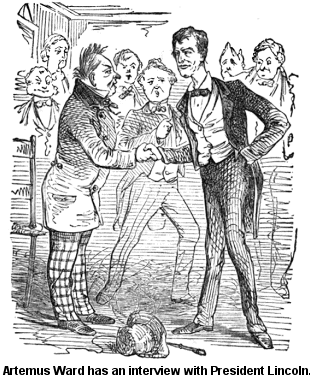
There4, havin no politics, I made bold to visit Old Abe at his humstid in Springfield. I found the old feller in his parler, surrounded by a perfeck swarm of orfice seekers. Knowin he had been capting of a flat boat on the roarin Mississippy I thought I'd address him in sailor lingo, so sez I, "Old Abe, ahoy! Let out yer main-suls, reef hum the forecastle & throw yer jib-poop over-board! Shiver my timbers, my harty!" [N.B. This is ginuine mariner langwidge. I know, becawz I've seen sailor plays acted out by them New York theatre fellers.] Old Abe lookt up quite cross & sez, "Send in yer petition by & by. I can't possibly look at it now. Indeed, I can't. It's onpossible, sir!"
"Mr. Linkin, who do you spect I air?" sed I.
"A orfice-seeker, to be sure," sed he.
"Wall, sir," sed I, "you's never more mistaken in your life. You hain't gut a orfiss I'd take under no circumstances. I'm A. Ward. Wax figgers is my perfeshun. I'm the father of Twins, and they look like me both of them. I cum to pay a friendly visit to the President eleck of the United States. If so be you wants to see me, say so, if not, say so & I'm orf like a jug handle."
"Mr. Ward, sit down. I am glad to see you, Sir."
"Repose in Abraham's Buzzum!" sed one of the orfice seekers, his idee bein to git orf a goak at my expense.
"Wall," sez I, "ef all you fellers repose in that there Buzzum thar'll be mity poor nussin for sum of you!" whereupon Old Abe buttoned his weskit clear up and blusht like a maidin of sweet 16. Jest at this pint of the conversation another swarm of orfice-seekers arrove & cum pilin into the parler. Sum wanted post orfices, sum wanted collectorships, sum wantid furrin missions, and all wanted sumthin. I thought Old Abe would go crazy. He hadn't more than had time to shake hands with 'em, before another tremenjis crowd cum porein onto his premises. His house and dooryard was now perfeckly overflowed with orfice seekers, all clameruss for a immejit interview with with Old Abe. One man from Ohio, who had about seven inches of corn whisky into him, mistook me for Old Abe and addrest me as "The Pra-hayrie Flower of the West!" Thinks I you want a offiss putty bad. Another man with a gold-heded cane and a red nose told Old Abe he was "a seckind Washington & the Pride of the Boundliss West."
Sez I, "Square, you wouldn't take a small post-offiss if you could git it, would you?"
Sez he, "A patrit is abuv them things, sir!"
"There's a putty big crop of patrits this season, ain't there, Squire?" sez I, when another crowd of offiss seekers pored in. The house, dooryard, barng & woodshed was now all full, and when another crowd cum I told 'em not to go away for want of room as the hog-pen was still empty. One patrit from a small town in Michygan went up on top the house, got into the chimney and slid into the parler where Old Abe was endeverin to keep the hungry pack of orfice-seekers from chawin him up alive without benefit of clergy. The minit he reached the fireplace he jumpt up, brusht the soot out of his eyes, and yelled: "Don't make eny pintment at the Spunkville postoffiss till you've read my papers. All the respectful men in our town is signers to that there dockyment!"
"Good God!" cried Old Abe, "they cum upon me from the skize down the chimneys, and from the bowels of the yerth!" He hadn't more'n got them words out of his delikit mouth before two fat offiss-seekers from Winconsin, in endeverin to crawl atween his legs for the purpuss of applyin for the tollgateship at Milwawky, upsot the President eleck, & he would hev gone sprawlin into the fireplace if I hadn't caught him in these arms. But I hadn't more'n stood him up strate before another man cum crashing down the chimney, his head strikin me viliently again the inards and prostratin my voluptoous form onto the floor. "Mr. Linkin," shoutid the infatooated being, "my papers is signed by every clergyman in our town, and likewise the skoolmaster!"
Sez I, "You egrejis ass," gittin up & brushin the dust from my eyes, "I'll sign your papers with this bunch of bones, if you don't be a little more keerful how you make my bread basket a depot in the futur. How do you like that air perfumery?" sez I, shuving my fist under his nose. "Them's the kind of papers I'll give you! Them's the papers you want!"
"But I workt hard for the ticket; I toiled night and day! The patrit should be rewarded!"
"Virtoo," sed I, holdin' the infatooated man by the coat-collar, "virtoo, sir, is its own reward. Look at me!" He did look at me, and qualed be4 my gase. "The fact is," I continued, lookin' round on the hungry crowd, "there is scacely a offiss for every ile lamp carrid round durin' this campane. I wish thare was. I wish thare was furrin missions to be filled on varis lonely Islands where eppydemics rage incessantly, and if I was in Old Abe's place I'd send every mother's son of you to them. What air you here for?" I continnered, warmin up considerable, "can't you giv Abe a minit's peace? Don't you see he's worrid most to death? Go home, you miserable men, go home & till the sile! Go to peddlin tinware—go to choppin wood—go to bilin' sope—stuff sassengers—black boots—git a clerkship on sum respectable manure cart—go round as original Swiss Bell Ringers—becum 'origenal and only' Campbell Minstrels—go to lecturin at 50 dollars a nite—imbark in the peanut bizniss—write for the Ledger—saw off your legs and go round givin concerts, with tuchin appeals to a charitable public, printed on your handbills—anything for a honest living, but don't come round here drivin Old Abe crazy by your outrajis cuttings up! Go home. Stand not upon the order of your goin,' but go to onct! Ef in five minits from this time," sez I, pullin' out my new sixteen dollar huntin cased watch and brandishin' it before their eyes, "Ef in five minits from this time a single sole of you remains on these here premises, I'll go out to my cage near by, and let my Boy Constructor loose! & ef he gits amung you, you'll think old Solferino has cum again and no mistake!" You ought to hev seen them scamper, Mr. Fair. They run ort as tho Satun hisself was arter them with a red hot ten pronged pitchfork. In five minits the premises was clear.
"How kin I ever repay you, Mr. Ward, for your kindness?" sed Old Abe, advancin and shakin me warmly by the hand. "How kin I ever repay you, sir?"
"By givin the whole country a good, sound administration. By poerin' ile upon the troubled waturs, North and South. By pursooin' a patriotic, firm, and just course, and then if any State wants to secede, let 'em Sesesh!"
"How 'bout my Cabinit, Mister Ward?" sed Abe.
"Fill it up with Showmen, sir! Showmen, is devoid of politics. They hain't got any principles. They know how to cater for the public. They know what the public wants, North & South. Showmen, sir, is honest men. Ef you doubt their literary ability, look at their posters, and see small bills! Ef you want a Cabinit as is a Cabinit fill it up with showmen, but don't call on me. The moral wax figger perfeshun musn't be permitted to go down while there's a drop of blood in these vains! A. Linkin, I wish you well! Ef Powers or Walcutt wus to pick out a model for a beautiful man, I scarcely think they'd sculp you; but ef you do the fair thing by your country you'll make as putty a angel as any of us! A. Linkin, use the talents which Nature has put into you judishusly and firmly, and all will be well! A. Linkin, adoo!"
He shook me cordyully by the hand—we exchanged picters, so we could gaze upon each other's liniments, when far away from one another—he at the hellum of the ship of State, and I at the hellum of the show bizniss admittance only 15 cents.
____________________
INTERVIEW WITH THE PRINCE NAPOLEON.
Notwithstandin I hain't writ much for the papers of late, nobody needn't flatter theirselves that the undersined is ded. On the contry, "I still live," which words was spoken by Danyil Webster, who was a able man. Even the old-line whigs of Boston will admit that. Webster is ded now, howsever, and his mantle has probly fallen into the hands of sum dealer in 2nd hand close, who can't sell it. Leastways nobody pears to be goin round wearin it to any perticler extent, now days. The rigiment of whom I was kurnel, finerly concluded they was better adapted as Home Gards, which accounts for your not hearin of me, ear this, where the bauls is the thickest and where the cannon doth roar. But as a American citizen I shall never cease to admire the masterly advance our troops made on Washinton from Bull Run, a short time ago. It was well dun. I spoke to my wife 'bout it at the time. My wife sed it was well dun.
It havin there4 bin detarmined to pertect Baldinsville at all hazzuds, and as there was no apprehensions of any immejit danger, I thought I would go orf onto a pleasure tower. Accordinly I put on a clean Biled Shirt and started for Washinton. I went there to see the Prints Napoleon, and not to see the place, which I will here take occasion to obsarve is about as uninterestin a locality as there is this side of J. Davis's future home, if he ever does die, and where I reckon they'll make it so warm for him that he will si for his summer close. It is easy enough to see why a man goes to the poor house or the penitentiary. It's becawz he can't help it. But why he should woluntarily go and live in Washinton, is intirely beyond my comprehension, and I can't say no fairer nor that.
I put up to a leadin hotel. I saw the landlord and sed, "How d'ye do, Square?"
"Fifty cents, sir," was his reply.
"Sir?"
"Half-a-dollar. We charge twenty-five cents for lookin at the landlord and fifty cents for speakin to him. If you want supper, a boy will show you to the dinin-room for twenty-five cents. Your room bein in the tenth story, it will cost you a dollar to be shown up there."
"How much do you ax for a man breathin in this equinomikal tarvun?" sed I.
"Ten cents a Breth," was his reply.
Washinton hotels is very reasonable in their charges. [N.B. This is Sarkassum.]
I sent up my keerd to the Prints, and was immejitly ushered before him. He received me kindly, and axed me to sit down.
"I hav cum to pay my respecks to you, Mister Napoleon, hopin I see you hale and harty."
"I am quite well," he sed. "Air you well, sir?"
"Sound as a cuss!" I answerd.
He seemed to be pleased with my ways, and we entered into conversation to onct.
"How's Lewis?" I axed, and he sed the Emperor was well. Eugeny was likewise well, he sed. Then I axed him was Lewis a good provider? did he cum home arly nites? did he perfoom her bedroom at a onseasonable hour with gin and tanzy? Did he go to "the Lodge" on nites when there wasn't any Lodge? did he often hav to go down town to meet a friend? did he hav a extensiv acquaintance among poor young widders whose husbands was in Californy? to all of which questions the Prints perlitely replide, givin me to understand that the Emperor was behavin well.
"I ax these question, my royal duke and most noble hiness and imperials, becaws I'm anxious to know how he stands as a man. I know he's smart. He is cunnin, he is long-heded, he is deep—he is grate. But onless he is good he'll come down with a crash one of these days and the Bonyparts will be Bustid up agin. Bet yer life!"
"Air you a preacher, sir?" he inquired slitely sarkasticul.
"No, sir. But I bleeve in morality. I likewise bleeve in Meetin Houses. Show me a place where there isn't any Meetin Houses and where preachers is never seen, and I'll show you a place where old hats air stuffed into broken winders, where the children air dirty and ragged, where gates have no hinges, where the wimin are slipshod, and where maps of the devil's "wild land" air painted upon men's shirt bosums with tobacco-jooce! That's what I'll show you. Let us consider what the preachers do for us before we aboose 'em."
He sed he didn't mean to aboose the clergy. Not at all, and he was happy to see that I was interested in the Bonypart family.
"It's a grate family," sed I. "But they scooped the old man in."
"How, Sir?"
"Napoleon the Grand. The Britishers scooped him at Waterloo. He wanted to do too much, and he did it! They scooped him in at Waterloo, and he subsekently died at St. Heleny! There's where the gratest military man this world ever projuced pegged out. It was rather hard to consine such a man as him to St. Heleny, to spend his larst days in catchin mackeril, and walkin up and down the dreary beach in a military cloak drawn titely round him, (see picter-books), but so it was. 'Hed of the Army!' Them was his larst words. So he had bin. He was grate! Don't I wish we had a pair of his old boots to command sum of our Brigades!"
This pleased Jerome, and he took me warmly by the hand.
"Alexander the Grate was punkins," I continnered, "but Napoleon was punkinser! Alic wept becaws there was no more worlds to scoop, and then took to drinkin. He drowndid his sorrers in the flowin bole, and the flowin bole was too much for him. It ginerally is. He undertook to give a snake exhibition in his boots, but it killed him. That was a bad joke on Alic!"
"Since you air so solicitous about France and the Emperor, may I ask you how your own country is getting along?" sed Jerome, in a pleasant voice.
"It's mixed," I sed. But I think we shall cum out all right."
"Columbus, when he diskivered this magnificent continent, could hav had no idee of the grandeur it would one day assoom," sed the Prints.
"It cost Columbus twenty thousand dollars to fit out his explorin expedition," sed I. "If he had bin a sensible man he'd hav put the money in a hoss railroad or a gas company, and left this magnificent continent to intelligent savages, who when they got hold of a good thing knew enuff to keep it, and who wouldn't hav seceded, nor rebelled, nor knockt Liberty in the hed with a slungshot. Columbus wasn't much of a feller, after all. It would hav bin money in my pocket if he'd staid at home. Chris. ment well, but he put his foot in it when he saled for America."
We talked sum more about matters and things, and at larst I riz to go. "I will now say good-bye to you, noble sir, and good luck to you. Likewise the same to Clotildy. Also to the gorgeous persons which compose your soot. If the Emperor's boy don't like livin at the Tooleries, when he gits older, and would like to imbark in the show bizness, let him come with me and I'll make a man of him. You find us sumwhat mixed, as I before obsarved, but come again next year and you'll find us clearer nor ever. The American Eagle has lived too sumptuously of late his stummic becum foul, and he's takin a slite emetic. That's all. We're getting ready to strike a big blow and a sure one. When we do strike, the fur will fly and secession will be in the hands of the undertaker, sheeted for so deep a grave that nothin short of Gabriel's trombone will ever awaken it! Mind what I say. You've heard the showman!"
Then advisin him to keep away from the Peter Funk sections of the East, and the proprietors of corner-lots in the West, I bid him farewell, and went away.
There was a levee at Senator What's-his-name's, and I thought I'd jine in the festivities for a spell. Who should I see but she that was Sarah Watkins, now the wife of our Congresser, trippin in the dance, dressed up to kill in her store close. Sarah's father use to keep a little grosery store in our town and she used to clerk it for him in busy times. I was rushin up to shake hands with her when she turned on her heel, and tossin her hed in a contemptooious manner, walked away from me very rapid. "Hallo, Sal," I hollered, "can't you measure me a quart of them best melasses? I may want a codfish, also!" I guess this reminded her of the little red store, and "the days of her happy childhood."
But I fell in love with a nice little gal after that, who was much sweeter then Sally's father's melasses, and I axed her if we shouldn't glide in the messy dance. She sed we should, and we Glode.
I intended to make this letter very seris, but a few goaks may have accidentally crept in. Never mind. Besides, I think it improves a komick paper to publish a goak once in a while.
Yures Muchly,
WARD, (Artemus)
____________________
AGRICULTURE.
The Barclay County Agricultural Society having seriously invited the author of this volume to address them on the occasion of their next annual Fair, he wrote the President of that Society as follows:
New York. June 12, 1865,
Dear Sir:
I have the honor to acknowledge the receipt of your letter of the 5th inst., in which you invite me to deliver an address before your excellent agricultural society.
I feel flattered, and think I will come.
Perhaps, meanwhile, a brief history of my experience as an agriculturist will be acceptable; and as that history no doubt contains suggestions of value to the entire agricultural community, I have concluded to write to you through the Press.
I have been an honest old farmer for some four years.
My farm is in the interior of Maine. Unfortunately my lands are eleven miles from the railroad. Eleven miles is quite a distance to haul immense quantities of wheat, corn, rye, and oats; but as I hav'n't any to haul, I do not, after all, suffer much on that account.
My farm is more especially a grass farm.
My neighbors told me so at first, and as an evidence that they were sincere in that opinion, they turned their cows on to it the moment I went off "lecturing."
These cows are now quite fat. I take pride in these cows, in fact, and am glad I own a grass farm.
Two years ago I tried sheep-raising.
I bought fifty lambs, and turned them loose on my broad and beautiful acres.
It was pleasant on bright mornings to stroll leisurely out on to the farm in my dressing-gown, with a cigar in my mouth, and watch those innocent little lambs as they danced gayly o'er the hillside. Watching their saucy capers reminded me of caper sauce, and it occurred to me I should have some very fine eating when they grew up to be "muttons."
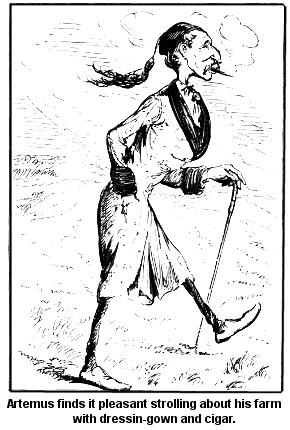
My gentle shepherd, Mr. Eli Perkins, said, "We must have some shepherd dogs."
I had no very precise idea as to what shepherd dogs were, but I assumed a rather profound look, and said:
"We must, Eli. I spoke to you about this some time ago!"
I wrote to my old friend, Mr. Dexter H. Follett, of Boston, for two shepherd dogs. Mr. F. is not an honest old farmer himself, but I thought he knew about shepherd dogs. He kindly forsook far more important business to accommodate, and the dogs came forthwith. They were splendid creatures snuff-colored, hazel-eyed, long-tailed, and shapely-jawed.
We led them proudly to the fields.
"Turn them in, Eli," I said.
Eli turned them in.
They went in at once, and killed twenty of my best lambs in about four minutes and a half.
My friend had made a trifling mistake in the breed of these dogs.
These dogs were not partial to sheep.
Eli Perkins was astonished, and observed:
"Waal! DID you ever?"
I certainly never had.
There were pools of blood on the greensward, and fragments of wool and raw lamb chops lay round in confused heaps.
The dogs would have been sent to Boston that night, had they not suddenly died that afternoon of a throat-distemper. It wasn't a swelling of the throat. It wasn't diptheria. It was a violent opening of the throat, extending from ear to ear.
Thus closed their life-stories. Thus ended their interesting tails.
I failed as a raiser of lambs. As a sheepist, I was not a success.
Last summer Mr. Perkins, said, "I think we'd better cut some grass this season, sir."
We cut some grass.
To me the new-mown hay is very sweet and nice. The brilliant George Arnold sings about it, in beautiful verse, down in Jersey every summer; so does the brilliant Aldrich, at Portsmouth, N.H. And yet I doubt if either of these men knows the price of a ton of hay to-day. But new-mown hay is a really fine thing. It is good for man and beast.
We hired four honest farmers to assist us, and I led them gayly to the meadows.
I was going to mow, myself.
I saw the sturdy peasants go round once ere I dipped my flashing scythe into the tall green grass.
"Are you ready?" said E. Perkins.
"I am here!"
"Then follow us."
I followed them.
Followed them rather too closely, evidently, for a white-haired old man, who immediately followed Mr. Perkins, called upon us to halt. Then in a low firm voice he said to his son, who was just ahead of me, "John, change places with me. I hain't got long to live, anyhow. Yonder berryin' ground will soon have these old bones, and it's no matter whether I'm carried there with one leg off and ter'ble gashes in the other or not! But you, John you are young."
The old man changed places with his son. A smile of calm resignation lit up his wrinkled face, as he sed, "Now, sir, I am ready!"
"What mean you, old man!" I sed.
"I mean that if you continner to bran'ish that blade as you have been bran'ishin' it, you'll slash hout of some of us before we're a hour older!"
There was some reason mingled with this white-haired old peasant's profanity. It was true that I had twice escaped mowing off his son's legs, and his father was perhaps naturally alarmed.
I went and sat down under a tree. "I never know'd a literary man in my life," I overheard the old man say, "that know'd anything."
Mr. Perkins was not as valuable to me this season as I had fancied he might be. Every afternoon he disappeared from the field regularly, and remained about some two hours. He sed it was headache. He inherited it from his mother. His mother was often taken in that way, and suffered a great deal.
At the end of the two hours Mr. Perkins would reappear with his head neatly done up in a large wet rag, and say he "felt better."
One afternoon it so happened that I soon followed the invalid to the house, and as I neared the porch I heard a female voice energetically observe, "You stop!" It was the voice of the hired girl, and she added, "I'll holler for Mr. Brown!"
"Oh no, Nancy," I heard the invalid E. Perkins soothingly say, "Mr. Brown knows I love you. Mr. Brown approves of it!"
This was pleasant for Mr. Brown!
I peered cautiously through the kitchen-blinds, and, however unnatural it may appear, the lips of Eli Perkins and my hired girl were very near together. She sed, "You shan't do so," and he do-soed. She also said she would get right up and go away, and as an evidence that she was thoroughly in earnest about it, she remained where she was.
They are married now, and Mr. Perkins is troubled no more with the headache.
This year we are planting corn. Mr. Perkins writes me that "on accounts of no skare krows bein put up krows cum and digged fust crop up but soon got nother in. Old Bisbee who was frade youd cut his sons leggs off Ses you bet go an stan up in feeld yrself with dressin gownd on & gesses krows will keep way. This made Boys in store larf. no More terday from
"Yours
"respecful
"Eli Perkins,"
"his letter."
My friend Mr. D.T.T. Moore, of the "Rural New Yorker," thinks if I "keep on" I will get in the Poor House in about two years.
If you think the honest old farmers of Barclay County want me, I will come.
Truly Yours,
Charles F. Browne.
____________________
BUSTS.
There are in this city several Italian gentlemen engaged in the bust business. They have their peculiarities and eccentricities. They are swarthy-faced, wear slouched caps and drab pea-jackets, and smoke bad cigars. They make busts of Webster, Clay, Bonaparte, Douglas, and other great men, living and dead. The Italian buster comes upon you solemnly and cautiously. "Buy Napoleon?" he will say, and you may probably answer "not a buy." "How much giv-ee?" he asks, and perhaps you will ask him how much he wants. "Nine dollar," he will answer always. We are sure of it. We have observed this peculiarity in the busters frequently. No matter how large or small the bust may be, the first price is invariably "nine dollar." If you decline paying this price, as you undoubtedly will if you are right in your head, he again asks, "how much giv-ee?" By way of a joke you say "a dollar," when the buster retreats indignantly to the door, saying in a low, wild voice, "O dam!" With his hand upon the door-latch, he turns and once more asks, "how much giv-ee?" You repeat the previous offer, when he mutters, "O ha!" then coming pleasantly towards you, he speaks thus: "Say! how much giv-ee?" Again you say a dollar, and he cries, "take 'um take 'um!" thus falling eight dollars on his original price.
Very eccentric is the Italian buster, and sometimes he calls his busts by wrong names. We bought Webster (he called him Web-STAR) of him the other day, and were astonished when he called upon us the next day with another bust of Webster, exactly like the one we had purchased of him, and asked us if we didn't want to buy "Cole, the wife-pizener!" We endeavored to rebuke the depraved buster, but our utterance was choked, and we could only gaze upon him in speechless astonishment and indignation.
____________________
A HARD CASE.
We have heard of some very hard cases since we have enlivened this world with our brilliant presence. We once saw an able-bodied man chase a party of little school-children and rob them of their dinners. The man who stole the coppers from his deceased grandmother's eyes lived in our neighborhood, and we have read about the man who went to church for the sole purpose of stealing the testaments and hymn-books. But the hardest case we ever heard of lived in Arkansas. He was only fourteen years old. One night he deliberately murdered his father and mother in cold blood, with a meat-axe. He was tried and found guilty. The Judge drew on his black cap, and in a voice choked with emotion asked the young prisoner if he had anything to say before the sentence of the Court was passed on him. The court-room was densely crowded and there was not a dry eye in the vast assembly. The youth of the prisoner, his beauty and innocent looks, the mild, lamblike manner in which he had conducted himself during the trial all, all had thoroughly enlisted the sympathy of the spectators, the ladies in particular. And even the Jury, who had found it to be their stern duty to declare him guilty of the appalling crime even the Jury now wept aloud at this awful moment.
"Have you anything to say?" repeated the deeply moved Judge.
"Why, no," replied the prisoner, "I think I haven't, though I hope yer Honor will show some consideration for the feelings of a poor orphan!"
The Judge sentenced the perfect young wretch without delay.
____________________
AFFAIRS AROUND THE VILLAGE GREEN.
It isn't every one who has a village green to write about. I have one, although I have not seen much of it for some years past. I am back again, now. In the language of the duke who went around with a motto about him, "I am here!" and I fancy I am about as happy a peasant of the vale as ever garnished a melodrama, although I have not as yet danced on my village green, as the melodramatic peasant usually does on his. It was the case when Rosina Meadows left home.
The time rolls by serenely now so serenely that I don't care what time it is, which is fortunate, because my watch is at present in the hands of those "men of New York who are called rioters." We met by chance, the usual way certainly not by appointment and I brought the interview to a close with all possible despatch. Assuring them that I wasn't Mr. Greeley, particularly, and that he had never boarded in the private family where I enjoy the comforts of a home, I tendered them my watch, and begged they would distribute it judiciously among the laboring classes, as I had seen the rioters styled in certain public prints.
Why should I loiter feverishly in Broadway, stabbing the hissing hot air with the splendid gold-headed cane that was presented to me by the citizens of Waukegan, Illinois, as a slight testimonial of their esteem? Why broil in my rooms? You said to me, Mrs. Gloverson, when I took possession of these rooms, that no matter how warm it might be, a breeze had a way of blowing into them, and that they were, withal, quite countryfied; but I am bound to say, Mrs. Gloverson, that there was nothing about them that ever reminded me, in the remotest degree, of daisies or new-mown hay. Thus, with sarcasm, do I smash the deceptive Gloverson.
Why stay in New York when I had a village green? I gave it up, the same as I would an intricate conundrum and, in short, I am here.
Do I miss the glare and crash of the imperial thoroughfare? The milkman, the fiery, untamed omnibus horses, the soda fountains, Central Park, and those things? Yes I do; and I can go on missing 'em for quite a spell, and enjoy it.
The village from which I write to you is small. It does not contain over forty houses, all told; but they are milk-white, with the greenest of blinds, and for the most part are shaded with beautiful elms and willows. To the right of us is a mountain to the left a lake. The village nestles between. Of course it does, I never read a novel in my life in which the villages didn't nestle. Villages invariably nestle. It is a kind of way they have.
We are away from the cars. The iron-horse, as my little sister aptly remarks in her composition On Nature, is never heard to shriek in our midst; and on the whole I am glad of it.
The villagers are kindly people. They are rather incoherent on the subject of the war, but not more so, perhaps, then are people elsewhere. One citizen, who used to sustain a good character, subscribed for the Weekly New York Herald a few months since, and went to studying the military maps in that well-known journal for the fireside. I need not inform you that his intellect now totters, and he has mortgaged his farm. In a literary point of view we are rather bloodthirsty. A pamphlet edition of the life of a cheerful being, who slaughtered his wife and child, and then finished himself, is having an extensive sale just now.
We know little of Honore de Balzac, and perhaps care less for Victor Hugo. M. Claes's grand search for the Absolute doesn't thrill us in the least; and Jean Valjean, gloomily picking his way through the sewers of Paris, with the spooney young man of the name of Marius upon his back, awakens no interest in our breasts. I say Jean Valjean picked his way gloomily, and I repeat it. No man, under these circumstances, could have skipped gayly. But this literary business, as the gentleman who married his colored chambermaid aptly observed, "is simply a matter of taste."
The store I must not forget the store. It is an object of great interest to me. I usually encounter there, on sunny afternoons, an old Revolutionary soldier. You may possibly have read about "Another Revolutionary Soldier gone," but this is one who hasn't gone, and, moreover, one who doesn't manifest the slightest intention of going. He distinctly remembers Washington, of course; they all do; but what I wish to call special attention to, is the fact that this Revolutionary soldier is one hundred years old, that his eyes are so good that he can read fine print without spectacles—he never used them, by the way and his mind is perfectly clear. He is a little shaky in one of his legs, but otherwise he is as active as most men of forty-five, and his general health is excellent. He uses no tobacco, but for the last twenty years he has drunk one glass of liquor every day no more, no less. He says he must have his tod. I had begun to have lurking suspicions about this Revolutionary soldier business, but here is an original Jacobs. But because a man can drink a glass of liquor a day, and live to be a hundred years old, my young readers must not infer that by drinking two glasses of liquor a day a man can live to be two hundred. "Which, I meanter say, it doesn't foller," as Joseph Gargery might observe.
This store, in which may constantly be found calico and nails, and fish, and tobacco in kegs, and snuff in bladders, is a venerable establishment. As long ago as 1814 it was an institution. The county troops, on their way to the defence of Portland, then menaced by British ships-of-war, were drawn up in front of this very store, and treated at the town's expense. Citizens will tell you how the clergyman refused to pray for the troops, because he considered the war an unholy one; and how a somewhat eccentric person, of dissolute habits, volunteered his services, stating that he once had an uncle who was a deacon, and he thought he could make a tolerable prayer, although it was rather out of his line; and how he prayed so long and absurdly that the Colonel ordered him under arrest, but that even while soldiers stood over him with gleaming bayonets, the reckless being sang a preposterous song about his grandmother's spotted calf, with its Ri-fol-lol-tiddery-i-do; after which he howled dismally.
And speaking of the store, reminds me of a little story. The author of "several successful comedies" has been among us, and the store was anxious to know who the stranger was. And therefore the store asked him.
"What do you follow, sir?" respectfully inquired the tradesman.
"I occasionally write for the stage, sir."
"Oh!" returned the tradesman, in a confused manner.
"He means," said an honest villager, with a desire to help the puzzled tradesman out, "he means that he writes the handbills for the stage drivers!"
I believe that story is new, although perhaps it is not of an uproariously mirthful character; but one hears stories at the store that are old enough, goodness knows stories which, no doubt, diverted Methuselah in the sunny days of his giddy and thoughtless boyhood.
There is an exciting scene at the store occasionally. Yesterday an athletic peasant, in a state of beer, smashed in a counter and emptied two tubs of butter on the floor. His father a white-haired old man, who was a little boy when the Revolutionary war closed, but who doesn't remember Washington much, came round in the evening and settled for the damages. "My son," he said, "has considerable originality." I will mention that this same son once told me that he could lick me with one arm tied behind him, and I was so thoroughly satisfied he could, that I told him he needn't mind going for a rope.
Sometimes I go a-visiting to a farmhouse, on which occasions the parlor is opened. The windows have been close-shut ever since the last visitor was there, and there is a dingy smell that I struggle as calmly as possible with, until I am led to the banquet of steaming hot biscuit and custard pie. If they would only let me sit in the dear old-fashioned kitchen, or on the door-stone if they knew how dismally the new black furniture looked but, never mind, I am not a reformer. No, I should rather think not.
Gloomy enough, this living on a farm, you perhaps say, in which case you are wrong. I can't exactly say that I pant to be an agriculturist, but I do know that in the main it is an independent, calmly happy sort of life. I can see how the prosperous farmer can go joyously a-field with the rise of the sun, and how his heart may swell with pride over bounteous harvests and sleek oxen. And it must be rather jolly for him on winter evenings to sit before the bright kitchen fire and watch his rosy boys and girls as they study out the charades in the weekly paper, and gradually find out why my first is something that grows in a garden, and my second is a fish.
On the green hillside over yonder there is a quivering of snowy drapery, and bright hair is flashing in the morning sunlight. It is recess, and the Seminary girls are running in the tall grass.
A goodly seminary to look at outside, certainly, although I am pained to learn, as I do on unprejudiced authority, that Mrs. Higgins, the Principal, is a tyrant, who seeks to crush the girls and trample upon them; but my sorrow is somewhat assuaged by learning that Skimmerhorn, the pianist, is perfectly splendid.
Looking at these girls reminds me that I, too, was once young and where are the friends of my youth? I have found one of 'em, certainly. I saw him ride in the circus the other day on a bareback horse, and even now his name stares at me from yonder board-fence, in green, and blue, and red, and yellow letters. Dashington, the youth with whom I used to read the able orations of Cicero, and who, as a declaimer on exhibition days, used to wipe the rest of us boys pretty handsomely out—well, Dashington is identified with the halibut and cod interest—drives a fish cart, in fact, from a certain town on the coast, back into the interior. Hurbertson, the utterly stupid boy the lunkhead, who never had his lesson he's about the ablest lawyer a sister State can boast. Mills is a newspaper man, and is just now editing a Major-General down South.
Singlinson, the sweet-voiced boy, whose face was always washed and who was real good, and who was never rude—he is in the penitentiary for putting his uncle's autograph to a financial document. Hawkins, the clergyman's son, is an actor, and Williamson, the good little boy who divided his bread and butter with the beggarman, is a failing merchant, and makes money by it. Tom Slink, who used to smoke short-sixes and get acquainted with the little circus boys, is popularly supposed to be the proprietor of a cheap gaming establishment in Boston, where the beautiful but uncertain prop is nightly tossed. Be sure, the Army is represented by many of the friends of my youth, the most of whom have given a good account of themselves. But Chalmerson hasn't done much. No, Chalmerson is rather of a failure. He plays on the guitar and sings love songs. Not that he is a bad man. A kinder-hearted creature never lived, and they say he hasn't yet got over crying for his little curly haired sister who died ever so long ago. But he knows nothing about business, politics, the world, and those things. He is dull at trade indeed, it is a common remark that "everybody cheats Chalmerson." He came to the party the other evening, and brought his guitar. They wouldn't have him for a tenor in the opera, certainly, for he is shaky in his upper notes; but if his simple melodies didn't gush straight from the heart, why were my trained eyes wet? And although some of the girls giggled, and some of the men seemed to pity him I could not help fancying that poor Chalmerson was nearer heaven than any of us all!