PREFACE. (continued 5)
Reading edition
381. WINE VINEGAR.
Take any sort of wine that has gone through fermentation, and put it into a cask that has had vinegar in it; then take some of the fruit or stalks of which the wine has been made, and put them wet into an open-headed cask in the sun, with a coarse cloth over the top of it, for six days—after which put them in the vinegar, and stir it well about—then put it in a warm place, if in winter, or if in summer, put it in a yard in the sun, with a slate over the bung. When the vinegar is sour enough and fine, rack it off into a clean sour cask, and bung it up; then put it in the cellar for use. Those wines that contain the most mucilage are fittest for the purpose.
The lees of pricked wine are also a very proper ingredient in vinegar.
382. SUGAR VINEGAR.
To each gallon of water add 2 lbs. of brown sugar, and a little yeast; leave it exposed to the sun for six months, in a vessel slightly stopped.
383. GOOSEBERRY VINEGAR.
Bruise the gooseberries, when ripe, and to every quart put three quarts of water; stir them well together, and let the whole stand for 24 hours, then strain it through a canvas bag.
To every gallon of liquor add 1 lb. of brown sugar, and stir them well together before they are put into the cask. Proceed in all other respects as before. This vinegar possesses a pleasant taste and smell; but raspberry vinegar, which may be made on the same plan, is far superior in these respects. The raspberries are not required to be of the best sort, still, they should be ripe and well flavoured.
384. CURRANT VINEGAR.
This is made in the same way as that from gooseberries, only pick off the currants from the stalks.
385. PRIMROSE VINEGAR.
To 15 quarts of water put 6 lbs. of brown sugar; let it boil ten minutes, and take off the scum: pour on it half a peck of primroses; before it is quite cold, put in a little fresh yeast, and let it work in a warm place all night; put it in a barrel in the kitchen, and when done working, close the barrel, still keeping it in a warm place.
386. RAISIN VINEGAR.
After making raisin wine, lay the pressed raisins in a heap to heat, then to each cwt. put 15 gallons of water, and a little yeast.
387. CIDER VINEGAR.
The poorest sort of cider will serve for vinegar, in managing which proceed thus:—
First draw off the cider into a cask that has had vinegar in it before; then put some of the apples that have been pressed into it, set the whole in the sun, and in a week or nine days it may be drawn off into another cask.—This is a good table vinegar.
388. VINEGAR FROM THE REFUSE OF FRUITS.
Take the skins of raisins after they have been used in making wine, and pour three times their own quantity of boiling water on them; stir them well about, and then set the cask in a warm place, close covered, and the liquor, in a week, when drawn off from its sediment, put into another cask, and well bunged down, will be a good vinegar for the table.
389. VINEGAR FROM THE REFUSE OF BEE-HIVES.
When honey is extracted from the combs, by means of pressure, take the whole mass, break and separate it, and into each tub or vessel, put one part of combs and two of water; place them in the sun, or in a warm place, and cover them with cloths. Fermentation takes place in a few days, and continues from 8 to 12 days, according to the higher or lower temperature of the situation in which the operation is carried on. During the fermentation, stir the matter from time to time, and press it down with the hands, that it may be perfectly soaked. When the fermentation is over, put the matter to drain upon sieves or strainers. At the bottom of the vessels will be found a yellow liquor, which must be thrown away, because it would soon contract a disagreeable smell, which it would communicate to the vinegar. Then wash the tubs, put into them the water separated from the other matter; it immediately begins to turn sour; when the tubs must be again covered with cloths, and kept moderately warm. A pellicle, or skin, is formed on their surface, beneath which the vinegar acquires strength; in a month’s time it begins to be sharp; it must be left standing a little longer, and then put into a cask, of which the bung-hole is left open. It may then be used like any other vinegar.
390. TO STRENGTHEN VINEGAR.
Suffer it to be repeatedly frozen, and separate the upper cake of ice, or water, from it.
All vinegars owe their principal strength to the acetic acid they contain; but the vinegar of wine contains also tartar, a small portion of the malic acid, alcohol, and colouring matter; that of eider contains merely the malic acid, little or no alcohol, and a yellowish colouring matter.
391. VINEGARS FROM ORANGE AND ELDER FLOWERS, CLOVE-GILLIFLOWERS, MUSK-ROSES, &c.
Dry an ounce of either of the above flowers, (except the orange flowers, which will not bear drying,) for two days in the sun; then put them into a bottle, pour on them a pint of vinegar, closely stop the bottle, and infuse 15 days in moderate heat of the sun. Vinegars of any other flowers, as tarragon, &c. may be made in a similar manner.
392. DISTILLED VINEGAR.
This is obtained from vinegar by distillation, rejecting the 4th or 8th part that comes over first, and avoiding its acquiring a burnt flavour.
Distilled vinegar is weaker than the common, but is used sometimes in pickles, where its want of colour is an advantage.
393. IMPROVED DISTILLED VINEGAR.
Obtained from wood distilled in large iron cylinders for the manufacture of charcoal for gunpowder; when rectified it is used for all the purposes of distilled vinegar.
394. TO MAKE STRONG ACETOUS ACID.
Take of vitriol, calcined to whiteness, 1 lb. sugar of lead, 10 drachms,
Rub together and distil.
395. Another.
Take of sugar of lead, 7 lbs. oil of vitriol 4½ lbs.
Distil 2½ lbs. This is used to make aromatic vinegar.
396. HONEY WATER FOR THE HAIR.
Take of honey, 4 lbs. very dry sand, 2 lbs.
Mix and put into a vessel that will hold five times as much; distil with a gentle heat a yellowish acid water: this acid greatly encourages the growth of hair.
397. DEPHLOGISTICATED SPIRIT OF SALT.
Take of common salt, 3 lbs. manganese, 1 lb. oil of vitriol, 2 lbs. water, 1 lb.
Distil, placing a sufficient quantity of water in the receiver.
This spirit is of a pale greenish yellow, and scarcely heavier than water. It bleaches linen, straw, and takes out fruit spots, iron moulds, or ink marks.
MISCELLANEOUS BEVERAGES.
398. TO MAKE GINGER BEER.
Take of good Jamaica ginger, 2½ oz. Moist sugar, 3 lbs. cream of tartar, 1 oz. the juice and peel of 2 middling sized lemons, brandy ½ pint, good solid ale yeast, ¼ pint, water, 3½ gallons.
This will produce 4½ dozen of excellent ginger beer, which will keep twelve months. Bruise the ginger and sugar, and boil them for 20 or 25 minutes in the water, slice the lemon and put it and the cream of tartar into a large pan; pour the boiling liquor upon them, stir it well round, and when milk-warm, add the yeast; cover it over, let it remain two or three days to work, skimming it frequently; then strain it through a jelly-bag into a cask, add the brandy, bung down very close, and at the end of a fortnight or three weeks, draw it off and bottle, and cork very tight; tie the cork down with twine or wire. If it does not work well at first, add a little more yeast, but be careful of adding too much, least it taste of it.
399. SPRUCE BEER.
Take, if white is intended, 6 lbs. of sugar; if brown, as much treacle, and a pot of spruce, and ten gallons of water.
This is also managed in the same way as ginger beer, except that it should be bottled as soon as it has done working.
400. BROWN SPRUCE BEER.
Pour 8 gallons of cold water into a barrel, and then boiling 8 gallons more, put that in also, add 12 lbs. of molasses, with about ½ lb. of the essence of spruce; and on its getting a little cooler, ½ a pint of good ale yeast. The whole being well stirred or rolled in the barrel, must be left with the bung out for two or three days; after which the liquor may be immediately bottled, well corked up, and packed in saw-dust or sand, when it will be ripe, and fit to drink in a fortnight.
Remember, that it should be drawn off into quart stone bottles, and wired.
401. WHITE SPRUCE BEER.
For a cask of six gallons, mix well together ¼ lb. of the purest essence of spruce, 7 lbs. of loaf-sugar made into a clarified syrup, and about 1½ gallons of hot water; and when sufficiently stirred and incorporated; put it into the cask, and fill up with cold water. Then add about a ¼ of a pint of good ale yeast, shake the cask well, and let it work for three or four days: after which, bung it up. In a few days it may be bottled off after the usual manner, and in a week or ten days it will be fit for use. If, on bunging it close, about ¼ of an oz. of isinglass, first dissolved in a little of the warmed liquor, or in cider, be stirred in, by way of fining, it will acquire a superior degree of clearness. In proportion to the coldness of the weather, the quantity of yeast should be increased. Some, instead of yeast, use ale or beer-grounds the first time of making, and afterwards the grounds of their former spruce beer. In warm weather, very little ferment is requisite.
402. SELTZER WATER.
Take of water any quantity. Impregnate it with about ten times its volume of carbonic acid gas, by means of a forcing pump.
403. LIQUID MAGNESIA.
Take of water 1 gallon, carbonate of magnesia, 3 drachms, and impregnate it as above.
404. POTASS WATER.
Take one ounce of subcarbonate of potass, and impregnate as above.
405. SODA WATER.
Take 2 ounces of subcarbonate of soda, and impregnate as above.
406. PORTABLE LEMONADE.
Take of tartaric acid, ½ oz. loaf sugar, 3 oz. essence of lemon, ½ drachm.
Powder the tartaric acid and the sugar very fine, in a marble or wedgewood mortar, (observe never to use a metal one) mix them together, and pour the essence of lemon upon them, by a few drops at a time, stirring the mixture after each addition, till the whole is added, then mix them thoroughly, and divide it into twelve equal parts, wrapping each up separately in a piece of white paper. When wanted for use, it is only necessary to dissolve it in a tumbler of cold water, and fine lemonade will be obtained, containing the flavour of the juice and peel of the lemon, and ready sweetened.
407. TO MAKE CHOCOLATE.
To make good chocolate, put the milk and water on to boil; then scrape the chocolate fine, from one to two squares to a pint, to suit the stomach: when the milk and water boils, take it off the fire; throw in the chocolate; mill it well, and serve it up with the froth; which process will not take 5 minutes. The sugar may either be put in with the scraped chocolate or added afterwards.
It should never be made before it is wanted; because heating again injures the flavour, destroys the froth, and separates the body of the chocolate; the oil of the nut being observed, after a few minutes’ boiling, or even standing long by the fire, to rise to the top, which is the only cause this chocolate can offend the most delicate stomach.
408. TO MAKE COFFEE.
To have coffee in perfection, it should be made from the best production, carefully roasted, and after cooling for a few minutes, reduced to powder, and immediately infused; the tincture will then be of a superior description. But for common use, the coffee of our own plantations is, in general, of very good quality.
In England, too little powder of the berry is commonly given. It requires about one small cup of coffee-powder to make four cups of tincture for the table. This is at the rate of an ounce of good powder to four common coffee-cups. When the powder is put in the bag, as many cups of boiling water is poured over it as may be wanted.
Pour a pint of boiling water on an ounce of coffee; let it boil five or six minutes, then pour out a cupful two or three times, and return it again; put two or three isinglass slips into it; or a lump or two of fine sugar; boil it five minutes longer, set the pot by the fire to keep hot for ten minutes, and the coffee will be beautifully clear. A hot cream should always be served with coffee. For foreigners, or those who like it extremely strong, make only eight dishes from three ounces. If not fresh roasted, lay it before a fire till hot and dry; or put the smallest bit of fresh butter into a preserving-pan, when hot throw the coffee into it, and toss it about till it be freshened.
THE COOK.
On her first going into a family the Cook will do well to inform herself of the rules and regulations of the house,—the customs of the kitchen,—the peculiarities of her master and mistress,—and above all, she must study, most sedulously, to acquire a perfect knowledge of their taste; which, when attained, will most probably lead to her permanent establishment in the sovereignty of the kitchen.
She will enter into all the economical plans of her employers, and endeavour to make the most of every thing, as well for the sake of her own character as for their interest. Not forgetting, that “wilful waste makes woful want.”
She will consider the encomiums of her master and mistress as her highest praise, and will accept even their admonitions as pleasing proofs of their desire to make her useful to themselves, and to enhance her own confidence and consequence.
The presidency of the kitchen being a situation of great trust and responsibility, she will best evince her sense of the confidence reposed in her by her anxiety to please, and a sedulous regard to the health and comforts of the family, which are, necessarily, in her keeping; governing her whole conduct by that most excellent moral maxim “Do unto others as you would they should do unto you.”
To be well qualified for every situation, the Cook must not only understand the business of the kitchen, but must be a good judge of provisions, as in many families, where there is no housekeeper, she will be required to go to market. She must also be able to keep an account of the current expenses of the family; and to examine, check, and pay the tradesmen’s bills, which she will have to settle with her mistress weekly, or when required.
The Cook should give directions to her assistants to rise early, particularly when a great dinner is to be dressed, that so every thing may be got quite ready in the kitchen to begin business as early in the morning as possible; else, nine times out of ten, the dinner will be too late: and it must always be recollected that “things done in a hurry are never well done,” and that, “an hour lost in the morning may be run after the whole day, but never overtaken.” Besides, to have every thing properly dressed, and to be punctual, as to time, with the dinner, will afford great satisfaction to her employers, and do credit both to them and to herself. Having learnt the precise time of dinner, she must not fail to be punctual.
Cleanliness, in every branch of domestic concerns cannot be too forcibly inculcated, and in the business of a Cook, particularly, it becomes a cardinal virtue. Cleanliness and neatness of person and dress are not less important in her than the arrangement of the kitchen and larder, and all her operations.
Boiling.
The boilers, saucepans, and other vessels, to be used for culinary purposes, must be kept perfectly clean and well tinned. Block tin saucepans, &c. are safest, and perhaps best for these purposes.—When washed they should be dried by the fire, before they are put away; and they should always be wiped out again, with a clean dry cloth, immediately before they are used. This is to be done chiefly to prevent rust, and its baleful effects.
Poultry, and every kind of meat, both fresh and salted, should be washed and wiped dry, and then dredged well with flour, before it be put into the boiler, or pot; this will prevent its being soiled in the water, and will, also, prevent its looking greasy, when taken up.
Meat must always be put into cold water, with just enough water to cover it; say, about a quart of water to a pound of meat,—and it must be kept so covered, during the whole process of dressing, by adding boiling water occasionally.—By this method the inside will always be heated thoroughly, and be properly swollen, before the outside becomes hard; and the whole will be regularly done. This will, also, occasion the meat to look plump; and veal and poultry, in particular, will be the whiter and the better for it.
Beef loses about one-fourth, and mutton about one-fifth, in boiling.
A moderate fire must be kept up under the pot, increasing the heat gradually, till it boils, when it must be drawn back, kept close covered, and constantly simmering, quite gently, but by no means boiling fast. A tea-spoonful of salt thrown into the water, before it boils, will cause the scum to rise the better, which must be very carefully skimmed clean off, immediately; and if, afterwards, a little cold water be thrown in, more scum will be cast up, which must frequently be taken off, as it rises, as on this alone depends the good appearance of all boiled articles.
Remember—that water cannot possibly be made hotter than it is when it first boils; it is, therefore, a waste of firing, and very detrimental to the meat to make it boil fast, as it is thereby rendered hard, and its juices and finest flavour are evaporated in steam.
Generally, beef, mutton, and lamb, unless the joints are very thin, or small, require boiling from a quarter of an hour to eighteen minutes to a pound; lamb, veal, and pork, and thick joints also, of whatever kind, require somewhat longer, especially in cold weather, or when fresh killed. A large leg of pork, for instance, will take a little more time;—always reckoning from the time of its first coming to boil, and taking into the account that the pot must always be kept gently simmering;—the slower the better, so that it be kept boiling. If you suffer boiled meats to remain in the pot after they are done, they become soddened and lose their flavour.
Examples in Boiling.
A Round of Beef.—After it has been carefully salted, and has lain in the pickle eight or ten days, wash it and wipe it dry; then cut out the bone, and skewer and tie it up tight and quite round. As soon as the pot boils skim it clean, and keep it boiling very gently, till done. The time will be according to its weight. Garnish with slices of carrot and turnip.
A LEG OF PORK.
If large, after it has been in salt eight or ten days, let it lie in cold water half an hour to make it white—weigh it, let it boil gently, allowing twenty minutes for every pound—skim it as soon as it boils, and often afterwards.—A small Leg of Pork is most delicate.—The liquor will make excellent peas-soup. Serve it up with peas-pudding and turnips.
A LEG OF MUTTON.
Put it in warm water for ten minutes, and wash it clean, then put it into the pot and cover it with water—let it simmer very gently and skim it carefully. A leg of ten pounds will take two and a half or three hours. Mutton, to be tender, should hang as long as it will keep.
A TURKEY.
Take a hen bird, pick nicely, singe, wash, draw the sinews of the thighs, and truss it. Make a stuffing of bread, herbs, salt, pepper, nutmeg, lemon-peel, a few oysters, or an anchovy, a bit of butter, some suet, and an egg, put this into the crop, fasten up the skin, and skim the pot most carefully to make it white. Serve with oyster sauce made rich with butter, a little cream, and a spoonful of soy or parsley and butter. Tongue, ham, or pickled pork, are the usual accompaniments.
A FOWL.
The legs, for boiling, should not be black.—Pick nicely, wash, singe, truss, and flour it—put it into boiling water, and simmer gently. A middling fowl will take forty minutes. Serve with parsley and butter, oyster, lemon, liver, or celery sauce.
Neither parsley and butter, liver and parsley, celery, onion, caper, curry, nor other sauce should be poured over boiled meats, but sent up separately in a boat.
VEGETABLES.
All vegetables are best when fresh from the garden,—when dead they are useless. They are also in the greatest perfection when in the greatest plenty;—unripe vegetables are unwholesome.
Greens must be carefully picked, neatly trimmed, washed quite clean from vermin, and laid on a cullender to drain. Then, having ready a well-tinned saucepan, with plenty of clean, soft, boiling water, into which some salt has been thrown, and the scum taken off, plunge them into it, boil them quickly, watch them, and keep continually pressing them under the water with a fork as they rise; and when they begin to sink of themselves, they are done, and must be taken up instantly, and drained dry; for if over done, they will lose not only their crispness and beautiful appearance, but their flavour also. Cabbages, savoys, and turnip-tops, require that the water should be changed when half done, the second water should be boiling, and if managed as above directed, they will eat much the milder and sweeter for it. This is the whole art of dressing vegetables to look green and eat well. We therefore deprecate the use of those factitious and filthy expedients recommended by some, and practised by many, to give, as they pretend, a good colour, to boiled vegetables. This is the best way;—and all artificial means ought to be avoided, as unnecessary and pernicious.
Esculent roots of all kinds may be set on to boil in cold water.
Fish.
Fish, particularly if large, must be put into cold water, with plenty of salt; when ready, it will part from the bone; or it may be tried with a fork, and must be taken out of the water the moment it is done.
If not immediately wanted, let it stay on the fish-plate, over the hot water, and throw over it a clean cloth, dipped in boiling water, to preserve its colour.
A sliced cod should be stewed fifteen minutes.
In all cases, dinner should be served up as soon as possible after it is ready, because keeping the boiled articles, particularly fish, in hot water, renders them vapid and heavy; and hot closets, covers, and other means used to keep them hot, dry the juices and make them eat strong and rancid.
Neither fish, nor vegetables of any kind, (except ripe potatoes,) should be boiled by steam.
Elements of Roasting.
Cleanliness must ever be the maxim for the kitchen.
Before the spit is drawn from the meat, let it be wiped clean, and when done with, let it be rubbed with a little sand and water.
A good brisk fire, due time, proper distance, and frequent basting, are the chief points to be attended to in roasting.
Much depends on the fire;—it should always be brisk and glowing, clear at the bottom, and suited to the article to be roasted.
Beef and mutton lose about one-third in roasting.
The ashes should be taken up, and the hearth made quite clean, before you begin to roast. If the fire require to be stirred during the operation, the dripping-pan must be drawn back, so that then, and at all times, it may be kept clean from cinders and dust.—Hot cinders, or live coals, dropping into the pan, make the dripping rank, and spoil it for basting.
Beef requires a strong, steady fire, which should be made up a little time previous to its being wanted. If the meat has been hung up some time, the dry outside parts must be pared off, and it must be basted, first, with a little salt and water, then well dredged with flour, and afterwards basted, continually, with the dripping; but, if the meat be frozen, it must be brought into the kitchen several hours before it is dressed.—Large joints should be kept at a good distance from the fire at first, and gradually brought nearer and nearer;—the average distance for a large joint, at a good fire, may be about ten or twelve inches, an inch or two more or less, according to circumstances: when kitchen paper, dipped in the dripping, must be tied, not skewered, over the fat parts, to prevent their being scorched. When nearly ready, the smoke will draw from the meat towards the fire; at which time the paper must be taken off, and the meat must be put nearer to the fire to brown it; it must also be sprinkled with a little salt, and well dredged again, with flour, to froth it.
It is as necessary to roast slowly as to boil slowly;—and the General Rule is to allow full a quarter of an hour to a pound for roasting with a proper fire, under ordinary circumstances, and with frequent basting. But neither beef nor mutton require to be so well done as pork, lamb, and veal.—Pork, in particular, requires to be thoroughly done. It must be basted with salt and water; and the skin or rind of the leg, loin, and spare-rib, must be scored, with a sharp knife, after it has been some time at the fire, to make it eat the better. Geese, pigs, and young pork, require a brisk fire, and should be turned quickly.
Great care should be taken in spitting the meat, that the prime part of the joint be not injured:—to balance it on the spit, cook-holds and loaded skewers are very handy.
A bottle jack is an excellent substitute for a spit, in small families, and for want of that, ten or a dozen yards of worsted, folded to a proper length, will answer the purpose very well. Meat if hung to be roasted, should have its ends changed when about half done. A good meat skreen, lined with tin, should always be set before the fire when roasting; it keeps off the cold air, renders the heat more equable, and saves coals.
After all, the above General Rule is liable to many exceptions. If the meat be fresh killed, or the weather be cold, a good joint will require half an hour longer than if the meat be tender and the weather temperate or warm.
We give the following particulars as a more certain guide to the Cook, in most cases on this important point.
Beef.—A Sirloin of about sixteen pounds, will take three hours and a half or four hours.
Ribs of Beef, of nearly the same weight, being thinner, will require half an hour less.
Mutton.—A Leg of eight or nine pounds, will take about two hours.
A Loin or Neck, from an hour and a half to an hour and three quarters.
A Breast, an hour and a quarter.
Veal requires to be managed as beef.
A Fillet, of fourteen or sixteen pounds, will take five hours.
(It must be placed at a distance from a strong fire at first, in order to be thoroughly soaked)
A good Loin, will take full three hours.
A Breast, from an hour and a half to two hours.
A Hind-quarter, of eight pounds, about two hours.
A Fore-quarter, of ten pounds, about two hours.
A Leg or Loin, about an hour and a quarter.
A Breast, three quarters of an hour.
Pork, as it must be well soaked and well done, requires longer time, in proportion, than any other meat.
A Hare will require an hour, at the least, and care must be taken that both ends be done enough. It should be well basted; first, with a pint of milk, or salt and water, then floured and basted with butter; when half done, it should be cut between the shoulders and the neck, to let out the blood.
A large Turkey, will require two hours roasting.
A smaller one,—one hour and a half.
A small one,—one hour and a quarter.
A Goose,—one hour.
A large Fowl,—about three quarters of an hour.
A middle sized Fowl,—thirty or forty minutes.
A Capon,—thirty or thirty-five minutes.
A Duck,—twenty or thirty minutes.
A small Fowl or Chicken,—twenty minutes.
A Partridge,—twenty or twenty-five minutes.
A Turkey Poult,—twenty minutes.
A Pheasant,—fifteen minutes.
Wild Ducks, or Grouse,—fifteen minutes.
Pigeons,—fifteen minutes.
Quails, and small Birds,—ten minutes.
Tame Fowls require more roasting than wild ones.
Poultry should not be dressed in less than four days.
All fowls must be well washed, and singed when put down to the fire, and they must be kept well basted with butter.
Examples in Roasting.
A SIRLOIN OF BEEF.
Wipe it clean and dry, and tie paper over the fat parts to preserve them. Baste it immediately with dripping, and frequently afterwards. Within the last half hour, sprinkle it with a little salt, baste it with butter, and dredge it with flour, and as soon as the froth has risen, dish it up. Garnish with horse-radish, scraped fine. If it weigh 15 lbs. or 16 lbs. it will require nearly four hours.
THE RIBS, OR OTHER JOINTS OF BEEF.
Must be roasted in the same way. If fifteen or twenty lbs. they will take three hours and a half, more or less according to circumstances.
LEG, SHOULDER, LOIN OR NECK OF MUTTON.
Let it be well basted and frothed in the same manner as directed for the Sirloin of Beef. The time and dressing will be according to its weight.
A LOIN OF VEAL.
Will take about three hours roasting. Paper the kidney, fat, and back, to preserve them.—Some will have it sent up with a toast to be eaten with the delicate fat of the kidney; brown it, and pour good melted butter over it. Garnish with slices of lemon and force-meat balls.
LAMB.
The Hind-quarter.—The leg and loin are best dressed together; baste and froth it as directed for beef. Serve it up with green mint-sauce and a salad.
The Leg, Shoulder, Ribs, Loin, Neck, and Breast are all to be dressed, and served up, in the same way.
FOWLS.
Turkeys and Fowls are to be roasted by a clear brisk fire, in the same way as each other, only allowing time according to their size. In drawing Poultry care must be taken not to break the gall-bag. The sinews of the thighs of Turkeys and large Fowls should be pulled out, and they should be trussed with the legs outward.—Wash well, dry, singe, extract the plugs, and dredge before roasting.
A GOOSE.
Stuff the Goose with onion, sage, pepper, and salt, fasten it tight at the neck and rump, and then set it down to the fire, at first, at some distance, bringing it nearer by degrees.—Paste a slip of paper over the breast-bone, and when the breast is rising, take it off. Send a good gravy up in the dish; but first take a table-spoonful of made mustard, half a tea-spoonful of cayenne pepper, and three spoonsful of port wine; mix and pour it hot into the body of the goose, by a slit in the apron: this will wonderfully improve the stuffing, and is, as Dr. Hunter says, a secret worth knowing.
All poultry must be nicely drawn, picked, the plugs removed, and the hair carefully singed off with white paper, and then well washed and dried.
Baking.
We do not much approve of baking butcher’s-meat, as a substitute for roasting it, though it cannot be denied that some articles may be baked to answer nearly as well as if roasted; and when a great dinner is to be prepared it may be convenient to send a dish or two to the oven, but over these the cook can have no controul, and must, therefore, depend entirely on the baker. The following are articles that may with most advantage be baked, provided the meat be good and fat, and the baker be very attentive:—A sucking-pig, goose, some joints of beef, leg and shoulder of mutton, leg and loin of pork, fillet of veal, ham, hare, sprats, and other small kinds of fish in pans, or jugs. To poor families, however, the oven affords great convenience as well as a considerable saving of expense and trouble.
Beef loses about one third of its weight by baking.
A SUCKING PIG.
Let it be prepared as for roasting; fasten buttered paper on its tail and ears to prevent their being scorched; and send with it a little butter, tied up in a bit of cloth, to baste its back with, occasionally, which the baker must be requested to do.
Broiling.
For this operation let the fire be brisk and clear. The bars of the gridiron must be bright at top and clean betwixt; wipe the gridiron quite clean with a cloth, make its bars hot, and rub them with nice mutton suet, before you lay on the meat. Set the gridiron slanting over the fire, to prevent the fat dropping into it so as to occasion a smoke, which must be prevented. We shall give as an example in this branch of cookery,
A RUMP STEAK.
The steak should be cut from the middle of the rump, must be about half an inch thick, and have been kept till tender. Broil it quick, and turn it often, with steak-tongs, to keep in the gravy and make it a nice brown; it will be done in fifteen or twenty minutes. Having ready, before the fire, a warm dish, with a table-spoonful of catsup, and a little minced shallot or onion, lay the steak on it, rub it over with a little butter, and garnish the dish with pickles and horse-radish scraped fine.
Frying.
Frying is, in fact, boiling in fat. Before you begin to fry, rub the inside of the Frying-pan with a little fat, warm it and wipe it out with a cloth, quite clean.—To fry fish, half fill the pan with fat, olive oil, nice fresh lard, clarified drippings, or beef or mutton suet;—but whatever fat be used let it be perfectly sweet, free from salt, and nice and clean. Keep a brisk fire, and make the fat very hot, which may be known by its having done hissing. When ready, carefully drain it quite dry before the fire.
We give the following as an example of the best method of Frying soles, and most other kinds of fish:
Let them be quite fresh, and some time before you dress them, wash them thoroughly, and wipe them with a clean cloth, quite dry.—If to be fried with bread-crumbs, beat up an egg, the white and yolk together, quite well, dip the fish in the egg, and cover them completely with grated crumbs, and if you wish the fish to look still better, do them twice over with egg. The fish, if large, may be cut into pieces, the proper size for the table, otherwise they may be fried whole; when cut they must be dished up as if whole. Let the fat in the pan be sufficient to cover the fish, and when it quite boils, and begins to smoke, put in the fish; it will be nicely browned in about five minutes, when it should be turned, and fried just as long on the other side. When done lay them on a soft cloth, before the fire, and turn them every two or three minutes, till they are perfectly dry on both sides.
The fat in which any thing is fried will serve to fry the same kind of thing several times.
Broths, Soups, Stock, &c.
Cleanliness in this, as in every department of kitchen business, must ever be held as the leading principle, and will contribute most to the satisfaction of all parties.
An economical Cook, when she boils animal food, will make a rule to convert the liquor, or broth, into some sort of soup or stock, which may be done at her leisure, and by which means she will always have a rich kitchen, as it is technically called, and will be able to make an extra dish, or an additional tureen of soup, at a short notice, and at a trifling expense. The fragments of meat left after dinner, with the trimmings of undressed meat and game, the heads, necks, gizzards, and feet of fowls, &c. when picked and washed clean, will help to enrich soups, or make stock, and save much expense in gravy meat. The broths, if saved in separate pans, will assist in making white or brown soups, and the gravies left in the dishes after dinner, will be good in hashes, or, with some trifling ingredients added, will make sauce for fish, goose, &c.
The liquor of a knuckle of veal may be converted into glaze, if boiled with a knuckle of ham, till reduced to a fourth or a third part, with the necessary herbs and spices added.
To prepare Soups, &c.—the first care of the Cook will be to see that the stew-pan to be used is well tinned, scalded, and wiped out perfectly clean and dry. She will put some butter or marrow into the bottom of the pan, then lay in a leg or shin of beef with the bones well broken, and the meat cut to pieces; or the skirts of beef, the kidney or melt, or the shank bones of mutton, well cleaned, with the fragments and trimmings of meat and other articles, as above mentioned;—these she will cover close and keep over a slow fire an hour, stirring it up, occasionally, from the bottom, and taking great care that it does not burn.—When all the virtues of the meats are extracted, and the juices are again absorbed by them, she will add water enough to cover them, which will be in the proportion of about a quart of water to a pound of meat, for soup, and to two pounds, for gravies; the scum must then be carefully taken off, quite clean, as it rises, after it has boiled; for the more soups and broths are skimmed, the better, and more transparent they will be: and this transparency, combined with their uniformity of taste, constitutes their chief excellence. It is important that the soup be kept gently simmering five or six or more hours, and that then be added a scraped carrot, a head of celery, a couple of onions, two turnips, and a few sweet herbs;—when ready, let it be strained carefully through a clean tamis, previously dipped in cold water, into stone or unglazed earthen pans, and let the fat remain upon it, to preserve it, till wanted.
Soups and broths when done, ought not to be covered, nor put away with vegetables in them.
Use soft water to boil white peas, and let the peas be whole; but pump water will make green peas-soup of a better colour.
A good tureen of peas-soup may be made from the liquor of pork, mutton, or beef.
The lean of hams or gammon of bacon should be used when Stock is made; but if the former, first give it a boil in water, before you put it in, else it will turn the soup red.
The sediment of gravies, &c. that have stood to be cold, should never be used.
A clear jelly of cow-heels makes a great improvement to gravies and soups.
A lump of clarified butter, thoroughly mixed with flour and boiled with the soup will give it a richness and a greater consistency, if required.—A little tarragon added, just before it is served up, will give it an agreeable flavour.
All soups should be sent to table quite hot.
Cullis, or brown gravy, is made with lean veal and ham or gammon, and sweet herbs, &c.
Bechamel, or white sauce, is made in the same way, but is not browned; it must be improved by the addition of equal quantities of good broth and thick cream simmered with it half an hour, before it is strained off.
The articles used in thickening, seasoning, and flavouring broths and soups, are chiefly bread, flour, oatmeal, peas, rice, Scotch and pearl-barley, isinglass, maccaroni, turnips, beet, carrots, mushrooms, garlick, onions, shallots, cress, parsley, thyme, sage, mint, and other sweet and savoury herbs; also allspice, cinnamon, cloves, mace, nutmeg, ginger, pepper, lemon-juice, essence of anchovies, &c. these combined with wine and mushroom catsup, form an endless variety for flavouring and seasoning broths and soups.
Basil, savoury, and knotted-marjorum, are very pungent, and should be used cautiously.
No Cook can support the credit of her kitchen without having plenty of gravy, cullis, and stock always at hand, as these are the bases of all soups and high-seasoned dishes.
Sauces and Gravies.
These are simple, and easily made.
GRAVY FOR ROAST MEAT.
Almost every joint will afford trimmings enough to make plain gravy for itself, which may be heightened with a little browning.
Or, half an hour before the meat is done, mix a little salt and boiling water, and drop it on the brown parts of the meat, which catch in something under, and set it by to cool; when the meat is ready, remove the fat, warm the gravy, and pour it into the dish.
Or, the brown bits of roasted or broiled meat, infused a night in boiling water, and the next day just boiled up, and drained off, will make a good gravy.
GRAVY FOR BOILED MEAT.
Make it of the trimmings and paring of the meat.
Or pour as much of the liquor as may be necessary into the dish, and pierce the meat, on the under part, with a skewer.
MELTED BUTTER.
Cut two ounces of butter into small pieces, and put it into a pint saucepan, with a large tea-spoonful of flour, and two table-spoonsful of milk; when thoroughly mixed, add six table-spoonsful of water, shake it continually, over the fire, always the same way, till it simmers, then set it on, and let it just boil up, when it will be about the thickness of cream: if too thick to eat with vegetables, add a little more milk.
This is the foundation of almost all the sauces.
Two table-spoonsful of mushroom catsup added to this instead of the milk, will make an excellent sauce for fish, flesh, or fowl, and particularly for chops and steaks.
If butter be oiled in melting, put in a spoonful of cold water and stir it with a spoon; or pour it forward and backward from the saucepan to the boat, till it is come again.
LEMON SAUCE.
Pare a lemon, cut it into thick slices, and divide these into small squares or dice, which mix with a quarter of a pint of melted butter.
PARSLEY AND BUTTER.
Wash and pick the parsley, very carefully, boil it ten minutes with a tea-spoonful of salt, in a little water, drain it, and bruise it to a pulp, then mix it by degrees with about half a pint of melted butter.
N. B. Sauces of fennel, chervil, basil, tarragon, burnet, cress, &c. may be made in the same way.
ANCHOVY SAUCE.
Pound three anchovies in a mortar with a bit of butter, rub it through a hair-sieve, with the back of a wooden spoon, and stir it into half a pint of melted butter.
CAPER SAUCE FOR MUTTON.
To a quarter of a pint of melted butter put a table-spoonful of capers, and nearly as much vinegar.
GARLIC SAUCE.
Pound two cloves of garlic and proceed as with the anchovy sauce.
SHALOT SAUCE,
Is made with three or four shalots pounded, and done in the same way.
Browning,
Is nothing more than pounded white sugar, melted over a slow fire, with a little butter and water, till it begins to smoke and turn brown, then diluted with more water, till about the consistence of soy, and afterwards boiled, skimmed, strained, and preserved in well corked bottles.
All plain sauces, should taste only of the articles from which they take their names.
In compound sauces the several ingredients should be so nicely proportioned that no particular flavour should predominate.
Soy, walnut-peels, burnt treacle, or sugar, cayenne pepper, or capsicums, chilies, vinegar, pickled herrings, anchovies, sardinias, or sprats, are the bases of almost all the sauces to be found in the shops.
Never season too highly your sauces, gravies, or soups.
Cloves and allspice,—mace and nutmeg,—marjorum, thyme, and savory,—leeks, onions, shalots, and garlic,—need not be mixed together in the same preparation, when either of them will supply the place of the others.
In short, Cooks now know, by experience, that a much less number of ingredients are sufficient to give a finer flavour to sauces, &c. than was formerly used; because, in this age of refined taste, we have learnt to combine the simply elegant with the purely nutritious.
Salads.
These may be eaten at all seasons of the year; but they are most wholesome in the spring, when green herbs, of all kinds, are in the greatest perfection. They are, then, most efficacious, in cleansing, sweetening, and purifying the blood. But, though Salads in the winter act not so powerful as in the spring, yet, such as are to be had, retain all the properties or qualities of their nature, and the warmer kinds, in particular, being gentle, salutary, and most excellent stimulants, are well calculated to warm the stomach, and exhilarate the spirits.
The following are the principal herbs, or vegetables, used in English salads; viz.
Beet Root, Mint, Small Salading
Celery, Onions, which are
Chervil, Parsley, Turnip,
Chives, Radish, Common, Rape,
Corn Salad, ——–, Turnip, Salad Radish,
Cucumber, Shalots, Mustard,
Garlic, Sorrel, Garden Cress.
Lettuce, Water Cresses, and
Balm, Dandelion, Nettle Tops, Sage, Spinage Tops, and Tarragon, are sometimes used.
Besides these, the French use many other articles as Salads, most of which being warm, exhilarating, and antiscorbutic, contribute greatly to their health and cheerfulness; viz.
Balm, Pennyroyal Tops, Dandelion,
Sage, Tarragon, Spinage Tops,
Nettle Tops.
Salad herbs should be used fresh from the gardens; but if grown stale, they must be refreshed in cold water. They must be carefully picked, and washed clean, and then shaken in a clean cloth to dry.
The ingredients generally used in mixing Salads are eggs boiled hard, and rubbed fine, oil, vinegar, mustard, pepper, and salt.
The adulteration of articles of provision is now so common, that the Cook will do well to be guarded against such impositions, by dealing with respectable tradesmen only.—The articles most frequently adulterated are bread, tea, brown sugars, coffee, mustard, pepper, and all other things that are to pass through the mill.
The Cook should take care to be amply provided with proper instruments, and kitchen utensils of all kinds, without which she can do nothing as it ought to be done. It will be necessary to have graduated glass measures, such as the apothecaries use, divided into tea-spoonsful and table-spoonsful,[14] and also graduated on their sides, according to the following figures, in order to measure quantities of fluids with accuracy.
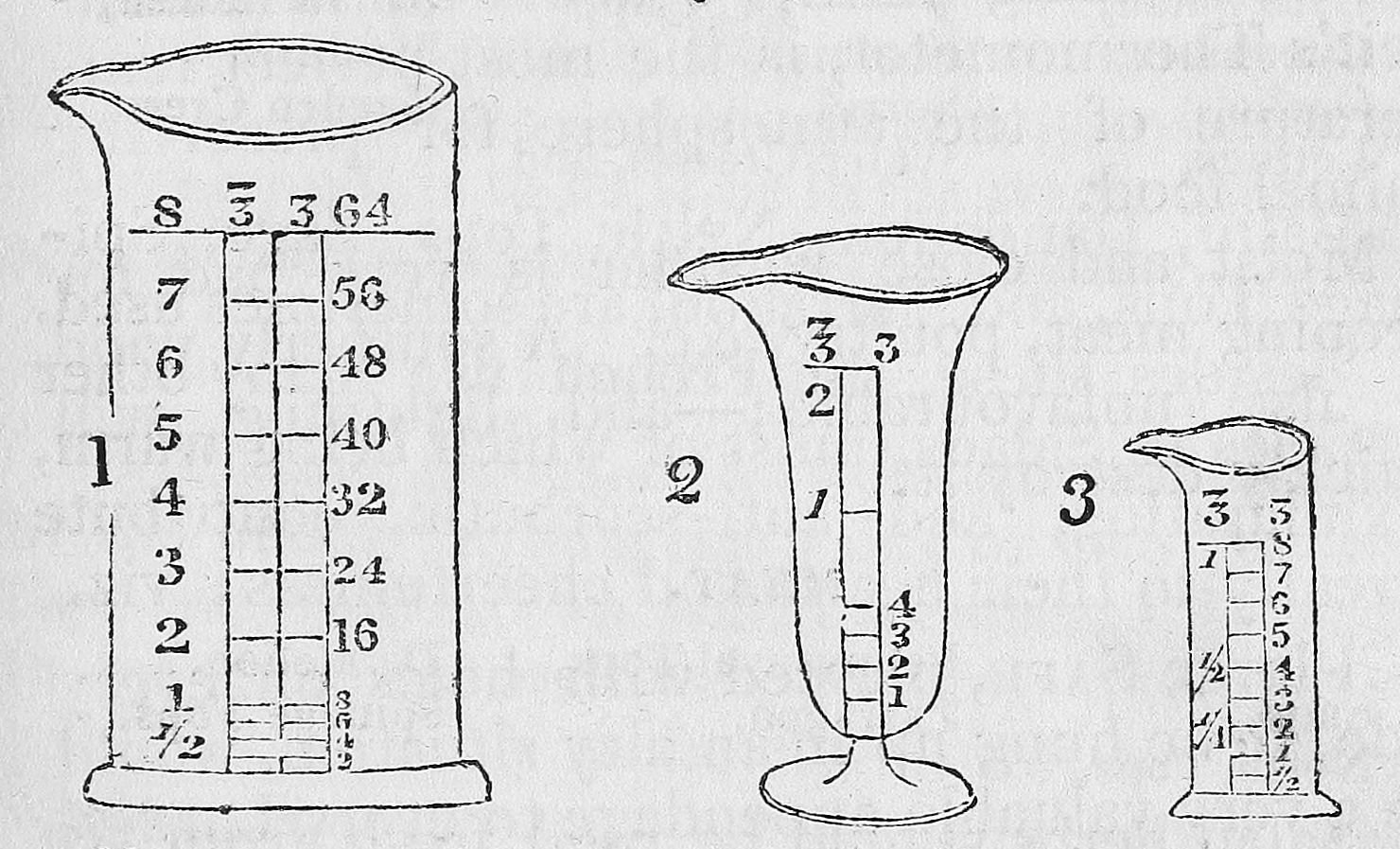
No. 1. represents a glass, calculated to measure any quantity from two drachms to eight ounces.
No. 2. From one drachm to two ounces.
No. 3. From half a drachm to one ounce.
Note.—Sixty drops or minims make one drachm.
Scales and weights should also be kept at hand, not only for weighing heavy articles, such as butcher’s-meat, grocery, &c. but also such as will weigh small quantities with accuracy. (See the Appendix.)
Before breakfast, or as soon as possible after, the Cook having seen that her assistants in the kitchen are getting forward all things preparatory to the principal dinner, and having also given the kitchen-maid directions for the servants’ dinner, her attention will next be directed to
The Larder.
The situation of the Larder should be dry, airy, and shady; it should be well ventilated, and kept perfectly clean, cool, and free from smells of all kinds.
The freezing point, or about 32° of Farenheit’s Thermometer, is the most perfect temperature of the atmosphere for preserving animal food.
Moist and close weather is very bad for keeping meat, poultry, &c. A southerly wind is also unfavourable;—and lightning will quickly destroy it.
MEAT.
A large Safe, pierced with holes on every side, to be hung up in an airy situation, would be a very valuable appendage to every Larder.
Management of Butcher’s Meat, &c. before it is dressed.
BEEF.
Management.—When the meat first comes in, trim it neatly and carefully, by cutting out all the bloody parts and the fly-blowings, if any; cut out also the kernels in the thick end of the sirloin, in the fat of the rump, in the pope’s-eye, the thick fat of the buttock, and wherever else they are to be found. Cut off the skirt under the ribs, and as much of the suet from the sirloin and rump as will leave them handsome for dressing. Cut off also the spare suet in the loins of veal and mutton; and the spare fat of necks, or loins of mutton, makes much lighter puddings than suet. Be careful also to take out the pipe which runs along the chine-bone, and the pith which is in the back-bone in the sirloin, rump, &c.; the whole should then be wiped dry, all the holes filled up with salt, and the roasting pieces should be sprinkled with salt and hung up till wanted. In winter, the boiling meat, that is frozen, should be soaked in cold water, two or three hours before it is dressed; but the best way to thaw a roasting joint is to let it be in the warm kitchen several hours before it is put to the fire.
SALTING.
The boiling pieces, if the weather permit, will be the better for hanging a day or two before they are salted. In warm weather, it is best to let them lie an hour, rubbing well every part that is likely to be fly-blown, and then wiping them dry with a cloth, and having salt ready, rub it into every part, taking care to fill the holes where the kernels and skewers have been. Turn them and rub them well with the pickle every day, and in three or four days they will be fit to dress, if wanted. Wash all the boiling pieces before dressing; and its colour will be the better for soaking; but never wash roasting joints before they are dressed, as it robs them of their best juices and finest flavour; it is, therefore, much better to wipe them well with a dry cloth, and pare off the dry parts on the outside.
VEAL.
Management.—Examine and trim the several joints when they come in; take out the skewers and wipe all the parts dry, particularly round the kidney and udder; cut out the pipe that runs along the chine-bone in the loin and neck; take out the spine in the back-bone, and the kernels in the leg and the chump end of the loin, and cut off the skirt within the breast.
MUTTON.
Management.—In warm weather, trim the meat as soon as it comes in, as directed for beef: cut out the kernels in the leg, the chine, and near the tail in the loin; cut out also the pipe that runs along the chine-bone, and take out the pith in the chine; cut off the skirt of the breast; wipe all dry with a clean cloth, and hang it up till wanted.
LAMB.
Management.—Lamb, whether in quarters or joints, should be managed like mutton and beef, as directed.
PORK.
Management.—Examine and trim it, when brought in, as you do all other kinds of meat. Sprinkle the joints intended for roasting with a little salt, to improve their relish. Cut the joints intended for boiling into suitable pieces, and rub them well with salt as you put them into the salting-pan.
VENISON.
Management.—To prevent venison from tainting, take the kernel out of the haunch, wash the whole with vinegar and water, then wipe it quite dry, and dust it with ground ginger or pepper, to keep off the flies.—Thus managed, it may be kept a fortnight.
General Business of the Larder.
Joints of meat, game, &c. should be hung where there is a current of dry air, till they are tender. If they be not kept long enough, they will be hard and tough;—if too long, they lose their flavour. Much loss is sustained by the spoiling of meat in warm weather; to prevent which, as far as possible, it must be turned daily, end for end, and wiped every morning and night, with a clean, dry cloth, to free it and keep it from damp and moisture. If it be feared that any of the ripe meat will not keep till wanted, it should be parboiled, or part-roasted, by which means it may be kept a day or two the longer. Pieces of charcoal should also be put over meat, and a plug of charcoal put into the vents of fowls, &c. a string being tied round their necks. Before dressing meat it must be well washed and wiped dry; except roasting-beef, the dry outsides of which must be pared off. When meat indicates the least degree of putridity it should be dressed with out delay, else it becomes unwholesome. In the latter case, however, even fish, as well as meat, may be reclaimed, by putting pieces of charcoal into the water with it, when boiled or parboiled.—Tainted meat may also be restored by washing it in cold water, and afterwards in strong chamomile tea, and rubbing it dry with a clean cloth; after which it may be sprinkled with salt, and suffered to remain till the next day, if necessary.
In frosty weather all meat should be brought into the kitchen over night, or at least several hours before it is to be dressed.
Early in the morning remove the cold meat into clean dishes; change also, all the broths, soups, gravies, stock, cullis, &c. that require it, into clean scalded stone-pans; and never leave any eatables in copper or brass vessels, for if touched with salt or vinegar, or any acid, and left wet, they will corrode and gather poison.
Turn and rub the meat that is in salt; after which let the Larder be well scoured and cleaned out.
Dried meats, hams, tongues, bacon, &c. must be hung up in a cool, dry place, otherwise they will become rusty.
Bread should be kept in an earthen pan, with a cover, to exclude the air;—it should not be cut till it is a day old.
The vigilant Cook, having attended to the minutiæ of the larder, and directed that the shelves and floor be well scoured and washed, and every part made perfectly free from smells, will next, if it be in her department, prepare to go to market, and consult her mistress or the housekeeper accordingly.[15]
Having seen that all the marketing is properly disposed of,—the parlour lunch, nursery and servants’ dinners getting forward, or got out of the way, then commences the principal preparations for the day.
In families where great dinners are seldom given, it will be better, when it can be conveniently done, to make an arrangement, as to the principal dishes, a day or two, or more, before hand. The Cook should never quit her post, on such an occasion, as it requires not only great skill but the utmost attention and exertion to send up the whole of a great dinner, with all its accompaniments, in perfect order.
When there is an opportunity of getting forward the soups, sauces, and made dishes, on the preceding day, it should, by all means, be done; but if not, the soups, &c. should be forwarded early in the morning, and while these are preparing, the joints of meat, cutlets, and other articles should be trimmed, the poultry and game, &c. trussed and made ready for dressing; the vegetables picked quite clean, trimmed, and well washed, and laid separate, in dishes or cullenders. The shalots, onions, sweet-herbs, spices, &c. should also be prepared, and laid quite at hand.
The Bill of Fare being made out, and the hour of active operation approaching, the clock must be consulted, and the different articles prepared and laid to the fire, in succession, according to the times they will take, that all may be ready in due time.—A scene of activity now commences, in which you must necessarily be cool, collected, and attentive.—Have an eye to the roast meat, and an ear to the boils,—and let your thoughts continually recur to the rudiments of your art, which at this moment must be called into practical requisition. You will endeavour that every kind of vegetable, and of sauce, be made to keep pace with the dishes to which they respectively belong—so that all may go up stairs smoking hot together, and in due order.
Let a clean cloth be laid on the kitchen-table, and with the bill of fare for your guide, if neither housekeeper nor the butler be present, let the dishes, intended to be used, be placed on this table, exactly as they are meant to stand on the table in the dining-room, and let every article be taken off the table in the kitchen, by the footman, and proper assistants, in regular order, by which means the butler cannot fail to set them in their proper places above stairs.
In some families, the soups are sent up first; and next, after a few minutes, the fish, then the removes, vegetables, sauces, and the whole of the first course:—mean time the entremets, or second course, will be dished and sent up, precisely in the same way. This would be done in all families, at all times, were it not deemed necessary frequently to sacrifice convenience, comfort, and every other consideration, at the shrine of fashion and elegance of appearance.
When the dinner things are brought down, the meat must be removed into clean common dishes; and as many things, such as fricandeaus, stews, &c. may remain untouched, or can be made to do again, when tossed up afresh, in different ways; they must be taken out of the gravies, the garnish, &c. picked clean off them, and the meat put by in clean dishes, and covered with thin slices of bacon. These gravies, and those from the roast meats of different kinds, must all be saved in separate stone pans, as all things of this kind serve to make a rich kitchen, and may be converted or applied to various useful purposes. The soups that are left should be strained through sieves to take out the bread and other vegetable matters, which, if left in, would turn them sour.
What sweets are left, such as Blancmange, Jellies, &c. may be melted and run into smaller moulds or shapes, and made to do again. Such management as this is highly commendable in all families, as thereby you are at all times provided for extra visiters.
Potted Meats, Collared articles, Anchovies, Oysters and other shell-fish, mock Brawn, cold Hams, Tongue, Stewed Peas, Black Caps, Sweets of various kinds, and some sorts of Tarts, should also be kept ready for suppers and extra occasions.[16]
The kitchen fire being reduced, and made up for ordinary occasions,—The dishes and every other article that has been used in the course of the day, and particularly the pots, kettles, sauce-pans, and other culinary utensils, being all scoured, and made perfectly clean, dried, wiped out, and put in their proper places;—the dressers and tables scoured down, and the whole kitchen made quite clean and put into perfect order, the principal business of the day may be considered at an end, as little more, of consequence, will seldom be required on the part of the Cook, except what further attention the larder, in hot weather, may demand, before she retires.
Useful Hints.
With the utmost attention of the Cook, she can gain no credit, if she send up more than one dish, with all its accompaniments, at a time, and that as quickly as possible.
Old meats do not require so much dressing as young, because they may be eaten with the gravy in them.
Pickled pork requires longer dressing, in proportion, than any other meat.
Hashes and minces should be only simmered, if boiled, they become hard.
Meat hastily boiled or roasted is, thereby, made the more indigestible, and its juices are wastefully extracted.
The warmer the weather, and the staler the meat, the less time it will take in dressing.
When meat is overdone it is spoiled, and the fault can never be corrected;—when neither overdone nor underdone it is most digestible and most nutritious;—and when thoroughly done, it eats short and tender.
In dressing Meats, be as correct as possible as to quantities, qualities, and time.
Meat that is not to be cut up till cold must be well done, particularly in the summer time.
The greatest skill of the best cook will avail nothing, unless the provisions are good.
The present taste is simply to boil both carp and tench; and serve up with plain or savoury sauce, or rather, with Dutch sour sauce, which does not destroy the flavour of the fish.
All fish should be sent up as hot as possible, and particularly the sauces. In fact, all sauces ought to be set on the table quite hot.
Essence of anchovies is a very good fish-sauce, alone—or otherwise.
To prepare meat in a hot-bath is a most excellent mode of cookery; as it makes it tender without the loss of its juices.
A conjuror or Papin’s digester is a very economical Utensil. It will dress a steak deliciously, with the addition of a little catsup, or with oysters, &c.—It boils water in a few minutes.
To keep meat hot, when done, take it up, set the dish over a pan of boiling water, put a deep cover over it, and throw a clean cloth over that.
Broiled beef steaks, mutton-chops, &c. should always be sent to the table hot and hot.
Whole peas are better than split peas for soup, in winter. It is a good practice to steep them an hour or more in cold water, before they are boiled.
Wines and spices should not be put into soups, stews, &c. too early, as the heat evaporates both the spirit and the flavour.
Vermicelli, when used in soups, &c. should not be suffered to remain in it more than fifteen minutes, as it will become a paste.
Dripping will do as well as butter to baste any thing.
A small quantity of cream is better than flour and water, in melting butter.
Much butter is not to be recommended on all occasions.
When the palate is become dull by frequent tasting, wash the mouth with milk;—or eat an apple.
A bit of bread stuck upon the point of the knife with which you peel or cut onions, will prevent their disagreeable effect on the eyes.
A kettle of water kept boiling, over a charcoal fire, will effectually prevent its deleterious effects in the room.
Coals. Judicious Cooks will perform their culinary operations with much less coal than those who erroneously conceive that the greater the fire, the greater the dispatch. Time, rather than a fierce fire, answers best both for roasting and boiling meats.—Round coals are best for use, and small coal should never be thrown on a weak fire, as it will stop the progress of the air through the fire; and perhaps extinguish it. But small coal, or culm, a little wetted, and thrown at the back of a good fire, will become cinders or coke, and greatly improve it.
All the ashes of the kitchen and other grates should be sifted, and the cinders saved, to be used under the boilers in brewing and washing, or in the ironing stove.
A simple and excellent contrivance for sifting cinders may be purchased at the Ironmongers.
Omelets should be made to eat full and thick at the mouth. They should be sent up quite hot, after dinner, and are wholesome, and great favourites in most countries.
A little sugar much improves the taste of green peas.
Potted meats make excellent sandwiches.
Sandwiches should be neatly cut in mouthfuls, so as to be taken up with a fork.
Maxims.
Do every thing in the proper time.
Keep every thing in its proper place.
Use every thing for its proper use.
Never use any boiling or stewing utensil, pot or pan, spit, cookhold, spoon, ladle, or skewer, sieve, tammy or pudding cloth, jelly bag, net, tape, or other kitchen article, that have not been well scalded or washed with boiling water, and thoroughly dried.
The Cook’s Catechism.
Browning A preparation of white sugar, browned over the fire, and then diluted to the consistency of soy, for the purpose of colouring soups, gravies, &c.
Bechamel A simple white gravy or sauce
To Braize To stew over a slow fire
Consommé A rich soup or gravy consumed over the fire to the consistency of a jelly, to be diluted and converted, when wanted, into soup
Cullis A rich brown gravy, made in various ways, according to the purpose for which it is intended
Entrés Dishes for a first course
Entremets Dishes for a second course
Esculents or Edibles Animal or Vegetable food—any article that may be eaten
Fricandeau A sort of Scotch collops
Fricassee Fowls, rabbits, or other things cut to pieces and dressed with a strong white sauce
Garnishes Articles laid round a dish by way of ornament, and generally, but not always, intended to be eaten therewith
Glaze A very rich sauce or gravy boiled to a thick substance, and preserved in pots, to be laid on with a long-haired brush, over high-seasoned dishes
To Glaze To cover the outsides of hams, tongues, and all stewed dishes, with glaze or braize, to give them a rich appearance
Harrico Veal, mutton, &c. stewed with vegetables
Hot-Bath A pan or other vessel filled with water, and placed in a pot, which is kept boiling over the fire, for the purpose of scalding fruits, or preparing meats
Maigre Soup, or any other dish, made without meat or gravy
To Pass To dress a thing partially, by setting on, or shaking it over the fire for a short time
Ragoût Or stewing or boiling meat or other articles, to preserve their juices
To Sheet To line the inside of a dish with paste
Stock A preparation from gravy meats, &c. always to be kept at hand, for the purpose of making soup or gravy
We have now initiated our honest candidate for culinary fame, by regular and easy gradations, into the whole arcana of the profession,—taught her to judge of the natures and qualities of provisions, and their comparative values;—the best seasons and methods of purchasing, and of managing undressed animal and vegetable food; and the general economy of the larder;—Have given her the plainest elementary principles and precepts, and a few of the most simple examples, for practice, in all the various branches of boiling, roasting, baking, broiling, frying, &c.—the best methods of making soups, gravies, sauces, and salads: and, lastly, the modern mode of preparing a good dinner, with all its most approved accompaniments. In fine, we have been anxious, not only to instruct the common cook in the rudiments, and all the ordinary operations of her art, but how to combine, both in principle and practice, the most elegant with the most useful results; so as to enable her to please both the man of taste and the man of temperance;—the economist and the epicure;—the whimsical and the wise;—those who eat to live, and those who live to eat.—Under the head Housekeeper, we have also given ample instructions for making Pastry, Confectionary, Preserves, and Pickles, which frequently fall within the province of the cook. The whole comprises, as it were in a nut-shell, a complete compendium of culinary knowledge, chiefly valuable for its comprehensive brevity, and which, we trust, will be found, by the ingenious practitioner, full as useful as many, more elaborate volumes, professedly written on this subject only, and published at not less, if not more than the whole price of this little Work.
Dean Swift’s ironical directions to the Cook.
Although I am not ignorant, that it hath been a long time since the custom began among people of quality to keep men cooks, and generally of the French nation; yet because my treatise is chiefly calculated for the general run of knights, ’squires, and gentlemen both in town and country, I shall therefore apply to you, Mrs. Cook, as a woman; however, a great part of what I intend may serve for either sex: and your part naturally follows the former; because the butler and you are joined in interest; your vails are generally equal, and paid when others are disappointed; you can junket together at nights upon your own prog, when the rest of the house are a-bed; and have it in your power to make every fellow-servant your friend; you can give a good bit or a good sup to the little masters and misses, and gain their affections: a quarrel between you is very dangerous to you both, and will probably end in one of you being turned off, in which fatal case, perhaps, it will not be so easy in some time to cotton with another. And now, Mrs. Cook, I proceed to give you my instructions, which I desire you will get some fellow-servant in the family to read to you constantly one night in every week when you are going to bed; whether you serve in town or country, for my lessons shall be fitted for both.
If your lady forgets at supper, that there is any cold meat in the house, do not you be so officious as to put her in mind of it; it is plain she did not want it; and if she recollects it the next day, say she gave you no orders, and it is spent; therefore, for fear of telling a lie, dispose of it with the butler, or any other crony, before you go to bed.
Never send up a leg of a fowl at supper, while there is a cat or a dog in the house, that can be accused for running away with it: but if there happen to be neither, you must lay it upon the rats, or a strange hound.
It is ill house-wifery to foul your kitchen rubbers with wiping the bottoms of the dishes you send up, since the table-cloth will do as well, and is changed every meal.
Never clean your spits after they have been used; for the grease left upon them by meat is the best thing to preserve them from rust; and when you make use of them again, the same grease will keep the inside of the meat moist.
If you live in a rich family, roasting and boiling are below the dignity of your office, and which it becomes you to be ignorant of; therefore leave that work wholly to the kitchen-maid, for fear of disgracing the family you live in.
If you are employed in marketing, buy your meat as cheap as you can, but when you bring in your accounts, be tender of your master’s honour, and set down the highest rate; which, besides, is but justice, for nobody can afford to sell at the same rate that he buys, and I am confident that you may charge safely; swear that you gave no more than what the butcher and poulterer asked. If your lady orders you to set up a piece of meat for supper, you are not to understand that you must set it up all; therefore, you may give half to yourself and the butler.
Good cooks cannot abide what they justly call fiddling work, where abundance of time is spent and little done: such, for instance, is the dressing of small birds, requiring a world of cookery and clutter, and a second or third spit, which by the way is absolutely needless; for it will be a very ridiculous thing indeed, if a spit which is strong enough to turn a sirloin of beef, should not be able to turn a lark; however, if your lady be nice, and is afraid that a large spit will tear them, place them handsomely in the dripping-pan, where the fat of roasted mutton or beef falling on the birds, will serve to baste them, and so save both time and butter: for what cook of any spirit would lose her time in picking larks, wheat-ears, and other small birds? Therefore, if you cannot get the maids, or the young misses to assist you, e’en make short work, and either singe or flay them; there is no great loss in the skins, and the flesh is just the same.
If you are employed in marketing, do not accept a treat of a beef-steak and a pot of ale from the butcher, which I think in conscience is no better than wronging your master; but do you always take that perquisite in money if you do not go in trust, or in poundage when you pay the bills.
The kitchen bellows being usually out of order with stirring the fire with the muzzle to save the tongs and poker, borrow the bellows out of your lady’s bed-chamber, which being least used, are commonly the best in the house; and if you happen to damage or grease them, you have a chance to have them left entirely for your own use.
Let a blackguard boy be always about the house to send on your errands, and go to market for you on rainy days, which will save your clothes, and make you appear more creditable to your mistress.
If your mistress allows you the kitchen-stuff, in return for her generosity take care to boil and roast your meat sufficiently. If she keeps it for her own profit, do her justice, and, rather than let a good fire be wanting, enliven it now and then with the dripping, and the butter that happens to turn to oil.
Send up your meat well stuck with skewers, to make it look round and plump; and an iron skewer rightly employed now and then will make it look handsomer.
When you roast a long joint of meat, be careful only about the middle, and leave the two extreme parts raw, which may serve another time, and will also save firing.
When you scour your plates and dishes, bend the brim inwards, so as to make them hold the more.
Always keep a large fire in the kitchen, when there is a small dinner, or the family dines abroad, that the neighbours, seeing the smoke, may commend your master’s house-keeping: but when much company is invited, then be as sparing as possible of your coals, because a great deal of the meat, being half raw, will be saved, and serve next day.
Boil your meat constantly in pump water, because you must sometimes want river or pipe water; and then your mistress, observing your meat of a different colour, will chide you when you are not in fault.
When you have plenty of fowls in the larder, leave the door open, in pity to the poor cat, if she be a good mouser.
If you find it necessary to go to market in a wet day, take out your mistress’s cloak, to save your clothes.
Get three or four chair-women to attend you constantly in the kitchen, whom you pay at small charges, only with the broken meat, a few coals, and all the cinders.
To keep troublesome servants out of the kitchen, always leave the winder sticking on the jack, to fall on their heads.
If a lump of soot falls into the soup, and you cannot conveniently get it out, stir it well, and it will give the soup a high French taste.
If you melt your butter to oil, be under no concern, but send it up; for oil is a genteeler sauce than butter.
Scrape the bottoms of your pots and kettles with a silver spoon, for fear of giving them a taste of the copper.
When you send up butter for sauce, be so thrifty as to let it be half water; which is also much wholesomer.
If your butter, when it is melted, tastes of brass, it is your master’s fault, who will not allow you a silver saucepan; besides, the less of it will go the farther, and new tinning is very chargeable: if you have a silver saucepan, and the butter smells of smoke, lay the fault upon the coals.
Never make use of a spoon in any thing that you can do with your hands, for fear of wearing out your master’s plate.
When you find that you cannot get dinner ready at the time appointed, put the clock back, and then it may be ready to a minute.
Let a red-hot coal now and then fall into the dripping-pan; that the smoke of the dripping may ascend, and give the roast meat a high taste.
You are to look upon the kitchen as your dressing room; but you are not to wash your hands, till you have gone to the Privy, and spitted your meat, trussed your fowl, picked your salad, nor indeed till after you have sent up your second course: for your hands will be ten times fouler with the many things you are forced to handle; but when your work is over, one washing will serve for all.
There is but one part of your dressing that I would admit while the victuals are boiling, roasting, or stewing; I mean, the combing your head, which loseth no time, because you stand over your cookery, and watch it with one hand, while you are using the comb with the other.
If any of the combings happen to be sent up with the victuals, you may safely lay the fault upon any of the footmen that hath vexed you: as those gentlemen are sometimes apt to be malicious, if you refuse them a sop in the pan, or a slice from the spit, much more when you discharge a ladle-full of hot porridge on their legs, or send them up to their masters with a dish-clout pinned at their tail.
In roasting and boiling, order the kitchen-maid to bring none but the large coals, and save the small ones for the fires above stairs: the first are properest for dressing meat; and when they are out, if you happen to miscarry in any dish, you may fairly lay the fault upon the want of coals; besides, the cinder-pickers will be sure to speak ill of your master’s house-keeping, where they do not find plenty of large cinders mixt with fresh large coals: thus you may dress your meat with credit, do an act of charity, raise the honour of your master, and sometimes get share of a pot of ale for your bounty to the cinder-woman.
As soon as you have sent up the second course, you have nothing to do (in a great family) until supper: therefore scour your bands and face, put on your hood and scarf, and take your pleasure among your cronies, till nine or ten at night—but dine first.
Let there be always a strict friendship between you and the butler, for it is both your interests to be united: the butler often wants a comfortable tit-bit, and you much oftener a cool cup of good liquor. However, be cautious of him, for he is sometimes an inconstant lover; because he hath great advantage to allure the maids with a glass of sack, or white-wine and sugar.
When you roast a breast of veal, remember your sweet-heart the butler loves a sweet-bread; therefore set it aside till evening; you can say, the cat or the dog has run away with it, or you found it tainted or fly-blown; and besides, it looks as well at the table without it.
When you make the company wait long for dinner, and the meat be over-done, which is generally the case, you may lawfully lay the fault upon your lady, who hurried you to send up dinner, that you was forced to send it up too much boiled or roasted.
If your dinner miscarries in almost every dish, how could you help it? You were teazed by the footmen coming into the kitchen; and to prove it true, take occasion to be angry, and throw a ladle-full of broth on one or two of their liveries; besides Friday and Childermas-day are two cross days in the week, and it is impossible to have good luck on either of them; therefore on those two days you have a lawful excuse.
When you are in haste to take down your dishes, tip them in such a manner, that a dozen will fall together upon the dresser, just ready for your hand.
To save time and trouble, cut your apples and onions with the same knife; well-bred gentry love the taste of an onion in every thing they eat.
Lump three or four pounds of butter together with your hand; then dash it against the wall just over the dresser, so as to have it ready to pull by pieces as you have occasion for it.
If you have a silver sauce-pan for the kitchen use, let me advise you to batter it well, and keep it always black; this will be for your master’s honour; for it shews there has been constant good house-keeping: and make room for the sauce-pan by wriggling it on the coals, &c.
In the same manner, if you are allowed a large silver spoon for the kitchen, let half the bowl of it be worn out with continual scraping and stirring; and often say merrily, this spoon owes my master no service.
When you send up a mess of broth, water-gruel, or the like, to your master in a morning, do not forget, with your thumb and two fingers, to put salt on the side of the plate; for if you make use of a spoon, or the end of a knife, there may be danger that the salt would fall, and that would be a sign of ill luck. Only remember to lick your thumb and fingers clean, before you offer to touch the salt.
In this satire, much useful instruction is conveyed, and many faults exposed which could not be so well noticed in any other form. A valuable servant will, of course, not lay herself open to the Dean’s irony.
Above all things, a cook should avoid all cruelty, and no custom or usage should be an excuse for any practices, by which living and sensitive creatures are to be put to wanton and unnecessary torture.
N.B. In the previous article it has not been attempted to give a detailed system of cookery, which alone would have filled a volume; but the object has been so to condense as to give the substance of the art in a few general rules, applicable to all cases, and therefore more useful than detailed instructions, for, applied with good sense, they cannot fail to make a complete cook.
THE KITCHEN-MAID, or UNDER COOK.
Cleanliness must be considered as the first and leading principle of the kitchen-maid, as well as of the head cook and all other persons in any way employed in the business of the kitchen.
This servant has, in many families, the hardest place in the house. It is her business, under the superintendance of the cook, to take nearly the whole management of roasting, boiling, and otherwise dressing all plain joints and dishes, and all the fish and vegetables.—She is also, if there be no scullion, to keep the kitchen, larder, scullery, all the kitchen utensils, and every thing belonging to it perfectly clean,—in the best possible condition, and always fit for use. On the due performance of this important part of her business mainly depends the credit and character, not of herself only, but of the cook also; it therefore behoves the cook to see it properly done.
The kitchen-maid must always rise betimes, light the kitchen fire, and set on water to be heated for all the purposes of the family, the first thing she does.—She next scours the dressers and shelves, and the kitchen tables, with soap and sand, and hot water; and cleans up the kitchen: she then clears out and cleans the housekeeper’s room, the hall and passages, the front door, and area steps, the larder, and the butler’s pantry; in doing which, the scullion (if there be one kept) takes the dirtiest and most laborious part. She then prepares the breakfasts in the housekeeper’s room, and the servants’-hall. These things, if she be active, she will have accomplished before the cook begins to require her attention and attendance in the larder, in the furtherance of the culinary preparations; to which, however, she must have an eye, even from her earliest rising, particularly to the soups and other things, that require a long time to prepare.
After breakfast, if not before, the cook will require her assistance in the larder, and afterwards for the remainder of the day she will be occupied in the kitchen, under the direction of the cook; first, in preparing for the servants’ dinner, the dinner in the nursery, or elsewhere, and the lunch in the parlour; next in helping to get ready the family dinner; then in washing up and clearing away every thing, and cleaning up the kitchen; and lastly, in setting out and preparing the supper, either hot or cold, for the servants.
As the kitchen-maid generally fills her situation with the view of becoming a cook, at a future day, it behoves her to read with attention the foregoing Directions to the Cook, which contain the rudiments of the art, and which, if she attentively study, and practically apply, will enable her to attain such a proficiency in her business, as will render her a valuable acquisition to her future employers. [Wages from 12 to 14 guineas per year.]
Having given a full and adequate sketch of the theory and leading principles of the culinary art, and exemplified them in the practical duties of the cook and kitchen-maid, we shall conclude the subject with a brief outline of the duties of their humble and laborious assistant,
THE SCULLION, or SCULLERY-MAID.
It is the business of this servant to light the fires in the kitchen range, and under the copper or boilers, and stew-holes—to wash up all the plates and dishes—scour and clean all the sauce-pans, stew-pans, kettles, pots, and all other kitchen utensils; and to take care that all the latter are always kept clean, dry, and fit for use. She is to assist the kitchen-maid in picking, trimming, washing and boiling the vegetables, cleaning the kitchen and offices, the servants’-hall, housekeeper’s room, and steward’s room; and to clean the steps of the front door and the area. She makes the beds for the stable men—and generally fetches, carries, and clears away for the cook and kitchen-maid, and otherwise assists in all the laborious parts of the kitchen business, [Wages from 8 to 12 guineas a year.]
TO CLEAN BLOCK-TIN DISH-COVERS, PEWTER POTS, &c.
Mix a little of the finest whiting, free from sand, with the smallest drop of sweet oil; rub the outside well and wipe it clean, with clean, dry soft linen rags.—Do the same to the inside, but wet with water, not oil:—always wiping these articles dry immediately after using them, and drying them by the fire, prevents their rusting, and saves much trouble in cleaning them.
THE LADY’S MAID.
The business of the lady’s-maid is extremely simple, and but little varied. She is generally to be near the person of her lady; and to be properly qualified for her situation, her education should be superior to that of the ordinary class of females, particularly in needle-work, and the useful and ornamental branches of female acquirements. To be peculiarly neat and clean in her person and dress, is better than to be tawdry or attractive, as intrinsic merit is a much greater recommendation than extrinsic appearance. In her temper she should be cheerful and submissive, studying her lady’s disposition, and conforming to it with alacrity. A soft and courteous demeanour will best entitle her to esteem and respect. In fine, her character should be remarkable for industry and moderation,—her manners and deportment, for modesty and humility—and her dress, for neatness, simplicity, and frugality.
It will be her business to dress, re-dress, and undress her lady; and, in this, she should learn to be perfectly au fait and expeditious, ever studying, so far as it depends on herself, to manifest good taste, by suiting the ornaments and decoration of her dress to the complexion, habits, age, and general appearance of her person. Thus will she evince her own good sense, best serve her lady, and gratify all those who are most interested in her welfare and happiness. She should always be punctual in her attendance, and assiduous in her attention. Her’s will be the care of her lady’s wardrobe, and she should make that her particular care; appropriating to each article of dress its proper place, where it always may be found when wanted. It will be her business carefully to examine every part of her dress, when taken off, and if they have sustained an injury, or acquired any spots or stains, immediately to clean and repair them;[17] then fold them up neatly, and put them away.
Her first business, in the morning, will be to see that the house-maid has made the fire, and properly prepared her lady’s dressing-room:—she then calls her mistress, informs her of the hour, and having laid out all her clothes, and carried her hot water, to wash, she retires to her breakfast with the house-keeper and other principal servants. When her lady’s bell rings, she attends her in her dressing-room,—combs her hair for the morning, and waits on her till dressed; after which, she folds and puts away her night-clothes, cleans her combs and brushes, and adjusts her toilet-table:—she then retires to her work-room, to be ready if wanted, and employs herself in making and altering dresses, millinery, &c. About one o’clock the family generally take their lunch, and the servants their dinner.—After this, she is again summoned to attend her lady’s toilet whilst dressing to go abroad. When gone, she again adjusts her clothes, and every thing in the room, and lays out and prepares the several articles that may be required for her dinner, or evening dress, and afterwards employs herself at needle-work in her own room, or in her other avocations, till her mistress returns to dress for dinner, perhaps about five, when she attends her for that purpose; and having done this, it may happen that no further attendance on her mistress’ person will be required till she retires to bed: meanwhile she employs herself at needle-work, as in the morning[18]—or else in the various occupations of getting up the fine linen, gauzes, muslins, cambrics, laces, &c. washing silk stockings, taking the spots or stains out of silks, &c. &c. for doing which the best receipts are annexed.
It is her business to see that the house-maid, or chamber-maid, empties the slops, keeps up the fires, both in this and the bed-room, (if wanted) and keeps the rooms in perfect order.—Previous to her mistress’ retiring for the night, she will have looked out her night-clothes, and aired them well; and she will, not only now, but at all times when she goes to dress, carry up hot water, for washing, &c. and when she is gone to bed, she will carefully examine all her clothes, and do all that is necessary to be done to them, before she folds them away. If her lady be elderly, infirm, or unwell, she will sometimes be required to bring her work, and sit with her, to administer her medicines, and sometimes to read to her. To qualify herself for this latter purpose, and to acquit herself with propriety, she will, at her leisure, practise reading aloud, from the best authors; as it is important to acquire a proper style and manner of reading, in all the varieties of poetry or prose, ode or epistle, comedy, or sermon; avoiding, alike, the dull monotony of the school girl, and the formal affectation of the pedant; but following nature as her guide, in all that appertains to emphasis, modulation, and delivery.
If acquainted with the superior branches of needle-work, she might afford her lady much gratification, in presenting her, occasionally, with such trifles as will be acceptable, and suitable ornaments for her person.—This will evince her disposition to be grateful and to oblige; and this, combined with a feminine sweetness of temper, and suavity of manners, cannot fail to be her sure recommendation to the esteem of her superiors and others, through all the various circumstances of life.—Wages, from 18 to 25 guineas per annum, with tea and washing.
As the duties of the lady’s-maid include the personal ornament, dress, and decoration of her mistress, we have availed ourselves of a work recently published, under the title of “The Art of Beauty,” and in the subsequent pages have introduced some important receipts and observations from that work; together with various approved receipts on other points of the lady’s-maid’s duty.
ROMAN BALSAM FOR FRECKLES OF THE SKIN.
Take one ounce of bitter almonds, one ounce of barley flour, a sufficient quantity of honey.
Beat the whole into a smooth paste, spread it thinly on the skin at night, and wash it off in the morning.
The skin being thus prepared for the chemical remedies, you may select any of the following, or try them in succession.