PREFACE. (continued 9)
Reading edition
TO BRUSH CLOTHES.
Have a wooden horse to put the clothes on, and a small cane or small hand-whip to beat the dust out of them; also a board or table long enough for them to be put their whole length when brushing them. Have two brushes, one hard and the other soft: use the hardest for the great coats, and the others when spotted with dirt. Fine cloth coats should never be brushed with too hard a brush, as this will take off the nap, and make them look bare in a little time. Be careful in the choice of your cane; do not have it too large, and be particular not to hit too hard; be careful also not to hit the buttons, for it will scratch, if not break them.
If a coat be wet, and spotted with dirt, let it be quite dry before you brush it; then rub out the spots with the hands, taking care not to rumple it. If it want beating, do it as before directed; then lay the coat at its full length on a board; let the collar be towards the left hand, and the brush in the right; brush the back of the collar first, between the two shoulders next, and then the sleeves, &c. observing to brush the cloth the same way that the nap goes, which is towards the bottom of the coat. When both sides are properly done, fold them together; then brush the inside, and last of all the collar.
TO TAKE OUT GREASE FROM CLOTHES.
Have a hot iron with some thick brown paper: lay the paper on the part where the grease is, then put the iron upon the spot; if the grease comes through the paper, put on another piece, till it does not soil the paper. If not all out, wrap a little bit of cloth or flannel round the finger, dip it into spirit of wine, and rub the grease spot; this will take it entirely out. Be careful not to have the iron too hot; but try it on a piece of white paper, and if it turn the paper brown, or scorch in the least, it is too hot. If paint should get on the coats, always have spirit of wine or turpentine ready, which, with a piece of flannel or cloth, will easily take it off, if not left to get quite dry.
TO CLEAN TEA TRAYS.
Do not pour boiling water over them, particularly on japanned ones, as it will make the varnish crack and peel off; but have a sponge wetted with warm water and a little soap, if the tray be very dirty, then rub it with a cloth; if it looks smeary, dust on a little flour, then rub it with a dry cloth. If the paper tray gets marked, take a piece of woollen cloth, with a little sweet oil, and rub it over the marks; if any thing will take them out this will. Let the urn be emptied, and the top wiped dry, particularly the outside, for if any wet be suffered to dry on, it will leave a mark.
METHOD OF DARKENING MAHOGANY.
Nothing more is necessary than to wash the mahogany with lime-water, which may be readily made by dropping a nodule of lime into a bason of water.
TO WASH AND CLEAN GENTLEMEN’S GLOVES.
Wash them in soap and water till the dirt is got out, then stretch them on wooden hands, or pull them out in their proper shape. Never wring them as that puts them out of form and makes them shrink; put them one upon another and press the water out. Then rub the following mixture over the outside of the gloves. If wanted quite yellow, take yellow ochre; if quite white, pipe clay; if between the two, mix a little of each together. By proper mixture of these any shade may be produced. Mix the colour with beer or vinegar.
Let them dry gradually, not too near the fire nor in too hot a sun; when they are about half dried rub them well, and stretch them out to keep them from shrinking and to soften them. When they are well rubbed and dried take a small cane and beat them, then brush them; when this is done iron them rather warm, with a piece of paper over them, but do not let the iron be too hot.
TO MANAGE WATER-PIPES IN WINTER.
When the frost begins to set in, cover the water-pipes with hay or straw bands, twisted tight round them. Let the cisterns and water butts be washed out occasionally; this will keep the water pure and fresh.
In pumping up water into the cistern for the water-closet, be very particular, in winter-time, as in general the pipes go up the outside of the house. Let all the water be let out of the pipe when you have done pumping; but if this be forgotten, and it should get frozen, take a small gimblet and bore a hole in the pipe, a little distance from the place where it is let off, which will prevent its bursting. Put a peg in to the hole when the water is let off. Pump the water up into the cistern, for the closet every morning, and once a week take a pail of water, and cast it into the basin, having first opened the trap at the bottom; this will clear the soil out of the pipe.
TO PRESERVE HATS.
Hats require great care, or they will soon look shabby. Brush them with a soft camel-hair brush, which will keep the fur smooth. Have a stick for each hat, to keep it in its proper shape, especially if the hat be wet: put the stick in as soon as the hat is taken off, and when dry put it into a hat-box, particularly if not in constant use, as the air and dust soon turn hats brown. If the hat is very wet, handle it as lightly as possible; wipe it dry with a cloth or silk handkerchief; then brush it with the soft brush.
VARNISH FOR WAINSCOTTING, SMALL ARTICLES OF FURNITURE, BALUSTRADES, AND INSIDE RAILING.
Take gum sandarac, 6 oz. shell lac, 2 oz. colophonium, or resin, white glass pounded, clear turpentine, each 4 oz. pure alcohol, 32 oz.
Dissolve the varnish according to the directions given for compound mastic varnish.
This varnish is sufficiently durable to be applied to articles destined to daily and continual use. Varnishes composed with copal ought, however, in these cases, to be preferred.
Another.
Melt over a moderate fire, in a very clean vessel, two ounces of white or yellow wax; and, when liquefied, add four ounces of oil of turpentine. Stir the whole until it is entirely cool, and the result will be a kind of pomade fit for waxing furniture, and which must be rubbed over them according to the usual method. The oil of turpentine is soon dissipated; but the wax, which by its mixture is reduced to a state of very great division, may be extended with more ease, and in a more uniform manner. The essence soon penetrates the pores of the wood, calls forth the colour of it, causes the wax to adhere better, and the lustre which thence results is equal to that of varnish, without having any of its inconveniences.
COLOURED VARNISH FOR PLUM-TREE, MAHOGANY, AND ROSE-WOOD.
Take of gum sandarac, 4 oz. seed lac, 2 oz. mastic, Benjamin in tears, each 1 oz. pounded glass, 4 oz. Venice turpentine, 2 oz. pure alcohol, 32 oz.
The gum sandarac and lac render this varnish durable; it may be coloured with a little saffron or dragon’s blood.
TO MAKE BLACKING.
Take of ivory-black and treacle, each 12 oz. spermaceti oil, 4 oz. white wine vinegar, 4 pints.
Mix.
This blacking, (recommended by Mr. Gray, lecturer on the materia medica,) is superior in giving leather a finer polish than any of those that are advertised, as they all contain sulphuric acid, (oil of vitriol,) which is necessary, to give it the polishing quality, but it renders leather rotten and very liable to crack.
Another.
Take of vinegar, No. 18, (the common,) 1 quart, ivory-black, and treacle, each 6 oz. vitriolic acid, and spermaceti, (or common oil,) each 1½ oz.
Mix the acid and oil first, afterwards add the other ingredients; if, when it is used, it does not dry quick enough on the leather, add a little more of the vitriol, a little at a time. When there is too much of the vitriolic acid, which is various in its strength, the mixture will give it a brown colour.
Liquid Japan Blacking.
Take 3 ounces of ivory-black, 2 ounces of coarse sugar, one ounce of sulphuric acid, one ounce of muriatic acid, one table-spoonful of sweet oil and lemon acid, and one pint of vinegar. First mix the ivory-black and sweet oil together, then the lemon and sugar, with a little vinegar, to qualify the blacking; next add the sulphuric and muriatic acids, and mix them all well together.
A Cheap Method.
Ivory-black, two ounces; brown sugar, one ounce and a half; and sweet oil, half a table spoonful. Mix them well, and then gradually add half a pint of small beer.
Another Method.
A quarter of a pound of ivory-black, a quarter of a pound of moist sugar, a table spoonful of flour, a piece of tallow about the size of a walnut, and a small piece of gum arabic. Make a paste of the flour, and whilst hot, put in the tallow, then the sugar, and afterwards mix the whole well together in a quart of water.
Bailey’s Composition for Blacking Cakes.
Take gum tragacanth, one ounce; neat’s-foot oil, super-fine ivory-black, deep blue, prepared from iron and copper, each two ounces; brown sugar-candy, river water, each four ounces. Having mixed well these ingredients, evaporate the water, and form it into cakes.
Blacking Balls for Shoes.
Take mutton suet, four ounces; bees’ wax, one ounce; sweet oil, one ounce; sugar-candy and gum arabic, one dram each in fine powder; melt these well together over a gentle fire, and add thereto about a spoonful of turpentine, and lamp black sufficient to give it a good black colour. While hot enough to run, make it into a ball, by pouring the liquor into a thin mould; or let it stand till almost cold; when it may be moulded by the hand.
TO RENDER LEATHER WATER PROOF.
This is done by rubbing or brushing into the leather a mixture of drying oils, and any of the oxides or calxes of lead, copper, or iron: or by substituting any of the gummy resins, in the room of the metallic oxides.
FURNITURE PASTE.
Scrape four ounces of bees’-wax into a basin, and add as much oil of turpentine as will moisten it through. Then powder a quarter of an ounce of resin, and add as much Indian red as will bring it to a deep mahogany colour. When the composition is properly stirred up, it will prove an excellent cement or paste for blemishes in mahogany, and other furniture.
Another Method.
Scrape four ounces of bees’-wax, as before. To a pint of oil of turpentine, in a glazed pipkin, add an ounce of alkanet-root. Cover it close, and put it over a slow fire, attending it carefully that it may not boil over, or catch fire. When the liquid is of a deep red, add as much of it to the wax as will moisten it through, also a quarter of an ounce of powdered resin. Cover the whole close, and let it stand six hours, when it will be fit for use.
Furniture Oil.
Put some linseed-oil into a glazed pipkin, with as much alkanet root as it will cover. Let it boil gently, and it will become of a strong red colour: when cool it will be fit for use.
TO REMOVE FLIES FROM ROOMS.
Take half a tea-spoonful of black pepper, in powder, one tea-spoonful of brown sugar, and one table-spoonful of cream; mix them well together, and place them in the room, on a plate, where the flies are troublesome, and they will soon disappear.
Another Way.
Dissolve two drams of extract of quassia in half a pint of boiling water, sweeten it, and pour it into plates to be set about the room. This mixture, though fatal to the flies, is not otherwise pernicious.
TO EXTINGUISH FIRE IN A CHIMNEY.
Put a wet blanket over the whole front of the fire-place, which will stop the current of air, and thus extinguish the flames.
TO CLEAN BOOT TOPS WHITE.
Take an ounce of oxalic acid, dissolve it in a pint of soft water, and keep it in a bottle well corked; dip a soft sponge into the mixture to clean the tops with, and if there are any spots which refuse to disappear, rub them with a little fine Bath brick dust: sponge the tops afterwards with clean water. Take particular care always to have any mixtures, or powders for boot-tops, labelled with the word poison in large letters, as fatal accidents have arisen from oxalic acid, being so like Epsom salts in appearance, as to be often taken for them in mistake.
TO CLEAN BOOT TOPS BROWN.
Take a pint of skimmed milk, half an ounce of spirits of salt, half an ounce of spirits of lavender, one ounce of gum Arabic, and the juice of two lemons; mix them well together, and keep them in a bottle closely corked; rub the tops with a sponge, but use no brick dust; and when they are dry, polish them with a brush or piece of flannel.
TO REMOVE UNPLEASANT ODOURS.
The unpleasant smell of new paint is best removed by time, and atmospheric ventilation: but tubs of water placed in the apartment will act more rapidly; with this inconvenience, however, that the gloss of the paint will be destroyed. Unpleasant smells from water-closets, or all articles of furniture connected with them, may be modified by the application of quick-lime, to which may be added the soap-suds that have been used in washing, which neutralize the pungently offensive salts. A little quick-lime put into a night-chair will destroy all disagreeable effluvia.
Aromatic pastiles of the following composition may be burned with great success: take of camphor, flowers of benzoin, powdered charcoal, powdered cascarilla bark, powdered Turkey myrrh, and powdered nitre, each equal quantities; beat them with syrup sufficient to form a mass, and divide into pastiles of conical shape. They may be mixed up with spirit of turpentine, or any thing inflammable.
TO CLEAN KNIVES AND FORKS.
Procure a smooth board, free from knots, or one covered with leather. If the latter, melt a sufficient quantity of mutton suet, and put it hot upon the leather with a piece of flannel; then take two pieces of soft Flanders brick, and rub them one against the other over the leather till it is covered with the powder, which rub in until no grease comes through, when a knife is passed over the leather, which may easily be known by the knife keeping its polish.
If only a plain board, rub the brick two or three times over it; for if too much be put on at once it will make the blades of the knives look rough and scratched. Let the board be of a proper height, and set so that you may be in a sloping position while cleaning the knives. Take a knife in each hand, holding them back to back; stand opposite the middle of the board; lay the knives flat upon it, and do not bear too hard upon them; by this method it will be easier to clean two knives at a time than one, and they will be less liable to be snapped or broken, when pressed on too heavily.
Be careful to keep a good edge on the knives. Carving knives in particular ought to be kept sharp, which may easily be done by taking one in each hand, back to back when cleaning, scarcely letting them touch the board when expanding the arms, but when drawing the hands together again, bearing a little hard on the edge of the knives; this will give them not only a good edge and a fine polish, but is much better than sharpening them with a steel.
The best way to clean steel forks is to fill a small oyster barrel with fine gravel, brick dust, or sand, mixed with a little hay or moss: make it moderately damp, press it well down, and let it always be kept damp. By running the prongs of the forks a few times into this, all the stains on them will be removed. Then have a small stick, shaped like a knife, with leather round it to polish between the prongs, &c. having first carefully brushed off the dust from them as soon as they are taken out of the tub. A knife board is often spoiled by cleaning forks, and the backs of the knives, upon it; to prevent this, fasten a piece of old hat or leather on the board where the forks and backs of knives are to be cleaned.
Always turn the back of the knives towards the palm of the hand in wiping them, which will prevent all danger from cutting. In wiping the forks put the corner of the cloth between the prongs, to remove any dirt or dust that may not have been thoroughly brushed out; and if there be silver ferules on the knives and forks, or silver handles, they must be rubbed with a piece of leather and plate powder, keeping the blades covered while the handles are cleaning.
Wipe the knives and folks as soon as possible after being used, as the longer they are left with grease and stains on them the harder they will be to clean; particularly if they have been used for acids, salads, tarts, &c. Have then a jug of hot water ready to put them into as soon as done with, and wipe them as before directed.
In order to keep knives and forks in good condition when they are not in use, rub the steel part with a flannel dipped in oil; wipe the oil off after a few hours, as there is often water in it; or dust the blades and prongs with quick-lime, finely powdered, and kept in a muslin bag.
TO CLEAN PLATED ARTICLES.
Plated articles require even more care than silver ones; they should be cleaned with soft brushes, not too often, and never with any thing but plate powder, not even whiting by itself; do not wet them more than can be helped or they will tarnish; nor brush them more than is necessary, or the silver will come off; the best thing for them is spirit of wine or oil, and take care that no plated articles remain long dirty or damp, for if they do they will rust, in case they are plated on steel, and canker if plated on copper.
Wash the brushes after the plate is cleaned with warm water and soap, and then set them to dry, with the wooden side uppermost.
THE UNDER BUTLER.
Is entirely under the controul and direction of the Butler. He cleans all the plate—the parlour knives and forks—lays the cloths—sets out the side-board, and assists to wait at table. As he is supposed to be busily employed, after dinner, in the Butler’s pantry, cleaning the plate, he is not usually expected to answer the bells at that period. He trims the lamps belonging to the dining and drawing-rooms, and is frequently required to assist the Butler in cleaning his master’s clothes and shoes. The Under Butler, generally looking to the situation of Butler, and as even in his present station he will have occasion for more particular directions, he will do well frequently to refer to the hints to the Butler, where he will find the immediate duties of the Butler and himself more particularly given.
A chief part of his duty consists in assisting in the rough work of the butler, such as brewing, bottling, and cellar business in general, in all which he should be as expert as the butler himself.
Wages 16 to 25 guineas.
TO CLEAN CHINA AND GLASS.
The best material for cleaning either porcelain or glass-ware is fullers’ earth, but it must be beaten into a fine powder, and carefully cleared from all rough or hard particles, which might endanger the polish of the brilliant surface.
TO CLEAN PLATE.
Wash the plate in boiling water to free it from grease, and if it has wrought edges, brush it well before you begin to clean it. The leathers ought to be soft and very thick, and the sponges well soaked in water.
Another Way.
Boil an ounce of prepared hartshorn-powder in a quart of water. While on the fire, put as much plate into it as the vessel will hold; let it boil a little time, then take it out, drain it over the saucepan, dry it before the fire, and rub it bright with leather. Then put more into the pan in the same manner until it is all boiled. Put clean linen rags into the pan to soak up the remainder, and when dry, they will give a beautiful polish to the plate merely by rubbing it with them. They are likewise admirable for cleaning brass locks, and the finger-plates of doors.—This method will only suit small articles of plate.
TO CLEAN PLATED ARTICLES.
Take an ounce of killed quicksilver, which you may buy at the chemist’s, and half a pound of the best whiting sifted; mix them with spirits of wine when used. Hartshorn-powder may be used instead of whiting; but whiting is quite as good, when dried and pounded.
TO GIVE SILVER PLATE A LUSTRE.
Dissolve alum in strong ley, skim it carefully, mix it with soap and wash your silver utensils with it, using a linen rag.
TO TAKE STAINS OUT OF SILVER PLATE.
Steep the plate in soap leys for the space of four hours; then cover it over with whiting wet with vinegar, so that it may stick thick upon it, and dry it by a fire; after which, rub off the whiting, and pass it over with dry bran, and the spots will not only disappear, but the plate will look exceedingly bright.
TO MAKE PLATE LOOK LIKE NEW.
Take of unslaked lime and alum, a pound each, of aqua vitæ and vinegar, each a pint, and of beer grounds, two quarts; boil the plate in these, and they will set a beautiful gloss upon it.
TO TAKE FRUIT SPOTS OUT OF CLOTH.
Let the spotted part of the cloth imbibe a little water without dipping, and hold the part over a lighted common brimstone match at a proper distance. The sulphurous gas which is discharged, will soon cause the spot to disappear.
Plate Powder.
Whiting properly purified from sand, applied wet, and rubbed till dry, is one of the easiest, safest, and, certainly the cheapest, of all plate powders.
THE UNDER, SECOND, OR LADY’S COACHMAN.
The business of the Under Coachman, is precisely the same as that of the Head Coachman, as before detailed. He attends with the assistance of the helper, to the care and dressing of his horses, washing and cleaning the harness and the coach, which is always the second best, and is driven by him at night; whereas the best coach and the best horses, are driven by the Head Coachman by day.
Wages from 20l. to 24 guineas, with two suits of livery, a box coat occasionally, hat and boots—also one or two stable dresses.
He is sometimes required to ride as postillion, or as courier, when the family travel post.
THE UNDER COACHMAN.
If there be other Coachmen kept, their duties are similar to those of the first and second Coachmen, but their wages are somewhat lower, and the liveries, &c. not always quite so costly.
THE LADY’S FOOTMAN.
The chief business of this servant is to wait on his lady only, for whom he performs all the offices of a footman. He carries out all her messages and cards of invitation. He prepares the breakfast, and waits behind her chair both at breakfast and dinner—must be ready at all times to go out with his lady, either behind her carriage or on foot. For his more general duties, see the Directions to the Footman.
A genteel exterior and a good figure are principal recommendations of this servant; to which he should add great cleanliness in his person, and studied neatness in his dress. He is, of course, expected to assist the other servants in waiting at the dinner table, and to receive instructions through the lady’s maid, in whose out-door concerns he must officiate when required.
Wages 18l. to 25 Guineas—two liveries and a working dress.
THE UNDER FOOTMAN.
In families where two or more footmen are kept, the under footman is expected, and indeed, engages to do that part of the business of a footman, which is deemed the most laborious; that is, he cleans knives and forks—boots and shoes—carries up the coals and attends all the fires above stairs during the day. He likewise carries out cards, messages, &c. and assists to carry up and wait at dinner, &c. &c. Wages, 16 to 20 guineas, with liveries.
THE HALL PORTER.
The duties of this servant are confined to the entrance-hall, and the door, where he is continually stationed. He answers every knock and ring, takes in all messages, parcels, letters, cards, &c. and immediately hands them to the butler, who conveys them to his master or mistress.
He trims the great hall and passage lamps, and opens and fastens up the doors and shutters every morning and night.
The public character of a nobleman or gentleman often depends on this servant. Rude or contemptuous language, to the meanest applicant, will frequently prove injurious to the interests of his master, in ways of which he cannot be a competent judge; and, therefore, his best qualities are patience and good temper, to which may be added, secrecy in regard to the affairs, connexions, and intercourse of the family. A close tongue, and an inflexible countenance, are, therefore, indispensable, and he should practise the maxim of hearing and seeing all, but saying nothing. It is recorded of the porter of a minister of state, who died in the morning, that, on being asked in the afternoon if the fact were true, he replied that really he could not tell, but if the party would give him his card, he would make enquiry, and let him know. This was a well-trained porter, and such should be the system of all porters.
Wages from 24l. to 30l. per annum.
THE GROOM.
This, and indeed, every other person in the stable department, must rise about five in the summer, and six in the winter.
When the Groom has two or more horses under his care, with a chaise, or other vehicle or vehicles, he is generally allowed a boy to assist him in the stable.
We shall here insert the general care and management of horses, because in every stable establishment, however small, or however large, a Groom is to be found; and he ought to be fully competent to this branch of stable experience. In order to avoid repetition, we shall refer every other servant in this department, to this description of the usual care and management of horses.
The first thing, on entering the stable, is to give to each horse about a gallon of clean water in a clean bucket; then to shake up the best litter, under the manger, sweep out each stall, and clean out the whole stable. Every Coachman and Groom feeds his own horses;[24] and during the time of their feeding, he proceeds to dress them: thus each horse is first curried all over, with the curry-comb, to loosen the dirt and dust on its skin; then brushed with a whalebone brush, to take the dust off; next whisped with straw, to smooth and cleanse its coat; and again brushed with the brush and curry-comb, to take off what dust may remain; after which the horse is whisped again with a damp lock of hay, and finally, rubbed down with a woollen rubber, or a clean cloth. The horse is then turned round in the stall, and his head is next brushed well and whisped clean and smooth, with a damp lock of hay. After this, his ears are drawn through the hands, for several minutes, till made warm, and then the insides of the ears are wiped out with a damp sponge, to remove such dust and filth as may have accumulated there. The sponge after being washed clean, is then applied to the eyes, to cleanse them from dust, and any exudation that may have arisen in them. The nostrils are also sponged clean, and the whole head is afterwards finished by rubbing it with a cloth, in the same manner as the body had previously been cleaned. The horse is then turned round into its proper situation, the head stall put on, and the dirt and filth that may have accumulated under its tail, are then washed away with a sponge. The mane and tail are next cleaned and laid with a mane comb and water brush, used alternately with both hands; the head and body are again wiped over, and the body clothes are put on and fastened with a surcingle.
The Groom next examines the horse’s heels, picks out the dirt from the feet, and washes its heels, with a water brush and plenty of water. If any horse has bad feet, they are then to be dressed and stuffed. Lastly, a due portion of hay,[25] (about three or four pounds) is shaken into the rack, and then the horse is considered as completely dressed.
This is a summary of the whole process of cleaning and dressing horses of every description.
Horses thus attended to, and regularly managed, under the humane superintendance of a diligent and conscientious Groom or Coachman, will have healthy and beautiful appearance, and in a great measure escape from many diseases to which they would otherwise be liable.
When the master rides out before breakfast, the Groom rises so much the earlier, so as to be able to get the horses for himself and master ready, and at the time appointed. In this case, he gives the horses not more than two quarts of water each, and about half their usual feed of corn. On their return from the morning ride, the Groom sponges the eyes and nostrils of the horses, and under their tails; picks out their feet, washes their feet and heels, and then otherwise cleans and dresses them in the usual way, as already described. When thus far dressed, it is necessary to hand-rub their legs, downwards, for about ten minutes, to prevent wind-galls, and to strengthen the back sinews.
When horses have been ridden hard, or have been a long journey, bandages must be wrapped round their legs, (from the knee to the fetlock joint) to prevent their swelling.
If their feet are heated, they must be stopped with the following mixture, called stopping: viz.
Mix equal quantities of cow-dung, clay, tar, and kitchen grease with urine, to the consistency of a stiff paste. This is usually kept in a small tub, or box, with a handle, to be ready when wanted.
The horses are then watered, fed, and littered down.
All horses when they come in, if they have sweated, or are very hot, must have their feet and legs first washed, and then be walked about ten or fifteen minutes, in the open air, till they are properly cool and dry; when they are to be well rubbed, and afterwards cleaned in the usual way. They should be encouraged to stale as soon as may be, by shaking a little straw under them, and whistling to them.
The saddles and bridles, with the bits and stirrups, are to be wiped when they are taken off, and are so left till the first opportunity, when they are to be thoroughly cleaned and put away.
If a gig, chaise, or other carriage has been used in the morning, it will require to be cleaned and got ready as soon as possible.
Such horses as are at home at twelve o’clock, are, at that hour, to be watered and fed again, and just wiped over, but not thoroughly cleaned, as in the morning; their manes and tails are, however, to be combed and properly laid with the mane-comb and water brush.
When the Groom’s horses and carriages come in, in the evening, he attends to his horses first, washes their feet and legs and rubs them quite dry, before he cleans them. He afterwards cleans his gig, or whatever it may be by day-light, if there be time, or at any rate, he has to get his harness cleaned. About eight o’clock the stable man repairs to the stable, for the last time, cleans it out, waters, feeds, and rubs down the horses, litters them up, bandages their legs, stops their feet, (if necessary) and racks them up for the night.
Wages 22l. to 25l. with, generally, two livery suits, and two stable dresses a year.
TO MAKE OATS PROVE DOUBLY NUTRITIOUS TO HORSES.
Instead of grinding the oats, break them in a mill; and the same quantity will prove doubly nutritious. Another method is, to boil the corn, and give the horses the liquor in which it has been boiled; the result will be, that instead of six bushels in a crude state, three bushels, so prepared, will be found to answer, and to keep the animals in superior vigour and condition.
SORES AND BRUISES.
Over the whole sore, or where the part is bruised, or where there is a tendency to suppuration, a poultice should be applied and kept on by suitable bandages. The poultice may be made of any kind of meal, fine bran, bruised linseed, or of mashed turnips, carrots, &c. The following has been found useful as a common poultice: Fine bran, 1 quart; pour on it a sufficient quantity of boiling water to make a thin paste; to this add of linseed powder enough to give it a proper consistence. The poultice may be kept on for a week or ten days, or even longer, if necessary, changing it once or twice a day; and cleaning the wound, when the poultice is removed, by washing it by means of a soft rag or linen cloth, with water not more than blood warm, (some sponge is too rough for this purpose); or, where the wound is deep, the water may be injected into it by a syringe, in order to clean it from the bottom.
Ointment.
In the course of a few days, when the wound, by care and proper management with the poultices, begins to put on a healthy appearance, and seems to be clean and of a reddish colour, not black or bloody; then there may be applied an ointment made of tallow, linseed oil, bees’ wax, and hog’s lard, in such proportion as to make it of a consistence somewhat firmer than butter. The ointment should be spread on some soft clean tow, and when applied to the sore, it ought never to be tied hard upon it, (which is done too frequently and very improperly,) but only fixed by a bandage of proper length and breadth, (for a mere cord is often improper,) so close and securely as to keep it from slipping off. This application may be changed once a day; or when nearly well, and discharging but little, once in two days.
Treatment according to the appearance of the part.
When the wounded part begins to discharge a whitish, thick matter, and is observed to fill up, the general treatment and dressings to the sore, now mentioned, should be continued; and in the course of the cure, the animal, when free of fever, may be allowed better provision, and may take gentle exercise. If the animal be feeble, from the loss of blood originally, or from the long continuance of a feverish state produced by the inflammation attending the wound, or from weakness arising from confinement, or connected with its constitution naturally; and if the wound appear to be in a stationary state, very pale and flabby on its edges, with a thin discharge, then better food may be given to it; and if still no change should be observed, with the better food, the wound may be treated somewhat differently from what has been already advised. The ointment may be made more stimulant, by adding to it some resin and less bees’ wax, or what would be still more stimulant, some common turpentine; for it is only in very rare cases that oil of turpentine can be requisite. The effects of an alteration in the mode of treatment should be particularly remarked, and stimulants should be laid aside, continued or increased, according as may be judged proper. Before changing the dressings applied to the wound, or before rendering them more stimulant and active by using heating applications, the effect of closer bandaging may be tried; for sometimes by keeping the parts a little more firmly together, the cure is promoted.
Food and Regimen.
In the case of severe wounds, attention should be paid to the condition of the animal in other respects. There being always when such happen, a tendency to violent inflammation and fever, that may end fatally, means should be employed to moderate both. The apartment should be cool and airy, and so quiet that the animal should not be disturbed; the drink should not be warm, but rather cold, and given freely, though not in too large quantities at a time; the food should be sparingly given and of a poorer quality than usual, and should be rather succulent and laxative, than dry or apt to produce costiveness; bleeding may be employed either generally from a vein, or, in some cases, when it can be done, by cupping from the injured part, as in the case of a bruise (though this last will be seldom requisite or found convenient,) and it may be done more than once or twice, as may seem proper; laxative medicines also ought to be given and repeated, as there may be occasion.
BLEEDING IN GENERAL.
Bleeding is often the most useful and efficacious means of curing diseases in horses, &c. In inflammatory affections, it is generally the first remedy resorted to, and its immediate salutary effects are often surprising.
When it is necessary to lessen the whole quantity of blood in the system, open the jugular or neck vein. If the inflammation is local, bleed where it can be conveniently done, either from the part affected, or in its vicinity, as by opening the plate vein, superficial vein of the thigh, or temporal arteries.
In fevers of all kinds, and when inflammation attacks any important organ, as the brain, eyes, lungs, stomach, intestines, liver, kidneys, bladder, &c. bleeding is of the greatest use. It diminishes the quantity of blood in the body; and by this means prevents the ill effects of inflammation. The quantity of blood to be taken varies according to the age, size, condition, and constitution of the horse, and urgency of the symptoms.
From a large or strong horse, four or six quarts will be requisite, and may be repeated in smaller quantities if symptoms demand it. The blood, in these diseases, must flow from a large orifice made in the vein. A horse should never be suffered to bleed upon the ground, but into a measure, in order that the proper quantity may be taken. Young horses, also, while shedding their teeth, have sometimes much constitutional irritation, which bleeding relieves. But in these affections it is very rarely necessary to bleed to the same extent as in fevers, &c.; two or three quarts generally suffice to be taken away.
Fulness of Blood.
Moderate bleeding, from two to three or four quarts, is also used to remove fulness of habit, or plethora, attended with slight inflammatory symptoms. In this case the eyes appear heavy, dull, red or inflamed, frequently closed as if asleep; the pulse small and oppressed; the heat of the body somewhat increased; the legs swell; and the hairs rub off. Horses that are removed from grass to a warm stable, and full fed on hay and corn, and not sufficiently exercised, are very subject to one or more of these symptoms. Regulating the quantity of food given to him, proper exercise and occasional laxatives, as the following powder, will be commonly found sufficient after the first bleeding, and operation of an aloetic purge. In slight affections of this kind, a brisk purge will often alone be sufficient.
Laxative and Diaphoretic Powder.
Take of crocus of antimony, finely levigated, nitre, cream of tartar, and flour of sulphur, of each, 4 ounces:
Powder and mix them well together for use.
One table-spoonful of this mixture may be given every night and morning, in a mash of scalded bran, or a feed of corn moistened with water, that the powders may adhere thereto.
This powder will be found excellent for such horses as are kept on dry meat, whether they be in the stable, or travel on the road; also for stallions in the spring of the year, as they not only keep the body cool and open, but cause them to cast their coat, and make the skin appear as bright as silk.
PURGING.
In obstinate grease and swellings of the legs, accompanied with lameness of the joints, dry coughs, worms, diseases of the skin, farcy, apoplexy or staggers, affections of the liver, &c. &c., mercurial purges are of the greatest service. They purge; destroy worms; generally increase the flow of urine; operate upon the skin, liver, and other viscera in a peculiar manner; cause a healthful action in these parts; and remove many chronic complaints incident to the horse. Great caution is necessary during their operation, lest the horse take cold. The water given him must be warm, and when exercised he should be properly clothed.
Horses that are kept on dry meat, and are full fed, with little or no exercise, require regular purging every six months, with two or three doses each time, allowing proper intervals between each.
THE GROOM AND VALET, OR FOOTMAN.
In small families, a servant is sometimes hired in the capacities of groom and valet, or groom and footman. The duties of this servant are given under the respective heads of Groom, Valet, and Footman. The wages out of the house, about 50l. a year, with the cast off clothes.
THE POSTILLION.
When the family travels post, the helper in the stables, and the stable-boy, generally ride as postillions: on other occasions, the boy or helper, rides and drives the chariot and other carriages; or if he be a regular servant, he has the care of a pair of horses. Wages from 16 to 20 guineas.—His clothing is nearly the same as the grooms, only that he has a cap, and generally a jacket instead of a frock coat.
THE COURIERS, OR OUTRIDERS.
Are generally selected from some of the persons employed in the stables—Often, the under coachman and groom. Their business is to ride with the family when travelling, to guard them on the road—to ride forward with orders, and to pay the turnpikes, &c. &c.
The outriders always take care of their own horses.
THE STABLE BOY.
Assists the coachman and groom, under whose direction he is occupied in cleaning out the stables, cleaning the horses, washing and cleaning the harness and carriages, and making himself generally useful. The wages, when in the house, is from 8 to 12l. per annum, and clothing, as may be agreed.
HELPERS IN THE STABLES.
The helpers are subordinate to the regular stable servants, and their business is to assist in cleaning the horses, harness, saddles, and carriages, cleaning out the stables, and assisting the coachman and groom in all the business of the stable that may be required of them. They are generally hired by the week, at from 16 to 21 shillings, out of doors, and have no liveries. If hired as regular stable servants, they are boarded in the house, and their wages and clothing are nearly the same as the groom’s.
When the family travels, the helper is sometimes taken either as postillion or outrider.
THE HEAD GARDENER.
The gardener, to understand his business well, and to be capable of undertaking the management of a gentleman’s garden and grounds, should not only be perfect in the ordinary business, and the regular routine of digging, cropping, and managing a kitchen garden, but should be also well versed in the nature of soils, manures, and composts, the best methods of propagating plants, shrubs, and trees, the management of the hot-house, green-house, conservatory, hot-beds; and the culture, not only of indigenous, but also of foreign and exotic productions.
The gardener, on first coming to his situation, will endeavour to ascertain the nature and present state of the soil. There are scarcely any of the ordinary esculent or culinary vegetables that will not require, at least, a depth of two spits of well cultivated earth; shrubs and trees much more; and this depth he should accordingly give it by proper digging, trenching, and other means. The sub-strata, or under soil, must also be considered, and articles fond of moisture should be planted where the sub-stratum is of a clayey nature, and will not suffer the moisture imbibed from above to pass off; while those which require warm and dry situations, should be planted where the under soil consists of sand or gravel, and will the more readily absorb the moisture from above.
In small families, or in gardens not exceeding an acre, with a paddock of three or four acres for a horse or cow, it is usual to keep but one gardener, who, at an out-door salary of a guinea a week, performs all the necessary work in the garden, milks the cow, feeds the poultry, and, sometimes, takes care of the horse, his assistant being a jobbing labourer during a few weeks of particular duty. These gardeners generally consist of under gardeners from large establishments, or from market gardeners near large towns; and the only questions which arise between them and their employer, are the difficulties which they feel at first in accommodating the practice on a large scale to that on a small and economical one; but, when reconciled to this, no situation is more independent and comfortable than that of the solitary and accommodating gardener.
Gardeners generally prefer a sandy loam, of a nature not too binding in summer, nor too retentive in winter.
Perhaps the best practical rules that can be given are the following, from the best Treatise on Gardening.
1. Perform every operation in the proper season.
2. Perform every operation in the best manner.
This is to be acquired in part by practice, and partly also by reflection. For example, in digging over a piece of ground, it is a common practice with slovens, to throw the weeds and stones on the dug ground, or on the adjoining alley or walk, with the intention of gathering them off afterwards. A better way is to have a wheelbarrow, or a large basket, into which to put the weeds and extraneous matters, as they are picked out of the ground. Some persons in planting or weeding, whether in the open air, or in hothouses, throw down all seeds, stones, and extraneous matters on the paths or alleys, with a view to pick them up, or sweep or rake them together afterwards; it is better to carry a basket or other utensil, either common or subdivided, in which to hold in one part the plants to be planted, in another the extraneous matters, &c.
3. Complete every part of an operation as you proceed.
4. Finish one job before beginning another.
5. In leaving off working at any job, leave the work and tools in an orderly manner.
6. In leaving off work for the day, make a temporary finish, and carry the tools to the tool-house.
7. In passing to and from the work, or on any occasion, through any part of what is considered under the charge of the gardener, keep a vigilant look out for weeds, decayed leaves, or any other deformity, and remove them.
8. In gathering a crop, remove at the same time, the roots, leaves, stems, or whatever else is of no farther use, or may appear slovenly, decaying, or offensive.
9. Let no crop of fruit, or herbaceous vegetables, go to waste on the spot.
10. Cut down the flower-stalks of all plants.
11. Keep every part of what is under your care, perfect in its kind.
Attend in spring and autumn to walls and buildings, and get them repaired, jointed, glazed, and painted, where wanted. Attend at all times to machines, implements, and tools, keeping them clean, sharp, and in perfect repair. See particularly that they are placed in their proper situations in the tool-house. House every implement, utensil, or machine not in use, both in winter and summer. Allow no blanks in edgings, rows, single specimens, drills, beds, and even where practicable, in broad-cast sown pieces. Keep edgings and edges cut to the utmost nicety. Keep the shapes of the wall-trees filled with wood according to their kinds, and let their training be in the first style of perfection. Keep all walks in perfect form, (whether raised or flat,) free from weeds, dry, and well rolled. Keep all the lawns by every means, of a close texture, and dark-green velvet appearance. Keep water clear and free from weeds, and let not ponds, lakes, or artificial rivers, rise to the brim in winter, nor sink very far under it in summer.
TO SOW SEEDS WITH ADVANTAGE.
This is the first operation of rearing. Where seeds are deposited singly, as in rows of beans, or large ruts, they are said to be planted; where dropt in numbers together, to be sown. The operation of sowing is either performed in drills, patches, or broadcast. Drills are small excavations formed with the draw-hoe, generally in straight lines parallel to each other, and in depth and distance apart, varying according to the size of the seeds. In these drills, the seeds are strewed from the hand of the operator, who, taking a small quantity in the palm of his hand and fingers, regulates its emission by the thumb. Some seeds are very thinly sown, as the pea, and spinage; others thick, as the cress, and small salad.
Patches are small circular excavations made with the trowel; in these seeds are either sown or planted, thicker or thinner, and covered more or less, according to their nature. This is the mode adopted in sowing in pots, and generally in flower-borders.
In broad-cast sowing, the operator scatters the seed over a considerable breadth of surface, previously prepared by digging, or otherwise being minutely pulverized. The seed is taken up in portions in the hand, and dispersed by a horizontal movement of the arm, to the extent of a semi-circle, opening the hand at the same time, and scattering the seeds in the air, so as they may fall as equally as possible over the breadth taken in by the sower at once, and which is generally six feet; that being the diameter of the circle in which his hand moves through half the circumference. In sowing broad-cast on beds, and narrow’ strips or borders, the seeds are dispersed between the thumb and fingers, by horizontal movements of the hand in segments of smaller circles.
Dry weather is essentially requisite for sowing, and more especially for the operation of covering in the seed, which in broad-cast sowing, is done by treading or gently rolling the surface, and then raking it; and in drill-sowing, by treading in the larger seeds, as peas, and covering with the rake; smaller seeds, sown in drills, are covered with the same implement, without treading.
TO PLANT SHRUBS AND TREES.
Planting, as applied to seeds, or seed-like roots, as potatoes, bulbs, &c. is most frequently performed in drills, or in separate holes made with the dibber; in these, the seed or bulb is dropped from the hand, and covered with or without treading, according to its nature. Sometimes planting is performed in patches, as in pots or borders, in which case, the trowel is the chief instrument used.
Quincunx is a mode of planting in rows, by which the plants in one row are always opposed to the blanks in the other, so that when a plot of ground is planted in this way, the plants appear in rows in four directions.
Planting, as applied to plants already originated, consists generally in inserting them in the soil of the same depth, and in the same position as they were before removal, but with various exceptions. The principal object is to preserve the fibrous roots entire; to distribute them equally around the stem among the mould or finer soil, and to preserve the plant upright. The plant should not be planted deeper than it stood in the soil before removal, and commonly the same side should be kept towards the sun. Planting should, as much as possible, be accompanied by abundant watering, in order to consolidate the soil about the roots; and where the soil is dry, or not a stiff clay, it may be performed in the beginning of wet weather, in gardens; and in forest planting, on dry soils, in all open weather during autumn, winter, and spring.
TO WATER GARDENS.
Watering becomes requisite in gardens for various purposes, as aliment to plants in a growing state, to support newly transplanted plants, for keeping under insects, and keeping clean the leaves of vegetables. One general rule must be ever kept in mind during the employment of watering a garden; that is, never to water the top or leaves of a plant when the sun shines. All watering should be carried on in the evening or early in the morning, unless it be confined to watering the roots, in which case, transplanted plants, and others in a growing state, may be watered at any time; and if they are shaded from the sun, they may also be watered over their tops. Watering over the tops is performed with the rose, or dispenser attached to the spout of the watering-pot, or by the syringe or engine. Watering the roots is best done with the rose; but in the case of watering-pots in haste, and where the earth is hardened, it is done with the naked spout.
Many kitchen-crops are lost, or produced of very inferior quality, for want of watering. Lettuces and cabbages are often hard and stringy; turnips and radishes do not swell, onions decay, cauliflowers die off, and, in general, in dry soils. Copious waterings in the evenings, during the dry season, would produce that fulness of succulency, which are found in the vegetables produced in the low countries, and in the Marsh Gardens at Paris; and in this country at the beginning and latter end of the season.
Watering the foliage of small trees to prevent the insects, and of strawberries, and fruit shrubs, to swell the fruit, is also of importance.
The principal tools used by gardeners are, a light handy spade, a shovel, rake, with iron teeth, hoe, three-pronged fork, dibber, or setting-stick, line and reel, usually called a skillet, wheelbarrow, baskets, trowel, a pair of shears, scythe, hay-rake, hook, ladder, besom, or broom, beater, garden-roller, turfing-iron, hatchet, and hammer. The gardener usually wears a blue woollen apron, which, when he is pruning, he ties up before him, and then serves to hold his nails, shreds, scissors, hammer, and pruning-knife. He should also be provided with a light measuring rod, flat and narrow, painted and divided on one side into feet and half feet, and on the other into yards and half yards; with this he will be able to measure distances, to lay out his beds for sowing and planting, and to measure and lay down his gravel-walks, grass-plats, &c. A table, that will be very useful to him in laying out beds, or any quantity of ground, large or small, will be found in the Appendix.
THE GARDENER’S CALENDAR.
Containing useful Information for every Month in the Year.
January. If the weather be open and dry, sow, upon warm compartments, small portions of peas, beans, cabbage, spinage, carrots, parsley, radish, lettuce, and onions, and preserve them from the cold by mats. Also, in hot-beds, cucumbers, melons, small salading, best early and red cabbage, kidney beans, and cauliflowers. Plant cabbages, horse-radish, beans, and mint roots. The cucumbers and melons this month require particular attention. They ought to receive air by small degrees, as often as possible.
February. Sow small salading, radishes, onions, parsley, spinage, lettuce, peas, beans, cabbage, cauliflowers, carrots, parsnips, fennel, &c. Plant cabbages, &c. as last month. The cucumber and melon plants raised last month, should be transplanted about the middle of this into new hot-beds. The ground should be prepared for planting asparagus next month.
March. Sow, in this month, principal crops of carrots, early turnips, radishes, onions, cabbage, celery, cauliflowers, spinage, lettuce, asparagus, peas, and beans. Sow asparagus for the new plantations of the next year. Make new asparagus beds, and fork the old ones.
April. Sow and plant, as in the former month, for a later crop. Towards the middle of the month dung should be prepared for ridges of melons and cucumbers. Snails and slugs ought to be killed, and weeds kept down; otherwise they will increase so fast as to render their destruction difficult.
May. The principal crops sowed and planted in the spring will now require weeding, hoeing, and thinning, and some transplanting. The melon beds require an equal degree of heat; and the glasses must be covered every night through the month with mats; but in the middle of the day they must be raised to the breadth of two or three fingers. Cucumbers in frames must receive a moderate supply of water, and be planted out under hand-glasses.
June. Particular attention is now required in weeding, hoeing, thinning, and watering the principal crops, and pricking out and transplanting for autumn and winter. Sow savoys, brocoli, borecole, cabbages, turnips, carrots, spinage, coleworts, kidney beans, lettuce, endive, celery, cucumbers, radishes, peas, beans, and small salading. Plant cabbages, colewort, savoys, brocoli, borecole, leeks, beans, lettuce, endive, celery, cucumbers, radishes, peas, and beans. Melon plants must be shaded in the heat of the day, and receive a large portion of fresh air. Transplant endive for blanching, and prick out young brocoli plants, which were sown in April or May.
July. Prepare ground for the reception of succession crops, and some main crops for autumn and winter, and sow turnips, &c. as at the beginning of the year. The common radishes sown now will be fit to draw the beginning of September; and the cauliflowers sown in May must be planted out in spots where they are to remain. The beds of carrots sown now will be fit to draw early in April. Spinage for winter may now be sown, and onions taken up if the leaves wither.
August. Asparagus beds planted in March must now be cleared; celery transplanted and earthed, and the heads or suckers taken from the March artichokes. The early cabbage seed must not be sown later than the 12th of this month; but lettuce seed may be put in as late as the 24th. The cauliflower seed will not do without covering, and the spinage sown last month will require hoeing.
September. Sow spinage, lettuce, onions, radishes, cabbages, colewort, chervil, corn-salad, borage, coriander, turnips, and successions of small salading. Plant savoys, cabbages, coleworts, brocoli, borecole, lettuces, leeks, celery, endive, and perennial, aromatic, and pot-herbs. Make mushroom beds, and cut down the haulm of asparagus, clean the beds and dung them if necessary. Hoe your turnips, and weed onions. The cauliflowers of last month must be weeded out, and cabbage-plants pricked. Of the lettuces sown last month some may be put into warm borders for spring use, and others planted under frames for pulling in December and January. The different seeds must be gathered as they ripen.
October. Sow a small crop of radishes and lettuces, successions of small salading, and a few early peas to come in next summer. Plant crops of cabbage, cauliflowers, late brocoli, celery, lettuce, early beans. Keep uncovered night and day, for the greater part of this month, such cauliflowers as are planted in frames. All spare ground should be dunged and trenched.
November. Most of the processes used last month will also be appropriate for this. Such as giving air to lettuce and cauliflower plants that are under frames. Cut down the leaves of artichokes and earth up the plants.
December. Forward the digging, manuring, or trenching vacant ground, preparing hot dung, making hot-beds, and earthing and tying up plants. Sow a few early peas and radishes on warm borders, and small salading and cucumbers in hot-beds. Plant early beans, strong cabbage-plants, and coleworts; and plant in hot-beds, cucumbers, mint, tarragon, and asparagus. The small salads may be sown every ten days, under frames; and such radish seed as may be put into the ground this month, should be covered on cold nights with fern, or long litter.
Salary from 50l. to 100l. a year,—a cottage, generally, and vegetables and fuel allowed.
THE UNDER GARDENERS.
These men are entirely under the controul and direction of the head gardener, and are employed by him, for the most part, in digging and trenching, wheeling, dunging, gravelling, hoeing, mowing, and other laborious work.
They are engaged as weekly servants, and are paid according to their abilities, from 16 to 20 or 21 shillings per week, and vegetables. Some under gardeners have a cottage assigned for themselves and families, and others have also fuel allowed them for their fires.
THE SERVANTS’ HALL.
In large establishments, the housekeeper, the lady’s maid, and the men servants out of livery, usually take their meals by themselves, in the housekeeper’s or steward’s room; but when they take their dinner together, they preserve an order at table like the following:—The housekeeper usually takes her seat at the head, and the butler at the lower end of the table; the cook at the right of the housekeeper, and the lady’s maid on her left; the under butler on the right, and the coachman on the left of the butler; the house-maid next to the cook, and the kitchen-maid next to the lady’s-maid; and the men servants always occupying the lower end of the table. The dinner is set on the table by the cook, and the beer is drawn by the under butler.
The servants’ table is usually provided with solid dishes, and with ale and table beer; and it is the business of the superior servants to see that their accommodation is comfortable and in plenty, but without extravagance, or waste and riot. In well-regulated families, the servants’ hall is distinguished by its decorum, good order, and even good manners, which the servants who wait in the parlour imbibe, and convey to the kitchen. Servants of coarse manners, vulgar habits, or profane discourse, and malicious dispositions, are shunned by others, and never make good their footing or rise in first-rate families, where all the good and bad qualities which belong to the superior ranks of society operate as much to their advantage or disadvantage as in any station of life. In truth, the servants’ hall is a little world by itself, in which the passions, tempers, vices, and virtues, are brought into play, and contribute their full share in promoting that welfare and happiness, which it is the object of this work to fix and improve.
APPRENTICES.
When a youth in the City of London is bound apprentice he is presented to the Chamberlain, who puts into his hands for his guide, the following instructions, and as they proceed from such high authority, they are thought worthy of being preserved in this volume as a body of instruction to apprentices generally.
A COPY OF INDENTURE OF APPRENTICESHIP.
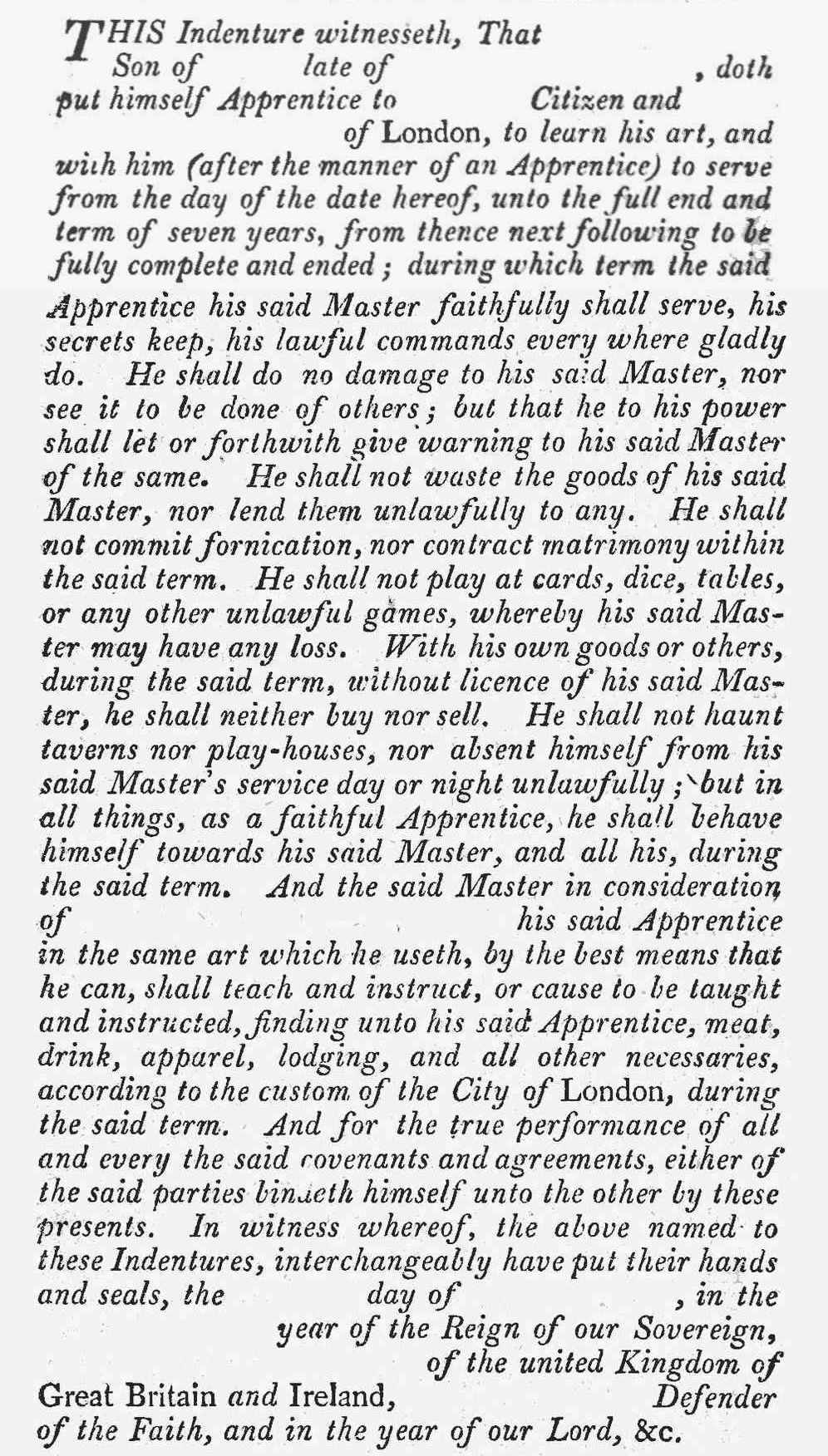
Click here for text of this image
A FAMILIAR EXPLANATION OF AN INDENTURE OF APPRENTICESHIP.
This Indenture witnesseth, That__R. B.__ Son of__J. B.__, Citizen of London, doth put himself (that is, by his own free and voluntary choice) apprentice to __A. A.__ Citizen and ____ of London, to learn his Art, and with him after the manner of an Apprentice to serve (that is, to live with him in the capacity of a learner and servant, doing all such work as belongs to his trade, and as Apprentices by custom are obliged to do) from the date hereof, unto the full end and term of ____ years from thence next following to be fully complete and ended; that is, not at the beginning only, or for part of the time, but so long as his Indenture shall continue in force, which must be for seven years at least.
During which term the said Apprentice his said Master faithfully shall serve; that is, he shall be true and just to his Master in all his dealings, both in word and deed; he must not only keep his hands from picking and stealing, and his tongue from lying and slandering; he must not only abstain from doing him any manner of injury, by idleness, negligence, or carelessness; by deceiving, defaming, or any kind of evil speaking: but, he must learn and labour to do him true and real service.
Ye must be faithful in all things. 1 Tim. i.
In all your labours let no iniquity be found. Hosea xii. 8.
Ye shall not steal, neither deal falsely, neither lie one to another. Lev. xix. 11.
Speak every man truth to his neighbour. Eph. iv. 25.
All that do unrighteously are an abomination to the Lord thy God. Deut. xxv. 16.
He that uttereth a slander is a fool. Prov. x. 18.
The lip of truth shall be established for ever, but a lying tongue is but for a moment; for the mouth of them who speak lies shall be stopped. Chap. xii. 19.
To do justice and judgment is more acceptable to the Lord than sacrifice; (for) they who deal truly are his delight. Chap. xxi. 3, chap. xii. 22.
His secrets keep; that is, conceal the particular secrets of his art, trade, or science, without divulging or making any one privy to them to the detriment of his Master, whose interest may very much depend on a peculiar management and knowledge of his business. To behave thus, is to serve faithfully; and fidelity is the glory and perfection of a Servant, as his want of it is his greatest discredit and reproach.
Discover not a secret to another, lest he that heareth it putteth thee to shame, and the infamy turn not away. Prov. xxv. 9, 10.
His lawful commands every where gladly do; that is, he shall readily and cheerfully obey him in all things lawful, without murmuring, hesitation, or reluctance; for obedience from a Servant to his Master, is a duty established by all laws, human and divine; and is founded likewise in the very nature of things; it being impossible to preserve any superiority in the one over the other, unless the inferior submits himself to the direction of his superior in all such things as he has a right to command him to do; that is, all things lawful: he is indeed, properly speaking, no longer a Servant than while he obeys his Master’s commands; so that the covenanted obedience of an Apprentice is on all accounts indispensably necessary; and the more cheerfully he performs it, the more perfectly he fulfils his duty, and the greater will be the reward as well as pleasure of his obedience; for his Master will doubtless take all opportunities of encouraging him on account of his willingness; he will contrive to make his work as easy to him as he can; he will treat him with all the kindness, and shew him all the favour that is consistent with the relation between them; whereby his servitude will be rendered a kind of freedom; the necessary labours of it a delight; and the time of its duration short and pleasant: he will beside gain the advantage of being trusted and confided in by his Master, which must necessarily give him a quick and thorough insight into his trade, whereby he will become duly qualified for the power and dignity of a Master himself, and establish such a reputation and character as will gain him the esteem and friendship of all who know him; and can therefore have no other than a comfortable prospect of advancing his station and fortune in the world. The quite contrary of all which must be the lot of the disobedient, churlish, and murmuring Servant; who will, in all probability, end his days as a Master (if ever he arrives at that honour) in the same discontented, uneasy, and disregarded manner, in which he lived as a Servant; feared by very few, beloved by none.
Exhort servants to be obedient unto their own Masters, and to please them well in all things, not answering again. Titus ii. 9.
His servants ye are whom ye obey. Rom. vi. 16.
Servants, obey in all things your Masters, according to the flesh; not only to the good and gentle, but also the froward. Col. iii. 22.
And when ye be buffeted for well-doing, take it patiently; for this is thank-worthy and acceptable with God. 1 Pet. ii. 20.
With good-will doing service. Ephes. vi. 7.
Not with eye-service, as men-pleasers, but in singleness of heart, fearing God. Col. iii. 22.
If any would not work, neither should he eat. 2 Thes. iii. 10.
In all labour there is profit; and the thoughts of the diligent tend only to plenteousness. Prov. xiv. 23.
The hand of the diligent maketh rich.—An idle soul shall suffer hunger. Chap. x. 4.—Chap. xix. 15.
Seest thou a man diligent, he shall stand before kings, he shall not stand before mean men. A slothful man is compared to a filthy stone, and every one will hiss him out to his disgrace. Chap. xxii. 29. Eccl. xxii. 1.
They that plough iniquity, and sow wickedness, shall reap the same. Job iv. 8.
The Lord will make them contemptible and base, before all the people, according as they have not kept his ways. Malachi ii. 9.
He shall do no damage to his said Master, nor see it to be done of others, but that he to his power shall let (that is, prevent or hinder) or forthwith give warning to his said Master of the same. He shall not waste the goods of his said Master, or lend them unlawfully to any. It is not sufficient that the Apprentice does not wrong his Master himself, by cheating, pilfering, purloining, wasting, spoiling, lending, or giving away any of his goods; by sloth and idleness, by neglecting his business, and loitering away his time; it is not enough that he does his Master no kind of damage himself; but he must be watchful that he is not injured in any kind by his fellow-servants and others; and be sure to do what in him lies to prevent or discover it to his Master; for he cannot be indifferent or careless in such a case, or connive and conceal any thing of this kind, without breach of covenant, and incurring the guilt and shame that is due to unfaithfulness.
Have no fellowship with the unfruitful works of darkness, but rather reprove them. Ephes. v. 11.
Beware of evil workers, and be not thou partaker with them.
Thou shalt not suffer sin in thy brother, but by any means reprove him. Phil. iii. 2.
When thou sawest a thief thou consentedst with him. Psalm l. 18.
He shall not commit fornication. This vice has been the bane of so many young men in all ages and places, that every one’s memory must furnish him with divers instances of its fatal effects; the Sessions papers are filled with numberless accounts of unhappy persons who are brought by it to public shame and infamous ends; and indeed nothing is so destructive to the morals and happiness of youth, as the having any kind of commerce with lewd and shameless women; for such conversation infallibly destroys the health, consumes the fortune, blasts the credit, and extinguishes that modesty which is the principal ornament and surest preservative of youth from the vices and dangers they are most exposed to.
Flee fornication: He that committeth fornication, sinneth against his own body. 1 Cor. vi. 18.
Keep thee from the evil woman, from the flattery of the tongue of the strange woman: lust not after her beauty in thy heart, neither let her take thee with her eye-lids; lest thou give thine honour to others: lest strangers be filled with thy wealth; and thou mourn at the last, when thy flesh and thy body are consumed. Prov. vi. 24, 25.—Prov. v. 10, 11.
Let not thy heart decline to her ways, for her house is the way to hell. Thou goest after her as an ox goeth to the slaughter, till a dart strike through thy liver; as a bird hasteth to the snare, and knoweth not that it is for his life. Prov. vii. 25, 27, 22, 23.
Neither fornicators nor adulterers shall inherit the kingdom of God. 1 Cor. vi. 9.
Whoremongers and adulterers God will judge. Heb. xiii. 4.
Blessed are the pure in heart, for they shall see God. Matt. v. 8.
Nor contract matrimony within the said term. Marriage is a very improper state for Apprentices, but is too often entered into rashly without consideration, or the consent of friends and relations; and therefore is very seldom advantageous, and generally unhappy. The necessary expense and charge which attends a growing family, must quite consume a small fortune, very much lessen a good one, and entail heavy debts and lasting misery on the generality of married Apprentices, who cannot hope to avoid a jail; and it is well if that is their worst misfortune. At best such a marriage is an act of great disobedience and contempt towards parents and friends, of injustice towards the Master, and must be attended with the loss of their esteem and friendship, if not with their heavy displeasure. It is a direct violation of this covenant, a forfeiture of their right to the freedom of London, and tends to unsettle and alienate the mind from business, and to disable the Apprentice from ever becoming a complete master of his trade.
He shall not play at cards, dice, tables, or any other unlawful game, whereby his said Master may have any loss. All sorts of gaming for money is prohibited by this covenant; it being a habit of the most pernicious consequence. Those who have an itch for gaming, very rarely have any relish for business; the dispositions and qualifications for the one, being quite inconsistent with the other. Modesty, caution, industry, frugality, and strict integrity, are indispensably necessary to the forming a good and successful tradesman; but no man ever made his fortune by play, without corrupting his morals and forfeiting his character; for the gamester must be bold and adventurous, extravagant and profuse, fraudulent, tricking, and deceitful, of scandalous life, and infamous reputation; and such will the unwary and thoughtless Apprentice soon become, who is addicted to this vice; who begins with it under pretence of amusement, but suffers the love of it to grow on him till it becomes habitual; and what assurance has he, that the loss of his own money, and the flattering hopes of better fortune, will not tempt him to steal and hazard what is his Master’s? What hopes can he have that he shall escape the rock on which so many have perished? The Apprentice therefore who would not expose himself to guilt, to shame, punishment, and ruin, must religiously observe this prohibition.
Wo onto him that buildeth his house by unrighteousness, and his chambers by wrong. Jer. xxii. 13.
Wo unto them that have made dishonest gain of their neighbours, by extortion, or by the iniquity of their traffic. Ezek. xxii. 12.
My soul come not thou into their secrets, unto their assemblies my honour be not thou united. Gen. xlix.
We have renounced the hidden things of dishonesty, therefore let us not walk in craftiness. (For) better is a little with righteousness, than great revenues without right. 2 Cor. iv.
Wealth got by vanity shall be diminished: but he that gathereth by labour shall increase. Prov. xiii. 11.
If sinners entice thee, consent thou not. Walk not then in the way with them; lest thou learn their ways, and get a snare to thy soul. Prov. i. 10, 15.—Chap. xxii.
With his own goods, or others, during the said term, without license of his said Master, he shall neither buy nor sell. The apprenticeship is a time of labour and improvement, not of gain; it is the season wherein youth are to acquire a thorough knowledge of trade, and to establish in themselves such habits as will enable them to carry it on hereafter with pleasure and profit. A liberty for the Apprentice to trade on his own account, would, in most instances, be rather a snare than an advantage to him; it would oftener increase his acquaintance and expenses than his fortune; it would furnish him with excuses for absenting himself from his Master’s house and business, under pretence of promoting his own; and lead him into company-keeping, and a large acquaintance, before he hath judgment to make a proper choice; and it is to be feared, would sometimes be the occasion of his being unfaithful, and create continual jealousies and misunderstandings between him and his Master. Upon all which accounts this prohibition is for their mutual advantage; and the breach of it on no account to be connived at by the Master, nor practised by the Apprentice.
If ye have not been faithful in that which is another man’s, who shall give you that which is your own?
He shall not haunt taverns or play-houses, nor absent himself from his said Master’s service day or night unlawfully. I have joined these three prohibitions together, because of the connexion they have; the Apprentice cannot commit the two first without being guilty of the last, which is a great act of injustice; for the Master has not a better title to his own money or goods than to the time of his Apprentice. He therefore must not upon any pretence whatsoever absent himself day or night from his Master’s house, without his consent. He must not, when the common business of the day is over, think himself at his own disposal, and take the liberty of going on his pleasure, without permission. Many things may occur which require his presence: business sometimes offers very unexpectedly; and the Apprentice should be always ready for his Master’s service. Add to this, that the house, the shop, and effects of his Master, are continually under his care, and the looking well after them a duty always incumbent on him; which such a one can never faithfully discharge who lists himself in clubs, or haunts taverns, or any other kind of tippling houses, or who frequents play-houses, and such like diversions. These habits are not only attended with a great waste of the Master’s time, but with an expense which few Apprentices can afford, and will probably lead him from wrong to robbery, when the Master’s money becomes as necessary to his pleasures as his time; for, he who scruples not to waste the one, will not be long before he makes free with the other. It is therefore the interest and happiness of youth, to be restrained from frequenting these places, where they can only associate themselves with the young and giddy, the raw and inexperienced, the loose and disorderly; for discreet and prudent persons will not encourage Apprentices in such unlawful haunts, by keeping them company. And what must be the fruits of such society? what, but noisy empty mirth; loose and licentious discourse, riot, intemperance, and disorder; of the same pernicious kind are the pleasures they receive from plays, interludes, and such like diversions. These, to youthful and unsettled judgments, are but vain and airy entertainments, which fill the head with romantic and unnatural ideas of life and the world, and tend only to alienate the mind from business, which is its proper, and ought to be its chief entertainment; and to expose youth to the danger of being corrupted by lewd and vicious persons of both sexes, who always crowd such places. Upon the whole, then, it is evident, the Apprentice cannot haunt taverns, that is, any kind of public tippling-houses, or frequent play-houses, nor absent himself day or night from his Master’s service, without breach of covenant, nor indeed without exposing himself to the loss of reputation (for such as his companions and pleasures are, such will his character be) and contracting vicious and expensive habits, which will probably bring him to want and misery, to shame and punishment.
He that is faithful in that which is least, is faithful also in much; and he that is unjust in the least, is unjust also in much. Luke vi. 10.
That which is altogether just shalt thou follow. Deut. xvi. 20.
Blessed are those servants, whom their Lord, when he cometh, shall find watching. Luke xii. 37.
Be ye therefore ready also. Luke xii. 40.
I wrote unto you not to accompany with fornicators. 1 Cor. v. 9, 11.
If a brother be a fornicator, or covetous, or an idolater, or a railer, or a drunkard, or an extortioner, with such a one eat not.
Be not among wine bibbers, amongst riotous eaters of flesh. Prov. xxiii. 20.
He that is a companion of riotous men, shameth his father. Prov. xxviii. 7.
Look not thou on the wine when it is red, when it giveth its colour in the cup, when it moveth itself aright; at the last it biteth as a serpent, and stingeth like an adder. Prov. xxiii. 31.
Wine is a mocker, strong drink is raging. Prov. xx. 1.
Withdraw yourself from every brother that walketh disorderly. Thes. iii. 6.
He that followeth vain persons is void of understanding.
Thou shalt not follow a multitude to do evil. Exod. xxiii. 2.
Cease to hear instructions that causeth to err from the words of knowledge. Prov. xix. 27.
He that loveth pleasure shall be a poor man: he that loveth wine and oil shall not be rich. Prov. xxi. 17.
Who hath woe? who hath sorrow? who hath contention? who hath babbling? who hath wounds without a cause? who hath redness of eyes? they who tarry long at the wine! they who go to seek mixed wine: and men of strength to mingle strong drink: that rise up early in the morning, that they may follow strong drink.
It is better to hear the rebuke of the wise, than for a man to hear the song of fools. Prov. xxiii. 29.—Isaiah v. 22.
But in all things, as a faithful Apprentice, he shall behave himself towards his said Master, and all his, during the said term.
That is, he shall faithfully and diligently perform the covenants in this Indenture, and demean himself humbly, dutifully, and obligingly to his Master and Mistress, with civility and respect to their children, friends, relations, and customers, and all who belong to them.
And the said Master in consideration of ____ being the money given with the said Apprentice, his said Apprentice, in the same art and mystery which he useth, by the best means that he can, shall teach, or instruct, or cause to be taught and instructed, finding unto his said Apprentice, meat, drink, apparel, lodging, and all other necessaries, according to the custom of the City of London, during the said term.
The end and design of Apprenticeship, is for the training up of youth to the knowledge and practice of some art or business; whereby they may learn to get their own living, and become useful to the public; and for the promoting this good and laudable design, the Master here covenants to furnish the Apprentice with all necessaries during the term of his Indenture, and to take especial care of his instruction and improvement in the trade he follows. It is, therefore, the indispensable duty of every Master to use his best means, that is, to take all proper methods for performance of these covenants. He must endeavour to render his Apprentice skilful and industrious, by due information and constant employment: he must enforce the duties of diligence, frugality, and honesty, by his own example, by kind and gentle usage, and by instilling into his mind the necessity and usefulness of these and all other good and virtuous habits. He must restrain him from whatever interferes with his duty or obstructs his improvement, by advice, by exhortation, by reproof, and (if need be) by moderate and reasonable correction; and if all these prove ineffectual, he must apply to the magistrate, and call to his assistance the authority of the Chamberlain, who will judge indifferently between the Master and the Apprentice, and oblige both parties to perform the covenants of their Indentures.
Let as many servants as are under the yoke, count their own masters worthy of all honour. 1 Tim.
Let not the child behave proudly against the ancients, nor the base against the honourable. For by pride cometh contention. Isai. iii. 5.
Honour widows. 1 Tim. v. 3.
A soft answer turneth away wrath, and yielding pacifieth great offences; (but) grievous words stir up anger. Prov. xv. 1.—Eccl. x. 4.
Please them well in all things, not answering again.
Whereas thy servant worketh truly, treat him not evil. Eccl. vii. 20.
Let my soul love a good servant. Ver. 21.
Masters, give unto your servants that which is just and equal, forbearing threatening; knowing that ye have also a Master in Heaven: neither is there respect of persons with him. Gal. iv. 1.—Eph. vi. 9.
Despise not the cause of thy servants when they contend with thee. Did not He that made thee in the womb, make him: And did not one fashion us all in the womb? Job. xxxi. 13.—Ver. 15.
Be not hasty in thy spirit to be angry. Eccl. vii. 9.
Ye shall not rule over one another with rigour, for ye are brethren. Lev. xxv. 49.
Be thou an example of the believers, in word, in conversation, in charity, in faith, in purity. 1 Tim. iv. 12.
Six days in the week shalt thou labour, and do all thy work.
Remember the Sabbath Day, to keep it holy. In it thou shalt not do any work, thou, nor thy son, nor thy daughter, nor thy servant, &c.
Why is the house of God forsaken?
Unto his habitation shall ye seek, and thither shall ye come, ye and your households.
That ye may hear, and that they may learn, and fear the Lord their God, and observe to do all the words of his law.
According to the sentence of the law which they shall teach thee, and according to the judgment which they shall tell thee, thou shalt do: thou shalt not decline from the sentence which they shall shew thee, to the right hand or to the left. Deut. xxxi. 12.
And for the true performance of all and every the said covenants and agreements, either of the said parties bindeth himself unto the other by these presents. In witness whereof, the parties above named of these Indentures, interchangeably have put their hands and seals, the ____ of ____ in the ____ year of the Reign of our Sovereign, ____ of the United Kingdom of Great Britain and Ireland, ____ Defender of the Faith, and in the year of our Lord, &c.