PREFACE. (continued 2)
Reading edition
[The Salary of the Housekeeper is from twenty-five to fifty guineas per annum, dependent on the extent of the family, and the nature of the business she undertakes.]
Useful Memorandums.
Provisions that will keep, should be laid in in quantities when cheapest, to be ready when wanted.—The best of all kinds are the most economical, not only because they are best, but also, because they go furthest.
As sugar is an article of considerable expense, it is to be understood that, of the white sugars, the most refined goes furthest and sweetens best. Chuse those that are close, heavy, and shining.—The best sorts of the brown have a bright gravelly look. The coarser sorts are strongest and fittest for wines, sweetmeats, &c.
The only certain road to regularity, is to do every thing in its proper time—keep every thing in its proper place—and apply every thing to its proper use.
The great Dutch statesman, De Witt, attributed the whole art of dispatching a multitude of business, to the doing of one thing at a time.
The want of regularity gives to families the appearance of chance and confusion; on the contrary, order in a family is productive of much happiness.
Accustom all the servants under your direction to rise early, and let them breakfast at an early hour. If orders be given betimes in the morning, there will be more time to execute them,—servants will perform their work with more ease,—and less hands will be required. If the economy of time were duly considered, and a regular plan of daily employment laid down, much business may be effected without hurry or fatigue.
As some preparation is necessary in all families for accidental visitors, care should be taken to have things in readiness for lunch, chocolate, sandwiches, &c.
An inventory of furniture, linen, china, plate, &c. should be kept, and the articles examined by it twice a year, at least, or oftener if the servants be changed, and a correct list of the articles delivered into the care of the new servants should be kept.—House-cloths, knife-cloths, &c. should be numbered, and always be accounted for, either whole or in part—which would be done if a note were inserted at the top of the list of the articles delivered out.
Tin fenders, and other things that are painted, should be painted every year or two.—Tin vessels, if suffered to become damp, soon rust, and are eaten into holes.
The best way to scald fruits or to boil vinegar is, to put it in a stone jar on an iron hearth—or to put the jar in a saucepan of boiling water, called a water bath.
THE STORE-ROOM AND STILL-ROOM.
These rooms are entirely under the management of the housekeeper. The store-room is appropriated as a depository for such imperishable articles of household consumption as are in continual request, and may be laid up, when purchased in quantities,—at times when cheapest,—most in season, or best—to be ready at hand when wanted.
☞ Let every thing, not only here, but all over the house, be kept in its proper place, applied to its proper use, and replaced when worn out or destroyed.
N. B. To save the trouble of referring to different places, for the several methods of storing or preserving many articles which are proper to be kept, we shall insert under this head every thing of this description that may occur to us.
Soap will be the better for keeping—indeed, it should not be used when newly made. The cakes should be cut with a wire or string, into oblong squares, and laid up, on a dry shelf, a little distance apart, and across each other, so as to admit the air betwixt them, to harden it.—This method will save one third. Note,—If dried fast, soap will crack and break when wetted.
Candles and soap made in cold weather, are best; and when the price of these articles are likely to be high, a reasonable stock of both should be laid in.—Candles, if kept packed in a chest, will be the better for keeping eight or ten months, and may be kept well, if necessary, for two years.
Starch should be bought when flour is cheap, and may be kept in a dry warm place, if closely covered, as long as may be necessary.
Loaf Sugars should be kept tied up in paper, and hung up in a dry place. Brown sugars should be kept covered up, and in a moderately dry place.
Sweetmeats, Preserves, &c. must be carefully kept from the air, and in a very dry place.
Teas, Coffee, Chocolate, Dried fruits, and generally, all kinds of Grocery and Condiments require to be kept dry and free from air.
The various kinds of seeds and rice, pearl-barley, oatmeal, &c. must be kept in a dry place, and be covered close, to preserve them from insects.
Bread is best kept in an earthern pan with a cover. A loaf should not be cut till it is a day old. The bread that is cut unnecessarily in the parlour, should be eaten at the second table before more is cut.
Writing and other papers, that are constantly wanted, should be bought by the ream or bundle, and kept in a dry place.
Apples should be spread, separately, on clean dry straw, on a dry upper floor, and care must be taken to preserve them from frost.—The Americans throw a clean canvas cloth over them, which will answer the purpose.
Pears should be hung up, singly, by the stalk in a dry place.
Grapes should be gathered before they are ripe, and may also be preserved hung up in single bunches the same way;—or they may be kept in saw-dust, in boxes with covers, to exclude the air—Every bunch being laid apart.
Oranges and Lemons, if bought when cheapest, may be preserved a long time, packed in fine, dried sand, with their stems upwards, and kept from the influence of the air.
Fresh Meat, Poultry, Fish, &c. should be kept in a cool, airy place.
All salted and dried meats, hams, tongues, &c. should be tied up in strong paper, and must be kept in a cold, dry place, (not in the kitchen) else they will become musty and rancid.
Green Vegetables should be kept on a damp stone floor, and excluded from the air by a damp cloth thrown over them.
Carrots, Parsnips, and Beet-roots, must be kept in layers of dry sand for winter use. Neither these nor potatoes should be washed till wanted.
Potatoes must be carefully covered, to protect them from frost, in winter.
Onions should be tied in traces, and hung up in a cold dry place. If the root of each onion be seared, it can never grow.
Parsley should be cut close to the root, and dried in a warm room.
Truffles, Morels, &c. must be kept in bags in a dry place.
A bag should be kept to save all the waste rags; this will not only be economical, but will prevent litter.
☞ For the management of savoury and sweet herbs, see Vegetables, p. 87.
THE STILL-ROOM MAID.
The business of this servant is to wait on and assist the housekeeper; not only in the distillation of aromatic waters, spirits, and oils,—in the making of essences, perfumery, &c. but also, in the making of pickles, preserves, pastry, and confectionary; in making coffee, &c. to go up stairs; in washing up the china; in the management and arrangement of the store-room; and whatever else she may have to employ her in.
[Wages from eight to twelve guineas per annum.]
THE ART OF CARVING.
The art of carving is an useful and elegant accomplishment; and, according to the fashion of the present day, cannot be too well understood by the Heads of Families. It may best be acquired by observation and practice; and to Young Ladies who can attend to the example of their parents, the following plain and familiar instructions may not be unacceptable.—A previous knowledge of the conformation of the several parts, and the peculiar nature of the article to be carved, will, with due attention, render the business easy, and it would be still more so, if the loins, breasts, and necks of mutton, lamb, and veal, were to be properly jointed and divided, before they are sent home.
The master and mistress of the family, who do The honours of the table, when dinner is announced, will see, of course, that the upper places are taken by the married ladies of the highest quality that are then present; the dowagers or widows next, and lastly, the unmarried ladies; all, nearly according to their respective ages. The gentlemen will be seated according to the same etiquette, which is perfectly understood by the fashionable world.[11]
Beef.—The Surloin. This joint is brought to table with the skin side upwards—Cut off the outside, in the direction of the ribs, quite down to the bone, and take off slice after slice of a moderate thickness, in the same direction.—Or, you may cut through the middle of the sirloin. Give a little of the soft fat with each slice, which will be found covering the roll, on the inside. Give also, a little of the roll, when preferred, as it is short-grained and tender. To get at this and the fat, turn the joint up, upon the chine-bone, and cut it across the ribs.
The Ribs are to be carved exactly in the same way.
The Edge-bone or isch (hip) bone. Cut off a thick outside slice from the upper surface, the whole length, horizontally, and follow the cut. The delicious soft fat, resembling marrow, will be found at the back of the bone, and the hard fat may be taken, in thin, horizontal slices, from the edge of the joint. The upper part of this joint is the richest and best.
The Buttock is to be carved in the same way.
The Breast-cut.—Cut off thin slices, either parallel with the ribs, or across. The fat on the upper side is firm and gristly, that on the under side soft, and more delicate; therefore offer that which is best liked.
Veal.—The Fillet. This is the joint similar to a round of beef. Cut off a slice from the upper surface, evenly, as from a round or edge-bone of beef, and this outside is often preferred. The next slices should be cut thin and smoothly. With every slice give a little fat, and some of the stuffing, which lies under the flap.
The Breast. Separate the ribs from the brisket, across, where the bones are broken, and again, the gristly part of the breast-cut from the ribs, in the same direction. Give some of the gristly part, with a bone of the ribs or neck, and a little of the sweetbread, cut across the middle, to each person.
The Calf’s-head. Every part of this joint is rich and delicious. Cut it lengthwise, from the nose to the neck, passing the knife through the flesh under the eye, quite to the bone, all the way. The throat sweetbread lies in the thick part of the neck end, and delicious short slices of it may be taken off from the lower side, crosswise, to be given with the former. The eye is esteemed a great delicacy and may be taken out with the point of a knife, and divided into two parts. Some fine lean will be found under the jaw-bone, when taken off, and the palate in the lower or under part of the head is deemed a dainty. Both sides of the head are to be carved alike. A part of the tongue and brains, which are usually served up in a separate dish, with egg sauce, must be given to each person.
Mutton.—The Shoulder. This joint should be sent to table with the back upwards, and with paper twisted round the shank. When properly roasted, it is very full of gravy, and has many nice parts. The first cut should be made in the thin, hollow part, and several slices may be taken thence. When that is all cut away, some fine slices may be taken from both sides of the ridge of the blade-bone, cutting straight up the back from the thick end towards the shank. The under side affords several nice cuts of fat and lean intermixed, and is full of gravy. Some prefer the jelly part near the knuckle;—the lean on the under side of the blade-bone, is the most tender. The fat lies in the round prominent part or flap, opposite the hollow part of the shoulder, which is cut lengthwise and a thin bit of this should be given to each person.—A shoulder of mutton over roasted is spoiled.
The Leg. When boiled, it should be served up lying on its back; but when roasted, with the back upwards. Cut into the hollow part a little distant from the knuckle, through the pope’s-eye, quite to the bone, and take out thin deep slices towards the thickest part. The back of the leg affords some nice slices at the thick end, which must be cut out the long way of the joint.—Slices of fat may also be taken from the under side, or back part of the leg, in the same direction. Some prefer the knuckle part, which, though dry, is full of jelly and very nutricious. The cramp-bone forms a slight prominence at the back of the leg, near the shank, and may be cut out by passing the knife round it. As this is a heavy joint, some writing paper should be wrapped round the shank, to enable the carver the better to turn it up, with his left hand.
The Haunch, is to be carved in the same manner as venison.
The Saddle, is the two loins together. Cut out long thin slices on each side of the chine-bone, from the tail to the end. If any person like a part of the tail, it may be readily divided, the joints being about an inch apart. Rich gravy is found in the cut along the chine-bone, where the incision has been made.
The Loin may be carved the same way; or it may be cut the other way, in the direction of the bones.
Lamb.—The Fore-quarter. Separate the shoulder from the ribs or breast, (by some called the crust or scoven,) taking care not to leave the bones bare. Then squeeze half a lemon or Seville orange, rub a slice of butter, and sprinkle a little pepper and salt over the ribs, and replace the shoulder for a few moments; after which, put the shoulder on another dish; and proceed to divide the neck from the breast, where the bones have been previously broken; then separate the gristly part from the breast, the whole length, and give a little of the gristle with each bone of the breast or neck, as may be chosen. If any part of the breast is to be put by to be eaten cold, let it be sprinkled while hot, with chopped parsley. All parts of young lamb are nice, but the shoulder of a fore-quarter is the least approved. It is to be carved as mutton.
The Hind-quarter, is usually divided into the leg and loin, and is to be carved as mutton. The close firm flesh about the knuckle is reckoned the best.
Pork.—The Leg, whether roasted or boiled, is sent to table with the back upwards, like a leg of mutton roasted: it is to be carved as mutton.
A Ham may be carved three several ways; viz. The first and most common way is to cut off the hock, and then to take off thin slices, in a circular manner, round the bone, towards the thick part and proceed as with venison. This is the most economical way.
The second way is to cut a round hole in the top of the ham with a sharp pointed knife, and to enlarge the circle by cutting out thin slices. This is a good way, as it keeps the meat moist, and preserves the gravy.
The other way is, to cut across, near the middle of the ham, quite down to the bone, and then to take off thin slices each way.
Tongue.—A tongue is to be cut across towards the thickest end; slices taken from that part, both ways, are the most tender and juicy; towards the tip of the tongue, the meat is hardest and dryest. For the fat and kernel, cut off a slice from the lower side of the root.
Sucking Pig.—The head and collar is usually cut off, and the carcase slit down the back into two equal parts; the head being also divided and laid at each end, and the ears on each side. But if the pig be sent up whole, before any one be helped, the shoulders and legs should be separated from the body, and the ribs divided into two or more parts; the shoulders may each be divided into two or more parts, also; and nice slices may be taken from the gammon and fleshy parts. The ribs are very delicious, but the collar and neck are most esteemed; the chaps are also much approved by many.
Venison.—The Haunch. First make a deep incision across, down to the bone, towards the knuckle end, to let out the gravy; then turn the broad end towards you, and take off thinnish deep slices, lengthwise, from the cross cut to the end. The fat, which is the most delicious part, lies, as in a shoulder of mutton, in the round prominent part, which, when the broad end is towards you, will be on the left side. Give some of this, and also some of the gravy, with each slice.
Hare.—The best and readiest way to cut up a hare, is to put the point of the knife under the point of the shoulder, and cut all the way down to the rump, on both sides of the back at equal distances from the back-bone, dividing the body into three parts; the middle or back may then be cut across the spine, into four or more pieces. These are by far the most tender and delicate, and the fullest of gravy. The shoulders or wings must be taken off in a circular direction, and the legs may be easily separated from the belly. The shoulders and legs may each be divided. The pieces of the back, and the fleshy parts of the shoulders and legs, should be given with a spoonful of the stuffing and gravy to those most respected. This method can only be practised when the Hare is young. If it be old, do not endeavour to divide it lengthwise, but put the knife between the leg and back, and give it a turn inwards, at the joint, which you must try to hit.—A nice cut or two may then be taken from each side of the back-bone;—then divide the back into parts, and take off the wings, which are called the sportsman’s pieces. When all are helped, cut off the head, and separate the ears, close to the roots, which some may approve; then with your knife divide the upper from the lower jaw, and laying the upper one flat on your plate, enter the point of your knife in the centre near the back of the skull, and divide it in two. The head and brains are liked by some.
Rabbit.—A rabbit is to be carved as a hare in the latter way; but it being smaller, the body may be divided into fewer parts, and the head, the ears having been taken off, may be given, to any one who likes it.
Goose.—A goose, fowl, turkey, pheasant, and partridge, are to be cut up nearly alike. First cut off the apron of the goose, and pour into the body a glass of port wine, and the gravy, well mixed with a large teaspoonful of ready made mustard; then turn the neck towards you, and cut the whole breast into long slices quite down to the bone, and take them off; turn the goose upon one side, and proceed to take off the leg, by putting the fork through the small end of the bone, and pressing it close to the body, which will raise the leg from the body and shew the direction in which the knife may be passed, in order to separate it; this may then be done by turning it back, but if it be an old bird, it will require some strength. To take off the wing, pass the fork into the small end of the pinion, and press it close to the body, then enter the knife at the point of the wing, and divide the joint (which requires some practice to hit cleverly) and separate it from the side. Next take off the merry-thought, at the neck end, across the body, and where it joins the body, on each side, you will find the joint of the neck bones, then put in the knife, and pass it the longest part of the bone, when you will lift it up and break it off from the breast bone, to which it is attached. All parts being thus separated from the carcase, divide the breast from the back by cutting through the tender ribs on each side from one end to the other. Then lay the back upwards, fix your fork under the rump, and pressing the edge of your knife hard across the back, lift up the rump, and the body will divide into two parts. The rump part may then be divided into three, cutting it lengthwise through the bones on each side of the back, and taking off the side-bones. It is not always necessary to cut up the whole goose, at once, but as you proceed, the breast may be distributed, the fleshy parts of the wings, when disjointed from the pinions, and the thigh parts of the legs, (the drum sticks being taken off), may next be given, remembering to draw out the sage and onions, gravy, &c. from the inside, and give a spoonful on each plate. The neck-bone and merry-thought are approved by some, and others approve different parts of the carcase, which are very savoury.
A Green Goose must be cut up the same way; and the best parts are the breast, and the gristle at the lower end of it.
Fowl.—Fowls, whether roasted or boiled, are to be cut up alike. The best way is to take the bird on your plate, and sticking your fork into the breast, upright, cut of slices, down the breast on each side, as long as you can; then proceed to take off the legs, by passing the knife between the legs and the body from the upper part of the thigh towards the rump. Next take off the wings by entering your knife at the point of the shoulder, and with your fork lift up the pinion and drawing the wing towards you, by which means it will separate very nicely without cutting. After this, take off the merry-thought, the neck-bones, and all the remaining parts, as described in the goose. The prime parts of a fowl are the wings, breast, and merry-thought: the legs are coarse dry, and of a darker colour, except those of a chick, which are full of gravy and most esteemed. The drum-sticks should be cut off from the legs of the fowl at the joint, when given.
Turkey.—A turkey is to be dissected as a fowl or goose, but it has no merry-thought. The white meats of a Turkey are best. The gizzard is sometimes scored in different directions, and when salted and peppered, it is sent down to be broiled; is divided into several parts, and sent round to the company as a bonne bouche.
Pheasant.—This bird is to be carved the same way as a fowl, first cutting off the head. The best parts of the pheasant are the breast, wings, and merry-thought; but the leg has a higher flavour. The head is sometimes preferred, because of the brains.
Partridge.—Partridges are to be carved as fowls.—The prime parts, as of nearly all birds, are the white meats; viz. the wings (the tip of which is reckoned the most delicious morsel,) the breast, and merry-thought.
Pigeons.—Pigeons are generally divided into two parts, to do which there are several ways; the most fashionable of which is, to cut from the top of the leg on each side, quite through and across the body to the breast bone.
Fish,—in general, requires but little carving.
A Cod’s head. The thick fleshy part on the back and shoulders, close to the head, is most esteemed, but many parts of the jowl are very delicious, particularly those about the jaw-bones, which consist of a fine jelly. The tongue, palate, and firm parts about the back-bone on the shoulders are also considered as dainties.
Take off a large piece across the shoulders, close to the head, and quite through to the back-bone, this will lay bare the sound, which is under the back-bone, some of which should be taken out with a spoon, and given with every slice. Care must be taken to preserve the beautifully fine flakes of this fish entire.
Salmon and all other fish that have a short grain, should be cut with the slices the long way of the fish, and not across. The belly part is the richest and most esteemed of salmon, but the head, and particularly the jowl, afford many rich and delicate bits, which are much prized.
DIRECTIONS FOR MARKETING. [12]
[We presume that the following will be found to be the best instructions on this important subject that have ever yet appeared in print.]
BUTCHERS’ MEAT.
General observations respecting it.
☞ The best of every kind of provision is cheapest, affords most nourishment, and goes farthest.
As this is the most nourishing of all animal food, and constitutes a considerable portion of our constant aliment, a knowledge, not only of the nature and properties of the several kinds of animals destined for our use, but also of the manner in which they have been bred and fed, would be very essential if to be obtained, as it would enable us to judge of their wholesomeness, and their fitness for our healthful support and nourishment.
The flesh of cattle, of all kinds, fatted in confined and filthy places, on oil-cakes, or rank and half-decayed vegetables, should be rejected, as unfit for use. On the contrary, those animals which have been bred and pastured in open situations, on high lands, extensive downs, dry commons, heaths, and large enclosures, where the air is pure, and particularly where the grass is short and sweet, and where they require much exercise to obtain their sustenance, have their juices pure, their flavour excellent, and the texture of their flesh delicate, nutritive, and wholesome. Hence the superiority of the Welch and South Down mutton, the Scotch and Welch beef, &c. This fact is clearly evinced in the superior qualities that venison, and the flesh of all wild animals possess over that of tame ones.
Buttocks of beef, fillets of veal, and legs of mutton and lamb, as they have most solid meat and least bone, in proportion, are best for large families.
The most economical way for marketing, is to buy what roasting and boiling pieces you want in one lot. Butchers will sell quantities, thus assorted, much cheaper than they will sell single joints; and prime roasting joints, when bought alone, are always charged extravagantly.
Beef and mutton, of a proper age, is more easy of digestion, and more nutritious, than veal and lamb. The same remark holds with respect to pork; for though young pigs are fat and luscious, yet they are not so nutritive as those of more mature age. The heart and other viscera of animals are nutritious, but hard to digest. Pork is a strong meat, but that which is fed at dairies, is mildest and best. Fat meat is not so easy of digestion as the flesh of well fed animals, though not so fat. The flesh of old animals is dry and hard of digestion, and affords but little nourishment.
BEEF.
Instructions for choosing it.
An ox is in its prime, for food, at five or six years old.
Beef is never out of season, but it is in the greatest perfection in November, December, and January.
The lean of the finest ox-beef, if of a proper age, has a fine smooth grain, it is of a bright or carnation red, feels tender, and appears to be marled or intermixed with fat. The fat parts are firm, of a cream colour, and rather white than yellow. This latter distinction is of importance, because, if the beef be old, the fat will be yellow and skinny; and if the ox has been unnaturally fed, or in a confined place, and particularly if it has been fed with oil-cake, it will be very yellow, soft, flabby, and greasy. On the other hand, if the beef be too young, the fat will be white, almost like mutton fat, and the lean will be of a pale colour.
The grain of cow-beef is closer than that of the ox, and the lean is of a darker red.
Heifer-beef has all the appearances and qualities of good ox-beef, except that the grain of the lean is of a finer texture.
Bull-beef is coarser and redder than any other, the fat hard and skinny, and it has a strong, rank smell.
The Joints of Beef, according to the London method of cutting.
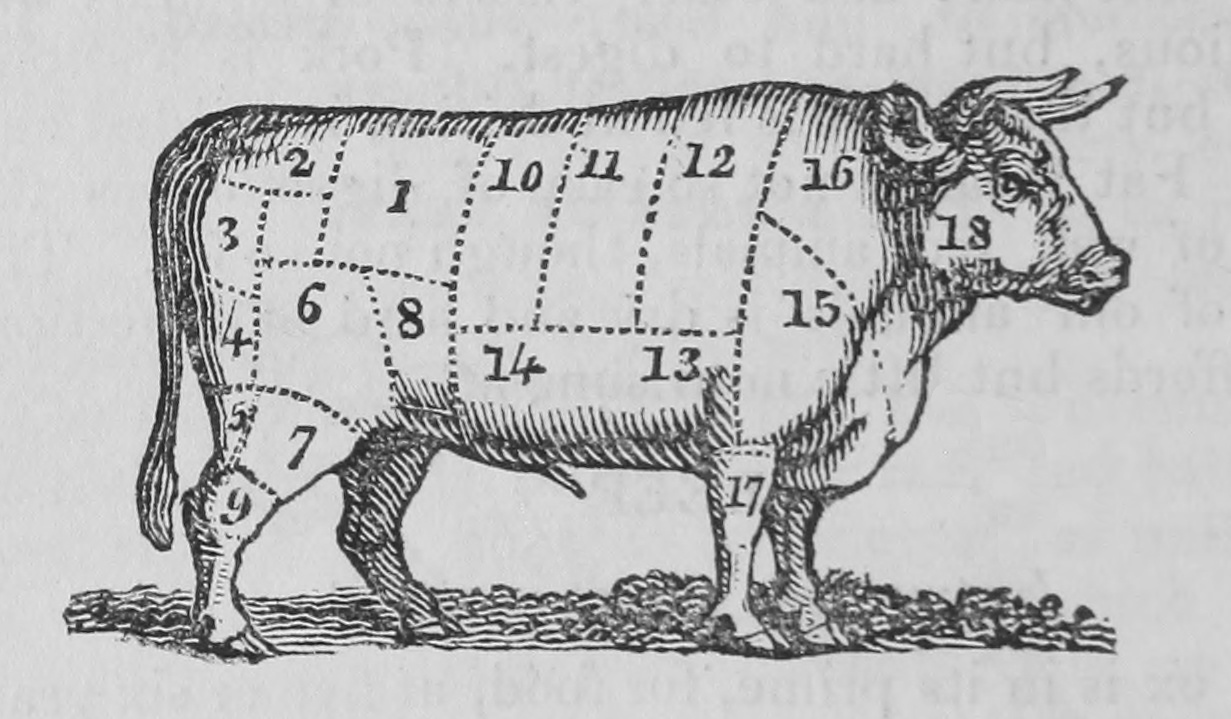
The Hind Quarter. The Fore Quarter.
1 Sirloin 11 Middle-ribs
2 Rump 12 Chuck-ribs
3 Edge-bone 13 Leg-of-mutton-piece
4 Buttock 14 Brisket or Breast-cut
5 Mouse-buttock 15 Clod
6 Veiny-piece 16 Neck or sticking-piece
7 Thick-flank 17 Shin
8 Thin-flank 18 Cheek
9 Leg A Baron of beef is the
10 Fore-ribs two sirloins cut together.
The best joints are the sirloin, rump, edge-bone, buttock, and the five or six fore-ribs; and the thin-flank, the sticking-piece, the leg, shin, and cheek, are the worst.
VEAL.
Instructions for choosing it.
Veal is best and cheapest from March to July.
Veal ought to be fine in the grain, firm, white, and fat. The leg bone should be small. If fresh, the eyes will be full and bright, the flesh not clammy but dry, and the large vein of the shoulder of a bright red. The kidney taints soonest, and if that be sweet, and neither soft nor slimy, the whole calf is fresh. On the contrary, if any part of the flesh be green or yellow, or feels flabby, it is stale. The fillet of a cow-calf is preferable on account of the udder, but the meat of the bull-calf is generally firmest, whitest, and best, when dressed. The finest calves have the smallest kidneys.
The Joints of Veal.
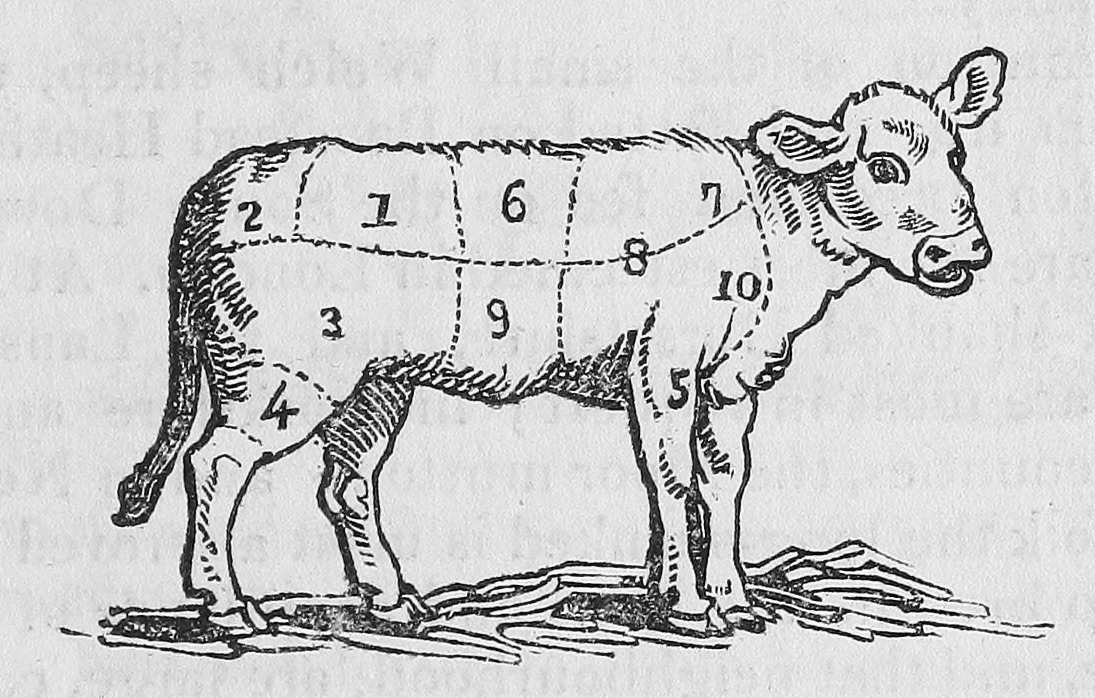
Hind-Quarter. Fore-Quarter.
1 Loin, best end 5 Fore-knuckle
2 Loin, chump-end 6 Neck, best end
3 Fillet 7 Neck, scrag end
4 Hind-knuckle 8 Blade-bone
9 Breast, best end
10 Breast, brisket end
A shoulder is the fore-knuckle and blade-bone together; and a leg is the fillet and hind-knuckle together.
The best end of the loin, the fillet, and the best end of the breast, are the choicest pieces: the knuckle, and scrag end of the neck, are the worst.
MUTTON.
Instructions for choosing it.
Mutton is best from Christmas to Midsummer.
When, if in its prime, (that is about four years of age,) it will feel tender when pinched with the finger and thumb, but if older, it will feel harder and fibrous. The grain of the lean should be a fine deep red, the colour bright, and the fat firm and white. Wether mutton is the best flavoured, and may be known by a prominent lump of fat at the edge of the broadest part. Ewe mutton is paler than wether mutton, is of a finer texture and of less value; ram mutton is strong flavoured, high coloured, and its fat is spungy.
The mutton of the small Welch sheep, which are driven up, and fatted on Banstead Heath, and the mutton bred and fed on the South Downs, in Sussex, are the most esteemed in London. At Bath, the short-shanked Dorsetshire, and the Lansdown mutton are most in request; in Yorkshire and the northern counties, the Moor mutton; and in Norfolk and Suffolk the long-shanked is most approved; but the sheep bred in the Fens and deep lands of Lincolnshire, and that neighbourhood, are large, coarse-grained, and ill-flavoured.—Mutton tastes strong of the coat in May and June, or just before shearing.
The Joints of Mutton.
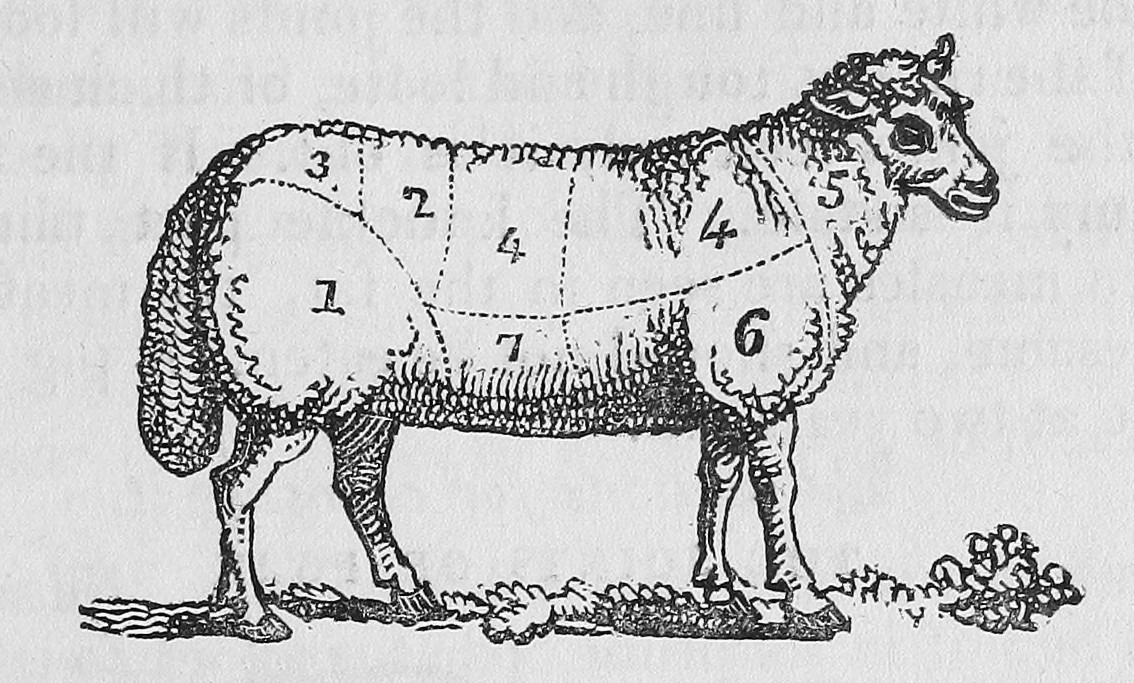
1 Leg 5 Neck, scrag-end
2 Loin, best end 6 Shoulder
3 Ditto, chump end 7 Breast
4 Neck, best end
A Chine is the two loins together; and a Saddle is the two necks together.
LAMB.
Instructions for choosing it.
Lamb, like veal, is fresh when the eyes are full and bright, and the vein in the neck is of a fine blue colour; but if it be green or yellow, or if there be a faint smell about the kidney, it is stale. The earliest house-lamb, in London, is from the Dorsetshire ewes, which are sold in great numbers at Weyhill-Fair, on the 10th of October, whence they are driven towards London, quite forward, frequently dropping their lambs on the road. This comes in at or before Christmas, and is generally cut into quarters. Grass-lamb comes into season about Easter, and when large and plentiful is cut up in joints, like mutton.
PORK.
Directions for choosing it.
The rind of all pork should be thin, and if young and properly fed, the lean will break when pinched, and will be smooth and of a delicate white; the fat will be white and fine, and the joints will look blue; but if the rind be tough and loose, or thick and hard, and the joints look red, it is old. If the flesh be clammy it is stale. The knuckle part taints first. When measles are seen in the fat, the meat is unwholesome, and should not be eaten. A pig is in its prime at two years old.
The Joints of Pork.
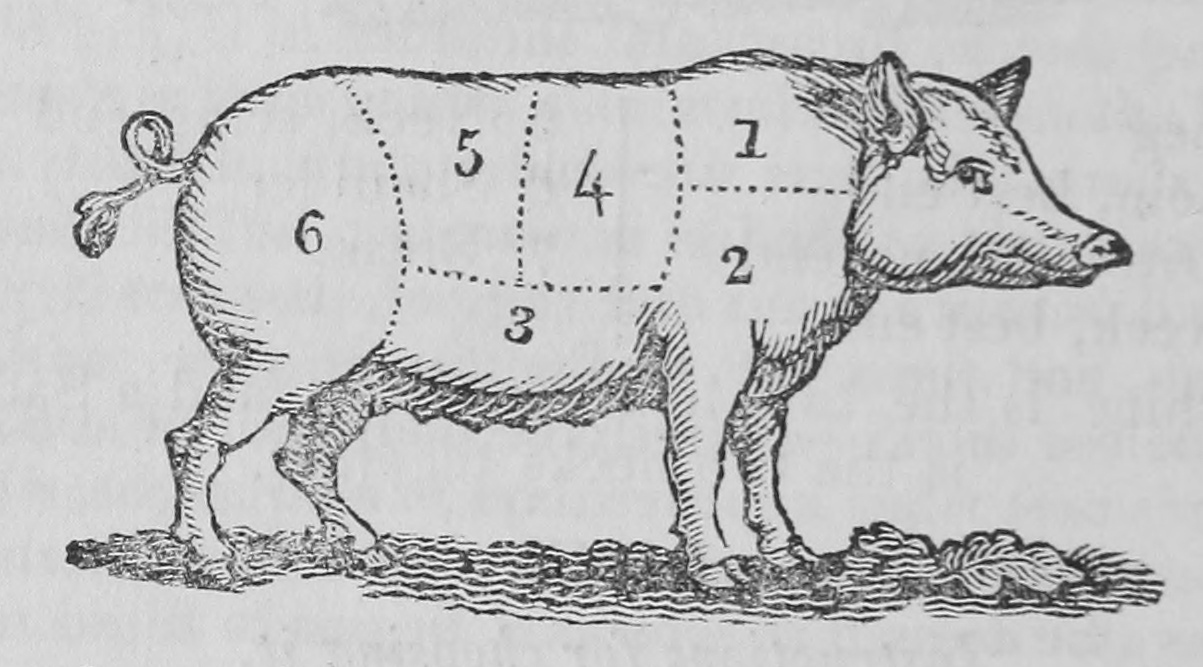
1 Spare-rib 4 Fore-loin
2 Hand 5 Hind-loin
3 Belly or spring 6 Leg
BACON.
The rind of good bacon is always thin, the fat firm and white, or rather inclined to a pink tinge, and the lean is of a bright red, tender and adhering close to the bone. If there be any appearance of yellow, it is rusty. The Wiltshire and Hampshire bacon is best, but the Yorkshire is much esteemed. Irish bacon is, in general, bad; but this article is now so re-manufactured in London, as to resemble, in appearance, the most beautiful Wiltshire bacon.
Hams.—The Westphalia or bear’s hams, are the best; but the Westmorland, Wiltshire, and Yorkshire are the most desirable, of the English curing. Choose these latter short in the shank; and to know whether they are good, thrust a picked-pointed knife under the bone, and if it comes out clean and sweet, the ham is good, otherwise it is not.
GAME.
Venison is chosen by its fat, which should be thick, clear, and bright. A knife stuck in under the shoulder or shank will shew whether it be sweet. If venison looks green, or approaching to black, it is stale.
The Joints of Venison are only four; viz. The haunch, neck, breast, and shoulder.
Hares.—The claws of a young hare are smooth and sharp, the ears are tender and will easily tear, and the cleft of the lip is narrow; but the claws of an old hare are blunt and rugged, the ears dry and tough, and the cleft of the lip is wide, and the haunch is thick.—If fresh the body will be stiff. A hare is best when kept ten days or a fortnight, which, in favourable weather, may be done; but it should always be dressed as soon as it begins to bleed at the nose.
Leverets may be distinguished from hares, by their having a knob or small bone on the fore leg, near the foot, which hares have not. Leverets will not keep, therefore should be dressed as soon as possible.
Rabbits.—The age of Rabbits, whether wild or tame, may be known by nearly the same rules as that of Hares: observe also, that if old, their hairs are intermixed with the wool, their claws will be limber, and their flesh, instead of being white, will have a blue cast, and be slimy.
POULTRY.
(Poultry is in the greatest perfection when most plentiful. It is generally dearest from February to Midsummer, and cheapest in September.)
Geese.—The bill and feet of a young Goose will be yellow, the breast fat and plump, and the fat white and soft; but if old, the bill and feet will be red, and the fat yellow and skinny. If fresh, the feet will be limber, but if stale, stiff and dry. Green-Geese are in season in April, May, and June. They should be scalded. Stubble-Geese come into season in September.
Turkeys.—Choose cock birds. The very best have black legs, but the white legged birds are nearly as fine. If young their legs will be smooth, and the spurs of the cock will be very short and tender; but if old, the legs will be rough, and the spurs long and hard, unless filed or cut off. But the best criterion, by which to judge of both Turkeys and Fowls with certainty is, that the toes and bills, if they be young, will be soft and pliable, but will feel hard and stiff, if old. A Turkey should be kept without meat thirty-six hours before it is killed, and should be hung up in its feathers a week before it is dressed.
Fowls.—Young Pullets are in their prime before they begin to lay; but Hen Fowls are best when full of eggs, at which time the vent is soft. The comb, skin, and legs of old Hens are rough. A good Capon has a large rump, and much fat at the shoulders, and its comb is pale.
To know whether any kind of Fowl in its feathers is fit to dress, pull the feathers off the vent very gently, and if they come off easily, it ought to be dressed immediately.
Ducks and Ducklings.—These may be chosen by the same rules as Turkeys and Fowls; but the bills and feet of wild Ducks are smaller and redder than those of tame ones; their plumage too is different. Young wild Ducks will not keep. All young Ducks should be scalded, as that sweetens them, and improves their flavour.
[Norfolk is famous for Turkeys, Geese, and Ducks; Surrey and Sussex for Fowls and Ducklings. The Dorking Fowls are in high estimation in London.]
Pigeons.—These birds should be both young and fresh, and when they are so, they are fat and full at the vent; their legs are limber and of a dusky white: young Pigeons have also a yellow down round their necks and heads. If old, their legs and feet are large, harsh, and red, and the vent discoloured and flabby. Tame Pigeons are best, as wood Pigeons are harder and darker coloured.
WILD FOWL.
To judge whether these are young and fresh, observe the rules given above for tame Fowls; recollect also that these birds should be fat, and when they are so, they will be hard at the vent; if stale, the skin will peel off when rubbed with the finger.
Pheasants.—Cock Pheasants are best. Hens are excellent when full of eggs.
Woodcocks.—These are fine, high-flavoured birds, and when in the best condition, they feel thick and firm, and have a vein of fat down the sides of the breast. When stale they run at the nostrils. Land Rails and Snipes are chosen by these rules.
Partridges.—The yellow legs of young partridges become blue when old, and their bills changed from yellow to a dark hue.
Quails.—These come chiefly from France and Germany, but the finest and best that are sold in London, come from Cambridgeshire, and are fed by the poulterers with herbs, seed, or boiled bread and milk. They are so extremely delicate, in feeding, that two of them will not eat out of the same trough.
Teal is of a beautiful plumage, and very delicate to eat. Their bills and feet are black, and are shaped like those of a Duck.
Ruffs and Rees are chiefly found in Lincolnshire and Cambridgeshire; and in April or May, when most in season, they are a perfect lump of fat. If poor, when caught, they should be fattened with white bread and milk boiled, given them in separate troughs.
Moor Game, and even Grouse, may be kept good a long time. Old birds of all kinds will keep longest, and will be the better for keeping; but young birds should be dressed soon.
Small Birds, of every description, should be dressed immediately.
FISH.
General Rules for choosing it.
(The price of fish depends on the supply; and it will often be found, that one kind of fish, equally as good and seasonable as another, may be bought for much less money; therefore, never buy at an extravagant price.)
When fish is fresh, it is firm, bright, and stiff; the gills are of a lively red, hard to open, and smell sweet; and the eyes are full and clear. If stale, the whole fish, and particularly the gills and fins, will always be flabby and limber, the gills will be pale, and the eyes sunk and dull. By these rules alone, good fish may be distinguished from bad; but besides these, some kinds of fish have other distinguishing peculiarities, which are as follow; viz.
Sturgeon.—The grain of the flesh of a fine Sturgeon is smooth and very white, interspersed with blue veins. The skin is soft and tender, and its smell is very pleasant. When the veins and gristles are brown or yellow, instead of blue, or the skin is hard and dry, the fish is not good.
Caviare.—This is the roe of the female Sturgeon. It should be taken out and beaten flat, then sprinkled with salt and dried, first in the sun and air, and afterwards in an oven, till it becomes very dry and of a reddish brown colour. Thus prepared, it is a fine relish; it is to be eaten with oil and vinegar.
Turbot, when good, is thick, firm, and plump; and the nose, and fins all round the belly, tinged with a pink colour; but if it has lost this beautiful tinge, or if the belly be changed from a yellowish white to a blueish cast, the fish is either stale or poor, or both.
Soles are to be chosen by these rules, particularly as to the pink tinge round their bellies and under their noses.
Cod Fish should be thick at the neck, having the gills red, the flesh very white, firm, hard, and dear, and the eyes bright.
Haddock are to be chosen by these rules. The shortest fish are the best.
Salmon should be chosen for its small head and thick neck; its scales should be bright, and its gills and flesh of a fine red colour. The Thames and Severn Salmon are mostly esteemed.
Skate, Maids, and Thornbacks are all of one species; they ought to be white and thick. The two latter should be kept a day, or perhaps two, to make them tender, and Skate may be kept longer. The maiden Skate and the young male, or Thornback, are the best; but large, old Skate, is generally coarse and rank.
Flounders, Plaice, &c. should be stiff and firm, with bright, full eyes. If flabby, these and all other kinds of fish are certainly stale. The Thames Flounders are reckoned best, in London, because they may be had alive, or nearly so, and they are always best when dressed as soon as caught.
Herrings, Pilchards, Whitings, Sprats, &c.—These may be classed together. The largest are the best. Their gills should be of a fine red, their fins stiff, their eyes bright, and their flesh, when best, is bright and firm. As the Herrings emigrate, in immense shoals, from the northern regions, they are in the greatest perfection on their first arrival on the coasts of Scotland, the North of Ireland, and the Isle of Man. On the coast of the German Ocean also, even so far south as Yarmouth, they are taken in great quantities, remarkably fat and fine, and full of spawn; but before they reach the southern coast of England, they become poor and thin, and are then known by the denomination of Shotten-Herrings.
Mackerel look beautifully bright when first caught. These and Whitings should be dressed as soon as possible.
FRESH WATER FISH.
Pike and Jack are taken in rivers; they are very dry eating, and require much seasoning and sauce.
Carp, Tench, and Perch, are best eaten as soon as caught; the latter is not so much esteemed as the two former.
Smelts, when fresh, have a fine bright appearance, firm flesh, and a fragrant smell, like a cucumber.
Gudgeons, Roach, and Dace, and most other river fish, must be chosen by the rules already given.
BUTTER, CHEESE, and EGGS.
Butter should be chosen by the taste and smell.—The best fresh butter is the Epping, and next the Cambridge; sometimes the potted weekly Dorset is very good. Of tub butter, the Welch is best, the Dutch next, and the Irish worst. In examining tub-butter, and particularly the Irish, look at and smell to the outside next the cask, which is often white in appearance like tallow, and quite rank in smell.
Cheese. Of the common kinds, Cheshire, North Wiltshire and double Gloucester, are the best. Cheese of the first making, in May, is usually brought to Market in August. Factors have a pernicious practice of sticking brass pins into cheese, which gives it the appearance of blue mould and old age. That cheese which has a smooth, moist coat, is generally good. Spanish arnatto is often used to give the rind a beautiful red colour.
Eggs.—If fresh, will feel warm when the tongue is applied to the biggest end; but if stale, it will be cold. An egg, when quite fresh, will sink at once when put into cold water; but if rotten, it will swim.
VEGETABLES.
N.B. Vegetables are cheapest soon after they come into full season.
Names. When best. Names. When best.
Artichokes July to October. Endive June & all Winter.
Asparagus May to July. Leeks Sept. & all Winter.
Beans, Windsor, &c. Midsummer to September. Lettuces April & all Summer.
——– French Midsumr. & onwd. Onions June to November.
——– Scarlet July to October. Parsley All the year.
Beet-root All the year. Parsnips Aug. & all Winter.
Borcole, or November and all Peas (green) June to September.
Scotch Kale the Winter. Potatoes May & all the year.
Brocoli October and ditto. Radishes March to July.
Cabbage May & all Summer. Small Salad All the year.
———– red July to September. Salsafy and
———– Plants All the year. Scarzonera July and August.
Carrots May till Winter. Sea Kale April and May.
Cauliflowers June to August. Spinach (sprg.) March to July.
Celery June till March. Do. (Winter) Winter and Spring.
Corn Sallad May to July. Turnips May to September.
Cucumbers June to September. Turnip Tops. February to May.
All vegetables are best if dressed as soon as gathered; and are in their greatest perfection just before they begin to flower.
Most Articles for Pickling will be in their prime in July and August; but walnuts not later than the middle of July; and mushrooms and white cabbage in September and October.
Herbs, of all kinds, should be gathered in a dry day; and when the roots are cut off, and the herbs are perfectly well cleaned from dust, &c. they should be divided into small bunches and dried very quick by the heat of a stove, or in a Dutch oven before a common fire, rather than by the heat of the sun, taking care that they be not burnt. When dry put them into bags, and hang them up in a dry place; or pound them and sift them through a hair sieve, and keep the powder in bottles closely stopped.
Sweet and Savory Herbs are best in season from May to August, according to their kinds.
The flavour and fragrance of fresh herbs are much finer than of those that are dried.
PASTRY, &c.
Here follow a great variety of the most useful and approved receipts in domestic economy, which are chiefly appropriate to the Housekeeper’s department; consisting of directions for making pastry, confectionary, preserves, pickles, perfumery, cosmetics, british wines, various articles of distillation, family medicine, and many miscellaneous receipts of general utility.
OBSERVATIONS ON PASTRY.
An adept in making pastry, never leaves any part of it adhering to the board used in making it. It is best when rolled on marble or slate. In hot weather the butter should be put in cold water to make it firm; and if the pastry be made early in the morning, and preserved from the air till baked, it will be the better. Salt butter, if good and well washed, makes a fine flaky crust.
Preserved fruit for pastry need not be baked; but the crust should be baked in a tin shape, or on a tin and cut out according to taste.
ON MAKING CAKES.
Currants should be nicely washed, dried in a cloth, and then set before the fire. If not quite dry they will make the cake heavy. The cake will be the lighter if a dust of flour be thrown on the currants and then shaken.
Eggs should be beaten very long, the whites and the yolks apart, after which, they must be strained.—Sugar should be rubbed to a powder, on a clean board, and sifted through a fine hair or lawn sieve. Lemon-peel should be pared quite thin, and beaten, with a little sugar, in a marble mortar, to a paste; and then mixed with a little wine or cream, so as to mix easily with the other ingredients. After all the articles are put together in the pan, they should be thoroughly beaten for a long while, as the lightness of the cake greatly depends on their being well incorporated. Yeast, in either black or white plum cakes, makes them require less butter and eggs, and yet be equally light and rich. The dough when made should be set to rise by the fire. If the oven be not quick the batter will not rise, and the cake will be heavy: if you think it too quick, put some paper over the cake to prevent its being burnt.
1. A RICH PLUM CAKE.
Take one pound of fresh butter, one pound of sugar, one pound and a half of flour, two pounds of currants, a glass of brandy, one pound of sweatments, two ounces of sweet almonds, ten eggs, a quarter of an ounce of allspice, and a quarter of an ounce of cinnamon.
Melt the butter to a cream, and put in the sugar. Stir it till quite light, adding the allspice, and pounded cinnamon; in a quarter of an hour take the yolks of the eggs, and work them in, two or three at a time; and the whites of the same must by this time be beaten into a strong snow quite ready to work in; as the paste must not stand to chill the butter, or it will be heavy, work in the whites gradually; then add the orange-peel, lemon, and citron, cut in fine stripes, and the currants, which must be mixed in well, with the sweet almonds. Then add the sifted flour and glass of brandy. Bake this cake in a tin hoop in a hot oven for three hours, and put twelve sheets of paper under it to keep it from burning.
2. A GOOD PLAIN CAKE.
The following is a receipt for making a good plain cake, to be given to children, at breakfast, instead of buttered bread.
Take as much dough as will make a quartern-loaf (either made at home, or procured at the baker’s), work into this a quarter of a pound of butter, a quarter of a pound of moist sugar, and a handful of caraway seeds. When well worked together, pull into pieces the size of a golden pippin, and work it together again. This must be done three times or it will be in lumps, and heavy when baked.
3. ICEING FOR CAKES.
Put one pound of fine-sifted, treble refined sugar into a basin, and the whites of three new-laid eggs; beat the sugar and eggs up well with a silver spoon until it becomes very white and thick; dust the cake over with flour, and then brush it off, by way of taking the grease from the outside, which prevents the iceing from running; put it on smooth with a palette knife, and garnish according to fancy: any ornaments should be put on immediately; for if the iceing gets dry, it will not stick on. Set it in a cool oven to harden.
4. A RICH SEED CAKE.
Take a pound and a quarter of flour well dried, a pound of butter, a pound of loaf sugar, beat and sifted, eight eggs and two ounces of caraway seeds, one grated nutmeg, and its weight in cinnamon. Beat the butter into a cream, put in the sugar, beat the whites of the eggs and the yolks separately, then mix them with the butter and sugar. Beat in the flour, spices, and seed, a little before sending it away. Bake it two hours in a quick oven.
5. A PLAIN POUND CAKE.
Beat one pound of butter in an earthen pan until it is like a fine thick cream, then beat in nine whole eggs till quite light. Put in a glass of brandy, a little lemon peel, shred fine, then work in a pound and a quarter of flour; put it into the hoop or pan and bake it for an hour. A pound plum cake is made the same with putting one pound and a half of clean washed currants and half a pound of candied lemon peel.
6. RATAFIA CAKES.
Beat half a pound each of sweet and bitter almonds in fine orange, rose, or ratafia water, mix half a pound of fine pounded and sifted sugar with the same, add the whites of four eggs well beaten to it, set it over a moderate fire in a preserving-pan. Stir it one way until it is pretty hot, and when a little cool form it into small rolls, and cut into thin cakes. Shake some flour lightly on them, give each a light tap, and put them on sugar papers, sift a little sugar on them, and put them into a thorough slack oven.
7. WIGGS.
Put half a pint of warm milk to three quarters of a pound of fine flour: mix in it two or three spoonsful of light yeast. Cover it up, and set it before the fire an hour, in order to make it rise. Work into it four ounces each of sugar and butter, make it into cakes, or wiggs, with as little flour as possible, and a few caraway seeds, and bake them quick.
8. BATH CAKES.
Mix well together, half a pound of butter, one pound of flour, five eggs, and a cupful of yeast. Set the whole before the fire to rise, which effected, add a quarter of a pound of fine powered sugar, an ounce of caraways well mixed in, and roll the paste out into little cakes. Bake them on tins.
9. SHREWSBURY CAKES.
Mix half a pound of butter well beat like cream, and the same weight of flour, one egg, six ounces of beaten and sifted loaf sugar, and half an ounce of caraway seeds. Form these into a paste, roll them thin, and lay them in sheets of tin; then bake them in a slow oven.
10. PORTUGAL CAKES.
Mix into a pound of fine flour, a pound of loaf sugar, beat and sifted, and rub it into a pound of butter, till it is thick, like grated white bread; then put to it two spoonsful of rose-water, two of sack, and ten eggs: work them well with a whisk, and put in eight ounces of currants. Butter the tin pans, fill them half full, and bake them. If made without currants they will keep a year.
11. GINGER CAKES WITHOUT BUTTER.
Take one pound of sugar, a quarter of a pound of ginger, a pint of water, two pounds of flour, and eight caps of orange peel. Pound and sift the ginger, and add a pint of water; boil it five minutes, then let it stand till cold. Pound the preserved orange-peel, and pass it through a hair sieve; put the flour on a pasteboard, make a wall, and put in the orange peel and ginger with the boiled water; mix this up to a paste and roll it out; prick the cakes before baking them.
12. SAVOY CAKES.
To one pound of fine sifted sugar, put the yolks of ten eggs, (have the whites in a separate pan,) and set it, if in summer, in cold water: if there is any ice set the pan on it as it will cause the eggs to be beat finer. Then beat the yolks and sugar well with a wooden spoon for 20 minutes, and put in the rind of a lemon grated; beat up the whites with a whisk, until they become quite stiff and white as snow. Stir them into the batter by degrees, then add three quarters of a pound of well-dried flour; finally put it in a mould in a slack oven to bake.
13. SAFFRON CAKES.
Take a quartern of fine flour, a pound and a half of butter, three ounces of caraway-seeds, six eggs, well beaten, a quarter of an ounce of well-beaten cloves and mace, a little pounded cinnamon, one pound of sugar, a little rose-water and saffron, a pint and a half of yeast, and a quart of milk. Mix them thus: first boil the milk and butter, then skim off the butter, and mix it with the flour and a little of the milk. Stir the yeast into the rest and strain it; mix it with the flour, put in the eggs and spice, rose-water, tincture of saffron, sugar, and eggs. Beat it all well up, and bake it in a hoop or pan well buttered. Send it to a quick oven, and an hour and a half will do it.
14. QUEEN CAKES.
Take a pound of sugar, beat and sift it, a pound of well-dried flour, a pound of butter, eight eggs, and half a pound of currants washed and picked; grate a nutmeg and an equal quantity of mace and cinnamon, work the butter to a cream, put in the sugar, beat the whites of the eggs 20 minutes, and mix them with the butter and sugar. Then beat the yolks for half an hour and put them to the butter. Beat the whole together, and when it is ready for the oven, put in the flour, spices, and currants; sift a little sugar over them, and bake them in tins.
15. RICE CAKES.
Beat the yolks of 15 eggs for nearly half an hour, with a whisk, mix well with them 10 ounces of fine sifted loaf sugar, put in half a pound of ground rice, a little orange water or brandy, and the rinds of two lemons grated, then add the whites of seven eggs well beaten, and stir the whole together for a quarter of an hour. Put them into a hoop and set them in a quick oven for half an hour, when they will be properly done.
16. LEMON CAKES.
Take one pound of sugar, three quarters of a pound of flour, 14 eggs, two table spoonsful of rose-water, the raspings and juice of four lemons; when the yolks are well beat up and separated, add the powder sugar, the lemon raspings, the juice, and the rose-water; beat them well together in a pan with a round bottom, till it becomes quite light, for half an hour. Put the paste to the whites previously well whisked about, and mix it very light. When well mixed sift in the flour and knead it in with the paste, as light as possible; form the biscuits and bake them in small oval tins, with six sheets of paper under them, in a moderate heat. Butter the tins well or it will prove difficult to take out the biscuits, which will be exceedingly nice if well made. Ice them previously to baking, but very lightly and even.
17. BANBURY CAKES.
Take a pound of dough made for white bread, roll it out, and put bits of butter upon the same as for puff paste, till a pound of the same has been worked in; roll it out very thin, then cut it into bits of an oval size, according as the cakes are wanted. Mix some good moist sugar with a little brandy, sufficient to wet it, then mix some clean washed currants with the former, put a little upon each bit of paste, close them up, and put the side that is closed next the tin they are to be baked upon. Lay them separate, and bake them moderately, and afterwards, when taken out, sift sugar over them. Some candied peel may be added, or a few drops of the essence of lemon.
18. ALMOND CAKES.
Take six ounces of sweet almonds, half a pound of powdered sugar, seven eggs, six ounces of flour, and the raspings of four lemons. Pound the almonds very fine, with whole eggs, add the sugar and lemon raspings, and mix them well together in the mortar. Take it out, put it in a basin and stir it with the yolks of eggs, till it is as white as a sponge paste; beat up the whites of the eggs to a strong snow, mix them very light with the paste, then take the flour and mix it as light as possible; on this the goodness of the paste principally depends, as it is impossible to make a good cake with a heavy paste; butter the mould and bake in a slack oven for an hour, with ten sheets of paper under it and one on the top.
19. PLAIN GINGERBREAD.
Mix three pounds of flour with four ounces of moist sugar, half an ounce of powdered ginger, and one pound and a quarter of warm treacle; melt half a pound of fresh butter in it; put it to the flour and make it a paste; then form it into nuts or cakes, or bake it in one cake.
20. Another Method.
Mix six pounds of flour with two ounces of caraway seeds, two ounces of ground ginger, two ounces of candied orange peel, the same of candied lemon peel cut in pieces, a little salt, six ounces of moist sugar; melt one pound of fresh butter in about half a pint of milk, pour it by degrees into four pounds of treacle, stir it well together, and add it, a little at a time, to the flour; mix it thoroughly, and make it into a paste; roll it out rather thin, and cut into cakes with the top of a dredger or wine glass; put them on floured tins, and bake them in rather a brisk oven.
21. CREAM CAKES.
Beat the whites of nine eggs to a stiff froth, stir it gently with a spoon lest the froth should fall, and to every white of an egg grate the rinds of two lemons; shake in gently a spoonful of double refined sugar sifted fine, lay a wet sheet of paper on a tin, and with a spoon drop the froth in little lumps on it near each other. Sift a good quantity of sugar over them, set them in the oven after the bread is out, and close up the mouth of it, which will occasion the froth to rise. As soon as they are coloured they will be sufficiently baked; lay them by two bottoms together on a sieve, and dry them in a cool oven.
22. CRUMPETS.
Set two pounds of flour with a little salt before the fire till quite warm; then mix it with warm milk and water till it is as stiff as it can be stirred; let the milk be as warm as it can be borne with the finger, put a cupful of this with three eggs well beaten, and mixed with three spoonsful of very thick yeast; then put this to the batter and beat them all well together in a large pan or bowl, add as much milk and water as will make it into a thick batter; cover it close and put it before the fire to rise: put a bit of butter in a piece of thin muslin, tie it up, and rub it lightly over the iron hearth or frying pan; then pour on a sufficient quantity of batter at a time to make one crumpet; let it do slowly, and it will be very light. Bake them all the same way. They should not be brown, but of a fine yellow.
23. MUFFINS.
Mix a pint and a half of warm milk and water, with a quarter of a pint of good yeast, and a little salt; stir them together for a quarter of an hour, then strain the liquor into a quarter of a peck of fine flour; mix the dough well and set it to rise for an hour, then roll it up and pull it into small pieces, make them up in the hand like balls, and lay a flannel over them while rolling to keep them warm. The dough should be closely covered up the whole time; when the whole is rolled into balls, the first that are made will be ready for baking. When they are spread out in the right form for muffins, lay them on tins and bake them, and as the bottoms begin to change colour turn them on the other side.
24. COMMON BUNS.
Rub four ounces of butter into two pounds of flour, a little salt, four ounces of sugar, a dessert spoonful of caraways, and a tea spoonful of ginger; put some warm milk or cream to four table spoonsful of yeast; mix all together into a paste, but not too stiff; cover it over and set it before the fire an hour to rise, then make it into buns, put them on a tin, set them before the fire for a quarter of an hour, cover over with flannel, then brush them with very warm milk, and bake them of a nice brown in a moderate oven.
25. CROSS BUNS.
Put two pounds and a half of fine flour into a wooden bowl, and set it before the fire to warm; then add half a pound of sifted sugar, some coriander seed, cinnamon and mace powdered fine; melt half a pound of butter in half a pint of milk: when it is as warm as it can bear the finger, mix with it three table spoonsful of very thick yeast, and a little salt; put it to the flour, mix it to a paste, and make the buns as directed in the last receipt. Put a cross on the top, not very deep.
26. RUSKS.
Beat up seven eggs, mix them with half a pint of warm new milk, in which a quarter of a pound of butter has been melted, add a quarter of a pint of yeast, and three ounces of sugar; put them gradually into as much flour as will make a light paste nearly as thin as batter; let it rise before the fire half an hour, add more flour to make it a little stiffer, work it well and divide it into small loaves, or cakes, about five or six inches wide, and flatten them. When baked and cold put them in the oven to brown a little. These cakes, when first baked, are very good buttered for tea; if they are made with caraway seeds they eat very nice cold.
27. ORANGE CUSTARDS.
Boil very tender the rind of half a Seville orange, and beat it in a mortar until it is very fine; put to it a spoonful of the best brandy, the juice of a Seville orange, four ounces of loaf sugar, and the yolk of four eggs. Beat them all together for ten minutes, and then pour in by degrees a pint of boiling cream; beat them until cold, then put them in custard cups, in a dish of hot water; let them stand till they are set, then take them out and stick preserved orange peel on the top; this forms a fine flavoured dish, and may be served up hot or cold.
28. BAKED CUSTARDS.
Boil a pint of cream with some mace and cinnamon, and when it is cold, take four yolks of eggs, a little rose water, sack, nutmeg, and sugar, to taste; mix them well and bake them.
29. RICE CUSTARDS.
Put a blade of mace, and a quartered nutmeg into a quart of cream; boil and strain it, and add to it some boiled rice and a little brandy. Sweaten it to taste, stir it till it thickens, and serve it up in cups, or in a dish; it may be used either hot or cold.
30. ALMOND CUSTARDS.
Blanch a quarter of a pound of almonds, beat them very fine, and then put them into a pint of cream, with two spoonsful of rose-water; sweeten it, and put in the yolks of four eggs; stir them well together till it becomes thick, and then pour it into cups.
31. LEMON CUSTARDS.
Take half a pound of double refined sugar, the juice of two lemons, the rind of one pared very thin, the inner rind of one boiled tender and rubbed through a sieve, and a pint of white wine; boil them for some time, then take out the peel and a little of the liquor; strain them into the dish, stir them well together and set them to cool.
32. ALMOND TARTS.
Blanch and beat fine some almonds, with a little white wine and some sugar, (a pound of sugar to a pound of almonds,) grated bread, nutmeg, cream, and the juice of spinach, to colour the almonds. Bake it in a gentle oven, and when done, thicken with candied orange peel or citron.
33. GREEN ALMOND TARTS.
Pull the almonds from the tree before they shell, scrape off the down, and put them into a pan with cold spring water; then put them into a skillet with more spring water; set it on a slow fire, and let it remain till it simmers. Change the water twice, and let them remain in the last till tender, then take them out and dry them well in a cloth. Make a syrup with double refined sugar, put them into it and let them simmer: do the same the next day, put them into a stone jar, and cover them very close, for if the least air comes to them they will turn black; the yellower they are before they are taken out of the water, the greener they will be after they are done. Put them into the crust, cover them with syrup, lay on the lid, and bake them in a moderate oven.
34. ORANGE OR LEMON PIE.
Rub six oranges or lemons with salt, and put them into water, with a handful of salt, for two days. Put every day fresh water without salt, for a fortnight. Boil them tender, cut them into half quarters, cornerways, quite thin: boil six pippins, pared, cored, and quartered, in a pint of water till they break, then put the liquor to the oranges or lemons, with half the pulp of the pippins well broken, and a pound of sugar; boil them a quarter of an hour, then put them into a pot and squeeze in two spoonsful of the juice of either orange or lemon, according to the kind of tart; put puff paste, very thin, into shallow patty-pans. Take a brush, and rub them over with melted butter, sift double refined sugar over them, which will form a pretty iceing, and bake them.
35. ORANGE TARTS.
Grate a little of the outside of a Seville orange, squeeze the juice into a dish, put the peel into water, and change it often for four days, then put into a saucepan of boiling water on the fire; change the water twice to take out the bitterness, and when tender, wipe and beat them fine in a mortar; boil their weight in double refined sugar into a syrup, and skim it, then put in the pulp and boil all together till clear; when cold put it into the tarts, and squeeze in the juice, and bake them in a quick oven. Conserve of orange makes good tarts.
36. ORANGE PUFFS.
Pare off the rinds from Seville oranges, then rub them with salt, let them lie twenty-four hours in water, boil them in four changes of water, make the first salt, drain and beat them to a pulp; bruise in the pieces of all that are pared, make it very sweet with loaf sugar, and boil it till thick; let it stand till cold, and then put it into the paste.
37. ENGLISH MACAROONS.
One pound of sweet almonds, 1 pound and a quarter of sugar, 6 whites of eggs, and the raspings of two lemons. Pound the almonds very fine with 6 whites of eggs, feel the almonds, and if they are free from lumps, they will do; then add the powdered sugar, and mix it well with the lemon raspings. Dress them in wafer paper of the required shape; bake them in a moderate heat, then let them stand till cold, cut the wafer paper round them, but leave it on the bottoms.
38. FANCY BISCUITS.
Take 1 pound of almonds, 1 pound of sugar, and some orange flower water. Pound the almonds very fine, and sprinkle them with orange flower water; when they are perfectly smooth to the touch, put them in a small pan, with flour sifted through a silk sieve; put the pan on a slow fire, and dry the paste till it does not stick to the fingers; move it well from the bottom to prevent its burning; then take it off, and roll it into small round fillets, to make knots, rings, &c., and cut it into various shapes; make an iceing of different colours, dip one side of them in it, and set them on wire gratings to drain. They may be varied by strewing over them coloured pistachios, or coloured almonds, according to fancy.
39. SPONGE BISCUITS.
Beat the yolks of 12 eggs for half an hour; then put in a pound and a half of beaten sifted sugar, and whisk it till it rises in bubbles; beat the whites to strong froth, and whisk them well with the sugar and yolks, work in 14 ounces of flour, with the rinds of 2 lemons grated. Bake them in tin moulds buttered, in a quick oven, for an hour; before they are baked, sift a little fine sugar over them.
40. FINE CHEESECAKES.
Put a pint of warm cream into a saucepan over the fire, and when it is warm, add to it 5 quarts of new milk. Then put in some rennet, stir it, and when it is turned, put the curd into a linen cloth or bag. Let the whey drain from it, but do not squeeze it too much. Put it into a mortar, and pound it as fine as butter. Add ½ a pound of sweet almonds blanched, ½ a pound of macaroons, or Naples biscuit. Then add nine well beaten yolks of eggs, a grated nutmeg, a little rose or orange water, and ½ a pound of fine sugar. Mix all well together.
41. ALMOND CHEESECAKES.
Put 4 ounces of blanched sweet almonds into cold water, and beat them in a marble mortar or a wooden bowl, with some rose water. Put to it 4 ounces of sugar, and the yolks of four eggs beat fine. Work it till it becomes white and frothy, and then make a rich puff paste as follows: Take ½ a pound of flour, and a ¼ of a pound of butter; rub a little of the butter into the flour, mix it stiff with a little cold water, and then roll out the paste. Strew on a little flour and lay over it in thin bits 1-3d of the butter, throw a little more flour over the bottom, and do the like three different times. Put the paste into the tins, grate sugar over them, and bake them gently.
42. BREAD CHEESECAKES.
Slice a penny loaf as thin as possible, pour on it a pint of boiling cream, and let it stand two hours. Beat together 8 eggs, ½ a pound of butter, and a grated nutmeg: mix them into the cream and bread with ½ a pound of currants well washed and dried, and a spoonful of white wine or brandy. Bake them in patty pans, on a raised crust.
43. RICE CHEESECAKES.
Boil 4 ounces of rice till it is tender, and then put it into a sieve to drain; mix with it 4 eggs well beaten up, ½ a pound of butter, ½ a pint of cream, 6 ounces of sugar, a nutmeg grated, a glass of brandy, or ratafia water. Beat them all well together, then put them into raised crusts, and bake them in a moderate oven.
44. APPLE CAKES.
Take half a quartern of dough, roll it out thin; spread equally over it 5 ounces each of coffee and sugar, a little nutmeg or allspice, and 2 ounces of butter; then fold and roll it again two or three times, to mix well the ingredients. Afterwards roll it out thin, and spread over it 4 rather large apples, pared, cored, and chopped small; fold it up, and roll until mixed. Let it stand to rise after. Half a pound of butter may be added.
45. BLANCMANGE.
Put into 1 quart of water an ounce of isinglass, and let it boil till it is reduced to a pint; then put in the whites of 4 eggs with 2 spoonsful of rice water, and sweeten it to taste. Run it through a jelly bag, and then put to it 2 ounces of sweet, and 1 ounce of bitter almonds. Scald them in the jelly, and then run them through a hair sieve. Put it into a china bowl, and the next day turn it out. Garnish with flowers or green leaves, and stick all over the top blanched almonds cut lengthways.
46. CLEAR BLANCMANGE.
Skim off the fat, and strain a quart of strong calf’s foot jelly, add to the same the whites of 4 eggs well beaten, set it over the fire and stir it till it boils. Then pour it into a jelly bag, and run it through several times till it is clear. Beat an ounce each of sweet and bitter almonds to a paste with a spoonful of rose water strained through a cloth. Then mix it with the jelly, and add to it 3 spoonsful of very good cream. Set it again over the fire and stir it till it almost boils. Pour it into a bowl; then stir it often till almost cold; and then fill the moulds.
CONFECTIONARY.
47. TO PREPARE SUGAR FOR CANDYING.
The first process is clarifying, which is done thus. Break the white of an egg into a preserving pan; put to it 4 quarts of water, and beat it with a whisk to a froth. Then put in 12 pounds of sugar, mix all together, and set it over the fire. When it boils put in a little cold water, and proceed as often as necessary, till the scum rises thick on the top. Then remove it from the fire, and when it is settled, take off the scum, and pass it through a straining bag. If the sugar should not appear very fine, boil it again before straining it.
48. TO CANDY SUGAR.
After having completed the above first process, put what quantity is wanted over the fire, and boil it till it is smooth enough. This is known by dipping the skimmer into the sugar, and touching it between the forefinger and thumb; and immediately on opening them a small thread will be observed drawn between, which will crystallize and break, and remain in a drop on the thumb, which will be a sign of its gaining some degree of smoothness. Boil it again, and it will draw into a larger string; it is now called bloom sugar, and must be boiled longer than in the former process. To try its forwardness, dip again the skimmer shaking off the sugar into the pan; then blow with the mouth strongly through the holes, and if certain bladders go through, it has acquired the second degree: to prove if the liquid has arrived at the state called feathered sugar, re-dip the skimmer, and shake it over the pan, then give it a sudden flirt behind, and the sugar will fly off like feathers.
It now arrives to the state called crackled sugar, to obtain which the mass must be boiled longer than in the preceding degree; then dip a stick in it, and put it directly into a pan of cold water, draw off the sugar which hangs to the stick in the water, and if it turns hard and snaps, it has acquired the proper degree of crystallization, if otherwise, boil it again until it acquires that brittleness.
The last stage of refining this article is called caramel sugar, to obtain which it must be boiled longer than in any of the preceding methods; prove it by dipping a stick first in the sugar, and then into cold water, and the moment it touches the latter, it will, if matured, snap like glass. Be careful that the fire is not too fierce, as by flaming up the sides of the pan, it will burn, discolour, and spoil the sugar.
49. French Method.
Put into a pan syrup enough of clarified sugar to fill the moulds; boil it until it comes to the state called small feather, skim it well, take the pan from the fire, and pour it into a small quantity of spirit of wine, sufficient to make it sparkle; let it rest till the skin, which is the candy, rises on the surface; take it off with a skimmer, and pour it directly into a mould; which keep in the stove at 90 degrees heat for eight days; then strain the candy by a hole, slanting the mould on a bason or pan, to receive the drainings; let it drain till it is perfectly dry, then loosen the paper by moistening it with warm water: warm it all round near the fire, and turn the candy by striking it hard on the table. Put it on a sieve in the stove, to finish drying it; but do not touch it while there, and keep up an equal heat, otherwise there will be only a mash instead of a candy. Spirit of wine will take off grease, and not affect the candy, as it soon evaporates.
50. TO CANDY ANY SORT OF FRUIT.
When finished in the syrup, put a layer into a new sieve, and dip it suddenly into hot water to take off the syrup that hangs about it: put it into a napkin before the fire to drain, and then do more in the sieve. Have ready sifted double refined sugar, which shake over the fruit till covered quite white. Set it on the shallow end of the sieve in a warm oven, and turn it two or three times. It must not be cold till dry. Watch it carefully.
51. BARLEY SUGAR.
Take a quantity of clarified sugar in that state that on dipping the finger into the pan the sugar which adheres to it will break with a slight noise; this is called crack. When the sugar is near this, put in two or three drops of lemon juice, or a little vinegar to prevent its graining. When it has come to the crack, take it off instantly, and dip the pan into cold water, to prevent its burning; let it stand a little, and then pour it on a marble which must be previously rubbed with oil. Cut the sugar into small pieces, when it will be ready for use. One drop of citron will flavour a considerable quantity.
52. BON-BONS.
Provide leaden moulds, which must be of various shapes, and be oiled with oil of sweet almonds. Take a quantity of brown sugar syrup in the proportion to their size, in that state called a blow, which may be known by dipping the skimmer into the sugar, shaking it, and blowing through the holes, when parts of light may be seen: add a drop of any esteemed essence. If the bon-bons are preferred white, when the sugar has cooled a little, stir it round the pan till it grains, and shines on the surface; then pour it into a funnel and fill the little moulds, when it will take a proper form and harden: as soon as it is cold take it from the moulds; dry it two or three days, and put it upon paper. If the bon-bons are required to be coloured, add the colour just as the sugar is ready to be taken off the fire.
53. CANDIED GINGER.
Put 1 ounce of race ginger grated fine, a pound of loaf sugar beat fine, into a preserving pan, with as much water as will dissolve the sugar. Stir them well together over a slow fire till the sugar begins to boil. Then stir in another pound of sugar, beat fine, and keep stirring it till it grows thick. Then take it off the fire, and drop it in cakes upon earthen dishes. Set them in a warm place to dry, when they will become hard and brittle, and look white.
54. CANDIED HOREHOUND.
Boil it in water until the juice is extracted: then boil a sufficient quantity of sugar to a great height, and add the juice to it. Stir it with a spoon against the sides of the sugar pan, till it begins to grow thick, then pour it out into a paper case that is dusted with fine sugar, and cut it into squares; dry the horehound, and put it into the sugar finely powdered and sifted.
55. WHITE SUGAR CANDY.
Sugar crystallized by the saturated syrup being left in a very warm place, from 90 to 100 degrees Fahrenheit, and the shooting promoted by placing sticks, or a net of threads at some distances from each other in the liquor: it is also deposited from compound syrup, and does not retain any of the foreign substances with which it is loaded.
56. TO CLARIFY LOAF SUGAR.
Break the same into a copper pan, which will hold 1-3d more, put half a pint of water to each pound of sugar, mix one white of egg to every 6 pounds; when it rises in boiling, throw in a little cold water, which must be kept ready in case it should boil over; skim it the fourth time of rising; continue to throw in a little cold water each time till the scum ceases to rise, and strain it through a sieve, cloth, or flannel bag. Save the scum, which, when a certain quantity is taken off, may be clarified. The latter skimming will do to add to fermented wines.
57. TO CLARIFY COARSE BROWN SUGAR.
Put 50 pounds of coarse brown sugar into a pan, which will contain 1-3d more, pour in 20 pints of water, well mixed with 5 whites of eggs; pound 5 pounds of small charcoal, mix it in the pan while on the fire, and boil it till it looks as black as ink. If it rises too fast, add cold water, strain it through a bag, and though at first it will be black, continue to strain it until it becomes quite clear; which may be seen by putting the syrup in a glass. Put it back until it comes out as fine as clarified loaf sugar.
58. TO IMPROVE AND INCREASE SUGAR.
To 5 pounds of coarse brown sugar, add 1 pound of flour, and there will be obtained 6 pounds of sugar worth 10 per cent. more in colour and quality.
59. TO CANDY ORANGE PEEL.
Soak the peels in cold water, which change frequently till they lose their bitterness; then put them into syrup till they become soft and transparent. Then they are to be taken out and drained.
60. CANDIED LEMON PEEL.
This is made by boiling lemon peel with sugar, and then exposing to the air until the sugar crystallizes.
61. TO COLOUR CANDIED SUGAR.
Red.—Boil an ounce of cochineal in half a pint of water for 5 minutes, add an ounce of cream of tartar, half an ounce of pounded alum, and boil them on a slow fire 10 minutes; if it shows the colour clear on white paper, it is sufficient. Add two ounces of sugar, and bottle it for use.
Blue.—Put a little warm water in a plate, and rub an indigo-stone in it till the colour has come to the tint required.
Yellow.—Rub with some water a little gamboge on a plate, or infuse the heart of a yellow lily flower, with milk-warm water.
Green.—Boil the leaves of spinach about a minute in a little water, and, when strained, bottle the liquor for use. In colouring refined sugars, taste and fancy must guide.
62. DEVICES IN SUGAR.
Steep gum-tragacanth in rose-water, and with double refined sugar make it into a paste, and colour and mould it to fancy.
63. WHIPT SYLLABUB.
Rub a lump of loaf sugar on the outside of a lemon, and put it into a pint of thick cream, and sweeten it to taste. Squeeze in the juice of a lemon, and add a glass of Madeira wine, or French brandy. Mill it to a froth with a chocolate mill, take off the froth as it rises, and lay it in a hair sieve. Fill one half of the glass with red wine, then lay the froth as high as possible, but take care that it is well drained in the sieve, otherwise it will mix with the wine, and the syllabub be spoiled.
64. A SOLID SYLLABUB.
To a quart of rich cream put a quart of white wine, the juice of two lemons, with the rind of one grated, and sweeten it to taste. Whip it up well and take off the froth as it rises. Put it upon a hair sieve, and let it stand in a cool place till the next day. Then half fill the glasses with the scum, and heap up the froth as high as possible. The bottom will look clear, and it will keep several days.
65. SNOW BALLS.
Pare and take out the cores of five large baking apples, and fill the holes with orange or quince marmalade. Then take some good hot paste, roll the apples in it, and make the crust of an equal thickness; put them in a tin dripping pan, bake them in a moderate oven, and when taken out, make iceing for them; let the same be a quarter of an inch thick, and set them a good distance from the fire until they become hardened, but be cautious that they are not browned.
66. CAPILLAIRE.
Mix six eggs well beat up, with fourteen pounds of loaf sugar, and three pounds of coarse sugar. Put them into three quarts of water, boil it twice, skim it well, and add a quarter of a pint of orange-flower water: strain it through a jelly-bag, and put it into bottles for use. A spoonful or two of this syrup put into a draught of either cold or warm water, makes it drink exceedingly pleasant.
67. CONFECTIONARY DROPS.
Take double refined sugar, pound and sift it through a hair sieve, not too fine; then sift it through a silk sieve, to take out all the fine dust, which would destroy the beauty of the drop. Put the sugar into a clean pan, and moisten it with any aromatic; if rose-water, pour it in slowly, stirring it with a paddle, which the sugar will fall from, as soon as it is moist enough, without sticking. Colour it with a small quantity of liquid carmine, or any other colour, ground fine. Take a small pan with a lip, fill it three parts with paste, place it on a small stove, the half hole being of the size of the pan, and stir the sugar with a little ivory or bone handle, until it becomes liquid. When it almost boils, take it from the fire and continue to stir it: if it be too moist, take a little of the powdered sugar, and add a spoonful to the paste, and stir it till it is of such a consistence as to run without too much extension. Have a tin plate, very clean and smooth; take the little pan in the left hand, and hold in the right a bit of iron, copper, or silver wire, four inches long, to take off the drop from the lip of the pan, and let it fall regularly on the tin plate; two hours afterwards, take off the drops with the blade of a knife.
68. CHOCOLATE DROPS.
Scrape the chocolate to powder, and put an ounce to each pound of sugar; moisten the paste with clear water, work it as above, only take care to use all the paste prepared, as, if it be put on the fire a second time, it greases, and the drop is not of the proper thickness.
69. ORANGE-FLOWER DROPS.
These are made as the sugar drops, only using orange-flower water, or, instead of it, use the essence of naroli, which is the essential oil of that flower.
70. COFFEE DROPS.
An ounce of coffee to a pound of sugar will form a strong decoction: when cleared, use it to moisten the sugar, and then make the drops as above.
71. PEPPERMINT DROPS.
The only requisites to make these are, extreme cleanliness, the finest sugar, and a few drops of the essence of peppermint.
72. CLOVE DROPS.
These are made as the cinnamon drops, the cloves being pounded, or the essence used. Good cloves should be black, heavy, of a pungent smell, hot to the taste, and full of oil.