Part 2 / Act 5 — SECOND SERIES
Reading edition
"You are sick, that 's sure,"—they say: "Sick of what?"—they disagree. "'T is the brain,"—thinks Doctor A; "'T is the heart,"—holds Doctor B; "The liver—my life I 'd lay!" "The lungs!" "The lights!" Ah me! So ignorant of man's whole Of bodily organs plain to see— So sage and certain, frank and free, About what 's under lock and key— Man's soul!
ECHETLOS
Here is a story, shall stir you! Stand up, Greeks dead and gone, Who breasted, beat Barbarians, stemmed Persia rolling on, Did the deed and saved the world, for the day was Marathon! No man but did his manliest, kept rank and fought away In his tribe and file: up, back, out, down—was the spear-arm play: Like a wind-whipt branchy wood, all spear-arms a-swing that day! But one man kept no rank, and his sole arm plied no spear, As a flashing came and went, and a form i' the van, the rear, Brightened the battle up, for he blazed now there, now here. Nor helmed nor shielded, he! but, a goat-skin all his wear, Like a tiller of the soil, with a clown's limbs broad and bare, Went he ploughing on and on: he pushed with a ploughman's share. Did the weak mid-line give way, as tunnies on whom the shark Precipitates his bulk? Did the right-wing halt when, stark On his heap of slain lay stretched Kallimachos Polemarch? Did the steady phalanx falter? To the rescue, at the need, The clown was ploughing Persia, clearing Greek earth of weed, As he routed through the Sakian and rooted up the Mede. But the deed done, battle won,—nowhere to be descried On the meadow, by the stream, at the marsh, —look far and wide From the foot of the mountain, no, to the last blood-plashed sea-side,— Not anywhere on view blazed the large limbs thonged and brown, Shearing and clearing still with the share before which—down To the dust went Persia's pomp, as he ploughed for Greece, that clown! How spake the Oracle? "Care for no name at all! Say but just this: 'We praise one helpful whom we call The Holder of the Ploughshare.' The great deed ne'er grows small." Not the great name! Sing—woe for the great name Miltiadés And its end at Paros isle! Woe for Themistokles —Satrap in Sardis court! Name not the clown like these!
CLIVE
Browning had this story from Mrs. Jameson as early as 1846, she in turn having just heard Macaulay tell it. Browning's own narrative preceded Clive's death by a week only.
I and Clive were friends—and why not? Friends! I think you laugh, my lad. Clive it was gave England India, while your father gives—egad, England nothing but the graceless boy who lures him on to speak— "Well, Sir, you and Clive were comrades—" with a tongue thrust in your cheek! Very true: in my eyes, your eyes, all the world's eyes, Clive was man, I was, am, and ever shall be—mouse, nay, mouse of all its clan Sorriest sample, if you take the kitchen's estimate for fame; While the man Clive—he fought Plassy, spoiled the clever foreign game, Conquered and annexed and Englished! Never mind! As o'er my punch (You away) I sit of evenings,—silence, save for biscuit crunch, Black, unbroken,—thought grows busy, thrids each pathway of old years, Notes this forthright, that meander, till the long-past life appears Like an outspread map of country plodded through, each mile and rood, Once, and well remembered still,—I 'm startled in my solitude Ever and anon by—what 's the sudden mocking light that breaks On me as I slap the table till no rummer-glass but shakes While I ask—aloud, I do believe, God help me!—"Was it thus? Can it be that so I faltered, stopped when just one step for us—" (Us,—you were not born, I grant, but surely some day born would be) "—One bold step had gained a province" (figurative talk, you see) "Got no end of wealth and honor,—yet I stood stock-still no less?" —"For I was not Clive," you comment: but it needs no Clive to guess Wealth were handy, honor ticklish, did no writing on the wall Warn me "Trespasser, 'ware man-traps!" Him who braves that notice—call Hero! none of such heroics suit myself who read plain words, Doff my hat, and leap no barrier. Scripture says, the land 's the Lord's: Louts then—what avail the thousand, noisy in a smock-frocked ring, All-agog to have me trespass, clear the fence, be Clive their king? Higher warrant must you show me ere I set one foot before T' other in that dark direction, though I stand forevermore Poor as Job and meek as Moses. Evermore? No! By and by Job grows rich and Moses valiant, Clive turns out less wise than I. Don't object "Why call him friend, then?" Power is power, my boy, and still Marks a man,—God's gift magnific, exercised for good or ill. You 've your boot now on my hearth-rug, tread what was a tiger's skin: Rarely such a royal monster as I lodged the bullet in! True, he murdered half a village, so his own death came to pass; Still, for size and beauty, cunning, courage—ah, the brute he was! Why, that Clive,—that youth, that greenhorn, that quill-driving clerk, in fine,— He sustained a siege in Arcot ... But the world knows! Pass the wine. Where did I break off at? How bring Clive in? Oh, you mentioned "fear"! Just so: and, said I, that minds me of a story you shall hear. We were friends then, Clive and I: so, when the clouds, about the orb Late supreme, encroaching slowly, surely, threatened to absorb Ray by ray its noontide brilliance,—friendship might, with steadier eye Drawing near, bear what had burned else, now no blaze—all majesty. Too much bee's-wing floats my figure? Well, suppose a castle 's new: None presume to climb its ramparts, none find foothold sure for shoe 'Twixt those squares and squares of granite plating the impervious pile As his scale-mail's warty iron cuirasses a crocodile. Reels that castle thunder-smitten, storm-dismantled? From without Scrambling up by crack and crevice, every cockney prates about Towers—the heap he kicks now! turrets—just the measure of his cane! Will that do? Observe moreover—(same similitude again)— Such a castle seldom crumbles by sheer stress of cannonade: 'T is when foes are foiled and fighting 's finished that vile rains invade, Grass o'ergrows, o'ergrows till night-birds congregating find no holes Fit to build in like the topmost sockets made for banner-poles. So Clive crumbled slow in London, crashed at last. A week before, Dining with him,—after trying churchyard chat of days of yore,— Both of us stopped, tired as tombstones, headpiece, foot-piece, when they lean Each to other, drowsed in fog-smoke, o'er a coffined Past between. As I saw his head sink heavy, guessed the soul's extinguishment By the glazing eyeball, noticed how the furtive fingers went Where a drug-box skulked behind the honest liquor,—"One more throw Try for Clive!" thought I: "Let 's venture some good rattling question!" So— "Come Clive, tell us"—out I blurted—"what to tell in turn, years hence, When my boy—suppose I have one—asks me on what evidence I maintain my friend of Plassy proved a warrior every whit Worth your Alexanders, Cæsars, Marlboroughs and—what said Pitt?— Frederick the Fierce himself! Clive told me once"—I want to say— "Which feat out of all those famous doings bore the bell away —In his own calm estimation, mark you, not the mob's rough guess— Which stood foremost as evincing what Clive called courageousness! Come! what moment of the minute, what speck-centre in the wide Circle of the action saw your mortal fairly deified? (Let alone that filthy sleep-stuff, swallow bold this wholesome Port!) If a friend has leave to question,—when were you most brave, in short?" Up he arched his brows o' the instant—formidably Clive again. "When was I most brave? I 'd answer, were the instance half as plain As another instance that 's a brain-lodged crystal —curse it!—here Freezing when my memory touches—ugh!—the time I felt most fear. Ugh! I cannot say for certain if I showed fear—anyhow, Fear I felt, and, very likely, shuddered, since I shiver now." "Fear!" smiled I. "Well, that 's the rarer: that 's a specimen to seek, Ticket up in one's museum, Mind-Freaks, Lord Clive's Fear, Unique!" Down his brows dropped. On the table painfully he pored as though Tracing, in the stains and streaks there, thoughts encrusted long ago. When he spoke 't was like a lawyer reading word by word some will, Some blind jungle of a statement,—beating on and on until Out there leaps fierce life to fight with. "This fell in my factor-days. Desk-drudge, slaving at Saint David's, one must game, or drink, or craze. I chose gaming: and,—because your high-flown gamesters hardly take Umbrage at a factor's elbow if the factor pays his stake,— I was winked at in a circle where the company was choice, Captain This and Major That, men high of color, loud of voice, Yet indulgent, condescending to the modest juvenile Who not merely risked but lost his hard-earned guineas with a smile. "Down I sat to cards, one evening,—had for my antagonist Somebody whose name 's a secret—you 'll know why—so, if you list, Call him Cock o' the Walk, my scarlet son of Mars from head to heel! Play commenced: and, whether Cocky fancied that a clerk must feel Quite sufficient honor came of bending over one green baize, I the scribe with him the warrior, guessed no penman dared to raise Shadow of objection should the honor stay but playing end More or less abruptly,—whether disinclined he grew to spend Practice strictly scientific on a booby born to stare At—not ask of—lace-and-ruffles if the hand they hide plays fair,— Anyhow, I marked a movement when he bade me 'Cut!' "I rose. 'Such the new manœuvre, Captain? I'm a novice: knowledge grows. What, you force a card, you cheat, Sir?' "Never did a thunder-clap Cause emotion, startle Thyrsis locked with Chloe in his lap, As my word and gesture (down I flung my cards to join the pack) Fired the man of arms, whose visage, simply red before, turned black. When he found his voice, he stammered 'That expression once again!' "'Well, you forced a card and cheated!' "'Possibly a factor's brain, Busied with his all-important balance of accounts, may deem Weighing words superfluous trouble: cheat to clerkly ears may seem Just the joke for friends to venture: but we are not friends, you see! When a gentleman is joked with,—if he 's good at repartee, He rejoins, as do I—Sirrah, on your knees, withdraw in full! Beg my pardon, or be sure a kindly bullet through your skull Lets in light and teaches manner to what brain it finds! Choose quick— Have your life snuffed out or, kneeling, pray me trim yon candle-wick!' "'Well, you cheated!' "Then outbroke a howl from all the friends around. To his feet sprang each in fury, fists were clenched and teeth were ground. 'End it! no time like the present! Captain, yours were our disgrace! No delay, begin and finish! Stand back, leave the pair a space! Let civilians be instructed: henceforth simply ply the pen, Fly the sword! This clerk 's no swordsman? Suit him with a pistol, then! Even odds! A dozen paces 'twixt the most and least expert Make a dwarf a giant's equal: nay, the dwarf, if he 's alert, Likelier hits the broader target!' "Up we stood accordingly. As they handed me the weapon, such was my soul's thirst to try Then and there conclusions with this bully, tread on and stamp out Every spark of his existence, that,—crept close to, curled about By that toying tempting teasing fool-forefinger's middle joint,— Don't you guess?—the trigger yielded. Gone my chance! and at the point Of such prime success moreover: scarce an inch above his head Went my ball to hit the wainscot. He was living, I was dead. "Up he marched in flaming triumph—'t was his right, mind!—up, within Just an arm's length. 'Now, my clerkling,' chuckled Cocky with a grin As the levelled piece quite touched me, 'Now, Sir Counting-House, repeat That expression which I told you proved bad manners! Did I cheat?' "'Cheat you did, you knew you cheated, and, this moment, know as well. As for me, my homely breeding bids you—fire and go to Hell!' "Twice the muzzle touched my forehead. Heavy barrel, flurried wrist, Either spoils a steady lifting. Thrice: then, 'Laugh at Hell who list, I can't! God 's no fable either. Did this boy's eye wink once? No! There 's no standing him and Hell and God all three against me,—so, I did cheat!' "And down he threw the pistol, out rushed—by the door Possibly, but, as for knowledge if by chimney, roof or floor, He effected disappearance—I 'll engage no glance was sent That way by a single starer, such a blank astonishment Swallowed up their senses: as for speaking—mute they stood as mice. "Mute not long, though! Such reaction, such a hubbub in a trice! 'Rogue and rascal! Who 'd have thought it? What 's to be expected next, When His Majesty's Commission serves a sharper as pretext For ... But where 's the need of wasting time now? Naught requires delay: Punishment the Service cries for: let disgrace be wiped away Publicly, in good broad daylight! Resignation? No, indeed! Drum and fife must play the Rogue's-March, rank and file be free to speed Tardy marching on the rogue's part by appliance in the rear —Kicks administered shall right this wronged civilian,—never fear, Mister Clive, for—though a clerk—you bore yourself—suppose we say— Just as would beseem a soldier? "'Gentlemen, attention—pray! First, one word!' "I passed each speaker severally in review. When I had precise their number, names and styles, and fully knew Over whom my supervision thenceforth must extend,—why, then— "'Some five minutes since, my life lay—as you all saw, gentlemen— At the mercy of your friend there. Not a single voice was raised In arrest of judgment, not one tongue—before my powder blazed— Ventured "Can it be the youngster blundered, really seemed to mark Some irregular proceeding? We conjecture in the dark, Guess at random,—still, for sake of fair play—what if for a freak, In a fit of absence,—such things have been!—if our friend proved weak —What 's the phrase?—corrected fortune! Look into the case, at least!" Who dared interpose between the altar's victim and the priest? Yet he spared me! You eleven! Whosoever, all or each, To the disadvantage of the man who spared me, utters speech —To his face, behind his back,—that speaker has to do with me: Me who promise, if positions change and mine the chance should be, Not to imitate your friend and waive advantage!' "Twenty-five Years ago this matter happened: and 't is certain," added Clive, "Never, to my knowledge, did Sir Cocky have a single breath Breathed against him: lips were closed throughout his life, or since his death, For if he be dead or living I can tell no more than you. All I know is—Cocky had one chance more; how he used it,—grew Out of such unlucky habits, or relapsed, and back again Brought the late-ejected devil with a score more in his train,— That 's for you to judge. Reprieval I procured, at any rate. Ugh—the memory of that minute's fear makes gooseflesh rise! Why prate Longer? You 've my story, there 's your instance: fear I did, you see!" "Well"—I hardly kept from laughing—"if I see it, thanks must be Wholly to your Lordship's candor. Not that —in a common case— When a bully caught at cheating thrusts a pistol in one's face, I should under-rate, believe me, such a trial to the nerve! 'T is no joke, at one-and-twenty, for a youth to stand nor swerve. Fear I naturally look for—unless, of all men alive, I am forced to make exception when I come to Robert Clive. Since at Arcot, Plassy, elsewhere, he and death—the whole world knows— Came to somewhat closer quarters." Quarters? Had we come to blows, Clive and I, you had not wondered—up he sprang so, out he rapped Such a round of oaths—no matter! I 'll endeavor to adapt To our modern usage words he—well, 't was friendly license—flung At me like so many fire-balls, fast as he could wag his tongue. "You—a soldier? You—at Plassy? Yours the faculty to nick Instantaneously occasion when your foe, if lightning-quick, —At his mercy, at his malice,—has you, through some stupid inch Undefended in your bulwark? Thus laid open,—not to flinch —That needs courage, you 'll concede me. Then, look here! Suppose the man. Checking his advance, his weapon still extended, not a span Distant from my temple,—curse him!—quietly had bade me, 'There! Keep your life, calumniator!—worthless life I freely spare: Mine you freely would have taken—murdered me and my good fame Both at once—and all the better! Go, and thank your own bad aim Which permits me to forgive you!' What if, with such words as these, He had cast away his weapon? How should I have borne me, please? Nay, I 'll spare you pains and tell you. This, and only this, remained— Pick his weapon up and use it on myself. If so had gained Sleep the earlier, leaving England probably to pay on still Rent and taxes for half India, tenant at the Frenchman's will." "Such the turn," said I, "the matter takes with you? Then I abate —No, by not one jot nor tittle,—of your act my estimate. Fear—I wish I could detect there: courage fronts me, plain enough— Call it desperation, madness—never mind! for here 's in rough Why, had mine been such a trial, fear had overcome disgrace. True, disgrace were hard to bear: but such a rush against God's face —None of that for me, Lord Plassy, since I go to church at times, Say the creed my mother taught me! Many years in foreign climes Rub some marks away—not all, though! We poor sinners reach life's brink, Overlook what rolls beneath it, recklessly enough, but think There 's advantage in what 's left us—ground to stand on, time to call 'Lord, have mercy!' ere we topple over—do not leap, that 's all!" Oh, he made no answer, re-absorbed into his cloud. I caught Something like "Yes—courage: only fools will call it fear." If aught Comfort you, my great unhappy hero Clive, in that I heard, Next week, how your own hand dealt you doom, and uttered just the word "Fearfully courageous!"—this, be sure, and nothing else I groaned. I 'm no Clive, nor parson either: Clive's worst deed—we 'll hope condoned.
MULÉYKEH
If a stranger passed the tent of Hóseyn, he cried "A churl's!" Or haply "God help the man who has neither salt nor bread!" —"Nay," would a friend exclaim, "he needs nor pity nor scorn More than who spends small thought on the shore-sand, picking pearls, —Holds but in light esteem the seed-sort, bears instead On his breast a moon-like prize, some orb which of night makes morn. "What if no flocks and herds enrich the son of Sinán? They went when his tribe was mulct, ten thousand camels the due, Blood-value paid perforce for a murder done of old. 'God gave them, let them go! But never since time began, Muléykeh, peerless mare, owned master the match of you, And you are my prize, my Pearl: I laugh at men's land and gold!' "So in the pride of his soul laughs Hóseyn—and right, I say. Do the ten steeds run a race of glory? Outstripping all, Ever Muléykeh stands first steed at the victor's staff. Who started, the owner's hope, gets shamed and named, that day. 'Silence,' or, last but one, is 'The Cuffed,' as we use to call Whom the paddock's lord thrusts forth. Right, Hóseyn, I say, to laugh!" "Boasts he Muléykeh the Pearl?" the stranger replies: "Be sure On him I waste nor scorn nor pity, but lavish both On Duhl the son of Sheybán, who withers away in heart For envy of Hóseyn's luck. Such sickness admits no cure. A certain poet has sung, and sealed the same with an oath, 'For the vulgar—flocks and herds! The Pearl is a prize apart.'" Lo, Duhl the son of Sheyban comes riding to Hoséyn's tent, And he casts his saddle down, and enters and "Peace!" bids he. "You are poor, I know the cause: my plenty shall mend the wrong. 'T is said of your Pearl—the price of a hundred camels spent In her purchase were scarce ill paid: such prudence is far from me Who proffer a thousand. Speak! Long parley may last too long." Said Hóseyn, "You feed young beasts a many, of famous breed, Slit-eared, unblemished, fat, true offspring of Múzennem: There stumbles no weak-eyed she in the line as it climbs the hill. But I love Muléykeh's face: her forefront whitens indeed Like a yellowish wave's cream-crest. Your camels—go gaze on them! Her fetlock is foam-splashed too. Myself am the richer still." A year goes by: lo, back to the tent again rides Duhl. "You are open-hearted, ay—moist-handed, a very prince. Why should I speak of sale? Be the mare your simple gift! My son is pined to death for her beauty: my wife prompts 'Fool, Beg for his sake the Pearl! Be God the rewarder, since God pays debts seven for one: who squanders on Him shows thrift,'" Said Hóseyn, "God gives each man one life, like a lamp, then gives That lamp due measure of oil: lamp lighted—hold high, wave wide Its comfort for others to share! once quench it, what help is left? The oil of your lamp is your son: I shine while Muléykeh lives. Would I beg your son to cheer my dark if Muléykeh died? It is life against life: what good avails to the life-bereft?" Another year, and—hist! What craft is it Duhl designs? He alights not at the door of the tent as he did last time, But, creeping behind, he gropes his stealthy way by the trench Half-round till he finds the flap in the folding, for night combines With the robber—and such is he: Duhl, covetous up to crime, Must wring from Hóseyn's grasp the Pearl, by whatever the wrench. "He was hunger-bitten, I heard: I tempted with half my store, And a gibe was all my thanks. Is he generous like Spring dew? Account the fault to me who chaffered with such an one! He has killed, to feast chance comers, the creature he rode: nay, more— For a couple of singing-girls his robe has he torn in two: I will beg! Yet I nowise gained by the tale of my wife and son. "I swear by the Holy House, my head will I never wash Till I filch his Pearl away. Fair dealing I tried, then guile, And now I resort to force. He said we must live or die: Let him die, then,—let me live: Be bold—but not too rash! I have found me a peeping-place: breast, bury your breathing while I explore for myself! Now, breathe! He deceived me not, the spy! "As he said—there lies in peace Hóseyn—how happy! Beside Stands tethered the Pearl: thrice winds her headstall about his wrist: 'T is therefore he sleeps so sound—the moon through the roof reveals. And, loose on his left, stands too that other, known far and wide, Buhéyseh, her sister born: fleet is she yet ever missed The winning tail's fire-flash a-stream past the thunderous heels. "No less she stands saddled and bridled, this second, in case some thief Should enter and seize and fly with the first, as I mean to do. What then? The Pearl is the Pearl: once mount her we both escape." Through the skirt-fold in glides Duhl,—so a serpent disturbs no leaf In a bush as he parts the twigs entwining a nest: clean through, He is noiselessly at his work: as he planned, he performs the rape. He has set the tent-door wide, has buckled the girth, has clipped The headstall away from the wrist he leaves thrice bound as before, He springs on the Pearl, is launched on the desert like bolt from bow. Up starts our plundered man: from his breast though the heart be ripped, Yet his mind has the mastery: behold, in a minute more, He is out and off and away on Buhéyseh, whose worth we know! And Hóseyn—his blood turns flame, he has learned long since to ride, And Buhéyseh does her part,—they gain—they are gaining fast On the fugitive pair, and Duhl has Ed-Dárraj to cross and quit, And to reach the ridge El-Sabán,—no safety till that be spied! And Buhéyseh is, bound by bound, but a horse-length off at last, For the Pearl has missed the tap of the heel, the touch of the bit. She shortens her stride, she chafes at her rider the strange and queer: Buhéyseh is mad with hope—beat sister she shall and must, Though Duhl, of the hand and heel so clumsy, she has to thank. She is near now, nose by tail—they are neck by croup—joy! fear! What folly makes Hóseyn shout "Dog Duhl, Damned son of the Dust, Touch the right ear and press with your foot my Pearl's left flank!" And Duhl was wise at the word, and Muléykeh as prompt perceived Who was urging redoubled pace, and to hear him was to obey, And a leap indeed gave she, and evanished forevermore. And Hóseyn looked one long last look as who, all bereaved, Looks, fain to follow the dead so far as the living may: Then he turned Buhéyseh's neck slow homeward, weeping sore. And, lo, in the sunrise, still sat Hóseyn upon the ground Weeping: and neighbors came, the tribesmen of Bénu-Asád In the vale of green Er-Rass, and they questioned him of his grief; And he told from first to last how, serpent-like, Duhl had wound His way to the nest, and how Duhl rode like an ape, so bad! And how Buhéyseh did wonders, yet Pearl remained with the thief. And they jeered him, one and all: "Poor Hóseyn is crazed past hope! How else had he wrought himself his ruin, in fortune's spite? To have simply held the tongue were a task for boy or girl, And here were Muléykeh again, the eyed like an antelope, The child of his heart by day, the wife of his breast by night!"— "And the beaten in speed!" wept Hóseyn. "You never have loved my Pearl."
PIETRO OF ABANO
Petrus Aponensis—there was a magician! When that strange adventure happened, which I mean to tell my hearers, Nearly had he tried all trades—beside physician, Architect, astronomer, astrologer,—or worse: How else, as the old books warrant, was he able, All at once, through all the world, to prove the promptest of appearers Where was prince to cure, tower to build as high as Babel, Star to name or sky-sign read,—yet pouch, for pains, a curse? —Curse: for when a vagrant,—foot-sore, travel-tattered, Now a young man, now an old man, Turk or Arab, Jew or Gypsy,— Proffered folk in passing—Oh, for pay, what mattered?— "I 'll be doctor, I 'll play builder, star I 'll name—sign read!" Soon as prince was cured, tower built, and fate predicted, "Who may you be?" came the question; when he answered "Petrus ipse," "Just as we divined!" cried folk—"A wretch convicted Long ago of dealing with the devil—-you indeed!" So, they cursed him roundly, all his labor's payment, Motioned him—the convalescent prince would—to vacate the presence: Babylonians plucked his beard and tore his raiment, Drove him from that tower he built: while, had he peered at stars, Town howled "Stone the quack who styles our Dog-star—Sirius!" Country yelled "Aroint the churl who prophesies we take no pleasance Under vine and fig-tree, since the year 's delirious, Bears no crop of any kind,—all through the planet Mars!" Straightway would the whilom youngster grow a grisard, Or, as case might hap, the hoary eld drop off" and show a stripling. Town and country groaned—indebted to a wizard! "Curse—nay, kick and cuff him—fit requital of his pains! Gratitude in word or deed were wasted truly! Rather make the Church amends by crying out on, cramping, crippling One who, on pretence of serving man, serves duly Man's arch foe: not ours, be sure, but Satan's—his the gains!" Peter grinned and bore it, such disgraceful usage: Somehow, cuffs and kicks and curses seem ordained his like to suffer: Prophet's pay with Christians, now as in the Jews' age, Still is—stoning: so, he meekly took his wage and went, —Safe again was found ensconced in those old quarters, Padua's blackest blindest by-street,—none the worse, nay, somewhat tougher: "Calculating," quoth he, "soon I join the martyrs, Since, who magnify my lore on burning me are bent."[10] Therefore, on a certain evening, to his alley Peter slunk, all bruised and broken, sore in body, sick in spirit, Just escaped from Cairo where he launched a galley Needing neither sails nor oars nor help of wind or tide, —Needing but the fume of fire to set a-flying Wheels like mad which whirled you quick—North, South, where'er you pleased require it,— That is—would have done so had not priests come prying, Broke his engine up and bastinadoed him beside. As he reached his lodging, stopped there unmolested, (Neighbors feared him, urchins fled him, few were bold enough to follow) While his fumbling fingers tried the lock and tested Once again the queer key's virtue, oped the sullen door,— Some one plucked his sleeve, cried, "Master, pray your pardon! Grant a word to me who patient wait you in your archway's hollow! Hard on you men's hearts are: be not your heart hard on Me who kiss your garment's hem, O Lord of magic lore! "Mage—say I, who no less, scorning tittle-tattle, To the vulgar give no credence when they prate of Peter's magic, Deem his art brews tempest, hurts the crops and cattle, Hinders fowls from laying eggs and worms from spinning silk, Rides upon a he-goat, mounts at need a broomstick: While the price he pays for this (so turns to comic what was tragic) Is—he may not drink—dreads like the Day of Doom's tick— One poor drop of sustenance ordained mere men—that 's milk! "Tell such tales to Padua! Think me no such dullard! Not from these benighted parts did I derive my breath and being! I am from a land whose cloudless skies are colored Livelier, suns orb largelier, airs seem incense,—while, on earth— What, instead of grass, our fingers and our thumbs cull, Proves true moly! sounds and sights there help the body's hearing, seeing, Till the soul grows godlike: brief,—you front no numskull Shaming by ineptitude the Greece that gave him birth! "Mark within my eye its iris mystic-lettered— That 's my name! and note my ear—its swan-shaped cavity, my emblem! Mine 's the swan-like nature born to fly unfettered Over land and sea in search of knowledge—food for song. Art denied the vulgar! Geese grow fat on barley, Swans require ethereal provend, undesirous to resemble 'em— Soar to seek Apollo—favored with a parley Such as, Master, you grant me—who will not hold you long. "Leave to learn to sing—for that your swan petitions: Master, who possess the secret, say not nay to such a suitor! All I ask is—bless mine, purest of ambitions! Grant me leave to make my kind wise, free, and happy! How? Just by making me—as you are mine—their model! Geese have goose-thoughts: make a swan their teacher first, then coadjutor,— Let him introduce swan-notions to each noddle,— Geese will soon grow swans, and men become what I am now! "That 's the only magic—had but fools discernment, Could they probe and pass into the solid through the soft and seeming! Teach me such true magic—now, and no adjournment! Teach your art of making fools subserve the man of mind! Magic is the power we men of mind should practice, Draw fools to become our drudges—docile henceforth, never dreaming— While they do our hests for fancied gain—the fact is What they toil and moil to get proves falsehood: truth 's behind! "See now! you conceive some fabric—say, a mansion Meet for monarch's pride and pleasure: this is truth—a thought has fired you, Made you fain to give some cramped concept expansion, Put your faculty to proof, fulfil your nature's task. First you fascinate the monarch's self: he fancies He it was devised the scheme you execute as he inspired you: He in turn sets slaving insignificances Toiling, moiling till your structure stands there—all you ask! "Soon the monarch 's known for what he was—a ninny: Soon the rabble-rout leave labor, take their work-day wage and vanish: Soon the late puffed bladder, pricked, shows lank and skinny— 'Who was its inflator?' ask we, 'whose the giant lungs' Petri en pulmones! What though men prove ingrates? Let them—so they stop at crucifixion—buffet, ban and banish! Peter's power's apparent: human praise—its din grates Harsh as blame on ear unused to aught save angels' tongues. "Ay, there have been always, since our world existed, Mages who possessed the secret—needed but to stand still, fix eye On the foolish mortal: straight was he enlisted Soldier, scholar, servant, slave—no matter for the style! Only through illusion; ever what seemed profit— Love or lucre—justified obedience to the Ipse dixi: Work done—palace reared from pavement up to soffit— Was it strange if builders smelt out cheating all the while? "Let them pelt and pound, bruise, bray you in a mortar! What 's the odds to you who seek reward of quite another nature? You 've enrolled your name where sages of your sort are, —Michael of Constantinople, Hans of Halberstadt! Nay and were you nameless, still you 've your conviction You it was and only you—what signifies the nomenclature?— Ruled the world in fact, though how you ruled be fiction Fit for fools: true wisdom's magic you—if e'er man—had 't! "But perhaps you ask me, 'Since each ignoramus While he profits by such magic persecutes the benefactor, What should I expect but—once I render famous You as Michael, Hans, and Peter—just one ingrate more? If the vulgar prove thus, whatsoe'er the pelf be, Pouched through my beneficence—and doom me dungeoned, chained, or racked, or Fairly burned outright—how grateful will yourself be When, his secret gained, you match your—master just before?' "That 's where I await you! Please, revert a little! What do folk report about you if not this—which, though chimeric, Still, as figurative, suits you to a tittle— That,—although the elements obey your nod and wink, Fades or flowers the herb you chance to smile or sigh at, While your frown bids earth quake palled by obscuration atmospheric,— Brief, although through nature naught resists your fiat, There 's yet one poor substance mocks you—milk you may not drink! "Figurative language! Take my explanation! Fame with fear, and hate with homage, these your art procures in plenty. All 's but daily dry bread: what makes moist the ration? Love, the milk that sweetens man his meal—alas, you lack: I am he who, since he fears you not, can love you. Love is born of heart not mind, de corde natus haud de mente; Touch my heart and love 's yours, sure as shines above you Sun by day and star by night though earth should go to wrack! "Stage by stage you lift me—kiss by kiss I hallow Whose but your dear hand my helper, punctual as at each new impulse I approach my aim? Shell chipped, the eaglet callow Needs a parent's pinion-push to quit the eyrie's edge: But once fairly launched forth, denizen of ether, While each effort sunward bids the blood more freely through each limb pulse, Sure the parent feels, as gay they soar together, Fully are all pains repaid when love redeems its pledge!" Then did Peter's tristful visage lighten somewhat, Vent a watery smile as though inveterate mistrust were thawing. "Well, who knows?" he slow broke silence. "Mortals—come what Come there may—are still the dupes of hope there 's luck in store. Many scholars seek me, promise mounts and marvels: Here stand I to witness how they step 'twixt me and clapper-clawing! Dry bread,—that I 've gained me: truly I should starve else: But of milk, no drop was mine! Well, shuffle cards once more!" At the word of promise thus implied, our stranger— What can he but cast his arms, in rapture of embrace, round Peter? "Hold! I choke!" the mage grunts. "Shall I in the manger Any longer play the dog? Approach, my calf, and feed! Bene ... won't you wait for grace?" But sudden incense Wool-white, serpent-solid, curled up—perfume growing sweet and sweeter Till it reached the young man's nose and seemed to win sense Soul and all from out his brain through nostril: yes, indeed! Presently the young man rubbed his eyes. "Where am I? Too much bother over books! Some reverie has proved amusing. What did Peter prate of? 'Faith, my brow is clammy! How my head throbs, how my heart thumps! Can it be I swooned? Oh, I spoke my speech out—cribbed from Plato's tractate, Dosed him with 'the Fair and Good,' swore—Dog of Egypt—I was choosing Plato's way to serve men! What 's the hour? Exact eight! Home now, and to-morrow never mind how Plato mooned! "Peter has the secret! Fair and Good are products (So he said) of Foul and Evil: one must bring to pass the other. Just as poisons grow drugs, steal through sundry odd ducts Doctors name, and ultimately issue safe and changed. You 'd abolish poisons, treat disease with dainties Such as suit the sound and sane? With all such kickshaws vain you pother! Arsenic 's the stuff puts force into the faint eyes, Opium sets the brain to rights—by cark and care deranged. "What, he 's safe within door?—would escape—no question— Thanks, since thanks and more I owe, and mean to pay in time befitting. What most presses now is—after night's digestion, Peter, of thy precepts!—promptest practice of the same. Let me see! The wise man, first of all, scorns riches: But to scorn them must obtain them: none believes in his permitting Gold to lie ungathered: who picks up, then pitches Gold away—philosophizes: none disputes his claim. "So with worldly honors: 't is by abdicating, Incontestably he proves he could have kept the crown discarded. Sulla cuts a figure, leaving off dictating: Simpletons laud private life? 'The grapes are sour,' laugh we. So, again—but why continue? All 's tumultuous Here: my head 's a-whirl with knowledge. Speedily shall be rewarded He who taught me! Greeks prove ingrates? So insult you us? When your teaching bears its first-fruits, Peter—wait and see!" As the word, the deed proved; ere a brief year's passage, Fop—that fool he made the jokes on—now he made the jokes for, gratis: Hunks—that hoarder, long left lonely in his crass age— Found now one appreciative deferential friend: Powder-paint-and-patch, Hag Jezebel—recovered, Strange to say, the power to please, got courtship till she cried Jam satis! Fop be-flattered. Hunks be-friended, Hag be-lovered— Nobody o'erlooked, save God—he soon attained his end. As he lounged at ease one morning in his villa, (Hag's the dowry) estimated (Hunks' bequest) his coin in coffer, Mused on how a fool's good word (Fop's word) could fill a Social circle with his praise, promote him man of mark,— All at once—"An old friend fain would see your Highness!" There stood Peter, skeleton and scarecrow, plain writ Phi-lo-so-pher In the woe-worn face—for yellowness and dryness, Parchment—with, a pair of eyes—one hope their feeble spark. "Did I counsel rightly? Have you, in accordance, Prospered greatly, dear my pupil? Sure, at just the stage I find you, When your hand may draw me forth from the mad war-dance Savages are leading round your master—down, not dead. Padua wants to burn me: balk them, let me linger Life out—rueful though its remnant—hid in some safe hold behind you! Prostrate here I lie: quick, help with but a finger Lest I house in safety's self—a tombstone o'er my head! "Lodging, bite and sup, with—now and then—a copper —Alms for any poorer still, if such there be,—is all my asking. Take me for your bedesman,—nay, if you think proper, Menial merely,—such my perfect passion for repose! Yes, from out your plenty Peter craves a pittance —Leave to thaw his frozen hands before the fire whereat you 're basking! Double though your debt were, grant this boon—remittance He proclaims of obligation: 't is himself that owes!" "Venerated Master—can it be, such treatment Learning meets with, magic fails to guard you from, by all appearance? Strange! for, as you entered,—what the famous feat meant, I was full of,—why you reared that fabric, Padua's boast. Nowise for man's pride, man's pleasure, did you slyly Raise it, but man's seat of rule whereby the world should soon have clearance (Happy world) from such a rout as now so vilely Handles you—and hampers me, for which I grieve the most. "Since if it got wind you now were my familiar, How could I protect you—nay, defend myself against the rabble? Wait until the mob, now masters, willy-nilly are Servants as they should be: then has gratitude full play! Surely this experience shows how unbefitting 'T is that minds like mine should rot in ease and plenty. Geese may gabble, Gorge, and keep the ground: but swans are soon for quitting Earthly fare—as fain would I, your swan, if taught the way. "Teach me, then, to rule men, have them at my pleasure! Solely for their good, of course,—impart a secret worth rewarding, Since the proper life's—prize! Tantalus's treasure Aught beside proves, vanishes, and leaves no trace at all. Wait awhile, nor press for payment prematurely! Over-haste defrauds you. Thanks! since,—even while I speak,—discarding Sloth and vain delights, I learn how—swiftly, surely— Magic sways the sceptre, wears the crown and wields the ball! "Gone again—what, is he? 'Faith, he 's soon disposed of! Peter's precepts work already, put within my lump their leaven! Ay, we needs must don glove would we pluck the rose—doff Silken garment would we climb the tree and take its fruit. Why sharp thorn, rough rind? To keep unviolated Either prize! We garland us, we mount from earth to feast in heaven, Just because exist what once we estimated Hindrances which, better taught, as helps we now compute. "Foolishly I turned disgusted from my fellows! Pits of ignorance—to fill, and heaps of prejudice—to level— Multitudes in motley, whites and blacks and yellows— What a hopeless task it seemed to discipline the host! Now I see my error. Vices act like virtues —Not alone because they guard—sharp thorns—the rose we first dishevel, Not because they scrape, scratch—rough rind—through the dirt-shoes Bare feet cling to bole with, while the half-mooned boot we boast. "No, my aim is nobler, more disinterested! Man shall keep what seemed to thwart him, since it proves his true assistance, Leads to ascertaining which head is the best head, Would he crown his body, rule its members—lawless else. Ignorant the horse stares, by deficient vision Takes a man to be a monster, lets him mount, then, twice the distance Horse could trot unridden, gallops—dream Elysian!— Dreaming that his dwarfish guide's a giant,—jockeys tell 's." Brief, so worked the spell, he promptly had a riddance: Heart and brain no longer felt the pricks which passed for conscience-scruples: Free henceforth his feet,—Per Bacco, how they did dance Merrily through lets and checks that stopped the way before! Politics the prize now,—such adroit adviser. Opportune suggester, with the tact that triples and quadruples Merit in each measure,—never did the Kaiser Boast as subject such a statesman, friend, and something more! As he, up and down, one noonday, paced his closet —Council o'er, each spark (his hint) blown flame, by colleagues' breath applauded, Strokes of statecraft hailed with "Salomo si nôsset!" (His the nostrum)—every throw for luck come double-six,— As he, pacing, hugged himself in satisfaction, Thump—the door went. "What, the Kaiser? By none else were I defrauded Thus of well-earned solace. Since 't is fate's exaction,— Enter, Liege my Lord! Ha, Peter, you here? Teneor vix!" "Ah, Sir, none the less, contain you, nor wax irate! You so lofty, I so lowly,—vast the space which yawns between us! Still, methinks, you—more than ever—at a high rate Needs must prize poor Peter's secret since it lifts you thus. Grant me now the boon whereat before you boggled! Ten long years your march has moved—one triumph—(though e 's short)—hactēnus, While I down and down disastrously have joggled Till I pitch against Death's door, the true Nec Ultra Plus. "Years ago—some ten 't is—since I sought for shelter, Craved in your whole house a closet, out of all your means a comfort. Now you soar above these: as is gold to spelter So is power—you urged with reason—paramount to wealth. Power you boast in plenty: let it grant me refuge! House-room now is out of question: find for me some stronghold—some fort— Privacy wherein, immured, shall this blind deaf huge Monster of a mob let stay the soul I 'd save by stealth! "Ay, for all too much with magic have I tampered! —Lost the world, and gained, I fear, a certain place I 'm to describe loth! Still, if prayer and fasting tame the pride long pampered, Mercy may be mine: amendment never comes too late. How can I amend beset by cursers, kickers? Pluck this brand from out the burning! Once away, I take my Bible-oath, Never more—so long as life's weak lamp-flame flickers— No, not once I 'll tease you, but in silence bear my fate!" "Gently, good my Genius, Oracle unerring! Strange now! can you guess on what—as in you peeped—it was I pondered? You and I are both of one mind in preferring Power to wealth, but—here 's the point—what sort of power, I ask? Ruling men is vulgar, easy, and ignoble: Rid yourself of conscience, quick you have at beck and call the fond herd. But who wields the crozier, down may fling the crow-bill: That 's the power I covet now; soul's sway o'er souls—my task! "'Well but,' you object, 'you have it, who by glamour Dress up lies to look like truths, mask folly in the garb of reason: Your soul acts on theirs, sure, when the people clamor, Hold their peace, now fight now fondle,—earwigged through the brains.' Possibly! but still the operation 's mundane, Grosser than a taste demands which—craving manna—kecks at peason— Power o'er men by wants material: why should one deign Rule by sordid hopes and fears—a grunt for all one's pains? "No, if men must praise me, let them praise to purpose! Would we move the world, not earth but heaven must be our fulcrum—pou sto! Thus I seek to move it: Master, why intérpose— Balk my climbing close on what 's the ladder's topmost round? Statecraft 't is I step from: when by priestcraft hoisted Up to where my foot may touch the highest rung which fate allows toe, Then indeed ask favor. On you shall be foisted No excuse: I 'll pay my debt, each penny of the pound! "Ho, my knaves without there! Lead this worthy downstairs! No farewell, good Paul—nay, Peter—what 's your name remembered rightly? Come, he 's humble: out another would have flounced—airs Suitors often give themselves when our sort bow them forth. Did I touch his rags? He surely kept his distance: Yet, there somehow passed to me from him—where'er the virtue might lie— Something that inspires my soul—Oh, by assistance Doubtlessly of Peter!—still, he 's worth just what he 's worth! "'T is my own soul soars now: soaring—how? By crawling! I 'll to Rome, before Rome's feet the temporal-supreme lay prostrate! 'Hands' (I 'll say) 'proficient once in pulling, hauling This and that way men as I was minded—feet now clasp!' Ay, the Kaiser's self has wrung them in his fervor! Now—they only sue to slave for Rome, nor at one doit the cost rate. Rome's adopted child—no bone, no muscle, nerve or Sinew of me but I 'll strain, though out my life I gasp!" As he stood one evening proudly—(he had traversed Rome on horseback—peerless pageant!—claimed the Lateran as new Pope)— Thinking "All 's attained now! Pontiff! Who could have erst Dreamed of my advance so far when, some ten years ago, I embraced devotion, grew from priest to bishop, Gained the Purple, bribed the Conclave, got the Two-thirds, saw my coop ope, Came out—what Rome hails me! O were there a wish-shop, Not one wish more would I purchase—lord of all below! "Ha—who dares intrude now—puts aside the arras? What, old Peter, here again, at such a time, in such a presence? Satan sends this plague back merely to embarrass Me who enter on my office—little needing you! 'Faith, I 'm touched myself by age, but you look Tithon! Were it vain to seek of you the sole prize left—rejuvenescence? Well, since flesh is grass which time must lay his scythe on, Say your say and so depart and make no more ado!" Peter faltered—coughing first by way of prologue— "Holiness, your help comes late: a death at ninety little matters. Padua, build poor Peter's pyre now, on log roll log, Burn away—I 've lived my day! Yet here 's the sting in death— I 've an author's pride: I want my Book's survival: See, I 've hid it in my breast to warm me 'mid the rags and tatters! Save it—tell next age your Master had no rival! Scholar's debt discharged in full, be 'Thanks' my latest breath!" "Faugh, the frowsy bundle—scribblings harum-scarum Scattered o'er a dozen sheepskins! What 's the name of this farrago? Ha—'Conciliator Differentiarum'— Man and book may burn together, cause the world no loss! Stop—what else? A tractate—eh, 'De Speciebus Ceremonialis Ma-gi-æ?' I dream sure! Hence, away, go, Wizard,—quick avoid me! Vain you clasp my knee, buss Hand that bears the Fisher's ring or foot that boasts the Cross! "Help! The old magician clings like an octopus! Ah, you rise now—fuming, fretting, frowning, if I read your features! Frown, who cares? We 're Pope—once Pope, you can't unpope us! Good—you muster up a smile: that 's better! Still so brisk? All at once grown youthful? But the case is plain! Ass— Here I dally with the fiend, yet know the Word—compels all creatures Earthly, heavenly, hellish. Apage, Sathanas Dicam verbum Salomonis—" "dicite!" When—whisk!— What was changed? The stranger gave his eyes a rubbing: There smiled Peter's face turned back a moment at him o'er the shoulder, As the black-door shut, bang! "So he 'scapes a drubbing!" (Quoth a boy who, unespied, had stopped to hear the talk.) "That 's the way to thank these wizards when they bid men Benedicite! What ails you? You, a man, and yet no bolder? Foreign Sir, you look but foolish!" "Idmen, idmen!" Groaned the Greek. "O Peter, cheese at last I know from chalk!" Peter lived his life out, menaced yet no martyr, Knew himself the mighty man he was—such knowledge all his guerdon, Left the world a big book—people but in part err When they style a true Scientiæ Com-pen-di-um: "Admirationem incutit" they sourly Smile, as fast they shut the folio which myself was somehow spurred on Once to ope: but love—life's milk which daily, hourly, Blockheads lap—O Peter, still thy taste of love 's to come! Greek, was your ambition likewise doomed to failure? True, I find no record you wore purple, walked with axe and fasces, Played some antipope's part: still, friend, don't turn tail, you 're Certain, with but these two gifts, to gain earth's prize in time! Cleverness uncurbed by conscience—if you ransacked Peter's book you 'd find no potent spell like these to rule the masses; Nor should want example, had I not to transact Other business. Go your ways, you 'll thrive! So ends my rhyme. When these parts Tiberius—not yet Cæsar—travelled, Passing Padua, he consulted Padua's Oracle of Geryon (God three-headed, thrice wise) just to get unravelled Certain tangles of his future. "Fling at Abano Golden dice," it answered: "dropt within the fount there, Note what sum the pips present!" And still we see each die, the very one, Turn up, through the crystal,—read the whole account there Where 't is told by Suetonius,—each its highest throw. Scarce the sportive fancy-dice I fling show "Venus:" Still—for love of that dear land which I so oft in dreams revisit— I have—oh, not sung! but lilted (as—between us— Grows my lazy custom) this its legend. What the lilt?
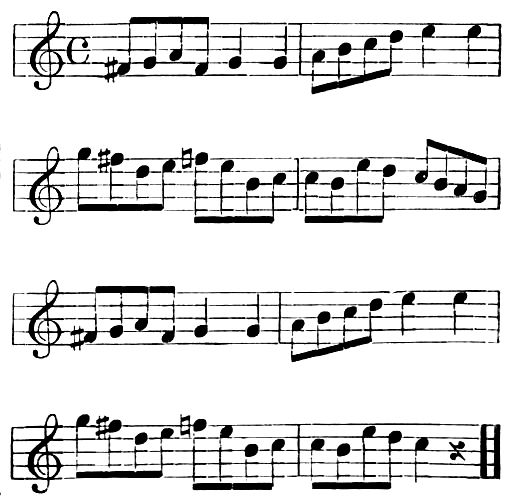
[See larger image]
[Listen]
DOCTOR ——
A Rabbi told me: On the day allowed Satan for carping at God's rule, he came, Fresh from our earth, to brave the angel-crowd. "What is the fault now?" "This I find to blame: Many and various are the tongues below, Yet all agree in one speech, all proclaim "'Hell has no might to match what earth, can show: Death is the strongest-born of Hell, and yet Stronger than Death is a Bad Wife, we know.' "Is it a wonder if I fume and fret— Robbed of my rights, since Death am I, and mine The style of Strongest? Men pay Nature's debt "Because they must at my demand; decline To pay it henceforth surely men will please, Provided husbands with bad wives combine "To baffle Death. Judge between me and these!" "Thyself shalt judge. Descend to earth in shape Of mortal, marry, drain from froth to lees "The bitter draught, then see if thou escape Concluding, with men sorrowful and sage, A Bad Wife's strength Death's self in vain would ape!" How Satan entered on his pilgrimage, Conformed himself to earthly ordinance, Wived and played husband well from youth to age Intrepidly—I leave untold, advance Through many a married year until I reach A day when—of his father's countenance The very image, like him too in speech As well as thought and deed,—the union's fruit Attained maturity. "I needs must teach "My son a trade: but trade, such son to suit, Needs seeking after. He a man of war? Too cowardly! A lawyer wins repute— "Having to toil and moil, though—both which are Beyond this sluggard. There 's Divinity: No, that 's my own bread-winner—that be far "From my poor offspring! Physic? Ha, we 'll try If this be practicable. Where 's my wit? Asleep?—since, now I come to think ... Ay, ay! "Hither, my son! Exactly have I hit On a profession for thee. Medicus— Behold, thou art appointed! Yea, I spit "Upon thine eyes, bestow a virtue thus That henceforth not this human form I wear Shalt thou perceive alone, but—one of us "By privilege—thy fleshly sight shall bear Me in my spirit-person as I walk The world and take my prey appointed there. "Doctor once dubbed—what ignorance shall balk Thy march triumphant? Diagnose the gout As colic, and prescribe it cheese for chalk— "No matter! All 's one: cure shall come about And win thee wealth—fees paid with such a roar Of thanks and praise alike from lord and lout "As never stunned man's ears on earth before. 'How may this be?' Why, that 's my skeptic! Soon Truth will corrupt thee, soon thou doubt'st no more! "Why is it I bestow on thee the boon Of recognizing me the while I go Invisibly among men, morning, noon, "And night, from house to house, and—quick or slow— Take my appointed prey? They summon thee For help, suppose: obey the summons! so! "Enter, look round! Where 's Death? Know—I am he, Satan who work all evil: I who bring Pain to the patient in whate'er degree. "I, then, am there: first glance thine eye shall fling Will find me—whether distant or at hand, As I am free to do my spiriting. "At such mere first glance thou shalt understand Wherefore I reach no higher up the room Than door or window, when my form is scanned. "Howe'er friends' faces please to gather gloom, Bent o'er the sick,—howe'er himself desponds,— In such case Death is not the sufferer's doom. "Contrariwise, do friends rejoice my bonds Are broken, does the captive in his turn Crow 'Life shall conquer'? Nip these foolish fronds "Of hope a-sprout, if haply thou discern Me at the head—my victim's head, be sure! Forth now! This taught thee, little else to learn!" And forth he went. Folk heard him ask demure, "How do you style this ailment? (There he peeps, My father through the arras!) Sirs, the cure "Is plain as A B C! Experience steeps Blossoms of pennyroyal half an hour In sherris. Sumat!—Lo, how sound he sleeps— "The subject you presumed was past the power Of Galen to relieve!" Or else, "How 's this? Why call for help so tardily? Clouds lour "Portentously indeed, Sirs! (Naught 's amiss: He 's at the bed-foot merely.) Still, the storm May pass averted—not by quacks, I wis, "Like you, my masters! You, forsooth, perform A miracle? Stand, sciolists, aside! Blood, ne'er so cold, at ignorance grows warm!" Which boasting by result was justified, Big as might words be: whether drugged or left Drugless, the patient always lived, not died. Great the heir's gratitude, so nigh bereft Of all he prized in this world: sweet the smile Of disconcerted rivals: "Cure?—say, theft "From Nature in despite of Art—so style This off-hand kill-or-cure work! You did much, I had done more: folk cannot wait awhile!" But did the case change? was it—"Scarcely such The symptoms as to warrant our recourse To your skill, Doctor! Yet since just a touch "Of pulse, a taste of breath, has all the force With you of long investigation claimed By others,—tracks an ailment to its source "Intuitively,—may we ask unblamed What from this pimple you prognosticate?" "Death!" was the answer, as he saw and named The coucher by the sick man's head. "Too late You send for my assistance. I am bold Only by Nature's leave, and bow to Fate! "Besides, you have my rivals: lavish gold! How comfortably quick shall life depart Cosseted by attentions manifold! "One day, one hour ago, perchance my art Had done some service. Since you have yourselves Chosen—before the horse—to put the cart, "Why, Sirs, the sooner that the sexton delves Your patient's grave the better! How you stare —Shallow, for all the deep books on your shelves! "Fare you well, fumblers!" Do I need declare What name and fame, what riches recompensed The Doctor's practice? Never anywhere Such an adept as daily evidenced Each new vaticination! Oh, not he Like dolts who dallied with their scruples, fenced With subterfuge, nor gave out frank and free Something decisive! If he said "I save The patient," saved he was: if "Death will be "His portion," you might count him dead. Thus brave, Behold our worthy, sans competitor Throughout the country, on the architrave Of Glory's temple golden-lettered for Machaon redivivus! So, it fell That, of a sudden, when the Emperor Was smit by sore disease, I need not tell If any other Doctor's aid was sought To come and forthwith make the sick Prince well. "He will reward thee as a monarch ought. Not much imports the malady; but then, He clings to life and cries like one distraught "For thee—who, from a simple citizen, Mayst look to rise in rank,—nay, haply wear A medal with his portrait,—always when "Recovery is quite accomplished. There! Pass to the presence!" Hardly has he crossed The chamber's threshold when he halts, aware Of who stands sentry by the head. All 's lost. "Sire, naught avails my art: you near the goal, And end the race by giving up the ghost." "How?" cried the monarch: "Names upon your roll Of half my subjects rescued by your skill— Old and young, rich and poor—crowd cheek by jowl "And yet no room for mine? Be saved I will! Why else am I earth's foremost potentate? Add me to these and take as fee your fill "Of gold—that point admits of no debate Between us: save me, as you can and must,— Gold, till your gown's pouch cracks beneath the weight!" This touched the Doctor. "Truly a home-thrust, Parent, you will not parry! Have I dared Entreat that you forego the meal of dust "—Man that is snake's meat—when I saw prepared Your daily portion? Never! Just this once, Go from his head, then,—let his life be spared!" Whisper met whisper in the gruff response; "Fool, I must have my prey: no inch I budge From where thou see'st me thus myself ensconce." "Ah," moaned the sufferer, "by thy look I judge Wealth fails to tempt thee: what if honors prove More efficacious? Naught to him I grudge "Who saves me. Only keep my head above The cloud that 's creeping round it—I 'll divide My empire with thee! No? What 's left but—love? "Does love allure thee? Well then, take as bride My only daughter, fair beyond belief! Save me—to-morrow shall the knot be tied!" "Father, you hear him! Respite ne'er so brief Is all I beg: go now and come again Next day, for aught I care: respect the grief "Mine will be if thy first-born sues in vain!" "Fool, I must have my prey!" was all he got In answer. But a fancy crossed his brain. "I have it! Sire, methinks a meteor shot Just now across the heavens and neutralized Jove's salutary influence: 'neath the blot "Plumb are you placed now: well that I surmised The cause of failure! Knaves, reverse the bed!" "Stay!" groaned the monarch, "I shall be capsized— "Jolt—jolt—my heels uplift where late my head Was lying—sure I 'm turned right round at last! What do you say now, Doctor?" Naught he said, For why? With one brisk leap the Antic passed From couch-foot back to pillow,—as before, Lord of the situation. Long aghast The Doctor gazed, then "Yet one trial more Is left me" inwardly he uttered. "Shame Upon thy flinty heart! Do I implore "This trifling favor in the idle name Of mercy to the moribund? I plead The cause of all thou dost affect: my aim "Befits my author! Why would I succeed? Simply that by success I may promote The growth of thy pet virtues—pride and greed. "But keep thy favors!—curse thee! I devote Henceforth my service to the other side. No time to lose: the rattle 's in his throat. "So,—not to leave one last resource untried,— Run to my house with all haste, somebody! Bring me that knobstick thence, so often plied "With profit by the astrologer—shall I Disdain its help, the mystic Jacob's-Staff? Sire, do but have the courage not to die "Till this arrive! Let none of you dare laugh! Though rugged its exterior, I have seen That implement work wonders, send the chaff "Quick and thick flying from the wheat—I mean, By metaphor, a human sheaf it threshed Flail-like. Go fetch it! Or—a word between Just you and me, friend!—go bid, unabashed, My mother, whom you 'll find there, bring the stick Herself—herself, mind!" Out the lackey dashed Zealous upon the errand. Craft and trick Are meat and drink to Satan: and he grinned —How else?—at an excuse so politic For failure: scarce would Jacob's-Staff rescind Fate's firm decree! And ever as he neared The agonizing one, his breath like wind Froze to the marrow, while his eye-flash seared Sense in the brain up: closelier and more close Pressing his prey, when at the door appeared —Who but his Wife the Bad? Whereof one dose, One grain, one mite of the medicament, Sufficed him. Up he sprang. One word, too gross To soil my lips with,—and through ceiling went Somehow the Husband. "That a storm 's dispersed We know for certain by the sulphury scent! "Hail to the Doctor! Who but one so versed In all Dame Nature's secrets had prescribed The staff thus opportunely? Style him first "And foremost of physicians!" "I've imbibed Elixir surely," smiled the prince,—"have gained New lease of life. Dear Doctor, how you bribed "Death to forego me, boots not: you 've obtained My daughter and her dowry. Death, I 've heard, Was still on earth the strongest power that reigned, "Except a Bad Wife!" Whereunto demurred Nowise the Doctor, so refused the fee —No dowry, no bad wife! "You think absurd This tale?"—the Rabbi added: "True, our Talmud Boasts sundry such: yet—have our elders erred In thinking there 's some water there, not all mud?" I tell it, as the Rabbi told it me.
PAN AND LUNA
Si credere dignum est.—Georgic, III. 390.
Oh, worthy of belief I hold it was, Virgil, your legend in those strange three lines! No question, that adventure came to pass One black night in Arcadia: yes, the pines, Mountains and valleys mingling made one mass Of black with void black heaven: the earth's confines, The sky's embrace,—below, above, around, All hardened into black without a bound. Fill up a swart stone chalice to the brim With fresh-squeezed yet fast-thickening poppy-juice: See how the sluggish jelly, late a-swim, Turns marble to the touch of who would loose The solid smooth, grown jet from rim to rim, By turning round the bowl! So night can fuse Earth with her all-comprising sky. No less. Light, the least spark, shows air and emptiness. And thus it proved when—diving into space, Stript of all vapor, from each web of mist Utterly film-free—entered on her race The naked Moon, full-orbed antagonist Of night and dark, night's dowry: peak to base, Upstarted mountains, and each valley, kissed To sudden life, lay silver-bright: in air Flew she revealed, Maid-Moon with limbs all bare. Still as she fled, each depth—where refuge seemed— Opening a lone pale chamber, left distinct Those limbs: 'mid still-retreating blue, she teemed Herself with whiteness,—virginal, uncinct By any halo save what finely gleamed To outline not disguise her: heaven was linked In one accord with earth to quaff the joy, Drain beauty to the dregs without alloy. Whereof she grew aware. What help? When, lo, A succorable cloud with sleep lay dense: Some pinetree-top had caught it sailing slow, And tethered for a prize: in evidence Captive lay fleece on fleece of piled-up snow Drowsily patient: flake-heaped how or whence, The structure of that succorable cloud, What matter? Shamed she plunged into its shroud. Orbed—so the woman-figure poets call Because of rounds on rounds—that apple-shaped Head which its hair binds close into a ball Each side the curving ears—that pure undraped Pout of the sister paps—that ... Once for all, Say—her consummate circle thus escaped With its innumerous circlets, sank absorbed, Safe in the cloud—O naked Moon full-orbed! But what means this? The downy swathes combine, Conglobe, the smothery coy-caressing stuff Curdles about her! Vain each twist and twine Those lithe limbs try, encroached on by a fluff Fitting as close as fits the dented spine Its flexible ivory outside-flesh: enough! The plumy drifts contract, condense, constringe, Till she is swallowed by the feathery springe. As when a pearl slips lost in the thin foam Churned on a sea-shore, and, o'er-frothed, conceits Herself safe-housed in Amphitrite's dome,— If, through the bladdery wave-worked yeast, she meets What most she loathes and leaps from,—elf from gnome No gladlier,—finds that safest of retreats Bubble about a treacherous hand wide ope To grasp her—(divers who pick pearls so grope)— So lay this Maid-Moon clasped around and caught By rough red Pan, the god of all that tract: He it was schemed the snare thus subtly wrought With simulated earth-breath,—wool-tufts packed Into a billowy wrappage. Sheep far-sought For spotless shearings yield such: take the fact As learned Virgil gives it,—how the breed Whitens itself forever: yes, indeed! If one forefather ram, though pure as chalk From tinge on fleece, should still display a tongue Black 'neath the beast's moist palate, prompt men balk The propagating plague: he gets no young: They rather slay him,—sell his hide to calk Ships with, first steeped in pitch,—nor hands are wrung In sorrow for his fate: protected thus, The purity we love is gained for us. So did Girl-Moon, by just her attribute Of unmatched modesty betrayed, lie trapped, Bruised to the breast of Pan, half god half brute, Raked by his bristly boar-sward while he lapped —Never say, kissed her! that were to pollute Love's language—which moreover proves unapt To tell now she recoiled—as who finds thorns Where she sought flowers—when, feeling, she touched—horns! Then—does the legend say?—first moon-eclipse Happened, first swooning-fit which puzzled sore The early sages? Is that why she dips Into the dark, a minute and no more, Only so long as serves her while she rips The cloud's womb through and, faultless as before, Pursues her way? No lesson for a maid Left she, a maid herself thus trapped, betrayed? Ha, Virgil? Tell the rest, you! "To the deep Of his domain the wildwood, Pan forthwith Called her, and so she followed"—in her sleep, Surely?—"by no means spurning him." The myth Explain who may! Let all else go, I keep —As of a ruin just a monolith— Thus much, one verse of five words, each a boon: Arcadia, night, a cloud, Pan, and the moon.
The first ten lines that follow were printed as epilogue to the second series of Dramatic Idyls; the second ten were added to them by Browning in the album of a young American girl in Venice, October, 1880. See The Century for November, 1882.
"Touch him ne'er so lightly, into song he broke: Soil so quick-receptive,—not one feather-seed, Not one flower-dust fell but straight its fall awoke Vitalizing virtue: song would song succeed Sudden as spontaneous—prove a poet-soul!" Indeed? Rock's the song-soil rather, surface hard and bare: Sun and dew their mildness, storm and frost their rage Vainly both expend,—few flowers awaken there: Quiet in its cleft broods—what the after-age Knows and names a pine, a nation's heritage. Thus I wrote in London, musing on my betters, Poets dead and gone; and lo, the critics cried, "Out on such a boast!" as if I dreamed that fetters Binding Dante bind up—me! as if true pride Were not also humble! So I smiled and sighed As I oped your book in Venice this bright morning, Sweet new friend of mine! and felt the clay or sand, Whatsoe'er my soil be, break—for praise or scorning— Out in grateful fancies—weeds; but weeds expand Almost into flowers, held by such a kindly hand.
THE BLIND MAN TO THE MAIDEN
Browning translated the following from a German poem in Wilhelmine von Hillern's novel The Hour Will Come at the request of Mrs. Clara Bell, the translator of the novel. It there appeared as the work of an anonymous friend, but was reprinted as Browning's in The Whitehall Review for March 1, 1883.
The blind man to the maiden said, "O thou of hearts the truest, Thy countenance is hid from me; Let not my question anger thee! Speak, though in words the fewest. "Tell me, what kind of eyes are thine? Dark eyes, or light ones rather?" "My eyes are a decided brown— So much, at least, by looking down, From the brook's glass I gather." "And is it red—thy little month? That too the blind must care for." "Ah! I would tell it soon to thee, Only—none yet has told it me. I cannot answer, therefore. "But dost thou ask what heart I have— There hesitate I never. In thine own breast 't is borne, and so 'T is thine in weal, and thine in woe, For life, for death—thine ever!"
GOLDONI
The following sonnet was written by Browning for the album of the Committee of the Goldoni monument, erected in Venice in 1883.
Goldoni—good, gay, sunniest of souls,— Glassing half Venice in that verse of thine,— What though it just reflect the shade and shine Of common life, nor render, as it rolls, Grandeur and gloom? Sufficient for thy shoals Was Carnival; Parini's depths enshrine Secrets unsuited to that opaline Surface of things which laughs along thy scrolls. There throng the people: how they come and go, Lisp the soft language, flaunt the bright garb,—see,— On Piazza, Calle, under Portico And over Bridge! Dear king of Comedy, Be honored! thou that didst love Venice so, Venice, and we who love her, all love thee! Venice, November 27, 1883.