ACT V Scene I. Whitehall.
Reading edition
Hollis, Lady Carlisle. Hol. Tell the King then! Come in with me! Lady Car. Not so! He must not hear till it succeeds. Hol. Succeed? No dream was half so vain—you 'd rescue Strafford And outwit Pym! I cannot tell you ... lady, The block pursues me, and the hideous show. To-day ... is it to-day? And all the while He 's sure of the King's pardon. Think, I have To tell this man he is to die. The King May rend his hair, for me! I 'll not see Strafford. Lady Car. Only, if I succeed, remember—Charles Has saved him. He would hardly value life Unless his gift. My stanch friends wait. Go in— You must go in to Charles! Hol. And all beside Left Stafford long ago. The King has signed The warrant for his death! the Queen was sick Of the eternal subject. For the Court,— The Trial was amusing in its way, Only too much of it: the Earl withdrew In time. But you, fragile, alone, so young, Amid rude mercenaries—you devise A plan to save him! Even though it fails, What shall reward you! Lady Car. I may go, you think, To France with him? And you reward me, friend, Who lived with Strafford even from his youth Before he set his heart on state-affairs And they bent down that noble brow of his. I have learned somewhat of his latter life, And all the future I shall know: but, Hollis, I ought to make his youth my own as well. Tell me,—when he is saved! Hol. My gentle friend, He should know all and love you, but 't is vain! Lady Car. Love? no—too late now! Let him love the King! 'Tis the King's scheme! I have your word, remember! We 'll keep the old delusion up. But, quick! Quick! Each of us has work to do, beside! Go to the King! I hope—Hollis—I hope! Say nothing of my scheme! Hush, while we speak Think where he is! Now for my gallant friends! Hol. Where he is? Calling wildly upon Charles, Guessing his fate, pacing the prison-floor. Let the King tell him! I 'll not look on Strafford.
Scene II. The Tower.
Strafford sitting with his Children. They sing. O bell' andare Per barca in mare, Verso la sera Di Primavera!
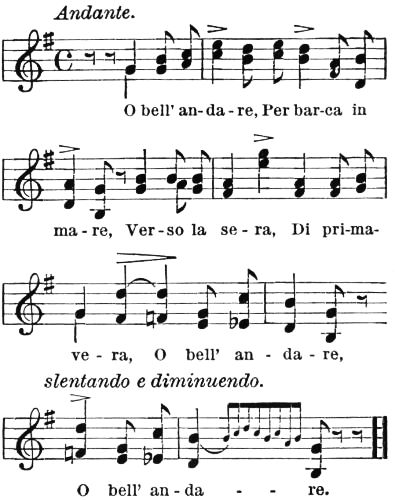
[See larger image]
[Listen]
William. The boat 's in the broad moonlight all this while— Verso la sera Di Primavera! And the boat shoots from underneath the moon Into the shadowy distance; only still You hear the dipping oar— Verso la sera, And faint, and fainter, and then all 's quite gone, Music and light and all, like a lost star. Anne. But you should sleep, father: you were to sleep. Straf. I do sleep, Anne; or if not—you must know There 's such a thing as ... Wil. You 're too tired to sleep? Straf. It will come by-and-by and all day long, In that old quiet house I told you of: We sleep safe there. Anne. Why not in Ireland? Straf. No! Too many dreams!—That song 's for Venice, William: You know how Venice looks upon the map— Isles that the mainland hardly can let go? Wil. You 've been to Venice, father? Straf. I was young, then. Wil. A city with no King; that 's why I like Even a song that comes from Venice. Straf. William? Wil. Oh, I know why! Anne, do you love the King? But I 'll see Venice for myself one day. Straf. See many lands, boy—England last of all,— That way you 'll love her best. Wil. Why do men say You sought to ruin her, then? Straf. Ah,—they say that. Wil. Why? Straf. I suppose they must have words to say, As you to sing. Anne. But they make songs beside: Last night I heard one, in the street beneath, That called you ... Oh, the names! Wil. Don't mind her, father! They soon left off when I cried out to them. Straf. We shall so soon be out of it, my boy! 'T is not worth while: who heeds a foolish song? Wil. Why, not the King. Straf. Well: it has been the fate Of better; and yet,—wherefore not feel sure That Time, who in the twilight comes to mend All the fantastic day's caprice, consign To the low ground once more the ignoble Term, And raise the Genius on his orb again,— That Time will do me right? Anne. (Shall we sing, William? He does not look thus when we sing.) Straf. For Ireland, Something is done: too little, but enough To show what might have been. Wil. (I have no heart To sing now! Anne, how very sad he looks! Oh, I so hate the King for all he says!) Straf. Forsook them? What, the common songs will run That I forsook the People? Nothing more? Ay, Fame, the busy scribe, will pause, no doubt, Turning a deaf ear to her thousand slaves Noisy to be enrolled,—will register The curious glosses, subtle notices, Ingenious clearings-up one fain would see Beside that plain inscription of The Name— The Patriot Pym, or the Apostate Strafford! [The Children resume their song timidly, but break off. (Enter Hollis and an Attendant.) Straf. No,—Hollis? in good time!—Who is he? Hol. One That must be present. Straf. Ah—I understand. They will not let me see poor Laud alone. How politic! They 'd use me by degrees To solitude: and, just as you came in, I was solicitous what life to lead When Strafford 's "not so much as Constable In the King's service." Is there any means To keep one's self awake? What would you do After this bustle, Hollis, in my place? Hol. Strafford! Straf. Observe, not but that Pym and you Will find me news enough—news I shall hear Under a quince-tree by a fish-pond side At Wentworth. Garrard must be re-engaged My newsman. Or, a better project now— What if when all 's consummated, and the Saints Reign, and the Senate's work goes swimingly,— What if I venture up, some day, unseen, To saunter through the Town, notice how Pym, Your Tribune, likes Whitehall, drop quietly Into a tavern, hear a point discussed, As, whether Strafford's name were John or James— And be myself appealed to—I, who shall Myself have near forgotten! Hol. I would speak ... Straf. Then you shall speak,—not now. I want just now, To hear the sound of my own tongue. This place Is full of ghosts. Hol. Nay, you must hear me, Strafford! Straf. Oh, readily! Only, one rare thing more,— The minister! Who will advise the King, Turn his Sejanus, Richelieu and what not, And yet have health—children, for aught I know— My patient pair of traitors! Ah,—but, William— Does not his cheek grow thin? Wil. 'T is you look thin, Father! Straf. A scamper o'er the breezy wolds Sets all to-rights. Hol. You cannot sure forget A prison-roof is o'er you, Strafford? Straf. No, Why, no. I would not touch on that, the first. I left you that. Well, Hollis? Say at once, The King can find no time to set me free! A mask at Theobald's? Hol. Hold: no such affair Detains him. Straf. True: what needs so great a matter? The Queen's lip may be sore. Well: when he pleases,— Only, I want the air: it vexes flesh To be pent up so long. Hol. The King—I bear His message, Strafford: pray you, let me speak! Straf. Go, William! Anne, try o'er your song again! [The Children retire. They shall be loyal, friend, at all events. I know your message: you have nothing new To tell me: from the first I guessed as much. I know, instead of coming here himself, Leading me forth in public by the hand, The King prefers to leave the door ajar As though I were escaping—bids me trudge While the mob gapes upon some show prepared On the other side of the river! Give at once His order of release! I 've heard, as well, Of certain poor manœuvres to avoid The granting pardon at his proper risk; First, he must prattle somewhat to the Lords, Must talk a trifle with the Commons first, Be grieved I should abuse his confidence, And far from blaming them, and ... Where 's the order? Hol. Spare me! Straf. Why, he 'd not have me steal away? With an old doublet and a steeple hat Like Prynne's? Be smuggled into France, perhaps? Hollis, 't is for my children! 'T was for them I first consented to stand day by day And give your Puritans the best of words, Be patient, speak when called upon, observe Their rules, and not return them prompt their lie! What 's in that boy of mine that he should prove Son to a prison-breaker? I shall stay And he 'll stay with me. Charles should know as much, He too has children! [Turning to Hollis's companion.] Sir, you feel for me! No need to hide that face! Though it have looked Upon me from the judgment-seat ... I know Strangely, that somewhere it has looked on me ... Your coming has my pardon, nay, my thanks: For there is one who comes not. Hol. Whom forgive, As one to die! Straf. True, all die, and all need Forgiveness: I forgive him from my soul. Hol. 'T is a world's wonder: Strafford, you must die! Straf. Sir, if your errand is to set me free This heartless jest mars much. Ha! Tears in truth? We 'll end this! See this paper, warm—feel—warm With lying next my heart! Whose hand is there? Whose promise? Read, and loud for God to hear! "Strafford shall take no hurt"—read it, I say! "In person, honor, nor estate"— Hol. The King ... Straf. I could unking him by a breath! You sit Where Loudon sat, who came to prophesy The certain end, and offer me Pym's grace If I 'd renounce the King: and I stood firm On the King's faith. The King who lives ... Hol. To sign The warrant for your death. Straf. "Put not your trust In princes, neither in the sons of men, In whom is no salvation!" Hol. Trust in God! The scaffold is prepared: they wait for you: He has consented. Cast the earth behind! Cha. You would not see me, Strafford, at your foot! It was wrung from me! Only, curse me not! Hol. [To Strafford.] As you hope grace and pardon in your need, Be merciful to this most wretched man. [Voices from within. Verso la sera Di Primavera. Straf. You 'll be good to those children, sir? I know You 'll not believe her, even should the Queen Think they take after one they rarely saw. I had intended that my son should live A stranger to these matters: but you are So utterly deprived of friends! He too Must serve you—will you not be good to him? Or, stay, sir, do not promise—do not swear! You, Hollis—do the best you can for me! I 've not a soul to trust to: Wandesford 's dead, And you 've got Radcliffe safe, Laud's turn comes next: I 've found small time of late for my affairs, But I trust any of you, Pym himself— No one could hurt them: there 's an infant, too,— These tedious cares! Your Majesty could spare them. Nay—pardon me, my King! I had forgotten Your education, trials, much temptation, Some weakness: there escaped a peevish word— 'T is gone: I bless you at the last. You know All 's between you and me: what has the world To do with it? Farewell! Cha. [at the door.] Balfour! Balfour! (Enter Balfour.) The Parliament!—go to them: I grant all Demands. Their sittings shall be permanent: Tell them to keep their money if they will: I 'll come to them for every coat I wear And every crust I eat: only I choose To pardon Strafford. As the Queen shall choose! —You never heard the People howl for blood, Beside! Balfour. Your Majesty may hear them now: The walls can hardly keep their murmurs out: Please you retire! Cha. Take all the troops, Balfour! Bal. There are some hundred thousand of the crowd. Cha. Come with me, Strafford! You 'll not fear, at least! Straf. Balfour, say nothing to the world of this! I charge you, as a dying man, forget You gazed upon this agony of one ... Of one ... or if ... why, you may say, Balfour, The King was sorry: 'tis no shame in him: Yes, you may say he even wept, Balfour, And that I walked the lighter to the block Because of it. I shall walk lightly, sir! Earth fades, heaven breaks on me: I shall stand next Before God's throne: the moment 's close at hand When man the first, last time, has leave to lay His whole heart bare before its Maker, leave To clear up the long error of a life And choose one happiness for evermore. With all mortality about me, Charles, The sudden wreck, the dregs of violent death— What if, despite the opening angel-song, There penetrate one prayer for you? Be saved Through me! Bear witness, no one could prevent My death! Lead on! ere he awake—best, now! All must be ready: did you say, Balfour, The crowd began to murmur? They 'll be kept Too late for sermon at St. Antholin's! Now! But tread softly—children are at play In the next room. Precede! I follow— (Enter Lady Carlisle, with many Attendants.) Lady Car Me! Follow me, Strafford, and be saved! The King? [To the King.] Well—as you ordered, they are ranged without, The convoy ... [seeing the King's state.] [To Strafford.] You know all, then! Why, I thought It looked best that the King should save you,—Charles Alone; 't is a shame that you should owe me aught. Or no, not shame! Strafford, you 'll not feel shame At being saved by me? Hol. All true! Oh Strafford, She saves you! all her deed! this lady's deed! And is the boat in readiness? You, friend, Are Billingsley, no doubt. Speak to her, Strafford! See how she trembles, waiting for your voice! The world 's to learn its bravest story yet. Lady Car. Talk afterward! Long nights in France enough, To sit beneath the vines and talk of home. Straf. You love me, child? Ah, Strafford can be loved As well as Vane! I could escape, then? Lady Car. Haste! Advance the torches, Bryan! Straf. I will die. They call me proud: but England had no right, When she encountered me—her strength to mine— To find the chosen foe a craven. Girl, I fought her to the utterance, I fell, I am hers now, and I will die. Beside, The lookers-on! Eliot is all about This place, with his most uncomplaining brow. Lady Car. Strafford! Straf. I think if you could know how much I love you, you would be repaid, my friend! Lady Car. Then, for my sake! Straf. Even for your sweet sake, I stay. Hol. For their sake! Straf. To bequeath a stain? Leave me! Girl, humor me and let me die! Lady Car. Bid him escape—wake, King! Bid him escape! Straf. True, I will go! Die and forsake the King? I 'll not draw back from the last service. Lady Car. Strafford! Straf. And, after all, what is disgrace to me? Let us come, child! That it should end this way! Lead then! but I feel strangely: it was not To end this way. Lady Car. Lean—lean on me! Straf. My King! Oh, had he trusted me—his friend of friends! Lady Car. I can support him, Hollis! Straf. Not this way! This gate—I dreamed of it, this very gate. Lady Car. It opens on the river: our good boat Is moored below, our friends are there. Straf. The same: Only with something ominous and dark, Fatal, inevitable. Lady Car. Strafford! Strafford! Straf. Not by this gate! I feel what will be there! I dreamed of it, I tell you: touch it not! Lady Car. To save the King,—Strafford, to save the King! [As Strafford opens the door, Pym is discovered with Hampden, Vane, etc. Strafford falls back: Pym follows slowly and confronts him. Pym. Have I done well? Speak, England! Whose sole sake I still have labored for, with disregard To my own heart,—for whom my youth was made Barren, my manhood waste, to offer up Her sacrifice—this friend, this Wentworth here— Who walked in youth with me, loved me, it may be, And whom, for his forsaking England's cause, I hunted by all means (trusting that she Would sanctify all means) even to the block Which waits for him. And saying this, I feel No bitterer pang than first I felt, the hour I swore that Wentworth might leave us, but I Would never leave him: I do leave him now. I render up my charge (be witness, God!) To England who imposed it. I have done Her bidding—poorly, wrongly,—it may be, With ill effects—for I am weak, a man: Still, I have done my best, my human best, Not faltering for a moment. It is done. And this said, if I say ... yes, I will say I never loved but one man—David not More Jonathan! Even thus, I love him now And look for my chief portion in that world Where great hearts led astray are turned again, (Soon it may be, and, certes, will be soon: My mission over, I shall not live long,)— Ay, here I know I talk—I dare and must, Of England, and her great reward, as all I look for there; but in my inmost heart, Believe, I think of stealing quite away To walk once more with Wentworth—my youth's friend Purged from all error, gloriously renewed, And Eliot shall not blame us. Then indeed ... This is no meeting, Wentworth! Tears increase Too hot. A thin mist—is it blood?—enwraps The face I loved once. Then, the meeting be! Straf. I have loved England too; we 'll meet then, Pym; As well die now! Youth is the only time To think and to decide on a great course: Manhood with action follows; but 'tis dreary To have to alter our whole life in age— The time past, the strength gone! As well die now. When we meet, Pym, I 'd be set right—not now! Best die. Then if there 's any fault, fault too Dies, smothered up. Poor gray old little Laud May dream his dream out, of a perfect Church, In some blind corner. And there 's no one left. I trust the King now wholly to you, Pym! And yet, I know not: I shall not be there: Friends fail—if he have any. And he 's weak, And loves the Queen, and ... Oh, my fate is nothing— Nothing! But not that awful head—not that! Pym. If England shall declare such will to me ... Straf. Pym, you help England! I, that am to die, What I must see! 'tis here—all here! My God, Let me but gasp out, in one word of fire, How thou wilt plague him, satiating hell! What? England that you help, become through you A green and putrefying charnel, left Our children ... some of us have children, Pym— Some who, without that, still must ever wear A darkened brow, an over-serious look, And never properly be young! No word? What if I curse you? Send a strong curse forth Clothed from my heart, lapped round with horror till She 's fit with her white face to walk the world Scaring kind natures from your cause and you— Then to sit down with you at the board-head, The gathering for prayer ... O speak, but speak! ... Creep up, and quietly follow each one home, You, you, you, be a nestling care for each To sleep with,—hardly moaning in his dreams, She gnaws so quietly,—till, lo he starts, Gets off with half a heart eaten away! Oh, shall you 'scape with less if she 's my child? You will not say a word—to me—to Him? Pym. If England shall declare such will to me ... Straf. No, not for England now, not for Heaven now,— See, Pym, for my sake, mine who kneel to you! There, I will thank you for the death, my friend! This is the meeting: let me love you well! Pym. England,—I am thine own! Dost thou exact That service? I obey thee to the end. Straf. O God, I shall die first—I shall die first!