THE COMIC ALMANACK For 1843.
Reading edition
346
OH! LAW!
There never were such times as these! A barrister could once, with ease, have got as many fees, by merely signing pleas, as would have given him something more than bread and cheese; but destiny's decrees have made it feasible no more to get such fees; and if the lawyers please to live, they can no longer live by pleas.
Those days, alas! are flown, when seeds of litigation, shrewdly sown, were very often known, not through a single life alone to have thriven and grown, but to have reach'd the state that's call'd full blown, in time for the attorney's son to make the crop his own. But now the lawyers are thrown over—the system's overthrown.
The common law is common now no more; full many a clause in Acts of Parliament has clipped its claw. The time is o'er, when, for an hour, one could jaw about the spelling of the man who did the indictment draw, and whose mistake, or clerical faux paw, had floored poor ill-used justice by a literal flaw.
If Eldon now could rise and see the changes made since he would doubt and disagree e'en with his own decree, what would the great man's feelings be? He'd say this seems not like the Court of Chanceree, in whose old customs I had hoped that we had an estate in fee; such suits as these would not have suited me!
Oh! who would once have dared to dream that judges could have worked by steam? Although, without a joke, justice would very often end in smoke; and, from the speeches still preserved on paper, we find that legal eloquence was often only vapour; while law itself contained, as it would seem, the element and principle of steam; for those who ever had a bout of it, found it hot water, and were very glad when they got out of it. Mechanics' principles the lawyers knew, and made amazing use of two—the wedge and screw! But of the third, in early legal cases, there is little heard; for though to scientific men of old the lever was well known, as we are told, the lawyers seem to have refused it, or never used it. The lever they despised; at least we find them not leaving anything they could take behind them! But it is also thought some early barristers so often moved in court, that they had something like a notion of coming to perpetual motion.
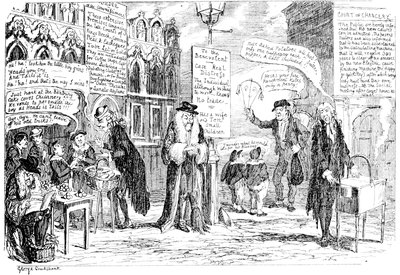
Oh, Law!
347
A LAW REPORT.
Doe on the demise of Roe, versus Roe on the demise of Doe.
This was a case of ejectment. Gabble (Q.C.) for plaintiff.—"This is a clear case of ouster (Shower, 2); but if the tenant in possession disputes the title of tenant in tail, he cannot plead laches (Campbell, 1)." In this case the remainder man was regularly let in, but the widow cannot now claim dower (Blackstone, 3). Suppose the mortgagee had been anxious to foreclose, then plaintiff must have been guided by the rule in Shelly's case (Adolphus and Ellis, 6.) Here there is nothing of the kind. If defendant takes anything, it is in the character of tenant in reversion after the possibility of issue extinct (Shower, 1).
Thumpus (Serjeant) contra.—Doe takes only a chattel interest, or, at most, a base fee (Taunton, 6). The court must presume that the outstanding term is satisfied (East, 6). The rule is not now as Coke laid it down, for Mansfield (C. J.) declined taking it up. This is a case of common ouster. Doe walked in as trustee, and was kicked out in tail. There is no relief for him at common law (Bracton). The door was shut upon him by defendant's son, and the parent is not answerable for the act of the boy (Chitty). Judgment was now delivered by the court.
Mither (C.J.)—This is an uncommon case. Doe was never regularly in, nor was Roe regularly out. Both took as devisees of the same testator. The case in Shower cannot guide us here, though the rule laid down has been recognised. I do not think there is much in the objection to the widow's claim of dower, though I see I have got it upon my notes. A mortgagee may suffer by laches, but then the defendant should have pleaded the tort. There is nothing of this on the record, and the verdict must go accordingly.
Puny (J.)—I am of the same opinion. My brother Thumpus has referred us to Bracton. I know the point in Bracton, and have decided it twice the other way. But here I think the rule in Shelly's case comes in and carries the verdict.
Twaddle (J.)—There are four points in this case; three of them amounted to nothing, and the fourth has been conceded. The laches ought to have appeared on the pleadings. There cannot be a use upon a use (Sanders), but a trustee may take by the common law, which the statute, Jac. II., c. 14, did not interfere with. The provisions of the act removed much abuse, and the eighty-fourth is a particularly wholesome section. Here these questions do not arise, and, as the rule is clear, the verdict must follow it.
Shiver (J.)—I am of the same opinion.
348
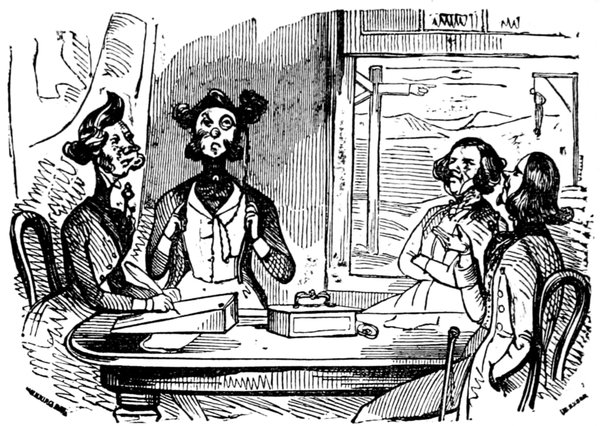
(Gentlemen in the Direction.)
LONDON AND UNIVERSAL DEPOSIT ASSOCIATION.
Time of taking in, ten to four. Drawing out, ten to one.
Wanted some fine young men, without delay,
To carry boards about the street,
And pop into the board-room once a day,
As shareholders, to muster a display,
When the directors meet.
It is expected all will be quite willing
To take a share for which they'll pay a shilling.
All those who don't object to taking more
Will profit in a very high degree;
And any one who purchases a score
Becomes vice-president and life trustee.
To each vice-president, besides his pay
Of eighteen-pence a day
Which is of all deductions clear
There is allowed a pot of beer.
The company beg to propose a job,
That is adapted well to any single swell,
Or may be undertaken by the mob.
In plainer terms to speak, there is a meeting once a week,
At which it is advisable to muster,
Of flashy-looking gentlemen, a cluster.
A liberal price to any one who brings
Of gold, of course mosaic, a display;
But there is some reduction in the pay,
When the Directors find pins, chains, and rings.
Immediate application is required
From those by whom employment is desired;
Because the company will soon begin
To take Shareholders and deposits in.
And there is very little doubt,
That when the time arrives for drawing out,
The company, by some strange antic,
Will be removed across the Atlantic.
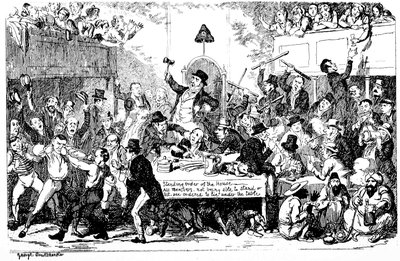
The Charter—A Common's Scene.
349