THE COMIC ALMANACK For 1840.
Reading edition
208
JANUARY. [1840.
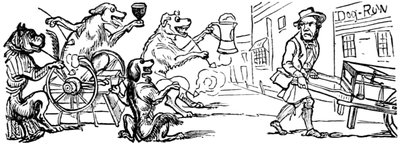
JOLLY DOGS.—ABOLITION OF THE TRUCK SYSTEM.
WEATHER —— Nipping frosts and driving snows, Hill-usage thick-soled shoes and double-hose. Counter petition.
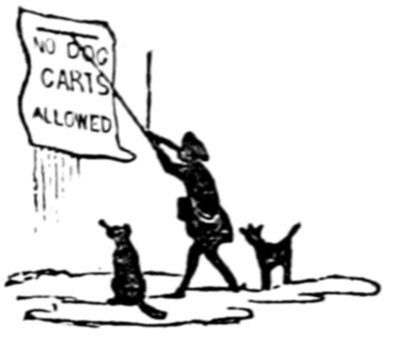
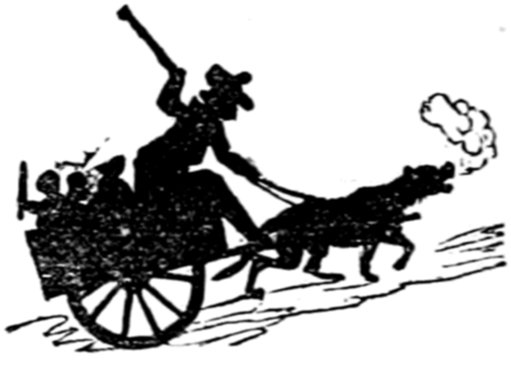
Well, blow me—here's a pretty go!
They'll only stop at ruination,
And bringing all our trade to woe,
For labouring in our just wocation.
Why this ere act's the cruel'st deed
That ever was devised to floor us;
Such as our ancasters ne'er seed,
Nor yet posterity afore us.
Its clean agen the nat'ral law
O' brute beasts, and of humane kind,
For surely dogs was made to draw,
And trucks was made to go behind.
And we was made to sit a-top,
And cut away in all our glory,
And if the lazy varmint stop,
To tell 'em jist another story.
But, dash my wigs—this pretty set,
With hearts as hard as any stone,
Wont let an honest feller whet
His lawful wengeance on his own.
No longer now up Highgate road
O' Sunday arternoons I gallop,
With all the brats, a tidy load,
And perhaps a neighbour's child to fill up.
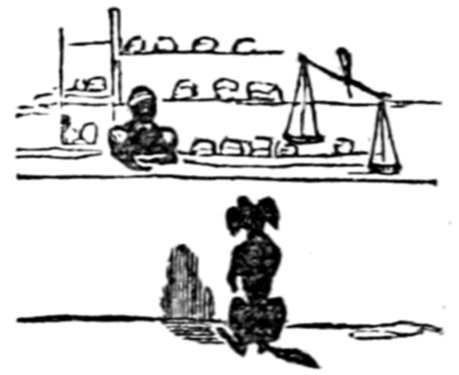
At Farringdon and Common Garden,
I'm fairly laid upon the shelf;
My only chance to earn a farden,
Is truckling to the truck myself.
But we'll resist this horrid plot,
And for our order boldly strive,
For this I know, that ours are not
The only ill-used dogs alive.
Let's not be down upon our luck,
Nor out of heart at our condition,
And since our dogs can't draw a truck,
At least we'll draw up a petition;
And lay our case before the Commons,
What keeps the money of the nation:
Perchance we'll get, like other rum 'uns,
An equitable compensation.
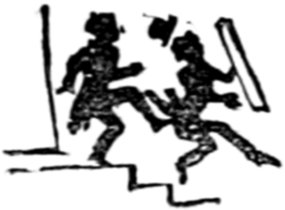
Ordered to be considered below.
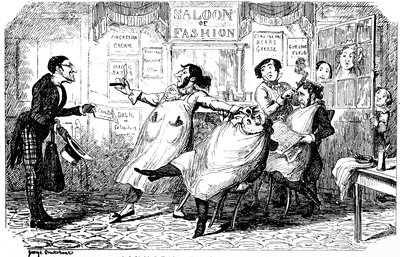
JANUARY:—The Announcement
209
BARBER COX, AND THE CUTTING OF HIS COMB. JANUARY.—The Announcement.
On the 1st of January, 1838, I was the master of a lovely shop in the neighbourhood of Oxford market; of a wife, Mrs. Cox; of a business, both in the shaving and cutting line, established three-and-thirty years; of a girl and boy respectively of the ages of eighteen and thirteen; of a three-windowed front, both to my first and second pair; of a young foreman, my present partner, Mr. Orlando Crump; and of that celebrated mixture for the human hair, invented by my late uncle, and called Cox's Bohemian Balsam of Tokay, sold in pots at two-and-three, and three-and-nine; the balsam, the lodgings, and the old-established cutting and shaving business, brought me in a pretty genteel income. I had had my girl, Jemimarann, at Hackney, to school; my dear boy, Tuggeridge, plaited hair already beautifully; my wife at the counter (behind the tray of patent soaps, &c.) cut as handsome a figure as possible; and it was my hope that Orlando and my girl, who were mighty soft upon one another, would, one day, be joined together in Hyming: and, conjointly with my son Tug, carry on the business of hairdressers, when their father was either dead or a gentleman; for a gentleman me and Mrs. C. determined I should be.
Jemima was, you see, a lady herself, and of very high connexions: though her own family had met with crosses, and was rather low. Mr. Tuggeridge, her father, kept the famous tripe-shop, near the Pigtail and Sparrow, in the Whitechapel Road, from which place I married her; being myself very fond of the article, and especially when she served it to me—the dear thing!
Jemima's father was not successful in business: and I married her, I am proud to confess it, without a shilling. I had my hands, my house, and my Bohemian balsam to support her!—and we had hopes from her uncle, a mighty rich East India merchant, who, having left this country sixty years ago, had arrived to be the head of a great house in India, and was worth millions, we were told.
Three years after Jemimarann's birth (and two after the death of my lamented father-in-law), Tuggeridge (head of the great house of Budgurow and Co.), retired from the management of it; handed over his shares to his son, Mr. John Tuggeridge, and came to live in England, at Portland Place and Tuggeridgeville, Surrey, and enjoy himself. Soon after, my wife took her daughter in her hand and went, as in duty bound, to visit her uncle; but whether it was that he was proud and surly, or she somewhat sharp in her way (the dear girl fears nobody, let me have you to know), a desperate quarrel took place between them; and from that day to the day of his death he never set eyes on her. All that he would condescend to do was to take a few dozen of lavender water from us in the course of the year, and to send his servants to be cut and shaved by us. All the neighbours laughed at this poor ending of our expectations, for Jemmy had bragged not a little; however, we did not care, for the connexion was always a good one, and we served Mr. Hock, the valet; Mr. Bar, the coachman; and Mrs. Breadbasket, the housekeeper, willingly enough. I used to powder the footman, too, on great days, but never in my life saw old Tuggeridge, except once; when he said, "O, the barber!" tossed up his nose, and passed on.
One day—one famous day last January—all our market was thrown into a high state of excitement by the appearance of no less than three vehicles at our establishment. As me, Jemmy, my daughter, Tug, and Orlando, were sitting in the back parlour over our dinner (it being Christmas time, Mr. Crump had treated the ladies to a bottle of port, and was longing that there should be a mistletoe bough; at which proposal my little Jemimarann looked as red as a glass of negus):—we had just, I say, finished the port, when, all of a sudden, Tug bellows out, "Law, pa, here's uncle Tuggeridge's housekeeper in a cab!"
And Mrs. Breadbasket it was, sure enough—Mrs. Breadbasket in deep mourning, who made her way, bowing and looking very sad, into the back shop. My wife, who respected Mrs. B. more than anything else in the world, set her a chair, offered her a glass of wine, and vowed it was very kind of her to come. "Law, mem," says Mrs. B., "I'm sure I'd do anything to serve your family, for the sake of that poor dear Tuck-Tuck-tug-guggeridge, that's gone."
210"That's what?" cries my wife.
"What, gone?" cried Jemimarann, bursting out crying (as little girls will about anything or nothing); and Orlando looking very rueful, and ready to cry too.
"Yes, gaw——" Just as she was at this very "gaw," Tug roars out, "Law pa! here's Mr. Bar, uncle Tug's coachman!"
It was Mr. Bar: when she saw him Mrs. Breadbasket stepped suddenly back into the parlour with my ladies. "What is it, Mr. Bar?" says I; and, as quick as thought, I had the towel under his chin, Mr. Bar in the chair, and the whole of his face in a beautiful foam of lather: Mr. Bar made some resistance. "Don't think of it, Mr. Cox," says he; "don't trouble yourself, sir;" but I lathered away and never minded. "And what's this melancholy event, sir," says I, "that has spread desolation in your family's bosoms? I can feel for your loss, sir—I can feel for your loss."
I said so out of politeness, because I served the family, not because Tuggeridge was my uncle—no, as such I disown him.
Mr. Bar was just about to speak. "Yes, sir," says he, "my master's gaw——" When at the "gaw" in walks Mr. Hock, the own man!—the finest gentleman I ever saw.
"What, you here, Mr. Bar?" says he.
"Yes, I am, sir; and haven't I a right, sir?"
"A mighty wet day, sir," says I to Mr. Hock, stepping up and making my bow. "A sad circumstance too, sir—and is it a turn of the tongs that you want to-day, sir? Ho, there! Mr. Crump!"
"Turn, Mr. Crump, if you please, sir," said Mr. Hock, making a bow; "but from you, sir, never, no never, split me!—and I wonder how some fellows can have the insolence to allow their MASTERS to shave them!" With this Mr. Hock flung himself down to be curled: Mr. Bar suddenly opened his mouth in order to reply; but, seeing there was a tiff between the gentlemen, and wanting to prevent a quarrel, I rammed the "Advertiser" into Mr. Hock's hands, and just popped my shaving brush into Mr. Bar's mouth—a capital way to stop angry answers.
Mr. Bar had hardly been in the chair a second, when whirr comes a hackney-coach to the door, from which springs a gentleman in a black coat with a bag.
"What, you here?" says the gentleman. I could not help smiling, for it seemed that everybody was to begin by saying, "What, you here?" "Your name is Cox, sir," says he; smiling, too, as the very pattern of mine. "My name, sir, is Sharpus—Blunt, Hone, and Sharpus, Middle Temple-lane,—and I am proud to salute you, sir; happy,—that is to say, sorry to say, that Mr. Tuggeridge, of Portland Place, is dead, and your lady is heiress, in consequence, to one of the handsomest properties in the kingdom."
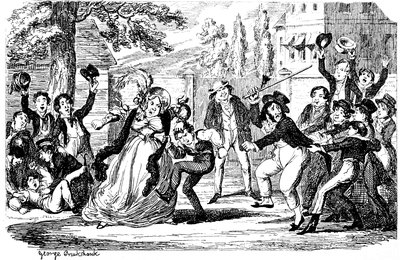
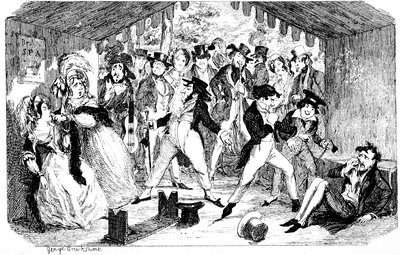
At this I started, and might have sunk to the ground, but for my hold of Mr. Bar's nose; Orlando seemed putrified to stone, with his irons fixed to Mr. Hock's head; our respective patients gave a wince out:—Mrs. C., Jemimarann, and Tug, rushed from the back shop, and we formed that splendid tableau which the great Cruikshank has here depicted!
"And Mr. John Tuggeridge, sir?" says I.
"Why—hee, hee, hee!" says Mr. Sharpus; "surely you know that he was only the—hee, hee, hee!—the natural son!"
You now can understand why the servants from Portland Place had been so eager to come to us: one of the housemaids heard Mr. Sharpus say there was no will, and that my wife was heir to the property, and not Mr. John Tuggeridge: this she told in the housekeeper's room; and off, as soon as they heard it, the whole party set, in order to be the first to bear the news.
We kept them, every one, in their old places; for, though my wife would have sent them about their business, my dear Jemimarann just hinted, "Mamma, you know they have been used to great houses, and we have not; had we not better keep them for a little?"—Keep them then, we did, to show us how to be gentlefolks.
I handed over the business to Mr. Crump without a single farthing of premium, though Jemmy would have made me take four hundred pounds for it; but this I was above: Crump had served me faithfully, and have the shop he should.
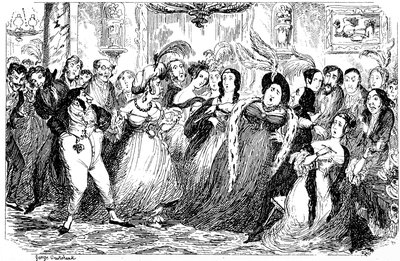
FEBRUARY.—First Rout
211
FEBRUARY. [1840.
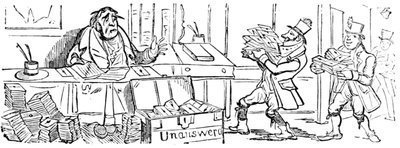
A PENNY POST-OBIT.
My dear Friend,—I write you this letter to explain to you why you have next to nothing to pay for it. The Government has settled the business; and the Chancellor of the Exchequer has resolved to set his revenue a going by the Post. We are to pay a penny for a letter, which is expected to have upon it the stamp of the Post Office, and of public approbation at the same time. I hardly think it will. Some of the community are looking dull about it already. There is a pence-ive air about the two—I beg pardon, the—one penny postmen, which strikes every one. They intimate that it is gammon to load a man with an additional hundredweight of paper, and to call that a reduction of public duty. It clearly affects people of that stamp; and the public surmise it may even touch the Newspapers. In short, they say that the Times will be quite altered by the Post. Ladies generally seem to like the idea, but there is a visible depression in the mails. Many a coachman has been thrown off his guard, and surprised into a most determined alteration of carriage. The Government will be a political mid-wife, engaged in an everlasting delivery. London is already afflicted with a metropolitan rheumatism, produced by the introduction of fresh draughts into passages, the carpenters having cut holes in all the street-doors. Sanguine people, however, retain their knockers, in the hope of getting the reward offered for the discovery of perpetual motion! They say there is to be an issue of more than a million of letters a day; but men are a little at issue about this. There must be some truth in it, however, as two thousand counters have been engaged,—one thousand to count them, and the other to count them upon. Sorters of all sorts are employed. At the Post Offices, at all hours, the pigeon holes will be surrounded by carriers. The poor fellows will be like muskets, perpetually going off. Rowland Hill has invented this scheme; but the postmen do not complain of him so much as of the other hills they must trudge over with their great bags of letters. The only district there is any contention for is Bag shot heath, once famous for highwaymen; they say, however, that we are all highwaymen now, and do nothing but make them "stand and deliver" from morning till night. Some mercantile quarrels have sprung out of the new regulation. For instance, there is a good deal of milling among the paper-makers. The march of paper will be prodigious—the French say we shall have none left, that it will be all papier marché! Men, women, and children are to write—right or wrong. Enjoinments to this duty—now the other duty is off—press from all quarters. "Be sure you send me plenty of notes," says the son, departing for College. "Write to me often, Billy, do," asks the affectionate mother of her school-going child. Love-letters, containing mutual pledges, will be popped into the post by thousands; and hearts gone passed redemption will be slipped recklessly through a hole in the door. It is uncertain whether orators will not cease spouting, and singers write the notes which they formerly would have uttered. Ironmongers are looking up—and forgery is going on famously—in consequence of the great demand for steam steal pens. Manifold-writers are quite exhausted. I confess, I do not like the system myself—as it's Hill's, it has its ills; any good in it will appear on an examination—
Post Mortem.
212
FEBRUARY.—First Rout.
We were speedily installed in our fine house: but what's a house without friends? Jemmy made me cut all my old acquaintances in the market, and I was a solitary being, when, luckily, an old acquaintance of ours, Captain Tagrag, was so kind as to promise to introduce us into distinguished society. Tagrag was the son of a baronet, and had done us the honour of lodging with us for two years; when we lost sight of him, and of his little account, too, by the way. A fortnight after, hearing of our good fortune, he was among us again, however; and Jemmy was not a little glad to see him, knowing him to be a baronet's son, and very fond of our Jemimarann; indeed, Orlando (who is as brave as a lion) had, on one occasion, absolutely beaten Mr. Tagrag for being rude to the poor girl; a clear proof, as Tagrag said afterwards, that he was always fond of her.
Mr. Crump, poor fellow, was not very much pleased by our good fortune, though he did all he could to try, at first; and I told him to come and take his dinner regular, as if nothing had happened. But to this Jemima very soon put a stop, for she came very justly to know her stature, and to look down on Crump, which she bid her daughter to do; and, after a great scene, in which Orlando showed himself very rude and angry, he was forbidden the house—for ever!
So much for poor Crump. The Captain was now all in all with us. "You see, sir," our Jemmy would say, "we shall have our town and country mansion, and a hundred and thirty thousand pounds in the funds to leave between our two children; and, with such prospects, they ought surely to have the first society of England." To this Tagrag agreed, and promised to bring us acquainted with the very pink of the fashion; ay, and what's more, did.
First, he made my wife get an opera-box, and give suppers on Tuesdays and Saturdays. As for me, he made me ride in the park; me and Jemimarann, with two grooms behind us, who used to laugh all the way, and whose very beards I had shaved. As for little Tug, he was sent straight off to the most fashionable school in the kingdom, the Rev. Doctor Pigney's, at Richmond.
Well, the horses, the suppers, the opera-box, the paragraphs in the papers about Mr. Coxe Coxe (that's the way, double your name, and stick an 'e' to the end of it, and you are a gentleman at once), had an effect in a wonderfully short space of time, and we began to get a very pretty society about us. Some of old Tug's friends swore they would do anything for the family, and brought their wives and daughters to see dear Mrs. Cox and her charming girl; and when, about the first week in February, we announced a grand dinner and ball, for the evening of the twenty-eighth, I assure you there was no want of company; no, nor of titles neither; and it always does my heart good even to hear one mentioned.
Let me see, there was, first, my Lord Dunbooze, an Irish peer, and his seven sons, the Honourable Messieurs Trumper (two only to dinner); there was Count Mace, the celebrated French nobleman, and his Excellency Baron Von Punter, from Baden; there was Lady Blanch Bluenose, the eminent literati, author of "The Distrusted," "The Distorted," "The Disgusted," "The Disreputable One," and other poems; there was the Dowager Lady Max, and her daughter, the Honourable Miss Adelaide Blueruin; Sir Charles Codshead, from the City; and Field-Marshal Sir Gorman O'Gallagher, K.A., K.B., K.C., K.W., K.X., in the service of the republic of Guatemala: my friend Tagrag, and his fashionable acquaintance, little Tom Tufthunt, made up the party; and when the doors were flung open, and Mr. Hock, in black, with a white napkin, three footmen, coachman, and a lad, whom Mrs. C. had dressed in sugar-loaf buttons, and called a page, were seen round the dinner-table, all in white gloves, I promise you I felt a thrill of elation, and thought to myself—Sam Cox, Sam Cox, who ever would have expected to see you here?
After dinner, there was to be, as I said, an evening party; and to this Messieurs Tagrag and Tufthunt had invited many of the principal nobility that our metropolis has produced. When I mention, among the company to tea, her Grace the Duchess of Zero, her son the Marquis of Fitzurse, and the Ladies North Pole, her daughters; when I say that there were yet others, whose names may be found in the Blue Book, but shan't, out of modesty, be mentioned here, I think I've said enough to show that, in our time, No. 96, Portland Place, was the resort of the best company.
213It was our first dinner, and dressed by our new cook, Munseer Cordongblew. I bore it very well, eating, for my share, a filly dysol allamater dotell, a cutlet soubeast, a pully bashymall, and other French dishes: and, for the frisky sweet wine, with tin tops to the bottles, called Champang, I must say that me and Mrs. Coxe-Tuggeridge-Coxe drank a very good share of it (but the Claret and Jonnysberger, being sour, we did not much relish); however, the feed, as I say, went off very well, Lady Blanch Bluenose sitting next to me, and being so good as to put me down for six copies of all her poems; the Count and Baron Von Punter engaging Jemimarann for several waltzes, and the Field-Marshal plying my dear Jemmy with Champang until, bless her! her dear nose became as red as her new crimson satin gown, which, with a blue turban and Bird-of-Paradise feathers, made her look like an Empress, I warrant.
Well, dinner past, Mrs. C. and the ladies went off:—thunder-under-under came the knocks at the door; squeedle-eedle-eedle, Mr. Wippert's fiddlers began to strike up; and, about half-past eleven, me and the gents thought it high time to make our appearance. I felt a little squeamish at the thought of meeting a couple of hundred great people; but Count Mace, and Sir Gorman O'Gallagher taking each an arm, we reached, at last, the drawing-room.
The young ones in company were dancing, and the Duchess and the great ladies were all seated, talking to themselves very stately, and working away at the ices and macaroons. I looked out for my pretty Jemimarann amongst the dancers, and saw her tearing round the room along with Baron Punter, in what they call a gallypard; then I peeped into the circle of the Duchesses, where, in course, I expected to find Mrs. C.; but she wasn't there! She was seated at the farther end of the room, looking very sulky; and I went up, and took her arm, and brought her down to the place where the Duchesses were. "O, not there!" said Jemmy, trying to break away. "Nonsense, my dear," says I, "you are Missis, and this is your place:"—then, going up to her Ladyship the Duchess, says I, "Me and my Missis are most proud of the honour of seeing of you."
The Duchess (a tall red-haired grenadier of a woman) did not speak.
I went on. "The young ones are all at it, ma'am, you see: and so we thought we would come and sit down among the old ones. You and I, ma'am, I think, are too stiff to dance."
"Sir?" says her Grace.
"Ma'am," says I, "don't you know me? my name's Cox—nobody's introduced me; but, dash it, it's my own house, and I may present myself—so give us your hand, ma'am."
And I shook hers in the kindest way in the world: but, would you believe it? the old cat screamed as if my hand had been a hot 'tater. "Fitzurse! Fitzurse!" shouted she; "help! help!" Up scuffled all the other Dowagers—in rushed the dancers. "Mamma! mamma!" squeaked Lady Julia North Pole. "Lead me to my mother," howled Lady Aurorer; and both came up and flung themselves into her arms. "Wawt's the raw?" said Lord Fitzurse, sauntering up quite stately.
"Protect me from the insults of this man," says her Grace. "Where's Tufthunt? he promised that not a soul in this house should speak to me."
"My dear Duchess," said Tufthunt, very meek.
"Don't Duchess me, sir. Did you not promise they should not speak; and hasn't that horrid tipsy wretch offered to embrace me? Didn't his monstrous wife sicken me with her odious familiarities? Call my people, Tufthunt! Follow me, my children!"
"And my carriage; and mine, and mine!" shouted twenty more voices; and down they all trooped to the hall: Lady Blanch Bluenose, and Lady Max among the very first; leaving only the Field-Marshal, and one or two men, who roared with laughter ready to split.
"O, Sam," said my wife, sobbing, "why would you take me back to them? they had sent me away before! I only asked the Duchess whether she didn't like rum-shrub better than all your Maxarinos and Curasosos: and, would you believe it? all the company burst out laughing; and the Duchess told me just to keep off, and not speak till I was spoken to. Imperence! I'd like to tear her eyes out."
And so I lo believe my dearest Jemmy would!
214
TOM THE DEVIL. A FRAGMENT OF THE BIOGRAPHY OF 1839.
"I do declare, upon an affidavit,
Romance I've never read like that I've seen:
Nor, if unto the world I ever gave it,
Would some believe that such a tale had been!"—Byron.
It was a little past the noon of a lovely day in the last Autumn, that, as I rode towards the Doncaster race-course, to enjoy an hour of its rural revelries, before the serious business of the Leger commenced, I found myself hailed by a voice, and an arm of a red silk robe de chambre, from a drawing-room window of the "Salutation." Now, when we set out in prepense search of adventure, it don't require the song of the Syrens to induce us to luff up to a hail. Turning under the gateway, therefore, I dismounted, and taking my way upstairs, made the apartment for which I was bound, with but little difficulty. The chamber was, certainly, not the worst specimen I had ever seen of the unfortunate world whereof it formed an item. The appointments combined no ordinary degree of comfort and elegance, while a table, placed at one of the windows, was stocked after a manner that would have done honour to the corporation of Bristol. Among various plats, consisting of cold partridges, French patés, devil'd grouse, and varieties of choice fruit, arose the graceful forms of tapering flasks, eloquent of many a rare and precious vintage. The lord or all, arrayed in a robe of scarlet silk, lined with purple of a like material, lay, dishevelled, in Sybarite indulgence, upon a sofa adjoining this teeming board. "Couchant," I knew him not; but as he rose to receive me, there, in that silk attire, stood confessed the worthy, a fragment of whose biography I am now in the act of perpetuating—the veritable hero of these presents, even Tom the Devil himself. As my acquaintance with him at the time (and indeed in all subsequent experience) was of a very desultory character, this introduction of him to the reader must be of a similar nature. Ireland was the land of his birth; but the particulars of his parentage were less definitely ascertained. I was assured he had an uncle (from an episode in his life that it is not convenient here to enter upon), and, indeed, he himself admitted that he was in the habit of frequent intercourse with a person distinguished by that appellation. However, for our present purpose, it is enough that he was an eccentric, endowed with little of the tedious coherence of the merely common-place. When we laugh at the samples of his compatriots, put before us by the playwright and the actor, we regard them as pleasant burlesques, cleverly, though unnaturally, got up. Reader! if haply thou hast had no personal experience of Erin as it is, permit me to offer thee this characteristic fragment.
"Ould fellow," said the fiend, clutching my hand in a monstrous horny fist, "by my sowl, I'm grately plazed to meet ye in these parts: when did ye come to Doncaster? and where do ye hang out? and how long do ye stop?" "Came by the Edinburgh mail yesterday morning; at my old lodgings at the saddler's, nearly opposite the Rooms: leave for town to-morrow," said I. "That's a nate way of doing business, sure enough," was the commentary; "ounly I can't larn the sinse of going to a private lodging, where, if you ordher a kidney for breakfast, you're expected to fork out to the butcher. See how I carry on the war, and never hard the ghost of an inquiry about coin sense I sot fut in the house. A hotel's the place for me! I've thried 'em all, from the Club-house at Kilkinny to the Clarendon, and, by the holy poker, never wish mysilf worse luck than such cantonments! Arrah! what more does a man require than a place where, if he wants a bottle of claret, all he has to do is to ring the bell for it? Dine with me to-night," continued the social economist; "they put you to trough very respectably in this same shop: ask, and have, that's the ticket." I declined, with thanks; urging a 215previous engagement, and made a demonstration of leave-taking.—"Fill a bumper of sparkling burgundy before you go, any how," said my hospitable host; "you'll find it a gentlemanly morning tipple! if this be war, may we never have pace; here's to our next merry meeting, and may we never know the want of oceans of wine, plantations of tobacco, cart-loads of pipes, lots of purty girls, and a large room to swear in.—Farewell."
About a fortnight after the date to which the foregoing refers, chance placed me in Dublin, and the coffee-room of Morisson's hotel, towards eight, P.M., with the remnant of a bottle of Sneyd and Barton's "twenty-two" before me. With his back to one of the fires stood what had all the outward appearance of a scare-crow—a figure made up of a coat that no respectable old clothesman would degrade his bag withal, and a superlatively "shocking bad hat." The waiters were eyeing it in a most suspicious manner, and I was wondering why they didn't kick it into the street, when, to my utter amazement, the "horrible illusion" stalked towards the place where I sat, and, in accents familiar to my ear, wheezed out, "Ould fellow, by my sowl I'm grately plazed to meet ye in these parts!" There could be no mistake about it—Tom, it was—"sed quanto mutatus ab illo diabolo." "A chair," said I, to a waiter who was now staring at us both, like the Trojan who drew Priam's curtain—"bring a chair and another wine-glass;" and pouring a bumper, I pushed it towards my vis-à-vis. "Drink, Tom," I continued; "whatever maybe your object in this masquerading, a drain of Bordeaux will never hurt you: drink, and then, unless it's treason, leave off your damnable faces and begin." "Masquerading!" exclaimed the scurvy libel upon the Doncaster Sardanapalus, with a smile as much out of character on such a face as a rose in an undertaker's button-hole; "by the piper of Blessingtown, it's rale arnest! Unless the smell of mate be disagreeable to you after dinner, for the honour of dacency tell them to get me a few steakes without delay: I'm as full of wind as a blown blather: like my ould coat, I'm dying of the stitches." Several handsome sections of a sirloin having been disposed of, without the ceremony of oyster sauce, and a wish for materials for punch (expressed with a look of intense yearning), duly administered to, "the Devil" thus detailed his progress since our parting:—
"It's mighty nice for philosophers, on three courses and a dessert, to talk about the uses of adversity being sweet; but if they'll thry a genuine sample of it, say a can of poorhouse soup (biling dish-wather, flavoured with a farthing rushlight to the gallon), perhaps they would alther their opinions a leetle. However, there's no need for these reflections now. How did the Leger serve you?—I lost (that was of very little consequence)—but I didn't win, and that was, as I was entirely without funds just thin. Well, I wint to ould——'s, at night (having transmogrified what odd togs I could muster into cash, by the assistance of my father's brother), and if it had been 'vingt un,' or 'loo,' we were playing, my fortune would have been made, for I got aces by the baker's dozen. But at hazard they're not the thing: so I was turned inside out as clane as a pudden-bag—indeed rather claner, as they got out of me about four times as much as ever I contained. Whin I rose to lave the house (who was to stay there with such a run against him?), the blaggards objected to my taking my Macintosh and hat with me, bad luck to them! and so I had to return home as classically undressed as William the Third in College Green. A man without hat or coat, however, isn't so well thought of now-a-days as among the ancient Romans; and, as misfortunes never come alone, without half a score to keep them company, I found my credit at the hotel had gone to look after that which I left at ould——'s hazard-table. No gentleman should ever demane himself by running the risk of a notice to quit; so, instead of stopping at the race-ground next morning, I walked 216quietly on to Newark. It's raly a purty walk from Doncaster to Liverpool—that is to say, for those who are fond of pedesthrian exercise—I like riding better; and so I wasn't sorry whin I seen the Mersey rowling away on my right. Having left my body-coat in pledge for the last night's lodging, I had to borry one that was hanging on a stick in a pay-field, and as my shoes had given in at Norman Cross, I was not just the cut for a fashionable hotel. A bit of an ague I was lucky enough to pick up at Grantham, however, qualified me for a berth in the hospital, where I remained till I was convalescent—which manes on the brink of the grave; so I left, to save them the trouble of burying me. There's no stepping from the pier-head at Liverpool to the North Wall here, so that there was nothing left for it but an application, in form of a distriss'd Irish agriculturist, to the export committee, and they furnished me with a pass for the hould of a steamer, and a fourpenny loaf for sea-store. If our passage hadn't been a bad one, I should have done well enough; but my provision was out before we reached the Orme's Head, and I was ready to ate my brogues whin I caught sight of you. Never mind! worse luck now—better another time; as Shakspeare says—'Life's a stage, and every man plays many parts.' Anthony to-day, Scrub to-morrow."
THE DUST ABOUT THE GOLD DUST.
A lac of lost rupees might make
The loser cry, "alack!"
But think upon their grief who're robb'd
Of gold, and by the sack!
And what a dust they did kick up
To get their gold dust back!
To rob two British merchants thus
Did wicked Jews combine;
They knew that gold dust had arriv'd,
And what house did consign:
Said each, "Since from the mine it comes,
I'll make some of it mine!"
With firm right-hand a bad Clerk forg'd
The write-hand of the Firm:
The Customs gave the box (where was
Reflection, then, O Sturm!)
And all the bags of gold, inside,
Were bagg'd, like briefs in Term.
They cabb'd the booty all away,
That boots might leave no tracks;
Then lugg'd the sacks out, one by one,
And laid them on their backs:
And marshall'd them all in a row,
Like troops of Marshal Saxe!
They hid them in the pot-house low
Of Moses—"fence," and "do;"
For wealth amass'd, 'tis doubtful how,
Call'd "Money Moses," too;
The world gave him that Christian name,
Because he was a Jew!
Now Moses had a daughter, dark,
A damsel all discreet,
217He gave the gold into her hands,
And she perform'd the feat
Of selling it to a goldsmith Jew,
Another wicked cheat!
Into the goldsmith's crucible
The bag of ore she thrust;
Then, as the dust dissolv'd, she cried,
"Come, down, now, with your dust!"
And he, all in the melting mood,
Said, "I suppose I must."
At once some pounds for every ounce
He paid upon the spot;
A shining ingot soon was turn'd
Out of the melting-pot.
A precious scrape the Jew got in,
All through that same ingot.
For 'mong the thieves divisions rose,
Like vinegar with oil,
They disagreed—for one would still
The other rob and foil:
And all their deep-laid schemes were spoil'd
In sharing out the spoil.
At last, of their dissentient rows,
A 'peach became the fruit,
One Jew, in jew-rious, blabb'd about
The dust and the dispute:
The gang were taken, and the law
Fell cute to prosecute.
Then Moses, goldsmith, damsel, clerk,
Into their pickle fell;
They found they were no sooner sold
Than clapp'd into a cell:
From which not one of them could bolt,
While bolted in so well!
At last the trial did come on,
The Court was in a throng,
The Evidence against them all
Was heavy, dense, and strong;
Guilty the Ju-ry found the Jews,
And so might end my song:—
But no; the lawyers found a flaw,
To keep the law at bay—
Not Bot'ny-bay—the way by which
They should be sent away—
So one or two, by getting off,
May still in London stay.
Now all the Culprits' fates depend
On what the Judges choose;
To sin-a-gain, not Synagogue,
Their liberty they'd use:
So England hopes her Judges wont
Emancipate the Jews!
218
MARCH. [1840.
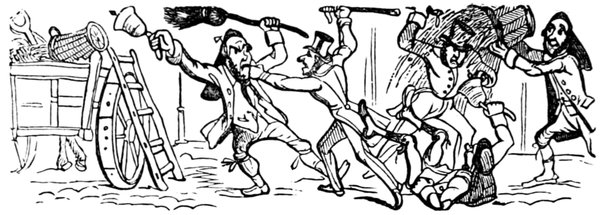
MARCH DUST.—THE BELL SAVAGE.
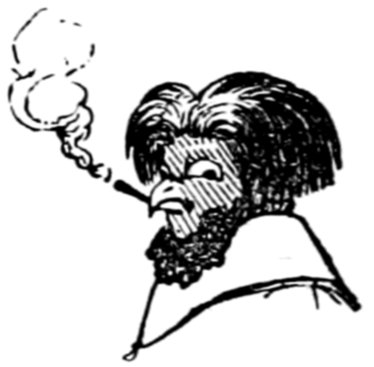
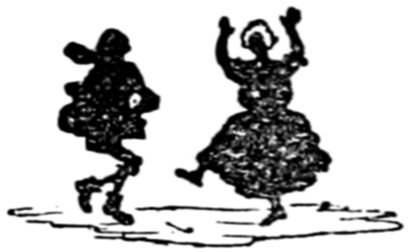
SEASON'S SIGNS. ——————— ♈ ♂ ♒ 'Tis hard for dust they may not ring; ♀ ♐ ♄ ⊕ because, in March, 'twill buy a King. A Jolly Cock A Dustman and his Belle.
That dustman's bell—that dustman's bell—
What horrid tales its tongue did tell!
He surely served his country well
Who freed us from the dustman's bell.
When basking in the morning beams,
I revell'd in Elysian dreams,
'Mong flowers, by Helicon's sweet bubble,
Inventing rhymes with little trouble;
What did so soon the charm dispel,
As that detested dustman's bell!
Or, thinking all the night away,
On debts ungather'd, bills to pay;
And pondering how it might be known
Whether 'twas best to hang or drown,
I've dropped into a wearied snooze,
And quickly tied the fatal nooze,
Then, starting at my funeral knell,
Found 'twas the dustman's passing bell.
When dining with a chosen few,
"The jolly cocks," a noble crew,
I've wander'd home supremely glorious,
And even dared to be uproarious,
The champagne mounting in my head,
Not knowing how I got to bed;
And, waking with the dawn, I've found
The room and bed-post turning round;
What time, in accents loud and clear,
My loving, lawful, lady dear,
With curtain'd privilege elate,
And heedless of my fallen state,
The round of all my faults doth tell;
Spite of my headache and my woes,
Exhausted, I begin to doze,
And dream I hear the dustman's bell,
That dustman's bell—that dustman's bell, &c.
15. Animal Magnetism Exhibitions stopped at the North London Hospital.
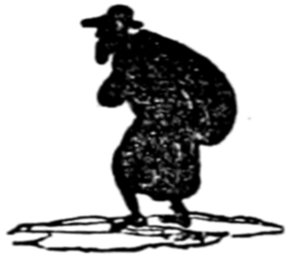
The cunning patient, we are told,
Would only move when touch'd by gold.
That would not suit the learned elves;
The Doctors wanted it themselves.
25. Gold-dust robbery. New version of "The Golden Fleece."
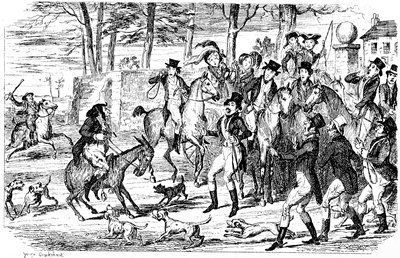
MARCH.—A day with the Surrey Hounds
219
MARCH.—A Day with the Surrey Hounds.
Our ball had failed so completely, that Jemmy, who was bent still upon fashion, caught eagerly at Tagrag's suggestion, and went down to Tuggeridgeville. If we had a difficulty to find friends in town, here there was none; for the whole county came about us, ate our dinners and suppers, danced at our balls—ay, and spoke to us too. We were great people, in fact; I a regular country gentleman; and, as such, Jemmy insisted that I should be a sportsman, and join the county hunt. "But," says I, "my love, I can't ride." "Pooh! Mr. C.," she said, "you're always making difficulties; you thought you couldn't dance a quadrille; you thought you couldn't dine at seven o'clock; you thought you couldn't lie in bed after six; and haven't you done every one of these things? You must and you shall ride!" And when my Jemmy said "must and shall," I knew very well there was nothing for it: so I sent down fifty guineas to the hunt, and, out of compliment to me, the very next week I received notice that the meet of the hounds would take place at Squashtail Common, just outside of my lodge-gates.
I didn't know what a meet was; and me and Mrs. C. agreed that it was most probable the dogs were to be fed there: however, Tagrag explained this matter to us, and very kindly promised to sell me a horse, a delightful animal of his own; which, being desperately pressed for money, he would let me have for a hundred guineas, he himself having given a hundred and fifty for it.
Well, the Thursday came; the hounds met on Squashtail Common; Mrs. C. turned out in her barouche to see us throw off; and being helped up on my chestnut horse, Trumpeter, by Tagrag and my head groom, I came presently round to join them.
Tag mounted his own horse; and as we walked down the avenue, "I thought," he said, "you told me you knew how to ride; and that you had ridden once fifty miles on a stretch!"
"And so I did," says I: "to Cambridge, and on the box too."
"On the box?" says he; "but did you ever mount a horse before?"
"Never," says I, "but I find it mighty easy."
"Well," says he, "you're mighty bold for a barber; and I like you, Coxe, for your spirit;" and so we came out of the gate.
As for describing the hunt, I own, fairly, I can't. I've been at a hunt, but what a hunt is—why the horses will go among the dogs and ride them down—why the men cry out "yooooic"—why the dogs go snuffling about in threes and fours, and the huntsman says, "Good Towler—good Betsy;" and we all of us after him, say, "Good Towler—good Betsy" in course: then, after hearing a yelp here, and a howl there, tow, row, yow, yow, yow! bursts out, all of a sudden, from three or four of them, and the chap in the velvet cap screeches out (with a number of oaths I shan't repeat here), "Hark, to Ringwood!" and then, "There he goes!" says some one; and all of a sudden, helter skelter, skurry hurry, slap bang, hooping, screeching, and hurraing, blue coats and red coats, bays and greys, horses, dogs, donkeys, butchers, baronets, dustmen, and blackguard boys, go tearing, all together, over the common after two or three of the pack that yowl the loudest. Why all this is, I can't say, but it all took place the second Thursday of last March, in my presence.
Up to this I'd kept my seat as well as the best, for we'd only been trotting gently about the field until the dogs found: and I managed to stick on very well; but directly the tow-rowing began, off went Trumpeter like a thunderbolt, and I found myself playing among the dogs like the donkey among the chickens. "Back, Mr. Coxe," holloas the huntsman; and so I pulled very hard, and cried out, Wo! but he wouldn't; and on I went galloping for the dear life. How I kept on is a wonder; but I squeezed my knees in very tight, and shoved my feet very hard into the stirrups, and kept stiff hold of the scruff of Trumpeter's neck, and looked betwixt his ears as well as ever I could, and trusted to luck, for I was in a mortal fright, sure enough, as many a better man would be in such a case, let alone a poor hairdresser.
As for the hounds, after my first riding in among them, I tell you, honestly, I never saw so much as the tip of one of their tails; nothing in this world did I see except Trumpeter's dun-coloured mane, and that I gripped firm: riding, 220by the blessing of luck, safe through the walking, the trotting, the galloping, and never so much as getting a tumble.
There was a chap at Croydon, very well known as the "Spicy Dustman," who, when he could get no horse to ride to the hounds, turned regularly out on his donkey; and on this occasion made one of us. He generally managed to keep up with the dogs, by trotting quietly through the cross roads, and knowing the country well. Well, having a good guess where the hounds would find, and the line that sly Reynolds (as they call the fox) would take, the Spicy Dustman turned his animal down the lane, from Squashtail to Cutshins Common, across which, sure enough, came the whole hunt. There's a small hedge and a remarkably fine ditch here; some of the leading chaps took both, in gallant style; others went round by a gate, and so would I, only I couldn't; for Trumpeter would have the hedge, and be-hanged to him, and went right for it.
Hoop! if ever you did try a leap! Out go your legs, out fling your arms, off goes your hat; and the next thing you feel, that is, I did, is a most tremendous thwack across the chest, and my feet jerked out of the stirrups; me left in the branches of a tree; Trumpeter gone clean from under me, and walloping and floundering in the ditch underneath. One of the stirrup-leathers had caught in a stake, and the horse couldn't get away; and neither of us, I thought, ever would have got away; but, all of sudden, who should come up the lane but the Spicy Dustman!
"Holloa!" says I, "you gent, just let us down from this here tree!"
"Lor!" says he, "I'm blest if I didn't take you for a robin."
"Let's down," says I; but he was all this time employed in disengaging Trumpeter, whom he got out of the ditch, trembling and as quiet as possible. "Let's down," says I. "Presently," says he; and taking off his coat, he begins whistling and swishing down Trumpeter's sides and saddle; and, when he had finished, what do you think the rascal did?—he just quietly mounted on Trumpeter's back, and shouts out, "Git down yourself, old Bears-grease; you've only to drop! I'll give your oss a hairing arter them 'ounds; and you, vy you may ride back my pony to Tuggeridgeweal!" And with this, I'm blest if he didn't ride away, leaving me holding, as for the dear life, and expecting every minute the branch would break.
It did break too, and down I came into the slush; and when I got out of it, I can tell you I didn't look much like the Venuses or the Apollor Belvidearis what I used to dress and titivate up for my shop-window, when I was in the hairdressing line, or smell quite so elegant as our rose-oil. Faugh! what a figure I was!
I had nothing for it but to mount the dustman's donkey (which was very quietly cropping grass in the hedge), and to make my way home; and after a weary, weary journey, I arrived at my own gate.
A whole party was assembled there. Tagrag, who had come back; their Excellencies Mace and Punter, who were on a visit; and a number of horses walking up and down before the whole of the gentlemen of the hunt, who had come in after losing their fox! "Here's Squire Coxe!" shouted the grooms. Out rushed the servants, out poured the gents of the hunt, and on trotted poor me, digging into the donkey, and everybody dying with laughter at me.
Just as I got up to the door, a horse came galloping up, and passed me; a man jumped down, and taking off a fantail-hat, came up, very gravely, to help me down.
"Squire," says he, "how came you by that there hanimal? Jist git down, will you, and give it to its howner."
"Rascal!" says I, "didn't you ride off on my horse?"
"Was there ever sich ingratitude?" says the Spicy. "I found this year oss in a pond, I saves him from drowning, I brings him back to his master, and he calls me a rascal!"
The grooms, the gents, the ladies in the balcony, my own servants, all set up a roar at this; and so would I, only I was so deucedly ashamed as not to be able to laugh just then.
And so my first day's hunting ended. Tagrag and the rest declared I showed great pluck, and want me to try again; but "no," says I, "I have been."
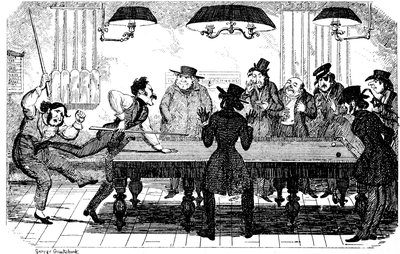
APRIL.—The finishing touch
221
1840.] APRIL.
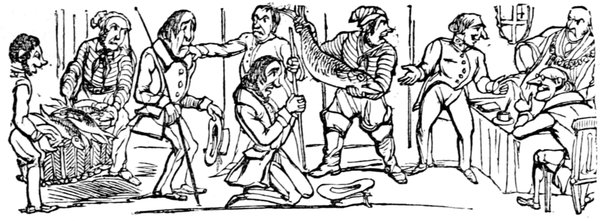
CAUGHT AT CATCHING.
WEATHER. The Weather-Prophet, foiled, doth loudly vow, Gentle Sport. though wrong before, I'm sure I've hit it now;
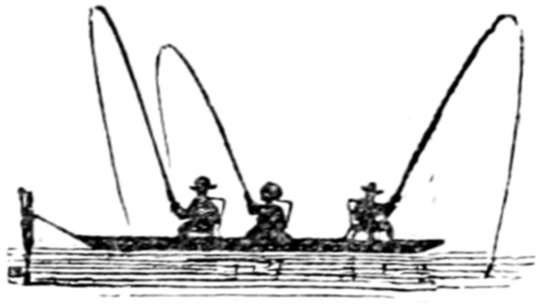
To angle o' April! Shame and wicked deed,
Debarr'd, like March, from Anglo-Saxon lad;
Nor May net profit must the fisher heed,
For bad it is, and so it is for-bad!
In these—the fence months—'tis offence: for men
To fish among the spawn were cruel sign:
John Bull should leave his Hook, and fishers then
Should be employed in quite another line.
'Twere graceless sure to fright the little fry
From family peace:—the Mayor, their quiet heeding
The die has cast that then they should not die,
Besides 'twould plainly be against good breeding!
The Thames is the Mayor's nest—a bitter dish
His Lordship gives its spoilers—name of fear;
Why 'tis admitted, even by the fish,
Diet of Worms was never more severe!
He tackles all the fishers: rightly deems
The sink of nets a sink of sin!—for boat,
To ply the angler, wherry wicked seems;
He will not have a single float afloat!
In March, upon the Thames, march no man must;
April must heed his reign—Invade the spot,
And out of water he'll kick up a dust;
The year says May,—but he says you may not.
Woe to the mortal who shall founder there!
Let man shun Mansion House, and Lord Mayor's search;
He, like an eagle, sits, with savage stare,
Defying all the world to touch—his perch!
MORAL.
Fishers! forego your line for three months' length,
And fence, don't fish, in fence months now; for mind,
Tho' every week the Mayor put out his strength,
If there you are not found you are not fined!
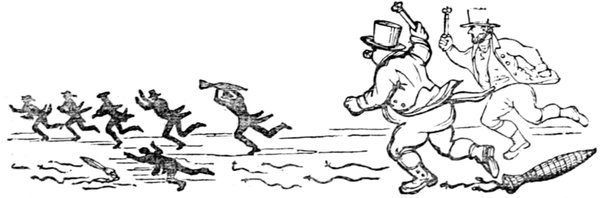
Taking to their Eels. "The Bailiffs are coming, Oh dear! oh dear!"
222
APRIL.—The Finishing Touch.
I was always fond of billiards: and in former days, at Grogram's, in Greek Street, where a few jolly lads of my acquaintance used to meet twice a week for a game, and a snug pipe and beer, I was generally voted the first man of the club; and could take five from John the marker himself. I had a genius, in fact, for the game; and now that I was placed in that station of life where I could cultivate my talents, I gave them full play, and improved amazingly. I do say that I think myself as good a hand as any chap in England.
The Count, and his Excellency Baron von Punter, were, I can tell you, astonished by the smartness of my play; the first two or three rubbers Punter beat me, but when I came to know his game, I used to knock him all to sticks; or, at least, win six games to his four: and such was the betting upon me: his Excellency losing large sums to the Count, who knew what play was, and used to back me. I did not play except for shillings, so my skill was of no great service to me.
One day I entered the billiard-room when these three gentlemen were high in words. "The thing shall not be done," I heard Captain Tagrag say. "I won't stand it."
"Vat, begause you would have de bird all to yourzelf, hey?" said the Baron.
"You sall not have a single fezare of him, begar," said the Count. "Ve vill blow you, M. de Taguerague; parole d'honneur, ve vill."
"What's all this, gents," says I, stepping in, "about birds and feathers?"
"Oh," says Tagrag, "we were talking about—about—pigeon-shooting. The Count, here, says he will blow a bird all to pieces at twenty yards, and I said I wouldn't stand it, because it was regular murder."
"Oh, yase, it was bidgeon-shooting," cries the Baron: "and I know no better sport. Have you been bidgeon-shooting, my dear Squire? De fon is gabidal." "No doubt," says I, "for the shooters, but mighty bad sport for the pigeon;" and this joke set them all a laughing ready to die. I didn't know then what a good joke it was, neither; but I gave Master Baron that day a precious good beating, and walked off with no less than fifteen shillings of his money.
As a sporting man, and a man of fashion, I need not say that I took in the "Flare-up," regularly; ay, and wrote one or two trifles in that celebrated publication (one of my papers, which Tagrag subscribed for me, Philo-pestitiæamicus, on the proper sauce for teal and widgeon; and the other, signed Scru-tatos, on the best means of cultivating the kidney species of that vegetable, made no small noise at the time, and got me in the paper a compliment from the editor). I was a constant reader of the Notices to Correspondents, and my early education having been rayther neglected (for I was taken from my studies and set, as is the custom in our trade, to practise on a sheep's-head at the tender age of nine years, before I was allowed to venture on the human countenance), I say, being thus curtailed and cut off in my classical learning, I must confess I managed to pick up a pretty smattering of genteel information from that treasury of all sorts of knowledge, at least sufficient to make me a match in learning for all the noblemen and gentlemen who came to our house. Well, on looking over the "Flare-up" notices to correspondents, I read, one day last April, among the notices, as follows:—
"'Automodon.' We do not know the precise age of Mr. Baker, of Covent Garden Theatre; nor are we aware if that celebrated son of Thespis is a married man.
"'Ducks and Green-peas' is informed, that when A plays his rook to B's second Knight's square, and B, moving two squares with his Queen's pawn, gives check to his adversary's Queen, there is no reason why B's Queen should not take A's pawn, if B be so inclined.
"'F. L. S.' We have repeatedly answered the question about Madame Vestris: her maiden name was Bartolozzi, and she married the son of Charles Mathews, the celebrated comedian.
"'Fair Play.' The best amateur billiard and écarté player in England, is Coxe Tuggeridge Coxe, Esq., of Portland Place, and Tuggeridgeville: Jonathan, who knows his play, can only give him two in a game of a hundred: and at the cards, no man is his superior. Verbum sap.
223"'Scipio Americanus' is a blockhead."
I read this out to the Count and Tagrag, and both of them wondered how the Editor of that tremendous Flare-up should get such information; and both agreed that the Baron, who still piqued himself absurdly on his play, would be vastly annoyed by seeing me preferred thus to himself. We read him the paragraph, and preciously angry he was. "Id is," he cried, "the tables (or 'de dabels,' as he called them), de horrid dabels; gom viz me to London, and dry a slate-table, and I vill beat you." We all roared at this; and the end of the dispute was, that, just to satisfy the fellow, I agreed to play his Excellency at slate-tables, or any tables he chose.
"Gut," says he, "gut; I lif, you know, at Abednego's, in de Quadrant; his dabels is goot; ve vill blay dere, if you vill;" and I said, I would: and it was agreed that, one Saturday night, when Jemmy was at the Opera, we should go to the Baron's rooms, and give him a chance.
We went, and the little Baron had as fine a supper as ever I saw; lots of champagne (and I didn't mind drinking it), and plenty of laughing and fun. Afterwards, down we went to billiards. "Is dish Mishter Coxsh, de shelebrated player?" says Mr. Abednego, who was in the room, with one or two gentlemen of his own persuasion, and several foreign noblemen, dirty, snuffy, and hairy, as them foreigners are. "Is dish Mishter Coxsh? blesh ma hart, it is a honer to see you, I have heard so much of your play."
"Come, come," says I, "sir;" for I'm pretty wide awake; "none of your gammon; you're not going to hook me."
"No, begar, dis fish you not catch," says Count Mace.
"Dat is gut! haw! haw!" snorted the Baron: "hook him! lieber himmel, you might dry and hook me as well. Haw! haw!"
Well, we went to play. "Fife to four on Coxe," screams out the Count.—"Done and done," says another nobleman. "Ponays," says the Count.—"Done," says the nobleman. "I vill take your six crowns to four," says the Baron.—"Done," says I; and, in the twinkling of an eye, I beat him;—once making thirteen off the balls without stopping.
We had some more wine after this; and if you could have seen the long faces of the other noblemen, as they pulled out their pencils and wrote I O U's for the Count. "Va toujours, mon cher," says he to me, "you have von for me tree hundred pounds."
"I'll blay you guineas dis time," says the Baron. "Zeven to four you must give me, though;" and so I did: and in ten minutes that game was won, and the Baron handed over his pounds. "Two hundred and sixty more, my dear, dear Coxe," says the Count; "you are mon ange gardien!" "Wot a flat Mishter Coxsh ish, not to back his luck," I heard Abednego whisper to one of the foreign noblemen.
"I'll take your seven to four, in tens," said I to the Baron. "Give me three," says he, "and done." I gave him three, and lost the game by one. "Dobbel, or quits," says he. "Go it," says I, up to my mettle; "Sam Coxe never says no;"—and to it we went. I went in, and scored eighteen to his five. "Holy Moshesh!" says Abednego, "dat little Coxsh is a vonder! who'll take odds?"
"I'll give twenty to one," says I, "in guineas."
"Ponays, yase, done," screams out the Count.
"Bonies, done," roars out the Baron: and before I could speak, went in, and, would you believe it?—in two minutes he somehow made the game!
Oh, what a figure I cut when my dear Jemmy heard of this afterwards!—In vain I swore it was guineas: the Count and the Baron swore to ponies; and when I refused, they both said their honour was concerned, and they must have my life, or their money. So when the Count showed me actually that, in spite of this bet (which had been too good to resist) won from me, he had been a very heavy loser by the night; and brought me the word of honour of Abednego, his Jewish friend, and the foreign noblemen, that ponies had been betted;—why, I paid one thousand pounds sterling of good and lawful money;—but I've not played for money since: no, no; catch me at that again, if you can.
224
MAY. [1840.
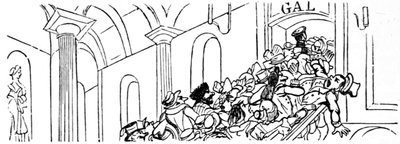
MEMBERS OF THE LONDON PRESS.
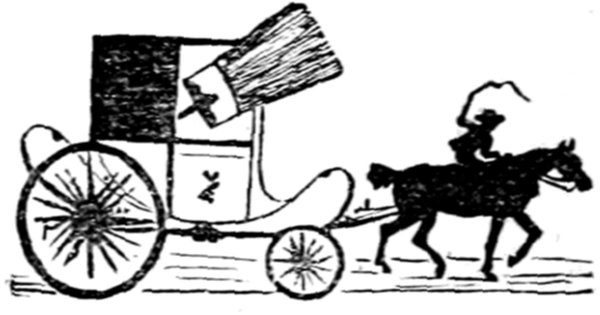
WEATHER. while forced his dwindling victims to confess, A Carriage Sweep. "small by degrees, and beautifully less."
A BENEFIT.
"Sich a Gettin up Stairs."
Sweet Gallery squeeze, you will possess
The utmost freedom of the press;
Crowds, looking up, still pushing go,
With stares above, and stairs below;
The soldier first, a foremost man,
Like Bow-street culprits—keeps the van,
Charges the door, whose keepers stern
A "bob" will charge him in return;
He's got his step, so with light mind
Bears all the pressure from behind;
Feels from the rear-mob, all alive,
A drive, though not a carriage drive:
And, lo! among them, soot-grimed deep,
A sweep, though not a carriage sweep.
Baker and butcher, lass and lover;
With one fat Falstaff falling over,
Sure—though he like it not—to go
And lump it when he gets below;
A prize John Bull, who, bulky dunce,
Takes both alternatives at once,
And quickly reaches his first floor,
Dismounted at the Gallery Door!
4. Exhibition of the Royal Academy opens, at the National Gallery.
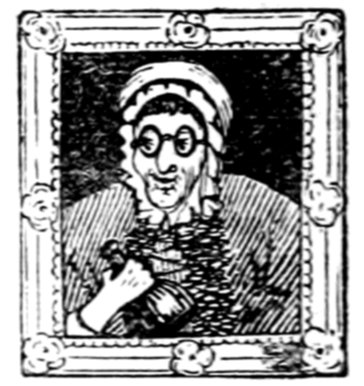
408. Portrait of the President. ☞
R.A.'s are raised to power: and, presto, bang!
"On inner walls the cry is still 'they hang;'"
While many a heavy sigh the artists fetch,
"To have them hang our pictures is no ketch."
For half their sins did justice prompt the elves,
Half the R.A. array would hang themselves!
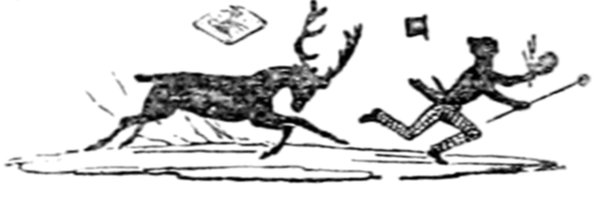
409. Red Deer, after Landseer.
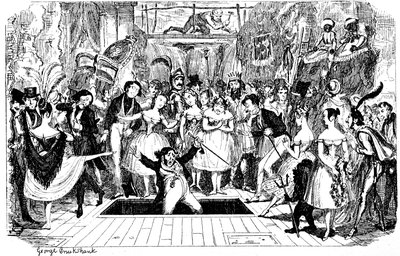
MAY—A new drop scene at the Opera.
225
MAY.—A New Drop Scene at the Opera.
No lady is a lady without having a box at the Opera: so my Jemmy, who knew as much about music,—bless her!—as I do about sanscrit, algebra, or any other foreign language, took a prime box on the second tier. It was what they called a double box; it really could hold two, that is, very comfortably; and we got it a great bargain—for five hundred a year! Here, Tuesdays and Saturdays we used regularly to take our places, Jemmy and Jemimarann sitting in front; me, behind: but as my dear wife used to wear a large fantail gauze hat, with ostrich feathers, birds of paradise, artificial flowers, and tags of muslin or satin, scattered all over it, I'm blest if she didn't fill the whole of the front of the box; and it was only by jumping and dodging, three or four times in the course of the night, that I could manage to get a sight of the actors. By kneeling down, and looking steady under my darling Jemmy's sleeve, I did contrive, every now and then, to have a peep of Senior Lablash's boots, in the Puritanny, and once saw Madame Greasi's crown and head-dress in Annybalony.
What a place that Opera is, to be sure! and what enjoyments us aristocracy used to have! Just as you have swallowed down your three courses (three curses I used to call them; for so, indeed, they are, causing a deal of heartburns, headaches, doctor's bills, pills, want of sleep, and such like)—just, I say, as you get down your three courses, which I defy any man to enjoy properly, unless he has two hours of drink and quiet afterwards, up comes the carriage, in bursts my Jemmy, as fine as a duchess, and scented like our shop. "Come, my dear," says she, "it's Normy to-night (or Annybalony, or the Nosey di Figaro, or the Gazzylarder, as the case may be); Mr. Coster strikes off punctually at eight, and you know it's the fashion to be always present at the very first bar of the aperture;" and so off we budge, to be miserable for five hours, and to have a headache for the next twelve, and all because it's the fashion!
After the aperture, as they call it, comes the opera, which, as I am given to understand, is the Italian for singing. Why they should sing in Italian, I can't conceive; or why they should do nothing but sing: bless us, how I used to long for the wooden magpie in the Gazzylarder, to fly up to the top of the church-steeple, and see the chaps with the pitchforks to come in and carry off that wicked Don June. Not that I don't admire Lablash, and Rubini, and his brother, Tomrubini, him who has that fine bass voice, I mean, and acts the Corporal in the first piece, and Don June in the second; but three hours is a little too much, for you can't sleep on those little rickety seats in the boxes.
The opera is bad enough; but what is that to the bally? You should have seen my Jemmy the first night when she stopped to see it; and when Madamsalls Fanny and Theresa Hustler came forward, along with a gentleman, to dance, you should have seen how Jemmy stared, and our girl blushed, when Madamsall Fanny, coming forward, stood on the tips of only five of her toes, and raising up the other five, and the foot belonging to them, almost to her shoulder, twirled round, and round, and round, like a teetotum, for a couple of minutes or more; and as she settled down, at last, on both feet, in a natural decent posture, you should have heard how the house roared with applause, the boxes clapping with all their might, and waving their handkerchiefs; the pit shouting, "Bravo!" Some people, who, I suppose, were rather angry at such an exhibition, threw bunches of flowers at her; and what do you think she did? why, hang me, if she did not come forward, as though nothing had happened, gather up the things they had thrown at her, smile, press them to her heart, and began whirling round again, faster than ever!—Talk about coolness, I never saw such in all my born days.
"Nasty thing!" says Jemmy, starting up in a fury; "if women will act so, it serves them right to be treated so."
"O, yes! she acts beautifully," says our friend, his Excellency, who, along with Baron von Punter, and Tagrag, used very seldom to miss coming to our box.
"She may act very beautifully, Munseer, but she don't dress so; and I am very glad they threw that orange-peel and all those things at her, and that the people waved to her to get off."
226Here his Excellency, and the Baron, and Tag, set up a roar of laughter. "My dear Mrs. Coxe," says Tag, "those are the most famous dancers in the world; and we throw myrtle, geraniums, and lilies, and roses, at them, in token of our immense admiration!"
"Well, I never!" said my wife; and poor Jemimarann slunk behind the curtain, and looked as red as it almost. After the one had done, the next begun; but when, all of a sudden, a somebody came skipping and bounding in, like an Indian-rubber ball, flinging itself up at least six feet from the stage, and there shaking about its legs like mad, we were more astonished than ever!
"That's Anatole," says one of the gentlemen.
"Anna who?" says my wife, and she might well be mistaken; for this person had a hat and feathers, a bare neck and arms, great black ringlets, and a little calico frock, which came down to the knees.
"Anatole; you would not think he was sixty-three years old, he's as active as a man of twenty."
"He!" shrieked out my wife; "what, is that there a man? For shame! Munseer. Jemimarann, dear, get your cloak, and come along; and I'll thank you, my dear, to call our people and let us go home."
You wouldn't think, after this, that my Jemmy, who had shown such a horror at the bally, as they call it, should ever grow accustomed to it; but she liked to hear her name shouted out in the crush-room, and so would stop till the end of everything; and, law bless you! in three weeks from that time she could look at the ballet as she would at a dancing-dog in the streets, and would bring her double-barrelled opera-glass up to her eyes as coolly as if she had been a born duchess. As for me, I did at Rome as Rome does, and precious fun it used to be, sometimes.
My friend the Baron insisted, one night, on my going behind the scenes, where, being a subscriber, he said I had what they call my ontray. Behind then I went; and such a place you never saw nor heard of! Fancy lots of young and old gents, of the fashion, crowding round and staring at the actresses practising their steps. Fancy yellow, snuffy foreigners, chattering always, and smelling fearfully of tobacco. Fancy scores of Jews, with hooked noses, and black muzzles, covered with rings, chains, sham diamonds, and gold waistcoats. Fancy old men, dressed in old night-gowns, with knock-knees, and dirty flesh-coloured cotton stockings and dabs of brickdust on their wrinkled old chops, and tow wigs (such wigs!) for the bald ones, and great tin spears in their hands, mayhap, or else shepherd's crooks, and fusty garlands of flowers, made of red and green baize! Fancy troops of girls, giggling, chattering, pushing to and fro, amidst old black canvas, Gothic halls, thrones, pasteboard Cupids, dragons, and such like; such dirt, darkness, crowd, confusion, and gabble of all conceivable languages was never known!
If you could but have seen Munseer Anatole! Instead of looking twenty, he looked a thousand. The old man's wig was off, and a barber was giving it a touch with the tongs; Munseer was taking snuff himself, and a boy was standing by, with a pint of beer from the public-house at the corner of Charles-street.
I met with a little accident, during the three-quarters of an hour which they allow for the entertainment of us men of fashion on the stage, before the curtain draws up for the bally, while the ladies in the boxes are gaping, and the people in the pit are drumming with their feet and canes in the rudest manner possible, as though they couldn't wait.
Just at the moment before the little bell rings, and the curtain flies up, and we scuffle off to the sides (for we always stay till the very last moment), I was in the middle of the stage, making myself very affable to the fair figgerantys which was spinning and twirling about me, and asking them if they wasn't cold, and such like politeness, in the most condescending way possible, when a bolt was suddenly withdrawn, and down I popped, through a trap in the stage, into the place below. Luckily, I was stopped by a piece of machinery, consisting of a heap of green blankets, and a young lady coming up as Venus rising from the sea. If I had not fallen so soft, I don't know what might have been the consequence of the collusion. I never told Mrs. Coxe, for she can't bear to hear of my paying the least attention to the fair sex.
JUNE—Striking a balance.
227
GAME IN SEASON.
2. Epsom Races.—"Surrey for the Field."
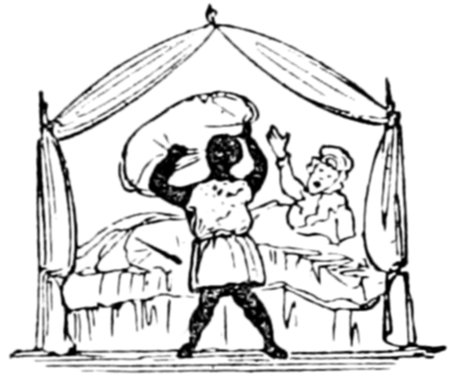
Death of Desdemona. Foul—from the Moor.
How hard to bear-o, ♌ ♄ ☿ ♒ Faro that's unfair-o.
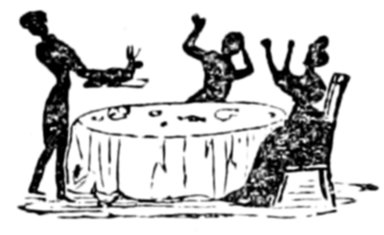
High game.
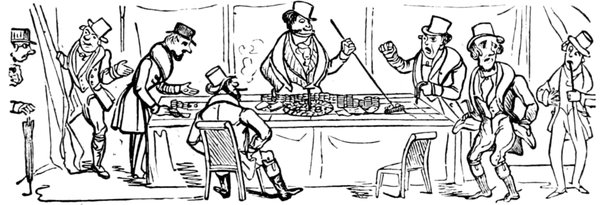
ROULETTE AT EPSOM.—Tent Scene.
I'm very ill; my circulation halts
I' the blood;
Soh! shall I take a dose of Epsom salts,
Or forego Epsom salts for Epsom races?
I chose the trip before the physic-sipping,
And very prettily I paid for tripping!
"Start fair," I cried,—I'd often started fowl
Out of the Moors,—but then I did start fair:
The Course of course I reach'd, and cheek by jowl
Was standing with my betters, gazing there
At a horse winning at his jockey's beck,
As felons win the gallows—by a neck!
"Tak tent!" the Scotchman says, that's "look about,"
But, "take care of the tent," he should have said:
I went within, and wish I'd gone without
A stake, or had a good rump-steak instead;
But I had cash, and having made a set
At them, and they at me, slap at Roulette.
And if 'twas natural to have gone within,
I soon discovered it was very flat:
A sovereign good for me it would have been
If I had had no sovereigns,—verbum sat!
I lost!—and took no note when all was done,
Except a note of how much they had won!
I cannot say they were a dirty set,
Because they clean'd me so completely out;
A bout like this of Epsom Downs' roulette
Teaches a mortal what he is about.
Cheating is physic.—While the game's alive
It empties pockets if it doesn't thrive!
5. Boniface, (first Alderman of Port-soken?)
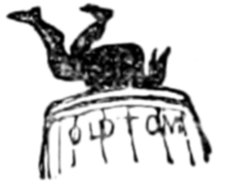
Cordial reception. Caught in his own gin.
12. Mr. Wakley declared, that Gin was his best friend—it was equal to 1000 inquests a year.
A Palace reared! and lo! in quest of gin,
Thousands, sans scruple, pass for drams within;
Water they'd spurn, e'en from Geneva's lake,
Gin ever—not Geneva's—they will take:
In quest of that, when they no more can run,
Wakley his inquest holds, and all is done!
228JUNE.—Striking a Balance.
Next door to us, in Portland-place, lived the Right Honourable the Earl of Kilblazes, of Kilmacrasy Castle, county Kildare, and his mother, the Dowager Countess. Lady Kilblazes had a daughter, Lady Juliana Matilda Mac Turk, of the exact age of our dear Jemimarann; and a son, The Honourable Arthur Wellington Anglesea Blucher Bulow Mac Turk, only ten months older than our boy, Tug.
My darling Jemmy is a woman of spirit, and, as became her station, made every possible attempt to become acquainted with the Dowager Countess of Kilblazes, which her ladyship (because, forsooth, she was the daughter of the Minister, and the Prince of Wales's great friend, the Earl of Portansherry) thought fit to reject. I don't wonder at my Jemmy growing so angry with her, and determining, in every way, to put her ladyship down. The Kilblazes' estate is not so large as the Tuggeridge property, by two thousand a-year, at least; and so my wife, when our neighbours kept only two footmen, was quite authorized in having three; and she made it a point, as soon as ever the Kilblazes' carriage-and-pair came round, to have her own carriage-and-four.
Well, our box was next to theirs at the Opera; only twice as big. Whatever masters went to Lady Juliana, came to my Jemimarann; and what do you think Jemmy did? she got her celebrated governess, Madam de Flicflac, away from the Countess, by offering a double salary. It was quite a treasure, they said, to have Madame Flicflac; she had been (to support her father, the Count, when he emigrated) a French dancer at the Italian Opera. French dancing, and Italian, therefore, we had at once, and in the best style: it is astonishing how quick and well she used to speak—the French especially.
Master Arthur Mac Turk was at the famous school of the Reverend Clement Coddler, along with a hundred and ten other young fashionables, from the age of three to fifteen; and to this establishment Jemmy sent our Tug, adding forty guineas to the hundred and twenty paid every year for the boarders. I think I found out the dear soul's reason, for, one day, speaking about the school to a mutual acquaintance of ours and the Kilblazes, she whispered to him, that "she never would have thought of sending her darling boy at the rate which her next-door neighbour paid; their lad, she was sure, must be starved: however, poor people! they did the best they could on their income."
Coddler's, in fact, was the tip-top school near London; he had been tutor to the Duke of Buckminster, who had set him up in the school, and, as I tell you, all the peerage and respectable commoners came to it. You read in the bill (the snopsis, I think Coddler called it), after the account of the charges for board, masters, extras, &c.: "Every young nobleman (or gentleman) is expected to bring a knife and fork, spoon, and goblet, of silver (to prevent breakage), which will not be returned; a dressing-gown and slippers; toilet-box, pomatum, curling-irons, &c. &c. The pupil must, on NO ACCOUNT, be allowed to have more than ten guineas of pocket-money, unless his parents particularly desire it, or he be above fifteen years of age. Wine will be an extra charge; as are warm, vapour, and douche baths; carriage exercise will be provided at the rate of fifteen guineas per quarter. It is earnestly requested that no young nobleman (or gentleman) be allowed to smoke. In a place devoted to the cultivation of polite literature, such an ignoble enjoyment were profane
"Clement Coddler, M.A.,
"Chaplain and late tutor to his Grace the
Duke of Buckminster.
"Mount Parnassus, Richmond, Surrey."
To this establishment our Tug was sent. "Recollect, my dear," said his mamma, "that you are a Tuggeridge by birth, and that I expect you to beat all the boys in the school, especially that Wellington Mac Turk, who though he is a lord's son, is nothing to you, who are the heir of Tuggeridgeville."
Tug was a smart young fellow enough, and could cut and curl as well as any young chap of his age; he was not a bad hand at a wig either, and could shave, too, very prettily; but that was in the old time, when we were not great people: when he came to be a gentleman, he had to learn Latin and Greek, and had a deal of lost time to make up for on going to school.
However we had no fear; for the Reverend Mr. Coddler used to send monthly 229accounts of his pupils' progress, and if Tug was not a wonder of the world, I don't know who was. It was
General behaviour excellent
English very good
French très bien
Latin optimé.
and so on; he possessed all the virtues, and wrote to us every month for money. My dear Jemmy and I determined to go and see him, after he had been at school a quarter; we went, and were shown by Mr. Coddler, one of the meekest, smilingest little men I ever saw, into the bed-rooms and eating rooms (the dromitaries and refractories he called them), which were all as comfortable as comfortable might be. "It is a holiday to-day," said Mr. Coddler; and a holiday it seemed to be. In the dining-room were half a dozen young gentlemen playing at cards ("all tip-top nobility," observed Mr. Coddler);—in the bed-rooms there was only one gent; he was lying on his bed, reading a novel and smoking cigars. "Extraordinary genius!" whispered Coddler; "Honourable Tom Fitz-Warter, cousin of Lord Byron's; smokes all day; and has written the sweetest poems you can imagine. Genius, my dear madam, you know, genius must have its way." "Well, upon my word," says Jemmy, "if that's genus, I had rather that Master Tuggeridge Coxe Tuggeridge remained a dull fellow."
"Impossible, my dear madam." said Coddler. "Mr. Tuggeridge Coxe couldn't be stupid if he tried."
Just then up comes Lord Claude Lollypop, third son of the Marquis of Allycompane. We were introduced instantly, "Lord Claude Lollypop, Mr. and Mrs. Coxe:" the little lord wagged his head, my wife bowed very low, and so did Mr. Coddler, who, as he saw my lord making for the play-ground, begged him to show us the way.—"Come along," says my lord; and as he walked before us, whistling, we had leisure to remark the beautiful holes in his jacket and elsewhere.
About twenty young noblemen (and gentlemen) were gathered round a pastrycook's shop, at the end of the green. "That's the grub-shop," said my lord, "where we young gentlemen wot has money buys our wittles, and them young gentlemen wot has none, goes tick."
Then he passed a poor red-haired usher, sitting on a bench alone. "That's Mr. Hicks, the Husher, ma'am," says my lord, "we keep him, for he's very useful to throw stones at, and he keeps the chaps' coats when there's a fight, or a game at cricket.—Well, Hicks, how's your mother? what's the row now?" "I believe, my lord," said the usher, very meekly, "there is a pugilistic encounter somewhere on the premises—the Honourable Mr. Mac——"
"O! come along," said Lord Lollypop, "come along, this way, ma'am! Go it, ye cripples!" and my lord pulled my dear Jemmy's gown in the kindest and most familiar way, she trotting on after him, mightily pleased to be so taken notice of, and I after her. A little boy went running across the green. "Who is it, Petitoes?" screams my lord. "Turk and the barber," pipes Petitoes, and runs to the pastrycook's like mad. "Turk and the ba—," laughs out my lord, looking at us: "hurrah! this way, ma'am;" and, turning round a corner he opened a door into a court-yard, where a number of boys were collected and a great noise of shrill voices might be heard. "Go it, Turk!" says one "Go it, barber!" says another. "Punch hith life out," roars another, whose voice was just cracked, and his clothes half a yard too short for him!
Fancy our horror, when, on the crowd making way, we saw Tug pummelling away at the Honourable Master Mac Turk! My dear Jemmy, who don't understand such things, pounced upon the two at once, and, with one hand tearing away Tug, sent him spinning back into the arms of his seconds, while, with the other, she clawed hold of Master Mac Turk's red hair, and, as soon as she got her second hand free, banged it about his face and ears like a good one.
"You nasty—wicked—quarrelsome—aristocratic (each word was a bang)—aristocratic, oh! oh! oh!" Here the words stopped; for, what with the agitation, maternal solicitude, and a dreadful kick on the shins which, I am ashamed to say, Master Mac Turk administered, my dear Jemmy could bear it no longer, and sunk, fainting away, in my arms.
230
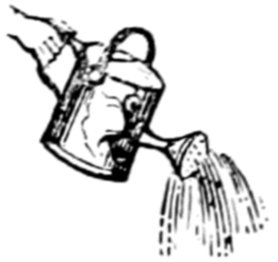
See Swithin spout The water out;
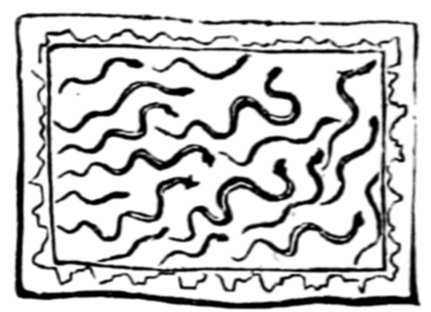
A Wiper-snake pattern
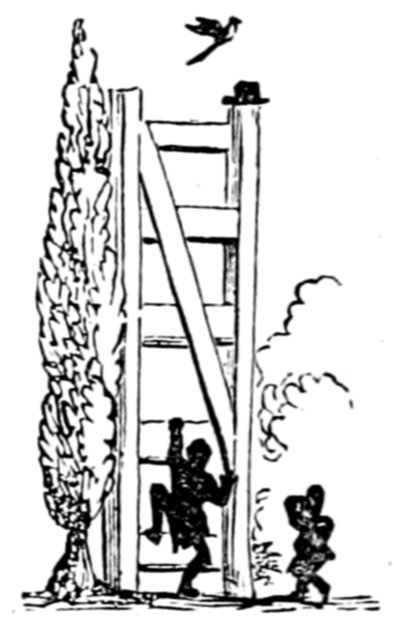
While wet sustains Highgate.
THE MARCH TO FINCHLEY.
Once out of town went big John Brown,
A Sunday man so gay;
He went with his life, and he went with his wife,
And he went with his kids in a shay!
The shay was like a lottery prize—
Exceedingly hard to draw;
And John Brown looked with both his eyes
As blank as ever you saw.
Oh! very hot the summer's sun
Shone over Somers town;
By sweat—not slander—John was soon
Exceedingly run down!
With piping heat he plied his drag,
While sinews paid the piper;
At Highgate Hill his handkerchief
Was turned into a "viper."
He gave his family "a long
And strong pull altogether;"
But they in spite of sunshine soon
Gave signs o£ squally weather.
John's wife survey'd her lord and shay
With most maternal mind;
She'd never such a load before,
And so she push'd behind!
So on they trudged: no half-way house
Afforded them a sup,
But about half-way up the hill
John found it was "all up."
With agony he used his sleeve,
And gasping, cried, "I'm blow'd!"
"What then befel the Browns?" I b'lieve
They're still upon the road!
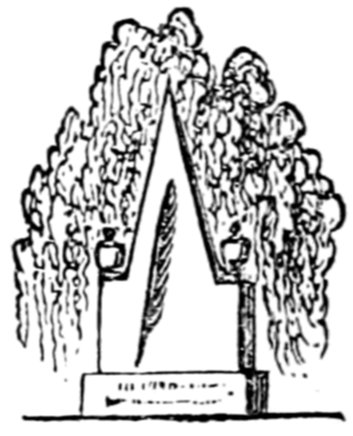
Rains and drains.
23. Newspaper born, 1588.—Editor I.
The first of architects, who, ere he died,
Rear'd columns more than all the world beside.
30. William Penn died, 1718.
Although we are not of our pencil vain,
Of Pennsylvania's father among men
We draw the tomb on stone; that once again
The Pencil may do honour to the Pen!
JULY—Down at Beulah.
231JULY.—Down at Beulah.
Although there was a regular cut between the next-door people and us, yet Tug and the Honourable Master Mac Turk kept up their acquaintance over the back-garden wall, and in the stables, where they were fighting, making friends, and playing tricks from morning to night, during the holidays. Indeed, it was from young Mac that we first heard of Madame de Flicflac, of whom my Jemmy robbed Lady Kilblazes, as I before have related. When our friend, the Baron, first saw Madame, a very tender greeting passed between them, for they had, as it appeared, been old friends abroad. "Sapristie," said the Baron, in his lingo, "que fais tu ici, Aménaïde?" "Et toi, mon pauvre Chicot," says she, 'est ce qu'on t'a mis à la retraite? Il parait, que tu n'est plus Général chez Franco—" "Chut!" says the Baron, putting his finger to his lips.
"What are they saying, my dear?" says my wife to Jemimarann, who had a pretty knowledge of the language by this time.
"I don't know what 'Sapristie' means, mamma; but the Baron asked Madame what she was doing here? and Madame said, 'And you, Chicot, you are no more a general at Franco.' Have I not translated rightly, Madame?"
"Oui, mon chou, mon ange; yase, my angel, my cabbage, quite right. Figure yourself, I have known my dear Chicot dis twenty years."
"Chicot is my name of baptism," says the Baron; "Baron Chicot de Punter is my name." "And, being a general at Franco," says Jemmy, "means, I suppose, being a French General?"
"Yes, I vas," said he, "General Baron de Punter, n'est il pas, Aménaïde?"
"O, yes!" said Madame Flicflac, and laughed; and I and Jemmy laughed out of politeness: and a pretty laughing matter it was, as you shall hear.
About this time my Jemmy became one of the Ladies-Patronesses of that admirable Institution, "The Washerwoman's Orphans' Home;" Lady de Sudley was the great projector of it; and the manager and chaplain, the excellent and Reverend Sidney Slopper. His salary, as chaplain, and that of Doctor Leitch, the physician (both cousins of her Ladyship's), drew away five hundred pounds from the six subscribed to the Charity: and Lady de Sudley thought a fête at Beulah Spa, with the aid of some of the foreign Princes who were in town last year, might bring a little more money into its treasury. A tender appeal was accordingly drawn up, and published in all the papers:
"APPEAL.
"BRITISH WASHERWOMAN'S ORPHANS' HOME.
"The 'Washerwoman's Orphans' Home' has now been established seven years; and the good which it has effected is, it may be confidently stated, incalculable. Ninety-eight orphan children of washerwomen have been lodged within its walls. One hundred and two British washerwomen have been relieved when in the last state of decay. One hundred and ninety-eight thousand articles of male and female dress have been washed, mended, buttoned, ironed, and mangled, in the Establishment. And, by an arrangement with the governors of the Foundling, it is hoped that the Baby-linen of that Hospital will be confided to the British Washerwoman's Home!
"With such prospects before it, is it not sad, is it not lamentable to think, that the Patronesses of the Society have been compelled to reject the applications of no less than three thousand eight hundred and one British Washerwomen, from lack of means for their support? Ladies of England! Mothers of England! to you we appeal. Is there one of you that will not respond to the cry in behalf of these deserving members of our sex?
"It has been determined by the Ladies-Patronesses to give a fête at Beulah Spa, on Thursday, July 25; which will be graced with the first foreign and native TALENT, by the first foreign and native RANK; and where they beg for the attendance of every WASHERWOMAN'S FRIEND."
Her Highness the Princess of Schloppenzollernschwigmaringen, the Duke of Sacks Tubbingen, His Excellency Baron Strumpff, His Excellency Lootf-Allee-Koolee-Bismillah-Mohamed-Rusheed-Allah, the Persian Ambassador, Prince Futtee-Jaw, Envoy from the King of Oude, His Excellency Don Alonzo Di Cachachero-y-Fandango-y-Castañete, the Spanish Ambassador, Count 232Ravioli, from Milan, the Envoy of the Republic of Topinambo, and a host of other fashionables, promised to honour the festival: and their names made a famous show in the bills.
I leave you to fancy what a splendid triumph for the British Washerwoman's Home was to come off on that day. A beautiful tent was erected, in which the Ladies-Patronesses were to meet; it was hung round with specimens of the skill of the washerwomen's orphans, ninety-six of whom were to be feasted in the gardens, and waited on by the Ladies-Patronesses.
There was a fine cold collation, to which the friends of the Ladies-Patronesses were admitted; after which, my ladies and their beaux went strolling through the walks; Tagrag and the Count having each an arm of Jemmy; the Baron giving an arm a-piece to Madame and Jemimarann. Whilst they were walking whom should they light upon but poor Orlando Crump, my successor in the perfumery and hair-cutting.
"Orlando!" says Jemimarann, blushing as red as a label, and holding out her hand.
"Jemimar!" says he, holding out his, and turning as white as pomatum.
"Sir!" says Jemmy, as stately as a Duchess.
"What! madame," says poor Crump, "don't you remember your shopboy?"
"Dearest mamma, don't you recollect Orlando?" whimpers Jemimarann.
"Miss Tuggeridge Coxe," says Jemmy, "I'm surprised of you. Remember, sir, that our position is altered, and oblige me by no more familiarity."
"Insolent fellow!" says the Baron; "vat is dis canaille?"
"Canal yourself, Mounseer," says Orlando, now grown quite furious; he broke away, quite indignant, and was soon lost in the crowd. Jemimarann, as soon as he was gone, began to look very pale and ill; and her mamma, therefore, took her to a tent, where she left her along with Madame Flicflac and the Baron; going off herself with the other gentlemen, in order to join us.
It appears they had not been seated very long when Madame Flicflac suddenly sprung up, with an exclamation of joy, and rushed forward to a friend whom she saw pass.
The Baron was left alone with Jemimarann; and, whether it was the champagne, or that my dear girl looked more than commonly pretty, I don't know; but Madame Flicflac had not been gone a minute when the Baron dropped on his knees, and made her a regular declaration.
Poor Orlando Crump had found me out by this time, and was standing by my side, listening, as melancholy as possible, to the famous Bohemian Minne-singers, who were singing the celebrated words of the poet Gothy:
Ich bui ya hupp lily lee, du bist ya hupp lily lee,
Wir sind doch hupp lily lee, hupp la lily lee.
Chorus.—Yodle-odle-odle-odle-odle-odle hupp! yodle-odle-aw-o-o-o.
They were standing with their hands in their waistcoats, as usual, and had just come to the o-o-o, at the end of the chorus of the forty-seventh stanza, when Orlando started: "That's a scream!" says he. "Indeed it is," says I; "and, but for the fashion of the thing, a very ugly scream too:" when I heard another shrill "O!" as I thought; and Orlando bolted off, crying, "By heavens, it's her voice!" "Whose voice?" says I. "Come and see the row," says Tag; and off we went, with a considerable number of people, who saw this strange move on his part. We came to the tent, and there we found my poor Jemimarann fainting; her mamma holding a smelling-bottle; the Baron, on the ground, holding a handkerchief to his bleeding nose; and Orlando squaring at him, and calling on him to fight if he dared.
My Jemmy looked at Crump very fierce. "Take that feller away," says she, "he has insulted a French nobleman, and deserves transportation, at the least."
Poor Orlando was carried off. "I've no patience with the little minx," says Jemmy, giving Jemimarann a pinch. "She might be a Baron's lady; and she screams out because his Excellency did but squeeze her hand."
"Oh, mamma! mamma!" sobs poor Jemimarann, "but he was t-t-tipsy."
"T-t-tipsy! and the more shame for you, you hussy, to be offended with a nobleman who does not know what he is doing."
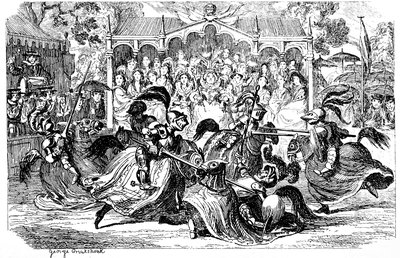
AUGUST—A Tournament.
233
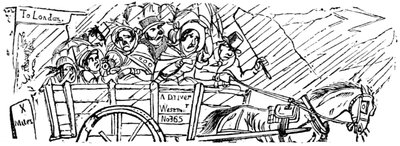
RETURNING BY WATER
Clock before the Sun. Too soon for dinner. Between Month and Monarch this difference is just; ♂ ☿ ♄ ♈ the Month it is August, the Monarch August.
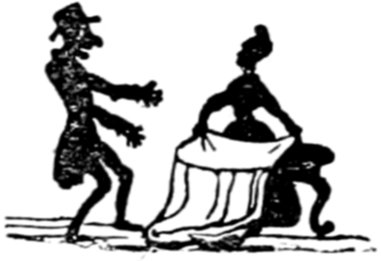
The rain of terror's come—the horse to go
At a smart pace has made himself to smart;
'Tis bad enough to bear the shafts of woe,
But who would bear the shafts of such a cart!
What a nice party—twelve inside—to drag,
Each fat and full, and heavy as a dunce,
And all, besides the man wot drives the nag,
Holding the rains together—all at once!
The horse is urged—most tired and half dead;
"Come up," they cry—when shall we get to town?
Fierce pours the shower—their pores are stopped instead,
The more they cry come up—the rain comes down!
Now, you may see, by every sorry face,
The water party wails its wretched doom,
And in that cart—that wends with lingering pace,
Altho' there's little room, there's lots of rheum!
17. Metropolitan Police Bill passed.
The bill has pass'd, the sharpest bill of latter days,
Gin shops must close by twelve o'clock o' Saturdays;
And lively landlords now, whate'er their merits,
After that time must not keep up their spirits,
Nor suffer the most fascinating fox
Of all their customers to turn their cocks!
29. Eglintoun Tournament.
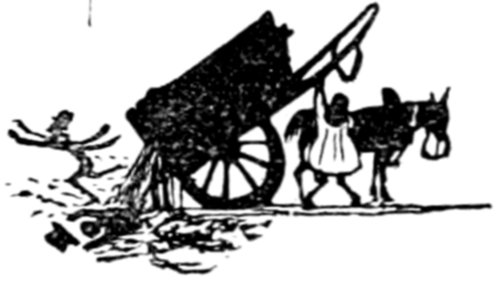
Running a-muck.
Oh! that Ayr tournament in that ere shire;
With lots of gentlemen in male attire,
And many a Don, and many a Skvire!
Took several days and lots of knights to mount;
And a great many pages to recount
Its deeds of glory—Chivalry their fount!
Though lances shivered (and no wonder, for
'Twas cold and rainy) no sword flesh'd its hilt;
And we'd pass all unnoticed: but, O lor!
We draw our own existence from a Tilt!
234
AUGUST.—A Tournament.
"I say, Tug," said Mac Turk, one day, soon after our flare-up at Beulah, "Kilblazes comes of age in October, and then we'll cut you out, as I told you: the old barberess will die of spite when she hears what we are going to do. What do you think? we're going to have a tournament!" "What's a tournament?" says Tug, and so said his mamma, when she heard the news; and when she knew what a tournament was, I think, really, she was as angry as Mac Turk said she would be, and gave us no peace for days together. "What!" says she, "dress up in armour, like play-actors, and run at each other with spears? the Kilblazes must be mad!" And so I thought, but I didn't think the Tuggeridges would be mad too, as they were; for, when Jemmy heard that the Kilblazes festival was to be, as yet, a profound secret, what does she do but send down to the Morning Post a flaming account of
"THE PASSAGE OF ARMS AT TUGGERIDGEVILLE!
"The days of chivalry are not past. The fair Castellane of T-gg-r-dgeville, whose splendid entertainments have so often been alluded to in this paper, has determined to give one which shall exceed in splendour even the magnificence of the middle ages. We are not at liberty to say more; but a tournament, at which His Ex—l—ncy B-r-n de P-nt-r, and Thomas T-gr-g, Esq., eldest son of Sir Th—s T-gr-g, are to be the knights-defendants against all comers; a Queen of Beauty, of whose loveliness every frequenter of fashion has felt the power; a banquet, unexampled in the annals of Gunter; and a ball, in which the recollections of ancient chivalry will blend sweetly with the soft tones of Weippert and Collinet, are among the entertainments which the Ladye of T-gg-ridgeville has prepared for her distinguished guests."
And now—O that I had twenty pages, instead of these miserable two, to describe the wonders of the day!—Twenty-four knights came from Ashley's, at two guineas a-head. We were in hopes to have had Miss Woolcombe, in the character of Joan of Arc, but that lady did not appear. We had a tent for the challengers, at each side of which hung what they called escoachings (like hatchments, which they put up when people die), and underneath sat their pages, holding their helmets for the tournament. Tagrag was in brass armour (my city connexions got him that famous suit); his Excellency in polished steel. My wife wore a coronet, modelled exactly after that of Queen Catharine, in Henry V.; a tight gilt jacket, which set off dear Jemmy's figure wonderfully, and a train of at least forty feet. Dear Jemimarann was in white, her hair braided with pearls. Madame de Flicflac appeared as Queen Elizabeth; and Lady Blanche Bluenose as a Turkish princess. An alderman of London, and his lady; two magistrates of the county, and the very pink of Croydon; several Polish noblemen; two Italian Counts (besides our Count); one hundred and ten young officers, from Addiscombe College, in full uniform, commanded by Major-General Sir Miles Mulligatawney, K.C.B., and his lady; the Misses Pimminy's Finishing Establishment, and fourteen young ladies, all in white; the Reverend Doctor Wapshot, and forty-nine young gentlemen, of the first families, under his charge; were some only of the company. I leave you to fancy that, if my Jemmy did seek for fashion, she had enough of it on this occasion. They wanted me to have mounted again, but my hunting day had been sufficient; besides, I ain't big enough for a real knight: so, as Mrs. Coxe insisted on my opening the Tournament—and I knew it was in vain to resist—the Baron and Tagrag had undertaken to arrange so that I might come off with safety, if I came off at all. They had procured, from the Strand Theatre, a famous stud of hobby-horses, which they told me had been trained for the use of the great Lord Bateman. I did not know exactly what they were till they arrived; but as they had belonged to a Lord, I thought it was all right, and consented; and I found it the best sort of riding, after all, to appear to be on horseback and walk safely a-foot at the same time, and it was impossible to come down as long as I kept on my own legs; besides, I could cuff and pull my steed about as much as I liked, without fear of his biting or kicking in return. As Lord of the Tournament, they placed in my hands a lance, ornamented spirally, in blue and gold. I 235thought of the pole over my old shop-door, and almost wished myself there again, as I capered up to the battle in my helmet and breastplate, with all the trumpets blowing and drums beating at the time. Captain Tagrag was my opponent, and preciously we poked each other, till prancing about, I put my foot on my horse's petticoat behind, and down I came, getting a thrust from the Captain, at the same time, that almost broke my shoulder-bone. "This was sufficient," they said, "for the laws of chivalry;" and I was glad to get off so.