THE COMIC ALMANACK For 1839. (continued 2)
Reading edition
And giving us no meat to cut, but leaving us a Whittle.
The watermen are all in tears,—it's fitting you should know,
That the stopping of our going is to them a tale of "Wo;"
And the 'osses stands, quite sad to see, besides the crib in vain,
And wonders whether they shall ever taste a bit again.
Now they're gettin' out of natur, for their raws is all a healing,
And soon they'll be onsenseless brutes, without a bit of feeling.
Or else they'll pine away so fast, the knackers scarce will skin 'em,
For they miss the bits of thrashing just to keep the life within 'em,
And the cuts that makes 'em lively, arter waiting in the street,
For 'tis but being on the stand that keeps 'em on their feet.
Now, blow'd if I can understand this here licensious day.
Unless it means the taking all our licence quite away.
And then, again, for characters, how very hard they use 'em,
Both them as vainly strive to find, and those who'd gladly lose 'em.
The cads look quite cadaverous, to think there's such a fuss
At their stepping from the treadmill, to the step behind a 'bus.
But here's the greatest grief, and sure it makes one choke to put on
A libel to one's neck, just like cheap cag-mag-scrag of mutton;
There's nothing stares us in the face but rueful ruination,
So there's my ticket, and I'll seek some more genteel vocation.
7. Jerusalem demolished by Titus, A.D. 70.
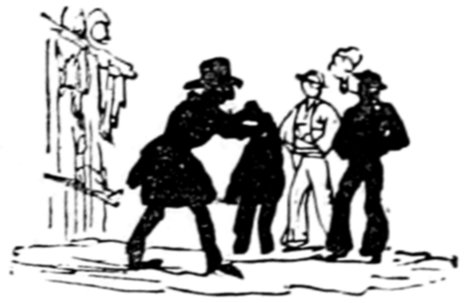
Land Sharks and Sea Gulls.
Old Isaac's so given to bite us,
In bargains whenever we meet,
That I wish we'd a similar Titus
To batter down Holywell Street.
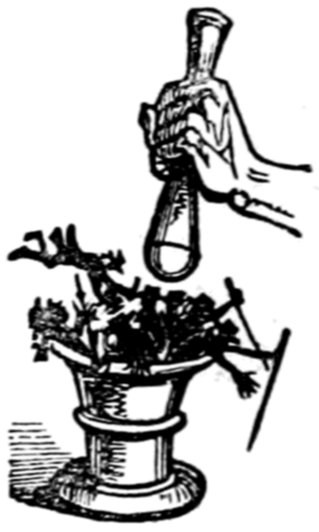
23. College of Physicians incorporated, 1518.
'Twere fair revenge to give no quarter,
But pound the doctors in their mortar.
189
SEPTEMBER.—Plucking a Goose.
After my papa's death, as he left me no money, and only a little land, I put my estate into an auctioneer's hands, and determined to amuse my solitude with a trip to some of our fashionable watering-places. My house was now a desert to me. I need not say how the departure of my dear parent, and her children, left me sad and lonely.
Well, I had a little ready money, and, for the estate, expected a couple of thousand pounds. I had a good military-looking person; for though I had absolutely cut the old North-Bungays (indeed, after my affair with Waters, Colonel Craw hinted to me, in the most friendly manner, that I had better resign), though I had left the army, I still retained the rank of Captain; knowing the advantages attendant upon that title, in a watering-place tour.
Captain Stubbs became a great dandy at Cheltenham, Harrogate, Bath, Leamington, and other places. I was a good whist and billiard-player; so much so, that in many of these towns the people used to refuse, at last, to play with me, knowing how far I was their superior. Fancy, my surprise, about five years after the Portsmouth affair, when strolling one day up the High Street, in Leamington, my eyes lighted upon a young man, whom I remembered in a certain butcher's yard, and elsewhere—no other, in fact, than Dobble. He, too, was dressed en militaire, with a frogged coat and spurs; and was walking with a showy-looking, Jewish-faced, black-haired lady, glittering with chains and rings, with a green bonnet, and a bird of Paradise—a lilac shawl, a yellow gown, pink silk stockings, and light blue shoes. Three children, and a handsome footman, were walking behind her, and the party, not seeing me, entered the Royal Hotel together.
I was known, myself, at the Royal, and calling one of the waiters, learned the names of the lady and gentleman. He was Captain Dobble, the son of the rich army clothier, Dobble (Dobble, Hobble, and Co., of Pall Mall); the lady was a Mrs. Manasseh, widow of an American Jew, living quietly at Leamington with her children, but possessed of an immense property. There's no use to give one's self out to be an absolute pauper, so the fact is, that I myself went everywhere with the character of a man of very large means. My father had died, leaving me immense sums of money, and landed estates—ah! I was the gentleman then, the real gentleman, and everybody was too happy to have me at table.
Well, I came the next day, and left a card for Dobble, with a note: he neither returned my visit, nor answered my note. The day after, however, I met him with the widow, as before; and, going up to him, very kindly seized him by the hand, and swore I was—as really was the case—charmed to see him. Dobble hung back, to my surprise, and I do believe the creature would have cut me, if he dared; but I gave him a frown, and said—
"What, Dobble, my boy, don't you recollect old Stubbs, and our adventure with the butcher's daughters, ha?"
Dobble gave me a sickly kind of grin, and said, "Oh! ah! yes! It is—yes! it is, I believe, Captain Stubbs."
"An old comrade, madam, of Captain Dobble's, and one who has heard so much, and seen so much, of your ladyship, that he must take the liberty of begging his friend to introduce him."
Dobble was obliged to take the hint; and Captain Stubbs was duly presented to Mrs. Manasseh; the lady was as gracious as possible: and when, at the end of the walk, we parted, she said, "she hoped Captain Dobble would bring me to her apartments that evening, where she expected a few friends." Everybody, you see, knows everybody at Leamington; and I, for my part, was well known as a retired officer of the army; who, on his father's death, had come into seven thousand a year. Dobble's arrival had been subsequent to mine, but putting up, as he did, at the Royal Hotel, and dining at the ordinary there with the widow, he had made his acquaintance before I had. I saw, however, that if I allowed him to talk about me, as he could, I should be compelled to give up all my hopes and pleasures at Leamington; and so I determined to 190be short with him. As soon as the lady had gone into the hotel, my friend Dobble was for leaving me likewise; but I stopped him, and said, "Mr. Dobble, I saw what you meant just now: you wanted to cut me, because, forsooth, I did not choose to fight a duel at Portsmouth; now look you, Dobble, I am no hero, but I'm not such a coward as you—and you know it. You are a very different man to deal with from Waters; and I will fight this time."
Not, perhaps, that I would: but after the business of the butcher, I knew Dobble to be as great a coward as ever lived: and there never was any harm in threatening, for you know you are not obliged to stick to it afterwards. My words had their effect upon Dobble, who stuttered, and looked red, and then declared, he never had the slightest intention of passing me by; so we became friends, and his mouth was stopped.
He was very thick with the widow: but that lady had a very capacious heart, and there were a number of other gentlemen who seemed equally smitten with her. "Look at that Mrs. Manasseh," said a gentleman (it was droll, he was a Jew, too), sitting at dinner by me; "she is old and ugly, and yet because she has money, all the men are flinging themselves at her."
"She has money, has she?"
"Eighty thousand pounds, and twenty thousand for each of her children. I know it for a fact," said the strange gentleman. "I am in the law, and we, of our faith, you know, know pretty well what the great families amongst us are worth."
"Who was Mr. Manasseh?"
"A man of enormous wealth—a tobacco-merchant—West Indies; a fellow of no birth, however; and who, between ourselves, married a woman that is not much better than she should be. My dear sir," whispered he, "she is always in love—now it is with that Captain Dobble; last week it was somebody else; and it may be you next week, if—ha! ha! ha!—you are disposed to enter the lists."
"I wouldn't, for my part, have the woman with twice her money."
What did it matter to me, whether the woman was good or not, provided she was rich? My course was quite clear. I told Dobble all that this gentleman had informed me, and being a pretty good hand at making a story, I made the widow appear so bad, that the poor fellow was quite frightened, and fairly quitted the field. Ha! ha! I'm dashed if I did not make him believe that Mrs. Manasseh had murdered her last husband.
I played my game so well, thanks to the information that my friend the lawyer had given me, that, in a month, I had got the widow to show a most decided partiality for me. I sat by her at dinner; I drank with her at the Wells; I rode with her; I danced with her; and at a pic-nic to Kenilworth, where we drank a good deal of champagne, I actually popped the question, and was accepted. In another month, Robert Stubbs, Esq., led to the altar Leah, widow of the late Z. Manasseh, Esq., of St. Kitt's!
We drove up to London in her comfortable chariot; the children and servants following in a post-chaise. I paid, of course, for everything; and until our house in Berkeley Square was painted, we stopped at Stevens's Hotel.
My own estate had been sold, and the money was lying at a bank, in the city. About three days after our arrival, as we took our breakfast in the hotel, previous to a visit to Mrs. Stubbs's banker, where certain little transfers were to be made, a gentleman was introduced, who, I saw at a glance, was of my wife's persuasion.
He looked at Mrs. Stubbs, and made a bow. "Perhaps it will be convenient to you to pay this little bill, one hundred and fifty-two poundsh?"
"My love," says she, "will you pay this? It is a trifle which I had really forgotten." "My soul!" said I, "I have really not the money in the house."
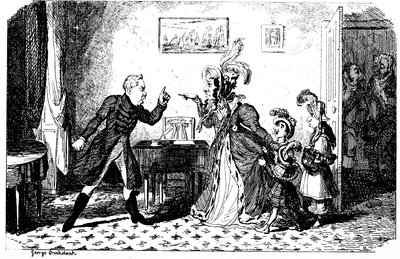
"Vel, denn, Captain Shtubbsh," says he, "I must do my duty—and arrest you—here is the writ! Tom, keep the door!"—My wife fainted—the children screamed, and I—fancy my condition, as I was obliged to march off to a sponging house, along with a horrid sheriff's officer!
191
1839.] OCTOBER.
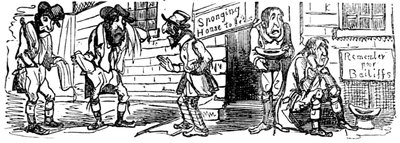
"OTHELLO'S OCCUPATION'S GONE."
1. Abolition of arrest on suspicion of debt, 1838.
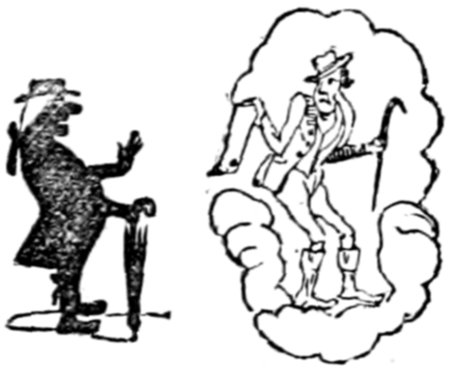
The ghost of a "Bailey.' "Remember thee? Ay, thou poor ghost!"
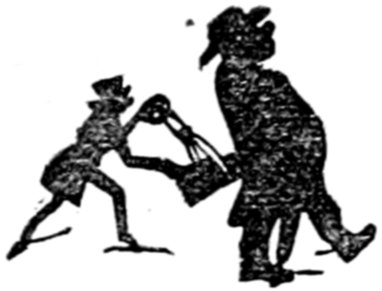
Share and share alike.
——Right little grieve I
To take my leave of all the tribe of Levi!
I care not now whom I may chance to meet
In Chancery Lane or Carey Street;
Gentile or Jew, or neither, or what not,
The bailiff's occupation's gone to pot,
And all their sport, thank common sense, is over;
Unless you find a man to swear,
That he heard another man declare,
That as he was walking the streets one day,
He met with Jones, who was heard to say,
That Smith intended to run away,
Across the straits of Dover.
But, any way, it does seem rather funny
To lock a man within four walls, and bid him seek for money.
There's no occasion now for me to hide,
Tho' once I was a deeply versed court guide;
I fear not now a single rap,
Nor startle at a tap.
From my boot's sole to my hat crown,
I'll have it all set down;
As to my tailleur, his suit's a failure,
And talking of a writ, quite a mis-fit;
So, spite his measures, I'll take my pleasures;
And, since for debt I need not run away,
Shall I, like vulgar traders, stoop to pay?
Nay!
10. Dividends due.
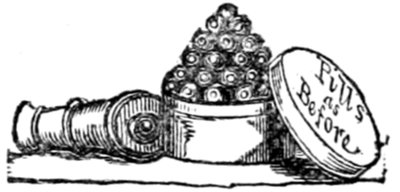
A Prescription.
Philosophers sagely declare,
Without reservation or stealth,
That the source of true happiness here
Is an equal division of wealth.
20. Battle of Navarino, 1827.
192
OCTOBER.—Mars and Venus in Opposition.
I shall not describe my feelings when I found myself in a cage in Cursitor-street, instead of that fine house in Berkeley Square, which was to have been mine as the husband of Mrs. Manasseh. What a palace!—in an odious, dismal street leading from Chancery Lane,—a hideous Jew boy opened the second of three doors; and shut it when Mr. Nabb and I (almost fainting) had entered: then he opened the third door, and then I was introduced to a filthy place, called a coffee-room, which I exchanged for the solitary comfort of a little dingy back-parlour, where I was left for a while to brood over my miserable fate. Fancy the change between this and Berkeley Square! Was I, after all my pains, and cleverness, and perseverance, cheated at last? Had this Mrs. Manasseh been imposing upon me, and were the words of the wretch I met at the table-d'hôte at Leamington, only meant to mislead me and take me in? I determined to send for my wife, and know the whole truth. I saw at once that I had been the victim of an infernal plot, and that the carriage, the house in town, the West India fortune, were only so many lies which I had blindly believed. It was true the debt was but a hundred and fifty pounds: and I had two thousand at my bankers. But was the loss of her £80,000 nothing? Was the destruction of my hopes nothing?—The accursed addition to my family of a Jewish wife, and three Jewish children, nothing? And all these I was to support out of my two thousand pounds. I had better have stopped at home, with my mamma and sisters, whom I really did love, and who produced me eighty pounds a-year.
I had a furious interview with Mrs. Stubbs; and when I charged her, the base wretch! with cheating me, like a brazen serpent, as she was, she flung back the cheat in my teeth, and swore I had swindled her. Why did I marry her, when she might have had twenty others? She only took me, she said, because I had twenty thousand pounds. I had said I possessed that sum; but in love, you know, and war, all's fair.
We parted quite as angrily as we met; and I cordially vowed that when I had paid the debt into which I had been swindled by her, I would take my £2,000, and depart to some desert island; or, at the very least, to America, and never see her more, or any of her Israelitish brood. There was no use in remaining in the sponging-house (for I knew that there were such things as detainers, and that where Mrs. Stubbs owed a hundred pounds, she might owe a thousand), so I sent for Mr. Nabb, and tendering him a cheque for £150, and his costs, requested to be let out forthwith. "Here, fellow," said I, "is a cheque on Child's for your paltry sum."
"It may be a shech on Shild's," says Mr. Nabb, "but I should be a baby to let you out on such a paper as dat."
"Well," said I, "Child's is but a step from this; you may go and get the cash,—just giving me an acknowledgment."
Nabb drew out the acknowledgment with great punctuality, and set off for the Bankers, whilst I prepared myself for departure from this abominable prison.
He smiled as he came in. "Well," said I, "you have touched your money; and now, I must tell you, that you are the most infernal rogue and extortioner I ever met with."
"O no, mishter Shtubbsh," says he, grinning still, "dere is som greater roag dan me,—mosh greater."
"Fellow," says I, "don't stand grinning before a gentleman; but give me my hat and cloak, and let me leave your filthy den."
"Shtop, Shtubbsh," says he, not even Mistering me this time, "here ish a letter, vich you had better read."
I opened the letter: something fell to the ground:—it was my cheque.
The letter ran thus: "Messrs. Child and Co. present their compliments to Captain Stubbs, and regret that they have been obliged to refuse payment of the enclosed, having been served this day with an attachment by Messrs. Solomonson and Co., which compels them to retain Captain Stubbs's balance of £2010 11s. 6d. until the decision of the suit of Solomonson v. Stubbs.
"Fleet Street."
"You see," says Mr. Nabb, as I read this dreadful letter, "you see, Shtubbsh, 193dere vas two debts,—a littel von, and a big von. So dey arrested you for de littel von, and attashed your money for de big von."
Don't laugh at me for telling this story: if you knew what tears are blotting over the paper as I write it; if you knew that for weeks after I was more like a madman than a sane man,—a madman in the Fleet Prison, where I went, instead of to the desert island. What had I done to deserve it? Hadn't I always kept an eye to the main chance? Hadn't I lived economically, and not like other young men? Had I ever been known to squander or give away a single penny? No! I can lay my hand on my heart, and, thank Heaven, say, No! Why—why was I punished so?
Let me conclude this miserable history. Seven months—my wife saw me once or twice, and then dropped me altogether—I remained in that fatal place. I wrote to my dear mamma, begging her to sell her furniture, but got no answer. All my old friends turned their backs upon me. My action went against me—I had not a penny to defend it. Solomonson proved my wife's debt, and seized my two thousand pounds.—As for the detainer against me, I was obliged to go through the court for the relief of insolvent debtors. I passed through it, and came out a beggar. But, fancy the malice of that wicked Stiffelkind; he appeared in court as my creditor for £3, with sixteen years' interest, at five per cent., for a PAIR OF TOP-BOOTS. The old thief produced them in court, and told the whole story—Lord Cornwallis, the detection, the pumping, and all.
Commissioner Dubobwig was very funny about it. "So Doctor Swishtail would not pay you for the boots, eh, Mr. Stiffelkind?"
"No; he said, ven I ask him for payment, dey was ordered by a yong boy, and I ought to have gone to his schoolmaster."
"What, then, you came on a bootless errand, eh, sir?" (A laugh.)
"Bootless! no, sare. I brought de boots back vid me; how de devil else could I show dem to you?" (Another laugh.)
"You've never soled 'em since, Mr. Tickleshins?"
"I never vood sell dem; I svore I never vood, on porpus to be revenged on dat Stobbs."
"What, your wound has never been healed, eh?"
"Vat do you mean vid your bootless errants, and your soling and healing? I tell you I have done vat I svore to do; I have exposed him at school, I have broak off a marriage for him, ven he vould have had twenty tousand pound, and now I have showed him up in a court of justice; dat is vat I ave done, and dat's enough." And then the old wretch went down, whilst everybody was giggling and staring at poor me—as if I was not miserable enough already.
"This seems the dearest pair of boots you ever had in your life, Mr. Stubbs," said Commissioner Dubobwig, very archly, and then he began to inquire about the rest of my misfortunes.
In the fulness of my heart I told him the whole of them; how Mr. Solomonson the attorney had introduced me to the rich widow, Mrs. Manasseh, who had fifty thousand pounds, and an estate in the West Indies. How I was married, and arrested on coming to town, and cast in an action for two thousand pounds, brought against me by this very Solomonson for my wife's debts.
"Stop," says a lawyer in the court. "Is this woman a showy black-haired woman, with one eye? very often drunk, with three children—Solomonson, short, with red hair?"
"Exactly so," says I, with tears in my eyes.
"That woman has married three men within the last two years. One in Ireland, and one at Bath. A Solomonson is, I believe, her husband, and they both are off for America ten days ago."
"But why did you not keep your £2000?" said the lawyer.
"Sir, they attached it."
"O! well, we may pass you; you have been unlucky, Mr. Stubbs, but it seems as if the biter had been bit in this affair."
"No," said Mr. Dubobwig, "Mr. Stubbs is the victim of a FATAL ATTACHMENT."
194
POETRY AT SIGHT.
A remarkably successful operation has just been performed by Mr. Curtis, on the eyes of an elderly lady, who had been blind and deaf from her birth. The following letter to her niece has been sent to us by her friends, to show the rapidity of her literary acquirements, immediately on her attainment of the power of vision; and such of our readers as can fancy themselves deaf will certainly see it to consist of capital rhymes.
Dear Dolly, I'll thank you to send the cocoa,
And Susan, who brings it, shall take back your boa.—
Pray, tell Doctor Bleed'em I've got a sad cough;
I caught it while watching young Hodge at the plough;
I thought the day fine and was simple enough
My umbrella to leave, so got wet through and through,
For it came down in torrents; your poor aunt was caught
In the rain, and I afterwards sat in a draught.
This made me much worse, but experience I bought,
And I'll never more trust to the sunshine and drought!
Well, I made myself dry, and I sat down to tea:
Of the good that it did me you'd form no idea.
But I quite hate the country, the weather's so rough,
So you'll see me, dear, soon in your little borough.
I hope, after all, that my cold will be trivial—
But still you may send me that stuff in the vial—
In the kitchen you'll find it, just over the trough.
Oh, my cough! oh, my cough! it all comes of the plough.
A SETTLER'S LETTER.
The Emigration Committee have thought it right to give publicity to the following very intelligent letter, lately written by a settler to his mother, on account of the valuable statistical information it contains.
Catchum's Shallow on the little Red River
Arkensaw Stait April 1838
My dere Muther,—Yer mustent wunder if you havnt herd of me for sume time, but grate grefe is dumb as Shaxpire sais, and I was advised to hop my twig and leaf old ingland, witch indede I was verry sorrorful, but now I am thanks gudnes saf, and in amerrykey. i ardly no ware miself, but the hed of this will tel my tail. I ham a sqwatter in the far wurst, about ½ a-mile this side sundown, an if i ad gone mutch father i should av found nothin but son, an no nite at all. Yu kno how the hummeggrating Agent tolde me that if peepel cudnt liv in Sent Gileses amerrykey was capitle to dy in; besides ses he if youre not verry nere you can ade yure mother in distres, so i went aborde a skip wat was going to Noo Orlines. Ive herd peepel tawk abowt rodes at C but the rodes on the attalantick is the verry ruffest i iver rode on and it was very long an very cold an we had nothing 2 heat hardly, but we founde a ded rat in a warter cask witch the flavur was grately increased thareby.
195at last we cam to the arbur at the citty of Noo Orlines witch is all under the bottum of the top of the rivver and we ad a ankering to go a-shore. I ad no idear as the rivers was so hi in this contry, but as the assent is so verry esy i didn't fele it at al. The noo orlines peepel is odd fishis and not at all commun plaice; wen all the peepel in the stretes is musterd it is a pepper an sault poppulashun, there is blak wites an wite blaks an a sorte of mixt peepel caled quadruunts because they are of fore colers blak, an wite, an wite blaks, and blak wites. Has the rivver is so verry hi it is alwys hi water, an the munnifold advantiges of the citty dipends on the gudnes of its banks. there is loks in em to let the water out and keys to kepe it in. munny here is very common and is cald sentse, and evvery thing is cheep in Noo Orlines 5 dollers bills bein only worth 2 dollers. We went up the rivver in a large bote like a noise ark only more promiscus. the current acount was aginst us it dont turn and turn agen like at putny bridg, and as it runs alwys won way i wunder it dont run away altogethir. Thire is no towns nor tailer shops nor palisses as I expectorated there wood be. the wood was all quite wilde not a bit of tame no ware nor no sines of the blessedniss of civilazashun as jales an jin shops nor no kitching gardins nor fields nor ouses nor lanes nor alleys nor gates nothin but alleygators. after a grate dale of settlin I settled to settle as abuv ware yu will rite to me. These staits is caled the united staits becawse theire mails and femails all united. there's six of them wimmin staits. 2 Carrolinas, Miss Sourry, Miss Sippy, Louesa Anna, an Vargina, all the rest is mails. i have sene no cannibels an verry few ingins besides steam ingins they're quite unhedducated and dont employ no tailers. I dont like fammin mutch but praps I shal wen i get used to it, tho its very ilconvenient at furst. i am obliged to wurk very ard and if I have to chop my one wood much longer I have determined to cut my stick.
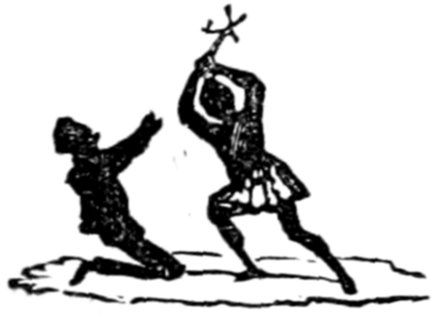
A Settler.
Dere muther, i think i shud be more cumfurtable if I had a few trifels witch you culd bye me, if yew wud onley sel sumthing and send me all the bils partickular, and I'l be sure to owe it you—namly sum needils and thred, and sum odd buttens, but thems of little use without you send me sum shirts, and a waistcote, and upper cote, to put em on, when those tumbles off thats on when you sends em, and sum brads, and some hammers do drive em with, and a spade an a pikax, an a saw, and some fish hooks, and gunpowdr, an sum shot, witch they wil be of the gratest conveniency, if you can send me a gun. likewis som stockins, an shues and other hardwares, only its no use to send me any bank nots, for my nerest naybours is sum ingun wagwams abuve 70 miles of, and I cudnt get change thare, so dont forgit some led, and some bullit moldes, for some blak fellers has been fishin close by, jist within 10 miles and I wants to have a pop at em with luv to all yore dutiful sone
Sam. Stroller.
196
NOVEMBER. [1839.
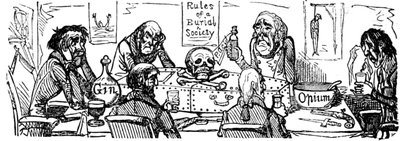
THE JOINT STOCK SUICIDE CLUB.
Put no faith in false Predictions, ☍ ♒ ♀ ♂ Patient bear the worst Inflictions. Fog or Sunshine, time will tell; Gentle Reader, Fare thee well.

Brothers! support me in my desperate duty!
I first propose to all a cup of Rue-tea,
While I recite once more the various ways
Our club allows to terminate our days.
————————————
We recommend strongly steamboat trips
To those who are tired of their wives;
For it's better to scald to death at once
Than pass in hot water your lives.
The club prescribe a railroad ride,
To such as are bent on marriages;
If they're looking for sweet, 'tis like they'll meet
A Jam between two carriages.
Or take your place when the coaches race,
And an opposition rages,
It's a pleasanter trick to be popp'd off quick,
Than be kill'd by lingering stages.
But we wish all poets to try their pens
On a work of fun and fancy;
They'll hang on a hook, ere they finish their book,
In a fit of neck-romancy.
Now a dismal band, let us seek the Strand,
From Waterloo to jump,
And we'll leap from the piers, 'mid the barges' tiers,
To show that our club's a trump.
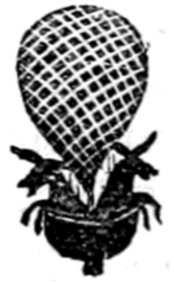
23. First balloon ass-sent, 1782.
I wonder which will be the last—don't you?
29. Insurrection of the Poles, 1830.
Paupers proclaim, so dignified their stations,
The shears a trespass on the rights of nations.
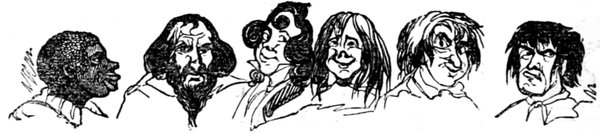
A Collection of National Hairs, with variations.
197
NOVEMBER.—A General Post Delivery.
I was a free man when I went out of the Court; but I was a beggar—I, Captain Stubbs, of the bold North-Bungays, did not know where I could get a bed or a dinner.
As I was marching sadly down Portugal Street, I felt a hand on my shoulder, and a rough voice which I knew well.
"Vell, Mr. Stobbs, have I not kept my bromise? I told you dem boots would be your ruin."
I was much too miserable to reply; and only cast up my eyes towards the roofs of the houses, which I could not see for the tears.
"Vat! you begin to gry and blobber like a shild? you vood marry, vood you, and noting vood do for you but a vife vid monny—ha, ha—but you vere de pigeon, and she vas de grow. She has plocked you, too, pretty vell—eh? ha! ha!"
"Oh, Mr. Stiffelkind," said I, "don't laugh at my misery; she has not left me a single shilling under heaven. And I shall starve—I do believe I shall starve." And I began to cry fit to break my heart.
"Starf! stoff and nonsense—you vil never die of starfing—you vil die of hanging, I tink, ho! ho! and it is moch easier vay too." I didn't say a word, but cried on, till everybody in the street turned round and stared.
"Come, come," said Stiffelkind, "do not gry, Gaptain Stobbs—it is not goot for a Gaptain to gry, ha! ha! Dere, come vid me, and you shall have a dinner, and a bregfast too—vich shall gost you nothing, until you can bay vid your earnings."
And so this curious old man, who had persecuted me all through my prosperity, grew compassionate towards me in my ill-luck: and took me home with him as he promised. "I saw your name among de Insolvents—and I vowed, you know, to make you repent dem boots. Dere now, it is done and forgotten, look you. Here, Betty, Bettchen, make de spare bed, and put a clean knife and fork; Lort Cornvallis is come to dine vid me."
I lived with this strange old man for six weeks. I kept his books, and did what little I could to make myself useful: carrying about boots and shoes, as if I had never borne his Majesty's commission. He gave me no money, but he fed and lodged me comfortably. The men and boys used to laugh, and call me General, and Lord Cornwallis, and all sorts of nicknames—and old Stiffelkind made a thousand new ones for me.
One day, I can recollect—one miserable day, as I was polishing on the trees a pair of boots of Mr. Stiffelkind's manufacture, the old gentleman came into the shop with a lady on his arm.
"Vere is Gaptain Stobbs," says he; "vere is dat ornament to his Majesty's service?"
I came in from the back shop, where I was polishing the boots, with one of them in my hand.
"Look, my dear," says he, "here is an old friend of yours, his Excellency Lord Cornvallis! Who would have thought such a nobleman vood turn shoe-black? Gaptain Stobbs, here is your former flame, my dear niece, Miss Grotty. How could you, Magdalen, ever leaf soch a lof of a man? Shake hands vid her, Gaptain;—dere, never mind de blacking:" but Miss drew back.
"I never shake hands with a shoe-black," says she, mighty contemptuous.
"Bah! my lof, his fingers von't soil you. Don't you know he has just been vite-vashed?"
"I wish, uncle," says she, "you would not leave me with such low people."
"Low, because he cleans boots? de Gaptain prefers pumps to boots, I tink, ha! ha!"
"Captain, indeed! a nice Captain," says Miss Crutty, snapping her fingers in my face, and walking away: "a Captain, who has had his nose pulled? ha! ha!"—And how could I help it? it wasn't by my own choice that that ruffian Waters took such liberties with me; didn't I show how averse I was to all quarrels by refusing altogether his challenge?—but such is the world: and thus the people at Stiffelkind's used to tease me until they drove me almost mad.
198At last, he came home one day more merry and abusive than ever. "Gaptain," says he, "I have goot news for you—a goot place. Your lortship vil not be able to geep your garridge, but you vil be gomfortable, and serve his Majesty."
"Serve his Majesty!" says I. "Dearest Mr. Stiffelkind, have you got me a place under Government?"
"Yes, and someting better still—not only a place, but a uniform—yes, Gabdain Stobbs, a red goat."
"A red coat! I hope you don't think I would demean myself by entering the ranks of the army? I am a gentleman, Mr. Stiffelkind—I can never—no, I never."
"No, I know you will never—you are too great a goward, ha! ha!—though dis is a red goat, and a place where you must give some hard knocks too, ha! ha!—do you gomprehend?—and you shall be a general, instead of a gabtain—ha! ha!"
"A general in a red coat! Mr. Stiffelkind?"
"Yes, a GENERAL BOSTMAN! ha! ha! I have been vid your old friend, Bunting, and he has an uncle in the Post-office, and he has got you de place—eighteen shillings a veek, you rogue, and your goat. You must not oben any of de letters, you know."
And so it was—I, Robert Stubbs, Esquire, became the vile thing he named—a general postman!
I was so disgusted with Stiffelkind's brutal jokes, which were now more brutal than ever, that when I got my place in the Post-office I never went near the fellow again—for though he had done me a favour in keeping me from starvation, he certainly had done it in a very rude, disagreeable manner, and showed a low and mean spirit in shoving me into such a degraded place as that of postman. But what had I to do? I submitted to fate, and for three years or more, Robert Stubbs, of the North-Bungay Fencibles, was——
I wonder nobody recognised me. I lived in daily fear the first year; but, afterwards, grew accustomed to my situation, as all great men will do, and wore my red coat as naturally as if I had been sent into the world only for the purpose of being a letter carrier.
I was first in the Whitechapel district, where I stayed nearly three years, when I was transferred to Jermyn Street and Duke Street—famous places for lodgings. I suppose I left a hundred letters at a house in the latter street, where lived some people who must have recognised me had they but once chanced to look at me.
You see, that when I left Sloffem, and set out in the gay world, my mamma had written to me a dozen times at least, but I never answered her, for I knew she wanted money, and I detest writing. Well, she stopped her letters, finding she could get none from me: but when I was in the Fleet, as I told you, I wrote repeatedly to my dear mamma, and was not a little nettled at her refusing to notice me in my distress, which is the very time one most wants notice.
Stubbs is not an uncommon name; and though I saw MRS. STUBBS on a little bright brass plate, in Duke Street, and delivered so many letters to the lodgers in her house, I never thought of asking who she was, or whether she was my relation, or not.
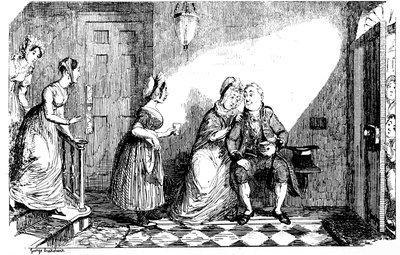
One day the young woman who took in the letters had not got change, and she called her mistress;—an old lady in a poke bonnet came out of the parlour, and put on her spectacles, and looked at the letter, and fumbled in her pocket for eight-pence, and apologized to the postman for keeping him waiting; and when I said, "Never mind, ma'am, it's no trouble," the old lady gave a start, and then she pulled off her spectacles, and staggered back; and then she began muttering, as if about to choke; and then she gave a great screech, and flung herself into my arms, and roared out, "MY SON! MY SON!"
"Law, mamma," said I, "is that you?" and I sat down on the hall bench with her, and let her kiss me as much as ever she liked. Hearing the whining and crying, down comes another lady from upstairs,—it was my sister Eliza; and down come the lodgers. And the maid gets water, and what not, and I was the regular hero of the group. I could not stay long then, having my letters to deliver. But, in the evening, after mail-time, I went back to my mamma and sister: and, over a bottle of prime old Port, and a precious good leg of boiled mutton and turnips, made myself pretty comfortable, I can tell you.
199
BLARNEYHUM ASS-TROLOGICUM PRO ANNO 1839.
Gentle Reader,—
Beware of false prophets, who predict of the times, which, but for thy simplicity, would be for them "out of joint"—of the seasons, of which they know not, save that they yield them a profitable harvest,—and of the winds, for which they care not, so that they blow them good; but turn from them awhile, and regard the Hieroglyphicum in Obscuro I here set before thee, and the interpretation thereof; and, if it come not as I predict, thou may'st guess the reason why. Unlucky planets rule the State Kitchen; and the great kettle being filled by Aquarius, with Sol in opposition, an unfriendly boil is produced, which maketh the place so hot that the Cooks find it hard to stay within, though loth to go out. Moreover, being of one mind as to the making of a mess, but differing as to the manner thereof, they have fallen to fighting, to settle the question, and are all going to pot together. By a touch of my wand, behold them transmogrified into a Lamb's head, served with a plentiful dressing of strong Durham mustard, a little Jack clinging to the side, as though he wished himself out of this pretty kettle of fish, and a fowl, though, by his looks, no chicken, attempting his escape in the form of a winged Cupid. He does not like his company, and has made his bow—behold it in his hand. Another fish, more like a Sir John than a sturgeon, seems as though his berth was far from pleasant. The Mistress, alarmed by the noise, comes to the window to see what is the matter; an ancient Master Cook, from Arthur's, stands, ladle in hand, his fingers itching to skim the scum off as it rises. An old Kitchen Maid, who, though pensioned off, will still have a finger in every pie, hath been stirring the fire with a worn-out broom-handle, (perchance she hath slyly put in a pinch of gunpowder) and is now playing the part of blow-bellows. She seemeth, by the satisfactionated curl of her nose, to be happy to see them all in hot water.
Now, as to the application hereof, every man must judge for himself; but of a verity it doth to me appear, that too many cooks will spoil any broth. And, while I speak of cookery, let me advise thee as to thy treatment of that which a departed wiseacre denominated the "worse than useless root." If, rejecting his advice, none but this fruit will content thee, let me counsel thee to follow my example—having well roasted my Murphy, I take him "cum grano salis." Now, touching other mundane matters, thou wilt herein find copious instructions, sage predictions, and wholesome advice, on which thou mayest surely rely, though I am no M.N.S., which can but mean Member of No Society.
Thine ever,
Rigdum Funnidos.
200
1839.] DECEMBER.
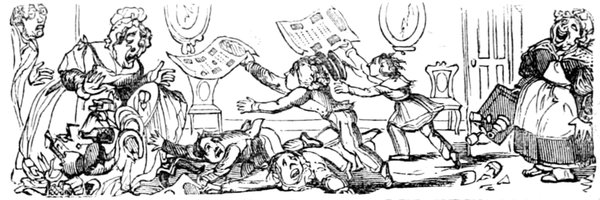
CHRISTMAS PIECES. A Soliloquial Care-all.
Here come December and the brats again! what pain! rushing like untamed kittens o'er a cataract. Tables turn'd, bottles broke, cups crack'd—All conspire to add to my distractions, to shew their skill in Christmas pieces, and in fractions.
How little dream'd I of the toil and trouble
Which wait on those who dare to carry double!
Why did I leave my life of singularity,
In my excess of Christian love and charity?
Too surely did I feel my courage falter
At that sad step which led up to the altar.
Since first I tied the matrimonial knot
Each year has added to my luckless lot;
I should not mind one little babe, no more.
But, poínt du TWO, I don't want half a score;
Yet still, in quick succession, lo! they rise,
A pretty string of pains and penal-ties.
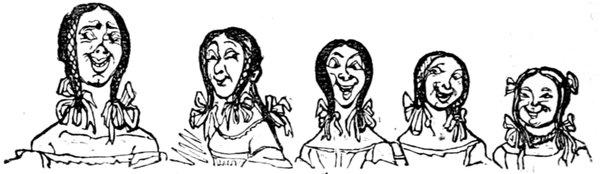
Family Ties.
From schoolmasters abroad the yearly bills
Run high among life's unsurmounted hills,
And pretty hillocks are those things call'd extras,
At doubling which they're all so ambidextrous;
Forgetting still, which greatly grieves my bowels,
To send back silver forks, or spoons, or towels.
Last, but not least, are those uncivil wars,
Poetic license calls domestic jars,
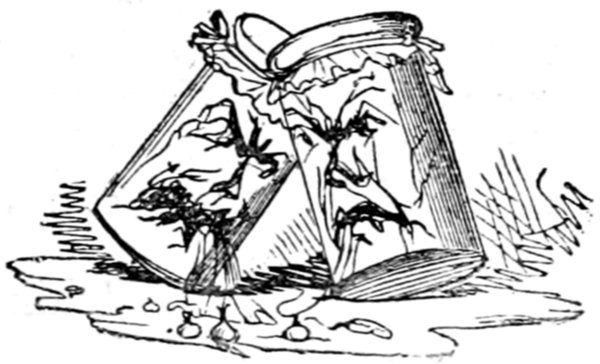
And which I find, though far from nice or fickle,
Without exception, yield the worst of pickle.
201
DECEMBER.—"The Winter of our Discontent."
Mamma had kept the house in Duke Street for more than two years. I recollected some of the chairs and tables, from dear old Squiggle, and the bowl in which I had made that famous rum-punch, the evening she went away, which she and my sisters left untouched, and I was obliged to drink after they were gone; but that's not to the purpose.
Think of my sister Mary's luck! That chap, Waters, fell in love with her, and married her; and she now keeps her carriage, and lives in state near Squiggle. I offered to make it up with Waters; but he bears malice, and never will see or speak to me. He had the impudence, too, to say that he took in all letters for mamma at Squiggle; and that, as mine were all begging letters, he burned them, and never said a word to her concerning them. He allowed mamma fifty pounds a year, and, if she were not such a fool, she might have had three times as much; but the old lady was high and mighty, forsooth, and would not be beholden, even to her own daughter, for more than she actually wanted. Even this fifty pounds she was going to refuse; but when I came to live with her, of course I wanted pocket money as well as board and lodging, and so I had the fifty pounds for my share, and eked out with it as well as I could.
Old Bates and the Captain, between them, gave mamma a hundred pounds when she left me (she had the deuce's own luck, to be sure—much more than ever fell to me, I know), and as she said she would try and work for her living, it was thought best to take a house and let lodgings, which she did. Our first and second floor paid us four guineas a week, on an average; and the front parlour and attic made forty pounds more. Mamma and Eliza used to have the front attic; but I took that, and they slept in the servants' bed room. Lizzy had a pretty genius for work, and earned a guinea a week that way; so that we had got nearly two hundred a year over the rent to keep house with,—and we got on pretty well. Besides, women eat nothing; my women didn't care for meat for days together sometimes,—so that it was only necessary to dress a good steak or so for me.
Mamma would not think of my continuing in the Post-office. She said her dear John, her husband's son, her gallant soldier, and all that, should remain at home, and be a gentleman—which I was, certainly, though I didn't find fifty pounds a year very much to buy clothes and be a gentleman upon; to be sure, mother found me shirts and linen, so that that wasn't in the fifty pounds. She kicked a little at paying the washing too; but she gave in at last, for I was her dear John, you know; and I'm blest if I could not make her give me the gown off her back. Fancy! once she cut up a very nice rich black silk scarf, which my sister Waters sent her, and made me a waistcoat and two stocks of it. She was so very soft, the old lady!
I'd lived in this way for five years or more, making myself content with my fifty pounds a year (perhaps, I'd saved a little out of it; but that's neither here nor there). From year's end to year's end I remained faithful to my dear mamma, never leaving her except for a month or so in summer, when a bachelor may take a trip to Gravesend or Margate, which would be too expensive for a family. I say a bachelor, for the fact is, I don't know whether I am married or not—never having heard a word since of the scoundrelly Mrs. Stubbs.
I never went to the public house before meals; for, with my beggarly fifty pounds, I could not afford to dine away from home; but there I had my regular seat, and used to come home pretty glorious, I can tell you. Then, bed till eleven; then, breakfast and the newspaper; then, a stroll in Hyde Park or Saint James's; then, home at half-past three to dinner, when I jollied, as I call it, for the rest of the day. I was my mother's delight; and thus, with a clear conscience, I managed to live on.
How fond she was of me, to be sure! Being sociable myself, and loving to have my friends about me, we often used to assemble a company of as hearty fellows as you would wish to sit down with, and keep the nights up royally. "Never mind, my boys," I used to say, "send the bottle round: mammy pays for all," as she did, sure enough; and sure enough we punished her cellar too. The good old lady used to wait upon us, as if for all the world she had been my servant, instead of 202a lady and my mamma. Never used she to repine, though I often, as I must confess, gave her occasion (keeping her up till four o'clock in the morning, because she never could sleep until she saw her "dear Bob" in bed, and leading her a sad anxious life). She was of such a sweet temper, the old lady, that I think in the course of five years I never knew her in a passion, except twice; and then with sister Lizzy, who declared I was ruining the house, and driving the lodgers away, one by one. But mamma would not hear of such envious spite on my sister's part. "Her Bob" was always right, she said. At last Lizzy fairly retreated, and went to the Waterses,—I was glad of it, for her temper was dreadful, and we used to be squabbling from morning till night.
Ah, those were jolly times! but ma was obliged to give up the lodging-house at last—for, somehow, things went wrong after my sister's departure—the nasty uncharitable people said, on account of me; because I drove away the lodgers by smoking and drinking, and kicking up noises in the house; and because mamma gave me so much of her money:—so she did, but if she would give it, you know, how could I help it? Heigho! I wish I'd kept it.
No such luck.—The business I thought was to last for ever; but at the end of two years a smash came—shut up shop—sell off everything. Mamma went to the Waterses: and, will you believe it, the ungrateful wretches would not receive me! that Mary, you see, was so disappointed at not marrying me. Twenty pounds a year they allow, it is true; but what's that for a gentleman? For twenty years I have been struggling manfully to gain an honest livelihood, and, in the course of them, have seen a deal of life, to be sure. I've sold segars and pocket-hand-kerchiefs at the corners of streets; I've been a billiard-marker; I've been Director (in the panic year) of the Imperial British Consolidated Mangle and Drying Ground Company. I've been on the stage (for two years as an actor, and about a month as a cad, when I was very low); I've been the means of giving to the police of this empire some very valuable information (about licensed victuallers, gentlemen's carts, and pawnbrokers' names); I've been very nearly an officer again—that is, an assistant to an officer of the Sheriff of Middlesex: it was my last place.
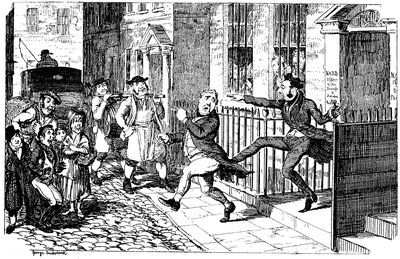
On the last day of the year 1837, even that game was up. It's a thing that has very seldom happened to a gentleman, to be kicked out of a sponging-house; but such was my case. Young Nabbs (who succeeded his father) drove me ignominiously from his door, because I had charged a gentleman in the coffee-rooms seven-and-sixpence for a glass of ale and bread and cheese, the charge of the house being only six shillings. He had the meanness to deduct the eighteen-pence from my wages, and, because I blustered a bit, he took me by the shoulders and turned me out—me, a gentleman, and, what is more, a poor orphan!
How I did rage and swear at him when I got out in the street!—There stood he, the hideous Jew monster, at the double door, writhing under the effect of my language. I had my revenge! Heads were thrust out of every bar of his windows, laughing at him. A crowd gathered round me, as I stood pounding him with my satire, and they evidently enjoyed his discomfiture. I think the mob would have pelted the ruffian to death (one or two of their missiles hit me, I can tell you), when a policeman came up, and, in reply to a gentleman, who was asking what was the disturbance, said, "Bless you, Sir, it's Lord Cornwallis." "Move on, Boots," said the fellow to me, for, the fact is, my misfortunes and early life are pretty well known—and so the crowd dispersed.
"What could have made that policeman call you Lord Cornwallis and Boots?" said the gentleman, who seemed mightily amused, and had followed me. "Sir," says I, "I am an unfortunate officer of the North Bungay Fencibles, and I'll tell you willingly for a pint of beer." He told me to follow him to his chambers at the Temple, which I did (a five pair back), and there, sure enough, I had the beer; and told him this very story you've been reading. You see he is what is called a literary man—and sold my adventures for me to the booksellers: he's a strange chap; and says they're moral.
I'm blest if I can see anything moral in them. I'm sure I ought to have been more lucky through life, being so very wide awake. And yet here I am, without a place, or even a friend, starving upon a beggarly twenty pounds a year—not a single sixpence more, upon my honour.
203
ASCOT CUP DAY. FROM THE RACING CALENDAR.
"Well, I never!—this the Great Western Railway: the Paddington Station? What a beautiful place:—ugh! ugh! ugh!—and that's the engine: did I ever!—What a funny noise it makes; and what elegant carriages—all plate-glass and silk-lace!" Thus rattled a lively little matron, as fine as a milliner's pattern-doll, to her dapper lord and master, as they seated themselves vis-à-vis, in the nine-o'clock down train, first-class, on the morning of the last anniversary of Ascot Cup Day. Anon they were darting onwards for their destination, and again the dame's loquacities were at high pressure. "It is charming, and that's all about it: for all the world like travelling by balloon; and as free from dust and dirt as if one was borne through the air. Why, we shall get down, I do declare, as clean as new pins." "No danger of being soiled on this line, marm," remarked a stout personage in nankeen leggings, a wig, and a very red face, "'cause why, we escape Staines and avoid Slough, you know: ha! ha!"
At the end of five-and-forty minutes, bump, bump, bump, and a hissing, as of a universe of boa-constrictors, were succeeded by the interrogatory, from officials in green and much brass, of—"Now Windsor?" and all the crew bound for the races descended of course. Then rose the clamour of 'bus cads and go-cart touters—
"Billingsgate eloquence, and, as I guess,
The logic of the 'os coccygis;'"
when, after a scuffle, and some energetic demonstrations, our little dame and second-self found themselves once more in company with the gentleman in the leggings and red face. The trio were seated in a lateral inconvenience on enormous wheels, the charioteer, with his behind before them, urging to utmost speed a gaunt but sinewy bit of blood, who flew onwards as if a herd of hungry wolves were at his haunches. Our travellers were soon on the best of terms: good fellowship generally results when people are thus thrown together. Windsor was quickly reached, and as they turned the corner beyond the White Hart, which leads to Ascot, an equipage at the door of the hostelry attracted, by its splendour, the go-carter's attention. "That's L——'s carriage," said the married male; "he that cut such a dash last season; gave balls to one half of London;"—"and rifled the other," rejoined the man with the rosy countenance: it was manifest that he was a wag. "A correct list of all the wonderful high-bred horses, and how they will come in for every heat during the day." "The modern Hercules, ladies and gentlemen; the modern Hercules: he will take and tie that ere donkey to this here ladder, and balance the astonishing conjunction on the tip of his nose. Waiting for a ha'penny, ladies and gentlemen; make it another 204brown, and—up—he—goes." Such is the chorus of the Olympic song, chanted what time Ascot celebrates her right-royal revels; but we tarry not for the ladder, or the staves.
Through streets of canvas caravanseras, all soliciting their custom, our tria juncta reach the ropes as the word runs along the lines, "The Queen is coming!" "Let me see her," ejaculated the lady voyager: "bless her heart! it was for that I came here; and is that Her Majesty? She is a darling, that's what she is! so amiable, so kind-looking, and so little to be a queen!" "And who is that in green, with the costly golden couples over his shoulders?" "Oh, that's the master of the dear hounds." "And all those lovely, smiling ladies?" "More of the sweet." "Clear the course, clear the course!" and straightway there is a movement of gold, precious stones, silk, and paradise plumes, enough to astonish the Genii of the Wonderful Lamp.
"Here they come!" Grey Momus, and Epirus, and Caravan, with "little Pavis, the rara avis." "Another round for it. Well done, grey; hurrah! dismal jacket." "Who's the favourite?" "The belles are all for Bowes; I'm for Suffield, he's such a good fellow." "I'm for Lord George, he's a better." "Hurrah! splendid race." "Oh! you villain, you've stolen my watch; but I've got you, and I'll give it you." "That ere's never no prigging. Didn't I hear you promise to give it him?" "Get away, do—you'll break the springs: you're not to climb up my steps for a stare." The Royal Stand is now vacated, and the cause reaches our little inquisitive friend. "Her Majesty has retired to luncheon." "Law, is she, indeed! how I should like to see her eat: I'm dying to know what sort of meals they provide for her." "All the delicacies in season," explained the wit, with a sinister smile, "and Lamb the whole year round." The matchless cavalcade has passed in all its gorgeous simplicity, bearing the cynosure of all eyes, where waves the banner of St. George a welcome to
"The fair-haired daughter of the Isles,
The hope of many nations."
This, and a rain, descending à l'Anglaise, gave notice to quit to all save those who, by the grace of Mackintosh and neat brandy, had set the elements at defiance. "Let us return to our conveyance," said the lively little matron, "and make our way back to the station of the Great Western Railway; my parasol is wet through already." "Here is the spot where we left it," ejaculated her spruce and dapper lord and master, "and no trace of it can I discover: what is to be done now? And the rascal was paid beforehand for stopping." "You could hardly have expected he would stay, however," remarked the stout personage in the nankeen leggings, the wig, and the very red face, proving thereby that he was not only a wit but a philosopher; "you could hardly, in reason, expect the vehicle to stop so long. You should remember it was a Go-cart."
205
EXTRACTS FROM THE ANNUAL REGISTER.
January 15.—A tradesman at the West End was thrown into convulsions, by the surprise of receiving payment of a Christmas bill!
February 9.—An elderly "Signer of Fives," who has, for thirty years past, walked from Walworth to the Bank, without picking up one new idea by the way, hearing that a deputation of paper-makers had applied to Mr. Murphy for a little more rain to make their wheels go round, exclaimed, "Don't tell me, they never can need it; have I not wanted my umbrella every morning for above a week?"
March 15.—The City Forensic Club applied to the Court of Aldermen for a contribution; the grant was opposed by one of the Court, on the ground that they could have nothing to spare for any Foreign-sick Society while there was so much illness at home.
The same gentleman thought it his duty to inform the Court, that there was a report on 'Change of an alarming rise in Sperma-City. He said he had been taken from school so long ago, that he had forgotten its locality, and requested the Remembrancer to remind him. That learned gentleman, after referring to a map, said he could not exactly find the place, but he believed it was somewhere in Wales.
April 1.—At the annual meeting of the Humane Society, medals were offered for the quickest method of putting disappointed authors out of their misery—for the means of supplying aldermen, at city feasts, with hot dinners, and—for the best plan for relieving the baronets from the agonies they are suffering, on account of their neglected claims.
May 15.—Legacy extraordinary.—A poor old woman, living at Clapham, a few weeks ago, was given over by the doctor. Her only anxiety was for her grandson, a scapegrace lad whom she had brought up, and of whom she was the only relative. He had been placed under the care of a neighbouring waggoner, and the man was sent for. "Thomas," said the old woman, "I feel that I'm not long here, and I fear for Dick when I'm gone. He's a wild lad, and I've nothing to leave him, but I hope you'll look after him,"—the man nodded assent,—"and try to make a good lad of him,"—nod—"and do your duty by him,"—nod again,—"and now and then do give him a cut or two!" The authorities at Somerset House have not yet been troubled to fix the duty payable on this bequest.
June 15.—The following advertisement having appeared in the daily papers, "Found—The wig and gown of a barrister unknown," the place of reference was next day blocked up with applicants answering the description.
July 21.—Lord Durham, in the midst of the cares of his government, has not been unmindful of the promotion of science. Among other of his original projects was one for exporting Canada geese, and domesticating them in the Bermudas. It was discovered, however, that the attempt was not likely to succeed, since his Lordship, though he might send them, could not make them stay there.
August 9.—The recent default in Clerkenwell parish has been the cause of the following notice on the Church doors:—"The inhabitants are requested to remember when their taxes were collected, or they will be recollected."
October 1.—The Greenwich Pensioners who have lost their legs, this day presented a petition to the Commissioners of Woods and Forests praying to be re-membered.
206November 15.—The Linendrapers' Shopmen held a public meeting to agitate for earlier hours. Some of the masters, who attended, manifested a very unaccommodating spirit, and seemed inclined to subject their complaint to that dangerous system of treatment, counter-irritation.
December 7.—Lord Durham safely arrived at his house in Cleveland Row this day. We can vouch for the accuracy of the following particulars. His Lordship, as he alighted, was observed to look up and down the street, in an impressive manner, and nodded his head significantly to the porter who stood to receive him—there seemed to be something in it. His Lordship passed rapidly through the hall, upstairs, and shortly after his dressing-room bell was heard to ring. Our reporter, who was stationed at the window of the opposite house, was not able to ascertain who answered it, but he observed servants pass out in various directions, and one of them, by his anxious looks, seemed to manifest peculiar solicitude. Soon afterwards, a butcher's boy presented himself at the area, with a tray containing three mutton chops; he received some communication from within, and disappeared rapidly, but shortly returned, bearing a leg of mutton. No movement of importance being observed for the next seven minutes, our reporter withdrew to the nearest public-house for refreshment, and had scarcely taken his seat, when a servant, in his Lordship's livery, entered, and whispered to the man at the bar. The words were not heard, but the pot-boy was observed to leave the house in great haste, having in his tray three pints of half-and-half. It was rumoured in the private public room, where our reporter was making his notes, that his Lordship's return was not attributable to political causes solely, but to the dread of a Canadian winter; for that, though he was amply furnished with warm feather beds, he had been disappointed in receiving a supply of bolsters from home.—[Intended for a Morning Paper.]
The principal novel publishers at the West End announce that, in the course of the ensuing season, they will publish a great many fictions on reduced terms. These will all be derived from the most authentic sources of information, arrangements having been made with several retired lady's-maids for original communications, and the contents of all slop-pails, sent under cover, will be considered confidential, and used with discretion. Gentlemen's gentlemen, who have dismissed their masters, and are of a literary turn, will meet with every encouragement.
The Marquis of Waterford is preparing for publication a new edition of Wild Sports of the West, with original illustrations.
Early in the new year will be published,
No. I. of
A FAMILY PERIODICAL.
To be continued regularly.
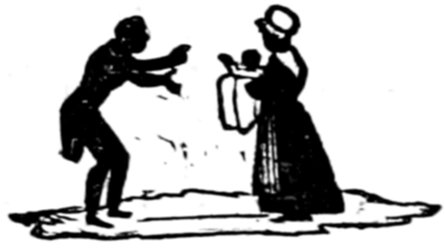
A PRESENTATION COPY.
Though Malthus indite it, and Martineau write it,
I don't think they've quite hit the nail on the head;
And spite of their pother 'bout father and mother,
We may be one or t'other before we are dead.
207