HENRY B. FULLER (continued 5)
Reading edition
A pass-book was lying on his desk, and between its covers there was a packet of checks, bound by a rubber strap. He drew out the top check and extended it towards his son; he used his clumsy thumb and forefinger to keep a strong hold on one end of the paper—the end that bore the signature.
"You've seen it before, too, unless I'm mistaken," he went on, with a glance in which indignation was overlaid by a cruel sense of power and a cruel determination to use it. "You didn't expect it to get around to me quite so quick, did you?"
"I see it, yes," said the young man. "And I've seen it before. What of it?" He spoke like one who had nerved himself to this—and to more.
"What of it?" cried his father, in a sudden fit of rage. "There's this of it! Do you think I'm going to stand being stripped by a thieving scamp like you? Do you think I'm going to be bled drop by drop by a couple of infernal scoundrels? Oh, that whining about your drawing, and your not being allowed to go on with it! You can handle a pen all right enough! You can draw cheeks for me, and you can draw yourself to Joliet! That's the best place, all around, for both of us."
"I shouldn't mind meeting you there," said Marcus, with a contemptuous sneer. "There would be a 'couple,' sure enough—the only one I know anything about."
"Where is that wretch?" cried Brainard, seizing the youth by the arm. "You know; you do, too—you see him every day! Tell me where I can find him! He must be followed up. Let me get him, too, and put him where he belongs!"
"Keep off!" called his son; "keep off, you fool! I haven't seen him for a year, and I don't want to see him for another. It's you I want to see; you and Burt—brother Burt."
His eyes glittered with a sharpened anger, and his dilated nostrils quivered with the indignation that the thought of his elder brother always aroused.
"I want to see the vice-president of the Underground National. I want to see the bridegroom who got half a million on his wedding-day. And I want him to see me. I want him to have a look at the poor devil who has been knocking around from pillar to post for the last two years, who has hidden in dives, and who has been dragged through the slums, and who has been driven from the variety stage, and has served his time more than once. Let him feel the difference; let me help him to feel it!"
"Your own blame!" cried his father. "You had the same chances and threw them all away. And you'll serve another term now—a longer one."
"I guess not," said Marcus. He looked about the room with a sharp and wary eye. It might have been thought that he sought at once both means of offence and means of escape.
There was a rap on the door; Burt's voice was heard outside.
"Here's Mr. Freeze, father. I suppose he can come right in."
Marcus reared his head suddenly.
"It's Burt!" he trumpeted. "He's here! he's here!" He sprang toward? the threshold and clamped his long fingers about his brother's throat. Burt's head struck with force against the wide jamb; he half fell, and his legs and arms writhed in company with his brother's.
"Get them apart, Freeze! Get them apart!" cried Brainard, with a loud roar. "Am I going to see Burt strangled before my very eyes?"
Marcus released his grip and staggered back into the room. He reared himself pantingly against the table. His face was deadly pale, and the perspiration was starting out in beads beneath the dark, disordered locks that lay on his forehead. The screaming of women's voices was heard in the corridor outside, and the light hastening of women's feet.
"Three to one!" panted Marcus. "It's a plot! it's a trap! I know you, Freeze. I see through all of you. But three ain't enough. You can't do it; no!"
Abbie Brainard came rushing through the hall. She reached the threshold and paused there to see her brother catch up her paper-cutter from the table, plunge it into her father's neck, and break through the window, and to hear his nimble feet clatter escape down the stairs of the side porch.
Brainard fell heavily against the marble slabs of the fire-place. Blood soaked his high, old-fashioned collar and trickled down the plaits of his shirt-front. He lay there stunned and bleeding, and lifeless—as it seemed.
His huge bulk was gotten laboriously to bed—half dragged, half lifted. He lay there for a fortnight, between life and death.
The doctor came, and with the chill gray of the first dawn came the nurse. It was to be a hand-to-hand struggle, and all the forces were engaged at once. The nurse spent the first halfhour of uncertain daylight in bringing order out of the chaos that had established its instant sway in the old man's room on the evening before. She raised or lowered the shades, adjusted the transom, quieted the fire, and arranged her bottles and bandages. She wore the dull uniform of a public institution; and she was accustomed to carry this uniform at a moment's notice into strange places and among strange people. She accepted her assignment blindly, and took up its details afterwards.
She seemed of a rather rugged, stolid build, but her eyes were eloquent with a haunting sorrow. It was as if time had redraped her figure with the flesh that sorrow and suffering had once stripped from it, but had been powerless to reclothe her spirit in its pristine hope and cheerfulness.
"'Three to one,' panted Marcus."
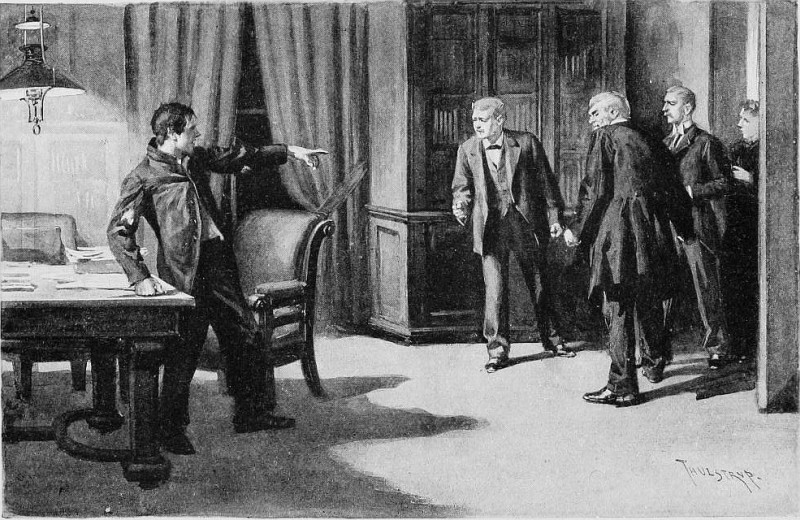
She stood at the window, endeavoring to get her bearings in the early light of the dim morning. The lilacs and syringas in the yard showed the crinkled brownness of latest autumn. A boy was crossing and recrossing the street to put out its lamps; and in the second-story window of the stable the flickering of a single gas-jet was helping the coachman and hostler to make up his own bed.
Behind her she heard the heavy grunting breath of the sick man. Presently another sound mingled with it—a creeping and rustling sound that made its little track along the hall and across the threshold of the half-open door. She turned; a baby was on the floor beside her—a beautiful boy with dusky, liquid eyes, and the beginnings of a poll of dark and curly hair. An inquiring pain plucked at her heart and set its signal in her eyes; she saw a resemblance that it was impossible to overlook. She cast a hungry and timorous glance about her, and presently, with a great yearning and a steadying resolve, Jane Doane was kissing Russell Vibert's child.
For this privilege she was indebted, in a sense, to Erastus Brainard. She had never been indebted to him for anything else.
The old man lay in a kind of stupor; his head had been seriously injured by his fall, and bloodpoisoning of the most virulent type pointed to his inevitable end. He had occasional moments of recurring consciousness, and at such times he attempted, with the help of Abbie and of Freeze, to bring his affairs into order, and to dispose of his belongings by will.
The Ogden affair, meanwhile, stood still. No formal steps had been taken, and the young man had Fairchild's assurance that an accommodation was sure to be brought about.
The situation became known to the Bradleys—in its general outlines, at least. They caught at the end and ignored the means, as would have been done by anybody else in their position. They considered that their friendliness towards Ogden had been misplaced and that their confidence had been betrayed. They preserved appearances with him through their daughter's final illness; and by a great effort they even produced an effect of a common suffering and a common sympathy at the funeral. But after that they never saw him again. The difficulty with the bank did not become public, but they considered themselves, all the same, no less disgraced than deceived.
The desperate illness of Brainard dragged itself along, meanwhile, and the house was saturated with gloom. Abbie assisted actively in the nursing; she watched in alternation with the first nurse and with the succeeding one. Cornelia was given an opportunity to put her hand to the household helm. As she said to herself, she was soon to manage a house of her own, and she might as well be brushing up her knowledge. "And she has got to go with me," Cornelia said to herself for the twentieth time; "she can't live here after—this."
Cornelia had fought out many a fight during her year in this grisly old house; but she saw now that her intended campaign on behalf of Marcus was an impossibility, and that all the forces might as well be withdrawn from the field.
Nobody had seen the youth since that fatal night; nobody, that is, who had cared to make the fact known. Neither did anybody know where he was keeping himself, save the sister on whose night-watches he had once or twice stolen by way of the window through which he had made his escape from his brother and Freeze.
He came again—for a third and last time. It was one o'clock in the morning when she heard his light touch on the window. She hastened to him with her mouth set for a terrified whisper.
"Yes, I know it's dangerous, Abbie; I know I promised not to come again. But I can't help it—I've got to hear. How is—how are things going on to-night? Is there any improvement over yesterday?" He locked his fingers in a convulsive strain. "I thought they had laid a trap for me," he said chokingly. "Just tell me yourself how it is, and after this you can send me word, as you have before. I won't come again, I promise you."
She threw herself on his breast and burst into an agony of tears. "No, you never will," she sobbed; "he is dying. There is no hope; he won't live till morning."
The young man trembled like an aspen; tears rolled out of his dark and hollow eyes. He tried to speak, but no word came. Then he clasped his sister in his arms and withdrew as he had entered.
The night, laden with anxiety and fear, dragged out its weary length. In the early morning the house resounded with a great cry. The dying man, in a brief moment of consciousness, half raised himself and heard the sound and the tidings thus conveyed. The word was passed from man-servant to maid-servant, and came to their master through the voice of a Swedish girl whose mind was capable of dealing with emotions only in the most primitive way, and whose imperfect command of English made her communication come with a horrible and harrowing directness. One second before Erastus Brainard fell back dead he knew that his son had hanged himself; the 'last picture that rose before his fleeting vision was that of his boy pendulous from the rafters of the stable, his slight body swinging to and fro and his tongue protruding uglily from the purple-black of his face.
XXIV
The months passed by, and autumn came around once more.
Ogden's first year as a widower was lived with his mother; he used the same time to establish himself in the real-estate business, whose ins and outs he had now mastered in the bitter school of experience. He had left the Clifton altogether, and had established himself in another street and a different neighborhood. Every stone of the great pile seemed to have raised its tongue against him, and to have driven him out with the loud and insulting hubbub of its angry clamor. He had no wish ever to see again the room in which he had first met his wife, the room in which he had wrestled with his brother-in-law, the room in which disgrace had forced him to bow his head. Bradley lay in wait for him in the court, Jane Doane dogged him through the long corridors, Marcus Brainard rose up as a pallid spectre within the entrance-way. He left the building for once and for all. The placards that he placed on vacant tenements and the signs that he caused to be reared on open corners in the suburbs directed inquirers to a street and number quite different from any near his old neighborhood.
Within this year Cornelia Tillinghast Brainard had moved into her new house and had moved out again. For three poor months she occupied her French Renaissance château on the Lake Shore Drive, and then she gave it up forever. In vain her anxious plannings of chambers and stairways, her long waitings for the slow finishing of the carved oaks and walnuts of her vast interiors; in vain (for the present, at least) her lofty aims in the direction of social distinction. For Burt with his father was one man, and Burt without his father was another. He had relied upon the elder's advice more than he had realized, and he had felt the steadying and restraining power of his father's hand to a greater degree than he would have been willing to acknowledge. When he came to act for himself and by himself the difference soon became apparent. He operated in a variety of directions; he was confident and daring and ambitious, and one day he risked all and lost all.
His failure swept away everything of his and nearly everything of his sister's. Abbie had come into the new house along with Burt and Cornelia—no great urging had now been required to induce her to abandon the house on the West Side. She led the same retired and quiet life in the one quarter that she had led in the other, save that she never felt otherwise than utterly strange and forlorn. And as she had placed herself in her brother's house, so she put a great part of her share in her father's estate into her brother's hands when ruin came and every available resource was required. She had never used much money; she may not have realized the gravity of her sacrifice. Perhaps, too, she had hoped to rest her disappointed soul on something that money could not buy.
To Cornelia the failure came as a sudden and awful blow. Considering the brief time at her disposal, she had made a distinct impression on society. A great many people of consequence came to her house and invited her to theirs. They laughed at her freedoms and familiarities; they enjoyed her picturesque and untrammelled phraseology. Some of the more insatiable invited her twice. She encountered but one decided check; this was from Mrs. Floyd.
The ship of the Floyd household, now navigating regardless of its customary dependence on the distant admiral of the whole Floyd fleet, was tossing in shallow yet stormy waters; there were not lacking indications that it was occasionally grazing bottom, and there was a notion abroad that it might presently beach or founder. Mrs. Floyd therefore manned the helm with more than her customary caution. For one thing, she set the ship's chronometer by local time. That is to say, her own watch, which had now been giving the time of Boston for the last three years (and she had become very expert in the deducting of the hour and some minutes of difference) came to be set by the hour of Chicago. For another thing, she must think twice before speaking every strange craft—such a one, for example, as that propelled by the Brainards. She did think twice, and concluded to remain silent.
"Huh!" said Cornelia; "all because I worked in her husband's office, and she met me there! Thank goodness, I wasn't allowed to have my wish and work for Ingles, too! I'll fetch things around, though—you see if I don't; and I'll capture Cecilia Ingles yet!"
Abbie, along with many other persons and things, became a mere piece of driftwood in the general wreck of her brother's fortunes. She swirled and eddied about for some time through a succession of boarding-houses, and after a while she found refuge in the latest home that her sister had made. She found her new brother-in-law a good-humored and well-disposed fellow. Briggs had established his family in the old neighborhood on the West Side, and readily admitted Abbie; he made no more objection to his sister-in-law than he had made to his sister-in-law's nephew.
Ogden saw nothing of them, heard nothing of them. He merely went around in a quiet way among a few old friends, and he dropped in at frequent intervals on the faithful Brower. Brower was sometimes at home and sometimes away; the fire-fiend still kept him on the move. One late September evening, after an interval of a month or more, Ogden repaired again to the house which had once been their common home, and found Brower just back from Minnesota.
He was seated on his trunk, the rigors of whose cover he had softened by the doubled folds of a striped travelling-wrap. He had his brier-wood pipe in his mouth and a book in his hand. It was a paper-bound volume; the back cover was missing, and there was exposed to view the fine, close tabulation of the books composing a well-known "library."
"Well, my dear fellow," cried Brower, rising and grasping his hand, "how are you? Say, I believe you're looking better. Here; put yourself in the light where I can have more of a chance at you."
George stood immovable, and Brower jerked out the elbowed gas-jet, so as to make the light fall upon his visitor's face. It fell on his visitor's head, too, and the whole brown head was sprinkled with silver.
Ogden put his two palms on his temples and spread out his hands until the finger-tips met over the part in his hair.
"There are more," he said, with a smile of quiet sadness; "don't count them again."
"I won't," said Brower. He drew away his eyes, but threw his arm over the other's shoulder.
"I've had quite a trip, this time," he went on, in the tone which we employ when contriving a light diversion. "Been away out into Dakota—Bismarck, Mandan, Yankton, Sioux Falls. I was at the Falls one Sunday."
"Is that any great place to spend Sunday?"
"Lots of folks go there to spend a few Sundays—twelve or fourteen Sundays, and the week-days between. On the evening of my Sunday I went to church."
"I've known you to go to church on Sunday evenings before. Service any different from any other?"
"It was a song service. Don't you suppose the poor creatures waiting along out there in Sioux Falls have got to have their little consolations? Ain't music the great consoler?"
"They were consoled, then?"
"Oh, yes, indeed; the principal consoler had been there himself. He sang tenor."
"Better tenor than the average?"
"Good deal better. The most touching, pathetic tones I ever heard. He sang the 'Angel's Serenade,' with another man playing the violin. It was affecting. One poor lady near me, with a sort of Eastern look about her, just caught up the child in the pew by her side and burst right out crying. I was all broke up, myself."
"That's a good song," declared Ogden. "I always like to hear it."
"You've heard it before, then? At St. Asaph's, perhaps?"
"At St. Asaph's; yes."
"Well," said Brower, "the man you heard sing it at St. Asaph's was the man I heard sing it at Sioux Falls."
"Vibert!"
"Vibert."
George dropped his eyes; he had no wish to pursue the theme further. "What have you there?" he asked. He indicated the book that Brower had left lying on top of the trunk.
"Oh, nothing special. It's just one of those cheap novels. I was merely running it through to see if he really did marry the right one in the end. Might have done it in the first place as well as not." He passed the book to Ogden wrong side up. "I guess it's yours, by rights—one you left behind when you moved out." Ogden turned the book over and read the title. It was—"A False Start."
He started. He blushed. "Yes, perhaps it is," he stammered. He held it awkwardly in his hand for a moment. Brower watched him curiously, yet sympathetically. "Yes," Ogden repeated, in a bold, firm voice, "it is mine." He put it in his inside pocket and buttoned his coat.
"Oh, come," cried Brower, trying to throw a veil of jocularity over his earnestness, "that isn't fair! I've got to finish it. I've got to know whether he did or didn't. Anyway, let me see the end."
"There is no end," said Ogden, soberly. "Or if there is, it has come."
"Then I can only guess." Brower looked at him, with a studious anxiety in his brown eyes. "He made a mistake, sure enough, but I think he sets it right. Yes, I think he sets it right." Ogden's eyes sought the floor.
"Ho; he abides by it."
"He can set it right," said Brower, gravely; "and if he can he ought."'
"Not now; not after—everything. Let bad enough alone."
"Make bad enough better," cried Brower. "Is he the only one to be considered? Upon my word," he went on, with a nervous attempt at lightness, "we are getting these great truths down finer and finer. A couple of years ago we agreed that marriage concerned but two people; now we are finding that it concerns only one. The question simply is—which one?"
"The one who would be most exposed to injury," said Ogden, with a distant mournfulness in his face and voice.
"There are different kinds of injury; there is the injury of commission, and there is the injury of omission. Sometimes the last is harder—on a woman. Why not let the victim choose her own particular woe? Why not be generous enough to give her an opportunity?"
"Not now," groaned Ogden. "You don't know. Not after all—that's happened."
"Well, then," continued Brower, with kindly perseverance, "out goes generosity. Now bring in selfishness and give that a chance. What is our hero going to do? Must there be more sorrow for him, more suffering, more self-punishment, and everlasting dissatisfaction generally? What is he made of? Can he stand it? If so, how long? And if he does, why should he?"
"Brower, Brower!" Ogden cried; "not another word if you care for me—if you care anything at all for me!" He crossed his arms on the table and bowed his head upon them.
Brower passed his hand softly over this head and said no more. He was a patient husbandman; he would sow the good seed and wait for the harvest.
Ogden took the book home with him. He fluttered its leaves a few times; then he sat down on the edge of his bed and read the title-page for an hour. The next night he read it some more and dreamed about it. The next night he was reading it still, and he lay awake thinking of it until daylight.
On the following evening he took the old, familiar way to the West Side.
He found Abbie Brainard at home alone. Mary and her husband had gone out, and the baby had been put to bed.
Abbie was sitting in the half-gloom of one small lamp; the parlor was a little room, and a rather cheap and ugly one. But the lamp, thanks to its beflowered shade, was discreet and reticent in the disclosure of unprepossessing detail; besides, twenty lamps would not have had power to divert his thoughts from the channel through which they were now coursing.
On his entrance she started up to light the gas. She looked pale and worn, and older than he would have believed possible. But he looked older, too, and felt much older than he looked. The light beat down upon his silvered hair, and heightened the glance of pitying surprise that shone from her eyes.
In this increased illumination he saw that fortune had left her, as well as her youth and beauty, as well as the father whose life he had felt to make their union impossible, and whose memory might still keep it so. But she herself, in her own essence, was before him—the same courage, the same resolution, the same tenderness and fidelity. And in him she saw the only man she had ever seen, or had ever cared to see.
To her, he came as a messenger of pity to heal the wounds that knavery and scandal and violence had hacked upon her quivering heart. A messenger of pity, yes; but could he, by any possible chance, find her worthy of the pity that was akin to love?
To him, she appeared as the victim of his own faint-heartedness and faithlessness. After all that he had done to wring her heart, could he venture upon the crowning indignity of offering her his tarnished name?
To her, he stood there as a tower of refuge—tower from whose summit the swathing fogs might be cleared away by the warm breath of trust and confidence, and whose smirched walls—if smirched indeed they were—might be purified by the tears of love and the fingers of forgetfulness.
To himself, he lay before her as a heap of crumbling and smoke-stained ruin. Every stone cried out for the cleansing power of pity and for the firm and friendly hand that was to rear them all again to their pristine use and comeliness.
The clock had struck eight as he entered; it was striking eleven as he rose to go.
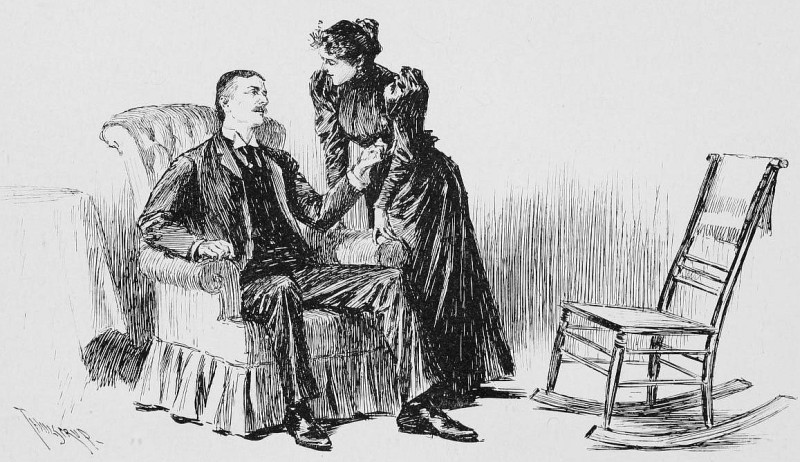
"Not yet," she said, softly. She pressed him back into the depths of his great easy-chair, and, leaning upon its rounded and padded arm, she looked down upon him.
"You take me, then, as I am?" he asked her, soberly.
"How else do you take me?"
He raised his hand to his head. "There will be more of them," he said. "They tell me I shall be white at forty."
"How many of them are mine?"
He pressed her hand.
"Not one, not one! Or, no," he continued, with a stronger pressure, "they are all yours—do with them as you please."
He felt something warm drop on his head and trickle down his temples.
"Yes, that is the best thing to do," he said. "To think," he added, with a tender seriousness, "that you might have saved me from them—from every one!"
They were married within a month, and they began their married life in the same house in which he had begun his Western life as a bachelor. Mrs. Gore's kindliness still survived, after the hard rubs of three years of city life, and she spread her sympathetic interest over her new couple with an unstinted hand.
"She pressed him back into the depths of his great easy chair."
Their wedding involved no social celebration, unless we note their participation in one of a series of great public functions that sometimes mark the early winter. This took place in a vast hall that was luminous in ivory and gold. They sat before a wide curved frame brilliant with a myriad points of light, and listened to the united endeavors of many voices and instruments to please the four thousand people about them. Ogden and his wife had taken places in the balcony. They had toned down existence to a quiet gray; they recognized the middlingness of their lot. Cornelia and her husband, unknown to the Ogdens, had seats on the floor beneath.
One box in the two long, parallel rows remained vacant during the first and second acts. As the prelude to the third act began among the violins the box was claimed. A party of four entered.
"There she is," said Cornelia to herself, in her place on the main floor. "Just you wait. Burt's smart and I'm careful, and we shall catch up to you yet!"
"Who are those people?" asked Abbie, turning towards her husband. "Who is the gentleman with gray hair?" She was beginning to admire her husband's own.
The two ladies of the party had seated themselves; the two gentlemen were busy with their own and their companions' wraps in the back of the box.
"That is Mr. Atwater, the architect. The lady in yellow is his wife. The tall, brownish man, just handing the glass, is Mr. Ingles; he owns the—the Clifton."
"And the other lady?" his wife continued. She indicated a radiant, magnificent young creature, splendid, like all her mates, with the new and eager splendor of a long-awaited opportunity. This new-comer had nodded smilingly to many people on entering—to her neighbors on either side, to a large dinner-party that filled three boxes across the house. She seemed pleased to have so many persons to bow to so publicly; and everybody whom she favored seemed equally glad of an opportunity to return her attention.
Ogden looked at her and turned his eyes away.
"I—I have never seen her before," he said. "I don't know who she is," he appeared to imply.
But he knew perfectly well who she was. He knew that she was Cecilia Ingles, and his heart was constricted by the sight of her. It is for such a woman that one man builds a Clifton and that a hundred others are martyred in it.