HENRY B. FULLER (continued 2)
Reading edition
His room was rather small and cramped, but he had preferred indifferent accommodations in a good house to good accommodations in an indifferent house—just as he would have chosen an indifferent house in a good neighborhood to a better house in a poorer one. His quarters, however, were well enough for a single young man of moderate pretensions. He had space for a three-quarter bed, a bureau, a wash-stand which displayed a set of pink-flowered crockery and two towels, a cane-seated chair, and a pair of book-shelves on the wall. And by means of a good deal of dexterous manoeuvring he contrived to extract some comfort from an undersized rocker. His decorations were principally photographs, which showed to the extent common under the circumstances. Some of these were grouped in twos and threes, in frames faced with Chinese silk; they helped to achieve the disordered and over-crowded effect that the present taste in house-furnishing aims at, and can always accomplish in a back hall bedroom.
The photographs stood in the position in which he had first placed them a month and a half ago, although the recent arrival of several of the originals had given their shadows an altered importance. Everybody knows of the inertia that overtakes decorative detail, even when portable. There were the pictures of his father and his mother, arranged in a pair. His father offered a placid, gray-bearded face; it seemed rather forceless, though that effect may have been due to retouching; yet, independent of any practical processes, it was the face of a man who obviously could not have risen in advance to any adequate conception of the Western metropolis.
The face of his mother was serious, strenuous. She had in some degree the semi-countrified aspect of one who has run a quiet course in a quiet quarter of a minor town.
His sister's picture had been taken in the East just before her starting for her new home. It was now in the hands of Ogden's next-door neighbor, who had come in carrying a choice of white ties, and who now wove around it a contemplative cloud of tobacco-smoke from his briar-wood pipe. He was a young man with a high forehead and a pair of shrewd but kindly brown eyes.
"A mighty pretty girl," Brower said, heartily. "Get the right kind of a New England face, and you can't do much better. I must haul out my own photographs and fix them up some time."
Brower kept his collection in his trunk, along with his shirts and underwear generally. He used his bureau drawers for collars and cuffs, and for a growing accumulation of newspapers, magazines, and novels. He had been in the house two years, yet his trunk had never been unpacked and put away. He was an adjuster for an insurance company, and was subject to sudden calls to remote localities, in accordance with the doings of the busy monster that the press knows as the "fire fiend." If Isaac Sobrinski, off in Des Moines, had the misfortune to be burned out, at the close of a dull season or in the face of brisk and successful competition, then Des Moines was the place to which Brower immediately posted. He estimated the damage on the building, figured the salvage on socks and ulsters, and endeavored to decide, so far as lay in his powers, whether the catastrophe had been inflicted by Providence or had been precipitated by Sobrinski's own match-box. However, he never carried anything except his valise on such excursions; the general state of his trunk is to be accepted simply as the mental index of a constant and hurried traveller.
"Yes, she's a mighty pretty girl," he repeated, thoughtfully. "Where have they gone?"
"Oh, not far. There's been a good deal of travelling done already. They just went up to Milwaukee; Eugene had something to see about there. They'll be back to-morrow, I expect."
"Milwaukee, eh? That's come to be quite the fashion, hasn't it? Some folks go there after they're married, and some of them to be married. We had one in our office a week or two ago; Vibert—have you met him?"
"It's in your office he is, then, is it? No, I've never met him. I've seen him and heard about him. Is he much thought of?"
"Well, the office doesn't have a great deal to say to a man as long as he keeps hours and attends to his work—when the position isn't responsible, I mean. What are you looking for—whisk-broom? Here; I'm sitting on it, I guess."
"I suppose he does attend to his work?"
"Oh, so-so; but a little break like that doesn't help a man any. He struck high, didn't he?"
"Yes."
"Wonder what he's got to keep her on. Great question—all that; ain't it? She's a rich girl, I hear. Subject for debate: is it safer to marry a rich girl or a poor girl—for a young man in moderate circumstances, I mean?"
"Oh, dear," said Ogden, sitting down on the edge of the bed, helplessly; "if you're going back to that chestnut!"
"Well, it's timely," rejoined Brower, knocking the ashes of his pipe into the cover of the soap-dish; "and always will be. Pro: if the girl's rich, she'll have had things, and got used to them, and perhaps tired of them. If the girl's poor, she'll be ravenous after her long starve-out, and will expect her husband to feed her with everything."
"Lay on."
"Con: if the girl's rich, she'll expect all the comforts and luxuries she has been used to at home. If she's poor, she'll have had some sense ground into her; she'll know how to manage and contrive. So there it is. What's your idea?" "No general rule. Depends on circumstances." "What does?"
"The girl. To begin with."
"The girl depends on circumstances. And after?"
"After? Oh, then circumstances depend on the girl."
"H'm! Can't lay down any general law—same as with little Johnny. Pshaw! You go to the foot."
But they both agreed on one point, as young men always do when they discuss this standard subject: they stood together on the assumption that such a venture concerned only the two people primarily involved.
Brower preceded Ogden into the hallway; he stood with the toe of one slipper on the heel of the other. "Well, remember me to the swells."
"Oh, shucks!" said George, turning back and laughing.
He walked down and out rather sedately, and picked his way over the muddy sidewalks with his thoughts fixed on the two recent marriages. That in his own family had just occurred under such disadvantages as must prevail in a disorganized household, and with the infliction of such discomforts as will sometimes be undergone by people who, while not in society, still feel impelled to have such a function proceed after the fashion that society prescribes. Kittie Ogden was duly married, then, with a certain regard to cards, carriages, caterers, and the rest; and the feast was graced by a number of McDowell's family and friends—people of a fairish sort, who called for little comment in either way. At least, little comment was bestowed by Ogden, whose principal thought was that his sister was now the wife of a fellow of some means and ability, and who felt that it would not come amiss to have a good business man in the family.
At the Floyds' he found the other wedding the subject of much comment, more or less discreet. On the other hand, the affair in his own family received but a mere civil mention; the Ogdens, he felt, must be only an insignificant little group, after all. Must they—must he—always remain so?
The Floyds occupied a snug little house which filled a chink between two bigger and finer ones, and commanded a view of the back yard of a third, which was bigger and finer still. Mrs. Floyd had lately begun to fill a chink in the social world as well, by having an "evening." She had approached the idea with a good deal of deliberation, and she had achieved something very small and quiet. She overcame her husband's weakness for knowing people and inviting them to the house; she was not after a deluge, but a drop; and if her tardy distillation did not equal the perfumes of the fragrant East, still it was the best result to be arrived at under the circumstances.
He found the Fairchilds there, and he came upon Fairchild and Floyd smoking, sub rosa, in a secluded corner of the library, which was furnished in a sombre and solid fashion. In the Floyd family the household divinity was the lace-curtain, whose susceptibility to offence from the fumes of tobacco is well known; her high-priestess was Mrs. Floyd, and her chief victim was Walworth. Associated with the two smokers was young Freddy Pratt, whose solicitude regarding Brainard's mental state on the occasion of his daughter's call at the bank has been already touched upon, and who was now puffing a cigarette with a learned and expert air. This attitude was displeasing to Ogden, who was perhaps over-disposed to feel official differences on social occasions; but no oppressive sense of his own subordinate rank troubled Freddy Pratt, who had but a feeble and intermittent realization of the orders of the business hierarchy, or indeed of anything else.
"It was a matter that concerned just her and him," Fairchild was saying as Ogden entered, with a contemplative regard fastened on the lengthening ash of his cigar. "It was nobody else's business."
He stopped. He had spoken in a low, quiet voice, but he had conveyed unmistakably the presence of quotation-marks.
"I called on 'em the other night," volunteered Freddy Pratt, unabashedly. His perky little nose was tipped in the air, and his eyes were closed to the two fine slits that denote the complete enjoyment of the smoker. "I wasn't going to stand off. They're at the Northumberland—big name, but not much else. Ragged matting in the halls, and the janitor didn't look very slick. I guess they've rented ready furnished. Mayme was real glad to see me. But he was rather grumpy, I thought."
"Everybody ought always to be glad to see you, Freddy," smiled Walworth, with a caressing irony.
"I suppose," resumed Fairchild, thoughtfully, "that the human family will always go on considering a wedding as a joyous occasion. It always has; it always must—hope springs eternal."
Ogden wondered what other view there might be to take. Everybody had seemed lively and happy enough when Kittie was married.
"But there's the other side—the side that turns to view with a consideration of the complicated relations of a good many new and diverse elements—new people coming in. We had a case in our own family some years ago, when my young cousin married. Poor Lizzie; she is dead now. Her father died six months before her and left a good deal to be divided up. Her husband was trustee for the boy after she herself went, and he made us a good deal of trouble. He had his eye on the estate from the start, and more than his share in the handling of it. There were a good many meetings in lawyers' offices—more trying than the courts themselves. There was a good deal of money lost, and there is a good deal of feeling that will never be got over. He traded on his wife's memory all through. Yet the family welcomed him very cordially and trustfully; we thought the poor girl was going to be so happy. She was; she never knew."
Ogden sighed; this was dismal matter.
"Oh, well," continued Fairchild, resuming his cigar, with an air of passing to lighter topics, "this can't apply here. All of us are happily married or are going to be—"
Freddy Pratt nonchalantly blew an ineffable smoke-ring across the room; Walworth slipped around the table to close the last inch of crack in the door.
"Oh, dear, yes!" he exclaimed.
"—and none of us are being troubled through relations by marriage."
The door was shut, but the penetrating voice of Ann Wilde came through it clearly, and Walworth winced.
"Oh, dear, no!" he protested.
"I should say not," chimed in Freddy Pratt, with his self-satisfied little ba-a.
The cigars were ending. "Come, let us go out to the others," said Floyd.
In the drawing-room Ogden presently encountered Jessie Bradley and her parents. The girl herself appeared as dressed as the occasion could warrant, but her father and mother wore the every-day habiliments in which he had first seen them, a fortnight before, on the occasion of a call at Hinsdale. They had an easy-going aspect, as if they hardly cared to put themselves out greatly. They were present in the triple capacity of relatives of the hostess, of suburbanites, and of body-guard to escort their daughter back home after another of her frequent visits in town, and their effect was quite provisional and transitory.
Mrs. Bradley was a pleasant woman whose face was full of the fine lines of experience and whose hair had thinned greatly without changing its dry, sandy brown. She wore an old-fashioned tortoise-shell comb. She met Ogden here precisely as she had met him in her own house. He noticed presently that she treated everybody else in exactly the same fashion, and he learned subsequently that she had, practically, one invariable manner for all times, places, and people. It was a manner that he found very quiet, simple, straightforward, and friendly. It showed that she valued herself, and was also disposed to accord a good value to anybody else. It seemed to say, as plainly as words: "The Lord is the maker of us all; so let's have no more fuss about it." It was the good American manner in full bloom.
Her husband had a jovial eye, a grizzled moustache, a rotund, polished forehead, and cheeks that hung downward fatly into his big, round, short neck. He appeared to have valued his peace of mind sufficiently to preserve it and to be satisfied with the moderate success that comes from moderate effort. He wore a short-waisted, double-breasted frock coat, and there were no wrinkles in it, either front or back: he would have found it impossible to thrust his plump hand in between any two of the buttons.
He was given in the directory as "Bradley, Danl. H., secty. and treas. Darrell & Bradley P't'g & Lith'g Co." He had been one of the organizers of the corporation, but had since yielded the lead to others of more push and means. He had a moderate salary and a small block of the stock. Since he was assisting the business as an officer, rather than directing it as an individual, he had little personal annoyance from typographical unions and from the paper manufacturers' trusts. As for "pi" and proof-readers' errors, matters which have a power to make some men agonize, he merely laughed at them. The concern, besides its central establishment, had a few retail branches placed here and there through the business district; one of them, on the ground floor of the Clifton, supplied the La Salle Street banks and insurance offices with ledgers, ink, and blotting-pads.
He had an acre of ground and a two-story frame house at Hinsdale, and Ogden remembered the small green-house where he fed his craze for chrysanthemums.
"'We have come to take our girl back home.'"
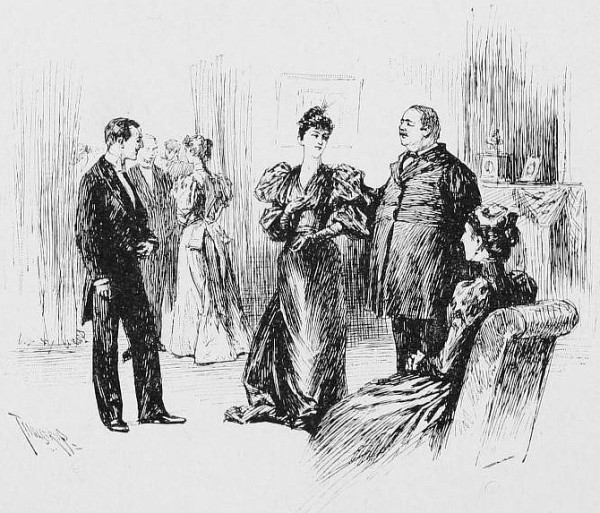
"We have come to take our girl back home," he said to Ogden as he laid his plump hand lightly on his daughter's shoulder. "That is, if she can make up her mind to go with us."
"Just us two all alone in the house," added her mother, with a humorous pathos. "No chick nor child."
Jessie laughed and shook out a bit of her frivolous finery. Her face had a tired look, but motion seemed more restful to her than rest itself.
Ogden canvassed the three. Whence could this girl have got her supple leanness, her light, gay, rapid, incisive air, her aspen-like quiverings of nervous force? Not from her parents. From the March winds, perhaps, that sweep down from Mackinaw, over the limy and choppy expanse of Lake Michigan; from the varied breezes, hot and cold, that scour the prairies on their way from scorched-up Texas or from the snow-fields beyond Manitoba.
"Not even a relative," pursued her father; "not one in all the country round—except Frances. All our people are down East," he continued, addressing Ogden more directly. "They write every so often to learn if we are millionnaires yet. We always have to say 'no,' and that discourages them. They stay where they are."
"But Jessie goes around to look after them," contributed her mother, with combined complacency and reproach. "She goes to Pittsfield and Nantucket and everywhere. People are beginning, now, to ask her up to Wisconsin, summers. And sometimes Florida."
The girl shrugged her shoulders in a fidgety fashion.
"Oh, well, mamma," she said, "I have to circulate. Let's circulate some now," she suggested, turning to Ogden. "I'll be ready to go when you are," she called back to her father.
VII
"We ave been expecting to see you out at the house again," she said to the young man, as they settled on the stairs. They were seated just below the landing. Her dress, trimmed with silver braid and little groups of flaunting bows, grazed his knees; he could number every stone in the rings that crowded her long, thin fingers. "We didn't suppose a matter of eighteen miles would scare you."
"It doesn't. But you're never home."
"Oh, yes, I am—once in a while. When you do favor us again, get a time-table for the next time after. I never heard of the 'Q.' charging anything for them."
"I will."
"Awfully sudden about Mayme, wasn't it?" she said, with a suddenness of her own. "I didn't suppose it was going to end like that—at least, not right away. I dare say you have been noticing how Cousin Frances looks at me, every now and then. You might think I was the one to blame. She's been talking to mother about it to-night—and me. I guess I'm going home all right enough."
"Don't you want to?"
"Oh, I don't mind. But what's the dif.—far as May me is concerned, I mean? She was bound to have him: she wouldn't have anybody else. It was their affair, wasn't it? Well, then, why not let them manage it?"
"I suppose so," assented George, dubiously.
"Her father won't see her, I hear. I'd like such a father. Her sister can't do anything with him."
"Her sister?"
"Yes; she's got about as much influence as anybody. Have you seen her?"
"Yes. Are you very well acquainted with her?" he asked.
"Not very. She belongs to the next older generation."
"How much older? Two or three years?"
"Twenty or thirty. She's about the same age as her mother. But more useful. Mayme thinks everything of her. She's a good, steady, plodding stay-at-home. She ought to have been let out and given a show—she's buried there. He makes her do lots of work."
"Her father?"
"Yes. She writes and figures a good deal of the time. She keeps the grocer's and butcher's books, for one thing. Mayme says she knows how to telegraph—they've got their own wire right to the house. When she wants dissipation she goes to her 'Friendly.' And she belongs to a club over there where they read papers and discuss. She was a good deal upset."
"Urn," said Ogden, abstractedly. He recalled the girl's appearance and her little ordeal of having to face a complete stranger at so distressful a juncture. Yet she had borne herself with dignity and composure; nor was he able to deny that she had been as perfectly courteous as her brief appearance permitted. How that he understood, he had less cause for complaint against her brother, and none at all against her.
He dwelt lingeringly on the idea of "a complete stranger." He did not feel that it would have been infinitely more trying to face a curious neighbor. He had begun to idealize the ordeal and the victim of it.
"A penny for your thoughts," he presently heard his companion saying. He came out of his study and looked through the stair-rail at the little throng below. Two gentlemen had just come out of the dining-room.
"I was wondering who they were," he replied, at a venture.
"Who?"
"Those two."
The pair was followed by Walworth, whose pleasure it was to pour libations whenever the gathering of two or three together gave a pretext for that ceremony. One of the two sucked in his upper lip with due caution, and both united in a pretence—decent, but slight and futile—that the ladies knew nothing of these hospitable doings.
"The tall, brown one is Mr. Ingles. Haven't you met him here before?"
She indicated a man of forty, whose face was shaven except for a small pair of snuff-colored whiskers, and whose mouth made a firm, straight, thin line.
"Ingles? Arthur J.?"
"I don't know; I guess so. He owns the building—the Clifton."
"He's no dude," murmured Ogden to himself.
"Eh? Who said he was?"
"Oh, nobody. Who is the other?"
"That's Mr. Atwater—Mr. Ingles's architect. They're chums; were in college together. Isn't he the most fascinating-looking man you ever saw?"
"By Jove, he is distinguished, for a fact! Was he born—here?"
"Don't you think it's lovely for a man of his age to have gray hair—gray that's almost white? I shall do all I can to make my husband grayhaired before he is middle-aged!"
She laughed at her own audacity. He turned about and stared at her, and she laughed more heartily yet.
"And don't you like the twirl of his moustache? Or would you have preferred him with whiskers?—cut in a straight line right across his cheeks, with the corners near his mouth rounded off—but not too formally. And do you notice the bridge of his nose and the air it gives him? And his eyes—wait till he turns around; there, did you ever see such a hazel? He seems to have everything—youth, experience, style, family;—why did you ask if he was born here?" she demanded suddenly.
"Did I? I must have meant—is he going to die here?"
"Why not? You don't suppose that men of talent are going to leave Chicago after this?"
"Do you expect to provide them with careers?"
"I don't see why we shouldn't. We're on the crest of the wave, and we're going higher yet. From now on anybody who leaves us is likely to be sorry for it."
Ogden looked back at Ingles; he stood in a doorway, between Fairchild and Jessie's father.
"Is his wife here?"
"Oh, he isn't married, I don't believe."
"Hot married?—Ingles, I mean."
"Oh! Yes, he's married."
"Is his wife here?"
"Dear, no; you have to speak weeks ahead to get her."
"He's the one, then," Ogden assured himself.
"Which one?"
"Her husband. Do you know her?"
"I've met her here." She leaned over the railing. "What are they all laughing about, down there?"
"Do you want to go and see?"
Mrs. Floyd and her sister had appeared in the doorway. Between them was a little girl of five; she had one hand in her mother's, and with the other she clutched a dilapidated doll. The child wore a guimpe and a prim little frock with puffed sleeves; she had long, smooth brown hair that turned thickly at her shoulders, and a pair of big, round, wondering brown eyes.
"It's Claudia," said Jessie Bradley. "Yes, let's go down."
Atwater had placed himself before the child, half crouching, half kneeling. He had the persuasive and ingratiating manner proper to a fashionable architect whose clients were largely women and wealthy ones, and he seemed willing enough to bring his batteries to bear on the tiny woman before him.
"Isn't it pretty late for dolly? Oughtn't she to be put to bed in her own little house?"
The child looked at him soberly. "She hasn't got any house."
"'Isn't it pretty late for Dolly?'"
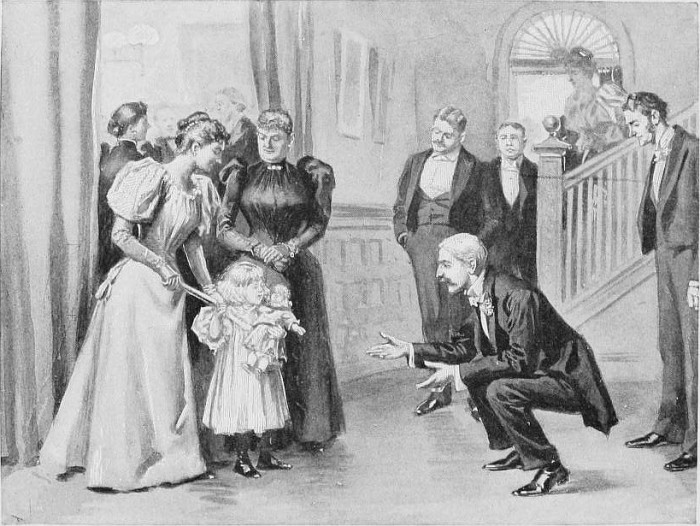
"Hasn't got any house?" He glanced at her father. "'Oh, it is pitiful—in a whole cityful.' But if I were to say that I would make you one?" he went on; "one with four rooms. And windows in each room."
The child pondered, fixing a bashful look on his handsome face.
"Would there be stairs?"
"Yes."
"And closets? Mamma says we never have enough closet-room."
"That's right, Claudia," said Ingles, commendingly; "score the profession."
"Yes, closets, if you insist."
"And glass in the windows?"
"Yes. Dear me, they get more exacting with us every year!"
"And—and—" she rolled her eyes around the group, as if wondering whether any important detail had been overlooked—"gas-fixtures? Would there be one in every room, with four globes on it?"
"Perhaps."
"But don't charge the poor child a full commission on them," said Ingles, grimly.
"Ah!" murmured Atwater, with a world of meaning. "And if I were to promise to put a nice little red chimney on the roof—what would you say?"
The child clasped her doll firmly and looked down at the carpet. "I shouldn't know whether to belave you," she said, shyly.
There was a burst of laughter. "You dear little tot!" cried Mrs. Fairchild, gathering her up, on no very definite grounds, for a kiss. Her father laughed loudest of all, but her mother contracted her eyebrows in distress.
"That dreadful Horah!" whimpered the poor woman. "She must go."
"Don't dismiss your bonne," laughed Atwater, thankful for the diversion; "she'll produce a beautiful accent in time."
"Well, after that," said her father, "I think our little McGintums had better retire. Say good-night, Claudia."
"Not yet," said Ingles. "Not before she has learned that she may have her doubts about a contractor, perhaps, but about an architect—never. Remember that great truth. Good-night, my child. Won't you kiss me?"
He lowered his face, but Claudia drew back. "I don't like whishky," she said, solemnly.
"For Heaven's sake, my pet," cried Floyd, "are you trying to start a panic? There's Horah; go-go."
"Good-night, Claudia," called Atwater; "we won't forget your house. Upon my word, Ingles," he went on rapidly, and with a face still slightly flushed, "I believe I shall have to reconsider that determination of mine I spoke to you about the other day."
"What's that?" asked Walworth.
"To give up sky-scrapers and to do nothing but colonial houses for the nobility and gentry. Sky-scraping is bad enough, but the demands of the modern house-builder are worse. Ingles, you're not as evil as I said you were; I'm sorry I ever called you a Philistine."
"Why did you do that?" asked Fairchild, amused.
"Because," answered Ingles, "I took two weeks to consider whether I could afford to let the Clifton have four good street-fronts."
"Didn't you say," demanded Atwater, "that you wanted to put up an architectural monument that would be a credit to the town? Would an eighteen-story flank of bare brick have been a pleasant object? Or, rather, is it?—for you see that sort of business all over the city. Heavens!" he went on, "we're doing some horrible things here, but we are not the ones who are altogether to blame."
"Who says you haven't done well with the Clifton?" demanded Ann Wilde. Host of the ladies had retired from these masculine topics, and were huddled in a gossipy little group at the foot of the stairs; Ann had remained behind, as an owner of real property. "That system of elevators is the most magnificent thing I ever saw."
Atwater groaned. "That's all a building is nowadays—one mass of pipes, pulleys, wires, tubes, shafts, chutes, and what not, running through an iron cage of from fourteen, to twenty stages. Then the artist comes along and is asked to apply the architecture by festooning on a lot of tile, brick, and terra-cotta. And over the whole thing hovers incessantly the demon of Nine-per-cent."
"A slap at me," said Ingles.
"It's enough to make you wonder whether Pericles ever lived. I doubt if he did," concluded Atwater.
"Are you the only sufferer?" asked his client. "How many of our sub-contractors failed?"
"Two."
"How many times were we set on fire by salamanders?"
"Three."
"How many drunken night-watchmen were discharged?"
"Four or five."
"How much of the tin-work did you condemn?"
"Lots."
"How many of the contractors suffered a penalty for over-time?"
"Too many."
"How many times did carpenters wreck plaster-work?"
"Fifty."
"How many times did plasterers ruin woodwork?"
"A hundred."
"How many men were killed or injured?"
"Thirteen."
"Thirteen!" cried Ann Wilde; "how horrible!" "Then you don't encourage building," commented Bradley; "and Mr. Atwater wouldn't encourage young men to go into architecture."
"As engineers, not as architects," replied Atwater. "Or shall I say—as constructionists?"
"Good word," murmured Ingles.
"Thanks. I've got fifteen draughtsmen up under the roof of the Clifton. When a new one comes, I say, 'My dear boy, go in for mining or dredging, or build bridges, or put up railway sheds, if you must; but don't go on believing that architecture nowadays has any great place for the artist. There won't be another Fair until long after you are dead and gone.'"
"I think I've had one of your young men with me lately," Bradley said. "He told us that he had been designing labels out at the Stock Yards, but had been in your office before that. Art may cover a wide range, you see," he said, laughing.
"Yes? What is his name?"
"Brainard, I think. He was a dark young fellow. He looked a little dissipated, it seemed to me."
"That's the one," said Atwater. "Now there's a case. That boy's father has treated him shamefully. He might have been made something of. He had a decided taste for drawing, and hardly any other. I won't say he had any great ability, but that wouldn't have mattered so much with training. However, he had no training to speak of, and we couldn't use him. He hasn't got the slightest faculty for business; they wouldn't have made a teller out of him in twenty years. But that was what they tried to do, and when it failed—"
Fairchild gave a delicate little cough.
"You don't have to listen, Fairchild," said Atwater. "Neither does Mr. Pratt, unless he chooses."
Fairchild withdrew a little from the group and stood with his hands behind his back, while the toe of his boot moved the corner of a rug to and fro over the polished floor. Freddy Pratt held his place, but moderated his show of interest. Ogden followed this new recital with a curious concern.
"His father lost all patience with him," Atwater went on. "Naturally, such a father would with such a son. He's altogether out of the family now. Is he with you yet?" he asked Bradley.
"We had him for a while, but he was pretty irregular and unreliable—I never knew why until now. He was pretty shabby, too. I guess he was about grazing bottom most of the time. I never knew what Brainard he was."
"Anyway, he seems to have made a good try," said Ingles. "I suppose he'll live on post-obits, now, and go to the dogs as fast as possible."
"If he's let go his hold lately," declared Atwater, "it's on account of his brother. Everything's done for him; he is just run right ahead. Do you know," he continued, dropping his voice and glancing aside towards Fairchild, "that Brainard has just pushed that Burt of his into the vice-presidency? Right over everybody. I don't see how Fairchild can stand it. And what could be better calculated to infuriate the other one—what is his name?—Marcus. I'd take to drink myself."
Ogden listened to all this, and was swayed accordingly. His brief, fluttering attempt to idealize Abbie Brainard ended, and he saw her only in the cold, garish light of crass reality that was beating down so fiercely on the rest of the family. He had been meditating on calling upon her at her father's house, moved by the kind of sympathy that anticipates an invitation, or does without one; this project he now determined to abandon.
VIII
McDowell had not quartered himself on the twelfth floor of the Clifton—as distinguished from the eleventh or the thirteenth or any other—by a mere chance. He had not been influenced by any finicky consideration of light, prospect, ventilation, or nearness to the elevators. His sole reason for selecting room number 1262 was that room number 1263 was occupied by Arthur J. Ingles, the owner of the building.
Ingles occupied a very small room, upon whose door was his name—his name and nothing more—in very small letters. The next door beyond was lettered "Office of the Building," and this second room had communication with the first by a door between. None of these three doors, however, had as much interest for McDowell as the one between his own office and the private office of Ingles. This door was closed, but it was McDowell's dream and ambition to see it open. In his thoughts he constantly saw it standing ajar in an intimate and friendly fashion, while he and Ingles and other magnates of Ingles's ilk circulated through it freely and all did business together.
Up to the present time this door had never been opened, nor had McDowell ever had access to the other suite except by the farther door, through which tenants passed to request repairs or to pay their monthly rent.
Ingles was enough of a lawyer to be a real-estate man, and enough of a real-estate man to need to be a lawyer. He supervised the drawing of his own deeds and leases, and seldom took counsel in matters between landlord and tenant. As a landlord, he had found it advantageous to divest himself of his soul by making the Clifton into a stock company; he himself held all the shares but five. He had an extraordinary faculty for keeping himself out of the papers; but this did not prevent McDowell from knowing that he was constantly engaged in enterprises of the first magnitude, and he felt that association with this great capitalist would be immensely to his own advantage.
But he had accomplished only one step that might be reckoned an advance: he had undertaken the financial arrangements connected with St. Asaph's choir. This was a large, well-trained body, and was provided with all the expensive paraphernalia of a "high" service. It included four or five tenors and basses who commanded rather good salaries, as well as an expert organist and an experienced choir-master who commanded larger ones. The management had been by committee, and several of the pillars of the church, Ingles among them, had learned the difficulty of mediating between music, money, and ritualism. A member of a previous committee had delighted in translating and adapting Latin hymns for Christmas and Easter, and in putting his hands into his pockets now and then to make good a small deficit in the budget. Ingles and his compeers were ready enough to put their hands into their pockets, but they were glad, one and all, to escape the details of administration.
It was here that McDowell stepped forward; he cynically acknowledged that religion must be made to play into the hands of business, and he justified himself to himself by many good arguments. The details of the new dispensation were arranged in a down-town office. McDowell had tried to contrive that that office should be Ingles's own; but the meeting was held, after all, in another tall tower a block or two down the street, and Ingles himself was not present more than ten minutes. McDowell regretted this; he felt very well disposed towards Ingles. He would have done almost anything for him—for a commission.
But McDowell did not push this choir matter to the neglect of his own proper business. He was engaged at about this time with a new subdivision out beyond the South Parks. He had bought up a ten-acre tract, which he himself acknowledged to be rather low-lying, and which his rivals, with an unusual disregard of the courtesies of the profession, did not hesitate to call an out-and-out swamp. He had mended matters somewhat by means of a dam and a sluice, which drained off a part of his moisture on to grounds lying lower still—other men's grounds; and on the driest and most accessible corner of his domain he had placed a portable one-story frame shanty which had already done duty on other subdivisions, and alongside of it stood a tall flagpole which flaunted a banner with his own name and number on it. This tract, by the way, had absorbed some moderate portion of Ann Wilde's hoarded savings.
A week of rainy weather now and then would lay a complete embargo on McDowell's operations in this quarter. His plank walks would float off in sections; the trees along his avenues would sag deeply into the slush and would sway sidewise, in spite of their networks of rusty wire; and the cellars of the three or four unfinished houses that he had artfully scattered through this promising tract would show odds and ends of carpenters' refuse floating around in muddy water a foot deep. It was an appalling spectacle to one who realized the narrow margins upon which many of these operations were conducted, or who failed to keep in mind the depths that human folly and credulity may sound.
"Oh, it's all right enough," McDowell would say. "It's going to dry up before long."
Occasionally it did dry up and stay so for several weeks. Then, on bright Sunday afternoons, folly and credulity, in the shape of young married couples who knew nothing about real estate, but who vaguely understood that it was a "good investment," would come out and would go over the ground—or try to. They were welcomed with a cynical effrontery by the young fellow whom McDowell paid fifty dollars a month to hold the office there. He had an insinuating manner, and frequently sold a lot with the open effect of perpetrating a good joke.
McDowell sometimes joked about his customers, but never about his lands. He shed upon them the transfiguring light of the imagination, which is so useful and necessary in the environs of Chicago. Land generally—that is, subdivided and recorded land—he regarded as a serious thing, if not indeed as a high and holy thing, and his view of his own landed possessions—mortgaged though they might be, and so partly unpaid for—was not only serious but idealistic. He was able to ignore the pools whose rising and falling befouled the supports of his sidewalks with a green slime; and the tufts of reeds and rushes which appeared here and there spread themselves out before his gaze in the similitude of a turfy lawn. He was a poet—as every real-estate man should be.
We of Chicago are sometimes made to bear the reproach that the conditions of our local life draw us towards the sordid and the materialistic. Now, the most vital and typical of our human products is the real-estate agent: is he commonly found tied down by earth-bound prose?
"You fellows," said Floyd to McDowell, during one of Sister Ann's sessions, "are the greatest lot I ever struck." He spoke in a half-quizzical, half-admiring way, and showed some effort to handle the language with the Western ease and freedom of those to the manner born. "Do you know, when I had been here three or four months some fellows took me with them to the banquet of the Deal Estate Board. Well, it was an eye-opener; I never saw anything like it. It was Chicago—all Chicago. Heavens! how the town was hymned and celebrated! It was personified—"
"That's right," said McDowell.
"And glorified—"
"Of course."
"And deified—"
"Why not?"
"Why not, indeed?" cried Aim Wilde. "I haven't been around much yet, but you strike me as the most imaginative lot of people I ever saw."
"Whenever Chicago is involved," amended Walworth.
"Sure."
"How you idealize it!" cried Ann, enthusiastically. "How you—"
"It needs to be idealized—and badly," said her sister.
But McDowell's interests in the southern suburbs as well as at St. Asaph's were soon set aside by another matter; domestic interests claimed his attention.
His father-in-law had now passed some two or three months in Chicago. He had entered the city without any conception of its magnitude, and he had remained in it without rising to any conception of its metropolitan complexities. He had made a change that was too great and too late. He made but an ineffectual attempt to connect and identify himself with the great rush of life going on all about him. He came down town almost every day to spend an hour or more in McDowell's office, where he took a certain satisfaction in following out the intricacies of the local topography by passing a thin, blue-veined hand over McDowell's maps and his canvas bound books of plats. McDowell treated him with considerable patience and with as much respect as was due to a man who had no great experience in real estate and little aptitude for learning. One day old Mr. Ogden, who apprehended the lake winds little better than the local "lay of the land," took a slight cold in returning home from the office; two days after pneumonia developed, and within a week he died.
George undertook the charge of such arrangements as recognized the old New-Englander as a dead man merely, and McDowell subsequently took charge of those which recognized him as a dead property-owner. First, the funeral; afterwards, the Probate Court.
A funeral is more disagreeable than a wedding, chiefly because its multifarious details make their demands with but a scanty notice in advance. All of these details George was now called upon to face and to dispose of.
He squared his jaw, set his eyes, put a cold, heavy paving-stone in place of his heart, and met these details one by one. It was a man's privilege.
Brower went with him to the undertaker's, and mediated between grief and rapacity.
"Be careful here," Brower said to him in an undertone. They were in a room where sample caskets stood on end against opposite walls and were let down one by one for the inspection of purchasers.
"They always show the most expensive ones first. Don't look at these. You don't need to pay a hundred and fifty dollars. You can select a suitable one for eighty or ninety—perfectly good and no loss of respect."
"How about the outside box?" asked the man in due course. He was in his shirt-sleeves and wore a high silk hat.
"Here," whispered Brower, "you'll have to take the most expensive. It's chestnut—fifteen dollars. Nothing else but plain pine for a dollar fifty. Shameful, isn't it?"
Brower arranged for the handles and the plates. He also met the family at the railway-station next day, and saw the casket put on board the east-bound express.
He and George were walking slowly up and down the platform alongside the train when a man in blue overalls leaned out of the door of the baggage-car and called to them. He held a paper in his hand.
"This ain't quite regular," he said. "Our road is pretty strict. The air-tight casket is all right for inter-state travel, but the doctor hasn't signed this certificate."
George turned on Brower with a look of anguish.
"Here!" cried Brower, stretching up his hand. "How forgetful of me! I'll sign it now. Go along, Ogden."
The man hesitated. "Not contagious?"
"Certainly not. Hand it down. Got a pencil? There! Here's a two. Take extra care."
The dead man's son paid for the music and flowers, his wife and daughter folded away his clothes, and his son-in-law undertook to see his estate through the courts.
"I don't believe you'd better pay the doctors and undertaker yet," he counselled. "Let them file their claims with the Probate people. It doesn't cost but a dollar, and if you pay without, you might be liable over again—you are on other claims. I'll keep a general eye on matters, of course, but questions will be coming up all the time. I don't know but what we'd better have a lawyer first as last. The Probate arrangements are different now from what they used to be—more expensive, for one thing. Now there's Freeze & Freeze—they're as good as any, and they're right there in the Clifton, George, only five floors above you."
"Have we got to go into this thing right away?" asked George, as if in physical pain.
"Oh, no. Wait a few weeks—wait a month, if you like."
"Yes, we'll wait," he sighed.
McDowell made no opposition to his wife's suggestion that her mother now come and live with them. He had not anticipated his mother-in-law as a member of his own household; but he liked her well enough, and he generally treated her with a dry and sapless sort of kindness. Besides, he looked on domestic arrangements as a mere incident in business life, anyway. George, who for some time had been anticipating a home with his parents, could not find an equivalent in a home with the McDowells, and he remained with Brower on Bush Street.
There was no will; the recasting and consolidation of the small estate had required too much time and attention to leave much for any-thought of its redistribution. Mrs. Ogden went into court at the proper time and qualified as administratrix. She was a figure-head, of course. She signed various documents at George's instance; George himself was guided by McDowell, principally; and McDowell got a point, now and then, from the attorneys. However, the legal labors of Freeze & Freeze on the Ogden estate were chiefly clerical; this did not prevent them from charging like chancellors and chief-justices.
These charges and others were paid, by McDowell, who began informally by giving checks on his own private account. He came to receive, too, most of the rents and other payments, which were more conveniently made to him in his own office than to George in the office of the bank. And since he paid the estate charges out of his own private account, it seemed natural enough that his own account (which was with the Underground) should receive the sums coming in. This arrangement came about gradually, without receiving any formal acquiescence; but George appeared satisfied with the business capacity of his sister's husband; while his mother was an inmate of her son-in-law's house, where inquiry and explanation were easily enough made.
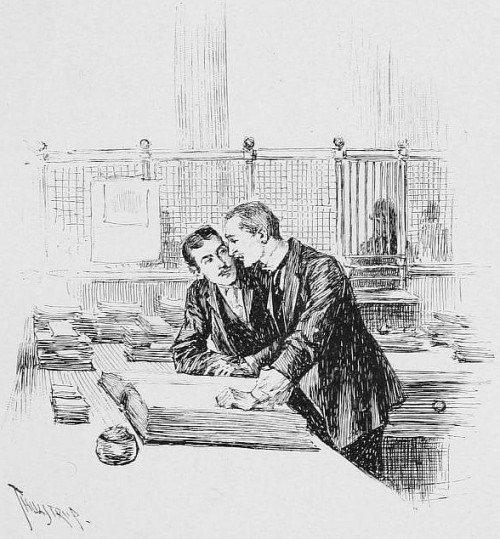
"'How's this, Jo?' asked Ogden."
These details, once in hand, appeared to give little hinderance to the course of McDowell's regular business. His acquaintances in his own line noticed its increasing spread, and agreed among themselves that he was flying a little high for a man of his limited resources. He had more work for the surveyors and sign-painters, and he presently added a clerk or so to his office force.
Various small claims were filed in the Probate Court and were allowed. "I think," said George to McDowell, "that we'll use Kastner's rent for them. To-day is the third; he has been in, I suppose?"
"He'll have to be punched up," replied McDowell. "It doesn't do to give them any leeway."
"He has always been prompt on the first," said George, somewhat annoyed.
The next morning he entered the paying-teller's pen for a moment, as occasionally happened. His eye chanced to alight on the balance sheet that ran from L to Z.
McAvoy, Louis M.81.98
McCloud, Peters & Co.1187.25
McDowell, E. H..0
"How's this, Jo?" asked Ogden. "What's the matter with McDowell?"
"Pulled out yesterday," responded the payer, briefly.
IX
McDowell's defection, from the Underground was presently followed by an addition to its working force. One morning, a month or so later, Ogden, in an interval of leisure, glanced across to the window before which Burton Brainard had railed in his desk, and saw a young woman within the enclosure. She sat there alone, before a desk of the peculiar kind that has been contrived for the typewriter, and her effect at the moment was that of leisure finally and elegantly achieved.
He was at once struck by her peculiar facial expression; she had one eye open and the other shut. All at once she effected an instantaneous change which closed the open eye and opened the closed one. Then she opened both and gave out a smile of recognition, surprise, and pleasure, which he now perceived to be the work of the features of Cornelia McNabb.
"Here we are!" she seemed to say.
She had followed Burt's elevation to the vice-presidency, along with the new desk and the handsome rail-work enclosing it. Burt's concerns, despite his rise in rank, were now, as heretofore, largely outside the hank proper; he did something in stocks now and then, and he kept the run of things on the Board of Trade. But he was like his father in looking upon the bank as a personal and family matter—a point of view which the action of the body of stockholders somewhat justified: as a general thing they made up a chorus that huddled in the wings—several of them declining to come "on" even for the election that advanced Brainard, Jr., to the second place. So he saw no very good reason why the bank generally should not foot the bill for his own clerk-hire.
"Why can't you use the man we've got here already?" his father had asked him, however. "Ain't one enough?"
"No. Somebody else has always got him. If I could have one for myself just for an hour or so, it would be a great help."
"Why don't you get one of those girls that circulate around upstairs? I hear there's one or two of 'em."
"I believe I will." And thus Cornelia McNabb came in for a brief daily attachment to the Underground.
She sat in her place quite unoccupied for an hour or so, looking about inquiringly, fidgeting a little, and watching the clock. Ogden glanced over in her direction once or twice. He saw that she had contrived to express her rise by several subtile alterations in her dress, and that she had succeeded in enveloping herself in a promising atmosphere of gentility. She, in her turn, kept an eye on him and contrived to time her own luncheon along with his. She thrust her hat-pin into place just as he buttoned on his cuffs, and she drew a black-dotted veil across the tip of her nose just as he was reaching up for his hat.
They sauntered out separately, but came together in the hallway.
"Do I look nice, or don't I?" she asked him, as she passed one of her gloves over the smooth surface of the massive marble balustrade. "You needn't think the Pewaukee girls are jays; they're too near Lakeside and Waukesha for that."
"You do, indeed. But where are the chains and rings?"
"Fiddle! I hope I know better than that, now."
The elevators were sliding up and down behind their gilded grilles with great rapidity, and hundreds of hungry helpers were stepping out of them in search of brief refreshment. Some of these stopped in the basement vestibule, and our young people, looking over the balustrade, saw them buying packages of cigarettes or the noon papers. There came to them, too, the voice of the man who stood at the foot of the elevator shafts and who regulated the movements of the various cabs by calling out their numbers with a laconic yawp. He wore a blue uniform with gilt buttons and he had a gold band on his cap. He was as important as Ingles himself—perhaps more so.
"I believe I'll go up to the restaurant to-day," said Cornelia, with a precious little intonation. Her mincing tone intimated a variety of things—altered conditions among them.
"I go up there occasionally myself," said Ogden. "You have entertained me several times downstairs, and you ought to give me my chance now, don't you think?"
"Quite happy, I'm sure," she murmured demurely.
"Up!" called Ogden, and up they went.
"Well," said Cornelia, a few minutes later, taking off her gloves with a self-conscious grace, and pushing aside her tumbler so as to find a place to lay them, "I can't say I've been overworked this morning. I haven't seen my new man at all."
"He's out a good deal."
"But the old one was on deck."
"In what way?"
"Oh, he put me through a regular drill. Had quite a number of remarks. I shouldn't care to take him down. May have to, though, if he gets too bossy. Eh?—oh, well, I don't know that I care for so very much, thank you. What are you going to have? Chicken-soup?—all right. Yes, chicken-soup, John."
She leaned hack in her chair with a genteel grace, and looked out of the window down on the snow-piled roofs below.
"Do you know, I used to think I was a pretty smart girl, but I begin to believe I'm a good deal of a dummy, after all. That man has been in the building all this time, and I have just found it out."
Ogden's eye involuntarily followed the waiter.
"Not that black man—nix. But how could I be expected to spot his name among all the 'steen hundred on that bulletin by the door? I did see it there this morning, though—just by accident."
"Whose?"
"Oh, Ingles's. Arthur J. Ingles. Think of his being in this very building all this time!" She put the rim of her tumbler up under the edge of her veil.
"In it?" repeated Ogden. "He owns it."
"He does? Great Scott!" she choked and spluttered, setting her glass down suddenly. "Well, I'll be switched!"
She gave another gulp. "I suppose his father willed it to him."
"No; he put it up for himself; I heard him say so."
"And you know him?" A new light shone in her brimming eyes.
"Yes."
"Well," she declared with emphasis, "now I see my way. He's got to have me do shorthand for him, and then I shall see—her."
"Ah!"
"Yes. Can't you tell Mr. High-and-mighty that you know a respectable girl who is trying to make her own living?" She ran her fingers over the edge of one of her cuffs, which was slightly frayed. "You see how poor I am."
George laughed. "The laundries are pretty rough, for a fact."
"How mean of you!" she exclaimed, and laughed too.
She thrust back her soup.
"I don't want it. I don't want anything. I can't eat a mouthful. Then I was wrong about his being a society dude?"
"Completely."
"And how is she? S'posing I've made a mistake about her, too?"
"I don't know, I'm sure. I've never seen her."
"You're telling me a fib."
"Ho, truly, I never have. I don't believe there's any such person. I think she's somebody that the papers have just made up. How many people have you found to work for?"
"Oh, three or four. But time for more. Rhyme, ain't it? I'm trying for the Massachusetts Brass, but I'd rather get Ingles. She gave a dance at Kinsley's night before last."
"How many words can you do?"
"About ninety—enough for business; of course I couldn't manage courts or banquets or sermons. I expect she comes down to his office for a check every now and then. Why don't she ever have her picture in the Sunday papers?"
"O Lord! I hope they're above that!"
"What's the objection? I'd have mine there quicker 'n scat if I could. I will some time—bet you. And not in any office togs either."
"But don't dream of rivalry. She isn't real; she's only a beautiful myth. What will you take next—roast beef?"
"I don't mind; yes. When I'm alone I usually skip right from soup to pie—or pudding. But I guess I will take something a little solider this time; nothing makes me tireder than sitting still and fidgeting." She tapped her toes on the mosaic pavement, and gave a hitch and a pat to the dimity curtain alongside her. "I squirmed around for an hour, with a whole bookful of other people's notes that I might have been writing out. What sort of a young fellow is he?"
"He has his own way."
"Only child, I suppose?"
"N—no."
"Only son?"
"No—yes—I don't know. How do you like your work?"
"Middling. I'm terrible enterprising, but I guess I was never meant for a drudge. Say, what does a patroness really do?"
"Oh, nothing much; she just has her name on the list. Sometimes they don't even go."
"I notice that your Mrs. Floyd is beginning to be one; I've seen her in the papers two or three times."
"She doesn't like it, though; sometimes names get put on just to fill up. 'My dear Mrs. Floyd, we thought you wouldn't mind; you don't, do you?' they say. 'But my name in the papers,' she objects. 'You are too sensitive,' they reply. 'You've had your name in the papers at home,' her husband reminds her. 'Yes,' she answers, 'but—here!' She hates the town."
"Well, if I was a patroness I guess I'd have some say—no figure-head for me. I wouldn't be put on, either; I'd put the others on."
"I see you were cut out for a 'society' career."
"I guess you've about struck it. I went to a dance a week ago to-night—Periclean Pleasure Party."
"Like it?"
'Twa'n't much. And I was invited to a firemen's ball—such impudence!"
"Right—don't cheapen yourself."
"I guess I understand that."
Meanwhile a nooning of a different character was going on in the directors' room of the Underground. This is not to be taken as indicating that the green-baize plane of the long centre-table was littered with reports and memoranda, and that the high-backed, leather-seated chairs were filled with the solid figures of a dozen solid men. No; the aspect of the room was that of Sunday-like disoccupation, and the only people in it were an appealing young woman and a stubborn old man.
"Let her come in, father; please do."
"Take care, Abbie. You know what I think of you, but you make a mistake when you try this."
Abbie Brainard passed her handkerchief across her tearful face. Her father stood before her with his legs spread wide and his feet firmly planted; he had his hands thrust deeply into his trousers pockets. His jaw was set, and his shaggy brows were drawn down over eyes that glared fiercely at nothing.
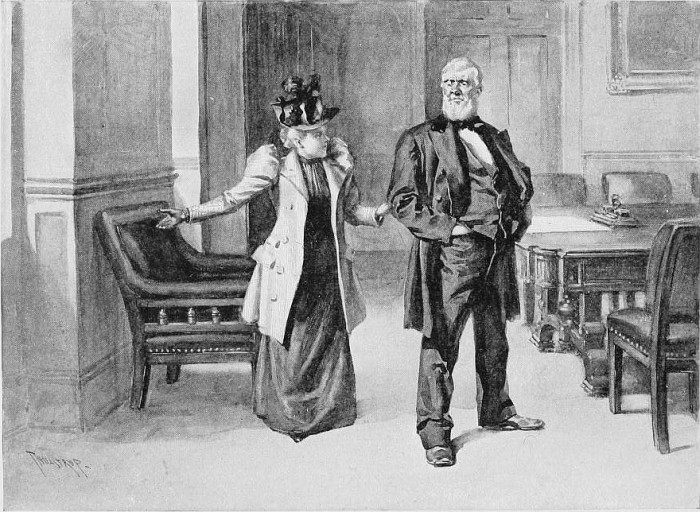
"Then meet her out in the hall somewhere, just for a minute." She laid her hand tremblingly upon the old man's arm. He moved, as if to shake it off.
"Then just walk by outside; she can see you from the cab."
He turned his eyes upon her, half in expostulation and half in threat. "Abbie!"
"Then, father, just step here to the window; she'll see you and know it's all right. Come." She caught hold of a fold of his sleeve. "You won't keep her waiting out there such a cold day as this?"
Brainard moved his feet, but he turned his back on the window and fixed his eye on the fireplace. His daughter's light touch was quite powerless on his huge bulk.
"Father, you know Burt says—"
"Abbie," he interrupted sharply, "don't you say a word to set me against Burt. I won't hear it. Don't drag him in, or you'll be sorry for it." "But, father, don't you understand? He struck her; there's a mark on her face now."
Brainard's great frame shook, but he made no other sign. This quiet she took as a favorable symptom. She would have done better in perceiving that he was between two contending forces so nearly equal as to hold him almost in equilibrium. The wretch had struck his daughter—a brutal, hateful thing as regarded his daughter or any daughter or any other woman; but his daughter had defied him, overridden him, and the man whom she had chosen for a master was now the instrument of her punishment. The accounts appeared to balance. However, figures do lie, and his own agitation indicated that the x of human emotion had not been completely eliminated from his problem.
"She laid her hand tremblingly upon the old man's arm."
He cleared his throat. "She has made her bed, Abbie," he said in a husky tone, "and now she must lie on it."
"No, father; you must hear what Burt says. He has had to go up there and—"
"Burt? Is that where he has been this morning? Has he turned against me too? Good God! what have I done to deserve such treatment as this? First it's Mark, with his drawing and his trying to play the fiddle; and then it's this pen-pusher that puts on those things Sundays and marches around singing songs; and now it's Burt, who's had every chance to make a good business-man of himself, and everything done for him. It's too bad; it's too almighty bad."
Abbie steadied herself against the corner of the table. Her breast heaved with fearfulness; she had never before openly protested to her father against himself.
"Why haven't you done anything for the others? Why didn't you give Mark an education?—the kind, I mean, that would have helped him, and the only kind. Why haven't you taken this Mr.—Mayme's hus—this man and made the best of it, and found something for him to do?—he can work in an office. Oh, father," she moaned, with a softening note of deprecation, "you have made it pretty hard for all of us."
"Abbie," he gasped, "are you turning against me too? Abbie, I've always thought so much of you, and I've done well by you. But I want you to go away—I won't see her. I won't. She must go away, and you too."
He caught her by the arm and tried to move her towards the door—gently, as if she might go of her own accord.
Ogden, on coming in from lunch, found himself intercepted by Freddy Pratt. This youth had a few moments' leisure, and he assailed Ogden between the wardrobe and the wash-stand.
"I went over to see the Viberts again; last night," he communicated. "Poor Mayme—I wasn't going back on her, if others did. She was sitting there all alone in the dark. I guess she had been crying. Anyway, when I lit the gas her eyes looked red. She wouldn't say much—"
"Good plan."
"And after he came in she wouldn't say hardly anything at all. Slow work talking to him! He wasn't drunk exactly, but he had been drinking; didn't need a light to tell that. I wasn't doing anything at all, and all of a sudden he blurted out, 'I say, you young fellow you, what do you mean by coming here and destroying the peace of a man's family?' You can bet I was taken back. Then he got up and came towards me—he looked big, too! 'You get out of here'—that's what he said."
"And did you?"
"Oh, yes, I got out," responded Freddy Pratt, with a meek complacency.
"You surprise me. You showed sense."
Freddy looked at him doubtfully. "I heard this morning that he had just lost his place with those insurance people," he resumed cautiously. "That was what was the matter, I guess."
"Possibly," said George, who had heard from Brower that something of the kind was likely to occur. The fellow's work had been done indifferently of late, and he was far from being worth the increased salary he had asked for.
As Ogden passed up to the other end of the office Brainard appeared in the doorway of the directors' room and beckoned to him. His face was pale and disturbed; the veins in the end of his nose showed redly; his eyes burned with an appealing fierceness.
"Ogden," he said, in a loud, hoarse whisper, "where is that type-writer girl? Tell her to bring some water here as quick as she can."
"She isn't here, sir; she has gone back upstairs."
"Then you get some yourself. Here; take this tumbler. Be quick, and don't make any fuss."
Ogden hastened to the wash-stand near which Freddy Pratt had detained him. Returning again, he saw through the half-open door that Abbie Brainard was lying back in one of the big chairs with her face pallid and her eyes closed.
Her father dipped two of his great, clumsy fingers into the glass and made an awkward attempt to sprinkle her face. "My poor girl has fainted," he said.
The girl's eyes half opened; she seemed to see Ogden standing just outside.
She clutched both arms of the chair and raised herself half up. Her bosom heaved; her mouth was drawn tensely.
"Fainted?" she tried to say; "not at all!" She gasped once or twice and rose to her feet. "I never fainted in my life," she said grandly; "I never should think of doing such a thing!"
She reeled; her eyes closed. George rushed forward to catch her. Her hand dropped numb on his arm, and her head fell heavily on his shoulder.
X
Ogden and his mother were now beginning to have frequent conferences with regard to the management of the property and to McDowell's connection with the matter. Perhaps the word "conference" puts, however, too set and formal a stamp on the brief, hap-hazard interchanges of ideas that took place, as chance permitted, within McDowell's own house—a few words after a Sunday dinner or at the front door late at night. And besides being handicapped as to occasion, they were further hampered by McDowell's new relation to them and by their own presence under his roof. Besides, Mrs. Ogden, with a multitude of small experiences, had no ability for grasping things in a large and general way; while George, with a broader and more comprehensive outlook, was embarrassed by a lack of experience in the actual details of business transactions. Added to this, he was a new-comer, under all a new-comer's disadvantages; he hardly knew where to turn for the proper agents, legal or financial, that might have been employed; while many of the agencies—courts, for instance—were different in procedure and even, in name from anything he had known East.
"All the same, though," he said to his mother, "things ought to be in different shape for you. I'm bound hand and foot in that bank—no time or thought for anything outside. I don't know but what you'd better put everything with some good real-estate firm, and let them look after repairs and collections and taxes."
His mother fixed a pair of anxious eyes upon him, and the wrinkles of perplexity appeared on her forehead.
"Eugene is real-estate."
"Or those lawyers," he went on. "Anyway, you ought to have an account as administratrix with some bank. I believe I'll open one to-morrow. Something has got to be done to make things quicker and clearer."
He presently took upon himself the delicate task of intimating to McDowell that a simpler and more regular way of doing things was desired.
He went up to McDowell's office in the latter part of the afternoon. As he entered, a tall, dark man was standing in the middle of the room. There was a sinister look in his eyes and a contemptuously sarcastic smile on his heavy red lips. He gave a last fold to a small piece of paper that he held in his hands and thrust it into his vest pocket. It was Vibert.
"It's pretty near four now," he was saying to McDowell, "so I can't try again to-day; but I expect to find this all right after ten to-morrow morning."
He gave his hand a hardy flip across one side of his dark moustache and passed out. McDowell looked after him sourly. "Damn the brute!" he muttered.
As Vibert's words implied, he had been in McDowell's office once before on the same day. His salary at St. Asaph's now meant more to him than it had meant a month ago, and he had called with reference to it and to the delay in its payment. Hitherto, the financial arrangements of the church had gone on with the same precision as its anthems and its processionals. In the present condition of things delay to Vibert was more than a surprise, more than an embarrassment; it was an exasperation.
"I don't sing for glory," he had declared with an offensive brusqueness. "It's the here and not the hereafter that I'm busy with."
McDowell looked at him uneasily. "I'm going to fix up all the salaries next week in one batch. I don't see why any particular man should be favored."
"Favored!" repeated Vibert, with a loud insolence. "I should say not. I don't feel favored in running my legs off for money three weeks overdue. We can't live on air. We have bills to pay. We ain't singing for the pleasure of it."
McDowell contracted his eyes to a critical narrowness. "You may not be singing much longer for anything else, either."
"That's another matter; it isn't you that put the choir together."
McDowell tapped his fingers on the yellow varnish of his desk. "I don't know about that. From what I hear, you're not making the sort of record for yourself that's useful in a church."
"My private life is nobody's business. I sing; I'm worth the money."
"That may work on the stage; it won't work quite so close to the pulpit. Come, now; I know a little something of your daily doings. Plenty of men sing who don't hang around race-tracks and loaf in pool-rooms. And, from what I hear, you're helping that young Brainard along at a good gait, too. You'd better wait—along with the others."
"Waiting be hanged! I'm here for money—money that's mine. If I can't work it with the man who pays out the loaves and fishes, I'll try one of the men that contribute them, in the first place." He tossed his head insultingly towards the door that led to Ingles's office.
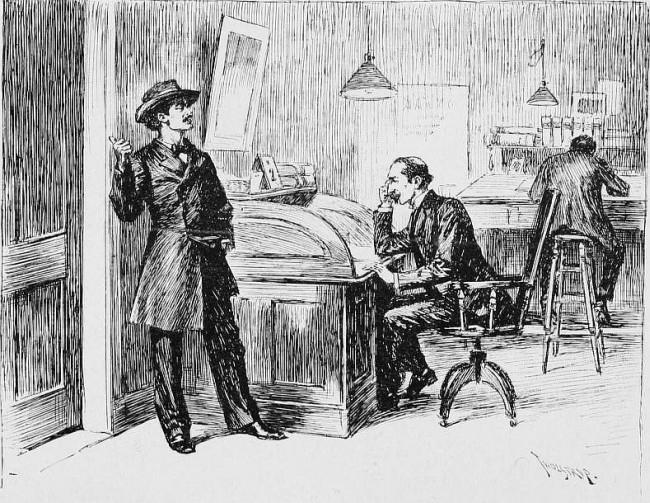
McDowell's elbow rested on the edge of his desk (his thumb on the tip of his ear and his middle finger rubbing his farther eyebrow) as he looked out steadily on Vibert from under his hand. "Joseph," he called to his clerk, "bring me that check-book."
"He looked steadily on Vibert from under his hand."
The man opened a lower drawer and brought out a book whose covers enclosed a number of stubs and three or four blank checks.
McDowell wrote and passed the check to Vibert, who went out with no further words on either side.
McDowell did some figuring and saw some people, and somewhat later Vibert returned. He threw his check on McDowell's desk contemptuously. "That's no good."
"How's that?"
"No account with 'em."
"No ac—oh, I see. We've changed banks, and I forgot to change the name in the check." He picked up a ruler and drew the red-ink-bottle a little nearer. "I'll fix it. Sorry to have troubled you. We want to look out for this, Joseph."
Vibert withdrew, speaking the words that Ogden had heard on his entrance—words that would have been the reverse of assuring if he had fully understood them. "Bad egg," said McDowell to him, wagging his head in the direction of the just closed door.
George looked at him studiously. He appeared to be in a state of extreme nervous irritation. His wiry moustache moved up and down stiffly as he felt about with, his teeth for the inner membrane of his lips. His long, lean fingers were interlaced, and a clicking sound came from his snapping his finger-nails together. It was clearly no occasion for more than a partial statement of Ogden's matter, and this was the most that he permitted himself.
But McDowell was in the sensitive state of mind when one word does the work of three, and in the irritable state of mind when talk is such a relief that three words evoke thirty in reply. He met George's brief and modest suggestions with a hitching of his shoulders, and answered them in a harsh and strident tone.
"The first thing in doing business," he said, "is to have an office to do it in." He looked about his own—his desks, his cashier's window, his letter-press. "And the second is to know how to do it." He looked out of the window in a wholly impersonal way, but his words had a more personal slant than he would have given them at almost any other time. "Gad knows I've got enough to do already, but Kittie's affairs are mine. She has equal interests with the others, and she seems to feel that I am able and willing to look after them."
He spoke with some show of reason, and George was obliged so to concede.
"There's taxes, for one thing. Or, take special assessments alone; they're almost a business by themselves. Say you've got ten acres or so just beyond the limits. Some fine day it's six hundred dollars or more for half a mile of side-walk—a sidewalk that won't be walked on by seven people a week. What's the reason? Oh, some one of those township politicians or other has got a friend that's a carpenter. Now, who's going to tackle the boards and stave off such things?"
George looked at him silently.
"There's tax-sales—I guess you never went to one of them. You'd strike a bloodthirsty crew if you did. Supposing you've got a mortgage, and the mortgager don't come to time with his taxes? You've got to buy 'em up to protect yourself. And you've got to get there first. Last year I fought this point for a week with one of those tax-sharks. And so it goes. Real estate is no kindergarten business, I can tell you."
The truth of this view was becoming more and more apparent to Ogden. He withdrew, after some further parleyings, in a confused and inconclusive state of mind—well convinced, however, of McDowell's abilities and more fully conscious of McDowell's position as the husband of his father's daughter. Never did the town of his adoption seem less, indeed, like a kindergarten than when he took his way northward to dinner, or when, later in the early evening, he made his way over to the West Side to call at the Brainards. The thousands of acres of ramshackle that made up the bulk of the city, and the tens of thousands of raw and ugly and half-built prairie that composed its environs, seemed together to constitute a great checker-board over whose squares of "section" and "township" keenness and rapacity played their daring and wary game. And through the middle of the board ran a line, a hinge, a crack—the same line that loomed up in ad those various deeds and abstracts of his with the portentousness and unescapability of the equator—the "line of the third principal meridian."
The Brainard house reared itself in the same frivolous ugliness that we have already viewed; but an excess of light came through the front parlor windows, and Ogden was prepared to find that at least four of the eight burners in the big chandelier were lighted. This turned out to be the case; it was as great a tribute as the family ordinarily paid to society. The family he found represented by Brainard, his wife, and his elder daughter; society was present in the shape of a young couple who were called Mr. and Mrs. Valentine.
The elder daughter received him with a quiet and simple cordiality. He could not help looking about furtively for the possible presence of the younger. He had not remained ignorant of her half-hour wait in a cab outside the bank; but he might have surmised the inflexibility of her father's will. The old man had refused to see her or to let her see him; the most that he would yield was a species of non-committal communication through Burt.
Mrs. Brainard presented herself to Ogden as a peculiarly faded and ineffective person; it was easy enough to grant her an abysmal incapacity. Her husband, in fact, had fallen upon her, crushed her, absorbed her—as a heavy blotting-pad falls on a page of light and delicate writing. Except for one thing she had no aim, no occupation, no diversion—beyond her ills and remedies. This was a penchant for chess. To those who object that chess is an intellectual game, one may simply put the question: have you ever seen it taken up by an elderly, invalided female who has rested content with a mere learning of the moves? It was thus with Mrs. Brainard; she played a good many games with herself every day, and they really soothed and rested her.
On the social board, however, she had hardly learned the first "opening," and the entertainment of the brilliant young couple now in her house fell almost altogether on Abbie; for the girl's mother sank back into a passive silence, while her father toured through the rooms occasionally, and threw out remarks, more or less à propos, in a gruff and abrupt fashion peculiar to himself.
His manner with young men had simply closed the house to them. To him it was an inexplicable and harassing thing that a young fellow of twenty-five should not possess the capacity, experience, and accumulations of a man of thirty-five or forty. He regarded every intruder in the light of a potential son-in-law, and no more potential than undesirable. Most of these callers would gulp down once, with such smile as they could master, the old man's abrupt ways and disconcerting comments; then they got out of the house in good order and never came back. However, at the present juncture he did not appear to resent Ogden's appearance—notwithstanding the young man's share in the episode at the bank; perhaps he looked upon him as a serviceable prop in another bad quarter of an hour.
"Yes, Mr. Brainard," Mrs. Valentine was saying, as George entered, "it's just as I have been telling Abbie; you ought to move over on the North Side, too."
Brainard happened to be passing through the room; it had occurred to him that he might turn down one of the side-burners in the back parlor.
"Um, no," he said, in an off-hand way; "too near the lake: fog; damp; rheumatism."
"And pneumonia too, perhaps," his wife suggested feebly.
"I'll risk it!" cried Mrs. Valentine, vivaciously. She had an expansive and affluent effect; she appeared mettlesome, decisive, confident. "It seemed to me that, so long as I was going to build, I might as well make a complete sweep—an out-and-out break. I've always had a fancy for that part of town. So I sent Adrian around to the different offices—"
She threw a look of passing reference towards her husband, who made a little bow in return.
"—and I had the good luck to get a lot on Bellevue Place—one of the last left, and only a block from the Lake Shore drive. Then I went to Mr. Atwater, and he has made my house a perfect little dream! I thought it best to have him to dinner once or twice, and I'm glad I did--he's been so interested all through. There hasn't been the least hitch to speak of, and I expect to get in within a fortnight. This," she went on, turning to Ogden with an undiminished vivacity, "is really my P. P. C."
Ogden glanced at the husband of the lady whose use of the first person singular was so frank and continuous. He was a young man with a pleasant and amiable face, and that face was set in a meek little smile, from whose forced lines the element of deception was most pitifully lacking.
"Yes, Abbie dear," Mrs. Valentine went on, "I'm afraid it's good-by—or nearly the same thing." She took the girl's hand within her own and gave it repeated pats in a rather careless and self-absorbed way. "I shall try to see you often, of course; but it will be so far. How nice it would be if you could only come up there and settle down right next door to me."
Ogden sighed unconsciously. He had fancied the first rays of social illumination as falling upon this benighted family; but it was only the last faint glow of a Speeding twilight, after all.
Abbie withdrew her hand with a quiet dignity; she seemed to put but a moderate value on these protestations.
"I believe we are satisfied where we are, Fanny," she said in a low and even tone. "We have always lived here; we feel more at home in this house than we could anywhere else. All our—all our—friends are near us"—a desolate little blush came in here—"and then there's the church and everything. I've heard my sis—I'm told that the North Side is very pleasant on some accounts, but I don't think we are likely ever to change."
"Change!" called her father, suddenly. "I wouldn't live anywhere else if you paid me to. What's better than this?"
"So attached," murmured her mother, vaguely.
Mrs. Valentine continued for some time further to flutter her hands, her clothing, and her conversation, but she was very slow about getting up and fluttering away. She was a neighbor, and her return home was a matter of three minutes. Ogden's return was a matter of nearly an hour, and he left first. He carried away the discontented feeling of a young man whose aim in the direction of a young woman is frustrated by the presence of uncongenial elders and irrelevant outsiders. He had been quite certain of his ability to meet Abbie Brainard after the bank episode without any particular embarrassment or restraint; certainly he had come to view with more interest a girl whose hand had lain in his and whose head had rested on his shoulder. There had been no embarrassment in her greeting of him; her manner had been as straightforward and sensible as it always was. But never mind; he should try again; he was only too certain of soon finding her alone.
He took his hour through the clamor and the slime of the public ways. He escaped from these by his talismanic night-key, and stumbled up thoughtfully to his room.
There was a light burning in it, and the fireplace showed the faint red of dying coals. A valise, open and half unpacked, stood in the middle of the floor, and sitting up in bed was Brower, busy with the last volume of "Monte Cristo." They now occupied a large front room together, which Ogden had to himself a good half of the time.
"Back, are you?" said George. "When did you get in?"
"About seven."
"How's Missouri?"
"Weather good; eating bad."
"Heading all this time?"
"Went to theatre."
"What did you see?"
"'Crackling of Thorns.'"
"Any good?"
"Hot much; one pretty girl. Where have you been?"
"West Side; Brainard's."
"Anybody there?"
"The old people. And some friends—Valentines."
"Valentine? I used to know a Valentine—nice, quiet fellow, light complexion. His name was Alpheus—no, Adrian."
"That's the one."
"Poor fellow! he deserved a better fate."
"What's the matter with him?"
"His wife owns him."
George smiled. Brower hitched himself up on his pillow and put his finger into the book to keep the place. "He was a first-rate fellow —good all through and kind of capable; that is, he was worth a salary of eighteen hundred a year—or two thousand. He married a girl with two thousand a month. No head book-keeper, no cashier, no secretary could she let him be after that; no, Johnny must be his own master—except as regarded her. To-day he sort o' hangs on the outskirts of business, and picks up a little here and a little there—he has desk-room somewhere in the Clifton, I believe. He does the best he can to preserve his self-respect, but I don't see how he can pay the bills and the house-rent too."
"House-rent? They're building—I mean, she is."
"Yaugh!" cried Brower, with deep meaning.
"Atwater's doing the house for them—for her."
"Atwater?" Brower gave a second hitch to the pillow, and threw the book to the foot of the bed. "He's another. He's had a trip in the same boat."
"Why, he isn't married."
"I guess he is—just about as hard as any man ever was. But he has fought through gallantly—I'll say that for him."
"What's his story?"
"Begins in the same way. She was rich, too, and a high-flyer. He had education and family and his profession—and no money. He struggled up for ten years, and now—now he stands on his own legs; his wife has her own money for her clothes and amusements. He saw he had got to strike society, and he struck it—hard; he costs like smoke. But he snatched victory from defeat. It was a great act. Speaking of acts—who do you think I saw there in a stage-box to-night?"
"Who?"
"Burt Brainard. Just kick that valise out of the way if you want to."
"All alone?"
"Hope. Girl with him. One of the Clifton type-writers—the one who used to be down in the lunch-room."
"Healie McNabb?"
"U'm h'm."
XI
McDowell's second check to Vibert proved good on the opening of business next morning. It was paid in the usual mechanical and impersonal fashion that gives no possible clue to the amount of the balance remaining after; but paid it was, all the same, and Vibert's anticipated opportunity for further invective—an opportunity which he considered quite possible, and would have been by no means sorry to embrace—came to naught.
McDowell's friendly intimation that St. Asaph's might presently dispense with Vibert's services was soon found to have as solid a backing as his signature. Within less than a fortnight Vibert was dismissed, though on grounds not altogether the same as those that McDowell had figured upon.
If Vibert, after descending to the ground floor, had immediately crossed the great court of the Clifton instead of lingering there for a moment, the outcome might have been quite different. But he paused in the midst of its mosaicked expanse to pull out the check from his pocket and to take another look at it. He projected his vision so far into the future as the next forenoon, and saw the check again rejected—this time by the teller of the Highflyers'—by reason of "no account," or perhaps by reason of "no funds." He dramatized a precipitous visit to McDowell's office, and improvised the scene of denunciation and vigorous action that was to accompany it.
"It had better be good this time," he muttered, with his eyes on the pavement. "I'll strangle him if it ain't."
He tossed up his head and sent a fierce and frowning glance through one of the great plates of French glass that shut in the court. His eye darted forward on its own level, but it saw nothing save McDowell in his office, ten or twelve floors above.
Most of the panes that enclosed this central space were of great height and breadth, and were lettered with the silvered styles and titles of various railroad and mining companies; others, smaller, gave light and some ventilation to a few booth-like shops; a few others, immovable half-lights, admitted a little daylight and no air at all to certain closet-like crannies that had a squeezed and crowded rôle in the Clifton's general economy. One of these last looked out from under a kind of secondary stairway; it lighted the scullery of the Acme Lunch Room, and it commanded a view of that side of the court on which Vibert was standing.
Vibert's heel gave a vicious dig into the mosaic pavement and made a quick and rasping turn towards the exit; he crossed the court with a heavy yet rapid stride, and passed out into the street. He was quite unconscious of observation, but he had been seen.
Through the half-pane under the stairway a young woman had noted his presence and witnessed his departure. She was a thin, faded creature, in the forlorn garments of an undisguisable poverty. All but the faintest traces of good looks seemed to have been taken from her by a long experience with illness and suffering. She stood close against the pane. Her thin fingers, red and chapped, showed, as they pressed against the glass, the crinkled puffiness that comes from long immersion in hot water, and she stared through with a look of mingled fear, entreaty, and agony. At the glance which Vibert's indignation over McDowell's trickery sent in her direction, she started and cowered like one who had encountered that glance before; and when he turned to go she recovered herself, and flung her bosom and her hands against the pane as if bent upon breaking through and following him.
A moment later she appeared in the court; she had put on a shabby hat and a flimsy, faded shawl. She crossed over hastily, and approached the head of the elevator squad.
"The tall, dark man who just went out—you saw him?" she inquired hurriedly. She spoke in two quick-expulsions of the breath, and seemed left without a third.
"Um?" The man opposed his gold band and gilt buttons to her forlorn and bedraggled shabbiness. His brief inquiry, made without opening his lips, had the true official indifference; but it caused his questioner to feel some of the disadvantage that comes to a young woman from a public and impulsive inquiry after a young man.
"You saw him standing over there; he had a paper in his hand. Tell me, does he work in this building?" She was panting and all a-tremble, but she found breath for these words and will to use it.
"Yes, I saw him," the man answered, with the slow reluctance of his kind to be interested in individuals as individuals. "Used to work here, I believe. Haven't seen much of him lately."
"Where can I find him?"
The man turned towards the elevators; one had just that minute come down. "Chicago!" its youthful conductor had called with an airy drawl.
"Pete," said his superior; "a tall, dark man who's been standing around here." He threw his thumb over towards the girl, to indicate that the inquiry was hers. "Had on a soft brown hat."
"Yes, I seen him," said the boy. "Used to be in one of them insurance offices, didn't he? Vibert—was that his name?"
"Vi—?"
"Vibert," said the man, impatiently. "Come, come, don't block the way—sev-en!" he cried, in his professional tone, and the boy at once slammed his door to and started roofwards.
The man retired into himself with a resumption of his air of idle dignity. The girl, at a short remove, stood looking at him with an anxious face. She made a timid attempt to approach him again and presently stole away.
Vibert was followed down from McDowell's office, in the course of half an hour, by Ogden. McDowell's dissertation on tax matters, with its pointed presentation of extreme cases, had left him, as we have seen, in a state more or less stirred up; and it had occurred to him that if he were to stop on the way down he might find some legal sedative in the office of Freeze & Freeze. But the hour was now rather late; Freeze & Freeze were being locked up by the last of their junior clerks; and Ogden was left to ramble through the corridors in a confused and disconsolate state.
He was presently accosted by a young woman, who appeared to be roaming through the building in a state even more dazed and forlorn than his own. She approached him with appeal so plainly written on her features that his hand went instinctively to his pocket for the ready dime. He was used to addresses of this sort; Brower had told him many times that he was a "soft mark." He soon ascertained, however, that what she wanted was not alms, but information—an appeal which is more familiar still in the great down-town buildings; it comes frequently enough from simple, inexperienced creatures who know what they want, but not at all how to get it.
The girl thrust back a straggling lock and gave him a glance both wild and timid.
"Please, sir," she said, "do you know any one in this building named Vibert—in an insurance office?" She pronounced the name with an effort of overcoming its strangeness.
There was a certain primitiveness in her speech; it was provincial, rustic—a fine ear might have called it uncouth.
Ogden was struck with her plaintive "please, sir." He had never before heard that literary form of speech in actual use.
"Well," he said, with the unceremonious kindness proper to the occasion and person, "I think you can learn something about him in the office of the Vesuvian—next floor below."
"Oh, thank you, sir!" She made a movement suggestive of an abbreviated courtesy; it was as much in the way of acknowledgment as her sense of strangeness and confusion of mind appeared to permit.
"The girl gave him a glance, wild and timid."
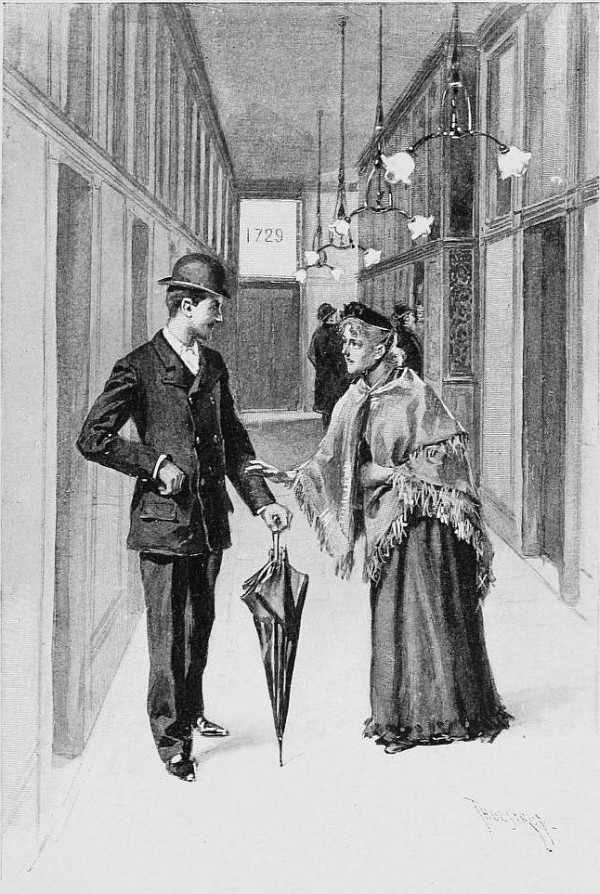
"Not that way," called Ogden after her, adding a benevolent postscript. "Here; come along down these stairs with me; I'll show you where it is."
She stumbled after him down the marble steps with a heavy-footed clatter that could hardly have been expected from her slightness, and with a timorous hold on the bronze of the hand-rail.
"There," indicated Ogden; "the sixth door along, on the right. 'Vesuvian Fire Insurance Co.' it says." And he himself continued an abstracted descent by the stairway.
His nearest way home lay through the court and out of the door that led into the asphalted alley. Just within the archway of this door two men stood. The one was Vibert and the other was a dark young fellow of twenty or more whom Ogden, by a brief glimmer of fancy, made to be Brainard's younger son. Vibert was in the act of receiving a roll of bills from him.
The youth had a pinched and slender aspect; there was a furtive tremulousness in his hands; his eyes were reddish and the pupils swam half hazily in a lucent humor.
"I didn't know, Mark, but what you'd gone back on me, too," Vibert was saying to him. "If you'd managed to get around a little sooner you'd have saved a certain party from the grand razoo." He smiled grimly. "It's pretty close sailing—thirty, forty, forty-five"—he ran over the bills, rolled them up, and thrust them into his pocket.
The boy looked at him with some doubt and with a shade of fear. He seemed to have been fascinated and then dominated by the bigness and the hardihood of the other.
"It's all right, Mark," Vibert presently went on with a dogged vagueness; "I'm his son, too. Why wouldn't he give me any show? Why wouldn't he let me have a chance to show him what I am? Why did he go and shut down on me at the very start?"
"You!" cried the boy. "What can you expect, after the way he's treated me—his own son? They're up there now, I dare say"—with a bitter glance towards the corner of the Underground—"but they can never make things right with me. If it hadn't been for Abbie—she's about the only one that's turned a hand for me."