HENRY B. FULLER (continued 3)
Reading edition
"Haven't I done well by you, too?—don't forget that. Well, you don't—'sh! I say you don't. Let the executors settle, and give 'em plenty to settle, too; they'll get enough for doing it." Vibert glanced up at the Underground windows. "He can't live forever." He brought his eyes back to the boy. "You've got to live yourself, though, and so have I. You've got some rights, haven't you?"
The boy did not accept this cue; perhaps he had already followed it more than once. He studied Vibert with eyes that seemed to indicate a change of thought.
"Say, Russ," he hinted, deprecatingly, "you're going to be a little more patient with Mayme?"
Vibert scowled. "Come, now, Marcus, that's all right; only don't let's have any preaching. What I like is a cheerful house—and an orderly one. Less sniffling and better meals. I guess you won't deny that, for a housekeeper, your sister is a good deal of a fizzle. She doesn't have to wash her own dishes, does she? And that girl I got her does the scrubbing and takes up the ashes, doesn't she? And we always take our dinners out, don't we? Well, then! I don't see what else we can do but go out altogether."
He drubbed his foot impatiently on the pavement.
"Well, so long!" he said carelessly to his companion. "Better not take anything more this afternoon. Do I see you on the track to-morrow?"
Ogden, of course, heard next to nothing of this talk, and his own preoccupations left him no opportunity to scandalize over the relations between Vibert and the young woman of the corridors, even if his inclinations had run that way. But it need not be denied that so close a grouping of these various persons turned his thoughts in the direction of the Brainard household, and his feet later in the direction of the Brainard house. He had lately been cultivating a more sympathetic apprehension of Abbie Brainard's position; it seemed possible that an hour's talk would offer opportunity for the delicate insinuation of his friendly interest. He rehearsed a number of suitable phrases; they took felicitous advantage of remarks on her side—remarks which he himself constructed—and left her, as she thought them over, in no doubt of his feeling sense of her position and of his desire to make his sympathies known and operative. That all these pretty paces would have been gone through in the absence of the Valentines is by no means certain; but their presence excluded the least attempt to try them, and it was with lagging feet indeed that he made his late return home to Brower and "Monte Cristo."
XII
Cornelia McNabb's campaign against the tenants of the Clifton proceeded apace. Such as pleased her fancy or promised advantage to her future she attacked one by one; she made quite a succession of engagements, dropping here and picking up there, until she reached the point where, for as many hours of the day as she chose, her time was occupied, and occupied to her taste. We have already seen her in the office of the Underground National, and we may now see her in the office of the Massachusetts Brass Company. She did good work within the limits she had set for herself; she was accurate and fairly rapid, and therefore was in considerable request.
"I'd a good deal rather work around like this," she expounded to Ogden, one day, "than put in all my time in one place. Lots more variety, to begin with, and lots more pay. 'Most every one gives me half as much as I could get in any single office; and then I can skip around and have more of a show. You can talk about your rolling stone; that's all bosh."
Cornelia was now doing a daily stint of an hour or so in the office of the Brass Company. This hour came in the middle of the forenoon, and the work was oftener performed under the severe eye of Mrs. Floyd than our young amanuensis could have wished. Mrs. Floyd's presence in the office had always been rather frequent, and her prejudice against female stenographers did not operate to make it any the less so. She bestowed considerable scrutiny on Cornelia, and Cornelia returned the interest in kind. She recognized in Mrs. Floyd one of the minor lights of "Society," and she became more deeply indebted to her for points in costume, speech, and behavior than either perhaps realized.
Mrs. Floyd was generally accompanied by Miss Wilde. This provided Cornelia with a double course of instruction: she learned what to do and what to avoid.
Miss Wilde was generally accompanied by her hand-bag, and that receptacle was capable of an endless yield of documents calculated to irritate and perplex her brother-in-law. Mrs. Floyd encouraged this. Who, indeed, should take an interest in the affairs of her own sister if not her own husband?
One morning Ann produced a memorandum that stunned him. As he studied it she stood above him like the spirit of Bankruptcy.
"For Heaven's sake, Walworth, tell me what it means. Am I a ruined woman, or what?"
Floyd glanced at the sum total; the figures mounted high. "They have struck you pretty hard, that's a fact."
It was a bill for special assessments levied on the possessions of Ann E. Wilde, in one of McDowell's subdivisions. Paving, so much; sewers and water-mains, so much; stone sidewalk, so much.
"And eighteen dollars and a half for a quarter of a lamp-post," wailed Ann. "Why, Walworth, I haven't got the money on hand for all this; I never anticipated such a thing."
"What's a quarter of a lamp-post good for?" asked her sister.
"I suppose the cost is levied on four property-owners," said her husband.
"And who's going to see by it when it's up?" asked the disconsolate investor. "Nobody ever goes past."
"Not this year, perhaps; but there'll be plenty next year. You've no idea how the town is spreading about. Why don't you step upstairs and see McDowell?"
"Who starts these things going?" asked Ann. "Who fixes the amounts?"
"I guess it's done sometimes on the petition of other owners about—according to the frontage."
"And who's the principal owner all about there?" demanded Ann. "Ain't it McDowell himself?"
"Well, I don't suppose he's sold off very much yet."
"And so he's taxing me to make his own property more valuable. I like that. I'm glad I went to him. And your young Ogden—I suppose I can thank him for this."
"Good gracious, Ann; McDowell is taxed, too. The town's growing, and all outlying property is subject to such things. And don't blame poor Ogden."
"What more can you expect, Ann, in such a half-baked place as this?" queried her sister.
"Go up and see McDowell," repeated Walworth. "He can tell you all about it—when it's payable, and how, and whether there's a rebate or anything." He passed the papers back to Ann with the definitive air that closes a matter. "Jessie didn't come with you, then?" he inquired, turning towards his wife.
"No, poor thing; she is away down this morning. Why, what do you think, Walworth? They've been asking her if she can't testify."
"Testify fiddlesticks! What could she say? They don't need her; they've got a clear enough case as it is."
"But think of her in court."
"Don't think of her in court. She may be a thousand miles away by the time the thing comes up. Has anything more been seen or heard of that interesting vocalist?"
"Nothing. He left the poor child all alone in that big place, with not three days' supplies and the—"
She looked sharply over towards Cornelia. The girl's hour was ended, but she had engaged in a pretence of tidying up the desk.
Ann creased her papers thoughtfully between her fingers. "I had no idea that curb-stones cost so much," she sighed. "If I had only sold out on that offer last month!"
Cornelia was now engaged in complicating her apron-strings. Her interest in the Underground people, while becoming no less professional, had become a good deal more personal. She would have given anything for a decent pretext to remain. It was hard indeed to tear herself away from this discussion of the affairs of Burton Brainard's sister.
"—and the gas turned off," Mrs. Floyd finished, as the door closed on the reluctant girl. "And that's the state Jessie found her in—everything just about as bad as it could be."
"Well, no," Floyd dissented, thoughtfully. "There's one important consolation—this suit could be brought."
"Oh, yes," answered his wife, quickly. "This Canadian woman doesn't claim to be his wife—only that she ought to be, and that he promised to make her so."
"Interesting family," murmured Walworth. "Should like to be related to 'em."
"She knew him in Toronto. She found him here before she had been in town a week."
"Small world," remarked Walworth, negligently. He played with his penholders.
Mrs. Floyd became silent. Gossip seemed out of the question with an indifferent husband and a preoccupied sister.
Vibert's detection by the girl he had betrayed and discarded, and his desertion of his young wife, were immediately followed by the proper steps on the part of Brainard's attorneys. The old man had received the intelligence of Vibert's double misdeed with a tremendous outburst of wrath and vituperation. His indignation revived in him all the crude violence of his youth; he drew out from the disused corners of his memory such a vocabulary and such turns of phrase as are possible only to one whose boyhood has been spent on the crass and barbaric frontier. He towered and swayed like a rank plant that has sprung rapidly from the earth and has brought up the slime and mould on its sheath and stalk. His prodigal and picturesque indecencies were heard but half understandingly by his son, and were lost, as to everything save their animus, on his advisers.
The equilibrium of the scales (whose mathematical poise he had once proven to his own satisfaction) was now destroyed; this outrage on his daughter and himself and all his belongings put another and a different face on the matter. The girl was received back into her father's house. It was the understanding that she was to remain there until the legal undoing of all this mischief had been accomplished, and that, afterwards, she must prepare herself for an indefinite exile among certain of her father's relatives still resident in Centralia.
During this interval Brainard allowed himself only the minimum of communication with his daughter; her mother's fluttering sympathies were too tenuous and too faded to furnish anything very definite or vivid in the way of consolation; her brother did not readily abandon himself to the softer feelings—particularly when work of so much sterner character was before them; and but for her sister this crushed and unfortunate child would have received but slender support and comfort. Abbie was not only sister, but mother and family circle too; she found a use for all the pent-up tenderness and domesticity of her nature.
The bill in the case of Vibert vs. Vibert was filed without receiving any undue attention from the press. Some exertions were taken, some influence was used, and the matter merely made a cold, official, numerical appearance in the legal columns of such of the dailies as affect complete court reports. The relations between Vibert and Jane Doane, however, made too good a "story" to be ignored in every quarter; some brief mention of it appeared in a new and struggling one-cent evening paper. The friends and well-wishers of the Brainards were surprised by the extent of that paper's circulation—a good many people appeared to have seen it.
The case of Vibert vs. Vibert had its place near the head of a short docket and was reached with much less than the usual delay. It was tried quietly and privately rather late one afternoon at a sitting which might have been termed either a prolongation of the regular session or a supplement to it. Perhaps only a legal mind could have distinguished; probably the legal mind that dominated the occasion did not attempt the distinction.
The matter was adjusted in a small and compact court-room.
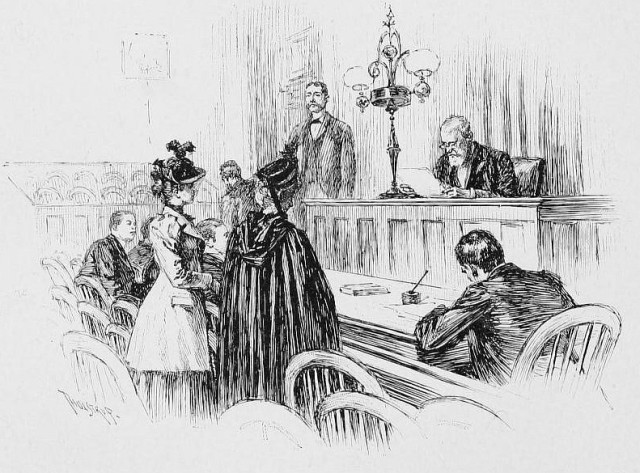
The matter was adjusted in a small and compact court-room high up in a certain vast and pillared pile—a room which differed little in size and not greatly in furnishings from an ordinary office. The court reporters and the crowd of court loungers had withdrawn; nobody remained behind save the clerk and a bailiff or two. Yet the spectre of publicity seemed hovering there; it hurled a flood of glaring light in through the high and curtainless windows, it shimmered on the staring yellow oak furnishings of bench and bar, and it searched out the darkest corner of the yawning jury-box. Abbie Brainard, standing beside her sister, peopled all this void with jargoning lawyers and callous constables and malicious witnesses and indifferent jurymen and sharp-witted reporters and trivial, time-killing spectators; and then she set her unveiled sister in that revolving witness-chair and brought to bear upon her the searching glare from the lofty windows and the more pitiless glare of the thousand-eyed crowd. She shuddered, and thanked Heaven—without going too deeply beneath the surface of things—that present conditions were so favorable.
For they involved none of the ordinary phenomena of a "trial." There was no wrangling, no eloquence, no auditory; there was no humiliation—beyond that which was inevitable. It was hardly more than a conference. The judge, with a quiet gravity, took a simple conversational tone—a keynote to which the indignation of Burt, the mortification of his sister, the sorrow of Jane Doane, and the juvenility of Freddy Pratt all came to be attuned. There was a simple recital of uncombated facts, the separation was decreed, and Mary Vibert was presently at liberty to resume her maiden name. It was considered best that she be known henceforth as Mrs. Mary Brainard. There was no report in the next day's papers, nor the next; on the third day things took a different turn.
One or two of the newspapers had sacrificed the Vibert-Doane story with considerable reluctance. They felt a certain degree of martyrdom, too, in withholding their hand from Brainard, who had been a standard subject of attack throughout the careers of all the younger writers. Nor were they at all sure that their position as guardians of the public morals justified any such suppression of the truth. They learned of the clandestine trial of the Vibert case, and that decided them. Their virtue was strengthened; the whole affair was reopened and thoroughly ventilated. The encroachments of wealth and privilege were held up before the alarmed eyes of the public; the entire episode, with everything leading up to it, was minutely rehearsed. A good many people were interviewed—a few who knew something of the circumstances, a good many who did not. Reportorial requisitions were also made on the bank and the house. Some persons contributed facts relating to the matter in hand; others, facts relating to matters whose connection was not so close; still others volunteered opinions on the method of procedure that made the trial noteworthy. "Vox Populi" and "Ruat Coelum" wrote letters "to the editor." Rough cuts from sketches and photographs made their appearance. The whole career of Brainard was reviewed with merciless detail, and the issue of one edition of a particular publication was attended with the shouting of his name through the streets. Certain sheets whose existence is unknown to the majority of reputable people and whose circulation is in accordance therewith, gave their clients a scare-head full of exclamation-points; and one pink publication, whose single connection with respectability is through the barber-shops, devoted its whole front page to the illustration of the case: the wronged girl claimed her surpliced betrayer at the altar-rail, while the equally wronged wife swooned in a front pew. There was an appropriate Gothic background, while one corner of the foreground—piquant touch of innocence—was filled in by an open-eyed choir-boy.
All these manifestations of public interest caused Ogden a keen personal distress that surprised him. He heard the names of Brainard and Vibert bawled in the streets. He became familiar, for the first time, with the salient points in Brainard's career. He heard himself referred to once or twice as a clerk in Brainard's bank. As he handled that pink sheet in the Clifton barber-shop while awaiting his turn, he half expected some acquaintance to brand him as a caller at Brainard's house. As he lay, lathered and defenceless, in his chair, he almost dreaded lest some pitiless friend might happen in and stamp him as a suitor for the hand of Brainard's daughter.... He paused and blushed under the barber's eye; he saw now the reason for his personal distress over these odious domestic entanglements. His surprise passed away, but it left behind it a distress greater still.
XIII
The appearance and deportment of young Frederick Pratt as a witness in the Vibert case offered several delicate shades whose noting and whose accounting for may justify a paragraph or two. His general effect, then, was in the highest degree sobered, chastened, depressed. To what was this to be attributed?
To his consciousness of the overshadowing majesty of the law? No; for the law had turned its softest and most silken side outward; the little party had taken up its informal grouping at the judge's elbow and had replied conversationally to the interrogations of the judge himself or to the prompting inquiries of Brainard's attorney. Justicia had appeared in her most sympathetic and domestic aspect.
Was the youth disappointed as to his performance of a beau rôle? There is no doubt that he had anticipated with some relish his first appearance in the witness-box. He would have been obliged, it is true, to confess himself a minor, and he might have been exposed to the humiliating necessity of declaring that he understood the nature of an oath; but after that all would have been smooth sailing. Only to be for full fifteen minutes the observed of all observers, to be able to lift up his voice and tell—all—he—knew! Yet to be balked in this called for exasperation rather than deep dejection, and deep dejection, after all, was what he chiefly showed.
Was this dejection the sign of sympathetic sorrow for the woes of his former friend and playmate? Not quite. His sympathy, while real enough, was largely the sprightly product of novelty, curiosity, and conscious self-importance; unentangled with other considerations, it would have shown itself in a nervous and volatile loquacity.
But Freddy in court was not loquacious; he gave his testimony after a benumbed and backward fashion that indicated other and deeper troubles. The boy, in fact, was under a cloud. An issue of some importance had arisen between the Underground National Bank and its youngest messenger; it involved no less a question than that of meum and tuum. Freddy Pratt, as messenger, had been in the habit of making two or three daily trips through the business district, during which the notes and acceptances that filled his big official wallet came to be exchanged for checks and greenbacks that represented corresponding values. One or two discrepancies had developed that called for attention.
The boy's father came down to the Underground to contribute his share of this attention. He was a grave, repressive, saturnine person, who might have been set down as possessed of far greater means to meet the requirements of a growing boy in the midst of a circle of well-to-do urban acquaintances than of inclination to study those requirements. He was received in Brainard's own private room, and the affairs of the penitent and sobbing boy were discussed over his head by his parent and his employer.
"You foolish child," said the elder Pratt to his son, in the self-conscious tone by which we address age through youth; "if you wanted anything, why didn't you ask me for it?"
This father, seriously handicapped as he was by his own temperament, was attempting to treat the matter as something rather slight and trivial. The pettiness of the amount involved, the perfect ease of restitution, the youth of the offender, the utter simplicity and primitiveness of his method—all these he touched upon with a feint of light-handed ease. Another might have blown an airy bubble like this, even in the face of Brainard's ominous and taciturn frown; but Pratt was not the man to do it. He soon left the upper air of informal jocularity for the firmer ground of argument and expostulation, and this ground, before he ended, was almost pressed by the knees of entreaty.
"It's plain enough," said Brainard, at length; "he took it, and he kept it."
Each one, from his own point of view, cast his eye on the culprit.
"But it can't be that you mean to ruin a boy's future in any such way as this?" snarled the boy's father with a rasping expostulation.
Brainard turned a look on him from under his overhanging brows.
"Um," he merely said, in a voice which might have meant anything.
But the affair presently came to adjustment—a treaty with several clauses. Brainard wished to use the boy in court; to dispose of the Vibert matter in the cursory fashion that he hoped to follow permitted scant margin for the plea of desertion, and he was depending on young Pratt for the recital of certain occurrences which, in a cumulative way, might have their bearings on the plea of cruelty. Pratt, Jr., was to testify in court, Pratt, Sr., was to reimburse the bank, and the boy's final dismissal from the Underground would then be timed in a way so disassociated from any particular cause as to excite no comment and to occasion no injury. But all this was scant and nominal payment for Brainard's clemency; a larger one followed.
Brainard owned a number of woe-begone tenements scattered here and there over that unattractive part of the West Side which is most affected by manufacturers of furniture. One of these tumble-down dwellings adjoined a large lot owned by Ingles—took out one corner, in fact, in such a way as to interfere seriously with its value for building purposes. Ingles, in treaty with a furniture firm for the putting up of a building, had made an offer for this corner. Brainard, informed as to the circumstances, had put a price on it that was excessive—exorbitant. Ingles had taken time for consideration; and at the very moment of Pratt's call a letter from him lay on Brainard's desk, to the effect that he was looking elsewhere; evidently, on principle, he was drawing off. Brainard had no use for the property, and it was hardly paying taxes. He wanted to sell it at his own figure, and he had expected to. Ingles's tactics nettled him; he solaced himself by a step that reached Ingles and Pratt at the same time. He sardonically raised his price a peg higher, and offered the property to Pratt with an intimation that refusal would not be entertained. He put his lot still further beyond the reach of Ingles's possible necessities, and he made it realize even more than Ingles had declined to pay. Pratt swallowed this mouthful with such grace as he could command; and with the celerity possible to a perfected system of land transfer when supplemented by the guarantee of a title company, Norval H. Pratt, in a day or two, became the owner, at an excessive price, of a piece of property for which he had no use, and for which, so far as he knew, no one else had any use either.
This transaction was at once noted by McDowell, whose study of the daily transfers as reported in the real-estate publications was minute, and whose attention had been fixed for some time on this particular piece of ground. He knew something of Ingles's intentions, through the people whom Ingles was endeavoring to accommodate, and he saw here the entering wedge that he had waited for so long. He had approached Brainard unsuccessfully; he now tried Pratt. Pratt, who figured himself justly enough as a lamb led to the shearing, made no effort to evade the rôle; he promptly made an agreement for the transfer of the Brainard lot to McDowell. He let it go at a decided sacrifice—he sold it at a possible shade under its actual value.
McDowell, whose eagerness had committed him to an out-and-out purchase, was now in a position to approach Ingles. He was willing to sell the ground for simply what it had cost him; his profits would come later, through that open door between 1262 and 1263. Ingles received him coldly. He had disposed, he said, of his holdings in that neighborhood, and was using the proceeds to build for his new tenants in another quarter. He bowed McDowell out with a faintly cynical contempt, and this enterprising person was left with an unpromising piece of ground on his hands to dispose of as best he might. He tried the new purchasers of Ingles's lot; his own was not necessary to their purposes.
McDowell was seriously embarrassed. This bit of ground was a trifle in itself—to Ingles or to Pratt it mattered little either way; but to McDowell, who was of a considerably smaller calibre, the thing came as a kind of last straw. In expectation of great activity in acres he had loaded himself down with outside property; everything of his own was invested in that way, everything that was his wife's, and something, to tell the truth, that was neither his nor his wife's. He was in up to his chin, and at this moment came Ogden, asking him in set terms for an accounting and a settlement.
McDowell met this demand with a promise of figures, and he renewed this promise several times. The intervals between gave opportunity for a slow insinuation of the truth—for a graduated confession that a considerable part of old Mr. Ogden's estate was tied up in the operations of his son-in-law. This confession was followed by his statement; but it was some time before the account opened at the Underground by George received any great enlargement through the agent of the administratrix.
"It's all right, though," McDowell said; "you don't need to worry, and there's no use in stirring things up. There's big money ahead, and you'll stand in."
But the statement was the ground, and a sufficient one, for a rupture. McDowell, in order to diminish his indebtedness to the estate, had charged it with various fees and percentages of his own, and with numerous items that properly concerned his individual and household expenses. He charged the estate with a new porch on the front of his own house, and with the full expense of railway travel which had been undertaken in great part for his own interests. He even made a hardy attempt to force the Brainard lot upon the indignant widow.
Mrs. Ogden immediately left his house, in spite of the good offices of her bewildered daughter. George himself, forecasting the future, beheld a long succession of wrangling days in the law-courts and in the offices of attorneys—days that threatened to surpass in worry, loss, expense, and nerve-wear anything that his family had experienced yet. He felt himself on the threshold of a struggle for which he was but scantily equipped, and in which he was certain to be seriously handicapped through consideration for Kittie.
Absorbed in these moody reflections, he was crossing the court of the Clifton on a Saturday afternoon when a pencil-tap on one of the great glass panes took his attention. The tap sounded on the court frontage of Darrell & Bradley's branch, and George started from his revery to see the face of Bradley himself looking out at him over the rulers, mucilage bottles, and memorandum-books that formed symmetrical piles within.
Bradley hastened to throw open the narrow glass door adjoining the show-window, and motioned George in with a friendly and quizzical grimace.
"Let Jones walk," he said, crinkling up his eyes and laying his fat hand on Ogdens shoulder.
"He is walking," responded George, with a wan smile.
Bradley drew him in and closed the door.
"Well, let him walk in a different path, then. Let him come out to Hinsdale to-morrow and try the primrose path."
"Of dalliance?" asked George, with a doleful attempt to meet half-way the cheery facetiousness of the other.
Well, I dont think a little dalliance would hurt him." Bradley made it seem quite absurd that a young fellow of twenty-five should have any real cares and annoyances. "All work and no playyou know."
"Im afraid so, admitted George, with a pathos that the elder man found amusing.
Bradley stepped back to a snug office that was was stowed away behind a tall piece of shelving piled with newly bound account-books, to pick up his hat. "I'm glad to have caught sight of you," he proceeded, with the friendliness of an elder brother; "I've just taken an hour or so to overhaul things here a little. If you're going north, I'll walk a block or two with you."
They passed out into the street and picked their way along through the splashing, slumping, and dripping that marks the spring break-up. They elbowed other pedestrians over miry flaggings, and they dodged the muddy spray that bumping trucks sent up from the street-car tracks at almost every crossing.
"My wife's wondering what has become of you," Bradley puffed out among many other things, as he tried to keep up with Ogden's supple and light-footed gait. "And Jessie, too. She's home to-morrow—just back from Evanston. You come out on the eleven fifty-five, and we'll have an early dinner, and that will leave enough of the afternoon to make things worth while. And we'll show you that spring is a little nearer at hand than you'd suspect in town. Your first spring here?"
"Yes."
"Pretty bad, ain't it?"
"Worse than Boston," said George, in a tone implying that nothing further could be added.
At the next corner Bradley paused, detaining him for a moment with a friendly hand.
"Sunday noon, then. You provide the dalliance and we'll see to the primroses. Care anything for 'em?"
"Oh, yes, indeed."
"Good thing; can't have chrysanthemums all the year round. Well, good-by. Jessie will drive down for you in the buggy."
"I'll be there," called Ogden, as they drifted apart in the thickening crowd.
He had reached the point where he felt it would be a relief to cut away from town and everything in it—the bustle, the uproar, the filth, the routine of the bank, the complications of the Brainards, the entanglements of the Ogdens. It was a simple thing to do—only so many miles of flimsy and shabby shanties and back views of sheds and stables; of grimy, cindered switch-yards, with the long flanks of freight-houses and interminable strings of loaded or empty cars; of dingy viaducts and groggy lamp-posts and dilapidated fences whose scanty remains called to remembrance lotions and tonics that had long passed their vogue; of groups of Sunday loungers before saloons, and gangs of unclassifiable foreigners picking up bits of coal along the tracks; of muddy crossings over roads whose bordering ditches were filled with flocks of geese; of wide prairies cut up by endless tracks, dotted with pools of water, and rustling with the dead grasses of last summer; then suburbs new and old—some in the fresh promise of sidewalks and trees and nothing else, others unkempt, shabby, gone to seed; then a high passage over a marshy plain, a range of low wooded hills, emancipation from the dubious body known as the Cook County Commissioners—and Hinsdale.
At the station Jessie Bradley sat drawn up in a buggy: she had her place in a small convention of phaetons, carryalls, and express-wagons. She tossed her head brightly and waved her whip.
"I could have walked as well as not," said Ogden, climbing in. "What's half a mile?"
"Three quarters—almost," she corrected. She gathered up the lines and secured the approved hold on the whip. "Unless you care to drive?" she suggested.
"Not particular," replied Ogden, leaning back easily. "Quite willing to be a passenger."
He took a look at her sidewise from behind. She wore a pert little flat-brimmed, flat-crowned hat, set straight on the top of her head; a stray lock of hair brushed across her ear in the breeze; she had a bunch of pale purple primroses at her throat.
"You may if you want to," she said, with a sudden turn in his direction. Her eyes snapped and sparkled.
"'Here we go,' she cried, 'Sunday or no Sunday, I hate to poke.'"
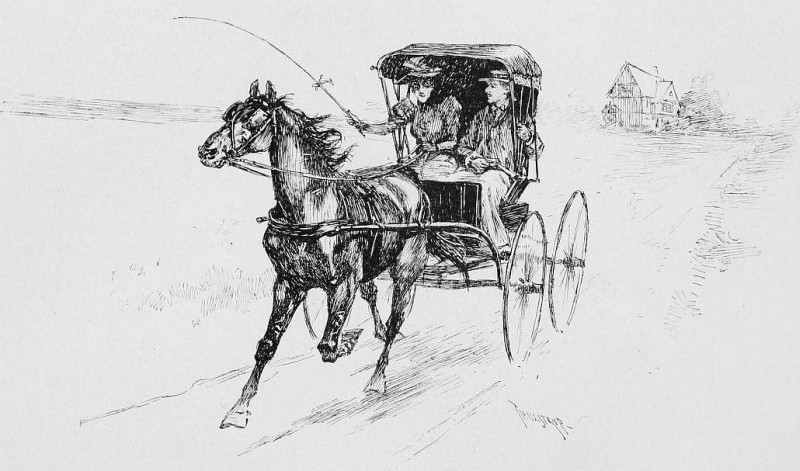
"I'd as soon see you—unless you don't care to."
"Oh, as far as that goes! Just hold on tight, though. Get up, John!"
She drew a taut rein and flicked the horse over the ear. He was a mettlesome five-year-old, and he rushed into his best gait at once. "Here we go!" she cried, "Sunday or no Sunday. I hate to poke."
She rushed him through the outskirts of the town; she bumped over the cumbrous plank crossings, she grazed one or two of the wooden posts that held up oil-lamps, she charged a flock on its homeward way from church and cut it into two frightened and indignant halves. She was on her native heath; she felt it; she showed it.
George grasped the buggy-cover with his left hand and held his right in readiness to seize the reins. The buggy, with many a bump and sudden wrench, sped on over the stones and ruts and puddles and rough crossings of an indifferent country road, and presently it turned into a yard with a rasping graze on one of the two painted white posts that made the entrance way. On the side porch of the house stood the girl's parents. They were laughing.
Jessie jumped out briskly. She struck a masculine attitude on the carriage-block, her right hand resting on the stock of her whip, her left arm a-kimbo.
"I was to get yer through on time; them was my orders, and here ye are!"
George climbed out carefully.
"Poor Horace!" chuckled Bradley, coming down; "he's here all right, but is he able to give his lecture?"
Mrs. Bradley followed, to shake hands. She wore a black silk dress, and there was a bit of lace over her thin hair—an adornment which her consciousness seemed to put forth as a modish novelty. Her wrinkles all flowed together in a companionable smile.
"He may have lost his voice on the way," she joked, "but we hope he saved his appetite."
"They're both all right," said George, laughing in turn.
Bradley was at the horse's head. "The voice is there, anyway," he said in cautious acknowledgment. "And we'll see about the appetite as soon as you've got enough spare breath to say 'Amen' to our grace." The Bradley house was a mere box of a building set in an acre lot. They had built for themselves, on finally breaking with the city, two years before; and they had accepted the gables and dormers and shingles and the brown and yellow paint that the modest suburban house of the period finds it so difficult to evade. They stood on high, rolling ground; there were half-hints of considerable vistas here and there, and they were surrounded by groves and copses through which, to-day, the first faint colors of the spring were hurtling. Bradley, after dinner, walked Ogden around the house—previous visits had been confined to the parlor. He dwelt on the swelling of the lilac buds, and he drew attention with an impartial interest to the first sproutings of his peonies and of his rhubarb. The back of the place was littered with the debris of a second green-house in an advanced stage of construction, and through this disorder he picked his way, along with his daughter and his guest, towards the door of the first.
"Hop in," said Bradley, lifting his own foot over the perpendicular threshold. The air within was but a few degrees warmer than the air without, yet closer. On either side stretched fragmental beds of young plants, with frequent breaks between. "It's late for prims, after all; and a good many of them are outside, anyway." He waved his hand over a few patches of color on the left; there were white, pink, cherry, pale purple, such as Jessie was wearing, and a few belated clumps of young and indeterminate green.
Ogden passed to and fro, with the oh's and ah's that accompany the exposition of any host's pet hobby, however partial and trifling the exhibit may be. He had done the same last autumn with the chrysanthemums.
Bradley took this tribute with the customary complacency, and presently drifted to one side for a word with his man about a small matter of glazing—he had quite an eye for broken panes. Ogden leaned against a damp ledge. Jessie had seated herself on one of the steps of a rude flower-stand; she brushed aside two or three small pots that had been left standing on it.
She showed an air of lassitude; it had been stealing over her all through dinner, and now it had completely overtaken her in the languid atmosphere of the flowers. Her slender arms hung limply, and she moved her back as if to find a comfortable rest for it. Her face, under the pallor of the painted glass, looked rather colorless and a little drawn, and a languorous apathy seemed to have taken the sparkle from her eyes.
She looked up at him as she dropped the petals of a primrose one by one. "You didn't care to drive, then?"
"Bid you want me to? I'm sorry not to have understood. You drove down, and so I thought—Was it too much for you, both ways?"
"Oh, no. It only struck me that you might want to. You were not—that is, you understand horses?"
"Certainly; I drive on occasion." He smiled serenely, not in the least disturbed by her perfectly obvious thought. "However, a wise man never goes out of his way to handle a strange horse—perhaps that isn't one of Solomon's proverbs, but it ought to be."
"You are awfully cautious." She rose undecidedly, and presently she sat down again with a little sigh.
"I have to be. That is my business—from half-past eight till four. Perhaps it's growing on me."
"I don't mean that. Ton were born cautions; you'd be cautions anyway."
"I'm a Down-easter, you know. Look before you leap. Perhaps I shall learn the off-hand Western ways in time. I'll try to. I'll make myself over."
"I wonder if you can," she said, half to herself. Then aloud:
"But I don't believe all Down-easters are as careful as you are. There must be lots of them who would have just laid the whip on that horse, and run over a boy or two, and knocked our gate-post to pieces, and come up to the door with a wheel just ready to break to flinders. Why couldn't you have done it? I shouldn't have minded it—I should have liked it first-rate." She spoke with a kind of lingering drawl, and there was a half-smile in her lack-lustre eye.
"Your father would have minded it, though, and so should I. Never begin to dance without arranging about the fiddler—good rule, don't you think?"
She threw a bare stem to the ground. "Oh, yes; but tiresome." She rose. "Close in here, isn't it? Let's go outside."
XIV
The sun that had given some warmth to the early hours of the afternoon was dimmed, later, by an overcasting of thin clouds, and the rest of the time was passed in-doors. George smoked a friendly cigar with Bradley in the dining-room, and after Mrs. Bradley had disappeared for a short nap he whiled away the remaining hours with Jessie in the parlor. They sat in two easy-chairs on opposite sides of the fireplace, in which a handful of coal was working against the last lingering chill of winter. The girl had partly recovered her earlier tone, and she chatted with him in a-string of smart jocularities with the manner which sometimes assures a doubtful caller that he has not made a mistake in coming and that he has not remained too long after coming. But between these uptilted strata of facetiousness there came now and then a layer of greater seriousness, and in one of these intervals she trenched on the domestic affairs of the Brainards.
"Poor Mayme went South the other day, didn't she? I hardly suppose you could call it a visit?" She looked at him soberly, with her eyebrows slightly raised.
George winced. "To visit her uncle's family," he answered. He half wondered why he reiterated her word and even emphasized it.
"Her sister was going to run down there with her."
"I heard so."
"You see Abbie occasionally?"
"Occasionally."
"I suppose she is at the bank a good deal?"
"Not often." He fixed his eye on the last Bickerings of the coals and lapsed into silence. It was not so easy now as once before to discuss Abbie Brainard with Jessie Bradley.
Mrs. Bradley came in brisk and refreshed about half an hour before train-time. The young people were chatting amusedly enough on indifferent subjects, and she urged Ogden to stay to tea with the clinging insistency of the suburban housekeeper.
"You can go home by moonlight; I've arranged it all for you." She drew aside a window curtain and showed him a pale white disk in a bluish sky.
"It's full, you see. We just have cold meat and tea and biscuits—I don't want to keep you under false pretences."
The moon kept faith with his hostess;—lighting him to the station and following him in to town and keeping him in sight through a mile of noisy and glaring streets. From the car-window, now and then, as the train passed back through a string of scattered suburbs and crossed the flat reaches of prairie-land between he was conscious of her bland insipidity; and as he traversed the down-town business district she raked the long parallels of the east-and-west streets with an undiscriminating indifference that a mind less preoccupied might have found irritating. It was all the same to that big, foolish face—town and country were one. It had its vacuous smile for trees and fields, and it had the same smile for the variant lights of the street-cars, for the clamorous cab-drivers around the depots, for the flaring jewelled guide-posts of the theatres, for the gaudy fronts of sample-rooms, for the cheap dishevelment of occasional strayed revellers, for the signs of chiropodists and the swinging shingles of justices of the peace, and for a certain meditative young man, whether he was traversing the rustic roads of Hinsdale or the sophisticated planks of the State Street Bridge. Ogden's thoughts flowed along with a quiet and grateful sense of the friendliness of the Bradleys, and with many a ripple, wave, and eddy to correspond with the changing moods of their daughter. He made a careful rehearsal of some of their bits of talk—why had she said this? what had she meant by that? why had she done the other? He dwelt on these matters with an absorbed speculation, and with a young man of Ogden's temperament speculation was but the first step on the way to love.
The spring trailed along slowly, with all its discomforts of latitude and locality, and then came the long, fresh evenings of early June, when domesticity brings out its rugs and druggets, and invites its friends and neighbors to sit with it on its front steps. The Brainards had these appendages to local housekeeping—lingering reminders of a quick growth from village to city. Theirs was a large rug made of two breadths of Brussels carpeting and surrounded on all four sides with a narrow border of pink and blue flowers on a moss-colored background. This rug covered the greater part of the long flight of lime-stone steps. In the beautiful coolness of these fresh June evenings Abbie frequently sat there on the topmost step, under the jig-saw lace-work of the balcony-like canopy over the front door, while her mother occupied a carpet camp-chair within the vestibule and languidly allowed the long twilight to overtake her neglected chess-board. They sat out, now, only after dark. Ogden called at intervals, and was not flattered that the poor girl brightened at his coming; it seemed as if she must brighten at the coming of almost anybody.
One evening he elected to tell off their long street on foot—the street whose ornamental lamp-posts and infrequent spindling elms had partly decided him in the selection of his first quarters. When within a few streets of the Brainard corner he passed a house (one of a long row) on whose front steps (as with its neighbors, right and left) were camped a large and merry party, whose exaggerated domesticity made it plain that they were all fellow-boarders. They occupied two rugs as well as two chairs and a foot-stool at the head of the steps. Through their light-minded hubbub came dominatingly a voice which Ogden recognized, and he threw up his head to meet the frank but overdone bow of Cornelia McNabb. Beside Cornelia sat a young man who bowed at the same time with a somewhat forced and conscious smile. It was Burton Brainard.
Cornelia had returned to the neighborhood of her early trials. She considered herself now on a distinctly fashionable street; she put "Washington Boulevard" on her cards, and thought her eight dollars a week was none too much. She had had a plate engraved and a hundred cards printed. She had not found it easy to dispose of many of them; sometimes she gave them in shops, when she was asked to what address the goods were to be sent.
"But just wait till I order my next plate!" she would say to herself.
"They sat out now only after dark."
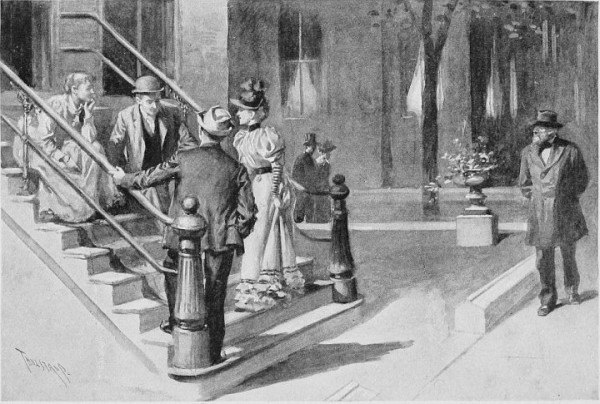
She had left one of her cards with Mrs. Gore. The poor, good soul (come in from her baking) was quite taken aback. Then Cornelia, conscious of too stiff an application of the social code, kissed her on coming away and made herself more intelligible.
"Yes," Abbie was saying to Ogden, a few minutes later, "Cornelia is a pretty smart girl. Father has come to be quite taken with her."
He noticed that she said—Cornelia.
"She takes down some of his letters, now, too," she continued. "I never learned," she added, in a tone of slight self-reproach.
"Good Peter!" exclaimed Ogden, with a protesting admiration, "you can do almost everything else!"
She waved aside this ardent apology, and looked rather shyly through the rusty iron-work of the hand-rail. The syringas were in blossom; the asphalt path had stopped its afternoon's running and had solidified since sundown.
"I think he likes her because she isn't afraid of him. Neither are you," she added, in a low tone, as if on an after-thought. She did not look his way.
Ogden appreciated this appreciation of his behavior. He had always been prompt and respectful with Brainard, but he had never knuckled down.
"He gives her letters almost every day. She corrects his mistakes."
"And he corrects hers?"
"He says she doesn't make many. When she does she sticks it out. She talks back. That's where she's bright. It kind of irritates him, I think, to have his—his clerks—his employés seem afraid. It pleases him, though, when other business men are."
This piece of filial analysis fell softly and slowly on the thickening darkness. The lamplighter was zigzagging across the wide roadway with his kerosene torch, and the voices of talkative neighbors on the other side of the street were brought over by the breeze along with the fumes of burning oil.
Ogden was pleased with this touch of gilding that the daughter's devotion applied to the father's clay. Perhaps the old man was not hopelessly beyond the reach of idealization's hand, after all.
Besides the people on other steps around, many clattered by over the asphalt pavement, and others promenaded slowly along the sidewalk. These moved in couples towards the Park, whose scant clumps of citified foliage appeared a few hundred yards away under the light of a waning moon and a half-bemisted sprinkling of stars; many of them issued from basement doors.
Presently another couple came sauntering along, and they paused at the foot of the Brainard steps. They were Burt and Cornelia. Cornelia came up and found a place on the rug that suited her, and greeted Mrs. Brainard in a familiar and masterful manner, before which the good woman soon boxed up her chessmen and retired. Cornelia then turned on Ogden.
"Stiff—or bashful?"
"H'm?"
"Why didn't you stop and say a word as you passed by?"
"Oh! Yes, bashful; too many people."
"Too bad about you!" She turned to Burton. He had seated himself on a lower step with his back to the others. His hat was on the back of his head and his chin was propped up by his knees and elbows. He was looking thoughtfully at the curbstone. "Come up and be sociable," she called.
Burt rose and ascended a step or two.
"Oh, how are you, Ogden?" he said rather absently. George felt that he should have said more, and said it sooner and said it differently.
Cornelia passed a cushion down to Burt. "There; take that and be comfortable." She regarded him studiously. It was dark, but he was all there—the short, thick, yellow moustache, the virile chin lately shaved and powdered, the dense hair that rose in a level line from the top of his forehead. Cornelia would have seen all these things in darkness that was Egyptian. She felt her fingers working towards them.
Cornelia was dressed with a trim and subdued modishness. She had taken a good many cues from Mrs. Floyd, and she had not been above cultivating an intimacy with a girl who worked for the excessively dear and fashionable house that dressed Mrs. Ingles. Mrs. Floyd had had no need to teach Cornelia anything about grammar, but she had shown her, all unconsciously, the advantage of a regulated use of slang.
Her fingers, debarred by the cold conventions of society from any entanglement in the head of hair just before her, smoothed and patted the folds in her own skirt. She further relieved herself by a high, sniffling toss of the head and a long, deep respiration.
"Well, isn't this a great night!" she said, addressing the little party generally. "Isn't the air splendid! I declare, I could just ramble about till morning. And yet I suppose your mother"—to Abbie—"has checkmated herself and gone to bed. Dear me, if there wasn't any city, and no clatter-clatter on that machine! Seems as if I must just make a break for the country before long—just get up home and hop into my little boat and paddle all around that whole blessed lake!"
"Why don't you?" asked Ogden. "Can't you give yourself a vacation?" He spoke a little wistfully; there was none ahead for him—no Underground man ever had an outing during his first year.
"I don't see hour. They say you can't serve two masters. Well, I've got five—four too many. At least," she tacked on, as if a closer calculation would further increase the number of these superfluities. "Can I go all over the building and tell each one of them that my services are going to be demanded exclusively for several days by some other one of them? Or shall I he sick—just for a day, at first, and keep adding days, one at a time, until I've had a week? I don't know what to do."
"Drop the whole business," said Burt brusquely, without turning about.
"And leave all my poor people in the lurch?" she cried, as if her employers were her most poignant concern.
"They can get somebody else."
"Oh, yes!" cried Cornelia, with mock humility; "I'm nobody; I can be easily replaced." She cast her humility aside lightly. "I'll tell you what I would do, though, if I was up at Pewaukee this eve. I'd paddle down to Lakeside and back—by the light of that moon." She pointed down the street towards the park foliage. "The moon that gilds those fruit-tree tops—Shakespeare. And it would be a good deal brighter up there than it is in this smoky old place."
"Can you row?" asked Ogden.
"Can I? I guess. Pair of oars made to order; and I can feather with 'em, too. Speaking of Lakeside, I know who's going to be there the last of this month; that Miss Bradley—Mrs. Floyd's niece."
"Cousin," corrected George.
"Is it? Cousin, then. She's a lively girl; she and I would make a pair. Only she don't look very strong."
"I thought," said he, "that she was going to Ocon—Ocon—"
Cornelia gave an encouraging ha, ha. "That's right! Take time and you'll get it. Mow, then; Ocono—"
"Ocono—"
"Mowoc."
"Mowoc."
"Oconomowoc; easy enough when you have it. Accent on second syllable. The only trouble is when you write it; you never know where to stop. Well, so she is going to Oconomowoc, later—to stay through July. They're only twelve miles apart."
"You know Miss Bradley, then?" Abbie asked Ogden. "She was over here once or twice, to see—Mayme. She seemed like a real nice girl."
Ogden bowed assent. He found himself as unwilling to discuss Jessie Bradley with Abbie Brainard as he had been to discuss Abbie Brainard with Jessie Bradley. Whenever he debated them it was a silent debate, in which he himself took both sides.
"She's a high-stepper," volunteered Cornelia, filling in Ogden's silence. "Good deal of style, too. Yet they say her father isn't so extra well off. She's a great contriver, I expect. Well, gumption goes a long ways; it's wriggled me off my back a good many times." She turned to Burt. "Now then, young man, do you want to walk me along to the park? Haven't we roosted about long enough?"
"All right," said he, getting up promptly. He seemed to be smiling appreciatively at her pertness.
"Ta!" cried Cornelia, dabbing her hand to Ogden and Abbie; and off she went. "Perhaps you'll see us later—if you're good!"
A big, bulky figure came stamping along the walk, and reached the foot of the steps just as Burt and Cornelia started off.
"I guess they'll be good," a heavy voice said. The voice was not greatly disguised by its assumption of unaccustomed jocularity, and George with a flush recognized it as Brainard's.
"Well, Abbie," he said, lumbering up the steps. And, "How are you, Ogden?" he said to George, as he passed on and seated himself with a loud grunt on his wife's chair.
George bit his lip; the old man had no business to misuse other people's pronouns in that way. Cornelia's "you" might have meant one person—if it meant more than one still it might have meant them separately; but Brainard's perverting "they" bracketed him and his companion in a fashion utterly unwarranted.
Brainard lingered a few moments above their heads. He made one or two clumsy attempts at facetiousness, and George surmised that this was his way of showing a friendliness. But his joking was much more painful than any hectoring could have been, and George was greatly relieved when he presently rose and retired unceremoniously into the house.
XV
After Brainard's withdrawal Abbie and Ogden sat for some time in silence. The moon sank; the clatter of hoofs on the asphalt sounded less frequently; some of the neighbors over the way had pulled in their rugs, and were now seen, by new-lighted gas-jets, at upper windows pulling down their shades. The breeze freshened; it rustled the lilacs and syringas in the side yard, and it swayed the stringy mass of wild cucumbers that had taken it upon themselves to hide the red hideousness of the barn.
Suddenly Ogden spoke.
"There! I knew I should forget it, and I have. I laid it on my bureau the last thing, too!"
"What?"
"Why—'A False Start.' You haven't wanted it, have you?"
"No; keep it if you like. I've read it."
She meant, "Keep it; please do. Keep it, for my sake."
"It's a pretty good book; didn't you think so?" he asked.
"Yes; I liked it ever so much. He married the right one, after all, didn't he?"
"Might have done it before," Ogden commented. "No earthly reason why not. Only you know how they spin these things out."
There was a sudden shutting down of windows over their heads. Ogden drew out his watch, and turned it so as to profit by the lamp-post on the corner. "Why, I'd no idea!" Burt and Cornelia had not returned from the park, or, if so, had passed on the other side of the street. "Good-night."
"It isn't late, is it?"
"Only for a North-sider."
"Good-night," she said, slowly, and sat alone on the steps until her father came down and called her in.
On the first of July Brainard summoned George into his own private room.
"We have about decided to have an assistant cashier here," he said. His voice was gruff, but his glance was a little sheepish. "Mr. Fairchild thinks it will be convenient about signatures and a good many other things. Burt's out a good deal and likely to be off all through August, and I don't like to have drafts signed in advance. You could make up the reports, too, and swear to 'em. Besides, it's elective—puts you in the Bankers' Almanac, for one thing. As to salary, I suppose we could stand an extra five hundred—or six."
He looked at George with some constraint, but his intention appeared to be friendly.
"We might expect you to go on helping with the tellers' work on occasion—vacation-time, for instance. Now, about your own vacation—"
George bowed with an additional acknowledgment of the favor; he had expected to pass an unbroken summer in town.
"Thursday's the Fourth. Put five or six days with it, if you like—to get accustomed to the new deal."
He turned to his desk. "That's all right; talk to Fairchild." It seemed that anything beyond the merest word of thanks would be distasteful, and George withdrew.
He accepted his elevation and his vacation with unfeigned pleasure; he attributed his advance to the old man's softened mood occasioned by his son's engagement to Cornelia McNabb. Burt, a few mornings back, had told his father, plainly and promptly, that it was his intention to marry Cornelia—and soon. He had prepared himself for remonstrance—even for opposition, and he had braced himself to demonstrate to his father that he was going to have his own way. The old man, however, made no difficulties; Cornelia had certain qualities that he appreciated, and he knew that Burt had a strong and a strengthening will. Besides, a son-in-law was one thing, and a daughter-in-law another. A daughter's husband must come as an ally, offensive and defensive; he must contribute money, and if not money, then abilities. There must he abilities in actual exercise, or there must be the certain promise of their development in the pursuit of some such career as would be recognized and endorsed by business men of his own sort. That ten-dollar-a-week man—that anthem singer! His fist clenched and his eye glared at the very thought of him. But a son's wife could be moulded—if not moulded, then coerced. There was to be no breaking away from two such wills as his and Burt's. He liked vim; he recognized snap; he was prepared to welcome Cornelia as a vital force.
"Oconomowoc," murmured George to himself. He was bending over his bureau drawer, sorting out his collars. The gas-flame reflected itself in the mirror and threw a doubled glare upon his face.
"Eh!" said Brower, sitting cross-legged on his trunk. He laid the book down across two of the top slats; it was "David Grieve"—he read everything.
They were still in the Bush Street house. Mrs. Ogden had a room on the floor below.
"Did I speak?" asked George.
"Ton said—Oconomowoc. Is that where you are going?"
"Queer name, isn't it? What's the place like?"
"If you've got a chance to go there, you go." The oracle spoke and retired into his book.
George went. The train made its rapid run up to Milwaukee, took its short stop, and turned westward on its way towards La Crosse. At Pewaukee there was the usual halt; it lengthened to an unusual halt. George paced the long platform impatiently; his mind had projected itself through Nagowicka and Nashotah and Okauchee to Oconomowoc, and his body was eager to follow.
"What's the trouble?" he asked the brakeman.
"St. Paul express late—passes us here."
The platform was swarming with passengers and townspeople. A figure rushed through the crowd and grasped George by the hand.
"So you're gallivanting, too? And I'll bet a nickel you've been aboard all the way up—parlor-car. Now, haven't you?" The voice sounded a trumpet-note of wide-flung triumph. It was Cornelia's.
Her cheeks blazed and her eyes burned with the magnificence of conscious conquest. Her glory spread about her the same succession of flowing circles that a stone spreads over a pond. It seemed as if her expansiveness must crowd the train from its track and the station from its foundations.
"Ma," she called back into the crowd, "come here—do! I want you to meet Mr. Ogden. He's one of my most particular friends; but I guess you don't need to be told that—you've heard enough about him. Mr. Ogden, this is my mother, and she's about the best mother that ever lived."
Mrs. McNabb smiled bravely and took Ogden's slender palm in her large, capable grasp. She wore a sedate black bonnet; her gray hair was parted in the middle and fell right and left in two wide, crinkly folds.
"And I want pa to come, too; no dodging." An elderly man came forward reluctantly, in his loose, short trousers and his thick boots with broad, square toes; he seemed to find Ogden, in his modified tourist guise, a disconcerting object. He lifted up his shrewd but retiring eyes, placing one embarrassed hand on his grizzled chin whiskers and giving George the other; it was rough, and the nails were broken.
George shook hands with the old fellow—who went well enough with other features of the Wisconsin landscape: the shaggy tamarack swamps, the gashed sides of gravelly "hog-backs," the long stretches of disordered barbed-wire fences, the rusty reds of depots and storehouses, and the marshy ponds, edged by the ragged scantlings of gigantic ice-houses.
Cornelia did not perceive this harmony—or ignored it.
"Yes," she declared, "ma's the best ma, and pa ain't far behind. Now don't shy, pa; Mr. Ogden is more scary than you are. He'd been trying for near three months to ask me to go to the theatre with him, when along came Burt and plumped out and asked me inside of a week. Burt's enterprising; no mistake."
The old people smiled at each other, half embarrassed by Cornelia's frankness.
"But we won't shut out George—oh, dear! I mean Mr. Ogden—altogether. Bear witness, both of you: I ask him to be one of my ushers." George stared. Was the girl meaning to be married in church after—everything? Then he bowed. "On Abbie's account—if at all," he thought.
"Going to Coonie for the Fourth, I suppose?" Cornelia continued.
"Coonie?"
"Oh, well—'Con'm'woc, if you must have it all. Well, we're on the move, too. Good-by. But"—meaningly—"you'd find us all again in town pretty soon; and if pa and ma don't see the whole place from the tip-top of the Clifton, my name is McMudd. On a clear day, too—when you can tell where the smoke ends and the land begins. Good-by. Our house is on the right, a mile farther; watch out for it."
Oconomowoc, from Ogden's point of view, appeared as one wide street running between two small lakes that were only a few hundred feet asunder. The business part of the street was built neatly and compactly of the cream-colored brick of Milwaukee, and the rest of it was a thickly shaded stretch bordered with a double string of summer cottages, which fronted on the street and backed on the water. In the midst of the cottages stood a big hotel of yellow brick; it was faced with a lofty row of seven immense white columns, and above the maples before it there rose a steep roof set with a series of dormer-windows. George was given a room which one of these dormers lighted, and presently stepped down the street to inquire at one of the cottages for Jessie Bradley. He soon stepped back again; she was not expected for two days yet. He thanked Brainard again for his full week, and threw himself into one of the chairs under the big colonnade.
The town was at the beginning of its annual patriotic flurry; after the Fourth it settles down, and the real season begins a week or two later. A good many young people were scurrying about, many of them in aquatic attire; those who did not carry rackets carried banjos. Nobody noticed him except the young wife of the proprietor. She stood in the doorway; her black eyebrows were contracted in a study of him. She wore her raven hair in a Japanesque fashion, but she corrected the plump dumpiness of the Japanese maiden by a tall and slender grace of her own. "He's all right," she said to herself, and sank down in a chair beside him.
"You poor, lonesome man," she began, with a graceful audacity that was her peculiar possession, "let me talk to you."
"Do," answered George, smilingly. He seemed to have known her a week.
"That is, if you're not just married or not just going to be. Are you?"
"N—no."
"We see so much of that sort of thing. May is dreadful; this year we had five couples in a week—it's so pleasant and quiet here then. The fifth was from Detroit; they stayed quite a while, and when they went away they thanked us all over. We hadn't done a thing for them—we simply left them alone and let them go about. But they were just chuck full of it—they'd have been in glory anywhere. What do you think of our columns?"
Two men could hardly have spanned their fluted shafts. George cast his eye up to their capitals, on a level with the third-story windows. "They're great."
"Aren't they? They've only been on two or three years. We call them the Seven Bridegrooms."
"The Seven Bridegrooms? Is each the gift of a happy man?"
"Hot quite; one happy man gave them all. He was here a week; he gave us one every day. Think how happy he must have been."
She smiled at his inquiring glance.
"He wanted things his own way, and could afford it," she said. "His name was Ingles."
Ogden did some lounging up and down the street. He crossed a bridge where one lake fell into the other over a mill-dam, and found himself in another cluster of cottages. They stood on a bluff and looked down the three miles of the lower lake. Both shores were diversified by promontories and islands, and the red roofs of other cottages showed everywhere over the tufted foliage of the shores.
"How it balances—how it composes!" he said of the view, as he recrossed the bridge. "And how it's kept!" he said of the town, as he retraced his steps to the hotel. "Really"—with unconscious patronage—"it's the only thing West, so far, that has tone and finish."
He took a boat. The next day, the same. The town was full, but was lying back quietly for the excitement of the morrow; he had the water almost to himself.
Sloops and cat-boats were being rigged for a coming regatta. A scow for fireworks was being anchored two or three hundred yards from shore. He paddled about with a trolling-line. But the line was neglected. He had a good deal to think about; here was place and time to do it.
His future was assured. He could now marry. He wanted to marry. There was only the question—which?
He had surrendered his primitive theory that marriage was a matter which concerned only the two principals. Kittie's marriage—who had come to be more deeply concerned in it than he?
He thought of Abbie Brainard, and he thought of her family—a divorced sister; a disreputable brother, whose future was to sound, perhaps, depths yet undreamed of; another brother, whose coming marriage was but conclusive evidence of the coarseness of the family grain.
And the father—his scandalous success; his tainted millions; his name a byword. Those bawlings in the streets; those disgraceful and degrading pictures; the stench of the whole scandal.
His oars dropped idly, and he sat with his eyes fixed on the bottom of the boat.
But the old man would die. Yes; and then would come the division of the spoil. If there had been so much trouble in a poor sixty or eighty thousand, how much more might there be in all these millions? If he had found such difficulty in getting restitution from McDowell—a restitution so incomplete as to be even yet largely in the future—what might there be to expect from other brothers-in-law and from other new relations that so much money would be sure to bring?
He ran his troubled eyes along the shore. A party of children were wading and splashing at the foot of a high, wooded point.
That money—those millions! It was the talk of the bank that Burt, on his wedding-day, was to have five hundred thousand dollars as an out-and-out gift. And if Burt, why not Abbie—in the proper degree? Those shameful, indecent millions—millions that it would be a disgrace to receive, to handle.
"Boat ahoy!" A sloop swept by. He dodged its bowsprit and was tossed by its wake. He threw out his oars to steady himself.
The husband of a rich wife—another Valentine. My house—my furniture!
Then, he had meant to get on—in business, in society. Was he to marry a recluse?—a girl inexperienced in the ways of his world—perhaps incapable of adapting herself to them—surely careless of them.
Abbie was before him in her tender and steadfast serenity, in her stanch and genuine capability. He set his teeth, and took up his oars again, and rowed half a mile with a furious vigor. He stopped, panting and exhausted, in a clump of reeds off a sedgy shore, near a group of linden-trees. He had left Abbie behind.
He sat with his eyes fixed on the bottom of the boat.
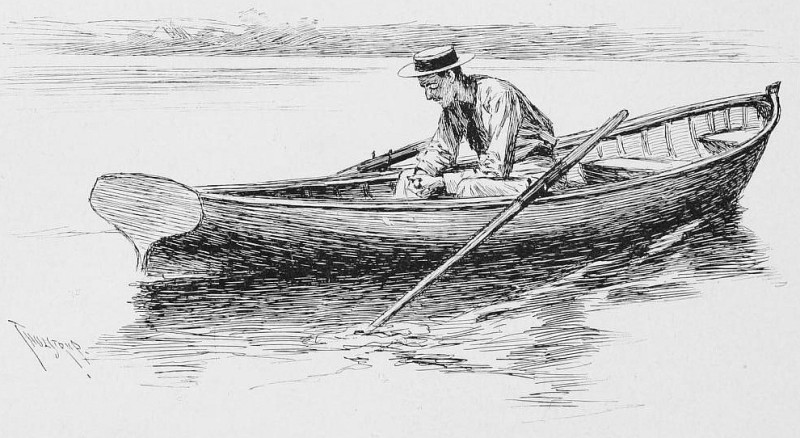
An elderly couple were standing among the rashes. They regarded him with a friendly and companionable smile. They seemed to offer him the "middling lot" that the sage and poet have called the best and safest. "No hazardous and complicated relationships," they seemed to say; "no struggle over dead men's dollars, no swamping of self-respect in ill-got gains; only our daughter—"
George pressed his forehead confusedly and raised his eyes to get his bearings; the late afternoon sun dazzled him with its level beams. He saw a house set high among the trees; and on its porch, amidst a tangle of bittersweet, a girl was standing. He shaded his eyes; it was as if she waved a handkerchief at him. Presently she strolled to the brow of the bank.
"Glad to see you," she called; "we have just driven over."
It was Jessie Bradley.
XVI
Cornelia McNabb became Mrs. Barton Brainard during the first week in August. Neither of the pair was inclined to wait, and neither had such a circle of friends as to make a midsummer wedding less preferable than a later one.
The wedding took place in church—as Cornelia had intimated to Ogden. She was not disposed to let false delicacy clog the heels of success, and she had her way. They were married in the daytime, as a partial concession to the social inexperience of one father and the social indifference of the other. The young men of the bank were drawn on freely; Ogden served as an usher—as Cornelia had requested. Adrian Valentine supported Burt at the chancel-rail, and gave some friendly counsel as to details at both church and house.
Cornelia's circle of girl-friends yielded nothing suitable in the way of bridesmaids; but there was the groom's sister—and one maiden attendant was enough. Abbie therefore took this part—for the first time. She walked up the long aisle with a bashful modesty. She had a dozen opportunities to meet Ogden's eye, but her embarrassed shyness prevented her from once looking into his face.
Mary Brainard was still in exile, and her mother was confined to her room by one of her nervous attacks; but in one of the back pews, in the twilight under the gallery, a dark, meagre, and dissolute-looking young man had taken his post. And as Burt, with a proud and prosperous smile, led Cornelia down the aisle, tears of indignant rage started from the eyes of his banned and mistreated brother.
The Brainard marriage was celebrated in print, just as the Brainard divorce had been. Some of the cuts that had illustrated the one were also used to illustrate the other.
Mr. and Mrs. Burton Brainard went to California and were absent a month. On their return they took up their quarters in the Brainard house, while Burt considered the question of building. Cornelia had made up her own mind where this building should be done.
They returned to town in accordance with the mandate conveyed by certain cards that had been sent out, directed by the serviceable Abbie, during their absence. These cards announced that "Mr. and Mrs. Burton Tillinghast Brainard" would be "at home" on the "Thursdays in September."
Cornelia had gloated over these cards on their arrival from the stationer's.
"Mrs. Burton Tillinghast Brainard," she read, with a vigorous hitch of her shoulder. "H'm! now we're ready to knock out your Smiths and your Joneses." She tossed her head. "And then bring on your Floyds and your Ingleses!"
Before going away she had wrung Ogden's hand, and had committed her parents to him during the concluding days of their stay. Especially was he enjoined to take them up to the top of the Clifton on the very first clear day. A clear day came; he conducted them up to the roof-observatory and showed them the city, and they numbered the towers thereof.
The old people tiptoed gingerly around the parapet, while Ogden waved his hand over the prospect—the mouth of the river with its elevators and its sprawling miles of railway track; the weakish blue of the lake, with the coming and going of schooners and propellers, and the "cribs" that stood on the faint horizon—"that's where our water comes from," George explained; the tower of the water-works itself and the dull and distant green of Lincoln Park; the towering bulk of other great sky-scrapers and the grimy spindling of a thousand surrounding chimneys; the lumber-laden brigs that were tugged slowly through the drawbridges, while long strings of drays and buggies and street-cars accumulated during the wait. "My! don't they look little!" cried Mrs. McNabb.
George smiled with all the gratified vanity of a native.
"And that," he said, pointing southward down the street, "is the Board of Trade."
"Where we was the other day," the old man reminded his wife. "And that gilt thing on the top of it is a ship, I swan. And wasn't they noisy, though. Well, now, Josephine, ain't it handsome?"
A simple soul found to admire the tower of the Board of Trade—let it be put on record.
George and McNabb had got on very well. The old countryman had felt rather frost-bitten on seeing George in full social regalia, but seeming to find him more human and approachable in a simple business suit, he had thawed out again. Mrs. McNabb had taken to him kindly from the start. Most women did, though he appeared never to have observed it. She joined with her husband in wreathing him in an atmosphere of simple friendliness.
The other father concerned in the festivities had also thawed towards George, though it would be a mistake to attribute simplicity to any friendliness shown by the head of the Underground. At one stage of the proceedings Erastus M. Brainard had laid his hand on Ogden's shoulder, and the young man had asked himself with distressful circumspection what it meant. It might have been to his advantage if he had found an answer.
George's engagement to Jessie Bradley was now an accomplished fact; the nail was driven—only a formal announcement was required to clinch it. He had preferred to withhold this until his affairs with McDowell were more accurately adjusted. Freeze & Freeze had put on a pretty positive pressure, and an arrangement had been contrived that had some of the externals, at least, of an adjustment.
McDowell's affairs had not been taking a very favorable turn; some of his ventures had been too rank for even gullibility itself, and his hope of relations with Ingles was now completely at an end. Ingles, in fact, had signified to him that an accounting for of the St. Asaph funds was desired by himself and the other contributing members of the former committee, that a remittance in accordance therewith was looked for, and that his resignation of the financial guidance of the choir would receive prompt consideration.
This communication might have been made by Ingles personally, or it might have been sent by his office-boy, or it might even (as a physical possibility) have been pushed in under the crack of the door between them. As a matter of fact, it came through the mail. So formal a transmission of so formidable a communication was conclusive; McDowell felt at once that all possibility of personal relations between himself and Ingles was at an end—that door in the wall between them was as good as bricked up.
"Burt led Cornelia down the aisle."
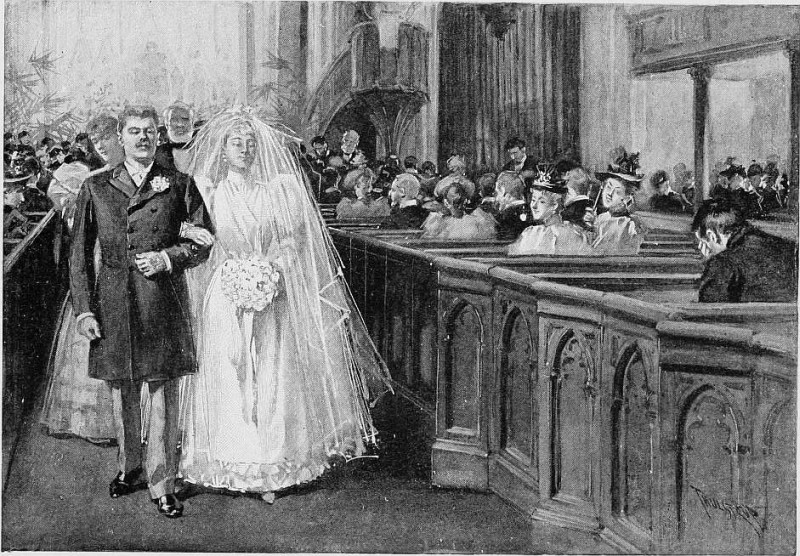
Kittie came around late one afternoon to see her mother. "Do you know, George," she said to her brother, "that Eugene is going to give up our pew at St. Asaph's? Can you imagine why?"
He had heard and read a good deal in his lifetime about the fine penetration of feminine intuition; he wondered why feminine intuition always failed when it came up for application to business matters. The pretty, high-held female heads that would droop in shame if they could come to learn the how and wherefore of their own costly bedeckings! Poor innocent Kittie—sitting there and twirling in unsuspecting surprise the sparkling novelties that encircled her fingers, and never caring or thinking about the means by which they had come to be there!
The principal instruments in McDowell's settlement with the Ogden estate were certain promissory notes and certain warranty deeds—warranty, after quit-claims had been refused; and Ogden found himself in possession of his brother-in-law's signature on several bits of paper which he hoped might realize their full value when the time came, and also of two or three largish tracts of suburban property in which the general public interest seemed rather diminishing than increasing. McDowell saved the best here, just as he had managed to secure the best of his father-in-law's estate for his wife. In the original division—fair, according to appraised values—his knowledge of tendencies of growth had put into his wife's third almost everything that was likely to show a quick increase in price. George took his notes and his lands, and the task of turning them into money; and he left to Kittie an unimpaired trust and confidence in her own husband.
The matter of a house shared his thoughts, along with the McDowell business—an October wedding, a week for a trip, and then the beginning of housekeeping on the first of November in a home of their own.
"You want to see Mrs. Cass," Floyd had told him; "she fixed us up when we first came out here."
"Who is she?"
"A clever little woman who makes a sort of specialty of North-side houses. She has got desk-room somewhere upstairs—sixteenth or seventeenth. She married badly—her husband doesn't do anything. She began by renting friends' houses to other friends, and has kept on until she has worked up quite a business. In such a big town as this has got to be you need to go to a specialist for almost everything. You might take in the whole lot of those big house-renting agencies and never get satisfied."
The office of the Massachusetts Brass Company was as much a social exchange as ever. Jessie frequently came down with Mrs. Floyd and Ann and Claudia, and George would sometimes step up to see her for a few minutes during his noonings. Mrs. Floyd looked upon the meetings indulgently enough, but Ann seemed to hold against Ogden a deeply-seated grudge.
She had been considerably embarrassed in the matter of her special assessments, and she had as much feeling against George as against McDowell himself. Her efforts to fortify and to recoup herself had led her into other fields of business, and she was now spending a good part of every forenoon in the neighborhood of the Board of Trade. Thus far she had not been so successful as to lessen the grudge.
The particular institution in which Ann was interested bore some external resemblance to its great prototype across the street. It was smaller and, if possible, uglier; but it, too, had its quadrangular arcade, its big square skylight, its ladies' gallery. In this gallery Ann sat daily for several hours, along with other women of a like turn of mind, and kept an eye on the proceedings generally. After a few sessions she became accustomed to the mere externals of the place—the endless shuffle of feet on the grimy floor, the sharp yawps of raw and eager voices, the flinging aloft of excited arms, the little tangles of noise and passion that were instantly woven around every new-comer with, an offer to buy or to sell. She looked over this choppy sea across to the promised land that was being portrayed on the opposite blackboard; the artist paced to and fro on a long, high, narrow platform, and worked in the uncertainty of a single drop-light. He frequently changed his mind, and his alterations usually had a deep and sometimes a discouraging effect upon Ann and her associates. Every now and then one would retire into the hallway and consult with her agent, and then there would be the rustle of greenbacks, and the agent would take the elevator down and presently be seen among the crowd of men on the floor. The agent was likely to be a gallant fellow, only too happy to be of service to a lady.
Ann was now a member of Floyd's household, in good and regular standing. She felt herself very much at home. What was her brother-in-law's was her sister's, and what was her sister's was hers. She was usually the first to unfold the morning paper; she pre-empted the bathroom with little regard to Walworth's established habits; and if the idea of some trifling delicacy occurred to her she would order it from the grocery, and after it had appeared on Walworth's table it appeared again in his bill. She did not stand on ceremony; she waived all stiff formality; cosily and frankly she was quite one of the family.
As such, she used Walworth's office quite freely, and in the same capacity she joined in the conferences which the Floyds were now beginning to hold with Atwater up under his great skylight in the roof. Atwater's little house for Claudia had given great satisfaction, and he was now about to do a larger one for Claudia's parents, who had begun to look upon their banishment to the West as a perpetual fact. Claudia's house had been delivered with its stairs, its windows, its red chimney, and its chandeliers—which last were composed by a pushing young draughtsman who was as anxious to make interest with Atwater as Atwater had perhaps been to make interest with Floyd.
Atwater was accustomed to people who didn't know their own minds, to people who knew their own minds too well, to people who had too many minds to really have any mind at all, and to people who had so much money that they didn't need to have any mind. He was impeccably suave and unruffled, but he had the immense advantage of being able to impress the unduly brusque and capricious and exasperating among his clients with the fact that they were dealing with a gentleman and an artist. He also put a good deal of "presence" into the rendering and the collecting of his accounts; there was no more disputing his charges than his taste.
He took equally, with his urbane imperturbability, the anxious carpings of Mrs. Floyd and the easy joking of her husband. Ann he quietly ignored, and Walworth thanked him; for his sister-in-law's interest in the new house was becoming oppressively personal. As for Claudia, he always saw that she had, out of his sample cabinet, all the bits of tiling and scraps of marqueterie that she needed; and if she fancied a promenade among the boards and trestles of his drawing-room, her whim was gratified. Ogden and Jessie, who sometimes came too, he welcomed pleasantly—the guests of the present were the clients of the future. Ogden admired his beautiful manners and his whitened hair; one day he amusedly recalled Jessie's determination to make her husband's hair like it.
He looked at Atwater, who was explaining his preliminary sketches to the Floyds and was trying to fix the general bearings of hall, stairway, and closets; his hair looked whiter still under the diffused glare from the skylight.
George turned to Jessie, with his hand on his own head, so smooth and shining brown.
"This is the hair you are to whiten," he said, and he lifted his eyebrows in a smile.
"I never saw such a boy!" she murmured in a repressed ecstasy. "Do you remember everything I have said?" No one was looking, and she placed her own hand on his other temple.
"Wouldn't powder do?" he asked lightly.
"Only for girls."
"Couldn't it be bleached?"
"Not and get that color."
"Must I suffer, then?"—with his hand still on his brow.
"I'm afraid that's the only way." She lowered his hand in her own, and gave it a tender pressure on its descent.
"Must it be lingering, or something sharp and sudden?"
She pressed his hand again, and looked affectionately into his eyes. "Both, perhaps."
"Will it be fear or anxiety or shame?"
"Wait and see."
Atwater rolled up his sketches and threw them into a drawer. Then he went to his cabinet and took out a few small strips and squares of encaustic tiling in yellow and gray.
"And now I wonder if our little Colleen wouldn't like to take some of these home to play with." He turned courteously to Mrs. Floyd, while his hand reached out for a sheet of brown paper.
"They're not too—too heavy?" she asked, cautiously. "Nor too easily broken?"
The child opened wide her brown eyes, in one of her sober little ecstasies. "Oh, plaze, mamma! Oh, lave me have them—do!"
Ogden turned to Jessie, mutely asking her to share his appreciation of this. But she did not seem, especially amused. He remembered, then, that to himself he had frequently called her treatment of Claudia "uneven." Sometimes the child entertained her, sometimes she annoyed her. Jessie seemed to regard her—and he felt now and then that she so regarded children generally—as a doll to be played with until weariness came, and then to be carelessly thrust away.
"Oh, let her have 'em," said Ann, with an air of authority.
"Very good of you, I'm sure," said Floyd to Atwater.
"Not at all; I'm sampled to death. There, my child." He gave her a neat little package. "I'm sure they'll understand you when you get to Paris!"
XVII
George Ogden and Jessie Bradley were married during the third week in October. The wedding took place at St. Asaph's, with the participation of a small section of the choir, and the Floyds opened their house for the reception that followed. Walworth even gave George a small lunch at his club.
For some weeks previous Ogden had watched for the right opportunity to make a formal announcement of his plans to the head of the bank and to ask for a week's leave. For nearly a month, now, Brainard had not looked at him, had not spoken to him; and when he entered the old man's office to make his request Brainard still refrained from looking at him, and in speaking to him was as curt as possible.
"We need all our men right here; you must give up any idea of going off."
"Blow hot, blow cold," thought George, and asked Jessie what she preferred to do under the circumstances.
She had planned a long and rapid and lavish tour, and the tears of disappointment started to her eyes.
"Go anyway," she cried.
"Go? Do you know what he is?" And "Do you know what business is?" he almost added.
She lapsed into a sullen silence.
"We could arrange the wedding for a Saturday," he suggested, "and spend Sunday in Wisconsin."
This proposition stuck in her throat, but presently she gulped it down. "Only don't call it a wedding-trip," she said tartly. "Well," she went on, "we'll settle that. We must, because the cards have got to be started out pretty soon—all those people who have entertained me have got to be remembered. There's some in Providence, and in Detroit, and in St. Paul. And don't let me forget those Louisville people that took me to Old Point."
They spent their Sunday in Oconomowoc, along with the Seven Bridegrooms. The day was wet and gloomy, and most of the time they sat in-doors over a grate-fire. Mists dulled the blazing red of the maples, and a thick fall of leaves was churned into the mud before the house by the wheels of farm wagons returning home from church. Only at sunset did the clouds clear away, and the full moon rose over one lake while the sun sank below the other.
George recalled this many times in afteryears.
They had taken a house in Walton Place for the year and a half from November first. The house had been vacant some little time, and the landlord made no account of an introductory fortnight.
Mrs. Bradley had come in from Hinsdale and had superintended most of the furnishing and fitting up. She saw the window-shades put into place and told the men where to set the refrigerator, and Jessie had looked on with the gay irresponsibility of a child who watches puppets being strung.
On their return from Wisconsin they found the house decorated almost throughout with chrysanthemums. The new green-house at Hinsdale had devoted the whole autumn to this specialty.
Jessie sank down into one of her big new easy-chairs. "Nothing to do but to be happy," she sighed, with a long and delicious expiration.
She had her days, but those dates were of course overridden by her intimates.
Among the first to call were the Floyds. Walworth came over with a pocketful of cigars—to christen the new wall-paper, he said.
"Have you got any closets?" was one of his questions.
"Plenty," replied George.
"Then I don't see but what you're all right—just as well off in a house that you rent as we are going to be in a house made to order. If ever I turn architect"—with a glance towards his wife—"I shall begin every house with a dozen closets and then pour in the various rooms around them. Four drawers in every one, and two rows of hooks. How stuff does accumulate!"
"Yes, the inside is rather nice," Jessie acknowledged; "but the outside might be improved. I have my own notion about the porch and the front door."
George turned to her, as if to ask what that notion might be.
Other friends followed—Brower among them.
He went about rather shyly, looking at the draperies and grilles and mirrors. In the semi-gloom of the dining-room he threw his arm over Ogden's shoulder and looked into his eye with a friendly and affectionate smile.
"I never expected you to do it," he said. "You have left me as lonesome as the deuce."
"Ho it? Why not?"
"Because you're so careful; you always think things out—regular old Puritan sage."
"Oh, well," began George, with the air proper to a launching out into a broad and easy generalization, "aren't we New England Puritans the cream of the Anglo-Saxon race? And why does the Anglo-Saxon race rule the globe except because the individual Anglo-Saxon can rule himself?"
"Oh, I know," said Brower, discontentedly; "that's all right, up to a certain point."
Others came, among them the Valentines.
"And how do you like your new house?" asked Mrs. Valentine, effusively. She addressed Jessie exclusively; with her everything went in the female line. "We are new converts too, you know—just over from the West Side. We are very much pleased, aren't we, Adrian?"
Her husband gave his corroborative little bow. "We were being left rather aside, over there," he admitted. "And take the South Side, for that matter. Business is walking right over them, and the whole section is in a state of mild panic from the Courts to Oakwood Boulevard. Yes, we're safe and quiet, and settled to stay." Still others came, among them Cornelia Tillinghast Brainard. She called frequently, she usually brought her husband with her, and she never failed to walk him all around the Ogdens' neighborhood. Her favorite time was Sunday afternoon; then she took him along the Lake Shore Drive and through all the adjacent streets, with the full benefit of daylight.
Cornelia now had command over a good seven hundred thousand dollars, and she was arming for the social fray. She meant to bang her shield against the shields of other amazons. The gladiator must come to the arena, and the centre of the arena seemed to be somewhere near the water-works tower. If Burton was going to put seventy or eighty thousand dollars into a house, the site of it must not be too far away from this point.
"I expect I shall cut a pretty wide swath," Cornelia acknowledged to herself.
Jessie had her receptions through November; her intimates appeared at these as well, and so did many of her more formal acquaintances.
On one of these occasions George, having left the bank early, after a light day, hurried home, dressed himself, and hastened down to the parlor. Its contracted space was beflowered and belighted, and quite a little throng of ladies were circulating and chatting there. Mrs. Floyd and Miss Wilde were among them; so were Mrs. Ogden and Kittie; so were Mrs. Valentine and Mrs. Atwater.