HENRY B. FULLER (continued 4)
Reading edition
His wife hurried up to him; her cheeks were flushed and her large eyes burned brightly.
"If you had only been three minutes sooner! She has just gone. She was telling me why she hadn't been able to come to the wedding. I wanted you to meet her so much."
"Who is this?"
"Cecilia Ingles."
"There is such a person, then?"
"Why, George, what do you mean? Of course there is, and she was just as nice to me as she could be."
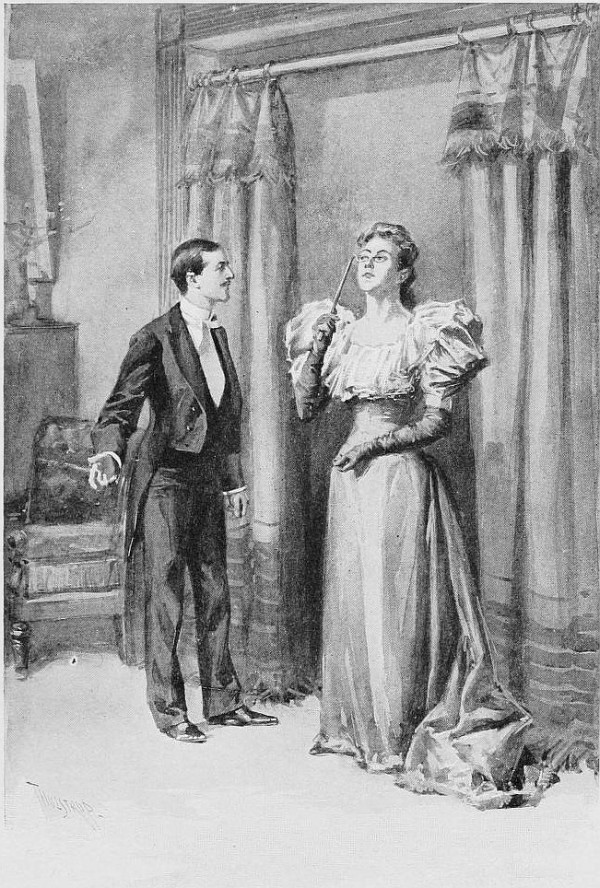
"'How well it's done!' she said to him."
"Why shouldn't she have been? I see you call her Cecilia. Are you as intimate as that?"
"Everybody calls her Cecilia. See, Mrs. Atwater is trying to catch your eye."
A tall and rather stately woman of thirty-five was standing in the doorway; she seemed finished—in profile, figure, and carriage. "How well it's done," she said to him; "who is the presiding genius?"
"My wife's mother, I fancy." He turned and drew her attention to the rustling of Mrs. Bradley's black silk.
"Ah!" she said indifferently, and turned away.
He had been unable to apprehend the simple costliness of his questioner's dress, and he only half wondered how, in a dozen quiet words, she had conveyed the impression of an expert addressing a beginner; but he could not refrain from asking himself if there was a slight here on Mrs. Bradley. He looked at the old lady again. She was moving about with the greatest show of confidence and good-will. No thought of anything called "differences" had entered her head. She did not believe that anybody would want to slight her or that anybody could. She had come on the ground in the early days of simple friendliness, and perhaps she was too old to apprehend that anything different had developed in the meanwhile. She certainly seemed to need no defence, and George was assuredly in no position to offer any.
"Cecilia has gone off and left me," Mrs. Atwater resumed; "careless girl!" They were half-sisters, and Mrs. Atwater was several years the elder. The Atwaters and the Ingleses ran as a kind of four-in-hand. The rich sister had married a poor man, and the poor sister had married a rich man, and they all went along at the same pace. It was a somewhat rapid pace. "I'm going to see what Mrs. Floyd can do for me; I dare say she has a spare seat."
His wife caught at Mrs. Atwater and bade her adieu with effusion. Did Jessie regard it as a feat and a triumph to have secured her presence? So it seemed to Jessie's husband.
The last of these little receptions was disposed of, and the honeymoon drew to its close. Quiet succeeded this introductory flurry to married life, and George now took occasion to lay a steady hand upon the throbbings of the "pocket-nerve."
His apprehension of any suffering in this part of his financial anatomy was, indeed, largely anticipatory; it was not that the nerve had been roughly touched, but that it soon might be. He had no tendency towards a retrospective study of the journal-and-ledger aspects of his courtship. He had been spared the expense of the wedding-journey that Jessie had planned by the unaccountable countable veto of Brainard. And the remuneration of St. Asaph's choir and kindred matters had fallen to his wife's father to arrange. But, all the same, many small indications arose to make it worth while for him to remember that he was a young man on a moderate salary and that most of his available means were badly tied up.
He noticed that his wife was developing a disdain of the public conveyances; a carriage was sometimes required of afternoons, and invariably of evenings when dances or theatre-going might be the matter in hand. She was also cultivating her taste for flowers; she had employed them rather lavishly at her receptions (in conjunction with her mandolin-players), and her appreciation of them kept equal pace with the advancing coldness of the weather and their own advancing cost. She also betrayed a ravenous taste for the exasperating superfluities of house-furnishing, and his bills for things needful were attended by a train of little accounts for things quite worse than useless.
"Oh, well, we shall be fitted out pretty soon," he sighed; and he saw his studious face reflected from among the cluttered bibelots of his mantelpiece.
The point of completion as regarded the interior was finally reached, and his wife's intentions as to the exterior presently developed. She accompanied him out into the vestibule one morning, and stood at the head of the steps to bid him good-by.
"These doors are awfully shabby and old-fashioned," she declared. "Don't you suppose the landlord would put in new ones?"
"I'm quite sure he wouldn't. I wouldn't in his place."
"Well, we have taken this house for a year and a half, and are likely to take it again for a year or two longer. Why couldn't we fix things up ourselves? The entrance counts more, really, than anything else."
"That might be thought about."
"Yes, indeed. If Mary Munson is coming to see me, I want things as nice as they have everything."
Mary Munson was of the Louisville family that had entertained Jessie Bradley at Old Point Comfort. It presently transpired that she was under like obligations to many other acquaintances of her girlhood.
"I must pay them up," she explained. "Besides, I need company—all alone here during the day, and mamma away off there in the country."
The succession of Mary Munsons lasted, indeed, through into spring. Blowers, carriages, and matinee-tickets doubled up finely, and the hideous mien of the caterer was seen in connection with frequent lunches.
"I spoke to Mr. Atwater to-day about the front of the house," she said to him one evening towards the close of dinner. "Maggie didn't quite get around to pudding to-day," she went on, as the dessert came in, "so I sent out for this ice-cream. Take some of these lady-fingers with it."
"To Atwater?"
"Yes. Frances wanted me to go up with her and see the drawings for the front of their house. It's going to be lovely. He had some special little drawings for the outside doors, and things like that. He's got beautiful taste."
"I know he has."
"I asked him to design some doors for us."
"You did?"
"Yes. He said he had a new idea that he'd like to try."
"You must get your landlord to pass on that. He might not like the new idea."
"Think not?"
"He might object. It would all come on his hands in the end."
"We'd better go on with it, don't you think?"
"But don't let it be anything too unusual or too elaborate." Architects, he understood, generally charged a commission on the cost of the work; so much per cent.—five, he had heard. "We don't want to go in too deep."
They left the table and sauntered slowly into the parlor—the drawing-room, Jessie called it. The standing lamp sent out a broad glare from under its shade of crinkled yellow paper, and the floor of the room burned with a dull and unaccustomed red—the red of a handsome Turkish rug.
"Ah, what's this?" exclaimed George.
"I picked it up to-day," she said; "it was so pretty and just the thing for this room. Cecilia called it a great bargain—she knows all about rugs."
"Then you have been shopping with Mrs. Ingles?"
"Well, she was getting a few things. She said that sixty dollars was little enough for it."
"Sixty dollars! Did you pay for it?"
"I had it charged."
"Charged?"
"Yes; wasn't that right? Why, George, even poor mamma, away out there in Hinsdale, has her account at Field's."
XVIII
The drawings for the embellishment of the house on Walton Place were undertaken by Atwater, and their scope broadened under the artist's hands. George, at his wife's request, took the elevator one noon and went up to the roof to see them.
In Atwater's absence he was received by the head draughtsman. The scheme had widened, as such schemes will; there were suggestions for the porch and for new hand—rails. There was also a drawing for a cornice in harmony.
"Urn," said George, thoughtfully. "This is all very handsome."
At about the same time that work on the Ogden house began, the work on the plans for the Floyd house received a check. This check was due to the first Western trip of Winthrop C. Floyd, treasurer of the Massachusetts Brass Company. He came on a general visit of inspection.
The morning after his arrival he sat in the office of the Chicago branch; he had come down with Mrs. Floyd and Claudia. His keen and quiet eye ran over the furnishings of the place. He was a bachelor of forty; he was dressed simply but elegantly—he was completely comme il faut, except for his muddy shoes, which seemed to trouble him.
"Well, Walworth," he said, with the manner of an elder brother and of an official whose dictum had weight, "you are pretty well fixed up out here—better than the home office, in fact."
"Have to be," returned the other. "Down East everybody knows the company; you could do business in a coal-shed if you wanted to. Here it's different. People don't know us from a hole in the ground; they go by what they see."
"Do you use all these calls and things?"
The wall was set with electrical devices for calling boys from everywhere for everything.
"Sometimes. Anyway it looks as if we did, and that helps business."
Little Claudia came creeping up to his desk.
"When are you going to begin, papa? I've come down to see you do it."
"Do what, my dear?"
"Make money. You said you did it here. When are you going to begin?"
Winthrop swung his chair towards the window and looked out at the driving rain and at the crowds of vehicles and passengers in the filthy streets below.
"Yes," he said, under his breath; "when are you going to begin?" Then aloud, "What a beastly hole! Is there no government here?"
"Precious little for a million and a half of people, and precious bad what there is."
"A million and a half? Nonsense!"
"Why nonsense? There's the census, and there's the regular annual increase."
Winthrop favored his brother with a stare of frank curiosity. Walworth had spoken with some warmth; he seemed disposed to throw an undue ardor into his defence of his adopted home—a city where quality seemed to count for less than quantity, and where the "prominent" citizen made the "eminent" citizen a superfluity. Then, too, Winthrop coupled with the earnest lines in his brother's forehead a slightly dingy necktie under his brother's chin. He observed, moreover, in the polishing of the shoe which Walworth, for greater emphasis, was beating on the carpet, a neglect of the heel in favor of the toe. And there were several other indications of a growing carelessness in dress.
"Well, Walworth," he remarked, "you are getting acclimated, I guess."
"Not to this sort of thing. Yes, there's a million and a half of us here, and this little quarter of a square mile is probably the most crowded and the most active of any on the globe, and yet it isn't found worth while to keep it clean, or even decent, small as it is. On days like this you feel as if you just wanted to remove the inhabitants and annex the whole place to the Stock-yards."
Mrs. Floyd paused in the adjustment of her bedraggled skirts and looked up fiercely.
"Why remove the inhabitants?" she inquired.
"Frances!" called her husband.
"Why, indeed?" asked Winthrop. "I never saw such a beastly rabble in my life."
"Nor I," she cried. All her smouldering resentment against the town broke out with the appearance of a new Eastern ally.
"Except in Madrid or Naples." Winthrop had travelled in his younger days; he never made these European comparisons except under extreme provocation.
"Why are things so horrible in this country?" demanded Mrs. Floyd, plaintively.
"Because there's no standard of manners—no resident country gentry to provide it. Our own rank country folks have never had such a check, and this horrible rout of foreign peasantry has just escaped from it. What little culture we have in the country generally we find principally in a few large cities, and they have become so large that the small element that works for a bettering is completely swamped."
He looked almost pityingly on his brother. "This is no town for a gentleman," he felt obliged to acknowledge. "What an awful thing," he admitted further, "to have only one life to live, and to be obliged to live it in such a place as this!"
But pity was not an important factor in Winthrop's Western mission. The Chicago office was costing too much and earning too little. There was to be a general reduction and scaling-down; the most important part of Winthrop's baggage was the pruning-knife.
He remained a week. He used the knife pretty thoroughly. He snipped Atwater's plans for Walworth's house into very small pieces. He left Walworth in a great state of depression—a depression deeper than any he had felt since his failure in coffee and spices.
His last evening in Chicago he spent in Walworth's library. It was a sober little room, and Walworth was the soberest man in it. His wife made only an occasional emergence from her unquiet silence; she no longer looked on Winthrop as an ally. The Fairchilds were there, and the Ogdens dropped in during the course of the evening. Fairchild and Winthrop did most of the talking.
Winthrop's sensibilities had now lost their keenest edge; the weather had improved, and the general aspect of things was a little less disgusting. He listened to Fairchild with the cautious reserve of a maturity that was accustomed to meet elderly strangers. He acknowledged, too, that the city was a big fact, and perhaps a more complicated fact than, he had imagined.
"You have seen the foundations," Fairchild said to him. The old gentleman lay back in his chair and spoke in a quiet and dispassionate tone. "It has taken fifty years to put them in, but the work is finally done and well done. And now we are beginning to build on these foundations. We might have put up our building first and then put in the underpinning afterwards. That is a common way, but ours will be found to have its advantages."
"I dare say," admitted Winthrop; "but you have made an awful muss doing it."
"Well," rejoined Fairchild, "you may look at the external aspect of things, which is distressing enough, I acknowledge, or you may consider the people themselves, who are perhaps the real essential."
"Winthrop finds them rather distressing too." It was Walworth who spoke; his voice came in a muffled tone from the darkest comer of the room.
"What have we done to him?" demanded Jessie Ogden, quickly. "Haven't we received him well?"
Winthrop had no ground for individual complaint, and he hastened to make this clear. Personally, he had been made a great deal of. He was rather a large figure at home, and he naturally grew larger still the farther he travelled West.
"I don't think it can be denied," pursued Fairchild, tranquilly, "that new-comers are pretty well received here, whether they come to stay or to pass on or to go back. All that a man has to do, in order to insure good treatment, is to put a certain valuation on himself. That done, the more he claims, the more he receives; we take him at his own figure. The more I think of it, the more I am astonished at so much humility among people who have accomplished such great results. Commercially, we feel our own footing; socially, we are rather abashed by the pretensions that any new arrival chooses to make. We are a little afraid of him, and, to tell the truth, we are a little afraid of each other."
"H'm," said Winthrop, rather grimly; "Boston goes farther than that. Some of our great lights are almost afraid of themselves."
"I've noticed," remarked Mrs. Floyd, "that there is a good deal of watching and waiting for cues—people of plain origin who are beginning to take upon themselves the forms of social organization." She spoke like a princess of the blood-royal.
"That is the point," said Fairchild. "Individually, we may be of a rather humble grade of atoms, but we are crystallizing into a compound that is going to exercise a tremendous force. To him that hath eyes this crystallization, this organization, is the great thing to note just now."
"I acknowledge to have seen the ferment of activity, as they call it," said Winthrop.
"You may have seen the boiling of the kettle," returned Fairchild, "but you have hardly seen the force that feeds the flame. The big buildings are all well enough, and the big crowds in the streets, and the reports of the banks and railways and the Board of Trade. But there is something, now, beyond and behind all that."
"Let me tell Winthrop," broke in Mrs. Floyd. "Since I can't take him to our club, I must bring the club to him. At our last meeting"—there was a sub-acid relish in all this—"it developed that the present intellectual situation in Chicago is precisely that of Florence in the days of the-the—"
"Medici," suggested Ogden.
"Yes, the Medici," said Ann Wilde, loudly. She looked at him with a sharp aversion; he seemed to be taking part in her sister's joke. "That's just exactly what my paper said; the Florence of the Medici after the dispersal of the Greek scholars from Constantinople by the Turks."
"Oh, murder!" said Walworth to himself; "what will Ann rig up next?"
"The Florentines of that day," pursued his sister-in-law, "didn't know so very much, perhaps, but they were bound to learn, and that was the main thing. And it's just so here."
"Quite right," said Fairchild; "we know what there is to learn, and we are determined to master it. Our Constantinoples are Berlin and London and the rest—yes, Boston, too; and all their learned exiles are flocking here to instruct us."
"And the books that are coming in!" cried Jessie Ogden. She was no great reader, and she spoke less as a student than as a Chicagoan—that is, she spoke more ardently than any student could have spoken. "Does the enemy know that four of the biggest buildings in this big city are built of books?"
"The new libraries," her husband explained—"the ones that are going to make us the literary centre."
"Dear me," said Winthrop, "are you expecting that?"
"And we expect to be the financial centre, and presently the political centre, too—Chicago, plus New York and Washington."
"And where is Boston?"
"A little behind," said Fairchild. "New York is the main-mast yet; Chicago ranks as foremast—at present; while Boston is—"
"The mizzen-mast," completed Ogden.
"And we Chicago folks stand at the bow," chimed in his wife, "and sniff the first freshness of the breeze."
"Yes," said Winthrop, in satirical assent; "the 'Windy City.'"
"Don't abuse our wind," cried Mrs. Floyd; "we should all die like flies without it."
"That's so," assented her husband. "The wind is our only scavenger."
"I see," said Winthrop. "If you can only be big you don't mind being dirty."
Then, half in amusement, half in amaze, he concentrated his attention on the banker. "Can it be that there are really any such expectations here as these?" He addressed Fairchild exclusively—the oldest and most sedate of the circle.
"Why not?" returned Fairchild. "Does it seem unreasonable that the State which produced the two greatest figures of the greatest epoch in our history, and which has done most within the last ten years to check alien excesses and un-American ideas, should also be the State to give the country the final blend of the American character and its ultimate metropolis?"
"And you personally—is this your own belief?"
Fairchild leaned back his fine old head on the padded top of his chair and looked at his questioner with the kind of pity that has a faint tinge of weariness. His wife sat beside him silent, but with her hand on his, and when he answered she pressed it meaningly; for to the Chicagoan—even the middle-aged female Chicagoan—the name of the town, in its formal, ceremonial use, has a power that no other word in the language quite possesses. It is a shibboleth, as regards its pronunciation; it is a trumpet-call, as regards its effect. It has all the electrifying and unifying power of a college yell.
"Chicago is Chicago," he said. "It is the belief of all of us. It is inevitable; nothing can stop us now."
But Winthrop Floyd was glad to withdraw himself on the morrow from his temporary enlistment—or drafting—under the vociferous banner of the Western capital. He did all in his power, as well, to oppose its manifest destiny by transmitting to Walworth, immediately after his return to Boston, a full corporate confirmation of his own anathema against Walworth's office and house. The Chicago representative of the Massachusetts Brass Company was recommended to secure less expensive quarters at the earliest opportunity, and was directed to drop his architectural scheme forthwith.
Walworth at once adjusted matters with Atwater. The architect received his "reconsideration" with composure, but he was doubtless nettled to be balked in a work in which he had taken unusual personal interest, and he was also disappointed merely to be paid for his plans when he had looked for the fees that follow construction. These considerations may have had their influence on the account which he rendered a month later to the Ogdens—friends and relatives of the Floyds, and introduced, too, by them. This account was handed in much more promptly than is generally the case with an accredited client in other professions—the legal or the medical, let us say—and its final footing caused Ogden considerable consternation.
The account was mailed to the house instead of to the bank, and the stationery employed was such as to suggest a personal matter between gentlemen rather than a purely business matter between architect and client; and Ogden opened it under his wife's eyes to learn that design had cost him more than construction.
"Your drawings are more of an item than your porch itself," he said, rather faintly. "I shall have to step up there and see about it."
XIX
Late one afternoon Ogden drew down his desk-top, put on his street-coat, felt in his pocket to be sure that Atwater's tasteful memorandum was still there, and took the elevator up to the eighteenth floor. He had been as conscious of that memorandum all through the day as he would have been of a mustard-plaster. On taking it out and recreasing its immaculate folds he almost felt as if he were about to dispute a debt of honor.
Atwater was in, but he was completely taken up in radiating his careful affability upon some promising clients who wanted not only doors but the house that went with them. Ogden got no closer to him than to secure the attention of the clerk whose duty it was to mediate between the contractors and the plans they were to follow.
He was an alert, nervous young man, with a big shock of unruly hair and a pair of large, luminous eyes behind his hooked and shimmering spectacles. He ran his long, lean, inky fingers through his hair, and transferred his wide eyes from the memorandum to the man who had brought it in.
"No," he said presently; "it's all right—there's no mistake. Mr. Atwater took a good deal of interest in this work. He sketched out some of the drawings himself, to start with, and he even touched up a few of them to finish with."
"Touched up a few of them to finish with?" George repeated, inquiringly.
"Yes; he don't do that often. When he does, it makes a difference; it ought to."
The whole matter was coming to assume the aspect of a personal favor; it was a debt of honor, after all. The grocer, the upholsterer, and the rest of them might wait; it would give them time to learn the value of an elegant "presence" and the compelling force of personal acquaintance.
The doors, hung and paid for, swung open many times during the following winter and spring, to admit people whom, as his wife assured him, it was an advantage to know. He became conscious that she was actuated by motives quite different from his, and that she had a standard quite at variance from any that he himself would have set up. She strained for people that he would not have turned his hand for. Most of these had familiar names, and it sometimes seemed to him as if many of them had had their place in the social yearnings of Cornelia McNabb. Certainly, his wife's attitude was quite different from that of the Floyds, who had been disposed to pooh-pooh quietly almost everybody, and also from that of her own parents, who simply accepted the circle that chance and association had formed for them, and met everybody on the same dead level of good-will.
During Lent his wife arranged a small musicale; another Mary Munson had arrived—this time from Cincinnati. The names of the performers included only those of amateurs of the better sort—since she knew that good professional services were quite beyond her reach; yet chairs, awning, and refreshments called for the expense of outside supervision. The morning before it she put a slip of paper into his hands.
"You are going right past the Tribune. Won't you just leave this with them?"
It was an announcement of her musicale. It included a list of names—not those of the performers, but those of the listeners.
"All old friends—in print," her husband commented. "What do you care for these people? Why don't you ask the Fairchilds?—they're quiet, but they're nice; and they like music. Why don't you have your father and mother? I haven't seen either of them for a month."
His wife writhed delicately in protest. Her winter had increased her paleness. The blue veins were bluer in her temples; her large eyes looked larger yet, and there were faint circles under them.
"Well, Cecilia doesn't fancy Mrs. Fairchild very much, in the first place—"
George bit his lip. By the curious workings of chance he had never yet seen Cecilia Ingles, but he no longer joked about her non-actuality. She appeared to be looming up as the great power in his household.
"—and besides," she proceeded, "who would recognize their names if they saw them in print?"
George stood like a looker-on at a transformation-scene, before whose eyes the gauze veils are lifted one by one in slow succession.
"Oh, then," he said, and less in jest than in earnest, "there is no use in enjoying ourselves unless we put it in the papers, and no use of putting it in the papers unless we can give a list of names, and no—"
"Now, George!" She flushed with vexation.
"—and no use of putting in a list of names unless they are names that will be generally recognized. Well, that does cut out the Fairchilds, and your poor mother, too. And mine." He looked at her narrowly.
"Now, George," she cried again, "how can you be so disagreeable? You know papa and mamma wouldn't care anything for this; nor your mother, either. And it isn't the only thing I'm ever going to have. I can ask her yet, though, if you want me to."
"Oh, fiddlesticks! Only don't lose your head. Here; give me that precious notice. Perhaps, before long, people who are after names will be just as anxious to get yours."
"You silly boy!" she cried, striking him lightly across the shoulder. But she was pleased and gratified by this, and she was not able to conceal it.
Following Lent there was the usual social aftermath. For Mrs. George Milward Ogden the major stress of the season was over, but she gave a few luncheons, and she went to a good many others. These little functions sent dozens of ladies tripping through the raw winds and the slushy streets of spring. The lake, weltering under the gray skies of March, dashed its vicious sprays high over the sea-wall, and sent its cruel blasts gashingly through the streets that ended on its confines. And at such signals asthma and bronchitis and pneumonia dug their clutching fingers into the throats and lungs of thousands of tender sufferers.
Jessie's supplementary doings were of too informal a nature to demand the entrance of outside help, but at the same time they were of a kind to lay the maximum strain upon the small and simply organized household which was all that her husband was as yet able to maintain. About every so often the domestic tension overtook the breaking-point. An interregnum would follow, and then a change of dynasty. The blame for these economic hitches George was obliged to distribute with an even hand. He acknowledged frankly the mere muddishness of most of the peasant material that oozed in and out of his kitchen; but he was also obliged to recognize the utter tactlessness of his wife and the folly of her unguarded exhibitions of conscious superiority. She had never before been able to issue directions to two servants, and she had never acquired the practical experience necessary for the control of even one. She referred to her servants in their own hearing as servants; and this did not seem to her as inconsiderate from the point of humanity or unwise as a mere matter of policy.
The burden of this fell principally upon her husband. He was obliged now and then to temporize with an indignant cook to secure a dinner for the evening; on one occasion he employed all his finesse to effect without scandal the removal of a frantic chamber-maid; and he became more familiarly known to the intelligence offices than he had ever expected to be. His wife was manifestly incapable of keeping a house, and he was committed to housekeeping for a year to come.
March passed and April came. One evening they sat together in their little parlor. The weather outside was raw and rainy, and not all of its chill could be kept out by the grate-fire over which Jessie was cowering and shivering. She wore a fleecy wrap on which her thin fingers took a sinuous clutch, and she was nursing a cold whose sniffling discomfort seemed passing into an obstinate cough. She was running over the newspaper carelessly.
"I see Mayme Brainard's 'mother has just died," she said presently. "'On the eighth of April, at her residence'—and all that—'Abigail Brainard, aged fifty-six years.' Wasn't she any older than that? Well, I suppose not. No great change for her, is it?"
"What did she die of?"
"Oh, it was her lungs. It's a wonder that anybody lives through these springs. I can't think why we ever got so close to the lake as this. I don't feel sure of getting through another winter here myself."
She leaned forward to stir the fire, and then lay back, coughing.
"I suppose they'll let Mayme come home, now—for the funeral, anyway. I wonder if shell bring the baby; he swears he won't see it. Cornelia says it's a pretty little thing—Abbie was down there a month ago."
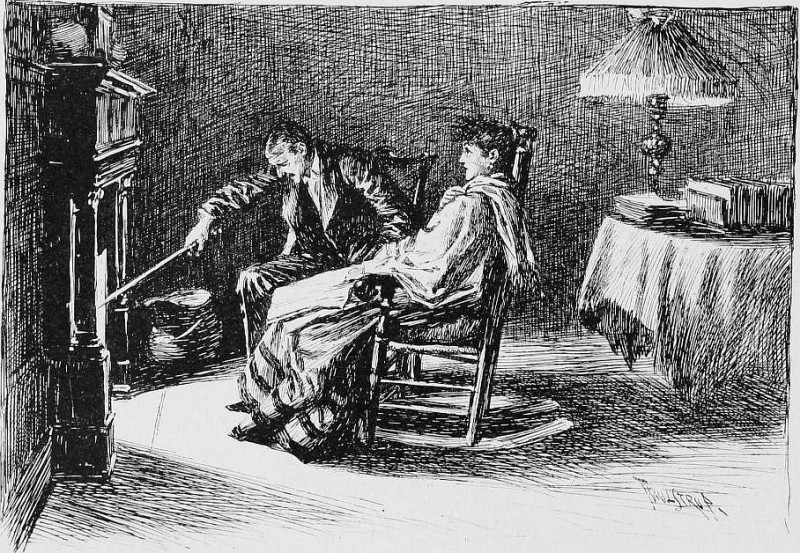
George stared at the fire thoughtfully, and reached mechanically for the poker.
"I don't know how they will feel, now, about staying in that house," she went on. "Cornelia wants to move the whole family over here, but Abbie won't listen to her. I don't know whether she likes her own part of town, but she seems to have taken a strong dislike to this. Anyway, she has never come near me, for all you helped them at her brother's wedding. Cornelia appears to think everything of her, though, and I guess she likes Cornelia quite a little. Funny, isn't it, that those two—Goodness, George, don't knock the fire all to pieces. Here; let me have it."
She took the poker from him.
"Dear me, what a miserable flue!" She looked at him discontentedly, as she settled back wearily in her big chair. "And we've really got this house on our hands for a whole year more?" She seemed to feel in this one year the weight of eternity.
"That's what the lease says," he responded, soberly. "What do you say?" his eyes seemed to ask.
She spoke her thoughts presently and at some length. She proposed giving up the house on the first of May. Was it a passing caprice or a serious desire? he wondered.
"'Goodness, George, don't knock the fire all to pieces.'"
"Shall you take your porch and your doors with you?" he asked, with a sorry smile. "They cost enough to be worth considering."
"No," she answered, with the simple literalness that builds a stone wall in a moment. "We shouldn't need them in an apartment-house."
"That's the idea, is it?"
"Yes, it strikes me that that would be the best thing all around—an apartment-house, with a cafe or something. Lots of nice people live that way now. Look at Cecilia Ingles's cousin; she is invited everywhere, and she entertains just the same as if she was in her own house. It's too hard work for me to run things like this, and I've just got to get farther away from this miserable lake."
"There's all the furniture."
"We could use some of it."
"And store the rest?"
"Yes—or auction it."
"Small profit in either. What are you going to do with the lease? Store it, or auction it, or use it for furnishing?"
Her lip quivered sensitively. "Why, I supposed—"
"Yes, we can sublet the house—if anybody is found to take it. There was something of a wait before we took it. There might be another."
"There's that Mrs. Cass—"
"I don't know how much she could do in three weeks—a good many people are fixed by this time. Two weeks sooner would have made some difference. I couldn't very well afford to carry the house all through the summer. There's a bottom to our pocket-book, and we are getting to it faster than you think."
This was a figure of speech that called for no direct response. For—
"Well," she went on, "that's my idea: a flat, with our meals. This would give me my chance to get away for a part of the summer—I'm sure I need it."
"Away for a part of the summer?"
"Yes. Mary Munson was saying something about my going to the White Mountains with her in July. They would do me good. Though perhaps the sea-shore might be better; plenty of those Down-east people are indebted to me now."
Another of those gauze veils was lifting. Married life was but a prolongation of girlhood, with all its associations and peregrinations. Where did the husband come in?
They left the house on the first of May. George recognized by this time the essential slightness and incapacity of his wife, and renounced the possibility of a home in any but a modified sense. Part of their goods were sacrificed at auction, part were stored at a rate that would have provided a home for a working-man's family, a few pieces were utilized in filling up a partly furnished flat, and the deserted house remained vacant through the summer. It was not until October that its ornate front and its tasteful decorations caught the eye of the right man, and by October a complication of interests had made a vacant house the very least of Ogden's concerns.
The place came under the consideration of the Floyds as soon as the intentions of the Ogdens became known. A decided change had come over Walworth's affairs; a less expensive house than his present one now seemed a great advantage. But his own lease ran for a year more; besides, his wife had too high an idea of their position and its dues to think of succeeding the young Ogdens in such a tenancy. The Floyds, as a matter of fact, were sinking to bed-rock-a foothold whose reality they had never tested yet; and there need be no wonder that the beginning of their downward course was marked by a slow reluctance. Walworth endeavored to make good the shortages occasioned through his brother's clippings by intrusting Ann with commissions on his behalf upon the Open Board—affairs in which she was no more successful for him than for herself; while his wife, for the first time, made some efforts in a society for which she had always had a shade of careless contempt.
The Ogdens established themselves anew in a large building where they had four or five, small rooms, and where they could breakfast and dine with a few hundred persons of like requirements and like situation. George now began renewed efforts to turn to account the property for which he had received deeds from McDowell. His halfyear of married life had put him in an awkward and straitened position, and the usual activity in real property that comes with the spring was something of which the utmost advantage must be taken.
He placed some of his outside acres with one or two good houses, but this entire side of business seemed pervaded by apathy.
"It's going to be an off-year," he was told. "Acres are down, and it looks as if they were going to stay so—for some time, anyway. We'll take this, though, and do what we can. You pay this year's taxes, of course?"
So much for the real estate. McDowell's notes, which he had made to run for a longer term than pleased anybody but himself, showed the due and prompt endorsement of interest payments; and if there was anything else in the general situation to call for gratulation Ogden failed to discover it.
XX
Jessie Ogden's supposition with regard to Mary Brainard was justified by events; the poor exile was allowed to come back to town to attend her mother's funeral, and, thanks to a providential escort, she was enabled to bring her child with her. The two arrived under the charge of a distant relative by marriage of the Centralia Brainards, who was understood to be on the point of visiting the city anyway, for the purpose of "buying goods." He was presented by the name of Briggs.
He was a somewhat uncouth and slovenly man of thirty-five—a fair specimen of the type evolved by the small towns of southern Illinois. But he had a bright and capable way with him, and it seemed likely enough that if he were to transfer himself and his business to Chicago, as he once spoke of doing, he might work himself up into pretty fair shape. He was a widower.
He showed some fitting sense of the solemnity of the occasion that had brought him to the house; but it was fair to surmise from various tokens that his usual treatment of the subdued young mother was in the line of familiar kindness, which only genuine solicitude kept apart from semi-jocularity—a jocularity that had almost the effect of an understanding. He seemed to have about the same understanding with the baby; he had held it part of the time on the train, and he had shown a willingness to be useful in the same direction subsequently.
Brainard saw the child once. He looked at the boy's dark hair and eyes and vented a dreadful oath, and signified that while he and his mother were in the house the infant must be kept out of sight and out of sound.
Abbie Brainard made no effort towards further mediation between her father and her sister. The present status was endurable, and there was little to be gained by additional appeal to the irascible old man; it was irascibility rather than sorrow which now possessed him. Nothing irritated him more than an address to the deeper emotions, and the passing of his life-long partner was an address of this character. And this irascibility had risen to a pitch of fury on account of the unfortunate resemblance of Mary Vibert's child to its father.
Abbie was still leading her old life in her old way. She had her reading, her accounts, her church-work; but she went at these with less energy than she had shown a year ago. She had lost something in flesh and something in spirits, but nothing was slighted. She had no confidants and she made no moan.
"What is the matter with her?" Cornelia would now and then ask herself. "If she would only rip out and say something; but I never saw a girl who was so mum. I'll get her out of this place, though, if anybody can. She has got to come up there and live with me. I'll fetch that, if I have to pull her up by the roots."
And then, putting generalization in the place of any tangible particulars, "I believe she's just starving"—which was not altogether wrong.
Cornelia found no specific grounds for approaching her father-in-law about Abbie, but she had some words with him about Abbie's sister.
She went to him one evening in his den; it was the day after the funeral. The distant wailing of the baby's voice had caused him to shut the door of his little room with a profane slam.
"Mr. Briggs is right there in the parlor," she said to him boldly, "waiting for her to come down; I don't see that it's going to help things any to slam doors. If he don't mind the baby, I guess we don't have to."
He turned upon her fiercely and half rose from his chair. It seemed for a moment as if he was intending to put her out of the room.
But she stood her ground and stared him full in the face. She was the only one in the family who, when the real pinch came, could look him down. He fell back in his seat and fixed an uncertain eye upon the panels of the door.
"There's such a thing as sense at such places as this, if you'd only know it," she went on. She spoke out loudly; she knew that if she used a moderate voice her tones would tremble. "I should think we might hold in for the day or so that the man's here. He knows why she was sent off down there, and that's bad enough; but it's worse for him to bring her up here and have her treated bad right before his face. Why can't you speak to her at table? Why can't you have—"
"That will do, Cornelia." He beat on the arm of his chair with his doubled-up fist. "We won't have anything more of this sort of thing. That will do."
But there was a kind of harsh grin on his face; he either admired her pluck or anticipated her point. She saw this and knew that she held him in her hand.
"No, it won't do, Cornelia—not yet. Why do you think he is here? Do you suppose a man goes travelling around the country with a woman and a three months' old baby for the fun of it? And he hasn't come up to 'buy goods'—don't you believe it. This is a great chance for Mayme, everything considered. He's a smart fellow, and you don't want to go and spoil it all. This is a thing that will take care of itself, if you'll only give it a show."
He stared at her—still rather forbiddingly. But she saw admiration appearing through indignation, and she judged that it was gaining the upper hand.
"Now," she said, with her own hand on the door-knob, "when you ask May me to-morrow morning if she would like another piece of steak, I want you to look at her; seems to me this is a time when a family should act like a family. And I guess it wouldn't hurt you much to put yourself out far enough to ask that man to smoke a cigar with you. You try. And I think this door had better stay the way I leave it."
She passed out, leaving the door open. And open it remained.
In such fashion as this came Mary Brainard to her mother's burial. But her younger brother came not, and no one knew where he was or what he might be doing.
Briggs left for Centralia on the following evening, his charges remaining behind, by an inconclusive arrangement that might terminate in almost any way. Cornelia, who attended his departure with a lively interest, noticed that Abbie, in her hat and cloak, was trying to take advantage of this same occurrence to steal out of the house. She followed her through the vestibule and overtook her half way down the steps.
"Abbie!" she called after her, "where are you going?"
"'Sh!" Abbie said, softly. "I'm just going out for a few minutes."
"Neighbors?"
"No, not exactly," the girl hesitated. "I'm just going a block or two."
"You don't want to be trotting around alone this time of night. Sha'n't I go with you?"
She placed her hand on Abbie's arm to draw her back while she put on her own things. She felt her companion tremble, and saw an expression of anxiety on her face which she took to mean embarrassment.
"No, Cornelia, I don't want you to go with me. I don't need you, I've got to go alone."
"Upon my word, I think you're acting mighty queer. I just believe, Abbie Brainard, that you are going out to meet somebody—you, of all people!"
Abbie started. "Supposing I am?" she stammered.
"Who is it?" asked Cornelia, peremptorily. Only an extremely eager interest would have made her take this tone with Abbie. "Well, I must say, I think your father is a little too bad. Why can't he see that girls have got to be girls? First it's Mayme and now it's—"
"Cornelia!" cried Abbie, with a violent blush and the trembling voice that foreshadows tears. "It's my brother! It's Marcus!"
"Marcus!" exclaimed Cornelia. "Then I am going, sure. Where are you to meet him—in the park?"
Abbie bowed assent.
"Well, then, you wait one second. I'll he right out again."
"Don't come. He won't speak to me if he sees anybody with me."
"I can stand around somewhere—I won't do any harm."
She was actuated as much by curiosity as by sympathy. She had never seen Marcus, but she remembered the "erring son" of her first play, and nothing more than one's first play has a fixed footing in one's association of ideas.
The park lay under the cold glare of the electric light, in the state of forbidding bareness that overtakes all such urban tracts during the earlier days of spring. Soggy footprints showed everywhere in the soaked brown turf that bordered the winding paths, and masses of dead leaves were matted together at the roots of the spindling shrubbery. The arc-lights threw a ghastly illumination on the flat white fronts of the houses that stood around in rows outside as well as on the stretches of theatrical posters which filled up the spaces between; and they flung deep shadows into the flimsy arbors and kiosks that started up here and there within. Abbie, with her companion, traversed a number of spongy, gravelled paths, and presently the figure of a man emerged from a summer-house and advanced to meet her. Cornelia turned off, and paused behind the thickened stalks of a bare bush.
"Marcus!" cried Abbie, as her brother moved towards her, "Marcus, why didn't you come? I waited at the door to let you in. Could anybody have made any trouble at such a time as that?"
He came up to her with a few unsteady steps. His eyes were blood-shot, and on his face, which seemed paler and thinner than ever under the white flood from the globe overhead, there was a long, half-healed scar. He looked at her in a dull, dazed way; perhaps he simply misapprehended these present words, perhaps he was unable to fully comprehend any words at all.
"You could have gone in a carriage all alone with me," she went on, in pitiful reproach. "And you could have stayed in it—you needn't have seen anybody else at all. I wanted you so much. Mayme came; why couldn't you? Oh, Marcus, you were thought of; your name was almost the last one said."
She threw her head on his shoulder and burst into tears. He gave way a little, and then, with an effort, he mastered a steadier pose.
Her crape brushed his face; he felt it, rather than saw it.
"'Is he dead?'"
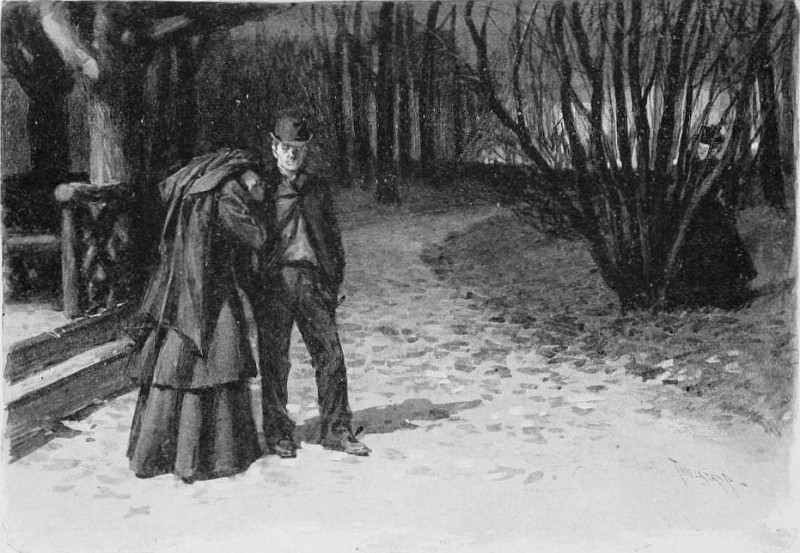
"Is he dead?" Something like light came into his dull eye. The lamp above gave a sudden vast flicker, and the long scar on his face deepened and lengthened and came back to itself again. It was all like a sinister and cynical smile.
"Marcus! don't you know? Where have you been? Haven't you got any of my letters?"
He leaned against the silly rusticity of the summer-house, and looked at her with a dazed but inquiring eye.
"It's mother! It's mother!" the poor girl cried. "Why didn't you come?"
"Why, how is this?" asked Cornelia, stepping forward. "Hadn't he heard?"
"I mailed them to the same place. And the money—didn't you get that, either?"
He looked at her steadily and soberly, but his eyes had a heavy droop. "It's mother," he said at length; "it's mother that's dead." He sat down carefully on the steps of the summerhouse. "And my name was the last. Always the last, Abbie. When was it?"
"Has he moved—do you suppose?" asked Cornelia. She regarded him long and steadily. She seemed about to recognize him—though voice was apparently counting for more than face.
"It was only day before yesterday," Abbie said. "I tried to see you, but it was so far and there was so much to do. But I sent you word."
"I haven't been there lately," he said slowly. "I couldn't have come day before yesterday," he added presently.
"Where have I seen him before?" thought Cornelia. And, "What is the matter with him?" she seemed to ask of Abbie.
"I couldn't come," he repeated. "I'm sorry," he added humbly. "I was—somewhere else."
"Have you been away all these three months? I haven't seen you since almost New Year's. Have you been away from the city all this time?"
"I have been somewhere—somewhere else," he repeated thickly. 'He rose tremblingly. "I suppose they'll have me there again, some time. Well, all right," he said, with resignation.
"What does he mean?" asked Abbie, turning appealingly to Cornelia.
Marcus followed his sister's eyes. He looked at Cornelia narrowly, his own eyes half closed. "Who is this?" he asked.
"It's Cornelia—Burt's wife."
"Burt's wife?" He held her with an enigmatical stare. "I have seen her," he said; "before."
"Where?" thought Cornelia. "Not possibly at—the theatre?"
"In church," he explained, with a slow gravity. "He isn't dead—Burt?"
"Dead?" cried Cornelia. "No, indeed."
"No, he isn't dead," Marcus repeated deliberately. His eyelids raised themselves. "He is married; he has half a million," he went on, with the same slowness. His eye lighted up with a malignant glare. "No, he isn't dead. But—"
He stretched himself aloft, and thrust out his arm, and staggered, and only half-saved himself.—"but I will kill him," he added suddenly.
"Marcus!" his sister screamed; "are you mad?"
He lay slantingly against the corner of the summer-house. His arm caught at the crosspieces of the rustic carpentry, and he hung there panting. Presently a little stream of blood began to trickle across the palm of his hand—he had torn himself on a nail. He felt the warm fluid on his skin, and held up his hand to his own curious and impersonal inspection.
"Give me your handkerchief, Cornelia," Abbie implored pitifully. She folded her own and laid Cornelia's over it, and twisted it around his thumb and tied it over his wrist.
His fingers felt thin and claw-like, and there was a grime rubbed into their cracked and roughened skin—those girlish fingers (his mother's fingers) that had once held a pencil so delicately.
"I have seen her—before," he repeated. "Here." He jerked his hand out of his sister's hold and waved it over the circumscribed and shabby landscape. The light shimmered on the leaden surface of the pond behind them, and the wind rustled the stark weeds along its muddy edges. "I knew it was coming." Abbie caught his hand back. "Half a million; he never did anything for me. I will kill him" he muttered faintly.
Cornelia continued her inspection of him. "Abbie, just look at these clothes, will you? And he hasn't got any cuffs on, either."
"Marcus!" his sister called appealingly. Her raised voice indicated that, after all, she must acknowledge him as other than himself. "All that money I sent you—you need it. Go right away to-morrow to your old number and get it." She turned to Cornelia. "I haven't got any; have you? I forgot it, after all."
"Just this half-dollar," she answered. "Exactly what I paid," she said to herself, "to see him in this part once before." She recognized him now; she saw that she had been interested in the new actor because nobody else had seemed so; and she felt sure that his attempt on the stage had been the same brief failure that all of his other attempts must have been as well.
Marcus raised himself, and a sly smile came over his face. "Money?" he said. "Keep it. I don't want it. I can raise all I need. Vibert knew the ropes, and now I know them just as well myself. I can do business all right again. No money, Abbie; no." He thrust it back upon her. "He always said I wasn't fit for business; but I'll show him."
He braced himself and stepped out decidedly into the path. He turned in the direction of the exit. The other two insensibly took this direction as well, and fell to regulating their steps by his.
"You are a good sister, Abbie," he said, as they passed out. "You have been good to me. Good." He put his hand on hers; he had forgotten that it was bandaged. There was a soft stringency in the folds of the handkerchiefs, but she felt his grateful pulses underneath.
"Oh, Cornelia," moaned poor Abbie; "I must take him home—I must—I must! So near at hand—and the place where he belongs. I can't leave him to go wandering around like this."
Marcus laid his bandaged hand on his sister's shoulder. "No, Abbie." The earlier waves of a sodden stupor now seemed to be washing over him, and he looked on the two girls with a dull leer. "Not home. Better place than home. But some time—I will come home some time. He never treated me as well as he did Burt." His tones came thickly. "I will kill him," he murmured softly to himself in a drunken confidence.
He turned off, down a side street. Abbie stood watching him as he disappeared, to reappear in the light of frequent lamp-posts. Presently he turned a corner. Abbie clasped her hand tightly in her companion's and allowed herself to be led home.
"Another job for me," said Cornelia, thoughtfully.
XXI
The Ogdens, in their apartment, presented to their callers substantially the same aspect that they had offered in a complete house, save that the dining-room had been lopped off, along with the kitchen. They were a shade more compact and, if anything, a shade more luxurious.
Among the first of their callers here was the faithful Brower. As he lounged back in a familiar easy-chair he cast his eye around the drawingroom and the reception-hall; he recognized a number of things from the other house, and detected, too, a good many novel elegancies. In one corner of the room, in particular, there stood a delightful little tea-table; and he learned that the full paraphernalia of the delicate function known as "a tea" could be produced at a moment's notice.
On the purchase of this adjunct to polite living Jessie had brought all her insistence to bear. Life to her had now come merely to mean receiving and being received; and to receive at all she must receive correctly and elegantly.
"It's about all I feel equal to doing now—giving teas," she explained; "and that's all the more reason why I should do it properly. Now, Cecilia Ingles's table and china—"
"For Heaven's sake, Jessie, please to remember that you are not Mrs. Ingles and that I am not her husband. Can you expect me to compete with a man who has an income like his? Do you know what that building—that building alone—pays him a year?"
"Well, I only want things nice. I shall have to live quietly for a while—I don't feel as if I had any great strength; and I don't think I ought to be denied such a small thing as this."
Hence the charming little tea-table, the delicate and exquisite porcelain, and the beautifully burnished kettle; and hence, too, the cup for Brower, so that he might see how the whole thing went. But the hand that passed it to him was white and tremulous, and the graceful bit of lace over the wrist fluttered with a pitiful palpitation.
"I'm going to put another lump on your saucer; so sorry you have caught us without a lemon." She smiled at him as she spoke, and he could not but see that her lips had a bluish tinge. "So good of you to let me come in just as I was." She smoothed down the fall of lace along the front of her wrapper. "But I hardly felt equal to dressing this evening; besides, an old friend like you—"
The "old friend" went home and talked things over with his room-mate.
He lit the burners on both sides of his dressing-case mirror and slowly took off his coat. His room-mate was in his shirt-sleeves, too.
"I wonder if he is happy," said Brower, thoughtfully running his thumb-nail along the teeth of his tortoise-shell comb.
"He tried hard enough to be," answered his room-mate, running his thumb along the teeth of his comb.
Brower sighed and looked with frank but troubled eyes into his friend's face. "Too hard, perhaps."
The other returned his glance in kind. "I'm afraid so," he breathed.
"He figured it all out beforehand," said Brower. "We talked a good deal on the subject generally."
"That sort of thing doesn't always pay."
"We considered the rich girl and the poor girl," Brower went on. "But there's another kind of girl that we both failed to take account of."
"What kind is that?"
"The girl in very moderate circumstances who has spent all her time in going about among wealthy relatives and friends."
"The poor princess who makes the grand chain of other people's castles?"
"Yes," assented Brower; "the grand chain of other people's castles. It's demoralizing."
"Is he a disappointed man?"
"Yes; I'm certain of it. Disappointed, and worried half to death. I'm sorry for him. I'm afraid for him."
He sat down on the edge of the bed and began to unlace his shoes. His room-mate wore shoes of the same size and laced them in the same way.
"I wonder," said he, "if he really loved her?"
"'Sh!" said Brower.
"Wasn't there another one that he did love?"
"Not a word more!" cried Birower.
He undressed and got into bed. He took a book with him. It was "A Mistaken Marriage"—he read everything.
"What do you want to read for?" asked the other. "It's late."
"I read because I don't want to think." He opened at the mark and settled back on his pillow and started in.
"Where are you now?" demanded his double.
"Page 316; the castle's on fire."
"Do you want anything more about castles?"
"No."
"And haven't you had enough of fires?"
"Plenty."
"Well, then!"
Out went the gas, and sleep presently succeeded.
The Ogdens had other callers; among them was Frederick Pratt.
Frederick had left the Underground for the temple at the extreme end of the street, where he was engaged in an ardent study of puts and calls. The atmosphere of the Board of Trade is less sedate than that of the clearing-house association, and the new recruit had become still more volatile and giddy. He was skating on thinner ice and was putting more assurance into his movements.
Pratt, like Brower, made his own observations on the new status of the Ogdens; but unlike Brower, he did not keep his opinions and conjectures to himself. He gave the same currency to his reflections on this pair that he had given to those on the Viberts—and among others thus favored were the Floyds.
"What's the matter with George, anyhow?" he asked Walworth one evening. They were sitting again in Floyd's library, and a light haze of tobacco-smoke prompted to elegiac revery. "He looks old. And he has come to be as poky as the deuce. He seemed last night as if he was worried half to death."
"I guess he is," answered Walworth. "He's anxious about his wife, for one thing."
"Well, she does look pretty bad, that's a fact. I don't believe she will live the year out. The first cold weather will carry her off."
"Don't say that!" exclaimed Mrs. Floyd. "She's delicate, and she has got to take care of herself. But to talk about dying—that's another thing."
"I'm not so sure." And Walworth shook his head gravely.
"But there's something more than that," said Freddy. "It's money. Gad! how they are fixed up! How can he stand it?"
"He can't," answered Walworth; "he's falling behind. And there is that house of his empty yet. I'd take it off his hands myself if it wasn't for being left in the same fix too. Wish I could help him; he hasn't said anything, though."
"He won't, either," replied Pratt. "He ain't that kind."
"Well, I don't see that we need trouble ourselves about help," Ann broke in. "He harmed me, anyway, a great deal more than he helped me—with that precious brother-in-law of his."
"I imagine he knows all about the brother-in-law, too, by this time," rejoined Walworth. "Haven't you got almost tired of twanging that string?"
He wondered if Ogden's brother-in-law were really as trying as his own sister-in-law.
Still other callers favored the Ogdens. Among them was one that had not called at the other house—that had never before, indeed, called at any house whatever. About the first of August a little debutante appeared on the social scene and was "received" with all the care and flattering attention that the new apartment had at its disposal She was a pale and fragile little bud, like many of the exotics with which her mother was fond of decorating her rooms; she had the same slender fingers that set these flowers around, and the same large blue eyes that studied their effect.
A nurse came, and she stayed long after the time when a mere nurse-maid should have taken her place. Curtains were pulled down and kept so; the doctor's carriage (and sometimes more than one) stood waiting before the big doorway of the "Westmoreland"; bottles big and little accumulated on tables and shelves; and cautious tiptoeing became the habit of the whole household; until, at the end of a month, mother and child were doing as well—and only as well—as could be expected. This was not well at all. But both were out of immediate danger, and presently both appeared to mend.
The nurse-maid now arrived, and the carriage and the cap. The languid young mother was capable of taking but a tepid interest in most things, but she rallied her powers to enforce the cap, Cecilia Ingles was her model here as in other matters, and the model was followed closely. Not every girl would wear a cap, but at last a capable one was found who was willing to. The lace cover of the perambulator and the white frills of its propeller were a frequent sight on the streets for a little time; then the necessity developed for the transfer of mother, child, and nurse, during a few weeks, to the convenient sanatorium provided by nature in southern Wisconsin.
The little party was back again in town at the opening of the fall season. Jessie employed her dwindling powers in a partial resumption of the duties which she felt that "society" demanded of her, and the child taxed the energies and resources of the maid, who received little real assistance from its mother. There were small gusts and starts of maternal affection now and then, but they would quickly run their brief course and baby would be carried out of the room. Ogden wondered, from a curiously impersonal outside standpoint, whether he was to attribute this to his wife's waning vitality or to an inherent incapacity for deep and genuine feeling.
But this matter soon passed beyond the confines of discussion. The day came when the nurse was dismissed, the carriage was put away, and Brower went with the stricken father to select a lot in the cemetery. It came that the two stood together one forenoon before a wide and polished mahogany counter, and bent their heads over a handsome plat that was neatly lettered and numbered, and was shaded in pleasant tints of blue and green. A man stood on the other side of the counter and tapped the drawing here and there with the reversed end of a fat penholder.
"This is a good section," he said; he was pausing over a green oval which was intersected by four or five fine black lines. "You are right on a leading drive-way"—carrying the pen-holder along between the waving of two other and wider lines that ran parallel—"and just over here is the lake"—with his little finger on a tangled and shapeless patch of blue.
"That small lot could be made to do," said Brower, softly.
"This is the most fashionable part of the whole place," the man went on, with an indifferent loudness. "See here." He took down a large warped photograph from its place on a dusty shelf behind him, and gave it a dexterous wipe with his elbow. "This monument here is just across the drive-way, and it cost twenty thousand dollars. Put up this summer by Arthur J. Ingles—I guess you've heard of him?
"Good God!" groaned Ogden. "Have I got to compete with that man even in the graveyard?"
The next afternoon a sombre little procession took its way limits-ward to a tract outside, which was tenderly enclosed by great stretches of barbed wire, and was neighbored by the noise and glare of several stone-cutting yards. This little train traversed the raw and ragged edges of the town, and trailed across the succeeding reach of open prairie-land, over which led a long, straight, sandy road, dotted here and there with houses of refreshment for the occupants of mourning-coaches and for their drivers. There was the raw chill in the air which the north sometimes sends down into our early October days. The poor mother sobbed and coughed and shivered in her corner of the carriage; she returned to her home ill and exhausted, and entered it never to leave it alive.
It costs when a baby comes, it costs when a baby goes, it costs when a wife lies sick and dying, and Ogden now confessed himself almost driven to the wall.
"I know, George," his wife said, "that everything has been a great expense; but I'm sure papa would help us if you only spoke to him."
"What!" he cried, harshly.
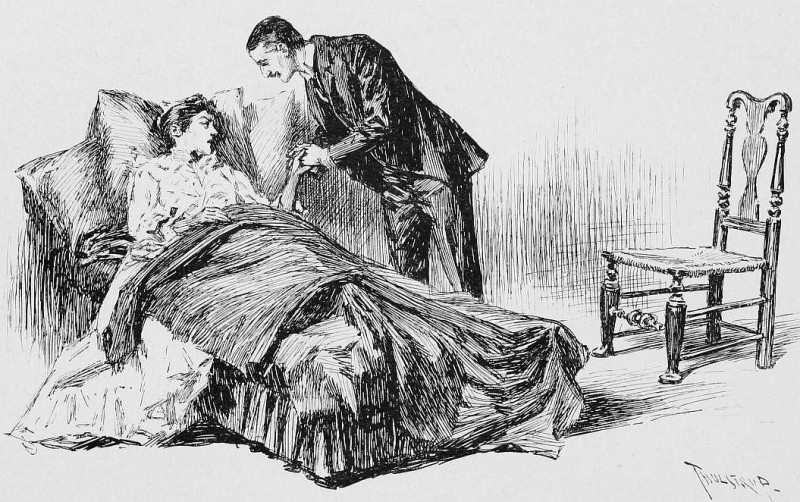
She started, and presently was all a-tremble. Then she fell back weakly and coughed long and violently. "Oh, George, how could you?" she gasped.
"Forgive me, my poor child," he said, and took her hand. "But I could never do anything like that—never."
"Then she fell back whanly and coughed long and violently."
The next day he took the McDowell notes and spent what time he could spare among the brokers. They passed commendingly on the prompt payment of the interest as shown by the endorsements; but McDowell was pretty well known, and it was intimated that endorsements of another sort would be needed to make negotiation possible.
Then he got out the abstract of one of the McDowell tracts—the only one that he personally and individually had any right to use. "You've got considerably more than a pocketful there," the door-keeper of the Clifton Deposit Vaults said to him as he passed out. He left the abstract with a firm of mortgage brokers for examination. In the course of a week they advised him that a release had been over-looked—an instrument which must show of record before a loan could be effected on the property.
The tract had been put through a good many paces, and some of McDowell's work had been too hurried to be careful. The man to give the necessary release was a professional tax-buyer. He lived on the mistakes and misfortunes of other people—their sins of omission and commission; and such an act from such a man would cost something. It might be ten dollars, or fifty, or five hundred.
He waited in this harpy's outer office, while another caller, a woman, claimed attention in the inner one. It was Ann Wilde; he recognized her and she recognized him. She threw a scowling glance upon him, and her harsh and vindictive tones fell on his ears for several succeeding minutes. She knew his necessities; could she be making them known to another?
It seemed so when his turn came. The release would be given only on payment of a sum that, in his present circumstances, was simply impossible.
He seemed now to have exhausted all expedients—all legitimate ones. A bitter recollection of that Sunday drive in the country came over him; he had indeed given a free rein to his wife, and just how close he was to graze against ruin only the future could show. He spent a miserable, sleepless night, and at daybreak he had decided to tax the bank for his own necessities—relying upon the present maturing of his notes to set himself right within a month or two. Do not inquire as to his precise method—there are many ways to take: the actual appropriation of currency, the abstraction of securities, the overissue of certificates of stock, and so on and on. He chose the method which seemed liable to the lightest misconstruction and allowable of the promptest reparation. He avoided seeing himself in the aspect of a criminal by pleading his own cruel needs and by believing in his ability to make a prompt and complete restitution. Perhaps neither of these two reasons could have stood alone, but they leaned together and held each other up—a precarious poise that was not long to endure.
XXII
It endured, in fact, scarcely a fortnight. It lapsed at the close of a dull October day—a day that was within one of the first anniversary of his marriage. Let the means by which he was detected be asked no more than the means through which he transgressed. The delicate mechanism of a bank's accounts responds sensitively to the slightest and most ingenious variation; and it may be, too, that some one in this particular bank was watching for the slip and was waiting for the chance to expose and punish it.
The smoky dusk of the short afternoon was falling outside, while within, under the illumination made by a single electric light, a mother, in the same room where one of Brainard's daughters had plead for the other, was now pleading with him for her son.
No taint had ever fallen before on any of her family or connections. She was crushed and dazed at the thought that anything like this had happened, could have happened, had had the slightest need of happening. And she was dumfounded that all explanation fell upon heedless ears, and that all offers of restitution encountered such, stubborn, brutish, and determined opposition.
"We have lands," she cried, with the tears coursing down her anxious face. "We can make this good, twice and three times over. What more can you want?"
But Brainard did want something more. He wanted the ruin of her son.
"A bank can't deal in real estate," he said doggedly.
He sent a malevolent glance across the table on whose far edge Ogden's bowed head was resting. Beside Ogden stood Fairchild; there was a look of sympathetic distress upon his kindly face.
"It is true," he said, in a low and quiet tone, "that it is not allowable for us to make a loan upon real property; but it would not be amiss for us to take it in payment of this—this—"
"Theft!" cried Brainard loudly. Ogden winced and shuddered; his mother sank into a chair with a low moan.
"Look here, Fairchild," the old man went on, holding up his forefinger with an offensively masterful effect of caution, "it will pay you to go pretty slow just about here. This"—he wagged his head contemptuously towards the bowed: head of the culprit—"was your man. You took his letters; you put him in here. Just stop and think of that!"
Fairchild bit his lip.
"And the other man, before him, was yours. Don't forget that, either." His face showed a cruel and malignant grin.
Fairchild flushed, and lowered his eyes to the floor in silence. Ogden half raised his head to look at him; what could these words mean? He looked at his mother, too; she was lying back with her face in her hands.
The young man's own dace was mapped with the lines of a worry that goads one on to desperation, and it was painted with the blended hue that comes from shame and anxiety and fear and the exhausting struggles carried on through long and sleepless nights. It was hard to face these other faces; it was hard to face even the light of day, thick and dulling though it might be. His head drooped again to the friendly dusk of the table-top before him.
"By Heaven," Brainard went on, "not another man comes into this bank except under a guarantee; and he'll pay the premium for it if he don't stay more than a week. You might think, in a small bank like this, that some kind of eye could be kept on things; but it seems not. It's pick and steal, all the time; first one, then another. No sooner is young Pratt rooted out than this fellow comes up. One steady string of flea-bites—I can't stand it; I won't stand it. Do you think I am going to have Shayne and Cutter and all the rest of 'em go around and tell how Brainard's always got somebody else's hand in his pants pocket and never finds it out? Not very much. I do find it out and I'm going to punish it. You needn't ask me to hold off—it's no use. There's a law for this, and that law is going to take its course."
His white hair stood up in a stiff shock over his forehead, and the gray gristle sprouting on his lip moved up and down forbiddingly as the lip itself worked over the broken row of his teeth. The red veins in his nose showed more redly yet, and his fists were clenched at the ends of his down-hung arms with the straightened tension of an inexorable will.
"My poor boy! My poor boy!" his mother cried. She came over to him and bowed her head on his.
Fairchild looked at Brainard—a look that called for all his self-control and fortitude. "This is too hard," he said. "There was provocation for him, and there are means to make everything good."
"See here, Fairchild," cried the enraged old man, "you have got to keep out of this, if you want to stay friends with me. We've pulled together a good while, but we shall pull apart after five seconds more of this. That young man there has fooled along with us a little too far. He has had his fun, and now he shall pay for it. He shall; by God, I say he shall!"
His voice rose to a harsh and strident cry, and his great fist fell with a ponderous thud on the table before him.
A second later another hand was heard—on the other side of the door. It was faint, but it was audible. It had been preparing for five long and hesitating minutes. To the heart that guided this hand the five seemed five-and-twenty.
Fairchild moved swiftly towards the door and laid his hand upon the knob to prevent any intrusion.
The knock was repeated. He opened the door to a narrow crack. Then he opened it wider.
Abbie Brainard stood on the threshold.
She stepped in swiftly and softly. She shut the door behind her quickly and then leaned her back against its shining panels.
Her face was pale; her bosom was heaving; but her gray eyes gave out the strong and steady light of courage and resolution.
Ogden saw her. He locked his jaws, and took a firm hold on the two arms of his chair, and raised himself and stood erect before her. Had not she herself, on this very spot, once done the same for him? However it might be, or might have been, with others, here, at least, was one who should not see him humbled.
There was no salutation of any kind on either side. She saw him, but seemed to be looking beyond him rather than at him; and in his eyes she stood there with the remote inaccessibility of some distant snow-peak.
Her father turned towards her.
"Abbie! You here? What do you want? What do you mean by coming in like this? Go out again!"
She looked at him with a cool and quiet inflexibility. But her voice was low and trembling as she said,
"I shall stay."
"You can't; you mustn't. You don't want to mix up in this business—you don't understand."
He laid one hand on her arm, and with the other he reached out towards the door-knob.
She withdrew her arm from the hold of his fingers.
"I understand," she said, immovably.
He drew back. "You do? Well, stay then, if you will, and understand better. Learn what kind of a man he really is."
He thrust out his arm towards Ogden, with a cruel and contemptuous smile.
"He came here with letters," he began. "We gave him a chance. Nobody really knew what he was—"
Ogden stood there straight before him. He ground his teeth together to keep his face composed; behind him his nails dug into the palms of his hands, as he held himself back from springing forward and fastening them around the throat of Abbie Brainard's father. There was a ringing in his ears, and through it there sounded faintly the fine tones of Fairchild, speaking to Mary Brainard:
"Nobody really knows who he is, or who his people are, or where he is from ... a town full to overflowing with single young men ... from everywhere. They are taken on faith. Most of them are all right, no doubt; but others—"
He was now one of the "others"; his "people," whom no one had known, were to be known now, after years of probity, as the relatives of a—
"Nobody really knew who he was," Brainard repeated; "but he was taken right in and given a good place. Hasn't he ever wondered why? Is it so easy to go into a new town, and get a good job in a bank the very first thing? Wasn't there any other men to jump at the chance of a position half as good—ain't the city full of 'em? Wasn't there any of 'em in the bank itself who was waiting for the place themselves—and had a right to it, too? Why was there a vacant place to fill, anyhow? Because, a week before, another man had done just what this man has done. He was your man, Fairchild, too. And why did this one here come stepping in ahead of all the old ones? You fixed it, Fairchild; you liked his looks and his talk, you said. Another bad guess for you."
Fairchild studied the carpet with abashed eyes, as were he himself the culprit.
"Yes," Brainard continued, "he was put in a good place and he was pushed right along. Hasn't he ever guessed why? Does a new man come into an office like this, and get as far along inside of a year as he has, without there being any reason for it 2 I'll tell him the reason for it. I did it because my girl here—"
"Father!" cried Abbie, with face aflame. "No! No!"
"You say you understand," he said, turning towards her. "Now, let him understand, too. I advanced him to this position," he went on shamelessly, "because my girl here asked me to."
"No, father! No!" the poor child cried. She threw her shamefaced head on Mrs. Ogden's bosom. She had never seen her before, but under such circumstances the only place for a woman's face was on another woman's breast.
"Yes, you did, too—ask me," he went on, with increased hardihood. "Or just the same as asked—I knew what you meant, well enough. And I said to myself I'd do it. One girl went wrong," he continued, with a choking in his throat, "and I wanted to do what I could to—I wanted Abbie to do different; I wasn't going to have her carried off by another infernal scoundrel."
Ogden flushed and paled and sank down into his chair. His head dropped into his hands; there was no possibility of his holding it up before anything like this.
"And so I helped him on. I said, 'If I do the right thing by him, he will do the right thing by—her; he will act like a man.' I did do the right thing by him—and what then? He had been hanging around all the spring—taking walks and sitting out in front and borrowing books. But the moment I put him on his legs what did he do?"
He was addressing the young man's mother now, whose tear-stained face showed over Abbie's black hat, and whose poor old hand was laid tenderly on Abbie's shoulder. It was plain to every one now that the question was not one of money. Ogden saw clearly enough at last why he had suffered wreck when so many others had ridden the waves. Pratt had filched and had escaped. McDowell had plundered right and left and had never been brought down. Brainard himself had piled up a scandalous fortune and yet had contrived to evade the law. But none of them had come athwart the mortified rage of a father—a father who had humbled his inborn savageness and pride for a daughter's sake and had humbled himself in vain.
Stop!' cried Ogden.
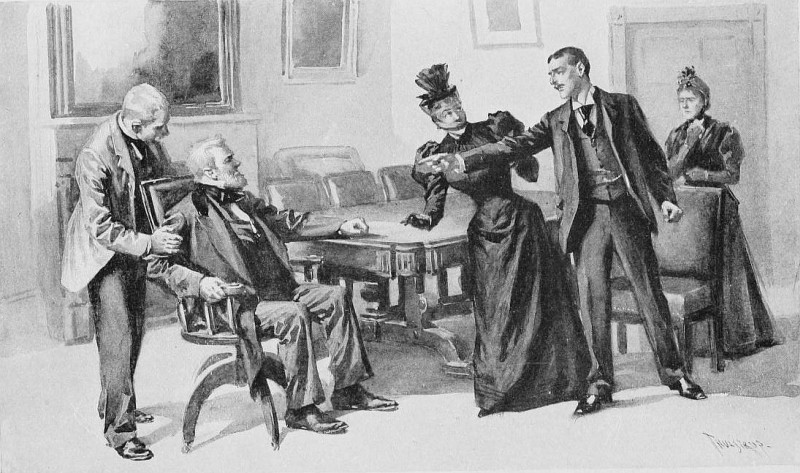
Ogden glanced across towards Abbie. She rested on his mother's shoulder as once, almost, and in this very room, she had rested on his. He knew why she had come; he recognized her devotion and her bravery. She had overlooked his pitiful palterings; she had forgiven the final slight to which they had led; she had imperilled her modesty and mortified her self-love' by coming here that she might save him from her father's vengeance.
Her father looked at her now and took a softer tone.
"She's the best girl there ever was in the world," he declared, with a choking voice and a moistened glimmer in his eyes; "and the smartest—she knows how to do everything; she's the only real comfort I've ever had. She would be a credit to any man, I don't care who. And what does he pass her over for? For another," he went on, with a recrudescence of his insane and primitive jealousy, "who can't care for her house, who couldn't be a mother to his child, who has ruined him by her extravagance—"
"Stop!" cried Ogden. He rose and approached Brainard. There was a threatening glitter in his eyes, and convulsive twitches played among his fingers.
"Yes, stop, for Heaven's sake," said Fairchild, laying an expostulatory hand on the old man's arm. "Stop," he murmured again; "his wife is dying."
Abbie rushed between Ogden and her father. "George! George!" she cried. "Don't! Be patient!"
"What if his wife is dying?" called out the infuriated old wretch. "Is that any reason for lying down when he has slighted my daughter and robbed me!"
"For shame, father! For shame!" She hid her face in her hands, and her tears gushed through them.
Ogden paused, stung and quivering. His hands dropped; his fingers relaxed. His wife was dying! Nobody had told him that before, and he had never dared to tell it to himself. But it was true, and he knew it.
Abbie rose again and confronted her father. The tears were still in her eyes and a wide blush suffused her cheeks.
"Father, you shall not punish him. He may have done wrong, but there was reason for it. And any wrong he has done can be set right."
Ogden's eyes were bedimmed, but through the moisture he seemed to see again the sight that closed the evening of his one-day wedding journey towards the north; again he stood on the bridge, and the sun set over one lake while the moon rose over the other. Only now, with Abbie Brainard's blushes before his body's eye and his wife's pale face before his mind's eye, a confusion came alike over his thought and his vision; it was now the sun rising on him at the moment that the pallid moon was going down. He looked at her and she looked at him, and in the eyes of both there was read the confession of a great mistake. Then her eyes drooped for shame and his for disloyalty, and neither one was able to look into the other's face again.
"Do you defend him?" her father cried. "Can you forgive her? I can't do either. No quarter; don't ask it, Abbie. He has chosen his course—he is responsible for his acts. And he shall answer for them, as any other man must who crosses me."
He flung open the door and passed out. Fairchild stood anxiously over the chair in which Abbie lay back panting for breath. Ogden pressed her hand and turned towards his mother.
"Come, let us go," he said, and the two passed out into the great vestibule of the Clifton. He signalled the elevator.
"Wait for me here, mother—five minutes;" he spoke in a voice which she hardly recognized as his. "Twelfth," she heard him say to the boy inside.
"Twelfth!" she gasped. "Twelfth? It's Eugene!"
She tried to stop him; her fingers merely caught in the grille-work that shut off the empty shaft.
Why do we go mad? Why do we kill ourselves? Why is there more insanity and more self-murder to-day than ever before? It is because, under existing conditions, the relief that comes from action is so largely shut off. How has humanity contrived to endure so well the countless ills of countless ages? Because society has been, in general, loose-knit, so that each unit in it has had room for some individual play. What so increases and intensifies the agonies of to-day? The fact that society has a closer and denser texture than ever before; its finespun meshes bind us and strangle us. Indignation ferments without vent; injury awaits with a wearing impatience the slow and formal infliction of a corporate punishment; self-consciousness paralyzes the quick 'and free action that is the surest and sometimes the only relief.
McDowell was in his office alone. A single light was burning in the room, and nothing remained but the drawing down of a desk-top and the quenching of the light before locking the door from the outside and calling the day's work over. He looked up as Ogden entered.
"Oh, it's you. I haven't seen you for some time past." He used the dubious intonation that marks a half-smothered enmity.
"Yes, it's I. And you won't see me for some time to come. You see me this once."
He stood with his hand on the back of a chair. He made no motion to seat himself, but he was unmistakably planted there to remain. McDowell therefore resumed his own accustomed chair beside his desk.
"Well, what is it?" he asked.
He scrutinized Ogden with an undisguised curiosity. The young man's voice sounded strange in his ears; his face had an expression which made it almost the face of an acquaintance now first met.
"I have come to square with you," began Ogden, slowly. He passed an unconscious hand along the varnished back of the chair; it was a chair in yellow oak, whose frame was light but strong, and whose seat was of cane.
"We are square," said McDowell, curtly. "You have your deeds for that ground—all put into the settlement at a fair value. I have paid your interest as it came due, and shall go on doing so. The principal the same. I'm all right; what is it you want? Try the courts, if you think you can reach me."
"I shall reach you."
"I wonder how?"
Ogden lifted his hand from the chair to his forehead, across which he passed it once or twice. McDowell gave him an amused smile.
"You have robbed me," Ogden said; "you have disgraced me; you have brought me to the edge of ruin. You took advantage of my trust, my inexperience, my strangeness to the city. You have stripped us all, and you have used my sister for a shield. You knew we would stand everything for her, and we have stood everything. You have acted like a sneak and a coward."
McDowell's eyes dropped to his desk. But no flush mounted to his face; that would have been a physical and a moral impossibility. He looked up again after a moment.
"You will reach me? I wonder how?"
Ogden, for the first time in his life, passed completely out of himself. There fell away from him all the fetters that shackle the super-civilized man who is habitually conscious of his civilization.
"Like this."
He seized the chair, raised it over McDowell's head, and went out, leaving the man crushed and bleeding on the floor.
XXIII
Brainard, after leaving the office of the bank, had also taken, the elevator, and before Ogden had reached McDowell's floor his chief stood at the door of Freeze & Freeze; the firm did some legal business for him now and then, under his own general designation of "odd jobs." But their door was locked, as it usually was at that hour; and the old man descended again, took the street-car, and went home to tea.
"I've got him, all the same," he muttered to himself. "He can have a little leeway if he wants, but it won't carry him very far off—as things are now."
He stamped and fumed through the parlor floor for the quarter of an hour during which he attended the preparation of tea in the basement dining-room. He sat down with Burt and Cornelia and his younger daughter; Abbie had shut herself up in her room, and had sent down word that she was too ill to appear.
The table was set with the plated ware of twenty years ago, hideous in varied quirks and chasings. Just within the door of the room stood a baby's high-chair; and Brainard, in passing to his place, contrived to put a vicious foot heavily on one of its sprawling wicker legs.
He went through the meal with a great grinding of molars and a loud smacking of lips. He said nothing; he handled his knife and fork and his goblet with a heavy-handed clatter, while his eyes stared fixedly at the table-cloth. The others watched him in silence; his teeth were grinding something other than food, and the smacking of his lips indicated a relish beyond that for any mere eating and drinking.
After his second cup of tea he arose and pushed back his chair, and planted his feet with a ponderous stamp on the space over which the chair had stood.
"Burt," he said, as he moved towards the door, "you can step down the street when you get through, and tell Albert Freeze to come up here. I shall be in my room."
He commanded the attendance of his attorneys as lightly as he commanded that of his clerks. The Freezes happened to be youngish men, but it would have been the same with older ones.
He withdrew to his den. He rearranged the coke-balls that he had had spread on the top of his grate fire, and then he began to rummage among the disordered papers on his desk.
A book was lying among them—a thin volume, with the place marked by a paper-cutter.
"I wish. Abbie wouldn't leave her things around everywhere," he said, grumblingly.
He tossed the book across to a table. The paper-cutter fell out of it, but landed by its side, where it balanced on one corner of the tabletop. It was a cumbrous implement, somewhat after the fashion of a dagger, and it was smeared over with something that produced the effect of green bronze.
He went to the window and looked out before pulling down its shade; the window opened, after the manner of a door, on the side porch. A misty rain was falling—slight, but deadly chill, and through it there appeared the discolored flank of the stable, draped with the autumnal stringiness of its wild cucumber vines.
The door of the room opened with a swift and sudden quiet, and a young man stepped in. His shoulders were covered with a thousand shimmering rain-globules, and his breath gave out a strong reek of brandy. It was Marcus.
"I want to see Mr. Brainard," he had said, at the outer door, to the strange servant-girl, and he had pushed straight by her without further word.
He stood there pale and tremulous; his eyes glittered like two knife-points.
"I'm out again," he said. "I've got another chance, and I don't mean to lose this one."
His father turned on him with a fierce frown—a frown full of malevolent intention.
"It's you, is it?" He was silent for a moment. "Well, you can stay. I've been thinking about you, lately. I can 'tend to two as well as one."
"You've been thinking about me lately, have you?" Marcus repeated. He spoke with a hardihood that came from draughts of brandy more than once indulged in. "You had better have thought of me before."
"I'm thinking to just as much purpose," his father declared grimly. "I haven't been altogether in the dark," he went on, "about your goings and your doings. I know what you've been living on, and how you got it, and who put you up to it all. I know how you have been figuring on my dying and preying on me before my dying; but I'm alive yet, and the next time you see that singing Canadian scoundrel you can tell him so. And I know all about your latest tactics, too. Do you see that?"