Chapter III · Concluding the Route to the Great Salt Lake City. (continued 2)
Reading edition
The Wind-River Range has other qualities than mere formal beauty to recommend it. At Horseshoe Creek I was shown a quill full of large gold-grainsGOLD. from a new digging. Probably all the primitive masses of the Rocky Mountains will be found to contain the precious metal. The wooded heights are said to be a very paradise of sport, GAME.full of elk and every kind of deer; pumas; bears, brown[103] as well as grizzly; the wolverine;[104] in parts the mountain buffalo—briefly, all the noble game of the Continent. The Indian tribes, Shoshonees and Blackfeet, are not deadly to whites. Washiki, the chief of the former, had, during the time of our visit, retired to hilly ground, about forty miles north of the Foot of Ridge Station. This chief—a fine, manly fellow, equal in point of physical strength to the higher race—had been a firm friend, from the beginning, to emigrant and settler; but he was complaining, according to the road officials, that the small amount of inducement prevented his affording good conduct any longer—that he must rob, like the rest of the tribe. Game, indeed, is not unfrequently found near the Pacific Springs; they are visited, later in the year, by swans, geese, and flights of ducks. At this season they seem principally to attract coyotes—five mules have lately been worried by the little villains—huge cranes, chicken-hawks, a large species of trochilus, and clouds of musquetoes,MUSQUETOES. which neither the altitude, the cold, nor the eternal wind-storm that howls through the Pass can drive from their favorite breeding-bed. Near nightfall a flock of wild geese passed over us, audibly threatening an early winter. We were obliged, before resting, to insist upon a A “SMUDGE.”smudge,[105] without which fumigation sleep would have been impossible.
The shanty was perhaps a trifle more uncomfortable than the average; our only seat was a kind of trestled plank, which suggested a certain obsolete military punishment called riding on a rail. The station-master was a bon enfant; but his help, a Mormon lad, still in his teens, had been trained to go in a “sorter” jibbing and somewhat uncomfortable “argufying,” “highfalutin’” way. He had the furor for fire-arms that characterizes the ingenuous youth of Great Salt Lake City, and his old rattletrap of a revolver, which always reposed by his side at night, was as dangerous to his friends as to himself. His vernacular was peculiar; like Mr. Boatswain Chucks (Mr. D——s), he could begin a sentence with polished and elaborate diction, but it always ended, like the wicked, badly. He described himself, for instance, as having lately been “slightly inebriated;” but the euphuistic periphrasis concluded with an asseveration that he would be “Gord domned” if he did it again.
The night was, like the day, loud and windy, the log hut being somewhat crannied and creviced, and the door had a porcelain handle, and a shocking bad fit—a characteristic combination. We had some trouble to keep ourselves warm. At sunrise the thermometer showed 35° Fahrenheit.
To Green River. August 21st.
We rose early, despite the cold, to enjoy once more the lovely aspect of the Wind-River Mountains, upon whose walls of snow the rays of the unrisen sun broke with a splendid effect; breakfasted, and found ourselves en route at 8 A.M. The day did not begin well: Mrs. Dana was suffering severely from fatigue, and the rapid transitions from heat to cold; Miss May, poor child! was but little better, and the team was re-enforced by an extra mule returning to its proper station: this four-footed Xantippe caused us, without speaking of the dust from her hoofs, an immensity of trouble.
At the Pacific Creek, two miles below the springs, we began the descent of the Western water-shed, and the increase of temperature soon suggested a lower level. We were at once convinced that those who expect any change for the better on the counterslope of the mountains labor under a vulgar error. The land was desolate, a red waste, dotted with sage and greasebush, and in places pitted with large rain-drops. But, looking backward, we could admire the Sweetwater’s Gap heading far away, and the glorious pile of mountains which, disposed in crescent shape, curtained the horizon; their southern and western bases wanted, however, one of the principal charms of the upper view: the snow had well-nigh been melted off. Yet, according to the explorer, they supply within the space of a few miles the Green River with a number of tributaries, which are all called the New Forks. We kept them in sight till they mingled with the upper air like immense masses of thunder-cloud gathering for a storm.
From Pacific Creek the road is not bad, but at this season the emigrant parties are sorely tried by drought, and when water is found it is often fetid or brackish. After seventeen miles we passed the junction of the Great Salt Lake and Fort Hall roads. Near Little Sandy Creek—a feeder of its larger namesake—which after rains is about 2·5 feet deep, we found nothing but sand, caked clay, sage, thistles, and the scattered fragments of camp-fires, with large ravens picking at the bleaching skeletons, and other indications of a halting-ground, an eddy in the great current of mankind, which, ceaseless as the Gulf Stream, ever courses from east to west. After a long stage of twenty-nine miles we made Big Sandy Creek, an important influent of the Green River; the stream, then shrunken, was in breadth not less than five rods, each = 16·5 feet, running with a clear, swift current through a pretty little prairillon, bright with the blue lupine, the delicate pink malvacea, the golden helianthus, purple aster acting daisy, the white mountain heath, and the green Asclepias tuberosa,[106] a weed common throughout Utah Territory. The Indians, in their picturesque way, term this stream Wágáhongopá, or the THE GLISTENING GRAVEL WATER.Glistening Gravel Water.[107] We halted for an hour to rest and dine; the people of the station, man and wife, the latter very young, were both English, and of course Mormons; they had but lately become tenants of the ranch, but already they were thinking, as the Old Country people will, of making their surroundings “nice and tidy.”
Beyond the Glistening Gravel Water lies a mauvaise terre, sometimes called the First Desert, and upon the old road water is not found in the dry season within forty-nine miles—a terrible jornada[108] for laden wagons with tired cattle. We prepared for drought by replenishing all our canteens—one of them especially, a tin flask, covered outside with thick cloth, kept the fluid deliciously cold—and we amused ourselves by the pleasant prospect of seeing wild mules taught to bear harness. The tricks of equine viciousness and asinine obstinacy played by the mongrels were so distinct, that we had no pains in determining what was inherited from the father and what from the other side of the house. Before they could be hitched up they were severally hustled into something like a parallel line with the pole, and were then forced into their places by a rope attached to the fore wheel, and hauled at the other end by two or three men. Each of these pleasant animals had a bell: it is sure, unless corraled, to run away, and at night sound is necessary to guide the pursuer. At last, being “all aboord,” we made a start, dashed over the Big Sandy, charged the high stiff bank with an impetus that might have carried us up an otter-slide or a Montagne Russe, and took the right side of the valley, leaving the stream at some distance.
Rain-clouds appeared from the direction of the hills: apparently they had many centres, as the distant sheet was rent into a succession of distinct streamers. A few drops fell upon us as we advanced. Then the fiery sun “ate up” the clouds, or raised them so high that they became playthings in the hands of the strong and steady western gale. The thermometer showed 95° in the carriage, and 111° exposed to the reflected heat upon the black leather cushions. It was observable, however, that the sensation was not what might have been expected from the height of the mercury, and perspiration was unknown except during severe exercise; this proves the purity and salubrity of the air. In St. Jo and New Orleans the effect would have been that of India or of a Turkish steam-bath. The heat, however, brought with it one evil—a green-headed horsefly, that stung like a wasp, and from which cattle must be protected with a coating of grease and tar. Whenever wind blew, tourbillons of dust coursed over the different parts of the plain, showing a highly electrical state of the atmosphere. When the air was unmoved the mirage was perfect as the sarab in Sindh or Southern Persia; earth and air were both so dry that the refraction of the sunbeams elevated the objects acted upon more than I had ever seen before. A sea lay constantly before our eyes, receding of course as we advanced, but in all other points a complete lusus naturæ. The color of the water was a dull cool sky-blue, not white, as the “looming” generally is; the broad expanse had none of that tremulous upward motion which is its general concomitant; it lay placid, still, and perfectly reflecting in its azure depths—here and there broken by projecting capes and bluff headlands—the forms of the higher grounds bordering the horizon.
After twelve miles’ driving we passed through a depression called Simpson’s Hollow, and somewhat celebrated in local story. Two semicircles of black still charred the ground; on a cursory view they might have been mistaken for burnt-out lignite. Here, in 1857, the Mormons fell upon a corraled train of twenty-three wagons, laden with provisions and other necessaries for the federal troops, then halted at Camp Scott awaiting orders to advance. The wagoners, suddenly attacked, and, as usual, unarmed—their weapons being fastened inside their awnings—could offer no resistance, and the whole convoy was set on fire except two conveyances, which were left to carry back supplies for the drivers till they could reach their homes. On this occasion the dux facti was Lot Smith, a man of reputation for hard riding and general gallantry. The old Saint is always spoken of as a good man who lives by “Mormon rule of wisdom.” As at Fort Sumter, no blood was spilled. So far the Mormons behaved with temper and prudence; but this their first open act of rebellion against, or secession from, the federal authority nearly proved fatal to them; had the helm of government been held by a firmer hand than poor Mr. Buchanan’s, the scenes of Nauvoo would have been acted again at Great Salt Lake City. As it was, all turned out à merveille for the saints militant. They still boast loudly of the achievement, and on the marked spot where it was performed the juvenile emigrants of the creed erect dwarf graves and nameless “wooden” tomb-“stones” in derision of their enemies.
As sunset drew near we approached the banks of the Big Sandy River. The bottom through which it flowed was several yards in breadth, bright green with grass, and thickly feathered with willows and cotton-wood. It showed no sign of cultivation; the absence of cereals may be accounted for by its extreme cold; it freezes there every night, and none but the hardiest grains, oats and rye, which here are little appreciated, could be made to grow. We are now approaching the valley of the VALLEY OF THE GREEN RIVER.Green River, which, like many of the rivers in the Eastern States, appears formerly to have filled a far larger channel. Flat tables and elevated terraces of horizontal strata—showing that the deposit was made in still waters—with layers varying from a few lines to a foot in thickness, composed of hard clay, green and other sandstones, and agglutinated conglomerates, rise like islands from barren plains, or form escarpments that buttress alternately either bank of the winding stream. Such, according to Captain Stansbury, is the general formation of the land between the South Pass and the “Rim” of the Utah Basin.
Advancing over a soil alternately sandy and rocky—an iron flat that could not boast of a spear of grass—we sighted a number of coyotes, fittest inhabitants of such a waste, and a long, distant line of dust, like the smoke of a locomotive, raised by a herd of mules which were being driven to the corral. We were presently met by the Pony Express rider; he reined in to exchange news, which de part et d’autre were simply nil. As he pricked onward over the plain, the driver informed us, with a portentous rolling of the head, that Ichabod was an a’mighty fine “shyoot.” Within five or six miles of Green River we passed the boundary stone which bears Oregon on one side and Utah on the other. We had now traversed the southeastern corner of the country of Long-eared men,[109] and were entering Deserét, the Land of the Honey-bee.
At 6 30 P.M. we debouched upon the bank of the Green River. The station was the home of Mr. Macarthy, our driver. The son of a Scotchman who had settled in the United States, he retained many signs of his origin, especially freckles, and hair which one might almost venture to describe as sandy; perhaps also, at times, he was rather o’er fond of draining “a cup o’ kindness yet.” He had lately taken to himself an English wife, the daughter of a Birmingham mechanic, who, before the end of her pilgrimage to “Zion on the tops of the mountains,” had fallen considerably away from grace, and had incurred the risk of being buffeted by Satan for a thousand years—a common form of commination in the New Faith—by marrying a Gentile husband.[110] The station had the indescribable scent of a Hindoo village, which appears to result from the burning of bois de vache and the presence of cattle: there were sheep, horses, mules, and a few cows, the latter so lively that it was impossible to milk them. The ground about had the effect of an oasis in the sterile waste, with grass and shrubs, willows and flowers, wild geraniums, asters, and various cruciferæ. A few trees, chiefly quaking asp, lingered near the station, but dead stumps were far more numerous than live trunks. In any other country their rare and precious shade would have endeared them to the whole settlement; here they were never safe when a log was wanted. The Western man is bred and perhaps born—I believe devoutly in transmitted and hereditary qualities—with an instinctive dislike to timber in general. He fells a tree naturally as a bull-terrier worries a cat, and the admirable woodsman’s axe which he has invented only serves to whet his desire to try conclusions with every more venerable patriarch of the forest.[111] Civilized Americans, of course, lament the destructive mania, and the Latter-Day Saints have learned by hard experience the inveterate evils that may arise in such a country from disforesting the ground. We supped comfortably at Green-River Station, the stream supplying excellent salmon trout. The kichimichi, or buffalo berry,[112] makes tolerable jelly, and alongside of the station is a store where Mr. Burton (of Maine) sells “Valley Tan” whisky.[113]
The Green River is the Rio Verde of the Spaniards, who named it from its timbered shores and grassy islets: it is called by the Yuta Indians Piya Ogwe, or the Great Water; by the other tribes Sitskidiágí, or “Prairie-grouse River.” It was nearly at its lowest when we saw it; the breadth was not more than 330 feet. In the flood-time it widens to 800 feet, and the depth increases from three to six. During the inundation season a ferry is necessary, and when transit is certain the owner sometimes nets $500 a week, which is not unfrequently squandered in a day. The banks are in places thirty feet high, and the bottom may average three miles from side to side. It is a swift-flowing stream, running as if it had no time to lose, and truly it has a long way to go. Its length, volume, and direction entitle it to the honor of being called the head water of the great Rio Colorado, or Colored River, a larger and more important stream than even the Columbia. EXPLORATION YET TO BE DONE.There is some grand exploration still to be done upon the line of the Upper Colorado, especially the divides which lie between it and its various influents, the Grand River and the Yaquisilla, of which the wild trapper brings home many a marvelous tale of beauty and grandeur. Captain T. A. Gove, of the 10th Regiment of Infantry, then stationed at Camp Floyd, told me that an expedition had often been projected: a party of twenty-five to thirty men, well armed and provided with inflatable boats, might pass without unwarrantable risk through the sparsely populated Indian country: a true report concerning regions of which there are so many false reports, all wearing more or less the garb of fable—beautiful valleys inclosed in inaccessible rocks, Indian cities and golden treasures—would be equally interesting and important. I can not recommend the undertaking to the European adventurer: the United States have long since organized and perfected what was proposed in England during the Crimean war, and which fell, as other projects then did, to the ground, namely, a corps of Topographical Engineers, a body of well-trained and scientific explorers, to whose hands the task may safely be committed.[114]
We passed a social evening at Green-River Station. It boasted of no less than three Englishwomen, two married, and one, the help, still single. Not having the Mormonite retenue, the dames were by no means sorry to talk about Birmingham and Yorkshire, their birthplaces. At 9 P.M. arrived one of the road-agents, Mr. Cloete, from whom I gathered that the mail-wagon which once ran from Great Salt Lake City had lately been taken off the road. The intelligence was by no means consolatory, but a course of meditation upon the saying of the sage, “in for a penny, in for a pound,” followed by another visit to my namesake’s grog-shop, induced a highly philosophical turn, which enabled me—with the aid of a buffalo—to pass a comfortable night in the store.
22d August. To Ham’s Fork and Millersville.
We were not under way before 8 A.M. Macarthy was again to take the lines, and a Giovinetto returning after a temporary absence to a young wife is not usually rejoiced to run his course. Indeed, he felt the inconveniences of a semi-bachelor life so severely, that he often threatened in my private ear, chemin faisant, to throw up the whole concern.
After the preliminary squabble with the mules, we forded the pebbly and gravelly bed of the river—in parts it looks like a lake exhausted by drainage—whose swift surging waters wetted the upper spokes of the wheels, and gurgled pleasantly around the bags which contained the mail for Great Salt Lake City.[115] We then ran down the river valley, which was here about one mile in breadth, in a smooth flooring of clay, sprinkled with water-rolled pebbles, overgrown in parts with willow, wild cherry, buffalo berries, and quaking asp. Macarthy pointed out in the road-side a rough grave, furnished with the normal tomb-stone, two pieces of wagon-board: it was occupied by one Farren, who had fallen by the revolver of the redoubtable Slade. MICHAEL MARTIN’S STORE.Presently we came to the store of Michael Martin, an honest Creole, who vended the staple of prairie goods, Champagne, bottled cocktail, “eye-opener,” and other liquors, dry goods—linen drapery—a few fancy goods, ribbons, and finery; brandied fruits, jams and jellies, potted provisions, buckskins, moccasins, and so forth. Hearing that Lieutenant Dana was en route for Camp Floyd, he requested him to take charge of $500, to be paid to Mr. Livingston, the sutler, and my companion, with the obligingness that marked his every action, agreed to deliver the dollars, sauve the judgment of God in the shape of Indians, or “White Indians.”[116] At the store we noticed a paralytic man. AN ORIGINAL.This original lived under the delusion that it was impossible to pass the Devil’s Gate: his sister had sent for him to St. Louis, and his friends tried to transport him eastward in chairs; the only result was that he ran away before reaching the Gate, and after some time was brought back by Indians.
Resuming our journey, we passed two places where trains of fifty-one wagons were burned in 1857 by the Mormon Rangers: the black stains had bitten into the ground like the blood-marks in the palace of Holyrood—a neat foundation for a structure of superstition. Not far from it was a deep hole, in which the plunderers had “cached” the iron-work which they were unable to carry away. Emerging from the river plain we entered upon another mauvaise terre, with knobs and elevations of clay and green gault, striped and banded with lines of stone and pebbles: it was a barren, desolate spot, the divide between the Green River and its western influent, the shallow and somewhat sluggish Black’s Fork. The name is derived from an old trader: it is called by the Snakes Ongo Ogwe Pa, or “Pine-tree Stream;” it rises in the Bear-River Mountains, drains the swamps and lakelets on the way, and bifurcates in its upper bed, forming two principal branches, Ham’s Fork and Muddy Fork.
Near the Pine-tree Stream we met a horse-thief driving four bullocks: he was known to Macarthy, and did not look over comfortable. We had now fallen into the regular track of Mormon emigration, and saw the wayfarers in their worst plight, near the end of the journey. We passed several families, and parties of women and children trudging wearily along: most of the children were in rags or half nude, and all showed gratitude when we threw them provisions. The greater part of the men were armed, but their weapons were far more dangerous to themselves and their fellows than to the enemy. There is not on earth a race of men more ignorant of arms as a rule than the lower grades of English; becoming an emigrant, the mechanic hears that it may be necessary to beat off Indians, so he buys the first old fire-arm he sees, and probably does damage with it. Only last night a father crossed Green River to beg for a piece of cloth; it was intended to shroud the body of his child, which during the evening had been accidentally shot, and the station people seemed to think nothing of the accident, as if it were of daily recurrence. I was told of three, more or less severe, that happened in the course of a month. The Western Americans, who are mostly accustomed to the use of weapons, look upon these awkwardnesses with a profound contempt. We were now in a region of graves, and their presence in this wild was not a little suggestive.
Presently we entered a valley in which green grass, low and dense willows, and small but shady trees, an unusually vigorous vegetation, refreshed, as though with living water, our eyes, parched and dazed by the burning glare. Stock strayed over the pasture, and a few Indian tents rose at the farther side; the view was probably pas grand’ chose, but we thought it splendidly beautiful. At midday we reached Ham’s Fork, the northwestern influent of Green River, and there we found a station. The pleasant little stream is called by the Indians Turugempa, the “Blackfoot Water.”
The station was kept by an Irishman and a Scotchman—“Dawvid Lewis:” it was a disgrace; the squalor and filth were worse almost than the two—Cold Springs and Rock Creek—which we called our horrors, and which had always seemed to be the ne plus ultra of Western discomfort. THE DIRTY HOUSE.The shanty was made of dry stone piled up against a dwarf cliff to save back wall, and ignored doors and windows. The flies—unequivocal sign of unclean living!—darkened the table and covered every thing put upon it; the furniture, which mainly consisted of the different parts of wagons, was broken, and all in disorder; the walls were impure, the floor filthy. The reason was at once apparent. Two Irishwomen, sisters,[117] were married to Mr. Dawvid, and the house was full of “childer,” the noisiest and most rampageous of their kind. I could hardly look upon the scene without disgust. The fair ones had the porcine Irish face—I need hardly tell the reader that there are three orders of physiognomy in that branch of the Keltic family, viz., porcine, equine, and simian—the pig-faced, the horse-faced, and the monkey-faced. Describing one I describe both sisters; her nose was “pugged,” apparently by gnawing hard potatoes before that member had acquired firmness and consistency; her face was powdered with freckles; her hair, and, indeed, her general costume, looked, to quote Mr. Dow’s sermon, as though she had been rammed through a bush fence into a world of wretchedness and woe. Her dress was unwashed and in tatters, and her feet were bare; she would not even take the trouble to make for herself moccasins. Moreover, I could not but notice that, though the house contained two wives, it boasted only of one cubile, and had only one cubiculum. Such things would excite no surprise in London or Naples, or even in many of the country parts of Europe; but here, where ground is worthless, where building material is abundant, and where a few hours of daily labor would have made the house look at least respectable, I could not but wonder at it. My first impulse was to attribute the evil, uncharitably enough, to Mormonism; to renew, in fact, the stock-complaint of nineteen centuries’ standing—
“Fœcunda culpæ secula nuptias Primùm inquinavere, et genus et domus.”
A more extended acquaintance with the regions west of the Wasach taught me that the dirt and discomfort were the growth of the land. To give the poor devils their due, Dawvid was civil and intelligent, though a noted dawdler, as that rare phenomenon, a A SCOTCH IDLER.Scotch idler, generally is. Moreover, his wives were not deficient in charity; several Indians came to the door, and none went away without a “bit” and a “sup.” During the process of sketching one of these men, a Snake, distinguished by his vermilion’d hair-parting, eyes blackened, as if by lines of soot or surma, and delicate Hindoo-like hands, my eye fell upon the German-silver handle of a Colt’s revolver, which had been stowed away under the blankets, and a revolver in the Lamanite’s hands breeds evil suspicions.
Again we advanced. The air was like the breath of a furnace; the sun was a blaze of fire—accounting, by-the-by, for the fact that the human nose in these parts seems invariably to become cherry-red—all the nullahs were dried up, and the dust-pillars and mirage were the only moving objects on the plain. Three times we forded Black’s Fork, and then debouched once more upon a long flat. The ground was scattered over with pebbles of granite, obsidian, flint, and white, yellow, and smoky quartz, all water-rolled. After twelve miles we passed Church Butte, one of many curious formations lying to the left hand or south of the road. This isolated mass of stiff clay has been cut and ground by wind and rain into folds and hollow channels which from a distance perfectly simulate the pillars, groins, and massive buttresses of a ruinous Gothic cathedral. The foundation is level, except where masses have been swept down by the rain, and not a blade of grass grows upon any part. An architect of genius might profitably study this work of Nature: upon that subject, however, I shall presently have more to say. The Butte is highly interesting in a geological point of view; it shows the elevation of the adjoining plains in past ages, before partial deluges and the rains of centuries had effected the great work of degradation.
Again we sighted the pretty valley of Black’s Fork, whose cool clear stream flowed merrily over its pebbly bed. The road was now populous with Mormon emigrants; some had good teams, others hand-carts, which looked like a cross between a wheel-barrow and a tax-cart. There was nothing repugnant in the demeanor of the party; they had been civilized by traveling, and the younger women, who walked together and apart from the men, were not too surly to exchange a greeting. The excessive barrenness of the land presently diminished; gentian and other odoriferous herbs appeared, and the greasewood, which somewhat reminded me of the Sindhian camel-thorn, was of a lighter green than elsewhere, and presented a favorable contrast with the dull glaucous hues of the eternal prairie sage. We passed a dwarf copse so strewed with the bones of cattle as to excite our astonishment: Macarthy told us that it was the place where the 2d Dragoons encamped in 1857, and lost a number of their horses by cold and starvation. The wolves and coyotes seemed to have retained a predilection for the spot; we saw troops of them in their favorite “location”—the crest of some little rise, whence they could keep a sharp look-out upon any likely addition to their scanty larder.
After sundry steep inclines we forded another little stream, with a muddy bed, shallow, and about thirty feet wide: it is called Smith’s Fork, rises in the “Bridger Range” of the Uinta Hills, and sheds into Black’s Fork, the main drain of these parts. On the other side stood Millersville, a large ranch with a whole row of unused and condemned wagons drawn up on one side. We arrived at 5 15 P.M., having taken three hours and fifteen minutes to get over twenty miles. The tenement was made of the component parts of vehicles, the chairs had backs of yoke-bows, and the fences which surrounded the corral were of the same material. The station was kept by one Holmes, an American Mormon,THE UNGENIAL MAN. and an individual completely the reverse of genial; he dispensed his words as if shelling out coin, and he was never—by us at least—seen to smile. His wife was a pretty young Englishwoman, who had spent the best part of her life between London and Portsmouth; when alone with me she took the opportunity of asking some few questions about old places, but this most innocent tête-à-tête was presently interrupted by the protrusion through the open door of a tête de mari au naturel, with a truly renfrogné and vinegarish aspect, which made him look like a calamity. After supplying us with a supper which was clean and neatly served, the pair set out for an evening ride, and toward night we heard the scraping of a violin, which reminded me of Tommaso Scarafaggio:
“Detto il sega del villagio Perché suona il violino.”
The “fiddle” was a favorite instrument with Mr. Joseph Smith, as the harp with David; the Mormons, therefore, at the instance of their prophet, are not a little addicted to the use of the bow. We spent a comfortable night at Millersville. After watching the young moon as she sailed through the depths of a firmament unstained by the least fleck of mist, we found some scattered volumes which rendered us independent of our unsocial Yankee host.
23d August. Fort Bridger.
We breakfasted early the next morning, and gladly settled accounts with the surly Holmes, who had infected—probably by following the example of Mr. Caudle in later life—his pretty wife with his own surliness. Shortly after starting—at 8 30 A.M.—we saw a little clump of seven Indian lodges, which our experience soon taught us were the property of a white; the proprietor met us on the road, and was introduced with due ceremony by Mr. Macarthy. “UNCLE JACK.”“Uncle Jack” (Robinson, really) is a well-known name between South Pass and Great Salt Lake City; he has spent thirty-four years in the mountains, and has saved some $75,000, which have been properly invested at St. Louis; as might be expected, he prefers the home of his adoption and his Indian spouse, who has made him the happy father of I know not how many children, to good society and bad air farther east.
Our road lay along the valley of Black’s Fork, which here flows from the southwest to the northeast; the bottom produced in plenty luxuriant grass, the dandelion, and the purple aster, thickets of a shrub-like hawthorn (cratægus), black and white currants, the willow and the cotton-wood. When almost in sight of the military post we were addressed by two young officers, one of them an assistant surgeon, who had been engaged in the healthful and exciting pursuit of a badger, whose markings, by-the-by, greatly differ from the European; they recognized the uniform, and accompanied us to the station.
Fort Bridger lies 124 miles from Great Salt Lake City; according to the drivers, however, the road might be considerably shortened. The position is a fertile basin cut into a number of bits by Black’s Fork, which disperses itself into four channels about 1·5 mile above the station, and forms again a single bed about two miles below. The fort is situated upon the westernmost islet. It is, as usual, a mere cantonment, without any attempt at fortification, and at the time of my visit was garrisoned by two companies of foot, under the command of Captain F. Gardner, of the 10th Regiment. The material of the houses is pine and cedar brought from the Uinta Hills, whose black flanks supporting snowy cones rise at the distance of about thirty-five miles. They are a sanitarium, except in winter, when under their influence the mercury sinks to -20° F., not much less rigorous than Minnesota, and they are said to shelter grizzly bears and an abundance of smaller game.
The fort was built by Colonel James Bridger, now the oldest trapper on the Rocky Mountains, of whom Messrs. Frémont and Stansbury have both spoken in the highest terms. He divides with Christopher Carson, the Kit Carson of the Wind River and the Sierra Nevada explorations, the honor of being the best guide and interpreter in the Indian country: the palm for prudence is generally given to the former; for dash and hard fighting to the latter, although, it is said, the mildest mannered of men. Colonel Bridger, when an Indian trader, placed this post upon a kind of neutral ground between the Snakes and Crows (Hapsaroke) on the north, the Ogalalas and other Sioux to the east, the Arapahoes and Cheyennes on the south, and the various tribes of Yutas (Utahs) on the southwest. He had some difficulties with the Mormons, and Mrs. Mary Ettie Smith, in a volume concerning which something will be said at a future opportunity, veraciously reports his barbarous murder, some years ago, by the Danite band. He was at the time of my visit absent on an exploratory expedition with Captain Raynolds.
Arrived at Fort Bridger, our first thought was to replenish our whisky-keg: its emptiness was probably due to the “rapid evaporation in such an elevated region imperfectly protected by timber;” but, however that may be, I never saw liquor disappear at such a rate before. Par parenthèse, our late friends the officials had scarcely been more fortunate: they had watched their whisky with the eyes of Argus, yet, as the driver facetiously remarked, though the quantity did not diminish too rapidly, the quality lost strength every day. We were conducted by Judge Carter to a building which combined the function of post-office and sutler’s store, the judge being also sutler, and performing both parts, I believe, to the satisfaction of every one. After laying in an ample provision of biscuits for Miss May and korn-schnapps for ourselves, we called upon the commanding officer, who introduced us to his officers, and were led by Captain Cumming to his quarters, where, by means of chat, “solace-tobacco,” and toddy—which in these regions signifies “cold with”—we soon worked our way through the short three quarters of an hour allowed us. The officers complained very naturally of their isolation and unpleasant duty, which principally consists in keeping the roads open for, and the Indians from cutting off, parties of unmanageable emigrants, who look upon the federal army as their humblest servants. A SORE SUBJECT.At Camp Scott, near Bridger, the army of the federal government halted under canvas during the severe winter of 1857-1858, and the subject is still sore to military ears.
We left Bridger at 10 A.M. Macarthy explained away the disregard for the comfort of the public on the part of the contractors in not having a station at the fort by declaring that they could obtain no land in a government reservation; moreover, that forage there would be scarce and dear, while the continual influx of Indians would occasion heavy losses in cattle. At Bridger the road forks: the northern line leads to Soda or BEER SPRINGS.Beer Springs,[118] the southern to Great Salt Lake City. Following the latter, we crossed the rough timber bridges that spanned the net-work of streams, and entered upon another expanse of degraded ground, covered as usual with water-rolled pebbles of granite and porphyry, flint and greenstone. On the left was a butte with steep bluff sides, called the Race-course: the summit, a perfect mesa, is said to be quite level, and to measure exactly a mile round—the rule of the American hippodrome. Like these earth formations generally, it points out the ancient level of the land before water had washed away the outer film of earth’s crust. The climate in this part, as indeed every where between the South Pass and the Great Salt Lake Valley, was an exaggeration of the Italian, with hot days, cool nights, and an incomparable purity and tenuity of atmosphere. We passed on the way a party of emigrants, numbering 359 souls and driving 39 wagons. They were commanded by the patriarch of Mormondom, otherwise Captain John Smith, the eldest son of Hyrum Smith, a brother of Mr. Joseph Smith the Prophet, and who, being a child at the time of the murderous affair at Carthage, escaped being coiffe’d with the crown of martyrdom. He rose to the patriarchate on the 18th of February, 1855; his predecessor was “old John Smith”—uncle to Mr. Joseph, and successor to Mr. Hyrum Smith—who died the 23d of May, 1854. He was a fair-complexioned man, with light hair. His followers accepted gratefully some provisions with which we could afford to part.
After passing the Mormons we came upon a descent which appeared little removed from an angle of 35°, and suggested the propriety of walking down. There was an attempt at a zigzag, and, for the benefit of wagons, a rough wall of stones had been run along the sharper corners. At the foot of the hill we remounted, and, passing through a wooded bottom, reached at 12 15 P.M.—after fording the Big Muddy—Little Muddy Creek, upon whose banks stood the station. Both these streams are branches of the Ham’s Fork of Green River; and, according to the well-known “rule of contrairy,” their waters are clear as crystal, showing every pebble in their beds.
Little Muddy was kept by a Canadian, a chatty, lively, good-humored fellow blessed with a sour English wife. Possibly the heat—the thermometer showed 95° F. in the shade—had turned her temper; fortunately, it had not similarly affected the milk and cream, which were both unusually good. Jean-Baptiste, having mistaken me for a Française de France, a being which he seemed to regard as little lower than the angels—I was at no pains to disabuse him—was profuse in his questionings concerning his imperial majesty, the emperor, carefully confounding him with the first of the family; and so pleased was he with my responses, that for the first time on that route I found a man ready to spurn cet animal féroce qu’on appelle la pièce de cinq francs—in other words, the “almighty dollar.”
We bade adieu to Little Muddy at noon, and entered a new country, a broken land of spurs and hollows, in parts absolutely bare, in others clothed with a thick vegetation. Curiously shaped hills, and bluffs of red earth capped with a clay which much resembled snow, bore a thick growth of tall firs and pines whose sombre uniform contrasted strangely with the brilliant leek-like, excessive green foliage, and the tall, note-paper-colored trunks of the ravine-loving quaking asp (Populus tremuloides). The mixture of colors was bizarre in the extreme, and the lay of the land, an uncouth system of converging, diverging, and parallel ridges, with deep divisions—in one of these ravines, which is unusually broad and grassy, rise the so-called Copperas Springs—was hardly less striking. We ran winding along a crest of rising ground, passing rapidly, by way of farther comparison, two wretched Mormons, man and woman, who were driving, at a snail’s pace, a permanently lamed ox, and after a long ascent stood upon the summit of Quaking-Asp Hill.
QUAKING-ASP HILL.Quaking-Asp Hill, according to the drivers, is 1000 feet higher than the South Pass, which would exalt its station to 8400 feet; other authorities, however, reduce it to 7900. The descent was long and rapid—so rapid, indeed, that oftentimes when the block of wood which formed our brake dropped a bit of the old shoe-sole nailed upon it to prevent ignition, I felt, as man may be excused for feeling, that catching of the breath that precedes the first five-barred gate after a night of “heavy wet.” The sides of the road were rich in vegetation, stunted oak, black-jack, and box elder of the stateliest stature; above rose the wild cherry, and the service-tree formed the bushes below. The descent, besides being decidedly sharp, was exceedingly devious, and our frequent “shaves”—a train of Mormon wagons was crawling down at the same time—made us feel somewhat thankful that we reached the bottom without broken bones.
The train was commanded by a Captain Murphy, who, as one might expect from the name, had hoisted the Stars and Stripes—it was the only instance of such loyalty seen by us on the Plains. The emigrants had left Council Bluffs on the 20th of June, an unusually late date, and, though weather-beaten, all looked well. Inspirited by our success in surmounting the various difficulties of the way, we “poked fun” at an old Yorkshireman, who was assumed, by way of mirth, to be a Cœlebs in search of polygamy at an epoch of life when perhaps the blessing might come too late; and at an exceedingly plain middle-aged and full-blooded negro woman, who was fairly warned—the children of Ham are not admitted to the communion of the Saints, and consequently to the forgiveness of sins and a free seat in Paradise—that she was “carrying coals to Newcastle.”
As the rays of the sun began to slant we made Sulphur Creek;SULPHUR CREEK. it lies at the foot of a mountain called Rim Base, because it is the eastern wall of the great inland basin; westward of this point the waters can no longer reach the Atlantic or the Pacific; each is destined to feed the lakes,
“Nec Oceani pervenit ad undas.”
Beyond Sulphur Creek, too, the face of the country changes; the sedimentary deposits are no longer seen; the land is broken and confused, upheaved into huge masses of rock and mountains broken by deep kanyons, ravines, and water-gaps, and drained by innumerable streamlets. The exceedingly irregular lay of the land makes the road devious, and the want of level ground, which is found only in dwarf parks and prairillons, would greatly add to the expense of a railway. We crossed the creek, a fetid stagnant water, about ten feet wide, lying in a bed of black infected mud: during the spring rains, when flowing, it is said to be wholesome enough. On the southern side of the valley there are some fine fountains, and on the eastern are others strongly redolent of sulphur; broad seams of coal crop out from the northern bluffs, and about a mile distant in the opposite direction are the Tar Springs, useful for greasing wagon-wheels and curing galled-backed horses.
Following the valley, which was rough and broken as it well could be, we crossed a small divide, and came upon the plain of the Bear River, a translation of the Indian Kuiyápá. It is one of the most important tributaries of the Great Salt Lake. Heading in the Uinta Range to the east of Kamas Prairie,[119] it flows with a tortuous course to the northwest, till, reaching Beer Springs, it turns sharply round with a horseshoe bend, and sets to the southwest, falling into the general reservoir at a bight called Bear-River Bay. According to the mountaineers, it springs not far from the sources of the Weber River and of the Timpanogos Water. Coal was found some years ago upon the banks of the Bear River, and more lately near Weber River and Silver Creek. It is the easternmost point to which Mormonism can extend main forte; for fugitives from justice “over Bear River” is like “over Jordan.” The aspect of the valley, here half a mile broad, was prepossessing. Beyond a steep terrace, or step which compelled us all to dismount, the clear stream, about 400 feet in width, flowed through narrow lines of willows, cotton-wood, and large trees, which waved in the cool refreshing western wind; grass carpeted the middle levels, and above all rose red cliffs and buttresses of frowning rock.
We reached the station at 5 30 P.M. The valley was dotted with the tents of the Mormon emigrants, and we received sundry visits of curiosity; the visitors, mostly of the sex conventionally termed the fair, contented themselves with entering, sitting down, looking hard, tittering to one another, and departing with Parthian glances that had little power to hurt. From the men we heard tidings of “a massacree” of emigrants in the north, and a defeat of Indians in the west. Mr. Myers, the station-master, was an English Saint, who had lately taken to himself a fifth wife, after severally divorcing the others; his last choice was not without comeliness, but her reserve was extreme; she could hardly be coaxed out of a “Yes, sir.” I found Mr. Myers diligently perusing a translation of “Volney’s Ruins of Empire;” we had a chat about the Old and the New Country, which led us to sleeping-teme. I had here a curious instance of the effect of the association of words, in hearing a by-stander apply to the Founder of Christianity the “Mr.” which is the “Kyrios” of the West, and is always prefixed to “Joseph Smith:” he stated that the mission of the latter was “far ahead of” that of the former prophet, which, by-the-by, is not the strict Mormon doctrine. My companion and his family preferred as usual the interior of the mail-wagon, and it was well that they did so; after a couple of hours entered Mr. Macarthy, very drunk and “fighting mad.” He called for supper, but supper was past and gone, so he supped upon “fids” of raw meat. Excited by this lively food, he began a series of caprioles, which ended, as might be expected, in a rough-and-tumbleROUGH-AND-TUMBLE.—MR. MACARTHY. with the other three youths who occupied the hard floor of the ranch. To Mr. Macarthy’s language on that occasion horresco referens; every word was apparently English, but so perverted, misused, and mangled, that the home reader would hardly have distinguished it from High-Dutch: e. g., “I’m intire mad as a meat-axe; now du don’t, I tell ye; say, you, shut up in a winkin’, or I’ll be chawed up if I don’t run over you; ’can’t come that ’ere tarnal carryin’ on over me,” and—O si sic omnia! As no weapons, revolvers, or bowie-knives were to the fore, I thought the best thing was to lie still and let the storm blow over, which it did in a quarter of an hour. Then, all serene, Mr. Macarthy called for a pipe, excused himself ceremoniously to himself for taking the liberty with the “Cap’s.” meerschaum solely upon the grounds that it was the only article of the kind to be found at so late an hour, and presently fell into a deep slumber upon a sleeping contrivance composed of a table for the upper and a chair for the lower portion of his person. I envied him the favors of Morpheus: the fire soon died out, the cold wind whistled through the crannies, and the floor was knotty and uneven.
Echo Kanyon. August 24th.
At 8 15 A.M. we were once more en voyage. Mr. Macarthy was very red-eyed as he sat on the stool of penitence: what seemed to vex him most was having lost certain newspapers directed to a friend and committed to his private trust, a mode of insuring their safe arrival concerning which he had the day before expressed the highest opinion. After fording Bear River—this part of the land was quite a grave-yard—we passed over rough ground, and, descending into a bush, were shown on a ridge to the right a huge Stonehenge, a crown of broken and somewhat lanceolate perpendicular conglomerates or cemented pudding-stones called not inappropriately Needle Rocks. At Egan’s Creek, a tributary of the Yellow Creek, the wild geraniums and the willows flourished despite the six feet of snow which sometimes lies in these bottoms. We then crossed Yellow Creek, a water trending northeastward, and feeding, like those hitherto forded, Bear River: the bottom, a fine broad meadow, was a favorite camping-ground, as the many fire-places proved. Beyond the stream we ascended Yellow-Creek Hill, a steep chain which divides the versant of the Bear River eastward from that of Weber River to the west. The ascent might be avoided, but the view from the summit is a fine panorama. The horizon behind us is girt by a mob of hills, Bridger’s Range, silver-veined upon a dark blue ground; nearer, mountains and rocks, cones and hog-backs, are scattered about in admirable confusion, divided by shaggy rollers and dark ravines, each with its own little water-course. In front the eye runs down the long bright red line of Echo Kanyon, and rests with astonishment upon its novel and curious features, the sublimity of its broken and jagged peaks, divided by dark abysses, and based upon huge piles of disjointed and scattered rock. On the right, about half a mile north of the road, and near the head of the kanyon, is a place that adds human interest to the scene. Cache Cave is a dark, deep, natural tunnel in the rock, which has sheltered many a hunter and trader from wild weather and wilder men: the wall is probably of marl and earthy limestone, whose whiteness is set off by the ochrish brick-red of the ravine below.
ECHO KANYON.Echo Kanyon has a total length of twenty-five to thirty miles, and runs in a southeasterly direction to the Weber River. Near the head it is from half to three quarters of a mile wide, but its irregularity is such that no average breadth can be assigned to it. The height of the buttresses on the right or northern side varies from 300 to 500 feet; they are denuded and water-washed by the storms that break upon them under the influence of southerly gales; their strata here are almost horizontal; they are inclined at an angle of 45°, and the strike is northeast and southwest. The opposite or southern flank, being protected from the dashing and weathering of rain and wind, is a mass of rounded soil-clad hills, or sloping slabs of rock, earth-veiled, and growing tussocks of grass. Between them runs the clear, swift, bubbling stream, in a pebbly bed now hugging one, then the other side of the chasm: it has cut its way deeply below the surface; the banks or benches of stiff alluvium are not unfrequently twenty feet high; in places it is partially dammed by the hand of Nature, and every where the watery margin is of the brightest green, and overgrown with grass, nettles, willow thickets, in which the hop is conspicuous, quaking asp, and other taller trees. Echo Kanyon has but one fault: its sublimity will make all similar features look tame.
We entered the kanyon in somewhat a serious frame of mind; our team was headed by a pair of exceedingly restive mules; we had remonstrated against the experimental driving being done upon our vile bodies, but the reply was that the animals must be harnessed at some time. We could not, however, but remark the wonderful picturesqueness of a scene—of a nature which in parts seemed lately to have undergone some grand catastrophe. The gigantic red wall on our right was divided into distinct blocks or quarries by a multitude of minor lateral kanyons, which, after rains, add their tribute to the main artery, and each block was subdivided by the crumbling of the softer and the resistance of the harder material—a clay conglomerate. The color varied in places from white and green to yellow, but for the most part it was a dull ochrish red, that brightened up almost to a straw tint where the sunbeams fell slantingly upon it from the strip of blue above. All served to set off the curious architecture of the smaller masses. A whole Petra was there, a system of projecting prisms, pyramids, and pagoda towers, a variety of form that enabled you to see whatever your peculiar vanity might be—columns, porticoes, façades, and pedestals. Twin lines of bluffs, a succession of buttresses all fretted and honeycombed, a double row of steeples slipped from perpendicularity, frowned at each other across the gorge. And the wondrous variety was yet more varied by the kaleidoscopic transformation caused by change of position: at every different point the same object bore a different aspect.
And now, while we are dashing over the bouldered crossings; while our naughty mules, as they tear down the short steep pitches, swing the wheels of the mail-wagon within half a foot of the high bank’s crumbling edge; while poor Mrs. Dana closes her eyes and clasps her husband’s hand, and Miss May, happily unconscious of all peril, amuses herself by perseveringly perching upon the last toe that I should have been inclined to offer, the monotony of the risk may be relieved by diverting our thoughts to the lessons taught by the scenery around.
ART IN AMERICA.An American artist might extract from such scenery as Church Butte and Echo Kanyon a system of architecture as original and national as Egypt ever borrowed from her sandstone ledges, or the North of Europe from the solemn depths of her fir forests. But Art does not at present exist in America; as among their forefathers farther east, of artists they have plenty, of Art nothing. We can explain the presence of the phenomenon in England, where that grotesqueness and bizarrerie of taste which is observable in the uneducated, and which, despite collections and art-missions, hardly disappears in those who have studied the purest models, is the natural growth of man’s senses and perceptions exposed for generation after generation to the unseen, unceasing, ever-active effect of homely objects, the desolate aspects of the long and dreary winters, and the humidity which shrouds the visible world with its dull gray coloring. Should any one question the fact that Art is not yet English, let him but place himself in the centre of the noblest site in Europe, Trafalgar Square, and own that no city in the civilized world ever presented such a perfect sample of barbarous incongruity, from mast-headed Nelson with his coil behind him, the work of the Satirist’s “one man and small boy,” to the two contemptible squirting things that throw water upon the pavement at his feet. Mildly has the “Thunderer” described it as the “chosen home of exquisite dullness and stilted mediocrity.” The cause above assigned to the fact is at least reasonable. Every traveler, who, after passing through the fruitful but unpicturesque orchard grounds lying between La Manche and Paris, and the dull flats, with their melancholy poplar lines, between Paris and Lyons, arrives at Avignon, and observes the picturesqueness which every object, natural or artificial, begins to assume, the grace and beauty which appear even in the humblest details of scenery, must instinctively feel that he is entering the land of Art. Not of that Art which depends for development upon the efforts of a few exceptional individuals, but the living Art which the constant contemplation of a glorious nature,
“That holy Virgin of the sage’s creed,”
makes part of a people’s organization and development. Art, heavenly maid, is not easily seduced to wander far from her place of birth. Born and cradled upon the all-lovely shores of that inland sea, so choicely formed by Nature’s hand to become the source and centre of mankind’s civilization, she loses health and spirits in the frigid snowy north, while in the tropical regions—Nubia and India—her mind is vitiated by the rank and luxuriant scenery around her. A “pretty bit of home scenery,” with dumpy church tower—battlemented as the house of worship ought not to be—on the humble hill, red brick cottages, with straight tiled roofs and parallelogramic casements, and dwelling-houses all stiff-ruled lines and hard sharp angles, the straight road and the trimmed hedgerow—such scenery, I assert, never can make an artistic people; it can only lead, in fact, to a nation’s last phase of artistic bathos—a Trafalgar Square.
The Anglo-Americans have other excuses, but not this. Their broad lands teem with varied beauties of the highest order, which it would be tedious to enumerate. They have used, for instance, the Indian corn for the acanthus in their details of architecture—why can not they try a higher flight? Man may not, we readily grant, expect to be a great poet because Niagara is a great cataract; yet the presence of such objects must quicken the imagination of the civilized as of the savage race that preceded him. It is true that in America the class that can devote itself exclusively to the cultivation and the study of refinement and art is still, comparatively speaking, small; that the care of politics, the culture of science, mechanical and theoretic, and the pursuit of cash, have at present more hold upon the national mind than what it is disposed to consider the effeminating influences of the humanizing studies; that, moreover, the efforts of youthful genius in the body corporate, as in the individual, are invariably imitative, leading through the progressive degrees of reflection and reproduction to originality. But, valid as they are, these reasons will not long justify such freaks as the Americo-Grecian capitol at Richmond, a barn with the tritest of all exordiums, a portico which is original in one point only, viz., that it wants the portico’s only justification—steps; or the various domes originally borrowed from that bulb which has been demolished at Washington, scattered over the country, and suggesting the idea that the shape has been borrowed from the butt end of a sliced cucumber. Better far the warehouses of Boston, with their monoliths and frontages of rough Quincy granite; they, at least, are unpretending, and of native growth: no bad test of the native mind.
After a total of eighteen miles we passed ECHO STATION.Echo Station, a half-built ranch, flanked by well-piled haystacks for future mules. The ravine narrowed as we advanced to a mere gorge, and the meanderings of the stream contracted the road and raised the banks to a more perilous height. A thicker vegetation occupied the bottom, wild roses and dwarfish oaks contending for the mastery of the ground. About four miles from the station we were shown a defile where the Latter-Day Saints, in 1857, headed by General D. H. Wells, now the third member of the Presidency, had prepared modern Caudine Forks for the attacking army of the United States. Little breastworks of loose stones, very like the “sangahs” of the Affghan Ghauts, had been thrown up where the precipices commanded the road, and there were four or five remains of dams intended to raise the water above the height of the soldiers’ ammunition pouches. The situation did not appear to me well chosen. Although the fortified side of the bluff could not be crowned on account of deep chasms that separated the various blocks, the southern acclivities might have been occupied by sharpshooters so effectually that the fire from the breastworks would soon have been silenced; moreover, the defenders would have risked being taken in rear by a party creeping through the chapparal[120] in the sole of the kanyon. AN EXPERIMENT.Mr. Macarthy related a characteristic trait concerning two warriors of the Nauvoo Legion. Unaccustomed to perpendicular fire, one proposed that his comrade should stand upon the crest of the precipice and see if the bullet reached him or not; the comrade, thinking the request highly reasonable, complied with it, and received a yäger-ball through his forehead.
Traces of beaver were frequent in the torrent-bed; the “broad-tailed animal” is now molested by the Indians rather than by the whites. On this stage magpies and ravens were unusually numerous; foxes slunk away from us, and on one of the highest bluffs a coyote stood as on a pedestal; as near Baffin Sea, these craggy peaks are their favorite howling-places during the severe snowy winters. We longed for a thunder-storm: flashing lightnings, roaring thunders, stormy winds, and dashing rains—in fact, a tornado—would be the fittest setting for such a picture, so wild, so sublime as Echo Kanyon. But we longed in vain. The day was persistently beautiful, calm and mild as a May forenoon in the Grecian Archipelago. We were also disappointed in our natural desire to hold some converse with the nymph who had lent her name to the ravine—the reverberation is said to be remarkably fine—but the temper of our animals would not have endured it, and the place was not one that admitted experiments. Rain had lately fallen, as we saw from the mud-puddles in the upper course of the kanyon, and the road was in places pitted with drops which were not frequent enough to allay the choking dust. A fresh yet familiar feature now appeared. The dews, whose existence we had forgotten on the prairies, were cold and clammy in the early mornings; the moist air, condensed by contact with the cooler substances on the surface of the ground, stood in large drops upon the leaves and grasses. As we advanced the bed of the ravine began to open out, the angle of descent became more obtuse; a stretch of level ground appeared in front, where for some hours the windings of the kanyon had walled us in, and at 2 30 P.M. we debouched upon the Weber-River Station. It lies at the very mouth of the ravine, almost under the shadow of lofty red bluffs, called “The Obelisks;” and the green and sunny landscape, contrasting with the sterile grandeur behind, is exceedingly pleasing.
After the emotions of the drive, a little rest was by no means unpleasant. The station was tolerably comfortable, and the welcome addition of potatoes and onions to our usual fare was not to be despised. The tenants of the ranch were Mormons, civil and communicative. They complained sadly of the furious rain-storms, which the funnel-like gorge brings down upon them, and the cold draughts from five feet deep of snow which pour down upon the milder valley.
At 4 30 we resumed our journey along the plain of the Weber or Webber River. It is second in importance only to the Bear River: it heads near the latter, and, flowing in a devious course toward the northwest, falls into the Great Salt Lake a few miles south of its sister stream, and nearly opposite Frémont’s Island. The valley resembles that described in yesterday’s diary; it is, however, narrower, and the steep borders, which, if water-washed, would be red like the kanyon rocks, are well clothed with grass and herbages. In some places the land is defended by snake-fences in zigzags,[121] to oppose the depredations of emigrants’ cattle upon the wheat, barley, and stunted straggling corn within. After fording the river and crossing the bottom, we ascended steep banks, passed over a spring of salt water five miles from the station, and halted for a few minutes to exchange news with the mail-wagon that had left Great Salt Lake City this (Friday) morning. Followed a rough and rugged tract of land apparently very trying to the way-worn cattle; many deaths had taken place at this point, and the dead lay well preserved as the monks of St. Bernard. After a succession of chuck-holes, rises, and falls, we fell into the valley of Bauchmin’s Creek.BAUCHMIN’S CREEK. It is a picturesque hollow; at the head is a gateway of red clay, through which the stream passes; the sides also are red, and as the glow and glory of the departing day lingered upon the heights, even artemisia put on airs of bloom and beauty, blushing in contrast with the sharp metallic green of the quaking asp and the duller verdure of the elder (Alnus viridis). As the evening closed in, the bottom-land became more broken, the path less certain, and the vegetation thicker: the light of the moon, already diminished by the narrowness of the valley, seemed almost to be absorbed by the dark masses of copse and bush. We were not sorry to make, at 7 45 P.M., the CARSON-HOUSE STATION.“Carson-House Station” at Bauchmin’s Fork—the traveling had been fast, seven miles an hour—where we found a log hut, a roaring fire, two civil Mormon lads, and some few “fixins” in the way of food. We sat for a time talking about matters of local importance, the number of emigrants, and horse-thieves, the prospects of the road, and the lay of the land. Bauchmin’s Fork, we learned, is a branch of East Kanyon Creek, itself a tributary of the Weber River;[122] from the station an Indian trail leads over the mountains to Provo City. I slept comfortably enough upon the boards of an inner room, not, however, without some apprehensions of accidentally offending a certain skunk (Mephitis mephitica), which was in the habit of making regular nocturnal visits. I heard its puppy-like bark during the night, but escaped what otherwise might have happened.
And why, naturally asks the reader, did you not shut the door? Because there was none.
The End—Hurrah! August 25th.
To-day we are to pass over the Wasach,[123] the last and highest chain of the mountain mass between Fort Bridger and the Great Salt Lake Valley, and—by the aid of St. James of Compostella, who is, I believe, bound over to be the patron of pilgrims in general—to arrive at our destination, New Hierosolyma, or Jerusalem, alias Zion on the tops of the mountains, the future city of Christ, where the Lord is to reign over the Saints, as a temporal king, in power and great glory.
So we girt our loins, and started, after a cup of tea and a biscuit, at 7 A.M., under the good guidance of Mr. Macarthy, who, after a whiskyless night, looked forward not less than ourselves to the run in. Following the course of Bauchmin’s Creek, we completed the total number of fordings to thirteen in eight miles. The next two miles were along the bed of a water-course, a complete fiumara, through a bush full of tribulus, which accompanied us to the end of the journey. Presently the ground became rougher and steeper: we alighted, and set our beasts manfully against “Big Mountain,” which lies about four miles from the station. The road bordered upon the wide arroyo, a tumbled bed of block and boulder, with water in places oozing and trickling from the clay walls, from the sandy soil, and from beneath the heaps of rock—living fountains these, most grateful to the parched traveler. The synclinal slopes of the chasm were grandly wooded with hemlocks, firs, balsam-pines, and other varieties of abies, some tapering up to the height of ninety feet, with an admirable regularity of form, color, and foliage. The varied hues of the quaking asp were there; the beech, the dwarf oak, and a thicket of elders and wild roses; while over all the warm autumnal tints already mingled with the bright green of summer. The ascent became more and more rugged: this steep pitch, at the end of a thousand miles of hard work and semi-starvation, causes the death of many a wretched animal, and we remarked that the bodies are not inodorous among the mountains as on the prairies. In the most fatiguing part we saw a hand-cart halted, while the owners, a man, a woman, and a boy, took breath. We exchanged a few consolatory words with them and hurried on. The only animal seen on the line, except the grasshopper, whose creaking wings gave forth an ominous note, was the pretty little chirping squirrel. The trees, however, in places bore the marks of huge talons, which were easily distinguished as the sign of bears. The grizzly does not climb except when young: this was probably the common brown variety. At half way the gorge opened out, assuming more the appearance of a valley; and in places, for a few rods, were dwarf stretches of almost level ground. Toward the Pass-summit the rise is sharpest: here we again descended from the wagon, which the four mules had work enough to draw, and the total length of its eastern rise was five miles. Big Mountain lies eighteen miles from the city. The top is a narrow crest, suddenly forming an acute based upon an obtuse angle.
From that eyrie, 8000 feet above sea level, the weary pilgrim first sights his shrine, the object of his long wanderings, hardships, and perils, the Happy Valley of the Great Salt Lake. The western horizon, when visible, is bounded by a broken wall of light blue mountain, the Oquirrh, whose northernmost bluff buttresses the southern end of the lake, and whose eastern flank sinks in steps and terraces into a river basin, yellow with the sunlit golden corn, and somewhat pink with its carpeting of heath-like moss. In the foreground a semicircular sweep of hill-top and an inverted arch of rocky wall shuts out all but a few spans of the valley. These heights are rough with a shaggy forest, in some places black-green, in others of brownish-red, in others of the lightest ash-color, based upon a ruddy soil; while a few silvery veins of snow still streak the bare gray rocky flanks of the loftiest peak.
After a few minutes’ delay to stand and gaze, we resumed the footpath way, while the mail-wagon, with wheels rough-locked, descended what appeared to be an impracticable slope. The summit of the Pass was well-nigh cleared of timber; the woodman’s song informed us that the evil work was still going on, and that we are nearly approaching a large settlement. Thus stripped of their protecting fringes, the mountains are exposed to the heat of summer, that sends forth countless swarms of devastating crickets, grasshoppers, and blue-worms; and to the wintry cold, that piles up, four to six feet high—the mountain-men speak of thirty and forty—the snows drifted by the unbroken force of the winds. The Pass from November to February can be traversed by nothing heavier than “sleighs,” and during the snow-storms even these are stopped. Falling into the gorge of Big Kanyon Creek,BIG KANYON CREEK. after a total of twelve hard miles from Bauchmin’s Fork, we reached at 11 30 the station that bears the name of the water near which it is built. We were received by the wife of the proprietor, who was absent at the time of our arrival; and half stifled by the thick dust and the sun, which had raised the glass to 103°, we enjoyed copious draughts—tant soit peu qualified—of the cool but rather hard water that trickled down the hill into a trough by the house side. Presently the station-master, springing from his light “sulky,” entered, and was formally introduced to us by Mr. Macarthy as Mr. Ephe Hanks. I had often heard of this individual as one of the old triumvirate of Mormon desperadoes, the other two being Orrin Porter Rockwell and Bill Hickman—as the leader of the dreaded Danite bandTHE DANITE., and, in short, as a model ruffian. The ear often teaches the eye to form its pictures: I had eliminated a kind of mental sketch of those assassin faces which one sees on the Apennines and Pyrenees, and was struck by what met the eye of sense. The “vile villain,” as he has been called by anti-Mormon writers, who verily do not try to ménager their epithets, was a middle-sized, light-haired, good-looking man, with regular features, a pleasant and humorous countenance, and the manly manner of his early sailor life, touched with the rough cordiality of the mountaineer. “Frank as a bear-hunter” is a proverb in these lands. He had, like the rest of the triumvirate, and like most men (Anglo-Americans) of desperate courage and fiery, excitable temper, a clear, pale blue eye, verging upon gray, and looking as if it wanted nothing better than to light up, together with a cool and quiet glance that seemed to shun neither friend nor foe.
The terrible Ephe began with a facetious allusion to all our new dangers under the roof of a Danite, to which, in similar strain, I made answer that Danite or Damnite was pretty much the same to me. After dining, we proceeded to make trial of the air-cane, to which he took, as I could see by the way he handled it, and by the nod with which he acknowledged the observation, “almighty convenient sometimes not to make a noise, Mister,” a great fancy. He asked me whether I had a mind to “have a slap” at his namesake,[124] an offer which was gratefully accepted, under the promise that “cuffy” should previously be marked down so as to save a long ride and a troublesome trudge over the mountains. His battery of “killb’ars” was heavy and in good order, so that on this score there would have been no trouble, and the only tool he bade me bring was a Colt’s revolver, dragoon size. He told me that he was likely to be in England next year, when he had set the “ole woman” to her work. I suppose my look was somewhat puzzled, for Mrs. Dana graciously explained that every Western wife, even when still, as Mrs. Ephe was, in her teens, commands that venerable title, venerable, though somehow not generally coveted.
From Big Kanyon Creek Station to the city, the driver “reckoned,” was a distance of seventeen miles. We waited till the bright and glaring day had somewhat burned itself out; at noon heavy clouds came up from the south and southwest, casting a grateful shade and shedding a few drops of rain. After taking friendly leave of the “Danite” chief—whose cordiality of manner had prepossessed me strongly in his favor—we entered the mail-wagon, and prepared ourselves for the finale over the westernmost ridge of the stern Wasach.
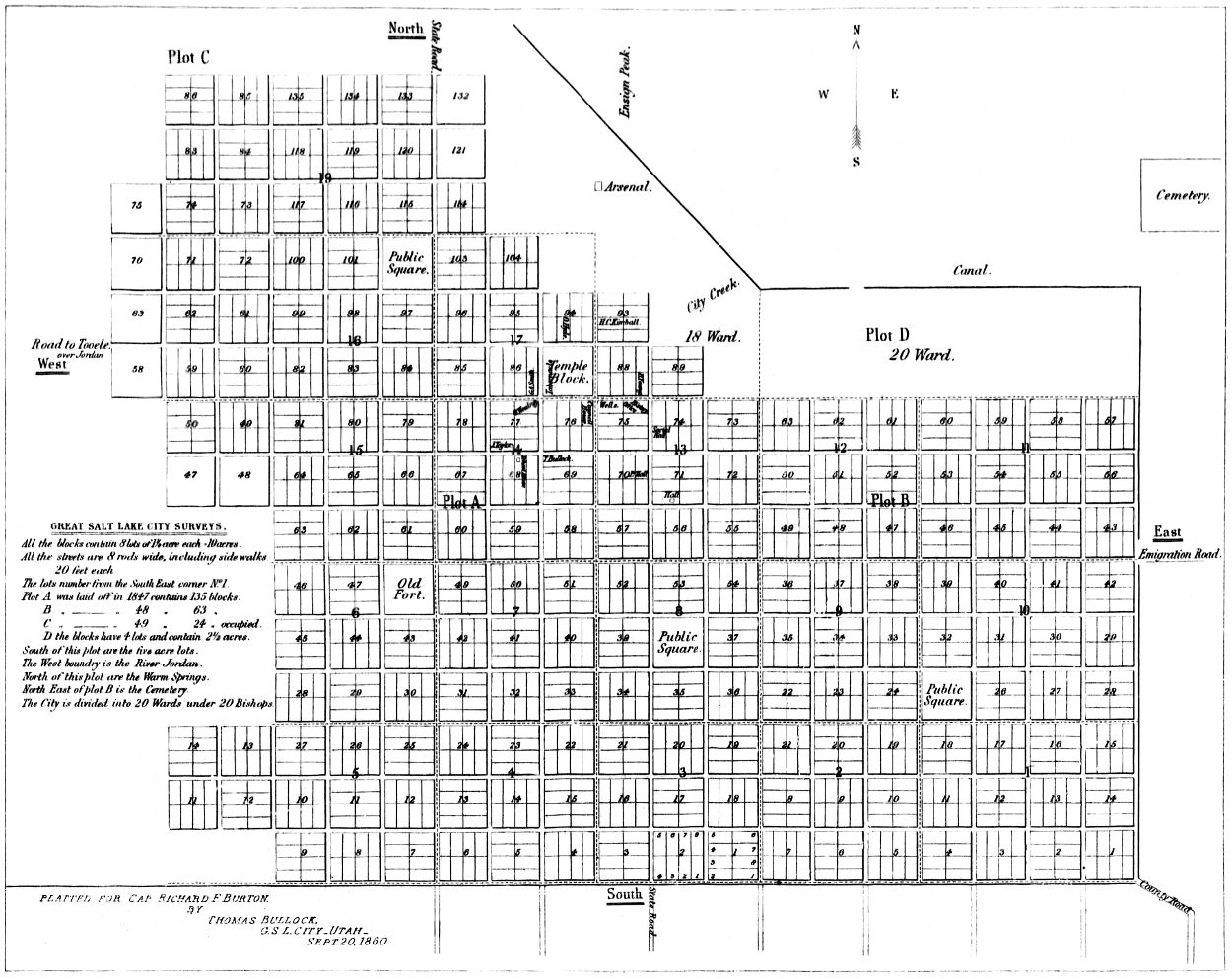
H. Adlard, sc. London, Longman & Co.
GREAT SALT LAKE CITY SURVEYS.
All the blocks contain 8 lots of 11⁄4 acre each = 10 acres.
All the streets are 8 rods wide, including side walks. 20 feet each.
The lots number from the South East corner No. 1.
Plot A was laid off in 1847 contains 135 blocks.
B „ ——— „ 48 „ 63 „
C „ ——— „ 49 „ 24 „ occupied.
D the lots have 4 blocks and contain 21⁄2 acres.
South of this plot are the five acre lots.
The West boundry is the River Jordan.
North of this plot are the Warm Springs.
North East of plot B is the Cemetery.
The City is divided into 20 Wards under 20 Bishops.
PLATTED FOR CAP. RICHARD F. BURTON. BY THOMAS BULLOCK. G. S. L. CITY _UTAH_ SEPT. 20. 1860.
Larger map (1.1 MB)
After two miles of comparatively level ground we came to the foot of “Little Mountain,” and descended from the wagon to relieve the poor devils of mules. The near slope was much shorter, but also it was steeper far than “Big Mountain.” The counterslope was easier, though by no means pleasant to contemplate with the chance of an accident to the brake, which in all inconvenient places would part with the protecting shoe-sole. Beyond the eastern foot, which was ten miles distant from our destination, we were miserably bumped and jolted over the broken ground at the head of Big Kanyon. Down this pass, whose name is a translation of the Yuta name Obitkokichi, a turbulent little mountain stream tumbles over its boulder-bed, girt with the usual sunflower, vines of wild hops, red and white willows, cotton-wood, quaking asp, and various bushes near its cool watery margin, and upon the easier slopes of the ravine, with the shin or dwarf oak (Quercus nana), mountain mahogany, balsam, and other firs, pines, and cedars. A TICKLISH ROAD.The road was a narrow shelf along the broader of the two spaces between the stream and the rock, and frequent fordings were rendered necessary by the capricious wanderings of the torrent. I could not but think how horrid must have been its appearance when the stout-hearted Mormon pioneers first ventured to thread the defile, breaking their way through the dense bush, creeping and clinging like flies to the sides of the hills. Even now accidents often occur; here, as in Echo Kanyon, we saw in more than one place unmistakable signs of upsets in the shape of broken spokes and yoke-bows. At one of the most ticklish turns Macarthy kindly pointed out a little precipice where four of the mail passengers fell and broke their necks, a pure invention on his part, I believe, which fortunately, at that moment, did not reach Mrs. Dana’s ears. He also entertained us with many a tale, of which the hero was the redoubtable Hanks: how he had slain a buffalo bull single-handed with a bowie-knife; and how, on one occasion, when refused hospitality by his Lamanite brethren, he had sworn to have the whole village to himself, and had redeemed his vow by reappearing in cuerpo, with gestures so maniacal that the sulky Indians all fled, declaring him to be “bad medicine.” The stories had at least local coloring.
In due time, emerging from the gates, and portals, and deep serrations of the upper course, we descended into a lower level: here Big, now called Emigration Kanyon,EMIGRATION KANYON. gradually bulges out, and its steep slopes of grass and fern, shrubbery and stunted brush, fall imperceptibly into the plain. The valley presently lay full before our sight. At this place the pilgrim emigrants, like the hajjis of Mecca and Jerusalem, give vent to the emotions long pent up within their bosoms by sobs and tears, laughter and congratulations, psalms and hysterics. It is indeed no wonder that the children dance, that strong men cheer and shout, and that nervous women, broken with fatigue and hope deferred, scream and faint; that the ignorant should fondly believe that the “Spirit of God pervades the very atmosphere,” and that Zion on the tops of the mountains is nearer heaven than other parts of earth. In good sooth, though uninfluenced by religious fervor—beyond the natural satisfaction of seeing a bran-new Holy City—even I could not, after nineteen days in a mail-wagon, gaze upon the scene without emotion.
The sublime and the beautiful were in present contrast. Switzerland and Italy lay side by side. The magnificent scenery of the past mountains and ravines still floated before the retina, as emerging from the gloomy depths of the Golden Pass—the mouth of Emigration Kanyon is more poetically so called—we came suddenly in view of the Holy Valley of the West.
The hour was about 6 P.M.; the atmosphere was touched with a dreamy haze, as it generally is in the vicinity of the lake; a little bank of rose-colored clouds, edged with flames of purple and gold, floated in the upper air, while the mellow radiance of an American autumn, that bright interlude between the extremes of heat and cold, diffused its mild soft lustre over the face of earth.
The sun, whose slanting rays shone full in our eyes, was setting in a flood of heavenly light behind the bold, jagged outline of “Antelope Island,” which, though distant twenty miles to the northwest, hardly appeared to be ten. At its feet, and then bounding the far horizon, lay, like a band of burnished silver, the Great Salt Lake, that still innocent Dead Sea. Southwestward also, and equally deceptive as regards distance, rose the boundary of the valley plain, the Oquirrh Range, sharply silhouetted by a sweep of sunshine over its summits, against the depths of an evening sky, in that direction so pure, so clear, that vision, one might fancy, could penetrate behind the curtain into regions beyond the confines of man’s ken. In the brilliant reflected light, which softened off into a glow of delicate pink, we could distinguish the lines of Brigham’s, Coon’s, and other kanyons, which water has traced through the wooded flanks of the Oquirrh down to the shadows already purpling the misty benches at their base. Three distinct and several shades, light azure, blue, and brown-blue, graduated the distances, which extended at least thirty miles.
The undulating valley-plain between us and the Oquirrh Range is 12·15 miles broad, and markedly concave, dipping in the centre like the section of a tunnel, and swelling at both edges into bench-lands, which mark the ancient bed of the lake. In some parts the valley was green; in others, where the sun shot its oblique beams, it was of a tawny yellowish-red, like the sands of the Arabian desert, with scatters of trees, where the Jordan of the West rolls its opaline wave through pasture-lands of dried grass dotted with flocks and herds, and fields of ripening yellow corn. Every thing bears the impress of handiwork, from the bleak benches behind to what was once a barren valley in front. Truly the Mormon prophecy had been fulfilled: already the howling wilderness—in which twelve years ago a few miserable savages, the half-naked Digger Indians, gathered their grass-seed, grasshoppers, and black crickets to keep life and soul together, and awoke with their war-cries the echo of the mountains, and the bear, the wolf, and the fox prowled over the site of a now populous city—“has blossomed like the rose.”
This valley—this lovely panorama of green, and azure, and gold—this land, fresh, as it were, from the hands of God, is apparently girt on all sides by hills: the highest peaks, raised 7000 to 8000 feet above the plain of their bases, show by gulches veined with lines of snow that even in this season winter frowns upon the last smile of summer.
Advancing, we exchanged the rough cahues and the frequent fords of the ravine for a broad smooth highway, spanning the easternmost valley-bench—a terrace that drops like a Titanic step from the midst of the surrounding mountains to the level of the present valley-plain. From a distance—the mouth of Emigration Kanyon is about 4·30 miles from the city—Zion, which is not on a hill, but, on the contrary, lies almost in the lowest part of the river-plain, is completely hid from sight, as if no such thing existed. Mr. Macarthy, on application, pointed out the notabilia of the scene.
Northward, curls of vapor ascending from a gleaming sheet—the Lake of the Hot Springs—set in a bezel of emerald green, and bordered by another lake-bench upon which the glooms of evening were rapidly gathering, hung like a veil of gauze around the waist of the mountains. Southward for twenty-five miles stretched the length of the valley, with the little river winding its way like a silver thread in a brocade of green and gold. The view in this direction was closed by “Mountain Point,”MOUNTAIN POINT. another formation of terraced range, which forms the water-gate of Jordan, and which conceals and separates the fresh water that feeds the Salt Lake—the Sea of Tiberias from the Dead Sea.
As we descend the Wasach Mountains, we could look back and enjoy the view of the eastern wall of the Happy Valley.THE HAPPY VALLEY. A little to the north of Emigration Kanyon, and about one mile nearer the settlement, is the Red Butte, a deep ravine, whose quarried sides show mottlings of the light ferruginous sandstone which was chosen for building the Temple wall.[125] A little beyond it lies the single City of the Dead, decently removed three miles from the habitations of the living, and farther to the north is City-Creek Kanyon, which supplies the Saints with water for drinking and for irrigation. Southeast of Emigration Kanyon are other ravines, Parley’s, Mill Creek, Great Cotton-wood, and Little Cotton-wood, deep lines winding down the timbered flanks of the mountains, and thrown into relief by the darker and more misty shading of the farther flank-wall.
The “Twin Peaks,” the highest points of the Wasach Mountains, are the first to be powdered over with the autumnal snow. When a black nimbus throws out these piles, with their tilted-up rock strata, jagged edges, black flanks, rugged brows, and bald heads gilt by a gleam of sunset, the whole stands boldly out with that phase of sublimity of which the sense of immensity is the principal element. Even in the clearest of weather they are rarely free from a fleecy cloud, the condensation of cold and humid air rolling up the heights and vanishing only to be renewed.
The bench-land then attracted our attention. The soil is poor, sprinkled with thin grass, in places showing a suspicious whiteness, with few flowers, and chiefly producing a salsolaceous plant like the English samphire. In many places lay long rows of bare circlets, like deserted tent-floors; they proved to be ant-hills, on which light ginger-colored swarms were working hard to throw up the sand and gravel that every where in this valley underlie the surface. The eastern valley-bench, upon whose western declivity the city lies, may be traced on a clear day along the base of the mountains for a distance of twenty miles: its average breadth is about eight miles.
After advancing about 1·50 mile over the bench ground, the city by slow degrees broke upon our sight. It showed, one may readily believe, to special advantage after the succession of Indian lodges, Canadian ranchos, and log-hut mail-stations of the prairies and the mountains. The site has been admirably chosen for drainage and irrigation—so well, indeed, that a “Deus ex machinâ” must be brought to account for it.[126] About two miles north, and overlooking the settlements from a height of 400 feet, a detached cone, called Ensign Peak or Ensign Mount, rises at the end of a chain which, projected westward from the main range of the heights, overhangs and shelters the northeastern corner of the valley. Upon this “big toe of the Wasach range,” as it is called by a local writer, the spirit of the martyred prophet, Mr. Joseph Smith, appeared to his successor, Mr. Brigham Young, and pointed out to him the position of the New Temple, which, after Zion had “got up into the high mountain,” was to console the Saints for the loss of Nauvoo the Beautiful. The city—it is about two miles broad—runs parallel with the right bank of the Jordan, which forms its western limit. It is twelve to fifteen miles distant from the western range, ten from the debouchure of the river, and eight to nine from the nearest point of the lake—a respectful distance, which is not the least of the position’s merits. It occupies the rolling brow of a slight decline at the western base of the Wasach—in fact, the lower, but not the lowest level of the eastern valley-bench; it has thus a compound slope from north to south, on the line of its water supplies, and from east to west, thus enabling it to drain off into the river.
The city revealed itself, as we approached, from behind its screen, the inclined terraces of the upper table-land, and at last it lay stretched before us as upon a map. At a little distance the aspect was somewhat Oriental, and in some points it reminded me of modern Athens without the Acropolis. None of the buildings, except the Prophet’s house, were whitewashed. The material—the thick, sun-dried adobe, common to all parts of the Eastern world[127]—was of a dull leaden blue, deepened by the atmosphere to a gray, like the shingles of the roofs. The number of gardens and compounds—each tenement within the walls originally received 1·50 square acre, and those outside from five to ten acres, according to their distance—the dark clumps and lines of bitter cotton-wood, locust, or acacia, poplars and fruit-trees, apples, peaches, and vines—how lovely they appeared, after the baldness of the prairies!—and, finally, the fields of long-eared maize and sweet sorghum strengthened the similarity to an Asiatic rather than to an American settlement. The differences presently became as salient. The farm-houses, with their stacks and stock, strongly suggested the Old Country. Moreover, domes and minarets—even churches and steeples—were wholly wanting, an omission that somewhat surprised me. The only building conspicuous from afar was the block occupied by the present Head of the Church. The court-house, with its tinned Muscovian dome, at the west end of the city; the arsenal, a barn-like structure, on a bench below the Jebel Nur of the valley—Ensign Peak; and a saw-mill, built beyond the southern boundary, were the next in importance.
On our way we passed the vestiges of an old moat, from which was taken the earth for the bulwarks of Zion.BULWARKS OF ZION. A Romulian wall, of puddle, mud, clay, and pebbles, six miles—others say 2600 acres—in length, twelve feet high, six feet broad at the base, and two and three quarters at the top, with embrasures five to six feet above the ground, and semi-bastions at half musket range, was decided, in 1853-54, to be necessary, as a defense against the Lamanites, whose name in the vulgar is Yuta Indians. Gentiles declare that the bulwarks were erected because the people wanting work were likely to “strike” faith, and that the amount of labor expended upon this folly would have irrigated as many thousand acres. Anti-Mormons have, of course, detected in the proceeding treacherous and treasonable intentions. Parenthetically, I must here warn the reader that in Great Salt Lake City there are three distinct opinions concerning, three several reasons for, and three diametrically different accounts of, every thing that happens, viz., that of the Mormons, which is invariably one-sided; that of the Gentiles, which is sometimes fair and just; and that of the anti-Mormons, which is always prejudiced and violent. A glance will show that this much-talked-of fortification is utterly harmless; it is commanded in half a dozen places; it could not keep out half a dozen sappers for a quarter of an hour; and now, as it has done its work, its foundations are allowed to become salt, and to crumble away.
The road ran through the Big Field, southeast of the city, six miles square, and laid off in five-acre lots. Presently, passing the precincts of habitation, we entered, at a slapping pace, the second ward, called Denmark, from its tenants, who mostly herd together. The disposition of the settlement is like that of the nineteenth century New-World cities—from Washington to the future metropolis of the great Terra Australis—a system of right angles, the roads, streets, and lanes, if they can be called so, intersecting one another. The advantages or disadvantages of the rectangular plan have been exhausted in argument; the new style is best suited, I believe, for the New, as the old must, perforce, remain in the Old World. The suburbs are thinly settled; the mass of habitations lie around and south of Temple Block. The streets of the suburbs are mere roads, cut by deep ups and downs, and by gutters on both sides, which, though full of pure water, have no bridge save a plank at the trottoirs. In summer the thoroughfares are dusty, in wet weather deep with viscid mud.
The houses are almost all of one pattern—a barn shape, with wings and lean-tos, generally facing, sometimes turned endways to the street, which gives a suburban look to the settlement; and the diminutive casements show that window-glass is not yet made in the Valley. In the best abodes the adobe rests upon a few courses of sandstone, which prevent undermining by water or ground-damp, and it must always be protected by a coping from the rain and snow. The poorer are small, low, and hut-like; others are long single-storied buildings, somewhat like stables, with many entrances. The best houses resemble East Indian bungalows, with flat roofs, and low, shady verandas, well trellised, and supported by posts or pillars. All are provided with chimneys, and substantial doors to keep out the piercing cold. The offices are always placed, for hygienic reasons, outside; and some have a story and a half—the latter intended for lumber and other stores. I looked in vain for the out-house harems, in which certain romancers concerning things Mormon had informed me that wives are kept, like any other stock. I presently found this but one of a multitude of delusions. Upon the whole, the Mormon settlement was a vast improvement upon its contemporaries in the valleys of the Mississippi and the Missouri.
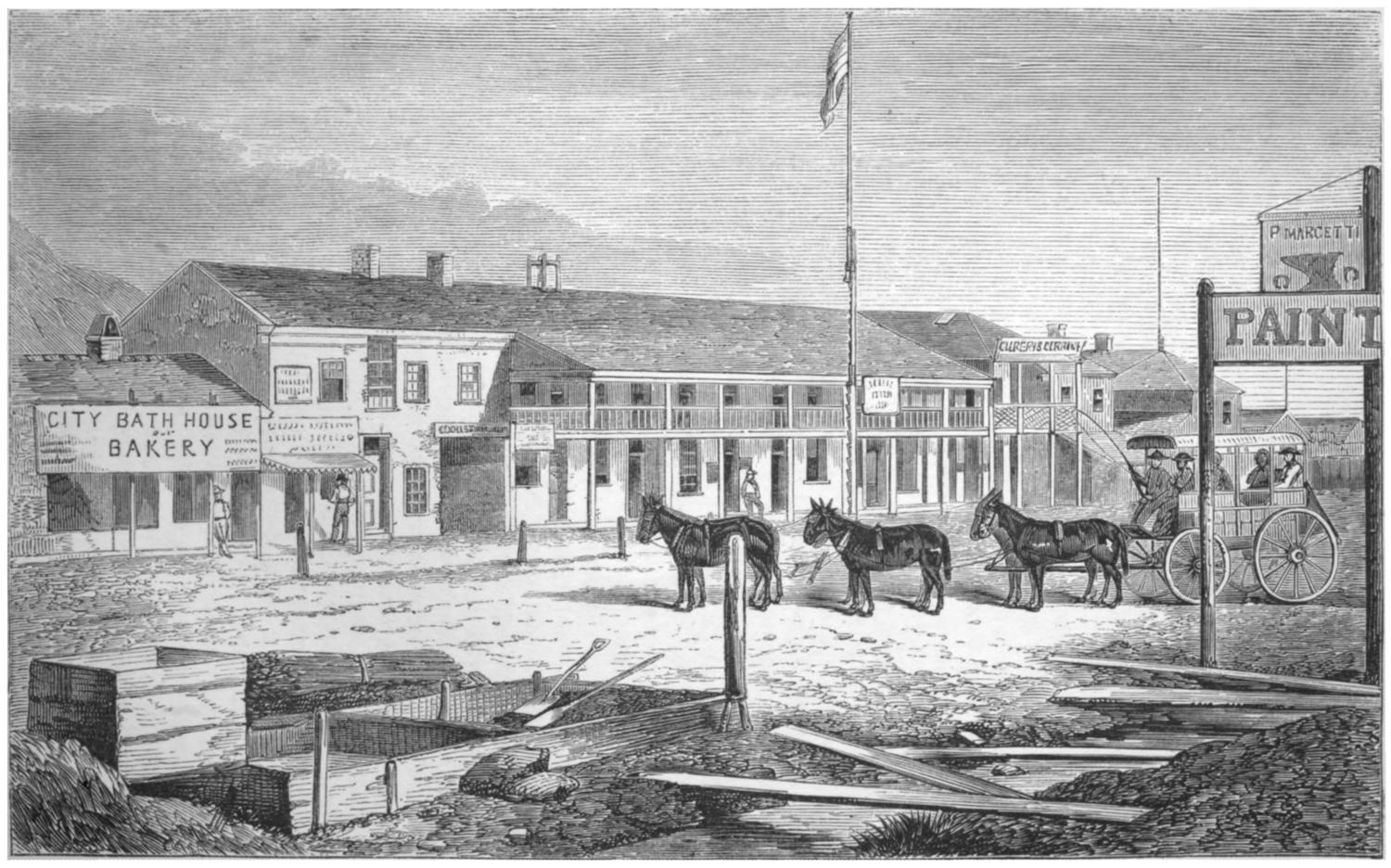
STORES IN MAIN STREET.
The road through the faubourg was marked by posts and rails, which, as we advanced toward the heart of the city, were replaced by neat palings. The garden-plots were small,GARDENS. as sweet earth must be brought down from the mountains; and the flowers were principally those of the Old Country—the red French bean, the rose, the geranium, and the single pink; the ground or winter cherry was common; so were nasturtiums; and we saw tansy, but not that plant for which our souls, well-nigh weary of hopes of juleps long deferred, chiefly lusted—mint. The fields were large and numerous, but the Saints have too many and various occupations to keep them, Moravian-like, neat and trim; weeds overspread the ground; often the wild sunflower-tops outnumbered the heads of maize. The fruit had suffered from an unusually nipping frost in May; the peach-trees were barren; the vines bore no produce; only a few good apples were in Mr. Brigham Young’s garden, and the watermelons were poor, yellow, and tasteless, like the African. On the other hand, potatoes, onions, cabbages, and cucumbers were good and plentiful, the tomato was ripening every where, fat full-eared wheat rose in stacks, and crops of excellent hay were scattered about near the houses. The people came to their doors to see the mail-coach, as if it were the “Derby dilly” of old, go by. I could not but be struck by the modified English appearance of the colony, and by the prodigious numbers of the white-headed children.
Presently we debouched upon the main thoroughfare, the centre of population and business, where the houses of the principal Mormon dignitaries and the stores of the Gentile merchants combine to form the city’s only street which can be properly so called. It is, indeed, both street and market, for, curious to say, New Zion has not yet built for herself a bazar or market-place. Nearly opposite the Post-office, in a block on the eastern side, with a long veranda, supported by trimmed and painted posts, was a two-storied, pent-roofed building,THE HOTEL IN NEW ZION. whose sign-board, swinging to a tall, gibbet-like flag-staff, dressed for the occasion, announced it to be the Salt Lake House, the principal, if not the only establishment of the kind in New Zion. In the Far West, one learns not to expect much of the hostelry;[128] I had not seen aught so grand for many a day. Its depth is greater than its frontage, and behind it, secured by a porte cochère, is a large yard for corraling cattle. A rough-looking crowd of drivers, drivers’ friends, and idlers, almost every man openly armed with revolver and bowie-knife, gathered round the doorway to greet Jim, and “prospect” the “new lot;” and the host came out to assist us in transporting our scattered effects. We looked vainly for a bar on the ground floor; a bureau for registering names was there, but (temperance, in public at least, being the order of the day) the usual tempting array of bottles and decanters was not forthcoming; up stairs we found a Gentile ballroom, a tolerably furnished sitting-room, and bedchambers, apparently made out of a single apartment by partitions too thin to be strictly agreeable. The household had its deficiencies; blacking, for instance, had run out, and servants could not be engaged till the expected arrival of the hand-cart train. However, the proprietor, Mr. Townsend, a Mormon, from the State of Maine—when expelled from Nauvoo, he had parted with land, house, and furniture for $50—who had married an Englishwoman, was in the highest degree civil and obliging, and he attended personally to our wants, offered his wife’s services to Mrs. Dana, and put us all in the best of humors, despite the closeness of the atmosphere, the sadness ever attending one’s first entrance into a new place, the swarms of “emigration flies”—so called because they appear in September with the emigrants, and, after living for a month, die off with the first snow—and a certain populousness of bedstead, concerning which the less said the better. Such, gentle reader, are the results of my first glance at Zion on the tops of the mountains, in the Holy City of the Far West.