Chapter I · Why I went to Great Salt Lake City.—The various Routes.—The Line of Country traversed.—Diaries and Disquisitions.
Reading edition
A tour through the domains of Uncle Samuel without visiting the wide regions of the Far West would be, to use a novel simile, like seeing Hamlet with the part of Prince of Denmark, by desire, omitted. Moreover, I had long determined to add the last new name to the list of “Holy Cities;” to visit the young rival, soi-disant, of Memphis, Benares, Jerusalem, Rome, Meccah; and after having studied the beginnings of a mighty empire “in that New World which is the Old,” to observe the origin and the working of a regular go-ahead Western and Columbian revelation. Mingled with the wish of prospecting the City of the Great Salt Lake in a spiritual point of view, of seeing Utah as it is, not as it is said to be, was the mundane desire of enjoying a little skirmishing with the savages, who in the days of Harrison and Jackson had given the pale faces tough work to do, and that failing, of inspecting the line of route which Nature, according to the general consensus of guide-books, has pointed out as the proper, indeed the only practical direction for a railway between the Atlantic and the Pacific. The commerce of the world, the Occidental Press had assured me, is undergoing its grand climacteric: the resources of India and the nearer orient are now well-nigh cleared of “loot,” and our sons, if they would walk in the paths of their papas, must look to Cipangri and the parts about Cathay for their annexations.
The Man was ready, the Hour hardly appeared propitious for other than belligerent purposes. Throughout the summer of 1860 an Indian war was raging in Nebraska; the Comanches, Kiowas, and Cheyennes were “out;” the Federal government had dispatched three columns to the centres of confusion; intestine feuds among the aborigines were talked of; the Dakotah or Sioux had threatened to “wipe out” their old foe the Pawnee, both tribes being possessors of the soil over which the road ran. Horrible accounts of murdered post-boys and cannibal emigrants, greatly exaggerated, as usual, for private and public purposes, filled the papers, and that nothing might be wanting, the following positive assertion (I afterward found it to be, as Sir Charles Napier characterized one of a Bombay editor’s saying, “a marked and emphatic lie”) was copied by full half the press:
“Utah has a population of some fifty-two or fifty-three thousand—more or less—rascals. Governor Cumming has informed the President exactly how matters stand in respect to them. Neither life nor property is safe, he says, and bands of depredators roam unpunished through the territory. The United States judges have abandoned their offices, and the law is boldly defied every where. He requests that 500 soldiers may be retained at Utah to afford some kind of protection to American citizens who are obliged to remain here.”
“Mormon” had in fact become a word of fear; the Gentiles looked upon the Latter-Day Saints much as our crusading ancestors regarded the “Hashshashiyun,” whose name, indeed, was almost enough to frighten them. Mr. Brigham Young was the Shaykh-el-Jebel, the Old Man of the Hill redivivus, Messrs. Kimball and Wells were the chief of his Fidawin, and “Zion on the tops of the mountains” formed a fair representation of Alamut.
“Going among the Mormons!” said Mr. M—— to me at New Orleans; “they are shooting and cutting one another in all directions; how can you expect to escape?”
Another general assertion was that “White Indians”—those Mormons again!—had assisted the “Washoes,” “Pah Utes,” and “Bannacks” in the fatal affair near Honey Lake, where Major Ormsby, of the militia, a military frontier-lawyer, and his forty men, lost the numbers of their mess.
But sagely thus reflecting that “dangers which loom large from afar generally lose size as one draws near;” that rumors of wars might have arisen, as they are wont to do, from the political necessity for another “Indian botheration,” as editors call it; that Governor Cumming’s name might have been used in vain; that even the President might not have been a Pope, infallible; and that the Mormons might turn out somewhat less black than they were painted; moreover, having so frequently and willfully risked the chances of an “I told you so” from the lips of friends, those “prophets of the past;” and, finally, having been so much struck with the discovery by some Western man of an enlarged truth, viz., that the bugbear approached has more affinity to the bug than to the bear, I resolved to risk the chance of the “red nightcap” from the bloodthirsty Indian and the poisoned bowie-dagger—without my Eleonora or Berengaria—from the jealous Latter-Day Saints. I forthwith applied myself to the audacious task with all the recklessness of a “party” from town precipitating himself for the first time into “foreign parts” about Calais.
And, first, a few words touching routes.
THE PACIFIC RAILROADAs all the world knows, there are three main lines proposed for a “Pacific Railroad” between the Mississippi and the Western Ocean, the Northern, Central, and Southern.[2]
The first, or British, was in my case not to be thought of; it involves semi-starvation, possibly a thorough plundering by the Bedouins, and, what was far worse, five or six months of slow travel. The third, or Southern, known as the Butterfield or American Express, offered to start me in an ambulance from St. Louis, and to pass me through Arkansas, El Paso, Fort Yuma on the Gila River, in fact through the vilest and most desolate portion of the West. Twenty-four mortal days and nights—twenty-five being schedule time—must be spent in that ambulance; passengers becoming crazy by whisky, mixed with want of sleep, are often obliged to be strapped to their seats; their meals, dispatched during the ten-minute halts, are simply abominable, the heats are excessive, the climate malarious; lamps may not be used at night for fear of unexisting Indians: briefly, there is no end to this Via Mala’s miseries. The line received from the United States government upward of half a million of dollars per annum for carrying the mails, and its contract had still nearly two years to run.
There remained, therefore, the central route, which has two branches. You may start by stage to the gold regions about Denver City or Pike’s Peak, and thence, if not accidentally or purposely shot, you may proceed by an uncertain ox-train to Great Salt Lake City, which latter part can not take less than thirty-five days. On the other hand, there is “the great emigration route” from Missouri to California and Oregon, over which so many thousands have traveled within the past few years. I quote from a useful little volume, “The Prairie Traveler,”[7] by Randolph B. Marcy, Captain U. S. Army. “The track is broad, well worn, and can not be mistaken. It has received the major part of the Mormon emigration, and was traversed by the army in its march to Utah in 1857.”
The mail-coach on this line was established in 1850, by Colonel Samuel H. Woodson, an eminent lawyer, afterward an M. C., and right unpopular with Mormondom, because he sacrilegiously owned part of Temple Block, in Independence, Mo., which is the old original New Zion. The following are the rates of contract and the phases through which the line has passed.
1. Colonel Woodson received for carrying a monthly mail $19,500 (or $23,000?): length of contract 4 years.
2. Mr. F. McGraw, $13,500, besides certain considerable extras.
3. Messrs. Heber Kimball & Co. (Mormons), $23,000.
4. Messrs. Jones & Co., $30,000.
5. Mr. J. M. Hockaday, weekly mail, $190,000.
6. Messrs. Russell, Majors, & Waddell, army contractors; weekly mail, $190,000.[8]
Thus it will be seen that in 1856 the transit was in the hands of the Latter-Day Saints: they managed it well, but they lost the contracts during their troubles with the federal government in 1857, when it again fell into Gentile possession. In those early days it had but three changes of mules, at Forts Bridger, Laramie, and Kearney. In May, 1859, it was taken up by the present firm, which expects, by securing the monopoly of the whole line between the Missouri River and San Francisco, and by canvassing at head-quarters for a bi-weekly—which they have now obtained—and even a daily transit, which shall constitutionally extinguish the Mormon community, to insert the fine edge of that wedge which is to open an aperture for the Pacific Railroad about to be. At Saint Joseph (Mo.), better known by the somewhat irreverent abbreviation of St. Jo, I was introduced to Mr. Alexander Majors, formerly one of the contractors for supplying the army in THE UTAH LINE.Utah—a veteran mountaineer, familiar with life on the prairies. His meritorious efforts to reform the morals of the land have not yet put forth even the bud of promise. He forbade his drivers and employés to drink, gamble, curse, and travel on Sundays; he desired them to peruse Bibles distributed to them gratis; and though he refrained from a lengthy proclamation commanding his lieges to be good boys and girls, he did not the less expect it of them. Results: I scarcely ever saw a sober driver; as for profanity—the Western equivalent for hard swearing—they would make the blush of shame crimson the cheek of the old Isis bargee; and, rare exceptions to the rule of the United States, they are not to be deterred from evil talking even by the dread presence of a “lady.” The conductors and road-agents are of a class superior to the drivers; they do their harm by an inordinate ambition to distinguish themselves. I met one gentleman who owned to three murders, and another individual who lately attempted to ration the mules with wild sage. The company was by no means rich; already the papers had prognosticated a failure, in consequence of the government withdrawing its supplies, and it seemed to have hit upon the happy expedient of badly entreating travelers that good may come to it of our evils. The hours and halting-places were equally vilely selected; for instance, at Forts Kearney, Laramie, and Bridger, the only points where supplies, comfort, society, are procurable, a few minutes of grumbling delay were granted as a favor, and the passengers were hurried on to some distant wretched ranch,[9] apparently for the sole purpose of putting a few dollars into the station-master’s pockets. The travel was unjustifiably slow, even in this land, where progress is mostly on paper. From St. Jo to Great Salt Lake City, the mails might easily be landed during the fine weather, without inconvenience to man or beast, in ten days; indeed, the agents have offered to place them at Placerville in fifteen. Yet the schedule time being twenty-one days, passengers seldom reached their destination before the nineteenth; the sole reason given was, that snow makes the road difficult in its season, and that if people were accustomed to fast travel, and if letters were received under schedule time, they would look upon the boon as a right.
Before proceeding to our preparations for travel, it may be as well to cast a glance at the land to be traveled over.
The United States territory lying in direct line between the Mississippi River and the Pacific Ocean is now about 1200 miles long from north to south, by 1500 of breadth, in 49° and 32° N. lat., about equal to Equatorial Africa, and 1800 in N. lat. 38°. The great uncultivable belt of plain and mountain region through which the Pacific Railroad must run has a width of 1100 statute miles near the northern boundary; in the central line, 1200; and through the southern, 1000. Humboldt justly ridiculed the “maddest natural philosopher” who compared the American continent to a female figure—long, thin, watery, and freezing at the 58th°, the degrees being symbolic of the year at which woman grows old. Such description manifestly will not apply to the 2,000,000 of square miles in this section of the Great Republic—she is every where broader than she is long.
The meridian of 105° north longitude (G.)—Fort Laramie lies in 104° 31′ 26″—divides this vast expanse into two nearly equal parts. The eastern half is a basin or river valley rising gradually from the Mississippi to the Black Hills, and the other outlying ranges of the Rocky Mountains. The average elevation near the northern boundary (49°) is 2500 feet, in the middle latitude (38°) 6000 feet, and near the southern extremity (32°), about 4000 feet above sea level. These figures explain the complicated features of its water-shed. The western half is a mountain region whose chains extend, as far as they are known, in a general N. and S. direction.
The 99th meridian (G.)—Fort Kearney lies in 98° 58′ 11″—divides the western half of the Mississippian Valley into two unequal parts.
The eastern portion, from the Missouri to Fort Kearney—400 to 500 miles in breadth—may be called the “Prairie land.” It is true that passing westward of the 97° meridian, the mauvaises terres, or Bad Grounds, are here and there met with, especially near the 42d parallel, in which latitude they extend farther to the east, and that upward to 99° the land is rarely fit for cultivation, though fair for grazing. Yet along the course of the frequent streams there is valuable soil, and often sufficient wood to support settlements. This territory is still possessed by settled Indians, by semi-nomads, and by powerful tribes of equestrian and wandering savages, mixed with a few white men, who, as might be expected, excel them in cunning and ferocity.
The western portion of the valley, from Fort Kearney to the base of the Rocky Mountains—a breadth of 300 to 400 miles—is emphatically “the desert,” sterile and uncultivable, a dreary expanse of wild sage (artemisia) and saleratus. The surface is sandy, gravelly, and pebbly; cactus carduus and aloes abound; THE WESTERN GRAZING-GROUNDS.grass is found only in the rare river bottoms where the soils of the different strata are mixed, and the few trees along the borders of streams—fertile lines of wadis, which laborious irrigation and coal mining might convert into oases—are the cotton-wood and willow, to which the mezquite[10] may be added in the southern latitudes. The desert is mostly uninhabited, unendurable even to the wildest Indian. But the people on its eastern and western frontiers, namely, those holding the extreme limits of the fertile prairie, and those occupying the desirable regions of the western mountains, are, to quote the words of Lieutenant Gouverneur K. Warren, U. S. Topographical Engineers, whose valuable reconnaissances and explanations of Nebraska in 1855, ’56, and ’57 were published in the Reports of the Secretary of War, “on the shore of a sea, up to which population and agriculture may advance and no farther. But this gives these outposts much of the value of places along the Atlantic frontier, in view of the future settlements to be formed in the mountains, between which and the present frontier a most valuable trade would exist. The western frontier has always been looking to the east for a market; but as soon as the wave of emigration has passed over the desert portion of the plains, to which the discoveries of gold have already given an impetus that will propel it to the fertile valleys of the Rocky Mountains, then will the present frontier of Kansas and Nebraska become the starting-point for all the products of the Mississippi Valley which the population of the mountains will require. We see the effects of it in the benefits which the western frontier of Missouri has received from the Santa Fé tract, and still more plainly in the impetus given to Leavenworth by the operations of the army of Utah in the interior region. This flow of products has, in the last instance, been only in one direction; but when those mountains become settled, as they eventually must, then there will be a reciprocal trade materially beneficial to both.”
The mountain region westward of the sage and saleratus desert, extending between the 105th and 111th meridian (G.)—a little more than 400 miles—will in time become sparsely peopled. Though in many parts arid and sterile, dreary and desolate, the long bunch grass (Festuca), the short curly buffalo grass (Sisleria dactyloides), the mesquit grass (Stipa spata), and the Gramma, or rather, as it should be called, “Gamma” grass (Chondrosium fœnum),[11] which clothe the slopes west of Fort Laramie, will enable it to rear an abundance of stock. The fertile valleys, according to Lieutenant Warren, “furnish the means of raising sufficient quantities of grain and vegetables for the use of the inhabitants, and beautiful healthy and desirable locations for their homes. The remarkable freedom here from sickness is one of the attractive features of the region, and will in this respect go far to compensate the settler from the Mississippi Valley for his loss in the smaller amount of products that can be taken from the soil. The great want of suitable building material, which now so seriously retards the growth of the West, will not be felt there.” The heights of the Rocky Mountains rise abruptly from 1000 to 6000 feet over the lowest known passes, computed by the Pacific Railroad surveyors to vary from 4000 to 10,000 feet above sea-level. The two chains forming the eastern and western rims of the Rocky Mountain basin have the greatest elevation, walling in, as it were, the other sub-ranges.
There is a popular idea that the western slope of the Rocky Mountains is smooth and regular; on the contrary, the land is rougher, and the ground is more complicated than on the eastern declivities. From the summit of the Wasach range to the eastern foot of the Sierra Nevada, the whole region, with exceptions, is a howling wilderness, the sole or bed of an inland sweetwater sea, now shrunk into its remnants—the Great Salt and the Utah Lakes. Nothing can be more monotonous than its regular succession of high grisly hills, cut perpendicularly by rough and rocky ravines, and separating bare and barren plains. From the seaward base of the Sierra Nevada to the Pacific—California—the slope is easy, and the land is pleasant, fertile, and populous.
After this aperçu of the motives which sent me forth, once more a pilgrim, to young Meccah in the West, of the various routes, and of the style of country wandered over, I plunge at once into personal narrative.
Lieutenant Dana (U. S. Artillery), my future compagnon de voyage, left St. Louis,[12] “the turning-back place of English sportsmen,” for St. Jo on the 2d of August, preceding me by two days. Being accompanied by his wife and child, and bound on a weary voyage to Camp Floyd, Utah Territory, he naturally wanted a certain amount of precise information concerning the route, and one of the peculiarities of this line is that no one knows any thing about it. In the same railway car which carried me from St. Louis were five passengers, all bent upon making Utah with the least delay—an unexpected cargo of officials: Mr. F********, a federal judge with two sons; Mr. W*****, a state secretary; and Mr. G****, a state marshal. As the sequel may show, Dana was doubly fortunate in securing places before the list could be filled up by the unusual throng: all we thought of at the time was our good luck in escaping a septidium at St. Jo, whence the stage started on Tuesdays only. We hurried, therefore, to pay for our tickets—$175 each being the moderate sum—to reduce our luggage to its minimum approach toward 25 lbs., the price of transport for excess being exorbitantly fixed at $1 per lb., and to lay in a few necessaries for the way, tea and sugar, tobacco and cognac. I will not take liberties with my company’s KIT.“kit;” my own, however, was represented as follows:
One India-rubber blanket, pierced in the centre for a poncho, and garnished along the longer side with buttons, and corresponding elastic loops with a strap at the short end, converting it into a carpet-bag—a “sine quâ non” from the equator to the pole. A buffalo robe ought to have been added as a bed: ignorance, however, prevented, and borrowing did the rest. With one’s coat as a pillow, a robe, and a blanket, one may defy the dangerous “bunks” of the stations.
For weapons I carried two revolvers: from the moment of leaving St. Jo to the time of reaching Placerville or Sacramento the pistol should never be absent from a man’s right side—remember, it is handier there than on the other—nor the bowie-knife from his left. Contingencies with Indians and others may happen, when the difference of a second saves life: the revolver should therefore be carried with its butt to the fore, and when drawn it should not be leveled as in target practice, but directed toward the object by means of the right fore finger laid flat along the cylinder while the medius draws the trigger. The instinctive consent between eye and hand, combined with a little practice, will soon enable the beginner to shoot correctly from the hip; all he has to do is to think that he is pointing at the mark, and pull. As a precaution, especially when mounted upon a kicking horse, it is wise to place the cock upon a capless nipple, rather than trust to the intermediate pins. In dangerous places the revolver should be discharged and reloaded every morning, both for the purpose of keeping the hand in, and to do the weapon justice. A revolver is an admirable tool when properly used; those, however, who are too idle or careless to attend to it, had better carry a pair of “Derringers.” For the benefit of buffalo and antelope, I had invested $25 at St. Louis in a “shooting-iron” of the “Hawkins” style—that enterprising individual now dwells in Denver City—it was a long, top-heavy rifle; it weighed 12 lbs., and it carried the smallest ball—75 to the pound—a combination highly conducive to good practice. Those, however, who can use light weapons, should prefer the Maynard breech-loader, with an extra barrel for small shot; and if Indian fighting is in prospect, the best tool, without any exception, is a ponderous double-barrel, 12 to the pound, and loaded as fully as it can bear with slugs. The last of the battery was an air-gun to astonish the natives, and a bag of various ammunition.
Captain Marcy outfits his prairie traveler with a “little blue mass, quinine, opium, and some cathartic medicine put up in doses for adults.” I limited myself to the opium, which is invaluable when one expects five consecutive days and nights in a prairie wagon, quinine, and Warburg’s drops, without which no traveler should ever face fever, and a little citric acid, which, with green tea drawn off the moment the leaf has sunk, is perhaps the best substitute for milk and cream. The “holy weed Nicotian” was not forgotten; cigars must be bought in extraordinary quantities, as the driver either receives or takes the lion’s share: the most satisfactory outfit is a quantum sufficit of Louisiana Pirique and Lynchburg gold-leaf—cavendish without its abominations of rum and honey or molasses—and two pipes, a meerschaum for luxury, and a brier-root to fall back upon when the meerschaum shall have been stolen. The Indians will certainly pester for matches; the best lighting apparatus, therefore, is the Spanish mechero, the Oriental sukhtah—agate and cotton match—besides which, it offers a pleasing exercise, like billiards, and one at which the British soldier greatly excels, surpassed only by his exquisite skill in stuffing the pipe.
For literary purposes, I had, besides the two books above quoted, a few of the great guns of exploration, Frémont, Stansbury, and Gunnison, with a selection of the most violent Mormon and Anti-Mormon polemicals, sketching materials—I prefer the “improved metallics” five inches long, and serving for both diary and drawing-book—and a tourist’s writing-case of those sold by Mr. Field (Bible Warehouse, The Quadrant), with but one alteration, a snap lock, to obviate the use of that barbarous invention called a key. For instruments I carried a pocket sextant with a double face, invented by Mr. George, of the Royal Geographical Society, and beautifully made by Messrs. Cary, an artificial horizon of black glass, and bubble tubes to level it, night and day compasses, with a portable affair attached to a watch-chain—a traveler feels nervous till he can “orienter” himself—a pocket thermometer, and a B. P. ditto. The only safe form for the latter would be a strong neckless tube, the heavy pyriform bulbs in general use never failing to break at the first opportunity. A Stanhope lens, a railway whistle, and instead of the binocular, useful things of earth, a very valueless telescope—(warranted by the maker to show Jupiter’s satellites, and by utterly declining so to do, reading a lesson touching the non-advisability of believing an instrument-maker)—completed the outfit.
The prairie traveler is not particular about TOILET.toilet: the easiest dress is a dark flannel shirt, worn over the normal article; no braces—I say it, despite Mr. Galton—but broad leather belt for “six-shooter” and for “Arkansas tooth-pick,” a long clasp-knife, or for the rapier of the Western world, called after the hero who perished in the “red butchery of the Alamo.” The nether garments should be forked with good buckskin, or they will infallibly give out, and the lower end should be tucked into the boots, after the sensible fashion of our grandfathers, before those ridiculous Wellingtons were dreamed of by our sires. In warm weather, a pair of moccasins will be found easy as slippers, but they are bad for wet places; they make the feet tender, they strain the back sinews, and they form the first symptom of the savage mania. Socks keep the feet cold; there are, however, those who should take six pair. The use of the pocket-handkerchief is unknown in the plains; some people, however, are uncomfortable without it, not liking “se emungere” after the fashion of Horace’s father.
In cold weather—and rarely are the nights warm—there is nothing better than the old English tweed shooting-jacket, made with pockets like a poacher’s, and its similar waistcoat, a “stomach warmer” without a roll collar, which prevents comfortable sleep, and with flaps as in the Year of Grace 1760, when men were too wise to wear our senseless vests, whose only property seems to be that of disclosing after exertions a lucid interval of linen or longcloth. For driving and riding, a large pair of buckskin gloves, or rather gauntlets, without which even the teamster will not travel, and leggins—the best are made in the country, only the straps should be passed through and sewn on to the leathers—are advisable, if at least the man at all regards his epidermis: it is almost unnecessary to bid you remember spurs, but it may be useful to warn you that they will, like riches, make to themselves wings. The head-covering by excellence is a brown felt, which, by a little ingenuity, boring, for instance, holes round the brim to admit a ribbon, you may convert into a riding-hat or night-cap, and wear alternately after the manly slouch of Cromwell and his Martyr, the funny three-cornered spittoon-like “shovel” of the Dutch Georges, and the ignoble cocked-hat, which completes the hideous metamorphosis.
And, above all things, as you value your nationality—this is written for the benefit of the home reader—let no false shame cause you to forget your hat-box and your umbrella. I purpose, when a moment of inspiration waits upon leisure and a mind at ease, to invent an elongated portmanteau, which shall be perfection—portable—solid leather of two colors, for easy distinguishment—snap lock—in length about three feet; in fact, long enough to contain without creasing “small clothes,” a lateral compartment destined for a hat, and a longitudinal space where the umbrella can repose: its depth—but I must reserve that part of the secret until this benefit to British humanity shall have been duly made by Messrs. Bengough Brothers, and patented by myself.
The dignitaries of the mail-coach, acting upon the principle “first come first served,” at first decided, maugre all our attempts at “moral suasion,” to divide the party by the interval of a week. Presently reflecting, I presume, upon the unadvisability of leaving at large five gentlemen, who, being really in no particular hurry, might purchase a private conveyance and start leisurely westward, they were favored with a revelation of “’cuteness.” On the day before departure, as, congregated in the Planter’s House Hotel, we were lamenting over our “morning glory,” the necessity of parting—in the prairie the more the merrier, and the fewer the worse cheer—a youth from the office was introduced to tell, Hope-like, a flattering tale and a tremendous falsehood. This juvenile delinquent stated with unblushing front, over the hospitable cocktail, that three coaches instead of one had been newly and urgently applied for by the road-agent at Great Salt Lake City, and therefore that we could not only all travel together, but also all travel with the greatest comfort. We exulted. But on the morrow only two conveyances appeared, and not long afterward the two dwindled off to one. “The Prairie Traveler” doles out wisdom in these words: “Information concerning the route coming from strangers living or owning property near them, from agents of steam-boats and railways, or from other persons connected with transportation companies”—how carefully he piles up the heap of sorites—“should be received with great caution, and never without corroboratory evidence from disinterested sources.” The main difficulty is to find the latter—to catch your hare—to know whom to believe.
I now proceed to my Diary.
THE START.
Tuesday, 7th August, 1860.
Precisely at 8 A.M. appeared in front of the Patee House—the Fifth Avenue Hotel of St. Jo—the vehicle destined to be our home for the next three weeks. We scrutinized it curiously.
The mail is carried by a “Concord coach,” a spring wagon, comparing advantageously with the horrible vans which once dislocated the joints of men on the Suez route. MAIL-COACH.—MULES.The body is shaped somewhat like an English tax-cart considerably magnified. It is built to combine safety, strength, and lightness, without the slightest regard to appearances. The material is well-seasoned white oak—the Western regions, and especially Utah, are notoriously deficient in hard woods—and the manufacturers are the well-known coachwrights, Messrs. Abbott, of Concord, New Hampshire; the color is sometimes green, more usually red, causing the antelopes to stand and stretch their large eyes whenever the vehicle comes in sight. The wheels are five to six feet apart, affording security against capsising, with little “gather” and less “dish;” the larger have fourteen spokes and seven fellies; the smaller twelve and six. The tires are of unusual thickness, and polished like steel by the hard dry ground; and the hubs or naves and the metal nave-bands are in massive proportions. The latter not unfrequently fall off as the wood shrinks, unless the wheel is allowed to stand in water; attention must be paid to resetting them, or in the frequent and heavy “sidlins” the spokes may snap off all round like pipe-stems. The wagon-bed is supported by iron bands or perpendiculars abutting upon wooden rockers, which rest on strong leather thoroughbraces: these are found to break the jolt better than the best steel springs, which, moreover, when injured, can not readily be repaired. The whole bed is covered with stout osnaburg supported by stiff bars of white oak; there is a sun-shade or hood in front, where the driver sits, a curtain behind which can be raised or lowered at discretion, and four flaps on each side, either folded up or fastened down with hooks and eyes. In heavy frost the passengers must be half dead with cold, but they care little for that if they can go fast. The accommodations are as follows: In front sits the driver, with usually a conductor or passenger by his side; a variety of packages, large and small, is stowed away under his leather cushion; when the brake must be put on, an operation often involving the safety of the vehicle, his right foot is planted upon an iron bar which presses by a leverage upon the rear wheels; and in hot weather a bucket for watering the animals hangs over one of the lamps, whose companion is usually found wanting. The inside has either two or three benches fronting to the fore or placed vis-à-vis; they are movable and reversible, with leather cushions and hinged padded backs; unstrapped and turned down, they convert the vehicle into a tolerable bed for two persons or two and a half. According to Cocker, the mail-bags should be safely stowed away under these seats, or if there be not room enough, the passengers should perch themselves upon the correspondence; the jolly driver, however, is usually induced to cram the light literature between the wagon-bed and the platform, or running-gear beneath, and thus, when ford-waters wash the hubs, the letters are pretty certain to endure ablution. Behind, instead of dicky, is a kind of boot where passengers’ boxes are stored beneath a stout canvas curtain with leather sides. The comfort of travel depends upon packing the wagon; if heavy in front or rear, or if the thoroughbraces be not properly “fixed,” the bumping will be likely to cause nasal hemorrhage. The description will apply to the private ambulance, or, as it is called in the West, “avalanche,” only the latter, as might be expected, is more convenient; it is the drosky in which the vast steppes of Central America are crossed by the government employés.
On this line mules are preferred to horses as being more enduring. They are all of legitimate race; the breed between the horse and the she-ass is never heard of, and the mysterious jumard is not believed to exist. In dry lands, where winter is not severe—they inherit the sire’s impatience of cold—they are invaluable animals; in swampy ground this American dromedary is the meanest of beasts, requiring, when stalled, to be hauled out of the mire before it will recover spirit to use its legs. For sureness of foot (during a journey of more than 1000 miles, I saw but one fall and two severe stumbles), sagacity in finding the road, apprehension of danger, and general cleverness, mules are superior to their mothers: their main defect is an unhappy obstinacy derived from the other side of the house. They are great in hardihood, never sick nor sorry, never groomed nor shod, even where ice is on the ground; they have no grain, except five quarts per diem when snow conceals the grass; and they have no stable save the open corral. Moreover, a horse once broken down requires a long rest; the mule, if hitched up or ridden for short distances, with frequent intervals to roll and repose, may still, though “resté,” get over 300 miles in tolerable time. The rate of travel on an average is five miles an hour; six is good; between seven and eight is the maximum, which sinks in hilly countries to three or four. I have made behind a good pair, in a light wagon, forty consecutive miles at the rate of nine per hour, and in California a mule is little thought of if it can not accomplish 250 miles in forty-eight hours. The price varies from $100 to $130 per head when cheap, rising to $150 or $200, and for fancy animals from $250 to $400. The value, as in the case of the Arab, depends upon size; “rats,” or small mules, especially in California, are not esteemed. The “span”—the word used in America for beasts well matched—is of course much more expensive. At each station on this road, averaging twenty-five miles apart—beyond the forks of the Platte they lengthen out by one third—are three teams of four animals, with two extra, making a total of fourteen, besides two ponies for the express riders. In the East they work beautifully together, and are rarely mulish beyond a certain ticklishness of temper, which warns you not to meddle with their ears when in harness, or to attempt encouraging them by preceding them upon the road. In the West, where they run half wild and are lassoed for use once a week, they are fearfully handy with their heels; they flirt out with the hind legs, they rear like goats, breaking the harness and casting every strap and buckle clean off the body, and they bite their replies to the chorus of curses and blows: the wonder is that more men are not killed. Each fresh team must be ringed half a dozen times before it will start fairly; there is always some excitement in change; some George or Harry, some Julia or Sally disposed to shirk work or to play tricks, some Brigham Young or General Harney—the Trans-Vaal Republican calls his worst animal “England”—whose stubbornness is to be corrected by stone-throwing or the lash.
But the wagon still stands at the door. We ought to start at 8 30 A.M.; we are detained an hour while last words are said, and adieu—a long adieu—is bidden to joke and julep, to ice and idleness. Our “plunder”[13] is clapped on with little ceremony; a hat-case falls open—it was not mine, gentle reader—collars and other small gear cumber the ground, and the owner addresses to the clumsy-handed driver the universal G— d—, which in these lands changes from its expletive or chrysalis form to an adjectival development. We try to stow away as much as possible; the minor officials, with all their little faults, are good fellows, civil and obliging; they wink at non-payment for bedding, stores, weapons, and they rather encourage than otherwise the multiplication of whisky-kegs and cigar-boxes. We now drive through the dusty roads of St. Jo, the observed of all observers, and presently find ourselves in the steam ferry which is to convey us from the right to the left bank of the Missouri River. The “Big Muddy,” as it is now called—the Yellow River of old writers—venerable sire of snag and sawyer, displays at this point the source whence it has drawn for ages the dirty brown silt which pollutes below their junction the pellucid waters of the “Big Drink.”[14] It runs, like the lower Indus, through deep walls of stiff clayey earth, and, like that river, its supplies, when filtered (they have been calculated to contain one eighth of solid matter), are sweet and wholesome as its brother streams. The Plata of this region, it is the great sewer of the prairies, the main channel and common issue of the water-courses and ravines which have carried on the work of denudation and degradation for days dating beyond the existence of Egypt.
According to Lieutenant Warren, who endorses the careful examinations of the parties under Governor Stevens in 1853, the THE MISSOURI RIVERMissouri is a superior river for navigation to any in the country, except the Mississippi below their junction. It has, however, serious obstacles in wind and frost. From the Yellow Stone to its mouth, the breadth, when full, varies from one third to half a mile; in low water the width shrinks, and bars appear. Where timber does not break the force of the winds, which are most violent in October, clouds of sand are seen for miles, forming banks, which, generally situated at the edges of trees on the islands and points, often so much resemble the Indian mounds in the Mississippi Valley, that some of them—for instance, those described by Lewis and Clarke at Bonhomme Island—have been figured as the works of the ancient Toltecs. It would hardly be feasible to correct the windage by foresting the land. The bluffs of the Missouri are often clothed with vegetation as far as the debouchure of the Platte River. Above that point the timber, which is chiefly cotton-wood, is confined to ravines and bottom lands, varying in width from ten to fifteen miles above Council Bluffs, which is almost continuous to the mouth of the James River. Every where, except between the mouth of the Little Cheyenne and the Cannon Ball rivers, there is a sufficiency of fuel for navigation; but, ascending above Council Bluffs, the protection afforded by forest growth on the banks is constantly diminishing. The trees also are injurious; imbedded in the channel by the “caving-in” of the banks, they form the well-known sawyers, or floating timbers, and snags, trunks standing like chevaux de frise at various inclinations, pointing down the stream. From the mouth of the James River down to the Mississippi, it is a wonder how a steamer can run: she must lose half her time by laying to at night, and is often delayed for days, as the wind prevents her passing by bends filled with obstructions. The navigation is generally closed by ice at Sioux City on the 10th of November, and at Fort Leavenworth by the 1st of December. The rainy season of the spring and summer commences in the latitude of Kansas, Missouri, Iowa, and Southern Nebraska, between the 15th of May and the 30th of June, and continues about two months. The floods produced by the melting snows in the mountains come from the Platte, the Big Cheyenne, the Yellow Stone, and the Upper Missouri, reaching the lower river about the 1st of July, and lasting a month. Rivers like this, whose navigation depends upon temporary floods, are greatly inferior for ascent than for descent. The length of the inundation much depends upon the snow on the mountains: a steamer starting from St.Louis on the first indication of the rise would not generally reach the Yellow Stone before low water at the latter point, and if a miscalculation is made by taking the temporary rise for the real inundation, the boat must lay by in the middle of the river till the water deepens.
Some geographers have proposed to transfer to the Missouri, on account of its superior length, the honor of being the real head of the Mississippi; they neglect, however, to consider the direction and the course of the stream, an element which must enter largely in determining the channels of great rivers. It will, I hope, be long before this great ditch wins the day from the glorious Father of Waters.
The reader will find in Appendix No. I. a detailed itinerary, showing him the distances between camping-places, the several mail stations where mules are changed, the hours of travel, and the facilities for obtaining wood and water—in fact, all things required for the novice, hunter, or emigrant. In these pages I shall consider the route rather in its pictorial than in its geographical aspects, and give less of diary than of dissertation upon the subjects which each day’s route suggested.
Landing in Bleeding Kansas—she still bleeds[15]—we fell at once into “Emigration Road,” a great thoroughfare, broad and well worn as a European turnpike or a Roman military route, and undoubtedly the best and the longest natural highway in the world. For five miles the line bisected a bottom formed by a bend in the river, with about a mile’s diameter at the neck. The scene was of a luxuriant vegetation. A deep tangled wood—rather a thicket or a jungle than a forest—of oaks and elms, hickory, basswood[16] and black walnut, poplar and hackberry (Celtis crassifolia), box elder, and the common willow (Salix longifolia), clad and festooned, bound and anchored by wild vines, creepers, and huge llianas, and sheltering an undergrowth of white alder and red sumach, whose pyramidal flowers were about to fall, rested upon a basis of deep black mire, strongly suggestive of chills—fever and ague. After an hour of burning sun and sickly damp, the effects of the late storms, we emerged from the waste of vegetation, passed through a straggling “neck o’ the woods,” whose yellow inmates reminded me of Mississippian descriptions in the days gone by, THE PRAIRIE.and after spanning some very rough ground we bade adieu to the valley of the Missouri, and emerged upon the region of the Grand Prairie,[17] which we will pronounce “perrairey.”
Differing from the card-table surfaces of the formation in Illinois and the lands east of the Mississippi, the Western prairies are rarely flat ground. Their elevation above sea-level varies from 1000 to 2500 feet, and the plateau’s aspect impresses the eye with an exaggerated idea of elevation, there being no object of comparison—mountain, hill, or sometimes even a tree—to give a juster measure. Another peculiarity of the prairie is, in places, its seeming horizontality, whereas it is never level: on an open plain, apparently flat as a man’s palm, you cross a long groundswell which was not perceptible before, and on its farther incline you come upon a chasm wide and deep enough to contain a settlement. The aspect was by no means unprepossessing. Over the rolling surface, which, however, rarely breaks into hill and dale, lay a tapestry of thick grass already turning to a ruddy yellow under the influence of approaching autumn. The uniformity was relieved by streaks of livelier green in the rich soils of the slopes, hollows, and ravines, where the water gravitates, and, in the deeper “intervales” and bottom lands on the banks of streams and courses, by the graceful undulations and the waving lines of mottes or prairie islands, thick clumps and patches simulating orchards by the side of cultivated fields. The silvery cirri and cumuli of the upper air flecked the surface of earth with spots of dark cool shade, surrounded by a blaze of sunshine, and by their motion, as they trooped and chased one another, gave a peculiar liveliness to the scene; while here and there a bit of hazy blue distance, a swell of the sea-like land upon the far horizon, gladdened the sight—every view is fair from afar. Nothing, I may remark, is more monotonous, except perhaps the African and Indian jungle, than those prairie tracts, where the circle of which you are the centre has but about a mile of radius; it is an ocean in which one loses sight of land. You see, as it were, the ends of the earth, and look around in vain for some object upon which the eye may rest: it wants the sublimity of repose so suggestive in the sandy deserts, and the perpetual motion so pleasing in the aspect of the sea. No animals appeared in sight where, thirty years ago, a band of countless bisons dotted the plains; they will, however, like the wild aborigines, their congeners, soon be followed by beings higher in the scale of creation. These prairies are preparing to become the great grazing-grounds which shall supply the unpopulated East with herds of civilized kine, and perhaps with the yak of Tibet, the llama of South America, and the koodoo and other African antelopes.
As we sped onward we soon made acquaintance with a traditionally familiar feature, the “pitch-holes,” or “chuck-holes”—the ugly word is not inappropriate—which render traveling over the prairies at times a sore task. They are gullies and gutters, not unlike the Canadian “cahues” of snow formation: varying from 10 to 50 feet in breadth, they are rivulets in spring and early summer, and—few of them remain perennial—they lie dry during the rest of the year. Their banks are slightly raised, upon the principle, in parvo, that causes mighty rivers, like the Po and the Indus, to run along the crests of ridges, and usually there is in the sole a dry or wet cunette, steep as a step, and not unfrequently stony; unless the break be attended to, it threatens destruction to wheel and axle-tree, to hound and tongue. The pitch-hole is more frequent where the prairies break into low hills; the inclines along which the roads run then become a net-work of these American nullahs.
Passing through a few wretched shanties[18] called Troy—last insult to the memory of hapless Pergamus—and Syracuse (here we are in the third, or classic stage of United States nomenclature), we made, at 3 P.M., Cold Springs, the junction of the Leavenworth route. Having taken the northern road to avoid rough ground and bad bridges, we arrived about two hours behind time.SQUALOR. The aspect of things at Cold Springs, where we were allowed an hour’s halt to dine and to change mules, somewhat dismayed our fine-weather prairie travelers. The scene was the rale “Far West.” The widow body to whom the shanty belonged lay sick with fever. The aspect of her family was a “caution to snakes:” the ill-conditioned sons dawdled about, listless as Indians, in skin tunics and pantaloons fringed with lengthy tags such as the redoubtable “Billy Bowlegs” wears on tobacco labels; and the daughters, tall young women, whose sole attire was apparently a calico morning-wrapper, color invisible, waited upon us in a protesting way. Squalor and misery were imprinted upon the wretched log hut, which ignored the duster and the broom, and myriads of flies disputed with us a dinner consisting of dough-nuts, green and poisonous with saleratus, suspicious eggs in a massive greasy fritter, and rusty bacon, intolerably fat. It was our first sight of squatter life, and, except in two cases, it was our worst. We could not grudge 50 cents a head to these unhappies; at the same time, we thought it a dear price to pay—the sequel disabused us—for flies and bad bread, worse eggs and bacon.
The next settlement, Valley Home, was reached at 6 P.M. Here the long wave of the ocean land broke into shorter seas, and for the first time that day we saw stones, locally called rocks (a Western term embracing every thing between a pebble and a boulder), the produce of nullahs and ravines. A well 10 to 12 feet deep supplied excellent water. The ground was in places so far reclaimed as to be divided off by posts and rails; the scanty crops of corn (Indian corn), however, were wilted and withered by the drought, which this year had been unusually long. Without changing mules we advanced to Kennekuk, where we halted for an hour’s supper under the auspices of Major Baldwin, whilom Indian agent; the place was clean, and contained at least one charming face.
Kennekuk derives its name from a chief of the Kickapoos, in whose reservation we now are. This tribe, in the days of the Baron la Hontan (1689), a great traveler, but “aiblins,” as Sir Walter Scott said of his grandmither, “a prodigious story-teller,” then lived on the Rivière des Puants, or Fox River, upon the brink of a little lake supposed to be the Winnebago, near the Sakis (Osaki, Sawkis, Sauks, or Sacs),[19] and the Pouteoustamies (Potawotomies). They are still in the neighborhood of their dreaded foes, the Sacs and Foxes,[20] who are described as stalwart and handsome bands, and they have been accompanied in their southern migration from the waters westward of the Mississippi, through Illinois, to their present southern seats by other allies of the Winnebagoes,[21] the Iowas, Nez Percés, Ottoes, Omahas, Kansas, and Osages. Like the great nations of the Indian Territory, the Cherokees, Creeks, Choctaws, and Chickasaws, they form intermediate social links in the chain of civilization between the outer white settlements and the wild nomadic tribes to the west, the Dakotahs and Arapahoes, the Snakes and Cheyennes. They cultivate the soil, and rarely spend the winter in hunting buffalo upon the plains. Their reservation is twelve miles by twenty-four; as usual with land set apart for the savages, it is well watered and timbered, rich and fertile; it lies across the path and in the vicinity of civilization; consequently, the people are greatly demoralized. The men are addicted to intoxication, and the women to unchastity; both sexes and all ages are inveterate beggars, whose principal industry is horse-stealing. Those Scottish clans were the most savage that vexed the Lowlands; it is the case here: the tribes nearest the settlers are best described by Colonel B——’s phrase, “great liars and dirty dogs.” They have well-nigh cast off the Indian attire, and rejoice in the splendors of boiled and ruffled shirts, after the fashion of the whites. According to our host, a stalwart son of that soil which for generations has sent out her best blood westward, Kain-tuk-ee, the Land of the Cane, the Kickapoos number about 300 souls, of whom one fifth are braves. He quoted a specimen of their facetiousness: when they first saw a crinoline, they pointed to the wearer and cried, “There walks a wigwam.” Our “vertugardin” of the 19th century has run the gauntlet of the world’s jests, from the refined impertinence of Mr. Punch to the rude grumble of the American Indian and the Kaffir of the Cape.
Beyond Kennekuk we crossed the first Grasshopper Creek. Creek, I must warn the English reader, is pronounced “CRIK.”“crik,” and in these lands, as in the jargon of Australia, means not “an arm of the sea,” but a small stream of sweet water, a rivulet; the rivers of Europe, according to the Anglo-American of the West, are “criks.” On our line there are many grasshopper creeks; they anastomose with, or debouch into, the Kansas River, and they reach the sea viâ the Missouri and the Mississippi. This particular Grasshopper was dry and dusty up to the ankles; timber clothed the banks, and slabs of sandstone cumbered the sole. Our next obstacle was the Walnut Creek, which we found, however, provided with a corduroy bridge; formerly it was a dangerous ford, rolling down heavy streams of melted snow, and then crossed by means of the “bouco” or coracle, two hides sewed together, distended like a leather tub with willow rods, and poled or paddled. At this point the country is unusually well populated; a house appears after every mile. Beyond Walnut Creek a dense nimbus, rising ghost-like from the northern horizon, furnished us with a spectacle of those perilous prairie storms which make the prudent lay aside their revolvers and disembarrass themselves of their cartridges. Gusts of raw, cold, and violent wind from the west whizzed overhead, thunder crashed and rattled closer and closer, and vivid lightning, flashing out of the murky depths around, made earth and air one blaze of living fire. Then the rain began to patter ominously upon the carriages; the canvas, however, by swelling, did its duty in becoming water-tight, and we rode out the storm dry. Those learned in the weather predicted a succession of such outbursts, but the prophecy was not fulfilled. The thermometer fell about 6° (F.), and a strong north wind set in, blowing dust or gravel, a fair specimen of “Kansas gales,” which are equally common in Nebraska, especially during the month of October. It subsided on the 9th of August.
Arriving about 1 A.M. at Locknan’s Station, a few log and timber huts near a creek well feathered with white oak and American elm, hickory and black walnut, we found beds and snatched an hourful of sleep.
8th August, to Rock Creek.
Resuming, through air refrigerated by rain, our now weary way, we reached at 6 A.M. a favorite camping-ground, the “Big Nemehaw” Creek, which, like its lesser neighbor, flows after rain into the Missouri River, viâ Turkey Creek, the Big Blue, and the Kansas. It is a fine bottom of rich black soil, whose green woods at that early hour were wet with heavy dew, and scattered over the surface lay pebbles and blocks of quartz and porphyritic granites. “Richland,” a town mentioned in guide-books, having disappeared, we drove for breakfast to Seneca, a city consisting of a few shanties, mostly garnished with tall square lumber fronts, ineffectually, especially when the houses stand one by one, masking the diminutiveness of the buildings behind them. The land, probably in prospect of a Pacific Railroad, fetched the exaggerated price of $20 an acre, and already a lawyer has “hung out his shingle” there.
Refreshed by breakfast and the intoxicating air, brisk as a bottle of veuve Clicquot—it is this that gives one the “prairie fever”—we bade glad adieu to Seneca, and prepared for another long stretch of twenty-four hours. That day’s chief study was of wagons, those ships of the great American Sahara which, gathering in fleets at certain seasons, conduct the traffic between the eastern and the western shores of a waste which is every where like a sea, and which presently will become salt. The white-topped wain—banished by railways from Pennsylvania, where, drawn by the “Conestoga horse,” it once formed a marked feature in the landscape—has found a home in the Far West. They are not unpicturesque from afar, these long-winding trains, in early morning like lines of white cranes trooping slowly over the prairie, or in more mysterious evening resembling dim sails crossing a rolling sea. The vehicles are more simple than our Cape wagons—huge beds like punts mounted on solid wheels, with logs for brakes, and contrasting strongly with the emerald plain, white tilts of twilled cotton or osnaburg, supported by substantial oaken or hickory bows. The wain is literally a “prairie ship:” its body is often used as a ferry, and when hides are unprocurable the covering is thus converted into a “bull boat.” Two stakes driven into the ground, to mark the length, are connected by a longitudinal keel and ribs of willow rods; cross-sticks are tied with thongs to prevent “caving in,” and the canvas is strained over the frame-work. In this part of the country the wagon is unnecessarily heavy; made to carry 4000 lbs., it rarely carries 3000: westward I have seen many a load of 31⁄2 tons of 2000 lbs. each, and have heard of even 6 tons. The wheels are of northern white oak, well seasoned under pain of perpetual repairs, the best material, “bow-dark” Osage orange-wood (bois d’arc or Maclura aurantiaca), which shrinks but little, being rarely procurable about Concord and Troy, the great centres of wagon manufacture. The neap or tongue (pole) is jointed where it enters the hounds, or these will be broken by the heavy jolts; and the perch is often made movable, so that after accidents a temporary conveyance can be made out of the débris. A long covered wooden box hangs behind: on the road it carries fuel; at the halt it becomes a trough, being preferred to nose-bags, which prevent the animals breathing comfortably; and in the hut, where every part of the wagon is utilized, it acts as a chest for valuables. A bucket swings beneath the vehicle, and it is generally provided with an extra chain for “coraling.” The teams vary in number from six to thirteen yoke; they are usually oxen, an “Old Country” prejudice operating against the use of cows.[22] The yoke, of pine or other light wood, is, as every where in the States, simple and effective, presenting a curious contrast to the uneasy and uncertain contrivances which still prevail in the antiquated Campagna and other classic parts of Europe. A heavy cross-piece, oak or cotton-wood, is beveled out in two places, and sometimes lined with sheet-lead, to fit the animals’ necks, which are held firm in bows of bent hickory passing through the yoke and pinned above. The several pairs of cattle are connected by strong chains and rings projecting from the under part of the wood-work.
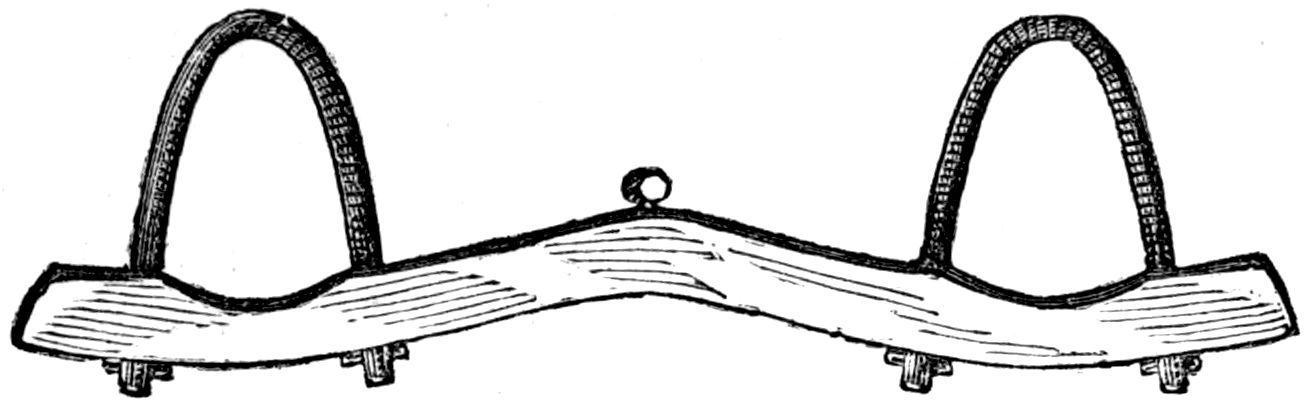
THE WESTERN YOKE.
THE “RIPPER.”The “ripper,” or driver, who is bound to the gold regions of Pike’s Peak, is a queer specimen of humanity. He usually hails from one of the old Atlantic cities—in fact, from settled America—and, like the civilized man generally, he betrays a remarkable aptitude for facile descent into savagery. His dress is a harlequinade, typical of his disposition. Eschewing the chimney-pot or stove-pipe tile of the bourgeois, he affects the “Kossuth,” an Anglo-American version of the sombrero, which converts felt into every shape and form, from the jaunty little head-covering of the modern sailor to the tall steeple-crown of the old Puritan. He disregards the trichotomy of St. Paul, and emulates St. Anthony and the American aborigines in the length of his locks, whose ends are curled inward, with a fascinating sausage-like roll not unlike the Cockney “aggrawator.” If a young hand, he is probably in the buckskin mania, which may pass into the squaw mania, a disease which knows no cure: the symptoms are, a leather coat and overalls to match, embroidered if possible, and finished along the arms and legs with fringes cut as long as possible, while a pair of gaudy moccasins, resplendent with red and blue porcelain beads, fits his feet tightly as silken hose. I have heard of coats worth $250, vests $100, and pants $150: indeed, the poorest of buckskin suits will cost $75, and if hard-worked it must be renewed every six months. The successful miner or the gambler—in these lands the word is confined to the profession—will add $10 gold buttons to the attractions of his attire. The older hand prefers to buckskin a “wamba” or round-about, a red or rainbow-colored flannel over a check cotton shirt; his lower garments, garnished a tergo with leather, are turned into Hessians by being thrust inside his cow-hide Wellingtons; and, when in riding gear, he wraps below each knee a fold of deer, antelope, or cow skin, with edges scalloped where they fall over the feet, and gartered tightly against thorns and stirrup thongs, thus effecting that graceful elephantine bulge of the lower leg for which “Jack ashore” is justly celebrated. Those who suffer from sore eyes wear huge green goggles, which give a crab-like air to the physiognomy, and those who can not procure them line the circumorbital region with lampblack, which is supposed to act like the surma or kohl of the Orient. A broad leather belt supports on the right a revolver, generally Colt’s Navy or medium size (when Indian fighting is expected, the large dragoon pistol is universally preferred); and on the left, in a plain black sheath, or sometimes in the more ornamental Spanish scabbard, is a buck-horn or ivory-handled bowie-knife. In the East the driver partially conceals his tools; he has no such affectation in the Far West: moreover, a glance through the wagon-awning shows guns and rifles stowed along the side. When driving he is armed with a mammoth fustigator, a system of plaited cow-hides cased with smooth leather; it is a knout or an Australian stock-whip, which, managed with both hands, makes the sturdiest ox curve and curl its back. If he trudges along an ox-team, he is a grim and grimy man, who delights to startle your animals with a whip-crack, and disdains to return a salutation: if his charge be a muleteer’s, you may expect more urbanity; he is then in the “upper-crust” of teamsters; he knows it, and demeans himself accordingly. He can do nothing without whisky, which he loves to call tarantula juice, strychnine, red-eye, corn juice, Jersey lightning, leg-stretcher, “tangle-leg,”[23] and many other hard and grotesque names; he chews tobacco like a horse; he becomes heavier “on the shoulder” or “on the shyoot,” as, with the course of empire, he makes his way westward; and he frequently indulges in a “spree,” which in these lands means four acts of drinking-bout, with a fifth of rough-and-tumble. Briefly, he is a post-wagon driver exaggerated.
Each train is accompanied by men on horse or mule back—oxen are not ridden after Cape fashion in these lands.[24] The equipment of the cavalier excited my curiosity, especially the saddle,THE PRAIRIE SADDLE. which has been recommended by good authorities for military use. The coming days of fast warfare, when “heavies,” if not wholly banished to the limbo of things that were, will be used as mounted “beef-eaters,” only for show, demand a saddle with as little weight as is consistent with strength, and one equally easy to the horse and the rider. In no branch of improvement, except in hat-making for the army, has so little been done as in saddles. The English military or hunting implement still endures without other merit than facility to the beast, and, in the man’s case, faculty of falling uninjured with his horse. Unless the rider be copper-lined and iron-limbed, it is little better in long marches than a rail for riding. As far as convenience is concerned, an Arab pad is preferable to Peat’s best. But the Californian saddle can not supply the deficiency, as will, I think, appear in the course of description.
The native Indian saddle is probably the degenerate offspring of the European pack-saddle: two short forks, composing the pommel and cantle, are nailed or lashed to a pair of narrow sideboards, and the rude tree is kept in shape by a green skin or hide allowed to shrink on. It remarkably resembles the Abyssinian, the Somal, and the Circassian saddle, which, like the “dug-out” canoe, is probably the primitive form instinctively invented by mankind. It is the sire of the civilized saddle, which in these lands varies with every region. The Texan is known by its circular seat; a string passed round the tree forms a ring: provided with flaps after the European style, it is considered easy and comfortable. The Californian is rather oval than circular; borrowed and improved from the Mexican, it has spread from the Pacific to the Atlantic slope of the Rocky Mountains, and the hardy and experienced mountaineer prefers it to all others: it much resembles the Hungarian, and in some points recalls to mind the old French cavalry demipique. It is composed of a single tree of light strong wood, admitting a freer circulation of air to the horse’s spine—an immense advantage—and, being without iron, it can readily be taken to pieces, cleaned or mended, and refitted. The tree is strengthened by a covering of raw-hide carefully sewed on; it rests upon a “sweat-leather,” a padded sheet covering the back, and it is finished off behind with an “anchero” of the same material protecting the loins. The pommel is high, like the crutch of a woman’s saddle, rendering impossible, under pain of barking the knuckles, that rule of good riding which directs the cavalier to keep his hands low. It prevents the inexperienced horseman being thrown forward, and enables him to “hold on” when likely to be dismounted; in the case of a good rider, its only use is to attach the lariat, riata, or lasso. The great merit of this “unicorn” saddle is its girthing: with the English system, the strain of a wild bull or of a mustang “bucker” would soon dislodge the riding gear. The “sincho” is an elastic horsehair cingle, five to six inches wide, connected with “lariat straps,” strong thongs passing round the pommel and cantle; it is girthed well back from the horse’s shoulder, and can be drawn till the animal suffers pain: instead of buckle, the long terminating strap is hitched two or three times through an iron ring. The whole saddle is covered with a machila, here usually pronounced macheer, two pieces of thick leather handsomely and fancifully worked or stamped, joined by a running thong in the centre, and open to admit the pommel and cantle. If too long, it draws in the stirrup-leathers, and cramps the ankles of any but a bowlegged man. The machila is sometimes garnished with pockets, always with straps behind to secure a valise, and a cloak can be fastened over the pommel, giving purchase and protection to the knees. The rider sits erect, with the legs in a continuation of the body line, and the security of the balance-seat enables him to use his arms freely: the pose is that of the French schools in the last century, heels up and toes down. The advantages of this equipment are obvious; it is easier to horse and man probably than any yet invented. On the other hand, the quantity of leather renders it expensive: without silver or other ornaments, the price would vary from $25 at San Francisco to $50 at Great Salt Lake City, and the highly got-up rise to $250 = £50 for a saddle! If the saddle-cloth slips out, and this is an accident which frequently occurs, the animal’s back will be galled. The stirrup-leathers can not be shortened or lengthened without dismounting, and without leggins the board-like leather macheer soon makes the mollets innocent of skin. The pommel is absolutely dangerous: during my short stay in the country I heard of two accidents, one fatal, caused by the rider being thrown forward on his fork. Finally, the long seat, which is obligatory, answers admirably with the Californian pacer or canterer, but with the high-trotting military horse it would inevitably lead—as has been proved before the European stirrup-leather was shortened—to hernias and other accidents.
To the stirrups I have but one serious objection—they can not be made to open in case of the horse falling; when inside the stiff leather macheer, they cramp the legs by bowing them inward, but habit soon cures this. Instead of the light iron contrivances which before recovered play against the horse’s side, which freeze the feet in cold, and which toast them in hot weather, this stirrup is sensibly made of wood. In the Eastern States it is a lath bent somewhat in the shape of the dragoon form, and has too little weight; the Californian article is cut out of a solid block of wood, mountain mahogany being the best, then maple, and lastly the softer pine and cotton-wood. In some parts of the country it is made so narrow that only the toe fits in, and then the instep is liable to be bruised. For riding through bush and thorns, it is provided in front with zapateros or leathern curtains, secured to the straps above, and to the wood on both sides: they are curiously made, and the size, like that of the Turk’s lantern, denotes the owner’s fashionableness; dandies may be seen with the pointed angles of their stirrup-guards dangling almost to the ground. The article was borrowed from Mexico—the land of character dresses. When riding through prickly chapparal, the leathers begin higher up, and protect the leg from the knee downward. I would not recommend this stirrup for Hyde Park, or even Brighton; but in India and other barbarous parts of the British empire, where, on a cold morning’s march, men and officers may be seen with wisps of straw defending their feet from the iron, and on African journeys, where the bush is more than a match for any texture yet woven, it might, methinks, be advantageously used.
The same may be said of the THE PRAIRIE SPUR.spurs, which, though cruel in appearance, are really more merciful than ours. The rowels have spikes about two inches long; in fact, are the shape and size of a small starfish; but they are never sharpened, and the tinkle near the animal’s sides serves to urge it on without a real application. The two little bell-like pendants of metal on each side of the rowel-hinge serve to increase the rattling, and when a poor rider is mounted upon a tricksy horse, they lock the rowels, which are driven into the sincho, and thus afford another point d’appui. If the rider’s legs be long enough, the spurs can be clinched under the pony’s belly. Like the Mexican, they can be made expensive: $25 a pair would be a common price.
BRIDLE.The bridle is undoubtedly the worst part of the horse’s furniture. The bit is long, clumsy, and not less cruel than a Chifney. I have seen the Arab ring, which, with sufficient leverage, will break a horse’s jaw, and another, not unlike an East Indian invention, with a sharp triangle to press upon the animal’s palate, apparently for the purpose of causing it to rear and fall backward. It is the offspring of the Mexican manége, which was derived, through Spain, from the Moors.
Passing through Ash Point at 9 30 A.M., and halting for water at Uncle John’s Grocery, where hang-dog Indians, squatting, standing, and stalking about, showed that the forbidden luxury—essence of corn—was, despite regulations, not unprocurable there, we spanned the prairie to Guittard’s Station. This is a clump of board houses on the far side of a shady, well-wooded creek—the Vermilion, a tributary of the Big Blue River, so called from its red sandstone bottom, dotted with granitic and porphyritic boulders.
Our conductor had sprained his ankle, and the driver, being in plain English drunk, had dashed like a Phaeton over the “chuck-holes;” we willingly, therefore, halted at 11 30 A.M. for dinner. The host was a young Alsatian, who, with his mother and sister, had emigrated under the excitement of Californian fever, and had been stopped, by want of means, half way. The improvement upon the native was palpable: the house and kitchen were clean, the fences neat; the ham and eggs, the hot rolls and coffee, were fresh and good, and, although drought had killed the salad, we had abundance of peaches and cream, an offering of French to American taste which, in its simplicity, luxuriates in the curious mixture of lacteal with hydrocyanic acid.
At Guittard’s I saw, for the first time, the Pony Express rider arrive. In March, 1860, “the great dream of news transmitted from New York to San Francisco (more strictly speaking from St. Joseph to Placerville, California) in eight days was tested.” It appeared, in fact, under the form of an advertisement in the St. Louis “Republican,”[25] and threw at once into the shade the great Butterfield Mail, whose expedition had been the theme of universal praise. Very meritoriously has the contract been fulfilled. At the moment of writing (Nov., 1860), the distance between New York and San Francisco has been farther reduced by the advance of the electric telegraph—it proceeds at the rate of six miles a day—to Fort Kearney from the Mississippi and to Fort Churchill from the Pacific side. The merchant thus receives his advices in six days. The contract of the government with Messrs. Russell, Majors, and Co., to run the mail from St. Joseph to Great Salt Lake City, expired the 30th of November, and it was proposed to, continue it only from Julesburg on the crossing of the South Platte, 480 miles west of St. Joseph. Mr. Russell, however, objected, and so did the Western States generally, to abbreviating the mail-service as contemplated by the Post-office Department. His spirit and energy met with supporters whose interest it was not to fall back on the times when a communication between New York and California could not be secured short of twenty-five or thirty days; and, aided by the newspapers, he obtained a renewal of his contract. The riders are mostly youths, mounted upon active and lithe Indian nags. They ride 100 miles at a time—about eight per hour—with four changes of horses, and return to their stations the next day: of their hardships and perils we shall hear more anon. The letters are carried in leathern bags, which are thrown about carelessly enough when the saddle is changed, and the average postage is $5 = £1 per sheet.
Beyond Guittard’s the prairies bore a burnt-up aspect. Far as the eye could see the tintage was that of the Arabian Desert, sere and tawny as a jackal’s back. It was still, however, too early;THE PRAIRIE FIRES. October is the month for those prairie fires which have so frequently exercised the Western author’s pen. Here, however, the grass is too short for the full development of the phenomenon, and beyond the Little Blue River there is hardly any risk. The fire can easily be stopped, ab initio, by blankets, or by simply rolling a barrel; the African plan of beating down with boughs might also be used in certain places; and when the conflagration has extended, travelers can take refuge in a little Zoar by burning the vegetation to windward. In Texas and Illinois, however, where the grass is tall and rank, and the roaring flames leap before the wind with the stride of maddened horses, the danger is imminent, and the spectacle must be one of awful sublimity.
In places where the land seems broken with bluffs, like an iron-bound coast, the skeleton of the earth becomes visible; the formation is a friable sandstone, overlying fossiliferous lime, which is based upon beds of shale. These undergrowths show themselves at the edges of the ground-waves and in the dwarf precipices, where the soil has been degraded by the action of water. The yellow-brown humus varies from forty to sixty feet deep in the most favored places, and erratic blocks of porphyry and various granites encumber the dry water-courses and surface drains. In the rare spots where water then lay, the herbage was still green, forming oases in the withering waste, and showing that irrigation is its principal, if not its only want.
Passing by Marysville, in old maps Palmetto City, a county town which thrives by selling whisky to ruffians of all descriptions, we forded before sunset the “Big Blue,” a well-known tributary of the Kansas River. It is a pretty little stream, brisk and clear as crystal, about forty or fifty yards wide by 2·50 feet deep at the ford. The soil is sandy and solid, but the banks are too precipitous to be pleasant when a very drunken driver hangs on by the lines of four very weary mules. We then stretched once more over the “divide”—the ground, generally rough or rolling, between the fork or junction of two streams, in fact, the Indian Doab—separating the Big Blue from its tributary the Little Blue. At 6 P.M. we changed our fagged animals for fresh, and the land of Kansas for Nebraska, at Cotton-wood Creek, a bottom where trees flourished, where the ground had been cleared for corn, and where we detected the prairie wolf watching for the poultry. The fur of our first coyote was light yellow-brown, with a tinge of red, the snout long and sharp, the tail bushy and hanging, the gait like a dog’s, and the manner expressive of extreme timidity; it is a far more cowardly animal than the larger white buffalo-wolf and the black wolf of the woods, which are also far from fierce. At Cotton-wood Station we took “on board” two way-passengers, “lady” and “gentleman,” who were drafted into the wagon containing the Judiciary. A weary drive over a rough and dusty road, through chill night air and clouds of musquetoes, which we were warned would accompany us to the Pacific slope of the Rocky Mountains, placed us about 10 P.M. at Rock, also called Turkey Creek—surely a misnomer; no turkey ever haunted so villainous a spot! Several passengers began to suffer from fever and nausea; in such travel the second night is usually the crisis, after which a man can endure for an indefinite time. The “ranch” was a nice place for invalids, especially for those of the softer sex. Upon the bedded floor of the foul “doggery” lay, in a seemingly promiscuous heap, men, women, children, lambs, and puppies, all fast in the arms of Morpheus, and many under the influence of a much jollier god. The employés, when aroused pretty roughly, blinked their eyes in the atmosphere of smoke and musquetoes, and declared that it had been “merry in hall” that night—the effects of which merriment had not passed off. After half an hour’s dispute about who should do the work, they produced cold scraps of mutton and a kind of bread which deserves a totally distinct generic name. The strongest stomachs of the party made tea, and found some milk which was not more than one quarter flies. This succulent meal was followed by the usual douceur. On this road, however mean or wretched the fare, the station-keeper, who is established by the proprietor of the line, never derogates by lowering his price.
The Valley of the Little Blue, 9th August.
LITTLE BLUE RIVER VALLEY.A little after midnight we resumed our way, and in the state which Mohammed described when he made his famous night journey to heaven—bayni ’l naumi wa ’l yakzán—we crossed the deep shingles, the shallow streams, and the heavy vegetation of the Little Sandy, and five miles beyond it we forded the Big Sandy. About early dawn we found ourselves at another station, better than the last only as the hour was more propitious. The colony of Patlanders rose from their beds without a dream of ablution, and clearing the while their lungs of Cork brogue, prepared a neat déjeûner à la fourchette by hacking “fids” off half a sheep suspended from the ceiling, and frying them in melted tallow. Had the action occurred in Central Africa, among the Esquimaux, or the Araucanians, it would not have excited my attention: mere barbarism rarely disgusts; it is the unnatural cohabitation of civilization with savagery that makes the traveler’s gorge rise.
Issuing from Big Sandy Station at 6 30 A.M., and resuming our route over the divide that still separated the valleys of the Big Blue and the Little Blue, we presently fell into the line of the latter, and were called upon by the conductor to admire it. It is pretty, but its beauties require the cosmetic which is said to act unfailingly in the case of fairer things—the viewer should have lately spent three months at sea, out of sight of rivers and women. Averaging two miles in width, which shrinks to one quarter as you ascend, the valley is hedged on both sides by low rolling bluffs or terraces, the boundaries of its ancient bed and modern debordements. As the hills break off near the river, they show a diluvial formation; in places they are washed into a variety of forms, and being white, they stand out in bold relief. In other parts they are sand mixed with soil enough to support a last-year’s growth of wheat-like grass, weed-stubble, and dead trees, that look like old corn-fields in new clearings. One could not have recognized at this season Colonel Frémont’s description written in the month of June—the “hills with graceful slopes looking uncommonly green and beautiful.” Along the bluffs the road winds, crossing at times a rough projecting spur, or dipping into some gully washed out by the rains of ages. All is barren beyond the garden-reach which runs along the stream; there is not a tree to a square mile—in these regions the tree, like the bird in Arabia and the monkey in Africa, signifies water—and animal life seems well-nigh extinct. As the land sinks toward the river bottom, it becomes less barren. The wild sunflower (Helianthus)—it seldom, however, turns toward the sun—now becomes abundant; it was sparse near the Missouri; it will wax even more plentiful around Great Salt Lake City, till walking through the beds becomes difficult. In size it greatly varies according to the quality of the soil; six feet is perhaps the maximum. It is a growth of some value. The oleaginous seeds form the principal food of half-starved Indians, while the stalks supply them with a scanty fuel: being of rapid growth, it has been used in the States to arrest the flow of malaria, and it serves as house and home to the rattlesnake. Conspicuous by its side is the sumach, whose leaf, mixed with kinnikinik, the peel of the red willow, forms the immemorial smoking material of the Wild Man of the North. Equally remarkable for their strong odor are large beds of wild onions; they are superlatively wholesome, but they effect the eater like those of Tibet. The predominant colors are pink and yellow, the former a lupine, the latter a shrub, locally called the rabbit-bush. The blue lupine also appears with the white mallow, the eccentric putoria, and the taraxacum (dandelion), so much used as salad in France and in the Eastern States. This land appears excellently adapted for the growth of manioc or cassava. In the centre of the bottom flows the brownish stream, about twenty yards wide, between two dense lines of tall sweet cotton-wood. The tree which was fated to become familiar to us during our wanderings is a species of poplar (P. monilifera), called by the Americo-Spaniards, and by the people of Texas and New Mexico, “Alamo:” resembling the European aspen, without its silver lining, the color of the leaf, in places, appears of a dull burnished hue, in others bright and refreshingly green. Its trivial name is derived, according to some, from the fibrous quality of the bark, which, as in Norway, is converted into food for cattle and even man; according to others, from the cotton-like substance surrounding the seeds. It is termed “sweet” to distinguish it from a different tree with a bitter bark, also called a cotton-wood or narrow-leaved cotton-wood (Populus angustifolia), and by the Canadians liard amère. The timber is soft and easily cut; it is in many places the only material for building and burning, and the recklessness of the squatters has already shortened the supply.
This valley is the Belgium of the adjoining tribes, the once terrible Pawnees, who here met their enemies, the Dakotahs and the Delawares: it was then a great buffalo ground; and even twenty years ago it was well stocked with droves of wild horses, turkeys, and herds of antelope, deer, and elk. The animals have of late migrated westward, carrying off with them the “bones of contention.” Some details concerning the present condition of these bands and their neighbors may not be uninteresting—these poor remnants of nations which once kept the power of North America at bay, and are now barely able to struggle for existence.
In 1853, the government of the United States, which has ever acted paternally toward the Indians, treating with them—Great Britain did the same with the East Indians—as though they were a civilized people, availed itself of the savages’ desire to sell lands encroached upon by the whites, and set apart for a general reservation 181,171 square miles. Here, in the Far West, were collected into what was then believed to be a permanent habitation, the indigenes of the land, and the various bands once lying east of the Mississippi. This “Indian’s home” was bounded, in 1853, on the north by the Northwestern Territory and Minnesota; on the south by Texas and New Mexico; to the east lay Iowa, Missouri, and Arkansas; and to the west, Oregon, Utah, and New Mexico.
The savages’ reservation was then thus distributed. The eastern portion nearest the river was stocked with tribes removed to it from the Eastern States, namely, the Iowas, Sacs and Foxes, Kickapoos, Delawares, Potawotomies, Wyandottes, Quapaws, Senecas, Cherokees, Seminoles, Creeks, Choctaws, Chickasaws, Miamis, and Ottawas. The west and part of the northeast—poor and barren lands—were retained by the aboriginal tribes, Ponkahs, Omahas or Mahas, Pawnees, Ottoes, Kansas or Konzas, and Osages. The central and the remainder of the western portion—wild countries abounding in buffalo—were granted to the Western Pawnees, the Arickarees, Arapahoes, Cheyennes, Kiowas, Comanches, Utahs, Grosventres, and other nomads.
It was somewhat a confusion of races. For instance, the Pawnees form an independent family, to which some authors join the Arickaree; the Sacs (Sauk) and Foxes, Winnebagoes, Ottoes, Kaws, Omahas, Cheyennes, Mississippi Dakotahs, and Missouri Dakotahs, belong to the Dakotan family; the Choctaws, Creeks, and Seminoles are Appalachians; the Wyandottes, like the Iroquois, are Hodesaunians; and the Ottawas, Delawares, Shawnees, Potawotomies, Peorians, Mohekuneuks, Kaskaskias, Piankeshaws, Weaws, Miamis, Kickapoos, and the Menomenes, are, like the Ojibwas, Algonquins.
The total number of Indians on the prairies and the Rocky Mountains was estimated roughly at 63,000.
Still the resistless tide of emigration swept westward: the federal government was as powerless to stem it as was General Fitzroy of New South Wales to prevent, in 1852, his subjects flocking to the “gold diggings.” Despite all orders, reckless whites would squat upon, and thoughtless reds, bribed by whisky, tobacco, and gunpowder, would sell off the lands. On the 20th of May, 1854, was passed the celebrated “Kansas-Nebraska Bill,” an act converting the greater portion of the “Indian Territory,”THE INDIAN TERRITORY. and all the “Northwestern Territory,” into two new territories—Kansas, north of the 37th parallel, and Nebraska, north of the 40th. In the passage of this bill, the celebrated “Missouri Compromise” of 1828, prohibiting negro slavery north of 36° 30′, was repealed, under the presidency of General Pierce.[26] It provided that the rights and properties of the Indians, within their shrunken possessions, should be respected. By degrees the Indians sold their lands for whisky, as of old, and retired to smaller reservations. Of course, they suffered in the bargain; the savage ever parts with his birthright for the well-known mess of pottage. The Osages, for instance, canceled $4000, claimed by unscrupulous traders, by a cession of two million acres of arable land. The Potawotomies fared even worse; under the influence of liquor, ὡς λεγουσι, their chiefs sold 100,000 acres of the best soil on the banks of the Missouri for a mere song. The tribe was removed to a bald smooth prairie, sans timber and consequently sans game; many fled to the extreme wilds, and the others, like the Acadians of yore, were marched about till they found homes—many of them six feet by two—in Fever Patch, on the Kaw or Kansas River. Others were more fortunate. The Ottoes, Omahas, and Kansas had permanent villages near the Missouri and its two tributaries, the Platte and the Kansas. The Osages, formerly a large nation in Arkansas, after ceding 10,000,000 of acres for a stipend of $52,000 for thirty years, were settled in a district on the west bank of the Neosho or Whitewater—the Grand River. They are described as the finest and largest men of the semi-nomad races, with well-formed heads and symmetrical figures, brave, warlike, and well disposed to the whites. Early in June, after planting their maize, they move in mounted bands to the prairies, feast upon the buffalo for months, and bring home stores of smoked and jerked meat. When the corn is in milk they husk and sundry it; it is then boiled, and is said to be better flavored and more nutritious than the East Indian “butah” or the American hominy. After the harvest in October they return to the game country, and then pass the winter under huts or skin lodges. Their chief scourge is small-pox: apparently, all the tribes carry some cross. Of the settled races the best types are the Choctaws and the Cherokees; the latter have shown a degree of improvability, which may still preserve them from destruction; they have a form of government, churches, theatres, and schools; they read and write English; and George Guess, a well-known chief, like the negro inventor of the Vai syllabarium in West Africa, produced an alphabet of sixty-eight characters, which, improved and simplified by the missionaries, is found useful in teaching the vernacular.
Upon the whole, however, the philanthropic schemes of the government have not met with brilliant success. The chiefs are still bribed, and the people cheated by white traders, and poverty, disease, and debauchery rapidly thin the tribesmen. Sensible heads have proposed many schemes for preserving the race. Apparently the best of these projects is to introduce the Moravian discipline. MISSIONARIES. Of all missionary systems, I may observe, none have hitherto been crowned with important results, despite the blood and gold so profusely expended upon them, except two—those of the Jesuits and the United Brethren. The fraternity of Jesus spread the Gospel by assimilating themselves to the heathen; the Unitas Fratrum by assimilating the heathen to themselves. The day of Jesuitism, like that of protection, is going by. The advance of Moravianism, it may safely be prophesied, is to come. These civilization societies have as yet been little appreciated, because they will not minister to that ignorant enthusiasm which extracts money from the pockets of the many. Their necessarily slow progress is irksome to ardent propagandists. We naturally wish to reap as well as to sow; and man rarely invests capital in schemes of which only his grandson will see the results.
The American philanthropist proposes to wean the Indian savage from his nomad life by turning his lodge into a log tent, and by providing him with cattle instead of buffalo, and the domestic fowl instead of grasshoppers. The hunter become a herdsman would thus be strengthened for another step—the agricultural life, which necessarily follows the pastoral. Factors would be appointed instead of vicious traders—coureurs des bois, as the Canadians call them; titles to land would be granted in fee-simple, practically teaching the value of property in severalty, alienation into white hands would be forbidden, and, if possible, a cordon militaire would be stretched between the races. The agricultural would lead to the mechanical stage of society. Agents and assistant craftsmen would teach the tribes to raise mills and smithies (at present there are mills without millers, stock without breeders, and similar attempts to make civilization run before she can walk), and a growing appreciation for the peace, the comfort, and the luxuries of settled life would lay the nomad instinct forever.
The project labors only under one difficulty—the one common to philanthropic schemes. In many details it is somewhat visionary—utopian. It is, like peace on earth, a “dream of the wise.” Under the present system of Indian agencies, as will in a future page appear, it is simply impossible. It has terrible obstacles in the westward gravitation of the white race, which, after sweeping away the aborigines—as the gray rat in Europe expelled the black rat—from the east of the Mississippi in two centuries and a half, threatens, before a quarter of that time shall have elapsed, to drive in its advance toward the Pacific the few survivors of now populous tribes, either into the inhospitable regions north of the 49th parallel, or into the anarchical countries south of the 32d. And where, I may ask, in the history of the world do we read of a people learning civilization from strangers instead of working it out for themselves, through its several degrees of barbarism, feudalism, monarchy, republicanism, despotism? Still it is a noble project; mankind would not willingly see it die.
THE PAWNEES.The Pawnees were called by the French and Canadian traders Les Loups, that animal being their totem, and the sign of the tribe being an imitation of the wolf’s ears, the two fore fingers of the right hand being stuck up on the side of the head. They were in the last generation a large nation, containing many clans—Minnikajus, the Sans Arc, the Loup Fork, and others. Their territory embraced both sides of the Platte River, especially the northern lands; and they rendered these grounds terrible to the trapper, trader, and traveler. They were always well mounted. Old Mexico was then, and partially is still, their stable, and a small band has driven off horses by hundreds. Of late years they have become powerless. The influenza acts as a plague among them, killing off 400 or 500 in a single season, and the nation now numbers little more than 300 braves, or rather warriors, the latter, in correct parlance, being inferior to the former, as the former are subservient to the chief. A treaty concluded between them and the United States in the winter of 1857 sent them to a reserve on the Loup Fork, where their villages were destroyed by the Sioux. They are Ishmaelites, whose hand is against every man. They have attempted, after the fashion of declining tribes, to strengthen themselves by alliances with their neighbors, but have always failed in consequence of their propensity to plunder developing itself even before the powwow was concluded. They and the northern Dakotahs can never be trusted. Most Indian races, like the Bedouin Arabs, will show hospitality to the stranger who rides into their villages, though no point of honor deters them from robbing him after he has left the lodge-shade. The Pawnees, African-like, will cut the throat of a sleeping guest. They are easily distinguished from their neighbors by the scalp-lock protruding from a shaven head. After killing white men, they have insulted the corpse in a manner familiar to those who served in the Affghan war. They have given up the practice of torturing prisoners, saying that the “Great Spirit,” or rather, as the expression should be translated, the “Great Father” no longer wills it. The tradition is, that a few years ago a squaw of a hostile tribe was snatched from the stake by a white trader, and the action was interpreted as a decree of heaven. It is probably a corruption of the well-known story of the rescue of the Itean woman by Petalesharoo, the son of the “Knife Chief.” Like the Southern and Western Indians generally, as is truly remarked by Captain Mayne Reid,[27] “They possess more of that cold continence and chivalrous delicacy than characterize the Red Men of the forest.” They are too treacherous to be used as soldiers. Like most pedestrian Indians, their arms and bodies are light and thin, and their legs are muscular and well developed. They are great in endurance. I have heard of a Pawnee, who, when thoroughly “stampeded” by his enemies, “loped” from Fort Laramie to Kearney—300 miles—making the distance as fast as the mail. This bad tribe is ever at war with their hereditary enemies the Sioux. They do not extend westward of Fort Kearney. The principal sub-tribe is the Arickaree, or Ree, called Pedani by the Dakotah, who attacked and conquered them. Their large villages, near the mouth of the Grand River, were destroyed by the expedition sent in 1825-26, under Colonel Leavenworth, to chastise the attack upon the trading party of General Ashley.